

Mathematical and Neuro-Fuzzy Modeling of a Hollow Fiber Membrane System for a Petrochemical Process

 ,
,  ,
,  ,
,  ,
,  , and
, and
Abstract
1. Introduction
2. Materials and Methods
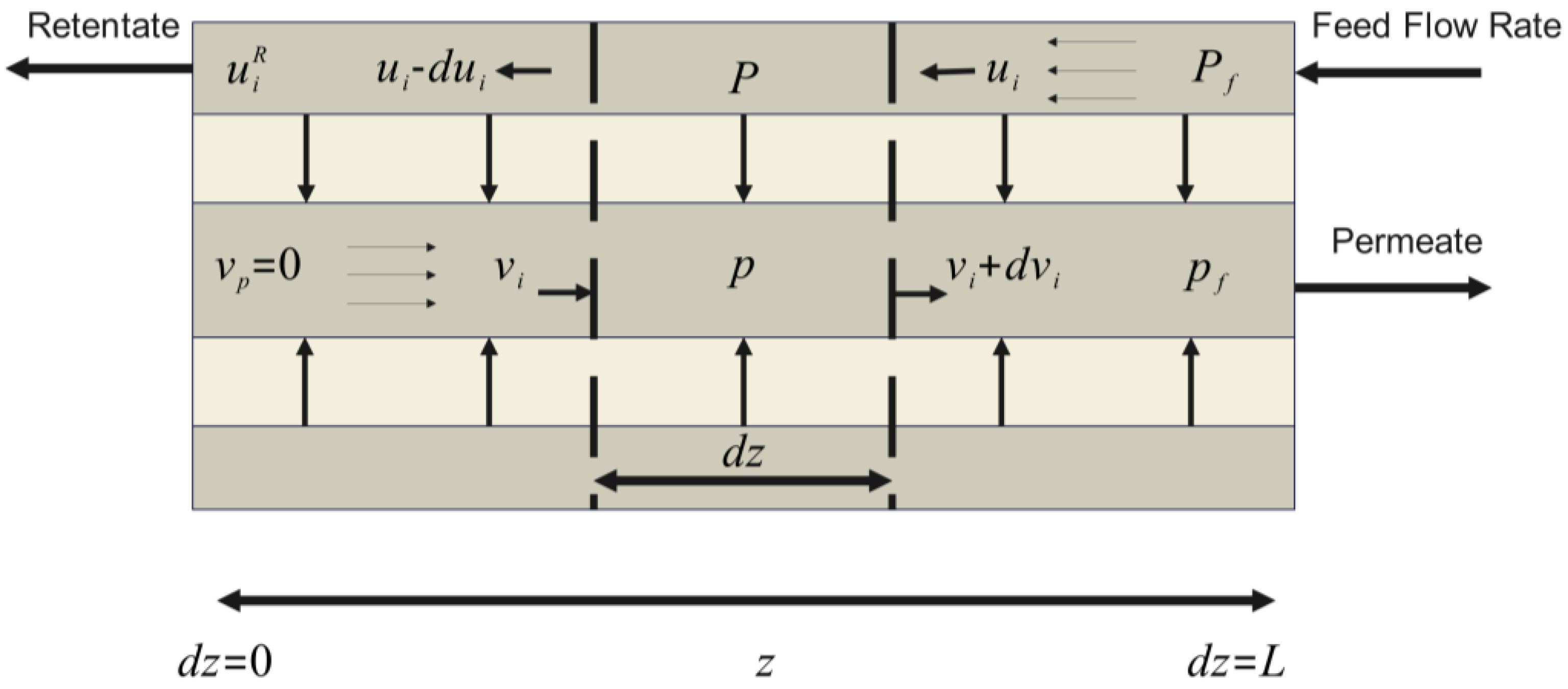
2.1. Mathematical Modeling of HFMM
- The membrane does not deform under the applied pressure. This is a simplifying assumption [3].
- Pressure drop on the permeate and retentate sides can be calculated using the Hagen-Poiseuille equation.
- Permeance of chemical species is considered constant in model validation (see Section 2.1.3).
2.1.1. Dynamic Determination of Viscosity
2.1.2. Peng–Robinson Equation of State for Non-Ideal Gas Behavior
2.1.3. Permeance: Baseline Assumption and Post-Validation Exploration
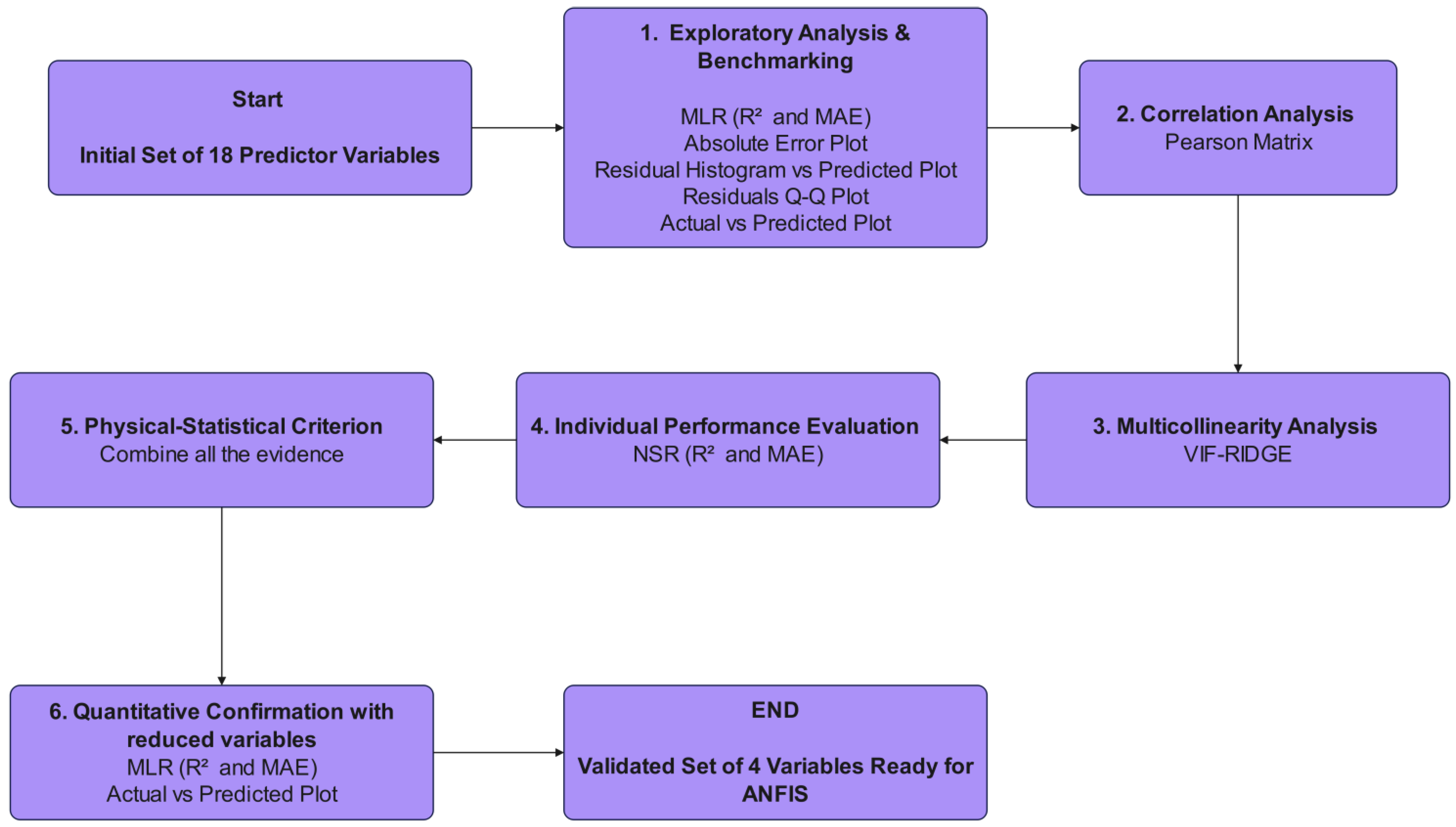
2.2. Statistical Method
2.2.1. Data Normalization
2.2.2. Normalized Multiple Linear Regression
2.2.3. Parameter Estimation via Gradient Descent
2.2.4. Multicollinearity Analysis
2.2.5. Validation of Model Assumptions via Diagnostic Plots
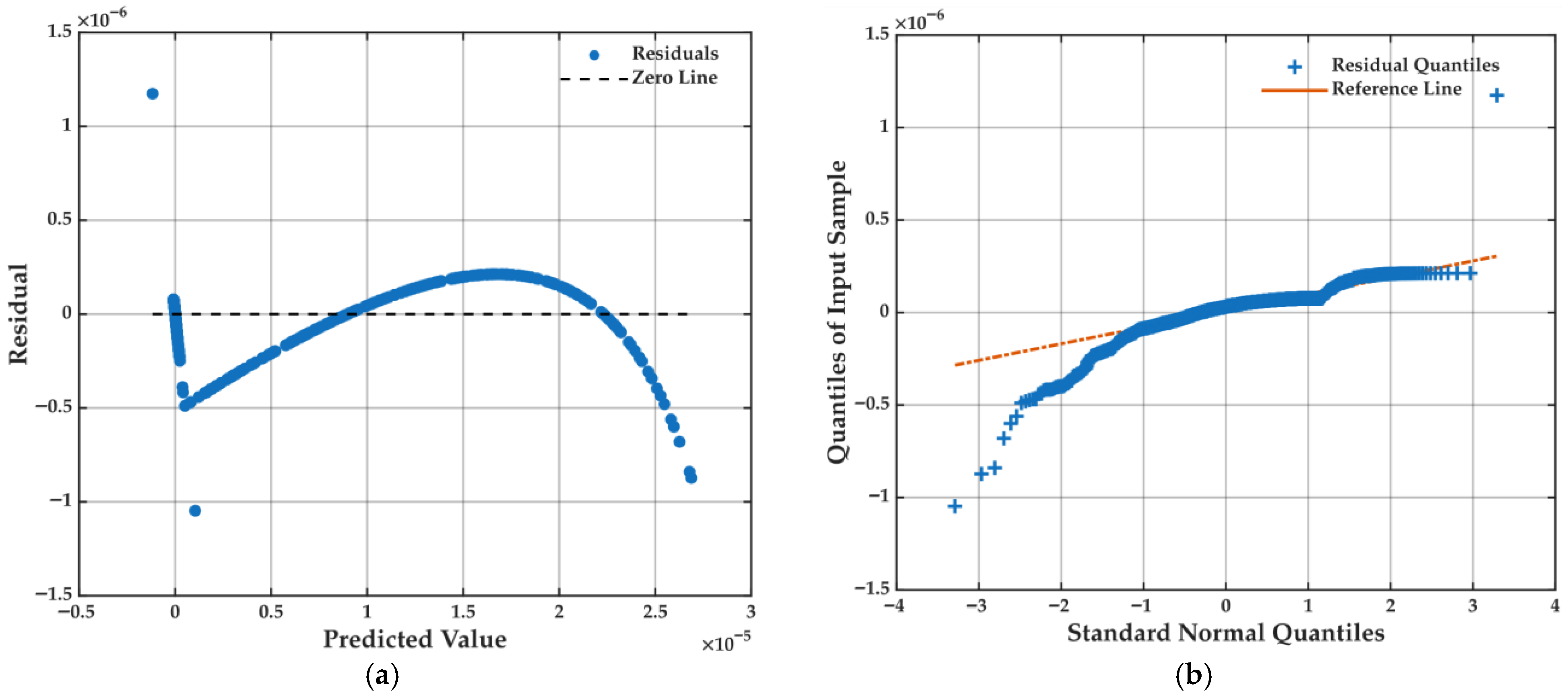
- Residuals vs. Predicted Values: Plot the residual against the fitted value yk. This visualization is used to assess homoscedasticity—constancy of error variance across the prediction range—and to detect any funnel-shaped or nonlinear patterns that would indicate model misspecification.
- Q-Q-Plot of Residuals: Construct a quantile-quantile plot comparing the empirical quantiles of the residuals to theoretical quantiles of a standard normal distribution. Close adherence of points to the 45° reference line will validate the assumption of approximate Gaussianity of the errors, which is important for subsequent inferential procedures.
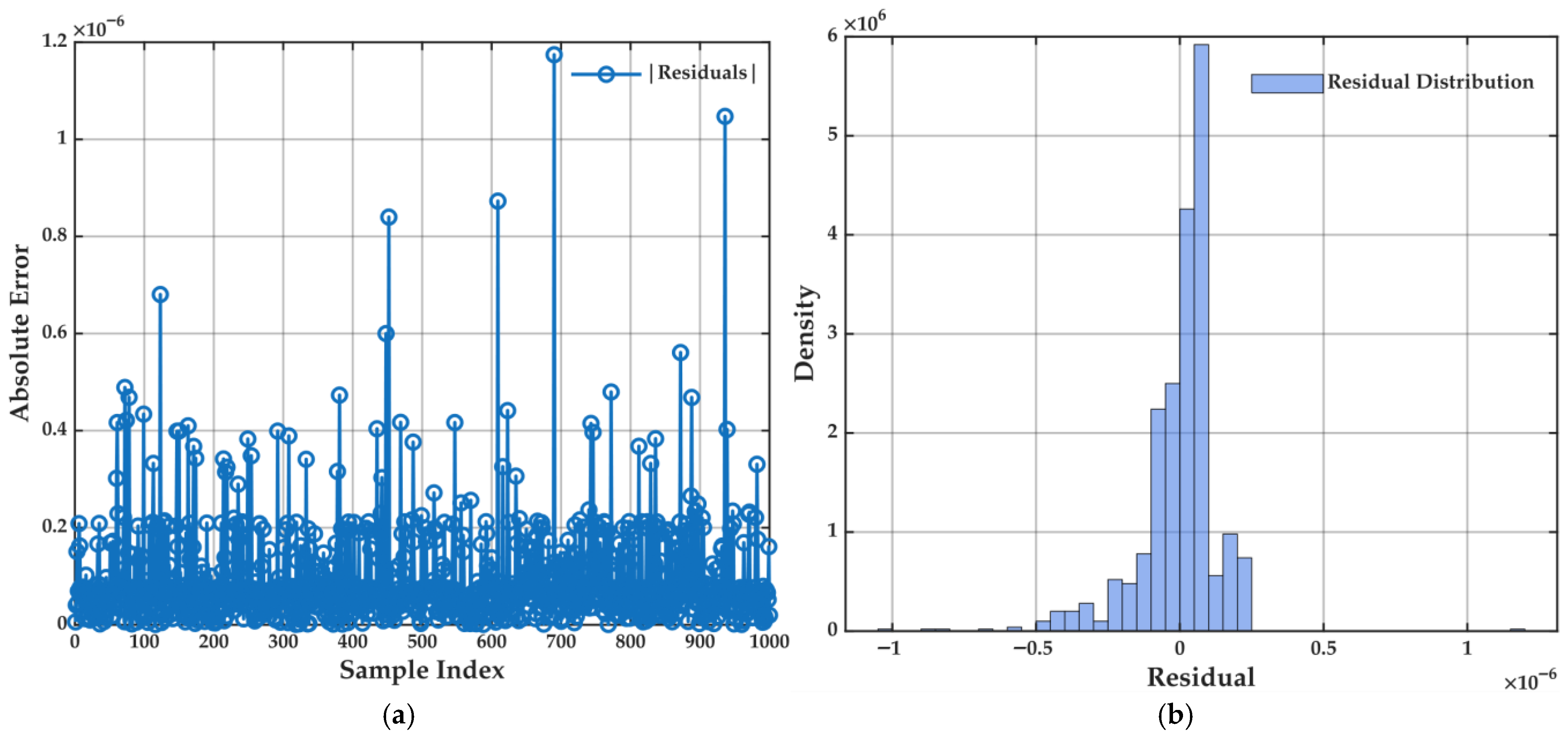
- Histogram of Residuals: Generate a normalized histogram of residuals to examine the shape of their distribution—specifically symmetry, peakedness, and tail behavior. This complements the Q-Q-plot by visually confirming the presence (or absence) of skewness or heavy tails.
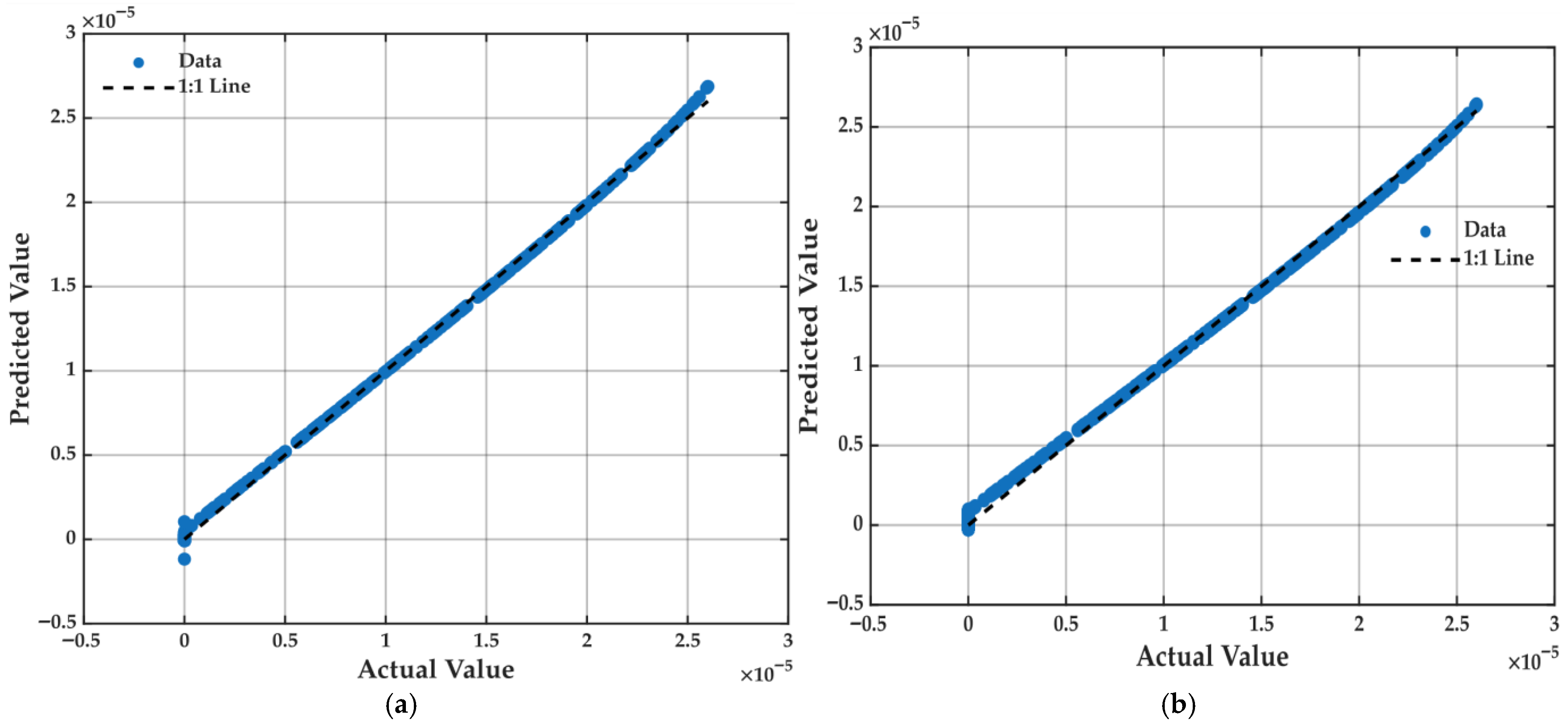
- Actual vs. Predicted Values: Plot observed responses versus predicted values alongside the identity line . A tight cluster of points around this line will demonstrate high overall predictive accuracy and minimal systematic bias.
- Absolute Error per Sample: Compute and plot the absolute error for each sample index. This plot helps to identify isolated outliers or regions where the model’s performance deteriorates, thereby guiding further data investigation or model refinement.
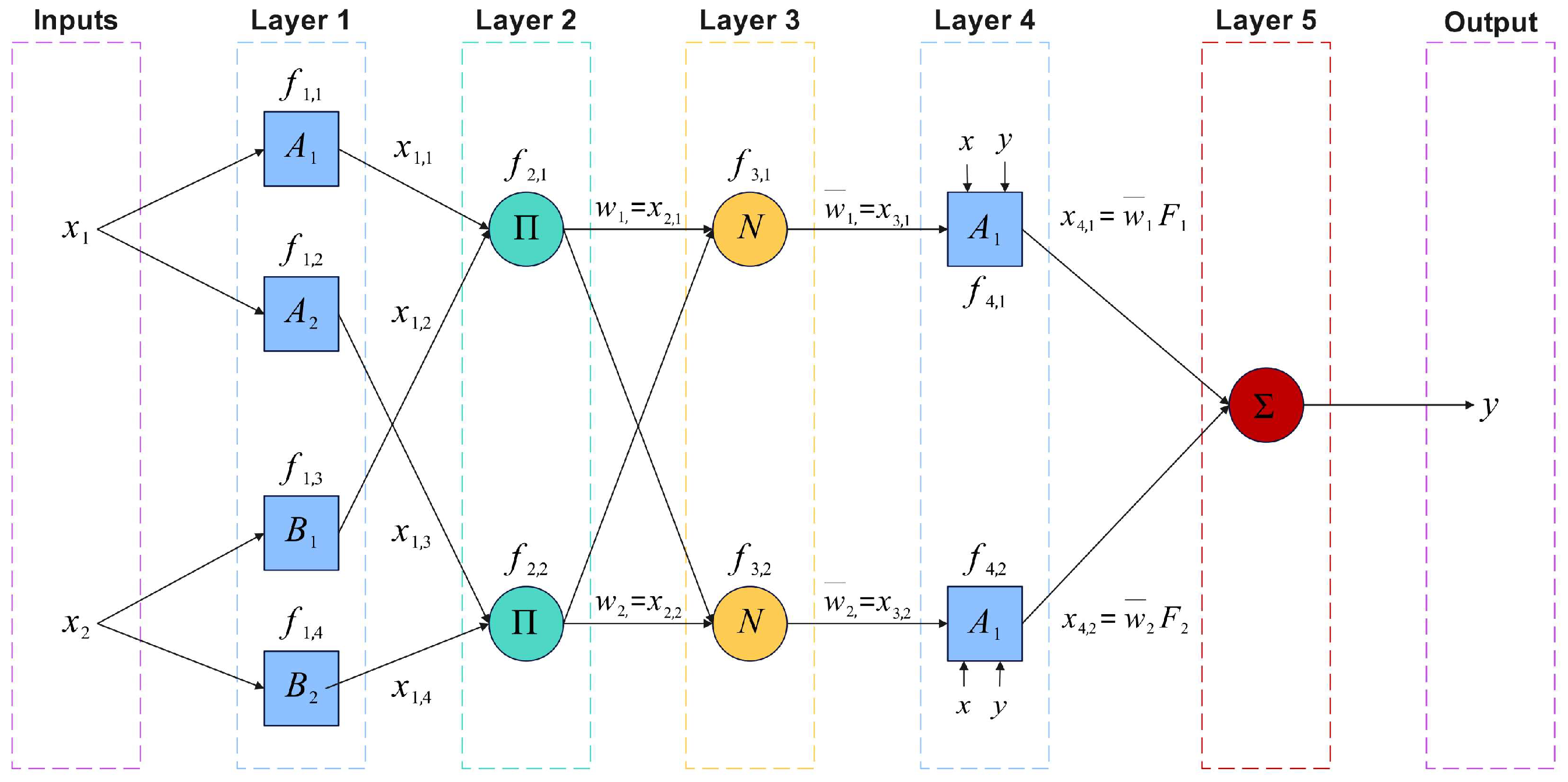
2.3. Intelligent Modeling with ANFIS
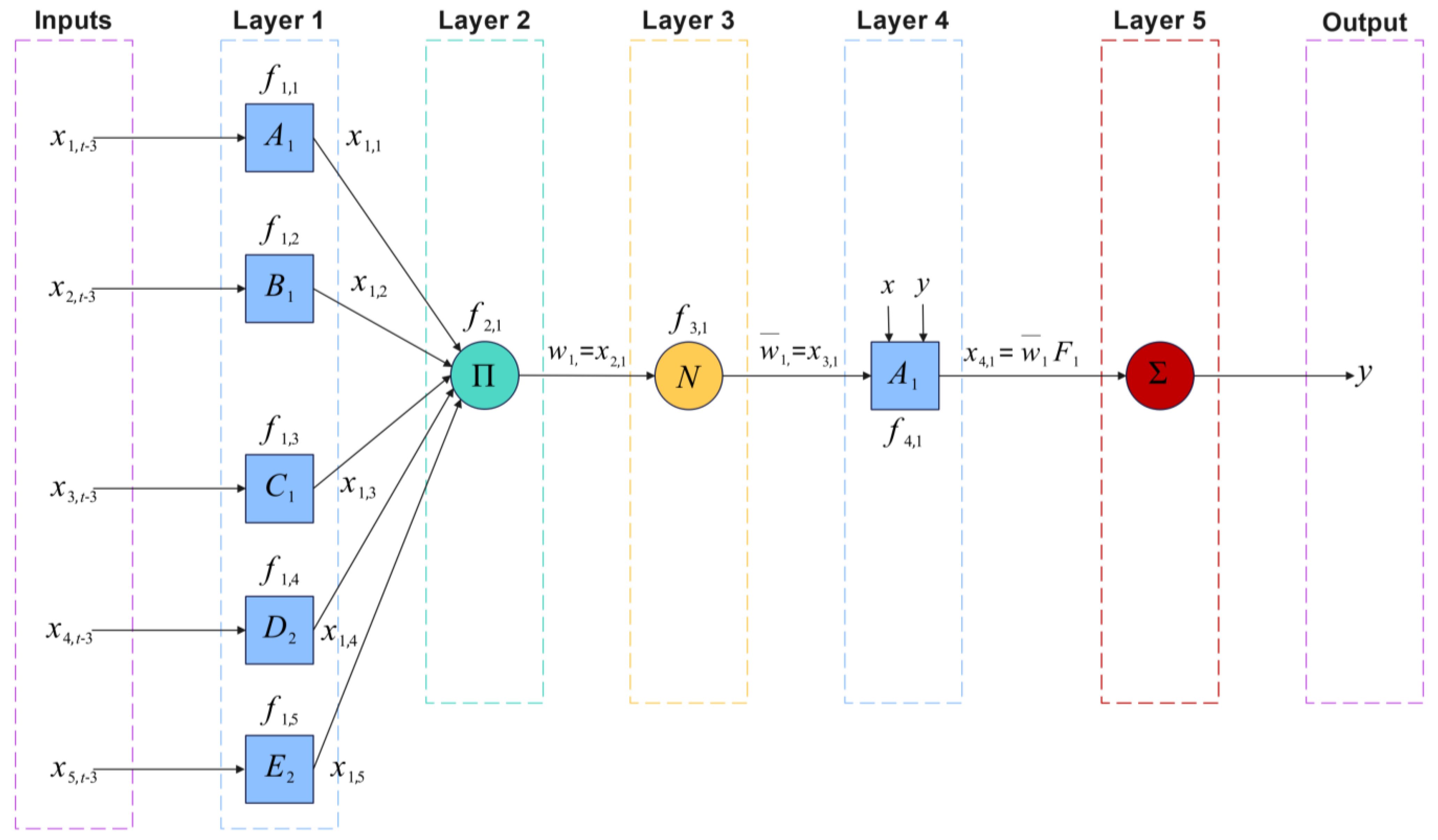
- Layer 1 (Membership Functions): Each input is fuzzified using membership functions (MFs) that transform crisp inputs into membership degrees ranging from 0 to 1. In this work, different membership functions were tested, such as Gaussian, triangular, sigmoidal, and bell functions. After a comparative analysis, the membership function with the best performance was the sigmoidal one, as presented and discussed later in Table 10. The sigmoidal membership function is defined as follows:
- Layer 2 (Rule Firing Strength): Computes the firing strength of each fuzzy rule by aggregating membership degrees of all inputs via product:
- Layer 3 (Normalization): Normalizes firing strengths:
- Layer 4 (Consequents): Each rule computes an output as a linear function of inputs weighted by :
- Layer 5 (Output Aggregation): Aggregates all outputs to produce final prediction:
3. Results
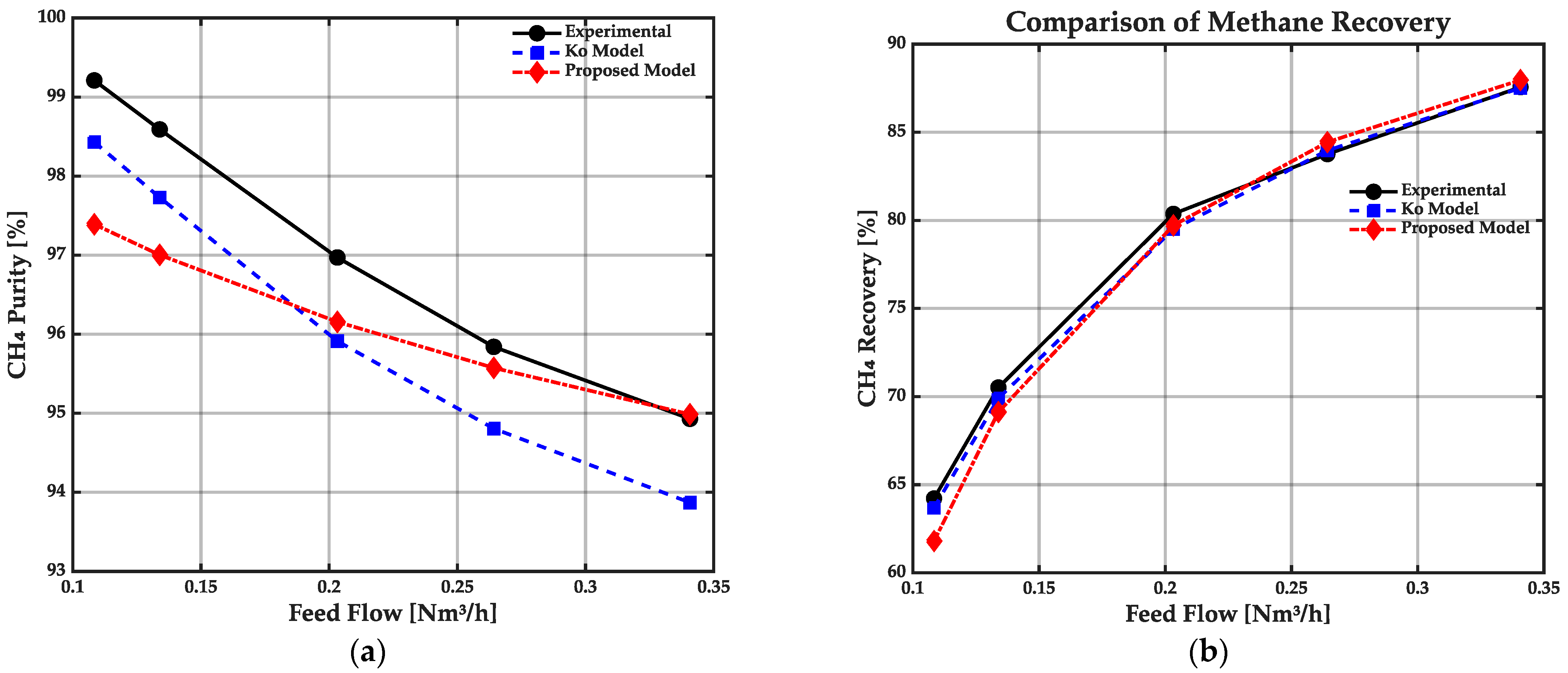
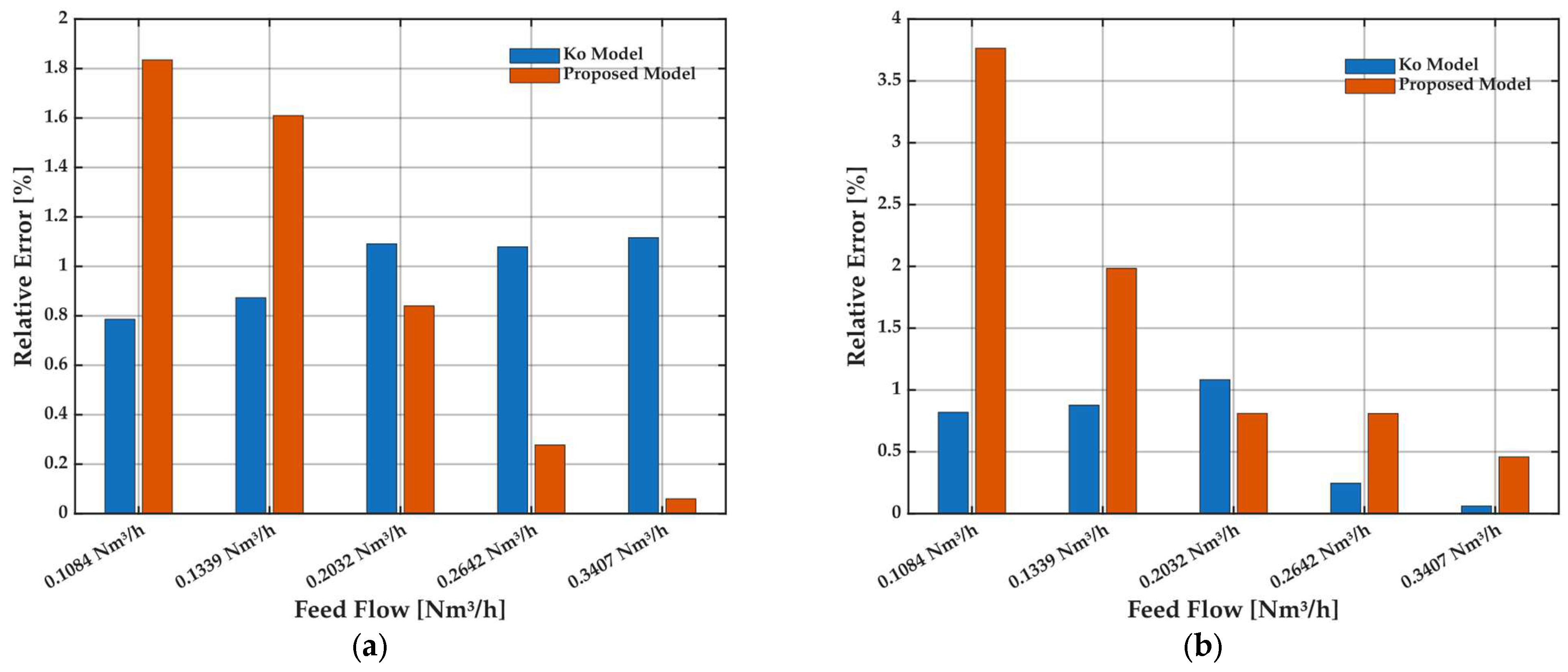
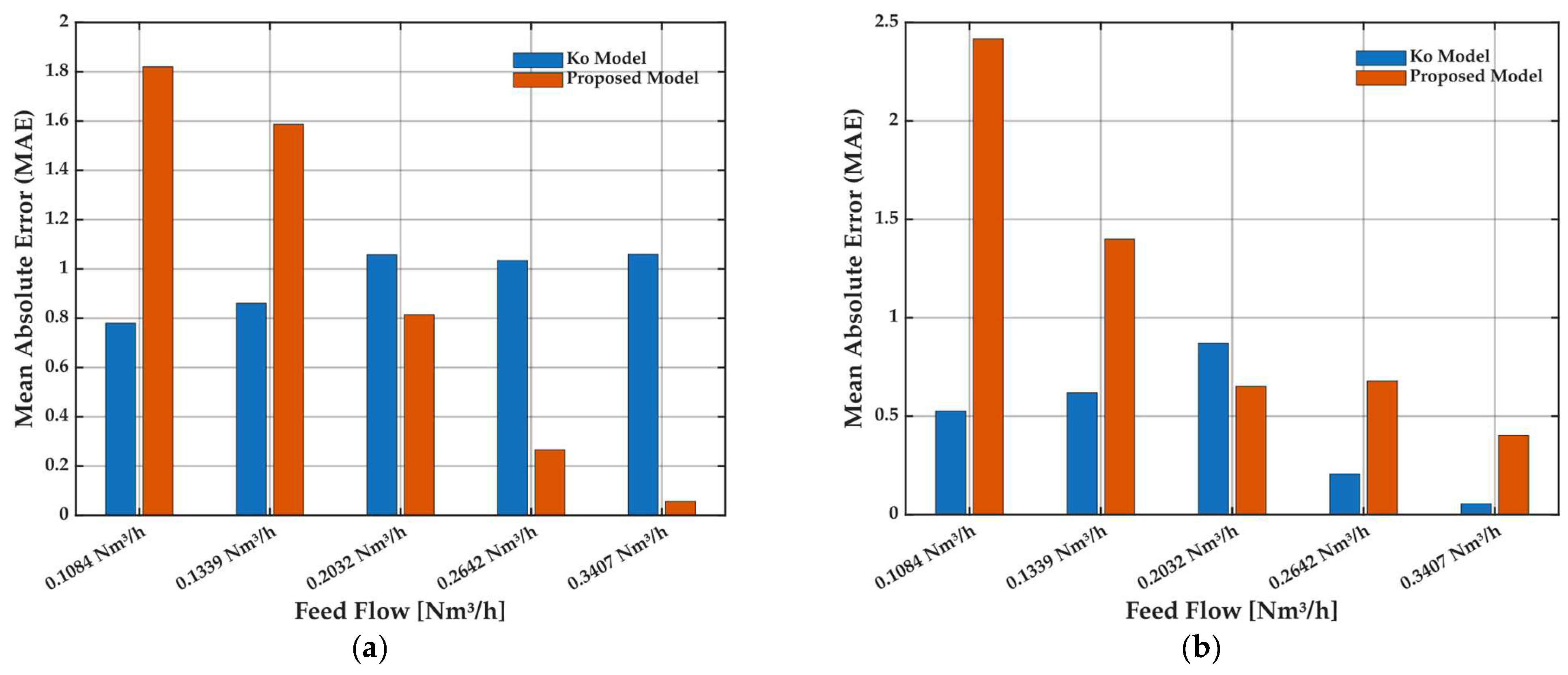
3.1. Mathematical Modeling of HFMM Results and Validation
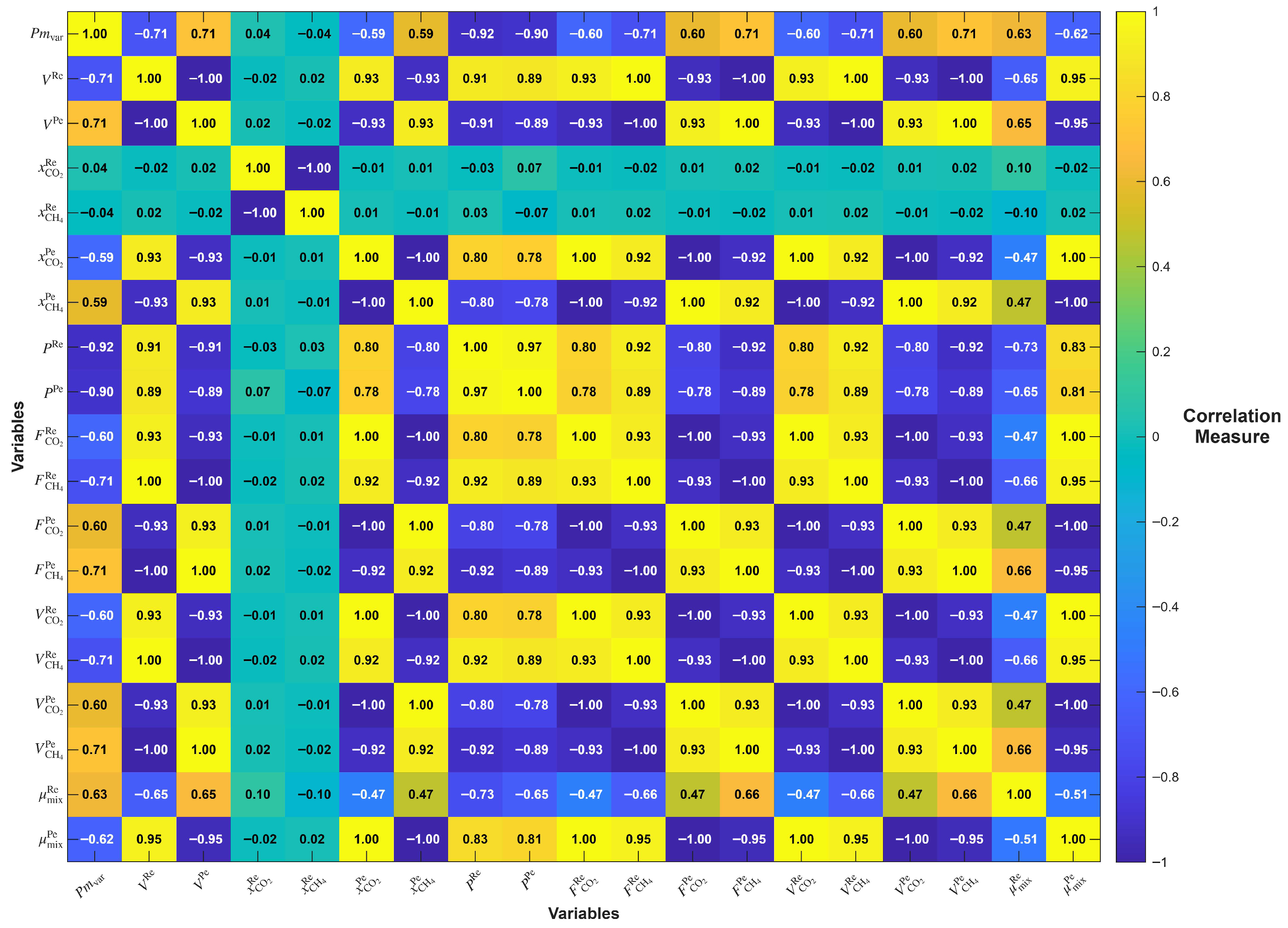
3.2. Statistical Method Results
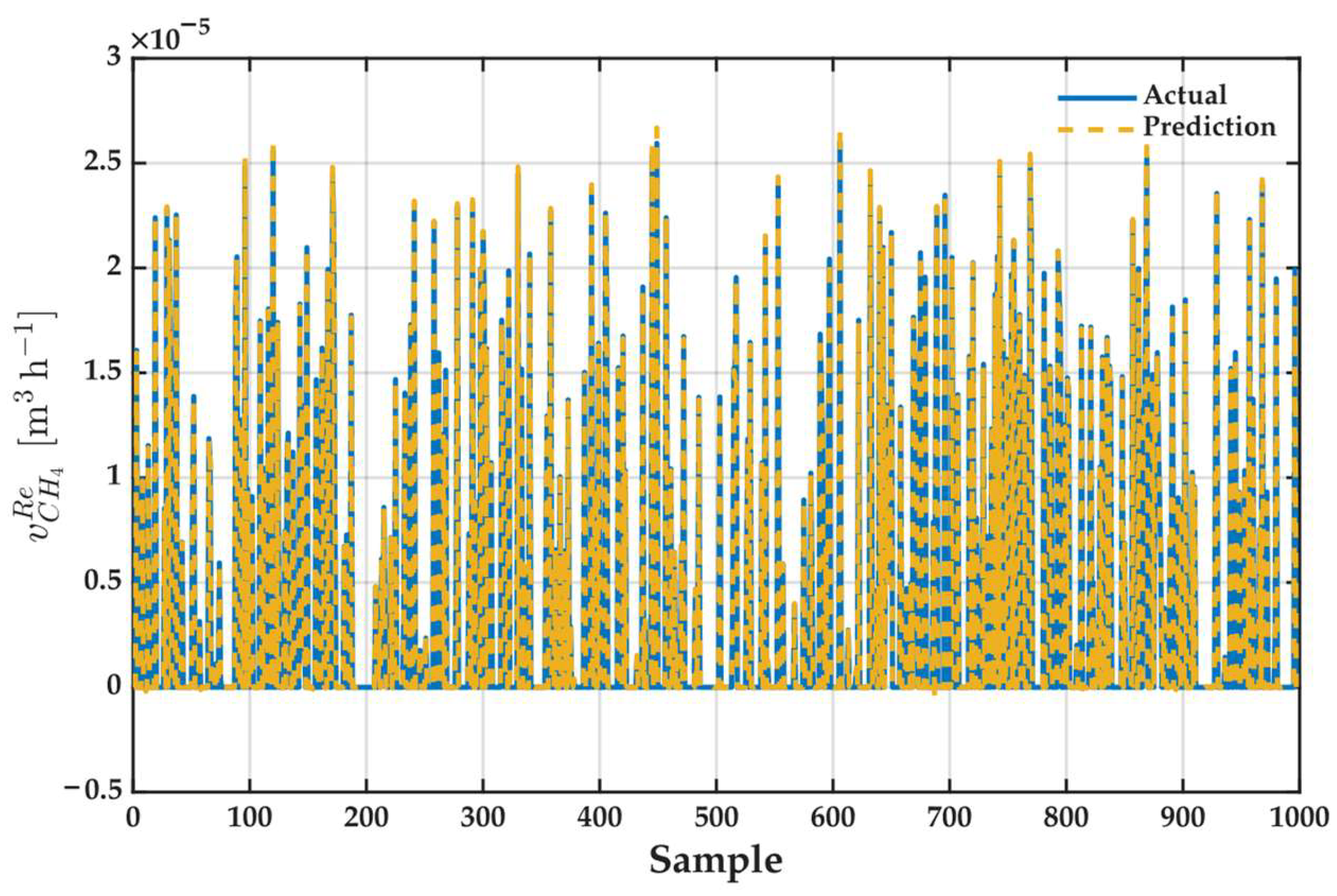
3.3. ANFIS Simulation Results

| Delay | Eval Time (s) | MSETrain | RMSETrain | MAETrain | R2Train | MSETest | RMSETest | MAETest | R2Test | |
|---|---|---|---|---|---|---|---|---|---|---|
| Gaussian | 5 | 3.1722 | 7.4569 × 10⁻¹⁵ | 8.6354 × 10⁻⁸ | 4.3155 × 10⁻⁸ | 0.9998 | 3.4332 × 10⁻¹⁵ | 5.8594 × 10⁻⁸ | 3.6890 × 10⁻⁸ | 0.9999 |
| Sigmoidal | 4 | 0.0111 | 6.50 × 10⁻¹⁵ | 8.06 × 10⁻⁸ | 4.07 × 10⁻⁸ | 0.9998 | 5.83 × 10⁻¹⁵ | 7.64 × 10⁻⁸ | 4.39 × 10⁻⁸ | 0.9999 |
| Bell | 6 | 4.2737 | 7.2937 × 10⁻¹⁵ | 8.5403 × 10⁻⁸ | 4.4189 × 10⁻⁸ | 0.9998 | 3.8136 × 10⁻¹⁵ | 6.1755 × 10⁻⁸ | 3.9547 × 10⁻⁸ | 0.9999 |
| Triangular | 3 | 4.2068 | 5.4029 × 10⁻¹¹ | 7.3505 × 10⁻⁶ | 3.328 × 10⁻⁶ | −0.258 | 5.9828 × 10⁻¹¹ | 7.7348 × 10⁻⁶ | 3.5508 × 10⁻⁶ | −0.267 |
4. Conclusions
Author Contributions
Funding
Data Availability Statement
Acknowledgments
Conflicts of Interest
Abbreviations
| AARD | Average Absolute Relative Deviation |
| ACO | Ant Colony Optimization |
| AI | Artificial Intelligence |
| ANFIS | Adaptive Neuro-Fuzzy Inference System |
| ANN/ANNs | Artificial Neural Network(s) |
| ARD | Average Relative Deviation |
| BDF | Backward Differentiation Formula(s) |
| BR | Bayesian Regularization |
| CFD | Computational Fluid Dynamics |
| CSA-LSSVM | Crow Search Algorithm–Least-Squares Support Vector Machine |
| Cu-BTC | Copper(II) benzene-1,3,5-tricarboxylate (HKUST-1) |
| DE | Differential Evolution |
| dsigmf | Difference-of-Sigmoids Membership Function |
| EUF | Electro-Ultrafiltration (Electro-assisted Ultrafiltration) |
| FCM | Fuzzy C-Means |
| FFBP-LM | Feed-Forward Backpropagation with Levenberg–Marquardt |
| FO | Forward Osmosis |
| FS | Fumed Silica |
| GA | Genetic Algorithm |
| gaussmf | Gaussian membership function |
| GMDH | Group Method of Data Handling |
| GP | Genetic Programming |
| GPU | Gas Permeation Unit |
| GWO | Gray Wolf Optimizer |
| HF | Hollow Fiber |
| HFMM | Hollow Fiber Membrane Module(s) |
| Jw | Water flux |
| Js | Reverse salt flux |
| LM | Levenberg–Marquardt (algorithm) |
| MAE | Mean Absolute Error |
| MAD | Mean Absolute Deviation |
| MD | Molecular dynamic |
| MF/MFs | Membership Function(s) |
| MMM | Mixed-Matrix Membrane |
| MLP | Multilayer Perceptron |
| MOFs | Metal–Organic Frameworks |
| MSE | Mean Square Error |
| NSE | Nash–Sutcliffe Efficiency |
| NP/NPs | Nanoparticle(s) |
| PBCC5 | Polyethersulfone, 5 kDa |
| PBSA | Poly(butylene succinate-co-adipate) |
| PBS | Poly(butylene succinate) |
| PDMS | Polydimethylsiloxane |
| PI | Performance Index |
| PL/PLs | Porous Liquid(s) |
| PLCC5 | Regenerated cellulose, 5 kDa |
| PMP | Polymethylpentene |
| PNN | Probabilistic Neural Network |
| POSS | Polyhedral Oligomeric Silsesquioxane |
| PR | Peng–Robinson |
| PS | Polystyrene |
| PSO | Particle Swarm Optimization |
| PVAc | Poly(vinyl acetate) |
| RF | Random Forest |
| RMSE | Root Mean Square Error |
| RSM | Response Surface Methodology |
| SAPO-34 | Silicoaluminophosphate-34 |
| SC | Subtractive Clustering |
| SGD | Stochastic Gradient Descent |
| TFC | Thin-Film Composite |
| TSK | Takagi–Sugeno–Kang (Sugeno fuzzy model) |
| VIF | Variance Inflation Factor |
Nomenclature
| Latin letters | |||
| PR parameter for pure component i, | |||
| MF slope/shape parameter, | |||
| PR mixture parameter, | |||
| PR parameter for pure component i, | |||
| PR mixture parameter, | |||
| Linear consequent coefficient (rule , input ), | |||
| MF center, | |||
| Consequent offset (rule ), | |||
| Time lag (delay), | |||
| Module (shell) diameter, | |||
| Inner fiber diameter, | |||
| Outer fiber diameter, | |||
| Mean squared error in ANFIS training, | |||
| Molar flow rate of component i, | |||
| Output of rule , | |||
| Identity matrix used in ridge-VIF, | |||
| Regression MSE cost function, | |||
| Number of selected predictors, | |||
| Initial number of candidate predictors (18), | |||
| Boltzmann constant, | |||
| Empirical parameter in , | |||
| Binary interaction parameter, | |||
| Module length, | |||
| Number of fuzzy rules in ANFIS, | |||
| Molar mass of component i, | |||
| Number of observations (samples), | |||
| Number of Hollow Fiber, | |||
| Number of samples (for MSE in ANFIS), | |||
| Pressure on the retentate side, | |||
| Critical pressure of component i, | |||
| Pressure on the permeate side, | |||
| Permeance of component i, | |||
| Number of ANFIS inputs, | |||
| Universal gas constant, | |||
| Coefficient of determination, | |||
| Predictor correlation matrix, | |||
| Time/sample index in ANFIS, | |||
| Temperature, | |||
| Critical temperature of component i, | |||
| Reduced temperature, | |||
| Flow rate on the permeate side of species , | |||
| Flow rate on the retentate side of species , | |||
| Total Volumetric flow rate, | |||
| Volumetric flow rate of component , | |||
| Molar volume, | |||
| Rule firing strength, | |||
| Normalized rule firing strength, | |||
| ANFIS input , | |||
| Value of predictor at observation , | |||
| Normalized predictors, | |||
| ANFIS aggregated output, | |||
| Normalized response, | |||
| Predicted output, | |||
| Predicted output normalized, | |||
| Axial coordinate along the module Length, | |||
| Greek symbols | |||
| Temperature dependence in Peng-Robinson equation, | |||
| Intercept, | |||
| Regression coefficients | |||
| Coefficient vector, | |||
| Depth of the potential well in the Lennard–Jones potential, | |||
| Mole fraction of component , | |||
| Learning rate in ANFIS gradient descent, | |||
| Ridge penalty in ridge-VIF, | |||
| Pure-gas viscosity of component , Pa·s | |||
| Mixture dynamic viscosity, Pa·s | |||
| Column-wise mean vector of X, | |||
| Mean scalar of response y, | |||
| Membership function, | |||
| Lennard–Jones collision diameter, | |||
| Column-wise std. dev. vector of X, | |||
| Std. dev. scalar of response y, | |||
| Pearson correlation between predictors and , | |||
| Binary weighting factor, | |||
| Collision integral, | |||
| Acentric factor of component , | |||
| Subscripts and Superscripts | |||
| Refers to the retentate stream (non-permeated) | |||
| Refers to the permeate stream (permeated) | |||
| Refers to a specific chemical component (e.g., CO2, CH4) | |||
| Refers to a property of the gas mixture | |||
| Refers to a variable parameter in the simulation | |||
Appendix A
| Species | |
|---|---|
| CH4 | 16.04 |
| CO2 | 44.01 |
| Species | |||
|---|---|---|---|
| CH4 | 190.7 | 45.8 | 0.011 |
| CO2 | 304.2 | 72.9 | 0.225 |
| Species | ||
|---|---|---|
| CH4 | 3.882 | 137 |
| CO2 | 3.996 | 190 |
| Algorithm A1 Gas Separation Membrane Simulation Process and Validation. Pseudocode for the simulation and validation of the mechanistic membrane model. |
| // PHASE 1: SETUP AND INITIALIZATION 1 DEFINE FixedSystemParameters: 2 - Membrane module geometry (Length, Diameters, Number of Fibers) 3 - Operating conditions (Temperature, Inlet Pressures) 4 - Physical and gas constants (R, Molar Masses, etc.) 5 DEFINE MembraneProperties: 6 - Permeance coefficients (Pi) for each gas (CO₂, CH₄) 7 DEFINE StudyCases: 8 - Load list of feed flow rates to simulate 9 LOAD ReferenceData: 10 - Load experimental results (purity, recovery, etc.) 11 - Load results from a comparison model (“Ko Model”) 12 DEFINE 13 Solver Type: ode15s (variable-step method for stiff systems). 14 Relative Tolerance (RelTol): 1 × 10⁻⁶. 15 Absolute Tolerance (AbsTol): 1 × 10⁻¹² 16 Integration Interval: [0, L] (along the axial axis of the module). 17 INITIALIZE an empty data structure to store the simulation results. // PHASE 2: MAIN SIMULATION LOOP 18 FOR EACH feed_flow_rate IN the list of StudyCases: 19 // a. Prepare initial conditions for the solver 20 CALCULATE the total molar inlet flow based on the feed_flow_rate. 21 CONSTRUCT the initial state vector Q0 at the module inlet (z = 0). 22 // b. Solve the mathematical model along the module length 23 CALL the Ordinary Differential Equation (ODE) Solver with: massPressureModel, range [0, L], and Q0. 24 GET the final state vector Qf at the module outlet. 25 // c. Post-process and store the results for this simulation 26 CALCULATE performance metrics (Purity, Recovery, etc.) from Qf. 27 STORE these calculated metrics in the results structure. 28 END FOR // PHASE 3: RESULTS ANALYSIS AND VISUALIZATION 29 CALCULATE errors (Relative, MAE, and RMSE) by comparing simulation vs. experimental data. 30 GENERATE Performance Plots (Purity and Recovery vs. Flow Rate). 31 GENERATE Error Plots (Bar charts for comparison). 32 END |
| Algorithm A2 Generation of Synthetic Data via Parametric Exploration. Pseudocode for the generation of the synthetic dataset via parametric exploration. |
| // PHASE 1: SETUP AND PARAMETER DEFINITION 1 DEFINE FixedSystemParameters (T, Geometry, Pressures, n_total, etc.). 2 DEFINE SpeciesProperties (Molar fractions, Molar masses M, Pmi_base, etc.). 3 DEFINE RandomSimulationParameters: 4 - Index of the component to vary (var_index = CH₄). 5 - Number of simulations (num_segments). 6 DEFINE 7 Solver Type: ode15s (variable-step method for stiff systems). 8 Relative Tolerance (RelTol): 1 × 10⁻⁶. 9 Absolute Tolerance (AbsTol): 1 × 10⁻¹² 10 CALCULATE lower and upper limits for the variable permeance (lim_inf_pmi, lim_sup_pmi). 11 GENERATE a vector Pmi_range with num_segments random permeance values within the limits. // PHASE 2: MAIN SIMULATION LOOP 12 INITIALIZE a results matrix ZF (num_segments x 18) with NaN values. 13 FOR EACH Pmi_varied IN the Pmi_range vector: 14 INSIDE a Try-Catch block to handle simulation errors: 15 // a. Configure conditions for the current simulation 16 ASSIGN the Pmi_varied to the permeance vector Pmi. 17 CONSTRUCT the initial state vector Q0 (flows and pressures at z = 0). 18 GROUP all parameters into a ‘sim’ structure for the solver. 20 // b. Solve the mathematical model 21 CALL the ODE Solver (ode15s) with the ‘modeloMasaPresion’ model, Q0, and ‘sim’. 22 GET the solution matrix Qsol. 24 // c. Post-process and calculate performance metrics 25 EXTRACT the final values of flows (FiR, FiP) and pressures from Qsol. 26 CALCULATE the 18 output metrics (volumes, fractions, viscosities, etc.). 27 STORE the calculated metrics as a new row in the ZF matrix. 28 END FOR 29 FILTER ZF to remove any rows containing errors (NaNs). // PHASE 3: STRUCTURING THE FINAL DATASET 30 CONVERT the numerical matrix ZF to a structured table (tabla_ZF) using predefined headers. 31 RETURN tabla_ZF as the synthetic dataset for statistical analysis and ANFIS model training. 32 END |
| Algorithm A3 Statistical Analysis and Multivariate Regression Diagnostics. Pseudocode for the statistical analysis and variable selection workflow. |
| // PHASE 1: SETUP AND PRELIMINARY DIAGNOSTICS 1 LOAD the dataset (tabla_ZF). 2 PROMPT user to select the dependent variable (Y) and independent variables (X). 3 FOR EACH variable in X: 4 CALCULATE and DISPLAY descriptive statistics (standard deviation, min/max). 5 END FOR 6 CALCULATE and DISPLAY the rank of matrix X for an initial multicollinearity check. // PHASE 2: FITTING REGRESSION MODELS 7 // -- Multiple Linear Regression Model -- 8 DEFINE GradientDescentHyperparameters: 9 Learning Rate (alpha): 0.01 10 Number of iterations: 1000 11 NORMALIZE the X and Y matrices. 12 FIT the model coefficients (theta) using Gradient Descent on the normalized data. 13 DENORMALIZE the predictions (Y_pred) back to the original scale. 14 CALCULATE the model's global performance metrics (R², MAE, MAPE). 15 // -- Simple Linear Regression Models -- 16 FOR EACH variable in X: 17 FIT a simple regression model against Y. 18 CALCULATE and STORE its individual performance metrics (R², MAE, MAPE). 19 END FOR // PHASE 3: MULTICOLLINEARITY ANALYSIS 20 CALCULATE the Pearson correlation matrix (Rxx) for the variables in X. 21 FOR EACH variable in X: 22 CALCULATE the Variance Inflation Factor (VIF) using several methods (Classic and with Ridge regularization). 23 Ridge VIF: Using a fixed regularization parameter (lambda = 0.03). 24 END FOR 25 CALCULATE the Condition Index from the eigenvalues of Rxx. 26 GENERATE a summary table with the VIF and Condition Index results. // PHASE 4: GENERATION OF VISUAL DIAGNOSTICS AND REPORTS 27 CALCULATE the residuals of the multiple regression model (resid = Y - Y_pred). 28 GENERATE a Heatmap of the correlation matrix Rxx with labels and values. 29 GENERATE a Residuals vs. Predicted Values plot to check for homoscedasticity. 30 GENERATE a Q-Q plot of the residuals to check for normality. 31 GENERATE a histogram of the residual distribution. 32 GENERATE an Actual vs. Predicted Values plot to evaluate the overall fit. 33 GENERATE an Absolute Error per Sample plot to identify outliers. 34 GENERATE final summary tables with the model coefficients and performance metrics. 35 END |
| Algorithm A4 Optimal Lag Search for ANFIS Model with Fixed Split (Train/Test). Pseudocode for the optimal lag search and training of the ANFIS model. |
| // PHASE 1: INITIAL SETUP 1 LOAD the pre-processed dataset. 2 DEFINE model hyperparameters (I/O indices, max_lags, M, mf_type, k0, max_iters). 3 INITIALIZE Random Number Generator (Seed = 45) for reproducibility. 4 INITIALIZE structures to store metrics, latencies, and parameters for each trained model. // PHASE 2: OPTIMAL LAG SEARCH 5 FOR EACH time lag (lag) FROM 1 TO max_lags: 6 // a. Data Preparation and Splitting 7 GENERATE the input-output dataset by applying the current lag. 8 SPLIT the data into a training set (70%) and a testing set (30%). 9 // b. Model Training 10 INITIALIZE the ANFIS model parameters (a, b, c). 11 FOR EACH epoch FROM 1 TO max_iters: 12 // Step 1: Forward Pass & Least Squares Estimate 13 CALCULATE the consequent parameters (params) using a Least Squares estimate (A\B). 14 // Step 2: Backward Pass & Gradient Descent 15 CALCULATE the error gradient with respect to the premise parameters. 16 UPDATE the premise parameters (a, b, c) using Gradient Descent. 17 // Step 3: Adaptive Learning Rate 18 ADJUST the learning rate (k) based on the error trend of the last 5 epochs (e.g., increase by 10% on steady decrease, decrease by 10% on oscillation)squares and Gradient Descent with an adaptive learning rate). 19 END FOR 20 // c. Evaluation and Storage 21 MAKE predictions on both the training and testing sets. 22 CALCULATE performance metrics (MSE, RMSE, MAE, R²) for both sets. 23 STORE the calculated metrics for the current lag. 24 CALCULATE and STORE the model’s inference latency. 25 SAVE all trained model parameters and results (a, b, c, params, test data, predictions, etc.). 26 END FOR // PHASE 3: RESULTS ANALYSIS AND REPORT GENERATION 27 IDENTIFY the best lag (best_idx) based on the lowest MSE on the test set. 28 // -- General and Best Model Reports -- 29 GENERATE an Error vs. Latency plot to visualize the trade-off of all evaluated models. 30 GENERATE a summary table with the key performance of the best model (lag, MSE, latency). 31 GENERATE a general table with the performance metrics for all evaluated lags. 32 IDENTIFY the top N models (e.g., Top 7) based on the test set MSE. 33 FOR EACH of the top N models: 34 RETRIEVE its saved parameters and results. |
| Algorithm A5 ANFIS Model Training and Cross-Validation. Pseudocode for the ANFIS model training and k-fold cross-validation. |
| // PHASE 1: INITIAL SETUP 1 LOAD the pre-processed dataset. 2 DEFINE model hyperparameters (I/O indices, max_lags, M, mf_type, k_folds, etc.). 3 INITIALIZE structures to store average metrics and standard deviation. 4 INITIALIZE a container (all_lags_fold_metrics) to store the detailed metrics for EACH FOLD. // PHASE 2: OPTIMAL LAG SEARCH VIA CROSS-VALIDATION 5 FOR EACH time lag (lag) FROM 1 TO max_lags: 6 // a. Data Preparation and Partitioning 7 GENERATE the input-output dataset by applying the current lag. 8 CREATE k_folds partitions of the data for cross-validation. 9 // b. Training and Evaluation of the current fold 10 FOR EACH partition (fold) FROM 1 TO k_folds: 11 SPLIT the data into training and testing sets. 12 TRAIN the ANFIS model using the training data. 13 EVALUATE the trained model and CALCULATE performance metrics (MSE, RMSE, MAE, R²). 14 CALCULATE the inference latency and STORE all metrics for this fold. 15 END FOR 16 // c. Consolidation of results for the current lag 17 CALCULATE the average and standard deviation of the metrics from all folds. 18 STORE the consolidated results (average and std. dev.) for the current lag. 19 STORE the complete matrix with the metrics from each fold in ‘all_lags_fold_metrics’. 20 END FOR // PHASE 3: BEST MODEL IDENTIFICATION AND REPORTING 21 IDENTIFY the best lag (best_idx) based on the lowest average MSE on the test set. 22 // -- Generate summary table for the best model -- 23 RETRIEVE the saved test metrics for each fold of the best lag (best_idx) from the container. 24 CALCULATE the average and standard deviation of these retrieved metrics. 25 GENERATE a detailed summary table with the metrics for each fold of the best model. // PHASE 4: REPORT GENERATION 26 GENERATE a summary table comparing the average performance of all evaluated lags. 27 GENERATE an Error vs. Latency plot to visualize the model trade-offs. 28 GENERATE diagnostic plots for the final model (Actual vs. Predicted, error curve, etc.). 29 END |
| Delay | Eval Time(s) | MSETrain | RMSETrain | MAETrain | R2Train | MSETest | RMSETest | MAETest | R2Test |
|---|---|---|---|---|---|---|---|---|---|
| 1 | 1.4773 | 5.4903 × 10⁻¹¹ | 7.4097 × 10⁻⁶ | 3.4251 × 10⁻⁶ | −0.2717 | 5.7991 × 10⁻¹¹ | 7.6152 × 10⁻⁶ | 3.3465 × 10⁻⁶ | −0.2393 |
| 2 | 1.8107 | 5.1806 × 10⁻¹¹ | 7.1976 × 10⁻⁶ | 3.1886 × 10⁻⁶ | −0.2442 | 6.5415 × 10⁻¹¹ | 8.0880 × 10⁻⁶ | 3.9106 × 10⁻⁶ | −0.3051 |
| 3 | 2.2136 | 4.7748 × 10⁻¹⁵ | 6.9100 × 10⁻⁸ | 3.4422 × 10⁻⁸ | 0.9999 | 1.0148 × 10⁻¹⁴ | 1.0074 × 10⁻⁷ | 4.2528 × 10⁻⁸ | 0.9998 |
| 4 | 2.6798 | 5.9851 × 10⁻¹¹ | 7.7364 × 10⁻⁶ | 3.5949 × 10⁻⁶ | −0.2754 | 4.6392 × 10⁻¹¹ | 6.8112 × 10⁻⁶ | 2.9390 × 10⁻⁶ | −0.2288 |
| 5 | 3.1722 | 7.4569 × 10⁻¹⁵ | 8.6354 × 10⁻⁸ | 4.3155 × 10⁻⁸ | 0.9998 | 3.4332 × 10⁻¹⁵ | 5.8594 × 10⁻⁸ | 3.6890 × 10⁻⁸ | 0.9999 |
| 6 | 3.6361 | 5.7754 × 10⁻¹¹ | 7.5996 × 10⁻⁶ | 3.4671 × 10⁻⁶ | −0.2629 | 5.0826 × 10⁻¹¹ | 7.1292 × 10⁻⁶ | 3.2077 × 10⁻⁶ | −0.2538 |
| 7 | 4.0638 | 5.8503 × 10⁻¹¹ | 7.6487 × 10⁻⁶ | 3.5729 × 10⁻⁶ | −0.2791 | 4.9241 × 10⁻¹¹ | 7.0172 × 10⁻⁶ | 2.9706 × 10⁻⁶ | −0.2183 |
| 8 | 4.6857 | 7.2461 × 10⁻¹⁵ | 8.5124 × 10⁻⁸ | 4.4180 × 10⁻⁸ | 0.9998 | 4.1107 × 10⁻¹⁵ | 6.4115 × 10⁻⁸ | 3.8834 × 10⁻⁸ | 0.9999 |
| 9 | 5.0098 | 5.7740 × 10⁻¹⁵ | 7.5987 × 10⁻⁸ | 4.0684 × 10⁻⁸ | 0.9999 | 7.3984 × 10⁻¹⁵ | 8.6014 × 10⁻⁸ | 4.4977 × 10⁻⁸ | 0.9999 |
| 10 | 5.4081 | 5.5581 × 10⁻¹¹ | 7.4553 × 10⁻⁶ | 3.3961 × 10⁻⁶ | −0.2618 | 5.6650 × 10⁻¹¹ | 7.5266 × 10⁻⁶ | 3.4191 × 10⁻⁶ | −0.2600 |
| 11 | 6.4764 | 6.0751 × 10⁻¹⁵ | 7.7943 × 10⁻⁸ | 4.1210 × 10⁻⁸ | 0.9999 | 6.8112 × 10⁻¹⁵ | 8.2530 × 10⁻⁸ | 5.2199 × 10⁻⁸ | 0.9999 |
| 12 | 7.0233 | 5.9000 × 10⁻¹⁵ | 7.6811 × 10⁻⁸ | 4.1660 × 10⁻⁸ | 0.9999 | 6.9338 × 10⁻¹⁵ | 8.3270 × 10⁻⁸ | 4.1058 × 10⁻⁸ | 0.9998 |
| 13 | 7.1029 | 5.3830 × 10⁻¹¹ | 7.3369 × 10⁻⁶ | 3.2650 × 10⁻⁶ | −0.2469 | 6.0972 × 10⁻¹¹ | 7.8085 × 10⁻⁶ | 3.7264 × 10⁻⁶ | −0.2949 |
| 14 | 7.7078 | 5.0582 × 10⁻¹⁵ | 7.1121 × 10⁻⁸ | 3.9266 × 10⁻⁸ | 0.9999 | 1.1384 × 10⁻¹⁴ | 1.0670 × 10⁻⁷ | 4.8726 × 10⁻⁸ | 0.9997 |
| 15 | 7.9784 | 4.3128 × 10⁻¹⁵ | 6.5672 × 10⁻⁸ | 3.6525 × 10⁻⁸ | 0.9999 | 1.1275 × 10⁻¹⁴ | 1.0618 × 10⁻⁷ | 4.4277 × 10⁻⁸ | 0.9998 |
| 16 | 8.4660 | 5.8757 × 10⁻¹⁵ | 7.6653 × 10⁻⁸ | 4.3189 × 10⁻⁸ | 0.9999 | 6.9371 × 10⁻¹⁵ | 8.3289 × 10⁻⁸ | 4.7004 × 10⁻⁸ | 0.9998 |
| 17 | 8.8192 | 5.4818 × 10⁻¹⁵ | 7.4039 × 10⁻⁸ | 4.0819 × 10⁻⁸ | 0.9999 | 9.4202 × 10⁻¹⁵ | 9.7058 × 10⁻⁸ | 4.5190 × 10⁻⁸ | 0.9998 |
| 18 | 9.3072 | 6.5666 × 10⁻¹⁵ | 8.1035 × 10⁻⁸ | 4.6366 × 10⁻⁸ | 0.9999 | 5.1686 × 10⁻¹⁵ | 7.1893 × 10⁻⁸ | 4.5648 × 10⁻⁸ | 0.9999 |
| 19 | 9.7245 | 6.8630 × 10⁻¹⁵ | 8.2843 × 10⁻⁸ | 4.6651 × 10⁻⁸ | 0.9998 | 4.3345 × 10⁻¹⁵ | 6.5837 × 10⁻⁸ | 4.6216 × 10⁻⁸ | 0.9999 |
| 20 | 10.4467 | 6.5070 × 10⁻¹⁵ | 8.0666 × 10⁻⁸ | 4.5100 × 10⁻⁸ | 0.9999 | 5.1161 × 10⁻¹⁵ | 7.1527 × 10⁻⁸ | 4.3540 × 10⁻⁸ | 0.9999 |
| Delay | Eval Time(s) | MSETrain | RMSETrain | MAETrain | R2Train | MSETest | RMSETest | MAETest | R2Test |
|---|---|---|---|---|---|---|---|---|---|
| 1 | 1.5262 | 5.9250 × 10⁻¹⁵ | 7.6974 × 10⁻⁸ | 3.7942 × 10⁻⁸ | 0.9999 | 7.3363 × 10⁻¹⁵ | 8.5652 × 10⁻⁸ | 4.2986 × 10⁻⁸ | 0.9998 |
| 2 | 2.0329 | 6.5181 × 10⁻¹⁵ | 8.0735 × 10⁻⁸ | 4.0019 × 10⁻⁸ | 0.9999 | 5.7547 × 10⁻¹⁵ | 7.5860 × 10⁻⁸ | 3.8586 × 10⁻⁸ | 0.9999 |
| 3 | 2.6502 | 5.8358 × 10⁻¹¹ | 7.6393 × 10⁻⁶ | 3.5393 × 10⁻⁶ | −0.2733 | 4.9722 × 10⁻¹¹ | 7.0514 × 10⁻⁶ | 3.0590 × 10⁻⁶ | −0.2318 |
| 4 | 3.1597 | 1.2387 × 10⁻¹³ | 3.5196 × 10⁻⁷ | 1.5528 × 10⁻⁷ | 0.9967 | 2.1791 × 10⁻¹³ | 4.6681 × 10⁻⁷ | 2.3510 × 10⁻⁷ | 0.9962 |
| 5 | 3.7116 | 2.1288 × 10⁻¹³ | 4.6138 × 10⁻⁷ | 2.1905 × 10⁻⁷ | 0.9950 | 2.6294 × 10⁻¹³ | 5.1278 × 10⁻⁷ | 2.5875 × 10⁻⁷ | 0.9946 |
| 6 | 4.2737 | 7.2937 × 10⁻¹⁵ | 8.5403 × 10⁻⁸ | 4.4189 × 10⁻⁸ | 0.9998 | 3.8136 × 10⁻¹⁵ | 6.1755 × 10⁻⁸ | 3.9547 × 10⁻⁸ | 0.9999 |
| 7 | 4.8130 | 8.0846 × 10⁻¹⁵ | 8.9915 × 10⁻⁸ | 5.1029 × 10⁻⁸ | 0.9998 | 7.0667 × 10⁻¹⁵ | 8.4064 × 10⁻⁸ | 5.0239 × 10⁻⁸ | 0.9998 |
| 8 | 5.3189 | 4.3471 × 10⁻¹⁴ | 2.0850 × 10⁻⁷ | 1.1121 × 10⁻⁷ | 0.9991 | 3.4166 × 10⁻¹⁴ | 1.8484 × 10⁻⁷ | 9.5496 × 10⁻⁸ | 0.9991 |
| 9 | 5.8998 | 6.3681 × 10⁻¹⁵ | 7.9800 × 10⁻⁸ | 4.1977 × 10⁻⁸ | 0.9999 | 6.1065 × 10⁻¹⁵ | 7.8144 × 10⁻⁸ | 4.1437 × 10⁻⁸ | 0.9999 |
| 10 | 6.4539 | 2.9457 × 10⁻¹³ | 5.4274 × 10⁻⁷ | 2.6237 × 10⁻⁷ | 0.9934 | 2.8870 × 10⁻¹³ | 5.3731 × 10⁻⁷ | 2.6382 × 10⁻⁷ | 0.9933 |
| 11 | 7.0060 | 5.6392 × 10⁻¹¹ | 7.5095 × 10⁻⁶ | 3.4379 × 10⁻⁶ | −0.2640 | 5.4435 × 10⁻¹¹ | 7.3780 × 10⁻⁶ | 3.2942 × 10⁻⁶ | −0.2478 |
| 12 | 7.6982 | 3.2737 × 10⁻⁷ | 5.7217 × 10⁻⁴ | 2.6318 × 10⁻⁴ | −7334.3460 | 3.1597 × 10⁻⁷ | 5.6211 × 10⁻⁴ | 2.5221 × 10⁻⁴ | −7229.1041 |
| 13 | 8.3414 | 1.6842 × 10⁻¹¹ | 4.1039 × 10⁻⁶ | 1.8579 × 10⁻⁶ | 0.6067 | 1.9071 × 10⁻¹¹ | 4.3670 × 10⁻⁶ | 2.0322 × 10⁻⁶ | 0.6026 |
| 14 | 8.9202 | 5.3176 × 10⁻¹¹ | 7.2922 × 10⁻⁶ | 3.3594 × 10⁻⁶ | −0.1307 | 4.2280 × 10⁻¹¹ | 6.5023 × 10⁻⁶ | 2.8812 × 10⁻⁶ | −0.1087 |
| 15 | 9.3410 | 1.9545 × 10⁻¹¹ | 4.4210 × 10⁻⁶ | 2.0286 × 10⁻⁶ | 0.5593 | 1.9552 × 10⁻¹¹ | 4.4218 × 10⁻⁶ | 1.9978 × 10⁻⁶ | 0.5625 |
| 16 | 10.0022 | 8.8777 × 10⁻¹⁵ | 9.4222 × 10⁻⁸ | 5.5752 × 10⁻⁸ | 0.9998 | 9.5581 × 10⁻¹⁵ | 9.7766 × 10⁻⁸ | 5.6664 × 10⁻⁸ | 0.9998 |
| 17 | 10.5615 | 4.1529 × 10⁻¹¹ | 6.4443 × 10⁻⁶ | 2.9652 × 10⁻⁶ | 0.0773 | 3.9082 × 10⁻¹¹ | 6.2516 × 10⁻⁶ | 2.7742 × 10⁻⁶ | 0.0947 |
| 18 | 11.0355 | 1.2335 × 10⁻¹¹ | 3.5121 × 10⁻⁶ | 1.6065 × 10⁻⁶ | 0.7211 | 1.2656 × 10⁻¹¹ | 3.5575 × 10⁻⁶ | 1.6355 × 10⁻⁶ | 0.7197 |
| 19 | 11.5248 | 3.7456 × 10⁻¹⁴ | 1.9353 × 10⁻⁷ | 1.0576 × 10⁻⁷ | 0.9992 | 3.4843 × 10⁻¹⁴ | 1.8666 × 10⁻⁷ | 1.0325 × 10⁻⁷ | 0.9992 |
| 20 | 12.2448 | 5.8600 × 10⁻⁹ | 7.6551 × 10⁻⁵ | 3.4059 × 10⁻⁵ | −136.5574 | 7.0564 × 10⁻⁹ | 8.4002 × 10⁻⁵ | 4.0930 × 10⁻⁵ | −143.4051 |
| Delay | Eval Time(s) | MSETrain | RMSETrain | MAETrain | R2Train | MSETest | RMSETest | MAETest | R2Test |
|---|---|---|---|---|---|---|---|---|---|
| 1 | 2.3089 | 5.2895 × 10⁻¹¹ | 7.2729 × 10⁻⁶ | 3.2705 × 10⁻⁶ | −0.2535 | 6.2693 × 10⁻¹¹ | 7.9179 × 10⁻⁶ | 3.7083 × 10⁻⁶ | −0.2810 |
| 2 | 3.2791 | 5.6158 × 10⁻¹¹ | 7.4939 × 10⁻⁶ | 3.4448 × 10⁻⁶ | −0.2679 | 5.5241 × 10⁻¹¹ | 7.4324 × 10⁻⁶ | 3.3119 × 10⁻⁶ | −0.2477 |
| 3 | 4.2068 | 5.4029 × 10⁻¹¹ | 7.3505 × 10⁻⁶ | 3.3286 × 10⁻⁶ | −0.2580 | 5.9828 × 10⁻¹¹ | 7.7348 × 10⁻⁶ | 3.5508 × 10⁻⁶ | −0.2670 |
| 4 | 5.1379 | 5.7863 × 10⁻¹¹ | 7.6068 × 10⁻⁶ | 3.4970 × 10⁻⁶ | −0.2680 | 5.1050 × 10⁻¹¹ | 7.1449 × 10⁻⁶ | 3.1684 × 10⁻⁶ | −0.2448 |
| 5 | 6.1085 | 5.4894 × 10⁻¹¹ | 7.4091 × 10⁻⁶ | 3.3714 × 10⁻⁶ | −0.2611 | 5.8187 × 10⁻¹¹ | 7.6280 × 10⁻⁶ | 3.4739 × 10⁻⁶ | −0.2617 |
| 6 | 7.1356 | 5.5803 × 10⁻¹¹ | 7.4701 × 10⁻⁶ | 3.3211 × 10⁻⁶ | −0.2464 | 5.5382 × 10⁻¹¹ | 7.4419 × 10⁻⁶ | 3.5486 × 10⁻⁶ | −0.2943 |
| 7 | 8.0671 | 5.5216 × 10⁻¹¹ | 7.4307 × 10⁻⁶ | 3.3730 × 10⁻⁶ | −0.2595 | 5.6945 × 10⁻¹¹ | 7.5462 × 10⁻⁶ | 3.4391 × 10⁻⁶ | −0.2622 |
| 8 | 8.9672 | 5.4187 × 10⁻¹¹ | 7.3612 × 10⁻⁶ | 3.2155 × 10⁻⁶ | −0.2358 | 5.9538 × 10⁻¹¹ | 7.7161 × 10⁻⁶ | 3.8189 × 10⁻⁶ | −0.3244 |
| 9 | 10.0539 | 5.4872 × 10⁻¹¹ | 7.4076 × 10⁻⁶ | 3.2907 × 10⁻⁶ | −0.2459 | 5.8120 × 10⁻¹¹ | 7.6236 × 10⁻⁶ | 3.6540 × 10⁻⁶ | −0.2983 |
| 10 | 10.8480 | 5.7613 × 10⁻¹¹ | 7.5904 × 10⁻⁶ | 3.4500 × 10⁻⁶ | −0.2604 | 5.1908 × 10⁻¹¹ | 7.2047 × 10⁻⁶ | 3.2934 × 10⁻⁶ | −0.2641 |
| 11 | 12.9791 | 5.3992 × 10⁻¹¹ | 7.3479 × 10⁻⁶ | 3.3587 × 10⁻⁶ | −0.2641 | 6.0230 × 10⁻¹¹ | 7.7608 × 10⁻⁶ | 3.4848 × 10⁻⁶ | −0.2525 |
| 12 | 13.7962 | 5.7085 × 10⁻¹¹ | 7.5555 × 10⁻⁶ | 3.4768 × 10⁻⁶ | −0.2686 | 5.3181 × 10⁻¹¹ | 7.2926 × 10⁻⁶ | 3.2202 × 10⁻⁶ | −0.2422 |
| 13 | 15.0747 | 5.7818 × 10⁻¹¹ | 7.6038 × 10⁻⁶ | 3.5455 × 10⁻⁶ | −0.2778 | 5.1663 × 10⁻¹¹ | 7.1877 × 10⁻⁶ | 3.0714 × 10⁻⁶ | −0.2234 |
| 14 | 15.6277 | 6.1075 × 10⁻¹¹ | 7.8150 × 10⁻⁶ | 3.6762 × 10⁻⁶ | −0.2842 | 4.4209 × 10⁻¹¹ | 6.6490 × 10⁻⁶ | 2.7757 × 10⁻⁶ | −0.2110 |
| 15 | 16.4818 | 5.8956 × 10⁻¹¹ | 7.6783 × 10⁻⁶ | 3.5931 × 10⁻⁶ | −0.2804 | 4.9373 × 10⁻¹¹ | 7.0266 × 10⁻⁶ | 2.9826 × 10⁻⁶ | −0.2198 |
| 16 | 16.9554 | 5.5234 × 10⁻¹¹ | 7.4319 × 10⁻⁶ | 3.3770 × 10⁻⁶ | −0.2602 | 5.7816 × 10⁻¹¹ | 7.6037 × 10⁻⁶ | 3.4604 × 10⁻⁶ | −0.2612 |
| 17 | 18.6361 | 5.5712 × 10⁻¹¹ | 7.4640 × 10⁻⁶ | 3.4169 × 10⁻⁶ | −0.2651 | 5.6891 × 10⁻¹¹ | 7.5426 × 10⁻⁶ | 3.3786 × 10⁻⁶ | −0.2510 |
| 18 | 18.9670 | 5.6679 × 10⁻¹¹ | 7.5285 × 10⁻⁶ | 3.4563 × 10⁻⁶ | −0.2670 | 5.4818 × 10⁻¹¹ | 7.4040 × 10⁻⁶ | 3.2981 × 10⁻⁶ | −0.2476 |
| 19 | 19.7371 | 5.4637 × 10⁻¹¹ | 7.3917 × 10⁻⁶ | 3.3915 × 10⁻⁶ | −0.2667 | 5.9781 × 10⁻¹¹ | 7.7318 × 10⁻⁶ | 3.4613 × 10⁻⁶ | −0.2506 |
| 20 | 20.7408 | 6.0140 × 10⁻¹¹ | 7.7550 × 10⁻⁶ | 3.5966 × 10⁻⁶ | −0.2740 | 4.7127 × 10⁻¹¹ | 6.8649 × 10⁻⁶ | 2.9941 × 10⁻⁶ | −0.2349 |
References
- Agwu, O.E.; Alatefi, S.; Azim, R.A.; Alkouh, A. Applications of artificial intelligence algorithms in artificial lift systems: A critical review. Flow Meas. Instrum. 2024, 97, 102613. [Google Scholar] [CrossRef]
- Lu, H.; Guo, L.; Azimi, M.; Huang, K. Oil and gas 4.0 era: A systematic review and outlook. Comput. Ind. 2019, 111, 68–90. [Google Scholar] [CrossRef]
- Chu, Y.; Lindbråthen, A.; Lei, L.; He, X.; Hillestad, M. Mathematical modeling and process parametric study of CO2 removal from natural gas by hollow fiber membranes. Chem. Eng. Res. Des. 2019, 148, 45–55. [Google Scholar] [CrossRef]
- Gu, B. Mathematical modelling and simulation of CO2 removal from natural gas using hollow fibre membrane modules. Korean Chem. Eng. Res. 2022, 60, 51–61. [Google Scholar] [CrossRef]
- Ko, D. Development of a dynamic simulation model of a hollow fiber membrane module to sequester CO2 from coalbed methane. J. Membr. Sci. 2018, 546, 258–269. [Google Scholar] [CrossRef]
- Gbadamosi, A.O.; Junin, R.; Manan, M.A.; Agi, A.; Yusuff, A.S. An overview of chemical enhanced oil recovery: Recent advances and prospects. Int. Nano Lett. 2019, 9, 171–202. [Google Scholar] [CrossRef]
- Baghban, A.; Azar, A.A. ANFIS modeling of CO2 separation from natural gas using hollow fiber polymeric membrane. Energy Sources Part A Recovery Util. Environ. Eff. 2017, 40, 193–199. [Google Scholar] [CrossRef]
- Rezakazemi, M.; Azarafza, A.; Dashti, A.; Shirazian, S. Development of hybrid models for prediction of gas permeation through FS/POSS/PDMS nanocomposite membranes. Int. J. Hydrogen Energy. 2018, 43, 17283–17294. [Google Scholar] [CrossRef]
- Alibak, A.H.; Alizadeh, S.M.; Davodi Monjezi, S.; Alizadeh, A.; Alobaid, F.; Aghel, B. Developing a hybrid neuro-fuzzy method to predict carbon dioxide (CO2) permeability in mixed matrix membranes containing SAPO-34 zeolite. Membranes 2022, 12, 1147. [Google Scholar] [CrossRef]
- Abdollahi, S.A.; Ranjbar, S.F. Modeling the CO2 separation capability of poly(4-methyl-1-pentane) membrane modified with different nanoparticles by artificial neural networks. Sci. Rep. 2023, 13, 8812. [Google Scholar] [CrossRef]
- Kim, N.E.; Basak, J.K.; Kim, H.T. Application of hollow fiber membrane for the separation of carbon dioxide from atmospheric air and assessment of its distribution pattern in a greenhouse. Atmosphere 2023, 14, 299. [Google Scholar] [CrossRef]
- Ames, A.; Flores-López, L.Z.; Rogel-Hernandez, E.; Castro, J.R.; Wakida, F.T.; Espinoza-Gomez, H. Electro-cross-flow ultrafiltration system for the rejection of nickel ions from aqueous solution, and Sugeno fuzzy model simulation. Chem. Eng. Commun. 2015, 202, 936–945. [Google Scholar] [CrossRef]
- Fathi, S.; Rezaei, A.; Mohadesi, M.; Nazari, M. PSO-ANFIS and ANN modeling of propane/propylene separation using Cu-BTC adsorbent. J. Chem. Pet. Eng. 2019, 53, 191–201. [Google Scholar] [CrossRef]
- Dashti, A.; Raji, M.; Azarafza, A.; Rezakazemi, M.; Shirazian, S. Computational simulation of CO2 sorption in polymeric membranes using genetic programming. Arab. J. Sci. Eng. 2020, 45, 7655–7666. [Google Scholar] [CrossRef]
- Babanezhad, M.; Nakhjiri, A.T.; Shirazian, S. Changes in the number of membership functions for predicting the gas volume fraction in two-phase flow using grid partition clustering of the ANFIS method. ACS Omega 2020, 5, 16284–16291. [Google Scholar] [CrossRef]
- Pishnamazi, M.; Babanezhad, M.; Nakhjiri, A.T.; Rezakazemi, M.; Marjani, A.; Shirazian, S. ANFIS grid partition framework with difference between two sigmoidal membership functions structure for validation of nanofluid flow. Sci. Rep. 2020, 10, 15395. [Google Scholar] [CrossRef]
- Sodeifian, G.; Niazi, Z. Prediction of CO2 absorption by nanofluids using artificial neural network modeling. Int. Commun. Heat Mass Transf. 2021, 123, 105193. [Google Scholar] [CrossRef]
- Aghilesh, K.; Mungray, A.; Agarwal, S.; Ali, J.; Garg, M.C. Performance optimisation of forward-osmosis membrane system using machine learning for the treatment of textile industry wastewater. J. Clean. Prod. 2021, 289, 125690. [Google Scholar] [CrossRef]
- Ansarian, O.; Beiki, H. Nanofluids application to promote CO2 absorption inside a bubble column: ANFIS and experimental study. Int. J. Environ. Sci. Technol. 2022, 19, 9979–9990. [Google Scholar] [CrossRef]
- Banik, A.; Majumder, M.; Biswal, S.K.; Bandyopadhyay, T.K. Polynomial neural network-based group method of data handling algorithm coupled with modified particle swarm optimization to predict permeate flux (%) of rectangular sheet-shaped membrane. Chem. Pap. 2022, 76, 79–97. [Google Scholar] [CrossRef]
- Nait Amar, M.; Djema, H.; Belhaouari, S.B.; Zeraibi, N. Toward robust models for predicting carbon dioxide absorption by nanofluids. Greenh. Gases Sci. Technol. 2022, 12, 537–551. [Google Scholar] [CrossRef]
- Cooley, I.; Boobier, S.; Hirst, J.D.; Besley, E. Machine learning insights into predicting biogas separation in metal–organic frameworks. Commun. Chem. 2024, 7, 102. [Google Scholar] [CrossRef] [PubMed]
- Amirkhani, F.; Dashti, A.; Abedsoltan, H.; Mohammadi, A.H.; Zhou, J.L.; Altaee, A. Modeling and estimation of CO2 capture by porous liquids through machine learning. Sep. Purif. Technol. 2025, 359, 130445. [Google Scholar] [CrossRef]
- Chen, B.; Dai, Y.; Ruan, X.; Xi, Y.; He, G. Integration of molecular dynamic simulation and free volume theory for modeling membrane VOC/gas separation. Front. Chem. Sci. Eng. 2018, 12, 296–305. [Google Scholar] [CrossRef]
- Medi, B.; Vesali-Naseh, M.; Haddad-Hamedani, M. A generalized numerical framework for solving cocurrent and counter-current membrane models for gas separation. Heliyon 2022, 8, e09053. [Google Scholar] [CrossRef]
- Khalilpour, R.; Abbas, A.; Lai, Z.; Pinnau, I. Analysis of hollow fibre membrane systems for multicomponent gas separation. Chem. Eng. Res. Des. 2013, 91, 332–347. [Google Scholar] [CrossRef]
- Wang, Z.; Han, Y.; Cao, W. Simplified mixing rules for calculating transport coefficients of high-temperature air. Int. J. Aerosp. Eng. 2023, 2023, 7644738. [Google Scholar] [CrossRef]
- Yerumbu, N.; Sahoo, R.K.; Sivalingam, M. Multiobjective optimization of membrane in hybrid cryogenic CO2 separation process for coal-fired power plants. Environ. Sci. Pollut. Res. 2023, 30, 108783–108801. [Google Scholar] [CrossRef]
- Khaghani, A.; Moghaddam, M.S.; Kheshti, M.F. Investigation of the liquid-vapor equilibrium in the mixture of carbon dioxide and normal alkanes in binary systems using the Peng–Robinson equation of state modified with mixing rules. Chem. Thermodyn. Therm. Anal. 2025, 17, 100161. [Google Scholar] [CrossRef]
- Araújo, O.F.; de Medeiros, J.L.; Alves, R.M.B. CO2 Utilization: A Process Systems Engineering Vision. In CO2 Sequestration and Valorization; Morgado, C.R.V., Esteves, V.P.P., Eds.; IntechOpen: London, UK, 2014. [Google Scholar] [CrossRef]
- Dasgupta, S.; Rajasekaran, M.; Roy, P.K.; Thakkar, F.M.; Pathak, A.D.; Ayappa, K.G.; Maiti, P.K. Influence of chain length on structural properties of carbon molecular sieving membranes and their effects on CO2, CH4 and N2 adsorption: A molecular simulation study. J. Membr. Sci. 2022, 664, 121044. [Google Scholar] [CrossRef]
- Castellani, B.; Gambelli, A.M.; Nicolini, A.; Rossi, F. Energy and Environmental Analysis of Membrane-Based CH4-CO2 Replacement Processes in Natural Gas Hydrates. Energies 2019, 12, 850. [Google Scholar] [CrossRef]
- Da Conceicao, M.; Nemetz, L.; Rivero, J.; Hornbostel, K.; Lipscomb, G. Gas separation membrane module modeling: A comprehensive review. Membranes 2023, 13, 639. [Google Scholar] [CrossRef] [PubMed]
- Hillman, F.; Wang, K.; Liang, C.Z.; Seng, D.H.L.; Zhang, S. Breaking the permeance–selectivity tradeoff for post-combustion carbon capture: A bio-inspired strategy to form ultrathin hollow fiber membranes. Adv. Mater. 2023, 35, 2305463. [Google Scholar] [CrossRef] [PubMed]
- Chen, B.; Yang, T.; Xiao, W.; Nizamani, A.K. Conceptual design of pyrolytic oil upgrading process enhanced by membrane-integrated hydrogen production system. Processes 2019, 7, 284. [Google Scholar] [CrossRef]
- Ruz-Hernandez, J.A.; Matsumoto, Y.; Arellano-Valmaña, F.; Pitalúa-Díaz, N.; Cabanillas-López, R.E.; Abril-García, J.H.; Herrera-López, E.J.; Velázquez-Contreras, E.F. Meteorological Variables’ Influence on Electric Power Generation for Photovoltaic Systems Located at Different Geographical Zones in Mexico. Appl. Sci. 2019, 9, 1649. [Google Scholar] [CrossRef]
- Šverko, Z.; Vrankić, M.; Vlahinić, S.; Rogelj, P. Complex Pearson correlation coefficient for EEG connectivity analysis. Sensors 2022, 22, 1477. [Google Scholar] [CrossRef]
- Salmerón Gómez, R.; García Pérez, J.; López Martín, M.D.M.; García, C.G. Collinearity diagnostic applied in ridge estimation through the variance inflation factor. J. Appl. Stat. 2016, 43, 1831–1849. [Google Scholar] [CrossRef]
- Pitalúa-Díaz, N.; Arellano-Valmaña, F.; Ruz-Hernandez, J.A.; Matsumoto, Y.; Alazki, H.; Herrera-López, E.J.; Hinojosa-Palafox, J.F.; García-Juárez, A.; Pérez-Enciso, R.A.; Velázquez-Contreras, E.F. An ANFIS-Based Modeling Comparison Study for Photovoltaic Power at Different Geographical Places in Mexico. Energies 2019, 12, 2662. [Google Scholar] [CrossRef]
- Eliwa, E.H.I.; El Koshiry, A.M.; Abd El-Hafeez, T.; Omar, A. Optimal gasoline price predictions: Leveraging the ANFIS regression model. Int. J. Intell. Syst. 2024, 2024, 8462056. [Google Scholar] [CrossRef]
- Jang, J.S.R.; Sun, C.T.; Mizutani, E. Neuro-fuzzy and soft computing-a computational approach to learning and machine intelligence [Book Review]. IEEE Trans. Autom. Control. 1997, 42, 1482–1484. [Google Scholar] [CrossRef]
- Fetimi, A.; Merouani, S.; Khan, M.S.; Asghar, M.N.; Yadav, K.K.; Jeon, B.-H.; Hamachi, M.; Kebiche-Senhaji, O.; Benguerba, Y. Modeling of textile dye removal from wastewater using innovative oxidation technologies (Fe(II)/chlorine and H2O2/periodate processes): Artificial neural network–particle swarm optimization hybrid model. ACS Omega 2022, 7, 13818–13825. [Google Scholar] [CrossRef]
- Bird, R.B.; Stewart, W.E.; Lightfoot, E.N. Transport Phenomena, 2nd ed.; John Wiley: Hoboken, NJ, USA, 2002. [Google Scholar]


| Ref | Year | Domain | Model | Application | Gases | Key Metrics |
|---|---|---|---|---|---|---|
| [7] | 2017 | Polymeric hollow fiber (HF) | ANFIS (GA; ≈7 gaussmf MFs) | Predict permeate-side CO2 for CH4/CO2 HF separation | CH4/CO2 | R2 ≈ 0.9993 RMSE ≈ 0.0064 AARD ≈ 1.25% |
| [8] | 2018 | MMM (FS/POSS/PDMS) | DE-ANFIS; CSA-LSSVM | Gas permeation (single-gas) | H2/CH4/CO2/C3H8 | DE-ANFIS: R2 = 0.9981 (total); CSA-LSSVM (test): R2 = 0.9689; CSA-LSSVM (train/test): R2 = 0.9946/0.9689 MSE = 0.0003/0.0011, MAE = 0.0114/0.0257 |
| [9] | 2022 | MMM (SAPO-34) | ANFIS (SC/FCM/GP) | Predict CO2 permeability | CO2 | R2 > 0.995 AARD < 3% |
| [10] | 2023 | MMM (PMP + nanoparticles) | MLP-ANN (3–8–1) MLP (3–8–1; BR) | CO2 separation capability (CO2 permeability) | CO2 | R = 0.99477 MAE = 6.87 AARD = 5.46% MSE = 152.75; |
| [11] | 2023 | HFMM | Empirical + regression | CO2 enrichment/distribution | CO2 | R2 ≈ 0.628 |
| Ref | Year | Domain | Model | Application | Gases | Key Metrics |
|---|---|---|---|---|---|---|
| [12] | 2015 | Electroultrafiltration (EUF/HF (water) | TSK | Ni2+ removal under applied voltage | — | R2 ≥ 0.98 (model fit) max rejection ≈ 60% (PBCC5 @ 3.5–4.5 V) 45% (PLCC5 @ 4 V) |
| [13] | 2019 | Adsorption (Cu-BTC) | PSO-ANFIS vs. ANN | C3H6/C3H8 adsorption | — | ANN: MAE = 0.111 PSO-ANFIS: MAE = 0.421 |
| [14] | 2020 | Polymeric membranes | GP | Predict CO2 solubility in PS, PVAc, PBS, PBSA | CO2 | R2 > 0.98 ARD (per polymer) = 0.095%, 0.0503%, 0.0312%, 0.039% Split (train/test) = 70/30 |
| [15] | 2020 | Bubble column (hydrodynamics) | ANFIS (grid, dsigmf) | Void fraction (CFD→ANFIS) | — | R = 0.9999 R_test = 0.64 |
| [16] | 2020 | Nanofluids (CFD validation) | ANFIS (grid; 4 MFs/input → 64 rules; dsigmf) | Predict flow field from CFD → ANFIS (lid-driven square cavity, Cu/H2O) | — | ANFIS R = 0.999 Train fraction ≈ 65% Max iters ≈ 800 ACO surrogate: R = 0.92 |
| [17] | 2021 | Nanofluids | ANN (MLP, 6–9–1; LM) | CO2 absorption in nanofluids (closed-vessel absorber) | CO2 | R = 0.9996 MSE = 2.36 × 10⁻⁵ MAE% = 0.326 N = 165 |
| [18] | 2021 | Forward osmosis (textile wastewater) | RSM; ANN (FFBP-LM, 5–10–2); ANFIS (Sugeno; 5 inputs) | Predict/optimize water flux (Jw) and reverse salt flux (Js) with fertilizer draw solution | — | ANN (Jw): R2 = 0.798 R = 0.8933 MAD = 0.8120 MSE = 1.4800 RMSE = 1.2170 ANN (Js): R2 = 0.7807 R = 0.8836 MAD = 0.7940 MSE = 1.5220 RMSE = 1.2340 |
| [19] | 2022 | Nanofluids (bubble column) | ANFIS-FCM (3 rules; hybrid) | CO2 absorption in SiO2/H2O and Fe3O4/H2O (output: St/kₗa) | CO2 | ANFIS (70/15/15): R2train = 0.998 R2test = 0.997; RMSEtrain = 0.0136 RMSEtest = 0.0194 |
| [20] | 2022 | Sheet (water) | PNN-GMDH + PSO | Permeate-flux optimization | — | R2 = 0.983 PI = 0.723 NSE = 0.984 |
| [21] | 2022 | Nanofluids | GP; GMDH | CO2 absorption correlations | CO2 | GP (all): R2 = 0.9914 AARD = 3.732% RMSE = 0.0141 n = 230 Split = 80/20 GMDH (all): R2 = 0.9726 AARD = 8.1134% RMSE = 0.0231 |
| [22] | 2024 | Metal–Organic Frameworks (MOFs) | RF | Predicting biogas separation in MOFs | CH4/CO2 | Metrics not reported in the main text |
| [23] | 2025 | Porous liquids | CSA-LSSVM; MLP; PSO-ANFIS; ANFIS | CO2 solubility | CO2 | CSA-LSSVM: AARD = 3.17% MLP: AARD = 6.64% PSO-ANFIS: AARD = 8.67% ANFIS: AARD = 12.98% |
| Parameter | Value | Unit |
|---|---|---|
| 8 | atm | |
| 1 | atm | |
| 298.15 | K | |
| 0.00135 | mol/s | |
| 0.0002 | m | |
| 0.0004 | m | |
| 3800 | - | |
| 0.0381 | m | |
| 0.27 | m |
| Parameter | Mole Fraction | Permeance () |
|---|---|---|
| CO2 | 0.10 | 1.51 × 10⁻³ |
| CH4 | 0.90 | 5.17 × 10⁻⁵ |
| Parameter | Description |
|---|---|
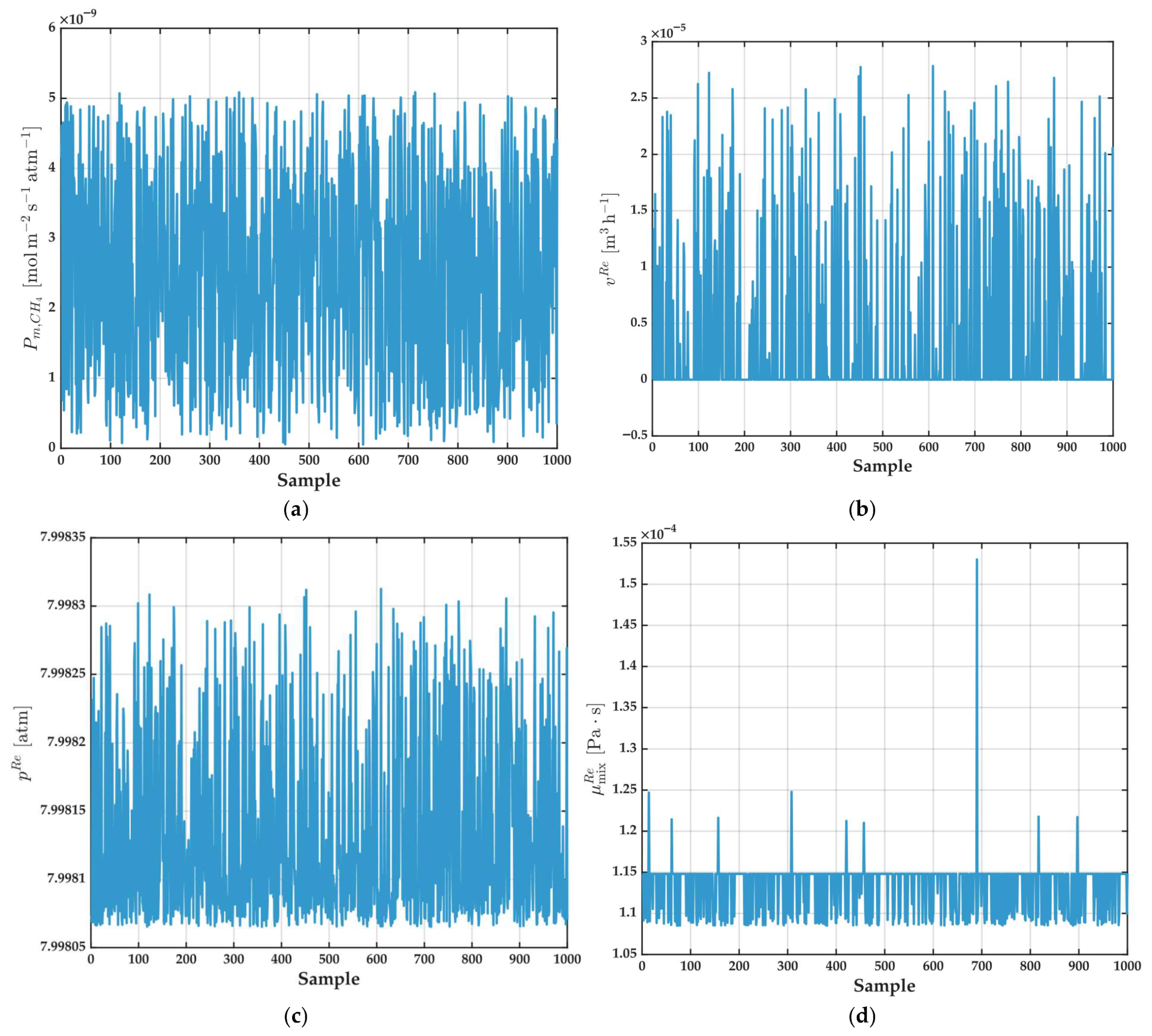
| xm | Permeance PmCH4, Retentate Volume VRe, Retentate Pressure PRe, Retentate Mixture Viscosity |
| Methane volume in retentate | |
| 1 to 20 time lags to incorporate temporal dependencies in the inputs | |
| Membership function type | Sigmoidal type |
| Number of Membership Functions | 1 (sigmoidal) |
| Number or Fuzzy rules | 1 |
| Data Split | 70% training, 30% testing, with no overlap between sets and cross valida-tion with 5 folds. |
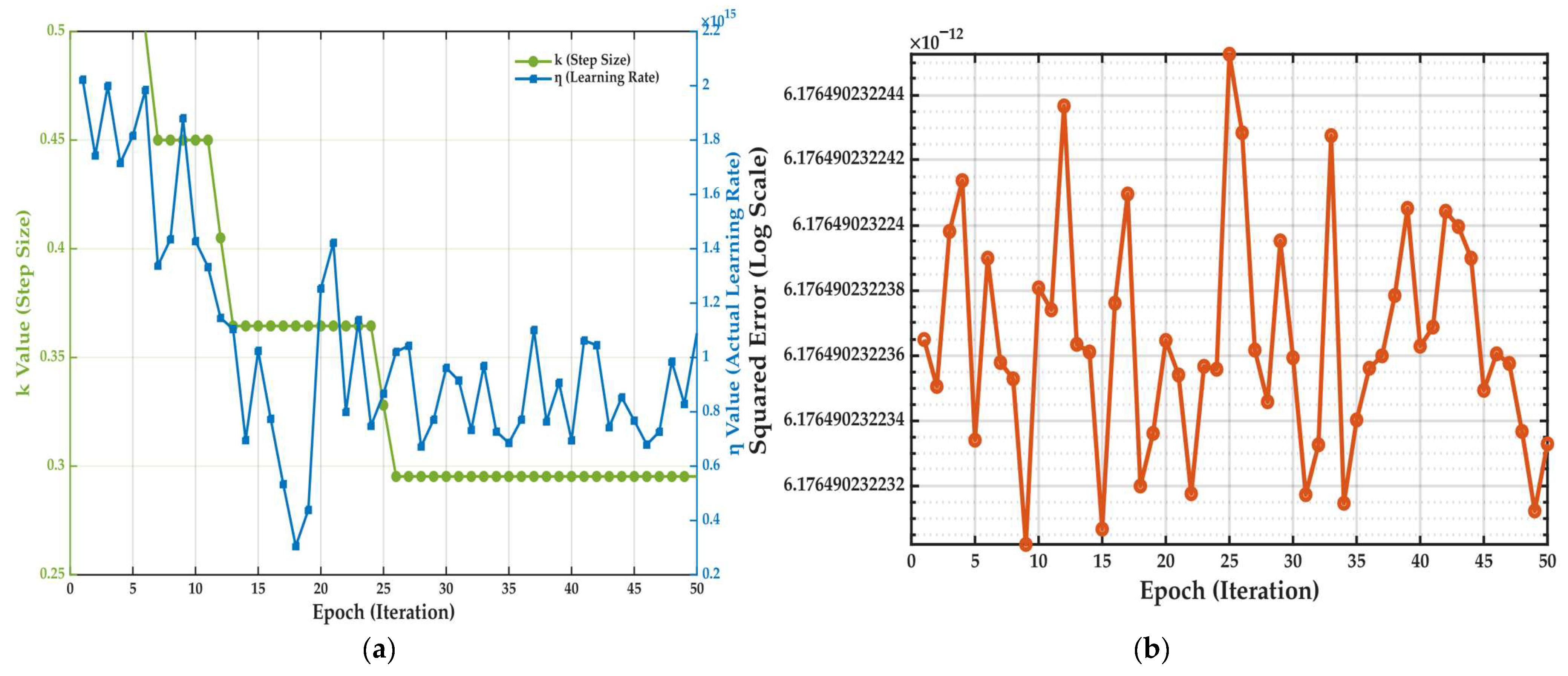
| Training Method | Hybrid approach: linear parameter estimation via pseudoinverse combined with nonlinear optimization of parameters by gradient descent using analytical derivatives |
| Parameter Initialization | Random initialization for parameters within defined ranges. |
| Stopping Criteria | Maximum of 50 iterations. |
| Performance Metrics | Eval Time, MSE, RMSE, MAE, and coefficient of determination () calculated for training and testing datasets |
| Best Model Selection | Based on lowest test set MSE among all evaluated |
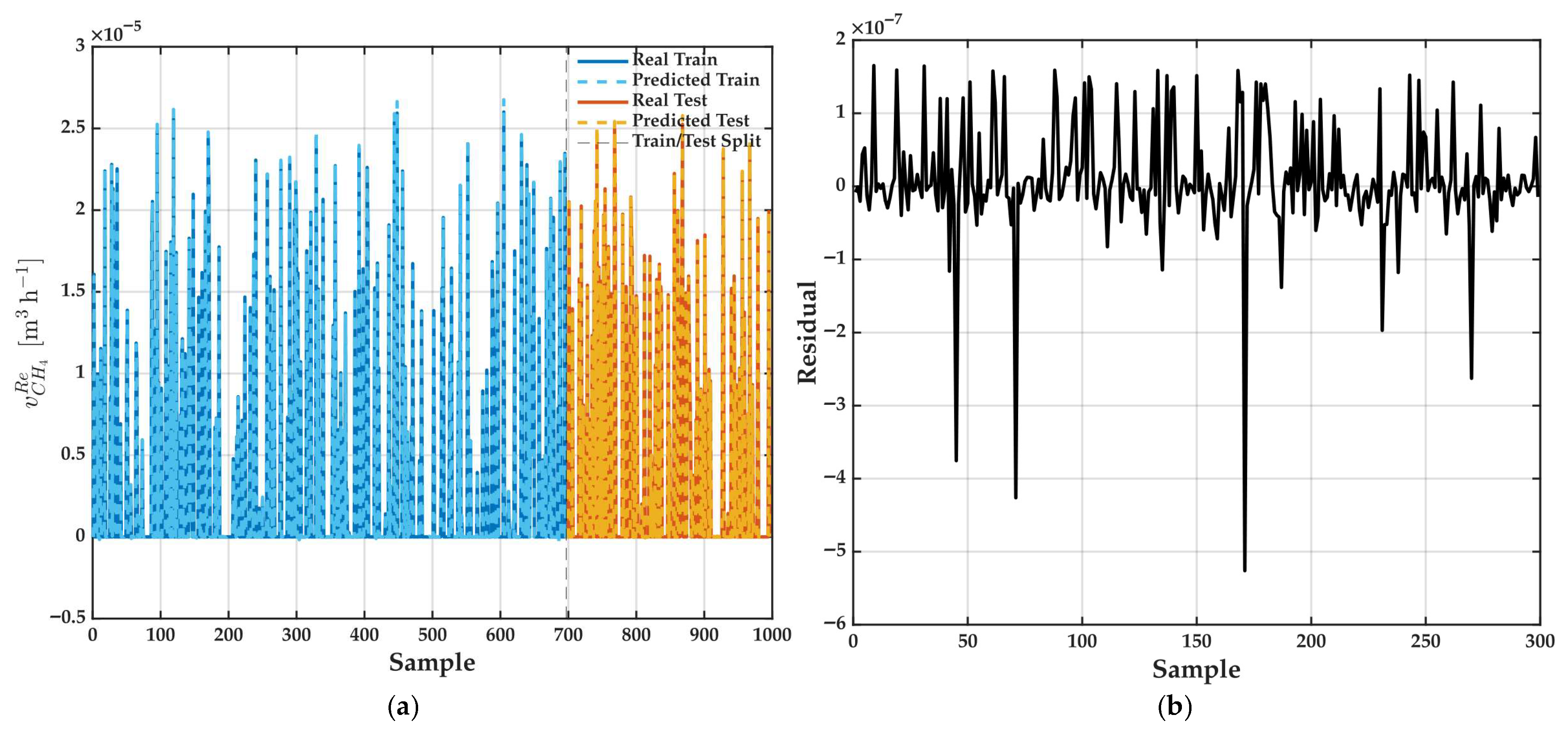
| Validation | Graphical comparison of predicted vs. actual values in training and testing; residual error analysis |
| Variable | MAE | ||
|---|---|---|---|
| Variable permeance | 0.4883 | 3.93 × 10⁻⁶ | 3.70 |
| Retentate volume | 0.9998 | 5.47 × 10⁻⁸ | 0.52 |
| Permeate volume | 0.9998 | 5.47 × 10⁻⁸ | 0.52 |
| Retentate fraction CO2 | 2.85 × 10⁻⁴ | 5.06 × 10⁻⁶ | 0.25 |
| Retentate fraction CH4 | 2.85 × 10⁻⁴ | 5.06 × 10⁻⁶ | 0.25 |
| Permeate fraction CO2 | 0.8520 | 1.76 × 10⁻⁶ | 0.24 |
| Permeate fraction CH4 | 0.8520 | 1.76 × 10⁻⁶ | 0.24 |
| Retentate pressure | 0.8356 | 2.26 × 10⁻⁶ | 3.32 |
| Permeate pressure | 0.8039 | 2.36 × 10⁻⁶ | 5.62 |
| Retentate flow CO2 | 0.8591 | 1.71 × 10⁻⁶ | 0.18 |
| Retentate flow CH4 | 1.0000 | 2.21 × 10⁻¹⁰ | 0.58 |
| Permeate flow CO2 | 0.8591 | 1.71 × 10⁻⁶ | 0.18 |
| Permeate flow CH4 | 1.0000 | 2.21 × 10⁻¹⁰ | 0.58 |
| Retentate volume CO2 | 0.8591 | 1.71 × 10⁻⁶ | 0.18 |
| Permeate volume CO2 | 0.8591 | 1.71 × 10⁻⁶ | 0.18 |
| Permeate volume CH4 | 1.0000 | 2.21 × 10⁻¹⁰ | 0.58 |
| Retentate mix viscosity | 0.4305 | 3.02 × 10⁻⁶ | 2.18 |
| Permeate mix viscosity | 0.8992 | 1.43 × 10⁻⁶ | 0.37 |
| Metric | Value (18 Variables) | Value (4 Variables) |
|---|---|---|
| 0.999 | 0.998 | |
| 1.159 × 10⁻⁷ | 2.279 × 10⁻⁷ |
| Parameter | MCS |
|---|---|
| −0.035 | |
| 231 | |
| 0.162 | |
| −0.162 | |
| 6.26 × 10⁻¹² | |
| −6.26 × 10⁻¹² | |
| 5.46 × 10⁻⁸ | |
| −5.46 × 10⁻⁸ | |
| 0.00437 | |
| 2.44 × 10⁻⁵ | |
| 0.00329 | |
| 0.00392 | |
| −0.00329 | |
| −0.00392 | |
| 0.147 | |
| −0.147 | |
| −0.175 | |
| −0.0723 | |
| 0.0734 |
| Variable | Statistical Justification | Physical Justification | Multicollinearity | Reason for Selection |
|---|---|---|---|---|
| (3.70), strong negative ρ with pressure and volume | Captures intrinsic membrane transport property | Low to moderate | Orthogonal information; essential transport parameter | |
| (0.52) | Reflects process state, influences driving force | High with some variables | High predictive power; represents feed conditions | |
| (3.32) | Key driver for mass transfer, operationally controlled | Moderate | Adds unique, mechanistically important information | |
| Moderate (2.18), low ρ with other selected variables | Influences mass transfer and flow resistance | Low | Mechanistic relevance; low redundancy |
| Delay | Eval Time (s) | MSETrain | RMSETrain | MAETrain | R2Train | MSETest | RMSETest | MAETest | R2Test |
|---|---|---|---|---|---|---|---|---|---|
| 1 | 0.0077 | 6.5682 × 10⁻¹⁵ | 8.1045 × 10⁻⁸ | 4.0207 × 10⁻⁸ | 0.9998 | 5.8827 × 10⁻¹⁵ | 7.6699 × 10⁻⁸ | 4.3855 × 10⁻⁸ | 0.9999 |
| 2 | 0.0078 | 6.5491 × 10⁻¹⁵ | 8.0926 × 10⁻⁸ | 4.0288 × 10⁻⁸ | 0.9998 | 5.8646 × 10⁻¹⁵ | 7.6581 × 10⁻⁸ | 4.3781 × 10⁻⁸ | 0.9999 |
| 3 | 0.0089 | 6.5080 × 10⁻¹⁵ | 8.0672 × 10⁻⁸ | 4.0305 × 10⁻⁸ | 0.9998 | 5.8353 × 10⁻¹⁵ | 7.6389 × 10⁻⁸ | 4.3838 × 10⁻⁸ | 0.9999 |
| 4 | 0.0111 | 6.4958 × 10⁻¹⁵ | 8.0597 × 10⁻⁸ | 4.0715 × 10⁻⁸ | 0.9998 | 5.8345 × 10⁻¹⁵ | 7.6384 × 10⁻⁸ | 4.3929 × 10⁻⁸ | 0.9999 |
| 5 | 0.0143 | 6.4895 × 10⁻¹⁵ | 8.0557 × 10⁻⁸ | 4.0732 × 10⁻⁸ | 0.9998 | 5.8459 × 10⁻¹⁵ | 7.6459 × 10⁻⁸ | 4.4128 × 10⁻⁸ | 0.9999 |
| 6 | 0.0142 | 6.4649 × 10⁻¹⁵ | 8.0405 × 10⁻⁸ | 4.0680 × 10⁻⁸ | 0.9998 | 5.8456 × 10⁻¹⁵ | 7.6457 × 10⁻⁸ | 4.4327 × 10⁻⁸ | 0.9999 |
| 7 | 0.0158 | 6.4602 × 10⁻¹⁵ | 8.0375 × 10⁻⁸ | 4.0815 × 10⁻⁸ | 0.9998 | 5.8696 × 10⁻¹⁵ | 7.6613 × 10⁻⁸ | 4.4559 × 10⁻⁸ | 0.9999 |
| 8 | 0.0188 | 6.4516 × 10⁻¹⁵ | 8.0322 × 10⁻⁸ | 4.1009 × 10⁻⁸ | 0.9998 | 5.9111 × 10⁻¹⁵ | 7.6884 × 10⁻⁸ | 4.4614 × 10⁻⁸ | 0.9999 |
| 9 | 0.0192 | 6.4121 × 10⁻¹⁵ | 8.0076 × 10⁻⁸ | 4.1117 × 10⁻⁸ | 0.9998 | 5.8620 × 10⁻¹⁵ | 7.6564 × 10⁻⁸ | 4.4542 × 10⁻⁸ | 0.9999 |
| 10 | 0.0215 | 1.7664 × 10⁻¹³ | 4.2029 × 10⁻⁷ | 1.9986 × 10⁻⁷ | 0.9958 | 2.3289 × 10⁻¹³ | 4.8259 × 10⁻⁷ | 2.5229 × 10⁻⁷ | 0.9952 |
| 11 | 0.0234 | 1.9624 × 10⁻¹² | 1.4008 × 10⁻⁶ | 6.2475 × 10⁻⁷ | 0.9536 | 2.3208 × 10⁻¹² | 1.5234 × 10⁻⁶ | 7.6129 × 10⁻⁷ | 0.9522 |
| 12 | 0.0260 | 3.4528 × 10⁻¹¹ | 5.8760 × 10⁻⁶ | 2.5711 × 10⁻⁶ | 0.1844 | 4.2499 × 10⁻¹¹ | 6.5192 × 10⁻⁶ | 3.2217 × 10⁻⁶ | 0.1263 |
| 13 | 0.0274 | 5.0096 × 10⁻¹¹ | 7.0779 × 10⁻⁶ | 3.0953 × 10⁻⁶ | −0.1821 | 6.1502 × 10⁻¹¹ | 7.8423 × 10⁻⁶ | 3.8721 × 10⁻⁶ | −0.2644 |
| 14 | 0.0289 | 4.8944 × 10⁻¹¹ | 6.9960 × 10⁻⁶ | 3.0619 × 10⁻⁶ | −0.1536 | 6.0004 × 10⁻¹¹ | 7.7462 × 10⁻⁶ | 3.8249 × 10⁻⁶ | −0.2336 |
| 15 | 0.0408 | 1.7002 × 10⁻¹² | 1.3039 × 10⁻⁶ | 5.8830 × 10⁻⁷ | 0.9603 | 2.0688 × 10⁻¹² | 1.4383 × 10⁻⁶ | 7.2201 × 10⁻⁷ | 0.9568 |
| 16 | 0.0436 | 5.1784 × 10⁻¹¹ | 7.1961 × 10⁻⁶ | 3.1518 × 10⁻⁶ | −0.2097 | 6.1707 × 10⁻¹¹ | 7.8554 × 10⁻⁶ | 3.8599 × 10⁻⁶ | −0.2889 |
| 17 | 0.0346 | 9.3228 × 10⁻¹² | 3.0533 × 10⁻⁶ | 1.3496 × 10⁻⁶ | 0.7825 | 1.1175 × 10⁻¹¹ | 3.3429 × 10⁻⁶ | 1.6535 × 10⁻⁶ | 0.7666 |
| 18 | 0.0360 | 8.3914 × 10⁻¹² | 2.8968 × 10⁻⁶ | 1.2885 × 10⁻⁶ | 0.8044 | 9.7818 × 10⁻¹² | 3.1276 × 10⁻⁶ | 1.5537 × 10⁻⁶ | 0.7957 |
| 19 | 0.0381 | 4.9418 × 10⁻⁸ | 2.2230 × 10⁻⁴ | 9.8204 × 10⁻⁵ | −1150.4074 | 5.8296 × 10⁻⁸ | 2.4145 × 10⁻⁴ | 1.1864 × 10⁻⁴ | −1213.9289 |
| 20 | 0.0397 | 3.9225 × 10⁻¹¹ | 6.2629 × 10⁻⁶ | 2.7594 × 10⁻⁶ | 0.0871 | 4.6493 × 10⁻¹¹ | 6.8186 × 10⁻⁶ | 3.3415 × 10⁻⁶ | 0.0311 |
| Delay | Eval Time (s) | MSE Test (Avg ± Std) | RMSE Test (Avg ± Std) | MAE Test (Avg ± Std) | R2 Test (Avg ± Std) |
|---|---|---|---|---|---|
| 1 | 0.0021 | 7.735 × 10⁻¹⁵ ± 3.356 × 10⁻¹⁵ | 8.642 × 10⁻⁸ ± 1.824 × 10⁻⁸ | 3.890 × 10⁻⁸ ± 4.691 × 10⁻⁹ | 0.9998 ± 0.0001 |
| 2 | 0.0014 | 8.301 × 10⁻¹⁵ ± 3.746 × 10⁻¹⁵ | 8.957 × 10⁻⁸ ± 1.865 × 10⁻⁸ | 4.036 × 10⁻⁸ ± 2.922 × 10⁻⁹ | 0.9998 ± 0.0001 |
| 3 | 0.0018 | 7.256 × 10⁻¹⁵ ± 4.286 × 10⁻¹⁵ | 8.276 × 10⁻⁸ ± 2.255 × 10⁻⁸ | 4.006 × 10⁻⁸ ± 2.732 × 10⁻⁹ | 0.9998 ± 0.0001 |
| 4 | 0.0027 | 8.387 × 10⁻¹⁵ ± 3.983 × 10⁻¹⁵ | 8.945 × 10⁻⁸ ± 2.193 × 10⁻⁸ | 4.145 × 10⁻⁸ ± 3.036 × 10⁻⁹ | 0.9998 ± 0.0001 |
| 5 | 0.0026 | 7.565 × 10⁻¹⁵ ± 3.810 × 10⁻¹⁵ | 8.472 × 10⁻⁸ ± 2.202 × 10⁻⁸ | 4.098 × 10⁻⁸ ± 3.133 × 10⁻⁹ | 0.9998 ± 0.0001 |
| 6 | 0.0030 | 7.581 × 10⁻¹⁵ ± 4.334 × 10⁻¹⁵ | 8.470 × 10⁻⁸ ± 2.257 × 10⁻⁸ | 4.087 × 10⁻⁸ ± 4.583 × 10⁻⁹ | 0.9998 ± 0.0001 |
| 7 | 0.0032 | 7.568 × 10⁻¹⁵ ± 3.840 × 10⁻¹⁵ | 8.508 × 10⁻⁸ ± 2.030 × 10⁻⁸ | 4.187 × 10⁻⁸ ± 2.673 × 10⁻⁹ | 0.9998 ± 0.0001 |
| 8 | 0.0034 | 7.524 × 10⁻¹⁵ ± 3.731 × 10⁻¹⁵ | 8.462 × 10⁻⁸ ± 2.132 × 10⁻⁸ | 4.169 × 10⁻⁸ ± 3.158 × 10⁻⁹ | 0.9998 ± 0.0001 |
| 9 | 0.0037 | 8.011 × 10⁻¹⁵ ± 3.050 × 10⁻¹⁵ | 8.812 × 10⁻⁸ ± 1.754 × 10⁻⁸ | 4.281 × 10⁻⁸ ± 3.534 × 10⁻⁹ | 0.9998 ± 0.0001 |
| 10 | 0.0040 | 7.718 × 10⁻¹⁵ ± 3.231 × 10⁻¹⁵ | 8.649 × 10⁻⁸ ± 1.720 × 10⁻⁸ | 4.302 × 10⁻⁸ ± 2.830 × 10⁻⁹ | 0.9998 ± 0.0001 |
| 11 | 0.0044 | 6.149 × 10⁻¹² ± 9.529 × 10⁻¹² | 1.681 × 10⁻⁶ ± 2.039 × 10⁻⁶ | 8.087 × 10⁻⁷ ± 1.019 × 10⁻⁶ | 0.8764 ± 0.1741 |
| 12 | 0.0049 | 1.210 × 10⁻¹¹ ± 1.793 × 10⁻¹¹ | 2.259 × 10⁻⁶ ± 2.957 × 10⁻⁶ | 1.056 × 10⁻⁶ ± 1.399 × 10⁻⁶ | 0.7511 ± 0.3601 |
| 13 | 0.0054 | 1.184 × 10⁻¹¹ ± 1.856 × 10⁻¹¹ | 2.788 × 10⁻⁶ ± 2.255 × 10⁻⁶ | 1.253 × 10⁻⁶ ± 9.445 × 10⁻⁷ | 0.7058 ± 0.4847 |
| 14 | 0.0056 | 1.527 × 10⁻¹¹ ± 1.386 × 10⁻¹¹ | 3.359 × 10⁻⁶ ± 2.234 × 10⁻⁶ | 1.573 × 10⁻⁶ ± 1.078 × 10⁻⁶ | 0.6688 ± 0.2729 |
| 15 | 0.0060 | 1.627 × 10⁻¹⁰ ± 3.052 × 10⁻¹⁰ | 9.206 × 10⁻⁶ ± 9.873 × 10⁻⁶ | 4.044 × 10⁻⁶ ± 4.061 × 10⁻⁶ | −3.3766 ± 8.4932 |
| 16 | 0.0066 | 3.130 × 10⁻¹¹ ± 2.162 × 10⁻¹¹ | 5.273 × 10⁻⁶ ± 2.088 × 10⁻⁶ | 2.396 × 10⁻⁶ ± 9.865 × 10⁻⁷ | 0.2707 ± 0.4788 |
| 17 | 0.0067 | 3.619 × 10⁻¹¹ ± 1.319 × 10⁻¹¹ | 5.938 × 10⁻⁶ ± 1.077 × 10⁻⁶ | 2.706 × 10⁻⁶ ± 4.863 × 10⁻⁷ | 0.1866 ± 0.2695 |
| 18 | 0.0070 | 2.568 × 10⁻¹¹ ± 2.965 × 10⁻¹¹ | 4.008 × 10⁻⁶ ± 3.468 × 10⁻⁶ | 1.840 × 10⁻⁶ ± 1.585 × 10⁻⁶ | 0.4516 ± 0.6191 |
| 19 | 0.0074 | 7.472 × 10⁻¹⁰ ± 1.654 × 10⁻⁹ | 1.424 × 10⁻⁵ ± 2.608 × 10⁻⁵ | 6.721 × 10⁻⁶ ± 1.244 × 10⁻⁵ | −14.9436 ± 35.2595 |
| 20 | 0.0082 | 9.743 × 10⁻¹² ± 1.215 × 10⁻¹¹ | 2.649 × 10⁻⁶ ± 1.846 × 10⁻⁶ | 1.213 × 10⁻⁶ ± 7.754 × 10⁻⁷ | 0.7801 ± 0.2853 |
| Fold | MSE Test | RMSE Test | MAE Test | R2 Test |
|---|---|---|---|---|
| 1 | 6.781 × 10⁻¹⁵ | 8.235 × 10⁻⁸ | 4.209 × 10⁻⁸ | 0.9999 |
| 2 | 3.406 × 10⁻¹⁵ | 5.836 × 10⁻⁸ | 3.532 × 10⁻⁸ | 0.9999 |
| 3 | 6.108 × 10⁻¹⁵ | 7.815 × 10⁻⁸ | 3.996 × 10⁻⁸ | 0.9999 |
| 4 | 1.430 × 10⁻¹⁴ | 1.196 × 10⁻⁷ | 4.307 × 10⁻⁸ | 0.9996 |
| 5 | 7.742 × 10⁻¹⁵ | 8.799 × 10⁻⁸ | 4.179 × 10⁻⁸ | 0.9998 |
| # Samples | Average Time | Standard Deviation | Minimum Time | Maximum Latency |
|---|---|---|---|---|
| 1 | 0.3930 ms | 0.0000 ms | 0.3930 ms | 0.3930 ms |
| 10 | 0.1252 ms | 0.2486 ms | 0.0080 ms | 0.8190 ms |
| 100 | 0.0085 ms | 0.0025 ms | 0.0080 ms | 0.0250 ms |
| 500 | 0.0086 ms | 0.0023 ms | 0.0070 ms | 0.0370 ms |
Disclaimer/Publisher’s Note: The statements, opinions and data contained in all publications are solely those of the individual author(s) and contributor(s) and not of MDPI and/or the editor(s). MDPI and/or the editor(s) disclaim responsibility for any injury to people or property resulting from any ideas, methods, instructions or products referred to in the content. |
© 2025 by the authors. Licensee MDPI, Basel, Switzerland. This article is an open access article distributed under the terms and conditions of the Creative Commons Attribution (CC BY) license (https://creativecommons.org/licenses/by/4.0/).
Share and Cite
Garcia-Sigales, B.J.; Ruz-Hernandez, J.A.; Rullan-Lara, J.-L.; Alanis, A.Y.; Ruz Canul, M.A.; Gonzalez Gomez, J.C.; Romero-Sotelo, F.J. Mathematical and Neuro-Fuzzy Modeling of a Hollow Fiber Membrane System for a Petrochemical Process. ChemEngineering 2025, 9, 115. https://doi.org/10.3390/chemengineering9060115
Garcia-Sigales BJ, Ruz-Hernandez JA, Rullan-Lara J-L, Alanis AY, Ruz Canul MA, Gonzalez Gomez JC, Romero-Sotelo FJ. Mathematical and Neuro-Fuzzy Modeling of a Hollow Fiber Membrane System for a Petrochemical Process. ChemEngineering. 2025; 9(6):115. https://doi.org/10.3390/chemengineering9060115
Chicago/Turabian StyleGarcia-Sigales, Bryand J., Jose A. Ruz-Hernandez, Jose-Luis Rullan-Lara, Alma Y. Alanis, Mario Antonio Ruz Canul, Juan Carlos Gonzalez Gomez, and Francisco J. Romero-Sotelo. 2025. "Mathematical and Neuro-Fuzzy Modeling of a Hollow Fiber Membrane System for a Petrochemical Process" ChemEngineering 9, no. 6: 115. https://doi.org/10.3390/chemengineering9060115
APA StyleGarcia-Sigales, B. J., Ruz-Hernandez, J. A., Rullan-Lara, J.-L., Alanis, A. Y., Ruz Canul, M. A., Gonzalez Gomez, J. C., & Romero-Sotelo, F. J. (2025). Mathematical and Neuro-Fuzzy Modeling of a Hollow Fiber Membrane System for a Petrochemical Process. ChemEngineering, 9(6), 115. https://doi.org/10.3390/chemengineering9060115