
First-Principles Modeling of an Electrolytic Cell for Lithium Hydroxide Production: A Multiscale ODE-PDE Framework


Abstract
1. Introduction
Novelty Statement and Organization
- Hybrid ODE-PDE Coupling: Coupling the lumped bulk-phase dynamics of the chambers to time-dependent membrane transport equations resolves the transient “induction period” of ion crossover—the finite interval over which the membrane concentration profiles and the crossover flux develop before reaching a steady state. This regime cannot be represented by steady-state models and governs the early-time evolution of the current efficiency.
- Parasitic Leakage Dynamics: Explicit modeling of back-migration and its neutralization at the anode yields a rigorous, time-resolved estimate of the net current efficiency, beyond what steady-state assumptions allow.
- Complexation Kinetics: Accounting for the finite kinetics of LiOH complex formation provides a more realistic description of the cathode chemistry and of the resulting product composition.
2. Process Modeling
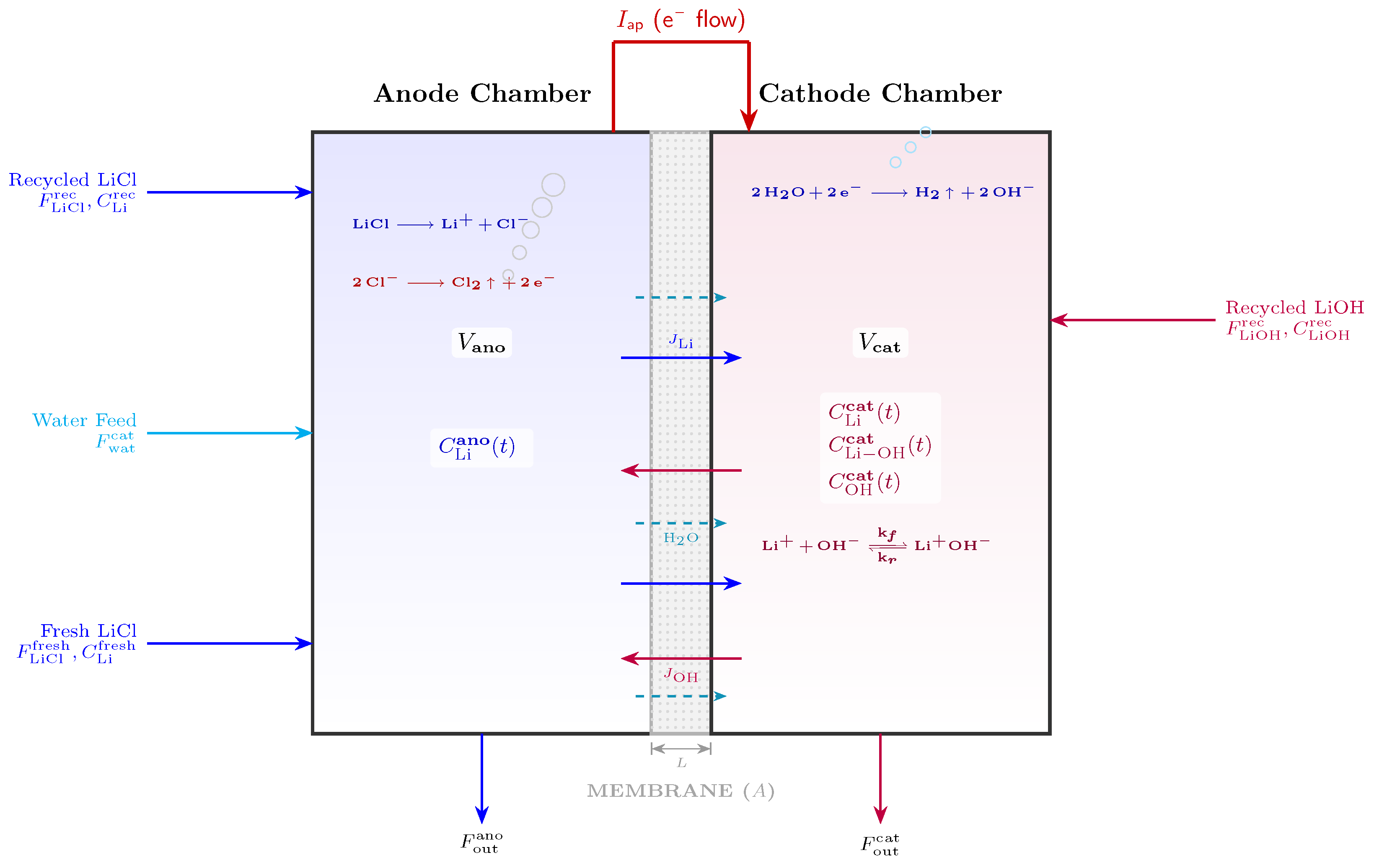
2.1. Process Description
2.2. Mathematical Model
2.2.1. Anode Chamber Balances
2.2.2. Cathode Chamber Balances
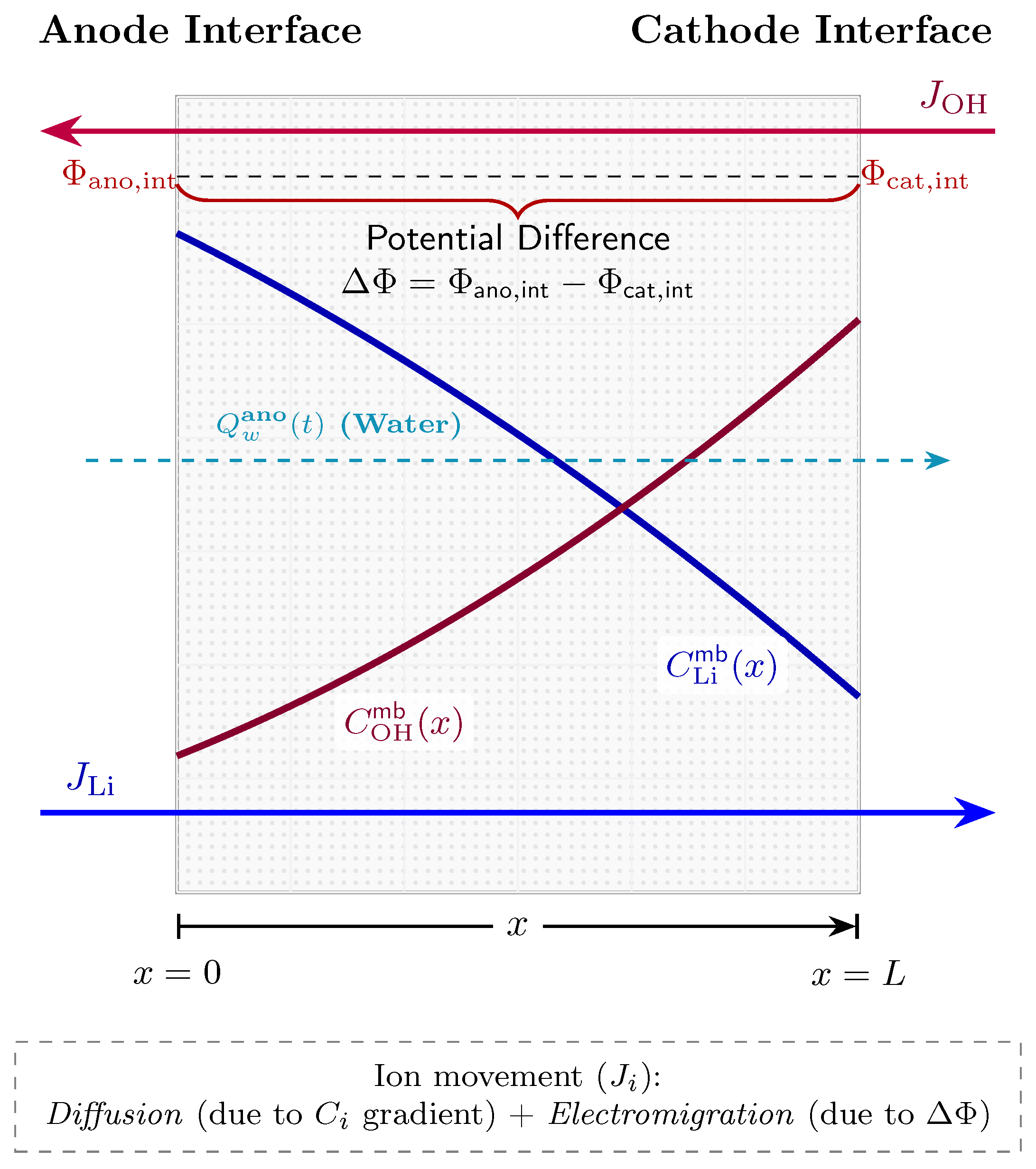
2.2.3. Membrane Balances
2.2.4. Potential Distribution and Ohm’s Law
2.3. Integrated System and State Representation
- Electrical Potential: The spatial distribution is determined by the local ionic conductivity and current density. The field approximation is given by Equation (6), with the full non-linear expressions for the bulk gradient and its curvature reported in Appendix B.
- Trans-Membrane Water Transport: The net electro-osmotic water transport leaving the anode is estimated via Equation (3). This term accounts for the electro-osmotic drag effects coupled with the multi-species ionic transport through the membrane.
- Current Efficiency: This metric characterizes the effective utilization of the applied current. It is defined by the ratio of the net current contributing to hydroxide production at the cathode to the total applied current, explicitly accounting for Faradaic losses due to back-migration:where represents the interfacial molar flux of species OH and is given by Equation (A14).
3. Numerical Treatment
4. Numerical Results and System Analysis
4.1. Physical Parameters and Baseline Conditions
4.2. System Analysis and Dominant Dynamics
4.3. Dynamic Simulation Results
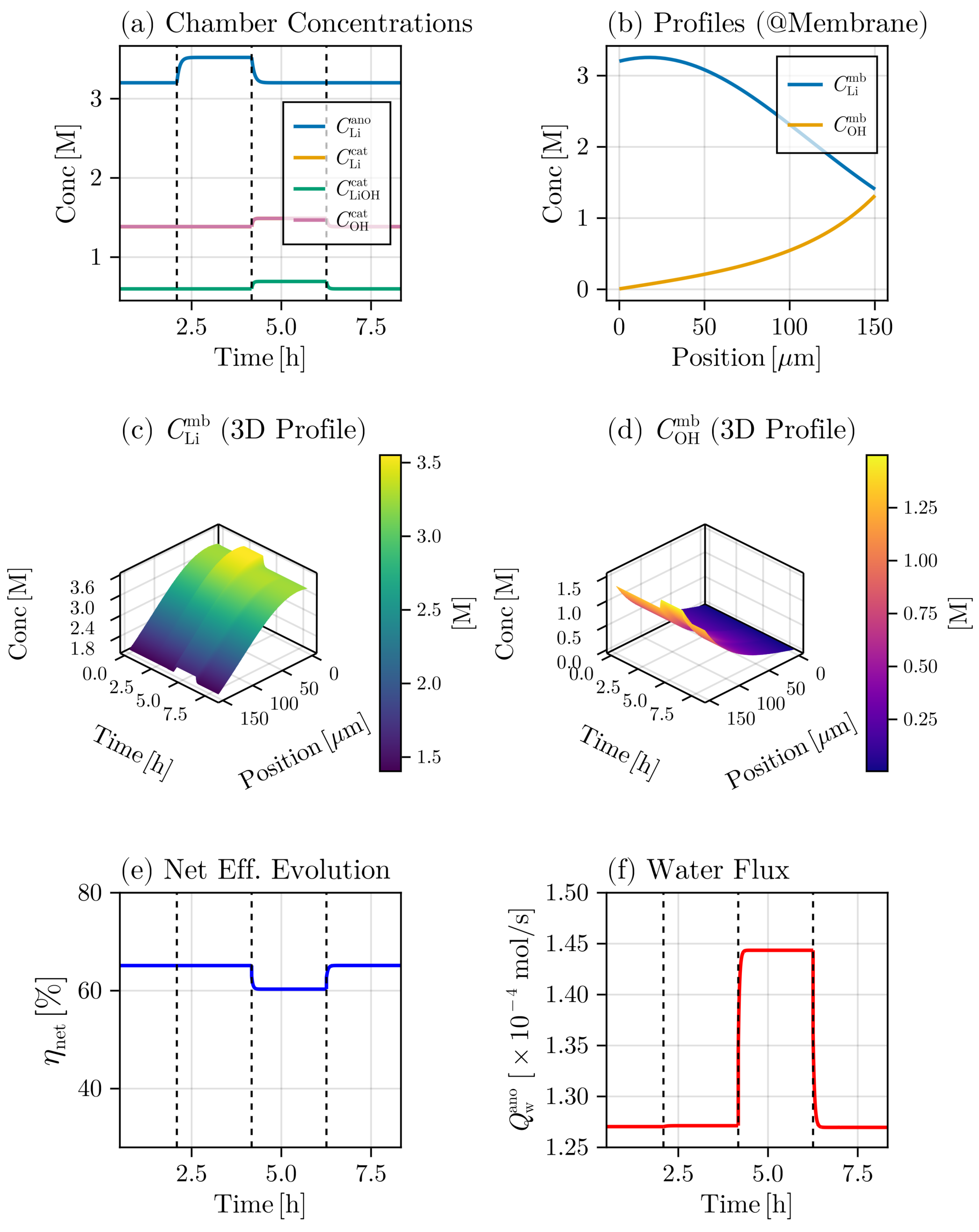
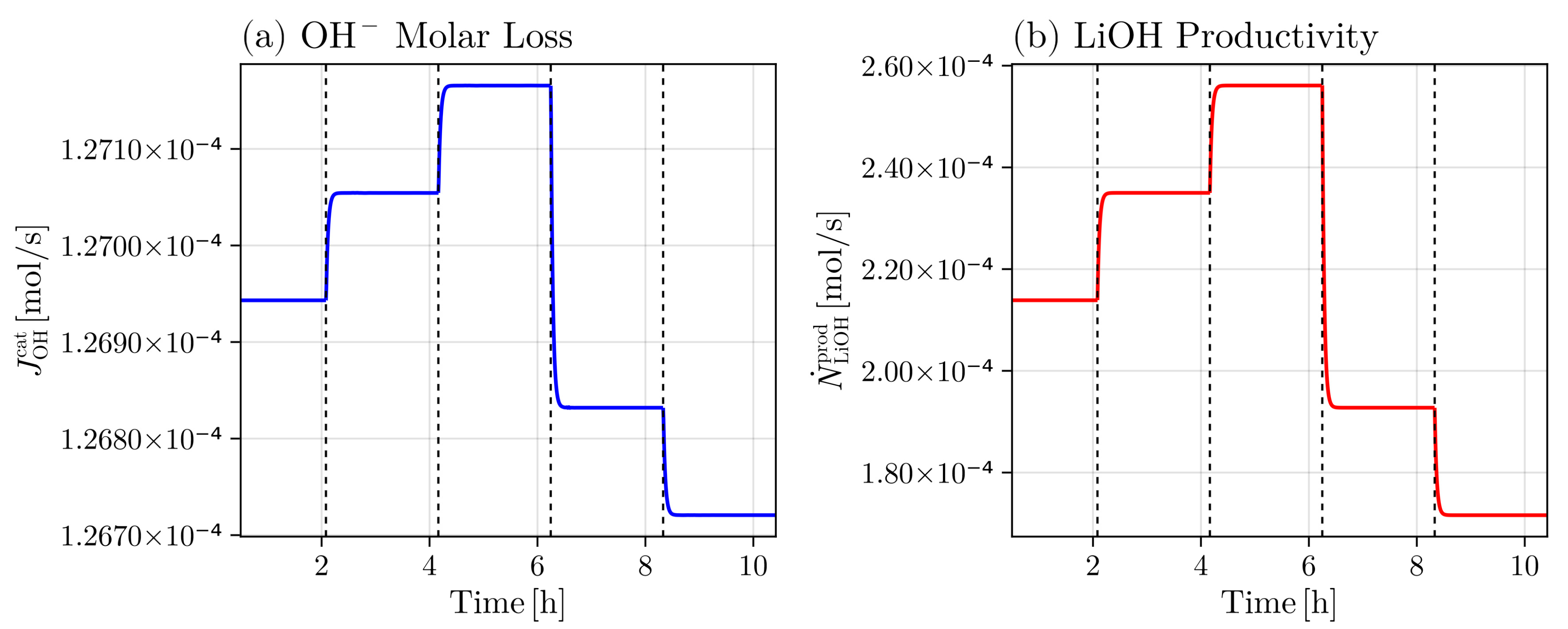
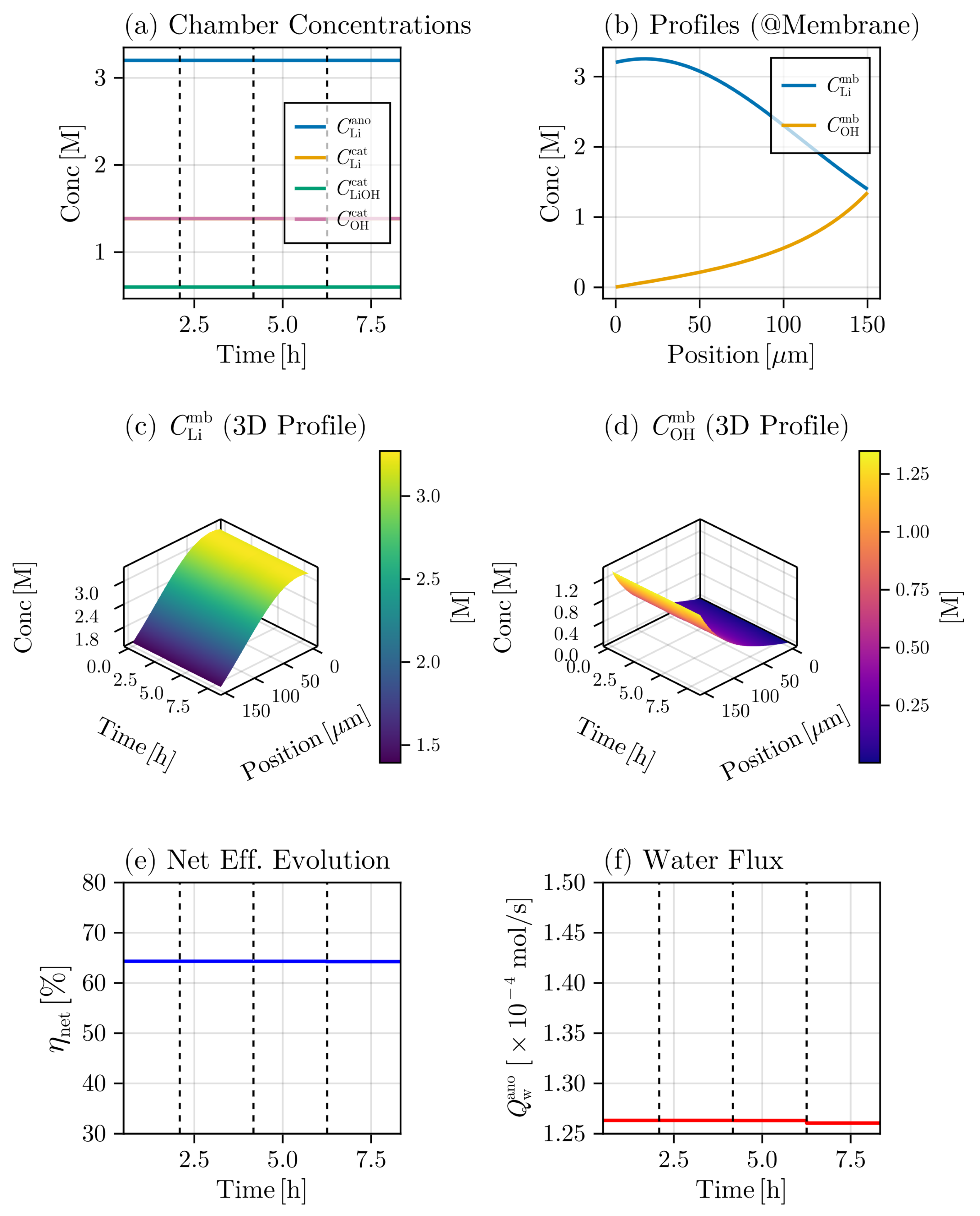
- Baseline Steady State: For ( ), the system was maintained at stationary conditions: , , and .
- Disturbance Phase I: At , a step increase to was introduced. This phase spanned .
- Disturbance Phase II: At , was restored to the baseline, and a step increase to was implemented for .
- Disturbance Phase III: At , was restored to the baseline and a step decrease to was introduced (corresponding to ), lasting until .
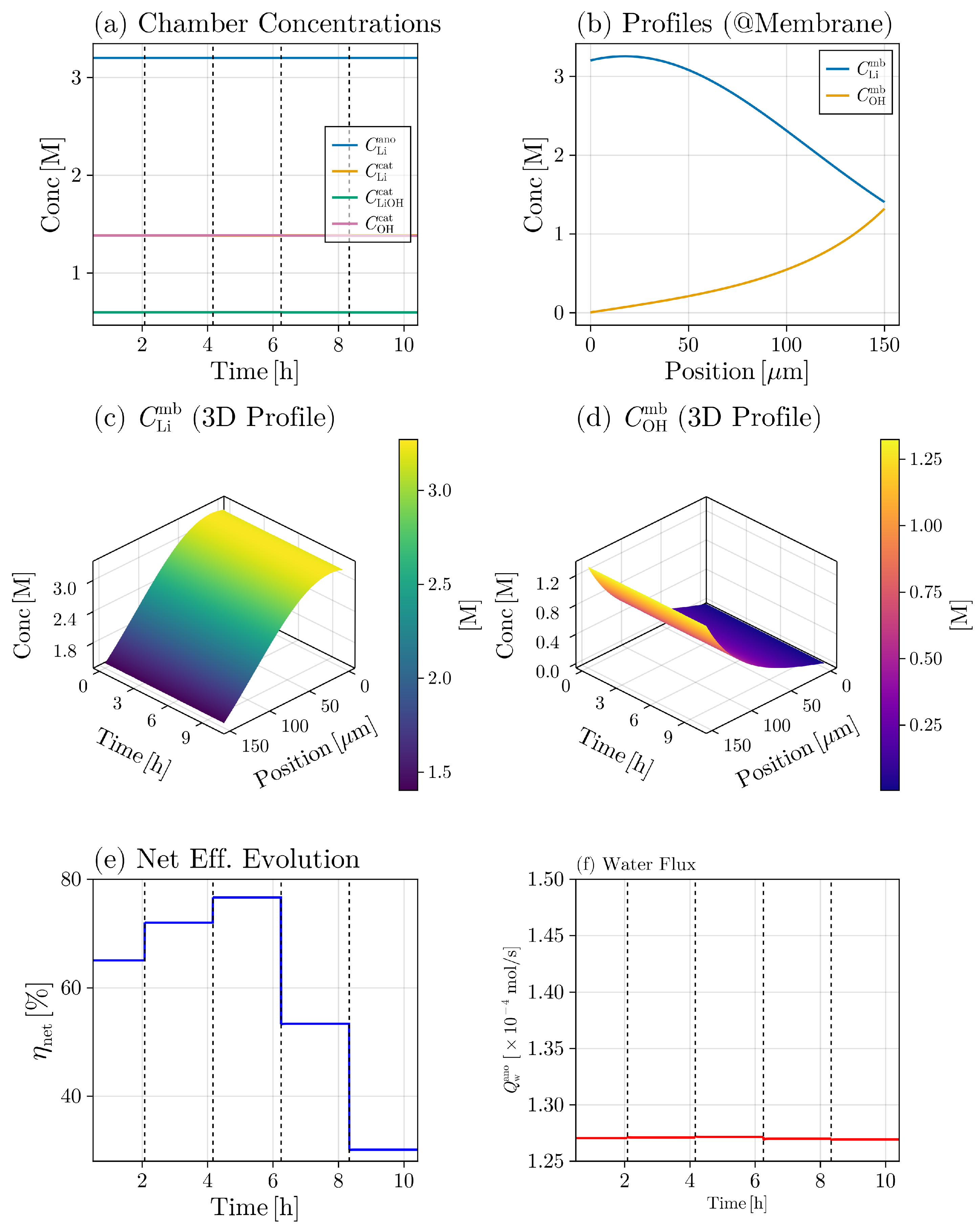
- Baseline Steady State: For ( ), the system was maintained at stationary conditions with .
- Disturbance Phase I: For , a step increase to (a + disturbance) was introduced.
- Disturbance Phase II: For , the applied current was further increased to (a + disturbance).
- Disturbance Phase III: For , was decreased to 26.25 A, corresponding to a − disturbance relative to the baseline.
- Disturbance Phase IV: For , the current was further reduced to , representing a − disturbance.
- Baseline Steady State: For , the system was held at , , and .
- Disturbance Phase I: At , was increased by 10% to 211.2 .
- Disturbance Phase II: At , the flow was restored, and the temperature was increased to .
- Disturbance Phase III: At , the temperature was restored and the mass transfer coefficient was increased to .
5. Conclusions
Author Contributions
Funding
Data Availability Statement
Conflicts of Interest
Nomenclature
| Latin symbols | |
| A | Membrane active area () |
| Concentration of species i in domain ( | |
| Molar concentration of water ( | |
| Free-solution and effective diffusion coefficient of species i () | |
| F | Faraday constant (C ) |
| Volumetric flow rate of stream j (L ) | |
| Applied current (A); current density (A ) | |
| Molar flux of species i in domain (mol ) | |
| Water autoionization equilibrium constant | |
| Water-association rate constant (L ) | |
| Forward/reverse complexation rate constants (L ; ) | |
| Interfacial mass-transfer coefficient (m ) | |
| L | Membrane thickness ( |
| Total molar transfer rate across the membrane (mol ) | |
| Lithium hydration number (—) | |
| Electro-osmotic/reduction water volumetric rate (L ) | |
| R | Universal gas constant (J ) |
| Homogeneous reaction rate; association rate (M ) | |
| Cathodic hydroxide production rate (mol ) | |
| Bulk gradient of the potential (V ) | |
| T | Absolute temperature (K) |
| Time (; spatial coordinate ( | |
| Effective ionic mobility, | |
| Anode/cathode liquid volume ( | |
| Charge number of species i (—) | |
| Greek symbols | |
| Interfacial Donnan potential jump ( | |
| Membrane porosity (—); permittivities | |
| Current efficiency (%) | |
| Characteristic diffusion time, ( | |
| Local ionic conductivity (S ) | |
| Characteristic decay length ( | |
| Water-consumption coefficient (—) | |
| Effective ionic conductivity (S ) | |
| Characteristic time of process k (; membrane tortuosity (—) | |
| Electric potential ( | |
| Superscripts/Subscripts | |
| Anode, cathode, membrane | |
| Recycled, fresh feed | |
| eff | Effective (membrane-corrected) property |
| Applied, interfacial, production | |
| * | Dimensionless quantity |
Appendix A. Dimensionless Model Formulation
Appendix A.1. Anode Chamber Balances
Appendix A.2. Cathode Chamber Balances
Appendix A.3. Membrane PDEs
Appendix A.4. Dimensionless Boundary Conditions
Appendix A.5. Potential Distribution
Appendix B. Local Electric Field Formulation
Nomenclature (Appendix B)
| Symbol | Description | Unit |
| Bulk gradient of the membrane potential, | V | |
| Electric potential in the membrane | V | |
| Total current density | A | |
| Local ionic conductivity of the membrane | S | |
| Effective ionic mobility, | mol s | |
| Effective diffusion coefficient of species i | ||
| Membrane concentration of species i | M | |
| Charge number of species i | — | |
| F | Faraday constant | C |
| R | Universal gas constant | J |
| T | Absolute temperature | K |
| Spatial coordinate; time | m; s |
Appendix C. Membrane Fluxes, Boundary Conditions, and Auxiliary Cathodic Rates
Appendix C.1. Nernst–Planck Membrane Flux
Appendix C.2. Interfacial (Robin) Boundary Conditions
Appendix C.3. Auxiliary Cathodic Rates
Appendix C.4. Nomenclature (Appendix C)
| Symbol | Description | Unit |
| Molar flux of species i in the membrane | mol | |
| Effective diffusion coefficient of species i | ||
| Membrane concentration of species i | M | |
| Anode/cathode bulk concentration of species i | M | |
| Cathode concentration of the LiOH complex | M | |
| Molar concentration of water | M | |
| Charge number of species i | — | |
| Electric potential in the membrane | V | |
| Interfacial mass-transfer coefficient | m | |
| Volumetric water-consumption rate (cathode) | L | |
| Lithium–hydroxide association rate | M | |
| Forward/reverse complexation rate constants | L , | |
| Applied current | A | |
| Water-consumption coefficient of the reduction | — | |
| F | Faraday constant | C |
| R | Universal gas constant | J |
| T | Absolute temperature | K |
| Spatial coordinate; time | m; s |
References
- Li, X.; Yang, W.; Wang, Y.; Tonggang, L. Electrochemical performance of ultra-high nickel layered oxide cathode synthesized using different lithium sources. Solid State Ion. 2024, 417, 116721. [Google Scholar] [CrossRef]
- Sun, Y.K.; Myung, S.T.; Park, B.C.; Prakash, J.; Belharouak, I.; Amine, K. High-energy cathode material for long-life and safe lithium batteries. Nat. Mater. 2009, 8, 320–324. [Google Scholar] [CrossRef] [PubMed]
- Jung, R.; Metzger, M.; Maglia, F.; Stinner, C.; Gasteiger, H.A. Chemical versus electrochemical electrolyte oxidation on NMC111, NMC622, NMC811, LNMO, and conductive carbon. J. Phys. Chem. Lett. 2017, 8, 4820–4825. [Google Scholar] [CrossRef] [PubMed]
- BenchChem. A Comparative Guide: Lithium Carbonate vs. Lithium Hydroxide in High-Performance Battery Cathodes. 2025. Available online: https://www.benchchem.com/pdf/A_Comparative_Guide_Lithium_Carbonate_vs_Lithium_Hydroxide_in_High_Performance_Battery_Cathodes.pdf (accessed on 5 January 2026).
- Media, A. Stronger Demand Growth to Boost Lithium Prices: Ganfeng. 2025. Available online: https://www.argusmedia.com/en/news-and-insights/latest-market-news/2754693-stronger-demand-growth-to-boost-lithium-prices-ganfeng (accessed on 5 January 2026).
- Ang, K.L.; Barmi, M.; Boroumand, Y.; Razmjou, A.; Nikoloski, A.N. Production of LiOH·H2O from lithium chloride by electrodialysis and crystallisation. Desalin. Water Treat. 2024, 320, 100778. [Google Scholar] [CrossRef]
- Grageda, M.; Gonzalez, A.; Quispe, A.; Ushak, S. Analysis of a process for producing battery grade lithium hydroxide by membrane electrodialysis. Membranes 2020, 10, 198. [Google Scholar] [CrossRef] [PubMed]
- Wei, G.; Wang, M.; Lin, C.; Xu, C.; Gao, J. Optimizing operational parameters for lithium hydroxide production via bipolar membrane electrodialysis. Separations 2024, 11, 146. [Google Scholar] [CrossRef]
- Kong, L.; Yan, G.; Hu, K.; Yu, Y.; Conte, N.; McKenzie, K.R., Jr.; Wagner, M.J.; Boyes, S.G.; Chen, H.; Liu, C.; et al. Electro-driven direct lithium extraction from geothermal brines to generate battery-grade lithium hydroxide. Nat. Commun. 2025, 16, 560. [Google Scholar] [CrossRef] [PubMed]
- Amores, M.; Ang, K.L.; Nikoloski, A.N.; Pozo-Gonzalo, C. Electrodialysis as a method for LiOH production: Cell configurations and ion-exchange membranes. Adv. Sustain. Syst. 2025, 9, 2400402. [Google Scholar] [CrossRef]
- Henderson, G.; D’Haese, A.; De Ketelaere, E.; Bonin, L.; Schutyser, W. Application of bilayer membranes for the production of concentrated LiOH from LiCl through chlor-alkali membrane cell electrolysis. Sep. Purif. Technol. 2026, 382, 135859. [Google Scholar] [CrossRef]
- Zhang, W.; Han, Z.; Xia, H.; Li, Z.; Wang, X.; Xu, C.; Yang, W. A sustainable and energy-efficient electrolysis approach for converting lithium chloride to high-purity lithium hydroxide. J. Power Sources 2026, 666, 239134. [Google Scholar] [CrossRef]
- Uzdenova, A.; Kovalenko, A.; Urtenov, M.; Nikonenko, V. 1D mathematical modelling of non-stationary ion transfer in the diffusion layer adjacent to an ion-exchange membrane in galvanostatic mode. Membranes 2018, 8, 84. [Google Scholar] [CrossRef] [PubMed]
- Urtenov, M.; Uzdenova, A.; Kovalenko, A.; Nikonenko, V.; Pismenskaya, N.; Vasil’eva, V.; Sistat, P.; Pourcelly, G. Basic mathematical model of overlimiting transfer enhanced by electroconvection in flow-through electrodialysis membrane cells. J. Membr. Sci. 2013, 447, 190–202. [Google Scholar] [CrossRef]
- Gjelstad, A.; Rasmussen, K.E.; Pedersen-Bjergaard, S. Simulation of flux during electro-membrane extraction based on the Nernst–Planck equation. J. Chromatogr. A 2007, 1174, 104–111. [Google Scholar] [CrossRef] [PubMed]
- Szyszkiewicz, K.; Jasielec, J.J.; Danielewski, M.; Lewenstam, A.; Filipek, R. Modeling of electrodiffusion processes from nano to macro scale. J. Electrochem. Soc. 2017, 164, E3559. [Google Scholar] [CrossRef]
- Kodým, R.; Fíla, V.; Šnita, D.; Bouzek, K. Poisson–Nernst–Planck model of multiple ion transport across an ion-selective membrane under conditions close to chlor-alkali electrolysis. J. Appl. Electrochem. 2016, 46, 679–694. [Google Scholar] [CrossRef]
- Filipek, R.; Kalita, P.; Sapa, L.; Szyszkiewicz, K. On local weak solutions to Nernst–Planck–Poisson system. Appl. Anal. 2017, 96, 2316–2332. [Google Scholar] [CrossRef]
- Culcasi, A.; Gurreri, L.; Cipollina, A.; Tamburini, A.; Micale, G. A comprehensive multi-scale model for bipolar membrane electrodialysis (BMED). Chem. Eng. J. 2022, 437, 135317. [Google Scholar] [CrossRef]
- Dickinson, E.J.F.; Limon-Petersen, J.G.; Compton, R.G. The electroneutrality approximation in electrochemistry. J. Solid State Electrochem. 2011, 15, 1335–1345. [Google Scholar] [CrossRef]
- Nikonenko, V.; Zabolotsky, V.; Larchet, C.; Auclair, B.; Pourcelly, G. Mathematical description of ion transport in membrane systems. Desalination 2002, 147, 369–374. [Google Scholar] [CrossRef]
- Loza, S.; Loza, N.; Kutenko, N.; Smyshlyaev, N. Profiled ion-exchange membranes for reverse and conventional electrodialysis. Membranes 2022, 12, 985. [Google Scholar] [CrossRef] [PubMed]
- Sokalski, T.; Lingenfelter, P.; Lewenstam, A. Numerical solution of the coupled Nernst–Planck and Poisson equations for liquid junction and ion selective membrane potentials. J. Phys. Chem. B 2003, 107, 2443–2452. [Google Scholar] [CrossRef]
- Aydogan Gokturk, P.; Sujanani, R.; Qian, J.; Wang, Y.; Katz, L.E.; Freeman, B.D.; Crumlin, E.J. The Donnan potential revealed. Nat. Commun. 2022, 13, 5880. [Google Scholar] [CrossRef] [PubMed]
- Moya, A. Simple analytical approximations for Donnan ion partitioning in permeable ion-exchange membranes under reverse electrodialysis conditions. Membranes 2025, 15, 365. [Google Scholar] [CrossRef] [PubMed]
- Sun, Y.; Song, L. Accurate determination of electrical potential on ion exchange membranes in reverse electrodialysis. Separations 2021, 8, 170. [Google Scholar] [CrossRef]
- Newman, J.; Thomas-Alyea, K.E. Electrochemical Systems, 3rd ed.; Wiley-Interscience: Hoboken, NJ, USA, 2004. [Google Scholar]
- Moshtarikhah, S.; Oppers, N.A.W.; de Groot, M.T.; Keurentjes, J.T.F.; Schouten, J.C.; van der Schaaf, J. Nernst–Planck modeling of multicomponent ion transport in a Nafion membrane at high current density. J. Appl. Electrochem. 2017, 47, 51–62. [Google Scholar] [CrossRef]
- Patel, S.K.; Iddya, A.; Pan, W.; Qian, J.; Elimelech, M. Approaching infinite selectivity in membrane-based aqueous lithium extraction via solid-state ion transport. Sci. Adv. 2025, 11, eadq9823. [Google Scholar] [CrossRef] [PubMed]
- Zhang, D.; Zhang, X.; Xing, L.; Li, Z. Numerical simulation of continuous extraction of Li+ from high Mg2+/Li+ ratio brines based on free flow ion concentration polarization microfluidic system. Membranes 2021, 11, 697. [Google Scholar] [CrossRef] [PubMed]
- Stephanopoulos, G. Chemical Process Control: An Introduction to Theory and Practice; Prentice-Hall International Series in the Physical and Chemical Engineering Sciences; Prentice-Hall: Hoboken, NJ, USA, 1984. [Google Scholar]
- Hangos, K.; Cameron, I. Process Modelling and Model Analysis. In Process Systems Engineering; Academic Press: Cambridge, MA, USA, 2001. [Google Scholar]
- Ma, Y.; Gowda, S.; Anantharaman, R.; Isaacson, C.; Isaacson, H.; Rackauckas, C. ModelingToolkit.jl: A composable graph-based model transformation system. arXiv 2021, arXiv:2103.05244. [Google Scholar]
- Sabharwal, A.; Rackauckas, C. MethodOfLines.jl: Automated Finite Difference for Physics-Informed Learning. Available online: https://docs.sciml.ai/MethodOfLines/stable/ (accessed on 8 April 2026).
- Hindmarsh, A.C.; Brown, P.N.; Grant, K.E.; Lee, S.L.; Serban, R.; Shumaker, D.E.; Woodward, C.S. SUNDIALS: Suite of Nonlinear and Differential/Algebraic Equation Solvers. ACM Trans. Math. Softw. 2005, 31, 363–396. [Google Scholar] [CrossRef]
- Rackauckas, C.; Nie, Q. DifferentialEquations.jl—A performant and feature-rich ecosystem for solving differential equations in Julia. J. Open Res. Softw. 2017, 5, 15. [Google Scholar] [CrossRef]



| Parameter | Value | Parameter | Value |
|---|---|---|---|
| Physical and thermodynamic parameters | |||
| () | () | ||
| 1 | |||
| (porosity) | 0.35 | (tortuosity) | 1.6 |
| (L ) | () | ||
| (L ) | (m ) | ||
| 4.2 | ( | 55.5 | |
| R (J ) | 8.314 | F (C ) | 96,485 |
| Geometric and operating parameters | |||
| ( | 15 | ( | 7 |
| A () | L ( | ||
| (L ) | 192 | (L ) | 0.15 |
| (L ) | 192 | T | 68 °C (341.15 K) |
| ( | 3.20 | ( | 11.8 |
| ( | 1.98 | (A) | 35 |
| Phenomenon | Expression | Value [s] | Physical Interpretation |
|---|---|---|---|
| Chamber residence (anode) | Global renewal rate of the LiCl feed electrolyte | ||
| Chamber residence (cathode) | Global renewal rate of the LiOH product stream. | ||
| Membrane diffusion (Li+) | Diffusive relaxation time for lithium ions in the membrane | ||
| Membrane diffusion () | Diffusive relaxation time for hydroxide ions in the membrane | ||
| Membrane migration (Li+) | Electromigrative response of to the electric field | ||
| Membrane migration () | Electromigrative response of to the electric field | ||
| Charge relaxation | Instantaneous adjustment of the electric potential in the membrane | ||
| Li–OH formation | Formation of Li–OH in the cathode |
Disclaimer/Publisher’s Note: The statements, opinions and data contained in all publications are solely those of the individual author(s) and contributor(s) and not of MDPI and/or the editor(s). MDPI and/or the editor(s) disclaim responsibility for any injury to people or property resulting from any ideas, methods, instructions or products referred to in the content. |
© 2026 by the authors. Licensee MDPI, Basel, Switzerland. This article is an open access article distributed under the terms and conditions of the Creative Commons Attribution (CC BY) license.
Share and Cite
Duarte, B.P.M.; Oliveira, N.M.C. First-Principles Modeling of an Electrolytic Cell for Lithium Hydroxide Production: A Multiscale ODE-PDE Framework. ChemEngineering 2026, 10, 97. https://doi.org/10.3390/chemengineering10080097
Duarte BPM, Oliveira NMC. First-Principles Modeling of an Electrolytic Cell for Lithium Hydroxide Production: A Multiscale ODE-PDE Framework. ChemEngineering. 2026; 10(8):97. https://doi.org/10.3390/chemengineering10080097
Chicago/Turabian StyleDuarte, Belmiro P. M., and Nuno M. C. Oliveira. 2026. "First-Principles Modeling of an Electrolytic Cell for Lithium Hydroxide Production: A Multiscale ODE-PDE Framework" ChemEngineering 10, no. 8: 97. https://doi.org/10.3390/chemengineering10080097
APA StyleDuarte, B. P. M., & Oliveira, N. M. C. (2026). First-Principles Modeling of an Electrolytic Cell for Lithium Hydroxide Production: A Multiscale ODE-PDE Framework. ChemEngineering, 10(8), 97. https://doi.org/10.3390/chemengineering10080097