


Abstract
Cyclone separators remain widely used for gas–solid separation, yet analytical prediction of cut size and pressure drop remains challenging. This study presents an explicit semi-empirical model for the cut size (d50) of reverse-flow cyclones based on the radial particle equation of motion in cylindrical coordinates, with d50 obtained by equating radial migration time and residence time. A closed-form solution is derived in the Stokes regime, whereas non-Stokes behavior is handled numerically through the Schiller–Naumann drag correction. Turbulence is incorporated through a phenomenological correction, and the grade–efficiency curve is represented by a logistic relation. The model was implemented in MATLAB R2025a and applied in a parametric study covering inlet velocity, particle density, cyclone diameter, and gas viscosity. A Euler-type pressure drop relation was included to examine the separation–energy trade-off. Validation on the Kim et al. benchmark using one calibration point per cyclone family and six independent verification cases yielded a mean absolute percentage error of 13.5% and a root mean square error of 0.22 μm for d50; the paired pressure drop check gave a 2.8% mean absolute percentage error. A complementary benchmark based on Wang et al. using 15 cm 1D3D and 2D2D cyclones under actual-air and standard-air conditions further supported the family-calibrated use of the model. A separate scale-up test showed that constant swirl intensity similarity is not transferable across large diameter changes. The formulation provides a transparent reduced-order tool for preliminary design and sensitivity analysis.
1. Introduction
Reverse-flow cyclone separators remain widely used in gas–solid separation due to their mechanical simplicity, robustness, and ease of integration into industrial systems. However, accurate prediction of cut size, grade efficiency, and pressure drop remains challenging because the internal flow is strongly swirling, turbulent, and highly geometry-dependent. For preliminary design, the cut size d50 represents a key synthesis parameter, linking geometry and operating conditions to separation performance and enabling reconstruction of the full grade–efficiency curve once the transition sharpness is defined. The present study is motivated by the need for a compact and physically interpretable d50 formulation that remains more transparent than empirical correlations and significantly less computationally demanding than Computational Fluid Dynamics (CFD), while still allowing systematic comparison with both reduced-order and numerical approaches.
From a design perspective, a single global efficiency indicator is insufficient when particle size distributions are broad or when fine fractions below approximately 5 μm dominate performance constraints. Nevertheless, d50 remains a practical parameter because it condenses geometry–performance interactions into a single scale that can be extended to η(dp) through a logistic representation, where d50 defines the transition point and β controls the sharpness of separation.
The objectives of this work are: derivation of the particle equation of motion in cylindrical coordinates under an idealized swirling field; development of a closed-form expression for d50 in the Stokes regime based on radial migration–residence time equivalence; introduction of Reynolds and Stokes numbers for scaling and validity assessment; extension to moderate non-Stokes regimes via the Schiller–Naumann correction; inclusion of a phenomenological turbulence correction χt; and implementation in MATLAB R2025a for sensitivity analysis and validation against literature data.
Classical cyclone models focused primarily on swirling flow structure and pressure losses, with Shepherd and Lapple [1] identifying rotational motion and energy dissipation as dominant mechanisms. Leith and Mehta [2] later related geometric proportions to operating range, while subsequent studies refined inlet, outlet, and frictional contributions to pressure drop [3,4].
In parallel, efficiency and cut-size modeling evolved through the work of Chan and Lippmann [5], Dietz [6], Dirgo and Leith [7], and Leith and Licht [8], establishing widely used empirical and semi-theoretical frameworks. However, their predictive accuracy depends strongly on assumptions regarding flow structure and residence time. A key advancement was provided by Iozia and Leith [9,10], who demonstrated that cyclone geometry significantly influences grade efficiency and introduced a logistic representation of η(dp), where d50 and β govern the curve shape. Zhou and Soo [11] further emphasized the role of particle trajectories in swirling flows, reinforcing the need for transparent reduced-order formulations.
In most classical reduced-order models, turbulence effects are not explicitly represented but are embedded implicitly within empirical coefficients. In contrast, the present work introduces χt as an explicit intermediate closure term that separates turbulent dispersion effects from geometric and inertial contributions, thereby improving physical interpretability within a unified analytical framework.
The internal flow field of a cyclone is inherently complex and non-ideal, involving a forced-vortex core, a surrounding free-vortex region, processing vortex-core motion, and secondary recirculation structures, as documented in [12,13,14,15]. These features influence velocity gradients, particle residence time, and re-entrainment, and therefore directly affect separation performance.
Due to this complexity, many studies rely on CFD-based approaches to capture detailed flow and geometry effects [16,17,18,19,20,21,22,23,24,25,26], including inlet optimization, wall interaction modeling, vortex finder design, and multi-objective optimization. Further developments include CFD reviews [27], CFD–machine learning hybrid models [28], Computational Fluid Dynamics–Discrete Element Method (CFD–DEM) simulations [29], dimensionless scaling analyses [30], surrogate modeling approaches [31], reduced-order CFD-inspired formulations [32], and optimization frameworks [33]. While highly accurate, these methods are computationally expensive and less suitable for preliminary design or transparent parametric studies.
Additional studies on axial, multistage, and high-solids-loading cyclones [34,35,36,37,38,39] confirm that no single closed-form model is universally valid across all operating regimes, reinforcing the need for reduced-order formulations that preserve physical interpretability.
Recent Euler–Lagrange and data-driven approaches have reduced computational cost in cyclone analysis [40], but they typically focus on trajectory simulation rather than explicit analytical expressions for cut size. In contrast, the present work develops a direct semi-empirical formulation derived from radial force balance, emphasizing interpretability over case-specific simulation.
The main contribution of this study is a reduced-order framework in which the influence of μ, ρp, Vin, D, geometric ratios (a/D, b/D, De/D, Heff/D), swirl intensity Ks, turbulence coefficient Ct, and indicator I is explicitly retained. This enables transparent sensitivity analysis, structured calibration, and direct comparison with both classical correlations and CFD-based approaches [26,27,28,29,30,31,32,33].
Unlike classical Lapple-type correlations, where geometric and flow effects are absorbed into aggregated empirical constants, the present formulation preserves their explicit analytical dependence. This allows direct physical interpretation of the roles of geometry, swirl intensity, and operating conditions at equation level rather than indirect calibration.
Finally, the paper is restricted to gas–solid cyclone separators to maintain consistency with the assumed physical framework of the model, excluding hydrocyclones due to fundamentally different liquid–solid, pressure-driven flow physics.
2. Materials and Methods
2.1. Assumptions and Idealized Flow Field
The study considers a conventional reverse-flow cyclone with a tangential gas–solid inlet. Cylindrical coordinates (r, θ, z) are used. In the outer vortex, where radial migration is dominant, the gas tangential velocity is approximated as a free vortex, as shown in Equation (1).
In real cyclones, the tangential velocity distribution generally includes a forced-vortex region near the axis and a free-vortex region toward the wall. In the present model, the free-vortex approximation is adopted for the dominant radial migration region, whereas deviations from the ideal profile are absorbed into the swirl intensity coefficient Ks and the turbulence correction χt.
At the order-of-magnitude level, the interface between the outer downward vortex and the inner upward vortex may be approximated by the radius of the outlet tube. Accordingly, the initial particle radius is linked to the vortex-finder diameter through r0 ≈ De/2, an approximation commonly used in classical Shepherd–Lapple-type reasoning [1]. The influence of this choice is examined through the sensitivity analysis of De/D in Section 3.6.
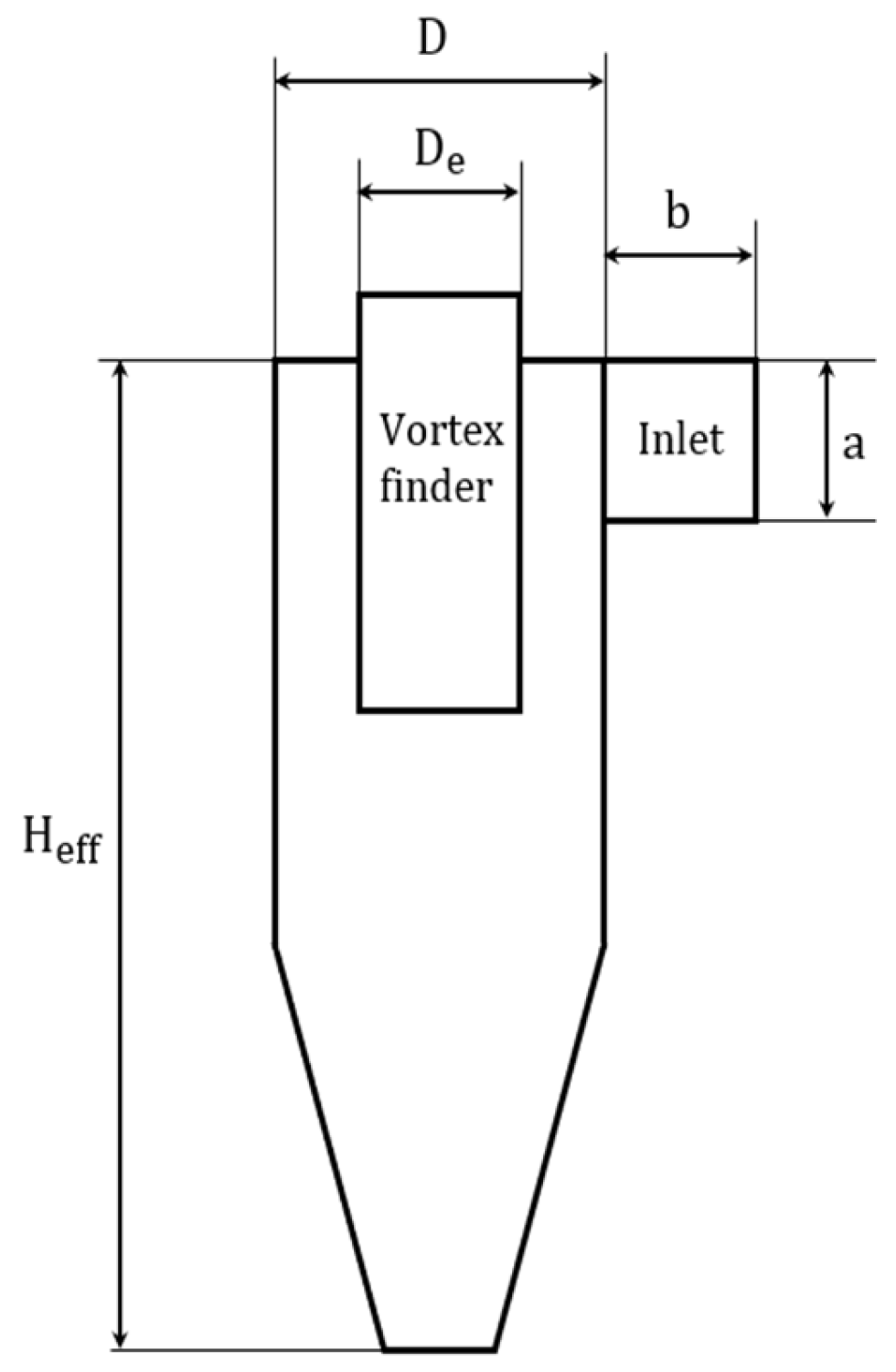
Figure 1 defines the reference reverse-flow cyclone geometry used throughout the derivation and identifies the parameters that enter the reduced-order model, namely D, De, a, b, and Heff. It also clarifies that radial migration is evaluated across the annular region between the vortex finder and the outer wall.
Figure 1.
Simplified cyclone geometry and definition of the parameters used in the model.
The tangential velocity distribution is defined as:
The wall tangential velocity is related to the inlet mean velocity through the dimensionless swirl intensity coefficient Ks:
The operational assumptions are as follows: statistically steady and incompressible flow; dilute suspension (one-way coupling); negligible particle–particle interaction; negligible mean radial gas velocity; and Stokes-regime treatment for the limiting particle associated with d50. For moderate-particle Reynolds number, the dependence on the drag coefficient is handled numerically without changing the analytical derivation.
Gravity and buoyancy are neglected in the radial force balance because centrifugal acceleration dominates in the regime of interest. For submicron particles, a natural extension would be to include the Cunningham slip correction by replacing μ with μ/Cc in the relaxation-time expression τp [41].
Note on particle-size definition: in this article, dp denotes the equivalent geometric diameter of a spherical particle. When literature data reports the cut point as aerodynamic equivalent diameter dae, comparisons should use a consistent diameter definition. For spherical particles in the Stokes regime, a common approximation is dae ≈ dp√(ρp/ρ0), with ρ0 = 1000 kg m−3. For non-spherical particles, a dynamic shape factor χ is required, and for submicron particles, the slip correction Cc becomes relevant [41].
2.2. Radial Equation of Motion
Mass of a spherical particle:
Accelerations in cylindrical coordinates:
Drag force (general form):
where
Momentum balance:
For the radial component, with negligible mean radial gas velocity, one obtains:
The radial equation of particle motion then becomes:
Rearranging gives:
For relatively small particles, tangential velocity synchronization is assumed. This assumption is reasonable when the particle relaxation time is small relative to the rotational time scale (τpuθ/r ≪ 1) so that the particle rapidly follows the tangential gas motion. For coarse particles, tangential slip may become significant and a two-component velocity solution would be required.
Substituting Equation (12) into Equation (11) yields:
Particle Reynolds number based on radial slip:
Stokes regime (Rep < 1)—the drag force becomes linear:
Equation (13) then reduces to the linear forced equation:
Stokes relaxation time:
Compact form:
Non-Stokes correction (handled numerically): for moderate Rep, the Schiller–Naumann correlation may be used:
and the corrected relaxation time becomes:
The Schiller–Naumann extension is applied as a moderate correction beyond the Stokes regime. In regimes dominated by tangential slip, particle–wall interactions, or strongly inertial particle motion, the present reduced-order closure does not capture the full complexity of the underlying physics and thus represents a reduced-order approximation rather than a fully predictive model.
2.3. Closed-Form Derivation of d50
For the limiting particle, a quasi-steady approximation is adopted:
From Equation (18), one obtains:
With the free-vortex expression from Equation (1):
Therefore:
Here, r0 denotes the outlet-tube radius (r0 = De/2) and rw denotes the wall radius (rw = D/2), so that radial migration is evaluated across the annular separation region between those two radii.
Annular area:
Volumetric flow rate at the inlet:
Residence time:
Definition of d50:
After substitution and simplification, with rw = D/2 and r0 = De/2, the final analytical expression is obtained:
2.4. Dimensional Analysis
Flow Reynolds number:
Particle Stokes number:
For the cut size:
From Equation (30), the scaling d502 ∝ (μ/(ρpVin))ab(1 + (De/D)2)/(Ks2Heff) is obtained. Under geometric similarity, with a/D, b/D, De/D, and Heff/D kept constant, this leads to d50 ∝ D1/2 and, equivalently, Stk50 ≈ constant. These relations are useful as internal consistency checks and as guidance for cautious extrapolation between cyclone scales.
2.5. Proposed Turbulence Correction and Fractional Efficiency Model
Unlike classical semi-empirical cyclone models, where turbulence effects are absorbed into global fitting parameters (e.g., effective number of turns or overall efficiency coefficients), the present formulation introduces χt as a separated correction term acting specifically on the apparent cut size. This separation enables a clearer distinction between geometric/inertial contributions and turbulence-induced radial dispersion mechanisms. The turbulence correction is defined as:
The factor χt is introduced as a reduced-order closure that captures the net influence of turbulent radial dispersion, short-circuiting of fine particles, and re-entrainment on the apparent cut size [12,13,14,15,38]. Physically, these mechanisms oppose deterministic centrifugal migration and therefore shift the effective threshold toward larger particle diameters. The coefficient Ct is defined as a calibration parameter for the cyclone family and operating regime under study.
The form χt = 1 + CtI√Re was chosen so that the correction remains dimensionless, approaches unity in the low-turbulence/low-Re limit and increases monotonically with turbulence intensity and inertial flow level. A simple scaling argument supports this choice. If turbulent diffusivity is written as Dt∼u′l, with u′∼IVin and l of order D, then Dt/ν is of order IRe; when the corresponding dispersive contribution enters reduced-order time or distance estimates under a square-root dependence, a √Re term provides a compact semi-empirical representation.
This correction is best interpreted in relation to existing model classes. In classical semi-empirical cyclone correlations, the influence of turbulence and fine-particle losses is typically absorbed into fitted constants, effective numbers of turns, or sharpness parameters, rather than represented by a dedicated correction term. By contrast, high-fidelity CFD and CFD–DEM approaches resolve the local turbulent flow and particle dynamics directly [27,29,38], but at substantially greater computational cost. The present χt term represents an intermediate reduced-order closure that makes the role of turbulence explicit within a closed-form, design-oriented model.
Because χt is phenomenological, Ct and, in practice, I, are not universal constants. Their influence is examined in the sensitivity analysis presented in Section 3.6 and quantitative application of the model requires family-specific calibration against experimental data or matched high-fidelity simulations.
The fractional efficiency curve is represented by the logistic function:
2.6. MATLAB Implementation and Computational Protocol
Equations (30)–(36) were implemented in MATLAB R2025a as a function that receives geometric and physical parameters and returns d50, χt, d50,t, and η(dp) on a prescribed diameter grid. The parametric study varied inlet velocity Vin, particle density ρp, cyclone body diameter D, and gas viscosity μ while maintaining geometric similarity (De = 0.5 D, a = 0.5 D, b = 0.2 D, Heff = 4 D). Unless otherwise stated, gas properties were fixed at ρg = 1.2 kg m−3 and the phenomenological parameters were set to Ks = 1.4, I = 0.05, Ct = 0.02, β = 2, and Eu = 8 for illustrative calculations only.
Because the present formulation is algebraic and reduced-order, it does not involve spatial discretization of the cyclone flow field; consequently, a conventional CFD mesh- or grid-independence analysis is not applicable. The analytical cut size d50 is obtained directly from Equation (30), without a numerical solution of the flow domain. Numerical resolution enters only through the particle diameter vector used to sample the fractional efficiency curve η(dp) and through the iterative update of τp when the Schiller–Naumann correction is applied.
The computational sequence is as follows: (i) compute Q = Vin·a·b and the Reynolds number Re; (ii) evaluate the analytical cut size d50 from Equation (30) and the turbulence factor χt from Equation (34); (iii) obtain the corrected cut size d50,t from Equation (35); (iv) evaluate the logistic grade–efficiency curve η(dp) from Equation (36) over the selected particle-size vector; and (v) when non-Stokes conditions are relevant, update τp iteratively with the Schiller–Naumann correction until convergence.
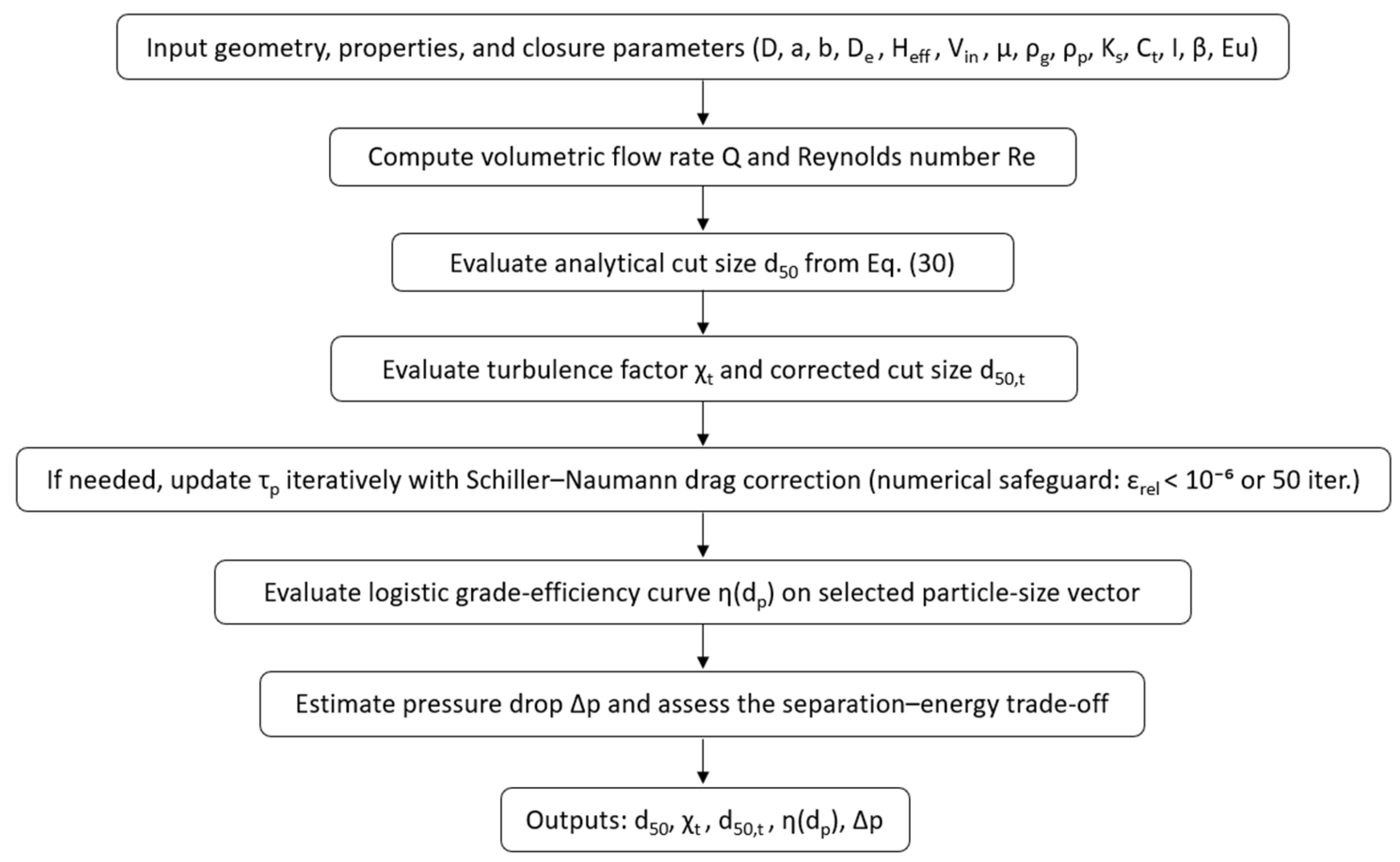
The overall computational logic is summarized in Figure 2.
Figure 2.
Computational workflow of the reduced-order cyclone model.
In Figure 2, inputs include geometry (D, a, b, De, Heff), operating conditions (Vin, μ, ρg, ρp), and closure parameters (Ks, Ct, I, β, Eu). The workflow returns d50, χt, d50,t, η(dp), and Δp; when the particle Reynolds number is outside the Stokes regime, τp is updated iteratively using the Schiller–Naumann correction.
For reproducibility, the particle-diameter vector was defined between 0.3 and 20 μm on a logarithmic grid with 200 points. This discretization affects only the sampling of the fractional efficiency curve η(dp), not the analytical value of d50 obtained from Equation (30). In the non-Stokes calculations, the iterative update of τp was terminated when the relative change between successive iterations fell below 10−6 or when 50 iterations were reached. The value 50 is used solely as a conservative numerical safeguard against indefinite looping in non-convergent cases; the actual convergence criterion remains the relative tolerance.
For the baseline case, a simple estimate of the particle Reynolds number at the threshold, obtained by evaluating Rep at dp = d50 using the mean radial velocity (rw − r0)/tres, gives Rep ≈ 0.025. This supports the use of the Stokes approximation for the fine-particle threshold, whereas the Schiller–Naumann correction becomes relevant mainly for substantially larger particles that are in any case collected with high efficiency.
This baseline estimate provides a case-specific validity check rather than a universal result; for new applications, Rep at d50 must be re-evaluated to determine whether the analytical Stokes form remains applicable or whether a non-Stokes correction is required.
For clarity and reproducibility, the baseline parameter set adopted in the numerical examples is summarized in Table 1.
Table 1.
Baseline parameters used in the numerical examples.
2.7. Relation to Classical Models
A generic expression associated with Lapple-type models can be written as:
Equation (30) can be mapped onto the Lapple-type form of Equation (37) by introducing an effective number of turns Ne,eff = (Ks2Heff/a)[1/(1 + (De/D)2)]. Under this identification, the proposed model reduces to the classical form when Ne ≈ Ne,eff and the geometric effects are absorbed into the effective number of turns. The key theoretical difference, however, is that the present formulation does not collapse geometry, swirl intensity, and turbulence effects into a single empirical constant. Instead, it retains the roles of a/D, b/D, De/D, Heff/D, and Ks explicitly, so that the influence of geometry and closure assumptions can be examined separately.
The model is formulated as a reduced-order analytical framework rather than a fitted universal correlation. This distinction enables the Stokes and non-Stokes forms, the turbulence correction χt, the logistic grade–efficiency curve, and the pressure drop estimate to be treated within a single consistent formulation. A direct quantitative comparison with the standard Lapple baseline and a broader structured positioning relative to other widely used model families are presented in Section 3.10.
3. Results and Discussion
Section 3.1, Section 3.2, Section 3.3, Section 3.4, Section 3.5, Section 3.6, Section 3.7 and Section 3.8 present model-generated trends intended to illustrate scaling laws, parameter sensitivity, and the effect of the proposed turbulence correction. Section 3.9 adds a literature-based validation layer in which the analytical prediction for d50 is compared with reported thresholds and, where available, with the reported pressure drop Δp.
3.1. Inlet Velocity Sensitivity
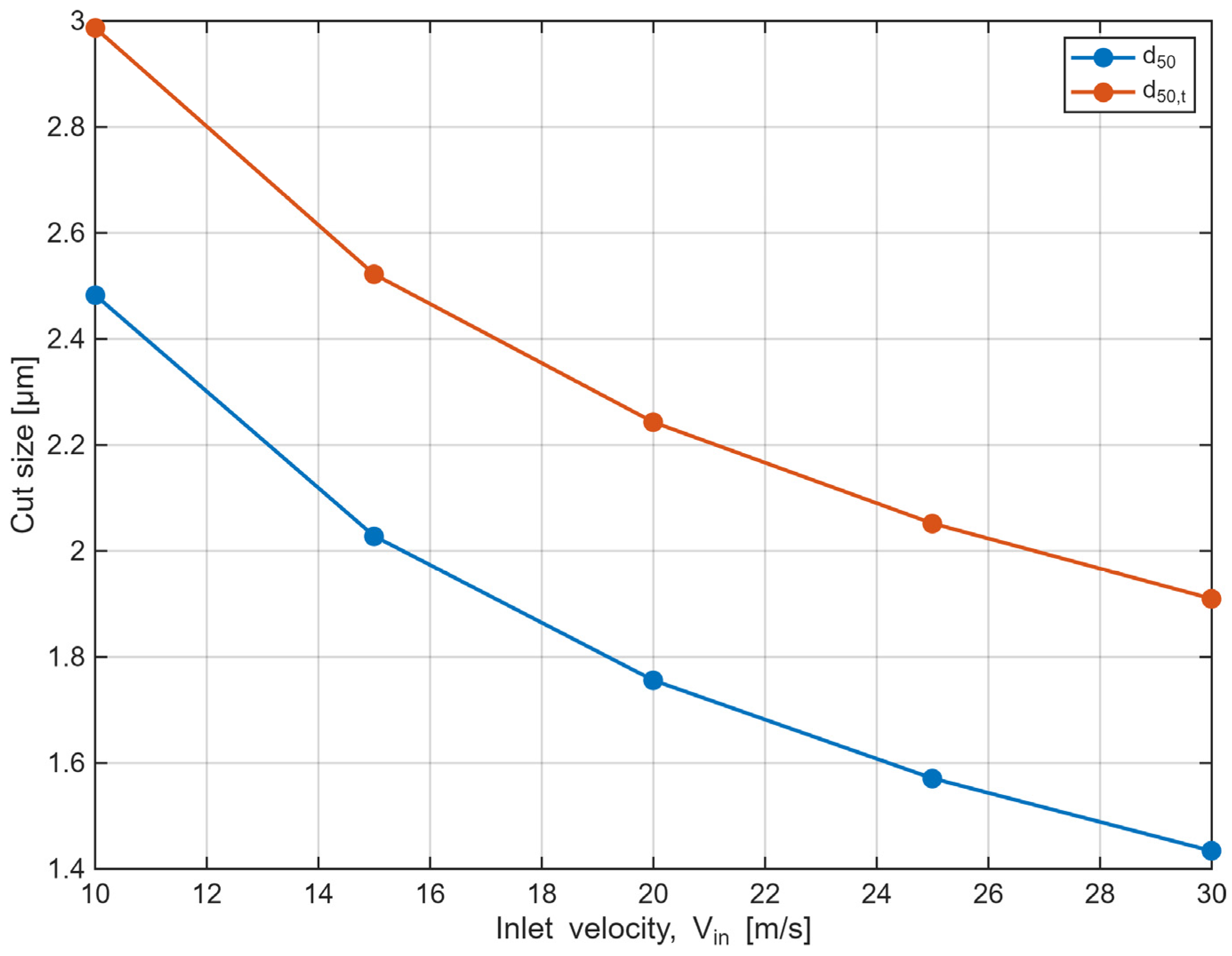
According to Equation (30), d50 decreases approximately as Vin−1/2. The numerical results in Table 2 confirm this trend, from about 2.48 μm at 10 m/s to about 1.43 μm at 30 m/s. Because χt increases with Re in the proposed closure, d50,t remains systematically larger than d50, and the benefit of increasing Vin is partially offset when turbulent dispersion and re-entrainment are represented.
Table 2.
Sensitivity of d50 and d50,t to inlet velocity Vin (baseline case: D = 0.3 m, ρp = 2000 kg m−3, μ = 1.8 × 10⁻⁵ Pa·s; phenomenological parameters Ks = 1.4, I = 0.05, Ct = 0.02).
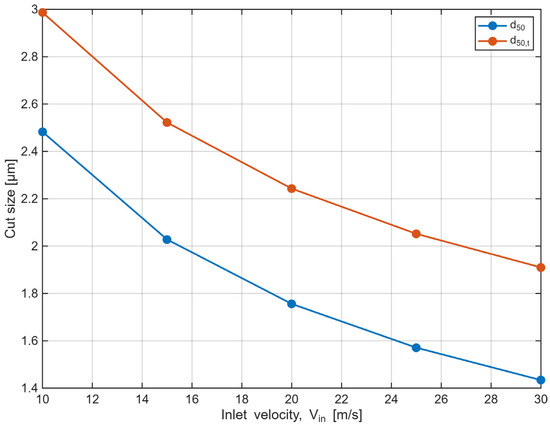
Figure 3 visualizes the monotonic decrease in both d50 and d50,t with increasing inlet velocity.
Figure 3.
Evolution of d50 and d50,t with inlet velocity Vin.
The persistent separation between the two curves reflects the turbulence penalty introduced through χt. Because d50,t = d50√χt and χt = 1 + CtI√Re in the present closure, the offset is only quasi-constant: it changes slightly whenever the operating condition modifies Re, even if Ct and I are held fixed.
3.2. Particle-Density Sensitivity (Vin = 20 m/s)
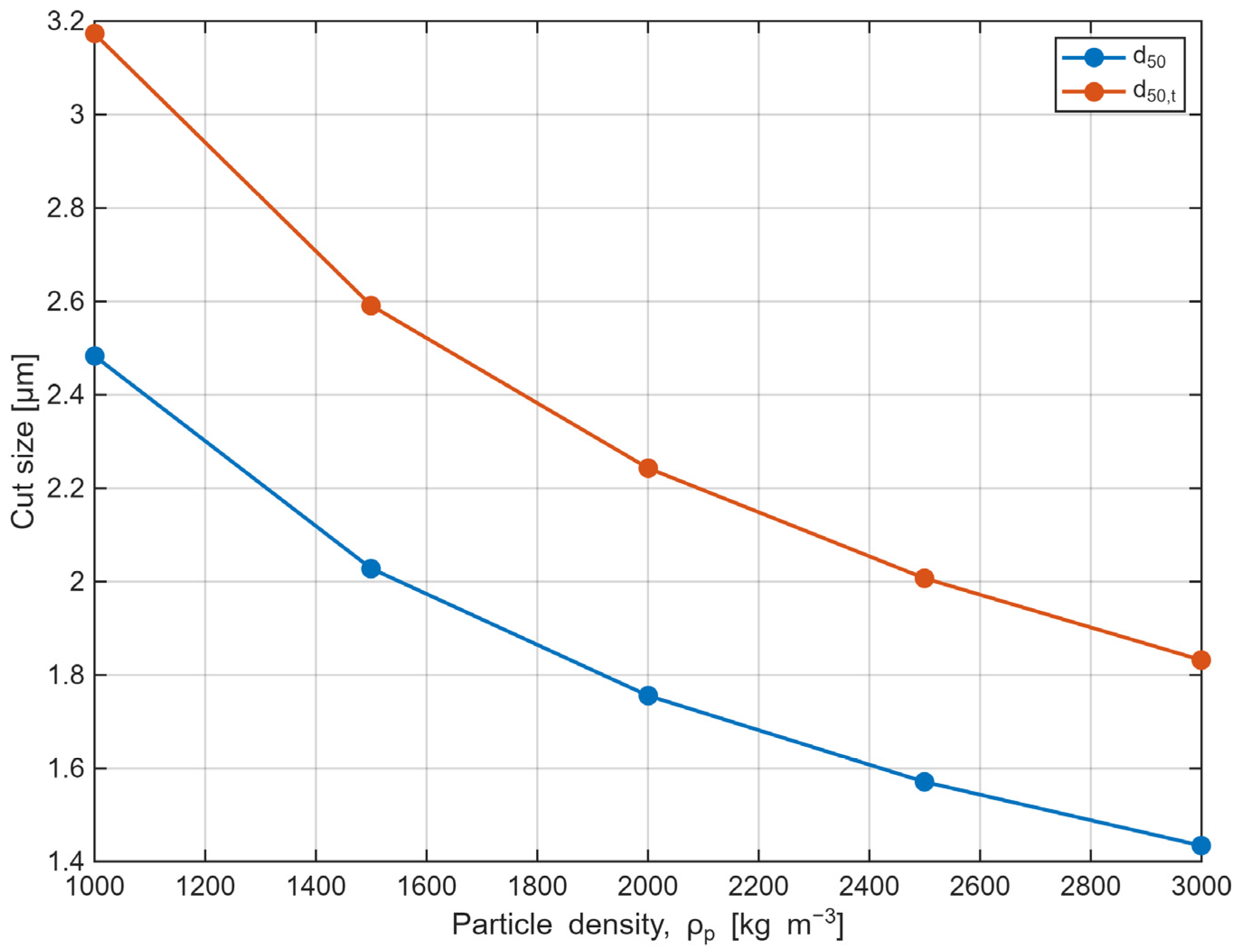
Equation (30) predicts d50 ∝ ρp−1/2, so denser particles are separated more easily. In Table 3, increasing ρp from 1000 to 3000 kg m−3 reduces d50 from about 2.48 μm to about 1.43 μm. Because Re and χt are independent of ρp in the present formulation, the density effect is isolated through the particle relaxation time.
Table 3.
Sensitivity of cut size to particle density ρp (Vin = 20 m/s, D = 0.3 m, μ = 1.8 × 10⁻⁵ Pa·s; all other parameters as in Table 1).
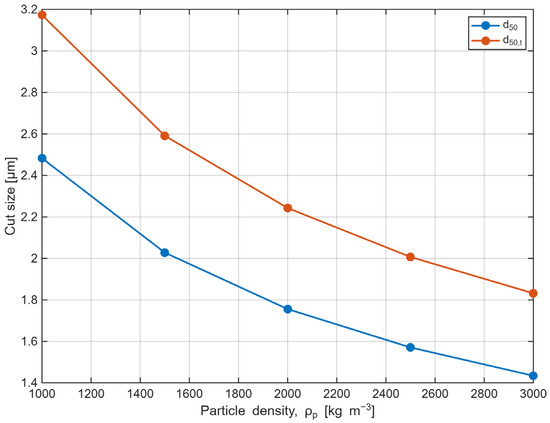
Figure 4 confirms the inverse dependence of cut size on particle density and shows that denser particles are separated more easily.
Figure 4.
Evolution of d50 and d50,t with particle density ρp at constant Vin.
Because χt is unchanged in this one-factor test, the turbulence correction mainly shifts the curve upward without altering its overall trend.
3.3. Cyclone-Diameter Sensitivity
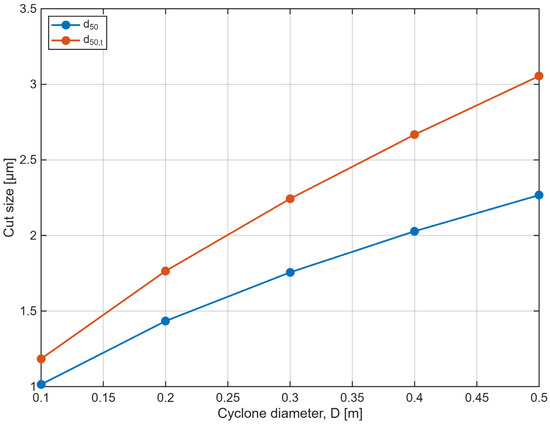
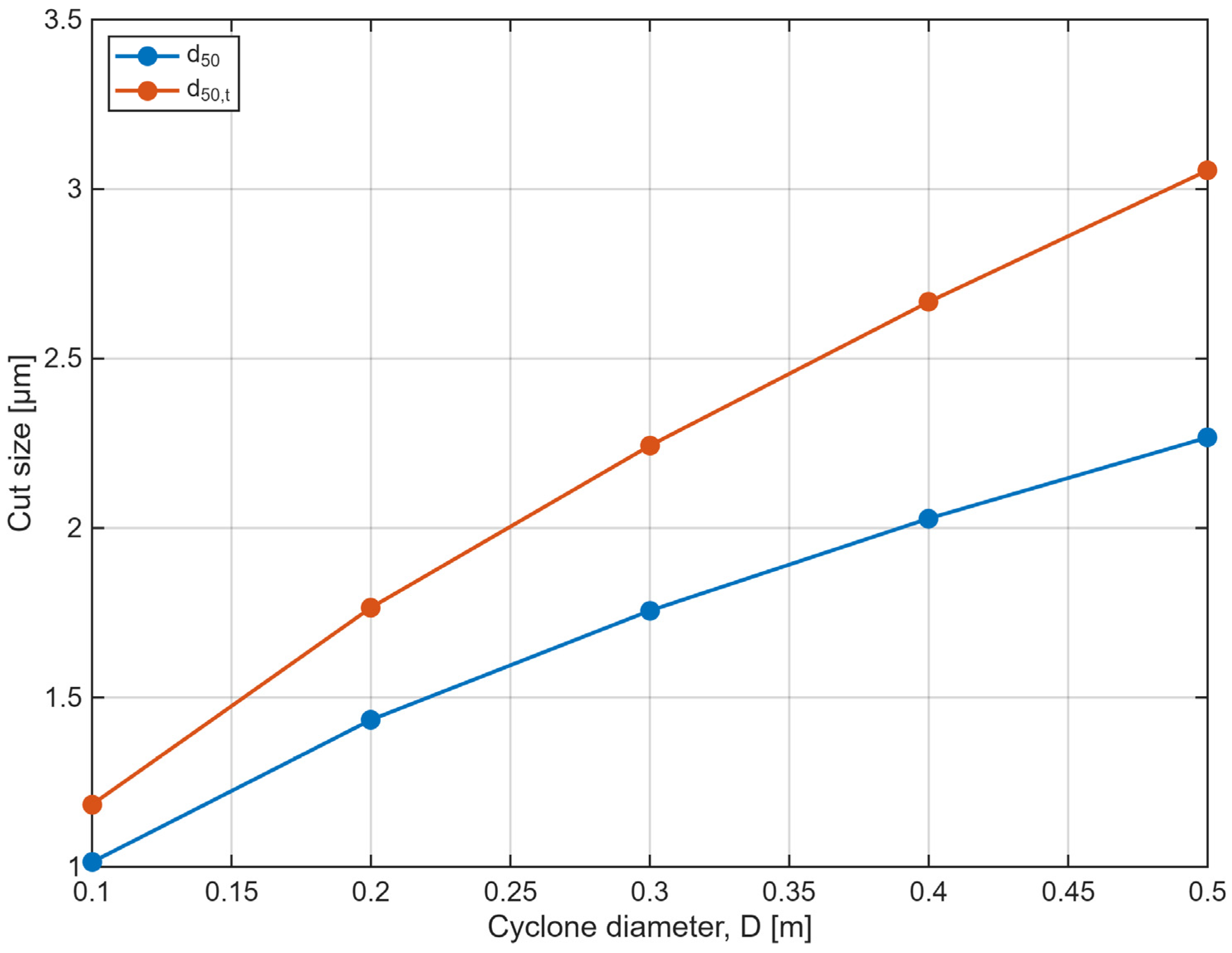
Under geometric similarity, Equation (30) implies d50 ∝ D1/2. Table 4 shows an expected increase in d50 with cyclone size, from about 1.01 μm at D = 0.1 m to about 2.27 μm at D = 0.5 m. At the same time, Re increases with D, so χt also increases mildly and further enlarges the gap between d50 and d50,t for larger units.
Table 4.
Sensitivity of cut size to cyclone diameter D under geometric similarity (Vin = 20 m/s, ρp = 2000 kg m−3, μ = 1.8 × 10⁻⁵ Pa·s).
Figure 5 shows that both d50 and d50,t increase with cyclone diameter under geometric similarity, consistent with the D1/2 scaling implied by Equation (30).
Figure 5.
Evolution of d50 and d50,t with cyclone diameter D under geometric similarity.
The widening gap between the two curves indicates that the turbulence penalty becomes slightly stronger as the Reynolds number increases with D.
3.4. Gas Viscosity Sensitivity at Vin = 20 m/s
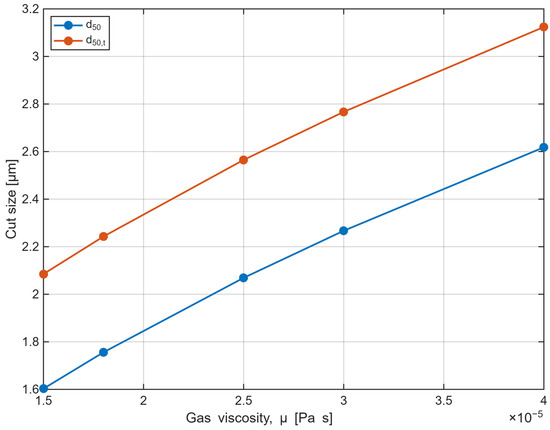
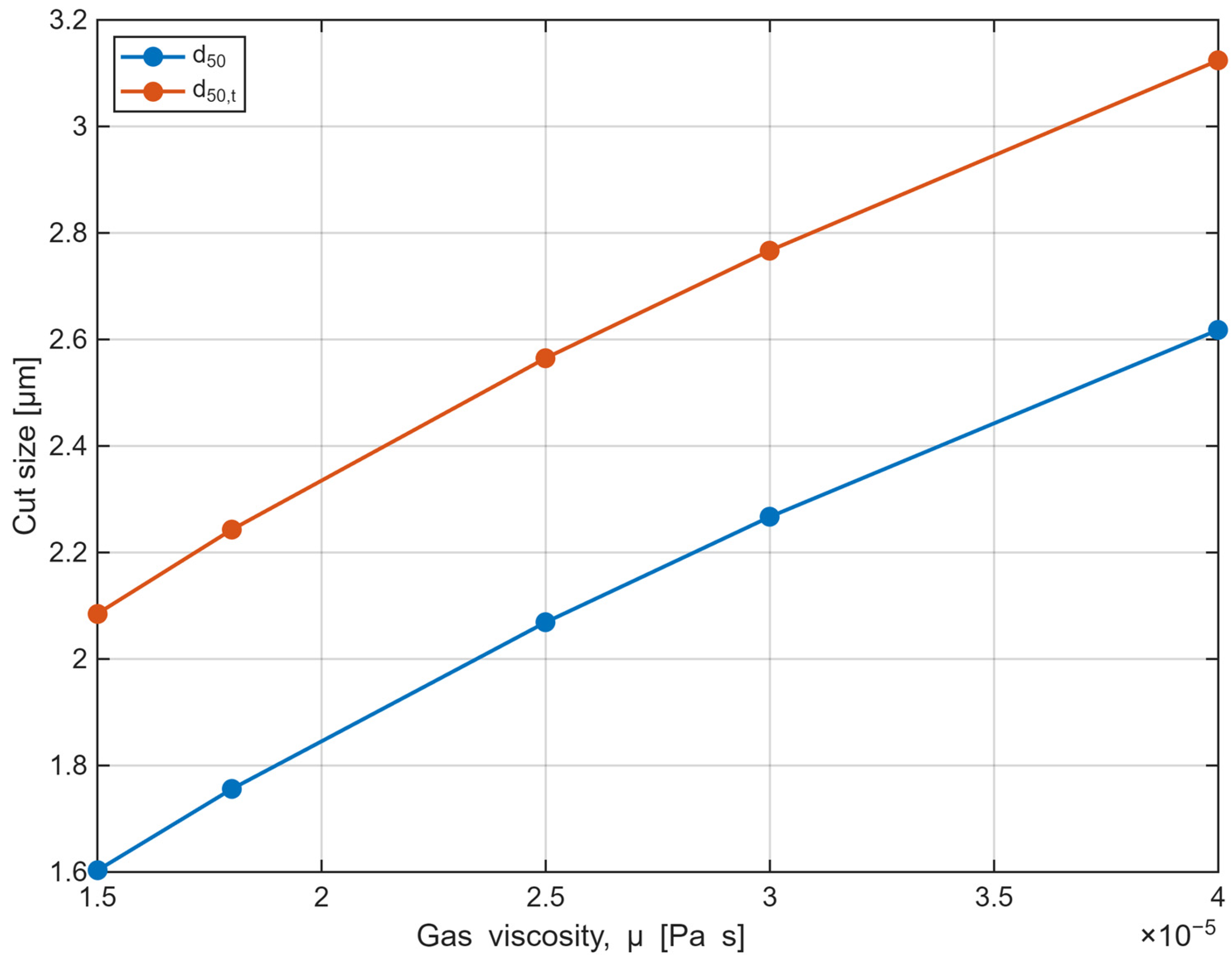
Because Equation (30) gives d50 ∝ μ1/2, a more viscous carrier gas leads to poorer separation performance. In Table 5, increasing μ from 1.5 × 10⁻⁵ to 4.0 × 10⁻⁵ Pa·s increases d50 from about 1.60 μm to about 2.62 μm. Since Re decreases as μ increases, the turbulence penalty χt is reduced slightly in the proposed closure, which partly counteracts the direct viscosity effect but does not overturn it.
Table 5.
Sensitivity of cut size to gas viscosity μ (Vin = 20 m/s, ρp = 2000 kg m−3, D = 0.3 m; all other parameters as in Table 1).
Figure 6 highlights the adverse effect of increasing gas viscosity on cyclone performance, with both threshold diameters shifting upward as μ increases.
Figure 6.
Evolution of d50 and d50,t with gas viscosity μ at constant Vin.
The mild reduction in χt at a higher viscosity moderates the trend but does not compensate for the direct viscosity penalty.
3.5. Example Fractional Efficiency Curve
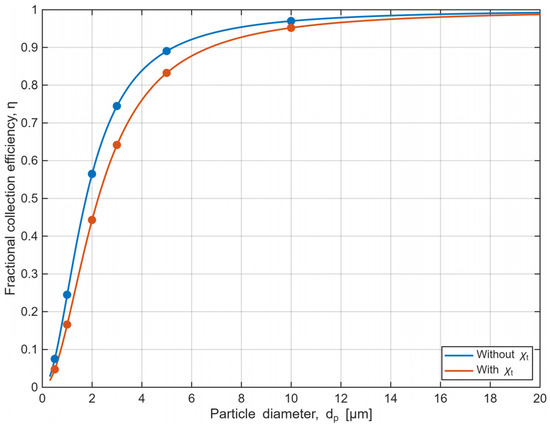
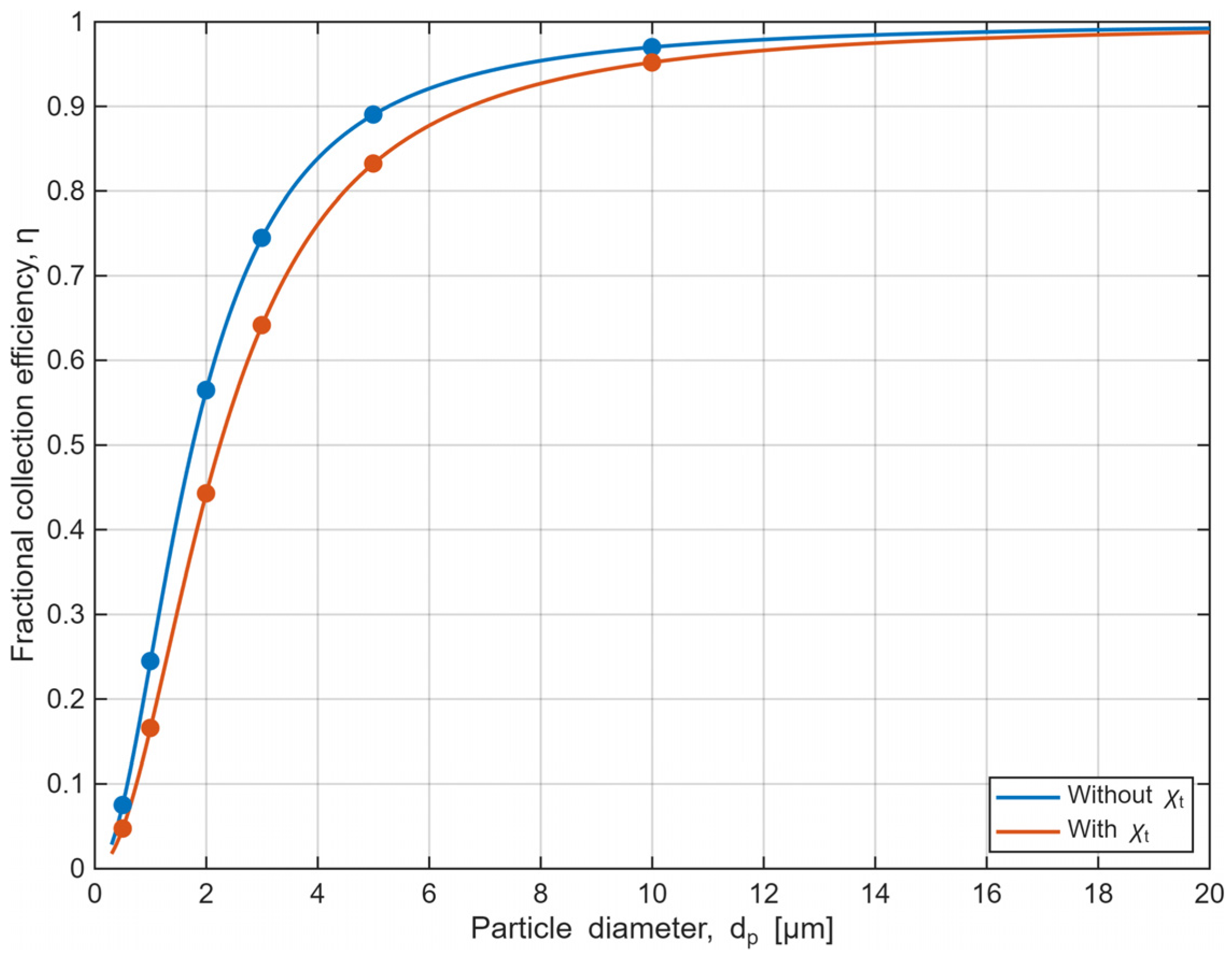
Table 6 illustrates the shape of the logistic grade–efficiency curve. For dp ≪ d50, the collection efficiency is low; for dp ≫ d50, it approaches unity. Introducing the turbulence correction shifts the threshold toward larger particle diameters (d50,t > d50) and therefore reduces predicted collection efficiency in the fine-particle range, consistent with the intended interpretation of turbulent dispersion and re-entrainment.
Table 6.
Illustrative grade–efficiency values η(dp) for the baseline case (β = 2), with and without turbulence correction.
Figure 7 translates the threshold shift from d50 to d50,t into a full grade efficiency.
Figure 7.
Logistic grade–efficiency curve η(dp) for the baseline case (β = 2), with and without the turbulence correction; markers correspond to the discrete values in Table 6.
The turbulence-corrected curve is displaced toward larger particle diameters and predicts lower collection efficiency in the fine-particle range, whereas both curves approach unity for coarse particles.
3.6. Sensitivity to Aggregated Parameters, Calibration Coefficients, and Extrapolation Capability
The purpose of this sensitivity analysis is to clarify the explicit role of the turbulence correction term χt within the reduced-order model and to demonstrate that its influence is physically consistent with expected trends in turbulent dispersion effects reported in cyclone literature.
Equation (30) explicitly separates the geometric contributions (a, b, D, De, Heff) from the aggregated flow-field parameter Ks. In practice, Ks and, in the turbulence-corrected form, the product CtI, control the effective swirl intensity and the penalty associated with turbulent dispersion. These parameters are not universal constants and should be calibrated for a given cyclone family and operating regime.
Table 7 and Table 8 report one-at-a-time sensitivity calculations around the baseline case. The offset between d50,t and d50 is therefore only quasi-constant. Since d50,t = d50√χt, the absolute difference d50,t − d50 = d50 (√χt − 1) depends both on the baseline threshold and on the turbulence factor. As a result, changes in Vin, D, or μ can modify the apparent penalty even when Ct and I are fixed, because they alter Re and/or the underlying value of d50. The penalty is quasi-constant only over limited operating windows.
Table 7.
Sensitivity of d50 to Ks, Heff, and De/D (baseline case: Vin = 20 m/s, D = 0.3 m, μ = 1.8 × 10⁻⁵ Pa·s, ρp = 2000 kg m−3).
Table 8.
Sensitivity of the turbulence factor χt to I and Ct (D = 0.3 m, Vin = 20 m/s, μ = 1.8 × 10⁻⁵ Pa·s, Re ≈ 4 × 10⁵).
The results show that d50 is strongly inversely dependent on Ks and decreases with the square root of Heff. The effect of the ratio De/D is moderate but non-negligible, because a larger outlet tube moves the effective inner radius outward and increases the geometric term that appears in Equation (30). This behavior justifies keeping De/D explicit instead of absorbing it entirely into an effective number of turns.
In Equation (34), χt depends on CtI and √Re. Consequently, uncertainty in either I or Ct can induce large changes in d50,t, especially at a high Reynolds number. Without dedicated calibration, Ct should be treated as a bounded parameter and reported through sensitivity intervals rather than as a fixed universal constant.
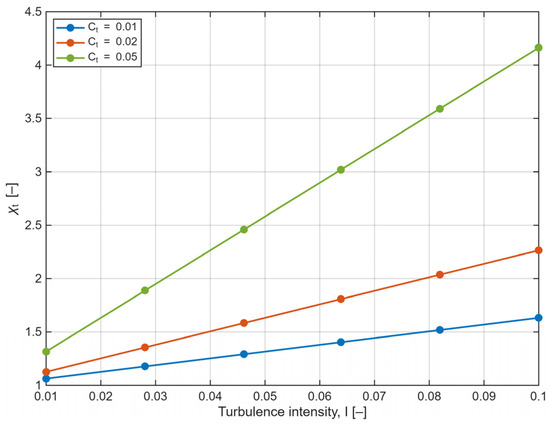
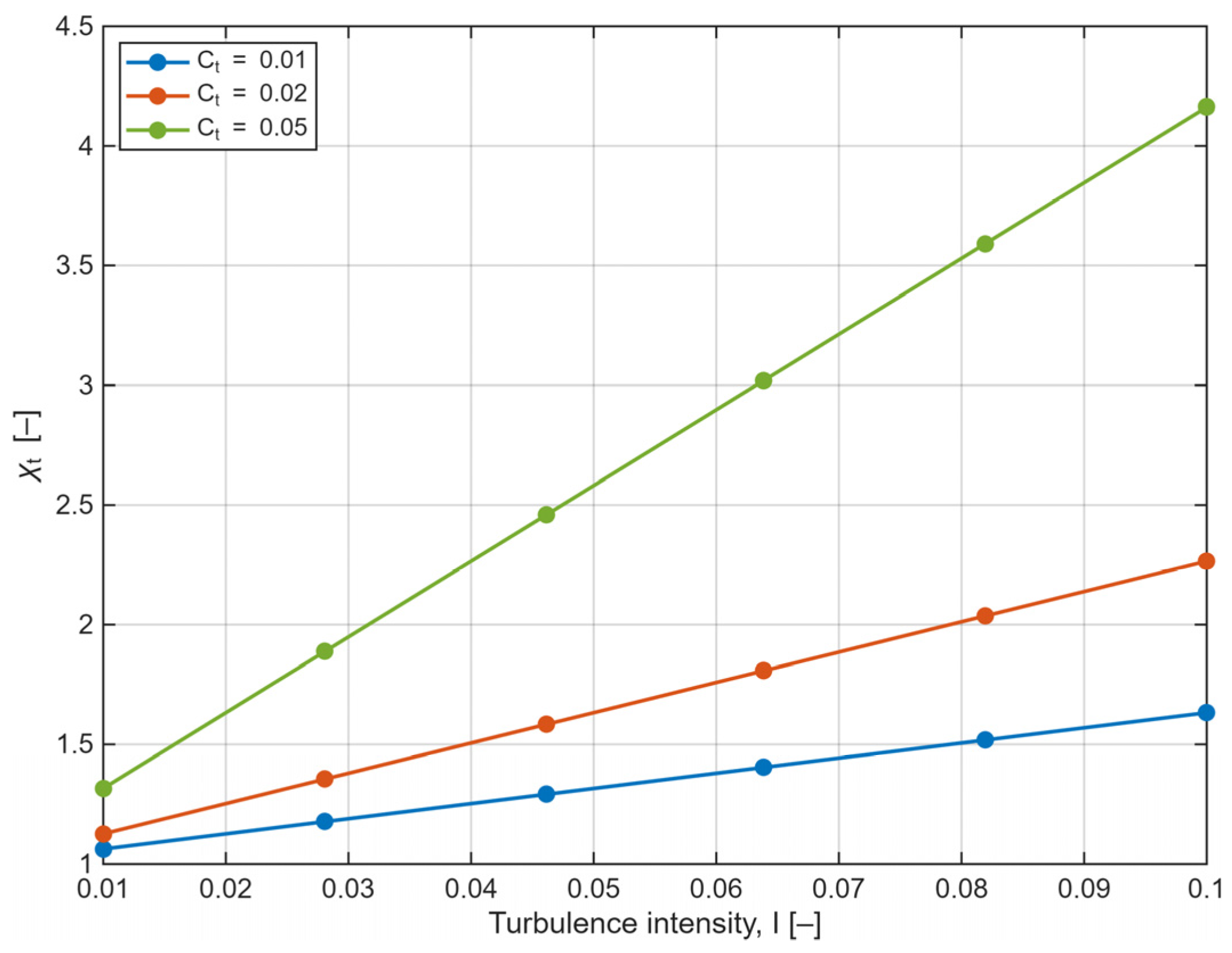
Figure 8 shows that χt increases linearly with turbulence intensity I at a fixed Reynolds number, with the slope controlled by Ct.
Figure 8.
Sensitivity of the turbulence correction factor χt to turbulence intensity I for different values of Ct (Re ≈ 4 × 10⁵).
Figure 8 therefore illustrates why uncertainty in either Ct or I can translate directly into significant uncertainty in the turbulence-corrected cut size.
This behavior reflects the role of χt as a lumped reduced-order closure rather than a turbulence model in the CFD sense. The results in Table 8 indicate that the turbulence penalty acts as a bounded, calibratable correction on the apparent cut size. Without independent information on I or matched calibration of Ct, the model is most appropriately reported with sensitivity intervals rather than as a universal deterministic prediction.
Taking together, Table 7 and Table 8 show that the practical extrapolation capability of the model depends primarily on the stability of Ks and of the product CtI over the operating window of interest. If these closure parameters vary substantially with cyclone family, Re, or turbulence-level predictions outside the calibrated range become less robust and are more appropriately represented as bounded estimates rather than as single-point deterministic values. In that sense, the sensitivity study provides information on the regimes in which extrapolation remains approximately valid.
3.7. Pressure Drop and the d50–Δp Trade-Off
From an engineering standpoint, a cyclone must be evaluated simultaneously by separation performance and pressure drop, because the energy penalty rises rapidly with Δp. Pressure drop is commonly expressed through a Euler-type coefficient, Eu, referenced to the inlet dynamic pressure. In the present work, Equation (38) is used as a transparent reduced-order estimate, while acknowledging that more detailed correlations exist [1,3,4,39].
When no geometry-specific correlation for Eu is available, internal comparisons can be made by assuming Eu≈constant. In that case, Δp scales with Vin2 while d50 decreases approximately as Vin−1/2. The hydraulic power Pf = ΔpQ then scales roughly as Vin3, which makes the separation–energy trade-off explicit.
The results in Table 9 show that higher inlet velocity improves d50 but rapidly increases the energetic burden. Under the Eu ≈ constant assumption, the gain in threshold reduction is much weaker than the growth in pressure drop and power, which is why cyclone design is best treated as a constrained or multi-objective problem rather than as a single-efficiency optimization.
Table 9.
Trade-off between cut size and pressure drop as inlet velocity varies (Eu = 8; Pf = ΔpQ, fan efficiency not included).
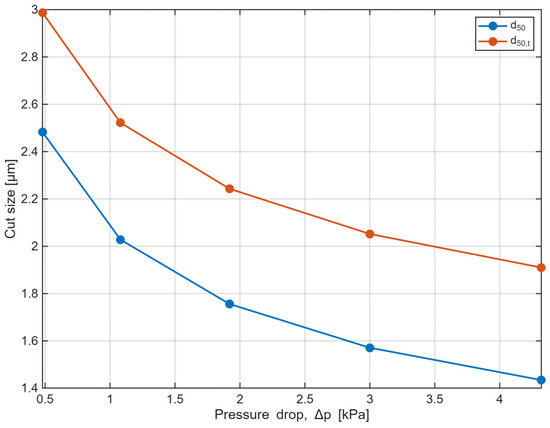
Figure 9 makes the separation–energy trade-off explicit: lower cut sizes are achieved only at the expense of rapidly increasing pressure drop.
Figure 9.
Evolution of cut size, with and without the turbulence correction, as a function of pressure drop (Eu = 8).
The corrected threshold d50,t remains above d50 over the entire range, indicating that turbulence reduces the apparent gain obtained by increasing the operating intensity.
3.8. External Scale-Up Challenge Based on 1D3D (Barrel Length = 1 D and Cone Length = 3 D, Where D Is the Cyclone Barrel Diameter) Cyclones
As a stronger external scale-up test, the primary 1D3D data of Faulkner et al. [42] were used. Four geometrically similar cyclones with D = 15.24, 30.48, 60.96, and 91.44 cm were tested at similar inlet velocities; the mean inlet velocity across all runs was 922 m/min. The reported aerodynamic cut points were 3.4 ± 0.2, 3.9 ± 0.4, 4.0 ± 0.6, and 3.9 ± 0.4 μm, respectively. When Equation (30) is calibrated on the 15.24 cm cyclone and then extrapolated to the larger cyclones under strict geometric similarity while keeping the aggregated parameters constant, it overpredicts their cut sizes. This is informative because it indicates that Ks, the residence time structure, and the effective number of turns cannot be treated as scale-invariant closure parameters over large diameter changes, even within nominally similar 1D3D layouts
3.9. Source Validation Benchmark and Pressure Drop Check
To provide a more defensible quantitative validation step prior to predictive use, the benchmark was rebuilt around the experimental data of Kim et al. [43]. Two geometrically distinct small cyclones were considered. For Cyclone I, Table 1 of [43] gives D = 44 mm, a = 20 mm, b = 10 mm, De = 20 mm, and H = 160 mm, corresponding to a/D = 0.455, b/D = 0.227, De/D = 0.455, and H/D = 3.64. For Cyclone II, D = 30 mm, a = 12 mm, b = 6 mm, De = 15 mm, and H = 122 mm, giving a/D = 0.400, b/D = 0.200, De/D = 0.500, and H/D = 4.07. Because Equation (30) uses an effective residence height Heff, whereas Kim et al. report the overall cyclone height H, the present benchmark uses Heff ≈ H as a reduced-order residence time approximation for these small reverse-flow cyclones. No separate correction from H to Heff was introduced because the source does not report a resolved vortex-reversal height or a residence time distribution.
It is important to clarify that the objective of the present validation is not to establish a universal predictive model across all cyclone configurations and operating regimes, but to assess the consistency of the proposed reduced-order formulation within the limits of family-based calibration. Within this framework, each cyclone family is characterized by similar geometric scaling and flow structure assumptions, allowing one calibration point to define the model parameters, while the remaining cases serve as independent verification points. This validation philosophy is consistent with the reduced-order nature of the model and with the fact that key physical effects (e.g., turbulence and re-entrainment) are represented through lumped correction terms rather than fully resolved flow fields.
For Cyclone I, the conventional point B0 (Qin = 80 L/min, Qminor = 0) was used to calibrate Ks and Eu, after which three independent points B1, B5, and B6 were used for verification. For Cyclone II, the mid-range point E2 (Qin = 50 L/min, Qminor = 4 L/min) was used for calibration, and E1, E3, and E4 were used for verification. The pooled benchmark, therefore, contains six independent d50 cases and six paired Δp cases.
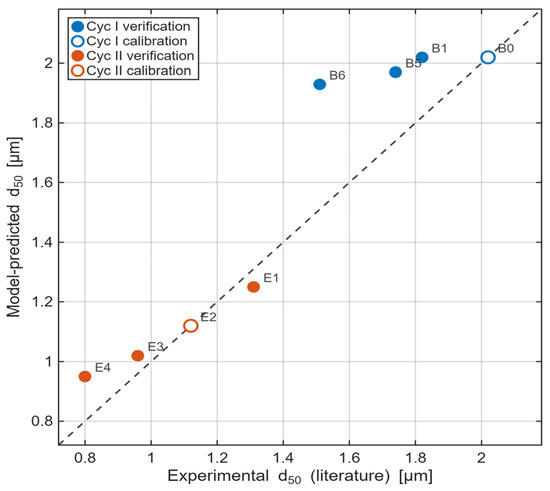
Across the six independent cases, the present model gives a mean absolute percentage error of 13.5% and a root mean square error (RMSE) of 0.22 μm for d50. On the same verification set, the pressure drop check gives a mean absolute percentage error of 2.8% and an RMSE of 34 Pa. The Cyclone II subset is reproduced more accurately, with a mean absolute percentage error (MAPE) of 9.7% for d50, than the moderate-bleed Cyclone I subset (MAPE 17.3%), indicating that the present closure captures conventional intra-family scaling better than the sensitivity to increasing minor-flow extraction.
Table 10 lists the source benchmark in full. All six verification cases include measured pressure drops, so the pressure drop assessment is no longer based on a single point. Figure 10 shows that most benchmark points lie reasonably close to the parity line, particularly for the Cyclone II cases. The largest positive deviations occur for the moderate-bleed Cyclone I points, supporting the view that the present closure reproduces intra-family scaling better than the effect of increasing minor-flow extraction.
Table 10.
Source validation benchmark from Kim et al. [43]. Cal. = calibration; Ver. = verification. Independent verification cases are B1, B5, B6, E1, E3, and E4.
Figure 10.
Comparison between model-predicted d50 and literature values for the Kim et al. [43] benchmark listed in Table 10 (parity line: y = x).
Within the verified benchmark, the model preserves the expected decrease in d50 with increasing inlet flow rate for Cyclone II and reproduces pressure drop scaling very well for both cyclone families. For Cyclone I, the d50 deviations grow as the minor-flow fraction increases, which is physically plausible because the present reduced-order closure does not explicitly resolve the altered residence time distribution produced by the extracted bottom flow.
Table 11 summarizes the external scale-up challenge from Faulkner et al. [42]. Using the 15.24 cm cyclone as a calibration point gives reasonable order-of-magnitude predictions, but the remaining 30.48–91.44 cm cyclones are overpredicted by 23–114%. The result is valuable because it clearly delimits the model’s domain of defensible use: calibration transfers well within a geometric family over nearby operating conditions, but not across large diameter changes when the experimental cut size remains nearly invariant.
Table 11.
External scale-up challenge using 1D3D cut-point data from Faulkner et al. [42]. F1* is the calibration point; F2-F4 are independent challenge cases.
Taken together, Table 10, Table 11 and Table 12 support the use of the present formulation as a family-calibrated reduced-order design tool rather than as a universal predictive model.
Table 12.
Additional literature benchmark from Wang et al. [44] for standard 15 cm 1D3D and 2D2D reverse-flow cyclones tested with fly ash.
In Table 10, d50 predictions from Equation (30) are compared directly with the values reported by Kim et al. [43], and the corresponding pressure drop predictions from Equation (38) are reported using a family-specific Eu calibrated on B0 and E2. Ambient-air properties (μ = 1.8 × 10⁻⁵ Pa·s, ρg = 1.2 kg m−3) and ρp = ρ0 = 1000 kg m−3 were used so that dp ≈ dae for order-of-magnitude comparison. This approximation should be kept in mind when interpreting the absolute errors.
In Table 11, the 1D3D challenge cases are based directly on the cut-point measurements of Faulkner et al. [42]. Standard 1D3D ratios a/D = 0.5, b/D = 0.25, De/D = 0.5, and Heff/D ≈ 4 were used consistently with the reported geometry and the published 1D3D layout. A parity plot comparing model-predicted and experimental d50 values is presented in Figure 10.
The parity plot shown in Figure 10 is consistent with the aggregated MAPE and RMSE values reported above and indicates that the model is more reliable within a calibrated family than under larger perturbations of the flow split.
The slope values reported by Faulkner et al. [42] are retained in Table 11 because they also show that cut sharpness changes with scale even when the cut size itself remains nearly constant.
An additional validation layer was constructed from Wang et al. [44], who reported cut point, slope, and pressure drop for standard 15 cm 1D3D and 2D2D reverse-flow cyclones tested with fly ash under two air-density/velocity conditions. Since the source reports the cut point in terms of aerodynamic equivalent diameter (AED), and fly ash is characterized by a particle density of 2.7 g cm−3, the comparison was carried out in an AED-consistent form, consistent with the dp–dae mapping introduced in Section 2.1.
The standard-air design condition was used as the calibration point for each cyclone family, following the one-point family calibration strategy already applied to the Kim et al. benchmark, while the corresponding actual-air condition was treated as an independent verification point. Wang et al. report that, at the stated air densities, 16 standard m s−1 for the 1D3D cyclone corresponds to 19 actual m s−1, and 15 standard m s−1 for the 2D2D cyclone corresponds to 18 actual m s−1. Under this split, the present model predicts 3.71 μm for the 1D3D actual-air case versus 3.90 μm experimentally, and 4.38 μm for the 2D2D actual-air case versus 4.20 μm experimentally.
The corresponding errors are therefore −5.0% and +4.3%, which yields a two-point verification MAPE of 4.7% and an RMSE of 0.19 μm.
The paired pressure drop check gives 878 Pa versus 755 Pa for the 1D3D actual-air case and 580 Pa versus 580 Pa for the 2D2D actual-air case. The corresponding pressure drop errors are +16.3% and approximately 0.0%, i.e., a two-point verification MAPE of 8.1% and an RMSE of 87 Pa.
This benchmark extends the validation beyond small virtual cyclones to conventional 1D3D and 2D2D reverse-flow families under different operating conditions. It provides additional evidence on the performance of the present formulation as a family-calibrated reduced-order tool, while broader multi-family validation remains necessary for generalization.
In Table 12, standard-air rows were used as family-specific calibration points, while the corresponding actual-air rows were treated as independent verification cases. Cut points are reported in an AED-consistent form.
Overall, Table 10 and Table 12 show that the model reproduces the correct order of magnitude of d50 and Δp across small-cyclone and standard reverse-flow families when one calibration point per family is supplied. Table 11 simultaneously shows that strict similarity with constant Ks fails under cross-scale extrapolation.
Across the three benchmarks, the results indicate that the formulation behaves as a family-calibrated reduced-order tool, while its applicability as a universal predictive law is not supported.
This behavior is consistent with the role of the model, Ks, Ct, and, in practice, I, which are treated as aggregated closure parameters rather than universal constants. The formulation can be positioned between classical algebraic models and recent Computational Fluid Dynamics (CFD)/Machine Learning (ML) hybrid approaches [28,29,30,31,32,33], in the sense that it is more transparent and computationally efficient than full CFD, while still requiring family-specific calibration for quantitative use.
A minimal calibration set contains at least one cut-size datum and, in addition, a measured grade–efficiency curve and a pressure drop datum for the geometry of interest. In the Stokes regime, Ks can be recovered directly by inverse application of Equation (30). If an estimate of turbulence intensity I is available, Ct can likewise be obtained from χt = (d50,t/d50)2 = 1 + CtI√Re. The present data split illustrates this strategy through calibration on B0 and E2 and verification on B1, B5, B6, E1, E3, and E4.
The logistic parameter β controls the sharpness of the grade–efficiency curve. When the literature reports sharpness in the Faulkner form Slope = √(d84.1/d15.9) [42], the logistic relation η(dp) = 1/[1 + (d50/dp)β] [10] gives the approximation β ≈ ln(27.97)/(2ln(Slope)). This provides a direct way to estimate β from reported percentile diameters without iterative fitting.
After calibration, validation should test whether Ks and Ct remain stable over the operating window of interest and whether the same particle-diameter definition is used across all reference data. If this consistency cannot be ensured, the model should be reported together with sensitivity intervals rather than as a single deterministic prediction.
3.10. Comparison with Widely Used Model Families
Two complementary comparisons are presented to relate the present formulation to established cyclone models. Table 13 provides a direct quantitative comparison with the standard Lapple cut-size correlation on the six independent Kim et al. verification cases. Table 14 summarizes the main structural differences between the present model and other widely used reduced-order approaches cited in the Introduction, namely Lapple-type, Leith–Licht, and Iozia–Leith formulations, as well as high-fidelity CFD/CFD–DEM approaches.
Table 13.
Comparison between the present model and the standard Lapple correlation on the six independent Kim et al. [43] verification cases.
Table 14.
Structured comparison between the present model and widely used cyclone-model families.
A fully matched one-to-one numerical comparison against transient 3D CFD or CFD–DEM simulations is not included, as case-matched high-fidelity results for the same geometries and operating conditions are not available in the benchmark datasets used in this study, and generating such simulations lies beyond the scope of the present work. The comparison with CFD/CFD–DEM is instead framed in terms of resolved physics, calibration requirements, and computational cost.
Compared with transient 3D CFD/CFD–DEM approaches, the present model does not resolve the local gas flow field, anisotropic turbulence, vortex-core dynamics, residence time distributions, or individual particle trajectories. Its role is complementary, as it provides reduced-order estimates for d50, η(dp), and Δp at negligible computational cost, whereas high-fidelity simulations provide greater physical detail at significantly higher setup and runtime cost. Table 14 summarizes this difference in modeling scope relative to numerical equivalence.
Table 13 compares the six independent Kim et al. [43] verification cases with the standard Lapple cut-size expression as a classical reduced-order reference for Equation (30). The Lapple baseline is used because it allows a direct evaluation of cut size from the geometric quantities reported by Kim et al., without introducing additional case-specific fitting parameters. The effective number of turns was estimated as N = (h + 0.5 (H − h))/a, where h denotes the cylindrical barrel height. The same air properties and the ρp = 1000 kg m−3 assumption used in Table 10 were retained.
On the six verification cases, the present model yields a MAPE of 13.5% and an RMSE of 0.22 μm, whereas the standard Lapple correlation gives 39.9% and 0.60 μm, respectively. The classical correlation shows a consistent overprediction of the cut size, particularly for the smaller Cyclone II family, while the present formulation better captures the observed decrease in d50 across both families.
This comparison is made in the context of different model formulations. The Lapple values in Table 13 are generic published predictions, whereas the present model is used here as a family-calibrated reduced-order closure. Moreover, the Kim benchmark keeps geometry fixed within each family and mainly probes flow rate variation. Under these conditions, a one-point re-fit of a Lapple-type constant collapses to a similar d50 ∝ Vin−1/2 trend as in Equation (30). The present formulation retains an explicit dependence on D, a/D, b/D, De/D, and Heff/D, and can be extended consistently through the turbulence correction, non-Stokes update, logistic efficiency curve, and pressure drop estimate.
Present-model values are those reported in Table 10. The Lapple baseline is evaluated in its standard published form, without additional case-specific re-fitting.
Table 14 clarifies this positioning more broadly. Relative to classical reduced-order models, the present framework retains the principal geometry ratios explicitly and links d50, turbulence-penalized threshold, grade–efficiency shape, and pressure drop estimate within one consistent formulation. Relative to CFD/CFD–DEM approaches, its advantage lies in transparency and computational efficiency rather than in flow-field fidelity. The price of that simplicity is that Ks, Ct, and, in practice, I, remain family-specific closure parameters and must be calibrated before quantitative use.
A case-matched comparison against transient 3D CFD/CFD–DEM simulations on the same cyclone geometries would be a valuable next validation step.
The comparison framework presented in this section is intended not only to quantify predictive accuracy, but also to highlight the structural differences between modeling approaches. Classical correlations such as the Lapple model rely on strongly lumped empirical representations of cyclone behavior, where geometric and flow effects are implicitly embedded into fitted parameters. In contrast, reduced-order formulations such as the present model and those of Leith–Licht or Iozia–Leith retain partial physical structure but differ in how explicitly geometry, turbulence, and efficiency coupling are represented. High-fidelity CFD and CFD–DEM approaches, while more accurate in principle, operate at a fundamentally different level of resolution and are not directly comparable in terms of computational cost or design usability. It is therefore important to note that no single model dominates across all criteria. While the proposed formulation improves accuracy relative to classical empirical correlations such as Lapple, it retains the reduced-order assumptions and calibration dependence characteristic of semi-empirical approaches. This trade-off between physical interpretability, computational efficiency, and predictive accuracy is inherent to all reduced-order cyclone models.
3.11. Practical Domain of Validity and Limitations
The proposed reduced-order formulation is intended for reverse-flow gas–solid cyclones with tangential inlet operating under dilute, one-way coupled conditions. The analytical cut-size expression derived in Equation (30) is valid when particle motion remains predominantly within the Stokes regime, i.e., Rep at d50 < 1. In the present baseline case, the estimated Rep ≈ 0.025 confirms this assumption for fine-particle separation, consistent with classical drag-regime criteria [41]. This condition should be re-evaluated when geometry, flow rate, or fluid properties change significantly.
The Schiller–Naumann correction is used to extend applicability to moderate deviations from Stokes drag, but it does not cover strongly inertial or transitional regimes [41]. For such cases, more advanced Lagrangian or CFD–DEM approaches are required.
The flow field is idealized as a free-vortex structure in the outer region, while the forced-vortex core, inlet asymmetry, and secondary flow structures are not explicitly resolved. Residence time is approximated using a global volume-to-flow ratio, rather than trajectory-resolved particle motion, which may introduce deviations for geometries outside the calibrated family.
Turbulence effects are included through a phenomenological correction factor χt, which aggregates dispersion and re-entrainment effects into a reduced-order closure. As a consequence, parameters such as Ct and swirl intensity require calibration using experimental data or high-fidelity simulations.
Particle–particle interactions, wall collision effects, and high-solids loading are not included. Similarly, the Cunningham slip and Brownian diffusion are neglected, limiting applicability in submicron aerosol regimes [41]. For coarse particles, deviations from Stokes flow require additional corrections beyond the present framework.
Pressure drop is estimated using a constant Euler number approximation, which should be interpreted as an engineering-level closure. In practice, Eu depends on the Reynolds number, geometry, and surface roughness. Additionally, the absence of an explicit minor-flow term restricts validity to moderate bleed ratios.
Finally, scale-up behavior is not strictly preserved under constant-Ks similarity. External validation indicates that geometric similarity assumptions may fail under large-scale transitions, requiring family-specific calibration [42].
3.12. Future Development of the Model
The Future improvements focus on reducing reliance on empirically calibrated parameters such as Ks, Ct, and I by integrating experimental datasets or CFD/CFD–DEM simulations for specific cyclone geometries. An important extension involves modeling non-uniform residence time distributions and explicitly including minor-flow extraction effects, which are currently lumped into reduced-order terms. Further refinement may also incorporate particle–wall interaction models for higher-solids loading conditions.
From a validation perspective, multi-family benchmark datasets reporting cut size, grade–efficiency curves, and pressure drop under consistent particle-size definitions are required. Such datasets would allow rigorous testing of geometry-dependent scaling laws and improve model generality across cyclone families [43,44]. For fine-particle applications, future extensions may include Cunningham slip correction, Brownian diffusion, and particle-shape effects through dynamic shape factors [41].
Ongoing work by the authors addresses uncertainty-aware reduced-order modeling, where variability in Ks, Ct, and I is propagated to evaluate robustness of design trends under bounded uncertainty.
4. Conclusions
A semi-empirical reduced-order model for reverse-flow cyclone separators has been developed based on the particle equation of motion in cylindrical coordinates combined with an idealized swirling flow field. In the Stokes regime, the model yields a closed-form expression for d50 that explicitly retains the influence of fluid properties, particle density, inlet velocity, and key geometric ratios, enabling transparent sensitivity analysis.
A turbulence correction factor and a logistic grade–efficiency function were introduced to extend applicability toward fine-particle separation, while a simplified Euler-based relation was used to estimate pressure drop and highlight energy–separation trade-offs. Validation against the benchmark dataset of Kim et al. [43] shows a mean absolute percentage error of 13.5% for d50 and 2.8% for pressure drop. Additional comparison with scale-up cases reported by Faulkner et al. [42] confirms that constant-Ks geometric similarity is not universally transferable across cyclone sizes. Complementary experimental results for 1D3D and 2D2D configurations reported by Wang et al. [44] further support the need for family-specific calibration under different operating conditions.
Overall, the model is suitable for preliminary design, sensitivity analysis, and family-calibrated prediction of reverse-flow cyclones under dilute operating conditions. Its predictive accuracy decreases for high-solids loading, strong bleed flows, submicron regimes without slip correction, and large-scale extrapolation without recalibration.
The formulation provides a transparent reduced-order framework that preserves physical interpretability while enabling rapid design exploration. Further improvements require enhanced closure modeling and systematic experimental or CFD-based validation across multiple cyclone families.
Author Contributions
Conceptualization, N.B. and M.C.; methodology, A.C. and M.C.; software, A.C. and M.C.; formal analysis, A.C. and M.C.; investigation, A.C. and N.B.; validation, N.B. and M.C.; writing—original draft preparation, N.B. and M.C.; writing—review and editing, A.C. and M.C.; supervision, N.B. and M.C. All authors have read and agreed to the published version of the manuscript.
Funding
This research was funded by the Romanian Ministry of Education and National University of Science and Technology Politehnica Bucharest through the PubArt Program.
Data Availability Statement
No new experimental data were generated in this study. The source benchmark data used for validation are reported in Faulkner et al. [42], Kim et al. [43] and Wang et al. [44] and are summarized in this article. The spreadsheet used to assemble the benchmark and the MATLAB implementation underlying the parametric study can be made available by the corresponding author on reasonable request.
Conflicts of Interest
The authors declare no conflicts of interest.
Abbreviations
The following abbreviations are used in this manuscript:
| RMSE | Root Mean Square Error |
| 1D3D | barrel length = 1D and cone length = 3D, where D is the cyclone barrel diameter |
| MAPE | mean absolute percentage error |
| CFD | Computational Fluid Dynamics |
| DEM | Discrete Element Method |
| ML | Machine Learning |
References
- Shepherd, C.B.; Lapple, C.E. Flow Pattern and Pressure Drop in Cyclone Dust Collectors. Ind. Eng. Chem. 1939, 31, 972–984. [Google Scholar] [CrossRef] [Scilit]
- Leith, D.; Mehta, D. Cyclone Performance and Design. Atmos. Environ. 1973, 7, 527–549. [Google Scholar] [CrossRef] [Scilit]
- Avci, A.; Karagoz, I. Theoretical Investigation of Pressure Losses in Cyclone Separators. Int. Commun. Heat Mass Transf. 2001, 28, 107–117. [Google Scholar] [CrossRef] [Scilit]
- Karagoz, I.; Avci, A. Modelling of the Pressure Drop in Tangential Inlet Cyclone Separators. Aerosol Sci. Technol. 2005, 39, 857–865. [Google Scholar] [CrossRef] [Scilit]
- Chan, T.; Lippmann, M. Particle Collection Efficiencies of Air Sampling Cyclones: An Empirical Theory. Environ. Sci. Technol. 1977, 11, 377–382. [Google Scholar] [CrossRef] [Scilit]
- Dietz, P.W. Collection Efficiency of Cyclone Separators. AIChE J. 1981, 27, 888–892. [Google Scholar] [CrossRef] [Scilit]
- Dirgo, J.; Leith, D. Cyclone Collection Efficiency: Comparison of Experimental Results with Theoretical Predictions. Aerosol Sci. Technol. 1985, 4, 401–415. [Google Scholar] [CrossRef] [Scilit]
- Leith, D.; Licht, W. The Collection Efficiency of Cyclone Type Particle Collectors—A New Theoretical Approach. AIChE Symp. Ser. 1972, 68, 196–206. [Google Scholar]
- Iozia, D.L.; Leith, D. Effect of Cyclone Dimensions on Gas Flow Pattern and Collection Efficiency. Aerosol Sci. Technol. 1989, 10, 491–500. [Google Scholar] [CrossRef] [Scilit]
- Iozia, D.L.; Leith, D. The Logistic Function and Cyclone Fractional Efficiency. Aerosol Sci. Technol. 1990, 12, 598–606. [Google Scholar] [CrossRef] [Scilit]
- Zhou, L.X.; Soo, S.L. Gas—Solid Flow and Collection of Solids in a Cyclone Separator. Powder Technol. 1990, 63, 45–53. [Google Scholar] [CrossRef] [Scilit]
- Yazdabadi, P.A.; Griffiths, A.J.; Syred, N. Characterization of the PVC Phenomena in the Exhaust of a Cyclone Dust Separator. Exp. Fluids 1994, 17, 84–95. [Google Scholar] [CrossRef] [Scilit]
- Hoekstra, A.J.; Derksen, J.J.; Van Den Akker, H.E.A. An Experimental and Numerical Study of Turbulent Swirling Flow in Gas Cyclones. Chem. Eng. Sci. 1999, 54, 2055–2065. [Google Scholar] [CrossRef] [Scilit]
- Solero, G.; Coghe, A. Experimental Fluid Dynamic Characterization of a Cyclone Chamber. Exp. Therm. Fluid Sci. 2002, 27, 87–96. [Google Scholar] [CrossRef] [Scilit]
- Hoffmann, A.C.; Groot, M.D.; Hospers, A. The Effect of the Dust Collection System on the Flow Pattern and Separation Efficiency of a Gas Cyclone. Can. J. Chem. Eng. 1996, 74, 464–470. [Google Scholar] [CrossRef] [Scilit]
- Avci, A.; Karagoz, I. Effects of Flow and Geometrical Parameters on the Collection Efficiency in Cyclone Separators. J. Aerosol Sci. 2003, 34, 937–955. [Google Scholar] [CrossRef] [Scilit]
- Zhao, B.; Su, Y.; Zhang, J. Simulation of Gas Flow Pattern and Separation Efficiency in Cyclone with Conventional Single and Spiral Double Inlet Configuration. Chem. Eng. Res. Des. 2006, 84, 1158–1165. [Google Scholar] [CrossRef] [Scilit]
- Bernardo, S.; Mori, M.; Peres, A.P.; Dionísio, R.P. 3-D Computational Fluid Dynamics for Gas and Gas-Particle Flows in a Cyclone with Different Inlet Section Angles. Powder Technol. 2006, 162, 190–200. [Google Scholar] [CrossRef] [Scilit]
- Lee, J.W.; Yang, H.J.; Lee, D.Y. Effect of the Cylinder Shape of a Long-Coned Cyclone on the Stable Flow-Field Establishment. Powder Technol. 2006, 165, 30–38. [Google Scholar] [CrossRef] [Scilit]
- Shi, L.; Bayless, D.J. Comparison of Boundary Conditions for Predicting the Collection Efficiency of Cyclones. Powder Technol. 2007, 173, 29–37. [Google Scholar] [CrossRef] [Scilit]
- Griffiths, W.D.; Boysan, F. Computational Fluid Dynamics (CFD) and Empirical Modelling of the Performance of a Number of Cyclone Samplers. J. Aerosol Sci. 1996, 27, 281–304. [Google Scholar] [CrossRef] [Scilit]
- Chen, J.; Lu, X.; Liu, H.; Yang, C. Effect of the Bottom-Contracted and Edge-Sloped Vent-Pipe on the Cyclone Separator Performance. Chem. Eng. J. 2007, 129, 85–90. [Google Scholar] [CrossRef] [Scilit]
- Raoufi, A.; Shams, M.; Farzaneh, M.; Ebrahimi, R. Numerical Simulation and Optimization of Fluid Flow in Cyclone Vortex Finder. Chem. Eng. Process. Process Intensif. 2008, 47, 128–137. [Google Scholar] [CrossRef] [Scilit]
- Elsayed, K.; Lacor, C. The Effect of Cyclone Inlet Dimensions on the Flow Pattern and Performance. Appl. Math. Model. 2011, 35, 1952–1968. [Google Scholar] [CrossRef] [Scilit]
- Elsayed, K.; Lacor, C. Optimization of the Cyclone Separator Geometry for Minimum Pressure Drop Using Mathematical Models and CFD Simulations. Chem. Eng. Sci. 2010, 65, 6048–6058. [Google Scholar] [CrossRef] [Scilit]
- Pandey, S.; Wasilewski, M.; Mukhopadhyay, A.; Prakash, O.; Ahmad, A.; Brar, L.S. Multi-Objective Optimization of Cyclone Separators Based on Geometrical Parameters for Performance Enhancement. Appl. Sci. 2024, 14, 2034. [Google Scholar] [CrossRef] [Scilit]
- Nakhaei, M.; Lu, B.; Tian, Y.; Wang, W.; Dam-Johansen, K.; Wu, H. CFD Modeling of Gas–Solid Cyclone Separators at Ambient and Elevated Temperatures. Processes 2020, 8, 228. [Google Scholar] [CrossRef] [Scilit]
- Park, D.; Go, J.S. Design of Cyclone Separator Critical Diameter Model Based on Machine Learning and CFD. Processes 2020, 8, 1521. [Google Scholar] [CrossRef] [Scilit]
- El-Emam, M.A.; Zhou, L.; Bai, L.; Zhao, Z. Modeling and Performance Analysis of Different Gas–Bioparticle Cyclone Separators: CFD–DEM Simulations. Ind. Eng. Chem. Res. 2023, 62, 18552–18578. [Google Scholar] [CrossRef] [Scilit]
- Misiulia, D.; Lidén, G.; Antonyuk, S. Cyclone Dimensionless Pressure Drop, Cut Size, and Separation Slope: One Dimensionless Number (Reynolds) to Rule Them All. Particuology 2024, 95, 235–251. [Google Scholar] [CrossRef] [Scilit]
- Bregolin, E.; Danieli, P.; Masi, M. Collection Efficiency of Cyclone Separators: Comparison between New Machine Learning-Based Models and Semi-Empirical Approaches. Waste 2024, 2, 240–257. [Google Scholar] [CrossRef] [Scilit]
- Dwars, G.; Mehring, C. Reduced-Order Model for Predicting the Performance of Small-Scale Unidirectional Cyclone Aerosol Separators. Adv. Powder Technol. 2024, 35, 104273. [Google Scholar] [CrossRef] [Scilit]
- Feng, M.; Gui, C.; Zhou, Y.; Lei, Z. Numerical Study on Performance Optimization and Flow Mechanism of a New Cyclone Separator. Green Chem. Eng. 2025, 6, 76–84. [Google Scholar] [CrossRef] [Scilit]
- Kenny, L.C.; Gussman, R.; Meyer, M. Development of a Sharp-Cut Cyclone for Ambient Aerosol Monitoring Applications. Aerosol Sci. Technol. 2000, 32, 338–358. [Google Scholar] [CrossRef] [Scilit]
- Hsiao, T.-C.; Chen, D.; Greenberg, P.S.; Street, K.W. Effect of Geometric Configuration on the Collection Efficiency of Axial Flow Cyclones. J. Aerosol Sci. 2011, 42, 78–86. [Google Scholar] [CrossRef] [Scilit]
- Chen, J.; Yang, B.; Jiang, Z.; Wang, Y. Effect of External Cyclone Diameter on Performance of a Two-Stage Cyclone Separator. ACS Omega 2019, 4, 13603–13616. [Google Scholar] [CrossRef] [Scilit] [PubMed]
- Fassani, F.L.; Goldstein, L. A Study of the Effect of High Inlet Solids Loading on a Cyclone Separator Pressure Drop and Collection Efficiency. Powder Technol. 2000, 107, 60–65. [Google Scholar] [CrossRef] [Scilit]
- Cortes, C.; Gil, A. Modeling the Gas and Particle Flow inside Cyclone Separators. Prog. Energy Combust. Sci. 2007, 33, 409–452. [Google Scholar] [CrossRef] [Scilit]
- Chen, J.; Shi, M. A Universal Model to Calculate Cyclone Pressure Drop. Powder Technol. 2007, 171, 184–191. [Google Scholar] [CrossRef] [Scilit]
- Constantin, M.; Dobre, C.; Chelmuș, A.; Băran, N.; Taban, D.; Ibrean, B.; Dima, D.; Oprea, M. Comparative Study of Single Cyclone Validation and Predictive Simulation of Multi-Cyclone Configurations. Appl. Mech. 2025, 6, 82. [Google Scholar] [CrossRef] [Scilit]
- Hinds, W.C. Aerosol Technology: Properties, Behavior, and Measurement of Airborne Particles, 2nd ed.; Wiley: Hoboken, NJ, USA, 1999; ISBN 978-1-118-59197-0. [Google Scholar]
- Faulkner, W.B.; Buser, M.D.; Whitelock, D.P.; Shaw, B.W. Effects of Cyclone Diameter on Performance of 1D3D Cyclones: Cyclone Cut Point. In Proceedings of the 2007 Beltwide Cotton Conferences, New Orleans, LA, USA, 9–12 January 2007; pp. 1542–1552. [Google Scholar]
- Kim, H.T.; Zhu, Y.; Hinds, W.C.; Lee, K.W. Experimental Study of Small Virtual Cyclones as Particle Concentrators. J. Aerosol Sci. 2002, 33, 721–733. [Google Scholar] [CrossRef] [Scilit]
- Wang, L.; Buser, M.D.; Parnell, C.B.; Shaw, B.W. Effect of Air Density on Cyclone Performance and System Design. Trans. ASAE 2003, 46, 1193–1201. [Google Scholar] [CrossRef] [Scilit]

Disclaimer/Publisher’s Note: The statements, opinions and data contained in all publications are solely those of the individual author(s) and contributor(s) and not of MDPI and/or the editor(s). MDPI and/or the editor(s) disclaim responsibility for any injury to people or property resulting from any ideas, methods, instructions or products referred to in the content. |
© 2026 by the authors. Licensee MDPI, Basel, Switzerland. This article is an open access article distributed under the terms and conditions of the Creative Commons Attribution (CC BY) license.