1. Introduction
Global CO
2 emissions from fossil fuels have shown significant fluctuations in recent years, with a 5.4% decrease observed in 2020 due to the COVID-19 pandemic [
1].
According to recent data, atmospheric CO
2 is the primary contributor to global warming, accounting for 76% of greenhouse gas effects, and to mitigate these impacts and limit the global average temperature increase to 2 °C, carbon capture and storage (CCS) technology is essential [
2].
From the point of view of CO
2 emissions levels and concentrations, the largest sources of stationary emissions are burning fossil fuels for energy production in oil refineries and petrochemical plants (24.2%), followed by transport activity (16.2%) [
3].
Recent publications estimate that atmospheric carbon dioxide accounts for 76% of global warming, followed by methane at 12% and nitrous oxide at 11% [
3].
Therefore, in the last decade, the capture of CO2 from flue gases has become a central theme of Romanian chemical engineering research because the European Community has decided that the oil and gas industry of Romania will store 10 million tons of CO2 from 2030.
The technology of carbon dioxide capture and storage is an integrated process involving the capture of CO2 from burning gases resulting in significant emission points (power plants powered by fossil fuels, operators in the cement industry, steel industry, petrochemical industry, etc.), transport to the storage site, and storage of CO2 in stable geological formations where it can be isolated for the long term.
However, CO
2 capture is technically and economically viable for sources that generate an annual amount of CO
2 exceeding 100.000 t [
4].
The European Union has adopted ambitious targets for reducing greenhouse gas emissions, which cannot be met without significantly reducing CO
2 emissions from fossil fuels [
5].
This reduction is technically possible by applying three types of measures [
6]:
- -
Improving energy efficiency;
- -
The use of renewable energy sources;
- -
The capture and storage of the currently emitted carbon dioxide.
CO2 capture and storage prevent carbon dioxide from the burning of fossil fuels from entering the atmosphere.
Since carbon dioxide is an important greenhouse gas, the Intergovernmental Panel on Climate Change (IPCC) believes that CO
2 capture and storage technology could contribute to limiting greenhouse gas emissions by 15 ÷ 55% and, therefore, combat climate change [
7].
Efforts to capture CO2 must focus on the combustion gases from fossil fuels (coal, natural gas, and oil) generated by electrothermal plants.
Depending on the fuel, the resulting gases contain 13–15% vol. CO2 and have very high flow rates.
A comparative analysis of methods for separating CO2 from such gases indicates that chemical absorption is the most effective.
The method can be implemented in various procedures, depending on the chemical solvent used.
Currently, there are three technological variants in competition [
3]:
- -
Absorption in activated potassium carbonate solutions,
- -
Absorption in ammonia solutions,
- -
Absorption in amine solutions.
Several articles and experiments have sought to determine the absorption efficiency in amine solutions.
However, neural networks have been little used to demonstrate the effectiveness of this carbon dioxide reduction technique.
Salooki conducted the first simulation to demonstrate the process’s efficiency in predicting reflux and CO
2-amine contact temperatures [
8].
Saghatoleslami and Adib developed a similar algorithm and provided temperature and reflux-flow data for a CO
2-amine contact column [
9].
Also, Sipöcz et al. modeled CO
2 absorption from flue gases in MEA solution [
10].
Zhou and Daneshvar present simulation work that models flue gas absorption processes with fuzzy systems based on ANN sensitivity [
11].
While this study focuses on optimizing the absorption stage, the ultimate goal of carbon management often involves the efficient conversion of captured CO2 into value-added chemicals.
Recent breakthroughs in catalysis have highlighted that the structural architecture of catalysts plays a decisive role in these processes.
Specifically, the controlled creation, selective exposure, and activation of more basal planes—while simultaneously minimizing the generation and exposure of edge sites—are crucial for accelerating methanol synthesis from CO
2 hydrogenation over MoS
2 catalysts. To address current bottlenecks, recent research has reported a facile method to fabricate heteronanotube catalysts, where single-layer MoS
2 coaxially encapsulates carbon nanotubes (CNTs@MoS
2) through host–guest chemistry [
12].
Integrating such high-efficiency conversion pathways with the high-accuracy ANN modeling of absorption equilibrium presented in this work is essential for the future development of fully optimized carbon capture and utilization (CCU) systems [
13].
2. Materials and Methods
Absorption of acid gases into alkanol amines is a process long used in industrial applications.
Alkanol amines are chemicals containing at least one hydroxyl group, which reduces vapor pressure and increases water solubility, and one amino group, which provides the alkalinity necessary for CO2 absorption.
The amines of commercial interest studied in this work include:
- -
Monoethanolamine (MEA): a primary amine with the highest alkalinity and fast reaction rates.
- -
Diethanolamine (DEA): a secondary amine often used for refinery gas purification.
- -
Methyl diethanolamine (MDEA): a tertiary amine known for selective H2S removal and low regeneration energy.
- -
Diglycolamine (DGA) and Dipropylamine (DPA).
The relationship between the concentration of CO2 in the liquid phase and its partial pressure in the gas phase—known as CO2 loading (mol CO2/mol amine) or absorption capacity—is essential for plant design.
In the design of gas treatment plants, it is essential to understand the relationship between the concentration of acid gases in amine solutions and their partial pressures in the gas phase, i.e., solubility (or liquid–vapor equilibrium) data.
Selective absorption of H2S from streams containing both acid gases is achieved by sizing the absorbers so that their contact area allows the reaction and absorption of H2S but is insufficient to absorb a significant proportion of the CO2.
The primary, secondary, and tertiary amines used in gas purification processes exhibit distinct physical characteristics that influence their selection for industrial applications. Key properties such as molar mass, density, and boiling point are detailed in
Table 1 below.
The specified literature describes several experimental tests of CO
2 absorption in an amine solution [
14,
15,
16].
The use of aqueous alkanolamines, specifically monoethanolamine (MEA), remains the industrial benchmark for post-combustion CO2 capture due to its high reactivity and low solvent cost. However, optimizing the process requires a deep understanding of the complex interaction between chemical kinetics and phase equilibria.
Shen and Li [
14] provided fundamental insights into the reaction mechanism, establishing the kinetic constants for CO
2 absorption into aqueous MEA and blends. Their work emphasized the dominance of carbamate formation in primary amines, which dictates the theoretical loading capacity. Building on these kinetic foundations, Lee and Lin [
14] focused on the thermodynamic challenges by developing rigorous vapor-liquid equilibrium (VLE) models. By utilizing the electrolyte-NRTL framework, they successfully predicted the CO
2 partial pressure over loaded MEA solutions, a critical parameter for determining the energy required in the stripper section.
The transition from lab-scale kinetics to industrial-scale application was further bridged by Jones et al. [
15]. They developed a rate-based model that accounts for mass and heat transfer resistances, rather than assuming simple equilibrium. Their research highlighted the “temperature bulge” phenomenon within the absorber—a result of the exothermic nature of the amine reaction—which can significantly inhibit absorption efficiency if not properly managed through inter-cooling. Furthermore, more modern computational approaches have sought to simplify these complex simulations; for instance, Sipöcz et al. [
10] and Zhou and Daneshvar [
11] demonstrated that Artificial Neural Networks (ANN) and fuzzy systems can predict column performance with high accuracy while significantly reducing the computational time compared to traditional rate-based models.
The most frequently cited experiments are those given in
Table 2.
New laboratory experiments were conducted at a consistent temperature of 40 °C. Pure CO2 (99.9%) was passed through aqueous solutions of MEA, DEA (2M and 4M), and MDEA.
The CO2 partial pressure was varied while measuring the gas flow rate and concentration at the inlet and outlet of the reactor, to determine the amount of CO2 absorbed.
These results were compared with equilibrium data sourced from specialized literature.
The experiment was designed to pass a stream of pure CO2 through various amine solutions, including MEA, DEA 2M, DEA 4M, and MDA, each chosen for their unique properties and potential in CO2 absorption.
Our experiment aimed to discover mathematical relationships between each research study and data obtained in the literature to define the partial pressure of CO2 versus the amine loading capacity (moles CO2/moles amine).
A local manufacturer supplied (Dafcochim, Romania) pure CO2, and installation created for this experiment consisted of passing CO2 through an amine solution in a reactor at temperatures of 40 °C.
The partial pressure of CO2 was changed, determining the gas flow into and out of the reactor, and the gas concentration was also determined at the inlet and outlet.
3. Results
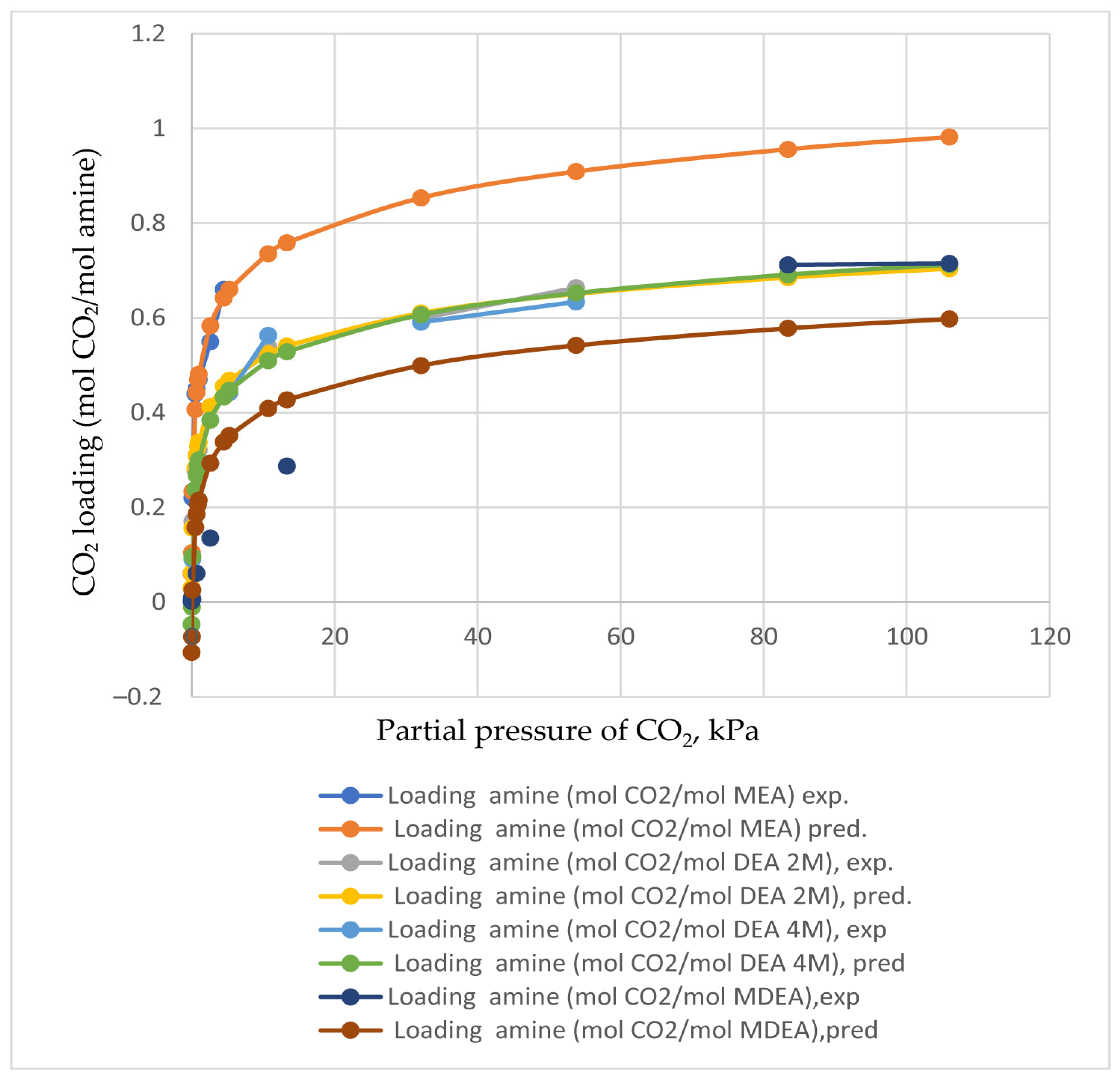
Five experiments were performed to determine the equilibrium curves for CO
2 absorption in aqueous solutions of MEA, 2M DEA, 4M DEA, and MDEA (
Table 3).
Each experiment was conducted under the same laboratory conditions (99.9% CO2 in pure gas and 1% water) and at a reactor temperature of 40 °C.
Also, the concentration and flow rate of the gases entering and leaving the reactor were measured.
The amount of CO2 absorbed by the amine was determined numerically for each component in the experimental setup, based on the inlet and outlet flow rates.
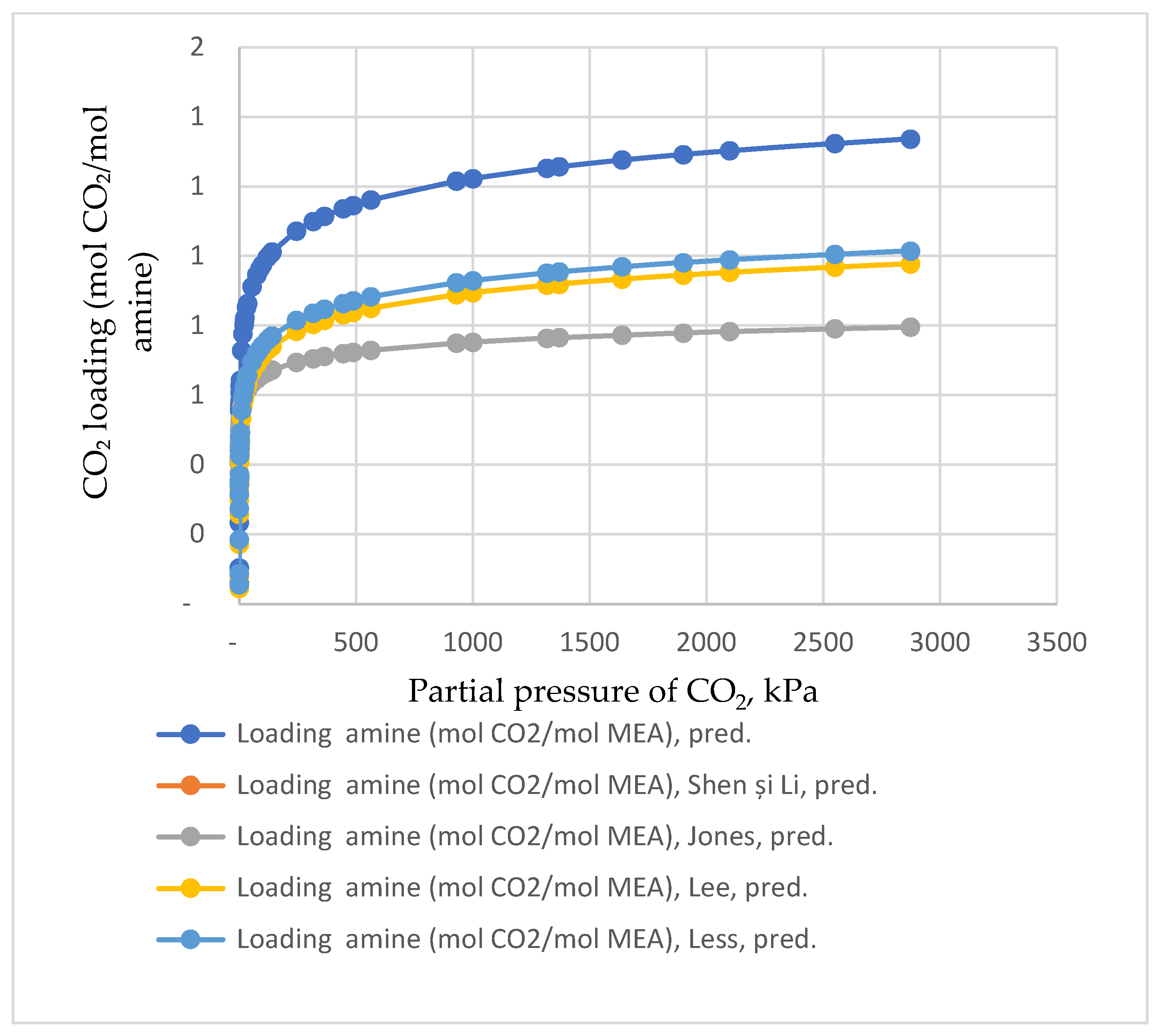
A logarithmic relationship was determined for each experiment, which enabled calculation of the CO
2 absorption process in amine solutions (
Figure 4,
Table 4 and
Table 5).
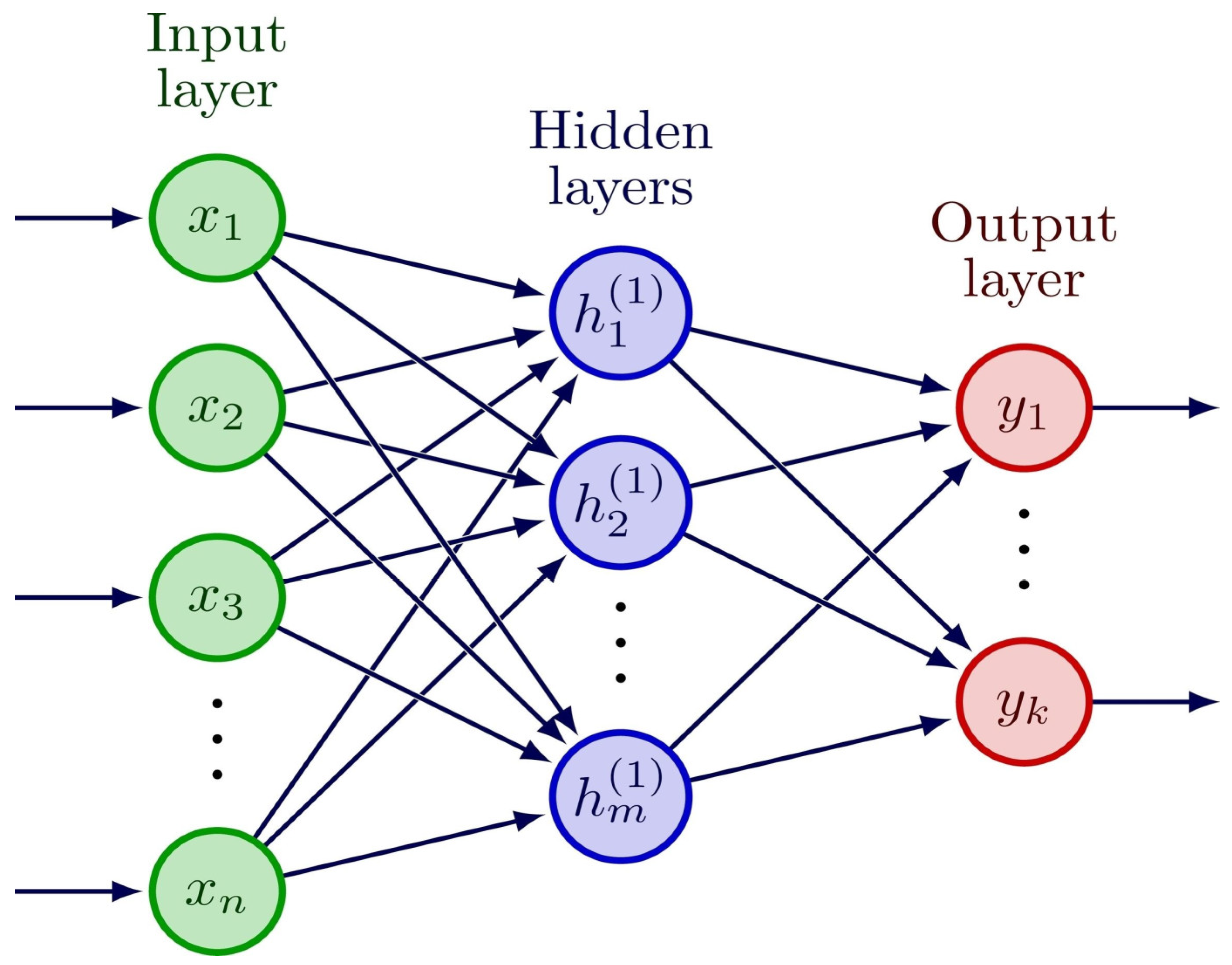
In this paper, for the development of the Artificial Neural Network (ANN) Model, to model the non-linear relationship between amine type, concentration, temperature, and CO2 loading, a Multi-Layer Perceptron (MLP) architecture was employed.
The network consists of an input layer with four variables (CO2 partial pressure, temperature, amine type, and concentration), one hidden layer with 10–15 neurons, and a single output layer for predicted CO2 loading.
The dataset, comprising 75 experimental and literature points, was divided into 70% for training, 15% for validation, and 15% for independent testing, to ensure model generalizability.
Overfitting was mitigated through the “Early Stopping” method, where training is halted once the validation error begins to rise, despite a falling training error.
Model performance was evaluated using R2 and Absolute Average Relative Deviation (AARD).
In this research, we also sought to write the kinetic equations of absorption isotherms (Freundlich [
17], Langmuir [
18], and Temkin [
19]). While the Freundlich, Langmuir, and Temkin models are historically derived for surface adsorption, they are utilized here strictly as empirical curve fits for liquid-phase behavior [
20].
No physical interpretation regarding surface sites or monomolecular layer formation is intended.
The Freundlich model is based on empirical observations, and describes absorption on inhomogeneous surfaces according to the normal or modified equation (
Table 6,
Table 7,
Table 8 and
Table 9) [
17]:
where:
y: amine charge (mol CO2/mol amine).
x: partial pressure of CO2 (kPa).
: Freundlich constant (absorption capacity).
: absorption intensity factor (where n is a measure of heterogeneity).
The Langmuir model is based on adsorption on a homogeneous surface and the analysis of the formation of a monomolecular layer in the absence of lateral interactions between adsorbed molecules (theoretical model) [
18].
where
is the maximum charge of the monolayer (mol CO
2/mol amine) and
is the Langmuir constant (linking the rate of absorption and desorption).
The Temkin model assumes that the absorption energy decreases linearly with surface coverage, according to the equations [
19]:
where
R is the universal gas constant,
T is the absolute temperature (in K) and
is the Temkin constant.
The total loading of the mixture
at a given partial pressure (
and temperature (40 °C) is given by:
where
and
are the CO
2 charge of Amine
A and Amine
B, respectively, calculated using the logarithmic equations, and
and
are the mole fractions of Amine A and Amine B in the mixture, respectively (
.
The equation shows the empirical DEA 2M/DEA 4M mixture model with a 50/50 ratio.
The above empirical model is NOT accurate for mixtures of amines (e.g., MEA + MDEA because of the following:
- -
Nonlinear Chemical Interactions: primary amines (MEA) and tertiary amines (MDE) react with CO2 by different chemical mechanisms.
- -
When mixed, they can interact chemically (activation effect) or physically, changing the total capacity in a nonlinear manner.
- -
Kinetics: adding a fast amine (e.g., MEA) to a slow amine (e.g., MDEA) accelerates the uptake.
- -
This kinetics is a synergistic effect that is not captured by a simple additive equilibrium model. Heat of Reaction: the heat of reaction of the mixture is not a simple average; it depends on complex thermodynamic equilibria, which are essential for regeneration.
Table 6.
Equation models of CO2 absorption in MEA (15.3% amine concentration) and 40 °C experiment temperature.
Table 6.
Equation models of CO2 absorption in MEA (15.3% amine concentration) and 40 °C experiment temperature.
| Models | Regression Forms | Equation | R2 |
|---|
| Logarithmic | | | 0.9725 |
| Freundlich | | | 0.9582 |
| Langmuir | | | 0.8911 |
| Temkin | | | 0.9725 |
Table 7.
Equation models of CO2 absorption in 2M (DEA 2M) (15.3% amine concentration) and 40 °C experiment temperature.
Table 7.
Equation models of CO2 absorption in 2M (DEA 2M) (15.3% amine concentration) and 40 °C experiment temperature.
| Models | Regression Forms | Equation | R2 |
|---|
| Logarithmic | | | 0.9942 |
| Freundlich | | | 0.9601 |
| Langmuir | | | 0.8475 |
| Temkin | | | 0.9942 |
Table 8.
Equation models of CO2 absorption in 4M (DEA 4M) (15.3% amine concentration) and 40 °C experiment temperature.
Table 8.
Equation models of CO2 absorption in 4M (DEA 4M) (15.3% amine concentration) and 40 °C experiment temperature.
| Models | Regression Forms | Equation | R2 |
|---|
| Logarithmic | | | 0.9839 |
| Freundlich | | | 0.9805 |
| Langmuir | | | 0.9201 |
| Temkin | | | 0.9839 |
Table 9.
Equation models of CO2 absorption in MDA and 40 °C experiment temperature.
Table 9.
Equation models of CO2 absorption in MDA and 40 °C experiment temperature.
| Models | Regression Forms | Equation | R2 |
|---|
| Logarithmic | | | 0.8311 |
| Freundlich | | | 0.9245 |
| Langmuir | | | 0.9673 |
| Temkin | | | 0.8311 |
We also created an Artificial Intelligence (AI) model specific to CO2 absorption in amine solutions, which would be an Artificial Neural Network (ANN) with excellent accuracy (R2 > 0.98 and %AARD < 5%).
We completed this model using an ANN and discussed how it can be improved.
The ANN model is ideal for this field, as it can learn complex, nonlinear relationships between operating variables (inputs) and absorption capacity (output), without being limited by the simplifying assumptions of classical thermodynamic models (Langmuir, Freundlich).
The model inputs are the variables that the engineer can control or measure during the absorption process:
- -
CO2 Partial Pressure (pCO2): the main variable, expressed in kPa (or bar/psi).
- -
Solution Temperature (T): measured in °C or K. All experiments were at 40 °C, but including temperature makes the model universally predictive.
- -
Amine Type: this categorical variable (MEA, DEA, MDEA, DGA, and DPA) must be converted to a numeric format (e.g., One-Hot Encoding or a numeric scale based on molar mass 6 or alkalinity).
- -
Amine Concentration (CAmine): expressed in mass or molar concentration (mol/L).
Network Architecture (Hidden Layer) is a simple Multi-Layer Perceptron (MLP) Neural Network structure.
Number of Hidden Layers: typically, one or two hidden layers are sufficient for chemical equilibrium problems.
Number of Neurons: the optimal number of neurons in the hidden layer is determined by iterative testing, often starting with 5–20.
Activation Function: Sigmoid or Rectified Linear Unit functions are frequently used to introduce the necessary nonlinearity in modeling kinetics and equilibria.
Output Variable (Output Layer): the model is trained to predict a single variable, namely the CO2 Loading, expressed in mol CO2/mol amine.
In the field of CO
2 capture, equilibrium behavior is traditionally described by thermodynamic models such as the Kent–Eisenberg or the Electrolyte Non-Random Two-Liquid (e-NRTL) models. While these classical approaches are grounded in physical chemistry, the ANN model developed in this work offers several distinct advantages and a few inherent limitations (
Figure 5 and
Table 10).
- 1.
Handling of Chemical Complexity
Classical models like e-NRTL require the determination of numerous parameters such as interaction energy and chemical equilibrium constants, which are often difficult to measure experimentally for complex amine blends.
In contrast, the ANN model functions as a data-driven tool that inherently “learns” the non-linear chemical interactions and synergistic effects (such as the activation effect when adding a fast primary amine to a slow tertiary amine) without requiring prior knowledge of the reaction mechanisms.
- 2.
Accuracy and Predictive Power
As demonstrated in this study, the ANN model achieved a superior fit, with an R2 of over 0.98 and an AARD below 5%. Classical models often struggle to maintain this level of precision across wide ranges of CO2 partial pressure and different amine types (primary vs. tertiary) unless they are heavily modified with empirical parameters.
- 3.
Computational Efficiency and Practical Application
From a practical engineering perspective, the ANN model is significantly faster to execute once trained, making it ideal for real-time process control and the rapid optimization of post-combustion CO2 capture facilities. However, classical models remain superior for extrapolation; they rely on physical laws that allow them to predict behavior outside of the experimental data range, whereas the ANN is strictly limited to the boundaries of its training dataset.
- 4.
ANN Mathematical Framework
The predictive engine developed in this study is a Multi-Layer Perceptron (MLP) that maps complex nonlinear input parameters to an equilibrium absorption output.
The fundamental operation of each neuron in the hidden layer involves calculating a weighted sum of inputs followed by the application of a bias and a non-linear activation function.
The activation
hj for a specific neuron
j is defined as:
where:
xi represents the input vector (including CO2 partial pressure, temperature, amine type, and concentration).
wij is the weight connecting input i to hidden neuron j.
bj is the bias term for the hidden layer.
represents the Sigmoid activation function.
To capture the saturation-limited behavior of the absorption curves, particularly the flattening observed after 500 kPa, the Sigmoid function was utilized:
The final predicted CO
2 loading (
y) is the resultant signal from the output layer, calculated as follows:
where:
m is the number of neurons in the hidden layer, optimized between 10 and 15.
represents the weights connecting the hidden layer to the output layer.
y is the predicted CO2 loading expressed in mol CO2/mol amine.
The model was trained to minimize the deviation between experimental data and network predictions.
The primary metric for validation is the Absolute Average Relative Deviation (
AARD):
where:
is the experimental loading observed at 40 °C.
is the predicted value from the ANN.
N is the total number of data points used in the study (N = 75).
4. Discussion
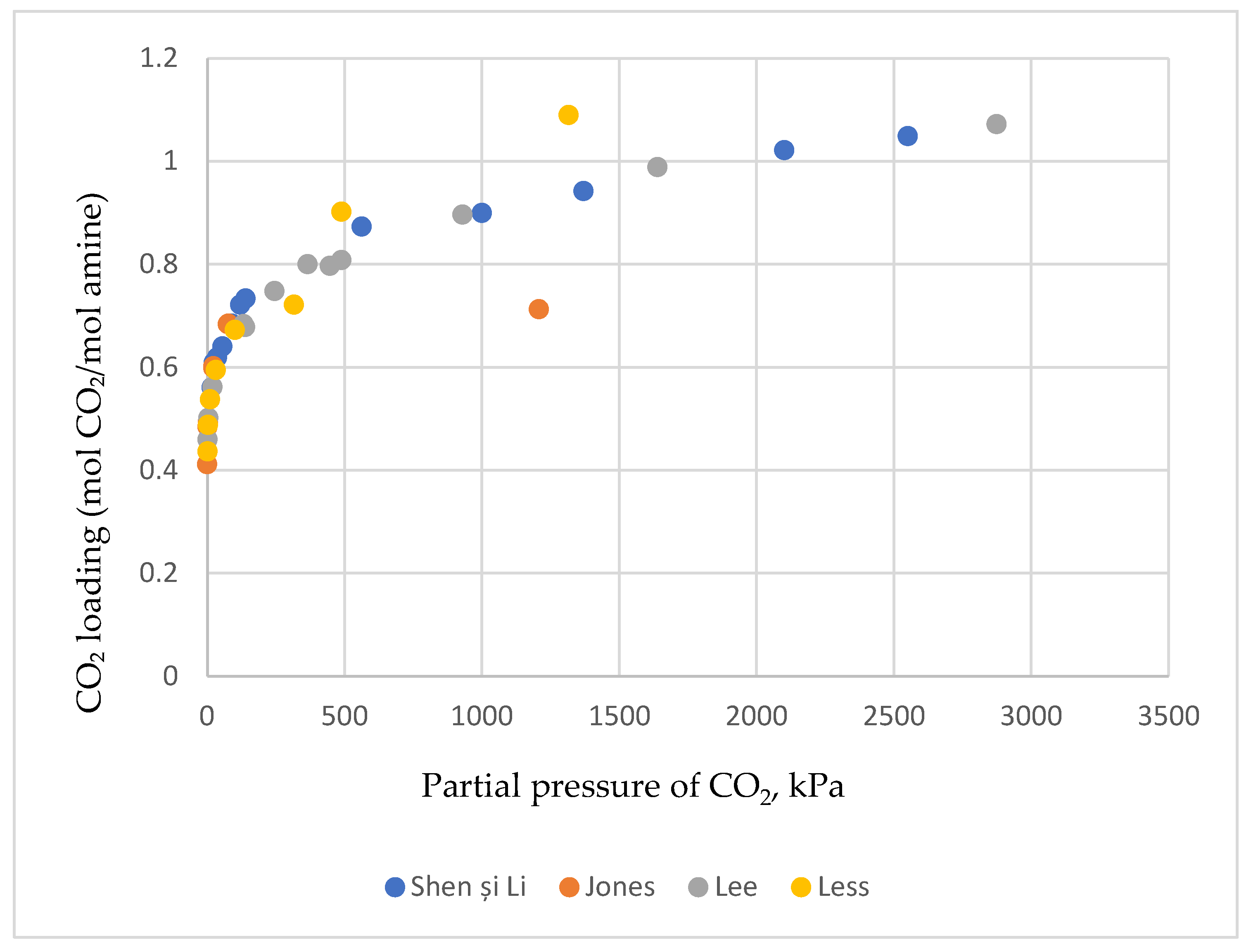
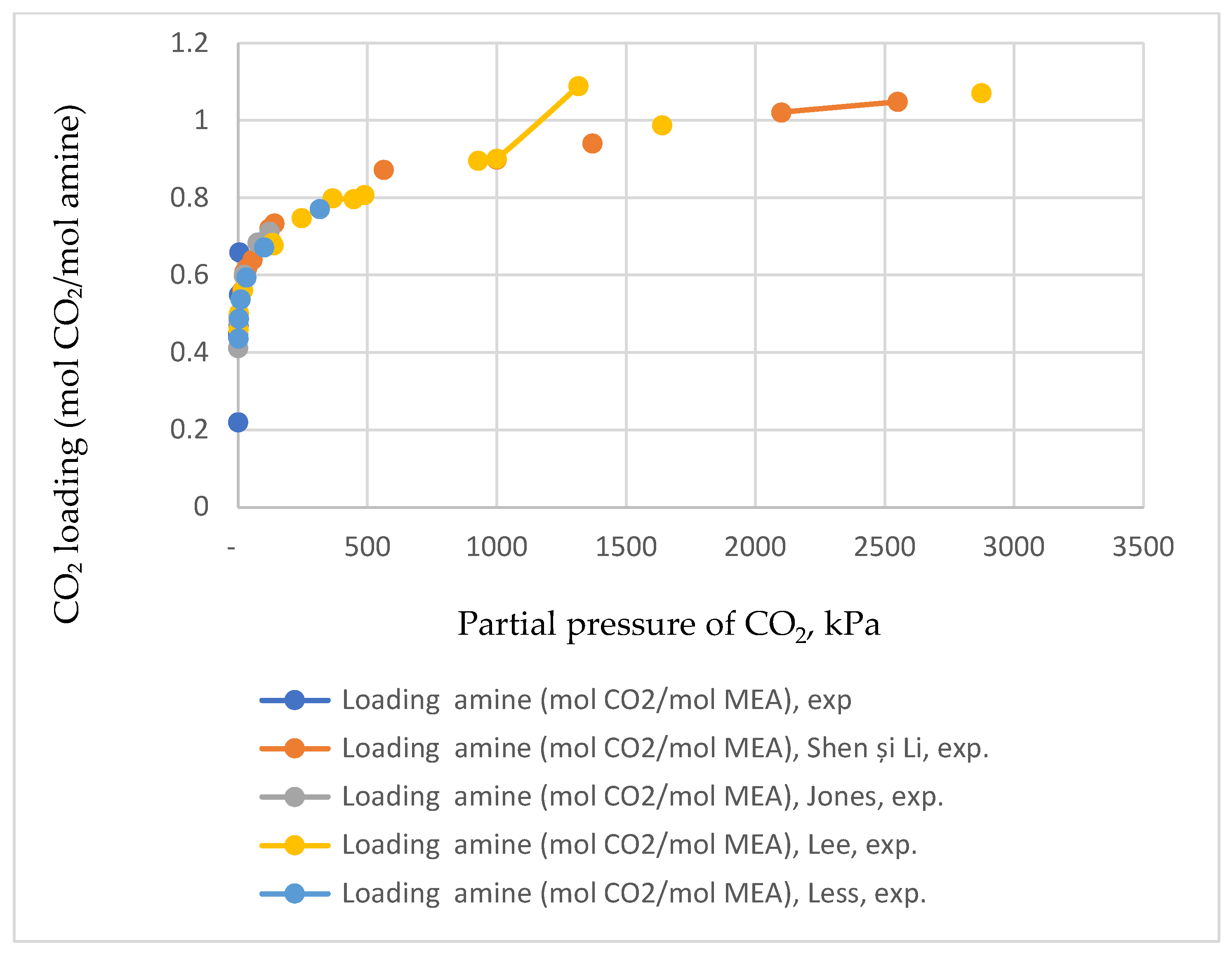
A detailed analysis of the experimental absorption data for MEA solutions compared to those in the specialized literature reveals several key findings:
Comparative Data Analysis
- -
The experimental results align closely with existing literature values, particularly within the 0 to 500 kPa pressure range.
- -
Logarithmic models provide an accurate description of CO2 absorption in amine solutions.
- -
Among the models tested, the predictions based on the study by Shen and Li show the highest proximity to the experimental data [
4].
- -
Subsequent error analysis was performed for each relationship, to validate accuracy against experimental results.
Amine Performance and Behavior
MEA-type amines demonstrate the highest CO2 absorption capacity.
Under specific partial pressures, MEA can achieve a loading of 1 mol CO2/mol MEA.
MDEA amines exhibit the lowest overall absorption capacity among the solvents tested [
8].
Both DEA 2M and DEA 4M exhibit nearly identical absorption behavior [
9].
Technological Context
The removal of CO2 emissions can be achieved through several established methods:
- -
Solid adsorption.
- -
Absorption in liquid solvents.
- -
Membrane separation.
- -
Physical or biological separation techniques.
Among these, gas–liquid absorption is recognized as one of the most mature and commercially viable technologies.
It is widely utilized in industrial chemical processes, such as ammonia and hydrogen synthesis.
Modeling Scope and Technical Specifications
While the Artificial Neural Network (ANN) and empirical models offer high precision, their theoretical boundaries must be clearly defined.
Empirical Nature of Isotherm Models
The Langmuir, Freundlich, and Temkin models are applied in this study strictly as empirical curve fits.
While these models originated from surface-adsorption theory, CO2 capture in amines is actually a liquid-phase dissolution and chemical reaction process.
No physical interpretation regarding monomolecular layers or surface sites is intended.
The high correlation found for MDEA using the Langmuir model (R2 = 0.9673) is purely a mathematical representation of its saturation-limited behavior.
ANN Technical Details and Reproducibility
To maintain model robustness, the following parameters were utilized:
- -
Dataset: a total of 75 experimental and literature data points covering MEA, DEA, MDEA, DGA, and DPA were used for training.
- -
Data Splitting: the data was divided into 70% training, 15% validation, and 15% testing, to prevent overfitting.
- -
Architecture: a Multi-Layer Perceptron (MLP) was used, featuring an input layer (pressure, temperature, concentration, and amine type), hidden layers with 10 to 15 neurons, and a single output layer for predicted loading.
- -
Training: the model utilized a Sigmoid activation function and a backpropagation optimizer to minimize the Absolute Average Relative Deviation (AARD).
Constraints on Generalizability
The current ANN employs categorical identity for amine types, rather than molecular structural descriptors.
Consequently, the model is highly precise for the specific solvents included in the study (MEA, DEA, MDEA, DGA, and DPA) but cannot be reliably extrapolated to new amine structures or proprietary mixtures without additional data and retraining.
5. Conclusions
The global imperative to mitigate climate change has positioned Carbon Capture and Storage (CCS) as a necessary technology.
Within this framework, chemical absorption is the preferred method for reducing CO2 from flue gas streams.
This work successfully employed a machine learning-based approach, utilizing Artificial Neural Networks (ANNs), to model the equilibrium CO2 absorption capacity (loading) across various alkanolamine solutions, including primary, secondary, and tertiary amines.
Technological Context and Carbon Capture
Capture Technologies: three primary CO2 capture technologies are currently recognized: pre-combustion, oxy-combustion, and post-combustion.
Absorption Method: gas–liquid absorption is the most widely utilized technological and commercial method in the chemical sector.
Solvent Selection: the most commonly used solvents include monoethanolamine (MEA), diethanolamine (DEA), and methyl diethanolamine (MDEA).
Chemisorption Mechanism: this process involves a chemical reaction between CO2 and the solvent to form a weakly bound intermediate, which can be regenerated, producing a relatively pure CO2 stream.
Modeling Performance and Findings
The data-driven models developed in this study demonstrated high efficacy in predicting equilibrium CO2 loading.
ANN Accuracy: the developed prediction model achieved a high coefficient of determination R2 > 0.98 and an absolute average relative deviation (AARD) of under 5%.
Empirical Isotherms: while historically adsorption-based, the Langmuir model provided the most accurate empirical representation for the tertiary amine MDEA (R2 = 0.9673), indicating a saturation-limited absorption capacity in the studied range.
Logarithmic Correlations: experimental datasets were successfully described by logarithmic equations:
- -
In the low-pressure range (0 to 10 kPa), absorption is best described by the relationship presented by Jones.
- -
In the high-pressure range (10 to 2873 kPa), the fit closest to experimental reality is described by Lee’s experiment.
Absorption Behavior: modeling confirms that amines are strongly absorbing in the 0 to 500 kPa range, after which the absorption curve flattens.
Chemical Engineering Insights on Amine Performance
The comparison of absorption capacities at a consistent temperature of 40 °C revealed distinct chemical behaviors among the amine classe
Primary (MEA) consistently demonstrated the highest absorption capacity in both low and high-pressure range. At 2873 kPa, loading can reach a 1:1 stoichiometric ratio (1 mol CO2/mol amine).
Secondary (DEA)-DEA 2M solutions were found to be more absorbent than the higher-concentration DEA 4M solutions.
Tertiary (MDEA) exhibited the lowest absorption capacity [
19]. However, this is offset by lower costs and reduced regeneration energy, due to its non-carbamate-forming mechanism.




 ,
,