
Review

Material-Based Hydrogen Storage Technologies: A Frontier Overview of Systems, Challenges, and Machine Learning Integration


by
Haval Kukha Hawez
1,*,
Jaidon Jibi Kurisinkal
2 and
Taimoor Asim
2
1
Department of Chemical Engineering, Faculty of Engineering, Koya University, Koya KOY45, Kurdistan Region-F.R., Iraq
2
School of Computing, Engineering and Technology, Robert Gordon University, Aberdeen AB10 7GJ, UK
*
Author to whom correspondence should be addressed.
ChemEngineering 2026, 10(3), 34; https://doi.org/10.3390/chemengineering10030034
Submission received: 22 December 2025 / Revised: 10 February 2026 / Accepted: 25 February 2026 / Published: 3 March 2026

Abstract

The intermittency of renewable-based power is a major barrier for long-term supply of clean energy, which necessitates the development of reliable solutions for clean energy storage and transition towards a carbon-neutral economy. Although hydrogen has emerged as a promising clean energy carrier to address this, its high compressibility requires safe, efficient and practical storage technologies for widespread deployment. Surface storage technologies for hydrogen have garnered attention due to their mobile and stationary applications, paving the way for a future hydrogen-based economy. This review provides a comprehensive review of surface hydrogen storage technologies, covering metal hydrides, metal-organic frameworks (MOFs), liquid organic hydrogen carriers (LOHCs), glass microspheres, capillary arrays, etc. Where previous reviews mostly address the chemistry behind these storage technologies, this study highlights practical integration and techno-economic assessment. Comparative analysis reveals that while LOHC and hydrides dominate in Technology Readiness Level, MOFs and carbohydrate-based systems offer high gravimetric potential, though they are currently quite costly. Other challenges like thermal management and large-scale regeneration remain critical for practical deployment. Moreover, recent advancements in Artificial Intelligence and Machine Learning offer unique insights, demonstrating their growing role in material screening, performance prediction, and the optimization of storage system designs. This review outlines the key challenges and research pathways required to support future deployment.

1. Introduction

Power-to-hydrogen technology converts excess renewable electricity into H2, which can be stored and later used for power generation when required. This facilitates the incorporation of renewable energy into sectors currently dominated by fossil fuels, replacing conventional grey or blue H2 with the more environmentally friendly green H2. Since renewable outputs fluctuate with weather and poorly align with consumption patterns, storage is essential for stabilizing supply. Therefore, the success of a renewable-based H2 economy heavily depends on the sustainability of the energy supply chain. Each component of the supply chain, from energy production and distribution terminals to end-users such as industries, households, etc., requires a certain level of safeguarding. The effective development of H2 storage solutions is vital for the widespread adoption of H2 at every stage of the energy supply chain.
H2 applications are generally classified into stationary and mobile systems. Stationary storage supports on-site energy use at end-user locations or generation terminals, typically operating at higher temperatures and pressures than mobile systems [1]. Examples of stationary applications include power distribution to off-grid areas, backup power supply, and domestic power generators [2]. H2’s existing annual global demand exceeds 95 million metric tons, and it is primarily used in refining, ammonia production, and the chemical industries [3]. The current application of H2 with stationary storage systems spans various sectors, including manufacturing (steel, glass, ammonia, methanol, fertilizers, cosmetics, and electronics), refining processes (hydrocracking and desulfurization), food processing, and heat generation [4,5]. With the increasing integration of the mobile sector, the overall demand is projected to exceed 2.3 Giga tons [6]. Mobile H2 storage serves the purpose of transporting H2 or using it as vehicular fuel and is anticipated to surpass stationary applications in the future [7]. An optimal H2 storage system should combine high volumetric and gravimetric energy densities, swift energy absorption and release rates, suitability for standard temperature and pressure conditions, inherent safety, and economic feasibility. Despite H2 exhibiting a superior energy density by weight, its volumetric energy content is low at 9.9 MJ/m3 [8,9]. The integration of H2 into various sectors lacks a singular storage solution. Distinct H2 storage systems are required, tailored to specific requirements, capacities, and operational conditions based on the components of the energy supply chain and end-user applications.
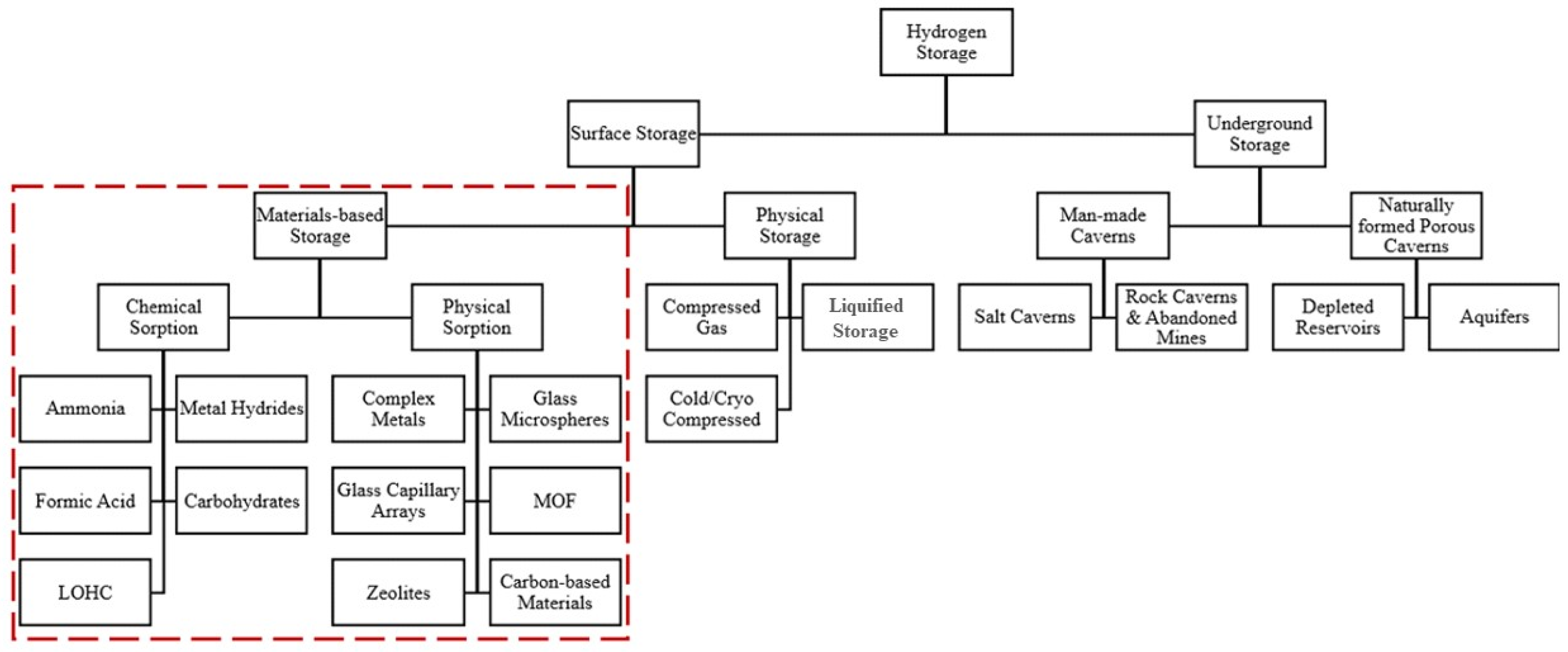
Large-scale storage is required for national grids to manage seasonal variations, replacing natural gas or enabling exports. Surplus renewable electricity can be converted to H2 via electrolysis and stored until peak-demand periods. Smaller systems serve daily end-user requirements. Various storage solutions have been explored in the literature for different applications, broadly categorized into two groups based on their location, i.e., surface and underground facilities, as illustrated in Figure 1. The literature groups storage technologies into surface and underground facilities (Figure 1). Subsurface systems are classified by geological formation, while surface storage is grouped by the underlying technology. For surface storage, physical and material-based systems dominate practical applications. Material-based surface storage is subdivided into several categories. The present study focuses on these technologies from both engineering and scientific perspectives. Surface storage is essential for short-term H2 distribution, unlike underground storage, which handles large capacities over seasonal cycles [10,11].
One of the primary considerations in the design of surface storage facilities is their capacity and cyclic storage period [12,13]. The technologies associated with these facilities either leverage the different physical states of H2 or exploit molecular-level interactions with other materials to ensure the efficient storage and release of H2 as required. Surface storage technologies that utilize the different physical states of H2 include compression, liquefaction, and adsorption, as illustrated in Figure 1. Compression involves reducing the volume of H2 gas by applying pressure, making it easier to store and transport [14]. Liquefaction involves cooling H2 gas to extremely low temperatures, transforming it into a liquid state with higher density, enabling more compact storage [15,16]. Adsorption technologies rely on the ability of certain materials, such as activated carbon or metal–organic frameworks, to attract and retain H2 molecules on their surfaces through physisorption or chemisorption processes [17,18]. Surface storage technologies based on molecular-level interactions with other materials exploit various chemical reactions or physical phenomena to store and release H2 efficiently [19]. These include material-based storage systems such as metal hydrides, where H2 is chemically bonded with metals to form hydride compounds, releasing H2 upon demand through suitable thermal or pressure conditions. Another approach involves H2 storage in complex hydrides or NH3 boranes, which offer high H2 densities and reversible storage capabilities.
In this review, we attempt to offer a broad and prospective outlook on hydrogen storage technologies for surfaces, with several key aspects that set this review apart:
(1) Comparative analysis of the most promising surface storage techniques, such as metal hydrides, chemical storage, and porous materials, according to their efficiency, reversibility, and safety.
(2) The role of the “system approach,” discussing the link between the hydrogen production and consumption technologies and the storage ones.
(3) Considering the issue of the “techno-economic approach,” including the analysis of the costs and technology readiness levels of the proposed techniques.
(4) Considering the issue of artificial intelligence and machine learning techniques in the discovery and optimization of the mentioned techniques for hydrogen storage.

2. Surface Storage of Hydrogen

Surface storage of H2 refers to the use of certain materials/carriers capable of absorbing and releasing H2 gas as a means of storing H2 for various applications. These carriers, often referred to as H2 storage media, undergo reversible chemical reactions or physical adsorption processes to store and release H2 efficiently. This approach is crucial for enabling the widespread adoption of H2 as a clean and renewable energy carrier, particularly in sectors such as transportation and energy storage. A comprehensive review of H2 storage involves a critical understanding of the different types of carriers used for H2 storage, including metal hydrides, porous materials like metal–organic frameworks (MOFs), carbohydrates, and liquid organic hydrogen carriers (LOHCs) [20,21]. Each type of carrier has its advantages and challenges in terms of H2 storage capacity, operating conditions, kinetics of H2 uptake and release, and cost-effectiveness, as summarized in Table 1. Surface H2 storage technologies hold great promise for addressing the challenges associated with H2 storage and facilitating the transition to a H2-based economy [22]. As such, research and development efforts continue to advance in this area to unlock the full potential of H2 as a clean and sustainable energy source [23]. There are advantages and drawbacks to H2 storage techniques. However, real-world implementation is challenging. These include using existing infrastructure, maintaining operational temperature and pressure, transferring and storing supplies, and logistics. For instance, LOHC systems need units that can dehydrogenate at high temperatures, and metal hydrides need thermal management for both hydrogenation and release processes. When planning how to integrate hydrogen production units (like electrolysers), storage media, and end-use applications like fuel cells or combustion systems, it is important to think about how they all work together. A modular integration approach can make both stationary and mobile use cases more flexible and scalable [24]. The following sub-sections provide state-of-the-art on the types and applications of H2 surface storage technologies.

2.1. Ammonia (NH3)

Ammonia is a well-studied hydrogen carrier with a high volumetric density and a well-developed handling infrastructure. It is one of the best options for storing chemicals. We start our review with ammonia because it is widely used in industry and is ready to go, which makes it a good point of reference for comparing other technologies. Ammonia (NH3) has gained attention as a viable H2 carrier, offering a solution to the challenges related to its storage and transportation. To avoid repetition, the fundamental physicochemical properties of ammonia are outlined here, while the following discussion focuses on its integration pathways, techno-economic performance, and operational challenges. NH3 has an H2 density of 17.8% by weight and has found versatile applications in both mobile and stationary storage settings [25]. Its stability makes it ideal for long-term storage and transportation, meeting the need for energy storage over time. NH3 can either release its stored H2 or serve directly as a fuel, and its existing global infrastructure, established for purposes like agriculture, refrigeration, and chemical manufacturing, supports its economic viability [26]. Regulations and protocols for handling NH3 are well-established worldwide. While numerous studies explore its potential in various contexts, including islanded systems and fertilizer production with renewable energy, challenges persist in its application in the energy sector, such as addressing its properties, conversion technologies, and potential environmental impacts [27,28].
Table 1. Summary of hydrogen surface storage technologies, their key performance parameters, i.e., gravimetric and volumetric density, operating temperature, and type of hydrogen storage. Compiled and adapted by the authors from references [1,8,12,20,21,22,25,29,30,31,32]. Conditions under which density values are obtained, i.e., temperature and pressure, are also mentioned in the table.
TechnologyGravimetric Density
(wt% H2)
Volumetric Density
(g H2/L)
Operating Temperature
(°C)
Category
Compressed H2 (69 MPa)4.524.825Physical
Liquid H2 (LH2)8.4970.8−253Physical
Ammonia (NH3)17.8108−33Chemical
MgH27.6110300–350Metal Hydride
Mg2NiH43.6280Metal Hydride
Mg2FeH65.5Metal Hydride
Formic Acid4.45325Chemical
Carbohydrates14.815037Biological
LOHCs200–300LOHC
Glass Microspheres200Physical
Glass Capillaries25–200Physical
MOF−196Adsorption
LaNi525–80Metal Hydride
FeTi25Metal Hydride
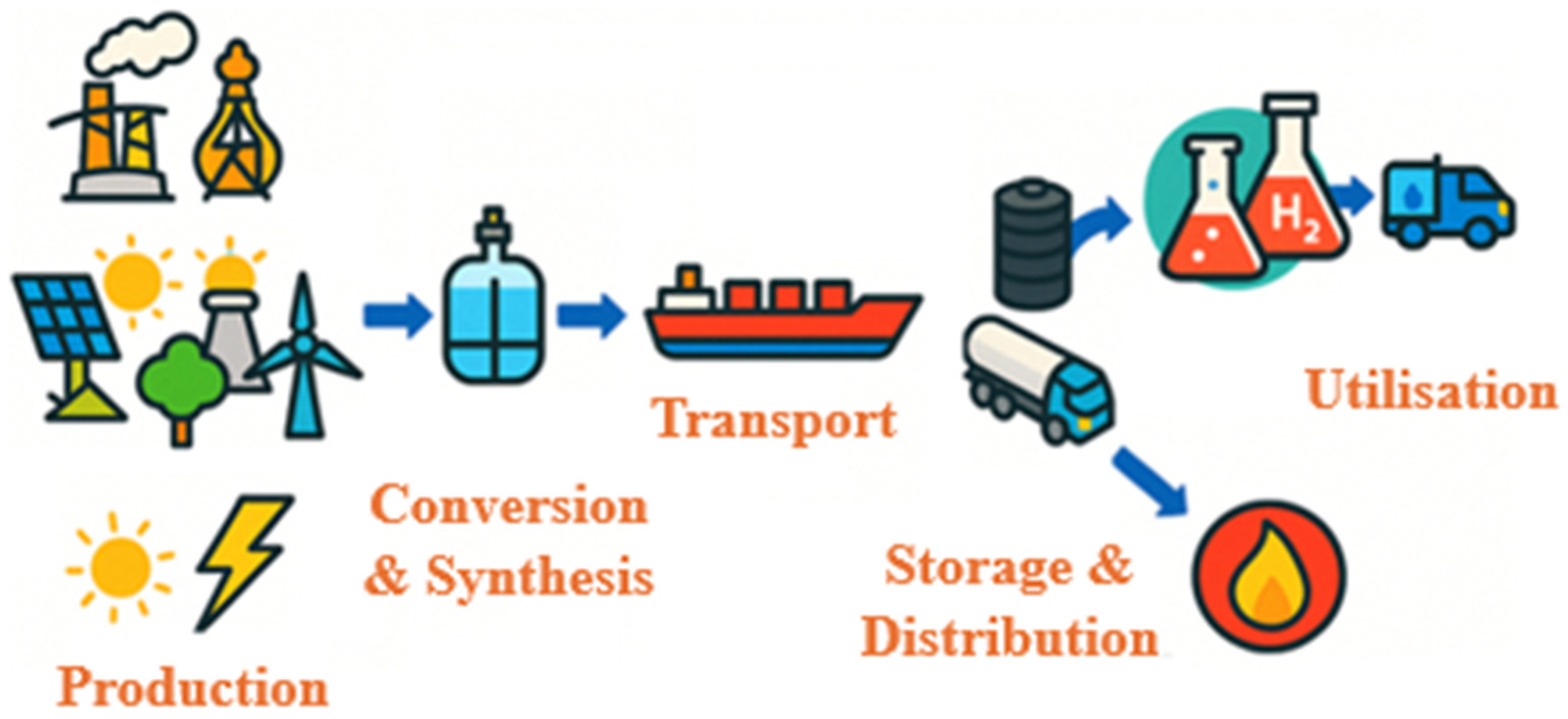
Figure 2 illustrates the various pathways for both producing and using NH3. This compound of nitrogen and hydrogen can be generated from either fossil fuels or renewable energy sources, undergoing several stages such as pre-treatment, conversion, and synthesis. Additionally, surplus electricity can be converted into H2, which is then converted into NH3, forming what’s known as power-to-NH3 technology [33,34]. Once produced, NH3 is stored, transported, and distributed for its intended applications. Many countries worldwide are strongly motivated to incorporate NH3 into their future energy systems, prompting them to develop both roadmaps and technologies to realize this vision. Japan, for instance, has set a clear plan for NH3 adoption, targeting the realization of an NH3 supply chain in the energy sector by 2030 [35]. Initiatives such as testing 300 kW class gas turbines by the end of 2020 and exploring advanced combined cycles and direct NH3-fueled fuel cells are already underway [36]. Similarly, Australia is actively advancing research and development programmes to utilize NH3 for storing domestically produced H2 and exporting it internationally [37]. The UK and Germany also exhibit significant research efforts to promote NH3 adoption [38,39]. Initially, the electricity generation and industrial sectors are the primary markets targeted for NH3 utilization.
Liquid NH3 boasts a relatively high volumetric energy density of 12.7 MJ/L, surpassing that of LH2 (8.49 MJ/L) and compressed H2 (4.5 MJ/L at 69 MPa and 25 °C). However, its apparent toxicity is notably higher than gasoline and methanol due to its high vapour pressure of 8.58 × 10² kPa at 20 °C [40]. NH3 faces challenges such as its narrow flammability range (15.15–27.35% in dry air and 15.95–26.55% in 100% relative humidity), which typically renders it non-flammable during storage and transportation. Moreover, as NH3 primarily consists of nitrogen, its utilization, particularly at high temperatures, can lead to NOx formation, necessitating careful combustion management [41]. Given its classification as a toxic chemical, proper hazard management is essential to mitigate its risks to both humans and the environment.
Presently, the global production of NH3 is around 200 million metric tons per year, ranking it the second most widely produced chemical in the world after sulfuric acid (H2SO4) [42]. Just like H2, NH3 can also be produced from different primary energy sources such as biomass, coal, natural gas, solar energy, wind energy, geothermal energy, hydro energy, and nuclear energy. There are different conversion methods used for the production of NH3, including thermochemical, electrochemical, photochemical, and plasma conversion [43].

2.2. Metal Hydrides

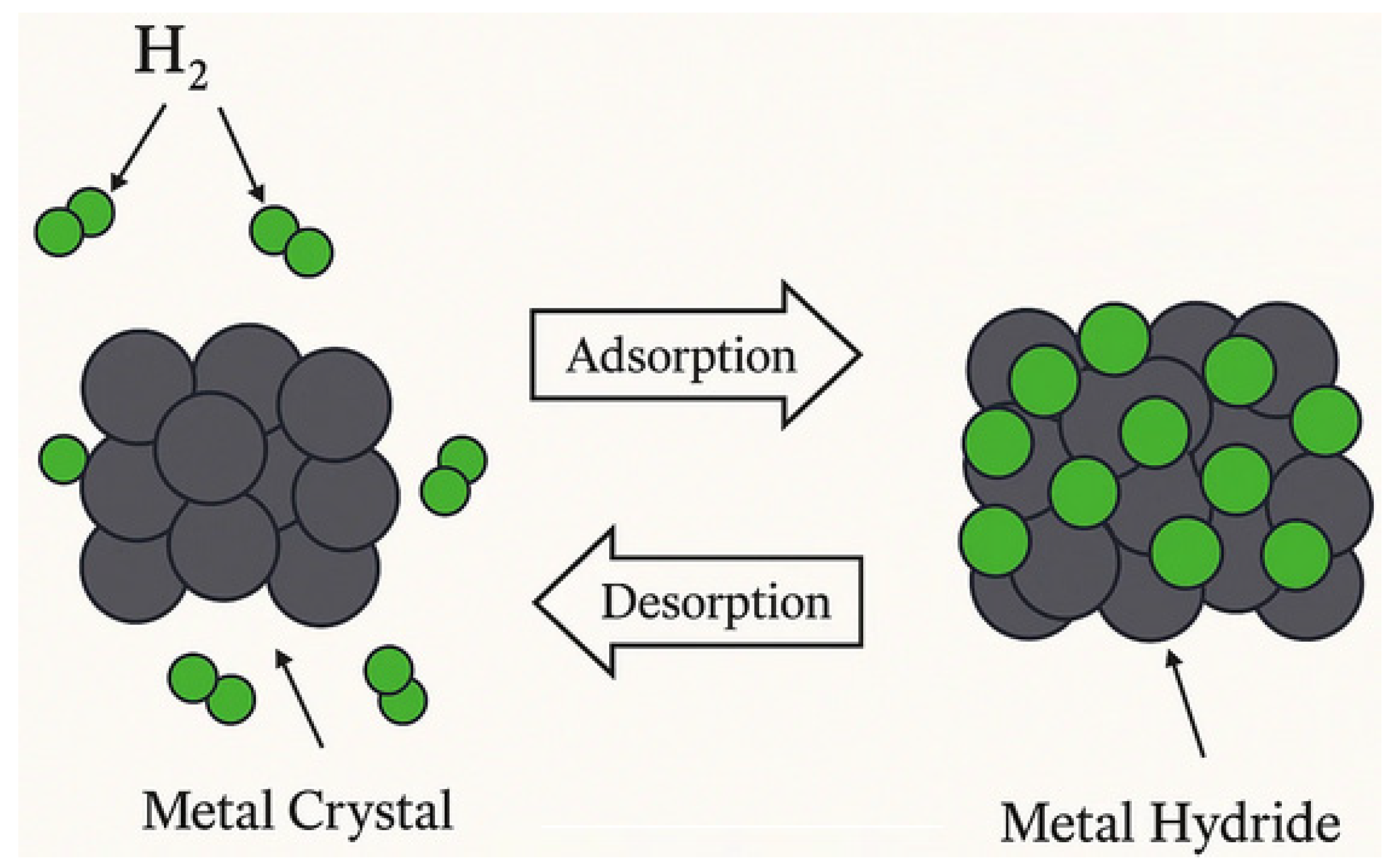
The second set of materials, after ammonia, that bind hydrogen chemically is known as metal hydrides. These materials, while very useful for small-scale reversible storage, do so in a very different manner. H2 has a chemical reactivity with metals or metal alloys, resulting in the formation of metal hydrides. The formation of metal hydride occurs when a molecule of H2 dissociates into atomic hydrogen, which then dissolves in the bulk by chemisorbing into the metal or metal alloy lattice, as depicted in Figure 3. This chemisorption can result in a lattice expansion that can reach 20–30% of its original volume. The formation of metal hydride can occur by a direct reaction involving H2 or by electrochemical dissociation of water molecules [44]. The two distinct reaction mechanisms are outlined as follows:
Mechanism: Direct reaction with hydrogen:
M   +   x 2 H 2 MH x
where M represents a metal or alloy in the context of the reactions.
When the formation of hydrides takes place, it leads to the production of heat due to chemisorption. On the other hand, when the reverse reaction of desorption takes place, where H2 gas is released for the purpose of commercial use, the same amount of energy must be provided from an external source. Detailed information about the pressure–composition–temperature (PCT) measurement of a metal hydride can be found in the works of Zepon et al. [30] and Jacobs et al. [31].
Metal hydrides can offer enhanced capacity for storing H2 compared to compression and liquefaction methods [46,47], enabling H2 storage at moderate temperatures and pressures [48,49]. Because the operational requirements are not as demanding as in gas compression and liquefaction, the use of metal hydrides is deemed a safer alternative [50]. Moreover, the charging and unloading of H2 can be done as many times as needed unless it is affected by the presence of contaminants. In general, most metal hydrides have moderate energy requirements (20–55 kJ/mol H2) [51]. Nevertheless, metal hydrides have some limitations, such as low sorption and desorption rates, high temperatures of H2 release, and the production of unwanted gases during the discharge of H2 [52,53]. In onboard applications, it is necessary to have adequate energy in the exhaust gases for the release of H2. Alternatively, some of the H2 might have to be combusted to satisfy the energy demands, thereby reducing the energy density of the H2 contained in the hydride [12,54]. It is intriguing to note that the proton exchange membrane fuel cells might not be effective in producing heat energy above 80–100 °C [55]. The optimum operating conditions of the Proton Exchange Membrane (PEM) fuel cell are between 1–10 bar and 0–100 °C with an enthalpy change of 30–48 kJ/mol H2 [56]. Exothermic heat might be a problem at the refuelling stations, and generating heat might be a challenge in the management of this type of hydride [57].

2.2.1. MgH2

Metal hydrides refer to binary or intermetallic hydrides. Binary light metal hydrides have high volumetric and gravimetric energy densities and, in most cases, require high dehydrogenation/hydrogenation conditions, both in terms of temperature and pressure. For example, LiH has a high 7.7 wt% energy content; however, it requires at least 900 °C to dehydrogenate [57]. Unfortunately, some of these hydrides do not present reversible reactions under low or moderate operating conditions. Among the metal hydrides, MgH2 is one of the most studied materials in the literature owing to its massive stored amount of H2, having high gravimetric energy density, with its volumetric energy density being almost twice that of LH2. In particular, MgH2 presents interesting properties, such as a 7.6 wt% H2 content, equal to 9 MJ/kg Mg [58]. Moreover, magnesium (Mg) metal, being cost-effective and in abundance, makes it feasible to have economical large-scale production of magnesium hydride (MgH2). Yet, the formation of magnesium hydride requires high temperature and pressure conditions up to 300 °C and pressure higher than 30 bar, respectively, and releases 75 kJ/mol as heat during hydrogenation. It releases H2 at a relatively lower temperature, ranging from 350 °C to 400 °C, in contrast [59]. The rate of formation of magnesium hydride is sluggish, and H2 release is at a temperature not favourable for Proton Exchange Membrane (PEM) cell technology.
Despite the challenges, efforts have been made to improve the properties of MgH2. The methods employed involve reducing the temperature and improving the kinetics of hydrogenation/dehydrogenation. The kinetics at 150 °C have also been improved and achieved through micro- and nanostructuring, or particle size reduction, via ball milling. Research carried out by Lyu et al. [60] showed that ball milling leads to size reductions in the crystal grains and greatly reduces the time needed for H2 loading in MgH2. Kudiyarov et al. [61] demonstrated that ball milling MgH2 improved the desorption kinetics and reduced the temperature, with these effects becoming more pronounced as the milling time increased, leading to a smaller crystal size.
Alloying for the formation of Mg2NiH4 demonstrates better kinetics and a smaller enthalpy change during hydration, reported at 65 kJ/mol [62]. Hydration occurs at 280 °C under 1 bar pressure [63]. Other examples of alloying have also been studied, such as Mg2FeH6, Mg17La, and Mg17Al12, and all display fast kinetics; however, their effectiveness, wt% H2, is compromised by the resultant reduced gravimetric density. Examples include Mg2NiH4, with 3.6 wt% Mg2FeH6, and Mg2FeH6H2, with 5.5 wt% H2, both lower than the capacity of the parent MgH2 of 7.6 wt%. Additionally, in some alloyed examples, the hydriding energy increases; for example, Mg2FeH6 displays a hydriding energy of 77.4 kJ/mol [64].
One of the major engineering difficulties associated with the use of MgH2 is thermal management. The hydrogenation reaction is exothermic, and thus the system must be designed to dissipate the heat generated during the charging of the material. On the other hand, the hydrogen desorption reaction is endothermic, and the system must be designed to provide the required heat to the material to facilitate the complete removal of the hydrogen. In an actual situation, the low thermal conductivity of MgH2, which is approximately 0.2 W/m∙K, might result in temperature gradients within the storage material, creating hot spots, which in turn lead to the inability to completely utilize the storage material [65].

2.2.2. Hybrid Hydrides

Intermetallic compounds, where two metals are combined with H2 gas, consist of heavy transition metals, making them reversible at lower temperature and pressure conditions [46]. However, although metal hydrides absorb H2 gas up to high capacities, their gravimetric densities are still below 3 wt% H2 [66]. Metal compounds that fall under the intermetallic compounds category include LaNi5, FeTi, and Mg2Ni and have 1.4 wt%, 1.89 wt%, and 3.59 wt% gravimetric densities, respectively [67]. The compounds that have been found interesting are LaNi5 and FeTi, owing to their low desorption temperature and pressures [68]. Thus far, our understanding suggests that metal hydrides generally exhibit favourable energy densities, albeit with slow hydrogenation and dehydrogenation kinetics. The release temperature of H2 is found to be significantly higher than expected. These properties can further be improved by reducing the particle sizes, decreasing the crystal grain sizes, alloying, adding additives to obtain composites, employing catalysts to obtain nanoforms, and employing the concept of nanoconfinement. For example, it is well known that ball milling can reduce particle sizes and crystal grain sizes, reduce diffusional barriers, and produce defects within the crystals. This reduction in particle sizes increases the surface areas of the materials, which would improve the rates of adsorption—a surface-dependent process. The lowered diffusional lengths reduce the time taken for the hydrogen gas to reach the surface of the metal or the alloy. Moreover, the crystal defects produce an “amorphous phase,” improving the thermodynamic behaviour. More specific information on the techniques for the improvement of the metal hydride materials can be found in the publications of Larpruenrudee et al. [69], Abetz et al. [70], Liu et al. [71], Kukkapalli et al. [72], and Drawer et al. [47].
Similarly, the incorporation of two different hydrides or even a hydride with carbon will lead to leveraging the strengths of each of the components in the final hydride composite [71]. Jin et al. [73] realized improved kinetics with the incorporation of LiBH4MgH2 and MgH2, improving H2 capacity to 11.4 wt%, and the enthalpy change decreased to 45 kJ/mol H2. Galey et al. [62] incorporated graphite with MgH2, which resulted in decreasing the H2 loading temperature to 200 °C. Some examples of hydride composites are MgH2–NaAlH4, MgH2–Mg(AlH4)2, and MgH2–AlH3. The addition of Si as an additive does not improve desorption kinetics [74]. In general, catalysts are observed to improve the kinetics of the hydrating process. Zhang et al. [75] found Pd and Fe catalysts to be among the most effective; these catalysts have reduced H2 absorption time dramatically. Da Conceição et al. [76] evaluated the effect of metal oxides on H2 desorption/sorption kinetics and found Nb2O5 is the best catalyst. AlH3 is another promising binary metal hydride. It contains a high H2 content of 10.1 wt% and a very high volumetric energy density of 1.48 g/mL [77]. However, it undergoes dehydrogenation at a low temperature of about 100 °C, and the reverse reaction is difficult, needing an immensely high H2 pressure to charge the hydride. Modification of the hydride is required to facilitate its convenience in the charging/discharging of H2 on board.

2.3. Formic Acid

Metal hydrides are excellent for use in solid-state storage, and formic acid is good in liquid storage and decomposes easily. This passage discusses the advantages and disadvantages of using the compound in real life. Currently, formic acid is considered one of the most promising substances for hydrogen storage. Although formic acid was noted as one of the mediums that can be used for H2 storage four decades ago [32], currently, formic acid is considered one of the most promising substances for hydrogen storage. Although formic acid was noted as one of the mediums that can be used for H2 storage four decades ago [32], serious interest in developing catalysts for the improvement of hydrogen production from formic acid was generated in the last decade. However, formic acid has many advantages, such as its large volume storage capacity of 53 gH2L−1, its lack of toxicity, its non-flammability (its flash point is 69 °C, which is much higher than that of methanol and gasoline, 12 °C and −40 °C, respectively), and its biodegradability [78]. Additionally, the fact that the compound is in a liquid state at room temperature makes the transportation and fueling process similar to that of diesel and gasoline fuels [79].
It is widely acknowledged that formic acid decomposition can occur through dehydration (decarbonylation) and dehydrogenation (decarboxylation), as illustrated by the chemical equations [80]:
Dehydration: HCOOH ↔ CO + H2O; (ΔG° = −12.4 kJ·mol−1, ΔH° = 29.2 kJ·mol−1, and ΔS° = 139 J·mol−1·K−1)
Dehydrogenation: HCOOH ↔ H2 + CO2; (ΔG° = −32.9 kJ·mol−1, ΔH° = 31.2 kJ·mol−1, and ΔS° = 216 J·mol−1·K−1)
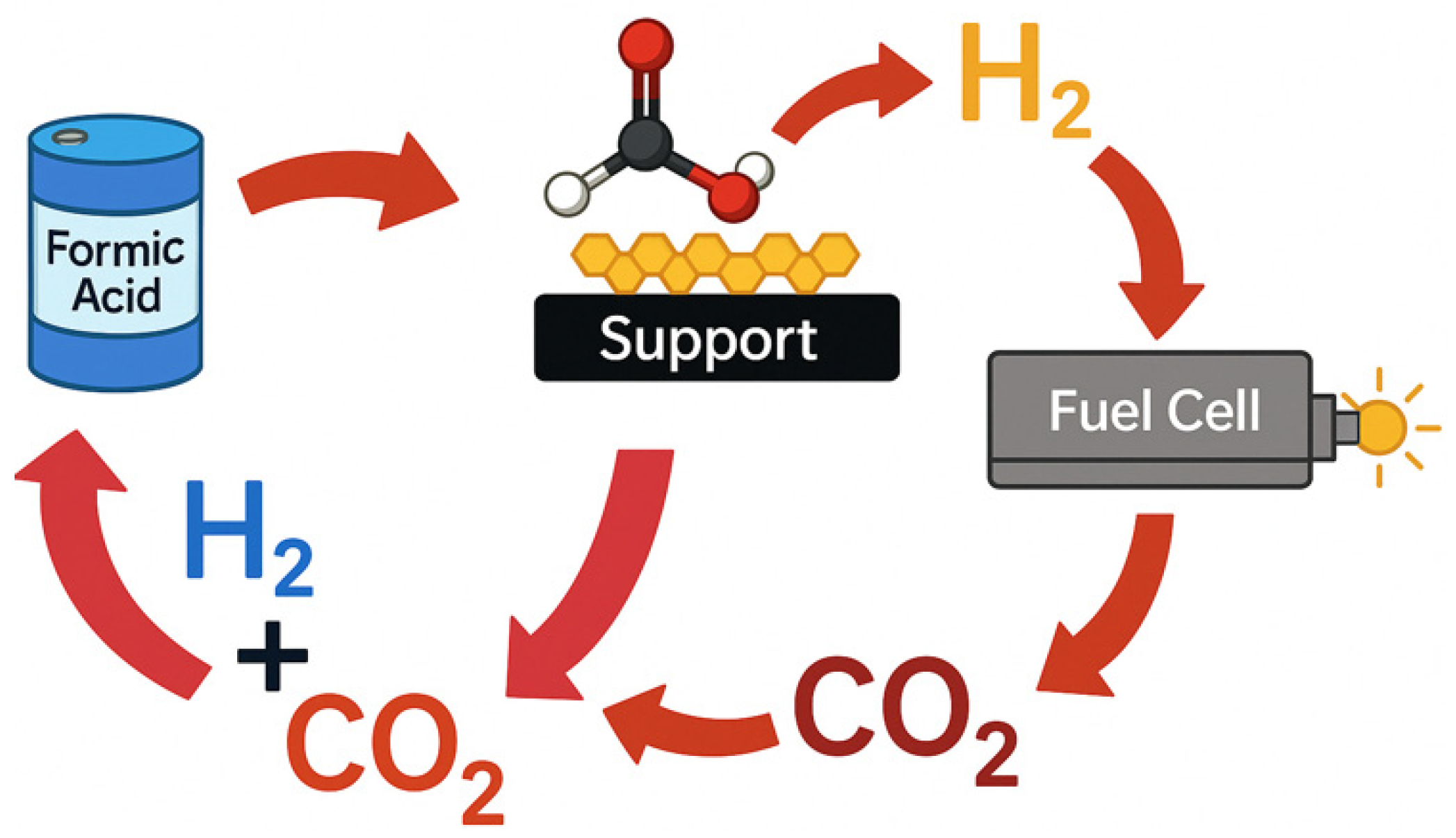
The resultant gas mixture prepared through the dehydrogenation reaction of formic acid can be harnessed to power an H2/air fuel cell directly [81]. In this instance, it becomes essential to avoid the dehydration pathway, in particular the formation of carbon monoxide, which is known to pose risks to the catalyst employed in the fuel cell. Therefore, to circumvent the dehydration pathway, the high selectivity of the catalyst becomes essential to enhance the dehydrogenation of formic acid, which is essential in the production of H2 and CO2. In addition, it has been clearly demonstrated that the mode of decomposition, which is considered to be either dehydration or dehydrogenation, largely depends on the catalytic surface, which determines the adsorption of formic acid molecules. In this case, it is suggested that the high terrace site is likely to adsorb formic acid molecules in a bidentate state, which enhances the dehydrogenation pathway. Moreover, surface-unsaturated sites were identified as determining the dehydration pathway [82,83]. Apart from its inherent nature, another distinct feature of the application of formic acid as an H2 storage material revolves around the possibility of the released CO2 during the dehydrogenation reaction of formic acid to further take part in a hydrogenation reaction, thereby producing formic acid molecules through a carbon-free emission mechanism [84,85], as depicted in Figure 4.

2.3.1. Catalysts for Formic Acid Dehydrogenation

Williams initially documented the electrochemical reduction of CO2 to formic acid in 1978 [32], sparking subsequent intriguing research endeavours employing various methodologies such as electrochemical [87,88], photoelectrochemical [89], catalytic [90,91], and photocatalytic approaches [92]. Despite its theoretical appeal, enhancing the energetically unfavourable conversion of gaseous CO2 and H2 into liquid formic acid requires careful consideration of several factors. Typically, the CO2 and H2 reaction proceeds via the water gas shift reaction, yielding CO and H2O, yet adjusting experimental conditions (e.g., employing inorganic or organic bases) and employing suitable catalysts could favour the hydrogenation of CO2 [93,94]. Since Coffey’s initial report in 1967 on the breakdown of formic acid using a homogeneous catalytic system, numerous studies have focused on creating efficient homogeneous catalysts that can selectively convert formic acid into H2 and CO2 under mild conditions [95]. These investigations, documented by Grasemann and Laurenczy [96] and Onishi et al. [97], have explored various catalysts such as ruthenium, rhodium, iron, and iridium complexes. Despite progress, developing competitive and selective heterogeneous catalysts under mild conditions remains challenging, as noted by Deng et al. [98], and Zhang et al. [99].
The investigation of formic acid decomposition using heterogeneous catalysts dates from the 1930s. However, early research was poorly carried out regarding catalyst optimization and measuring CO evolution from the side reaction of formic acid dehydration [86]. Thus, most experiments were performed in the gas phase at temperatures above 100 °C or under an inert gas to dilute formic acid below its vapour pressure; these operations increase the complexity in practical uses. Therefore, there is a great interest in the development of heterogeneous catalysts for formic acid dehydrogenation in the liquid phase [82]. The ideal heterogeneous catalyst is being pursued by a host of researchers, mostly focusing on noble metal nanoparticles, although some studies dealing with non-noble metal nanoparticles tackle this challenge from both an experimental and a theoretical perspective [100,101]. Pd-based catalysts, among the many prototypes investigated, represent a promising class of catalysts in this framework. In fact, they attracted remarkable attention because of their superior resistance to CO poisoning compared to other metals, as well as their remarkable H2 conversion and selectivity values at moderate temperatures [102]. Formic acid as an H2 carrier has, therefore, attracted the interest of the scientific community in understanding and optimizing Pd-based catalytic systems, with particular emphasis on improving their activity under mild conditions and enhancing their stability, durability, and selectivity. To this purpose, several approaches have been exploited, including the optimization of the characteristics of the active phase, like size, composition, and structure, and the investigation of the role of the support properties in modulating the catalyst features, such as metal-support interaction or acid/base properties. Several supports have been explored for this purpose, including silica [103], zeolites [104], and MOFs [105], among others.

2.3.2. Carbon-Based Catalysts

Carbon materials, in specific, have been a focus of research and investigation due to the special properties they possess that render them the best option compared to the most commonly employed materials, such as silica and alumina [106]. Among these properties are their stability under acidic and basic conditions, a tailor-made porous structure, hydrophilicity, and the ability to introduce different heteroatoms into their structure. All these properties are of great benefit for the formic acid dehydrogenation reaction. Carbon materials are the best catalytic support materials for the application of formic acid dehydrogenation due to their capability and flexibility to introduce basic sites, which are actively involved in the process of formic acid dehydrogenation, leading to materials with excellent catalytic efficiency.
As mentioned before, Pd-based catalysts have been proven to be very active in the formic acid dehydrogenation reaction for H2 production. In order to develop efficient heterogeneous catalysts that could compete with the activity of usually more active homogeneous systems and take advantage of the benefits of heterogeneous catalysis, researchers have investigated parameters such as the morphology of the active metallic phase, nanoparticle composition and structure, metal loading, etc. [107,108]. Most of the investigated heterogeneous catalysts in this context are carbon-supported systems. Activated carbon is by far the most frequently applied support, owing to its high surface area, which facilitates the dispersion of metal nanoparticles accessible to the reaction molecules. However, the latest literature reports some intriguing findings regarding various carbon materials and carbon-based materials, including reduced graphene oxide (rGO), graphene nanosheets, carbon nanospheres, several nitrogen-doped carbon materials, mesoporous carbon, hierarchically porous carbon, composite carbon-based supports, and carbon-containing structures like carbon nitride.

2.4. Carbohydrates

In addition to synthetic and inorganic carriers, bio-derived materials like carbohydrates can also be used to store hydrogen in a way that can be used again and again. The next section talks about their possible effects on both the environment and the economy. Carbohydrates are molecules that contain carbon, hydrogen, and oxygen, and their empirical formula is Cm(H2O)n, where m and n may have different values. Formaldehyde and glycolaldehyde, for example, are included in this formula but are not considered carbohydrates. The most accurate definition of carbohydrates is that they are polyhydroxy aldehydes or polyhydroxy ketones with more than three carbon atoms [109]. Carbohydrates, in general, refer to sugars, which are further divided into saccharides containing different numbers of carbon atoms in their chains and their monomeric constituents. Monosaccharides are the simplest carbohydrates and usually contain three or more carbon atoms. Glucose and xylose are the two most abundant monosaccharides in the world due to their being integral parts of plant cell walls. Oligosaccharides consist of 2–10 monosaccharide units bonded to each other through glycosidic bonds, whereas in polysaccharides, which include starch and cellulose, there are more than 10 monosaccharide units bonded to each other through glycosidic linkages.
Harnessing carbohydrates offers significant economic advantages due to their abundant availability in nature and low production costs. Terrestrial plants generate over 100 billion tons of dry cellulosic material annually, indicating a vast resource base [110]. Research suggests that utilizing approximately 700 million tons of biomass through processes could replace around 150 billion gallons of gasoline with H2, thus reducing reliance on fossil fuels by a considerable margin [111]. Even a modest 10% utilization of lignocellulose biomass could yield substantial benefits in reducing our dependence on conventional energy sources. Moreover, carbohydrates offer additional advantages beyond economics, being non-toxic, largely non-flammable, and widely distributed globally. Furthermore, carbohydrates exhibit exceptional H2 storage capabilities. With the chemical formula (C6H10O5)n, polysaccharides boast a gravimetric density of 14.8% in terms of H2 content (equivalent to 24 gm of H2 gas produced per 162 gm of polysaccharide consumed) [112]. The volumetric energy density of polysaccharides as H2 carriers greatly exceeds 100 kg/m3, thus surpassing the H2 storage benchmarks set by the Department of Energy (DoE) [113]. Additionally, carbohydrates offer a carbon-neutral energy source across their entire life cycle. The CO2 emitted during H2 production from carbohydrates via processes is balanced by the CO2 absorbed during the growth of the carbohydrates, resulting in nearly zero net CO2 emissions [114]. With these benefits, carbohydrates as an energy carrier possess significant potential to tackle diverse sustainability issues, such as storing H2, capturing and storing CO2 for the long term, and producing transportation fuel [115].

2.4.1. Economic Considerations

The economics of H2 production from carbohydrates is significantly affected by three major cost components, i.e., the costs of carbohydrates themselves, enzymes, and cofactors [116]. The economics of H2 production from carbohydrates is significantly affected by three major cost components, i.e., the costs of carbohydrates themselves, enzymes, and cofactors [116]. Enzyme costs are strongly affected by both their manufacturing costs, in US dollars per kilogram of enzyme, and their Total Turnover Number (TTN), a measure of the efficiency of conversion, in moles of product per mole of enzyme. All enzymes used are cytoplasmic, avoiding membrane proteins, allowing their production as recombinant proteins in Escherichia coli. Industrial expertise estimates that the production of bulk enzymes generally falls within a few dollars per kilogram of dry protein weight, within approximately $5 to $100 kg−1 [117]. Exponential decreases in enzyme costs result from higher TTN values of enzymes [118]. Several approaches, including enzyme immobilization, the use of thermostable enzymes, and protein engineering, may be employed in enhancing enzyme stability [119,120]. It has been estimated that costs for enzymes would become viable for industrial-scale uses at TTN values above 107–108, which has been shown to be achievable with thermostable enzymes from thermophilic microbes such as Clostridium Thermocellum and Thermotoga [121]. The use of thermostable enzymes produced in mesophilic hosts could lower enzyme purification costs as well.
Enzymes of thermophilic origin normally have greater stability, especially at higher temperatures (60 °C to 70 °C). These enzymes, therefore, can be used to deactivate E. coli proteins through heat treatment, leaving behind thermostable soluble proteins, which can be separated through centrifugation. Heat treatment then presents an alternative method for the purification of thermostable enzymes, which is cheaper than conventional laboratory methods such as chromatography. There is also an increase in TTNs through enzyme immobilization, which allows for the easy recycling of these enzymes from their reactants, where entrapment of enzymes with alginate and cross-linking enzyme aggregates has been widely accepted due to their cost-effectiveness [122]. In addition, immobilization of enzymes, which is a separate unit operation, can be combined with enzyme purification through the immobilization of cellulose-binding module-tagged proteins [123]. Stable enzymes have a longer shelf life and may be stored for long periods of time based on suitable conditions and intrinsic properties. For instance, a long shelf life of several years may be attained using suitable conditions in the storage of enzymes such as those utilized in various protease-based detergents. Thermostable isomerase glucose utilized in the food industry may be stored for up to 2 years at a temperature of 55 °C. Glucose oxidase, used in blood sugar test strip products, may be stored for more than 2 years at room temperature [124].

2.4.2. Practical Applications

The enzymatic conversion of carbohydrates to H2 presents numerous opportunities within the H2 economy, where H2 serves as an alternative fuel for transportation or as a means of short-term electricity storage. These applications range from more practical ones like local H2-generating stations to more ambitious endeavours such as Shanghai Fuel Cell Vehicle (SFCV), as shown in Figure 5. The immediate focus lies in producing H2 from local carbohydrate sources, unlike the conventional approach of distributing H2 from a centralized facility to local stations, necessitating minimal initial investment and ensuring heightened safety. Each station could feature a sizable high-pressure H2 storage tank underground, replenished with H2 generated from subterranean bioreactors such as anaerobic digesters [29,125]. Such decentralized H2 generation facilities, while likely on a limited scale, could actually serve to popularize H2 fuel cell-based vehicles without the requirement for expensive distribution infrastructure. These facilities, using sugar as fuel, may also be able to support fuel cells as an economically viable solution in residential electricity generation in remote areas. The whole setup is ultimately extremely energy efficient H2 due to the exothermic nature of electricity generation via fuel cells, while linked with the endothermic generation of H2 from carbohydrates, with the excess energy from the setup potentially being utilized for hot water generation [126,127].
The most ambitious application is found in SFCVs. These concept SFCVs would be fed with electricity generated from PEM fuel cells, which in turn would be fed with H2H2 generated from an onboard bioreactor capable of rapidly producing H2 on demand. SFCVs would be quickly refilled with solid carbohydrate fuels or a carbohydrate/water mixture in minutes. The ultra-pure H2 produced could greatly simplify the entire powertrain system and widen its efficiency [129]. The generated water and heat from PEM fuel cells could be recycled back to the bioreactor to keep it at the desired temperature. Rechargeable batteries would still be needed to assist the powertrain system for vehicle start-up or acceleration, just like traditional FCVs [130]. One of the most crucial issues associated with onboard H2 storage/production systems is space. Assuming the current H2 production rate is 150 mmol/L/h, a 3.33 m3 reaction volume would be required to produce 1 kg H2 per hour. Although this reaction volume is literally infeasible technically, the reaction rate is expected to be able to be improved up to 60 times. The advantages of SFCVs include the highest biomass-to-wheel energy conversion efficiency of all types (overall, 55%; carbohydrate to hydrogen, 122%; PEM fuel cell, 50%; electric motor, 90%); they do not require specific infrastructure; they have a high safety level; and they use carbon-neutral carbohydrates [131]. However, the actual use of carbohydrate conversion for hydrogen production requires careful consideration of several specific limitations. For instance, the overall energy efficiency of enzymatic and bio-based conversion schemes remains relatively low when upstream processing of the biomass and enzyme production is considered. The reaction rates are slow, implying that large reactor volumes are required for significant hydrogen production. This makes this method less desirable for space- and weight-constrained applications. Moreover, enzyme costs are a significant barrier to this method of hydrogen production. Although advances in enzyme immobilization and recycling have helped in reducing this limitation to a certain extent, enzyme degradation over time is another factor that increases operation costs.

2.5. Liquid Organic Hydrogen Carriers (LOHC)

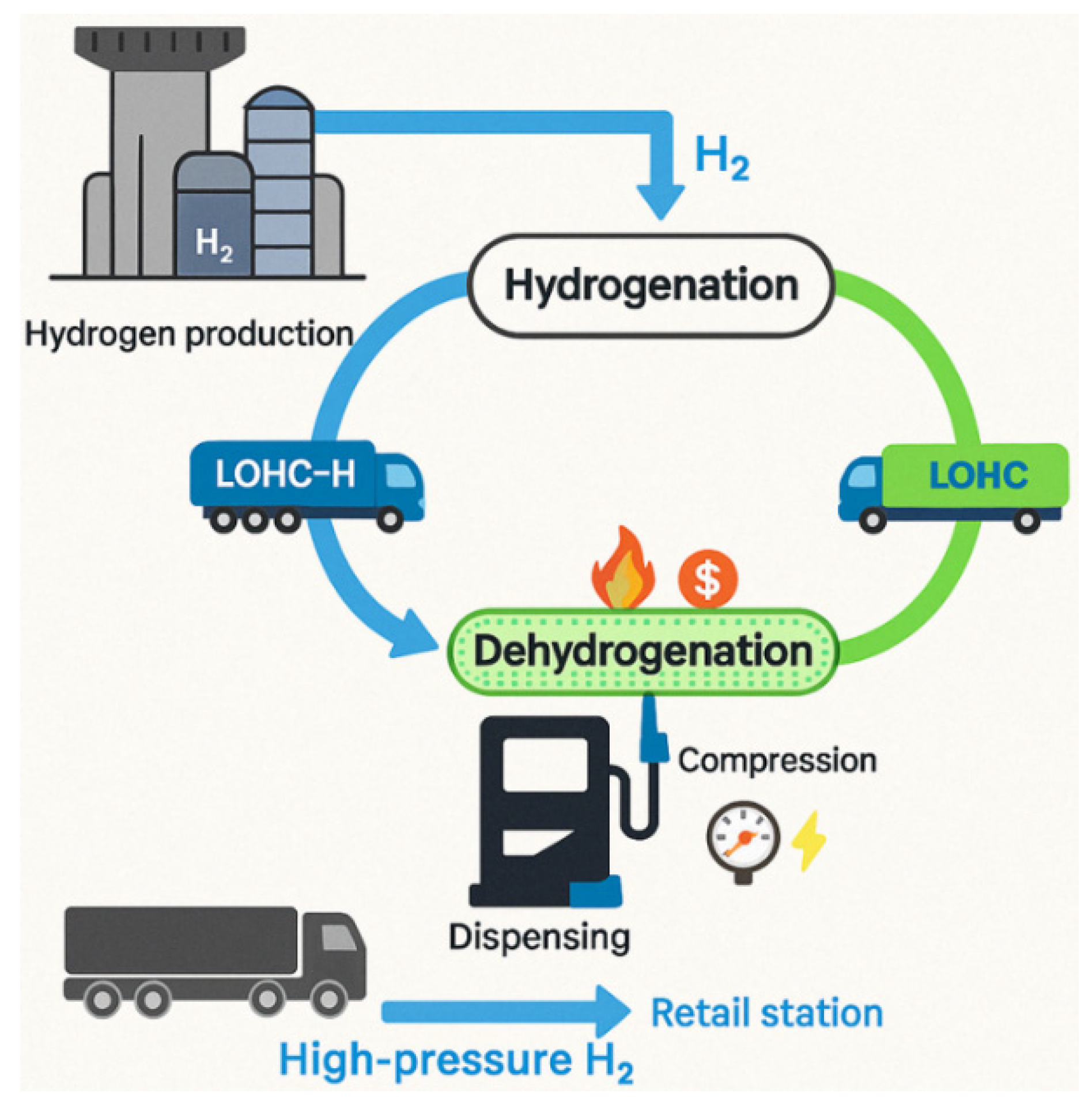
Liquid Organic Hydrogen Carriers (LOHCs) are another important type of hydrogen carrier. LOHCs employ a set of reversible chemical reactions for the storage and release of H2, as depicted in Figure 6, using unsaturated liquid organic hydrogen carriers such as toluene, naphthalene, etc. and N-ethylcarbazole, etc., in the storage form, and saturated forms such as methyl cyclohexane, decalin, etc. and dodecahydro-N-ethylcarbazole, etc., in the carrier form [132,133]. In the exothermic hydrogenation step, the liquid hydrogen carrier reacts with pure H2 gas in a reactor and, after heating, catalytically transforms into saturated liquid hydrogen gas, also referred to as H2 carriers (Hx-LOHCs). Actually, this reaction catalytically changes the unsaturated form into a saturated form by using pure hydrogen gas. On a thermodynamic basis, the reaction happens at lower temperatures and higher pressure [134]. On the other hand, dehydrogenation, which is the reverse reaction, is endothermic in nature. For the dehydrogenation apparatus, which uses a catalyst, H2 desorption occurs from Hx-LOHC, thus requiring the constant absorption of heat, which arises as a result of the energy difference between the dissociation energy of H2 atoms and the activation energy of the C-H bond [135]. This issue of large amounts of energy being consumed due to the temperature differences in the reaction and catalytic activity is of primary consideration. Conventional methods can be adopted for transporting H2 carriers, and these involve using pipelines, ships, and trucks. Research has shown that the reaction of hydrogenated aromatics, as well as their corresponding hydrides, can be accomplished without affecting the primary ring structure [136].
The use and development of LOHCs were first proposed as alternate options in 1975. This method mainly makes use of aromatic molecules, including benzene and toluene, for H2 storage in vehicles. However, during further development, studies showed that when heteroatoms, like nitrogen (N), are used in place of carbon (C) in an organic compound, the energy level is reduced [75]. Moreover, an increase in the number of heteroatoms in an organic compound enhances the temperature at which dehydrogenization occurs. As far as the organic compound in LOHCs is concerned, currently aromatic and nitrogenous compounds are under investigation, while new organic compounds are being explored. The different LOHCs being explored are toluene (TOL)/methyl cyclohexane (MCH), N-ethyl carbazole/decahedron-N-ethyl carbazole, naphthalene/decalin, toluene, dibenzyl toluene/perhydro dibenzyl toluene, biphenyl/bi-cyclohexyl, and diphenylmethane/dicyclohexylmethane [138]. Moreover, the different reaction mechanisms involving these H2 storage systems have been extensively explored using techniques like molecular dynamics simulations and nuclear magnetic resonance. While observing the results, it was deduced that the factors along with the compound that frequently affected steric effects during bond hydrogenation and dehydrogenization were the molecular size, methyl groups, and heteroatoms [139,140,141].
Among the benefits and drawbacks of LOHC technology, it can be seen that there are various factors impeding large-scale commercialization. The major problems are high energy consumption in the process, the difficulty of preparing dehydrogenation catalysts, and poor H2 storage performance due to the cycle increase [142,143]. Therefore, current research has focused on decreasing energy consumption and improving catalyst performance. Large dehydrogenation catalysts mainly refer to supported metal catalysts, generally prepared by impregnation [144], deposition precipitation [145], one-pot [146], and sol–gel methods [147], among others. These catalysts are generally loaded onto such materials as carbon-based materials, Al2O3, TiO2, zeolite, and others [148,149]. Because the hydrogenation and dehydrogenation of H2 storage liquids belong to a pair of reversible reactions, catalysts with high hydrogenation activity have better performance in dehydrogenation reactions [150,151]. Usually, catalysts are divided into several categories based on the method of metal mixing, including monometallic catalysts such as noble metal catalysts and non-noble metal catalysts, polymetallic catalysts, and other types, including boron nitride and metal complexes [152].
Aromatics and nitrogen (N) dopants are essential components in LOHC. Typically, H2 storage liquids are produced from coal and petroleum. Pure chemicals such as triphenylbenzene (BTX), including benzene, toluene, and xylene, are generally obtained from coal by thermal fractional distillation followed by purification processes [134]. In contrast, the fractionated products when obtained from petroleum contain fewer aromatic compounds but more alkanes, and thus multiple bond-breaking, reforming, and aromatization processes are required to transform them into aromatic hydrocarbons [153]. In contrast, the fractionated products when obtained from petroleum contain fewer aromatic compounds but more alkanes, and thus multiple bond-breaking, reforming, and aromatization processes are required to transform them into aromatic hydrocarbons [153]. Traditionally, using fossil energy sources as feedstocks has been finite and expensive. To prepare aromatic and N-doped compounds for different applications, economically viable and sustainable sources should be developed. Biomass resources are mainly composed of carbon, hydrogen, and oxygen elements with enormous potential for use as carbon-neutral renewable energy sources [154]. The three major components of biomass, such as cellulose, hemicellulose, and lignin, have different structural features, and thus their conversion methods and applications are different. Hemicellulose has a cyclic polysaccharide structure with five- or six-membered rings, which molecularly acts as a binder to connect cellulose and lignin [155]. Lignin is a complex organic substance that has a three-dimensional reticulated aromatic ring structure and reinforces cellulose and hemicellulose with interwoven C-C and C-O bonds [156]. The presence of aromatic and furan rings in direct biomass compounds that undergo pyrolysis can be utilized for biomass fuel, light aromatics, and small molecular compound production. Benzene, one of the basic carbon structures of biomass, contains an essential component of benzene, made up of six carbon atoms, that forms rings that hold all biomass compounds that undergo various conversion processes together [157]. Hence, this ability to utilize biomass for raw materials has practical and economic advantages for this LOHC reactor system. One of the most significant engineering challenges facing LOHC systems is related to catalyst deactivation during repeated hydrogenation/dehydrogenation cycles, where high-temperature conditions above 250 °C lead to thermal sintering and carbon formation and changes to supported metal catalyst surfaces and structures, especially for noble metals. This reduces the catalyst activity, selectivity, and hydrogen release rates. Regeneration of the catalysts also contributes to additional costs, while the long-term stability of the catalysts still has to be proven.

2.6. Complex Metals

Complex metals can be defined as compounds containing metal atoms and bonds with other elements or molecules to produce a new compound structure. Complex metal hydrides and certain metallic materials are identified as prospective H2 storage materials due to their excellent storage capacity and release abilities. Complex metal hydrides can best be defined as a family of materials consisting of a vector anion where H2 bonds covalently with a metal atom or a non-metal atom [158]. It is understood that transition metals, especially those situated at the end of the transition series, show a tendency to form homoleptic hydride complexes of the generic type [THn]m−. Theoretical research works have been conducted to predict the tendency of the existence of Na2Mg2NiH6, of transition metal complex hydrides. As a result, several materials such as Na2Mg2NiH6, Na2Mg2FeH8, Na2Mg2RuH8, Na2Mg2RuH8, YLiFeH6, Li4RuH4, and others have already been successfully synthesized. Within the past two decades alone, research activities have focused extensively on solid materials comprising complexes of Li, Be, B, C, N, F, and other light elements coordinated with metals such as [BH4], [AlH4], [AlH6]3−, [NH2], or [NH]2−.
Originally, mechanochemistry (ball milling) was the primary method for synthesizing complex metal hydrides through a metathesis (double substitution) reaction [159]. This method has been very successful in preparing a range of new rare-earth-based borohydrides with different chemistry and structural compositions with varying thermal properties. More recently, solvent-based methods have proven to be superior for the synthesis of phase-pure products. These generally involve initially synthesizing an ionic or polar covalent hydride, which is then reacted with a borane (BH3) donating solvent such as dimethyl sulphide borane, (CH3)2SBH3 [160]. The reaction proceeds through a nucleophilic attack on the electron-deficient boron atom in the metal hydride. This is possible only for an ionic or polar covalent metal hydride, MHx. The product is a metal borohydride solvate (M(BH4)x⋅solvent), which can be separated to yield M(BH4)x [161]. This method provides the advantage of purification using filtration, which assists in the attainment of the polymorph product in its pure form and the recycling of old metal borohydrides. This was shown in recent research, where the synthetic route was followed to form a family of rare-earth metal borohydrides. In this case, it was observed that only ionic SmH3 takes part in the reaction and not its more metallic relative, SmH2. In this example, Sm(BH4)3•(CH3)2S forms, which after desolvation becomes Sm(BH4)2 [162].
Monometallic borohydride crystalline structures may be similar to those of metal oxides. Monometallic borohydride crystalline structures may be similar to those of metal oxides [163,164]. The reason for the similarity in such structures is the isoelectronic nature of the BH4 and O2 anions [165]. Mono-metallic borohydride compounds with the most electropositive elements, like caesium, rubidium, sodium, and potassium, have the highest ionic character. Such compounds have high melting points and are stable as well.
Divalent rare-earth metal borohydrides were also observed to have relatively ionic structures. Polymorphs formed from compounds like Yb(BH4)2 have been observed to be similar to polymorphs formed from Ca(BH4)2Sm(BH4)2 compounds. On the other hand, Sm(BH4)2 and compounds like Eu(BH4)2 have been observed to bear structural similarities to polymorphs formed from compounds like Sr(BH4) [21]. In contrast, metals with higher electronegativity, like Al and Zr, tend to form molecular, covalent, and volatile compounds, as seen in Al(BH4)3 and Zr(BH4)4 [166]. The mono-metal borohydrides that lie in the middle seem to develop significant directional bonding and covalency in the form of structural frameworks [160]. For instance, rare earth metal borohydrides, (BH4)3, display framework structures related to that of Y(BH4)3 [167]. This characteristic can lead to polymorphism, as observed in M(BH4)2, where M = Mg or Mn, which has multiple known polymorphs including a high-pressure polymorph, δ–M(BH4)2, with high H2 densities, and a polymorph with an open zeolite-type structure, γ–M(BH4)2, totalling seven known polymorphs [168].
To better understand the mechanism underlying catalytic cycling triggered by transition metal-containing compounds such as titanium, the characteristics of NaAlH4 and LiAlH4 are still being investigated [169,170]. Nuclear magnetic resonance spectroscopy, X-ray and neutron diffraction, and in situ characterization of these processes have been made possible by developments in apparatus and sample confinement. These investigations demonstrate that although LiAlH4 is directly synthesized via solvent-mediated synthesis [171,172], NaAlH4 creation and breakdown proceed via the generation of Na3AlH6 [173]. Furthermore, a variety of Al1−xTix phases, including Al3Ti, are known to occur when the titanium additive is added. The addition of aluminum sulfidic and nano-confinement have both been examined as methods of destabilizing NaAlH4 [174]. One of the initial complex light metal aluminum hydrides thoroughly studied was LiAlH4, initially recognized as a reducing agent [175]. NaAlH4 has been widely studied as a metal alanate for solid-state H2 storage, as well as the crystalline dehydrogenation products of the subject material. The addition of a Ti catalyst at small concentrations enhances the H2 absorption kinetics of the subject material [176].

2.7. Glass Microspheres

Microspheres consisting of glass or crystal substances have been utilized for a wide variety of purposes that involve mechanical engineering disciplines like coatings and lubricants, cosmetics and biomedical applications, optical and photonics devices, etc. Though it is not an established technology, there exists a proportionate potential for glass microspheres being used for storage purposes involving H2 gas. Hollow Glass Microspheres (HGM) have been highlighted as an emerging area with significant potential for providing a quick supply-on-demand of H2 as an alternative fuel source for automobiles. These structures take advantage of the diffusion of H2 through the microsphere walls at high temperatures and pressures and trap it when cooled to room temperature [177]. Research and patent literature have revealed promising advancements in the use of hollow glass microspheres for H2 storage, featuring attractive characteristics such as a particle size ranging from 1 to 100 microns, a density between 1.0 and 2.0 gm/cc, and pore openings that vary from 1 to 100 nanometers [178]. Storage of hydrogen at up to 100 MPa pressures is realistic in HGM owing to the lower diffusivity of hydrogen at room temperature, although reheating is required for the release of hydrogen [179]. However, the limitation associated with hydrogen microspheres is their lower thermal conductivity, leading to lower hydrogen release rates. To improve the thermal conductivity, a technique of doping transition metals into glass has been proposed; for example, hydrogen glass microspheres containing cobalt, prepared by mixing a solution of cobalt nitrate hexahydrate and glass powders, followed by particle melting using an air-acetylene flame, have been found to increase thermal conductivity from 0.072 to 0.198 W/mK with increases in cobalt concentration up to 10 wt%. However, optimal adsorption capacities are attained at 2 wt% Co, beyond which storage capacities decrease owing to particle closure due to non-uniform depositions of CoO particles on the microspheres’ surface [133].
Glass microspheres are compact, light, and presumably safe for H2 storage, especially for mobile applications. Thermal conductivity, charging and discharging rates, and scalability limit glass microsphere utilization. Recent advances in doped glass formulations and surface treatments may solve these issues. This technology needs more research to become a storage system from lab prototypes. Glass capillary arrays, another glass-based approach, address some microsphere issues in the next section.

2.8. Glass Capillary Arrays

Glass capillary arrays in H2 storage material are an innovative concept under investigation in H2 storage technology. In this concept, H2 storage is achieved in an array of small glass capillaries at higher pressures. To circumvent the issues related to H2 embrittlement in pressurized containers and inefficiency in charging and discharging hollow glass microspheres, issues that have hampered conventional H2 storage, Zhang et al. [87] have proposed the use of glass capillary arrays in H2 storage material. The authors describe a concept of H2 storage in which an H2 multi-fibre storage vessel is made up of a large number of strands that create a multi-fibre structure composed of small hollow glass fibres. A wide array of multi-fibres can be used in this structure that has a varied shape and volume, depending on the large volume of H2 storage material. One significant limitation of standard high-pressure storage devices is that they rely heavily on the form to maximize the distribution of force. This has the potential to fail when too much edge stress builds up structurally, for example. To mitigate these pressure peaks, most containers are designed in a cylindrical shape. According to theoretical calculations, the H2 storage density per unit mass can reach over 7 wt% if the ratio of the capillary wall thickness to the radius is less than 0.2 [180]. Furthermore, if the working pressure exceeds 70 MPa, the storage density per unit volume can exceed 30 g/L. These results show a promising opportunity for the safe storage and transportation of H2 under high pressure, making it suitable for various fuel cell systems in vehicles.
H2 can also be stored inside a glass capillary tube using various techniques for filling and sealing, depending on use and storage requirements. In either scenario, glass capillary tube sealing is performed by melting the tube. Similarly, a glass capillary array, which is also made of glass, can be filled and released using the same technique as mentioned earlier. As a result, it is possible to charge and discharge H2 by varying the temperature, as proposed by the permeation theory. Nevertheless, it is important to seal the caps of the glass capillary array by melting. Secondly, a unique type of alloy with melting characteristics is employed for sealing water vapour inside a capillary tube or an array of tubes. First, a glass capillary tube is placed inside a container, which is then subjected to a vacuum to seal the water vapour as well as fill the hydrogen gas to the desired storage level. Then, the assembly is heated to the alloy melting point, whereupon the alloy is pressed into the capillary tube using a press or a device of the same function. Upon cooling, the alloy solidifies, filling and sealing the hydrogen gas inside the glass tube. From a practical viewpoint, the alloy is subjected to heating at its melting point, and H2H2 is released as the metal is compressed by the pressure of the H2. The rate at which the alloy is heated can control the amount of pressure released [181]. For efficiency and to avoid the need to either heat the alloy or plug it, a microvalve can be connected to the capillary tube. In this case, if a microvalve adapter is connected to the capillary structure, H2 storage systems that are important for both the short-term storage and alternative H2 supplies can be created [182]. It should, therefore, be noted that the microvalves that are important in this case are electrified using an electromagnetic principle and possess an extremely rapid switching time. They are also connected to a pressure sensor to maintain the necessary pressure and flow rate in a pre-volume portion. The process can begin with the connection of the microvalves to the H2 refuelling station, and then H2 can fill the station after vessel pressure evacuation [183]. Finally, when the required storage pressure has been reached, the microvalve will close automatically, and the system can then be separated from the filling station, ready for actual usage.
Zhevago et al. [184] carried out experiments on encapsulation of H2 using a capillary array. Two types of glass capillaries were used. The first capillary array, prepared from quartz glass, had a diameter of about 480 μm and a wall thickness of 25 μm. The open ends of the quartz capillary array were sealed with epoxy resin using an epoxy polymerization reaction under UV light. The second type of array consisted of borosilicate glass. To prepare this array, tightly hexahedral arranged capillaries were inserted into glass claddings of cylindrical shape. The HGM and glass capillary array used for hydrogen storage have almost equal strength; however, less H2 is carried by each capillary in comparison with a high-pressure tank. This benefit reduces the odds of explosions occurring because of mishandling or accidents. The capillary array has an appropriate shape and proportion in contrast with normal storage vessels, in addition to offering more space than HGMs. Plugs and regulating valves are used to charge and discharge H2 in a glass capillary, eliminating the need for temperature-controlled H2 diffusion [178].

2.9. Metal–Organic Framework (MOF)

Metal–organic frameworks (MOFs) are hybrid crystalline materials that combine inorganic and organic components. They are composed of metal ions or clusters connected to organic ligands via coordination bonds, resulting in networks that can be 1D, 2D or 3D. MOFs offer a wide range of structures by using different metal centres and ligands, allowing for precise customization of their properties. MOFs represent a category of nanoporous substances that exhibit significant promise for H2 storage, attributed to distinctive attributes like elevated surface area, porosity, reduced density, and a flexible, adjustable porous structure, distinguishing them from conventional materials such as zeolites [185,186]. Additionally, the internal surfaces of MOFs can be modified to enhance their performance. These features make MOFs highly attractive for H2 storage. As an indication of their potential suitability for H2 storage, MOFs have surpassed the Department of Energy’s 2021 onboard gravimetric H2 storage technical targets, achieving 4.5 wt% at 77 K and 100 bar [187]. Nevertheless, they have not yet achieved this at room temperature, with MOFs reported to adsorb 1–2 wt% at 100 bar under such conditions [188].
The first instance of H2 storage in a MOF was explored in 2003 [189]. Subsequently, numerous materials of this kind have been documented, exhibiting progressively higher values for overall storage capacity. Due to their distinct functional and structural attributes, MOFs are presently acknowledged as a substantial category of porous frameworks. MOFs exhibit greater porosity compared to any other nano-porous material, even double than porous carbon. Initially, the surface area of MOF-5 was examined at 2900 m2/g, but advancements now enable MOF-5 to reach 3800 m2/g when activated. This material comprises 60% open space, providing avenues for the introduction of gases and organic molecules. Unlike other porous materials, MOFs lack pore walls, instead, they consist entirely of struts and intersections, forming open scaffolds where gas molecules can access sites at the struts or intersections. This structural feature contributes to their exceptionally high surface area. For instance, the surface area of MOF-177 was initially 3800 m2/g, and through straightforward chemical processes, it can now achieve 5500 m2/g. Initial examination of gas adsorption in a MOF involved methane adsorption in [Cu(4,4-bipy)SiF6], revealing an adsorption capacity comparable to that of zeolites and activated carbons [190].
Another pivotal aspect significantly influencing the final structure and properties of MOFs is the selection of primary building blocks; however, other synthetic methods and variables, such as pressure, temperature, pH, reaction duration, and solvent, must also be taken into account [191]. Various synthetic approaches, including hydrothermal and solvothermal methods, can be employed to fabricate MOFs based on the desired characteristics and structures. Solvothermal synthesis is a common method for producing MOFs. Typically, metal precursors and organic linkers are dissolved in a solvent and placed in a sealed reaction vessel to facilitate the formation and self-assembly of MOF crystals. Commonly used solvents include methanol, ethanol, acetonitrile, N, N′-dimethylformamide (DMF), and N, N′-diethylformamide (DEF). The synthesis temperature typically remains below 220 °C, and the crystallization period ranges from several hours to tens of days [192]. Although these materials show promising hydrogen storage capabilities under cryogenic conditions, their scalability for commercial use remains an issue due to the expensive and complicated process involved in their synthesis. This is because most MOFs demand expensive and pure chemicals, longer reaction times, and activated processes that involve the removal of guest molecules from the framework. Solvent use, waste generation, and batch-to-batch reproducibility complicate this process. Furthermore, most promising MOFs are hydrophilic and oxidative, requiring protective conditions during storage.

2.10. Zeolites

Zeolites are a suitable storage medium for H2 because they are porous materials with a high surface area. Zeolites are microporous aluminosilicate minerals found to be widely used as adsorbents and catalysts in many industrial applications. Zeolites are also known as silica-based molecular sieves. They can absorb nonpolar H2 due to their porous characteristics. These materials have a cage and channel arrangement that is known to be thermally stable with high ion exchange capacity. Additionally, they are found to have enormous potential as adsorbents for nonpolar gases [193,194]. Recent works used meta-learning with Monte Carlo simulations on a zeolite database to find an ideal zeolite structure for H2 adsorption [195,196]. They identified the RWY-type zeolite as the one showing an H2 uptake of 35 g L−1 at 100 bar and 77 K (approximately 7 wt%). The AWO-type zeolite showed an H2 uptake of 10 g L−1 at 100 bar and 77 K, approximately 7 wt%, and 35 g L−1 at 100 bar, about 2 wt%.

2.11. Carbon-Based Materials

Carbon-based materials have received considerable research interest for storing hydrogen because they are easily modifiable in terms of properties and have a high surface area for both physical adsorption and chemisorption of hydrogen molecules. Hydrogen storage capacity of carbon-based materials is of particular research importance following a study by Chambers et al. [197]. Carbon nanofibers are a type of carbon-based material composed of graphitized filaments that are arranged in complex configurations. Chambers et al. reported [197] realized the highest reported H2 uptake in the open literature at 67.5 wt% under a temperature of 298 K and pressure of 11.3 MPa using Carbon Nanofibers (CNFs) in a herringbone-tubular uptake configuration, in which carbon filaments made 45° angles relative to graphitic sheets. A platelet configuration gave a 53.68 wt% tubular uptake, while a tubular configuration registered 11.26 wt% uptake under identical temperature and pressure, using the temperature-programmed desorption method. Since then, all attempts worldwide by researchers have failed to reproduce these values. Rzepka et al. [198] carried out an extensive study using samples prepared as per the original specifications, but their maximum uptake was only 0.4 wt%, obtained using both volumetric and gravimetric measurement methods.
Among the different techniques, Chemical Vapor Deposition (CVD) is considered the best for producing large quantities of CNFs. Using various carbon precursors, numerous kinds of CNFs can be prepared by the technique of CVD. The CVD-synthesized fibres after chemical activation using NaOH and KOH can enhance the surface area and pore volume. Jaybhaye et al. [199] have successfully shown excess uptakes of 0.51, 0.42, and 0.65 wt% of H2 fibres at 298 K and 1 MPa, using acetylene, ethanol, and cotton fibres as carbon sources and a subsequent technique of chemical activation. The introduction of Ni nanoparticles has been found effective in enhancing H2 uptakes at room temperature. High values of total H2 uptakes, above 2 wt%, were recorded by Kim et al. [200] for physically activated Ni-decorated graphite nanofibers at 298 K and a high 10 MPa pressure. Even though graphite has a low surface area measured at about 200–300 m2g−1 relative to other carbon materials, high H2 uptakes are spotted because of the spillover effect, which occurs at room temperature and involves the dissociative chemisorption of H2 on metal particles, followed by diffusion of atomic hydrogen on the surface of the carbon material [201,202].
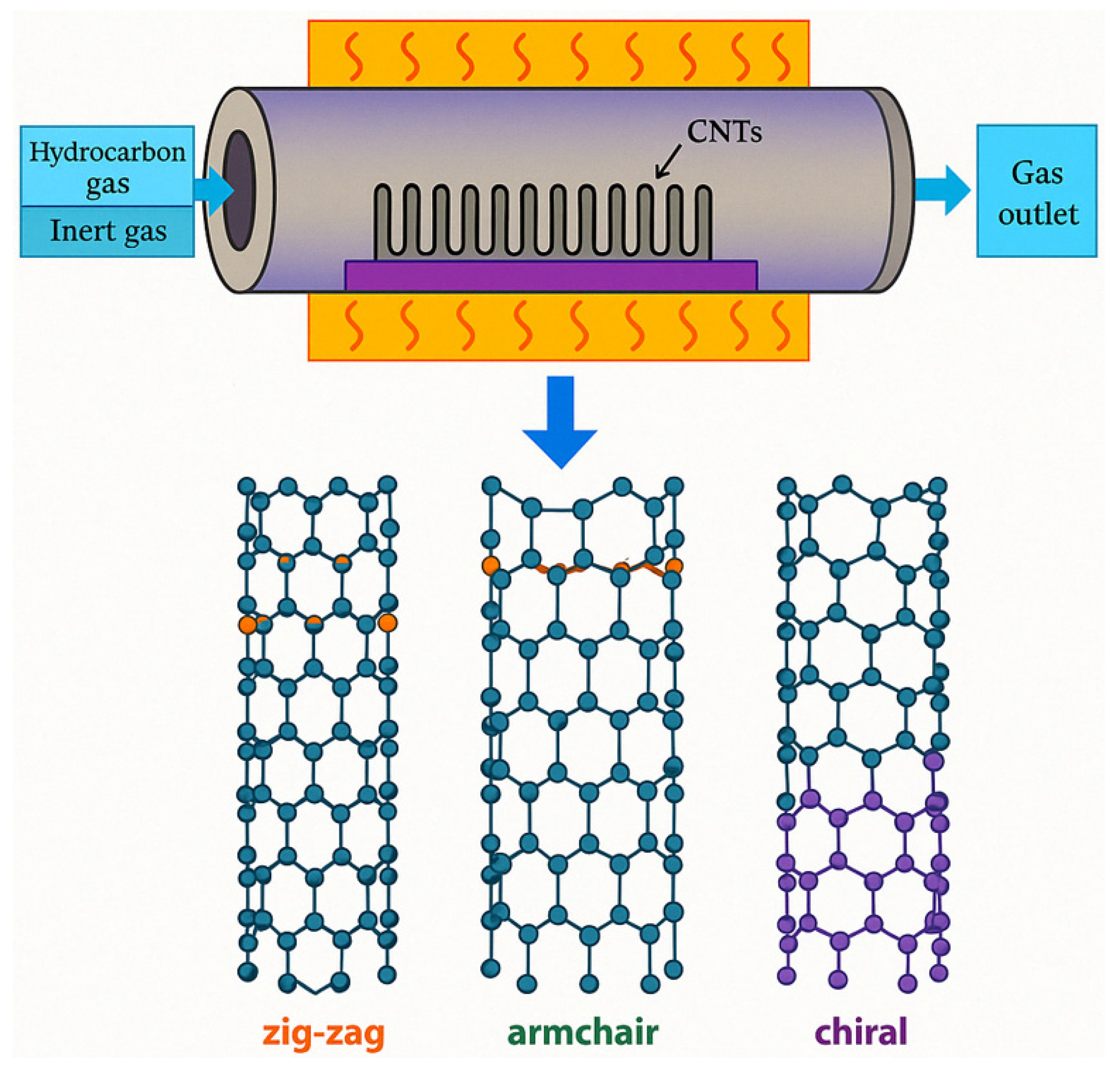
Like CNFs, Carbon Nanotubes (CNTs) have also been researched as promising media for solid-state reversible H2 storage, based on their properties such as high surface area, well-developed nanoporous texture, tunable properties, cage-like structure, chemical stability, and ease of preparation methods [203]. Unlike CNFs, CNTs have a simpler graphite-like structure consisting of one or several sheets of graphene rolled into cylindrical filaments, as shown in Figure 7. Depending on the number of layers, CNTs can be categorized into either SWCNTs or MWCNTs, in which the latter consists of several graphitic filaments arranged concentrically about the same axis. SWCNTs can also occur in bundles. CNTs typically possess micrometre-scale H2 lengths and corresponding inner diameters thousands of times smaller [204]. The highest reported H2 uptake for SWCNTs was first reported by Dillon et al. [205], at 5–10 wt% at 273 K and 0.04 MPa. Even higher values have been obtained by Chen et al. [206] by using alkali-doped CNTs. H2 uptake by Li-MWCNTs was found to be 20 wt% within the temperature range of 473–673 K and at a pressure of 0.1 MPa, while K-MWCNTs have shown an H2 uptake of 14 wt% at temperatures below 313 K and at a pressure of 0.1 MPa. These values were obtained by using the temperature-programmed desorption method. However, later Yang [207] reinvestigated the results and correlated the values obtained by attributing the weight gain to the reaction between the moist air used in the desorption study and the alkali ions on the surface of the carbon material. The same material was found to have an H2 uptake of only 2 wt% under dry conditions using a thermo-gravimetric analysis method.
Recently, research findings have expressed contrasting results about H2 uptake in CNTs. Many researchers have explored numerical simulation results, such as Grand Canonical Monte Carlo Simulations and Density Functional Theory, to investigate the storage of H2 in CNTsH2 with specific regard to the geometrical effects. Researchers have scrutinized various effects like tube diameter, tube configuration, spacing between tubes inside SWCNT bundles, wall-to-wall spacing in MWCNTs, and the number of walls in MWCNTs. H2 molecules adsorb on the inner and outer surfaces of the CNTs; in particular, H2 uptake occurs in the interstitial space between individual tubes. For instance, in a simulation carried out by Minami et al. [208], H2 uptake of 6 wt% at 77 K and 1 MPa in a bundle of CNT tubes in a triangular configuration with an average inter-axis distance of 2.159 nm and an average CNT diameter of 1.227 nm was observed. The optimum distance for the interlayer between concentric tubes in an MWCNT has been found to be 0.34 nm by Singh et al. [209]. Lobo et al. [210] have noted that the adsorption of H2 molecules takes place mostly at the interstitial spaces within the bundles of CNT due to the deformation of the nanotubes generated by defects. The molecular dynamics simulations conducted in the same study indicated that the storage capacity of CNT bundles with a square lattice exceeds that with a triangular lattice arrangement. Generally, carbon materials are promising candidates for hydrogen storage.
Figure 7. Chemical vapour deposition of carbon nanotubes; adapted from [211].
Chemengineering 10 00034 g007

3. TRL Assessment of Hydrogen Surface Storage Technologies

The Technology Readiness Levels (TRL) highlight how far each storage method has been developed beyond the testing stage. TRL of different material-based H2 surface storage technologies are summarized in Table 2, indicating that compressed and liquid H2 are fully commercial. Ammonia and formic acid are also well-established, mainly because the production and handling systems already exist at industrial scale. Most solid-state options fall into the mid-range. They have been proven to work, but they still face practical issues such as high operating temperatures, slow or the need for cryogenic conditions. The newer materials remain at the initial levels as they have only been demonstrated in controlled setups. This table can be used to distinguish technologies that are readily deployable from those that still require significant engineering improvement before they can be utilized.
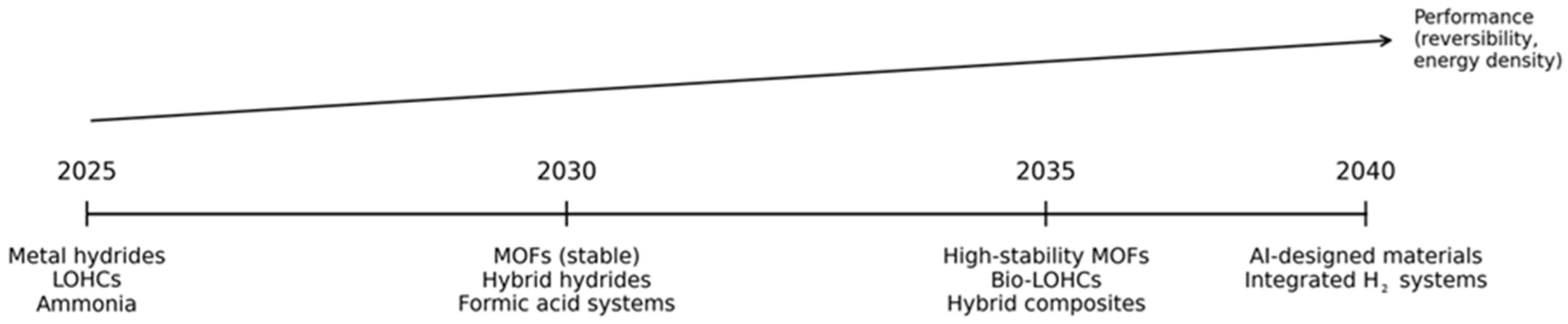
To consolidate the comparative analysis of different H2 surface storage technologies discussed in this study, a development roadmap is presented in Figure 8 summarizing their projected progress in the future. The pathway illustrates how individual storage technologies is expected to evolve in TRL and practicality as research efforts advance from component-level improvements to system-level integration. The predictions in Figure 9 come from a supervised machine learning model that was trained on a dataset of more than 500 material samples taken from public databases and literature. The model uses material descriptors to guess how much hydrogen will be taken up in certain situations.

Preliminary Techno-Economic Comparison

A preliminary techno-economic comparison shows that chemical carriers like ammonia and formic acid are cheaper to store because they can use existing infrastructure and handling systems. MOFs, on the other hand, have high gravimetric capacities, but they are still too expensive to use in business. Metal hydrides are a good choice because they are not too expensive and do not use too much energy. The operational costs depend a lot on how much thermal energy is needed, especially for desorption in hydride systems. Adding waste heat sources could make the economy work better. For future studies, it is suggested that a more detailed model that includes CAPEX/OPEX, energy prices, and system lifetime be used [212].

4. Role of Machine Learning in Assessing H2 Surface Storage Technologies

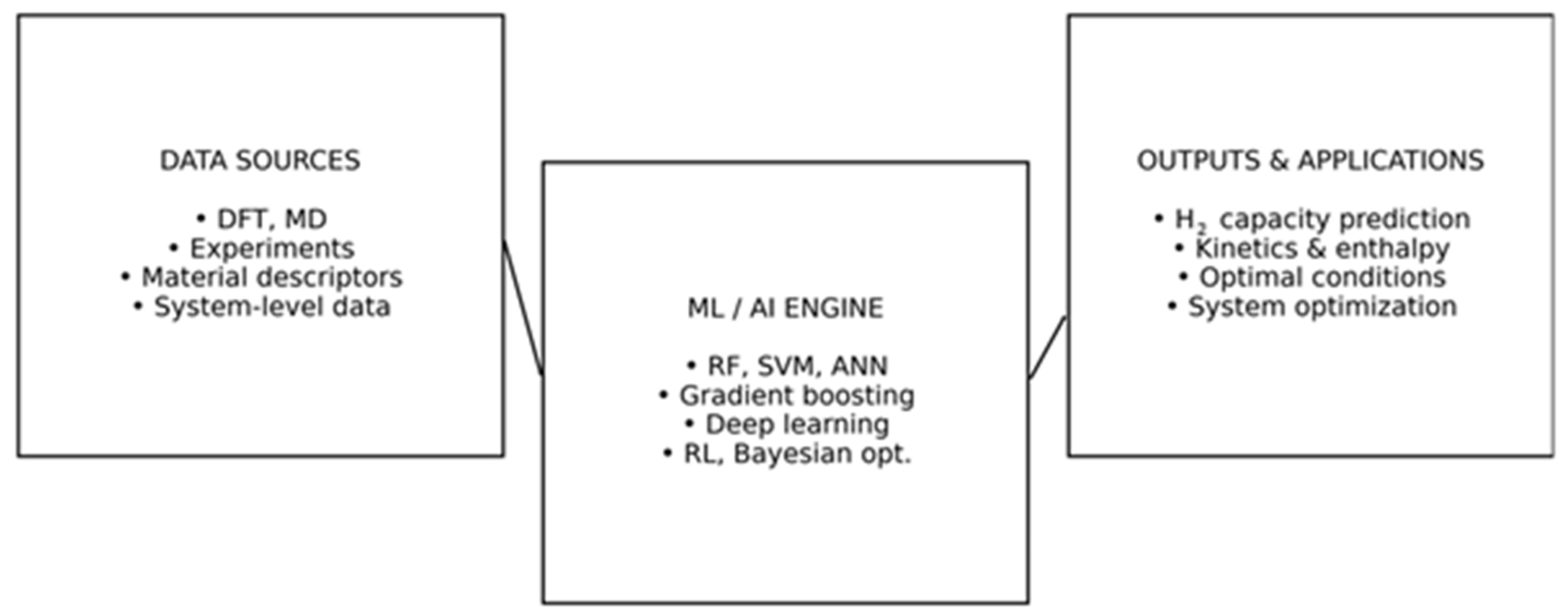
H2 storage technologies are fast gaining worldwide research interests, leading to extensive analytical, experimental and numerical data being produced and reported. This data ranges widely from materials analysis, adsorption kinetics, thermodynamic performance, storage capacity, etc. Conventional approaches for large data analysis are often cumbersome due to limited computational resources, time and cost. Meanwhile, Artificial Intelligence (AI) and Machine Learning (ML) are emerging as transformative tools for large data handling and analysis. This can prove extremely useful in the context of H2 storage technologies. Especially, the ability of ML to reduce data dimensionality and effective optimization strategies can pave the way for future H2 storage-related research.
Moreover, AI can also be used to accelerate the discovery of materials by transforming the conventional trial and error method of material research and development into a data-driven predictive research and development method. To this end, a dataset of materials can be created using experimental data or computational simulations, wherein the material can be represented using a variety of physicochemical properties, including elemental composition, pore structure, surface area, adsorption energy, and thermodynamic stability [213]. Machine learning algorithms can then be used as a surrogate model, wherein complex nonlinear relationships can be established between the physicochemical properties of materials and target properties, including hydrogen storage capacity and adsorption enthalpy. After the development of the machine learning model, it can be utilized for computationally simulating thousands to millions of materials in a much shorter period of time and at a lower cost compared to experimental and first-principles calculations [214]. The materials that have been discovered by using the machine learning model can then be synthesized and verified in a short period of time, thus completing a loop in the materials research and development process.
Recent studies clearly show that ML can provide critical insights into H2 storage technologies’ effectiveness. For example, Gradient Boosting Regression (GBR) has been used to correlate equilibrium pressure in metal hydrides with volume-based descriptors, which allows for accelerated identification of high-pressure hydride alloys [215]. Moreover, multiple ML algorithms are applied using DoE datasets, indicating that GBR models can predict H2 capacity (wt%) with very high accuracy, achieving an R2 of 0.83 [216]. For MOFs, ML has been applied at a large scale, where over 900,000 MOFs were used to train an ML model. This removed the need for trial-and-error synthesis and helped identify theoretical MOF structures with higher potential for H2 storage. This model found over 8200 high-quality MOF structures [217]. Another study applied ML to rapidly screen MOFs for H2 storage, where 12 out of 13 tested models achieved an R2 > 0.95 in predicting both gravimetric and volumetric H2 uptake [218]. A graph-based ML model has been developed to predict H2 uptake in MOFs by converting structures into weighted graphs and extracting 20 spectral and topological descriptors. The XGBoost, an optimized algorithm based on Gradient Boosted Decision Trees (GBDT), achieved results with R2 values of 0.737 for gravimetric uptake and 0.698 for volumetric uptake [219].
Achieving success in machine learning applications for research on hydrogen storage materials requires creating data sets, choosing input features, and validating the machine learning model. The data sets used for developing machine learning models usually include experimentally measured data or computed data for the material properties of the hydrogen storage material. The data sets may include experimentally measured data for the hydrogen capacity, adsorption energy, enthalpy of formation, and other material properties of the hydrogen storage material. The data sets may include structural and composition-based information for the hydrogen storage material. There are several ways to choose input features for the machine learning model. The input features for the machine learning model can be chosen through recursive feature elimination (RFE), principal component analysis (PCA), and tree-based feature importance ranking. After choosing the data sets for the machine learning model, it is important to validate it in a number of ways, such as k-fold cross-validation, leave-one-out validation, and train/test splitting. The performance of the machine learning model can be evaluated through several ways, such as R2 value, Root Mean Square Error (RMSE), and Mean Absolute Error (MAE) [220].
ML has also been used for liquid carriers. Ali et al. [221] used a Hydrogen Storage Prediction with Support Vector Machines (HSP-SVM) model to gauge LOHC performance. The model has been used to classify H2 storage capacity of dibenzyltoluene (H0-DBT), split into three separate classes, i.e., low, medium, and high. The study achieved 98.5% class-wise accuracy and 97% overall accuracy using Holdout Validation. A LaNi5-based metal hydride reactor with helical heat exchangers have been investigated where ML models have been used to predict H2 absorption/desorption behaviour [222]. Another study trained a Stacking Regressor ML model using COMSOL datasets (version 6.2) (R2 = 0.906) to predict saturation time in helically structured hydride-based storage canisters, finding absorption of 90% H2 saturation in 256 s [223]. To optimize economic feasibility, ML models have been used to search for suitable hydride alloys. Another study used a regression model to find suitable alloys for high-pressure hydrogen compression. Out of 6110 possible alloys, fewer than 400 were chosen for further testing using ML constraints [224].
Integrating AI and ML in assessing different H2 storage technologies provides a promising direction for developing data-driven approaches, enabling the prediction and optimization of these technologies, and aid in developing next-generation of storage materials with high energy density, low cost and superior reversibility, as illustrated in Figure 9.
A Life Cycle Assessment (LCA) is useful for more than just techno-economic reasons. It also shows how different storage technologies affect the environment. For instance, storage systems that use ammonia and carbohydrates can have carbon-neutral life cycles, especially if they come from biomass or renewable electricity. But making MOFs and complex metal hydrides might take a lot of energy. To figure out how long these technologies will last, it is important to look at LCA factors like their CO2 footprint, energy return on investment (EROI), and how easy they are to recycle at the end of their lives. LCA datasets could be used in future ML models to help choose the best materials and design systems that are good for the environment and the economy [225].
Although promising results have been obtained with ML models regarding predictions of hydrogen storage performance, a large gap has been found between ML model predictions and actual experimental outcomes. Such a gap may occur due to various reasons, including the lack of proper representation of real-world material defects in ML model parameters, as well as inadequate consideration of synthesis variability and environmental conditions. Inconsistency in measurement methods may also create a large gap between ML model predictions and actual outcomes. To bridge this gap between ML model predictions and actual outcomes, various novel approaches, including active learning and closed-loop ML experiment methods, are now being explored.

Workflow and Challenges of ML in Hydrogen Storage Material Design

The application of ML for hydrogen storage materials includes a series of steps similar to those in the material informatics workflow. The workflow starts with the acquisition of good-quality data, which is often readily available experimentally in the form of databases or computationally through high-throughput methods [226]. The data can include several properties for the materials, which can be hydrogen storage capacity, adsorption enthalpy, surface area, porosity, composition, etc.
The second part of the workflow is feature engineering, where a number of descriptors, both structural and electronic, are extracted for the materials, which can be used for their quantitative representation. Feature selection techniques, such as correlation analysis, PCA, recursive feature elimination, etc., are often applied for the selection of the features [227].
The last part of the workflow is the application of ML algorithms, which include Support Vector Machines (SVM), Random Forest (RF), Gradient Boosting (GB), and Neural Network (NN), that can be used to learn the correlation between the descriptors and the properties of the materials. However, the most important part of the workflow is the evaluation of the ML models, which can be carried out through cross-validation, test sets, and metrics such as R2, RMSE, MAE, etc. [228].
However, despite the recent progress, there are still some challenges. The first is the availability of data, which is not robust for ML models, particularly for unexplored storage materials like complex hydrides or carbohydrate-based materials. The second is the problem of overfitting and the lack of transferability of materials, which is a challenge for the accuracy of ML predictions in practical applications. The third challenge is the black-box nature of ML models, which makes it difficult to understand their predictions in terms of physical causality. The last is the problem of incorporating the predictions of ML models into experiments based on timescale, format, and reproducibility issues.
Overcoming these challenges will involve the creation of standardized ML databases, interpretable ML models, and closed-loop systems that integrate prediction, synthesis, and validation in a loop.

5. Concluding Remarks

This review examines state-of-the-art technologies used for the surface storage of H2. The primary focus has been on the engineering applications and practical approaches of surface H2 storage. A comprehensive review highlights the significant potential of different H2 surface storage technologies as creative, contemporary solutions to lower reliance on greenhouse gas emissions and fossil fuels. The current review study has explored the mechanics, economics, difficulties, and workable solutions associated with surface H2 storage technologies. It has offered insightful information to support further study and advancement on the operational aspects, including the associated costs. Although significant progress is still required to improve infrastructure and applications, the fast development of H2 surface storage technologies marks a considerable deviation from fossil fuels.
Despite its high volumetric energy density, liquid H2 proves energy-intensive and susceptible to issues like corrosion and boil-off. Although metal hydrides have reasonable gravimetric capacity, H2 release and generation depend on high pressure and temperature. Moreover, H2 adsorption on porous systems exhibits high capacity and rapid cycling but faces challenges like metal clustering and weak interaction with H2 molecules. Notwithstanding these challenges, H2 fuel cell technology has developed significantly. The efficiency of H2 as a jet fuel will address challenges with aircraft engines and turbines like sedimentation and corrosion. Its application in steam generators and catalytic burners also favours the industrial and medicinal sectors. Researchers’ primary focus is finding an optimal material with great H2 capacity. Overcoming constraints and driving H2’s extensive acceptance as a sustainable and clean energy source depends on constant innovation and cooperation. Using coordinated efforts, the vision of an H2-powered future can be fulfilled, bringing about a period of environmental responsibility and energy security. Moving forward, AI and ML will help shape the next phase of H2 storage technologies’ development as they offer faster ways to screen materials, optimize system designs, and cut down the cost and time of experimental work. This can significantly improve the research process whilst supporting the development of new technologies. Adding techno-economic and environmental metrics, such as cost-per-kg-H2, energy efficiency, and life cycle impact, makes it easier to understand whether something can be deployed and helps to prioritize research funding.

Author Contributions

Conceptualization, H.K.H.; formal analysis, H.K.H.; investigation, and resources, J.J.K.; writing—original draft preparation, H.K.H.; writing—review and editing, T.A.; supervision, T.A.; project administration, J.J.K. All authors have read and agreed to the published version of the manuscript.

Funding

This research received no external funding.

Data Availability Statement

No new data were created or analyzed in this study.

Conflicts of Interest

The authors declare no conflicts of interest.

References

  1. Hassan, I.A.; Ramadan, H.S.; Saleh, M.A.; Hissel, D. Hydrogen Storage Technologies for Stationary and Mobile Applications: Review, Analysis and Perspectives. Renew. Sustain. Energy Rev. 2021, 149, 111311. [Google Scholar] [CrossRef]
  2. Deevela, N.R.; Kandpal, T.C.; Singh, B. A Review of Renewable Energy Based Power Supply Options for Telecom Towers; Springer: Cham, The Netherlands, 2023. [Google Scholar]
  3. Rolo, I.; Costa, V.A.F.; Brito, F.P. Hydrogen-Based Energy Systems: Current Technology Development Status, Opportunities and Challenges. Energies 2024, 17, 180. [Google Scholar] [CrossRef]
  4. Oliveira, A.M.; Beswick, R.R.; Yan, Y. A Green Hydrogen Economy for a Renewable Energy Society. Curr. Opin. Chem. Eng. 2021, 33, 100701. [Google Scholar] [CrossRef]
  5. Töpler, J.; Lehmann, J. Hydrogen and Fuel Cell, 1st ed.; Springer: Berlin/Heidelberg, Germany, 2015. [Google Scholar]
  6. Williams, L.; Sovacool, B.K.; Foxon, T.J. The Energy Use Implications of 5G: Reviewing Whole Network Operational Energy, Embodied Energy, and Indirect Effects. Renew. Sustain. Energy Rev. 2022, 157, 112033. [Google Scholar] [CrossRef]
  7. Hassan, Q.; Azzawi, I.D.J.; Sameen, A.Z.; Salman, H.M. Hydrogen Fuel Cell Vehicles: Opportunities and Challenges. Sustainability 2023, 15, 11501. [Google Scholar] [CrossRef]
  8. Rathore, S.S.; Biswas, S.; Fini, D.; Kulkarni, A.P.; Giddey, S. Direct Ammonia Solid-Oxide Fuel Cells: A Review of Progress and Prospects. Int. J. Hydrogen Energy 2021, 46, 35365–35384. [Google Scholar] [CrossRef]
  9. Hawez, H.K.; Asaad, F.; Suleiman, A.; Khorsheed, A. Modeling Fluid Dynamics in Porous Media: A Pore-Scale Flow Analysis. EarthArXiv 2025. [Google Scholar] [CrossRef]
  10. Harati, S.; Rezaei Gomari, S.; Gasanzade, F.; Bauer, S.; Pak, T.; Orr, C. Underground Hydrogen Storage to Balance Seasonal Variations in Energy Demand: Impact of Well Configuration on Storage Performance in Deep Saline Aquifers. Int. J. Hydrogen Energy 2023, 48, 26894–26910. [Google Scholar] [CrossRef]
  11. Jahanbakhsh, A.; Louis Potapov-Crighton, A.; Mosallanezhad, A.; Tohidi Kaloorazi, N.; Maroto-Valer, M.M. Underground Hydrogen Storage: A UK Perspective. Renew. Sustain. Energy Rev. 2024, 189, 114001. [Google Scholar] [CrossRef]
  12. Gómez, J.A.; Santos, D.M.F. The Status of On-Board Hydrogen Storage in Fuel Cell Electric Vehicles. Designs 2023, 7, 97. [Google Scholar] [CrossRef]
  13. Liu, X.; Zhu, G.; Asim, T.; Mishra, R. Application of Momentum Flux Method for the Design of an α-Shaped Flame Incinerator Fueled with Two-Component Solid Waste. Energy 2022, 248, 123647. [Google Scholar] [CrossRef]
  14. Orlova, S.; Mezeckis, N.; Vasudev, V.P.K. Compression of Hydrogen Gas for Energy Storage: A Review. Latv. J. Phys. Tech. Sci. 2023, 60, 4–16. [Google Scholar] [CrossRef]
  15. Zhang, T.; Uratani, J.; Huang, Y.; Xu, L.; Griffiths, S.; Ding, Y. Hydrogen Liquefaction and Storage: Recent Progress and Perspectives. Renew. Sustain. Energy Rev. 2023, 176, 113204. [Google Scholar] [CrossRef]
  16. Kollár, L.E.; Mishra, R.; Asim, T. Particle Size Effects on Optimal Sizing and Lifetime of Pipelines Transporting Multi-Sized Solid-Liquid Mixtures. Procedia CIRP 2013, 11, 317–322. [Google Scholar] [CrossRef]
  17. Raji, Z.; Karim, A.; Karam, A.; Khalloufi, S. Adsorption of Heavy Metals: Mechanisms, Kinetics, and Applications of Various Adsorbents in Wastewater Remediation—A Review. Waste 2023, 1, 775–805. [Google Scholar] [CrossRef]
  18. Borgschulte, A. The Hydrogen Grand Challenge. Front. Energy Res. 2016, 4, 1–8. [Google Scholar] [CrossRef]
  19. Sathe, R.Y.; Dhilip Kumar, T.J.; Ahuja, R. Furtherance of the Material-Based Hydrogen Storage Based on Theory and Experiments. Int. J. Hydrogen Energy 2023, 48, 12767–12795. [Google Scholar] [CrossRef]
  20. Chen, Z.; Kirlikovali, K.O.; Idrees, K.B.; Wasson, M.C.; Farha, O.K. Porous Materials for Hydrogen Storage. Chem 2022, 8, 693–716. [Google Scholar] [CrossRef]
  21. Langmi, H.W.; Ren, J.; North, B.; Mathe, M.; Bessarabov, D. Hydrogen Storage in Metal-Organic Frameworks: A Review. Electrochim. Acta 2014, 128, 368–392. [Google Scholar] [CrossRef]
  22. Hirscher, M.; Yartys, V.A.; Baricco, M.; Bellosta von Colbe, J.; Blanchard, D.; Bowman, R.C.; Broom, D.P.; Buckley, C.E.; Chang, F.; Chen, P.; et al. Materials for Hydrogen-Based Energy Storage—Past, Recent Progress and Future Outlook. J. Alloys Compd. 2020, 827, 153548. [Google Scholar] [CrossRef]
  23. Shaker, L.M.; Al-Amiery, A.A.; Al-Azzawi, W.K. Nanomaterials: Paving the Way for the Hydrogen Energy Frontier. Discov. Nano 2024, 19, 3. [Google Scholar] [CrossRef]
  24. Mekonnin, A.S.; Wacławiak, K.; Humayun, M.; Zhang, S.; Ullah, H. Hydrogen Storage Technology, and Its Challenges: A Review. Catalysts 2025, 15, 260. [Google Scholar] [CrossRef]
  25. Aziz, M.; TriWijayanta, A.; Nandiyanto, A.B.D. Ammonia as Effective Hydrogen Storage: A Review on Production, Storage and Utilization. Energies 2020, 13, 3062. [Google Scholar] [CrossRef]
  26. Kurien, C.; Mittal, M. Utilization of Green Ammonia as a Hydrogen Energy Carrier for Decarbonization in Spark Ignition Engines. Int. J. Hydrogen Energy 2023, 48, 28803–28823. [Google Scholar] [CrossRef]
  27. Palys, M.J.; Wang, H.; Zhang, Q.; Daoutidis, P. Renewable Ammonia for Sustainable Energy and Agriculture: Vision and Systems Engineering Opportunities. Curr. Opin. Chem. Eng. 2021, 31, 100667. [Google Scholar] [CrossRef]
  28. Mallouppas, G.; Ioannou, C.; Yfantis, E.A. A Review of the Latest Trends in the Use of Green Ammonia as an Energy Carrier in Maritime Industry. Energies 2022, 15, 1453. [Google Scholar] [CrossRef]
  29. Nakayama, J.; Kasai, N.; Shibutani, T.; Miyake, A. Security Risk Analysis of a Hydrogen Fueling Station with an On-Site Hydrogen Production System Involving Methylcyclohexane. Int. J. Hydrogen Energy 2019, 44, 9110–9119. [Google Scholar] [CrossRef]
  30. Zepon, G.; Silva, B.H.; Zlotea, C.; Botta, W.J.; Zepon, G.; Silva, B.H.; Zlotea, C.; Botta, W.J.; Ther-, Y.C. Thermodynamic Modelling of Hydrogen-Multicomponent Alloy Systems: Calculating Pressure-Composition-Temperature Diagrams Hal-03267335. Acta Mater. 2021, 215, 117070. [Google Scholar] [CrossRef]
  31. Jacobs, H.; Gupta, A.; Möller, I. Governing-by-Aspiration? Assessing the Nature and Implications of Including Negative Emission Technologies (NETs) in Country Long-Term Climate Strategies. Glob. Environ. Change 2023, 81, 102691. [Google Scholar] [CrossRef]
  32. Williams, R.; Crandall, R.S.; Bloom, A. Use of Carbon Dioxide in Energy Storage. Appl. Phys. Lett. 1978, 33, 381–383. [Google Scholar] [CrossRef]
  33. Sagel, V.N.; Rouwenhorst, K.H.R.; Faria, J.A. Green Ammonia Enables Sustainable Energy Production in Small Island Developing States: A Case Study on the Island of Curaçao. Renew. Sustain. Energy Rev. 2022, 161, 112381. [Google Scholar] [CrossRef]
  34. Hawez, H.; Ahmed, Z. Enhanced Oil Recovery by CO2 Injection in Carbonate Reservoirs. WIT Trans. Ecol. Environ. 2014, 186, 547–558. [Google Scholar] [CrossRef]
  35. Estevez, R.; López-Tenllado, F.J.; Aguado-Deblas, L.; Bautista, F.M.; Romero, A.A.; Luna, D. Current Research on Green Ammonia (NH3) as a Potential Vector Energy for Power Storage and Engine Fuels: A Review. Energies 2023, 16, 5451. [Google Scholar] [CrossRef]
  36. Machaj, K.; Kupecki, J.; Malecha, Z.; Morawski, A.W.; Skrzypkiewicz, M.; Stanclik, M.; Chorowski, M. Ammonia as a Potential Marine Fuel: A Review. Energy Strateg. Rev. 2022, 44, 100926. [Google Scholar] [CrossRef]
  37. Bharadwaj, B.; Weder, F.; Ashworth, P. More Support for Hydrogen Export than Its Domestic Application in Australia. Humanit. Soc. Sci. Commun. 2023, 10, 7. [Google Scholar] [CrossRef]
  38. Faria, J.A. Renaissance of Ammonia Synthesis for Sustainable Production of Energy and Fertilizers. Curr. Opin. Green Sustain. Chem. 2021, 29, 100466. [Google Scholar] [CrossRef]
  39. Balci, G.; Phan, T.T.N.; Surucu-Balci, E.; Iris, Ç. A Roadmap to Alternative Fuels for Decarbonising Shipping: The Case of Green Ammonia. Res. Transp. Bus. Manag. 2024, 53, 101100. [Google Scholar] [CrossRef]
  40. Giddey, S.; Badwal, S.P.S.; Kulkarni, A. Review of Electrochemical Ammonia Production Technologies and Materials. Int. J. Hydrogen Energy 2013, 38, 14576–14594. [Google Scholar] [CrossRef]
  41. Aziz, M. Liquid Hydrogen: A Review on Liquefaction, Storage, Transportation, and Safety. Energies 2021, 14, 5917. [Google Scholar] [CrossRef]
  42. Rouwenhorst, K.H.R.; Travis, A.S.; Lefferts, L. 1921–2021: A Century of Renewable Ammonia Synthesis. Sustain. Chem. 2022, 3, 149–171. [Google Scholar] [CrossRef]
  43. Hossein Ali, Y.R.; Shin, D. Green Hydrogen Production Technologies from Ammonia Cracking. Energies 2022, 15, 8246. [Google Scholar] [CrossRef]
  44. Somo, T.R.; Maponya, T.C.; Davids, M.W.; Hato, M.J.; Lototskyy, M.V.; Modibane, K.D. A Comprehensive Review on Hydrogen Absorption Behaviour of Metal Alloys Prepared through Mechanical Alloying. Metals 2020, 10, 562. [Google Scholar] [CrossRef]
  45. Abe, J.O.; Popoola, A.P.I.; Ajenifuja, E.; Popoola, O.M. Hydrogen Energy, Economy and Storage: Review and Recommendation. Int. J. Hydrogen Energy 2019, 44, 15072–15086. [Google Scholar] [CrossRef]
  46. Klopčič, N.; Grimmer, I.; Winkler, F.; Sartory, M.; Trattner, A. A Review on Metal Hydride Materials for Hydrogen Storage. J. Energy Storage 2023, 72, 108456. [Google Scholar] [CrossRef]
  47. Drawer, C.; Lange, J.; Kaltschmitt, M. Metal Hydrides for Hydrogen Storage—Identification and Evaluation of Stationary and Transportation Applications. J. Energy Storage 2024, 77, 109988. [Google Scholar] [CrossRef]
  48. McWhorter, S.; O’Malley, K.; Adams, J.; Ordaz, G.; Randolph, K.; Stetson, N.T. Moderate Temperature Dense Phase Hydrogen Storage Materials within the US Department of Energy (DOE) H2 Storage Program: Trends toward Future Development. Crystals 2012, 2, 413–445. [Google Scholar] [CrossRef]
  49. Yang, Y.; Zhang, X.; Zhang, L.; Zhang, W.; Liu, H.; Huang, Z.; Yang, L.; Gu, C.; Sun, W.; Gao, M.; et al. Recent Advances in Catalyst-Modified Mg-Based Hydrogen Storage Materials. J. Mater. Sci. Technol. 2023, 163, 182–211. [Google Scholar] [CrossRef]
  50. Lototskyy, M.V.; Tarasov, B.P.; Yartys, V.A. Gas-Phase Applications of Metal Hydrides. J. Energy Storage 2023, 72, 108165. [Google Scholar] [CrossRef]
  51. Bellosta von Colbe, J.; Ares, J.R.; Barale, J.; Baricco, M.; Buckley, C.; Capurso, G.; Gallandat, N.; Grant, D.M.; Guzik, M.N.; Jacob, I.; et al. Application of Hydrides in Hydrogen Storage and Compression: Achievements, Outlook and Perspectives. Int. J. Hydrogen Energy 2019, 44, 7780–7808. [Google Scholar] [CrossRef]
  52. Guo, Z.X.; Shang, C.; Aguey-Zinsou, K.F. Materials Challenges for Hydrogen Storage. J. Eur. Ceram. Soc. 2008, 28, 1467–1473. [Google Scholar] [CrossRef]
  53. Rangel, C.M.; Fernandes, V.R.; Gano, A.J. Metal Hydride-Based Hydrogen Production and Storage System for Stationary Applications Powered by Renewable Sources. Renew. Energy 2022, 197, 398–405. [Google Scholar] [CrossRef]
  54. Hawez, H.; Sanaee, R.; Faisal, N.H. Multiphase Flow Modelling in Fractured Reservoirs Using a Novel Computational Fluid Dynamics Approach. In Proceedings of the 55th U.S. Rock Mechanics/Geomechanics Symposium, Virtual, 18–25 June 2021. [Google Scholar]
  55. Li, Q.; Liu, Z.; Sun, Y.; Yang, S.; Deng, C. A Review on Temperature Control of Proton Exchange Membrane Fuel Cells. Processes 2021, 9, 235. [Google Scholar] [CrossRef]
  56. Ramousse, J.; Lottin, O.; Didierjean, S.; Maillet, D. Heat Sources in Proton Exchange Membrane (PEM) Fuel Cells. J. Power Sources 2009, 192, 435–441. [Google Scholar] [CrossRef]
  57. Fang, Z.Z.; Zhou, C.; Fan, P.; Udell, K.S.; Bowman, R.C.; Vajo, J.J.; Purewal, J.J.; Kekelia, B. Metal Hydrides Based High Energy Density Thermal Battery. J. Alloys Compd. 2015, 645, S184–S189. [Google Scholar] [CrossRef]
  58. Fruchart, D.; Jehan, M.; Skryabina, N.; de Rango, P. Hydrogen Solid State Storage on MgH2 Compacts for Mass Applications. Metals 2023, 13, 992. [Google Scholar] [CrossRef]
  59. Brinkman, L.; Bulfin, B.; Steinfeld, A. Thermochemical Hydrogen Storage via the Reversible Reduction and Oxidation of Metal Oxides. Energy Fuels 2021, 35, 18756–18767. [Google Scholar] [CrossRef]
  60. Lyu, J.; Lider, A.; Kudiiarov, V. Using Ball Milling for Modification of the Hydrogenation/Dehydrogenation Process: An Overview. Metals 2019, 9, 768. [Google Scholar] [CrossRef]
  61. Kudiyarov, V.N.; Elman, R.R.; Kurdyumov, N.E. The Effect of High-Energy Ball Milling Conditions on Microstructure and Hydrogen Desorption Properties of Magnesium Hydride and Single-Walled Carbon Nanotubes. Metals 2021, 11, 1409. [Google Scholar] [CrossRef]
  62. Galey, B.; Auroux, A.; Sabo-Etienne, S.; Dhaher, S.; Grellier, M.; Postole, G. Improved Hydrogen Storage Properties of Mg/MgH2 Thanks to the Addition of Nickel Hydride Complex Precursors. Int. J. Hydrogen Energy 2019, 44, 28848–28862. [Google Scholar] [CrossRef]
  63. Driesner, T.; Heinrich, C.A. The System H2O-NaCl. Part I: Correlation Formulae for Phase Relations in Temperature-Pressure-Composition Space from 0 to 1000 °C, 0 to 5000 Bar, and 0 to 1 XNaCl. Geochim. Cosmochim. Acta 2007, 71, 4880–4901. [Google Scholar] [CrossRef]
  64. Huang, S.J.; Rajagopal, V.; Skripnyuk, V.; Rabkin, E.; Fang, C. A Comparative Study of Hydrogen Storage Properties of AZ31 and AZ91 Magnesium Alloys Processed by Different Methods. J. Alloys Compd. 2023, 935, 167854. [Google Scholar] [CrossRef]
  65. Li, B.; Li, J.; Shao, H.; He, L. Mg-Based Hydrogen Absorbing Materials for Thermal Energy Storage-A Review. Appl. Sci. 2018, 8, 1375. [Google Scholar] [CrossRef]
  66. Møller, K.T.; Jensen, T.R.; Akiba, E.; Li, H. wen Hydrogen—A Sustainable Energy Carrier. Prog. Nat. Sci. Mater. Int. 2017, 27, 34–40. [Google Scholar] [CrossRef]
  67. Lys, A.; Fadonougbo, J.O.; Faisal, M.; Suh, J.-Y.; Lee, Y.-S.; Shim, J.-H.; Park, J.; Cho, Y.W. Enhancing the Hydrogen Storage Properties of AxBy Intermetallic Compounds by Partial Substitution: A Short Review. Hydrogen 2020, 1, 38–63. [Google Scholar] [CrossRef]
  68. Konik, P.; Berdonosova, E.; Savvotin, I.; Zadorozhnyy, V.; Zadorozhnyy, M.; Semenov, D.; Korol, A.; Kvaratskheliya, A.; Klyamkin, S. Structure and Hydrogenation Features of Mechanically Activated LaNi5-Type Alloys. Int. J. Hydrogen Energy 2021, 46, 13638–13646. [Google Scholar] [CrossRef]
  69. Larpruenrudee, P.; Bennett, N.S.; Gu, Y.T.; Fitch, R.; Islam, M.S. Design Optimization of a Magnesium-Based Metal Hydride Hydrogen Energy Storage System. Sci. Rep. 2022, 12, 13436. [Google Scholar] [CrossRef]
  70. Abetz, C.; Georgopanos, P.; Pistidda, C.; Klassen, T.; Abetz, V. Reactive Hydride Composite Confined in a Polymer Matrix: New Insights into the Desorption and Absorption of Hydrogen in a Storage Material with High Cycling Stability. Adv. Mater. Technol. 2022, 7, 2101584. [Google Scholar] [CrossRef]
  71. Liu, L.; Ilyushechkin, A.; Liang, D.; Cousins, A.; Tian, W.; Chen, C.; Yin, J.; Schoeman, L. Metal Hydride Composite Structures for Improved Heat Transfer and Stability for Hydrogen Storage and Compression Applications. Inorganics 2023, 11, 181. [Google Scholar] [CrossRef]
  72. Kukkapalli, V.K.; Kim, S.; Thomas, S.A. Thermal Management Techniques in Metal Hydrides for Hydrogen Storage Applications: A Review. Energies 2023, 16, 3444. [Google Scholar] [CrossRef]
  73. Jin, O.; Shang, Y.; Huang, X.; Szabó, D.V.; Le, T.T.; Wagner, S.; Klassen, T.; Kübel, C.; Pistidda, C.; Pundt, A. Transformation Kinetics of LiBH4–MgH2 for Hydrogen Storage. Molecules 2022, 27, 7005. [Google Scholar] [CrossRef] [PubMed]
  74. Jain, A.; Agarwal, S.; Ichikawa, T. Catalytic Tuning of Sorption Kinetics of Lightweight Hydrides: A Review of the Materials and Mechanism. Catalysts 2018, 8, 651. [Google Scholar] [CrossRef]
  75. Zhang, J.; Yang, F.; Wang, B.; Li, D.; Wei, M.; Fang, T.; Zhang, Z. Heterogeneous Catalysts in N-Heterocycles and Aromatics as Liquid Organic Hydrogen Carriers (LOHCs): History, Present Status and Future. Materials 2023, 16, 3735. [Google Scholar] [CrossRef]
  76. Da Conceição, M.O.T.; Brum, M.C.; Dos Santos, D.S.; Dias, M.L. Hydrogen Sorption Enhancement by Nb2O5 and Nb Catalysts Combined with MgH2. J. Alloys Compd. 2013, 550, 179–184. [Google Scholar] [CrossRef]
  77. Gandhi, K.; Dixit, D.K.; Dixit, B.K. Hydrogen Desorption Energies of Aluminum Hydride (AlnH 3n) Clusters. Phys. B Condens. Matter 2010, 405, 3075–3081. [Google Scholar] [CrossRef]
  78. Navlani-García, M.; Salinas-Torres, D.; Mori, K.; Kuwahara, Y.; Yamashita, H. Enhanced Formic Acid Dehydrogenation by the Synergistic Alloying Effect of PdCo Catalysts Supported on Graphitic Carbon Nitride. Int. J. Hydrogen Energy 2019, 44, 28483–28493. [Google Scholar] [CrossRef]
  79. Riquelme-García, P.; Navlani-García, M.; Cazorla-Amorós, D. Hydrogen Storage System Attained by HCOOH-CO2 Couple: Recent Developments in Pd-Based Carbon-Supported Heterogeneous Catalysts. Energies 2024, 17, 260. [Google Scholar] [CrossRef]
  80. Eppinger, J.; Huang, K.W. Formic Acid as a Hydrogen Energy Carrier. ACS Energy Lett. 2017, 2, 188–195. [Google Scholar] [CrossRef]
  81. Ruiz-López, E.; Ribota Peláez, M.; Blasco Ruz, M.; Domínguez Leal, M.I.; Martínez Tejada, M.; Ivanova, S.; Centeno, M.Á. Formic Acid Dehydrogenation over Ru- and Pd-Based Catalysts: Gas- vs. Liquid-Phase Reactions. Materials 2023, 16, 472. [Google Scholar] [CrossRef]
  82. Al-Nayili, A.; Majdi, H.S.; Albayati, T.M.; Saady, N.M.C. Formic Acid Dehydrogenation Using Noble-Metal Nanoheterogeneous Catalysts: Towards Sustainable Hydrogen-Based Energy. Catalysts 2022, 12, 324. [Google Scholar] [CrossRef]
  83. Hawez, H.K.; Asim, T. Impact of Regional Pressure Dissipation on Carbon Capture and Storage Projects: A Comprehensive Review. Energies 2024, 17, 1889. [Google Scholar] [CrossRef]
  84. Mori, K.; Futamura, Y.; Masuda, S.; Kobayashi, H.; Yamashita, H. Controlled Release of Hydrogen Isotope Compounds and Tunneling Effect in the Heterogeneously-Catalyzed Formic Acid Dehydrogenation. Nat. Commun. 2019, 10, 4094. [Google Scholar] [CrossRef]
  85. Geng, Y.; Johnravindar, D.; Xue, W.; Ye, J.; Zhao, J. Efficient Dehydrogenation of Formic Acid at Room Temperature Using a Pd/Chitosan-Derived Nitrogen-Doped Carbon Catalyst: Synthesis, Characterization, and Kinetic Study. Ind. Eng. Chem. Res. 2023, 62, 20213–20222. [Google Scholar] [CrossRef]
  86. Navlani-García, M.; Mori, K.; Salinas-Torres, D.; Kuwahara, Y.; Yamashita, H. New Approaches toward the Hydrogen Production from Formic Acid Dehydrogenation over Pd-Based Heterogeneous Catalysts. Front. Mater. 2019, 6, 44. [Google Scholar] [CrossRef]
  87. Zhang, X.; Zhao, Y.; Hu, S.; Gliege, M.E.; Liu, Y.; Liu, R.; Scudiero, L.; Hu, Y.; Ha, S. Electrochemical Reduction of Carbon Dioxide to Formic Acid in Ionic Liquid [Emim][N(CN)2]/Water System. Electrochim. Acta 2017, 247, 281–287. [Google Scholar] [CrossRef]
  88. Kang, Y.; Kim, T.; Jung, K.Y.; Park, K.T. Recent Progress in Electrocatalytic CO2 Reduction to Pure Formic Acid Using a Solid-State Electrolyte Device. Catalysts 2023, 13, 955. [Google Scholar] [CrossRef]
  89. Kumaravel, V.; Bartlett, J.; Pillai, S.C. Photoelectrochemical Conversion of Carbon Dioxide (CO2) into Fuels and Value-Added Products. ACS Energy Lett. 2020, 5, 486–519. [Google Scholar] [CrossRef]
  90. Moret, S.; Dyson, P.J.; Laurenczy, G. Direct Synthesis of Formic Acid from Carbon Dioxide by Hydrogenation in Acidic Media. Nat. Commun. 2014, 5, 4017. [Google Scholar] [CrossRef]
  91. Hu, J.; Ma, W.; Liu, Q.; Geng, J.; Wu, Y.; Hu, X. Reaction and Separation System for CO2 Hydrogenation to Formic Acid Catalyzed by Iridium Immobilized on Solid Phosphines under Base-Free Condition. iScience 2023, 26, 106672. [Google Scholar] [CrossRef]
  92. Wang, H.; Cheng, S.; Cai, X.; Cheng, L.; Zhou, R.; Hou, T.; Li, Y. Photocatalytic CO2 Reduction to HCOOH over Core-Shell Cu@Cu2O Catalysts. Catal. Commun. 2022, 162, 106372. [Google Scholar] [CrossRef]
  93. Kushwaha, S.; Parthiban, J.; Singh, S.K. Recent Developments in Reversible CO2 Hydrogenation and Formic Acid Dehydrogenation over Molecular Catalysts. ACS Omega 2023, 8, 38773–38793. [Google Scholar] [CrossRef]
  94. Asim, T.; Hawez, H.K. Effects of CO2 Geosequestration on Opalinus Clay. Energies 2024, 17, 2431. [Google Scholar] [CrossRef]
  95. Coffey, R.S. The Decomposition of Formic Acid Catalysed by Soluble Metal Complexes. Chem. Commun. 1967, 18, 923–924. [Google Scholar] [CrossRef]
  96. Grasemann, M.; Laurenczy, G. Formic Acid as a Hydrogen Source—Recent Developments and Future Trends. Energy Environ. Sci. 2012, 5, 8171–8181. [Google Scholar] [CrossRef]
  97. Onishi, N.; Kanega, R.; Kawanami, H.; Himeda, Y. Recent Progress in Homogeneous Catalytic Dehydrogenation of Formic Acid. Molecules 2022, 27, 455. [Google Scholar] [CrossRef]
  98. Deng, X.; Wang, J.; Guan, N.; Li, L. Catalysts and Mechanisms for the Selective Heterogeneous Hydrogenation of Carbon-Carbon Triple Bonds. Cell Reports Phys. Sci. 2022, 3, 101017. [Google Scholar] [CrossRef]
  99. Zhang, X.; Huang, W.; Yu, L.; García-Melchor, M.; Wang, D.; Zhi, L.; Zhang, H. Enabling Heterogeneous Catalysis to Achieve Carbon Neutrality: Directional Catalytic Conversion of CO2 into Carboxylic Acids. Carbon Energy 2023, 6, e362. [Google Scholar] [CrossRef]
  100. Zhou, Y.; Jin, C.; Li, Y.; Shen, W. Dynamic Behavior of Metal Nanoparticles for Catalysis. Nano Today 2018, 20, 101–120. [Google Scholar] [CrossRef]
  101. Liu, L.; Corma, A. Metal Catalysts for Heterogeneous Catalysis: From Single Atoms to Nanoclusters and Nanoparticles. Chem. Rev. 2018, 118, 4981–5079. [Google Scholar] [CrossRef]
  102. Gupta, S.; Fernandes, R.; Patel, R.; Spreitzer, M.; Patel, N. A Review of Cobalt-Based Catalysts for Sustainable Energy and Environmental Applications. Appl. Catal. A Gen. 2023, 661, 119254. [Google Scholar] [CrossRef]
  103. Peng, H.; Dong, T.; Zhang, L.; Wang, C.; Liu, W.; Bao, J.; Wang, X.; Zhang, N.; Wang, Z.; Wu, P.; et al. Active and Stable Pt-Ceria Nanowires@silica Shell Catalyst: Design, Formation Mechanism and Total Oxidation of CO and Toluene. Appl. Catal. B Environ. 2019, 256, 117807. [Google Scholar] [CrossRef]
  104. Zhang, J.; Fan, S.K.; Zhang, M.H.; Grieneisen, M.L.; Zhang, J.F. Aliphatic Hydrocarbons Recovered in Vegetables from Soils Based on Their In-Situ Distribution in Various Soil Humus Fractions Using a Successive Extraction Method. J. Hazard. Mater. 2018, 346, 10–18. [Google Scholar] [CrossRef] [PubMed]
  105. Bi, F.; Ma, S.; Gao, B.; Liu, B.; Huang, Y.; Qiao, R.; Zhang, X. Boosting Toluene Deep Oxidation by Tuning Metal-Support Interaction in MOF-Derived Pd@ZrO2 Catalysts: The Role of Interfacial Interaction between Pd and ZrO2. Fuel 2024, 357, 129833. [Google Scholar] [CrossRef]
  106. Nagaraju, N.; Fonseca, A.; Konya, Z.; Nagy, J.B. Alumina and Silica Supported Metal Catalysts for the Production of Carbon Nanotubes. J. Mol. Catal. A Chem. 2002, 181, 57–62. [Google Scholar] [CrossRef]
  107. Pan, Y.; Shen, X.; Yao, L.; Bentalib, A.; Peng, Z. Active Sites in Heterogeneous Catalytic Reaction on Metal and Metal Oxide: Theory and Practice. Catalysts 2018, 8, 478. [Google Scholar] [CrossRef]
  108. Losch, P.; Huang, W.; Goodman, E.D.; Wrasman, C.J.; Holm, A.; Riscoe, A.R.; Schwalbe, J.A.; Cargnello, M. Colloidal Nanocrystals for Heterogeneous Catalysis. Nano Today 2019, 24, 15–47. [Google Scholar] [CrossRef]
  109. Pichon, L.; Huneau, J.F.; Fromentin, G.; Tomé, D. A High-Protein, High-Fat, Carbohydrate-Free Diet Reduces Energy Intake, Hepatic Lipogenesis, and Adiposity in Rats. J. Nutr. 2006, 136, 1256–1260. [Google Scholar] [CrossRef]
  110. Blasi, A.; Verardi, A.; Lopresto, C.G.; Siciliano, S.; Sangiorgio, P. Lignocellulosic Agricultural Waste Valorization to Obtain Valuable Products: An Overview. Recycling 2023, 8, 61. [Google Scholar] [CrossRef]
  111. Azni, M.A.; Md Khalid, R.; Hasran, U.A.; Kamarudin, S.K. Review of the Effects of Fossil Fuels and the Need for a Hydrogen Fuel Cell Policy in Malaysia. Sustainability 2023, 15, 4033. [Google Scholar] [CrossRef]
  112. Wang, Y.; Lu, Y. Sodium Alginate-Based Functional Materials toward Sustainable Applications: Water Treatment and Energy Storage. Ind. Eng. Chem. Res. 2023, 62, 11279–11304. [Google Scholar] [CrossRef]
  113. Pawelczyk, E.; Łukasik, N.; Wysocka, I.; Rogala, A.; Gębicki, J. Recent Progress on Hydrogen Storage and Production Using Chemical Hydrogen Carriers. Energies 2022, 15, 4964. [Google Scholar] [CrossRef]
  114. Wang, F.; Harindintwali, J.D.; Yuan, Z.; Wang, M.; Wang, F.; Li, S.; Yin, Z.; Huang, L.; Fu, Y.; Li, L.; et al. Technologies and Perspectives for Achieving Carbon Neutrality. Innovation 2021, 2, 100180. [Google Scholar] [CrossRef]
  115. Mikulčić, H.; Skov, I.R.; Dominković, D.F.; Wan Alwi, S.R.; Manan, Z.A.; Tan, R.; Duić, N.; Hidayah Mohamad, S.N.; Wang, X. Flexible Carbon Capture and Utilization Technologies in Future Energy Systems and the Utilization Pathways of Captured CO2. Renew. Sustain. Energy Rev. 2019, 114, 109338. [Google Scholar] [CrossRef]
  116. Qazi, U.Y. Future of Hydrogen as an Alternative Fuel For. Energies 2022, 15, 4741. [Google Scholar] [CrossRef]
  117. Bowie, J.U.; Sherkhanov, S.; Korman, T.P.; Valliere, M.A.; Opgenorth, P.H.; Liu, H. Synthetic Biochemistry: The Bio-Inspired Cell-Free Approach to Commodity Chemical Production. Trends Biotechnol. 2020, 38, 766–778. [Google Scholar] [CrossRef] [PubMed]
  118. Rogers, T.A.; Bommarius, A.S. Utilizing Simple Biochemical Measurements to Predict Lifetime Output of Biocatalysts in Continuous Isothermal Processes. Chem. Eng. Sci. 2010, 65, 2118–2124. [Google Scholar] [CrossRef]
  119. Mohamad, N.R.; Marzuki, N.H.C.; Buang, N.A.; Huyop, F.; Wahab, R.A. An Overview of Technologies for Immobilization of Enzymes and Surface Analysis Techniques for Immobilized Enzymes. Biotechnol. Biotechnol. Equip. 2015, 29, 205–220. [Google Scholar] [CrossRef]
  120. Maghraby, Y.R.; El-Shabasy, R.M.; Ibrahim, A.H.; Azzazy, H.M.E.S. Enzyme Immobilization Technologies and Industrial Applications. ACS Omega 2023, 8, 5184–5196. [Google Scholar] [CrossRef]
  121. Blumer-schuette, S.E. Insights into Thermophilic Plant Biomass Hydrolysis from Caldicellulosiruptor Systems Biology. Microorganisms 2020, 8, 385. [Google Scholar] [CrossRef] [PubMed]
  122. Ajeje, S.B.; Hu, Y.; Song, G.; Peter, S.B.; Afful, R.G.; Sun, F.; Asadollahi, M.A.; Amiri, H.; Abdulkhani, A.; Sun, H. Thermostable Cellulases/Xylanases From Thermophilic and Hyperthermophilic Microorganisms: Current Perspective. Front. Bioeng. Biotechnol. 2021, 9, 794304. [Google Scholar] [CrossRef] [PubMed]
  123. Freitas, A.I.; Domingues, L.; Aguiar, T.Q. Tag-Mediated Single-Step Purification and Immobilization of Recombinant Proteins toward Protein-Engineered Advanced Materials. J. Adv. Res. 2022, 36, 249–264. [Google Scholar] [CrossRef]
  124. Rodrigues, R.C.; Berenguer-Murcia, Á.; Carballares, D.; Morellon-Sterling, R.; Fernandez-Lafuente, R. Stabilization of Enzymes via Immobilization: Multipoint Covalent Attachment and Other Stabilization Strategies. Biotechnol. Adv. 2021, 52, 107821. [Google Scholar] [CrossRef]
  125. Genovese, M.; Blekhman, D.; Dray, M.; Piraino, F.; Fragiacomo, P. Experimental Comparison of Hydrogen Refueling with Directly Pressurized vs. Cascade Method. Energies 2023, 16, 5749. [Google Scholar] [CrossRef]
  126. Marouani, I.; Guesmi, T.; Alshammari, B.M.; Alqunun, K.; Alzamil, A.; Alturki, M.; Hadj Abdallah, H. Integration of Renewable-Energy-Based Green Hydrogen into the Energy Future. Processes 2023, 11, 2685. [Google Scholar] [CrossRef]
  127. Ekechukwu, O.M.; Asim, T.; Hawez, H.K. Recent Developments in Hydrocyclone Technology for Oil-in-Water Separation from Produced Water. Energies 2024, 17, 3181. [Google Scholar] [CrossRef]
  128. Fakhreddine, O.; Gharbia, Y.; Derakhshandeh, J.F.; Amer, A.M. Challenges and Solutions of Hydrogen Fuel Cells in Transportation Systems: A Review and Prospects. World Electr. Veh. J. 2023, 14, 156. [Google Scholar] [CrossRef]
  129. Tashie-Lewis, B.C.; Nnabuife, S.G. Hydrogen Production, Distribution, Storage and Power Conversion in a Hydrogen Economy—A Technology Review. Chem. Eng. J. Adv. 2021, 8, 100172. [Google Scholar] [CrossRef]
  130. Luciani, S.; Tonoli, A. Control Strategy Assessment for Improving PEM Fuel Cell System Efficiency in Fuel Cell Hybrid Vehicles. Energies 2022, 15, 2004. [Google Scholar] [CrossRef]
  131. Kindra, V.; Maksimov, I.; Oparin, M.; Zlyvko, O.; Rogalev, A. Hydrogen Technologies: A Critical Review and Feasibility Study. Energies 2023, 16, 5482. [Google Scholar] [CrossRef]
  132. Rao, P.C.; Yoon, M. Potential Liquid-Organic Hydrogen Carrier (Lohc) Systems: A Review on Recent Progress. Energies 2020, 13, 6040. [Google Scholar] [CrossRef]
  133. Le, T.H.; Tran, N.; Lee, H.J. Development of Liquid Organic Hydrogen Carriers for Hydrogen Storage and Transport. Int. J. Mol. Sci. 2024, 25, 1359. [Google Scholar] [CrossRef] [PubMed]
  134. Chu, C.; Wu, K.; Luo, B.; Cao, Q.; Zhang, H. Hydrogen Storage by Liquid Organic Hydrogen Carriers: Catalyst, Renewable Carrier, and Technology—A Review. Carbon Resour. Convers. 2023, 6, 334–351. [Google Scholar] [CrossRef]
  135. Garidzirai, R.; Modisha, P.; Bessarabov, D. Assessment of Reaction Kinetics for the Dehydrogenation of Perhydro-Dibenzyltoluene Using Mg− and Zn-Modified Pt/Al2O3 Catalysts. Catalysts 2023, 14, 32. [Google Scholar] [CrossRef]
  136. Papadias, D.D.; Peng, J.K.; Ahluwalia, R.K. Hydrogen Carriers: Production, Transmission, Decomposition, and Storage. Int. J. Hydrogen Energy 2021, 46, 24169–24189. [Google Scholar] [CrossRef]
  137. Biswas, S.; Moreno Sader, K.; Green, W.H. Perspective on Decarbonizing Long-Haul Trucks Using Onboard Dehydrogenation of Liquid Organic Hydrogen Carriers. Energy Fuels 2023, 37, 17003–17012. [Google Scholar] [CrossRef]
  138. Gemechu, D.N.; Mohammed, A.M.; Redi, M.; Bessarabov, D.; Mekonnen, Y.S.; Obodo, K.O. First Principles-Based Approaches for Catalytic Activity on the Dehydrogenation of Liquid Organic Hydrogen Carriers: A Review. Int. J. Hydrogen Energy 2023, 48, 33186–33206. [Google Scholar] [CrossRef]
  139. Shi, L.; Qi, S.; Qu, J.; Che, T.; Yi, C.; Yang, B. Integration of Hydrogenation and Dehydrogenation Based on Dibenzyltoluene as Liquid Organic Hydrogen Energy Carrier. Int. J. Hydrogen Energy 2019, 44, 5345–5354. [Google Scholar] [CrossRef]
  140. Dong, Y.; Zhao, H.; Zhao, Y.; Yang, M.; Zhang, H.; Cheng, H. Study of Catalytic Hydrogenation and Dehydrogenation of 2,3-Dimethylindole for Hydrogen Storage Application. RSC Adv. 2021, 11, 15729–15737. [Google Scholar] [CrossRef] [PubMed]
  141. Kustov, L.M.; Kalenchuk, A.N. The Role of the Metal in the Catalytic Reactions of Hydrogenation–Dehydrogenation of Polycyclic Hydrocarbons for Hydrogen Storage. Metals 2022, 12, 2002. [Google Scholar] [CrossRef]
  142. Clematis, D.; Bellotti, D.; Rivarolo, M.; Magistri, L.; Barbucci, A. Hydrogen Carriers: Scientific Limits and Challenges for the Supply Chain, and Key Factors for Techno-Economic Analysis. Energies 2023, 16, 6035. [Google Scholar] [CrossRef]
  143. Sage, V.; Patel, J.; Hazewinkel, P.; Yasin, Q.U.A.; Wang, F.; Yang, Y.; Kozielski, K.; Li, C. Recent Progress and Techno-Economic Analysis of Liquid Organic Hydrogen Carriers for Australian Renewable Energy Export—A Critical Review. Int. J. Hydrogen Energy 2024, 56, 1419–1434. [Google Scholar] [CrossRef]
  144. Wang, B.; Chang, T.Y.; Jiang, Z.; Wei, J.J.; Zhang, Y.H.; Yang, S.; Fang, T. Catalytic Dehydrogenation Study of Dodecahydro-N-Ethylcarbazole by Noble Metal Supported on Reduced Graphene Oxide. Int. J. Hydrogen Energy 2018, 43, 7317–7325. [Google Scholar] [CrossRef]
  145. Ntola, P.; Shozi, M. Gas-Phase Oxidative Dehydrogenation of n-Octane over Metal Oxide Catalysts: A Review. Catalysts 2024, 14, 100. [Google Scholar] [CrossRef]
  146. Yan, H.; Ren, Y.; Zhang, R.; Chang, F.; Wei, Q.; Xu, J. A One-Pot Hydrothermal Preparation of High Loading Ni/La2O3 Catalyst for Efficient Hydrogenation of Cinnamaldehyde. Catalysts 2023, 13, 298. [Google Scholar] [CrossRef]
  147. Gulyaeva, Y.K.; Alekseeva, M.V.; Bulavchenko, O.A.; Yakovlev, V.A.; Zaikina, O.O.; Ermakov, D.Y. High-Loaded Nickel Based Sol–Gel Catalysts for Methylcyclohexane Dehydrogenation. Catalysts 2020, 10, 1198. [Google Scholar] [CrossRef]
  148. Pimerzin, A.A.; Roganov, A.A.; Verevkin, S.P.; Konnova, M.E.; Pilshchikov, V.A.; Pimerzin, A.A. Bifunctional Catalysts with Noble Metals on Composite Al2O3-SAPO-11 Carrier and Their Comparison with CoMoS One in n-Hexadecane Hydroisomerization. Catal. Today 2019, 329, 71–81. [Google Scholar] [CrossRef]
  149. Bello, M.O.; Shelake, S.P.; Abdus-Salam, N.; Adekola, F.A.; Vennapoosa, C.S.; Sesha Sainath, A.V.; Pal, U. Na-Y Zeolite Supported TiO2/Pd Nanoparticles for Enhanced Photoredox Catalytic Properties and Green Hydrogen Generation. Catal. Commun. 2024, 186, 106817. [Google Scholar] [CrossRef]
  150. Kim, H.; Yoo, T.Y.; Bootharaju, M.S.; Kim, J.H.; Chung, D.Y.; Hyeon, T. Noble Metal-Based Multimetallic Nanoparticles for Electrocatalytic Applications. Adv. Sci. 2022, 9, 2104054. [Google Scholar] [CrossRef]
  151. Chu, S.; Wang, E.; Feng, F.; Zhang, C.; Jiang, J.; Zhang, Q.; Wang, F.; Bing, L.; Wang, G.; Han, D. A Review of Noble Metal Catalysts for Catalytic Removal of VOCs. Catalysts 2022, 12, 1543. [Google Scholar] [CrossRef]
  152. Meloni, E.; Martino, M.; Palma, V. A Short Review on Ni Based Catalysts and Related Engineering Issues for Methane Steam Reforming. Catalysts 2020, 10, 352. [Google Scholar] [CrossRef]
  153. Busca, G. Production of Gasolines and Monocyclic Aromatic Hydrocarbons: From Fossil Raw Materials to Green Processes. Energies 2021, 14, 4061. [Google Scholar] [CrossRef]
  154. Osman, A.I.; Mehta, N.; Elgarahy, A.M.; Hefny, M.; Al-Hinai, A.; Al-Muhtaseb, A.H.; Rooney, D.W. Hydrogen Production, Storage, Utilisation and Environmental Impacts: A Review; Springer International Publishing: Berlin/Heidelberg, Germany, 2022; Volume 20. [Google Scholar]
  155. Deng, W.; Feng, Y.; Fu, J.; Guo, H.; Guo, Y.; Han, B.; Jiang, Z.; Kong, L.; Li, C.; Liu, H.; et al. Catalytic Conversion of Lignocellulosic Biomass into Chemicals and Fuels. Green Energy Environ. 2023, 8, 10–114. [Google Scholar] [CrossRef]
  156. Fabbri, F.; Bischof, S.; Mayr, S.; Gritsch, S.; Jimenez Bartolome, M.; Schwaiger, N.; Guebitz, G.M.; Weiss, R. The Biomodified Lignin Platform: A Review. Polymers 2023, 15, 1694. [Google Scholar] [CrossRef]
  157. Vichaphund, S.; Wimuktiwan, P.; Soongprasit, C.; Sricharoenchaikul, V.; Atong, D. Aromatic and Aliphatic Production of Catalytic Pyrolysis of Lignin Using ZSM-5/Al-SBA-15 Catalyst Derived from High-Calcium Fly Ash. Energy Reports 2021, 7, 232–247. [Google Scholar] [CrossRef]
  158. Usman, M.R. Hydrogen Storage Methods: Review and Current Status. Renew. Sustain. Energy Rev. 2022, 167, 112743. [Google Scholar] [CrossRef]
  159. Huot, J.; Cuevas, F.; Deledda, S.; Edalati, K.; Filinchuk, Y.; Grosdidier, T.; Hauback, B.C.; Heere, M.; Jensen, T.R.; Latroche, M.; et al. Mechanochemistry of Metal Hydrides: Recent Advances. Materials 2019, 12, 2778. [Google Scholar] [CrossRef]
  160. Dematteis, E.M.; Amdisen, M.B.; Autrey, T.; Barale, J.; Bowden, M.E.; Buckley, C.E.; Cho, Y.W.; Deledda, S.; Dornheim, M.; De Jongh, P.; et al. Hydrogen Storage in Complex Hydrides: Past Activities and New Trends. Prog. Energy 2022, 4, 032009. [Google Scholar] [CrossRef]
  161. Golub, I.E.; Filippov, O.A.; Belkova, N.V.; Epstein, L.M.; Shubina, E.S. The Reaction of Hydrogen Halides with Tetrahydroborate Anion and Hexahydro-Closo-Hexaborate Dianion. Molecules 2021, 26, 3754. [Google Scholar] [CrossRef]
  162. Grinderslev, J.B.; Amdisen, M.B.; Skov, L.N.; Møller, K.T.; Kristensen, L.G.; Polanski, M.; Heere, M.; Jensen, T.R. New Perspectives of Functional Metal Borohydrides. J. Alloys Compd. 2022, 896, 163014. [Google Scholar] [CrossRef]
  163. Frommen, C.; Sørby, M.H.; Heere, M.; Humphries, T.D.; Olsen, J.E.; Hauback, B.C. Rare Earth Borohydrides—Crystal Structures and Thermal Properties. Energies 2017, 10, 2115. [Google Scholar] [CrossRef]
  164. Hawez, H.K.; Asim, T. Effects of Externally Applied Stress on Multiphase Flow Characteristics in Naturally Fractured Tight Reservoirs. Appl. Sci. 2024, 14, 8540. [Google Scholar] [CrossRef]
  165. Yao, W.Z.; Guo, J.C.; Lu, H.G.; Li, S.D. Td B(BO)4-: A Tetrahedral Boron Oxide Cluster Analogous to Boron Hydride Td BH4-. J. Phys. Chem. A 2009, 113, 2561–2564. [Google Scholar] [CrossRef] [PubMed]
  166. Rude, L.H.; Corno, M.; Ugliengo, P.; Baricco, M.; Lee, Y.; Cho, Y.W.; Besenbacher, F.; Overgaard, J.; Jensen, T.R. Synthesis and Structural Investigation of Zr(BH 4) 4. J. Phys. Chem. C 2012, 116, 20239–20245. [Google Scholar] [CrossRef]
  167. Ley, M.B.; Jørgensen, M.; Černý, R.; Filinchuk, Y.; Jensen, T.R. From M(BH4)3 (M = La, Ce) Borohydride Frameworks to Controllable Synthesis of Porous Hydrides and Ion Conductors. Inorg. Chem. 2016, 55, 9748–9756. [Google Scholar] [CrossRef]
  168. Tumanov, N.A.; Roedern, E.; Łodziana, Z.; Nielsen, D.B.; Jensen, T.R.; Talyzin, A.V.; Černý, R.; Chernyshov, D.; Dmitriev, V.; Palasyuk, T.; et al. High-Pressure Study of Mn(BH4)2 Reveals a Stable Polymorph with High Hydrogen Density. Chem. Mater. 2016, 28, 274–283. [Google Scholar] [CrossRef]
  169. Pal, P.; Ting, J.M.; Agarwal, S.; Ichikawa, T.; Jain, A. The Catalytic Role of D-Block Elements and Their Compounds for Improving Sorption Kinetics of Hydride Materials: A Review. Reactions 2021, 2, 333–364. [Google Scholar] [CrossRef]
  170. Salman, M.S.; Pratthana, C.; Lai, Q.; Wang, T.; Rambhujun, N.; Srivastava, K.; Aguey-Zinsou, K.F. Catalysis in Solid Hydrogen Storage: Recent Advances, Challenges, and Perspectives. Energy Technol. 2022, 10, 2200433. [Google Scholar] [CrossRef]
  171. Humphries, T.D.; Birkmire, D.; Hauback, B.C.; Sean McGrady, G.; Jensen, C.M. In Situ High Pressure NMR Study of the Direct Synthesis of NaAlH 4. Phys. Chem. Chem. Phys. 2013, 15, 6179–6181. [Google Scholar] [CrossRef][Green Version]
  172. Humphries, T.D.; Birkmire, D.; McGrady, G.S.; Hauback, B.C.; Jensen, C.M. Regeneration of LiAlH4 at Sub-Ambient Temperatures Studied by Multinuclear NMR Spectroscopy. J. Alloys Compd. 2017, 723, 1150–1154. [Google Scholar] [CrossRef]
  173. Hashe, V.T.; Jen, T.C. Modeling and Simulation of Hydrogenation Process of NaAlH4. Results Chem. 2022, 4, 100491. [Google Scholar] [CrossRef]
  174. Sheppard, D.A.; Jepsen, L.H.; Jensen, T.R.; Paskevicius, M.; Buckley, C.E. New Directions for Hydrogen Storage: Sulphur Destabilised Sodium Aluminium Hydride. J. Mater. Chem. A 2013, 1, 12775–12781. [Google Scholar] [CrossRef]
  175. Ambrosi, A.; Chua, C.K.; Bonanni, A.; Pumera, M. Lithium Aluminum Hydride as Reducing Agent for Chemically Reduced Graphene Oxides. Chem. Mater. 2012, 24, 2292–2298. [Google Scholar] [CrossRef]
  176. Ismail, M.; Ali, N.A.; Sazelee, N.A.; Muhamad, S.U.; Suwarno, S.; Idris, N.H. CoFe2O4 Synthesized via a Solvothermal Method for Improved Dehydrogenation of NaAlH4. Int. J. Hydrogen Energy 2022, 47, 41320–41328. [Google Scholar] [CrossRef]
  177. Dalai, S.; Vijayalakshmi, S.; Shrivastava, P.; Sivam, S.P.; Sharma, P. Preparation and Characterization of Hollow Glass Microspheres (HGMs) for Hydrogen Storage Using Urea as a Blowing Agent. Microelectron. Eng. 2014, 126, 65–70. [Google Scholar] [CrossRef]
  178. Righini, G.C. Glassy Microspheres for Energy Applications. Micromachines 2018, 9, 379. [Google Scholar] [CrossRef]
  179. Li, J.; Chai, X.; Gu, Y.; Zhang, P.; Yang, X.; Wen, Y.; Xu, Z.; Jiang, B.; Wang, J.; Jin, G.; et al. Small-Scale High-Pressure Hydrogen Storage Vessels: A Review. Materials 2024, 17, 721. [Google Scholar] [CrossRef]
  180. Zhevago, N.K. Other Methods for the Physical Storage of Hydrogen; Elsevier Ltd.: Amsterdam, The Netherlands, 2015. [Google Scholar]
  181. Hawez, H.K.; Bakir, H.; Jamal, K.; Kakakhan, M.; Hussein, K.; Omar, M. Numerical Investigation of CO2 Injection Effects on Shale Caprock Integrity: A Case Study of Opalinus Clay. Gases 2025, 5, 15. [Google Scholar] [CrossRef]
  182. Peshin, S.; Madou, M.; Kulinsky, L. Microvalves for Applications in Centrifugal Microfluidics. Sensors 2022, 22, 8955. [Google Scholar] [CrossRef]
  183. Genovese, M.; Cigolotti, V.; Jannelli, E.; Fragiacomo, P. Hydrogen Refueling Process: Theory, Modeling, and In-Force Applications. Energies 2023, 16, 2890. [Google Scholar] [CrossRef]
  184. Zhevago, N.K.; Chabak, A.F.; Denisov, E.I.; Glebov, V.I.; Korobtsev, S.V. Storage of Cryo-Compressed Hydrogen in Flexible Glass Capillaries. Int. J. Hydrogen Energy 2013, 38, 6694–6703. [Google Scholar] [CrossRef]
  185. Lin, R.B.; Xiang, S.; Zhou, W.; Chen, B. Microporous Metal-Organic Framework Materials for Gas Separation. Chem 2020, 6, 337–363. [Google Scholar] [CrossRef]
  186. Sandhu, Z.A.; Raza, M.A.; Awwad, N.S.; Ibrahium, H.A.; Farwa, U.; Ashraf, S.; Dildar, A.; Fatima, E.; Ashraf, S.; Ali, F. Metal-Organic Frameworks for next-Generation Energy Storage Devices; a Systematic Review. Mater. Adv. 2023, 5, 30–50. [Google Scholar] [CrossRef]
  187. Safaei, M.; Foroughi, M.M.; Ebrahimpoor, N.; Jahani, S.; Omidi, A.; Khatami, M. A Review on Metal-Organic Frameworks: Synthesis and Applications. TrAC Trends Anal. Chem. 2019, 118, 401–425. [Google Scholar] [CrossRef]
  188. Altintas, C.; Keskin, S. On the Shoulders of High-Throughput Computational Screening and Machine Learning: Design and Discovery of MOFs for H2 Storage and Purification. Mater. Today Energy 2023, 38, 101426. [Google Scholar] [CrossRef]
  189. Rosi, N.L.; Eckert, J.; Eddaoudi, M.; Vodak, D.T.; Science, S.; Series, N.; May, N. Hydrogen Storage in Microporous Metal-Organic Frameworks. Sience 2003, 300, 1127–1129. [Google Scholar] [CrossRef]
  190. Noro, S.; Kitagawa, S.; Kondo, M.; Seki, K. A New, Methane Adsorbent, Porous Coordination Polymer [{CuSiF6(4,4′-Bipyridine)2}n]. Angew. Chemie Int. Ed. 2000, 39, 2081–2084. [Google Scholar] [CrossRef]
  191. Viciano-Chumillas, M.; Liu, X.; Leyva-Pérez, A.; Armentano, D.; Ferrando-Soria, J.; Pardo, E. Mixed Component Metal-Organic Frameworks: Heterogeneity and Complexity at the Service of Application Performances. Coord. Chem. Rev. 2022, 451, 214273. [Google Scholar] [CrossRef]
  192. Vodyashkin, A.A.; Sergorodceva, A.V.; Kezimana, P.; Stanishevskiy, Y.M. Metal-Organic Framework (MOF)—A Universal Material for Biomedicine. Int. J. Mol. Sci. 2023, 24, 7819. [Google Scholar] [CrossRef]
  193. Pérez-Botella, E.; Valencia, S.; Rey, F. Zeolites in Adsorption Processes: State of the Art and Future Prospects. Chem. Rev. 2022, 122, 17647–17695. [Google Scholar] [CrossRef]
  194. Hawez, H.K.; Sanaee, R.; Faisal, N.H. A Critical Review on Coupled Geomechanics and Fluid Flow in Naturally Fractured Reservoirs. J. Nat. Gas Sci. Eng. 2021, 95, 104150. [Google Scholar] [CrossRef]
  195. Sun, Y.; DeJaco, R.F.; Li, Z.; Tang, D.; Glante, S.; Sholl, D.S.; Colina, C.M.; Snurr, R.Q.; Thommes, M.; Hartmann, M.; et al. Fingerprinting Diverse Nanoporous Materials for Optimal Hydrogen Storage Conditions Using Meta-Learning. Sci. Adv. 2021, 7, eabg3983. [Google Scholar] [CrossRef]
  196. Zhang, X.; Zheng, Q.R.; He, H.Z. Machine-Learning-Based Prediction of Hydrogen Adsorption Capacity at Varied Temperatures and Pressures for MOFs Adsorbents. J. Taiwan Inst. Chem. Eng. 2022, 138, 104479. [Google Scholar] [CrossRef]
  197. Chambers, A.; Park, C.; Baker, R.T.K.; Rodriguez, N.M. Hydrogen Storage in Graphite Nanofibers. J. Phys. Chem. B 1998, 102, 4253–4256. [Google Scholar] [CrossRef]
  198. Rzepka, M.; Bauer, E.; Reichenauer, G.; Schliermann, T.; Bernhardt, B.; Bohmhammel, K.; Henneberg, E.; Knoll, U.; Maneck, H.E.; Braue, W. Hydrogen Storage Capacity of Catalytically Grown Carbon Nanofibers. J. Phys. Chem. B 2005, 109, 14979–14989. [Google Scholar] [CrossRef]
  199. Jaybhaye, S.; Sharon, M.; Sharon, M.; Sathiyamoorthy, D.; Dasgupta, K. Semiconducting Carbon Nanofibers and Hydrogen Storage. Synth. React. Inorganic, Met. Nano-Metal Chem. 2007, 37, 473–476. [Google Scholar] [CrossRef]
  200. Kim, B.J.; Lee, Y.S.; Park, S.J. A Study on the Hydrogen Storage Capacity of Ni-Plated Porous Carbon Nanofibers. Int. J. Hydrogen Energy 2008, 33, 4112–4115. [Google Scholar] [CrossRef]
  201. Shen, H.; Li, H.; Yang, Z.; Li, C. Magic of Hydrogen Spillover: Understanding and Application. Green Energy Environ. 2022, 7, 1161–1198. [Google Scholar] [CrossRef]
  202. Hawez, H.K.; Asim, T.; Fazio, M. A Fully Coupled Model for Predicting Geomechanical and Multiphase Flow Behaviour in Fractured Rocks. Unconv. Resour. 2024, 4, 100105. [Google Scholar] [CrossRef]
  203. Lyu, J.; Kudiiarov, V.; Lider, A. An Overview of the Recent Progress in Modifications of Carbon Nanotubes for Hydrogen Adsorption. Nanomaterials 2020, 10, 255. [Google Scholar] [CrossRef]
  204. Gergeroglu, H.; Yildirim, S.; Ebeoglugil, M.F. Nano-Carbons in Biosensor Applications: An Overview of Carbon Nanotubes (CNTs) and Fullerenes (C60). SN Appl. Sci. 2020, 2, 603. [Google Scholar] [CrossRef]
  205. Dillon, A.C.; Jones, K.M.; Bekkedahl, T.A.; Kiang, C.H.; Bethune, D.S.; Heben, M.J. Storage of Hydrogen in Single-Walled Carbon Nanotubes. Nature 1997, 386, 377–379. [Google Scholar] [CrossRef]
  206. Chen, P.; Wu, X.; Lin, J.; Tan, K.L. High H 2 Uptake by Alkali-Doped Carbon Nanotubes Under Ambient Pressure and Moderate Temperatures. Science 1999, 285, 91–93. [Google Scholar] [CrossRef] [PubMed]
  207. Yang, R.T. Hydrogen Storage by Alkali-Doped Carbon Nanotubes-Revisited. Carbon 2000, 38, 623–626. [Google Scholar] [CrossRef]
  208. Minami, D.; Ohkubo, T.; Kuroda, Y.; Sakai, K.; Sakai, H.; Abe, M. Structural Optimization of Arranged Carbon Nanotubes for Hydrogen Storage by Grand Canonical Monte Carlo Simulation. Int. J. Hydrogen Energy 2010, 35, 12398–12404. [Google Scholar] [CrossRef]
  209. Singh, R.; Altaee, A.; Gautam, S. Nanomaterials in the Advancement of Hydrogen Energy Storage. Heliyon 2020, 6, e04487. [Google Scholar] [CrossRef] [PubMed]
  210. Lobo, R.; Ribeiro, J.; Inok, F. Hydrogen Uptake and Release in Carbon Nanotube Electrocatalysts. Nanomaterials 2021, 11, 975. [Google Scholar] [CrossRef]
  211. Vir Singh, M.; Kumar Tiwari, A.; Gupta, R. Catalytic Chemical Vapor Deposition Methodology for Carbon Nanotubes Synthesis. ChemistrySelect 2023, 8, e202204715. [Google Scholar] [CrossRef]
  212. Khan, H.B.; Zhang, T. Metal Hydride Hydrogen Storage Risk Assessment: A Review. J. Energy Storage 2025, 129, 117273. [Google Scholar] [CrossRef]
  213. Otyepka, M.; Pykal, M.; Otyepka, M. Advancing Materials Discovery through Artificial Intelligence. Appl. Mater. Today 2025, 47, 102981. [Google Scholar] [CrossRef]
  214. Cao, Y.; Fu, H.; Lu, J.; Chen, Y.; Jing, T.; Fan, X.; Xu, B. Artificial Intelligence Empowered New Materials: Discovery, Synthesis, Prediction to Validation; Springer Nature: Singapore, 2026; Volume 18. [Google Scholar]
  215. Witman, M.; Ling, S.; Grant, D.M.; Walker, G.S.; Agarwal, S.; Stavila, V.; Allendorf, M.D. Extracting an Empirical Intermetallic Hydride Design Principle from Limited Data via Interpretable Machine Learning. J. Phys. Chem. Lett. 2019, 11, 40–47. [Google Scholar] [CrossRef]
  216. Rahnama, A.; Zepon, G.; Sridhar, S. Machine Learning Based Prediction of Metal Hydrides for Hydrogen Storage, Part I: Prediction of Hydrogen Weight Percent. Int. J. Hydrogen Energy 2019, 44, 7337–7344. [Google Scholar] [CrossRef]
  217. Ahmed, A.; Siegel, D.J. Article Predicting Hydrogen Storage in MOFs via Machine Learning Predicting Hydrogen Storage in MOFs via Machine Learning. Patterns 2021, 2, 100291. [Google Scholar] [CrossRef]
  218. Borja, N.K.; Fabros, C.J.E.; Doma, B.T. Prediction of Hydrogen Adsorption and Moduli of Metal—Organic Frameworks (MOFs) Using Machine Learning Strategies. Energies 2024, 17, 927. [Google Scholar] [CrossRef]
  219. Alfarraj, A.; Alfuraidan, M.R.; Peedikakkal, A.M.P.; Sarumi, I.O. Graph-Based Machine Learning Framework for Predicting Hydrogen Storage Capacity in Metal–Organic Frameworks. J. Chem. Inf. Model. 2025, 65, 10093–10106. [Google Scholar] [CrossRef]
  220. Maleki, M.; Akbari, A.; Kazemzadeh, Y.; Ranjbar, A. Machine Learning Models for the Prediction of Hydrogen Solubility in Aqueous Systems. Sci. Rep. 2025, 15, 31487. [Google Scholar] [CrossRef] [PubMed]
  221. Ali, A.; Khan, M.A. Supervised Machine Learning-Based Prediction of Hydrogen Storage Classes Utilizing Dibenzyltoluene as an Organic Carrier. Molecules 2024, 29, 1280. [Google Scholar] [CrossRef]
  222. Tiwari, S.; Upta, N.; Kumar, S.; Kumar, A.; Sharma, P. Experimental Investigation, Development of Machine Learning Model and Optimization Studies of a Metal Hydride Reactor with Embedded Helical Cooling Tube. J. Energy Storage 2023, 72, 108522. [Google Scholar] [CrossRef]
  223. Aadhithiyan, A.K.; Prabhakar, M.R.; Anbarasu, S.; Balasubramanian, P. Machine Learning-Driven Prediction of Absorption Time Breakthrough in Helical Hydride Hydrogen Storage Canisters: Insights for Lightweight Assemblies. Int. J. Hydrogen Energy 2025, 138, 884–902. [Google Scholar] [CrossRef]
  224. Hattrick-Simpers, J.R.; Choudhary, K.; Corgnale, C. A Simple Constrained Machine Learning Model for Predicting High-Pressure-Hydrogen-Compressor Materials. Mol. Syst. Des. Eng. 2018, 3, 509–517. [Google Scholar] [CrossRef]
  225. Asim, T.; Ur Rahman, K.; Kukha Hawez, H.; Mishra, R. Hybrid CFD and Machine Learning Analysis of CO2 Enhanced Oil Recovery in Naturally Fractured Reservoirs. Sci. Rep. 2026, 16, 4630. [Google Scholar] [CrossRef]
  226. Xu, P.; Ji, X.; Li, M.; Lu, W. Small Data Machine Learning in Materials Science. npj Comput. Mater. 2023, 9, 42. [Google Scholar] [CrossRef]
  227. Koukaras, P.; Tjortjis, C. Data Preprocessing and Feature Engineering for Data Mining: Techniques, Tools, and Best Practices. AI 2025, 6, 257. [Google Scholar] [CrossRef]
  228. Saleem, M.A.; Sohail, G.M.; Rehman, S.U.; Yasin, Q.; Radwan, A.E. Multiple Machine Learning Algorithms for Lithofacies Prediction in the Deltaic Depositional System of the Lower Goru Formation, Lower Indus Basin, Pakistan. Sci. Rep. 2025, 15, 34933. [Google Scholar] [CrossRef] [PubMed]
Figure 1. Classification of different H2 storage methods used in practical applications. Compiled by the authors based on concepts adapted from [10,11].
Chemengineering 10 00034 g001
Figure 2. Pathways to production and utilization of NH3 within the energy industry.
Chemengineering 10 00034 g002
Figure 3. Schematic model of metal hydride storage of H2; adapted from [45].
Chemengineering 10 00034 g003
Figure 4. Carbon-neutral energy storage through the utilization of formic acid as a carrier molecule for H2; adapted from [86].
Chemengineering 10 00034 g004
Figure 5. Hydrogen fuel storage and delivery system for fuel cell vehicles [128].
Chemengineering 10 00034 g005
Figure 6. Role of LOHC in decarbonising the transport sector; adapted from [137].
Chemengineering 10 00034 g006
Figure 8. Projected development pathway of H2 surface storage technologies.
Chemengineering 10 00034 g008
Figure 9. Integration of AI/ML in H2 surface storage technologies.
Chemengineering 10 00034 g009
Table 2. The technology readiness level of H2 storage technologies is considered.
Storage MethodTRLNotes
Compressed H29Fully commercial; automotive and industrial deployment.
Liquid H28–9Used in aerospace, LH2 supply chains exist.
Ammonia7–9Global-scale production + cracking.
MgH25–7Demonstrators exist; still limited by temperature.
Mg2NiH44–6Lab-scale + limited studies.
Mg2FeH63–5Research stage; no large prototypes.
Formic Acid6–7Several pilot-scale reactors.
Carbohydrates3–4Concept and early biological systems.
LOHCs5–7Demonstration plants exist but not widespread.
Glass Microspheres3–5Early prototypes only.
Glass Capillaries3–5Lab-scale feasibility.
MOF3–4Cryogenic requirement limits readiness.
LaNi57–8Mature hydride; used in niche systems.
FeTi7Commercial hydride used in several industrial applications.
Disclaimer/Publisher’s Note: The statements, opinions and data contained in all publications are solely those of the individual author(s) and contributor(s) and not of MDPI and/or the editor(s). MDPI and/or the editor(s) disclaim responsibility for any injury to people or property resulting from any ideas, methods, instructions or products referred to in the content.