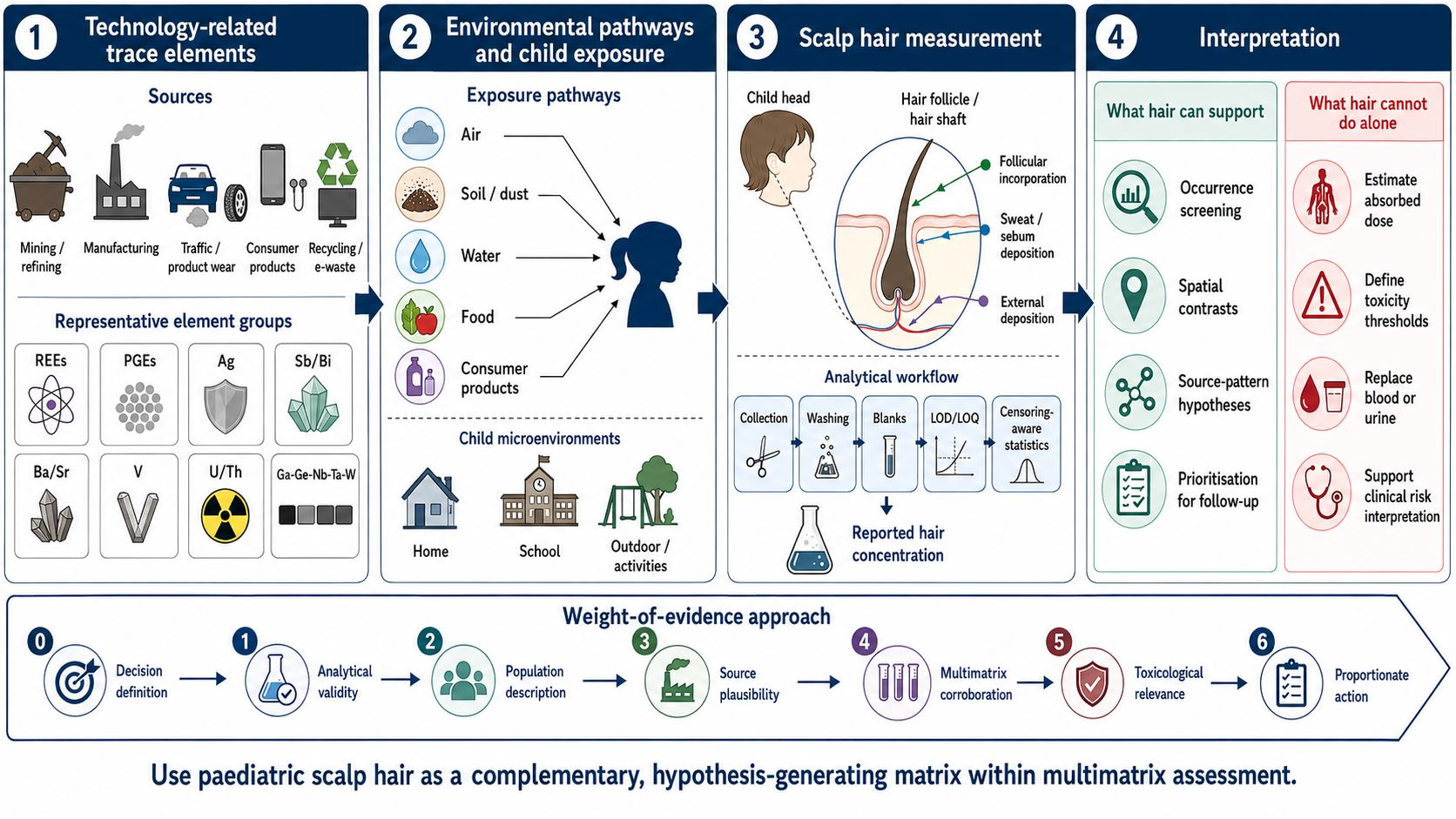
Technology-Related Trace Elements in Paediatric Scalp-Hair Biomonitoring: Biomarker Validity, Environmental Relevance, and Implications for Risk Assessment

 ,
,  ,
,  and
and 
Abstract
1. Introduction
2. Materials and Methods
3. Environmental Relevance of Technology-Related Trace Elements
4. Scalp Hair as a Paediatric Biomonitoring Matrix
4.1. Practical Advantages
4.2. Biological Incorporation
4.3. Sweat and Sebum
4.4. External Deposition
4.5. Exposure Window and Segmental Interpretation
4.6. Hair Colour, Melanin and Fibre Morphology
4.7. Cosmetic Treatment
4.8. Paediatric Ethics and Communication
4.9. Archived Hair
5. Pre-Analytical and Analytical Validity
5.1. Biomarker Fitness
5.2. Sampling Location and Segment
5.3. Collection-Tool Contamination
5.4. Participant Metadata
5.5. Washing Procedures
5.6. Digestion and Instrumentation
5.7. Procedural Blanks
5.8. Negative Blank-Corrected Values
5.9. Certified Reference Materials and Proficiency Testing
5.10. Multimatrix Analytical Validation
5.11. Limits of Detection and Quantification
5.12. Left-Censored Data
5.13. Multivariate and Mixture Analysis
6. Human Evidence Across Paediatric Populations
6.1. Population Patterns Across Contrasting Environmental Settings
6.2. European Paediatric Evidence and the Alcalá de Henares Programme
6.3. Nutritional, Behavioural and Health-Outcome Context
7. Multimatrix Evidence and Biomarker Validity
7.1. Analytical Feasibility Does Not Establish Biological Equivalence
7.2. Element-Group Lessons from the Available Multimatrix Evidence
8. From Population Distributions to Health-Risk Interpretation
8.1. Reference Distributions and Health-Based Biomonitoring Values
8.2. Why Hair Concentrations Cannot Be Converted into Hazard Quotients
9. Weight-of-Evidence Interpretation and Public-Health Application
9.1. A Seven-Stage Interpretative Framework
9.2. Population Surveillance, Individual Results and Environmental Justice
10. Conclusions, Applications, and Prospects
Supplementary Materials
Author Contributions
Funding
Institutional Review Board Statement
Informed Consent Statement
Data Availability Statement
Acknowledgments
Conflicts of Interest
Abbreviations
References
- European Parliament; Council of the European Union. Regulation (EU) 2024/1252 of the European Parliament and of the Council of 11 April 2024 Establishing a Framework for Ensuring a Secure and Sustainable Supply of Critical Raw Materials and Amending Regulations (EU) No 168/2013, (EU) 2018/858, (EU) 2018/1724 and (EU) 2019/1020. Official Journal of the European Union; 2024; L 2024/1252. Available online: http://data.europa.eu/eli/reg/2024/1252/oj (accessed on 7 August 2026).
- World Health Organization. Principles for Evaluating Health Risks in Children Associated with Exposure to Chemicals; Environmental Health Criteria 237; World Health Organization: Geneva, Switzerland, 2006. [Google Scholar]
- World Health Organization Regional Office for Europe. Human Biomonitoring: Facts and Figures; WHO Regional Office for Europe: Copenhagen, Denmark, 2015. [Google Scholar]
- Martinez-Morata, I.; Sobel, M.; Tellez-Plaza, M.; Navas-Acien, A.; Howe, C.G.; Sanchez, T.R. A State-of-the-Science Review on Metal Biomarkers. Curr. Environ. Health Rep. 2023, 10, 215–249. [Google Scholar] [CrossRef] [Scilit] [PubMed]
- Esteban, M.; Castaño, A. Non-Invasive Matrices in Human Biomonitoring: A Review. Environ. Int. 2009, 35, 438–449. [Google Scholar] [CrossRef] [Scilit] [PubMed]
- Pozebon, D.; Scheffler, G.L.; Dressler, V.L. Elemental Hair Analysis: A Review of Procedures and Applications. Anal. Chim. Acta 2017, 992, 1–23. [Google Scholar] [CrossRef] [Scilit] [PubMed]
- Kempson, I.M.; Lombi, E. Hair Analysis as a Biomonitor for Toxicology, Disease and Health Status. Chem. Soc. Rev. 2011, 40, 3915–3940. [Google Scholar] [CrossRef] [Scilit] [PubMed]
- Bencko, V. Use of Human Hair as a Biomarker in the Assessment of Exposure to Pollutants in Occupational and Environmental Settings. Toxicology 1995, 101, 29–39. [Google Scholar] [CrossRef] [Scilit] [PubMed]
- Skröder, H.; Kippler, M.; Nermell, B.; Tofail, F.; Levi, M.; Rahman, S.M.; Raqib, R.; Vahter, M. Major Limitations in Using Element Concentrations in Hair as Biomarkers of Exposure to Toxic and Essential Trace Elements in Children. Environ. Health Perspect. 2017, 125, 067021. [Google Scholar] [CrossRef] [Scilit] [PubMed]
- Rodrigues, J.L.; Batista, B.L.; Nunes, J.A.; Passos, C.J.S.; Barbosa, F., Jr. Evaluation of the Use of Human Hair for Biomonitoring the Deficiency of Essential and Exposure to Toxic Elements. Sci. Total Environ. 2008, 405, 370–376. [Google Scholar] [CrossRef] [Scilit] [PubMed]
- Semenova, Y.; Zhunussov, Y.; Pivina, L.; Abisheva, A.; Tinkov, A.A.; Skalny, A.V.; Zhanaspayev, M.; Bulegenov, T.; Glushkova, N.; Vinnikov, D. Trace Element Biomonitoring in Hair and Blood of Populations Living in Polluted Regions of Kazakhstan. J. Trace Elem. Med. Biol. 2019, 56, 31–37. [Google Scholar] [CrossRef] [Scilit] [PubMed]
- Pagano, G.; Thomas, P.J.; Di Nunzio, A.; Trifuoggi, M. Human Exposures to Rare Earth Elements: Present Knowledge and Research Prospects. Environ. Res. 2019, 171, 493–500. [Google Scholar] [CrossRef] [Scilit] [PubMed]
- Brouziotis, A.A.; Giarra, A.; Libralato, G.; Pagano, G.; Guida, M.; Trifuoggi, M. Toxicity of Rare Earth Elements: An Overview on Human Health Impact. Front. Environ. Sci. 2022, 10, 948041. [Google Scholar] [CrossRef] [Scilit]
- Tong, S.L.; Zhu, W.Z.; Gao, Z.H.; Meng, Y.X.; Peng, R.L.; Lu, G.C. Distribution Characteristics of Rare Earth Elements in Children’s Scalp Hair from a Rare Earths Mining Area in Southern China. J. Environ. Sci. Health A 2004, 39, 2517–2532. [Google Scholar] [CrossRef] [PubMed]
- Wei, B.; Li, Y.; Li, H.; Yu, J.; Ye, B.; Liang, T. Rare Earth Elements in Human Hair from a Mining Area of China. Ecotoxicol. Environ. Saf. 2013, 96, 118–123. [Google Scholar] [CrossRef] [Scilit] [PubMed]
- Meryem, B.; Ji, H.; Gao, Y.; Ding, H.; Li, C. Distribution of Rare Earth Elements in Agricultural Soil and Human Body (Scalp Hair and Urine) near Smelting and Mining Areas of Hezhang, China. J. Rare Earths 2016, 34, 1156–1167. [Google Scholar] [CrossRef] [Scilit]
- Dai, L.; Ge, J.; Wang, L.; Wan, X.; Guo, G.; Liang, T.; Bolan, N.; Rennert, T.; Rinklebe, J. Hair-Biomonitoring Assessment of Rare-Earth-Element Exposure in Residents of the Largest Rare-Earth Mining and Smelting Area of China. Environ. Int. 2023, 179, 108177. [Google Scholar] [CrossRef] [Scilit] [PubMed]
- He, Z.; Liu, L.; Wang, T.; Zhou, C.; Zhang, X.; Wu, N.; Xu, M.; Gao, J.; Li, B.; Wang, Y.; et al. Urine Is Better for Rare Earth Elements Biomonitoring in Long-Term Exposed Population: An Exposure–Response Relationship Study. Environ. Res. 2024, 263, 120121. [Google Scholar] [CrossRef] [Scilit] [PubMed]
- Zielińska-Dawidziak, M.; Czlapka-Matyasik, M.; Wojciechowska, Z.; Proch, J.; Kowalski, R.; Niedzielski, P. Rare Earth Elements Accumulation in the Hair of Malagasy Children and Adolescents in Relation to Their Age and Nutritional Status. Int. J. Environ. Res. Public Health 2022, 19, 455. [Google Scholar] [CrossRef] [Scilit] [PubMed]
- Belisheva, N.K.; Drogobuzhskaya, S.V. Rare Earth Element Content in Hair Samples of Children Living in the Vicinity of the Kola Peninsula Mining Site and Nervous System Diseases. Biology 2024, 13, 626. [Google Scholar] [CrossRef] [Scilit] [PubMed]
- Huo, W.; Zhu, Y.; Li, Z.; Pang, Y.; Wang, B.; Li, Z. A Pilot Study on the Association between Rare Earth Elements in Maternal Hair and the Risk of Neural Tube Defects in North China. Environ. Pollut. 2017, 226, 89–93. [Google Scholar] [CrossRef] [Scilit] [PubMed]
- Pawlak, J.; Łodyga-Chruścińska, E.; Chrustowicz, J. Fate of Platinum Metals in the Environment. J. Trace Elem. Med. Biol. 2014, 28, 247–254. [Google Scholar] [CrossRef] [Scilit] [PubMed]
- Lo Medico, F.; Varrica, D.; Alaimo, M.G. Occurrence of Palladium and Platinum in Human Scalp Hair of Adolescents Living in Urban and Industrial Sites. Sci. Total Environ. 2023, 892, 164777. [Google Scholar] [CrossRef] [Scilit] [PubMed]
- Frazzoli, C.; Bocca, B.; Battistini, B.; Ruggieri, F.; Rovira, J.; Amadi, C.N.; Offor, S.J.; Orisakwe, O.E. Rare Earth and Platinum Group Elements in Sub-Saharan Africa and Global Health: The Dark Side of the Burgeoning of Technology. Environ. Health Insights 2024, 18, 11786302241271553. [Google Scholar] [CrossRef] [Scilit] [PubMed]
- Peña-Fernández, A.; Higueras, M.; Valiente, R.; Lobo-Bedmar, M.C. Biomonitoring of Silver in Children and Adolescents from Alcalá de Henares (Spain): Assessing Potential Health Risks from Topsoil Contamination. Toxics 2025, 13, 1026. [Google Scholar] [CrossRef] [Scilit] [PubMed]
- Galizia, A.; Falchi, L.; Iaquinta, F.; Machado, I. Biomonitoring of Potentially Toxic Elements in Dyed Hairs and Its Correlation with Variables of Interest. Biol. Trace Elem. Res. 2024, 202, 3529–3537. [Google Scholar] [CrossRef] [Scilit] [PubMed]
- Ye, L.; Qiu, S.; Li, X.; Jiang, Y.; Jing, C. Antimony Exposure and Speciation in Human Biomarkers near an Active Mining Area in Hunan, China. Sci. Total Environ. 2018, 640–641, 1–8. [Google Scholar] [CrossRef] [Scilit] [PubMed]
- Gebel, T.; Claussen, K.; Dunkelberg, H. Human Biomonitoring of Antimony. Int. Arch. Occup. Environ. Health 1998, 71, 221–224. [Google Scholar] [CrossRef] [Scilit] [PubMed]
- Filella, M.; Belzile, N.; Chen, Y.W. Human Exposure to Antimony. III. Contents in Some Human Excreted Biofluids (Urine, Milk, Saliva). Crit. Rev. Environ. Sci. Technol. 2013, 43, 162–214. [Google Scholar] [CrossRef] [Scilit]
- Peña-Fernández, A.; Valiente, R.; Higueras, M.; Moreno-Gómez-Toledano, R.; Lobo-Bedmar, M.C. Ba–Sr–V as Geogenic and Traffic Tracers in Paediatric Hair from Urban–Industrial Spain, with Co-Located Topsoil Vanadium. Toxics 2026, 14, 268. [Google Scholar] [CrossRef] [Scilit] [PubMed]
- Poddalgoda, D.; Macey, K.; Assad, H.; Krishnan, K. Development of Biomonitoring Equivalents for Barium in Urine and Plasma for Interpreting Human Biomonitoring Data. Regul. Toxicol. Pharmacol. 2017, 86, 303–311. [Google Scholar] [CrossRef] [Scilit] [PubMed]
- Zeng, H.; Wang, Q.; Wang, H.; Guo, L.; Fang, B.; Zhang, L.; Wang, X.; Wang, Q.; Yang, W.; Wang, M. Exposure to Barium and Blood Pressure in Children and Adolescents: Results from the 2003–2018 National Health and Nutrition Examination Survey. Environ. Sci. Pollut. Res. 2022, 29, 68476–68487. [Google Scholar] [CrossRef] [Scilit] [PubMed]
- Camacho-delaCruz, A.A.; Mendoza-Cano, O.; Trujillo, X.; Huerta, M.; Ríos-Silva, M.; Gonzalez-Curiel, I.E.; Lugo-Radillo, A.; Romo-García, M.F.; Cuevas-Arellano, H.B.; Hilerio-López, Á.G.; et al. The Screening and Correlation of Trace Elements in the Blood and Urine of School-Aged Children (5–12 Years): A Pilot Biomonitoring Study. Toxics 2025, 13, 431. [Google Scholar] [CrossRef] [Scilit] [PubMed]
- Pérez, R.; Doménech, E.; Conchado, A.; Sanchez, A.; Coscollà, C.; Yusà, V. Influence of Diet in Urinary Levels of Metals in a Biomonitoring Study of a Child Population of the Valencian Region (Spain). Sci. Total Environ. 2018, 618, 1647–1657. [Google Scholar] [CrossRef] [Scilit] [PubMed]
- Zhang, Y.; Shao, X.; Kong, X.; Yin, L.; Wang, C.; Lin, L.; Ji, Y. Determination of Thorium in the Hair and Urine of Workers and the Public in a Rare Earth Mining Area. Radiat. Med. Prot. 2022, 3, 91–95. [Google Scholar] [CrossRef] [Scilit]
- Peña-Fernández, A.; Higueras, M.; Valiente, R.; Lobo-Bedmar, M.C. Rare Earth Elements and Technology-Related Trace Metals in Paediatric Scalp Hair: A 2001 Urban Baseline from Spain. J. Xenobiot. 2026, 16, 38. [Google Scholar] [CrossRef] [Scilit] [PubMed]
- Akram, S.; Khan, S.A.; Gul, H.K.; Syed, J.H.; Kazim, M.; Rehman, S.A.U.; Odabasi, M.; Kurt-Karakus, P. Using Hair as a Non-Invasive Matrix to Assess the Exposure of E-Waste Workers to Selected Heavy Metals in Pakistan. Environ. Geochem. Health 2025, 47, 226. [Google Scholar] [CrossRef] [Scilit] [PubMed]
- Petrick, L.M.; Arora, M.; Niedzwiecki, M.M. Minimally Invasive Biospecimen Collection for Exposome Research in Children’s Health. Curr. Environ. Health Rep. 2020, 7, 198–210. [Google Scholar] [CrossRef] [Scilit] [PubMed]
- Franbourg, A.; Hallegot, P.; Baltenneck, F.; Toutain, C.; Leroy, F. Current Research on Ethnic Hair. J. Am. Acad. Dermatol. 2003, 48, S115–S119. [Google Scholar] [CrossRef] [Scilit] [PubMed]
- Koch, S.L.; Tridico, S.R.; Bernard, B.A.; Shriver, M.D.; Jablonski, N.G. The Biology of Human Hair: A Multidisciplinary Review. Am. J. Hum. Biol. 2020, 32, e23316. [Google Scholar] [CrossRef] [Scilit] [PubMed]
- Lermen, D.; Gwinner, F.; Bartel-Steinbach, M.; Mueller, S.C.; Habermann, J.K.; Balwir, M.B.; Smits, E.; Virgolina, A.; Piddicke, U.; Berglund, M.; et al. Towards Harmonized Biobanking for Biomonitoring: A Comparison of Human Biomonitoring-Related and Clinical Biorepositories. Biopreserv. Biobank. 2020, 18, 122–131. [Google Scholar] [CrossRef] [Scilit] [PubMed]
- Runkel, A.A.; Jagodic Hudobivnik, M.; Živković, I.; Klemenčič, P.; Mazej, D.; Horvat, M. Optimisation of a Sample Preparation Method for the Determination of Multi-Elemental Compositions in Human Hair by Triple Quadrupole ICP-MS Analysis. Biol. Trace Elem. Res. 2026, 204, 4348–4362. [Google Scholar] [CrossRef] [Scilit] [PubMed]
- Morton, J.; Carolan, V.A.; Gardiner, P.H.E. Removal of Exogenously Bound Elements from Human Hair by Various Washing Procedures and Determination by Inductively Coupled Plasma Mass Spectrometry. Anal. Chim. Acta 2002, 455, 23–34. [Google Scholar] [CrossRef] [Scilit]
- Verrey, D.; Durand, S.; Thomas, O.; Lelévrier, V.; Quénel, P.; Le Bot, B. A New Washing Procedure for Inorganic Element Analysis of Hair. J. Expo. Sci. Environ. Epidemiol. 2019, 29, 706–717. [Google Scholar] [CrossRef] [Scilit] [PubMed]
- David, G.K.; Hunter, A.H.; Moromizato, K.H.; Allen, C.M.; Wheatley, R.; von Hippel, F.A.; Niehaus, A.C.; Wilson, R.S. Pre-Cleaning of Hair Is Not Beneficial in LA-ICP-MS Studies of Chronic Metal Exposure. PLoS ONE 2023, 18, e0289635. [Google Scholar] [CrossRef] [Scilit] [PubMed]
- Chen, Z.L.; Owens, G. Trends in Speciation Analysis of Vanadium in Environmental Samples and Biological Fluids—A Review. Anal. Chim. Acta 2008, 607, 1–14. [Google Scholar] [CrossRef] [Scilit] [PubMed]
- Tadić, Đ.; Pires de Lima, A.; Ricci, M. Quality Assurance and Quality Control for Human Biomonitoring Data—Focus on Matrix Reference Materials. Anal. Bioanal. Chem. 2025, 417, 3513–3528. [Google Scholar] [CrossRef] [Scilit] [PubMed]
- Goullé, J.P.; Mahieu, L.; Castermant, J.; Neveu, N.; Bonneau, L.; Lainé, G.; Bouige, D.; Lacroix, C. Metal and Metalloid Multi-Elementary ICP-MS Validation in Whole Blood, Plasma, Urine and Hair: Reference Values. Forensic Sci. Int. 2005, 153, 39–44. [Google Scholar] [CrossRef] [Scilit] [PubMed]
- Olmedo, P.; Pla, A.; Hernández, A.F.; López-Guarnido, O.; Rodrigo, L.; Gil, F. Validation of a Method to Quantify Chromium, Cadmium, Manganese, Nickel and Lead in Human Whole Blood, Urine, Saliva and Hair Samples by Electrothermal Atomic Absorption Spectrometry. Anal. Chim. Acta 2010, 659, 60–67. [Google Scholar] [CrossRef] [Scilit] [PubMed]
- Helsel, D.R. Statistics for Censored Environmental Data Using Minitab and R, 2nd ed.; John Wiley & Sons: Hoboken, NJ, USA, 2012. [Google Scholar]
- Drobyshev, E.; Solovyev, N.; Ivanenko, N.; Kombarova, M.; Ganeev, A. Trace Element Biomonitoring in Hair of Schoolchildren Living near a Toxic-Waste Site. J. Trace Elem. Med. Biol. 2017, 39, 14–20. [Google Scholar] [CrossRef] [Scilit] [PubMed]
- Batyrova, G.; Kononets, V.; Umarova, G.; Taskozhina, G.; Umarov, Y.; Issanguzhina, Z.; Kudabayeva, K.; Batyrov, R. Trace Metal and Metalloid Profiles in Hair Samples from Children in the Oil-Producing Region of Kazakhstan. Toxics 2025, 13, 522. [Google Scholar] [CrossRef] [Scilit] [PubMed]
- Beltrán-Ardila, J.D.; Escobar-Correa, P.A.; Varela-Martínez, D.A.; García-García, D.A.; Benavidez-Piracón, J.A.; Pinilla-Bonilla, L.B.; Santos-Yate, J.D. Hair Biomonitoring Reveals Spatial Heterogeneity of Multielement Exposure in Bogotá Schoolchildren. Environ. Geochem. Health 2026, 48, 242. [Google Scholar] [CrossRef] [Scilit] [PubMed]
- Peña-Fernández, A.; González-Muñoz, M.J.; Lobo-Bedmar, M.C. “Reference Values” of Trace Elements in the Hair of a Sample Group of Spanish Children (Aged 6–9 Years)—Are Urban Topsoils a Source of Contamination? Environ. Toxicol. Pharmacol. 2014, 38, 141–152. [Google Scholar] [CrossRef] [Scilit] [PubMed]
- Peña-Fernández, A.; Lobo-Bedmar, M.C.; González-Muñoz, M.J. Monitoring Lead in Hair of Children and Adolescents of Alcalá de Henares, Spain: A Study by Gender and Residential Areas. Environ. Int. 2014, 72, 170–175. [Google Scholar] [CrossRef] [Scilit] [PubMed]
- Peña-Fernández, A.; González-Muñoz, M.J.; Lobo-Bedmar, M.C. Evaluating the Effect of Age and Area of Residence in the Metal and Metalloid Contents in Human Hair and Urban Topsoils. Environ. Sci. Pollut. Res. 2016, 23, 21299–21312. [Google Scholar] [CrossRef] [Scilit] [PubMed]
- Peña-Fernández, A.; Lobo-Bedmar, M.C.; González-Muñoz, M.J. Effects of Sex on the Levels of Metals and Metalloids in the Hair of a Group of Healthy Spanish Adolescents (13 to 16 Years Old). Environ. Sci. Pollut. Res. 2017, 24, 23666–23678. [Google Scholar] [CrossRef] [Scilit] [PubMed]
- Llorente Ballesteros, M.T.; Navarro Serrano, I.; Izquierdo Álvarez, S. Reference Levels of Trace Elements in Hair Samples from Children and Adolescents in Madrid, Spain. J. Trace Elem. Med. Biol. 2017, 43, 113–120. [Google Scholar] [CrossRef] [Scilit] [PubMed]
- Ruiz, R.; Estevan, C.; Estévez, J.; Alcaide, C.; Sogorb, M.A.; Vilanova, E. Reference Values on Children’s Hair for 28 Elements Based on a Pilot Study in a Representative Non-Contaminated Local Area. Int. J. Mol. Sci. 2023, 24, 8127. [Google Scholar] [CrossRef] [Scilit] [PubMed]
- Torrente, M.; Gascon, M.; Vrijheid, M.; Sunyer, J.; Forns, J.; Domingo, J.L.; Nadal, M. Levels of Metals in Hair in Childhood: Preliminary Associations with Neuropsychological Behaviors. Toxics 2014, 2, 1–16. [Google Scholar] [CrossRef] [Scilit]
- Esplugas, R.; Mari, M.; Marquès, M.; Schuhmacher, M.; Domingo, J.L.; Nadal, M. Biomonitoring of Trace Elements in Hair of Schoolchildren Living Near a Hazardous Waste Incinerator—A 20 Years Follow-Up. Toxics 2019, 7, 52. [Google Scholar] [CrossRef] [Scilit] [PubMed]
- Shilnikova, N.; Karyakina, N.; Farhat, N.; Ramoju, S.; Cline, B.; Momoli, F.; Mattison, D.; Jensen, N.; Terrell, R.; Krewski, D. Biomarkers of Environmental Manganese Exposure. Crit. Rev. Toxicol. 2022, 52, 325–343. [Google Scholar] [CrossRef] [Scilit] [PubMed]
- Bader, M.; Dietz, M.C.; Ihrig, A.; Triebig, G. Biomonitoring of Manganese in Blood, Urine and Axillary Hair Following Low-Dose Exposure during the Manufacture of Dry Cell Batteries. Int. Arch. Occup. Environ. Health 1999, 72, 521–527. [Google Scholar] [CrossRef] [Scilit] [PubMed]
- Apel, P.; Rousselle, C.; Lange, R.; Sissoko, F.; Kolossa-Gehring, M.; Ougier, E. Human Biomonitoring Initiative (HBM4EU)—Strategy to Derive Human Biomonitoring Guidance Values for Health Risk Assessment. Int. J. Hyg. Environ. Health 2020, 230, 113622. [Google Scholar] [CrossRef] [Scilit] [PubMed]
- Santonen, T.; Mahiout, S.; Alvito, P.; Apel, P.; Bessems, J.; Bil, W.; Borges, T.; Bose-O’Reilly, S.; Buekers, J.; Cañas Portilla, A.I.; et al. How to Use Human Biomonitoring in Chemical Risk Assessment: Methodological Aspects, Recommendations and Lessons Learned from HBM4EU. Int. J. Hyg. Environ. Health 2023, 249, 114139. [Google Scholar] [CrossRef] [Scilit] [PubMed]
- Poddalgoda, D.; Macey, K.; Chander, N.; Jayawardene, I.; Sitland, B.; Mohr, S.; Hancock, S. A Review of Health Canada’s Progress on Human Biomonitoring-Based Risk Assessments and the Path Forward. Toxicol. Lett. 2024, 399, 19–24. [Google Scholar] [CrossRef] [Scilit] [PubMed]
- Schulz, C.; Wilhelm, M.; Heudorf, U.; Kolossa-Gehring, M. Update of the Reference and HBM Values Derived by the German Human Biomonitoring Commission. Int. J. Hyg. Environ. Health 2011, 215, 26–35. [Google Scholar] [CrossRef] [Scilit] [PubMed]
- Wilhelm, M.; Heinzow, B.; Angerer, J.; Schulz, C. Reassessment of Critical Lead Effects by the German Human Biomonitoring Commission Results in Suspension of the Human Biomonitoring Values for Lead in Blood of Children and Adults. Int. J. Hyg. Environ. Health 2010, 213, 265–269. [Google Scholar] [CrossRef] [Scilit] [PubMed]
- Domínguez-Morueco, N.; Pedraza-Díaz, S.; González-Caballero, M.C.; Esteban-López, M.; de Alba-González, M.; Katsonouri, A.; Santonen, T.; Cañas-Portilla, A.; Castaño, A. Methylmercury Risk Assessment Based on European Human Biomonitoring Data. Toxics 2022, 10, 427. [Google Scholar] [CrossRef] [Scilit] [PubMed]
- McDowell, M.A.; Dillon, C.F.; Osterloh, J.; Bolger, P.M.; Pellizzari, E.; Fernando, R.; Montes de Oca, R.; Schober, S.E.; Sinks, T.; Jones, R.L.; et al. Hair Mercury Levels in U.S. Children and Women of Childbearing Age: Reference Range Data from NHANES 1999–2000. Environ. Health Perspect. 2004, 112, 1165–1171. [Google Scholar] [CrossRef] [Scilit] [PubMed]
- CLSI EP28-A3c; Defining, Establishing, and Verifying Reference Intervals in the Clinical Laboratory; Approved Guideline, 3rd ed. Clinical and Laboratory Standards Institute: Wayne, PA, USA, 2010.
- Lamkarkach, F.; Ougier, E.; Garnier, R.; Viau, C.; Kolossa-Gehring, M.; Lange, R.; Apel, P. Human Biomonitoring Guidance Values Derived for Cadmium and Its Compounds. Environ. Int. 2021, 147, 106337. [Google Scholar] [CrossRef] [Scilit] [PubMed]
- German Environment Agency. Reference and HBM Values. Updated 30 July 2026. Available online: https://www.umweltbundesamt.de/en/topics/health/commissions-working-groups/human-biomonitoring-commission/reference-hbm-values (accessed on 6 August 2026).
- Permanent Senate Commission for the Investigation of Health Hazards of Chemical Compounds in the Work Area. List of MAK and BAT Values 2025. Maximum Concentrations at the Workplace and Assessment Values in Biological Material; Report 61; German Research Foundation: Bonn, Germany, 2025. [Google Scholar] [CrossRef]
- Health and Safety Executive. Biological Monitoring Guidance Values. Available online: https://books.hse.gov.uk/biological-monitoring-guidance-values (accessed on 6 August 2026).
- Health and Safety Executive. Antimony (Urine). 2025. Available online: https://books.hse.gov.uk/product/9780717667642 (accessed on 6 August 2026).
- Health Canada. Science Approach Document: Biomonitoring-Based Approach 2 for Barium-Containing Substances, Molybdenum-Containing Substances, Silver-Containing Substances, Thallium-Containing Substances and Inorganic Tin-Containing Substances; Government of Canada: Ottawa, ON, Canada, 2016. Available online: https://www.canada.ca/en/environment-climate-change/services/evaluating-existing-substances/science-approach-document-biomonitoring-based-approach-2barium-containing-substances-molybdenum-containing-s.html (accessed on 6 August 2026).
- Environment and Climate Change Canada; Health Canada. Screening Assessment: Silver and Its Compounds; Government of Canada: Ottawa, ON, Canada, 2022; Cat. No. En84-302/2022E-PDF. Available online: https://www.canada.ca/en/environment-climate-change/services/evaluating-existing-substances/screening-assessment-silver-compounds.html (accessed on 6 August 2026).
- Poddalgoda, D.; Hays, S.M.; Nong, A. Derivation of Biomonitoring Equivalents (BE Values) for Bismuth. Regul. Toxicol. Pharmacol. 2020, 114, 104672. [Google Scholar] [CrossRef] [Scilit] [PubMed]
- Agency for Toxic Substances and Disease Registry. Public Health Statement for Uranium; U.S. Department of Health and Human Services, Public Health Service: Atlanta, GA, USA, 2013. Available online: https://www.atsdr.cdc.gov/toxprofiles/tp150-c1-b.pdf (accessed on 6 August 2026).
- Agency for Toxic Substances and Disease Registry. Toxicological Profile for Uranium; U.S. Department of Health and Human Services, Public Health Service: Atlanta, GA, USA, 2013. Available online: https://www.atsdr.cdc.gov/toxprofiles/tp150.pdf (accessed on 6 August 2026).
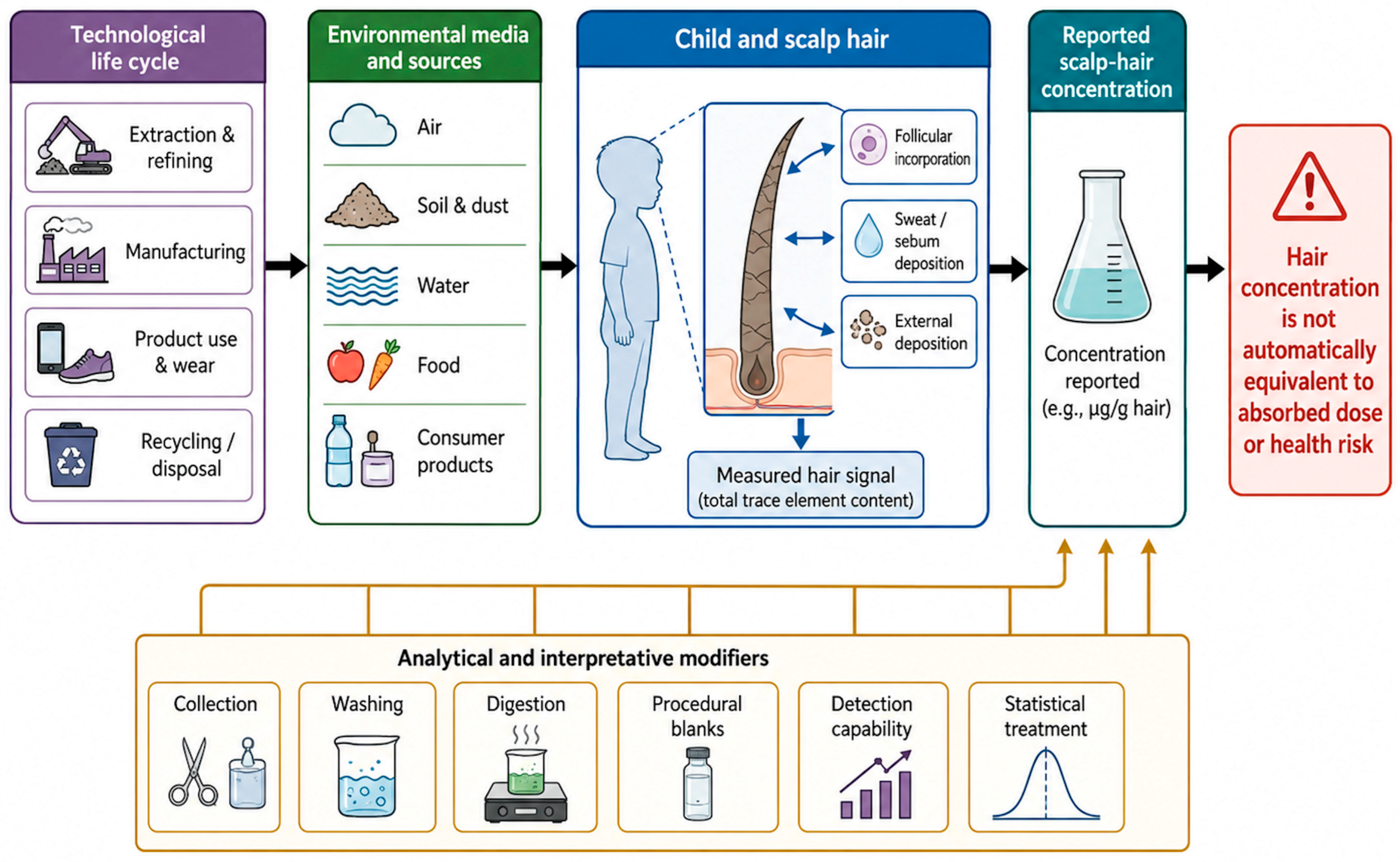
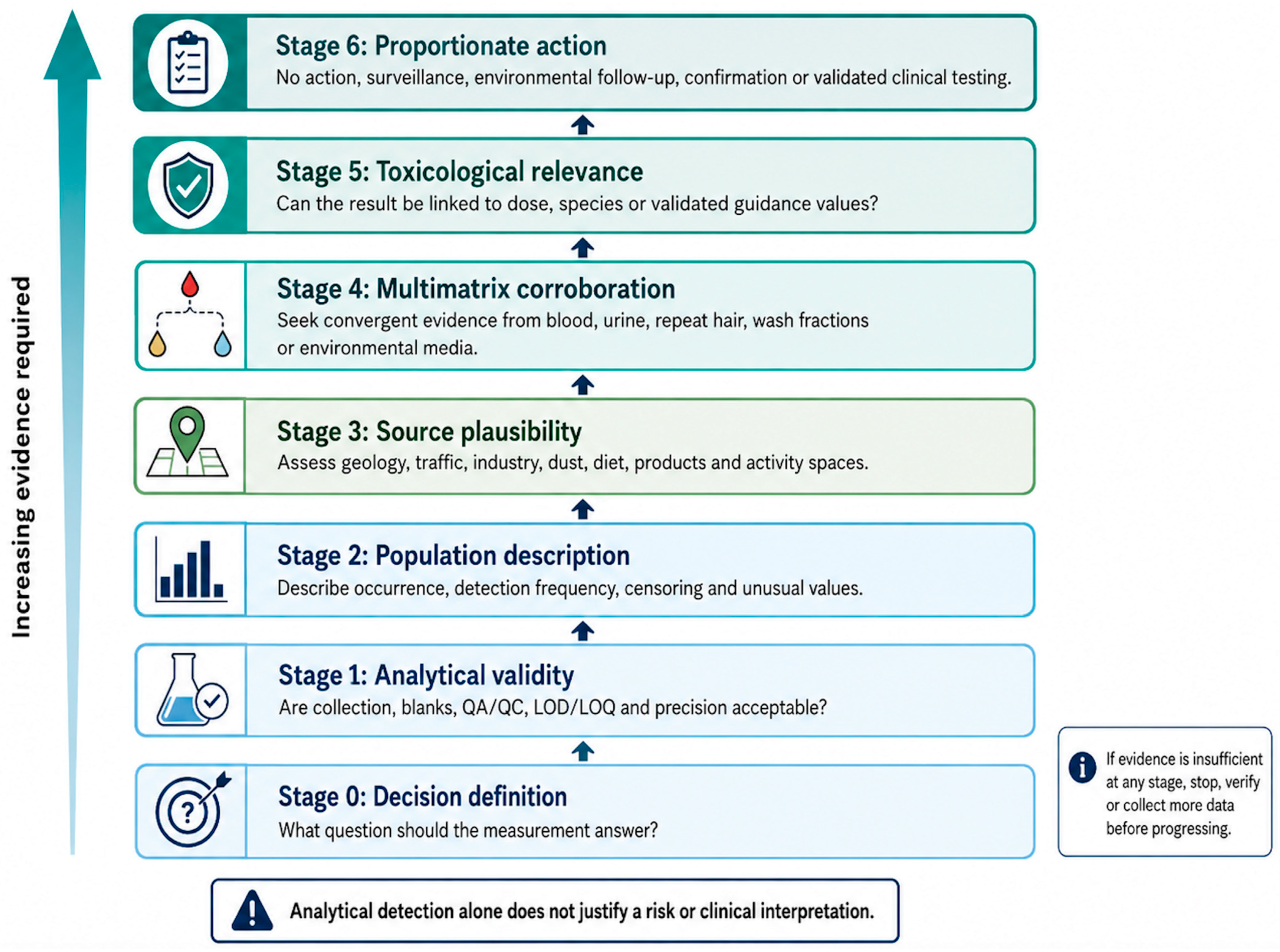

| Group | Examples | Selected Uses | Potential Sources | Defensible Role of Hair | Principal Limitation |
|---|---|---|---|---|---|
| Rare earth elements (REEs) | La–Lu, Y | Magnets, electronics, catalysts, phosphors, energy and medical technologies | Geogenic material; mining, beneficiation and smelting; industrial emissions; electronic waste | Spatial comparison, geochemical fingerprinting and source-pattern screening | External mineral particles, fractionation, low-level blanks and lack of hair–dose validation; urine currently has stronger exposure–response evidence in long-term occupational exposure |
| Platinum-group elements (PGEs) | Pt, Pd, Rh, Ru, Ir, Os | Vehicle and industrial catalysts, electronics, fuel cells and medical applications | Traffic particles, road dust, industrial emissions, mining and waste | Occurrence and area-comparison screening where analytical performance is demonstrated | Ultra-trace concentrations, blank contamination, instrumental carry-over/memory from residual analyte retained in the sample-introduction system, interferences and absence of validated hair thresholds |
| Silver | Ag | Electronics, photovoltaics, antimicrobial products, textiles and medical devices | Industrial and waste streams; products, jewellery, dyes, cosmetics and dust | Population occurrence and source/product-contact hypothesis generation | Direct contact and cosmetic treatment may dominate; no validated hair–dose or health threshold |
| Antimony and bismuth | Sb, Bi | Flame retardants, alloys, batteries, semiconductors, pharmaceuticals and cosmetics | Mining/smelting, indoor dust, brake wear, waste, medicines and consumer products | Context-specific screening with environmental and internal-matrix corroboration | Sb evidence varies by setting and discrete deposits may occur in hair; Bi is strongly confounded by products and medicines |
| Barium and strontium | Ba, Sr | Ceramics, glass, electronics, drilling fluids, pyrotechnics and specialised materials | Geology, soil, drinking water, diet, dust and selected industrial sources | Geogenic, dietary and spatial source-pattern assessment | Strong geogenic and dietary contributions; weak or absent cross-matrix correspondence; no hair-based guidance values |
| Vanadium | V | Steel alloys, catalysts and energy-storage technologies | Geology, residual-fuel combustion, industry, traffic mixtures and diet | Occurrence and source screening when detection frequency and exposure timing are adequate | Recent exposure, analytical censoring and source heterogeneity complicate interpretation; no validated hair guidance value |
| Uranium and thorium | U, Th | Nuclear fuel cycle and mineral-processing contexts | Geology, mining, phosphate materials, combustion residues and industry | Exposure-pattern screening and identification of highly exposed groups | Total concentration does not define isotope composition, speciation or radiological dose; dose estimation requires validated internal-matrix models |
| Sparsely studied technology-related elements | Rb, Ga, Ge, Nb, Ta, W | Semiconductors, fibre optics, capacitors, photovoltaics and advanced alloys | Geology, mining, manufacturing, combustion and electronic waste | Baseline occurrence, analytical method development and source-hypothesis generation | Human and paediatric evidence is sparse; analytical detectability currently exceeds biological interpretation |
| Domain | Minimum Requirement | Scientific Rationale |
|---|---|---|
| Decision question | Define whether the aim is occurrence, spatial comparison, source investigation, intervention follow-up, internal dose or clinical assessment. | Hair may be suitable for screening but not for every inferential objective. |
| Collection and sample definition | Report scalp region, proximal/distal orientation, segment length, mass, collection device and storage. | Collection devices and storage materials can contaminate ultra-trace panels; poorly defined segments weaken temporal interpretation. |
| Participant metadata | Record age, sex, hair colour, treatments, washing/swimming, products, medicines, diet, water, residence, school and activity spaces. | Biological, behavioural and product-related determinants can confound geographical comparisons. |
| Washing | Report reagents, sequence, duration, agitation, rinsing, drying and operational objective; analyse wash fractions where feasible. | No protocol completely separates endogenous from exogenous elements. |
| Digestion and instrumentation | Report vessels, acid grade, digestion programme, isotopes, reaction/collision conditions, calibration, internal standards, carry-over and washout. | Ultra-trace analyses are vulnerable to vessel contamination, interferences and instrumental carry-over/memory. |
| QA/QC | Use full procedural blanks, batch review, CRMs with assigned analytes, spikes, duplicates, calibration checks, isotope agreement and proficiency testing. | Validation for conventional certified elements does not validate unassigned technology-related elements. |
| LOD/LOQ and blank correction | Calculate from the full method in final hair units; retain negative blank-corrected values internally; distinguish ND, detected <LOQ, quantified and invalid results. | Instrument sensitivity alone is not a method detection capability; truncation biases distributions. |
| Censored data | Report detection frequencies and use censoring-aware methods; avoid arbitrary substitution and forced multivariate analysis. | Substitution can distort medians, correlations and apparent mixture or source patterns. |
| Biobanking | Document collection date, containers, storage and handling history, chain of custody and secondary-use ethics. | Archived hair is valuable, but historical comparability and contamination must remain auditable. |
| Environmental and temporal correspondence | Where source attribution is intended, characterise relevant soil, dust, air, water, food or product sources and document their spatial and temporal correspondence with the analysed hair segment. | Hair–environment associations are difficult to interpret when environmental samples represent different locations, activity spaces or time periods. |
| Interpretation and return of results | Separate population rarity, source plausibility, internal dose and health relevance; predefine confirmation, communication and referral pathways. | An unusual population value is not automatically toxic or clinically actionable. |
| Study and Setting | Population | Analytical Context | Selected Reported Concentrations | Detection/Censoring Information | Interpretative Note |
|---|---|---|---|---|---|
| Llorente Ballesteros et al., 2017 [58]; Madrid, Spain | n = 648; participants aged 0–18 years | ICP-MS; population reference study; sampling in 2008–2009 | Medians: Ag 0.196 µg/g; Ba 0.500 µg/g; Bi 0.010 µg/g; Sr 1.29 µg/g | Element-specific detection frequencies were not reported in a directly harmonisable form for all selected endpoints. | Broad Madrid comparator spanning infancy to adolescence; age range and analytical workflow differ from the Alcalá cohorts. |
| Ruiz et al., 2023 [59]; Elche/Mediterranean Spain | n = 419; children aged 3–12 years | Washed hair; acid digestion; ICP-MS; reference-population pilot study | Medians: V 0.077 µg/g; Sr 3.14 µg/g; Ba 0.289 µg/g; Bi 0.005 µg/g; Ag and U 0.000 µg/g at the reported precision | The zero-valued Ag and U medians reflect reporting precision and the underlying detection structure and should not be interpreted as absence of exposure. | Useful independent Spanish comparator; conventional medians and very-low results are not equivalent to censoring-aware estimates. |
| Peña-Fernández et al., 2025 [25]; Alcalá de Henares, Spain | Children: n = 120, aged 6–9 years; adolescents: n = 97, aged 13–16 years | Archived 2001 scalp hair; Ag analysed by ICP-MS | Median Ag: children 0.1120 µg/g; adolescents 0.0695 µg/g | Ag detected in all children; 19.6% of adolescent results were < LOD. | Children showed a slightly higher median, whereas adolescents displayed a markedly wider upper tail; the age-group difference was not statistically significant. Cosmetic and product contact remain relevant. |
| Peña-Fernández et al., 2026 [30]; Alcalá de Henares, Spain | Children: n = 120, aged 6–9 years; adolescents: n = 97, aged 13–16 years | Archived 2001 scalp hair; Ba, Sr and V; censoring-aware treatment of V | Children: Ba 0.193 µg/g, Sr 0.412 µg/g and V 0.003 µg/g. Adolescents: Ba 0.287 µg/g, Sr 1.105 µg/g and V 0.011 µg/g (reported medians/censoring-aware estimates as applicable). | Children: Ba 38.3%, Sr 23.3% and V 74.2% < LOD. Adolescents: Ba 35.1%, Sr 37.1% and V 51.5% < LOD. | Demonstrates age-related concentration and quantifiability differences; values were interpreted as geogenic/urban tracers rather than toxicity thresholds. |
| Peña-Fernández et al., 2026 [36]; Alcalá de Henares, Spain—children | Up to n = 120, aged 6–9 years; element-specific analytical support varied with censoring | Archived 2001 scalp hair; REEs and technology-related elements by ICP-MS | Medians (µg/g): Ce 0.0109; La 0.0072; Nd 0.0042; Pr 0.00137; Gd 0.00068; Er 0.00035; Bi 0.006; Rb 0.0298; Sb 0.033; U 0.011 | Y and Pt were not detected; Ir 99.2%, Pd 90.0%, Rh 95.0% and Th 95.8% < LOD. | One of the most extensive paediatric urban-baseline panels; highly censored endpoints support occurrence rather than continuous quantitative comparison. |
| Peña-Fernández et al., 2026 [36]; Alcalá de Henares, Spain—adolescents | Up to n = 97, aged 13–16 years; element-specific analytical support varied with censoring | Archived 2001 scalp hair; REEs and technology-related elements by ICP-MS | Selected medians (µg/g): Bi 0.002; Sb 0.0092; U 0.016 | Most REEs and PGEs were extensively censored; element-specific detection frequencies and upper percentiles are required for interpretation. | Historical adolescent comparator; should not be collapsed with the child distribution or treated as a health-based interval. |
| Lo Medico et al., 2023 [23]; Sicily, Italy | 108 adolescents aged 11–14 years were recruited; analytical N varied by element and site | Scalp hair; Pd and Pt reported at ng/g concentrations | Medians: industrial Pd 6.88 ng/g and Pt 0.44 ng/g; urban Pd 1.37 ng/g and Pt 1.56 ng/g; control Pd 0.56 ng/g and Pt 0.12 ng/g | Industrial Pd 72/Pt 70; urban Pd 22/Pt 22; control Pd 13/Pt 13. | Clear site contrasts support exposure-pattern screening; no paired internal matrix or health-based interpretation was established. |
| Study | Population and Exposure Setting | Matrices | Cross-Matrix Result | What the Study Supports | What It Does Not Support |
|---|---|---|---|---|---|
| Skröder et al., 2017 [9] | Children; paediatric biomarker-validity analysis | Hair compared with established exposure indicators | Hair showed major limitations for several toxic and essential elements in children. | Hair performance must be demonstrated element by element in the target population. | Does not validate hair for emerging TTEs or as a universal internal-dose matrix. |
| Rodrigues et al., 2008 [10] | 280 adults, Brazil | Hair, whole blood and plasma | Weak hair–blood relation for Pb; no meaningful relation for Cu, Mn or Sr. | Directly demonstrates limited correspondence between hair and circulating concentrations. | Adult population and conventional elements; findings cannot quantify TTE-specific hair kinetics. |
| Goullé et al., 2005 [48] | Reference/analytical populations; hair group n = 45 | Whole blood, plasma, urine and hair | Validated multielement ICP-MS methods and reported matrix-specific distributions for several TTEs. | Establishes analytical feasibility across matrices. | Does not establish paired individual-level hair–blood or hair–urine equivalence or health-based hair values. |
| He et al., 2024 [18] | 103 REE-exposed workers and 110 controls | Air, blood and urine | Urine showed stronger environmental correlations and exposure–response performance than blood. | Supports urine as a promising internal-exposure matrix for long-term occupational REE exposure. | Adult male occupational population; hair was not measured and paediatric transfer is untested. |
| Zhang et al., 2022 [35] | Rare-earth mine workers and nearby residents | Paired hair and urine for Th | Both matrices separated exposure groups, but no simple cross-matrix relationship was found; dose was estimated from urine. | Shows that group discrimination does not imply quantitative equivalence. | Adult/occupational setting; no paediatric health outcome or hair-based dose model. |
| Ye et al., 2018 [27] | Residents near active Sb mining | Environmental media, urine, saliva, hair and nails; speciation and micro-XRF | Hair related to estimated intake; urine/saliva characterised Sb species; discrete Sb-rich hair deposits were observed. | Supports multimatrix source and particle investigation in a high-exposure setting. | Endogenous incorporation and external particulate contributions were not fully separable. |
| Gebel et al., 1998 [28] | 89 geogenically exposed and 47 reference participants | 24 h urine, blood and scalp hair | No convincing elevation or soil–biomatrix relationship; urine was considered most practical. | Demonstrates that Sb biomarker performance is exposure-scenario dependent. | Older study and a different source regime from active mining. |
| Camacho-delaCruz et al., 2025 [33] | 91 children aged 5–12 years, Mexico | Paired blood and urine | Weak correlations for As, Pb and Sr; essentially no correlation for Ba or most other elements. | Shows that even two internal matrices are not interchangeable and require element-specific validation. | Pilot sample; hair was not measured. |
| Element/Group | Most Defensible Interpretation of Hair | Complementary Matrix/Evidence | Matrix-Specific Assessment-Value Status |
|---|---|---|---|
| REEs | Spatial/source-pattern screening; dose validity remains unestablished | Urine currently has the strongest exposure–response evidence in long-term occupational exposure; blood can discriminate exposure | No scalp-hair value identified; no qualifying target-group health-based biological value identified in the audited frameworks. |
| PGEs | Occurrence and area-comparison screening only | No universally validated matrix; blood or urine selection depends on compound, route and kinetics | No scalp-hair value identified for Pt, Pd, Rh, Ru, Ir or Os. |
| Ag | Occurrence and product/source-hypothesis generation | Blood or urine may be used for targeted questions, but validation is context dependent | No scalp-hair value identified. Whole-blood BE: 0.4 µg/L for ionic Ag; not transferable to hair and subject to greater paediatric uncertainty because the underlying PBPK model used adult physiology. |
| Sb | Context-dependent: positive mining findings but negative geogenic evidence | Urine, preferably with speciation, is generally more defensible for internal exposure | No health-based scalp-hair value identified. Urinary BAR: 0.2 µg/L; this is a statistical background/reference value, not a health-based limit. |
| Bi | Baseline occurrence and product/medicinal-context screening | Blood, plasma or urine selected according to medicinal or occupational context | No scalp-hair value identified. Published BEs: plasma 8.0 µg/L, whole blood 4.8 µg/L and urine 0.18 µg/L; derived from a therapeutic bismuth-subgallate intake scenario. |
| Ba | Geogenic, dietary and spatial patterning; not dose validated | Urine and plasma have published BEs; paired child blood–urine Ba showed no correlation | No scalp-hair value identified. Published BEs: urine 0.19 mg/L or 0.25 mg/g creatinine; plasma 9 µg/L. Urinary BAR: 10 µg/L for soluble Ba compounds. |
| Sr | Source-pattern interpretation; hair–blood equivalence unsupported | Paired child blood–urine data show only weak correlation; matrix choice requires validation | No scalp-hair value identified. |
| V | Occurrence/source screening where detection and timing are adequate | Urine is commonly used for recent occupational/environmental exposure, with timing limitations | No health-based scalp-hair value identified. Urinary BAR: 0.15 µg/L; this is a background/reference value, not a health threshold. |
| U and Th | Hair may separate highly exposed groups but does not define intake or dose | Urine is used for internal or radiological dose assessment in relevant exposure models | No scalp-hair value identified. Urinary U ranges may assist exposure interpretation but are not adverse-effect or clinical-action thresholds. |
| Rb, Ga, Ge, Nb, Ta and W | Occurrence, geochemical screening and method development | No preferred complementary matrix established for paediatric interpretation | No scalp-hair value or qualifying biological assessment value identified in the audited sources. |
| Hg, comparison element | Hair is interpretable for defined methylmercury pathways under validated assumptions | Hair and blood are established in specific methylmercury frameworks | Health-related hair values exist in defined methylmercury frameworks; they are not transferable to TTEs. |
| Stage | Core Question | Required Evidence | Permissible Conclusion/Action |
|---|---|---|---|
| 0. Decision definition | What decision should the measurement inform? | Explicit objective, target population, matrix role and exposure window | Redesign the study if hair cannot answer the decision question. |
| 1. Analytical validity | Is the reported concentration technically credible? | Collection audit, blanks, interference control, precision, recovery, LOD/LOQ and batch review | Repeat, qualify or exclude analytically invalid results. |
| 2. Population description | What was observed and how unusual is it? | Detection frequencies, censoring-aware summaries, relevant stratification and review of extreme observations | Describe occurrence and population rarity; do not infer toxicity. |
| 3. Source plausibility | Which sources and pathways are compatible with the pattern? | Activity-space data, products, diet, geology, environmental matrices and elemental fingerprints | State probabilistic source hypotheses. |
| 4. Multimatrix corroboration | Is there independent evidence of internal or environmental exposure? | Biologically and temporally appropriate blood, urine, nails, repeated hair, wash fractions or environmental matrices | Seek convergent evidence; discordance should redirect or narrow the exposure hypothesis rather than be treated automatically as analytical failure. |
| 5. Toxicological relevance | Can the result be linked to dose or adverse effect? | Element/species-specific toxicokinetics, epidemiology, validated biomarkers and matrix-specific guidance values | Limit conclusions to hazard identification or exposure prioritisation when dose linkage is absent. |
| 6. Proportionate action | What follow-up is justified by the total evidence? | Predefined confirmation, environmental investigation, communication and clinical-referral criteria | No action, surveillance, source control, confirmation using an appropriate validated clinical biomarker, or specialist referral when justified by confirmed exposure, clinical findings or authoritative matrix-specific criteria. |
Disclaimer/Publisher’s Note: The statements, opinions and data contained in all publications are solely those of the individual author(s) and contributor(s) and not of MDPI and/or the editor(s). MDPI and/or the editor(s) disclaim responsibility for any injury to people or property resulting from any ideas, methods, instructions or products referred to in the content. |
© 2026 by the authors. Licensee MDPI, Basel, Switzerland. This article is an open access article distributed under the terms and conditions of the Creative Commons Attribution (CC BY) license.
Share and Cite
Peña-Fernández, A.; Moreno-Gómez-Toledano, R.; Martínez-Alonso, B.; Peña Fernández, M.Á. Technology-Related Trace Elements in Paediatric Scalp-Hair Biomonitoring: Biomarker Validity, Environmental Relevance, and Implications for Risk Assessment. Toxics 2026, 14, 813. https://doi.org/10.3390/toxics14090813
Peña-Fernández A, Moreno-Gómez-Toledano R, Martínez-Alonso B, Peña Fernández MÁ. Technology-Related Trace Elements in Paediatric Scalp-Hair Biomonitoring: Biomarker Validity, Environmental Relevance, and Implications for Risk Assessment. Toxics. 2026; 14(9):813. https://doi.org/10.3390/toxics14090813
Chicago/Turabian StylePeña-Fernández, Antonio, Rafael Moreno-Gómez-Toledano, Borja Martínez-Alonso, and M. Ángeles Peña Fernández. 2026. "Technology-Related Trace Elements in Paediatric Scalp-Hair Biomonitoring: Biomarker Validity, Environmental Relevance, and Implications for Risk Assessment" Toxics 14, no. 9: 813. https://doi.org/10.3390/toxics14090813
APA StylePeña-Fernández, A., Moreno-Gómez-Toledano, R., Martínez-Alonso, B., & Peña Fernández, M. Á. (2026). Technology-Related Trace Elements in Paediatric Scalp-Hair Biomonitoring: Biomarker Validity, Environmental Relevance, and Implications for Risk Assessment. Toxics, 14(9), 813. https://doi.org/10.3390/toxics14090813