This is an early access version, the complete PDF, HTML, and XML versions will be available soon.
Article

Chemical Regimes and PMF-Resolved Sources Linked to Acute PM10 Ecotoxicity in Luanda, Angola
by
Alan Victor da Silva
1,2,*,
Estela D. Vicente
1,
Ana M. Sánchez de la Campa
2,
Yago Cipoli
1,
Diogo N. Cardoso
3,
Susana Loureiro
3,
Anabela Leitão
4,
Manuel Feliciano
5 and
Célia Alves
1,*
1
Department of Environment and Planning, Centre for Environmental and Marine Studies (CESAM), University of Aveiro, 3810-193 Aveiro, Portugal
2
Department of Earth Sciences, Associate Unit CSIC-University of Huelva “Atmospheric Pollution”, Centre for Research in Sustainable Chemistry (CIQSO), University of Huelva, E21071 Huelva, Spain
3
Department of Biology, Centre for Environmental and Marine Studies (CESAM), University of Aveiro, 3810-193 Aveiro, Portugal
4
Separation, Chemical Reaction, and Environmental Engineering Laboratory (LESRA), Agostinho Neto University, Av. Ho Chi Minh nº 201, Luanda, Angola
5
CIMO, LA SusTEC, Instituto Politécnico de Bragança, Campus Santa Apolónia, 5300-253 Bragança, Portugal
*
Authors to whom correspondence should be addressed.
Toxics 2026, 14(9), 773; https://doi.org/10.3390/toxics14090773 (registering DOI)

Submission received: 22 July 2026 / Revised: 24 August 2026 / Accepted: 28 August 2026 / Published: 30 August 2026
(This article belongs to the Topic Air Quality and the Built Environment, 2nd Edition)

Abstract

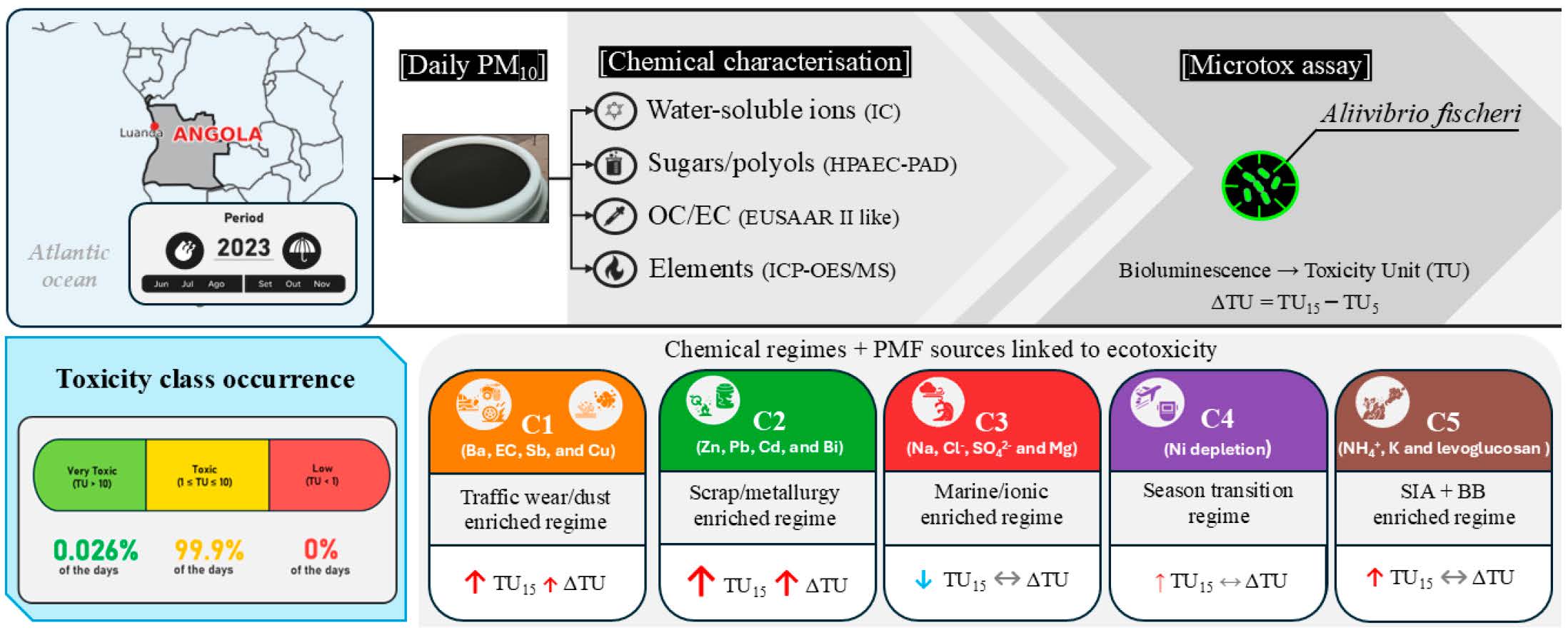
In rapidly expanding African cities, the ecotoxicological relevance of PM10 remains largely unresolved, especially where particle mass, chemical composition and emission sources are rarely assessed together. Here, 116 daily PM10 samples collected in Luanda between 27 June and 5 November 2023 were tested using the Microtox® Aliivibrio fischeri assay on aqueous extracts. Chemical speciation was combined with centred log-ratio (CLR) compositional clustering to identify recurring chemical regimes, while Positive Matrix Factorisation (PMF) was used to resolve the corresponding emission sources. Toxicity was moderate but highly variable: Toxic units after 15 min (TU15) ranged from 0.84 to 8.54, with changes in toxicity units between 5 and 15 min (ΔTU) varying from −1.51 to +4.84. Only 3 of the 116 samples showed TU15 < 1, and none reached TU15 ≥ 10. The strongest responses occurred under a metal-enriched chemical regime (C2), characterised by elevated Zn, Pb and Cd concentrations, which showed the highest mean TU15 (4.22) and ΔTU (1.52). This regime coincided with PMF evidence identifying non-ferrous metallurgy plus galvanised/metal scrap handling and burning as the factor most strongly associated with toxicity (ρTU15 = 0.63; ρΔTU = 0.78), followed by a Ni-rich metallurgical factor with possible aviation influence (ρTU15 = 0.51). Conversely, a marine/ionic chemical regime (C3) showed lower, stable toxicity, consistent with negative marine aerosol associations. These findings show that integrating chemical regimes with PMF-resolved sources identifies metal-related emissions as the main drivers of PM10 ecotoxicity.
Keywords: compositional clustering; trace metals; urban aerosol; Microtox; Aliivibrio fischeri; African megacity compositional clustering; trace metals; urban aerosol; Microtox; Aliivibrio fischeri; African megacity
Graphical Abstract