
This is an early access version, the complete PDF, HTML, and XML versions will be available soon.
Article

The Combined Effects of Citric Acid and Ammonium Nitrate on the Phytoremediation of Cd-Phenanthrene Co-Contaminated Soil Using Marigold

1
College of Earth Sciences, Guilin University of Technology, Guilin 541004, China
2
College of Environmental Science and Engineering, Guilin University of Technology, Guilin 541004, China
3
Guangxi Kangwanjia Farmland Soil Remediation Co., Nanning 530006, China
4
Research Center for Eco-Environmental Engineering, Dongguan University of Technology, Dongguan 523808, China
*
Authors to whom correspondence should be addressed.
These authors contributed equally to this work.
Toxics 2026, 14(9), 770; https://doi.org/10.3390/toxics14090770 (registering DOI)

Submission received: 6 August 2026 / Revised: 24 August 2026 / Accepted: 26 August 2026 / Published: 28 August 2026

Abstract

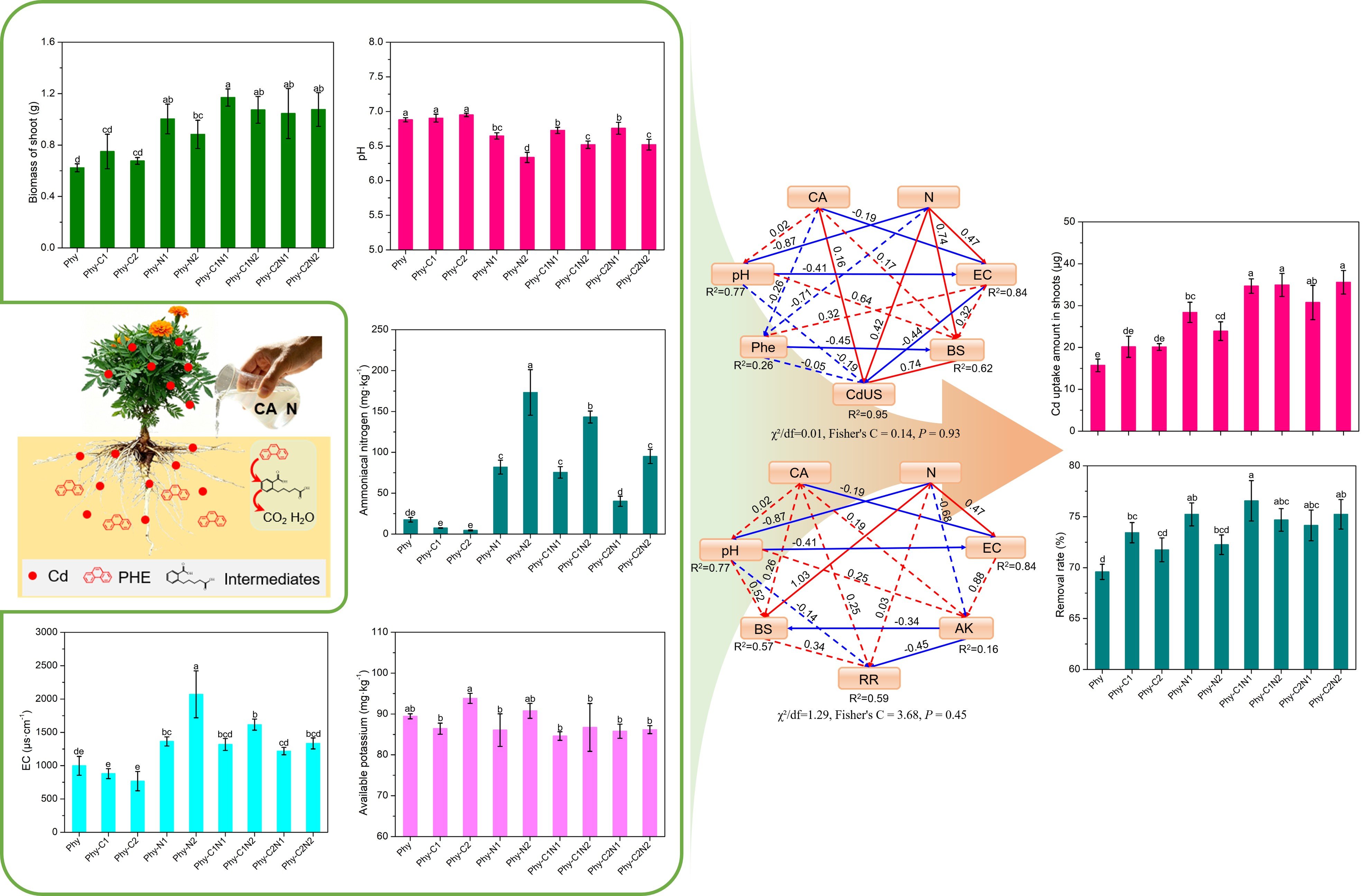
Citric acid (CA) and nitrogen (N) fertilizers have been widely applied to enhance phytoremediation of various contaminated soils, yet their combined effects and underlying mechanisms in cadmium (Cd)–polycyclic aromatic hydrocarbon (PAH) co-contaminated systems remain poorly understood. Here, we investigated the combined effects of CA and ammonium nitrate on the phytoremediation of Cd–phenanthrene (Phe) co-contaminated soil using marigold (Tagetes patula L.), with random forest, mantel tests, and structural equation modeling employed to explore hypothesized pathways and associations. The results demonstrated that combined CA and N application significantly promoted plant growth, Cd uptake, and Phe dissipation. Among the tested treatments, the low-dose combination (1 g CA + 0.1 g N pot−1) increased plant biomass by 88%, enhanced shoot Cd uptake by 121%, and achieved a Phe dissipation rate of 76.56%, representing the optimal remediation strategy. Mechanistically, the synergy between CA and N extends beyond simple growth promotion—N drives biomass production and, independently, facilitates Cd mobilization through rhizosphere acidification, while CA enhances contaminant bioavailability and buffers N-induced salt stress, together maintaining rhizosphere ionic homeostasis for efficient Cd translocation and Phe dissipation. This study provides a mechanistic framework for designing combined amendment strategies to enhance phytoremediation of co-contaminated soils.
Keywords: co-contamination soil; citric acid; nitrogen fertilizer; phytoremediation co-contamination soil; citric acid; nitrogen fertilizer; phytoremediation
Graphical Abstract