

Application and Mechanisms of Biochar in Anaerobic Digestion: Towards Process Resilience and Waste Valorization


Abstract
1. Introduction
2. Physicochemical Properties and Modulation of Biochar
2.1. Feedstock Type and Composition
2.2. Pyrolysis Conditions
2.3. Key Physicochemical Characteristics Relevant to AD
- (1)
- Specific surface area and porosity
- (2)
- Electrical conductivity
- (3)
- pH and buffering capacity
- (4)
- Surface functional groups
2.4. Biochar Modification and Functionalization

| Biochar Property | How the Property Is Regulated | Functional Outcome in AD | Main AD-Related Mechanisms | Limitation | Reference |
|---|---|---|---|---|---|
| Specific surface area (SSA) and accessible porosity | Physical activation, controlled pyrolysis temperature; pore-forming feedstocks | Improves biomass retention, hydrolysis efficiency, and syntrophic contact | Provides more attachment sites for syntrophic microbes and methanogens | High BET surface area alone does not guarantee AD enhancement; very small micropores may be inaccessible to microorganisms | Refs. [30,32,50] |
| Porous structure | Selection of tubular or fibrous biomass; particle-size control | Improves methane production stability | Creates microbial microhabitats and improves local retention of substrates, enzymes and intermediates | Pore size distribution and biological accessibility may be more important than total surface area | Refs. [50,51] |
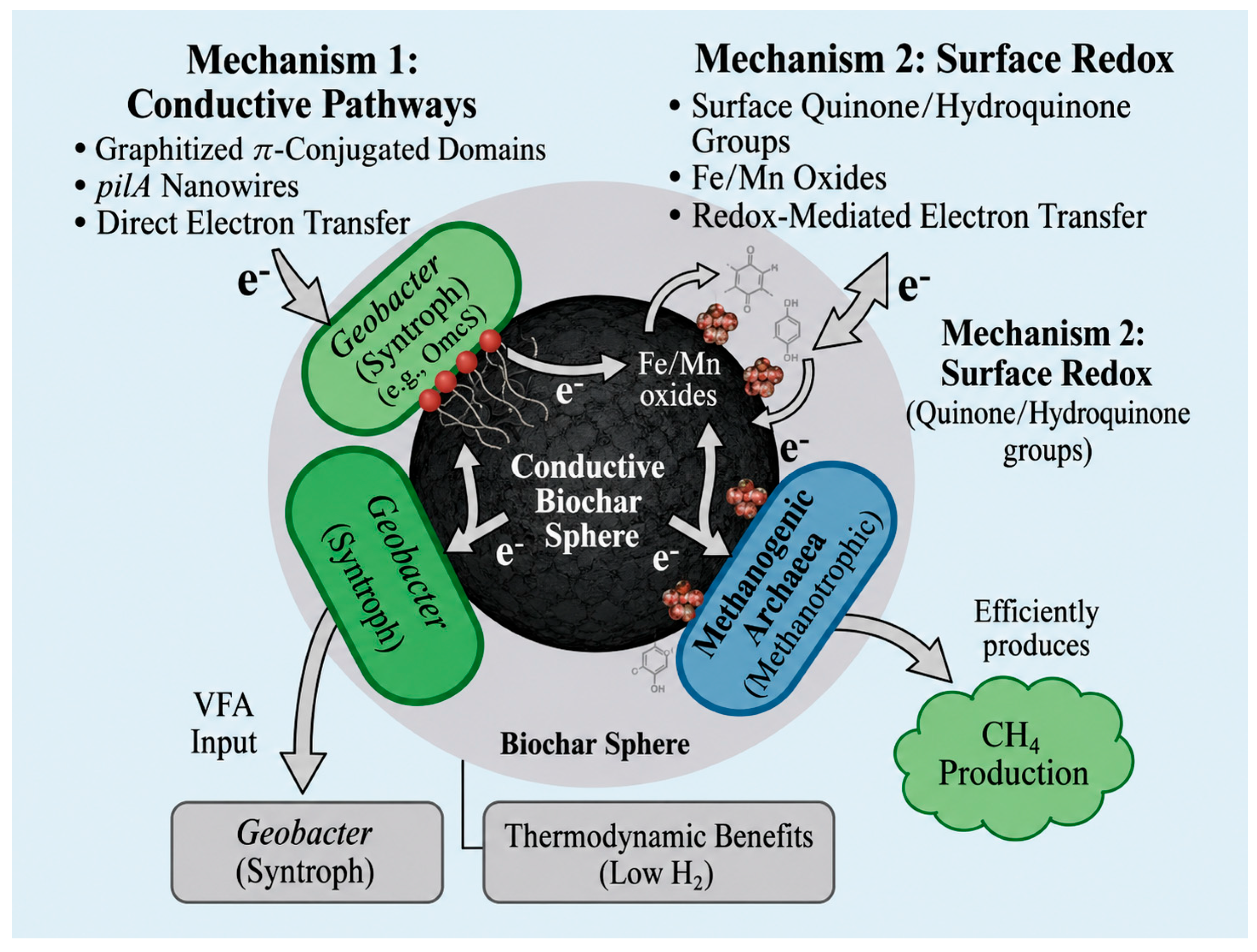
| Electrical conductivity | High-temperature pyrolysis, graphitization, N/P/S doping and carbon–metal composite formation | Enhances VFA conversion and methane production rate | Improves direct interspecies electron transfer (DIET) between syntrophic partners | Bulk conductivity is not the only predictor; redox-active groups and microbial contact also matter | Refs. [38,43] |
| Surface functional groups | Low-/medium-temperature pyrolysis, oxidation, acid/alkali treatment | Enhances adsorption of NH4+ and H2S and antibiotics and metals; reduces inhibition | Provides active sites for ion exchange, hydrogen bonding, complexation and redox mediation | Different groups may affect different AD stages; functional groups should not be treated as a single general descriptor | Ref. [46] |
| Cation exchange capacity (CEC) | Feedstock mineral composition, surface oxidation, chemical activation | Retains NH4+ and other charged species through ion exchange and electrostatic interaction | Alleviates ammonia inhibition and improves buffering capacity | Excessive adsorption may reduce the availability of essential nutrients | Refs. [23,44] |
| Redox-active moieties (quinone/phenolic groups) | Preservation or introduction of quinone, phenolic, carbonyl, and other oxygen-containing groups | Accelerates syntrophic metabolism and stabilizes electron flow | Acts as an electron shuttle or transient electron sink at the biochar and microbe interface | Excessive or harsh functionalization may introduce inhibitory effects | Refs. [38,49,52] |
| Mineral ash and alkalinity | Manure-, sludge-, or digestate-derived feedstocks; higher pyrolysis temperature; alkaline mineral loading | Maintains favorable pH and improves resistance to acidification and organic loading shocks | Releases alkaline minerals and replenishes buffering capacity | Excessive ash or metal release may affect microbial activity and digestate safety | Refs. [20,23,53] |
| Fe/Mn-containing phases and magnetic components | Inherent Fe-rich feedstocks, Fe/Mn loading, magnetization, ball milling | Enhances methanogenesis, VFA degradation, and material separation | Promotes redox cycling, electron transfer, and possible DIET; enables magnetic recovery | High metal loading may block pores or cause metal leaching | Refs. [7,8,54] |
| Particle size and spatial distribution | Grinding, pelletization, granulation, mixing intensity, reactor configuration | Influences reactor stability and biogas production under semi-continuous operation | Affects dispersion, microbial colonization, mass transfer, and contact between biochar and biomass | Smaller particles improve dispersion but may be difficult to recover and may intensify microbial over-colonization | Ref. [51] |
| Feedstock-derived nutrients and circular carbon source | Use of sludge-, manure-, or digestate-derived biochar/hydrochar | Supports waste valorization, ammonia-stress mitigation, and internal recycling of AD by-products | Supplies nutrients, trace elements, alkalinity, and microbial attachment sites | Potential risks include heavy metals, PAHs, and digestate safety concerns | Refs. [23,24,25] |
3. Performance Enhancement and Mechanisms of Anaerobic Digestion by Biochar
3.1. Methane Production and Energy Recovery
3.2. Process Stabilization of System and Lag Period Shortening
3.3. Mitigation of Inhibition by Toxic Compounds
3.4. Regulation of Microbial Community and Metabolic Pathways
3.5. Direct Interspecies Electron Transfer (DIET) and Electrochemical Mediation
4. Challenges and Future Perspectives
4.1. Challenges
4.1.1. Material Heterogeneity and Lack of AD-Specific Standards
4.1.2. Mechanistic Attribution Remains Largely Indirect
4.1.3. Engineering Constraints, Recovery, and Environmental Safety
4.2. Future Perspectives
4.2.1. Establish AD-Grade Biochar Standards and Green Manufacturing Routes
4.2.2. Strengthen Mechanism Verification and Long-Term Continuous Validation
5. Conclusions
Author Contributions
Funding
Institutional Review Board Statement
Informed Consent Statement
Data Availability Statement
Conflicts of Interest
References
- Kumar, M.; Bolan, N.S.; Hoang, S.A.; Sawarkar, A.D.; Jasemizad, T.; Gao, B.; Keerthanan, S.; Padhye, L.P.; Singh, L.; Kumar, S.; et al. Remediation of soils and sediments polluted with polycyclic aromatic hydrocarbons: To immobilize, mobilize, or degrade? J. Hazard. Mater. 2021, 420, 126534. [Google Scholar] [CrossRef] [Scilit] [PubMed]
- Peng, Y.; Liu, H.; Xing, T.; Zhen, F.; Wu, D.; Sun, Y. Instability mechanisms of overloaded anaerobic digestion: Insights from volatile fatty acid metabolism. Bioresour. Technol. 2026, 444, 134006. [Google Scholar] [CrossRef] [Scilit] [PubMed]
- Han, L.; Li, L.; Huang, J.; Ye, W.; Liu, Y.; Zhan, B.; Gu, Y.; Peng, X. Ammonia inhibition in anaerobic digestion: A critical review of inhibition mechanisms and mitigation strategies. J. Environ. Manag. 2026, 403, 129236. [Google Scholar] [CrossRef] [Scilit] [PubMed]
- Lovley, D.R. Syntrophy goes electric: Direct interspecies electron transfer. Annu. Rev. Microbiol. 2017, 71, 643. [Google Scholar] [CrossRef] [Scilit] [PubMed]
- Zhang, J.; Li, N.; Dai, X.; Tao, W.; Jenkinson, I.R.; Li, Z. Enhanced dewaterability of sludge during anaerobic digestion with thermal hydrolysis pretreatment: New insights through structure evolution. Water Res. 2018, 131, 177–185. [Google Scholar] [CrossRef] [Scilit] [PubMed]
- Wang, T.; Zhai, Y.; Zhu, Y.; Li, C.; Zeng, G. A review of the hydrothermal carbonization of biomass waste for hydrochar formation: Process conditions, fundamentals, and physicochemical properties. Renew. Sustain. Energy Rev. 2018, 90, 223. [Google Scholar] [CrossRef] [Scilit]
- He, Z.-W.; Jia, Y.-L.; Tang, C.-C.; Zhou, A.-J.; Liu, W.; Ren, Y.-X.; Wang, A.; Chen, R. Novel insights to the synergistic effects of magnetic biochar in anaerobic digestion while treating synthetic organic wastewater for biomethane recovery. Chem. Eng. J. 2025, 524, 169186. [Google Scholar] [CrossRef] [Scilit]
- Jin, H.Y.; Ren, Y.X.; Tang, C.C.; Zhang, S.; Wang, J.; Zhou, A.J.; Liang, B.; Liu, W.; Wang, A.; He, Z.W. Deciphering the synergistic effects and mechanisms of biochar and magnetite contained in magnetic biochar for enhancing methane production in anaerobic digestion of waste activated sludge. Water Res. 2025, 282, 123734. [Google Scholar] [CrossRef] [Scilit] [PubMed]
- Mohan, C.; Singh, D.J.; Budhathoki, S. Application of biochar in anaerobic digestion for sustainable bioenergy production: Mechanisms, multifunctional roles and future perspectives. Bioresour. Technol. Rep. 2026, 34, 102776. [Google Scholar] [CrossRef] [Scilit]
- Li, X.; Wang, T.; Sun, Z.; Tang, Y. Roles of biochar in anaerobic digestion and aerobic composting of organic wastes: Status and perspectives. Environ. Res. 2026, 295, 123944. [Google Scholar] [CrossRef] [Scilit] [PubMed]
- He, Y.; He, S.; Zou, J.; Wang, D.; Li, X.; Niu, Q.; Yang, C. Conductive materials in anaerobic digestion: Mechanisms of process intensification and regulations of microbial metabolisms. J. Environ. Chem. Eng. 2026, 14, 121305. [Google Scholar] [CrossRef] [Scilit]
- Tang, L.; Liu, L.; Xie, L.; Miao, X.; Zhou, Y.; Liu, W. A review of biological treatment strategies for antibiotic resistance genes in livestock wastewater: Challenges, advances, and future directions. J. Environ. Chem. Eng. 2026, 14, 121234. [Google Scholar] [CrossRef] [Scilit]
- Suo, M.; Liu, L.; Li, Y.; Fan, H.; Ye, D.; Ouyang, K.; Hrynsphan, D.; Tatsiana, S.; Wang, Z.; Chen, J. Biochar for next-generation anaerobic digestion: Global trends, multi-mechanism enhancement, and AI-driven prospects. J. Environ. Manag. 2026, 401, 128945. [Google Scholar] [CrossRef] [Scilit] [PubMed]
- Garcia-Prats, M.; Gonzalez, D.; Sanchez, A. Current Trends and Future Prospects of Biochar Use to Improve Anaerobic Digestion: An Up-to-Date Critical Review. Molecules 2026, 31, 503. [Google Scholar] [CrossRef] [Scilit] [PubMed]
- Deng, C.; Lin, R.; Kang, X.; Wu, B.; Wall, D.M.; Murphy, J.D. What physicochemical properties of biochar facilitate interspecies electron transfer in anaerobic digestion: A case study of digestion of whiskey by-products. Fuel 2021, 306, 121736. [Google Scholar] [CrossRef] [Scilit]
- Zhang, J.; Zhao, W.; Zhang, H.; Wang, Z.; Fan, C.; Zang, L. Recent achievements in enhancing anaerobic digestion with carbon-based functional materials. Bioresour. Technol. 2018, 266, 555. [Google Scholar] [CrossRef] [Scilit] [PubMed]
- Wang, C.; Liu, Y.; Gao, X.; Chen, H.; Xu, X.; Zhu, L. Role of biochar in the granulation of anaerobic sludge and improvement of electron transfer characteristics. Bioresour. Technol. 2018, 268, 28–35. [Google Scholar] [CrossRef] [Scilit] [PubMed]
- Lovley, D.R. Dissimilatory Fe(III)- and Mn(IV)-reducing prokaryotes. Prokaryotes 2006, 2, 635. [Google Scholar] [CrossRef] [Scilit]
- Ni, Z.; Zhou, L.; Lin, Z.; Kuang, B.; Zhu, G.; Jia, J.; Wang, T. Iron-modified biochar boosts anaerobic digestion of sulfamethoxazole pharmaceutical wastewater: Performance and microbial mechanism. J. Hazard. Mater. 2023, 452, 131314. [Google Scholar] [CrossRef] [Scilit] [PubMed]
- Lü, F.; Liu, Y.; Shao, L.; He, P. Powdered biochar doubled microbial growth in anaerobic digestion of oil. Appl. Energy 2019, 247, 605–614. [Google Scholar] [CrossRef] [Scilit]
- Pan, J.; Ma, J.; Zhai, L.; Luo, T.; Mei, Z.; Liu, H. Achievements of biochar application for enhanced anaerobic digestion: A review. Bioresour. Technol. 2019, 292, 122058. [Google Scholar] [CrossRef] [Scilit] [PubMed]
- Oldfield, T.L.; White, E.; Holden, N.M. An environmental analysis of options for utilising wasted food and food residue. J. Environ. Manag. 2016, 183, 826–835. [Google Scholar] [CrossRef] [Scilit] [PubMed]
- Bian, C.; Ren, X.; Gao, X.; Ma, S.; Wang, H.; Khan, M.U.; Meng, X.; Zhu, W. Circular bioenergy approach: Digestate-based biochar for enhancing anaerobic digestion performance under ammonia stress. Renew. Energy 2026, 264, 125597. [Google Scholar] [CrossRef] [Scilit]
- Chen, G.; Wang, Y.; Mu, L.; Cheng, Z.; Li, Z.; Dan, Z.; Guo, H.; Li, W.; Song, Y. High-load semi-continuous anaerobic digestion of kitchen waste: Regulation by iron oxide-modified digestate-derived biochar and metagenomic analysis of microbial functions. Renew. Energy 2026, 264, 125576. [Google Scholar] [CrossRef] [Scilit]
- Shi, J.; Li, G.; Yuan, S.; Lian, Z.; Wang, S.; Zhang, H. Sludge-derived hydrochar enhances anaerobic digestion of sludge with tetracycline: Focusing on synergistic mechanism and microbial response. J. Environ. Chem. Eng. 2026, 14, 121256. [Google Scholar] [CrossRef] [Scilit]
- Velasquez-Pinas, J.A.; Ghofrani-Isfahani, P.; Maya, D.Y.; Costa, J.M.; Forster-Carneiro, T.; Angelidaki, I. Understanding the effect of biochar characteristics on anaerobic digestion with focus in food processing industry. Biomass Bioenergy 2025, 201, 108154. [Google Scholar] [CrossRef] [Scilit]
- Mumme, J.; Srocke, F.; Heeg, K.; Werner, M. Use of biochars in anaerobic digestion. Bioresour. Technol. 2014, 164, 189–197. [Google Scholar] [CrossRef] [Scilit] [PubMed]
- Ren, S.; Usman, M.; Tsang, D.C.W.; O-Thong, S.; Angelidaki, I.; Zhu, X.; Zhang, S.; Luo, G. Hydrochar-Facilitated Anaerobic Digestion: Evidence for Direct Interspecies Electron Transfer Mediated through Surface Oxygen-Containing Functional Groups. Environ. Sci. Technol. 2020, 54, 5755–5766. [Google Scholar] [CrossRef] [Scilit] [PubMed]
- Yin, C.; Shen, Y.; Yuan, R.; Zhu, N.; Yuan, H.; Lou, Z. Sludge-based biochar-assisted thermophilic anaerobic digestion of waste-activated sludge in microbial electrolysis cell for methane production. Bioresour. Technol. 2019, 284, 315–324. [Google Scholar] [CrossRef] [Scilit] [PubMed]
- Luz, F.C.; Cordiner, S.; Manni, A.; Mulone, V.; Rocco, V.; Braglia, R.; Canini, A. Ampelodesmos mauritanicus pyrolysis biochar in anaerobic digestion process: Evaluation of the biogas yield. Energy 2018, 161, 663–669. [Google Scholar] [CrossRef] [Scilit]
- Sethupathi, S.; Zhang, M.; Rajapaksha, A.U.; Lee, S.R.; Nor, N.M.; Mohamed, A.R.; Al-Wabel, M.; Lee, S.S.; Ok, Y.S. Biochars as Potential Adsorbers of CH4, CO2 and H2S. Sustainability 2017, 9, 121. [Google Scholar] [CrossRef] [Scilit]
- Creamer, A.E.; Gao, B.; Zhang, M. Carbon dioxide capture using biochar produced from sugarcane bagasse and hickory wood. Chem. Eng. J. 2014, 249, 174–179. [Google Scholar] [CrossRef] [Scilit]
- Fiore, S.; Berruti, F.; Briens, C. Investigation of innovative and conventional pyrolysis of ligneous and herbaceous biomasses for biochar production. Biomass Bioenergy 2018, 119, 381–391. [Google Scholar] [CrossRef] [Scilit]
- Hao, W.; Björkman, E.; Lilliestråle, M.; Hedin, N. Activated carbons prepared from hydrothermally carbonized waste biomass used as adsorbents for CO2. Appl. Energy 2013, 112, 526–532. [Google Scholar] [CrossRef] [Scilit]
- Chen, T.; Zhang, Y.; Wang, H.; Lu, W.; Zhou, Z.; Zhang, Y.; Ren, L. Influence of pyrolysis temperature on characteristics and heavy metal adsorptive performance of biochar derived from municipal sewage sludge. Bioresour. Technol. 2014, 164, 47–54. [Google Scholar] [CrossRef] [Scilit] [PubMed]
- Martins, G.; Salvador, A.F.; Pereira, L.; Alves, M.M. Methane Production and Conductive Materials: A Critical Review. Environ. Sci. Technol. 2018, 52, 10241–10253. [Google Scholar] [CrossRef] [Scilit] [PubMed]
- Barua, S.; Dhar, B.R. Advances towards understanding and engineering direct interspecies electron transfer in anaerobic digestion. Bioresour. Technol. 2017, 244, 698. [Google Scholar] [CrossRef] [Scilit] [PubMed]
- Zhang, J.; Liu, H.; Wu, J.; Chen, C.; Ding, Y.; Liu, H.; Zhou, Y. Rethinking the biochar impact on the anaerobic digestion of food waste in bench-scale digester: Spatial distribution and biogas production. Bioresour. Technol. 2025, 420, 132115. [Google Scholar] [CrossRef] [Scilit] [PubMed]
- Li, H.; Dong, X.; da Silva, E.B.; de Oliveira, L.M.; Chen, Y.; Ma, L.Q. Mechanisms of metal sorption by biochars: Biochar characteristics and modifications. Chemosphere 2017, 178, 466–478. [Google Scholar] [CrossRef] [Scilit] [PubMed]
- Linville, J.L.; Shen, Y.W.; Ignacio-de Leon, P.A.; Schoene, R.P.; Urgun-Demirtas, M. In-situ biogas upgrading during anaerobic digestion of food waste amended with walnut shell biochar at bench scale. WASTE Manag. Res. 2017, 35, 669–679. [Google Scholar] [CrossRef] [Scilit] [PubMed]
- Ambaye, T.G.; Rene, E.R.; Dupont, C.; Wongrod, S.; van Hullebusch, E.D. Anaerobic Digestion of Fruit Waste Mixed with Sewage Sludge Digestate Biochar: Influence on Biomethane Production. Front. Energy Res. 2020, 8, 31. [Google Scholar] [CrossRef] [Scilit]
- Wang, Z.; Guo, H.; Shen, F.; Yang, G.; Zhang, Y.; Zeng, Y.; Wang, L.; Xiao, H.; Deng, S. Biochar produced from oak sawdust by Lanthanum (La)-involved pyrolysis for adsorption of ammonium (NH4+), nitrate (NO3−), and phosphate (PO43−). Chemosphere 2015, 119, 646–653. [Google Scholar] [CrossRef] [Scilit] [PubMed]
- Yin, Q.; Zhang, B.; Wang, R.; Zhao, Z. Biochar as an adsorbent for inorganic nitrogen and phosphorus removal from water: A review. Environ. Sci. Pollut. Res. 2017, 24, 26297–26309. [Google Scholar] [CrossRef] [Scilit] [PubMed]
- Zhang, Y.; Li, Z.; Mahmood, I.B. Recovery of NH4+by corn cob produced biochars and its potential application as soil conditioner. Front. Environ. Sci. Eng. 2014, 8, 825–834. [Google Scholar] [CrossRef] [Scilit]
- Sahota, S.; Vijay, V.K.; Subbarao, P.M.V.; Chandra, R.; Ghosh, P.; Shah, G.; Kapoor, R.; Vijay, V.; Koutu, V.; Thakur, I.S. Characterization of leaf waste based biochar for cost effective hydrogen sulphide removal from biogas. Bioresour. Technol. 2018, 250, 635–641. [Google Scholar] [CrossRef] [Scilit] [PubMed]
- Bamdad, H.; Hawboldt, K.; MacQuarrie, S. A review on common adsorbents for acid gases removal: Focus on biochar. Renew. Sustain. Energy Rev. 2018, 81, 1705–1720. [Google Scholar] [CrossRef] [Scilit]
- Han, Y.; Luo, Y.; Zhang, L.; Lu, X.; Luo, X.; Wu, X.; Zan, F. Deciphering the mechanistic insight into modified biochar for distinct anaerobic digestion processes: Surface functional groups and electron-transmitting capabilities. J. Environ. Chem. Eng. 2025, 13, 115581. [Google Scholar] [CrossRef] [Scilit]
- Kumar, M.; Dutta, S.; You, S.; Luo, G.; Zhang, S.; Show, P.L.; Sawarkar, A.D.; Singh, L.; Tsang, D.C.W. A critical review on biochar for enhancing biogas production from anaerobic digestion of food waste and sludge. J. Clean. Prod. 2021, 305, 127143. [Google Scholar] [CrossRef] [Scilit]
- Jiang, Q.; Zhou, W.; Chen, Y.; Peng, Z.; Li, C. Impacts of the quinone-functionalized biochar on anaerobic digestion: Beyond the redox property of biochar. PLoS ONE 2025, 20, e0322275. [Google Scholar] [CrossRef] [Scilit] [PubMed]
- Li, Z.M.; Li, A.H.; Meng, Q.B.; Tang, C.C.; Li, Q.; Zhou, A.J.; Liu, W.; Li, Z.L.; He, Z.W.; Chen, R. Insights to how tubular pore biochar affects anaerobic digestion of waste activated sludge: Performances and mechanisms. Bioresour. Technol. 2026, 448, 134296. [Google Scholar] [CrossRef] [Scilit] [PubMed]
- Zhang, P.; Zhang, J.; Zhang, T.; Chen, J.; Yang, Q.; He, Y.; Tong, Y.W. Unraveling the electron hopping mechanism in biochar-enhanced syntrophic acetate oxidation for methane production. Waste Manag. 2025, 204, 114925. [Google Scholar] [CrossRef] [Scilit] [PubMed]
- Klüpfel, L.; Keiluweit, M.; Kleber, M.; Sander, M. Redox Properties of Plant Biomass-Derived Black Carbon (Biochar). Environ. Sci. Technol. 2014, 48, 5601–5611. [Google Scholar] [CrossRef] [Scilit] [PubMed]
- Wei, W.; Guo, W.; Ngo, H.H.; Mannina, G.; Wang, D.; Chen, X.; Liu, Y.; Peng, L.; Ni, B.-J. Enhanced high-quality biomethane production from anaerobic digestion of primary sludge by corn stover biochar. Bioresour. Technol. 2020, 306, 123159. [Google Scholar] [CrossRef] [Scilit] [PubMed]
- Kong, T.; Wang, H.; Sun, J.; Liu, J.; Zhang, W.; Xing, W.; Li, R. Mechanisms of nano magnetite-loaded biochar enhancing anaerobic digestion of food waste and effects of different loading methods and dosages on process performance and microbial characteristics. Renew. Energy 2026, 267, 125799. [Google Scholar] [CrossRef] [Scilit]
- Sugiarto, Y.; Sunyoto, N.M.S.; Zhu, M.; Jones, I.; Zhang, D. Effect of biochar addition on microbial community and methane production during anaerobic digestion of food wastes: The role of minerals in biochar. Bioresour. Technol. 2021, 323, 124585. [Google Scholar] [CrossRef] [Scilit] [PubMed]
- Wang, Y.; Wei, W.; Huang, Q.-S.; Ni, B.-J. Methane production from algae in anaerobic digestion: Role of corncob ash supplementation. J. Clean. Prod. 2021, 327, 129485. [Google Scholar] [CrossRef] [Scilit]
- Wu, B.; Yang, Q.; Yao, F.; Chen, S.; He, L.; Hou, K.; Pi, Z.; Yin, H.; Fu, J.; Wang, D.; et al. Evaluating the effect of biochar on mesophilic anaerobic digestion of waste activated sludge and microbial diversity. Bioresour. Technol. 2019, 294, 122235. [Google Scholar] [CrossRef] [Scilit] [PubMed]
- Shi, Y.; Liu, M.; Li, J.; Yao, Y.; Tang, J.; Niu, Q. The dosage-effect of biochar on anaerobic digestion under the suppression of oily sludge: Performance variation, microbial community succession and potential detoxification mechanisms. J. Hazard. Mater. 2022, 421, 126819. [Google Scholar] [CrossRef] [Scilit] [PubMed]
- Lei, Z.; Ma, Y.; Wang, J.; Wang, X.C.; Li, Q.; Chen, R. Biochar addition supports high digestion performance and low membrane fouling rate in an anaerobic membrane bioreactor under low temperatures. Bioresour. Technol. 2021, 330, 124966. [Google Scholar] [CrossRef] [Scilit] [PubMed]
- Zhang, M.; Wang, Y. Effects of Fe-Mn-modified biochar addition on anaerobic digestion of sewage sludge: Biomethane production, heavy metal speciation and performance stability. Bioresour. Technol. 2020, 313, 123695. [Google Scholar] [CrossRef] [Scilit] [PubMed]
- Ma, H.; Hu, Y.; Kobayashi, T.; Xu, K.-Q. The role of rice husk biochar addition in anaerobic digestion for sweet sorghum under high loading condition. Biotechnol. Rep. 2020, 27, e00515. [Google Scholar] [CrossRef] [Scilit] [PubMed]
- Kaur, G.; Johnravindar, D.; Wong, J.W.C. Enhanced volatile fatty acid degradation and methane production efficiency by biochar addition in food waste-sludge co-digestion: A step towards increased organic loading efficiency in co-digestion. Bioresour. Technol. 2020, 308, 123250. [Google Scholar] [CrossRef] [Scilit] [PubMed]
- Wang, B.; Zhu, C.; Ai, D.; Fan, Z. Activation of persulfate by green nano-zero-valent iron-loaded biochar for the removal of p-nitrophenol: Performance, mechanism and variables effects. J. Hazard. Mater. 2021, 417, 126106. [Google Scholar] [CrossRef] [Scilit] [PubMed]
- Lv, L.; Li, W.; Zheng, Z.; Li, D.; Zhang, N. Exogenous acyl-homoserine lactones adjust community structures of bacteria and methanogens to ameliorate the performance of anaerobic granular sludge. J. Hazard. Mater. 2018, 354, 72–80. [Google Scholar] [CrossRef] [Scilit] [PubMed]
- Wang, G.; Li, Q.; Gao, X.; Wang, X.C. Synergetic promotion of syntrophic methane production from anaerobic digestion of complex organic wastes by biochar: Performance and associated mechanisms. Bioresour. Technol. 2018, 250, 812–820. [Google Scholar] [CrossRef] [Scilit] [PubMed]
- Shen, R.; Jing, Y.; Feng, J.; Luo, J.; Yu, J.; Zhao, L. Performance of enhanced anaerobic digestion with different pyrolysis biochars and microbial communities. Bioresour. Technol. 2020, 296, 122354. [Google Scholar] [CrossRef] [Scilit] [PubMed]
- Sun, C.; Liu, F.; Song, Z.; Wang, J.; Li, Y.; Pan, Y.; Sheng, T.; Li, L. Feasibility of dry anaerobic digestion of beer lees for methane production and biochar enhanced performance at mesophilic and thermophilic temperature. Bioresour. Technol. 2019, 276, 65–73. [Google Scholar] [CrossRef] [Scilit] [PubMed]
- Wang, G.; Gao, X.; Li, Q.; Zhao, H.; Liu, Y.; Wang, X.C.; Chen, R. Redox-based electron exchange capacity of biowaste-derived biochar accelerates syntrophic phenol oxidation for methanogenesis via direct interspecies electron transfer. J. Hazard. Mater. 2020, 390, 121726. [Google Scholar] [CrossRef] [Scilit] [PubMed]
- Tsui, T.-H.; Zhang, L.; Lim, E.Y.; Lee, J.T.E.; Tong, Y.W. Timing of biochar dosage for anaerobic digestion treating municipal leachate: Altered conversion pathways of volatile fatty acids. Bioresour. Technol. 2021, 335, 125283. [Google Scholar] [CrossRef] [Scilit] [PubMed]
- Zhao, D.; Yan, B.; Liu, C.; Yao, B.; Luo, L.; Yang, Y.; Liu, L.; Wu, F.; Zhou, Y. Mitigation of acidogenic product inhibition and elevated mass transfer by biochar during anaerobic digestion of food waste. Bioresour. Technol. 2021, 338, 125531. [Google Scholar] [CrossRef] [Scilit] [PubMed]
- Yuan, J.-H.; Xu, R.-K.; Zhang, H. The forms of alkalis in the biochar produced from crop residues at different temperatures. Bioresour. Technol. 2011, 102, 3488–3497. [Google Scholar] [CrossRef] [Scilit] [PubMed]
- Ren, X.; Awasthi, M.K.; Wang, Q.; Zhao, J.; Li, R.; Tu, Z.; Chen, H.; Awasthi, S.K.; Zhang, Z. New insight of tertiary-amine modified bentonite amendment on the nitrogen transformation and volatile fatty acids during the chicken manure composting. Bioresour. Technol. 2018, 266, 524–531. [Google Scholar] [CrossRef] [Scilit] [PubMed]
- Sunyoto, N.M.S.; Zhu, M.; Zhang, Z.; Zhang, D. Effect of Biochar Addition and Initial pH on Hydrogen Production from the First Phase of Two-Phase Anaerobic Digestion of Carbohydrates Food Waste. Energy Procedia 2017, 105, 379–384. [Google Scholar] [CrossRef] [Scilit]
- Chen, Y.; Cheng, J.J.; Creamer, K.S. Inhibition of anaerobic digestion process: A review. Bioresour. Technol. 2008, 99, 4044–4064. [Google Scholar] [CrossRef] [Scilit] [PubMed]
- Tan, Z.; Li, X.; Yang, C.; Liu, H.; Cheng, J.J. Inhibition and disinhibition of 5-hydroxymethylfurfural in anaerobic fermentation: A review. Chem. Eng. J. 2021, 424, 130560. [Google Scholar] [CrossRef] [Scilit]
- Cheng, Q.; Xu, C.; Huang, W.; Jiang, M.; Yan, J.; Fan, G.; Zhang, J.; Chen, K.; Xiao, B.; Song, G. Improving anaerobic digestion of piggery wastewater by alleviating stress of ammonia using biochar derived from rice straw. Environ. Technol. Innov. 2020, 19, 100948. [Google Scholar] [CrossRef] [Scilit]
- Wang, Z.; Liu, K.; Xie, L.; Zhu, H.; Ji, S.; Shu, X. Effects of residence time on characteristics of biochars prepared via co-pyrolysis of sewage sludge and cotton stalks. J. Anal. Appl. Pyrolysis 2019, 142, 104659. [Google Scholar] [CrossRef] [Scilit]
- Shanmugam, S.R.; Adhikari, S.; Nam, H.; Kar Sajib, S. Effect of bio-char on methane generation from glucose and aqueous phase of algae liquefaction using mixed anaerobic cultures. Biomass Bioenergy 2018, 108, 479–486. [Google Scholar] [CrossRef] [Scilit]
- Liu, Y.; Li, X.; Tan, Z.; Yang, C. Inhibition of tetracycline on anaerobic digestion of swine wastewater. Bioresour. Technol. 2021, 334, 125253. [Google Scholar] [CrossRef] [Scilit] [PubMed]
- Zhuang, H.; Shi, J.; Shan, S.; Ping, L.; Zhang, C. Enhanced anaerobic treatment of azo dye wastewater via direct interspecies electron transfer with Fe3O4/sludge carbon. Int. J. Hydrogen Energy 2020, 45, 28476–28487. [Google Scholar] [CrossRef] [Scilit]
- Xie, Q.; Zhang, Y.; Zhuang, H.; Liang, R.; Zhan, X.; Zhao, Y.; Shan, S.; Wu, H. Enhanced degradation of high-concentrated 2,4,6 trichlorophenol-containing wastewater by micron-grade high iron-containing fly ash/loofah sponge biochar: Metagenomic functional succession. J. Water Process Eng. 2022, 47, 102837. [Google Scholar] [CrossRef] [Scilit]
- Zhang, Y.; Zhao, L.; Feng, J.; Yu, J.; Luo, J.; Liang, Y.; Shen, R.; Yao, Z. Insights into quinone-functionalized biochar for stabilizing high-load anaerobic digestion and increasing biogas production. J. Environ. Manag. 2026, 401, 128733. [Google Scholar] [CrossRef] [Scilit] [PubMed]
- Liu, M.; Wang, H.; Nie, X.; Qin, J.; Yang, M.; Zheng, Z.; Hou, Y.; Duan, Y. Mitigating combined antibiotic inhibition in anaerobic digestion of aquaculture wastewater using zero-valent iron-modified biochar. J. Hazard Mater. 2026, 505, 141550. [Google Scholar] [CrossRef] [Scilit] [PubMed]
- Huang, J.-R.; Chen, X.; Hu, B.-B.; Cheng, J.-R.; Zhu, M.-J. Bioaugmentation combined with biochar to enhance thermophilic hydrogen production from sugarcane bagasse. Bioresour. Technol. 2022, 348, 126790. [Google Scholar] [CrossRef] [Scilit] [PubMed]
- Zhang, L.; Deng, F.; Liu, Z.; Ai, L. Removal of ammonia nitrogen and phosphorus by biochar prepared from sludge residue after rusty scrap iron and reduced iron powder enhanced fermentation. J. Environ. Manag. 2021, 282, 111970. [Google Scholar] [CrossRef] [Scilit] [PubMed]
- Yang, S.; Chen, Z.; Wen, Q. Impacts of biochar on anaerobic digestion of swine manure: Methanogenesis and antibiotic resistance genes dissemination. Bioresour. Technol. 2021, 324, 124679. [Google Scholar] [CrossRef] [Scilit] [PubMed]
- Chen, X.; Wu, B.; Yang, W.; Zhao, G.; Han, J.; Huang, C.; Sun, B.; Wang, A.; Li, Z. Biochar as a multifunctional material facilitate the organohalide remediation: A state-of-the-art review. Chem. Eng. J. 2023, 460, 141700. [Google Scholar] [CrossRef] [Scilit]
- Yang, S.; Wen, Q.; Chen, Z. Effect of KH2PO4-modified biochar on immobilization of Cr, Cu, Pb, Zn and as during anaerobic digestion of swine manure. Bioresour. Technol. 2021, 339, 125570. [Google Scholar] [CrossRef] [Scilit] [PubMed]
- Wang, H.; Larson, R.A.; Runge, T. Impacts to hydrogen sulfide concentrations in biogas when poplar wood chips, steam treated wood chips, and biochar are added to manure-based anaerobic digestion systems. Bioresour. Technol. Rep. 2019, 7, 100232. [Google Scholar] [CrossRef] [Scilit]
- Yang, X.; Tsibart, A.; Nam, H.; Hur, J.; El-Naggar, A.; Tack, F.M.G.; Wang, C.-H.; Lee, Y.H.; Tsang, D.C.W.; Ok, Y.S. Effect of gasification biochar application on soil quality: Trace metal behavior, microbial community, and soil dissolved organic matter. J. Hazard. Mater. 2019, 365, 684–694. [Google Scholar] [CrossRef] [Scilit] [PubMed]
- Xing, B.-S.; Feng, Y.-N.; Liu, J.-Y.; Zhang, Y.; Zhen, G.; Gadow, S.I.; Chen, R.; Wang, X.C.; Li, Y.-Y. Magnetic biochar combined with digestate bioaugmentation synergistically accelerates the recovery of a collapsed anaerobic digestion system. Chem. Eng. J. 2026, 535, 175462. [Google Scholar] [CrossRef] [Scilit]
- Chen, L.; Liang, X.; Yan, M.; Nabi, M.; Zhang, J.; Zheng, T.; Xing, T.; Li, Y.; Sun, Y. A novel mycelial pellet-biochar composite carrier designed for enhancing metabolic and physiological activity of methanogenic microbial consortium under propionate stress. Bioresour. Technol. 2026, 453, 134700. [Google Scholar] [CrossRef] [Scilit] [PubMed]
- McGlynn, S.E.; Chadwick, G.L.; Kempes, C.P.; Orphan, V.J. Single cell activity reveals direct electron transfer in methanotrophic consortia. Nature 2015, 526, 531–535. [Google Scholar] [CrossRef] [Scilit] [PubMed]
- Thapa, B.S.; Kim, T.; Pandit, S.; Song, Y.E.; Afsharian, Y.P.; Rahimnejad, M.; Kim, J.R.; Oh, S.-E. Overview of electroactive microorganisms and electron transfer mechanisms in microbial electrochemistry. Bioresour. Technol. 2022, 347, 126579. [Google Scholar] [CrossRef] [Scilit] [PubMed]
- Lovley, D.R. Happy together: Microbial communities that hook up to swap electrons. ISME J. 2017, 11, 327–336. [Google Scholar] [CrossRef] [Scilit] [PubMed]
- Summers, Z.M.; Fogarty, H.E.; Leang, C.; Franks, A.E.; Malvankar, N.S.; Lovley, D.R. Direct Exchange of Electrons Within Aggregates of an Evolved Syntrophic Coculture of Anaerobic Bacteria. Science 2010, 330, 1413–1415. [Google Scholar] [CrossRef] [Scilit] [PubMed]
- Rotaru, A.-E.; Shrestha Pravin, M.; Liu, F.; Markovaite, B.; Chen, S.; Nevin Kelly, P.; Lovley Derek, R. Direct Interspecies Electron Transfer between Geobacter metallireducens and Methanosarcina barkeri. Appl. Environ. Microbiol. 2014, 80, 4599–4605. [Google Scholar] [CrossRef] [Scilit] [PubMed]
- Liu, F.; Rotaru, A.-E.; Shrestha, P.M.; Malvankar, N.S.; Nevin, K.P.; Lovley, D.R. Promoting direct interspecies electron transfer with activated carbon. Energy Environ. Sci. 2012, 5, 8982–8989. [Google Scholar] [CrossRef] [Scilit]
- Liu, F.; Rotaru, A.-E.; Shrestha, P.M.; Malvankar, N.S.; Nevin, K.P.; Lovley, D.R. Magnetite compensates for the lack of a pilin-associated c-type cytochrome in extracellular electron exchange. Environ. Microbiol. 2015, 17, 648–655. [Google Scholar] [CrossRef] [Scilit] [PubMed]
- Jiang, Q.; Wu, P.; Zhang, X.; Zhang, Y.; Cui, M.; Liu, H.; Liu, H. Deciphering the effects of engineered biochar on methane production and the mechanisms during anaerobic digestion: Surface functional groups and electron exchange capacity. Energy Convers. Manag. 2022, 258, 115417. [Google Scholar] [CrossRef] [Scilit]
- Li, L.; Xu, Y.; Dai, X.; Dai, L. Principles and advancements in improving anaerobic digestion of organic waste via direct interspecies electron transfer. Renew. Sustain. Energy Rev. 2021, 148, 111367. [Google Scholar] [CrossRef] [Scilit]
- Hoang, A.T.; Goldfarb, J.L.; Foley, A.M.; Lichtfouse, E.; Kumar, M.; Xiao, L.; Ahmed, S.F.; Said, Z.; Luque, R.; Bui, V.G.; et al. Production of biochar from crop residues and its application for anaerobic digestion. Bioresour. Technol. 2022, 363, 127970. [Google Scholar] [CrossRef] [Scilit] [PubMed]
- Chen, J.; Yun, S.; Shi, J.; Wang, Z.; Abbas, Y.; Wang, K.; Han, F.; Jia, B.; Xu, H.; Xing, T.; et al. Role of biomass-derived carbon-based composite accelerants in enhanced anaerobic digestion: Focusing on biogas yield, fertilizer utilization, and density functional theory calculations. Bioresour. Technol. 2020, 307, 123204. [Google Scholar] [CrossRef] [Scilit] [PubMed]
- Gu, Y.; Qi, X.; Yang, X.; Jiang, Y.; Liu, P.; Quan, X.; Liang, P. Extracellular electron transfer and the conductivity in microbial aggregates during biochemical wastewater treatment: A bottom-up analysis of existing knowledge. Water Res. 2023, 231, 119630. [Google Scholar] [CrossRef] [Scilit] [PubMed]
- Zhao, Z.; Zhang, Y.; Holmes, D.E.; Dang, Y.; Woodard, T.L.; Nevin, K.P.; Lovley, D.R. Potential enhancement of direct interspecies electron transfer for syntrophic metabolism of propionate and butyrate with biochar in up-flow anaerobic sludge blanket reactors. Bioresour. Technol. 2016, 209, 148–156. [Google Scholar] [CrossRef] [Scilit] [PubMed]
- Wang, J.; Sun, C.; Huang, Q.-X.; Chi, Y.; Yan, J.-H. Adsorption and thermal degradation of microplastics from aqueous solutions by Mg/Zn modified magnetic biochars. J. Hazard. Mater. 2021, 419, 126486. [Google Scholar] [CrossRef] [Scilit] [PubMed]
- Huang, J.-R.; Bu, J.; Cheng, J.-R.; Ming, J. Improving methane production from hydrogenogenic effluent with magnetic leaf biochar. Biomass Convers. Biorefin. 2024, 14, 10909–10919. [Google Scholar] [CrossRef] [Scilit]
- Liu, H.; Xu, Y.; Li, L.; Yuan, S.; Geng, H.; Tang, Y.; Dai, X. A novel green composite conductive material enhancing anaerobic digestion of waste activated sludge via improving electron transfer and metabolic activity. Water Res. 2022, 220, 118687. [Google Scholar] [CrossRef] [Scilit] [PubMed]
- Chen, S.; Rotaru, A.-E.; Shrestha, P.M.; Malvankar, N.S.; Liu, F.; Fan, W.; Nevin, K.P.; Lovley, D.R. Promoting Interspecies Electron Transfer with Biochar. Sci. Rep. 2014, 4, 5019. [Google Scholar] [CrossRef] [Scilit] [PubMed]
- Nguyen, L.N.; Kumar, J.; Vu, M.T.; Mohammed, J.A.H.; Pathak, N.; Commault, A.S.; Sutherland, D.; Zdarta, J.; Tyagi, V.K.; Nghiem, L.D. Biomethane production from anaerobic co-digestion at wastewater treatment plants: A critical review on development and innovations in biogas upgrading techniques. Sci. Total Environ. 2021, 765, 142753. [Google Scholar] [CrossRef] [Scilit] [PubMed]


| Biochar Type/Modification | Substrate | Performance | Microbial/Metabolic Response | Proposed Mechanism | Representative Reference |
|---|---|---|---|---|---|
| Tubular-pore biochar | Waste-activated sludge | Increased cumulative methane yield by 17.6% | Enriched functional bacteria and methanogens, especially Romboutsia and Methanosaeta | Tubular pore structure promoted hydrolysis, microbial colonization, and potential DIET | Ref. [50] |
| Porous biochar | Organic substrates | Improved methane yield and process stability | Enriched syntrophic bacteria | Reduced diffusion distance for H2, formate, acetate | Ref. [84] |
| Biochar (general) | Complex organics | Enhanced substrate conversion | Promoted hydrolytic and fermentative guilds | Microhabitat formation and biomass retention | Ref. [84] |
| Mineral-releasing biochar | Food waste/sludge | Stable CH4 production under load fluctuation | Stimulated fermentative bacteria | Release of Fe, Co, Ni as enzyme cofactors | Refs. [85,86,87] |
| N-, Ca-, Fe-, Mn-doped biochar | Carbohydrate-rich substrates | Hydrogen yield enhanced | Clostridium sensu stricto 1, C. butyricum enriched | Selective enrichment of hydrogen-producing bacteria | Refs. [84,85,86,88] |
| Biochar-amended system | Organic substrates | H2 production accelerated | Promoted cellulolytic and fermentative bacteria | Increased cellulase and hydrogenase activities | Ref. [84] |
| Biochar addition | Sugars and VFAs | Shift toward acetate/ethanol pathways | Reduced competing pathways | Improved NAD+/NADH balance for proton reduction | Ref. [84] |
| Biochar + Fe0/Ni0 nanoparticles | Organic substrates | Synergistic increase in H2 yield | Enriched electron-transferring bacteria | Enhanced IET and EET within biofilms | Refs. [67,89] |
| Magnetic biochar | Waste-activated sludge; high-concentration organic wastewater | Formed synergistic enhancement compared with biochar and magnetite alone | Enriched Peptoclostridium, Anaerolineaceae, Methanosarcina, and Methanosaeta | Enhanced EPS electroactivity, cytochrome c, ATP supply, and DIET-related metabolism | Refs. [7,8] |
| Quinone-modified biochar | High-load corn straw | VFAs decreased by 77.38%; biogas production increased by 177.87% | Enriched Lentimicrobium, Flexilinea, Methanobacterium, and Methanosarcina | Quinone groups enhanced redox mediation, c-type cytochrome-related genes, and coenzyme F420 synthesis | Ref. [82] |
| Digestate-based biochar | High ammonia | Methane yield increased by 20.02% under ammonia stress | Enriched Firmicutes, Synergistota, Methanobacterium, and Methanomassiliicoccus | Improved ammonia adsorption, pH buffering, microbial adaptation, and hydrogenotrophic/methylotrophic methanogenesis | Ref. [23] |
| ZVI-modified biochar | Aquaculture wastewater AD under OTC and SMX stress | Maintained stable methane production under combined antibiotic stress | Increased resilience of Methanothrix-dominated methanogenic community | Reduced antibiotic bioavailability through microporous adsorption and restored IET via zero-valent iron | Ref. [83] |
| Cow-dung-derived biochar with inherent Fe | Swine wastewater AD under ciprofloxacin stress | Methane production increased by 386% compared with CIP-stressed control | Enriched Clostridium and Methanothrix | Inherent Fe and oxygen-containing groups promoted pollutant mitigation, acidogenesis, methanogenesis, and electron transfer | Ref. [82] |
Disclaimer/Publisher’s Note: The statements, opinions and data contained in all publications are solely those of the individual author(s) and contributor(s) and not of MDPI and/or the editor(s). MDPI and/or the editor(s) disclaim responsibility for any injury to people or property resulting from any ideas, methods, instructions or products referred to in the content. |
© 2026 by the authors. Licensee MDPI, Basel, Switzerland. This article is an open access article distributed under the terms and conditions of the Creative Commons Attribution (CC BY) license.
Share and Cite
Shi, Y.; Luo, Y.; Zhu, T.; Zang, K. Application and Mechanisms of Biochar in Anaerobic Digestion: Towards Process Resilience and Waste Valorization. Toxics 2026, 14, 764. https://doi.org/10.3390/toxics14090764
Shi Y, Luo Y, Zhu T, Zang K. Application and Mechanisms of Biochar in Anaerobic Digestion: Towards Process Resilience and Waste Valorization. Toxics. 2026; 14(9):764. https://doi.org/10.3390/toxics14090764
Chicago/Turabian StyleShi, Yuan, Yin Luo, Tingting Zhu, and Kaijia Zang. 2026. "Application and Mechanisms of Biochar in Anaerobic Digestion: Towards Process Resilience and Waste Valorization" Toxics 14, no. 9: 764. https://doi.org/10.3390/toxics14090764
APA StyleShi, Y., Luo, Y., Zhu, T., & Zang, K. (2026). Application and Mechanisms of Biochar in Anaerobic Digestion: Towards Process Resilience and Waste Valorization. Toxics, 14(9), 764. https://doi.org/10.3390/toxics14090764