
Characterisation of PAHs in Outdoor Air Pollution at Schools in a Medium-Sized Town, Hungary


Abstract
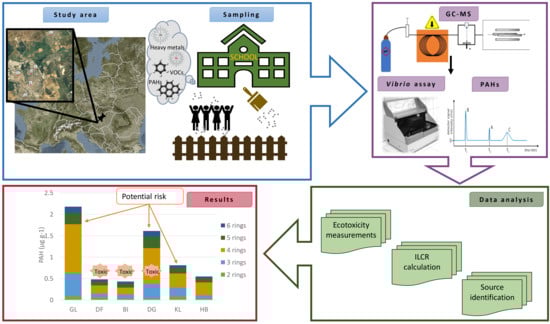
1. Introduction
2. Materials and Methods
2.1. Sampling
2.2. Analytical Measurements
2.3. Source Identification
2.4. Incremental Lifetime Cancer Risk (ILCR)
2.5. Toxicity Assessment
3. Results and Discussion
3.1. Levels and Distribution of PAHs in Resuspendable Dust
3.2. Source Identification
3.3. Cancer Risk Assessment
3.4. Ecotoxicity
3.5. Comparison of Schools
4. Conclusions
Author Contributions
Funding
Institutional Review Board Statement
Informed Consent Statement
Data Availability Statement
Acknowledgments
Conflicts of Interest
Abbreviations
| IARC | International Agency for Research on Cancer |
| ILCR | Incremental Lifetime Cancer Risk |
| TEF | Toxic Equivalency Factor |
References
- Diana, A.; Bertinetti, S.; Abollino, O.; Giacomino, A.; Buoso, S.; Favilli, L.; Inaudi, P.; Malandrino, M. PM10 element distribution and environmental-sanitary risk analysis in two Italian industrial cities. Atmosphere 2022, 14, 48. [Google Scholar] [CrossRef]
- Gregoris, E.; Argiriadis, E.; Vecchiato, M.; Zambon, S.; De Pieri, S.; Donateo, A.; Contini, D.; Piazza, R.; Barbante, C.; Gambaro, A. Gas-particle distributions, sources and health effects of polycyclic aromatic hydrocarbons (PAHs), polychlorinated biphenyls (PCBs) and polychlorinated naphthalenes (PCNs) in Venice aerosols. Sci. Total Environ. 2014, 476, 393–405. [Google Scholar] [CrossRef] [PubMed]
- Monographs on the Evaluation of Carcinogenic Risks to Humans. Some Non-Heterocyclic Polycyclic Aromatic Hydrocarbons and Some Related Exposures; International Agency for Research on Cancer: Lyon, France, 2010.
- IARC Working Group on the Evaluation of Carcinogenic Risks to Humans. Outdoor Air Pollution. IARC Monographs on the Evaluation of Carcinogenic Risks to Humans; International Agency for Research on Cancer: Lyon, France, 2016; Volume 109. [Google Scholar]
- Shi, Y.; Bilal, M.; Ho, H.C.; Omar, A. Urbanization and regional air pollution across South Asian developing countries—A nationwide land use regression for ambient PM2.5 assessment in Pakistan. Environ. Pollut. 2020, 266, 115145. [Google Scholar] [CrossRef]
- Elbayoumi, M.; Ramli, N.A.; Yusof, N.F.F.M. Spatial and temporal variations in particulate matter concentrations in twelve schools environment in urban and overpopulated camps landscape. Build. Environ. 2015, 90, 157–167. [Google Scholar] [CrossRef]
- Waked, A.; Favez, O.; Alleman, L.Y.; Piot, C.; Petit, J.E.; Delaunay, T.; Verlinden, E.; Golly, B.; Besombes, J.L.; Jaffrezo, J.L.; et al. Source apportionment of PM10 in a north-western Europe regional urban background site (Lens, France) using positive matrix factorization and including primary biogenic emissions. Atmos. Chem. Phys. 2014, 14, 3325–3346. [Google Scholar] [CrossRef]
- Tobiszewski, M.; Namiesnik, J. PAH diagnostic ratios for the identification of pollution emission sources. Environ. Pollut. 2012, 162, 110–119. [Google Scholar] [CrossRef]
- Zhang, Q.; Zhao, Z.; Wu, Z.; Niu, X.; Zhang, Y.; Wang, Q.; Ho, S.S.; Li, Z.; Shen, Z. Toxicity source apportionment of fugitive dust PM2.5-bound polycyclic aromatic hydrocarbons using multilayer perceptron neural network analysis in Guanzhong Plain urban agglomeration, China. J. Hazard. Mater. 2024, 468, 133773. [Google Scholar] [CrossRef]
- Xie, H.; Cao, Y.; Li, J.; Lyu, Y.; Roberts, N.; Jia, Z. Affective disorder and brain alterations in children and adolescents exposed to outdoor air pollution. J. Affect. Disord. 2023, 331, 423–434. [Google Scholar] [CrossRef] [PubMed]
- Castagna, A.; Mascheroni, E.; Fustinoni, S.; Montirosso, R. Air pollution and neurodevelopmental skills in preschool-and school-aged children: A systematic review. Neurosci. Biobehav. Rev. 2022, 136, 104623. [Google Scholar] [CrossRef] [PubMed]
- Hobbs, M.; Deng, B.; Woodward, L.; Marek, L.; McLeod, G.; Sturman, A.; Kingham, S.; Ahuriri-Driscoll, A.; Eggleton, P.; Campbell, M.; et al. Childhood air pollution exposure is related to cognitive, educational and mental health outcomes in childhood and adolescence: A longitudinal birth cohort study. Environ. Res. 2025, 274, 121148. [Google Scholar] [CrossRef]
- Kotzias, D.; Geiss, O.; Tirendi, S.; Barrero-Moreno, J.; Reina, V.; Gotti, A.; Cimino-Reale, G.; Casati, B.; Marafante, E.; Sarigiannis, D. Exposure to multiple air contaminants in public buildings, schools and kindergartens—The European indoor air monitoring and exposure assessment (AIRMEX) study. Fresenius Environ. Bull. 2009, 18, 670–681. [Google Scholar]
- Szabados, M.; Csákó, Z.; Kotlík, B.; Kazmarová, H.; Kozajda, A.; Jutraz, A.; Kukec, A.; Otorepec, P.; Dongiovanni, A.; Di Maggio, A.; et al. Általános iskolák beltéri levegőminősége Közép-Európában: Az InAirQ projekt. (Indoor air quality in elementary schools in Central Europe: The InAirQ project, in Hungarian). Egészségtudomány 2020, 65, 51–71. [Google Scholar] [CrossRef]
- Rogula-Kozłowska, W.; Kozielska, B.; Majewski, G. Submicron particle-bound polycyclic aromatic hydrocarbons in the Polish teaching rooms: Concentrations, origin and health hazard. J. Environ. Sci. 2018, 64, 235–244. [Google Scholar] [CrossRef] [PubMed]
- Pluhar, Z.F.; Piko, B.F.; Kovacs, S.; Uzzoli, A. “Air pollution is bad for my health”: Hungarian children’s knowledge of the role of environment in health and disease. Health Place 2009, 15, 239–246. [Google Scholar] [CrossRef]
- Kováts, N.; Hubai, K.; Sainnokhoi, T.A.; Hoffer, A.; Teke, G. Ecotoxicity testing of airborne particulate matter—Comparison of sample preparation techniques for the Aliivibrio fischeri assay. Environ. Geochem. Health 2021, 43, 4367–4378. [Google Scholar] [CrossRef]
- Ács, A.; Ferincz, Á.; Kovács, A.; Jancsek-Turóczi, B.; Gelencsér, A.; Kiss, G.; Kováts, N. Ecotoxicological characterisation of exhaust particulates from diesel-powered light-duty vehicles. Cent. Eur. J. Chem. 2013, 11, 1954–1958. [Google Scholar] [CrossRef]
- Casotti Rienda, I.; Nunes, T.; Amato, F.; Lucarelli, F.; Kováts, N.; Hubai, K.; Alves, C.A. Preliminary assessment of road dust from Portuguese motorways: Chemical profile, health risks, and ecotoxicological screening. Air Qual. Atmos. Health 2023, 16, 2579–2590. [Google Scholar] [CrossRef]
- Wróbel, M.; Kamińska, J.; Dissanayake Mudiyanselage, N.; Napiórkowska, K.; Bauman, G.; Rybak, J. Transport Dust in Poland: Tracking the Invisible Footprint of Transport on Ecosystem Health. Appl. Sci. 2025, 15, 8862. [Google Scholar] [CrossRef]
- Tositti, L.; Brattich, E.; Parmeggiani, S.; Bolelli, L.; Ferri, E.; Girotti, S. Airborne particulate matter biotoxicity estimated by chemometric analysis on bacterial luminescence data. Sci. Total Environ. 2018, 640, 1512–1520. [Google Scholar] [CrossRef]
- Google Maps. Satellite View of Veszprem, Hungary. Available online: https://www.google.com/maps (accessed on 31 March 2025).
- Gong, Y.; Wu, Y.; Lin, C.; Xu, D.; Duan, X.; Wang, B.; Liu, X.; Cheng, H.; Wang, Q.; Ma, J. Is hand-to-mouth contact the main pathway of children’s soil and dust intake? Environ. Geochem. Health 2022, 44, 1567–1580. [Google Scholar] [CrossRef] [PubMed]
- Wang, P.; Hu, J.; Zhang, Q.; Ma, W.; Tian, L.; Liu, T.; Zheng, H.; Han, G. Risk assessment and contamination drivers for heavy metals in kindergarten resuspended dust. J. Hazard. Mater. 2025, 490, 137757. [Google Scholar] [CrossRef]
- ISO/IEC 17025:2018; General Requirements for the Competence of Testing and Calibration Laboratories. International Organization for Standardization: Geneva, Switzerland, 2018.
- Mostert, M.M.R.; Ayoko, G.A.; Kokot, S. Application of chemometrics to analysis of soil pollutants. Trends Anal. Chem. 2010, 29, 430–435. [Google Scholar] [CrossRef]
- Ravindra, K.; Sokhi, R.; Van Grieken, R. Atmospheric polycyclic aromatic hydrocarbons: Source attribution, emission factors and regulation. Atmos. Environ. 2008, 42, 2895–2921. [Google Scholar] [CrossRef]
- Yunker, M.B.; Macdonald, R.W.; Vingarzan, R.; Mitchell, R.H.; Goyette, D.; Sylvestre, S. PAHs in the Fraser River basin: A critical appraisal of PAH ratios as indicators of PAH source and composition. Org. Geochem. 2022, 33, 489–515. [Google Scholar] [CrossRef]
- Oliveira, M.; Slezakova, K.; Madureira, J.; de Oliveira Fernandes, E.; Delerue-Matos, C.; Morais, S.; do Carmo Pereira, M. Polycyclic aromatic hydrocarbons in primary school environments: Levels and potential risks. Sci. Total Environ. 2017, 575, 1156–1167. [Google Scholar] [CrossRef] [PubMed]
- Katsoyiannis, A.; Terzi, E.; Cai, Q.-Y. On the use of PAH molecular diagnostic ratios in sewage sludge for the understanding of the PAH sources. Is this use appropriate? Chemosphere 2007, 69, 1337–1339. [Google Scholar] [CrossRef] [PubMed]
- Flores, R.M.; Özdemir, H.; Ünal, A.; Tayanç, M. Distribution and sources of SVOCs in fine and coarse aerosols in the megacity of Istanbul. Atmos. Res. 2022, 271, 106100. [Google Scholar] [CrossRef]
- Mihankhah, T.; Saeedi, M.; Karbassi, A. Contamination and cancer risk assessment of polycyclic aromatic hydrocarbons (PAHs) in urban dust from different land-uses in the most populated city of Iran. Ecotoxicol. Environ. Saf. 2020, 187, 109838. [Google Scholar] [CrossRef]
- Nisbet, I.C.; Lagoy, P.K. Toxic equivalency factors (TEFs) for polycyclic aromatic hydrocarbons (PAHs). Regul. Toxicol. Pharmacol. 1992, 16, 290–300. [Google Scholar] [CrossRef]
- Aslam, R.; Sharif, F.; Baqar, M.; Shahzad, L. Source identification and risk assessment of polycyclic aromatic hydrocarbons (PAHs) in air and dust samples of Lahore City. Sci. Rep. 2022, 12, 2459. [Google Scholar] [CrossRef] [PubMed]
- US Environmental Protection Agency (USEPA). Exposure Factors Handbook: 2011 Edition. Available online: https://cfpub.epa.gov/ncea/risk/recordisplay.cfm?deid=236252 (accessed on 26 March 2026).
- Soltani, N.; Keshavarzi, B.; Moore, F.; Tavakol, T.; Lahijanzadeh, A.R.; Jaafarzadeh, N.; Kermani, M. Ecological and human health hazards of heavy metals and polycyclic aromatic hydrocarbons (PAHs) in road dust of Isfahan metropolis, Iran. Sci. Total Environ. 2015, 505, 712–723. [Google Scholar] [CrossRef]
- Peng, C.; Chen, W.; Liao, X.; Wang, M.; Ouyang, Z.; Jiao, W.; Bai, Y. Polycyclic aromatic hydrocarbons in urban soils of Beijing: Status, sources, distribution and potential risk. Environ. Pollut. 2011, 159, 802–808. [Google Scholar] [CrossRef]
- Hidvégi, E.V.; Jakab, A.; Cziráki, A.; Illyés, M.; Bereczki, C. Egészséges, normál testtömegű magyar gyermek és serdülő mérésén alapuló perifériás (brachialis) vérnyomás-normálértékek. Orvosi Hetilap 2024, 165, 1086–1100. [Google Scholar] [CrossRef]
- ISO 21338:2010; Water Quality—Kinetic Determination of the Inhibitory Effects of Sediment, Other Solids and Coloured Samples on the Light Emission of Vibrio fischeri/Kinetic Luminescent Bacteria Test. International Organization for Standardization: Geneva, Switzerland, 2018.
- Škrbić, B.; Đurišić-Mladenović, N.; Živančev, J.; Tadić, Đ. Seasonal occurrence and cancer risk assessment of polycyclic aromatic hydrocarbons in street dust from the Novi Sad city, Serbia. Sci. Total Environ. 2019, 647, 191–203. [Google Scholar] [CrossRef] [PubMed]
- Rybak, J.; Wróbel, M.; Krzyżyńska, R.; Rogula–Kozłowska, W.; Olszowski, T. Is Poland at risk of urban road dust? Comparison studies on mutagenicity of dust. Environ. Pollut. 2022, 314, 120337. [Google Scholar] [CrossRef] [PubMed]
- Jancsek-Turóczi, B.; Hoffer, A.; Nyírő-Kósa, I.; Gelencsér, A. Sampling and characterization of resuspended and respirable road dust. J. Aerosol Sci. 2013, 65, 69–76. [Google Scholar] [CrossRef][Green Version]
- Lorenzi, D.; Entwistle, J.A.; Cave, M.; Dean, J.R. Determination of polycyclic aromatic hydrocarbons in urban street dust: Implications for human health. Chemosphere 2011, 83, 970–977. [Google Scholar] [CrossRef]
- Seibert, R.; Kotlík, B.; Kazmarová, H.; Dombek, V.; Volná, V.; Hladký, D.; Krejčí, B. Regional and seasonal drivers of metals and PAHs concentrations in road dust and their health implications in the Czech Republic. Heliyon 2024, 10, e40725. [Google Scholar] [CrossRef]
- Lohmann, R.; Lammel, G. Adsorptive and absorptive contributions to the gas particle partitioning of polycyclic aromatic hydrocarbons: State of knowledge and recommended parameterization for modeling. Environ. Sci. Technol. 2004, 38, 3793–3803. [Google Scholar] [CrossRef]
- Krugly, E.; Martuzevicius, D.; Sidaraviciute, R.; Ciuzas, D.; Prasauskas, T.; Kauneliene, V.; Stasiulaitiene, I.; Kliucininkas, L. Characterization of particulate and vapor phase polycyclic aromatic hydrocarbons in indoor and outdoor air of primary schools. Atmos. Environ. 2014, 82, 298–306. [Google Scholar] [CrossRef]
- Hubai, K.; Kováts, N.; Sainnokhoi, T.A.; Teke, G. Accumulation pattern of polycyclic aromatic hydrocarbons using Plantago lanceolata L. as passive biomonitor. Environ. Sci. Pollut. Res. 2022, 29, 7300–7311. [Google Scholar] [CrossRef] [PubMed]
- Bierkens, J.; Van Holderbeke, M.; Cornelis, C.; Torfs, R. Exposure Through Soil and Dust Ingestion. In Dealing with Contaminated Sites; Swartjes, F., Ed.; Springer: Berlin/Heidelberg, Germany, 2011. [Google Scholar] [CrossRef]
- Wang, M.; Jia, S.; Lee, S.H.; Chow, A.; Fang, M. Polycyclic aromatic hydrocarbons (PAHs) in indoor environments are still imposing carcinogenic risk. J. Hazard. Mater. 2021, 409, 124531. [Google Scholar] [CrossRef] [PubMed]
- Błaszczyk, E.; Rogula-Kozłowska, W.; Klejnowski, K.; Fulara, I.; Mielżyńska-Švach, D. Polycyclic aromatic hydrocarbons bound to outdoor and indoor airborne particles (PM2.5) and their mutagenicity and carcinogenicity in Silesian kindergartens, Poland. Air Qual. Atmos. Health 2017, 10, 389–400. [Google Scholar] [CrossRef] [PubMed]
- Davoudi, M.; Esmaili-Sari, A.; Bahramifar, N.; Moeinaddini, M. Spatio-temporal variation and risk assessment of polycyclic aromatic hydrocarbons (PAHs) in surface dust of Qom metropolis, Iran. Environ. Sci. Pollut. Res. 2021, 28, 9276–9289. [Google Scholar] [CrossRef]
- Kozielska, B.; Kaleta, D. Cancer risk associated with inhalation exposure to PM10-bound PAHs and PM10-bound heavy metals in Polish agglomerations. Appl. Sci. 2025, 15, 7903. [Google Scholar] [CrossRef]
- Man, Y.B.; Kang, Y.; Wang, H.S.; Lau, W.; Li, H.; Sun, X.L.; Giesy, J.P.; Chow, K.L.; Wong, M.H. Cancer risk assessments of Hong Kong soils contaminated by polycyclic aromatic hydrocarbons. J. Hazard. Mater. 2013, 261, 770–776. [Google Scholar] [CrossRef]
- Manoli, E.; Fantidou, V.; Kouras, A.; Samara, C. Polycyclic aromatic hydrocarbons in settled dust of playgrounds in Thessaloniki, Greece: Concentration levels and implications for childhood cancer risk. Environ. Res. 2025, 274, 121300. [Google Scholar] [CrossRef]
- Casotti Rienda, I.; Alves, C.A.; Nunes, T.; Soares, M.; Amato, F.; Sánchez de la Campa, A.; Kováts, N.; Hubai, K.; Teke, G. PM10 Resuspension of Road Dust in Different Types of Parking Lots: Emissions, Chemical Characterisation and Ecotoxicity. Atmosphere 2023, 14, 305. [Google Scholar] [CrossRef]
- Sainnokhoi, T.A.; Kováts, N.; Gelencsér, A.; Hubai, K.; Teke, G.; Pelden, B.; Tserenchimed, T.; Erdenechimeg, Z.; Galsuren, J. Characteristics of particle-bound polycyclic aromatic hydrocarbons (PAHs) in indoor PM2.5 of households in the Southwest part of Ulaanbaatar capital, Mongolia. Environ. Monit. Assess. 2022, 194, 665. [Google Scholar] [CrossRef]
- Alves, C.A.; Vicente, E.D.; Evtyugina, M.; Vicente, A.M.; Sainnokhoi, T.A.; Kováts, N. Cooking activities in a domestic kitchen: Chemical and toxicological profiling of emissions. Sci. Total Environ. 2021, 772, 145412. [Google Scholar] [CrossRef]
- Rienda, I.C.; Nunes, T.; Gonçalves, C.; Vicente, A.; Amato, F.; Lucarelli, F.; Kováts, N.; Hubai, K.; Sainnokhoi, T.A.; Alves, C.A. Road dust resuspension in a coastal Atlantic intermunicipal urban area with industrial facilities: Emission factors, chemical composition and ecotoxicity. Atmos. Res. 2023, 294, 106977. [Google Scholar] [CrossRef]
- Evagelopoulos, V.; Zoras, S.; Samaras, P.; Triantafyllou, A.; Albanis, T.; Kassomenos, P. Toxicity of Fine and Coarse Atmospheric Particles Using Vibrio fischeri. In Proceedings of the 2nd International Conference on Environmental Management, Engineering, Planning and Economics CEMEPE & SECOTOX Conference, Myconos Island, Greece, 21–26 June 2009. [Google Scholar]
- Parajuli, R.; Brandeis, C.; Chizmar, S. Impacts of the European renewable energy policy on forest resource markets in the Southern United States: A case of the wood pellet industry. Resour. Conserv. Recycl. 2024, 207, 107692. [Google Scholar] [CrossRef]
- Vicente, E.D.; Alves, C.A. An overview of particulate emissions from residential biomass combustion. Atmos. Res. 2018, 199, 159–185. [Google Scholar] [CrossRef]
- Omodieke, A.; Kalisa, E. Concentration, source identification and risk assessment of atmospheric polycyclic aromatic hydrocarbons at a kindergarten school in Kigali, Rwanda. City Environ. Interact. 2015, 28, 100260. [Google Scholar] [CrossRef]
- Korhonen, A.; Relvas, H.; Miranda, A.I.; Ferreira, J.; Lopes, D.; Rafael, S.; Almeida, S.M.; Faria, T.; Martins, V.; Canha, N.; et al. Analysis of spatial factors, time-activity and infiltration on outdoor generated PM2.5 exposures of school children in five European cities. Sci. Total Environ. 2021, 785, 147111. [Google Scholar] [CrossRef]
- Rivas, I.; Viana, M.; Moreno, T.; Pandolfi, M.; Amato, F.; Reche, C.; Bouso, L.; Àlvarez-Pedrerol, M.; Alastuey, A.; Sunyer, J.; et al. Child exposure to indoor and outdoor air pollutants in schools in Barcelona, Spain. Environ. Int. 2014, 69, 200–212. [Google Scholar] [CrossRef]
- Wang, A.; Wang, J.; Zhang, R.; Cao, S.J. Mitigating urban heat and air pollution considering green and transportation infrastructure. Transp. Res. Part A Policy Pract. 2024, 184, 104079. [Google Scholar] [CrossRef]




| School’s Name | Shortcut | Description |
|---|---|---|
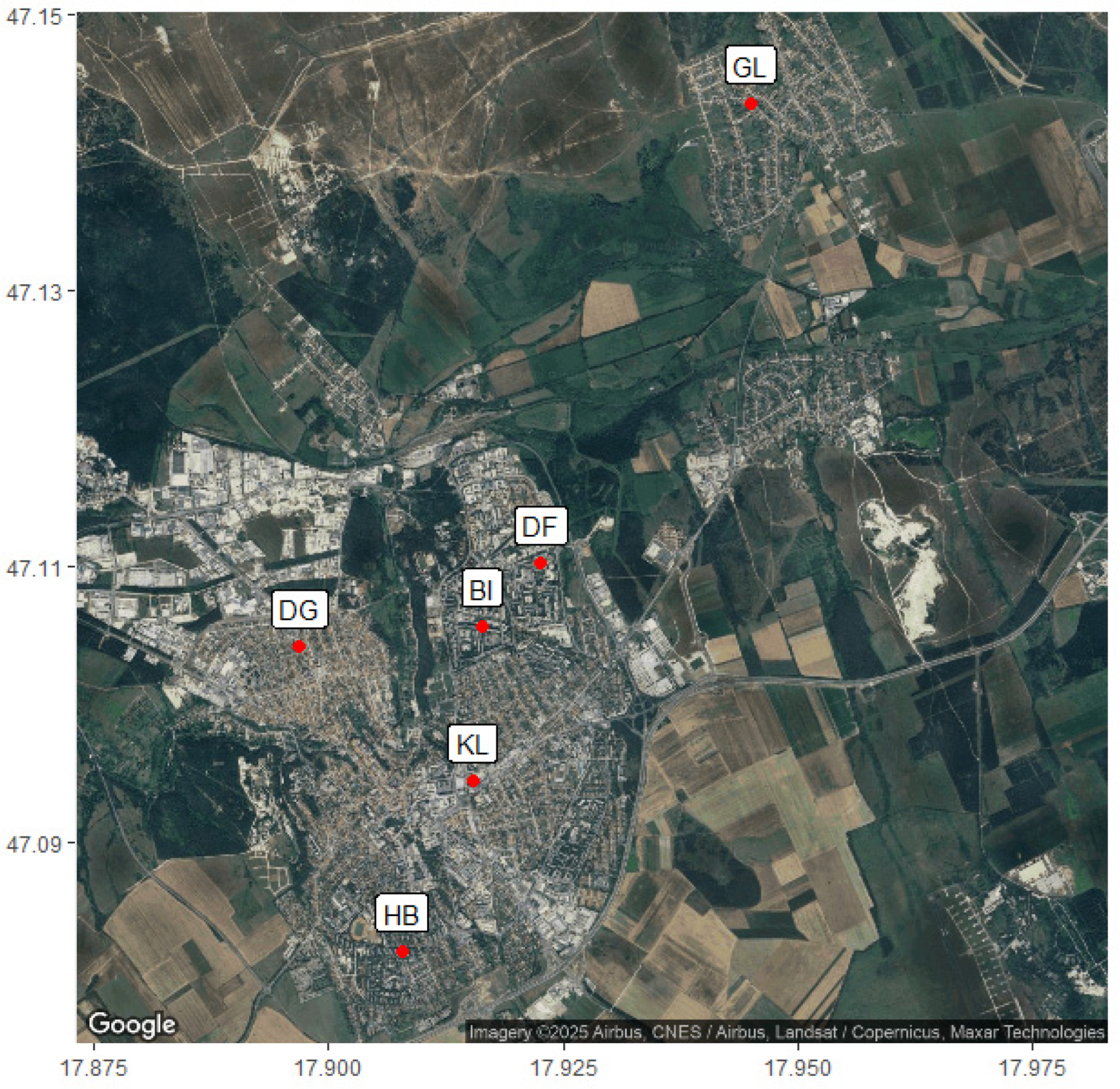
| Gyulaffy László German Nationality Language Teaching Primary School | GL | Suburban/rural area, with detached houses. Main heating sources are wood, coal, and gas. The distance of the main road with high traffic is 300 m. |
| Deák Ferenc Primary School | DF | Housing estate with block houses. Main heating sources are district heating and gas. The distance of the main road with high traffic is 300 m. |
| Báthory István Sports School and Primary School in Veszprém | BI | Housing estate surrounded by block houses, the main heating source is district heating. The distance of the main road with high traffic is 900 m. |
| Dózsa György German Nationality Language Teaching Primary School | DG | Suburban, typically with detached houses. Main heating sources are wood, coal, and gas. The distance of the main road with high traffic is 1500 m. |
| Kossuth Lajos Elementary School in Veszprém | KL | Central, located in the city centre. The distance to the main bus station is 100 m, and the main road of the city runs in front of the school. |
| Hristo Botev German Nationality Language Teaching Primary School | HB | Suburban, typically with terraced houses, main heating sources are gas and wood to a lesser extent. The distance of the main road with high traffic is 500 m. |
| Abbrev. | Value | Unit | Ref. | |
|---|---|---|---|---|
| Ingestion rate | IRing | 200 | mg day−1 | USEPA 2011 [35] |
| Inhalation rate | IRinh | 10 | m3 day−1 | Soltani et al., 2015 [36] |
| Dermal absorption fraction | ABS | 0.13 | USEPA 2011 [35] | |
| Dermal adherence factor | AF | 0.2 | mg cm2 | USEPA 2011 [35] |
| Dermal exposure area | SA | 2800 | cm2 | USEPA 2011 [35] |
| Ingestion cancer slope factor | CSFing | 7.3 | mg kg−1 day−1 | Peng et al., 2011 [37] |
| Inhalation cancer slope factor | CSFinh | 3.85 | mg kg−1 day−1 | Peng et al., 2011 [37] |
| Dermal cancer slope factor | CSFderm | 25 | mg kg−1 day−1 | Peng et al., 2011 [37] |
| Particulate emission factor | PEF | 1.36 × 10⁻⁹ | m3 kg−1 | USEPA 2011 [35] |
| Body weight (6–14 year mean) | BW | 34 | kg | Hídvégi et al., 2024 [38] |
| Exposure frequency | EF | 183 | day year−1 | Schooldays/year |
| Exposure duration | ED | 8 | year | |
| Averaging time | AT | 2920 | day |
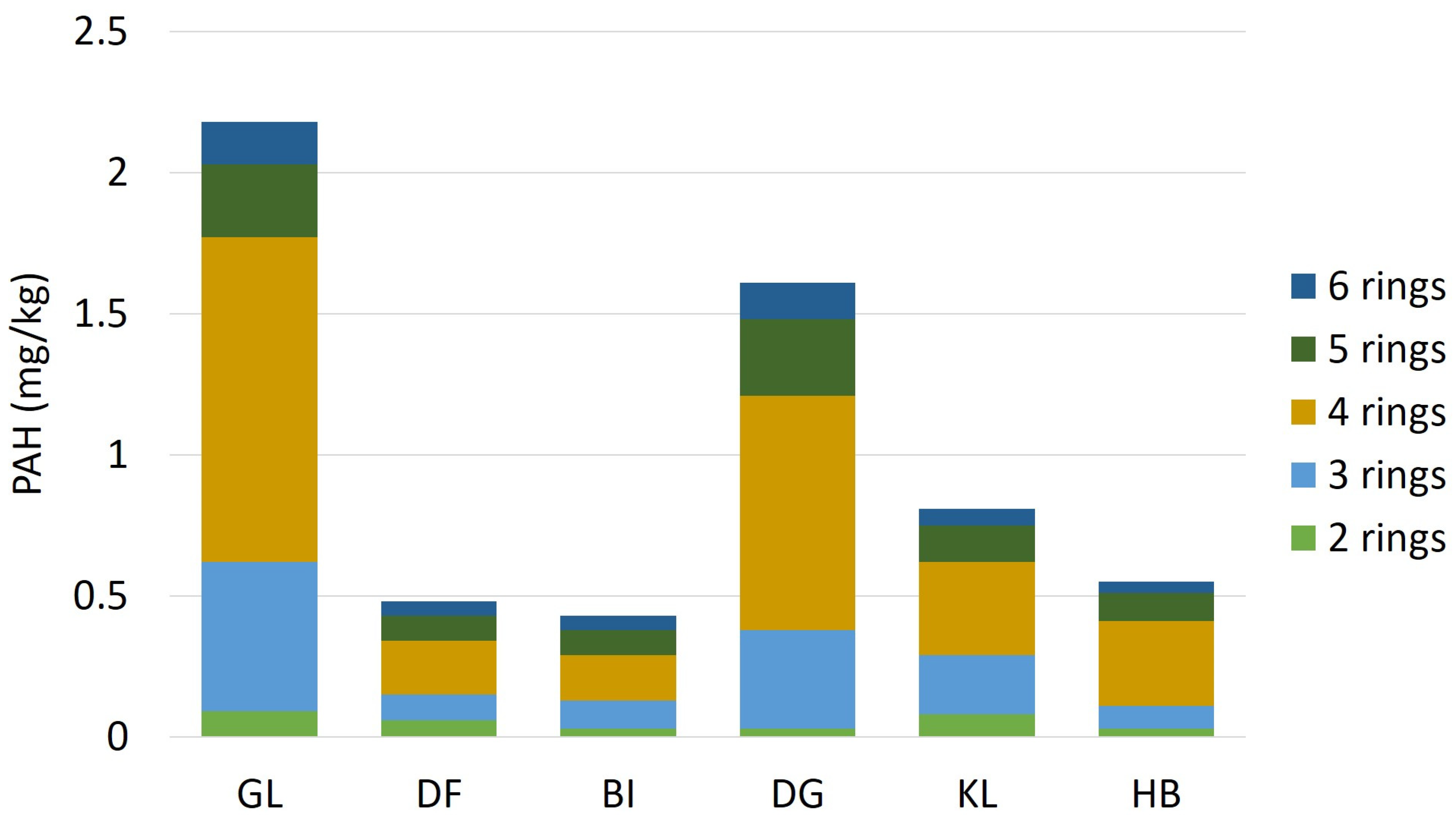
| PAH | GL | DF | BI | DG | KL | HB | |
|---|---|---|---|---|---|---|---|
| NP | Naphthalene | 0.06 | 0.06 | 0.03 | 0.03 | 0.08 | 0.03 |
| 2MNP | 2-methyl-naphthalene | 0.03 | 0 | 0 | 0 | 0 | 0 |
| 1MNP | 1-methyl-naphthalene | 0 | 0 | 0 | 0 | 0 | 0 |
| ∑2 rings | 0.09 | 0.06 | 0.03 | 0.03 | 0.08 | 0.03 | |
| ACY | Acenaphthylene | 0.02 | 0 | 0 | 0.02 | 0 | 0 |
| ACE | Acenaphthene | 0 | 0 | 0 | 0 | 0 | 0 |
| FL | Fluorene | 0.02 | 0.02 | 0.02 | 0.02 | 0.03 | 0 |
| PHE | Phenanthrene | 0.47 | 0.07 | 0.08 | 0.29 | 0.18 | 0.08 |
| ANT | Anthracene | 0.02 | 0 | 0 | 0.02 | 0 | 0 |
| ∑3 rings | 0.53 | 0.09 | 0.1 | 0.35 | 0.21 | 0.08 | |
| FLA | Fluoranthene | 0.63 | 0.1 | 0.07 | 0.42 | 0.18 | 0.16 |
| PYR | Pyrene | 0.37 | 0.05 | 0.05 | 0.27 | 0.11 | 0.08 |
| BaA | Benzanthracene | 0.04 | 0.02 | 0.02 | 0.06 | 0.02 | 0.02 |
| CHR | Chrysene | 0.11 | 0.02 | 0.02 | 0.08 | 0.02 | 0.04 |
| ∑4 rings | 1.15 | 0.19 | 0.16 | 0.83 | 0.33 | 0.3 | |
| BbF | Benzo(b)fluoranthene | 0.11 | 0.04 | 0.04 | 0.13 | 0.06 | 0.05 |
| BkF | Benzo(k)fluoranthene | 0.03 | 0.01 | 0 | 0.03 | 0.02 | 0.01 |
| BeP | Benzo(e)pyrene | 0.07 | 0.03 | 0.04 | 0.05 | 0.03 | 0.03 |
| BaP | Benzo(a)pyrene | 0.03 | 0.01 | 0.01 | 0.04 | 0.02 | 0.01 |
| DahA | Dibenzo(a,h)anthracene | 0.02 | 0 | 0 | 0.02 | 0 | 0 |
| ∑5 rings | 0.26 | 0.09 | 0.09 | 0.27 | 0.13 | 0.1 | |
| IcdP | Indeno1,2,3CD-pyrene | 0.07 | 0.03 | 0.02 | 0.08 | 0.04 | 0.02 |
| BghiP | Benzo(g,h,i)perylene | 0.08 | 0.02 | 0.03 | 0.05 | 0.02 | 0.02 |
| ∑6 rings | 0.15 | 0.05 | 0.05 | 0.13 | 0.06 | 0.04 | |
| Total naphthalenes | 0.09 | 0.06 | 0.03 | 0.03 | 0.08 | 0.03 | |
| PAHs without naphthalenes | 2.09 | 0.42 | 0.4 | 1.58 | 0.73 | 0.52 | |
| ∑PAHs | 2.18 | 0.48 | 0.43 | 1.61 | 0.81 | 0.55 | |
| GL | DF | BI | DG | KL | HB | ||
|---|---|---|---|---|---|---|---|
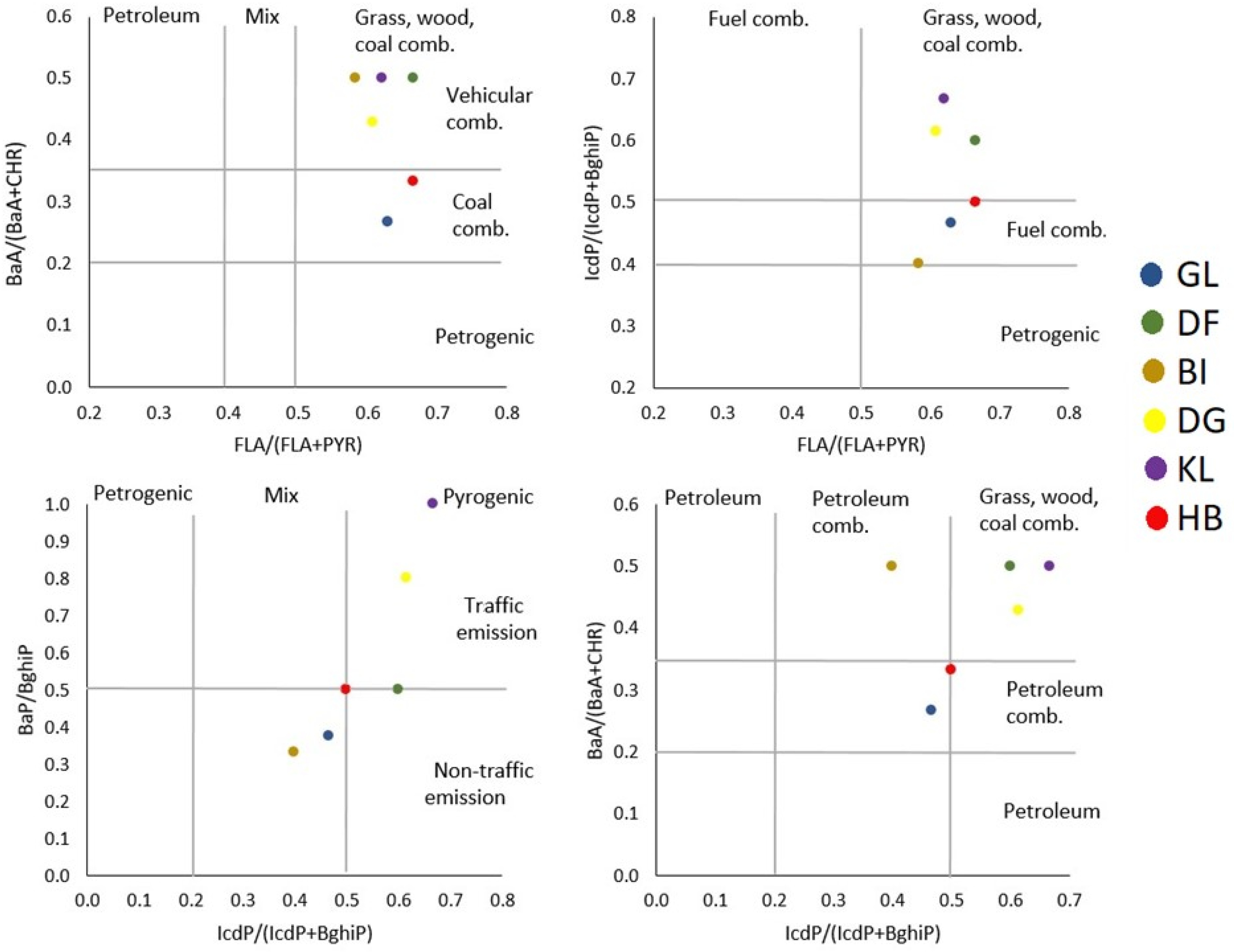
| LMW/HMW | 0.397 | 0.455 | 0.433 | 0.309 | 0.558 | 0.25 | <1 pyrogenic >1 petrogenic |
| FLA/(FLA + PYR) | 0.63 | 0.667 | 0.583 | 0.609 | 0.621 | 0.667 | <0.4 petrogenic 0.4–0.5 fossil fuel combustion. >0.5 grass, wood, coal comb. |
| FL/(FL + PYR) | 0.051 | 0.286 | 0.286 | 0.069 | 0.214 | 0.0 | <0.5 petrol emission >0.5 diesel emission |
| BaA/(BaA + CHR) | 0.267 | 0.5 | 0.5 | 0.429 | 0.5 | 0.333 | <0.2 petrogenic 0.2–0.35 coal comb. >0.35 vehicular |
| BAP/(BAP + BeP) | 0.3 | 0.25 | 0.2 | 0.444 | 0.4 | 0.25 | <0.5 photolysis ~0.5 fresh particles |
| IcdP/(IcdP + BghiP) | 0.467 | 0.6 | 0.4 | 0.615 | 0.667 | 0.5 | <0.2 petrogenic 0.2–0.5 petroleum comb. >0.5 grass, wood, coal comb. |
| BAP/BghiP | 0.375 | 0.5 | 0.333 | 0.8 | 1 | 0.5 | <0.6 non-traffic >0.6 traffic |
| CHR/(CHR + BAP) | 0.786 | 0.667 | 0.667 | 0.667 | 0.5 | 0.8 | 0.25 heavy-duty vehicles 0.39 coal comb. in a power plant 0.5 light-duty vehicles 0.76 coal comb. in households |
| School | BAP-TEQ (mg kg−1) | ILCRing | ILCRinh | ILCRderm | Risk |
|---|---|---|---|---|---|
| GL | 0.0786 | 1.37 × 10⁻⁶ | 2.7 × 10⁻¹¹ | 1.50 × 10⁻⁶ | 3.08 × 10⁻⁶ |
| DF | 0.0207 | 0.36 × 10⁻⁶ | 0.7 × 10⁻¹¹ | 0.45 × 10⁻⁶ | 0.81 × 10⁻⁶ |
| BI | 0.0187 | 0.33 × 10⁻⁶ | 0.6 × 10⁻¹¹ | 0.41 × 10⁻⁶ | 0.73 × 10⁻⁶ |
| DG | 0.0925 | 1.61 × 10⁻⁶ | 3.1 × 10⁻¹¹ | 2.01 × 10⁻⁶ | 3.62 × 10⁻⁶ |
| KL | 0.0349 | 0.61 × 10⁻⁶ | 1.2 × 10⁻¹¹ | 0.76 × 10⁻⁶ | 1.37 × 10⁻⁶ |
| HB | 0.0209 | 0.36 × 10⁻⁶ | 0.7 × 10⁻¹¹ | 0.45 × 10⁻⁶ | 0.82 × 10⁻⁶ |
| School | <1 mm Fraction | <0.1 mm Fraction | ||
|---|---|---|---|---|
| EC50 | EC20 | EC50 | EC20 | |
| GL | not toxic | not toxic | not toxic | not toxic |
| DF | 69.84% | 0.92% | not toxic | 40.62% |
| BI | not toxic | not toxic | 14.42% | 3.38% |
| DG | not toxic | 77.73% | 38.08% | 7.49% |
| KL | not toxic | not toxic | 112.22% | 1.69% |
| HB | not toxic | not toxic | not toxic | not toxic |
Disclaimer/Publisher’s Note: The statements, opinions and data contained in all publications are solely those of the individual author(s) and contributor(s) and not of MDPI and/or the editor(s). MDPI and/or the editor(s) disclaim responsibility for any injury to people or property resulting from any ideas, methods, instructions or products referred to in the content. |
© 2026 by the authors. Licensee MDPI, Basel, Switzerland. This article is an open access article distributed under the terms and conditions of the Creative Commons Attribution (CC BY) license.
Share and Cite
Eck-Varanka, B.; Kováts, N.; Szűcs, A.; Hubai, K. Characterisation of PAHs in Outdoor Air Pollution at Schools in a Medium-Sized Town, Hungary. Toxics 2026, 14, 326. https://doi.org/10.3390/toxics14040326
Eck-Varanka B, Kováts N, Szűcs A, Hubai K. Characterisation of PAHs in Outdoor Air Pollution at Schools in a Medium-Sized Town, Hungary. Toxics. 2026; 14(4):326. https://doi.org/10.3390/toxics14040326
Chicago/Turabian StyleEck-Varanka, Bettina, Nóra Kováts, Attila Szűcs, and Katalin Hubai. 2026. "Characterisation of PAHs in Outdoor Air Pollution at Schools in a Medium-Sized Town, Hungary" Toxics 14, no. 4: 326. https://doi.org/10.3390/toxics14040326
APA StyleEck-Varanka, B., Kováts, N., Szűcs, A., & Hubai, K. (2026). Characterisation of PAHs in Outdoor Air Pollution at Schools in a Medium-Sized Town, Hungary. Toxics, 14(4), 326. https://doi.org/10.3390/toxics14040326