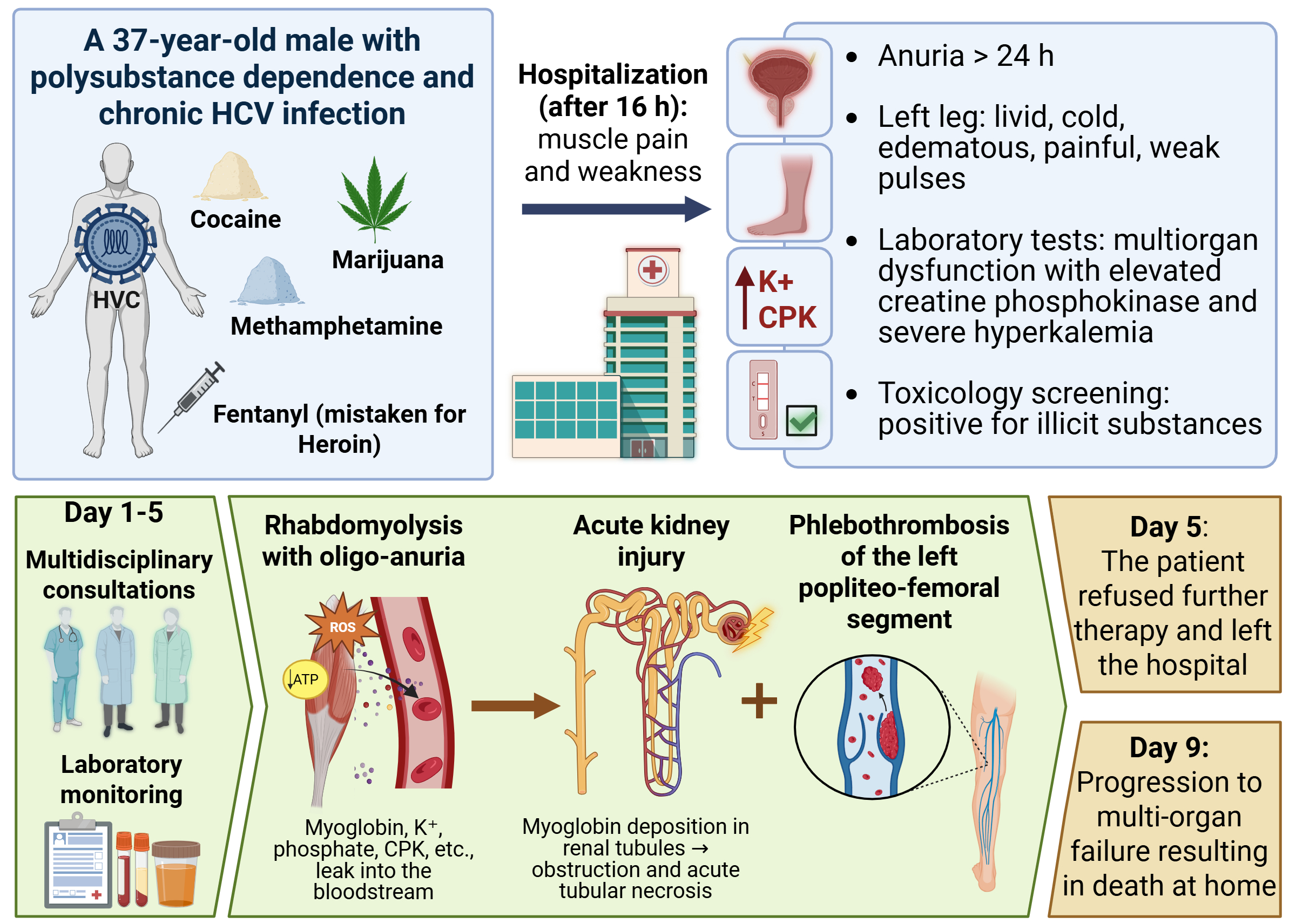

Fatal Outcome Following Polysubstance Use: A Case Report of Rhabdomyolysis, Acute Kidney Injury, and Deep Vein Thrombosis

 ,
,  , , , ,
Abstract
1. Introduction
2. Case Presentation
2.1. Medical History
2.2. Physical Examination and Clinical Course
2.3. Toxicological Screening and Laboratory Results
2.4. Diagnosis
2.5. Therapeutic Course
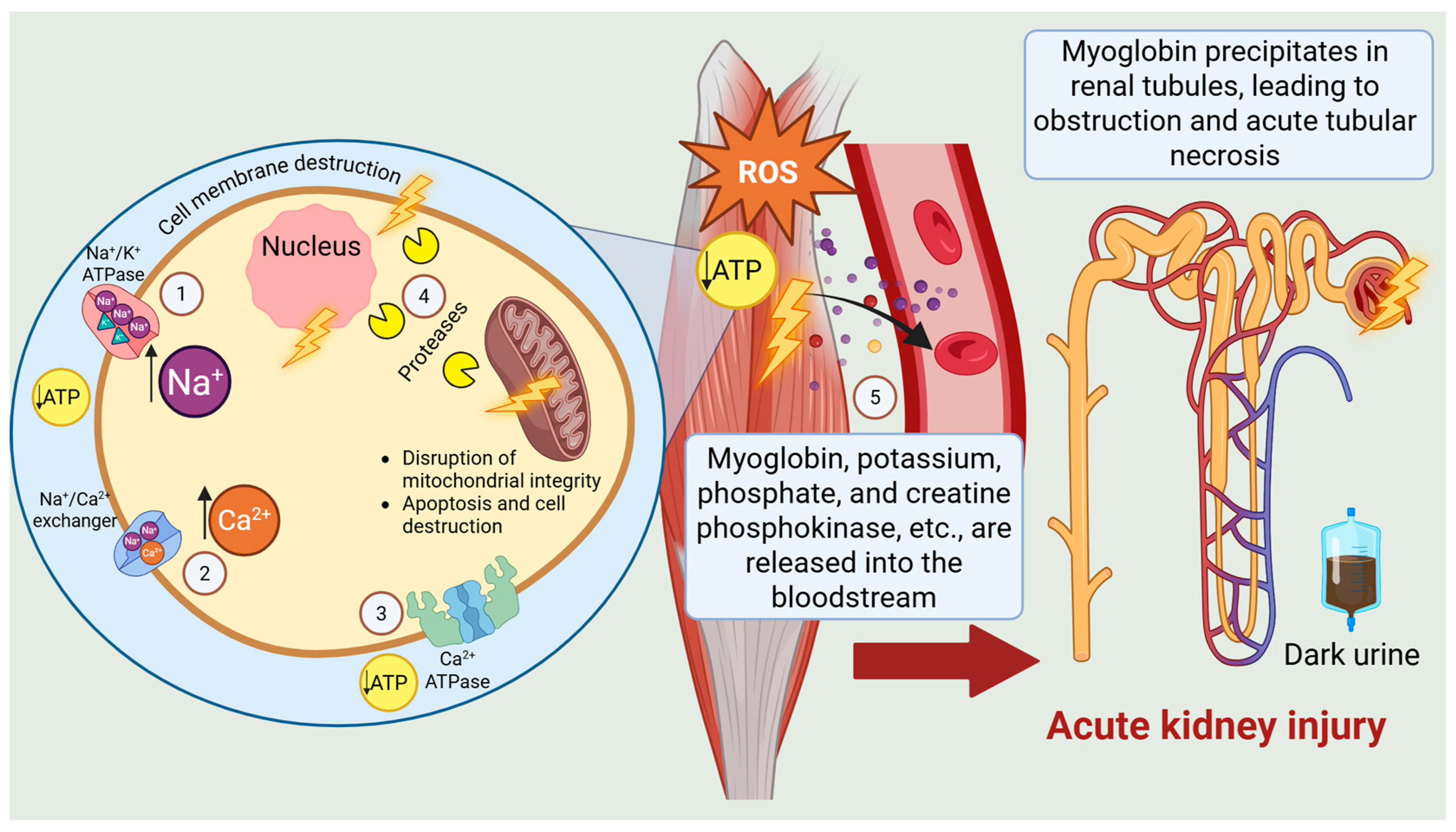
3. Discussion
- ○
- ○
- Systemic hypoxic and metabolic stress due to central depressant effects, altered consciousness, and impaired tissue oxygenation;
- ○
4. Conslusions
Author Contributions
Funding
Institutional Review Board Statement
Informed Consent Statement
Data Availability Statement
Conflicts of Interest
Abbreviations
| AKI | Acute kidney injury |
| ATP | Adenosine triphosphate |
| CK | Creatine phosphokinase |
| DVT | Deep vein thrombosis |
| EUDA | European Union Drugs Agency |
| HCV | Hepatitis C Virus |
References
- European Monitoring Centre for Drugs and Drug Addiction. European Drug Report 2024: Trends and Developments—The Drug Situation in Europe up to 2024; European Monitoring Centre for Drugs and Drug Addiction: Lisbon, Portugal, 2024; ISBN 978-92-9497-975-9. Available online: https://www.emcdda.europa.eu/publications/european-drug-report/2024/drug-situation-in-europe-up-to-2024_en (accessed on 13 November 2025).
- World Health Organization. Strengthening Clinical Trials to Provide High-Quality Evidence on Health Interventions and to Improve Research Quality and Coordination: Report by the Director-General; Document No. A75/43; World Health Organization: Geneva, Switzerland, 2022; Available online: https://apps.who.int/gb/ebwha/pdf_files/WHA75/A75_43-en.pdf (accessed on 13 November 2025).
- European Union Drugs Agency (EUDA). Drug Induced Deaths—The Current Situation in Europe (European Drug Report 2025); EUDA: Lisbon, Portugal, 2025; Available online: https://www.euda.europa.eu/publications/european-drug-report/2025_en (accessed on 13 November 2025).
- United Nations Office on Drugs and Crime. Contemporary Issues on Drugs. Booklet 2, World Drug Report 2025; United Nations Office on Drugs and Crime: Vienna, Austria, 2025; Available online: https://www.unodc.org/documents/data-and-analysis/WDR_2025/WDR25_B2_Contemporary_drug_issues.pdf (accessed on 13 November 2025).
- National Institutes of Health. HEAL Initiative. In Opioid Crisis; National Institutes of Health: Bethesda, MD, USA, 2024. Available online: https://heal.nih.gov/about/opioid-crisis (accessed on 22 December 2025).
- Rawy, M.; Abdalla, G.; Look, K. Polysubstance mortality trends in White and Black Americans during the opioid epidemic, 1999–2018. BMC Public Health 2024, 24, 112. [Google Scholar] [CrossRef]
- Shannon, M.W.; Borron, S.W.; Burns, M.J. Emergency management of poisoning. In Haddad and Winchester’s Clinical Management of Poisoning and Drug Overdose, 4th ed.; Shannon, M.W., Borron, S.W., Burns, M.J., Eds.; W.B. Saunders: Philadelphia, PA, USA, 2007; pp. 13–61. [Google Scholar] [CrossRef]
- Manjón-Prado, H.; Serrano Santos, E.; Osuna, E. Patterns of polydrug use in patients presenting at the emergency department with acute intoxication. Toxics 2025, 13, 380. [Google Scholar] [CrossRef] [PubMed]
- Uljon, S. Advances in fentanyl testing. Adv. Clin. Chem. 2023, 116, 1–30. [Google Scholar] [CrossRef]
- Stoeva-Grigorova, S.; Radeva-Ilieva, M.; Karkkeselyan, N.; Dragomanova, S.; Kehayova, G.; Dimitrova, S.; Petrova, M.; Zlateva, S.; Marinov, P. Historical perspectives and emerging trends in fentanyl use: Part 1—Pharmacological profile. Pharmacia 2025, 72, 1–9. [Google Scholar] [CrossRef]
- Stoeva-Grigorova, S.; Hvarchanova, N.; Gancheva, S.; Eftimov, M.; Georgiev, K.D.; Radeva-Ilieva, M. Differentiation of therapeutic and illicit drug use via metabolite profiling. Metabolites 2025, 15, 745. [Google Scholar] [CrossRef]
- Griswold, M.K.; Chai, P.R.; Krotulski, A.J.; Friscia, M.; Chapman, B.; Boyer, E.W.; Logan, B.K.; Babu, K.M. Self-identification of nonpharmaceutical fentanyl exposure following heroin overdose. Clin. Toxicol. 2018, 56, 37–42. [Google Scholar] [CrossRef]
- Vanholder, R.; Sever, M.S.; Erek, E.; Lameire, N. Rhabdomyolysis. J. Am. Soc. Nephrol. 2000, 11, 1553–1561. [Google Scholar] [CrossRef] [PubMed]
- Cabral, B.M.I.; Edding, S.N.; Portocarrero, J.P.; Lerma, E.V. Rhabdomyolysis. Dis. Mon. 2020, 66, 101015. [Google Scholar] [CrossRef]
- Yang, B.-F.; Li, D.; Liu, C.-L.; Luo, Y.; Shi, J.; Guo, X.-Q.; Fan, H.-J.; Lv, Q. Advances in rhabdomyolysis: A review of pathogenesis, diagnosis, and treatment. Chin. J. Traumatol. 2025, 29, 21–31. [Google Scholar] [CrossRef] [PubMed]
- Richards, J.R. Rhabdomyolysis and drugs of abuse. J. Emerg. Med. 2000, 19, 51–56. [Google Scholar] [CrossRef]
- Wurcel, A.G.; Merchant, E.A.; Clark, R.P.; Stone, D.R. Emerging and underrecognized complications of illicit drug use. Clin. Infect. Dis. 2015, 61, 1840–1849. [Google Scholar] [CrossRef]
- Alessi, M.R.; Ribas, T.M.; Campelo, V.S.; Mauer, S. Acute cocaine intoxication leading to multisystem dysfunction: A case report. Cureus 2024, 16, e72128. [Google Scholar] [CrossRef]
- Hong, Z.M.; Kromm, J.A. Neurological and systemic effects of cocaine toxicity: A case report and review of the literature. Med. Int. 2024, 8, 196. [Google Scholar] [CrossRef]
- Mirza, S.A.; Mohammed, N.S.; Ali, Z.Q.; Mohamed, A.S. The effects of methamphetamine intoxication on acute kidney injury in Iraqi male addicts. Toxicol. Rep. 2025, 14, 102065. [Google Scholar] [CrossRef] [PubMed]
- Mitaritonno, M.; Lupo, M.; Greco, I.; Mazza, A.; Cervellin, G. Severe rhabdomyolysis induced by co-administration of cocaine and heroin in a 45 years old man treated with rosuvastatin: A case report. Acta Biomed. 2021, 92, e2021089. [Google Scholar] [CrossRef]
- Sahni, V.; Garg, D.; Garg, S.; Agarwal, S.K.; Singh, N.P. Unusual complications of heroin abuse: Transverse myelitis, rhabdomyolysis, compartment syndrome, and ARF. Clin. Toxicol. 2008, 46, 153–155. [Google Scholar] [CrossRef] [PubMed]
- Kosmadakis, G.; Michail, O.; Filiopoulos, V.; Papadopoulou, P.; Michail, S. Acute kidney injury due to rhabdomyolysis in narcotic drug users. Int. J. Artif. Organs 2011, 34, 584–588. [Google Scholar] [CrossRef] [PubMed]
- Alinejad, S.; Ghaemi, K.; Abdollahi, M.; Mehrpour, O. Nephrotoxicity of methadone: A systematic review. SpringerPlus 2016, 5, 2087. [Google Scholar] [CrossRef]
- Babak, K.; Mohammad, A.; Mazaher, G.; Samaneh, A.; Fatemeh, T. Clinical and laboratory findings of rhabdomyolysis in opioid overdose patients in the intensive care unit of a poisoning center in 2014 in Iran. Epidemiol. Health 2017, 39, e2017050. [Google Scholar] [CrossRef]
- Dobrie, L.; Handa, T.; Sirotkin, I.; Cruz, A.; Konstas, D.; Baldinger, E. Rhabdomyolysis occurring after use of cocaine contaminated with fentanyl causing bilateral brachial plexopathy. Fed. Pract. 2022, 39, 261–265. [Google Scholar] [CrossRef]
- Pi, M.; Nie, S.; Su, L.; Li, Y.; Cao, Y.; Gao, P.; Lin, Y.; Zha, Y.; Shi, Y.; Li, H.; et al. Risk of Hospital-Acquired Acute Kidney Injury among Adult Opioid Analgesic Users: A Multicenter Real-World Data Analysis. Kidney Dis. 2023, 9, 517–528. [Google Scholar] [CrossRef] [PubMed]
- Tom, K.; Bzdusek, J. Heroin overdose complicated by compartment syndrome, rhabdomyolysis, and acute renal failure. Cureus 2024, 16, e61144. [Google Scholar] [CrossRef]
- Gokul, K.; Hoque, F. Rhabdomyolysis with severe creatine phosphokinase elevation and acute kidney injury: A case report and review of rare causes. APIK J. Intern. Med. 2025, 13, 300–302. [Google Scholar] [CrossRef]
- Keenum, O.D.; Patel, S.; Balasubramaniam, A.; Bates, W.; Smallwood, D. An unusual presentation of fentanyl-induced rhabdomyolysis. Cureus 2025, 17, e83426. [Google Scholar] [CrossRef]
- Amanollahi, A.; Babeveynezhad, T.; Sedighi, M.; Shadnia, S.; Akbari, S.; Taheri, M.; Besharatpour, M.; Jorjani, G.; Salehian, E.; Etemad, K.; et al. Incidence of rhabdomyolysis occurrence in psychoactive substances intoxication: A systematic review and meta-analysis. Sci. Rep. 2023, 13, 17693. [Google Scholar] [CrossRef]
- Eghbali, F.; Owliaey, H.; Shirani, S.; Fatahi Asl, F.; Hosseinzadeh, R.; Deravi, N.; Ghasemirad, H.; Shariatpanahi, M.; Farajidana, H. Rhabdomyolysis in patients with drug or chemical poisoning: Clinical investigation and implications. Int. J. Mol. Sci. 2025, 50, 455–463. [Google Scholar] [CrossRef]
- Jullian-Desayes, I.; Roselli, A.; Lamy, C.; Alberto-Gondouin, M.C.; Janvier, N.; Venturi-Maestri, G. Rhabdomyolysis with acute renal failure and deep vein thrombosis induced by antipsychotic drugs: A case report. Pharmacopsychiatry 2015, 48, 265–267. [Google Scholar] [CrossRef] [PubMed]
- Zhao, A.; Tan, M.; Aung, M.; Salifu, M.; Mallappallil, M. Rhabdomyolysis and acute kidney injury requiring dialysis as a result of concomitant use of atypical neuroleptics and synthetic cannabinoids. Case Rep. Nephrol. 2015, 2015, 235982. [Google Scholar] [CrossRef]
- Upadrista, P.K.; Peketi, S.H.; Sudireddy, N.; Cadet, B.; Kim, Z. Rhabdomyolysis and acute kidney injury: Exploring the potential causes in a hospitalized patient. Cureus 2025, 17, e80535. [Google Scholar] [CrossRef]
- Huerta-Alardín, A.L.; Varon, J.; Marik, P.E. Bench-to-bedside review: Rhabdomyolysis—An overview for clinicians. Crit. Care 2005, 9, 158–169. [Google Scholar] [CrossRef] [PubMed]
- Bagley, W.H.; Yang, H.; Shah, K.H. Rhabdomyolysis. Intern. Emerg. Med. 2007, 2, 210–218. [Google Scholar] [CrossRef] [PubMed]
- Bosch, X.; Poch, E.; Grau, J.M. Rhabdomyolysis and acute kidney injury. N. Engl. J. Med. 2009, 361, 62–72. [Google Scholar] [CrossRef]
- Zimmerman, J.L.; Shen, M.C. Rhabdomyolysis. Chest 2013, 144, 1058–1065. [Google Scholar] [CrossRef]
- Giannoglou, G.D.; Chatzizisis, Y.S.; Misirli, G. The syndrome of rhabdomyolysis: Pathophysiology and diagnosis. Eur. J. Intern. Med. 2007, 18, 90–100. [Google Scholar] [CrossRef]
- Torres, P.A.; Helmstetter, J.A.; Kaye, A.M.; Kaye, A.D. Rhabdomyolysis: Pathogenesis, diagnosis, and treatment. Ochsner J. 2015, 15, 58–69. [Google Scholar]
- Chavez, L.O.; Leon, M.; Einav, S.; Varon, J. Beyond muscle destruction: A systematic review of rhabdomyolysis for clinical practice. Crit. Care 2016, 20, 135. [Google Scholar] [CrossRef]
- Waldman, W.; Kabata, P.M.; Dines, A.M.; Wood, D.M.; Yates, C.; Heyerdahl, F.; Hovda, K.E.; Giraudon, I.; Euro-DEN Research Group; Dargan, P.I.; et al. Rhabdomyolysis related to acute recreational drug toxicity—A Euro-DEN study. PLoS ONE 2021, 16, e0246297. [Google Scholar] [CrossRef] [PubMed]
- Rixey, A.B.; Glazebrook, K.N.; Powell, G.M.; Baffour, F.I.; Collins, M.S.; Takahashi, E.A.; Tiegs-Heiden, C.A. Rhabdomyolysis: A review of imaging features across modalities. Skelet. Radiol. 2024, 53, 19–27. [Google Scholar] [CrossRef] [PubMed]
- Petejova, N.; Martinek, A. Acute kidney injury due to rhabdomyolysis and renal replacement therapy: A critical review. Crit. Care 2014, 18, 224. [Google Scholar] [CrossRef]
- Shimada, M.; Dass, B.; Ejaz, A.A. Paradigm shift in the role of uric acid in acute kidney injury. Semin. Nephrol. 2011, 31, 453–458. [Google Scholar] [CrossRef]
- Thompson, P.D.; Clarkson, P.; Karas, R.H. Statin-associated myopathy. JAMA 2003, 289, 1681–1690. [Google Scholar] [CrossRef]
- Gupta, A.; Thorson, P.; Penmatsa, K.; Gupta, P. Rhabdomyolysis: Revisited. Ulster Med. J. 2021, 90, 61–69. [Google Scholar] [PubMed]
- Yim, C.L.H.; Wong, E.W.W.; Jellie, L.J.; Lim, A.K.H. Illicit drug use and acute kidney injury in patients admitted to hospital with rhabdomyolysis. Intern. Med. J. 2019, 49, 1285–1292. [Google Scholar] [CrossRef]
- Kodadek, L.; Carmichael, S.P., II; Seshadri, A.; Pathak, A.; Hoth, J.; Appelbaum, R.; Michetti, C.P.; Gonzalez, R.P. Rhabdomyolysis: An American Association for the Surgery of Trauma Critical Care Committee Clinical Consensus Document. Trauma Surg. Acute Care Open 2022, 7, e000836. [Google Scholar] [CrossRef]
- Neves Pinto, G.; Campelo Fraga, Y.; De Francesco Daher, E.; Bezerra da Silva Junior, G. Acute Kidney Injury Due to Rhabdomyolysis: A Review of Pathophysiology, Causes, and Cases Reported in the Literature, 2011–2021. Rev. Colomb. Nefrol. 2023, 10, e619. [Google Scholar] [CrossRef]
- Wilhelm-Leen, E.R.; Winkelmayer, W.C. Predicting the outcomes of rhabdomyolysis: A good starting point. JAMA Intern. Med. 2013, 173, 1828–1829. [Google Scholar] [CrossRef] [PubMed]
- Welte, T.; Bohnert, M.; Pollak, S. Prevalence of rhabdomyolysis in drug deaths. Forensic Sci. Int. 2004, 139, 21–25. [Google Scholar] [CrossRef]
- Larbi, E.B. Drug induced rhabdomyolysis: Case report. East Afr. Med. J. 1997, 74, 829–831. [Google Scholar]
- Rodríguez, E.; Soler, M.J.; Rap, O.; Barrios, C.; Orfila, M.A.; Pascual, J. Risk factors for acute kidney injury in severe rhabdomyolysis. PLoS ONE 2013, 8, e82992. [Google Scholar] [CrossRef]
- Mansoor, K.; Kheetan, M.; Shahnawaz, S.; Shapiro, A.P.; Patton-Tackett, E.; Dial, L.; Rankin, G.; Santhanam, P.; Tzamaloukas, A.H.; Nadasdy, T.; et al. Systematic review of nephrotoxicity of drugs of abuse, 2005–2016. BMC Nephrol. 2017, 18, 379. [Google Scholar] [CrossRef]
- Flores-Chávez, A.; Carrion, J.A.; Forns, X.; Ramos-Casals, M. Extrahepatic manifestations associated with chronic hepatitis C virus infection. Rev. Esp. Sanid. Penit. 2017, 19, 87–97. [Google Scholar] [CrossRef]
- Kanters, C.T.M.M.; van Luin, M.; Solas, C.; Burger, D.M.; Vrolijk, J.M. Rhabdomyolysis in a hepatitis C virus-infected patient treated with telaprevir and simvastatin. Ann. Hepatol. 2014, 13, 452–455. [Google Scholar] [CrossRef]
- Qatomah, A.; Bukhari, M.; Cupler, E.; Alardati, H.; Mawardi, M. Acute reversible rhabdomyolysis during direct-acting antiviral hepatitis C virus treatment: A case report. J. Med. Case Rep. 2021, 15, 627. [Google Scholar] [CrossRef]
- Bansal, R.; Goel, A.; Mishra, N. Rhabdomyolysis: Heroin induced or HCV related. Indian J. Med. Spec. 2016, 7, 174–176. [Google Scholar] [CrossRef]
- Jensenius, M.; Holm, B.; Calisch, T.E.; Haugen, K.; Sandset, P.M. Dyp venetrombose hos intravenøse stoffmisbrukere [Deep venous thrombosis in intravenous drug addicts]. Tidsskr. Nor. Lægeforen. 1996, 116, 2556–2558. [Google Scholar]
- Pieper, B.; Kirsner, R.S.; Templin, T.N.; Birk, T.J. Injection drug use: An understudied cause of venous disease. Arch. Dermatol. 2007, 143, 1305–1309. [Google Scholar] [CrossRef]
- Pieper, B. Nonviral Injection-Related Injuries in Persons Who Inject Drugs: Skin and Soft Tissue Infection, Vascular Damage, and Wounds. Adv. Skin Wound Care 2019, 32, 301–310. [Google Scholar] [CrossRef]
- Mayo Clinic Staff. Deep vein Thrombosis (DVT)—Symptoms & Causes. Mayo Clinic, 11 June 2022. Available online: https://www.mayoclinic.org/diseases-conditions/deep-vein-thrombosis/symptoms-causes/syc-20352557 (accessed on 6 January 2026).
- Stark, K.; Massberg, S. Interplay between inflammation and thrombosis in cardiovascular pathology. Nat. Rev. Cardiol. 2021, 18, 666–682. [Google Scholar] [CrossRef] [PubMed]
- Murillo Solera, A.; Diaz, J.A. The Critical Role of Inflammation in Deep Vein Thrombosis. Endovasc. Today 2024. Available online: https://evtoday.com/articles/2024-july/the-critical-role-of-inflammation-in-deep-vein-thrombosis (accessed on 6 January 2026).
- Schulman, S.; Makatsariya, A.; Khizroeva, J.; Bitsadze, V.; Kapanadze, D. The Basic Principles of Pathophysiology of Venous Thrombosis. Int. J. Mol. Sci. 2024, 25, 11447. [Google Scholar] [CrossRef] [PubMed]
- Baker, M.; Anjum, F.; dela Cruz, J. Deep Venous Thrombosis Ultrasound Evaluation. In StatPearls [Internet]; StatPearls Publishing: Treasure Island, FL, USA, 2025; (Updated 8 August 2023). Available online: https://www.ncbi.nlm.nih.gov/books/NBK470453/ (accessed on 6 January 2026).
- Arnoldussen, C.W.K.P. Imaging of Deep Venous Pathology. Cardiovasc. Interv. Radiol. 2024, 47, 1580–1594. [Google Scholar] [CrossRef]
- Sorrentino, S.A.; Kielstein, J.T.; Lukasz, A.; Sorrentino, J.N.; Gohrbandt, B.; Haller, H.; Schmidt, B.M. High permeability dialysis membrane allows effective removal of myoglobin in acute kidney injury resulting from rhabdomyolysis. Crit. Care Med. 2011, 39, 184–186. [Google Scholar] [CrossRef]
- Sever, M.S.; Vanholder, R.; RDRTF of ISN Work Group on Recommendations for the Management of Crush Victims in Mass Disasters. Recommendation for the management of crush victims in mass disasters. Nephrol. Dial. Transplant. 2012, 27, i1–i67. [Google Scholar] [CrossRef]
- Brown, C.V.; Rhee, P.; Chan, L.; Evans, K.; Demetriades, D.; Velmahos, G.C. Preventing renal failure in patients with rhabdomyolysis: Do bicarbonate and mannitol make a difference? J. Trauma 2004, 56, 1191–1196. [Google Scholar] [CrossRef]
- Kahn, S.R.; Shapiro, S.; Wells, P.S.; Rodger, M.A.; Kovacs, M.J.; Anderson, D.R.; Tagalakis, V.; Houweling, A.H.; Ducruet, T.; Holcroft, C.; et al. Compression stockings to prevent post-thrombotic syndrome: A randomised placebo-controlled trial. Lancet 2014, 383, 880–888. [Google Scholar] [CrossRef]
- Appelen, D.; van Loo, E.; Prins, M.H.; Neumann, M.H.; Kolbach, D.N. Compression therapy for prevention of post-thrombotic syndrome. Cochrane Database Syst. Rev. 2017, 9, CD004174. [Google Scholar] [CrossRef]
- Ortel, T.L.; Neumann, I.; Ageno, W.; Beyth, R.; Clark, N.P.; Cuker, A.; Hutten, B.A.; Jaff, M.R.; Manja, V.; Schulman, S.; et al. American Society of Hematology 2020 Guidelines for Management of Venous Thromboembolism: Treatment of Deep Vein Thrombosis and Pulmonary Embolism. Blood Adv. 2020, 4, 4693–4738. [Google Scholar] [CrossRef]
- Palareti, G.; Santagata, D.; De Ponti, C.; Ageno, W.; Prandoni, P. Anticoagulation and compression therapy for proximal acute deep vein thrombosis. VASA Z. Für Gefasskrankh. 2024, 53, 289–297. [Google Scholar] [CrossRef]
- Stevens, S.M.; Woller, S.C.; Baumann Kreuziger, L.; Doerschug, K.; Geersing, G.J.; Klok, F.A.; King, C.S.; Murin, S.; Vintch, J.R.E.; Wells, P.S.; et al. Antithrombotic Therapy for VTE Disease: Compendium and Review of CHEST Guidelines 2012–2021. Chest 2024, 166, 388–404. [Google Scholar] [CrossRef]
- Ziyadeh, F.; Mauer, Y. Management of Lower Extremity Venous Thromboembolism: An Updated Review. Clevel. Clin. J. Med. 2024, 91, 229–235. [Google Scholar] [CrossRef]
- Patel, P.; Varacallo, M.A. Low-Molecular-Weight Heparin (LMWH) [Updated 2025 Mar 28]. In StatPearls [Internet]; StatPearls Publishing: Treasure Island, FL, USA, 2025. Available online: https://www.ncbi.nlm.nih.gov/books/NBK525957/ (accessed on 13 November 2025).
- Gaudry, S.; Grolleau, F.; Barbar, S.; Martin-Lefevre, L.; Pons, B.; Boulet, É.; Boyer, A.; Chevrel, G.; Montini, F.; Bohe, J.; et al. Continuous renal replacement therapy versus intermittent hemodialysis as first modality for renal replacement therapy in severe acute kidney injury: A secondary analysis of AKIKI and IDEAL-ICU studies. Crit. Care 2022, 26, 93. [Google Scholar] [CrossRef] [PubMed]
- Yılmaz Aydın, F.; Aydın, E.; Kadiroglu, A.K. Comparison of the Treatment Efficacy of Continuous Renal Replacement Therapy and Intermittent Hemodialysis in Patients with Acute Kidney Injury Admitted to the Intensive Care Unit. Cureus 2022, 14, e21707. [Google Scholar] [CrossRef]
- Chander, S.; Luhana, S.; Sadarat, F.; Parkash, O.; Rahaman, Z.; Wang, H.Y.; Kiran, F.; Lohana, A.C.; Sapna, F.; Kumari, R. Mortality and mode of dialysis: Meta-analysis and systematic review. BMC Nephrol. 2024, 25, 1. [Google Scholar] [CrossRef] [PubMed]
- Racheva, R. Attention as a Factor Related to Addictions to Psychoactive Substances. Bulg. J. Public Health 2025, 17, 30–39. [Google Scholar]
- Maina, G.; Ogenchuk, M.; Phaneuf, T.; Kwame, A. “I can’t live like that”: The experience of caregiver stress of caring for a relative with substance use disorder. Subst. Abus. Treat. Prev. Policy 2021, 16, 11. [Google Scholar] [CrossRef]
- Mikulić, M.; Ćavar, I.; Jurišić, D.; Jelinčić, I.; Degmečić, D. Burden and Psychological Distress in Caregivers of Persons with Addictions. Challenges 2023, 14, 24. [Google Scholar] [CrossRef]
- Tyo, M.B.; McCurry, M.K.; Horowitz, J.A.; Elliott, K. Perceived Stressors and Support in Family Caregivers of Individuals with Opioid Use Disorder. J. Addict. Nurs. 2023, 34, E136–E144. [Google Scholar] [CrossRef]
- Soellner, R.; Hofheinz, C. Burden and satisfaction with social support in families with a history of problematic substance use or dementia—A comparison. BMC Psychol. 2024, 12, 448. [Google Scholar] [CrossRef] [PubMed]


| Category of Effects | Types |
|---|---|
| Acute Effects |
|
| Chronic Effects |
|
| Day | Clinical Course |
|---|---|
| Day 1 |
|
| Day 2 |
|
| Day 3 |
|
| Day 4 |
|
| Day 5 |
|
| Day 6 |
|
| Day 9 |
|
| Hospital Day | Fluid Intake (mL) | Urine Output (mL) | Net Fluid Balance (mL) |
|---|---|---|---|
| Day 1 | 4600 | 400 | +4200 |
| Day 2 | 2500 | 200 | +2300 |
| Day 3 | 900 | 100 | +800 |
| Day 4 | 700 | 100 | +600 |
| Day 5 | Hemodialysis was initiated due to persistent oligoanuria and volume overload | ||
| Substance | Cut-Off (Urine, ng/mL) | Cut-Off (Plasma, ng/mL) | Result from the Analysis | |
|---|---|---|---|---|
| Urine | Plasma | |||
| Amphetamine | 1000 | 80 | − | − |
| Cocaine (Benzoylecgonine) | 300 | 50 | + | + |
| Δ9-Tetrahydrocannabinol metabolite (Marijuana) | 50 | 35 | + | + |
| Benzodiazepines | 300 | 100 | − | − |
| Tricyclic Antidepressants | 1000 | 100 | − | − |
| Barbiturates | 300 | 100 | − | − |
| Morphine (Opiates) | 300 | 40 | − | − |
| Methadone | 300 | 40 | − | − |
| Methamphetamine | 1000 | 70 | + | + |
| 3,4-Methylenedioxymethamphetamine | 500 | 50 | − | − |
| Fentanyl | 20 | 15 | + | − |
| Parameter | Reference Range | Day 01 | Day 02 | Day 03 | Day 04 | Day 05 |
|---|---|---|---|---|---|---|
| Complete Blood Count | ||||||
| ESR [mm/h] | <20 | 27.0 | – | – | – | – |
| Hemoglobin [g/L] | 130–180 | 164.0 | – | – | 126.0 | 106.0 |
| Erythrocytes [×1012/L] | 4.8–6.2 | 5.53 | – | – | 4.2 | 3.51 |
| Hematocrit [L/L] | 0.35–0.55 | 0.50 | – | – | 0.37 | 0.308 |
| Leukocytes [×109/L] | 3.5–10.5 | 22.21 | – | – | 14.31 | 11.1 |
| St [%] | 1–6 | 87.9 | – | – | 85.8 | 81.1 |
| Eosinophils [%] | 1.5–8 | 0.0 | – | – | 0.1 | 0.0 |
| Basophils [%] | <1 | 0.01 | – | – | 0.01 | 0.0 |
| Lymphocytes [%] | 22–50 | 6.3 | – | – | 7.2 | 12.2 |
| Monocytes [%] | 2–10 | 5.7 | – | – | 5.8 | 5.7 |
| MCV [fL] | 82–100 | 90.4 | – | – | 88.1 | 87.7 |
| MCH [pg] | 28–32 | 29.7 | – | – | 30.0 | 30.2 |
| MCHC [g/L] | 300–360 | 328.0 | – | – | 341.0 | 344.0 |
| RDW [%] | 11.5–14.9 | 14.2 | – | – | 14.3 | 14.4 |
| Platelets [×109/L] | 140–440 | 316.0 | – | – | 170.0 | 136.0 |
| MPV [fL] | 8.8–12.5 | 10.8 | – | – | 10.9 | 11.3 |
| NRBC [×109/L] | <0.01 | 0.01 | – | – | 0.01 | 0.01 |
| NRBC [%] | 0 | 0.0 | – | – | 0.1 | 0.1 |
| Immature Granulocytes [×109/L] | <0.3 | 0.18 | – | – | 0.07 | 0.07 |
| IG [%] | <4 | 0.8 | – | – | 0.5 | 0.6 |
| Neutrophils [×109/L] | 2.4–6.9 | 19.52 | – | – | 12.27 | 9.01 |
| Lymphocytes [×109/L] | 0.8–3.4 | 1.39 | – | – | 1.03 | 1.35 |
| Monocytes [×109/L] | 0.4–1.0 | 1.27 | – | – | 0.98 | 0.74 |
| Biochemistry | ||||||
| Total Bilirubin [μmol/L] | 5–21 | 7.17 | – | – | 5.31 | 7.8 |
| Direct Bilirubin [μmol/L] | <5.13 | – | – | – | 2.36 | 1.77 |
| AST [U/L] | <35 | 2501.8 | – | – | 2588.8 | 2876.68 |
| ALT [U/L] | <50 | 619.4 | – | – | 826.6 | 887.66 |
| GGT [U/L] | <55 | 32.0 | – | – | 16.3 | 21.68 |
| α-Amylase [U/L] | 28–100 | 1472.7 | – | – | 440.6 | 267.66 |
| Albumin [g/L] | 35–53 | – | – | – | 29.5 | 28.92 |
| CRP [mg/L] | <5 | 14.41 | – | – | 53.08 | 31.02 |
| Creatine Kinase [U/L] | 24–180 | 63,444.0 | – | – | 55,050.0 | 161,050.0 |
| Blood Glucose [mmol/L] | 4.1–5.9 | 5.18 | – | – | 5.66 | 5.27 |
| Urea [mmol/L] | 2.8–7.2 | 10.66 | – | – | 24.05 | 33.35 |
| Creatinine [μmol/L] | 64–104 | 260.1 | – | – | 605.2 | 737.0 |
| Sodium [mmol/L] | 135–150 | 133.0 | 130.0 | 128.0 | 127.0 | 126.0 |
| Potassium [mmol/L] | 3.5–5.5 | 8.4 | 6.7 | 6.2 | 6.2 | 6.0 |
| Chloride [mmol/L] | 96–106 | 100.4 | 98.9 | 99.0 | 98.0 | 97.0 |
| Total Protein [g/L] | 60–83 | – | – | – | 53.9 | 53.12 |
| CK-MB [U/L] | <24 | 8576.8 | – | – | 2188.9 | 2360.0 |
| Urinalysis | ||||||
| pH | 4.5–8.0 | – | – | – | 5.5 | – |
| Specific Gravity | 1.010–1.030 | – | – | – | 1.030 | – |
| Protein [g/L] | 0 | – | – | – | 3+ | – |
| Bilirubin | Negative | – | – | – | Negative | – |
| Urobilinogen [μmol/L] | 0–17 | – | – | – | Normal | – |
| Sediment [/μL] | RBC 0–3; WBC 0–5 | – | – | – | RBC 34; WBC 32; BACT 13; SQEP 5; UNCC 3 | – |
| Glucose (urine dipstick) | Negative | – | – | – | 1+ | – |
| Ketones (urine dipstick) [mmol/L] | Negative | – | – | – | Negative | – |
| Nitrites [μmol/L] | Negative | – | – | – | Negative | – |
| Leukocytes (urine dipstick) | 0–5 | – | – | – | 1+ | – |
| Blood in urine | Negative | – | – | – | 1+ | – |
| Immunology | ||||||
| Troponin I [ng/L] | <14 | 10,375.3 | – | – | – | 2094.66 |
| Arterial Blood Gas—Capillary | ||||||
| BE (ecf) [mmol/L] | ±3 | 1.2 | – | – | –12.8 | –11.6 |
| HCO3 act [mmol/L] | 22–26 | 22.1 | – | – | 12.9 | 14.1 |
| HCO3 stat [mmol/L] | 22–26 | 19.8 | – | – | 17.0 | 17.6 |
| O2 Sat [%] | 95–100 | 94.6 | – | – | 84.7 | 83.8 |
| pCO2 [kPa] | 4.7–6.0 | 5.6 | – | – | 3.3 | 3.6 |
| pH | 7.35–7.45 | 7.354 | – | – | 7.34 | 7.34 |
| pO2 [kPa] | 10–13 | 11.2 | – | – | 6.7 | 6.6 |
| tCO2 [mmol/L] | 22–29 | 24.5 | – | – | 13.5 | 14.8 |
| Lactate [mmol/L] | 0.5–2.2 | – | – | – | 1.4315 | 0.4666 |
| Hemostasis | ||||||
| Prothrombin Time [s] | 11.8–15 | 21.45 | – | 16.12 | – | 15.89 |
| Prothrombin Activity [%] | 80–120 | 49.22 | – | – | 73.92 | 68.94 |
| aPTT [sec] | 26–38.4 | – | – | – | – | 36.37 |
| INR | 0.7–1.1 | 1.73 | – | – | 1.26 | 1.33 |
| D-dimer [μg/mL] | <0.5 | – | – | – | 2.97 | 2.13 |
| Coagulation Screening | ||||||
| Bleeding Time [sec] | 60–180 | 90 | – | – | – | – |
| Clotting Time [sec] | 130–300 | 210 | – | – | – | – |
| Day | Therapeutic Goal | Treatment | Dose and Route |
|---|---|---|---|
| 1 | IV hydration & electrolyte balance | Sodium chloride 0.9% Ringer lactate Glucose 5% | 500 mL i.v., 2–4×/day 500 mL i.v., 2–4×/day 500 mL i.v., 4×/day |
| Parenteral nutrition | Lipid emulsion | 500 mL i.v., 1 bag over 6 h, as needed | |
| Neurometabolic & vitamin therapy | Piracetam Thiamine Pyridoxine Cyanocobalamin | 1 g i.v., 2×/day 3×/day i.v. 3×/day i.v. 1 mg i.m., 1×/day | |
| Electrolyte correction | Magnesium/Calcium aspartate | 1 amp i.v., 1×/day | |
| Anxiolytic/psychotropic therapy | Diazepam Haloperidol | As needed i.v. | |
| Anticonvulsant therapy | Carbamazepine | 200 mg p.o., 3×/day | |
| Anticoagulant prophylaxis | Enoxaparin | 0.4 mL s.c., 2×/day | |
| Antibacterial therapy | Ceftriaxone | 2 g i.v. | |
| Metabolic & antioxidant therapy | S-adenosylmethionine | 2 × 1 amp i.v. | |
| Diuretic therapy | Furosemide | 1 amp i.v., as needed | |
| Anti-inflammatory therapy | Dexamethasone | 4 mg i.v., 2×/day | |
| 2 | Diuretic & renal support | Furosemide | 2 amp i.v., bolus |
| Metabolic/electrolyte correction | Insulin Actrapid + Glucose 10% + Sodium bicarbonate + Calcium gluconate | 8E Insulin Actrapid in Glucose 10% 500 mL + 1 amp Sodium bicarbonate + 1 amp Calcium gluconate, 2–3 h i.v. infusion | |
| Hemodynamic & renal support | Dopamine + Theophylline + Furosemide | Continuous infusion via perfusor | |
| Anticoagulant therapy | Enoxaparin | 0.6 mL s.c., 1×/day | |
| Venous circulation | Diosmin/Hesperidin | 2×/day orally | |
| Local thrombosis prophylaxis | Heparinoid ointment | 100 IU/mg, topical | |
| Analgesia | Paracetamol | 1 fl. i.v. | |
| 3 | Diuretic & renal support | Furosemide | 5–15 amp i.v. + continuous infusion 15 mL/h |
| Hemodynamic & renal support | Dopamine + Theophylline | Continuous infusion via perfusor | |
| Neurometabolic & vitamin therapy | Piracetam Thiamine Pyridoxine | 1 g i.v., 2×/day 2×/day i.v. 2×/day i.v. | |
| Gastroprotection | Pantoprazole | 2×/day i.v. | |
| Antibacterial therapy | Ceftriaxone | 2 g i.v. | |
| Analgesia | Analgin | As needed i.v. | |
| Anticoagulant prophylaxis | Enoxaparin | 0.4 mL s.c., 2×/day | |
| Venous circulation | Diosmin/Hesperidin | 2 × 2 tablets/day | |
| 4 | Diuretic & renal support | Furosemide | i.v., 10× |
| Hemodynamic & renal support | Dopamine Theophylline | 1×/day i.v. 1/2 amp i.v., 5×/day | |
| Correction of metabolic acidosis | Sodium bicarbonate | i.v., 2×/day | |
| 5 | IV hydration & electrolytes | Sodium chloride 0.9% | 100 mL i.v., 2×/day |
| Metabolic & renal support | Insulin Actrapid + Glucose 10% + Sodium bicarbonate + Calcium gluconate | 8E Insulin Actrapid in Glucose 10% 500 mL + 1 amp Sodium bicarbonate + 1 amp Calcium gluconate, 2–3 h i.v. infusion | |
| Hemodynamic & renal support | Dopamine + Theophylline + Furosemide | Continuous infusion via perfusor | |
| Neurometabolic & vitamin therapy | Piracetam Thiamine Pyridoxine | 1 g i.v., 2×/day 2×/day i.v. 2×/day i.v. | |
| Gastroprotection | Pantoprazole | 2×/day i.v. | |
| Antibacterial therapy | Ceftriaxone | 2 g i.v. | |
| Anticoagulant prophylaxis | Enoxaparin | 0.4 mL s.c., 2×/day | |
| Hypertension control | Clonidine | 0.15 mg, tablets | |
| Renal support | Hemodialysis | – |
| Source | Study Design | Number of Patients with Rhabdomyolysis Due to Substance Use | Rhabdomyolysis (%) by Substance | Fatality (%) by Substance |
|---|---|---|---|---|
| Welte T. (2004) [53] | Retrospective forensic study | 103 (drug deaths) | Heroin/other opioids—NR Methadone—NR Cocaine—NR Alcohol—NR Benzodiazepines—NR | 50.5% of fatal drug abuse cases showed confirmed or probable rhabdomyolysis based on the presence of myoglobin in renal tissue (no stratification by substance) |
| Rodríguez E. (2013) [55] | Retrospective cohort | 35 (of 126) | Heroin—24% Cocaine—22.4% Other substances—19.8% Alcohol—13.5% “Smart drugs”—5.6% | NR |
| Lau Hing Yim C. (2019) [49] | Retrospective cohort | 77 (of 643) | NR | NR |
| Waldman W. (2021) [43] | Observational (Euro-DEN) | 468 (of 1015) | Cocaine—22.9% Amphetamine—16.2% Cannabis—15.8% GHB/GBL—15.4% Heroin—14.3% | NR |
| Amanollahi A. (2023) [31] | Systematic review & meta-analysis | NR | Heroin—57.2%† Amphetamines—30.5% † Methamphetamine—40.3% † MDMA—19.9% † Cocaine—26.6% † Tramadol—17.1% † Methadone—16.1% † Synthetic cannabinoids—10.3% † Opioids overall—8.8% † Ethanol—3.0% † Methanol—2.0% † | NR |
| Eghbali F. (2025) [32] | Cross-sectional clinical | 455 (of 788) | Methadone—41.5% Benzodiazepines—10.1% Opium—6.1% | Methadone—5.2% Benzodiazepines—0.8% Others—NR |
Disclaimer/Publisher’s Note: The statements, opinions and data contained in all publications are solely those of the individual author(s) and contributor(s) and not of MDPI and/or the editor(s). MDPI and/or the editor(s) disclaim responsibility for any injury to people or property resulting from any ideas, methods, instructions or products referred to in the content. |
© 2026 by the authors. Licensee MDPI, Basel, Switzerland. This article is an open access article distributed under the terms and conditions of the Creative Commons Attribution (CC BY) license.
Share and Cite
Stoeva-Grigorova, S.; Yarabanova, I.; Panayotova, I.; Radeva-Ilieva, M.; Bonchev, G.; Tsekov, M.; Ivanov, D.; Milkov, M.; Marinov, S.; Marinov, P.; et al. Fatal Outcome Following Polysubstance Use: A Case Report of Rhabdomyolysis, Acute Kidney Injury, and Deep Vein Thrombosis. Toxics 2026, 14, 273. https://doi.org/10.3390/toxics14040273
Stoeva-Grigorova S, Yarabanova I, Panayotova I, Radeva-Ilieva M, Bonchev G, Tsekov M, Ivanov D, Milkov M, Marinov S, Marinov P, et al. Fatal Outcome Following Polysubstance Use: A Case Report of Rhabdomyolysis, Acute Kidney Injury, and Deep Vein Thrombosis. Toxics. 2026; 14(4):273. https://doi.org/10.3390/toxics14040273
Chicago/Turabian StyleStoeva-Grigorova, Stanila, Ivanesa Yarabanova, Ivelina Panayotova, Maya Radeva-Ilieva, Georgi Bonchev, Milan Tsekov, Delyan Ivanov, Mario Milkov, Simeon Marinov, Petko Marinov, and et al. 2026. "Fatal Outcome Following Polysubstance Use: A Case Report of Rhabdomyolysis, Acute Kidney Injury, and Deep Vein Thrombosis" Toxics 14, no. 4: 273. https://doi.org/10.3390/toxics14040273
APA StyleStoeva-Grigorova, S., Yarabanova, I., Panayotova, I., Radeva-Ilieva, M., Bonchev, G., Tsekov, M., Ivanov, D., Milkov, M., Marinov, S., Marinov, P., & Zlateva, S. (2026). Fatal Outcome Following Polysubstance Use: A Case Report of Rhabdomyolysis, Acute Kidney Injury, and Deep Vein Thrombosis. Toxics, 14(4), 273. https://doi.org/10.3390/toxics14040273