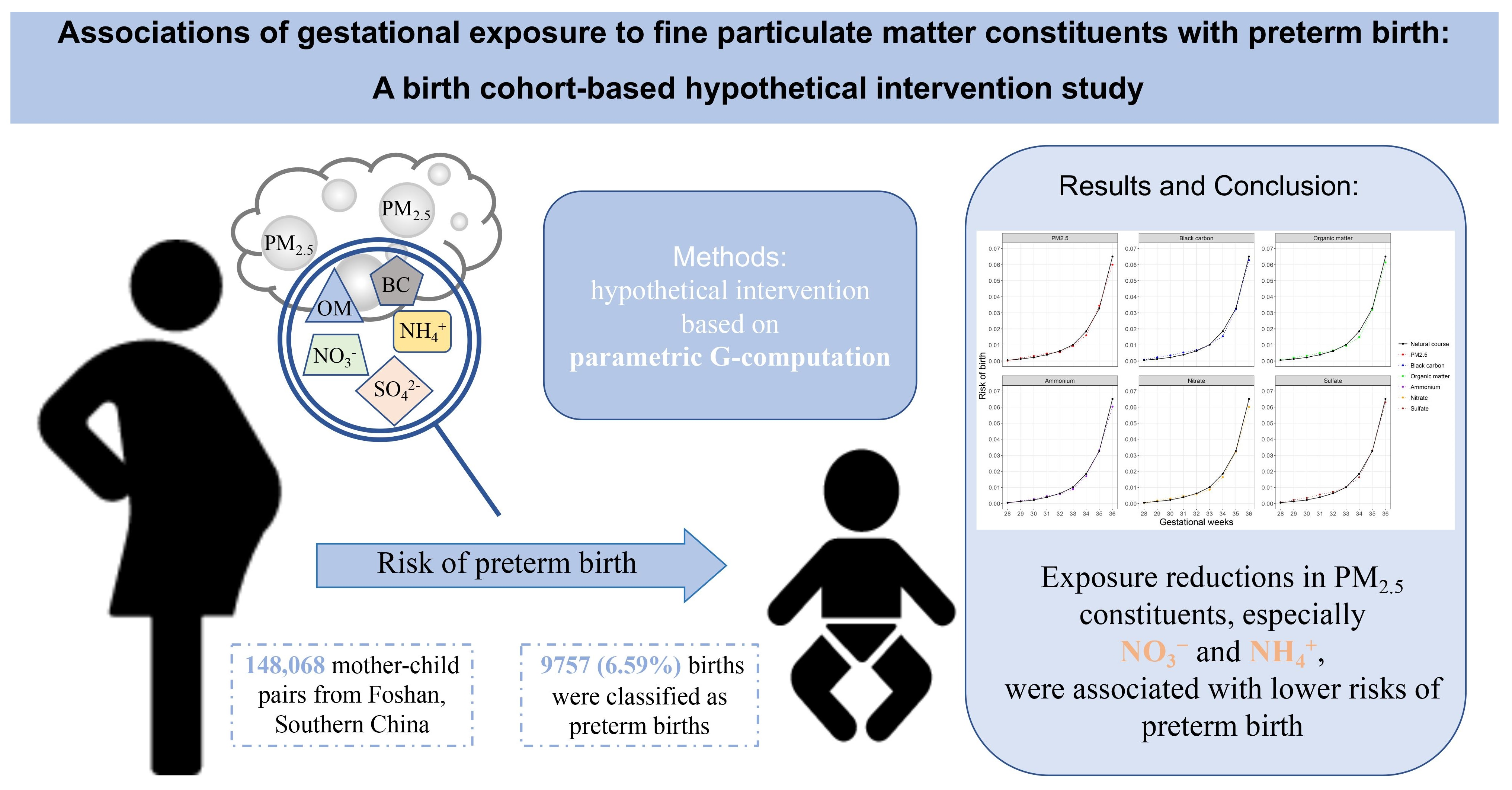
Associations of Gestational Exposure to Fine Particulate Matter Constituents with Preterm Birth: A Birth Cohort-Based Hypothetical Intervention Study

 ,
,  ,
, 
Abstract
1. Introduction
2. Materials and Methods
2.1. Study Population
2.2. Air Pollution Exposure Assessment
2.3. Outcome Assessment
2.4. Covariates
2.5. Statistical Analysis
3. Results
3.1. Population Characteristics
3.2. Exposure Distributions and Correlations
3.3. Association of PM2.5 and Constituents with PTB
3.4. Sensitivity Analysis
4. Discussion
5. Conclusions
Supplementary Materials
Author Contributions
Funding
Institutional Review Board Statement
Informed Consent Statement
Data Availability Statement
Acknowledgments
Conflicts of Interest
Abbreviations
| PTB | Preterm birth |
| PM2.5 | Fine particulate matter |
| BC | Black carbon |
| OM | Organic matter |
| NO3− | Nitrate |
| NH4+ | Ammonium |
| SO42− | Sulfate |
| TAP | Tracking air pollution in China |
| LMP | Last menstrual period |
| BMI | Body mass index |
| NO2 | Nitrogen dioxide |
| DLNM | Distributed lag nonlinear model |
| AQGs | Global air quality guidelines |
| RD | Risk difference |
| ITB | Immortal time bias |
References
- Dawes, L.; Groom, K.; Jordan, V.; Waugh, J. The use of specialised preterm birth clinics for women at high risk of spontaneous preterm birth: A systematic review. BMC Pregnancy Childbirth 2020, 20, 58. [Google Scholar] [CrossRef]
- Upadhyaya, S.; Sourander, A.; Luntamo, T.; Matinolli, H.-M.; Chudal, R.; Hinkka-Yli-Salomäki, S.; Filatova, S.; Cheslack-Postava, K.; Sucksdorff, M.; Gissler, M. Preterm birth is associated with depression from childhood to early adulthood. J. Am. Acad. Child. Adolesc. Psychiatry 2021, 60, 1127–1136. [Google Scholar] [CrossRef] [PubMed]
- Villar, J.; Restrepo-Méndez, M.C.; McGready, R.; Barros, F.C.; Victora, C.G.; Munim, S.; Papageorghiou, A.T.; Ochieng, R.; Craik, R.; Barsosio, H.C. Association between preterm-birth phenotypes and differential morbidity, growth, and neurodevelopment at age 2 years: Results from the INTERBIO-21st newborn study. JAMA Pediatr. 2021, 175, 483–493. [Google Scholar] [CrossRef]
- Crump, C.; Sundquist, J.; Sundquist, K. Preterm birth and risk of type 1 and type 2 diabetes: A national cohort study. Diabetologia 2020, 63, 508–518. [Google Scholar] [CrossRef] [PubMed]
- Lewandowski, A.J.; Levy, P.T.; Bates, M.L.; McNamara, P.J.; Nuyt, A.M.; Goss, K.N. Impact of the Vulnerable Preterm Heart and Circulation on Adult Cardiovascular Disease Risk. Hypertension 2020, 76, 1028–1037. [Google Scholar] [CrossRef]
- Xia, Y.; Xiao, J.; Yu, Y.; Tseng, W.L.; Lebowitz, E.; DeWan, A.T.; Pedersen, L.H.; Olsen, J.; Li, J.; Liew, Z. Rates of Neuropsychiatric Disorders and Gestational Age at Birth in a Danish Population. JAMA Netw. Open 2021, 4, e2114913. [Google Scholar] [CrossRef]
- Chawanpaiboon, S.; Vogel, J.P.; Moller, A.B.; Lumbiganon, P.; Petzold, M.; Hogan, D.; Landoulsi, S.; Jampathong, N.; Kongwattanakul, K.; Laopaiboon, M.; et al. Global, regional, and national estimates of levels of preterm birth in 2014: A systematic review and modelling analysis. Lancet Glob. Health 2019, 7, e37–e46. [Google Scholar] [CrossRef]
- Adane, H.A.; Iles, R.; Boyle, J.A.; Gelaw, A.; Collie, A. Maternal Occupational Risk Factors and Preterm Birth: A Systematic Review and Meta-Analysis. Public Health Rev. 2023, 44, 1606085. [Google Scholar] [CrossRef]
- Menzies, R.; Li, A.L.K.; Melamed, N.; Shah, P.S.; Horn, D.; Barrett, J.; Murphy, K.E. Risk of singleton preterm birth after prior twin preterm birth: A systematic review and meta-analysis. Am. J. Obstet. Gynecol. 2020, 223, 204.e1–204.e8. [Google Scholar] [CrossRef]
- Mitrogiannis, I.; Evangelou, E.; Efthymiou, A.; Kanavos, T.; Birbas, E.; Makrydimas, G.; Papatheodorou, S. Risk factors for preterm birth: An umbrella review of meta-analyses of observational studies. BMC Med. 2023, 21, 494. [Google Scholar] [CrossRef] [PubMed]
- Ghosh, R.; Causey, K.; Burkart, K.; Wozniak, S.; Cohen, A.; Brauer, M. Ambient and household PM2.5 pollution and adverse perinatal outcomes: A meta-regression and analysis of attributable global burden for 204 countries and territories. PLoS Med. 2021, 18, e1003718. [Google Scholar] [CrossRef]
- Song, S.; Gao, Z.; Zhang, X.; Zhao, X.; Chang, H.; Zhang, J.; Yu, Z.; Huang, C.; Zhang, H. Ambient fine particulate matter and pregnancy outcomes: An umbrella review. Environ. Res. 2023, 235, 116652. [Google Scholar] [CrossRef]
- Bekkar, B.; Pacheco, S.; Basu, R.; DeNicola, N. Association of Air Pollution and Heat Exposure With Preterm Birth, Low Birth Weight, and Stillbirth in the US: A Systematic Review. JAMA Netw. Open 2020, 3, e208243. [Google Scholar] [CrossRef]
- Zhang, R.; Jing, J.; Tao, J.; Hsu, S.-C.; Wang, G.; Cao, J.; Lee, C.S.L.; Zhu, L.; Chen, Z.; Zhao, Y. Chemical characterization and source apportionment of PM 2.5 in Beijing: Seasonal perspective. Atmos. Chem. Phys. 2013, 13, 7053–7074. [Google Scholar] [CrossRef]
- Dominici, F.; Wang, Y.; Correia, A.W.; Ezzati, M.; Pope, C.A., III; Dockery, D.W. Chemical Composition of Fine Particulate Matter and Life Expectancy: In 95 US Counties Between 2002 and 2007. Epidemiology 2015, 26, 556–564. [Google Scholar] [CrossRef]
- He, Z.Z.; Guo, P.Y.; Xu, S.L.; Zhou, Y.; Jalaludin, B.; Leskinen, A.; Knibbs, L.D.; Heinrich, J.; Morawska, L.; Yim, S.H.; et al. Associations of Particulate Matter Sizes and Chemical Constituents with Blood Lipids: A Panel Study in Guangzhou, China. Environ. Sci. Technol. 2021, 55, 5065–5075. [Google Scholar] [CrossRef]
- Yang, Y.; Ruan, Z.; Wang, X.; Yang, Y.; Mason, T.G.; Lin, H.; Tian, L. Short-term and long-term exposures to fine particulate matter constituents and health: A systematic review and meta-analysis. Environ. Pollut. 2019, 247, 874–882. [Google Scholar] [CrossRef] [PubMed]
- Niu, Y.; Chen, R.; Xia, Y.; Cai, J.; Ying, Z.; Lin, Z.; Liu, C.; Chen, C.; Peng, L.; Zhao, Z.; et al. Fine particulate matter constituents and stress hormones in the hypothalamus-pituitary-adrenal axis. Environ. Int. 2018, 119, 186–192. [Google Scholar] [CrossRef] [PubMed]
- Lei, X.; Chen, R.; Wang, C.; Shi, J.; Zhao, Z.; Li, W.; Yan, B.; Chillrud, S.; Cai, J.; Kan, H. Personal Fine Particulate Matter Constituents, Increased Systemic Inflammation, and the Role of DNA Hypomethylation. Environ. Sci. Technol. 2019, 53, 9837–9844. [Google Scholar] [CrossRef]
- Kelly, F.J.; Fussell, J.C. Size, source and chemical composition as determinants of toxicity attributable to ambient particulate matter. Atmos. Environ. 2012, 60, 504–526. [Google Scholar] [CrossRef]
- He, Y.; Jiang, Y.; Yang, Y.; Xu, J.; Zhang, Y.; Wang, Q.; Shen, H.; Zhang, Y.; Yan, D.; Peng, Z. Composition of fine particulate matter and risk of preterm birth: A nationwide birth cohort study in 336 Chinese cities. J. Hazard. Mater. 2022, 425, 127645. [Google Scholar] [CrossRef]
- Meng, Q.; Liu, J.; Shen, J.; Del Rosario, I.; Lakey, P.S.; Shiraiwa, M.; Su, J.; Weichenthal, S.; Zhu, Y.; Oroumiyeh, F. Fine particulate matter metal composition, oxidative potential, and adverse birth outcomes in Los Angeles. Environ. Health Perspect. 2023, 131, 107012. [Google Scholar] [CrossRef] [PubMed]
- Jiao, A.; Reilly, A.N.; Benmarhnia, T.; Sun, Y.; Avila, C.; Chiu, V.; Slezak, J.; Sacks, D.A.; Molitor, J.; Li, M.; et al. Fine Particulate Matter, Its Constituents, and Spontaneous Preterm Birth. JAMA Netw. Open 2024, 7, e2444593. [Google Scholar] [CrossRef]
- Cai, J.; Zhao, Y.; Kan, J.; Chen, R.; Martin, R.; van Donkelaar, A.; Ao, J.; Zhang, J.; Kan, H.; Hua, J. Prenatal exposure to specific PM2.5 chemical constituents and preterm birth in China: A nationwide cohort study. Environ. Sci. Technol. 2020, 54, 14494–14501. [Google Scholar] [CrossRef]
- Daniel, R.M.; De Stavola, B.L.; Cousens, S.N. gformula: Estimating causal effects in the presence of time-varying confounding or mediation using the g-computation formula. Stata J. 2011, 11, 479–517. [Google Scholar] [CrossRef]
- Robins, J. A new approach to causal inference in mortality studies with a sustained exposure period—Application to control of the healthy worker survivor effect. Math. Model. 1986, 7, 1393–1512. [Google Scholar] [CrossRef]
- Leung, M.; Weisskopf, M.G.; Modest, A.M.; Hacker, M.R.; Iyer, H.S.; Hart, J.E.; Wei, Y.; Schwartz, J.; Coull, B.A.; Laden, F. Using Parametric g-Computation for Time-to-Event Data and Distributed Lag Models to Identify Critical Exposure Windows for Preterm Birth: An Illustrative Example Using PM 2.5 in a Retrospective Birth Cohort Based in Eastern Massachusetts (2011–2016). Environ. Health Perspect. 2024, 132, 77002. [Google Scholar] [CrossRef]
- Chen, C.; Chen, H.; van Donkelaar, A.; Burnett, R.T.; Martin, R.V.; Chen, L.; Tjepkema, M.; Kirby-McGregor, M.; Li, Y.; Kaufman, J.S. Using parametric g-computation to estimate the effect of long-term exposure to air pollution on mortality risk and simulate the benefits of hypothetical policies: The Canadian Community Health Survey cohort (2005 to 2015). Environ. Health Perspect. 2023, 131, 37010. [Google Scholar] [CrossRef]
- Fu, J.; Lin, Q.; Ai, B.; Li, M.; Luo, W.; Huang, S.; Yu, H.; Yang, Y.; Lin, H.; Wei, J.; et al. Associations between maternal exposure to air pollution during pregnancy and trajectories of infant growth: A birth cohort study. Ecotoxicol. Environ. Saf. 2024, 269, 115792. [Google Scholar] [CrossRef] [PubMed]
- Lin, Q.; Gao, Y.; Liu, Y.; Huang, S.; Su, Y.; Luo, W.; Shi, C.; Yang, Y.; Lin, H.; Su, X.; et al. Heat wave exposure during pregnancy and neurodevelopmental delay in young children: A birth cohort study. Environ. Res. 2025, 266, 120541. [Google Scholar] [CrossRef] [PubMed]
- Geng, G.; Xiao, Q.; Liu, S.; Liu, X.; Cheng, J.; Zheng, Y.; Xue, T.; Tong, D.; Zheng, B.; Peng, Y. Tracking air pollution in China: Near real-time PM2. 5 retrievals from multisource data fusion. Environ. Sci. Technol. 2021, 55, 12106–12115. [Google Scholar] [CrossRef]
- Liu, S.; Geng, G.; Xiao, Q.; Zheng, Y.; Liu, X.; Cheng, J.; Zhang, Q. Tracking daily concentrations of PM2. 5 chemical composition in China since 2000. Environ. Sci. Technol. 2022, 56, 16517–16527. [Google Scholar] [CrossRef]
- Deng, K.; Liang, J.; Mu, Y.; Liu, Z.; Wang, Y.; Li, M.; Li, X.; Dai, L.; Li, Q.; Chen, P.; et al. Preterm births in China between 2012 and 2018: An observational study of more than 9 million women. Lancet Glob. Health 2021, 9, e1226–e1241. [Google Scholar] [CrossRef] [PubMed]
- Chen, Z.; Liu, N.; Tang, H.; Gao, X.; Zhang, Y.; Kan, H.; Deng, F.; Zhao, B.; Zeng, X.; Sun, Y.; et al. Health effects of exposure to sulfur dioxide, nitrogen dioxide, ozone, and carbon monoxide between 1980 and 2019: A systematic review and meta-analysis. Indoor Air 2022, 32, e13170. [Google Scholar] [CrossRef] [PubMed]
- Chersich, M.F.; Pham, M.D.; Areal, A.; Haghighi, M.M.; Manyuchi, A.; Swift, C.P.; Wernecke, B.; Robinson, M.; Hetem, R.; Boeckmann, M.; et al. Associations between high temperatures in pregnancy and risk of preterm birth, low birth weight, and stillbirths: Systematic review and meta-analysis. BMJ 2020, 371, m3811. [Google Scholar] [CrossRef]
- Wei, J.; Li, Z.; Wang, J.; Li, C.; Gupta, P.; Cribb, M. Ground-level gaseous pollutants (NO2, SO2, and CO) in China: Daily seamless mapping and spatiotemporal variations. Atmos. Chem. Phys. 2023, 23, 1511–1532. [Google Scholar] [CrossRef]
- Wei, J.; Liu, S.; Li, Z.; Liu, C.; Qin, K.; Liu, X.; Pinker, R.T.; Dickerson, R.R.; Lin, J.; Boersma, K.F. Ground-level NO2 surveillance from space across China for high resolution using interpretable spatiotemporally weighted artificial intelligence. Environ. Sci. Technol. 2022, 56, 9988–9998. [Google Scholar] [CrossRef]
- Han, S.; Liu, B.; Shi, C.; Liu, Y.; Qiu, M.; Sun, S. Evaluation of CLDAS and GLDAS Datasets for Near-Surface Air Temperature over Major Land Areas of China. Sustainability 2020, 12, 4311. [Google Scholar] [CrossRef]
- WHO Guidelines Approved by the Guidelines Review Committee. In WHO Global Air Quality Guidelines: Particulate Matter (PM(2.5) and PM(10)), Ozone, Nitrogen Dioxide, Sulfur Dioxide and Carbon Monoxide; World Health Organization: Geneva, Switzerland, 2021.
- Laurent, O.; Hu, J.; Li, L.; Kleeman, M.J.; Bartell, S.M.; Cockburn, M.; Escobedo, L.; Wu, J. A statewide nested case–control study of preterm birth and air pollution by source and composition: California, 2001–2008. Environ. Health Perspect. 2016, 124, 1479–1486. [Google Scholar] [CrossRef]
- Darrow, L.A.; Klein, M.; Flanders, W.D.; Waller, L.A.; Correa, A.; Marcus, M.; Mulholland, J.A.; Russell, A.G.; Tolbert, P.E. Ambient air pollution and preterm birth: A time-series analysis. Epidemiology 2009, 20, 689–698. [Google Scholar] [CrossRef]
- Sheridan, P.; Chen, C.; Thompson, C.A.; Benmarhnia, T. Immortal time bias with time-varying exposures in environmental epidemiology: A case study in lung cancer survival. Am. J. Epidemiol. 2023, 192, 1754–1762. [Google Scholar] [PubMed]
- Hernán, M.A.; Sauer, B.C.; Hernández-Díaz, S.; Platt, R.; Shrier, I. Specifying a target trial prevents immortal time bias and other self-inflicted injuries in observational analyses. J. Clin. Epidemiol. 2016, 79, 70–75. [Google Scholar]
- Guo, T.; Wang, Y.; Zhang, H.; Zhang, Y.; Zhao, J.; Wang, Q.; Shen, H.; Wang, Y.; Xie, X.; Wang, L.; et al. The association between ambient PM2.5 exposure and the risk of preterm birth in China: A retrospective cohort study. Sci. Total Environ. 2018, 633, 1453–1459. [Google Scholar] [CrossRef]
- Sastre-Serra, J.; Valle, A.; Company, M.M.; Garau, I.; Oliver, J.; Roca, P. Estrogen down-regulates uncoupling proteins and increases oxidative stress in breast cancer. Free Radic. Biol. Med. 2010, 48, 506–512. [Google Scholar] [CrossRef]
- Li, Z.; Tang, Y.; Song, X.; Lazar, L.; Li, Z.; Zhao, J. Impact of ambient PM2.5 on adverse birth outcome and potential molecular mechanism. Ecotoxicol. Environ. Saf. 2019, 169, 248–254. [Google Scholar] [CrossRef]
- Slama, R.; Darrow, L.; Parker, J.; Woodruff Tracey, J.; Strickland, M.; Nieuwenhuijsen, M.; Glinianaia, S.; Hoggatt Katherine, J.; Kannan, S.; Hurley, F.; et al. Meeting Report: Atmospheric Pollution and Human Reproduction. Environ. Health Perspect. 2008, 116, 791–798. [Google Scholar] [CrossRef]
- Bové, H.; Bongaerts, E.; Slenders, E.; Bijnens, E.M.; Saenen, N.D.; Gyselaers, W.; Van Eyken, P.; Plusquin, M.; Roeffaers, M.B.J.; Ameloot, M.; et al. Ambient black carbon particles reach the fetal side of human placenta. Nat. Commun. 2019, 10, 3866. [Google Scholar] [CrossRef]
- Liu, C.; Cai, J.; Qiao, L.; Wang, H.; Xu, W.; Li, H.; Zhao, Z.; Chen, R.; Kan, H. The Acute Effects of Fine Particulate Matter Constituents on Blood Inflammation and Coagulation. Environ. Sci. Technol. 2017, 51, 8128–8137. [Google Scholar] [CrossRef] [PubMed]
- Vadillo-Ortega, F.; Osornio-Vargas, A.; Buxton, M.A.; Sánchez, B.N.; Rojas-Bracho, L.; Viveros-Alcaráz, M.; Castillo-Castrejón, M.; Beltrán-Montoya, J.; Brown, D.G.; O’Neill, M.S. Air pollution, inflammation and preterm birth: A potential mechanistic link. Med. Hypotheses 2014, 82, 219–224. [Google Scholar] [CrossRef]
- Zheng, L.; Zhou, J.; Zhu, L.; Xu, X.; Luo, S.; Xie, X.; Li, H.; Lin, S.; Luo, J.; Wu, S. Associations of air pollutants and related metabolites with preterm birth during pregnancy. Sci. Total Environ. 2024, 951, 175542. [Google Scholar] [CrossRef] [PubMed]
- Bland, J.M.; Altman, D.G. Statistics Notes: Bootstrap resampling methods. BMJ Br. Med. J. 2015, 350, h2622. [Google Scholar] [CrossRef]



| Characteristics | All Participants | Preterm Birth | Term Birth | p a |
|---|---|---|---|---|
| Number of participants | 148,068 | 9757 | 138,311 | |
| Maternal age (years) | 29.52 (4.77) | 30.52 (5.14) | 29.45 (4.73) | <0.001 |
| Pre-pregnancy BMI (kg/m2) b | 22.64 (3.45) | 22.94 (3.70) | 22.62 (3.43) | <0.001 |
| Employment status | 0.032 | |||
| Employed | 120,050 (81.1%) | 7830 (80.3%) | 112,220 (81.1%) | |
| Unemployed | 28,018 (18.9%) | 1927 (19.7%) | 26,091 (18.9%) | |
| Education c | 0.010 | |||
| High | 75,865 (51.2%) | 4872 (49.9%) | 70,993 (51.3%) | |
| Medium | 35,040 (23.7%) | 2322 (23.8%) | 32,718 (23.7%) | |
| Low | 37,163 (25.1%) | 2563 (26.3%) | 34,600 (25.0%) | |
| Local household registration | <0.001 | |||
| Yes | 67,621 (45.7%) | 4790 (49.1%) | 62,831 (45.4%) | |
| No | 80,447 (54.3%) | 4967 (50.9%) | 75,480 (54.6%) | |
| Gestational hypertension | <0.001 | |||
| Yes | 2007 (1.4%) | 245 (2.5%) | 1762 (1.3%) | |
| No | 146,061 (98.6%) | 9512 (97.5%) | 136,549 (98.7%) | |
| Gestational diabetes mellitus | 0.001 | |||
| Yes | 15,368 (10.4%) | 1110 (11.4%) | 14,258 (10.3%) | |
| No | 132,700 (89.6%) | 8647 (88.6%) | 124,053 (89.7%) | |
| Infant sex | <0.001 | |||
| Male | 79,393 (53.6%) | 5613 (57.5%) | 73,780 (53.3%) | |
| Female | 68,675 (46.4%) | 4144 (42.5%) | 64,531 (46.7%) | |
| Season of conception | <0.001 | |||
| Spring | 34,573 (23.3%) | 2338 (24.0%) | 32,235 (23.3%) | |
| Summer | 34,779 (23.5%) | 2284 (23.4%) | 32,495 (23.5%) | |
| Autumn | 40,621 (27.4%) | 2807 (28.8%) | 37,814 (27.3%) | |
| Winter | 38,095 (25.7%) | 2328 (23.9%) | 35,767 (25.9%) |
| Reduction (%) | PM2.5 and Its Constituents | |||||
|---|---|---|---|---|---|---|
| PM2.5 | BC | OM | NH4+ | NO3− | SO42− | |
| 10 | −1.37 (−4.24, 1.58) | −0.62 (−3.28, 2.27) | −0.99 (−3.67, 1.89) | −1.21 (−4.53, 1.61) | −1.28 (−4.53, 0.96) | −0.56 (−3.50, 2.88) |
| 20 | −2.67 (−8.53, 3.59) | −1.21 (−6.56, 4.21) | −1.93 (−9.05, 3.42) | −2.40 (−8.31, 1.86) | −2.54 (−7.94, 1.25) | −1.10 (−7.72, 5.38) |
| 40 | −5.08 (−20.54, 8.94) | −2.29 (−12.39, 9.01) | −3.70 (−15.37, 5.14) | −4.74 (−14.93, 4.02) | −5.00 (−15.72, 5.87) | −2.11 (−18.37, 10.43) |
| 50 | −6.19 (−24.69, 9.00) | −2.78 (−18.43, 10.37) | −4.52 (−20.80, 8.63) | −5.88 (−19.71, 6.09) | −6.19 (−20.09, 5.34) | −2.59 (−19.01, 12.27) |
| 60 | −7.24 (−26.12, 10.33) | −3.23 (−18.36, 18.66) | −5.30 (−23.80, 8.96) | −7.01 (−24.44, 8.08) | −7.37 (−27.29, 6.31) | −3.04 (−24.70, 17.09) |
| 80 | −9.14 (−31.66, 17.82) | −4.04 (−31.90, 19.85) | −6.73 (−32.06, 17.38) | −9.21 (−26.20, 6.94) | −9.66 (−32.75, 7.15) | −3.87 (−29.93, 24.98) |
| 90 | −9.99 (−36.78, 25.89) | −4.39 (−24.43, 23.32) | −7.38 (−29.75, 16.06) | −10.30 (−35.45, 10.41) | −10.82 (−32.43, 11.14) | −4.25 (−29.61, 18.31) |
| Reduction (%) | PM2.5 and Its Constituents | |||||
|---|---|---|---|---|---|---|
| PM2.5 | BC | OM | NH4+ | NO3− | SO42− | |
| 10 | 203 | 92 | 147 | 179 | 190 | 83 |
| 20 | 395 | 179 | 286 | 355 | 376 | 163 |
| 40 | 752 | 339 | 548 | 702 | 740 | 312 |
| 50 | 917 | 412 | 669 | 871 | 917 | 383 |
| 60 | 1072 | 478 | 785 | 1038 | 1091 | 450 |
| 80 | 1353 | 598 | 996 | 1364 | 1430 | 573 |
| 90 | 1479 | 650 | 1093 | 1525 | 1602 | 629 |
Disclaimer/Publisher’s Note: The statements, opinions and data contained in all publications are solely those of the individual author(s) and contributor(s) and not of MDPI and/or the editor(s). MDPI and/or the editor(s) disclaim responsibility for any injury to people or property resulting from any ideas, methods, instructions or products referred to in the content. |
© 2026 by the authors. Licensee MDPI, Basel, Switzerland. This article is an open access article distributed under the terms and conditions of the Creative Commons Attribution (CC BY) license.
Share and Cite
Gao, Y.; Qian, R.; Li, X.; Qiu, S.; Yang, Z.; Huang, S.; Hu, P.; Yang, Y.; Lin, H.; Su, X.; et al. Associations of Gestational Exposure to Fine Particulate Matter Constituents with Preterm Birth: A Birth Cohort-Based Hypothetical Intervention Study. Toxics 2026, 14, 233. https://doi.org/10.3390/toxics14030233
Gao Y, Qian R, Li X, Qiu S, Yang Z, Huang S, Hu P, Yang Y, Lin H, Su X, et al. Associations of Gestational Exposure to Fine Particulate Matter Constituents with Preterm Birth: A Birth Cohort-Based Hypothetical Intervention Study. Toxics. 2026; 14(3):233. https://doi.org/10.3390/toxics14030233
Chicago/Turabian StyleGao, Yonggui, Rui Qian, Xinyue Li, Sheng Qiu, Zijun Yang, Saijun Huang, Pengzhen Hu, Yin Yang, Hualiang Lin, Xi Su, and et al. 2026. "Associations of Gestational Exposure to Fine Particulate Matter Constituents with Preterm Birth: A Birth Cohort-Based Hypothetical Intervention Study" Toxics 14, no. 3: 233. https://doi.org/10.3390/toxics14030233
APA StyleGao, Y., Qian, R., Li, X., Qiu, S., Yang, Z., Huang, S., Hu, P., Yang, Y., Lin, H., Su, X., Lin, Q., & Zhang, Z. (2026). Associations of Gestational Exposure to Fine Particulate Matter Constituents with Preterm Birth: A Birth Cohort-Based Hypothetical Intervention Study. Toxics, 14(3), 233. https://doi.org/10.3390/toxics14030233