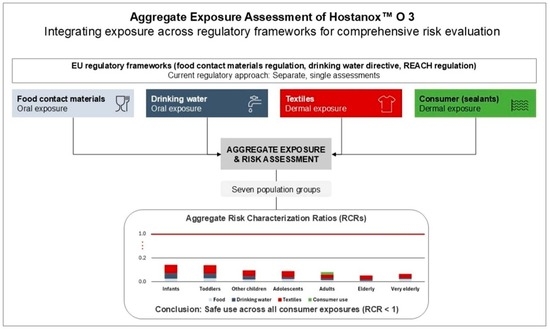
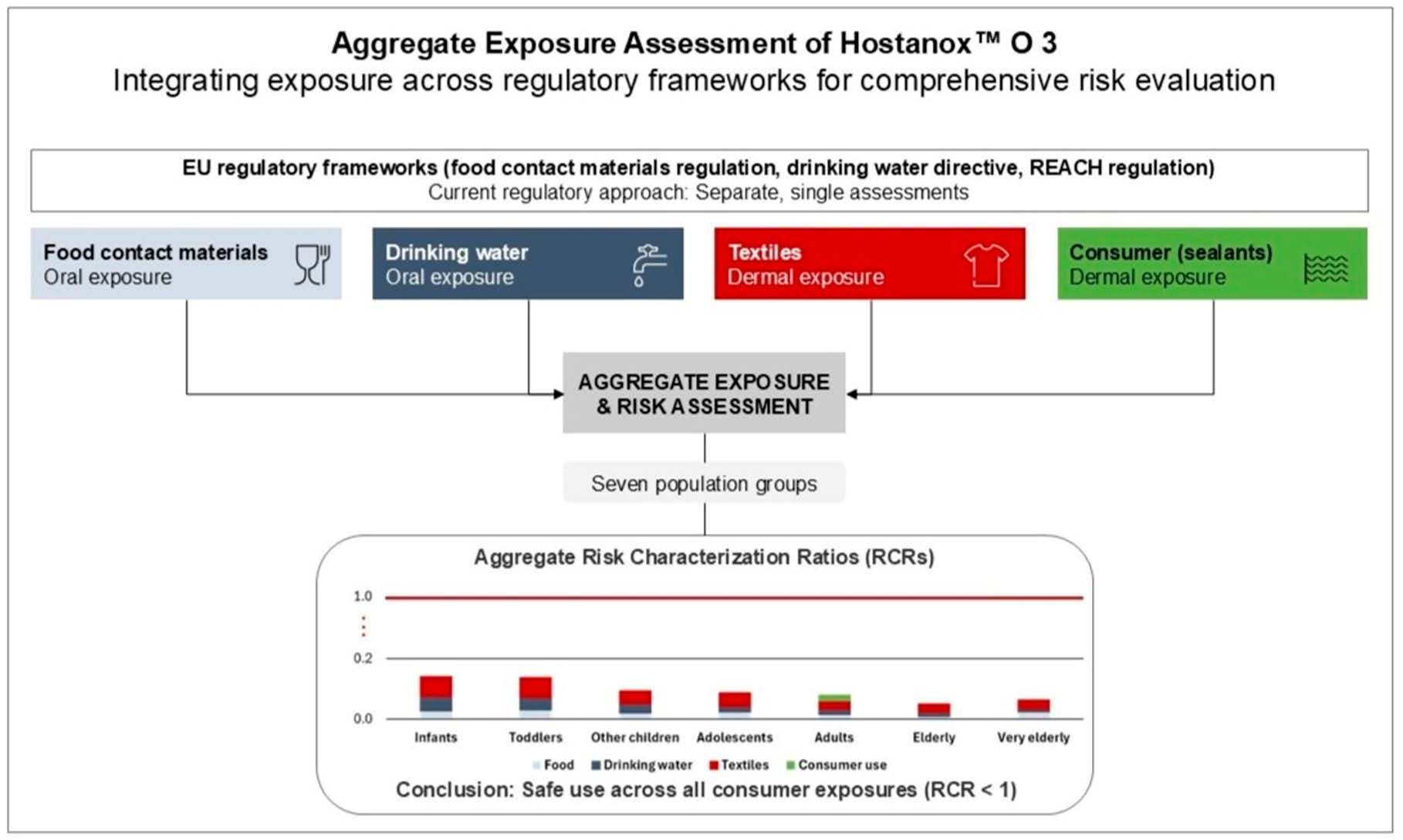
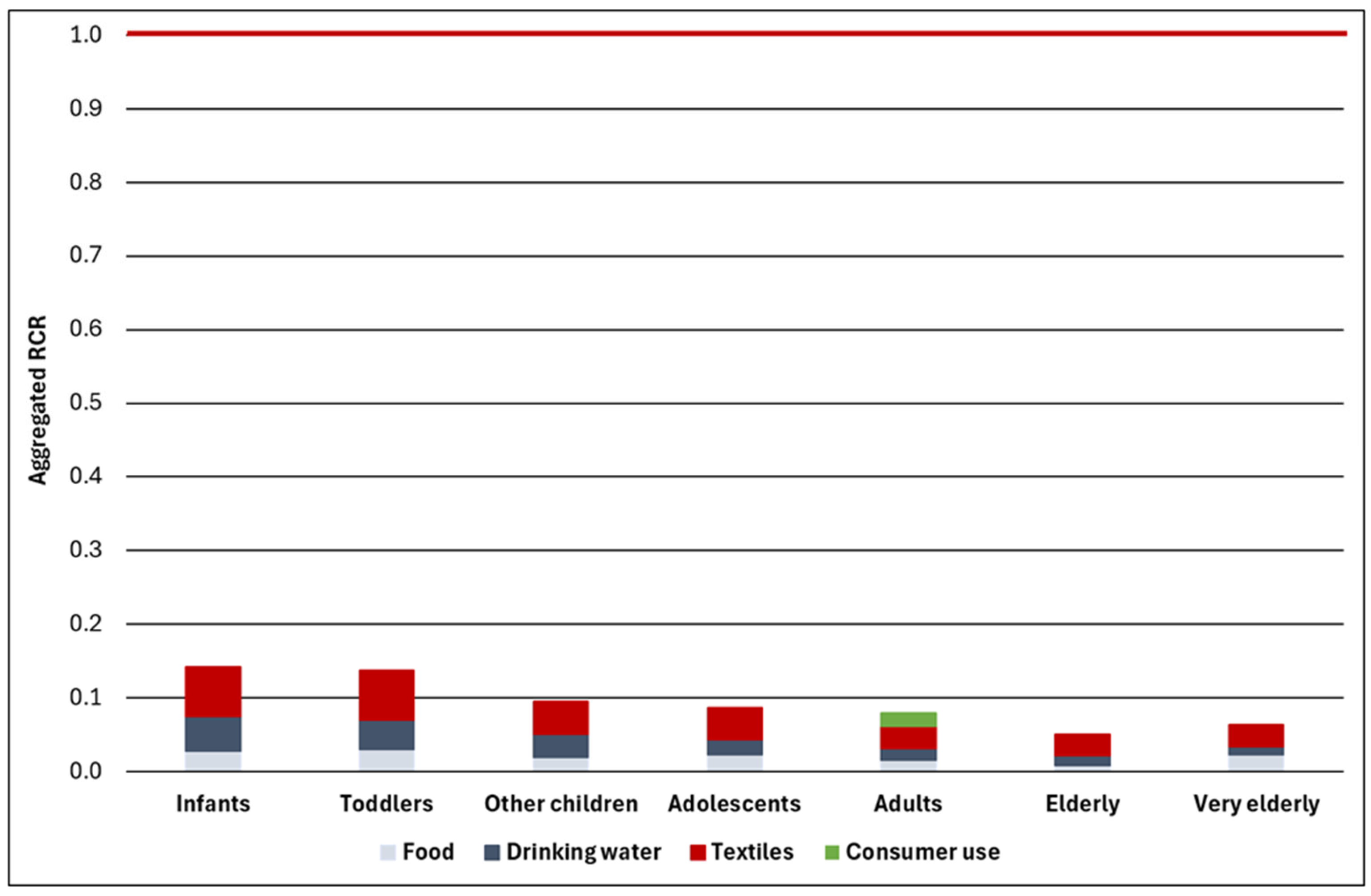
This study presents an aggregate exposure and risk assessment that—to our knowledge—is unique in several respects. First, it integrates exposure and risk from diffe rent applications of the substance that are typically assessed separately. Second, this as sess ment includes seven population groups aligned with EFSA’s methodology that are not assessed, e.g., under the REACH Regulation. The approach ensures consideration of population groups generally assumed to be potentially more vulnerable and—as shown in this study—who may experience higher exposures (i.e., infants and toddlers). Third, this study used key input values normalized to body weight for all exposure pathways except consumer uses, preventing unrealistic combinations of values for dependent pa ra meters (e.g., body weight and skin surface area). Finally, the approach therefore adequately reflects the characteristic higher food intake and skin surface area of the very young, when normalized to body weight.
The methodology described in this study was developed for application in practice also considering future regulatory developments in the EU as discussed in
Section 4.3 be low. In addition, all calculations are simple to apply, and all inputs and outputs are trans parent and well documented. This not only allows application, e.g., by industry stake holders, but also facilitates regulatory scrutiny by authorities. The methodology is based on external exposure estimates that are compared with external reference values (i.e., DNELs). This approach ensures that the methodology can be applied to many other sub stances, since oral, inhalation and dermal DNELs are available for a comparatively large number of substances. In contrast, other reference values (e.g., ADIs and TDIs) are only available for a comparatively small number of substances and only cover oral exposure. Furthermore, using reference values derived in the context of EU legislation may increase regulatory acceptance of such assessments. Finally, pathway-specific exposure and risk is assessed separately before aggregation, which allows for evaluating pathway con tri bu tions (also see
Section 4.3 below).
The approach developed in this paper differs from other aggregate exposure assess ment approaches. In fact, we were unable to locate publications that address the exposure pathways covered by this study in an aggregate consumer exposure assessment. Other aggregate exposure assessment approaches include, e.g., high-throughput exposure pre dictions [
31,
32], which are primarily developed for prioritization purposes but are un likely to be useful for substance-specific assessments. The development of aggregate ex posure pathways for combination with adverse outcome pathways [
33,
34] focusses on inter nal (biomarker) exposure metrics that can be compared with internal toxicity metrics. In practical application of such approaches to specific substances [
35,
36], no reference values are applied, and exposure via different pathways is not evident.
4.1. Data Accessibility and Challenges
The applied methodology demonstrates the general feasibility of an aggregate consumer exposure and risk assessment, but such assessments encounter several challenges. The concentration of the substance assessed needs to be known for the different applications in which it is used. As shown by this case study, concentrations in food and drinking water may be based on legal limit values (e.g., MTCtap) or migration studies (e.g., for use in FCM) required under the respective legislation. Other appropriate data or justified assumptions (e.g., by considering the water solubility of the substance) may inform the discussion of this key input value. Exposure resulting from the use in textiles or due to consumer uses of mixtures containing the substance, in contrast, require detailed knowledge to derive realistic mean and maximum values. Such knowledge may be available to REACH registrants in some cases based on their sector- or application-specific knowledge, including an appreciation of the functional requirements of the substance in specific uses. In this case study, such knowledge was available, but this may not always be the case. Default assumptions representing very high concentrations are unlikely to be helpful in such situations for most substances, since they may result in very high exposures exceeding the reference values. Overall, the concentration of the substance in relevant end products (
Table 9) may need to be based on non-public data for several uses.
Apart from the concentration of the substance in the products, challenges also relate to the generation of additional input data for the exposure assessment. Food and drinking water consumption data for Europe are publicly available in the Comprehensive Database (
Table 9). Using the Comprehensive Database has several advantages. First, information is typically available for the seven population groups defined by EFSA. Second, values normalized to body weight are available, the use of which prevents inappropriate combinations of per capita consumption and body weight data. Finally, information from most EU Member States is available (
Table S1 in the SMF), which allows for covering differences in consumption patterns across the EU in the exposure assessment. The main challenge lies in the extraction and evaluation of the consumption data for specific food items or categories of food items in the context of an aggregate exposure assessment. The detailed description in
Section S1.2.2 of the SMF illustrates the complexities involved and some of the problems encountered. In addition, the approach applied in this study for the extraction and evaluation of such data is not by any means harmonized.
For dermal exposure to the substance from textiles, information on the SA/BW ratio as a key input parameter is publicly available (
Table 9). One of the problems encountered in this study is the fact that the SA/BW ratios used [
22,
23] are only available for three rather broad age groups that had to be assigned to the seven EFSA population groups. While future research may develop SA/BW ratios with a higher degree of differentiation for subjects 3–17 years of age (‘other children’ and ‘adolescents’ in EFSA’s population group system;
Table 2), the results from the case study reflect the key difference between the very young and adult population with respect to dermal exposure.
The assessment of exposure resulting from consumer uses (application of sealants and other products) did not encounter major challenges since the established ConsExpo Web tool could be used for this purpose, and approaches for considering the infrequent nature of the tasks is established [
12]. Furthermore, the ConsExpo Web tool is freely available, and all input data are published in ConsExpo fact sheets, publicly available also for other consumer products (see
SMF, Section S1.4).
4.2. Uncertainties of Key Input Data
For the substance-specific assessment in this study, knowledge of the substance concentration was available based on marketing expert knowledge. While these data represent our best current understanding and are considered reliable estimates, some degree of uncertainty remains inherent in real-world application scenarios. The substance concentration may represent a more significant source of uncertainty in other assessment cases where such detailed application information is not available.
The food consumption values applied in this study involve some uncertainty, pri marily due to the use of the substance in cans, i.e., a rather specific FCM (see extended dis cussion in the
SMF, Section S1.2.2). For this reason, some conservative assumptions were made for deriving the consumption data (
Table 8). Nonetheless, aggregate assessments would benefit from harmonized consumption data—to be derived from the Com pre hen sive Database—for food items relevant for FCM, ideally differentiated by the type of FCM.
For dermal exposure from textiles, SA/BW ratios are considered robust but lack sufficient age differentiation (see above). The assumption of 60% of the total skin surface being in contact with textiles is considered conservative for an aggregate assessment, although it does not cover all kinds of textiles. Also, the migration rate is based on a ‘worst case’ default of the BfR methodology adding to the conservative assumptions (
Table 8). While the low migration rate applied (0.1%;
Section 2.4.2, Additional Input Data for the Exposure Assessment) substantially reduces daily dermal exposure, it is adequate for the modelling approach, which assumes that the substance concentration in the textile does not substantially change over time. In contrast, a migration rate of 1% would result in only one half of the initial amount of the substance being present in the textile after 70 days. In such a situation, the dermal exposure should not be compared with a chronic (i.e., lifetime) reference value.
For consumer uses, the main uncertainty relates to the amount of product in contact with the skin that is assumed in ConsExpo. This amount is calculated by multiplying the contact rate (in mg/min) with the duration (in min). While the ConsExpo default values for these parameters are based on expert judgement, they are discussed in some detail in the fact sheet [
24]. A critical appraisal of these default values is outside the scope of this article.
To address the potential uncertainty of this deterministic approach, we have not only applied some conservative assumptions (
Table 8) but have also calculated exposure assuming maximum concentrations of the substance. While the findings from these additional calculations increase the confidence in the conclusion on substance-specific risks, the uncertainty of the assessment cannot be quantified. A probabilistic exposure assessment using distributions for key input data may be developed in the future and be better suited than combining upper percentile values in a deterministic approach. Such a probabilistic exposure assessment would more fully address the variability and uncertainty in the data and the final exposure estimate. While probabilistic exposure assessments are occasionally performed, e.g., in the context of dietary exposure assessments, see e.g., [
37,
38], they are the exception rather than the rule and require substantial additional efforts. For such probabilistic assessments to be used in practice, i.e., by industry stakeholders or authorities, the development of a dedicated software would be beneficial. For several key input data of our study (e.g., food and drinking water consumption and SA/BW ratios), descriptive statistics are reported that in principle would allow for defining distributions for use in such software. Pending such a development, upper percentile values could be used for selected input parameters in principle, but this would require careful statistical examination when adding up exposures in an aggregate assessment to prevent unrealistic combinations.
4.3. Practical Issues and Regulatory Context
The application of aggregate exposure and risk assessment in a regulatory context encounters substantial challenges, not the least because different uses are covered by legislation within the remit of different European agencies (e.g., ECHA and EFSA). The scientific and regulatory challenges were recently summarized in a report for EFSA [
4], and we would like to highlight an additional, more practical aspect. There is no platform or tool for reporting aggregate exposure and risk assessments of the type described in this study. For example, ECHA’s CHESAR tool for assessments performed under the REACH Regulation does not allow us to integrate exposure assessments for uses covered by other regulatory areas.
The envisaged ‘common data platform’ described in the proposed OSOA package [
2] also does not contain any provisions in this respect. Concerning consumer exposure, it seems to place a strong emphasis on biomonitoring data. While results from biomonitoring studies do indeed reflect aggregate exposure from all sources, it is generally impossible to identify the sources of exposure and the contribution of different pathways of exposure. Approaches as applied in this study, in contrast, readily identify the source contribution (
Figure 1 and
Table S11 in the SMF) and therefore provide insights that will be impossible to generate from biomonitoring in most cases. In addition, biomonitoring requires detailed knowledge of the substance (e.g., with respect to toxicokinetic behaviour and identification of relevant metabolites), substantial efforts (e.g., in development and validation of analytical methods) as well as resources to generate representative data. It is therefore hardly conceivable that representative biomonitoring data will be generated for many of the chemicals with potential consumer exposure. For example, the EUPL of substances for drinking water contact materials alone contains more than 2 000 entries, and an MTCtap is provided for more than 500 of these. Finally, it is questionable whether representative biomonitoring data for infants and toddlers will be generated, e.g., due to practical and ethical constraints in sampling these age groups. Thus, a recent review of European biomonitoring studies on phthalates—a substance group very widely studied by biomonitoring—does not contain data for infants and toddlers [
39]. The lack of biomonitoring data for these population groups is important given that they may show higher exposures via food and dermal contact due to their specific characteristics, as noted in our case study.
More specifically to the substance assessed, the aggregate exposure and risk assess ment covering uses assessed separately under different legislations by default indicates that the use of Hostanox
® O 3 is safe for consumers (RCRs well below 1; see
Section 3.4). If for other substances aggregate RCRs above one are obtained, the approach described in this article allows for identifying the uses contributing the highest share to the aggregate RCR. Such findings may, e.g., inform industry to limit the concentration in specific applications or authorities to target regulatory risk management measures.
These substance-specific findings are discussed in the context of the generic approach to risk management that the CSS envisages to extend ‘to ensure that consumer products (…) do not contain chemicals that cause cancers, gene mutations, affect the reproductive or the endocrine system, or are persistent and bioaccumulative’ [
1]. Such a generic approach to risk management is based on the hazardous properties of a substance (e.g., its classification according to the European CLP Regulation) on the one hand and generic exposure considerations on the other hand, such as widespread uses of the substance, its use in applications resulting in exposure of vulnerable groups (e.g., children), or situations in which exposure is difficult to control [
1,
40]. Since generic approaches to risk mana ge ment do not require full-scale exposure and risk assessments, they are typically easier and more rapidly implemented than risk management measures derived from such in-depth assessments. Existing legislation already contains ‘generic’ provisions to limit consumer exposure. For example, a harmonized classification for reproductive toxicity under the CLP Regulation (Repr. 1A and 1 B) with few exceptions triggers bans of the substance as such and in mixtures available to the general public according to entry 30 of Annex XVII to the EU REACH Regulation.
The generic approach to risk management, if implemented as envisaged in the CSS, aims at extending this approach to all consumer products, ‘including, among other things, food contact materials, toys, childcare articles, cosmetics, detergents, furniture and textiles‘ to ensure ‘protection against (the) most harmful chemicals’ [
1]. The CSS does not define ‘most harmful chemicals’, but a recent communication from the European Commission [
41] defines fines ‘most harmful substances’ as chemicals having the ‘hazard properties’ of CMR substances (Cat. 1A and 1B), endocrine disruptors (Cat. 1), respiratory sensitizers (Cat. 1) or substances causing specific target organ toxicity following repeated exposure (STOT-RE Cat. 1; this list only relates to human health endpoints), apparently relating to classifications according to the CLP Regulation.
This extension of the generic approach to risk management is likely to affect many chemicals. For example, the European Union List of Authorized Substances in plastic FCM (Annex I of Regulation 10/2011/EU, as amended by Regulation (EU) 2024/3190) currently contains almost 1 200 entries. As shown in
Section S3 in the SMF, 24% of the substances that (a) are identified by a CAS or EC number and (b) have harmonized classifications in Annex VI to the CLP Regulation meet the criteria for their identification as ‘most harmful substances’ for human health. Most of these chemicals are also included in the EUPL for drinking water contact materials. This fraction is likely an underestimate (see
SMF Section S3) and is expected to increase in the future since substances continue to be classified for relevant properties. Hostanox
® O 3 is a case in point, if the harmonized classification for reproductive toxicity (Repr. 1B) recommended by ECHA’s RAC is adopted by the European Commission. An increase in this fraction may also result from classifications for the new hazard class of endocrine disruption for human health that is not reflected in the evaluation summarized above (see
SMF, Section S3).
It is outside the scope of this study to assess whether all or some of the uses covered by the aggregate exposure and risk assessment, e.g., in FCM and in materials in contact with drinking water, qualify as ‘essential uses’ according to the criteria laid down in the European Commission communication [
41]. If not, the use of ‘most harmful substances’ may be subject to the generic approach to risk management with the possible result of such substances being phased out in such applications, even if the exposure and risk associated with such uses is low (as illustrated in our case study). If, in contrast, such uses are considered ‘essential’, they may not become subject to the generic approach to risk management but rather be assessed in more detail. Such an in-depth assessment would require a detailed chemical risk assessment, which—in our opinion—could involve an aggregate exposure and risk assessment. Our case study may inform such an assessment for Hostanox
® O 3.