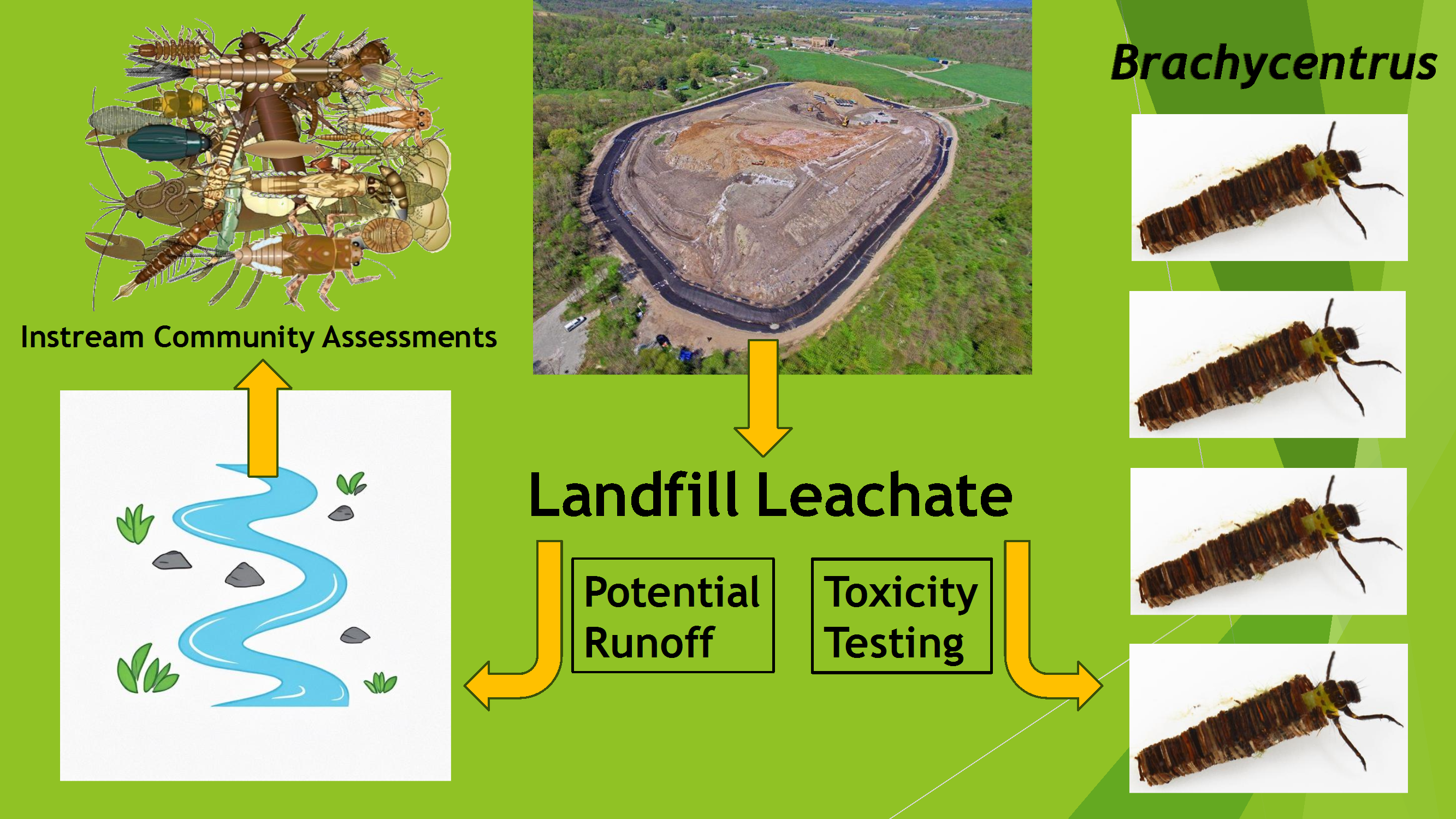
Toxicity of Landfill Leachate to Stream-Dwelling Benthic Macroinvertebrates


Abstract
1. Introduction
2. Materials and Methods
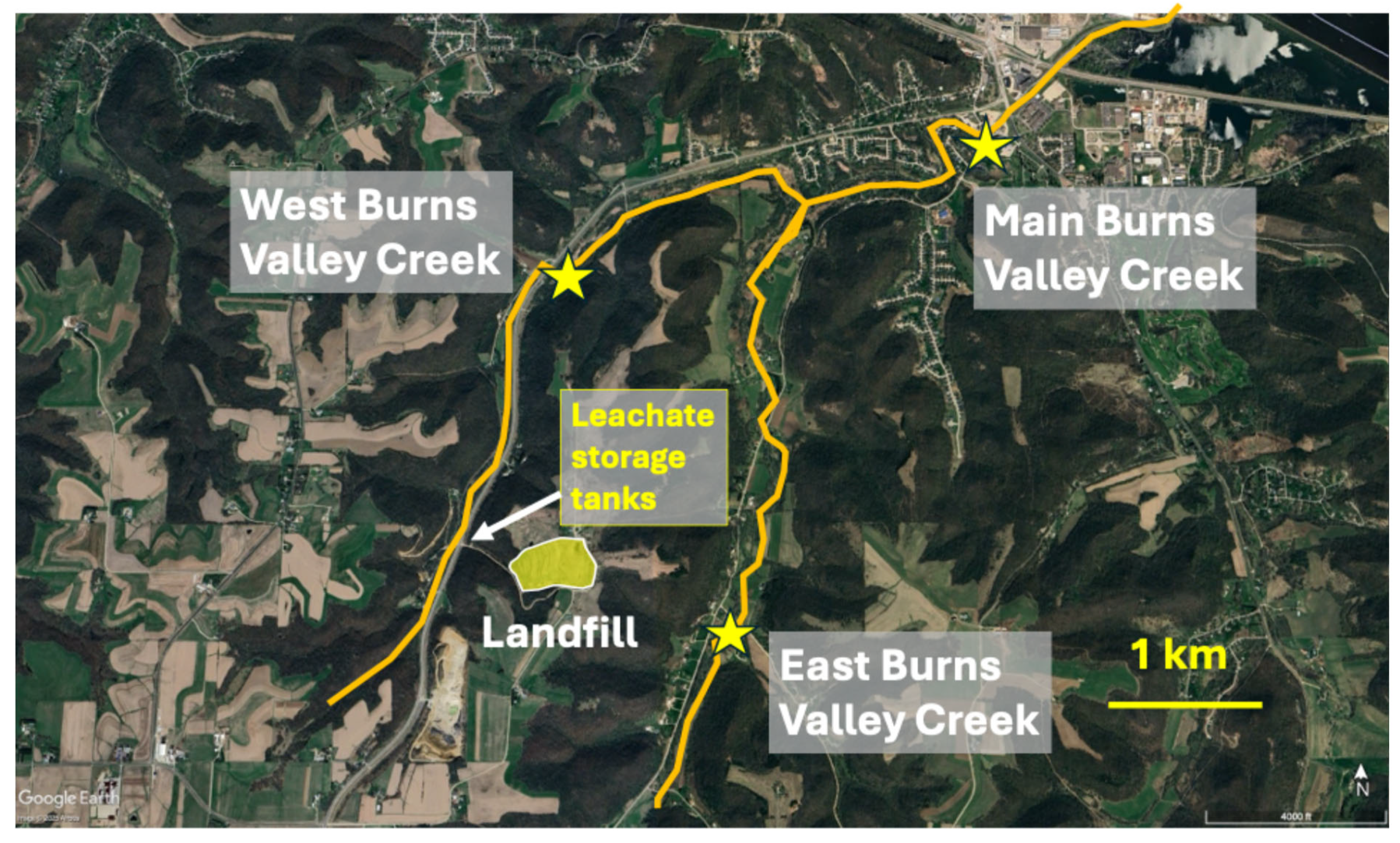
2.1. Winona County Landfill and Nearby Streams
2.2. Benthic Macroinvertebrate Community Assessments
2.3. Laboratory Testing
- Twenty-four h survival tests using 10 different taxa (insects and non-insect arthropods) and 100% leachate. Mortality checked after 24 h.
- Twenty-four survival tests using Brachycentrus caddisfly larvae and various leachate concentrations (0, 10, 20, 30, … 100%). Dilutions were prepared using field-collected stream water. Ten larvae were exposed to each leachate concentration. Mortality checked after 24 h. Experiment conducted twice. Brachycentrus larvae were selected for this and subsequent tests due to its sensitivity to pollutants (Table 1) and its high abundance within the Burns Valley Creek system.
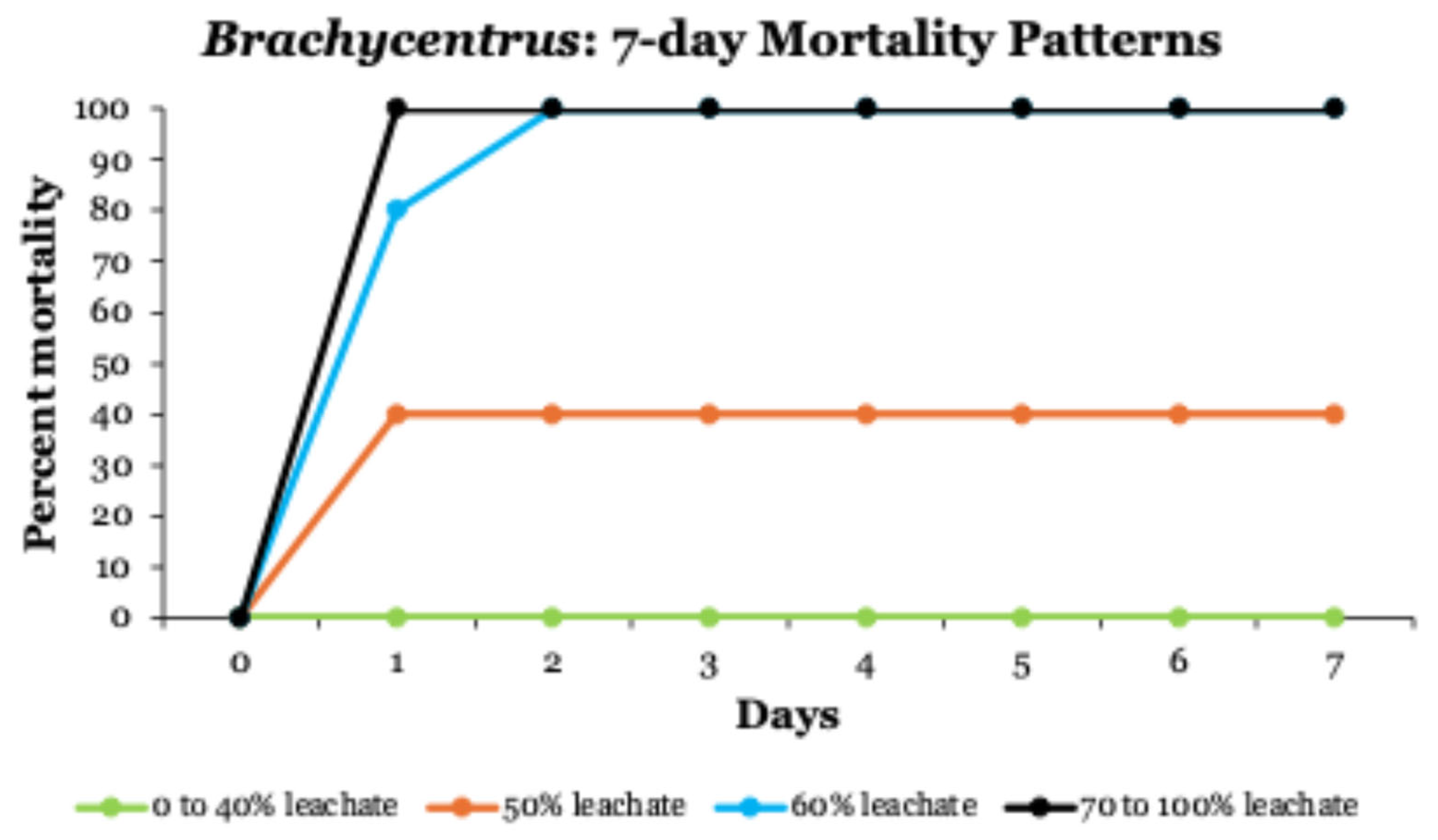
- Seven-day survival tests using Brachycentrus caddisfly larvae and various leachate concentrations (0, 10, 20, 30, … 100%). Ten larvae were exposed to each leachate concentration. Mortality checked daily for 7 days.
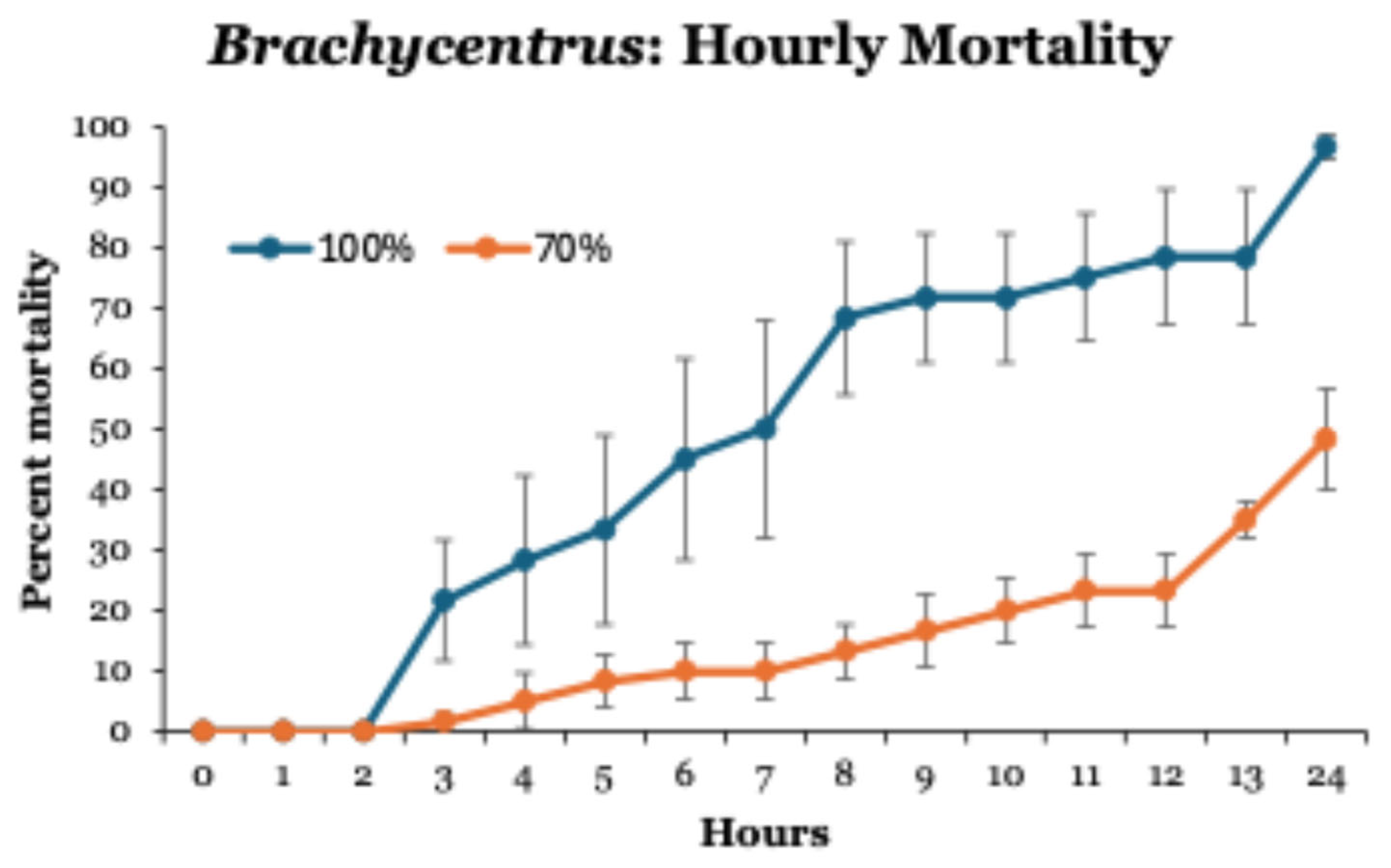
- Twenty-four h survival tests using Brachycentrus caddisfly larvae and leachate concentrations of 70 and 100%. Ten larvae were exposed in each of six replicates at each leachate concentration plus controls. Mortality checked hourly for 13 h, then after 24 h.
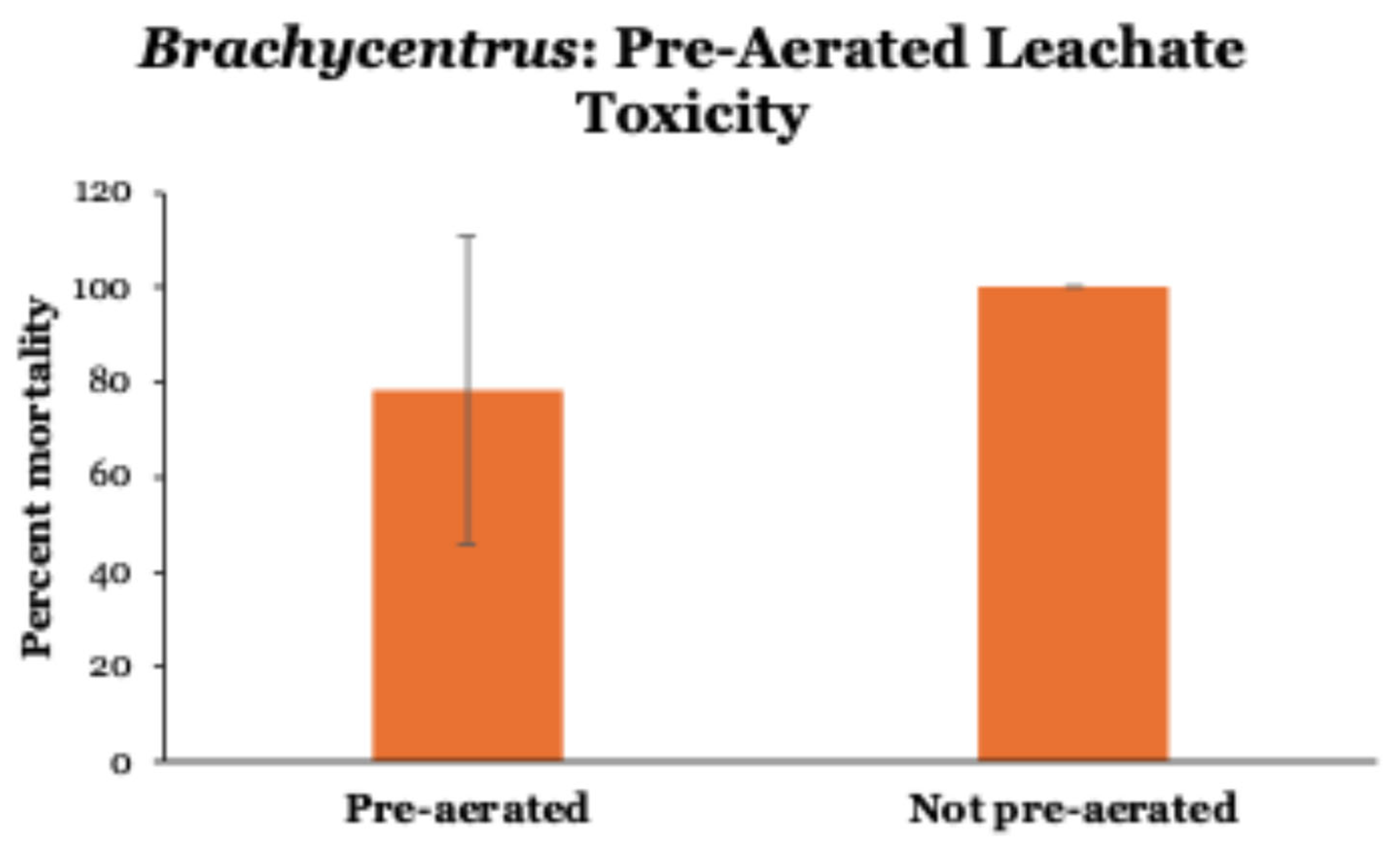
- Twenty-four h survival tests using Brachycentrus caddisfly larvae and 100% leachate (pre-aerated for 24 h prior to use to potentially reduce toxicities [2] versus not pre-aerated). Ten larvae were exposed in each of six replicates for each treatment plus controls. Mortality checked after 24 h. Mortality checked after 24 h.
2.4. Statistical Analyses
3. Results
3.1. Benthic Macroinvertebrate Community Assessments
3.2. Landfill Leachate Chemical Analyses
3.3. Leachate Toxicity Tests
4. Discussion
5. Conclusions
Author Contributions
Funding
Institutional Review Board Statement
Informed Consent Statement
Data Availability Statement
Acknowledgments
Conflicts of Interest
References
- Ritter, W.F. The history of landfills and landfill gas management in the U.S. Acad. Environ. Sci. Sust. 2024, 1. [Google Scholar] [CrossRef]
- Luo, H.; Zeng, Y.; Cheng, Y.; He, D.; Pan, X. Recent advances in municipal landfill leachate: A review focusing on its characteristics, treatment, and toxicity assessment. Sci. Total Environ. 2020, 703, 135468. [Google Scholar] [CrossRef] [PubMed]
- Anand, N.; Palani, S.G. A comprehensive investigation of toxicity and pollution potential of municipal solid waste landfill leachate. Sci. Total Environ. 2022, 838, 155891. [Google Scholar] [CrossRef] [PubMed]
- Thomas, D.J.L.; Tyrrel, S.F.; Smith, R.; Farrow, S. Bioassays for the evaluation of landfill leachate toxicity. J. Toxicol. Environ. Health B 2009, 12, 83–105. [Google Scholar] [CrossRef]
- Abdel-Shafy, H.I.; Ibrahim, A.M.; Al-Sulaiman, A.M.; Okasha, R.A. Landfill leachate: Sources, nature, organic composition, and treatment: An environmental overview. Ain Shams Eng. J. 2024, 15, 102293. [Google Scholar] [CrossRef]
- Friedland, A.; Relyea, R.; Courard-Hauri, D. Environmental Science: Foundations and Applications; W.H. Freeman: New York, NY, USA, 2012. [Google Scholar]
- Cunningham, W.P.; Cunningham, M.A. Environmental Science: A Global Concern, 11th ed.; McGraw Hill: New York, NY, USA, 2010. [Google Scholar]
- Cameron, R.D.; Koch, F.A. Toxicity of landfill leachate. J. Water Pollut. Control Fed. 1980, 52, 760–769. [Google Scholar]
- Clément, B.; Merlin, G. The contribution of ammonia and alkalinity to landfill leachate toxicity to duckweed. Sci. Total Environ. 1995, 170, 71–79. [Google Scholar] [CrossRef]
- Isidori, M.; Lavorgna, M.; Nardelli, A.; Parrella, A. Toxicity identification evaluation of leachates from municipal solid waste landfills: A multispecies approach. Chemosphere 2003, 52, 85–92. [Google Scholar] [CrossRef]
- Svensson, B.-M.; Mathiasson, L.; Mårtensson, L.; Bergström, S. Artemia salina as a test organism for assessment of acute toxicity of leachate water from landfills. Environ. Monit. Assess. 2005, 102, 309–321. [Google Scholar] [CrossRef]
- Pivato, A.; Gaspari, L. Acute toxicity test of leachates from traditional and sustainable landfills using luminescent bacteria. Waste Manag. 2006, 26, 1148–1155. [Google Scholar] [CrossRef]
- Fauziah, S.H.; Izzati, M.N.; Agamutha, P. Toxicity on Anabas testudineus: A case study of sanitary landfill leachate. Procedia Environ. Sci. 2013, 18, 14–19. [Google Scholar] [CrossRef]
- Przydatek, G. The analysis of the possibility of using biological tests for assessment of toxicity of leachate from an active municipal landfill. Environ. Toxicol. Pharmacol. 2019, 67, 94–101. [Google Scholar] [CrossRef] [PubMed]
- Kalka, J. Landfill leachate toxicity removal in combined treatment with municipal wastewater. Sci. World J. 2012, 2012, 202897. [Google Scholar] [CrossRef]
- Matejczyk, M.; Plaza, G.A.; Nalęcz-Jawecki, G.; Ulfig, K.; Markowske-Szczupak, A. Estimation of the environmental risk posed by landfills using chemical, microbiological and ecotoxicological testing of leachates. Chemosphere 2011, 82, 1017–1023. [Google Scholar] [CrossRef] [PubMed]
- Kalčíková, G.; Zupančič, M.; Levei, E.A.; Miclean, M.; Englande, A.J.; Gotvajn, A.Ž. Application of multiple toxicity tests in monitoring of landfill leachate treatment efficiency. Environ. Monitor. Assess. 2015, 187, 489. [Google Scholar] [CrossRef]
- Budi, S.; Suliasih, B.A.; Othman, M.S.; Heng, L.Y.; Surif, S. Toxicity identification evaluation of landfill leachate using fish, prawn and seed plant. Waste Manag. 2016, 55, 231–237. [Google Scholar] [CrossRef]
- Ghosh, P.; Thakur, I.S.; Kaushik, A. Bioassays for toxicological risk assessment of landfill leachate: A review. Ecotox. Environ. Saf. 2017, 141, 259–270. [Google Scholar] [CrossRef]
- Gupta, A.; Paulraj, R. Leachate composition and toxicity assessment: An integrated approach correlating physicochemical parameters and toxicity of leachates from MSW landfill in Delhi. Environ. Technol. 2017, 38, 1599–1605. [Google Scholar] [CrossRef]
- Hilsenhoff, W.L. Aquatic Insects of Wisconsin; Wisconsin Department of Natural Resources Technical Bulletin No. 89; Wisconsin Department of Natural Resources: Madison, WI, USA, 1975. [Google Scholar]
- Eddy, S.; Hodson, A.C.; Underhill, J.C.; Schmid, W.D.; Gilbertson, D.E. Taxonomic Keys to the Common Animals of the North Central States; Burgess Publishing: Minneapolis, MN, USA, 1982. [Google Scholar]
- Merritt, R.W.; Cummins, K.W. An Introduction to the Aquatic Insects of North America, 2nd ed.; Kendall/Hunt Publishing: Dubuque, IA, USA, 1984. [Google Scholar]
- Pennak, R.W. Fresh-Water Invertebrates of the United States, 3rd ed.; John Wiley & Sons: New York, NY, USA, 1989. [Google Scholar]
- Thorp, J.H.; Covich, A.P. Ecology and Classification of North American Freshwater Invertebrates; Academic Press: San Diego, CA, USA, 1991. [Google Scholar]
- Hilsenhoff, W.L. Using a Biotic Index to Evaluate Water Quality in Streams; Wisconsin Department of Natural Resources Technical Bulletin No.132; Wisconsin Department of Natural Resources: Madison, WI, USA, 1982. [Google Scholar]
- Hilsenhoff, W.L. An improved index of organic stream pollution. Grt. Lakes Entomol. 1987, 20, 31–39. [Google Scholar] [CrossRef]
- Wittman, E.; Mundahl, N.D. Development and validation of a benthic index of biotic integrity (B-IBI) for streams in southeastern Minnesota. Winona State Univ. Floruit 2003, 1, 41–48. [Google Scholar]
- Magner, J.A.; Vondracek, B.; Brooks, K.N. Grazed riparian management and stream channel response in southeastern Minnesota (USA) streams. Environ. Manag. 2008, 42, 377–390. [Google Scholar] [CrossRef] [PubMed]
- Kumar, V.; Sheoran, O.P.; Rani, S.; Malik, K. Development of a web-based tool for probit analysis to compute LC50/LD50/GR50 for its use in toxicology studies. J. Appl. Nat. Sci. 2020, 12, 641–646. [Google Scholar] [CrossRef]
- Waters, T.F. Streams and Rivers of Minnesota; University of Minnesota Press: Minneapolis, MN, USA, 1980. [Google Scholar]
- Troelstrup, N.H., Jr.; Perry, J.A. Water quality in southeastern Minnesota streams: Observations along a gradient of land use and geology. J. Minn. Acad. Sci. 1989, 55, 6–13. [Google Scholar]
- Lenat, D.R. A biotic index for the southeastern United States: Derivation and list of tolerance values, with criteria for assigning water quality ratings. J. N. Am. Benthol. Soc. 1993, 12, 279–290. [Google Scholar] [CrossRef]
- Hill, B.H.; Herlihy, A.T.; Kaufmann, P.R.; Stevenson, R.J.; McCormick, F.H.; Johnson, C.B. Use of periphyton assemblage data as an index of biotic integrity. J. N. Am. Benthol. Soc. 2000, 19, 50–67. [Google Scholar] [CrossRef]
- Wang, L.; Lyons, J. Fish and benthic macroinvertebrates as indicators of stream degradation in urbanizing watersheds. In Biological Response Signatures: Indicator Patterns Using Aquatic Communities; Simon, T.P., Ed.; CRC Press: Boca Raton, FL, USA, 2002; pp. 227–249. [Google Scholar]
- Karr, J.R.; Chu, E.W. Restoring Life in Running Waters: Better Biological Monitoring; Island Press: Washington, DC, USA, 2013. [Google Scholar]
- Clements, W.H.; Kiffney, P.M. Integrated laboratory and field approach for assessing impacts of heavy metals at the Arkansas River, Colorado. Environ. Toxicol. Chem. 1994, 13, 397–404. [Google Scholar] [CrossRef]
- Courtney, L.A.; Clements, W.H. Assessing the influence of water and substratum quality on benthic macroinvertebrate communities in a metal-polluted stream: An experimental approach. Freshw. Biol. 2002, 47, 1766–1778. [Google Scholar] [CrossRef]
- Clements, W.H. Small-scale experiments support causal relationships between metal contamination and macroinvertebrate community responses. Ecol. Appl. 2004, 14, 954–967. [Google Scholar] [CrossRef]
- Clark, J.L.; Clements, W.H. The use of in situ and stream microcosm experiments to assess population- and community-level responses to metals. Environ. Toxicol. Chem. 2006, 25, 2306–2312. [Google Scholar] [CrossRef]
- Clements, W.H.; Vieira, N.K.M.; Church, S.E. Quantifying restoration success and recovery in a metal-polluted stream: A 17-year assessment of physicochemical and biological responses. J. Appl. Ecol. 2010, 47, 899–910. [Google Scholar] [CrossRef]
- Clements, W.H.; Kotalik, C. Effects of major ions on natural benthic communities: An experimental assessment of the US Environmental Protection Agency aquatic life benchmark for conductivity. Freshw. Sci. 2010, 47, 899–910. [Google Scholar] [CrossRef]
- Kotalik, C.; Cadmus, P.; Clements, W. Before-after control-impact field surveys and novel experimental approaches provide valuable insights for characterizing stream recovery from acid mine drainage. Sci. Total Environ. 2021, 771, 145419. [Google Scholar] [CrossRef]
- Mundahl, N.D.; Mundahl, E.D. Potential influence of suspended sediments on the population dynamics and behavior of filter-feeding Brachycentrus occidentalis (Trichoptera: Brachycentridae) larvae in a southeastern Minnesota, USA, trout stream. Water 2024, 16, 863. [Google Scholar] [CrossRef]




| Taxa | Tolerance Rating | MBVC | WBVC | EBVC |
|---|---|---|---|---|
| NON-INSECTS | ||||
| Amphipods | 4 | 9.16 | 5.04 | 4.36 |
| Isopods | 8 | 7.78 | 18.11 | 30.21 |
| Acari | 4 | 0.05 | ||
| Physella | 8 | 0.09 | 8.78 | |
| Nematomorpha | 5 | 0.09 | ||
| Amnicola | 8 | 0.05 | ||
| Planarian | 4 | 0.05 | ||
| Oligochaeta | 7 | 1.39 | 0.28 | |
| Sphaeriidae | 8 | 0.05 | ||
| INSECTS | ||||
| Mayflies | ||||
| Baetis | 4 | 20.70 | 4.71 | 20.11 |
| Caddisflies | ||||
| Brachycentrus | 1 | 57.60 | 24.63 | 11.21 |
| Glossosoma | 0 | 0.55 | 1.52 | 5.28 |
| Hesperophylax | 4 | 5.04 | 0.93 | |
| Hydropsyche | 4 | 1.28 | 2.40 | 3.15 |
| Cheumatopsyche | 4 | 0.51 | ||
| Hydroptila | 4 | 0.09 | ||
| Limnephilus | 4 | 0.05 | ||
| Chimarra | 3 | 0.09 | ||
| Rhyacophila | 0 | 0.09 | ||
| Beetles | ||||
| Optioservus | 4 | 2.11 | 25.83 | 9.64 |
| Helichus | 4 | 0.18 | 0.51 | 0.74 |
| Gyrinus | 4 | 0.05 | ||
| True flies | ||||
| Chironomidae | 6 | 0.05 | 0.19 | |
| Antocha | 3 | 0.09 | 0.28 | |
| Tipula | 3 | 0.18 | 0.28 | |
| Dicranota | 3 | 0.69 | 0.37 | |
| Simulium | 6 | 0.18 | 0.18 | 12.97 |
| Hexatoma | 3 | 0.05 | ||
| Total organisms | 1092 | 2164 | 1079 |
| Metric | MBVC | WBVC | EBVC | K-W H | DF | p |
|---|---|---|---|---|---|---|
| Density | 1820 (435) | 3607 (1525) | 1798 (401) | 3.29 | 2 | 0.193 |
| Taxa richness | 9.0 (0.0) | 16.3 (1.2) | 12.3 (2.5) | 6.82 | 2 | 0.033 |
| Hilsenhoff index | 2.48 (0.56) excellent | 4.15 (0.32) very good | 4.88 (0.39) good | 7.2 | 2 | 0.0273 |
| B-IBI | 17 (3) poor | 48 (3) fair/good | 27 (8) poor/fair | 6.82 | 2 | 0.033 |
| Analyte | Unit | Result | Reporting Limit |
|---|---|---|---|
| Alkalinity, Total | mg/L | 2490 | 10 |
| Arsenic | µg/L | 17.6 | 2.0 |
| Biochemical oxygen demand | mg/L | 241 | 1 |
| Cadmium | µg/L | 0.2 | 0.2 |
| Chloride | µg/L | 215,000 | 200 |
| Chromium | µg/L | 598,000 | 3000 |
| Copper | µg/L | <2 | 2 |
| EH, Field | units | −39.2 | 2 |
| Iron | µg/L | 21,400 | 8 |
| Lead | µg/L | 49.0 | 1.0 |
| Magnesium | µg/L | 170,000 | 30 |
| Manganese | µg/L | 1810 | 3 |
| Mercury | µg/L | <0.06 | 0.06 |
| Molybdenum | µg/L | <9 | 9 |
| Nitrate + Nitrite | µg/L | <50 | 50 |
| Nitrogen, Ammonia | µg/L | 247,000 | 80 |
| pH | units | 7.86 | 1.00 |
| Potassium | µg/L | 161,000 | 100 |
| Sodium | µg/L | 460,000 | 50 |
| Solids, Total Dissolved | mg/L | 3390 | 1 |
| Solids, Total Suspended | mg/L | 28 | 1 |
| Specific conductance | µmhos/cm | 5234 | 1 |
| Sulfate | mg/L | 87 | 4 |
| Turbidity | NTU | 148 | 0.1 |
| Zinc | µg/L | 52 | 7 |
| Volatile organics | |||
| Acetone | µg/L | 94.2 | 6.0 |
| Ethyl ether | µg/L | 1.7 | 0.7 |
| Methyl ethyl ketone | µg/L | 39.9 | 5.0 |
| Tetrahydrofuran | µg/L | 16.6 | 5.0 |
| Taxa | Tolerance Value * | n | Mortality % |
|---|---|---|---|
| Amphipods—Gammarus pseudolimnaeus | 4 | 10 | 100 |
| Isopods—Asellus intermedius | 8 | 12 | 100 |
| Virile crayfish—Faxonius virilis | 6 | 6 | 100 |
| Water bug—Belostoma | 5 | 10 | 0 |
| Water scorpion—Ranatra | 5 | 2 | 0 |
| Cranefly larvae—Tipula | 3 | 4 | 100 |
| Caddisfly larvae | |||
| Brachycentrus | 1 | 10 | 100 |
| Ptilostomis | 4 | 11 | 0 |
| Pycnopsyche | 4 | 20 | 60 |
| Limnephilus | 4 | 6 | 33 |
| Leachate | Percent Mortality | |
|---|---|---|
| Concentration % | Test 1 | Test 2 |
| 100 | 100 | 100 |
| 90 | 100 | 100 |
| 80 | 100 | 100 |
| 70 | 100 | 100 |
| 60 | 20 | 80 |
| 50 | 20 | 0 |
| 40 | 0 | 0 |
| 30 | 0 | 0 |
| 20 | 0 | 0 |
| 10 | 0 | 0 |
| 0 | 0 | 0 |
| Duration | Median LC50 |
|---|---|
| 24 h | 46.5% leachate |
| 48 h | 50.5% leachate |
| 96 h | 50.5% leachate |
| 7 days | 54.8% leachate |
Disclaimer/Publisher’s Note: The statements, opinions and data contained in all publications are solely those of the individual author(s) and contributor(s) and not of MDPI and/or the editor(s). MDPI and/or the editor(s) disclaim responsibility for any injury to people or property resulting from any ideas, methods, instructions or products referred to in the content. |
© 2026 by the authors. Licensee MDPI, Basel, Switzerland. This article is an open access article distributed under the terms and conditions of the Creative Commons Attribution (CC BY) license.
Share and Cite
Mundahl, N.D.; Mundahl, E.D. Toxicity of Landfill Leachate to Stream-Dwelling Benthic Macroinvertebrates. Toxics 2026, 14, 109. https://doi.org/10.3390/toxics14020109
Mundahl ND, Mundahl ED. Toxicity of Landfill Leachate to Stream-Dwelling Benthic Macroinvertebrates. Toxics. 2026; 14(2):109. https://doi.org/10.3390/toxics14020109
Chicago/Turabian StyleMundahl, Neal D., and Erik D. Mundahl. 2026. "Toxicity of Landfill Leachate to Stream-Dwelling Benthic Macroinvertebrates" Toxics 14, no. 2: 109. https://doi.org/10.3390/toxics14020109
APA StyleMundahl, N. D., & Mundahl, E. D. (2026). Toxicity of Landfill Leachate to Stream-Dwelling Benthic Macroinvertebrates. Toxics, 14(2), 109. https://doi.org/10.3390/toxics14020109