
A GC-MS Database of Nitrogen-Rich Volatile Compounds

 , and
, and
Abstract
1. Introduction
2. Materials and Methods
2.1. Sample Preparation
2.2. GC-MS Analysis
2.3. Data Processing and Database Assembly
3. Results and Discussion
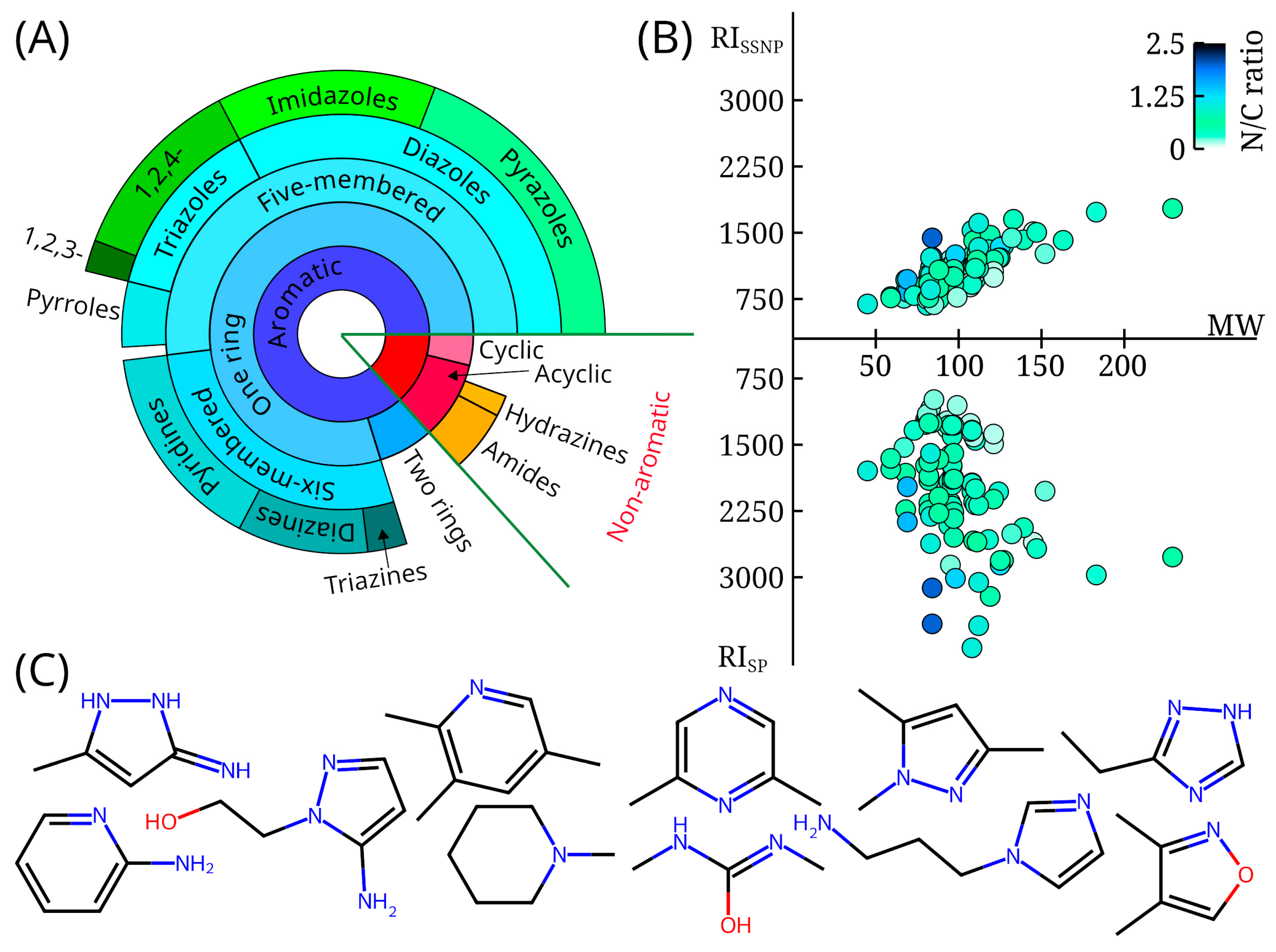
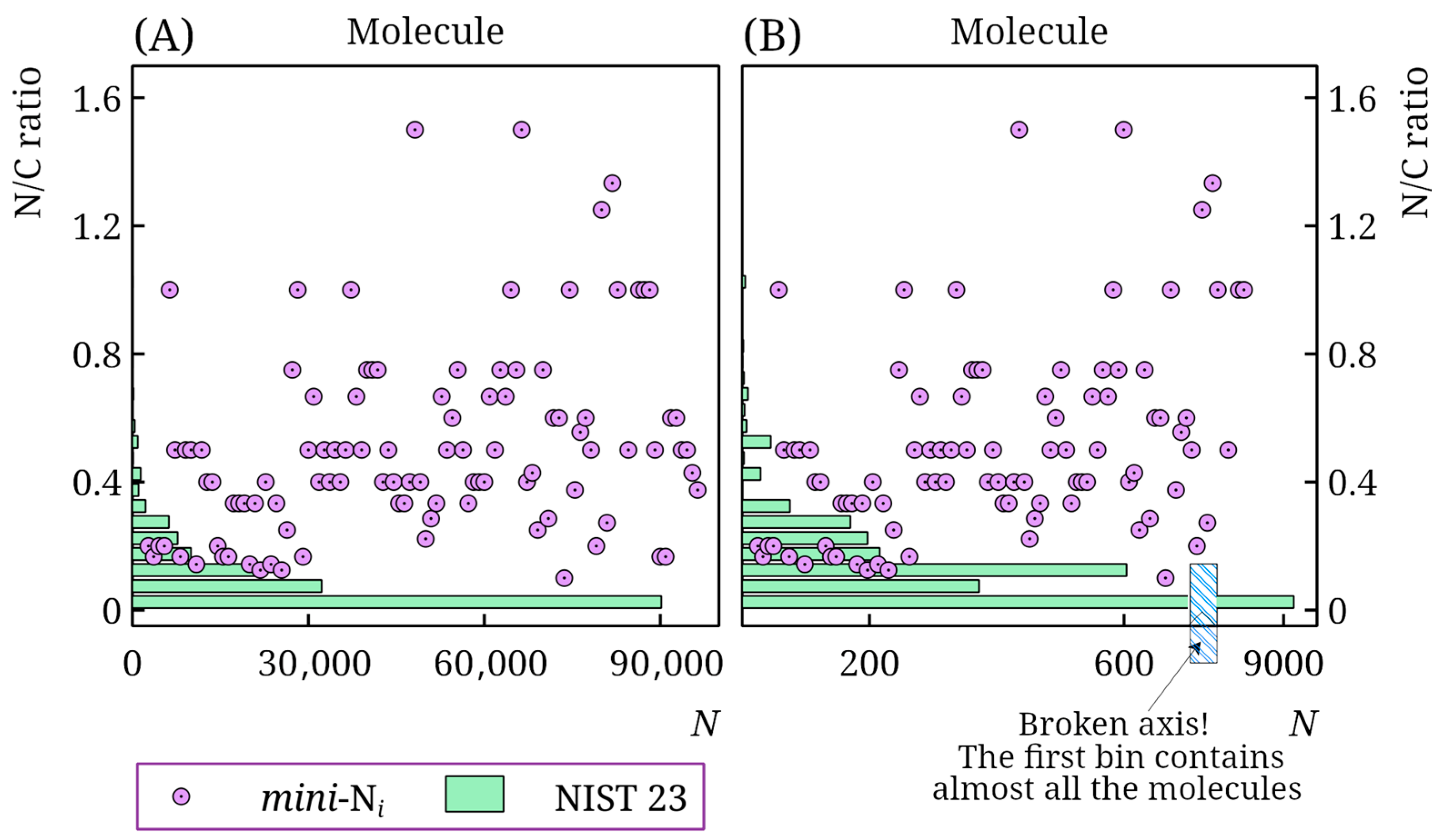
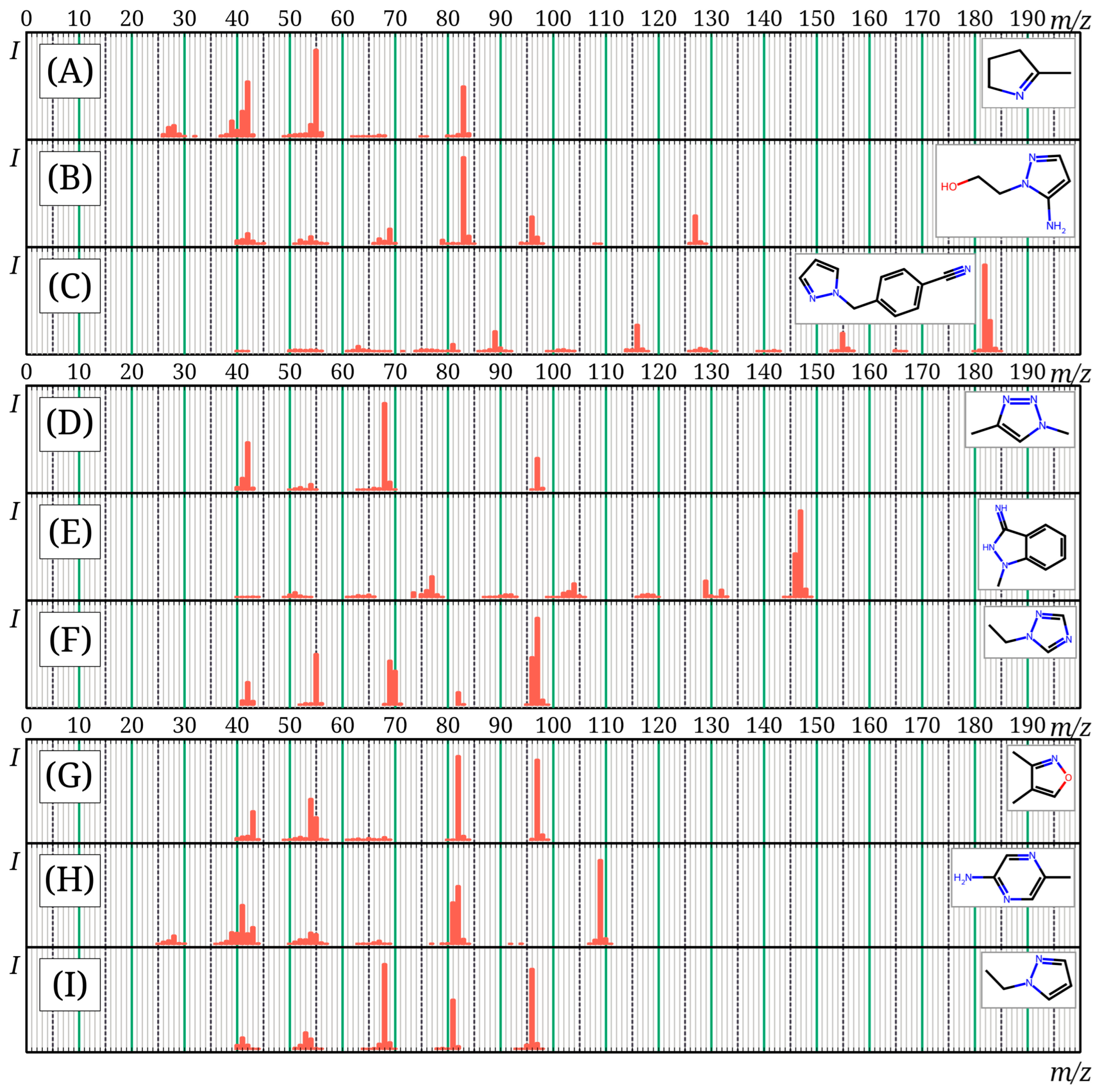
3.1. The mini-Ni GC-MS Database
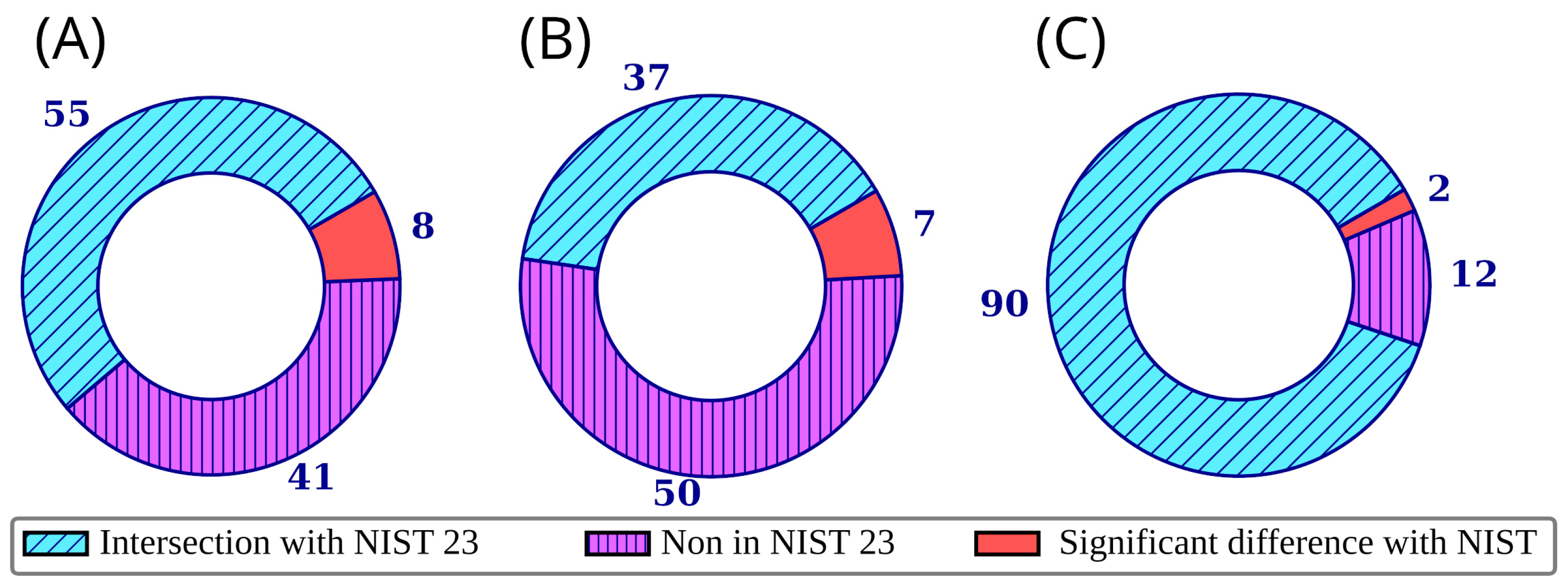
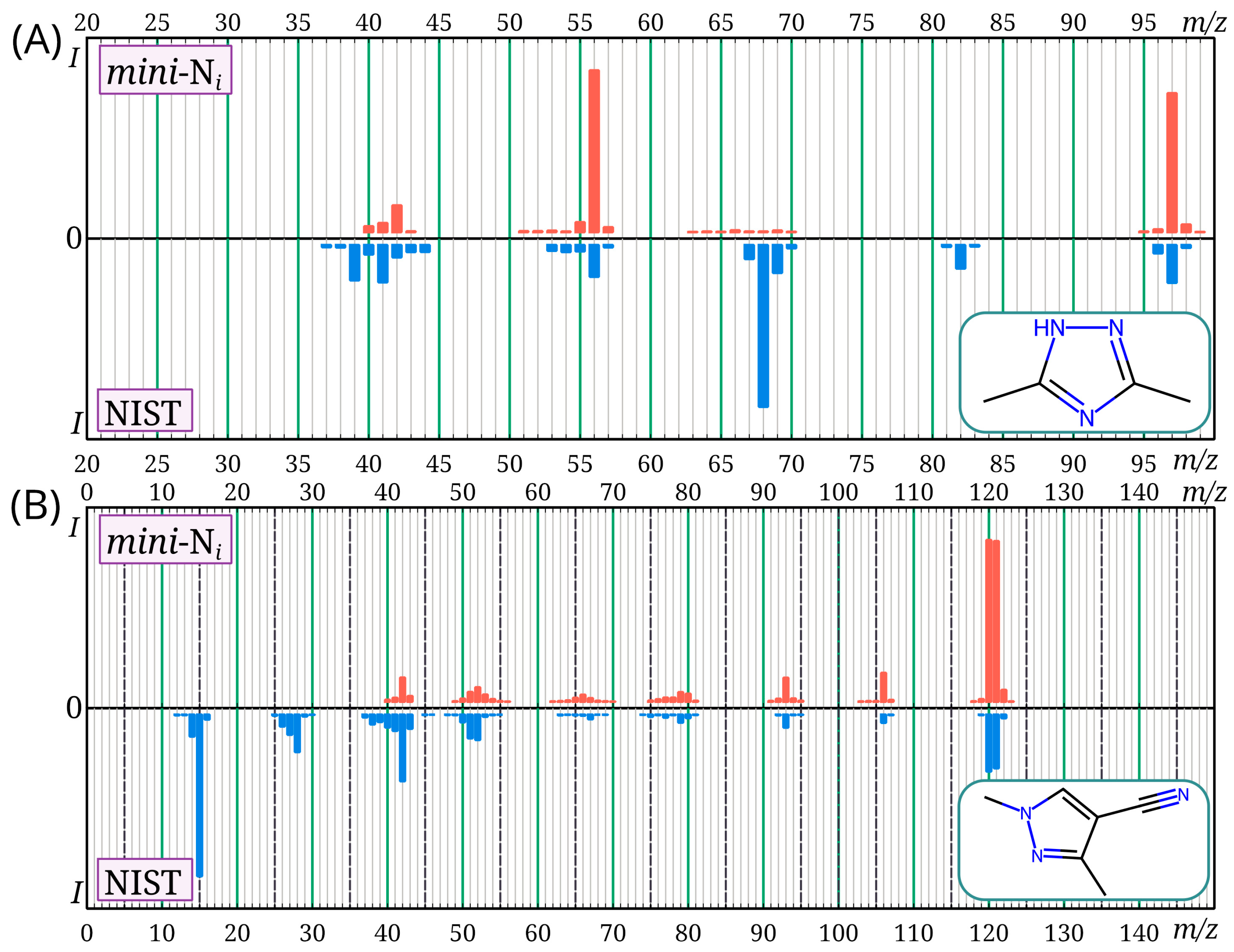
3.2. Inconsistencies with the NIST Database
4. Conclusions
Author Contributions
Funding
Institutional Review Board Statement
Informed Consent Statement
Data Availability Statement
Conflicts of Interest
References
- Sutton, G.P. History of Liquid Propellant Rocket Engines; American Institute of Aeronautics and Astronautics: Reston, VA, USA, 2006; ISBN 978-1-56347-649-5. [Google Scholar]
- Byers, M.; Byers, C. Toxic Splash: Russian Rocket Stages Dropped in Arctic Waters Raise Health, Environmental and Legal Concerns. Polar Rec. 2017, 53, 580–591. [Google Scholar] [CrossRef]
- Rodin, I.A.; Moskvin, D.N.; Smolenkov, A.D.; Shpigun, O.A. Transformations of Asymmetric Dimethylhydrazine in Soils. Russ. J. Phys. Chem. A 2008, 82, 911–915. [Google Scholar] [CrossRef]
- Kenessov, B.N.; Koziel, J.A.; Grotenhuis, T.; Carlsen, L. Screening of Transformation Products in Soils Contaminated with Unsymmetrical Dimethylhydrazine Using Headspace SPME and GC–MS. Anal. Chim. Acta 2010, 674, 32–39. [Google Scholar] [CrossRef]
- Koroleva, T.V.; Semenkov, I.N.; Lednev, S.A.; Soldatova, O.S. Unsymmetrical Dimethylhydrazine (UDMH) and Its Transformation Products in Soils: A Review of the Sources, Detection, Behavior, Toxicity, and Remediation of Polluted Territories. Eurasian Soil Sc. 2023, 56, 210–225. [Google Scholar] [CrossRef]
- Sholokhova, A.Y.; Matyushin, D.D.; Grinevich, O.I.; Borovikova, S.A.; Buryak, A.K. Intelligent Workflow and Software for Non-Target Analysis of Complex Samples Using a Mixture of Toxic Transformation Products of Unsymmetrical Dimethylhydrazine as an Example. Molecules 2023, 28, 3409. [Google Scholar] [CrossRef]
- Sirieys, E.; Gentgen, C.; Jain, A.; Milton, J.; De Weck, O.L. Space Sustainability Isn’t Just about Space Debris: On the Atmospheric Impact of Space Launches. MIT Sci. Policy Rev. 2022, 3, 143–151. [Google Scholar] [CrossRef]
- Carlsen, L.; Kenesova, O.A.; Batyrbekova, S.E. A Preliminary Assessment of the Potential Environmental and Human Health Impact of Unsymmetrical Dimethylhydrazine as a Result of Space Activities. Chemosphere 2007, 67, 1108–1116. [Google Scholar] [CrossRef] [PubMed]
- Cherednichenko, O.; Chirikova, M.; Magda, I.; Lopatin, O.; Nuraliyev, S.; Pilyugina, A.; Azizbekova, D. Eco-Toxicological Effects Assessment: Comparative Characteristics of Environmental Conditions and Status of Vertebrate Indicator Species in the “Dnepr” Launch Vehicle Accident Zone. Environ. Monit. Assess. 2024, 196, 951. [Google Scholar] [CrossRef] [PubMed]
- Lednev, S.A.; Koroleva, T.V.; Semenkov, I.N.; Klink, G.V.; Krechetov, P.P.; Sharapova, A.V.; Karpachevskiy, A.M. The Natural Regeneration of Desert Ecosystem Vegetation at the 2013 Crash Site of a Proton-M Launch Vehicle, Republic of Kazakhstan. Ecol. Indic. 2019, 101, 603–613. [Google Scholar] [CrossRef]
- Ul’yanovskii, N.V.; Kosyakov, D.S.; Popov, M.S.; Shavrina, I.S.; Ivakhnov, A.D.; Kenessov, B.; Lebedev, A.T. Rapid Quantification and Screening of Nitrogen-Containing Rocket Fuel Transformation Products by Vortex Assisted Liquid-Liquid Microextraction and Gas Chromatography—High-Resolution Orbitrap Mass Spectrometry. Microchem. J. 2021, 171, 106821. [Google Scholar] [CrossRef]
- Bukenov, B.; Karimkyzy, N.; Smail, A.; Kurmanbayeva, T.; Kenessov, B. On-Site Quantification of Transformation Products of Rocket Fuel Unsymmetrical Dimethylhydrazine in Air Using Solid-Phase Microextraction. J. Sep. Sci. 2025, 48, e70113. [Google Scholar] [CrossRef] [PubMed]
- Kurmanbayeva, T.; Rymzhanova, Z.; Kenessov, B. On-Site Gas Chromatographic Quantification of Transformation Products of Rocket Fuel Unsymmetrical Dimethylhydrazine in Water Using Vacuum-Assisted Headspace Solid-Phase Microextraction. Int. J. Environ. Anal. Chem. 2025. [Google Scholar] [CrossRef]
- Kenessov, B.; Alimzhanova, M.; Sailaukhanuly, Y.; Baimatova, N.; Abilev, M.; Batyrbekova, S.; Carlsen, L.; Tulegenov, A.; Nauryzbayev, M. Transformation Products of 1,1-Dimethylhydrazine and Their Distribution in Soils of Fall Places of Rocket Carriers in Central Kazakhstan. Sci. Total Environ. 2012, 427–428, 78–85. [Google Scholar] [CrossRef]
- Karnaeva, A.E.; Sholokhova, A.Y. Validation of the Identification Reliability of Known and Assumed UDMH Transformation Products Using Gas Chromatographic Retention Indices and Machine Learning. Chemosphere 2024, 362, 142679. [Google Scholar] [CrossRef]
- Matyushin, D.D.; Karnaeva, A.E.; Sholokhova, A.Y. Critical Evaluation of the NIST Retention Index Database Reliability with Specific Examples. Anal. Bioanal. Chem. 2024, 416, 6181–6186. [Google Scholar] [CrossRef]
- Samokhin, A.; Sotnezova, K.; Lashin, V.; Revelsky, I. Evaluation of Mass Spectral Library Search Algorithms Implemented in Commercial Software. J. Mass Spectrom. 2015, 50, 820–825. [Google Scholar] [CrossRef]
- Babushok, V.I.; Linstrom, P.J.; Reed, J.J.; Zenkevich, I.G.; Brown, R.L.; Mallard, W.G.; Stein, S.E. Development of a Database of Gas Chromatographic Retention Properties of Organic Compounds. J. Chromatogr. A 2007, 1157, 414–421. [Google Scholar] [CrossRef]
- Valdez, C.A.; Leif, R.N.; Hok, S.; Alcaraz, A. Assessing the Reliability of the NIST Library during Routine GC-MS Analyses: Structure and Spectral Data Corroboration for 5,5-diphenyl-1,3-dioxolan-4-one during a Recent OPCW Proficiency Test. J. Mass Spectrom. 2018, 53, 419–422. [Google Scholar] [CrossRef]
- Qu, C.; Schneider, B.I.; Kearsley, A.J.; Keyrouz, W.; Allison, T.C. Predicting Kováts Retention Indices Using Graph Neural Networks. J. Chromatogr. A 2021, 1646, 462100. [Google Scholar] [CrossRef] [PubMed]
- Geer, L.Y.; Stein, S.E.; Mallard, W.G.; Slotta, D.J. AIRI: Predicting Retention Indices and Their Uncertainties Using Artificial Intelligence. J. Chem. Inf. Model. 2024, 64, 690–696. [Google Scholar] [CrossRef]
- Allen, F.; Pon, A.; Greiner, R.; Wishart, D. Computational Prediction of Electron Ionization Mass Spectra to Assist in GC/MS Compound Identification. Anal. Chem. 2016, 88, 7689–7697. [Google Scholar] [CrossRef]
- Wakoli, J.; Anjum, A.; Sajed, T.; Oler, E.; Wang, F.; Gautam, V.; LeVatte, M.; Wishart, D.S. GCMS-ID: A Webserver for Identifying Compounds from Gas Chromatography Mass Spectrometry Experiments. Nucleic Acids Res. 2024, 52, W381–W389. [Google Scholar] [CrossRef] [PubMed]
- Wei, J.N.; Belanger, D.; Adams, R.P.; Sculley, D. Rapid Prediction of Electron–Ionization Mass Spectrometry Using Neural Networks. ACS Cent. Sci. 2019, 5, 700–708. [Google Scholar] [CrossRef] [PubMed]
- Ji, H.; Deng, H.; Lu, H.; Zhang, Z. Predicting a Molecular Fingerprint from an Electron Ionization Mass Spectrum with Deep Neural Networks. Anal. Chem. 2020, 92, 8649–8653. [Google Scholar] [CrossRef] [PubMed]
- Khrisanfov, M.; Samokhin, A. A General Procedure for Rounding m/z Values in Low-resolution Mass Spectra. Rapid. Comm. Mass Spectrom. 2022, 36, e9294. [Google Scholar] [CrossRef]
- Milman, B.L.; Zhurkovich, I.K. Mass Spectral Libraries: A Statistical Review of the Visible Use. TrAC Trends Anal. Chem. 2016, 80, 636–640. [Google Scholar] [CrossRef]
- Samokhin, A. The Identity Algorithm: How the Most Popular Electron Ionization Mass Spectral Library Search Engine Actually Works. J. Am. Soc. Mass Spectrom. 2024, 35, 3178–3183. [Google Scholar] [CrossRef]
- Stein, S.E.; Scott, D.R. Optimization and Testing of Mass Spectral Library Search Algorithms for Compound Identification. J. Am. Soc. Mass Spectrom. 1994, 5, 859–866. [Google Scholar] [CrossRef]
- Ames, J.M.; Guy, R.C.E.; Kipping, G.J. Effect of pH, Temperature, and Moisture on the Formation of Volatile Compounds in Glycine/Glucose Model Systems. J. Agric. Food Chem. 2001, 49, 4315–4323. [Google Scholar] [CrossRef]
- Stein, S.E. Estimating Probabilities of Correct Identification from Results of Mass Spectral Library Searches. J. Am. Soc. Mass Spectrom. 1994, 5, 316–323. [Google Scholar] [CrossRef]



| Name | ISSNP | ISP | Name | ISSNP | ISP |
|---|---|---|---|---|---|
| 1,3,5-Triazine a | 678 | 1171 | 3-Amino-5-methylpyrazole c | 1165 | 2548 |
| Formamide b | 694 | 1796 | 1-Methyl-2-imidazolemethanamine c | 1190 | - |
| 2-Methyl-1-pyrroline c | 758 | 1090 | 1,2,4,5-Tetramethylimidazole c | 1214 | 2033 |
| Dimethylisoxazole c | 818 | 1280 | 1,3,5-Trimethyl-1H-pyrazol-4-amine c | 1216 | 2810 |
| 1-Ethylpyrazole a | 819 | 1279 | 4-Methyl-1,2,4-triazole c | 1218 | 2619 |
| 1,5-Dimethyl-1H-pyrazole c | 891 | 1403 | 3-Amino-5-methyl-4H-1,2,4-triazole c | 1251 | 3012 |
| 1-Ethyl-1H-1,2,4-triazole a | 914 | 1596 | 2,6-Diaminopyridine a | 1262 | 2588 |
| 1-Vinylimidazole c | 947 | 1685 | 3,5-Diisopropylpyrazole a | 1263 | 2025 |
| 2-Aminopyrimidine a | 975 | 1892 | 1-(3-Aminopropyl)imidazole c | 1346 | - |
| 1,2,5-Trimethylpyrrole a | 1001 | 1412 | 2-(5-Aminopyrazol-1-yl)ethanol c | 1349 | 2809 |
| 1,4-Dimethyl-1H-1,2,3-triazole c | 1034 | 1878 | 3,4-Diaminopyridine c | 1410 | - |
| 2-Aminopyrazine c | 1060 | 2151 | 3-(3,5-Dimethyl-1H-pyrazol-1-yl)-3-oxopropanenitrile c | 1414 | - |
| 3,5-Dimethyl-1H-1,2,4-triazole c | 1064 | 2262 | 1-Methylbenzimidazole a | 1442 | 2509 |
| 2,4-Dimethylimidazole c | 1070 | 2194 | 1-Methyl-1H-indazol-3-amine c | 1504 | 2675 |
| 1,3-Dimethylurea c | 1078 | 2276 | 5-Amino-4-cyanopyrazole c | 1526 | 3799 |
| 3-Ethyl-1H-1,2,4-triazole c | 1086 | 2336 | 4-Amino-3,5-dimethyl-1,2,4-triazole c | 1608 | 3548 |
| (1-Methyl-1H-pyrazol-5-yl)methanol a | 1097 | 2185 | 5-Aminoindazole c | 1652 | - |
| 1-Methyl-1H-imidazole-5-carbaldehyde b | 1098 | 1999 | 4-(1H-Pyrazol-1-ylmethyl)benzonitrile c | 1733 | 2974 |
| 2-Amino-5-methylpyrazine c | 1131 | 2149 |
| Name | mini-Ni | NIST, SSNP | NIST, Polydimethylsiloxane |
|---|---|---|---|
| 4-Methylimidazole | 1030 (1029–1031) | 1198 * | - |
| N,N-Dimethylethylenediamine | 744 (741–746) | - | 820 |
| 2-Aminopyrimidine | 975 (973–977) | - | 1139 |
| 2,4-Dimethylpyrrole | 931 (929–932) | 842 | 842 |
| 2,6-Diaminopyridine | 1262 (1257–1266) | 1377 | - |
| 1H-Indazole | 1308 (1305–1312) | 1260 | 1383 |
| Name | mini-Ni | NIST | Years |
|---|---|---|---|
| 1-Methylpyrrolidine | 989 (983–1008) | 861 (9, 3) | 1971, 1973, 1991 |
| 4-Aminopyridine | 2413 (2406–2428) | 2299(6, 3) | 1973, 1987, 1977 |
| 1,3,5-Trimethyl-1H-pyrazole | 1451 (1446–1466) | 2197 * (1, 1) | 2011 |
| 1H-Benzotriazole | 3217 (3212–3224) | 2629 * (1, 1) | 2005 |
| Propazine | 2771 (2766–2792) | 2633 (3, 3) | 1978, 1979, 1979 |
Disclaimer/Publisher’s Note: The statements, opinions and data contained in all publications are solely those of the individual author(s) and contributor(s) and not of MDPI and/or the editor(s). MDPI and/or the editor(s) disclaim responsibility for any injury to people or property resulting from any ideas, methods, instructions or products referred to in the content. |
© 2025 by the authors. Licensee MDPI, Basel, Switzerland. This article is an open access article distributed under the terms and conditions of the Creative Commons Attribution (CC BY) license (https://creativecommons.org/licenses/by/4.0/).
Share and Cite
Sholokhova, A.Y.; Borovikova, S.A.; Kosyakov, D.S.; Matyushin, D.D. A GC-MS Database of Nitrogen-Rich Volatile Compounds. Toxics 2025, 13, 986. https://doi.org/10.3390/toxics13110986
Sholokhova AY, Borovikova SA, Kosyakov DS, Matyushin DD. A GC-MS Database of Nitrogen-Rich Volatile Compounds. Toxics. 2025; 13(11):986. https://doi.org/10.3390/toxics13110986
Chicago/Turabian StyleSholokhova, Anastasia Yu., Svetlana A. Borovikova, Dmitry S. Kosyakov, and Dmitriy D. Matyushin. 2025. "A GC-MS Database of Nitrogen-Rich Volatile Compounds" Toxics 13, no. 11: 986. https://doi.org/10.3390/toxics13110986
APA StyleSholokhova, A. Y., Borovikova, S. A., Kosyakov, D. S., & Matyushin, D. D. (2025). A GC-MS Database of Nitrogen-Rich Volatile Compounds. Toxics, 13(11), 986. https://doi.org/10.3390/toxics13110986