1. Introduction
Supply chain disruptions have become increasingly frequent and severe in today’s interconnected global economy, with the COVID-19 pandemic serving as a stark reminder of organizational vulnerabilities [
1,
2]. The concept of SCRes has emerged as a key area of inquiry across disciplines, including engineering, psychology, and business management [
3,
4,
5]. In the context of supply chains, SCRes encompasses both the ability to bounce back to pre-disruption performance and to adapt or transform in response to unforeseen challenges [
6,
7].
The dual perspective on SCRes, integrating engineering and socio-ecological viewpoints, highlights the need for supply chains to not only recover quickly but also to evolve and learn from disruptions [
7]. Despite an extensive body of literature, there remains a critical gap in understanding how pandemics, as unique and long-term disruptions, reshape SCRes capabilities [
8]. Pre-pandemic supply chains were heavily optimized for cost reduction and just-in-time delivery, leaving them vulnerable when confronted with the unprecedented scope and scale of COVID-19 [
9,
10]. The pandemic underscored the complexities of managing nonlinear interactions within supply networks, which can amplify even minor perturbations [
11,
12].
Traditional risk management frameworks often fell short when confronted with systemic crises like COVID-19 [
13,
14], a challenge amplified by supply chain complexity and vulnerability [
8]. The pandemic triggered not only operational disruptions but also a strategic rethinking of supply chain design, with firms increasingly investing in digital technologies and operational buffers to enhance agility and SCRes [
15,
16]. A growing body of research identifies the interplay of DC and SCA as crucial antecedents of SCRes [
2,
10,
13,
15,
17,
18,
19,
20,
21]. DC enable firms to sense, seize, and transform in response to dynamic environments, while SCA fosters the rapid response and flexibility necessary to mitigate disruption impacts [
2].
However, significant definitional ambiguity persists within SCRes research, with competing conceptualizations of SCRes either as a return-to-normal capacity or as an adaptive, evolutionary capability [
21,
22,
23]. This lack of consensus complicates efforts to unify theory and practice in SCRes-building strategies [
24]. Furthermore, while DC and SCA are established drivers of SCRes, limited empirical research has tested how these capabilities interact and whether their effectiveness is influenced by contextual factors, in particular, information asymmetry (IA). IA, in which information imbalances between supply chain partners hinder decision-making can obscure visibility, reduce responsiveness, and exacerbate disruption effects [
25,
26,
27,
28]. Despite its acknowledged importance, few studies have systematically examined IA as a moderator of the DC–SCRes and SCA–SCRes relationships. This study provides a nuanced, empirical assessment of the interplay between DC, SCA, and IA on SCRes, focusing on medium to large enterprises vulnerable to disruption [
29,
30].
This study is guided by the following research questions:
RQ1: What are the respective influences of Dynamic Capabilities and Supply Chain Agility in shaping Supply Chain Resilience?
RQ2: To what extent does Information Asymmetry moderate the relationship between a firm’s internal competencies (DC and SCA) and Supply Chain Resilience?
In the sections that follow, this paper develops hypotheses by integrating Dynamic Capabilities Theory (DCT) [
31] and the Resource-Based View (RBV) [
32]. It then outlines the research design and methods, reports the empirical results, and discusses theoretical and practical implications for supply chain managers navigating unprecedented disruption.
2. Hypothesis Development and Theoretical Framework
We integrate RBV and DCT to frame our study. RBV focuses on identifying internal firm resources that are valuable, rare, imitable, and non-substitutable (VRIN) and thus offer a source of sustained competitive advantage [
32]. However, RBV has been criticized for its static nature. DCT extends RBV by explaining how firms adapt and reconfigure these resources through processes of sensing, seizing, and transforming in dynamic environments [
31,
33]. In the context of supply chain resilience (SCRes), RBV highlights the foundational assets and relationships that enable firms to withstand disruptions, while DCT emphasizes the adaptive routines that allow those resources to be leveraged effectively in times of crisis. Drawing from DCT and RBV, this section outlines how organizational capabilities and environmental conditions shape Supply Chain Resilience (SCRes). It systematically develops the theoretical foundation and empirical support for each proposed relationship, culminating in a complete set of hypotheses for empirical testing.
2.1. Impact of Dynamic Capabilities on Supply Chain Resilience
Dynamic Capabilities enable firms to integrate, build, and reconfigure resources to address rapidly changing environments [
31]. In supply chain management, DC enhance a firm’s ability to sense potential disruptions, seize opportunities to mitigate risks, and transform structures and processes to maintain resilience [
31]. These capabilities are understood as adaptive processes that enable SCRes by allowing firms to continuously reconfigure supply chain operations to match or create change under disruptive conditions [
18,
33].
This study employs the tripartite DC framework: sensing, seizing, and transforming to demonstrate how organizations can utilize these skills to bolster resilience against supply chain shocks. In the context of SCRes, DC enable firms to sense potential disruptions, seize opportunities to mitigate risks, and transform their supply chain structures and processes to enhance SCRes [
18].
Empirical research has provided strong support for the role of DC in enhancing SCRes. Chowdhury and Quaddus [
34] found that DC, operationalized as the ability to sense, learn, integrate, and coordinate, significantly influence SCRes in the Bangladeshi garment industry. Similarly, Dubey, et al. [
35] demonstrated that big data analytics capability, when viewed as a Dynamic Capabilities, positively affects SCRes by enabling proactive sensing and mitigation of disruption.
The COVID-19 pandemic further emphasized the role of DC in navigating disruptions. According to Ivanov and Dolgui [
10], firms with strong DC were better able to sense the impending disruption, seize opportunities to reconfigure their supply chains, and transform their operations to maintain resilience during the crisis. These adjustments, such as restructuring supply chains, adopting alternative sourcing methods, and implementing cloud-based technologies, showcase how DC enabled firms to maintain operational continuity under severe disruptions [
1,
16,
36]. Based on this theoretical and empirical evidence, we propose our first hypothesis as follows:
H1. Dynamic Capabilities positively influence Supply Chain Resilience.
2.2. Impact of Supply Chain Agility on Supply Chain Resilience
SCA refers to the ability to respond quickly and adaptively to changes in the marketplace. Rather than being treated as a single process or function, SCA in this study is viewed as a strategic orientation, one that is embedded in organizational culture and reflected in collective behaviors [
17,
37].
SCA has been described as a multidimensional construct involving alertness, accessibility, decisiveness, swiftness, and flexibility [
38], and this agility enhances SCRes by enabling rapid responses to disruptions, thereby supporting recovery efforts [
20,
39].
Empirical studies have demonstrated that agility plays a central role in strengthening SCRes. Gligor, et al. [
40] showed that SCA positively influences both proactive and reactive resilience capabilities. Wieland and Wallenburg [
41] found that both SCA and robustness (a component of SCRes) positively impact supply chain customer value but through different mechanisms. Additionally, Dubey, Gunasekaran, Childe, Fosso Wamba, Roubaud and Foropon [
35] provided evidence that SCA mediates the relationship between big data analytics and SCRes, highlighting its transformative role.
The COVID-19 pandemic provided a critical context for understanding this relationship. According to Ivanov [
20], agile firms were better able to adapt to disruptions in demand and supply, leveraging capabilities such as digital technologies and flexible operations to maintain continuity. These findings align with earlier studies indicating that firms with agile supply chains can rapidly reconfigure operations in response to systemic shocks [
42,
43,
44]. Therefore, we hypothesize:
H2. Supply Chain Agility positively influences Supply Chain Resilience.
2.3. Moderating Role of Information Asymmetry
While capabilities like DC and SCA are crucial, their effectiveness can be contingent on the information environment. This study proposes that Information Asymmetry (IA), where supply chain partners possess unequal access to critical information, acts as a key moderator. IA may weaken the relationship between DC and SCRes, as well as the link between SCA and SCRes.
2.3.1. Moderating Effect of Information Asymmetry on the DC-SCRes Relationship
IA occurs when supply chain partners have unequal access to critical information, causing coordination issues. In supply chains, this can limit visibility into supplier risks, inventory levels, or demand changes. DC, which depends on timely and accurate information to sense and respond to disruptions, is less effective under such conditions [
31]. When firms lack accurate, timely information, it undermines their ability to sense, seize, and transform resources which are key elements of DC [
18]. Within the context of supply chains, IA is defined as the unequal access to relevant information between supply chain partners, which can hinder the effectiveness of SCA and SCRes efforts [
45]. It can be manifested vertically (e.g., between suppliers and manufacturers) or horizontally (e.g., among competitors), impacting coordination, increasing inefficiencies, and escalating supply chain risks.
Information Processing Theory further suggests that a mismatch between a firm’s information processing needs and its information processing capacity leads to performance degradation [
46]. When IA is high, visibility into supplier risks, inventory levels, or demand shifts is obscured. This directly undermines the core components of DC: sensing becomes inaccurate, seizing is delayed due to uncertainty, and transformation efforts may be misguided. The firm’s ability to leverage its dynamic capabilities to build resilience is therefore constrained.
Empirical studies substantiate these theoretical assertions. Research has shown that reducing IA through greater visibility improves coordination and resilience [
30]. DC achieve optimal performance in environments characterized by information transparency and reliability [
45]. Studies by Craighead, Ketchen Jr and Darby [
19] confirm that greater information sharing can enhance SCRes, particularly in complex and uncertain environments.
The COVID-19 pandemic provided further evidence: a lack of transparency exacerbated delays and disrupted firms’ ability to sense and respond effectively, while organizations with access to real-time data successfully reconfigured operations [
1,
47]. This implies that the positive impact of DC is weaker when IA is high, and vice versa. We therefore propose:
H3. Information Asymmetry negatively moderates the relationship between Dynamic Capabilities and Supply Chain Resilience, such that the positive influence of Dynamic Capabilities is stronger when Information Asymmetry is low.
2.3.2. Moderating Effect of Information Asymmetry on the SCA-SCRes Relationship
Similarly, the value of Supply Chain Agility is contingent on the information environment. SCA is the ability to respond swiftly, but a swift response requires a clear and timely signal. From an RBV perspective, the value of a resource like agility is context-dependent; its value diminishes in an environment of poor information flow [
32].
When IA is high, firms may lack visibility into key operational metrics or partner behaviors, impeding coordination and delaying agile responses. Empirical studies support this logic: Brandon-Jones, Squire, Autry and Petersen [
30] found that reducing IA through greater supply chain visibility improved coordination and resilience. Zhu, et al. [
48] demonstrated that during the COVID-19 pandemic, a lack of transparency exacerbated supply chain delays, indicating that IA hindered quick recovery from disruptions. Walmart’s implementation of blockchain-based tracking for its food supply chain is a concrete example of how reducing asymmetry can bolster resilience by ensuring greater transparency and traceability [
49]. Accordingly, we hypothesize:
H4. Information Asymmetry negatively moderates the relationship between Supply Chain Agility and Supply Chain Resilience, such that the positive influence of Supply Chain Agility is stronger when Information Asymmetry is low.
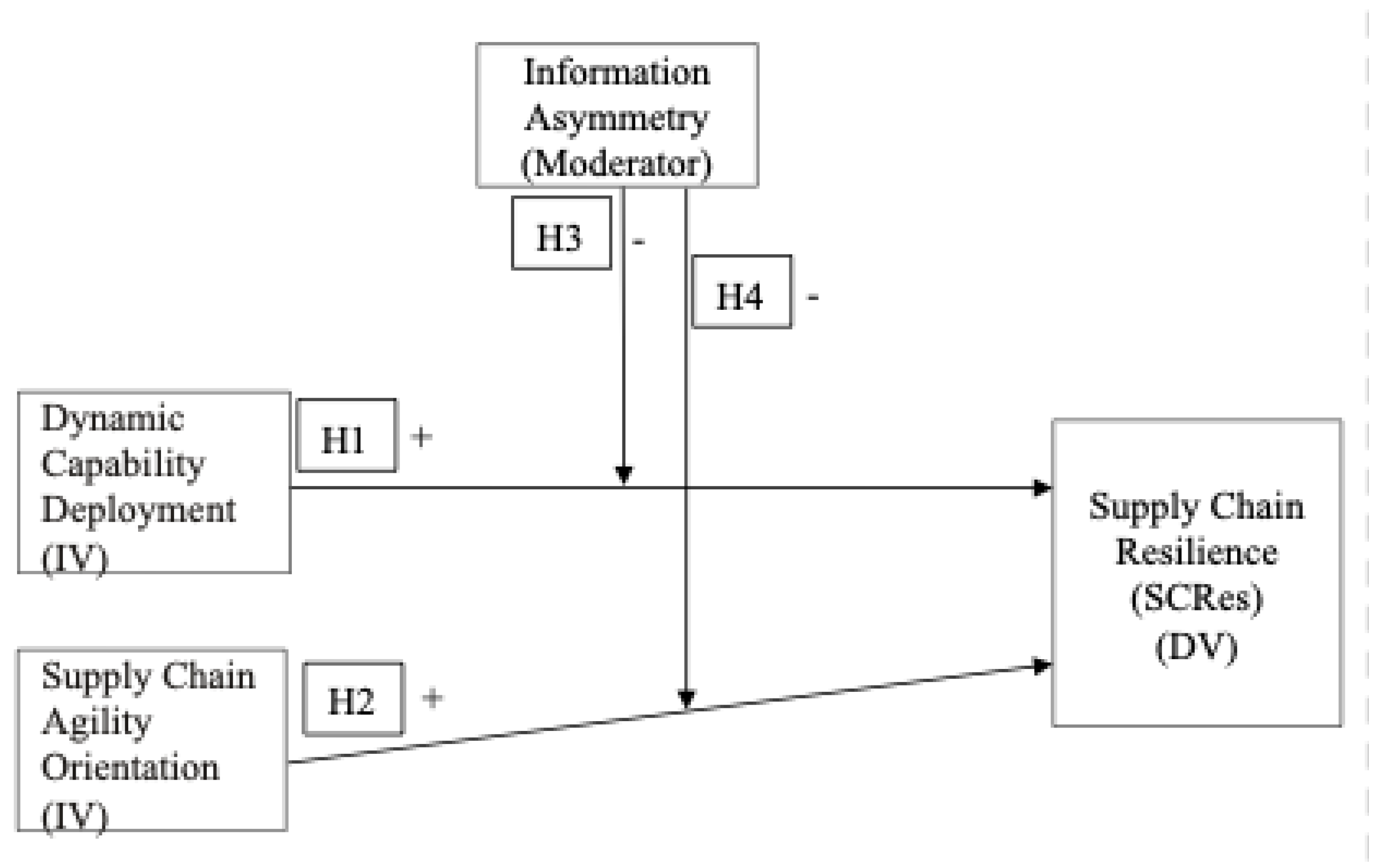
Based on the hypotheses developed above, the conceptual model for this study integrates DCT and RBV to explain how internal capabilities (DC and SCA) enhance SCRes, and how this relationship is moderated by the informational context (IA). The full model is visualized in
Figure 1.
3. Research Methodology
To examine the relationships among DC, SCA, and SCRes, this study used a quantitative, cross-sectional survey of supply chain professionals in globally disrupted industries. The conceptual model, which tests the moderating role of IA between DC, SCA, and SCRes, was analyzed using Partial Least Squares Structural Equation Modeling (PLS-SEM). We chose this approach due to its suitability in testing complex models with both observed and latent constructs, where the focus is on prediction [
50]. All latent constructs were modeled as reflective.
3.1. Sample and Data Collection
A purposive sample of U.S.-based supply chain professionals with disruption experience was recruited through Prolific. Eligibility included full-time employment, at least one year in role, and direct supply chain disruption management experience. Surveys were distributed via Qualtrics with single-response validation. The adequacy of our final sample (
n = 157) was assessed using guidelines specific to PLS-SEM [
50]. The sample size not only met the commonly used “10-items rule” but also exceeded the minimum sample size calculated using the inverse square root method proposed by Kock and Hadaya [
51]. At a 5% significance level, the minimum sample size needed to detect a path coefficient of at least 0.2 would be 155. The final sample reflected a diverse group of qualified professionals across industries and roles (see
Table 1), offering rich insight into how supply chain disruptions are experienced and managed in practice.
Table 1 presents the full distribution of respondent characteristics. Firm size was defined by employee count: small (<500), medium (500–999), large (1000–4999), and very large (5000+). Industry categories reflected the respondents’ primary sector of operation, including manufacturing, retail, logistics, healthcare, information technology (IT), and other. Supply chain complexity was self-reported, based on product variety, number of supply tiers, and geographic span: simple supply chains were typically single-tier and domestic; moderately complex chains involved regional and multi-tier structures; highly complex chains were global and involved extensive outsourcing. Disruption experience referred to the respondent’s exposure to events such as natural disasters, cyberattacks, pandemics, supplier failures, or geopolitical risks; “extensive” experience reflected exposure to multiple types over several years, while “limited” or “none” reflected isolated events. Organizational age was categorized into four ranges from under five years to more than twenty years. Geographic scope indicated whether the respondent’s supply chain was primarily domestic, included some international operations, or was primarily international. Technology sophistication captured the extent of digital integration, ranging from basic IT and ERP systems (low) to the use of advanced tools such as predictive analytics, automation, or AI platforms (very high).
While these original categories are retained in
Table 1 to illustrate the sample’s diversity, several variables were later recoded into binary controls to ensure model stability in the PLS-SEM analysis. For example, industry was coded as IT vs. non-IT, geographic scope as domestic vs. international, and technology sophistication as high vs. low-to-moderate.
3.2. Measures and Instrument Development
To ensure data quality, we implemented attention checks, completion time screens, and response pattern detection. Measures were adapted from previously validated scales to fit the study’s context, with a uniform 7-point Likert scale for all constructs: SCRes (dependent), DC and SCA (independent), and IA (moderator). Measures were drawn from validated scales and adapted from [
18,
38,
52,
53,
54].
Survey items reflected key subdimensions of each construct: sensing, seizing, transforming (DC); alertness, accessibility, decisiveness, flexibility (SCA); adaptation, recovery, stability (SCRes); and information sharing and information quality (IA). Each construct was measured using multi-item, perceptual scales appropriate for latent, socially constructed variables.
Seven control variables were included: firm size, industry, supply chain complexity, disruption experience, international scope, years of operation, and tech sophistication. These controlled for contextual factors that could affect SCRes. Sample diversity across size and industry enhanced external validity.
3.3. Data Analysis Procedure
3.3.1. Preliminary Data Screening
Prior to structural analysis, missing data were examined and imputed when necessary. Outliers were identified and managed using z-score thresholds. Normality was assessed via skewness and kurtosis. Descriptive statistics were calculated for all indicators to support further analysis.
3.3.2. Measurement Model Assessment
The reliability and validity of the measurement model were assessed using Confirmatory Composite Analysis (CCA), consistent with PLS-SEM best practices [
50]. Internal consistency reliability was verified using both Cronbach’s alpha and Composite Reliability (CR), with thresholds of ≥0.70. Indicator reliability was evaluated through outer loadings, with values above 0.70 deemed acceptable, though items between 0.50 and 0.70 were retained if AVE and CR were sufficient, given the exploratory context of the study.
Convergent validity was examined through Average Variance Extracted (AVE), where a minimum threshold of 0.50 indicates that more than 50% of the variance in observed variables is explained by their underlying construct. Discriminant validity was established using both the Fornell-Larcker criterion and the Heterotrait-Monotrait ratio (HTMT). Fornell-Larcker validation required the square root of each construct’s AVE to exceed its inter-construct correlations. HTMT values were required to fall below 0.90, confirming construct distinctiveness.
Applying these rigorous criteria revealed a significant discriminant validity issue in our initial model, necessitating the more advanced hierarchical modeling approach detailed in the Results section.
3.3.3. Structural Model Assessment
Structural model analysis was conducted using bootstrapping (5000 resamples) to evaluate the significance of path coefficients (β values) and test hypotheses. Collinearity among predictor variables was assessed using Variance Inflation Factor (VIF), with values below the threshold of 5.0 indicating no serious multicollinearity concerns. Effect sizes (f
2) were computed to assess the substantive impact of individual predictors, interpreted as small (0.02), medium (0.15), or large (0.35) per Cohen [
55].
The explanatory power of the model was determined through R2 values, with thresholds of 0.25 (weak), 0.50 (moderate), and 0.75 (substantial) used to interpret the proportion of variance explained in SCRes. Predictive relevance was assessed using Stone-Geisser’s Q2 statistic, with values greater than zero indicating that the model has predictive relevance for a given endogenous construct. These measures collectively validated the adequacy of the structural model in capturing the relationships among DC, SCA, IA, and SCRes.
Moderating effects were examined using product indicator interaction terms. IA’s moderation on both the DC→SCRes and SCA→SCRes paths was assessed, and results were interpreted based on significance, directionality, and f2 effect size. The statistical techniques employed allowed for a comprehensive understanding of both direct and conditional relationships within the model.
These assessments support the methodological soundness and robustness of the study’s model testing procedures, affirming the reliability of the constructs and the validity of structural inferences drawn.
3.4. Endogeneity and Common Method Bias
PLS-SEM was selected for its capacity to analyze complex structural models, especially in contexts where theory is still developing and data may be non-normal. However, as Rönkkö, et al. [
56] note, PLS-SEM has limitations including biased estimation, inflated correlations, inadequate model fit assessment, and limited capacity for addressing measurement error or chance capitalization.
To strengthen causal inference and reduce bias, this study incorporated multiple strategies to address endogeneity defined as systematic bias from omitted variables, simultaneity, or measurement error [
50,
57]. First, theoretically justified control variables, Disruption Experience, Supply Chain Complexity, and Industry were included to mitigate omitted variable bias. By comparing models with and without these controls, we tested for spurious relationships and enhanced model validity. Second, a marker variable approach was employed to detect and correct for potential common method variance. A theoretically unrelated variable was linked to all latent constructs to assess whether shared method variance inflated results. Third, full collinearity Variance Inflation Factor (VIF) analysis was conducted, following guideline that values above 3.3 may indicate endogeneity [
58]. VIFs were within acceptable bounds, reducing concerns about multicollinearity and estimation distortion.
While advanced methods like Instrumental Variable Estimation (IVE) are recommended for improving causal inference, obtaining valid instruments is a known challenge in supply chain research [
59]. Given these constraints, this study prioritized control-variable-based techniques, temporal separation, and marker variable analysis to mitigate common method bias and support internal validity.
3.5. Ethical Considerations
This research followed ethical best practices throughout. Informed consent was obtained from all participants, who were made aware of the study’s purpose, procedures, and data privacy protocols. All data were anonymized, securely stored, and protected from unauthorized access. The study was reviewed and approved by the Institutional Review Board (IRB) prior to data collection, ensuring full compliance with research ethics standards.
4. Results
This section provides the results of the data analysis, which followed established guidelines for PLS-SEM assessment [
50] to ensure methodological soundness.
4.1. Assessment of the Measurement Model
An evaluation was conducted to determine how effectively the indicators represented their respective constructs by examining their outer loadings. While loadings exceeding 0.70 are generally considered ideal for establishing indicator reliability [
50], a more lenient threshold is acceptable when items are adapted from established scales. Given that all measures in this study were based on well-established concepts in the literature, indicators with loadings between 0.60 and 0.70 were retained to preserve content validity.
Consequently, three indicators (see
Appendix B) with very low loadings (i.e., below 0.60) were removed from the model to improve construct reliability and validity. This refinement ensures that the retained indicators provide a robust representation of their underlying constructs.
The measurement model demonstrated robust psychometric properties, with reliability metrics confirming internal consistency: Cronbach’s α ranges from 0.904 to 0.953, while composite reliability values (0.906–0.954) comfortably exceed the established 0.70 threshold [
50].
Table 2 showed most constructs exhibited strong convergent validity with AVE values above the recommended 0.50 threshold, though DC (AVE = 0.477) was retained based on its theoretical significance and strong reliability metrics. Average Variance Extracted represented the proportion of variance a latent variable explains in its indicators, with values above 0.5 indicating that constructs explain more than half the variance in their respective indicators.
To establish discriminant validity, both the Fornell-Larcker criterion and Heterotrait-Monotrait (HTMT) ratios were employed. As presented in
Table 3, most HTMT values fell below the 0.85 benchmark recommended by Hair, Hult, Ringle and Sarstedt [
50], suggested adequate distinction between constructs. A notable exception was the HTMT ratio between DC and SCA, which was 0.934 due to high correlation (r = 0.847). As this value exceeds commonly accepted threshold of 0.85–0.90, it signals a potential issue of multicollinearity due to significant conceptual overlap between the two constructs, a point that is addressed in the Discussion section.
Overall, the measurement model was deemed reliable and valid, providing a solid foundation for structural model analysis.
4.2. Structural Model and Hypothesis Testing
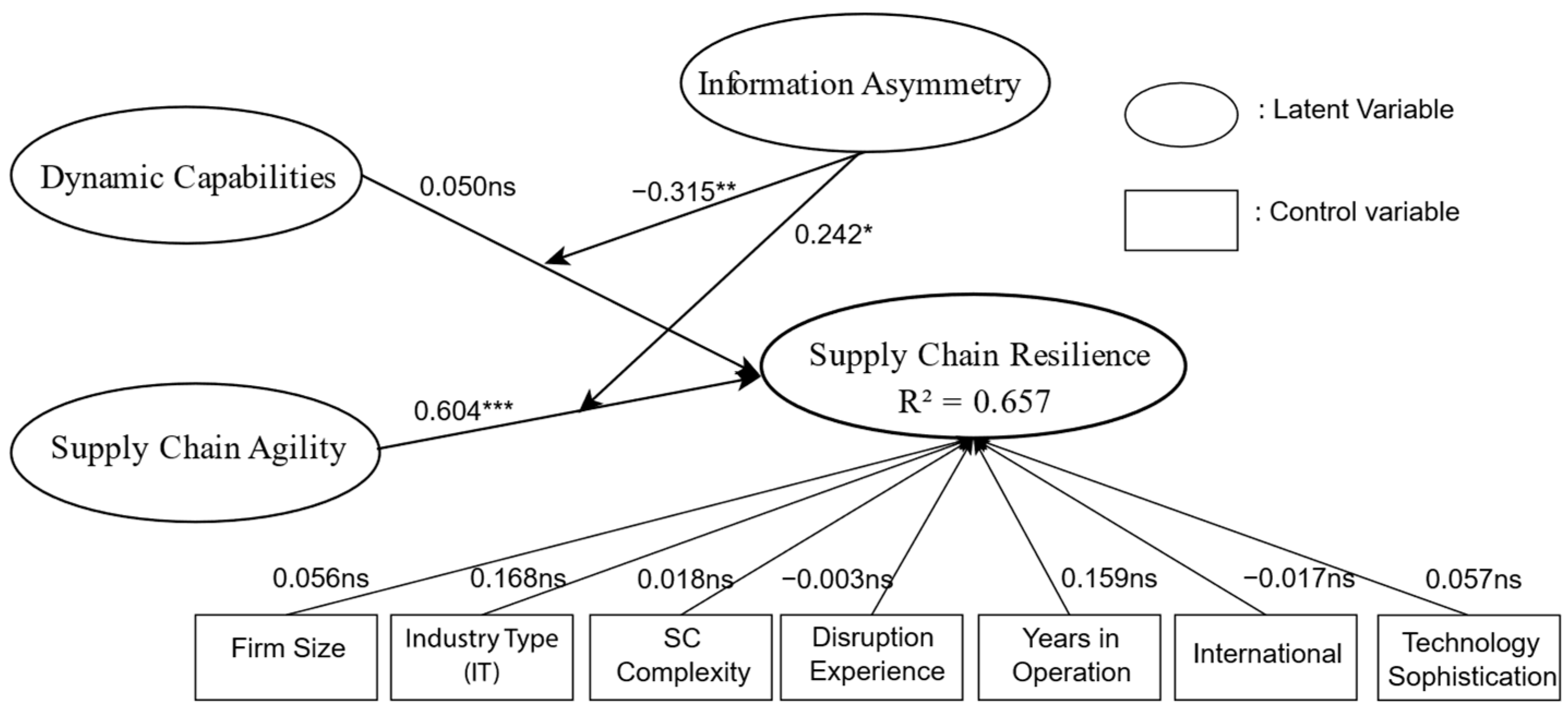
In
Figure 2, there is an illustration of the structural equation model results, highlighting the estimated path coefficients and the explained variance (R-squared = 0.654) for SCRes. The figure’s significance lies in providing an immediate visual summary of the core findings. It clearly depicts the strong, positive influence of SCA on SCRes (H2) in stark contrast to the non-significant path from DC, while also illustrating the significant moderating roles of IA. The figure also displays the paths from the control variables, providing a complete picture of the model tested.
The structural model was evaluated using PLS-SEM with 5000 bootstrap resamples to test path coefficients, statistical significance, and effect sizes [
50]. The model explained a substantial portion of the variance in Supply Chain Resilience (SCRes R
2 = 0.654). While the VIFs for the predictors in the structural model were within an acceptable range (1.049 to 4.736), suggesting that multicollinearity did not critically distort the estimation of the path model.
The results of the primary hypothesis tests are presented in
Table 4. H1, which proposed a direct link between DC and SCRes, was not supported in the initial model, while H2 (SCA- > SCRes) was strongly supported. However, the non-significant finding for H1, combined with the high correlation between DC and SCA, suggested a methodological issue rather than a lack of a true relationship.
To address this and better reflect the theoretical view of SCA as a component of DC, a hierarchical component model (HCM) was specified as an alternative analysis. In this higher-order model, DC is formed by its own core dimensions as well as the key dimensions of SCA. This approach resolved the multicollinearity issue and provides a more theoretically sound test of the hypotheses. The results of this alternative model, presented in
Appendix A, now show a strong and significant positive relationship between the higher-order DC construct and SCRes, providing clear support for H1. Accordingly, the moderation analysis in this revised model focuses exclusively on the effect of IA on this consolidated DC- > SCRes path, providing a more robust test of H3.
5. Discussion
This study investigated the roles of Dynamic Capabilities (DC), Supply Chain Agility (SCA), and the moderating influence of Information Asymmetry (IA) in shaping Supply Chain Resilience (SCRes). The findings highlight a nuanced interplay among these constructs, underscoring the complex dynamics in capability-driven resilience strategies.
5.1. Supply Chain Agility and Dynamic Capabilities on Supply Chain Resilience
Consistent with prior research [
41,
60], supply chain agility emerged as a strong direct driver of supply chain resilience (H2 supported). Firms with heightened agility were more effective at swiftly detecting disruptions, making timely decisions, and reconfiguring operations, thus demonstrating a critical capability for resilience.
Conversely, the direct relationship between dynamic capability and supply chain resilience was not significant in the initial analysis (H1 not supported). To resolve this, we adopted a hierarchical component model (HCM) where SCA’s key dimensions (alertness and flexibility) were treated as operational components of higher-order, strategic DC construct. This revised model revealed a strong and significant positive relationship between the consolidated DC construct and SCRes. This result supports the core theoretical proposition that DC is a foundational capability for building resilience. It confirms the hierarchical nature of these capabilities: strategic routines of sensing, seizing, and transforming (DC) are expressed through, and enabled by, operational capabilities like agility (SCA). Thus, DC provides the essential strategic context for firms to effectively navigate disruptions.
5.2. The Role of Information Asymmetry
Our findings on Information Asymmetry (IA) are best understood through the lens of Complexity Theory [
61,
62]. Supply chains are not simple, linear systems [
61,
63]; they are complex adaptive systems where small information gaps can cascade into major disruptions.
From this perspective, our results are particularly relevant. Dynamic Capabilities represent a firm’s essential toolkit for navigating the emergent and unpredictable threats inherent in such complex environments [
8]. Conversely, Information Asymmetry is especially detrimental in a complex system, as it amplifies uncertainty and can paralyze a firm’s ability to sense and respond, which explains the strong direct and moderating negative effects we found.
These final results provide a clearer and more powerful conclusion. In the complex and unpredictable environment of modern supply chains, IA is a critical vulnerability that both directly lowers resilience and dampens a firm’s ability to adapt.
5.3. Practical Implications
These findings carry significant managerial implications. The hierarchical model confirms that organizations should not view strategic capabilities (DC) and operational agility (SCA) as separate initiatives but as an integrated system for managing complexity.
Given the negative role of IA, the managerial imperative is clear. To build and maintain resilience, firms should prioritize initiatives aimed at information asymmetry. This may include strengthening trust-based partnerships that fosters information sharing and implementing robust supply chain analytics to increase information quality, thereby coping with the uncertainty inherent in complex systems. Firms that can successfully reduce information asymmetry will not only enhance their baseline resilience but will also unlock the full potential of their dynamic capabilities.
6. Conclusions
This research advances our understanding of supply chain resilience by using a hierarchical component model to clarify the relationships between dynamic capabilities (DC), supply chain agility (SCA), and information asymmetry (IA). The results confirm that a higher-order DC construct, which integrates strategic routines with operational agility, is a strong, direct driver of supply chain resilience. Our findings also establish that information asymmetry is a primary antagonist to resilience, exerting both a direct negative impact and a negative moderating effect that weakens the influence of a firm’s dynamic capabilities.
This study makes two novel contributions to the literature. First, it clarifies the hierarchical relationship between strategic (DC) and operational capabilities (SCA) by being among the first to empirically model DC as a higher-order construct in the context of SCRes, resolving a common point of ambiguity. Second, it uncovers the dual role of IA, not only as a contextual moderator that impairs adaptive capability deployment, but also as an independent source of vulnerability that directly undermines resilience.
While this study offers valuable insights, it is subject to certain limitations that provide avenues for future research. First, its cross-sectional design limits causal interpretations, and reliance on perceptual survey data may introduce response bias. Future studies should utilize longitudinal approaches and objective performance data to strengthen causal inference. Second, the findings are based on a U.S.-based sample, which may limit their generalizability. The relationships between capabilities, information asymmetry, and resilience could be influenced by national context. For example, cultural factors such as higher institutional trust or more collectivistic information sharing norms might weaken the negative effects of information asymmetry. Similarly, different regulatory environments or industry structures in other regions could alter the effectiveness of agility and dynamic capabilities. Therefore, we call for future comparative studies across different national and cultural contexts to test the robustness of our model.
Practically, our findings show that organizations should invest in an integrated capability system where foundational dynamic capabilities are expressed through operational agility. Given IA’s powerful negative effects, managers are advised to aggressively reduce information uncertainty by investing in new technologies that improve information quality and trust-based partnerships that facilitate information sharing.
As global supply chains continue to confront increasing volatility, understanding the interplay among strategic capabilities and the informational context is critical. Firms that effectively integrate strategic adaptability, operational flexibility, and information management practices will be better equipped to navigate disruptions and secure a sustainable competitive advantage.
Author Contributions
Conceptualization, M.L. and R.A.S.; methodology, M.L., R.A.S. and S.P.; software, M.L.; validation, M.L., R.A.S. and S.P.; formal analysis, M.L. and R.A.S.; data curation, M.L.; writing—original draft, M.L.; writing—review and editing, M.L., R.A.S. and S.P.; visualization, M.L.; supervision, R.A.S. and S.P. All authors have read and agreed to the published version of the manuscript.
Funding
This research received no external funding.
Institutional Review Board Statement
The study was conducted in accordance with the Office of Research Protections and Integrity of University of North Carolina at Charlotte, and the protocol was approved by the Ethics Committee of IRB-25-0440 on 24 January 2025.
Informed Consent Statement
Informed consent for participation was obtained from all subjects involved in the study.
Data Availability Statement
The raw data supporting the conclusions of this article will be made available by the authors upon request.
Conflicts of Interest
The authors declare no conflict of interest.
Appendix A. Hierarchical Component Model (HCM) Analysis
Appendix A.1. Rational for the Hierarchical Model
The initial analysis revealed high multicollinearity between Dynamic Capabilities (DC) and Supply Chain Agility (SCA) (HTMT = 0.934), which obscured the direct effect of DC on Supply Chain Resilience (SCRes) in the initial model. To address this issue and better reflect the theoretical view that SCA is an operational manifestation of the broader DC construct, a hierarchical component model (HCM) was specified. This approach models DC as a higher-order construct that is partially formed by the first-order dimensions of SCA.
Appendix A.2. Model Specification Using a Two-Stage Approach
We employed a disjoint two-stage approach [
57] to construct the HCM. In the first stage, latent variable scores for all first-order constructs were obtained. DC was modeled from its three dimensions (Sensing, Seizing, Transforming), SCA from its four dimensions (Alertness, Accessibility, Flexibility, Decisiveness), and Information Asymmetry (IA) from its two dimensions (Information Quality, Information Sharing). During this stage one indicator with a low outer loading (SCRes_Q14) was removed to ensure construct reliability.
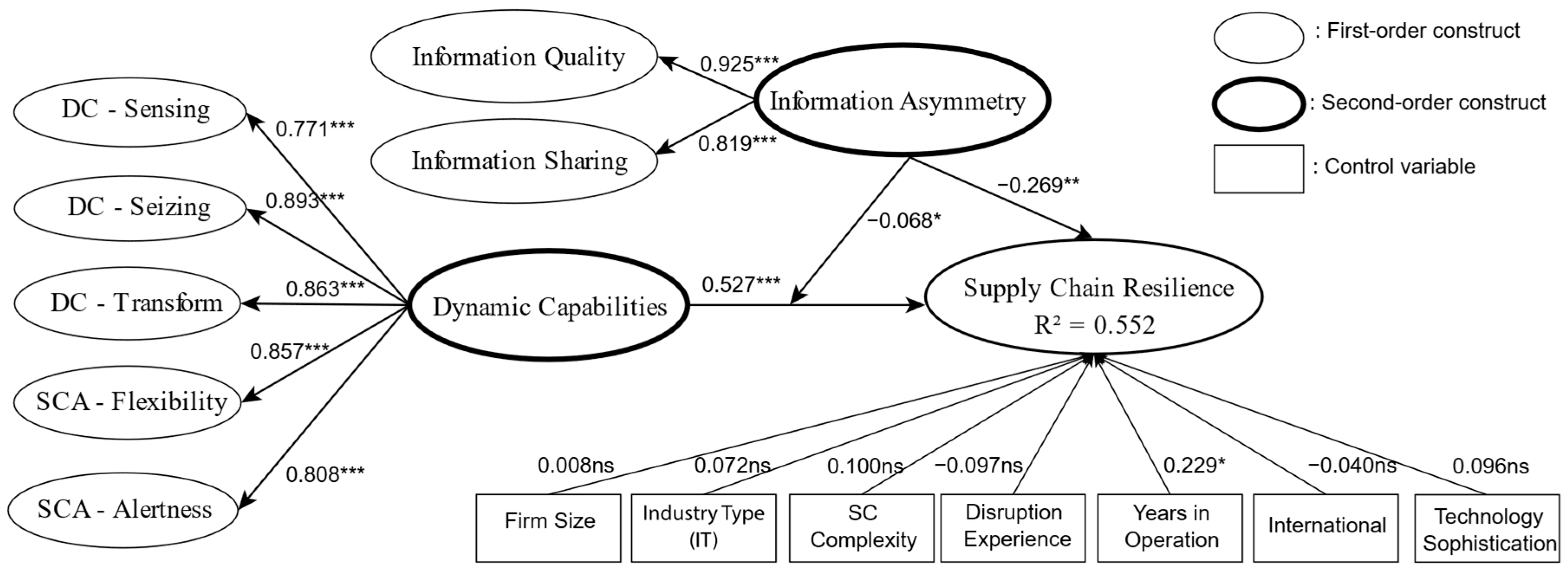
In the second stage, the latent variable scores from the first stage were used as indicators for the higher-order constructs in the final path model. Following a Confirmatory Composite Analysis (CCA), the two first-order constructs for SCA (Decisiveness and Accessibility) were dropped due to poor discriminant validity (HTMT ≥ 0.9) with other constructs. This resulted in a final, robust higher-order DC construct formed by its three native dimensions plus the two retained dimensions of SCA (Alertness and Flexibility), as shown in
Figure A1.
Figure A1.
Final Hierarchical Component Model. Notes: * p < 0.05; ** p < 0.01; *** p < 0.001; ns = not significant.
Figure A1.
Final Hierarchical Component Model. Notes: * p < 0.05; ** p < 0.01; *** p < 0.001; ns = not significant.
Appendix A.3. Final Path Model Results
The final HCM provides a clearer picture of the relationships. The model explains a substantial portion of the variance in SCRes (R
2 = 0.552). The path coefficients, t-statistics, and
p-values are presented in
Table A1.
The results show a strong, significant positive effect of the higher-order DC construct on SCRes, confirming H1. Further, the model reveals a significant direct negative effect of IA on SCRes and confirms IA’s significant negative moderating effect on the DC- > SCRes relationship, thereby supporting H3.
Table A1.
Path Coefficients of the Final Hierarchical Model.
Table A1.
Path Coefficients of the Final Hierarchical Model.
| Variable | Coefficient | t-Statistic | p-Value
|
|---|
| DC | 0.527 | 5.642 | 0.000 *** |
| IA | −0.269 | 2.735 | 0.003 ** |
| IA × DC | −0.068 | 1.674 | 0.047 * |
| Control Variables | | | |
| Disruption Experience | −0.097 | 0.619 | 0.268 |
| Firm Size | 0.008 | 0.056 | 0.478 |
| Years in Operation | 0.229 | 1.863 | 0.031 |
| International | −0.040 | 0.304 | 0.381 |
| Industry Type (IT) | 0.072 | 0.344 | 0.365 |
| SC Complexity | 0.100 | 0.592 | 0.277 |
| Technology Sophistication | 0.096 | 1.299 | 0.097 |
Appendix B. Survey Items
Seven-point Likert scale: Ranging from 1 (“strongly disagree”) to 7 (“strongly agree”)
Supply Chain Resilience:
SCRes_Q1. Our main supplier is able to maintain high situational awareness at all times
SCRes_Q2. Our main supplier is able to provide a quick response to a supply chain disruption
SCRes_Q3. Our main supplier is able to cope with changes brought by the supply chain disruption
SCRes_Q4. Our main supplier is able to adapt to the supply chain disruption easily
SCRes_Q5. Our main supplier can recover to normal operations speedily after the supply chain disruption
SCRes_Q7. Our main customer is able to maintain high situational awareness at all times
SCRes_Q8. Our main customer is able to provide a quick response to the supply chain disruption
SCRes_Q9. Our main customer is able to cope with changes brought by the supply chain disruption
SCRes_Q10. Our main customer is able to adapt to the supply chain disruption easily
SCRes_Q11. Our main customer can recover to normal operations speedily after a supply chain disruption
SCRes_Q12. Our firm’s supply chain is able to adequately respond to unexpected disruption by quickly restoring its product flow
SCRes_Q13. Our firm’s supply chain can quickly return to its original state after being disrupted
SCRes_Q15. Our firm’s supply chain is well prepared to deal with the financial outcomes of supply chain disruptions
SCRes_Q16. Our firm’s supply chain has the ability to maintain the desired level of control over structure and function at the time of disruption
Dynamic Capabilities:
DC_Q17. We can perceive demand shifts and changes in customer preference before competitors do
DC_Q18. We can feel significant potential opportunities and threats
DC_Q19. We have good observation and judgment ability
DC_Q20. We frequently interact with other partners to acquire new knowledge related to product development, process innovation, or logistics and distribution practices
DC_Q21. We can quickly deal with conflicts in the strategic decision-making process
DC_Q23. We can make timely decisions to deal with environmental change under any circumstance
DC_Q24. We can reconfigure resources in time to address environmental change
DC_Q25. We can quickly decide on our technological innovation and development
DC_Q26. We can successfully realign or reinvent an organization in response to (or anticipation of) market change
DC_Q27. We can successfully reconfigure organizational resources to develop new productive assets
DC_Q28. We can use resource recombination’s to match the product market areas better
DC_Q29. We can align (or re-distribute) skills to meet the current customer’s needs
DC_Q30. We can effectively integrate and combine existing resources into novel combinations
Supply Chain Agility:
SCA_Q31. Our firm can promptly identify opportunities in its environment
SCA_Q32. My organization can rapidly sense threats in its environment
SCA_Q33. We can quickly detect changes in our environment
SCA_Q34. We always receive the information we demand from our suppliers
SCA_Q35. We always obtain the information we request from our customers
SCA_Q36. We can swiftly deal with threats in our environment
SCA_Q37. My firm can quickly respond to changes in the business environment
SCA_Q38. We can rapidly address opportunities in our environment
SCA_Q39. When needed, we can adjust our supply chain operations to the extent necessary to execute our decisions
SCA_Q40. My firm can increase its short-term capacity as needed
Information Asymmetry (reverse-coded):
IA_Q44. Our trading partners share proprietary information with us
IA_Q45. Our trading partners share business knowledge of core business processes with us
IA_Q46. Information exchange with our trading partners is timely
IA_Q47. Information exchange with our trading partners is accurate
IA_Q48. Information exchange with our trading partners is complete
IA_Q49. Information exchange with our trading partners is adequate
IA_Q50. Information exchange with our trading partners is reliable
Excluded Items: Low Outer Loadings (<0.60) and Attention Checks
SCRes_Q6. (Attention Check—not included in analysis)
SCRes_Q14. Our firm’s supply chain can move to a new, more desirable state after being disrupted (0.592)
DC_Q22. (Attention Check—not included in analysis)
SCA_Q41. We can adjust the specification of orders as requested by our customers (0.562)
IA_Q42. We inform trading partners in advance of changing needs (0.520)
IA_Q43. (Attention Check—not included in analysis)
References
- Ivanov, D. Predicting the impacts of epidemic outbreaks on global supply chains: A simulation-based analysis on the coronavirus outbreak (COVID-19/SARS-CoV-2) case. Transp. Res. Part E Logist. Transp. Rev. 2020, 136, 101922. [Google Scholar] [CrossRef] [Scilit]
- Queiroz, M.M.; Ivanov, D.; Dolgui, A.; Fosso Wamba, S. Impacts of epidemic outbreaks on supply chains: Mapping a research agenda amid the COVID-19 pandemic through a structured literature review. Ann. Oper. Res. 2022, 319, 1159–1196. [Google Scholar] [CrossRef] [Scilit] [PubMed]
- Bonanno, G.A. Loss, trauma, and human resilience: Have we underestimated the human capacity to thrive after extremely aversive events? Am. Psychol. 2004, 59, 20–28. [Google Scholar] [CrossRef] [Scilit] [PubMed]
- Carpenter, S.; Walker, B.; Anderies, J.M.; Abel, N. From Metaphor to Measurement: Resilience of What to What? Ecosystems 2001, 4, 765–781. [Google Scholar] [CrossRef] [Scilit]
- Hamel, G.; Valikangas, L. The quest for resiience. Harv. Bus. Rev. 2003, 62, 52–63. [Google Scholar]
- Christopher, M.; Peck, H. Building the Resilient Supply Chain. Int. J. Logist. Manag. 2004, 15, 1–13. [Google Scholar] [CrossRef] [Scilit]
- Wieland, A. Dancing the Supply Chain: Toward Transformative Supply Chain Management. J. Supply Chain Manag. 2021, 57, 58–73. [Google Scholar] [CrossRef] [Scilit]
- Kähkönen, A.K.; Evangelista, P.; Hallikas, J.; Immonen, M.; Lintukangas, K. COVID-19 as a trigger for dynamic capability development and supply chain resilience improvement. Int. J. Prod. Res. 2023, 61, 2696–2715. [Google Scholar] [CrossRef] [Scilit]
- Choi, T.Y.; Rogers, D.; Vakil, B. Coronavirus is a wake-up call for supply chain management. Harv. Bus. Rev. 2020, 27, 364–398. [Google Scholar]
- Ivanov, D.; Dolgui, A. Viability of intertwined supply networks: Extending the supply chain resilience angles towards survivability. Int. J. Prod. Res. 2020, 58, 2904–2915. [Google Scholar] [CrossRef] [Scilit]
- Mason, R.B. Coping with complexity and turbulence—An entrepreneurial solution. J. Enterp. Cult. 2006, 14, 241–266. [Google Scholar] [CrossRef] [Scilit]
- Snowden, D.J.; Boone, M.E. A Leader’ s Framework for Decision Making. Harv. Bus. Rev. 2007, 85, 68. [Google Scholar]
- Sheffi, Y.; Rice, J.B. A Supply Chain View of the Resilient Enterprise. Sloan Manag. Rev. 2005, 47, 41–48. [Google Scholar]
- Sodhi, M.S.; Son, B.G.; Tang, C.S. Researchers’ perspectives on supply chain risk management. Prod. Oper. Manag. 2012, 21, 1–13. [Google Scholar] [CrossRef] [Scilit]
- Belhadi, A.; Kamble, S.S.; Venkatesh, M.; Jabbour, C.J.C.; Benkhati, I. Building supply chain resilience and efficiency through additive manufacturing: An ambidextrous perspective on the dynamic capability view. Int. J. Prod. Econ. 2023, 249, 108516. [Google Scholar] [CrossRef] [Scilit]
- Ivanov, D.; Dolgui, A. OR-methods for coping with the ripple effect in supply chains during COVID-19 pandemic. Int. J. Prod. Econ. 2021, 232, 107921. [Google Scholar] [CrossRef] [Scilit] [PubMed]
- Gligor, D.M.; Holcomb, M.C. Understanding the role of logistics capabilities in achieving supply chain agility. Int. J. Logist. Manag. 2012, 23, 353–372. [Google Scholar]
- Teece, D.J. Explicating dynamic capabilities: The nature and microfoundations of (sustainable) enterprise performance. Strateg. Manag. J. 2007, 28, 1319–1350. [Google Scholar] [CrossRef] [Scilit]
- Craighead, C.W.; Ketchen, D.J., Jr.; Darby, J.L. Pandemics and supply chain management research: Toward a theoretical toolbox. Decis. Sci. 2020, 51, 838–866. [Google Scholar] [CrossRef] [Scilit] [PubMed]
- Ivanov, D. Supply chain viability and the COVID-19 pandemic: A conceptual and formal generalisation of four major adaptation strategies. Int. J. Prod. Res. 2021, 59, 3535–3552. [Google Scholar] [CrossRef] [Scilit]
- Pettit, T.J.; Croxton, K.L.; Fiksel, J. Ensuring supply chain resilience: Development and implementation of an assessment tool. J. Bus. Logist. 2013, 34, 46–76. [Google Scholar] [CrossRef] [Scilit]
- Blackhurst, J.; Dunn, K.S.; Craighead, C.W. An empirically derived framework of global supply resiliency. J. Bus. Logist. 2011, 32, 374–391. [Google Scholar] [CrossRef] [Scilit]
- Fiksel, J. Designing resilient, sustainable systems. Environ. Sci. Technol. 2003, 37, 5330–5339. [Google Scholar] [CrossRef] [Scilit] [PubMed]
- Krykavskyy, Y.; Pokhylchenko, I.; Kaźmierczyk, J. Supply chain resilience: A systematic literature review and research agenda. Sustainability 2023, 15, 1185. [Google Scholar] [CrossRef] [Scilit]
- Akerlof, G.A. The market for “lemons”: Quality uncertainty and the market mechanism. Q. J. Econ. 1970, 84, 488–500. [Google Scholar] [CrossRef] [Scilit]
- Busse, C.; Schleper, M.C.; Niu, M.; Wagner, S.M. Supplier development for sustainability: Contextual barriers in global supply chains. Int. J. Phys. Distrib. Logist. Manag. 2017, 47, 586–608. [Google Scholar] [CrossRef] [Scilit]
- Durach, C.F.; Wieland, A.; Machuca, J.A. Antecedents and dimensions of supply chain robustness: A systematic literature review. Int. J. Phys. Distrib. Logist. Manag. 2020, 50, 82–114. [Google Scholar] [CrossRef] [Scilit]
- Stiglitz, J.E. Information and economic analysis: A perspective. Econ. J. 1985, 95, 21–41. [Google Scholar] [CrossRef] [Scilit]
- Bode, C.; Wagner, S.M. Structural drivers of upstream supply chain complexity and the frequency of supply chain disruptions. J. Oper. Manag. 2015, 36, 215–228. [Google Scholar] [CrossRef] [Scilit]
- Brandon-Jones, E.; Squire, B.; Autry, C.W.; Petersen, K.J. A contingent resource-based perspective of supply chain resilience and robustness. J. Supply Chain Manag. 2014, 50, 55–73. [Google Scholar] [CrossRef] [Scilit]
- Teece, D.J.; Pisano, G.; Shuen, A. Dynamic capabilities and strategic management. Strateg. Manag. J. 1997, 18, 509–533. [Google Scholar] [CrossRef] [Scilit]
- Barney, J. Firm resources and sustained competitive advantage. J. Manag. 1991, 17, 99–120. [Google Scholar] [CrossRef] [Scilit]
- Eisenhardt, K.M.; Martin, J.A. Dynamic capabilities: What are they? Strateg. Manag. J. 2000, 21, 1105. [Google Scholar] [CrossRef] [Scilit]
- Chowdhury, M.M.H.; Quaddus, M. Supply chain resilience: Conceptualization and scale development using dynamic capability theory. Int. J. Prod. Econ. 2017, 188, 185–204. [Google Scholar] [CrossRef] [Scilit]
- Dubey, R.; Gunasekaran, A.; Childe, S.J.; Fosso Wamba, S.; Roubaud, D.; Foropon, C. Empirical investigation of data analytics capability and organizational flexibility as complements to supply chain resilience. Int. J. Prod. Res. 2021, 59, 110–128. [Google Scholar] [CrossRef] [Scilit]
- Bastas, A.; Garza-Reyes, J.A. Impact of the COVID-19 pandemic on manufacturing operations and supply chain resilience: Effects and response strategies. J. Manuf. Technol. Manag. 2022, 33, 962–985. [Google Scholar] [CrossRef] [Scilit]
- Swafford, P.M.; Ghosh, S.; Murthy, N. The antecedents of supply chain agility of a firm: Scale development and model testing. J. Oper. Manag. 2006, 24, 170–188. [Google Scholar] [CrossRef] [Scilit]
- Gligor, D.M.; Holcomb, M.C.; Stank, T.P. A multidisciplinary approach to supply chain agility: Conceptualization and scale development. J. Bus. Logist. 2013, 34, 94–108. [Google Scholar] [CrossRef] [Scilit]
- Ponomarov, S.Y.; Holcomb, M.C. Understanding the concept of supply chain resilience. Int. J. Logist. Manag. 2009, 20, 124–143. [Google Scholar] [CrossRef] [Scilit]
- Gligor, D.M.; Esmark, C.L.; Holcomb, M.C. Performance outcomes of supply chain agility: When should you be agile? J. Oper. Manag. 2015, 33, 71–82. [Google Scholar] [CrossRef] [Scilit]
- Wieland, A.; Wallenburg, C.M. The influence of relational competencies on supply chain resilience: A relational view. Int. J. Phys. Distrib. Logist. Manag. 2013, 43, 300–320. [Google Scholar] [CrossRef] [Scilit]
- Ali, A.; Mahfouz, A.; Arisha, A. Analysing supply chain resilience: Integrating the constructs in a concept mapping framework via a systematic literature review. Supply Chain Manag. Int. J. 2017, 22, 16–39. [Google Scholar] [CrossRef] [Scilit]
- Brusset, X.; Teller, C. Supply chain capabilities, risks, and resilience. Int. J. Prod. Econ. 2017, 184, 59–68. [Google Scholar] [CrossRef] [Scilit]
- Craighead, C.W.; Blackhurst, J.; Rungtusanatham, M.J.; Handfield, R.B. The severity of supply chain disruptions: Design characteristics and mitigation capabilities. Decis. Sci. 2007, 38, 131–156. [Google Scholar] [CrossRef] [Scilit]
- Srinivasan, R.; Swink, M. Leveraging supply chain integration through planning comprehensiveness: An organizational information processing theory perspective. Decis. Sci. 2015, 46, 823–861. [Google Scholar] [CrossRef] [Scilit]
- Galbraith, J. Designing complex organizations. In Reading, Mass; Addison–Wesley: New York, NY, USA, 1973. [Google Scholar]
- Zhu, S.; Song, J.; Hazen, B.T.; Lee, K.; Cegielski, C. How supply chain analytics enables operational supply chain transparency: An organizational information processing theory perspective. Int. J. Phys. Distrib. Logist. Manag. 2018, 48, 47–68. [Google Scholar] [CrossRef] [Scilit]
- Zhu, G.; Chou, M.C.; Tsai, C.W. Lessons learned from the COVID-19 pandemic exposing the shortcomings of current supply chain operations: A long-term prescriptive offering. Sustainability 2020, 12, 5858. [Google Scholar] [CrossRef] [Scilit]
- Corkery, M.; Popper, N. From Farm to Blockchain: Walmart Tracks Its Lettuce. The New York Times, 25 September 2018; p. p. B1(L).
- Hair, J.F.; Hult, G.T.M.; Ringle, C.M.; Sarstedt, M. A Primer on Partial Least Squares Structural Equation Modeling (PLS-SEM), 3rd ed.; Sage: Thousand Oaks, CA, USA, 2021. [Google Scholar]
- Kock, N.; Hadaya, P. Minimum sample size estimation in PLS-SEM: The inverse square root and gamma-exponential methods. Inf. Syst. J. 2018, 28, 227–261. [Google Scholar] [CrossRef] [Scilit]
- Juan, S.J.; Li, E.Y. Financial performance of firms with supply chains during the COVID-19 pandemic: The roles of dynamic capability and supply chain resilience. Int. J. Oper. Prod. Manag. 2023, 43, 712–737. [Google Scholar] [CrossRef] [Scilit]
- Li, S.; Lin, B. Accessing information sharing and information quality in supply chain management. Decis. Support Syst. 2006, 42, 1641–1656. [Google Scholar] [CrossRef] [Scilit]
- Zhou, J.; Hu, L.; Yu, Y.; Zhang, J.Z.; Zheng, L.J. Impacts of IT capability and supply chain collaboration on supply chain resilience: Empirical evidence from China in COVID-19 pandemic. J. Enterp. Inf. Manag. 2024, 37, 777–803. [Google Scholar] [CrossRef] [Scilit]
- Cohen, J. Statistical Power Analysis for the Behavioral Sciences; Routledge: Abingdon, UK, 2013. [Google Scholar]
- Rönkkö, M.; McIntosh, C.N.; Antonakis, J.; Edwards, J.R. Partial least squares path modeling: Time for some serious second thoughts. J. Oper. Manag. 2016, 47, 9–27. [Google Scholar] [CrossRef] [Scilit]
- Sarstedt, M.; Hair, J.F., Jr.; Nitzl, C.; Ringle, C.M.; Howard, M.C. Beyond a tandem analysis of SEM and PROCESS: Use of PLS-SEM for mediation analyses! Int. J. Mark. Res. 2020, 62, 288–299. [Google Scholar] [CrossRef] [Scilit]
- Kock, N. Common method bias in PLS-SEM: A full collinearity assessment approach. Int. J. E-Collab. (IJeC) 2015, 11, 10. [Google Scholar] [CrossRef] [Scilit]
- Antonakis, J.; Bendahan, S.; Jacquart, P.; Lalive, R. On making causal claims: A review and recommendations. Leadersh. Q. 2010, 21, 1086–1120. [Google Scholar] [CrossRef] [Scilit]
- Gligor, D.; Gligor, N.; Holcomb, M.; Bozkurt, S. Distinguishing between the concepts of supply chain agility and resilience: A multidisciplinary literature review. Int. J. Logist. Manag. 2019, 30, 467–487. [Google Scholar] [CrossRef] [Scilit]
- Grobman, G. Complexity theory: A new way to look at organizational change. Public Adm. Q. 2005, 29, 351–384. [Google Scholar] [CrossRef] [Scilit]
- Najjar, M.; Yasin, M.M. The management of global multi-tier sustainable supply chains: A complexity theory perspective. Int. J. Prod. Res. 2023, 61, 4853–4870. [Google Scholar] [CrossRef] [Scilit]
- Nair, A.; Reed-Tsochas, F. Revisiting the complex adaptive systems paradigm: Leading perspectives for researching operations and supply chain management issues. J. Oper. Manag. 2019, 65, 80–92. [Google Scholar] [CrossRef] [Scilit]
| Disclaimer/Publisher’s Note: The statements, opinions and data contained in all publications are solely those of the individual author(s) and contributor(s) and not of MDPI and/or the editor(s). MDPI and/or the editor(s) disclaim responsibility for any injury to people or property resulting from any ideas, methods, instructions or products referred to in the content. |
© 2025 by the authors. Licensee MDPI, Basel, Switzerland. This article is an open access article distributed under the terms and conditions of the Creative Commons Attribution (CC BY) license (https://creativecommons.org/licenses/by/4.0/).