3.1. Supply Chain Resilience
Over the past twenty years, supply chain resilience has drawn sustained attention from scholars, yet the concept’s interpretation continues to evolve as disruptions grow more frequent and varied. Broadly, resilience denotes a firm’s capacity to foresee, prepare for, cope with, and recover from disruptions while sustaining acceptable performance or moving toward an improved state [
5,
34,
35]. Whereas early definitions stressed the idea of snapping back to a prior equilibrium, newer work gives equal weight to adaptive and transformative capacities [
6,
7,
29,
36].
Christopher and Peck [
37] were among the first to identify vulnerability, robustness, agility, and supply chain re-engineering as pillars of resilient supply chains. Ponomarov and Holcomb [
5] built on this by proposing a definition that unifies readiness, response, and recovery within a single framework. A further advance came when scholars recognized that resilience is not a single attribute but a bundle of interacting capabilities [
38,
39]. Hosseini et al. [
39] surveyed the quantitative modeling literature and noted that most studies addressed individual resilience dimensions without examining their interrelationships.
In a major synthesis of more than a decade of empirical work, Tukamuhabwa et al. [
38] pinpointed four recurring capability dimensions behind resilience: flexible processes and sourcing, supply chain-wide visibility, speed in decision-making and recovery, and collaboration among supply chain partners. Subsequent studies have validated these dimensions across a range of settings and provide the conceptual foundation for our mediating constructs.
The COVID-19 pandemic served as a real-world natural experiment in supply chain resilience. Firms that already possessed digital capabilities and maintained diversified supplier networks recovered faster [
4,
7,
9,
13]; those relying on single sources or manual coordination suffered prolonged disruptions. Using Moroccan data, El Baz and Ruel [
4] found that proactive risk management practices substantially attenuated the impact of pandemic-related disruptions, a finding we draw on to develop our hypotheses.
Four capabilities surface repeatedly in the literature as core ingredients of supply chain resilience; we treat them as mediating constructs. Visibility denotes the extent to which supply chain actors can obtain timely and accurate information on upstream and downstream activities [
19]. Flexibility refers to the capacity to adjust operations rapidly when circumstances change [
20,
35,
40]. Risk management encompasses the systematic identification, evaluation, and mitigation of possible disruptions [
21,
31]. Collaboration reflects the depth and quality of inter-firm relationships that enable coordinated responses [
22,
41].
3.2. Digital Maturity and Industry 4.0
In this paper, we treat digital maturity as an organizational capability that captures the extent to which digital technologies are woven into value-creating activities [
42]. The notion goes beyond simple technology adoption: it addresses how deeply digital tools, workflows, and mindsets permeate strategic and operational routines. This perspective is consistent with recent scholarship that distinguishes genuine digital capability from the mere presence of digital tools [
11,
43].
Drawing on Capability Maturity Models and digital transformation frameworks, researchers argue that digital maturity develops across several organizational domains [
31,
39,
40,
44]: (1) embedding technologies in core processes, (2) building sophisticated data analytics and decision support, (3) enabling interoperability within the firm and with outside partners, and (4) making use of real-time data for both day-to-day and strategic decisions. We relied on these four domains when designing our digital maturity measure.
Supply chain digital maturity rarely rests on a single technology. Rather, it emerges from a layering process in which various Industry 4.0 technologies are stacked and combined [
45,
46,
47]. IoT sensors and cloud platforms form the data backbone; machine learning and AI enable pattern recognition and anticipation of disruptions; blockchain and distributed ledger technologies provide traceability and trust [
48,
49,
50]. Ivanov et al. [
51] demonstrated that these technologies, when combined, reshape supply chain risk analytics by enabling both proactive detection and real-time response to ripple effects. Recent evidence from emerging markets further suggests that AI-driven tools are associated with stronger supply chain resilience, specifically through the development of dynamic capabilities [
50].
This point is especially relevant for emerging markets, where information environments are typically more opaque, less standardized, and less digitally connected than those in high-income countries. In Morocco, digital maturity differs markedly across sectors and firm sizes, a heterogeneity that the Digital Morocco 2030 strategy [
15] seeks to reduce. Analytically, this variation is advantageous: by sampling firms at different maturity levels, we can trace how differences in digital capability relate to differences in dynamic capabilities and, in turn, in resilience.
3.3. Dynamic Capabilities and the Resource-Based View
Our study rests on two complementary theoretical foundations. The Resource-Based View (RBV) provides the logic for why digital capabilities can confer competitive advantage. According to Barney [
52], valuable, rare, inimitable, and non-substitutable resources can generate sustained competitive advantage. Digital maturity qualifies on all four counts, especially when it is deeply embedded in organizational routines and in coordination with supply chain partners. The difficulty in replicating arises from the complementary investments it requires in people, process redesign, and organizational culture, all of which accumulate over time [
53].
Yet the RBV has a static quality that limits its usefulness in environments characterized by fast technological change and pronounced uncertainty, which is precisely the situation facing emerging markets in the throes of digital transformation. The Dynamic Capabilities framework (DCF) addresses this limitation [
24,
49,
50,
54].
Teece and colleagues define dynamic capabilities as the firm’s capacity to integrate, build, and reconfigure internal and external competencies to address rapidly changing environments [
24,
55]. The framework identifies three core processes: sensing (identifying opportunities and threats), seizing (mobilizing resources to capture opportunities), and transforming (reconfiguring assets and structures). These processes are not routines in themselves but meta-capabilities that shape how operational capabilities evolve [
25,
56].
The Dynamic Capabilities framework is particularly well-suited to this study for four reasons. First, the sensing–seizing–transforming logic maps naturally onto our four mediating capabilities: visibility and risk management primarily relate to sensing; flexibility primarily relates to seizing; and collaboration primarily relates to transforming through relational reconfiguration. Second, the DCF explicitly addresses how firms in turbulent environments convert resource endowments into performance outcomes, directly relevant to understanding how digital maturity is associated with resilience. Third, recent applications of the DCF to supply chain contexts have demonstrated its explanatory power for understanding both direct and mediated capability effects [
25,
50]. Fourth, the four selected capabilities form a parsimonious yet exhaustive set of operational mediators. Systematic reviews of supply-chain resilience [
38,
39] consistently identify visibility, flexibility, risk management, and partner collaboration as the four most frequently reported and most empirically supported capability dimensions. In contrast, alternative dimensions (e.g., agility, redundancy, learning) are typically subsumed under one of these four headings. This empirical convergence in the literature, combined with the theoretical alignment described above, justifies retaining these four capabilities as the mediating set in the present model.
From this integrated theoretical perspective, digital maturity can be understood as an enabling resource (in RBV terms) that facilitates the development of dynamic capabilities (in DCF terms), which in turn contribute to the desired performance outcome of supply chain resilience. This logic directly informs the mediation model tested in this study.
The integration of RBV and DCF is not without tension: RBV originally describes resources as relatively stable stocks, whereas DCF was developed to explain firm performance in turbulent environments. We resolve this tension by adopting the asset-orchestration view (Teece, 2007 [
55]), in which the value of a resource depends not on its stock but on how it is configured, redeployed, and recombined through firm routines. Under this view, digital maturity is not a static technological endowment but a substrate for routinised dynamic capabilities (Eisenhardt and Martin, 2000 [
56]): the same digital assets are mobilized differently across sensing, seizing and transforming cycles, which is precisely what allows them to support resilience in volatile, uncertain, complex and ambiguous environments (Helfat et al., 2007 [
40]; Teece, 2007 [
55]).
3.4. Hypotheses Development
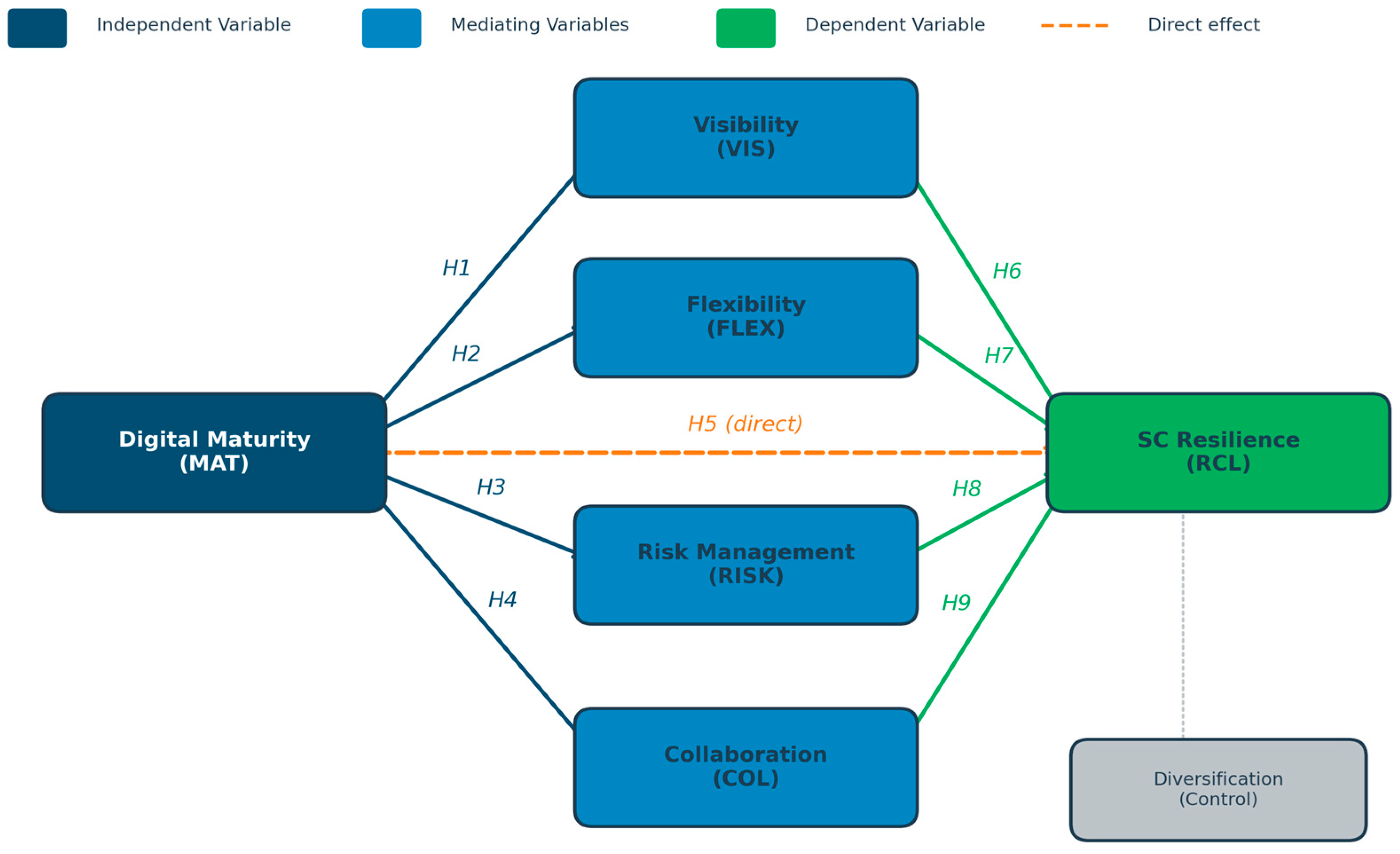
The theoretical framework outlined above generates nine hypotheses organized in three groups: the association of digital maturity with each dynamic capability (H1–H4), the direct association of digital maturity with resilience (H5), and the association of each dynamic capability with resilience (H6–H9).
Digital maturity and supply chain visibility.
The deployment of digital technologies has been associated with fundamental changes in how supply chains are monitored and coordinated. Several studies have linked enhanced monitoring to the circulation of data via digital platforms, enabling firms to track activities at successive stages of the chain [
17,
19,
57]. Research across multiple industries has described how digital tools can expand the scope, timeliness, and accuracy of supply chain information [
16,
32,
41,
51]. Additional evidence suggests that organizations with more mature digital infrastructures maintain broader visibility into partner activities, inventory positions, and potential bottlenecks [
51,
58].
H1. Digital maturity is positively related to supply chain visibility.
Digital maturity and supply chain flexibility.
Supply chain flexibility has been linked to the extent to which operational systems can adjust to changing conditions. Digital infrastructures facilitate flexible responses by enabling modifications to production schedules, logistics routing, and sourcing arrangements in shorter timeframes [
20,
59]. Studies have noted that real-time analytics and integrated information systems can reduce the latency between disruption detection and organizational response, enabling supply chains to shift suppliers, reconfigure routes, or adjust volumes more rapidly [
14,
42,
43].
H2. Digital maturity is positively related to supply chain flexibility.
Digital maturity and risk management capability.
Variation in supply chain risk management is frequently discussed in terms of how organizations process and act upon information to manage uncertainty. Research identifies proactive risk-related practices that benefit from digital capabilities: continuous monitoring of supplier financial health, scenario simulation via digital twins, and automated alerting systems that flag emerging threats before they propagate through the supply chain [
21,
31,
51]. By integrating data from multiple sources, digital systems enable broader scope and faster risk identification and assessment [
48,
50].
H3. Digital maturity is positively related to risk management capability.
Digital maturity and partner collaboration.
The quality of interaction between supply chain partners is partly dependent on the communication and coordination infrastructure available to them. Prior research suggests that digital platforms facilitate collaboration by reducing information asymmetries and transaction costs [
22,
41]. Studies have linked collaborative planning platforms, shared dashboards, and integrated communication systems to improvements in the quality and speed of joint decision-making [
17,
49]. However, the effectiveness of these tools depends partly on relational factors (trust, commitment, and shared norms) that digital technologies can support but not wholly create [
60,
61].
H4. Digital maturity is positively related to partner collaboration.
Direct association of digital maturity with resilience.
Beyond operating through intermediate capabilities, digital maturity may be directly associated with resilience through three complementary theoretical pathways.
First, automation and resilience-as-routine: Wieland and Durach [
35] argue that digitally enabled routines are associated with more stable decision-making patterns, reflecting the codification of responses to common types of disruption and shorter observed reaction times, without requiring full mediation by higher-order capabilities.
Second, RBV-grounded direct technology associations: Wu et al. [
10] document that digital infrastructure exhibits the characteristics of a valuable, rare, and inimitable resource, with direct associations to operational performance observable even when intermediate capabilities are not fully developed.
Third, AI-driven direct paths in emerging-market settings: Al-Banna et al. [
50] report a direct association between AI-powered analytics and resilience, observable in contexts characterized by real-time anomaly detection and automated response selection, particularly in resource-constrained contexts.
Taken together, these three theoretical considerations are consistent with the hypothesis of a direct path from digital maturity to resilience, as well as the four mediated pathways [
33]. The existence of both direct and mediated pathways is consistent with partial mediation, a configuration frequently observed in organizational capability research [
27].
H5. Digital maturity is positively and directly related to supply chain resilience.
Dynamic capabilities and supply chain resilience.
The literature has examined supply chain resilience as the emergent outcome of multiple complementary organizational capabilities. Visibility, flexibility, risk management, and collaboration operate in concert, each contributing differentially to the overall resilience posture [
31,
38,
62]. Several studies have demonstrated positive associations between individual capabilities and resilience outcomes [
4,
6,
19,
20,
21,
22], while others have argued that the combined effect of multiple capabilities exceeds the sum of their individual contributions [
14,
25]. These findings underpin the following hypotheses:
H6–H9. Supply chain visibility (H6), flexibility (H7), risk management capability (H8), and partner collaboration (H9) are positively related to supply chain resilience.
Figure 1 presents the conceptual model with all hypothesized relationships. The model posits that digital maturity is both directly associated with supply chain resilience (H5) and indirectly associated with it through four mediating dynamic capabilities: visibility (H1 → H6), flexibility (H2 → H7), risk management (H3 → H8), and collaboration (H4 → H9).
Triple Bottom Line (TBL) and sustainability considerations. While the present model focuses on the three classical resilience dimensions (visibility, flexibility, risk management, partner collaboration), recent scholarship has emphasized that supply chain resilience increasingly intersects with the three pillars of the Triple Bottom Line: economic, environmental, and social sustainability [
63,
64]. Although the incorporation of explicit sustainability constructs is beyond the scope of this study, we acknowledge that resilience pathways may also operate through environmental (e.g., low-carbon logistics, circular sourcing) and social (e.g., labor-relations robustness, community engagement) channels. We treat this as a complementary research stream rather than a competing one and discuss its implications for future research in
Section 6.3.