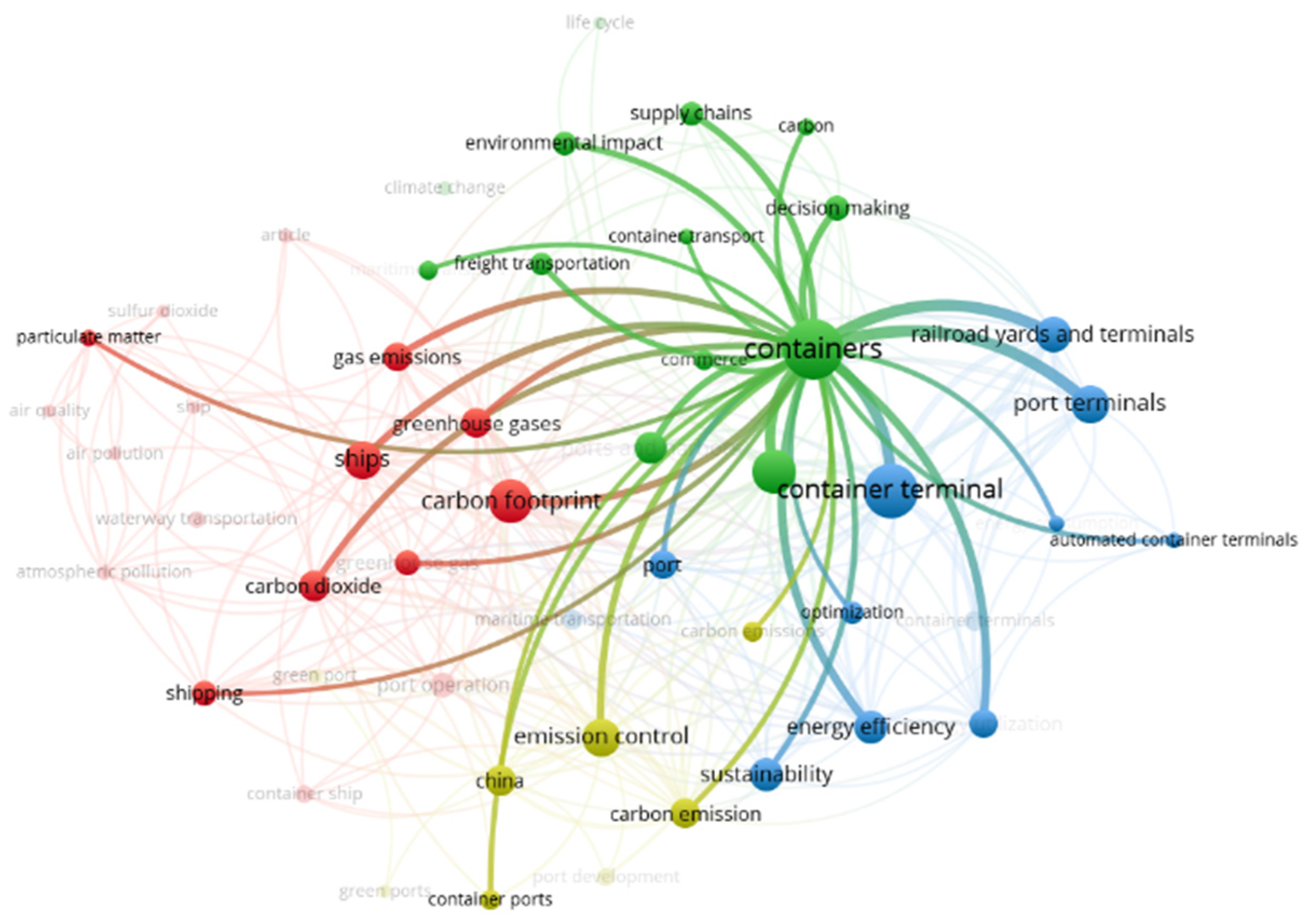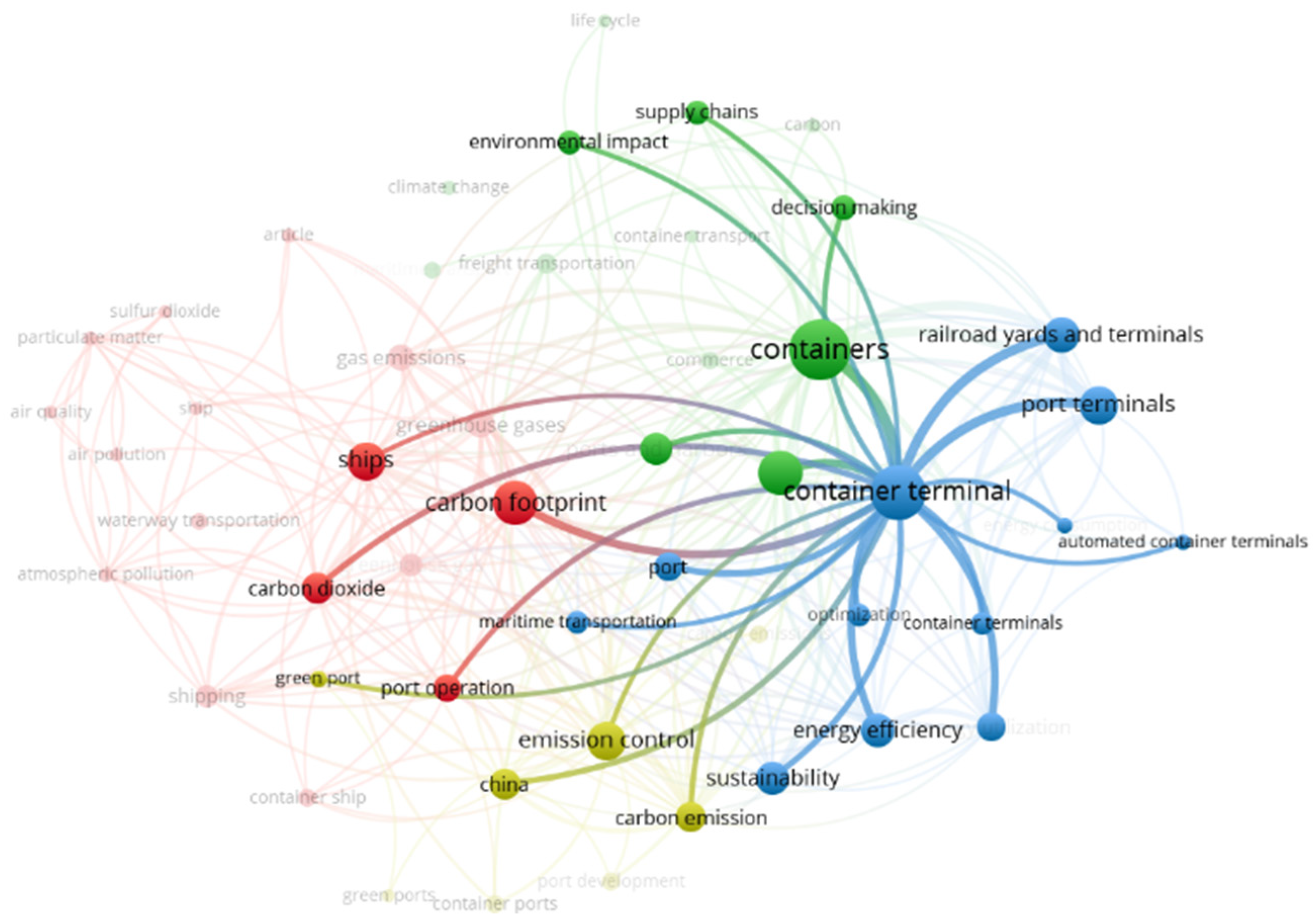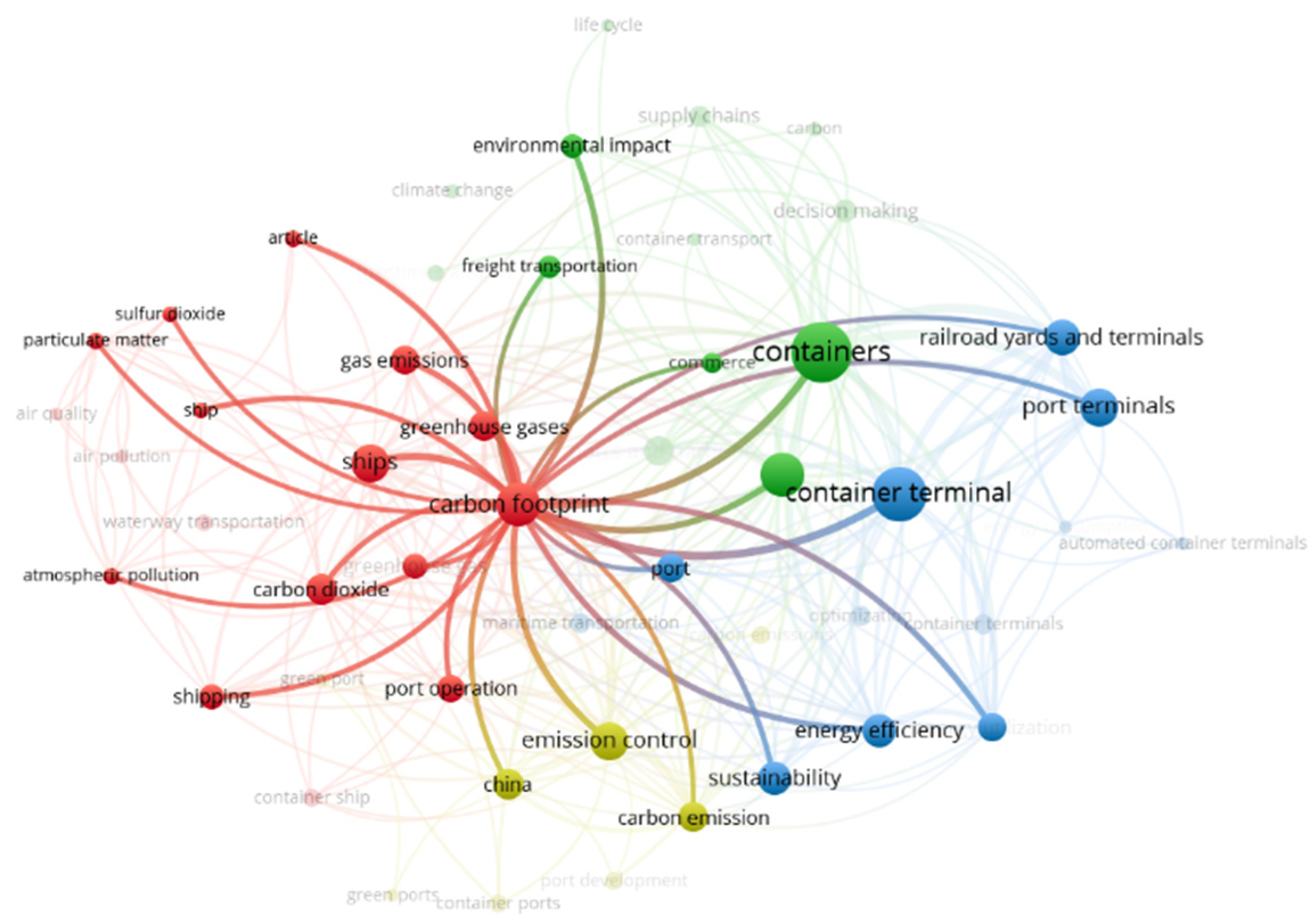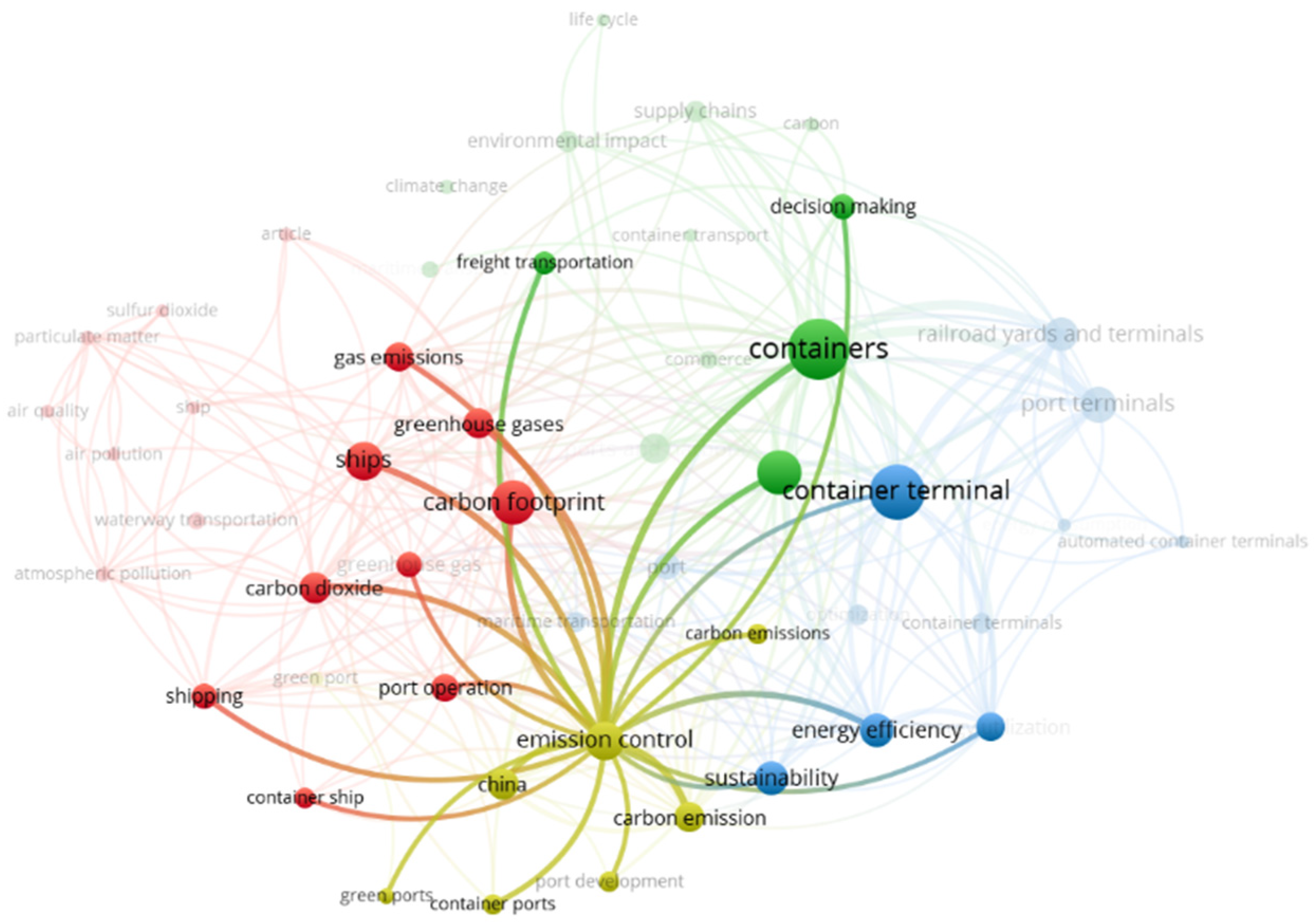

Systematic Review Analysis of Sustainability in Port Logistics Through Carbon Footprint of Container Terminals



Abstract
1. Introduction
- What methods and indicators are used to quantify the carbon footprint of container terminal operations, and how do they differ in terms of system boundaries and accuracy?
- How do selected green technologies (e.g., electrification, automation, and AI-based optimisation) affect carbon footprint reduction in container terminals, based on existing empirical and modelling studies?
2. Materials and Methods
3. Results and Discussion
3.1. Time Analysis
3.2. Spatial Analysis
3.3. Qualitative Analysis
3.4. Bibliometric Analysis
4. Conclusions
Author Contributions
Funding
Institutional Review Board Statement
Informed Consent Statement
Data Availability Statement
Conflicts of Interest
Appendix A. PRISMA 2020 Checklist
| Section and Topic | Item | Checklist Item | Location Where Item Is Reported |
| TITLE | |||
| Title | 1 | Identify the report as a systematic review. | 1 |
| ABSTRACT | |||
| Abstract | 2 | See the PRISMA 2020 for Abstracts checklist. | 1 |
| INTRODUCTION | |||
| Rationale | 3 | Describe the rationale for the review in the context of existing knowledge. | 1 |
| Objectives | 4 | Provide an explicit statement of the objective(s) or question(s) the review addresses. | 2 |
| METHODS | |||
| Eligibility criteria | 5 | Specify the inclusion and exclusion criteria for the review and how studies were grouped for the syntheses. | 2 and 3 |
| Information sources | 6 | Specify all databases, registers, websites, organisations, reference lists and other sources searched or consulted to identify studies. Specify the date when each source was last searched or consulted. | 2 |
| Search strategy | 7 | Present the full search strategies for all databases, registers and websites, including any filters and limits used. | 2 and 3 |
| Selection process | 8 | Specify the methods used to decide whether a study met the inclusion criteria of the review, including how many reviewers screened each record and each report retrieved, whether they worked independently, and, if applicable, details of automation tools used in the process. | 2 |
| Data collection process | 9 | Specify the methods used to collect data from reports, including how many reviewers collected data from each report, whether they worked independently, any processes for obtaining or confirming data from study investigators, and, if applicable, details of automation tools used in the process. | 2 and 15 |
| Data items | 10a | List and define all outcomes for which data were sought. Specify whether all results that were compatible with each outcome domain in each study were sought (e.g., for all measures, time points, analyses), and if not, the methods used to decide which results to collect. | 2 |
| 10b | List and define all other variables for which data were sought (e.g., participant and intervention characteristics, funding sources). Describe any assumptions made about any missing or unclear information. | 2 and 15 | |
| Study risk of bias assessment | 11 | Specify the methods used to assess risk of bias in the included studies, including details of the tool(s) used, how many reviewers assessed each study and whether they worked independently, and if applicable, details of automation tools used in the process. | N/A |
| Effect measures | 12 | Specify for each outcome the effect measure(s) (e.g., risk ratio, mean difference) used in the synthesis or presentation of results. | 7–9 |
| Synthesis methods | 13a | Describe the processes used to decide which studies were eligible for each synthesis (e.g., tabulating the study intervention characteristics and comparing against the planned groups for each synthesis (item #5)). | 7–9 |
| 13b | Describe any methods required to prepare the data for presentation or synthesis, such as handling of missing summary statistics or data conversions. | 3 | |
| 13c | Describe any methods used to tabulate or visually display the results of individual studies and syntheses. | 2 | |
| 13d | Describe any methods used to synthesise results and provide a rationale for the choice(s). If meta-analysis was performed, describe the model(s), method(s) to identify the presence and extent of statistical heterogeneity, and software package(s) used. | 2 | |
| 13e | Describe any methods used to explore possible causes of heterogeneity among study results (e.g., subgroup analysis, meta-regression). | 2 | |
| 13f | Describe any sensitivity analyses conducted to assess the robustness of the synthesised results. | N/A | |
| Reporting bias assessment | 14 | Describe any methods used to assess the risk of bias due to missing results in a synthesis (arising from reporting biases). | N/A |
| Certainty assessment | 15 | Describe any methods used to assess certainty (or confidence) in the body of evidence for an outcome. | N/A |
| RESULTS | |||
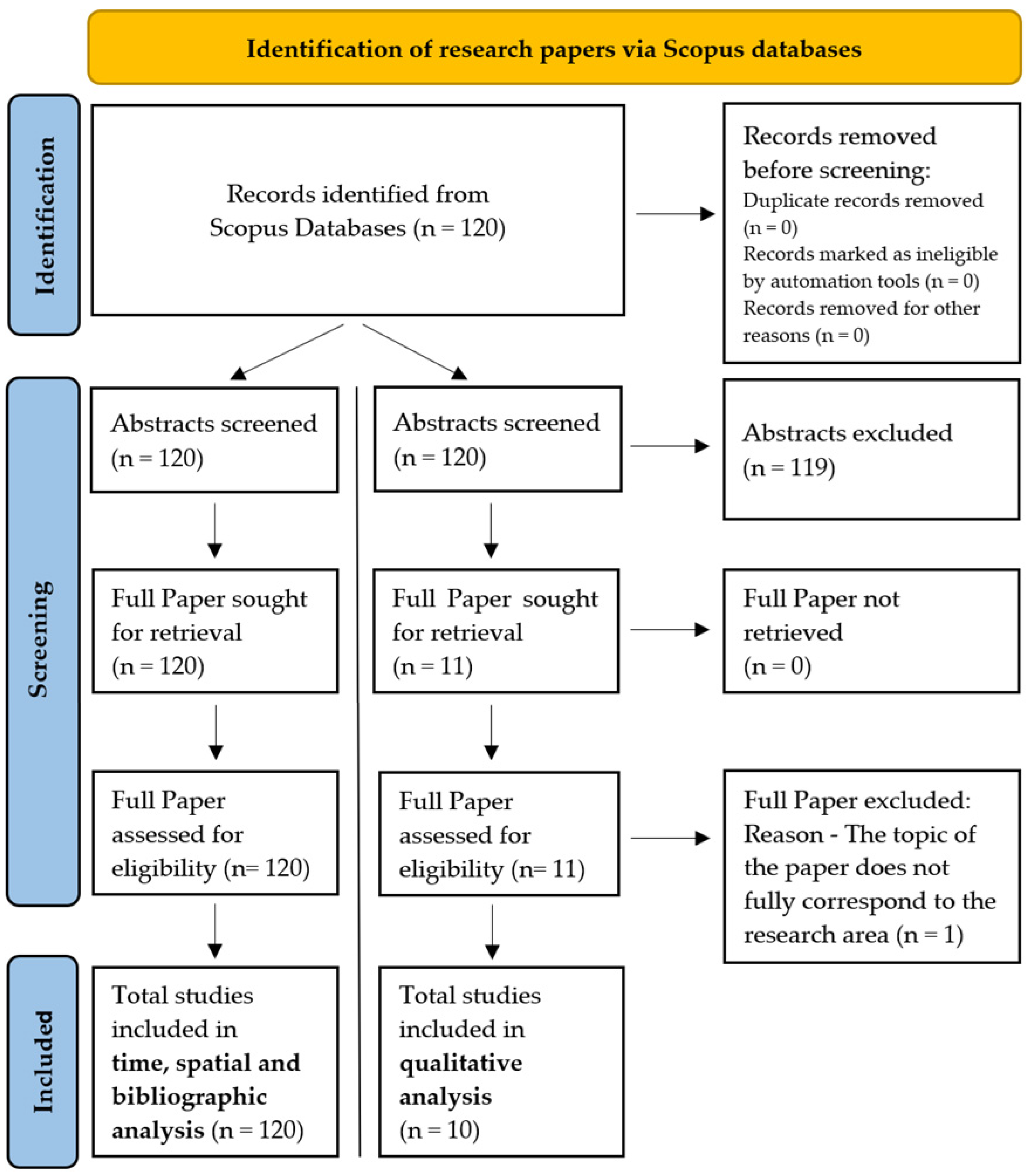
| Study selection | 16a | Describe the results of the search and selection process, from the number of records identified in the search to the number of studies included in the review, ideally using a flow diagram. | 4 |
| 16b | Cite studies that might appear to meet the inclusion criteria, but which were excluded, and explain why they were excluded. | 3 | |
| Study characteristics | 17 | Cite each included study and present its characteristics. | 4 and 5 |
| Risk of bias in studies | 18 | Present assessments of risk of bias for each included study. | N/A |
| Results of individual studies | 19 | For all outcomes, present, for each study: (a) summary statistics for each group (where appropriate) and (b) an effect estimate and its precision (e.g., confidence/credible interval), ideally using structured tables or plots. | 4 and 5 |
| Results of syntheses | 20a | For each synthesis, briefly summarise the characteristics and risk of bias among contributing studies. | 7–9 |
| 20b | Present the results of all statistical syntheses conducted. If meta-analysis was done, present for each the summary estimate and its precision (e.g., confidence/credible interval) and measures of statistical heterogeneity. If comparing groups, describe the direction of the effect. | 6 and 7 | |
| 20c | Present the results of all investigations of possible causes of heterogeneity among study results. | 6 and 7 | |
| 20d | Present the results of all sensitivity analyses conducted to assess the robustness of the synthesised results. | 6 and 7 | |
| Reporting biases | 21 | Present assessments of risk of bias due to missing results (arising from reporting biases) for each synthesis assessed. | N/A |
| Certainty of evidence | 22 | Present assessments of certainty (or confidence) in the body of evidence for each outcome assessed. | 7 and 8 |
| DISCUSSION | |||
| Discussion | 23a | Provide a general interpretation of the results in the context of other evidence. | 9 and 10 |
| 23b | Discuss any limitations of the evidence included in the review. | 14 | |
| 23c | Discuss any limitations of the review processes used. | 14 | |
| 23d | Discuss implications of the results for practice, policy, and future research. | 10 | |
| OTHER INFORMATION | |||
| Registration and protocol | 24a | Provide registration information for the review, including register name and registration number, or state that the review was not registered. | N/A |
| 24b | Indicate where the review protocol can be accessed, or state that a protocol was not prepared. | 2 and 3 | |
| 24c | Describe and explain any amendments to information provided at registration or in the protocol. | N/A | |
| Support | 25 | Describe sources of financial or non-financial support for the review, and the role of the funders or sponsors in the review. | 14 |
| Competing interests | 26 | Declare any competing interests of review authors. | 14 |
| Availability of data, code and other materials | 27 | Report which of the following are publicly available and where they can be found: template data collection forms; data extracted from included studies; data used for all analyses; analytic code; any other materials used in the review. | 2 |
References
- Amani, H.; Bouyaya, L.; Chaib, R.; Amani, M.S. Efficient Space Allocation for Import Containers Minimizing Reshuffling in Yard Blocks: Case Study. Pomorstvo 2024, 38, 224–238. [Google Scholar] [CrossRef]
- Sim, J. A carbon emission evaluation model for a container terminal. J. Clean. Prod. 2018, 186, 526–533. [Google Scholar] [CrossRef]
- Song, D.P.; Xu, J. CO 2 Emission Comparison Between Direct and Feeder Liner Services: A Case Study of Asia-Europe Services Interfacing with the UK. Int. J. Sustain. Transp. 2012, 6, 214–237. [Google Scholar] [CrossRef]
- Acciaro, M.; Ghiara, H.; Cusano, M.I. Energy management in seaports: A new role for port authorities. Energy Policy 2014, 71, 4–12. [Google Scholar] [CrossRef]
- Budiyanto, M.A.; Huzaifi, M.H.; Sirait, S.J.; Prayoga, P.H.N. Evaluation of CO2 emissions and energy use with different container terminal layouts. Sci. Rep. 2021, 11, 5476. [Google Scholar] [CrossRef]
- Martinić-Cezar, S.; Bratić, K.; Jurić, Z.; Račić, N. Exhaust emissions reduction and fuel consumption from the LNG energy system depending on the ship operating modes. Pomorstvo 2022, 36, 338–349. [Google Scholar] [CrossRef]
- Long, N.X.; Van Hung, P. Energy efficiency and carbon emissions assessment of container terminal equipment at Tan Cang–Cai Mep Thi Vai. Int. J. Sustain. Eng. 2025, 18, 2580726. [Google Scholar] [CrossRef]
- Chang, C.C.; Wang, C.M. Evaluating the effects of green port policy: Case study of Kaohsiung harbor in Taiwan. Transp. Res. D Transp. Environ. 2012, 17, 185–189. [Google Scholar] [CrossRef]
- Yang, Y.C. Operating strategies of CO2 reduction for a container terminal based on carbon footprint perspective. J. Clean. Prod. 2017, 141, 472–480. [Google Scholar] [CrossRef]
- Tao, X.; Wu, Q. Energy consumption and CO2 emissions in hinterland container transport. J. Clean. Prod. 2021, 279, 123394. [Google Scholar] [CrossRef]
- Issa, M.; Rizk, P.; Boulon, L.; Rezkallah, M.; Rizk, R.; Ilinca, A. Smart, Connected, and Sustainable: The Transformation of Maritime Ports Through Electrification, IoT, 5G, and Green Energy. Sustainability 2025, 17, 7568. [Google Scholar] [CrossRef]
- Hsu, W.K.K.; Huynh, N.T.; Le Quoc, T.; Yu, H.L. An assessment model of eco-efficiency for container terminals within a port. Econ. Transp. 2024, 39, 100359. [Google Scholar] [CrossRef]
- Calcerano, T.A.; de Castro Hilsdorf, W. Sustainability practices in container terminals in Brazil. Production 2021, 31, e20200113. [Google Scholar] [CrossRef]
- Van Eck, N.J.; Waltman, L. Visualizing Bibliometric Networks, in Measuring Scholarly Impact; Springer International Publishing: Berlin/Heidelberg, Germany, 2014; pp. 285–320. [Google Scholar] [CrossRef]
- Tsolakis, N.; Zissis, D.; Papaefthimiou, S.; Korfiatis, N. Towards AI driven environmental sustainability: An application of automated logistics in container port terminals. Int. J. Prod. Res. 2022, 60, 4508–4528. [Google Scholar] [CrossRef]
- Nguyen, S.; Leman, A.; Xiao, Z.; Fu, X.; Zhang, X.; Wei, X.; Zhang, W.; Li, N.; Zhang, W.; Qin, Z. Blockchain-powered incentive system for jit arrival operations and decarbonization in maritime shipping. Sustainability 2023, 15, 15686. [Google Scholar] [CrossRef]
- Geerlings, H.; Van Duin, R. A new method for assessing CO2-emissions from container terminals: A promising approach applied in Rotterdam. J. Clean. Prod. 2011, 19, 657–666. [Google Scholar] [CrossRef]
- Martínez-Moya, J.; Vazquez-Paja, B.; Gimenez Maldonado, J.A. Energy efficiency and CO2 emissions of port container terminal equipment: Evidence from the Port of Valencia. Energy Policy 2019, 131, 312–319. [Google Scholar] [CrossRef]
- Chen, D.; Zhao, Y.; Nelson, P.; Li, Y.; Wang, X.; Zhou, Y.; Lang, J.; Guo, X. Estimating ship emissions based on AIS data for port of Tianjin, China. Atmos. Environ. 2016, 145, 10–18. [Google Scholar] [CrossRef]
- Toscano, D.; Murena, F. Atmospheric Ship Emissions in Ports: A Review. Correlation with Data of Ship Traffic; Elsevier Ltd.: Amsterdam, The Netherlands, 2019. [Google Scholar] [CrossRef]
- Lam, J.S.L.; Gu, Y. A market-oriented approach for intermodal network optimisation meeting cost, time and environmental requirements. Int. J. Prod. Econ. 2016, 171, 266–274. [Google Scholar] [CrossRef]
- Kizilay, D.; Eliiyi, D.T. A comprehensive review of quay crane scheduling, yard operations and integrations thereof in container terminals. Flex. Serv. Manuf. J. 2021, 33, 1–42. [Google Scholar] [CrossRef]
- Lee, K.H.; Wu, Y. Integrating sustainability performance measurement into logistics and supply networks: A multi-methodological approach. Br. Account. Rev. 2014, 46, 361–378. [Google Scholar] [CrossRef]
- Xin, J.; Negenborn, R.R.; Lodewijks, G. Energy-aware control for automated container terminals using integrated flow shop scheduling and optimal control. Transp. Res. Part C Emerg. Technol. 2014, 44, 214–230. [Google Scholar] [CrossRef]
- Tsao, Y.C.; Linh, V.T. Seaport- dry port network design considering multimodal transport and carbon emissions. J. Clean. Prod. 2018, 199, 481–492. [Google Scholar] [CrossRef]



| Article Title | Authors | Journal (Year) | Cited |
|---|---|---|---|
| A new method for assessing CO2-emissions from container terminals: A promising approach applied in Rotterdam [17] | Geerlings, H., Van Duin, R. | Journal of Cleaner Production (2011) | 166 |
| Energy efficiency and CO2 emissions of port container terminal equipment: Evidence from the Port of Valencia [18] | Martínez-Moya, J., Vazquez-Paja, B., Gimenez Maldonado, J.A. | Energy Policy (2019) | 109 |
| Estimating ship emissions based on AIS data for the port of Tianjin, China [19] | Chen, D., Zhao, Y., Nelson, P., Li, Y., Wang, X., Zhou, Y., … & Guo, X. | Atmospheric environment (2016) | 102 |
| Atmospheric ship emissions in ports: A review. Correlation with data of ship traffic [20] | Toscano, D., Murena, F. | Atmospheric Environment (2019) | 82 |
| A market-oriented approach for intermodal network optimisation meeting cost, time and environmental requirements [21] | Lam, J.S.L., Gu, Y. | International Journal of Production Economics (2016) | 82 |
| A comprehensive review of quay crane scheduling, yard operations and integrations thereof in container terminals [22] | Kizilay, D., Eliiyi, D.T. | Flexible Services and Manufacturing Journal (2020) | 79 |
| Integrating sustainability performance measurement into logistics and supply networks: A multi-methodological approach [23] | Lee, K.-H., Wu, Y. | British Accounting Review (2014) | 79 |
| Energy-aware control for automated container terminals using integrated flow shop scheduling and optimal control [24] | Xin, J., Negenborn, R.R., Lodewijks, G. | Transportation Research Part C: Emerging Technologies (2014) | 73 |
| Seaport–dry port network design considering multimodal transport and carbon emissions [25] | Tsao, Y.-C., Linh, V.T. | Journal of Cleaner Production (2018) | 60 |
| Towards AI-driven environmental sustainability: an application of automated logistics in container port terminals [15] | Tsolakis, N., Zissis, D., Papaefthimiou, S., Korfiatis, N. | International Journal of Production Research (2021) | 57 |
| Title | Research Method/Technique |
|---|---|
| A new method for assessing CO2-emissions from container terminals: A promising approach applied in Rotterdam [17] | A systematic framework was developed to analyse CO2 emissions from container terminal operations in ports. The methodology is exemplified through its application to the Port of Rotterdam, serving as a representative case study. |
| Energy efficiency and CO2 emissions of port container terminal equipment: Evidence from the Port of Valencia [18] | The study analyses energy consumption and CO2 emissions at the Mediterranean container terminal (Valencia, Spain). Focus is on identifying key emission sources and assessing technical measures for improving energy efficiency. |
| Estimating ship emissions based on AIS data for the port of Tianjin, China [19] | The research was conducted using the Automatic Identification System (AIS) for Tianjin Port. |
| Atmospheric ship emissions in ports: A review. Correlation with data of ship traffic [20] | The study reviews and analyses NOₓ and PM10 emissions from passenger and commercial ships in ports, focusing on: cruise ships, other passenger ships, and commercial vessels. Emissions were correlated with annual traffic regression for emissions. |
| A market-oriented approach for intermodal network optimisation meeting cost, time and environmental requirements [21] | The study develops a bi-objective optimisation model for tactical planning of intermodal container flows, specifically designed for freight integrators. The model simultaneously minimises total cost and transit time, while incorporating constraints on carbon emissions. |
| A comprehensive review of quay crane scheduling, yard operations and integrations thereof in container terminals [22] | The study categorises and synthesises previous research on key problem areas including quay crane assignment and scheduling, yard crane operations, vehicle dispatching, routing, and storage planning to provide a holistic understanding of terminal performance. |
| Integrating sustainability performance measurement into logistics and supply networks: A multi-methodological approach [23] | The study employs a multi-methodological approach to assess economic and environmental performance in logistics and supply chain management. A case study of Westgate Ports (Australia) is used to compare cost and carbon emissions. |
| Energy-aware control for automated container terminals using integrated flow shop scheduling and optimal control [24] | A hybrid control methodology is proposed for optimising energy consumption and handling capacity in automated container terminals. Simulation is used to test the approach. |
| Seaport–dry port network design considering multimodal transport and carbon emissions [25] | The study uses an approximation model for a multimodal seaport–dry-port network that includes carbon emissions as a parameter. It combines road and rail transport and applies a game-theoretic approach to model interactions among seaports, dry ports, and shippers. |
| Towards AI-driven environmental sustainability: an application of automated logistics in container port terminals [15] | The paper combines a literature review with a simulation-based case study to examine the environmental impacts of artificial intelligence (AI) and automation, particularly Automated Guided Vehicles (AGVs), in container terminals. The study uses data for scenarios and assesses environmental outcomes. |
| Title | Research Method/Technique |
|---|---|
| A new method for assessing CO2 emissions from container terminals: A promising approach applied in Rotterdam [17] | The proposed analytical framework enables the quantification and evaluation of CO2 emissions across various container terminal activities. A set of targeted recommendations has been formulated to support emission reduction, including alternative fuels such as biofuels. |
| Energy efficiency and CO2 emissions of port container terminal equipment: Evidence from the Port of Valencia [18] | Retrofitting RTGs and replacing diesel tractors with LNG models significantly reduced emissions. The study underscores the role of port authority policies in promoting environmental improvements. |
| Estimating ship emissions based on AIS data for the port of Tianjin, China [19] | ship emission inventory with temporal and spatial resolution. spatial distribution and monthly variations in ship emissions. |
| Atmospheric ship emissions in ports: A review. Correlation with data of ship traffic [20] | Regression models were developed to estimate ship emissions in ports using easily available traffic data. The approach highlights significant uncertainty in existing emission estimation methods. |
| A market-oriented approach for intermodal network optimisation meeting cost, time and environmental requirements [21] | The model provides practical insights into trade-offs between cost and transit time in intermodal logistics. The study highlights the potential of integrated planning tools to balance economic efficiency and environmental impact in freight transport. |
| A comprehensive review of quay crane scheduling, yard operations and integrations thereof in container terminals [22] | Integrated approaches to operational planning show promise in improving overall terminal efficiency. The study offers managerial insights and research directions for optimising container terminal logistics. |
| Integrating sustainability performance measurement into logistics and supply networks: A multi-methodological approach [23] | The multi-method approach proved effective in supporting decision-making by providing a more comprehensive sustainability assessment. The study emphasises the value of integrating diverse performance indicators into a unified model to enhance sustainable logistics planning. |
| Energy-aware control for automated container terminals using integrated flow shop scheduling and optimal control [24] | The methodology enables minimisation of energy use while maintaining efficient container handling. Coordinated control across system levels allows for time-constrained energy optimisation. |
| Seaport–dry port network design considering multimodal transport and carbon emissions [25] | Rail transport via dry ports reduces both cost and carbon emissions compared to exclusive road transport. Game theory provides balanced outcomes, optimising environmental and economic goals. |
| Towards AI-driven environmental sustainability: an application of automated logistics in container port terminals [15] | Adoption of AGVs and AI-based systems improves environmental sustainability in port operations. Simulated routing strategies show measurable reductions in emissions. |
Disclaimer/Publisher’s Note: The statements, opinions and data contained in all publications are solely those of the individual author(s) and contributor(s) and not of MDPI and/or the editor(s). MDPI and/or the editor(s) disclaim responsibility for any injury to people or property resulting from any ideas, methods, instructions or products referred to in the content. |
© 2026 by the authors. Licensee MDPI, Basel, Switzerland. This article is an open access article distributed under the terms and conditions of the Creative Commons Attribution (CC BY) license.
Share and Cite
Grofelnik, H.; Jardas, M.; Mudronja, G. Systematic Review Analysis of Sustainability in Port Logistics Through Carbon Footprint of Container Terminals. Logistics 2026, 10, 132. https://doi.org/10.3390/logistics10060132
Grofelnik H, Jardas M, Mudronja G. Systematic Review Analysis of Sustainability in Port Logistics Through Carbon Footprint of Container Terminals. Logistics. 2026; 10(6):132. https://doi.org/10.3390/logistics10060132
Chicago/Turabian StyleGrofelnik, Hrvoje, Mladen Jardas, and Gorana Mudronja. 2026. "Systematic Review Analysis of Sustainability in Port Logistics Through Carbon Footprint of Container Terminals" Logistics 10, no. 6: 132. https://doi.org/10.3390/logistics10060132
APA StyleGrofelnik, H., Jardas, M., & Mudronja, G. (2026). Systematic Review Analysis of Sustainability in Port Logistics Through Carbon Footprint of Container Terminals. Logistics, 10(6), 132. https://doi.org/10.3390/logistics10060132