
Article

A System Dynamics Model to Support Transportation Procurement Based on the Logistical Costs of Potato Distribution in Mexico

by
Andrea C. Vazquez-Hernández
,
Ruben H. Alvarez-Mirazo
and
Ernesto A. Lagarda-Leyva
*
Industrial Engineering Department, Instituto Tecnológico de Sonora, Ciudad Obregón 85000, Mexico
*
Author to whom correspondence should be addressed.
Logistics 2026, 10(6), 126; https://doi.org/10.3390/logistics10060126
Submission received: 18 April 2026 / Revised: 26 May 2026 / Accepted: 28 May 2026 / Published: 3 June 2026

Abstract

Background: This study evaluates the return on investment (ROI) in new transport equipment using a purpose-built graphical user interface (GUI), addressing whether acquiring additional vehicles for peak demand periods is economically viable compared to optimizing the existing fleet. The research focuses on agricultural product transportation—specifically potatoes—across four key routes. Methods: A system dynamics (SD) methodology was applied, combining simulation and data analysis through a GUI that enabled the adjustment of key variables, including operating costs, yields, and transportation expenses. Results: The analysis revealed notable differences in costs and profitability across the studied routes. Variables such as diesel costs and fuel efficiency proved particularly influential on outcomes. The GUI demonstrated clear value as a visualization tool, enhancing comprehension of simulated scenarios and supporting strategic decision-making. Conclusions: Investing in new transport equipment can be profitable under specific operational and economic conditions, providing a solid foundation for expansion and optimization decisions. Beyond its immediate operational contribution, the study offers a replicable profitability analysis model applicable to future projects within the company.

1. Introduction

According to the Agri-food and Fisheries Information Service (SADER by its Spanish acronym of Secretaria de Agricultura y Desarrollo Rural) [1], potato production in Mexico has shown a stable and growing trend recently. In Mexico, a shortage of transportation has been a recurring problem affecting the distribution of agricultural products, including potatoes. According to reports from SADER, one of the main problems is the lack of adequate infrastructure for transporting perishable goods. Many producers face difficulties in getting their goods to major markets due to insufficient routes and inadequate transportation systems. The situation is exacerbated by the lack of cold chains necessary to prevent product spoilage, which affects the quality and availability of potatoes in the market.
Transportation costs have also risen due to higher fuel prices and a lack of investment in logistics infrastructure. This situation directly impacts producers’ profit margins and the final price of potatoes in domestic markets, making them less competitive against cheaper imports, especially from the United States [2].
In 2020, the main producing states were Sonora, Sinaloa, and Veracruz, accounting for more than 60% of national production. Sonora led with 505,907 tons, followed by Sinaloa with 462,094 tons and Veracruz with 227,871 tons [3].
In Sonora, according to information presented by the Secretariat of Agriculture, Livestock, Water Resources, Fisheries, and Aquaculture [4], the annual average of planted hectares is 453,505, yielding a total production of 4,889,128.8 tons, generating a total production value of 43,869.8 million pesos. This figure is the result of all crop plantings, incorporating all production cycles in the region.
The name of the organization under study is omitted for confidentiality reasons. It is dedicated to providing product transportation services from the supplier to the consumer, a task that is part of a logistics system, which involves paperwork, planning, execution, and data analysis for the future. The company in question is located in Ciudad Obregón, Sonora. The company interacts with both product suppliers—who are farmers—and customers, such as Sabritas. It handles the loading, distribution, and unloading of potatoes, as well as credit management, payments, and everything else involved.
The organization has a total of seven trailers: five 2012 International ProStart trailers, one 2012 Volvo trailer, and one 2017 Freightliner trailer; and 22 transport containers, 21 of which are 40-foot containers from 2005 with a capacity of 20 pallets or 25 tons of bulk cargo, and one 53-foot container with a capacity of 30 pallets or 28 tons of bulk cargo. Since the planting of various crops is seasonal, so too is the demand for transportation. During the high-demand season, the vehicle fleet is insufficient to meet all distribution orders, as shipments are made to various destinations—both for export and within the country—with varying frequencies and in different volumes, which presents both a challenge and an opportunity for the organization.
The main issue is the shortage of transportation; this situation has been a constant factor in potato distribution, from the regional to the global level. The reality is that the number of organizations operating in the sector lacks the capacity to meet the sector’s total demand for the service, which translates into opportunities for increased revenue.
However, demand is seasonal. Based on data for 2024, during the high season (February–June), the company makes 307 trips to various clients, while during the low season (October–January), it makes 160. The company has the capacity to handle an average of 10 trips per week when demand is steady and up to 20 trips during peak demand, with the revenue from each trip depending on the vehicle capacity used, yielding an average profit margin of 45% of the price and missing out on the opportunity to take up to 10 more trips—that is, an average revenue per trip of $47,000 (average data provided by the organization). Despite these values, increasing the capacity of each organization may represent an unwise investment, given that expanding the vehicle fleet increases expenses for acquisition, maintenance, etc., while revenue does not yield the expected profits.
In this regard, the main objective of this study is to develop a technological solution based on a graphical user interface that allows for the evaluation of the return on investment in new vehicles and transport containers for potato distribution on specific routes to efficiently meet demand, thereby increasing the organization’s revenue and implementing system dynamics and multicriteria decision-making (MCDM) using the Technique for Order of Preference by Similarity to Ideal Solution (TOPSIS) and Faire Un Choix Adéquate (FUCA) methods. The research question was, “What solution can be developed to assess the profitability of a distribution company that invests in vehicles and transport containers for different routes, taking into account the fluctuating demand in the sector?”. The paper presents a methodology that combines FUCA and TOPIS to support the selection of the optimal scenario based on two multi-criteria decision-making (MCDM) approaches and incorporates a graphical user interface (GUI) that facilitates the management of management decision policies for current and future decisions in accordance with the dynamics of the internal and external context.
The research will be carried out from January through December 2024 in Ciudad Obregón, Sonora, Mexico, for the transport of potatoes exclusively to various destinations within Mexico and across the border from Mexico to Arizona, USA (export), using vehicles with a capacity of 25 tons for this purpose. The main limitation was the function for entering demand into the simulation, given that the service has high- and low-demand seasons; therefore, demand is presented as a daily average.

2. Literature Review

Transportation costs have also increased due to rising fuel prices and a lack of investment in logistics infrastructure, making it difficult to meet the goal of increasing the number of trips made per year. Based on this, Lasso [5] studies parcel delivery routes, seeking to improve time, distances, and costs in the courier system using computational simulation and constraint analysis.
From an agricultural perspective, Van Tang et al. [6] implement a multi-objective optimization model in conjunction with genetic algorithms, aiming to minimize both costs and environmental impact while considering capacity constraints and time windows for product delivery. Among the various approaches Acosta-Agudelo et al. [7] analyze the role of intermediaries in the agricultural market, proposing as an alternative for cost reduction the creation of potential agreements that allow for products of similar origin in each shipment.
On the other hand, Shahbahrami et al. [8] implement system dynamics, simulating the behavior of the pharmaceutical supply chain over 24 months and analyzing the impact of various policies on it, which allows for the visualization of product trends and profits. In turn, Kamran et al. [9] develop a simulation model, based on multi-objective, multi-period, and multi-product simulation, for decisions regarding production, distribution, location, allocation, and inventory control.
In the pursuit of logistics cost reduction and optimization, Zhang and Wang [10] propose a dynamic programming method based on the adaptive ant colony algorithm, considering transportation costs and constraints, which allows for finding routes with fewer iterations, shorter paths, and a low degree of cargo loss, thereby increasing customer satisfaction and supply chain accuracy.
Pursuing the same objectives, Hamoudi et al. [11] achieved a 15% reduction in operating costs and a 20% improvement in delivery times by employing dynamic programming, taking into account capacity, traffic, and time window constraints, and considering multiple possible real-world scenarios.
In turn, Rodríguez et al. [12] developed a mathematical model implementing genetic algorithms to simulate various distribution scenarios, evaluating the performance of the proposed routes based on key variables and constraints, providing a flexible approach to address logistical complexities. The results show a 25% reduction in operating costs and a 20% improvement in delivery times.
Based on the savings algorithm, Yang and Chang [13] first analyze the information generated by manual route planning, noting significant waste of transportation resources. They redesign the distribution scheme under vehicle load and mileage constraints, significantly improving load factors and mileage utilization, reducing costs, and increasing efficiency. Another example of the results obtained through automatic route generation is presented by Iparraguirre and Coral [14], who developed advanced techniques, models, and technologies to adapt to dynamic environments and make real-time decisions. Despite these advancements, they highlight that challenges arise in implementing these solutions in areas with limited and inflexible infrastructure.
To achieve these objectives, organizations must determine the best approach: whether to minimize distance, time, or the sum of both in monetary units. Álvarez et al. [15] establish three different models to analyze the effect of each of these approaches in various scenarios. This analysis highlights the differences in results depending on the logistical scope (regional, city, and local levels).
Meanwhile, Jiang et al. [16] integrate dynamic demand behavior into route and cost optimization by adopting a genetic algorithm and updating key points, ensuring a rapid response to the customer, a reduction in carbon emissions, and an overall cost reduction of 17.13%.
Within the supply chain, the costs of this process influence the cost of the final product; therefore, organizations are advised to improve supply chain processes continuously to reduce overall costs. Katon et al. [17] implement system dynamics to generate 12 alternative scenarios, simulate them, and select the most efficient one considering the total shortage of products to be distributed. As a second example, Liu et al. [18] propose a system dynamics model by creating a cause–effect curve with an emphasis on agility and flexibility indicators, identifying the optimal point for the operation of the organization under study.
From another perspective, today’s businesses are moving toward sustainable development and a circular economy, providing an opportunity to simulate business models that explain the relationship between business strategy, daily operations, strategy implementation, and stakeholder interactions. In their study, Jonsdottir et al. [19] support through their findings that SD is an innovative tool for business model development, as it allows for the evaluation of scenarios and identifies leverage points, regulations, policies, and product design that lead to sustainable strategies. Similarly, Jin et al. [20] conclude that SD has potential applications in inventory management, risk management, supply chain financing, and the ecological management of the supply chain.
Following the same methodology, Cadenas et al. [21] develop a model that interprets the interactions between strategic thinking, project portfolio management, project management, and production using a new mathematical approach that explains patterns of growth and decline in the real system, resulting in a mathematical tool based on the incorporation of differential equations into their dynamic model.
Focusing on investment strategies, Łatuszyńska and Borawska [22] analyze the applicability of system dynamics models by considering feedback loops, delays, and nonlinearities in business operations, which allows for the evaluation of both macro- and microeconomic aspects and supports strategic decision-making, particularly regarding investment strategies. For their part, Khakdaman et al. [23] integrate government regulations, trends in sustainable adoption, investments in different technologies, and environmental requirements for the supply chain, enabling an assessment of the quantitative impact of investment on the sustainability of the CDS.
Dongle and Khalafalla [24] presented a modeling framework to examine policy and resource dynamics in the construction sector, integrating variables associated with the workforce, material supply, financing, and policy delays. Their findings suggest that regulatory reform and workforce training are the most effective measures for enhancing project performance, with an anticipated 28% decrease in human capital investment cost overruns over a 10-year simulation period.
Appendix A.1 provides a summary of the authors and their main contributions, as identified in the literature review.

3. Materials and Methods

The focus of the study in developing the proposal was current and future transport capacity for potato distribution to the various distribution routes.
The main resources used for its development were:
Vensim® PLE PLUS 2026 (Version 10.2.1, Ventana Systems Inc., Harvard, MA, USA). This software was used to design the causal diagram of the studied process, considering the factors involved, as well as those related to equipment investment and how they all interrelate.
Stella® Architect 2026 (Version 3.8.1, Isee Systems Inc., Lebanon, NH, USA). This software was used to construct the Forrester diagram, which enabled the design of a model of the potato distribution process, the equations required for it to run, the simulation of the real system, and its sensitivity analysis, culminating in the creation of a graphical interface through which the user can interact and obtain different results based on changes in variable values.
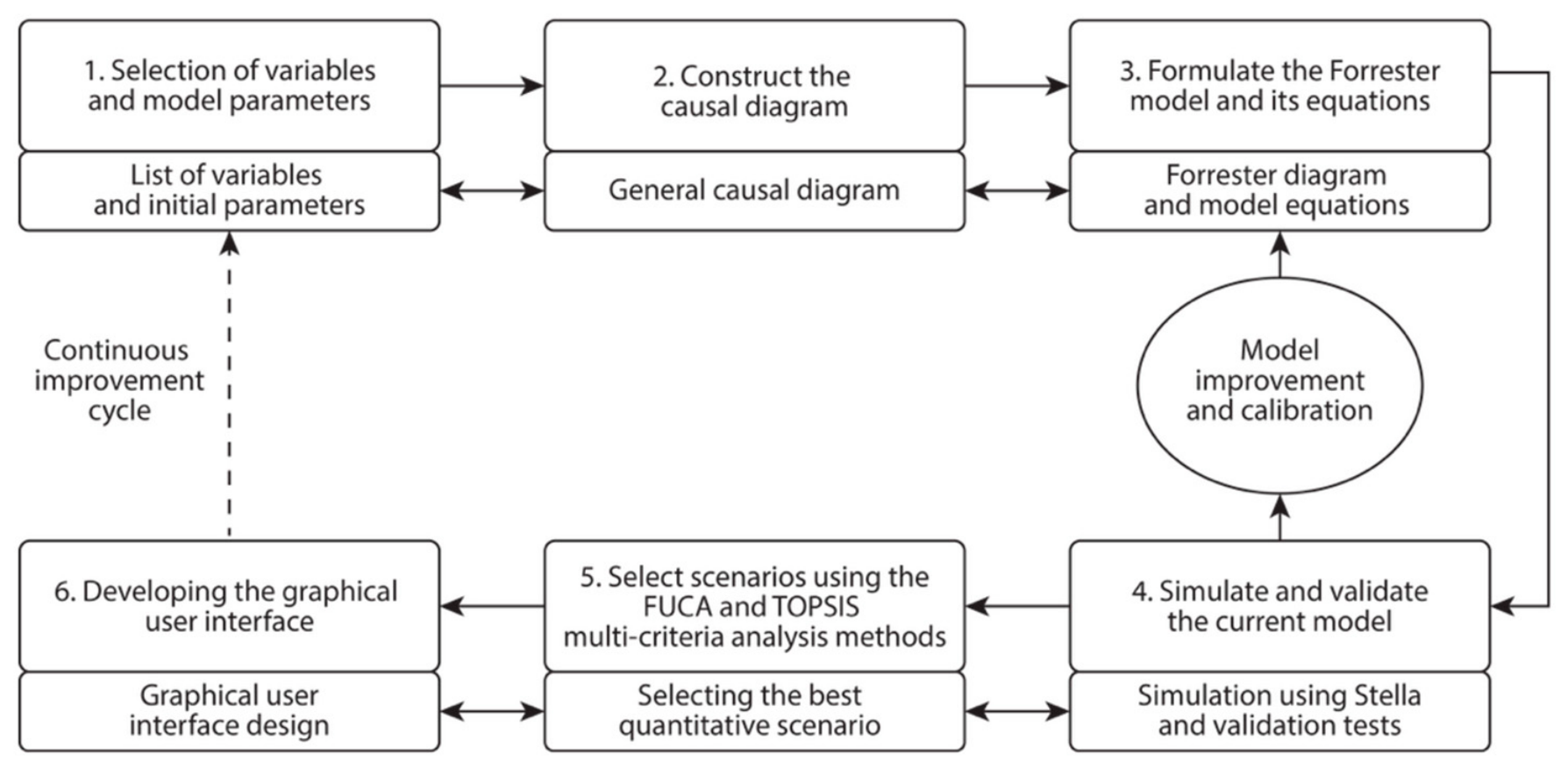
The method was carried out in seven phases; the process is as follows. See Figure 1, which includes six phases.
Select variables and model parameters. As a first step, to begin, the variables and parameters most relevant to the construction of the causal diagram and, subsequently, the model were identified—variables involved in the continuous flow of the system—resulting in a list of these, accompanied by a description of each for a better understanding of their integration.
Construct the causal diagram. Following this step, we sought to identify the relationship between the previously listed variables and parameters and their relevance. Once we clearly understood the organization’s situation regarding the process to be followed for potato distribution, the information was captured in a simple and concise causal diagram using Vensim® PLE PLUS 2026 (Version 10.2.1, Ventana Systems Inc., Harvard, MA, USA), where both balancing and feedback loops are highlighted for clarity.
Formulate the Forrester model and its equations. At this stage, the variables and parameters necessary and of greatest importance for the model to be simulated were identified and distinguished. First, the sequence of operations within the operational area was mapped out, followed by the associated financial behavior, and then the development of mathematical equations to be used in each element of the model to represent the relationship between the variables and parameters that comprise it, using the Stella® Architect 2026 (Version 3.8.1, Isee Systems Inc., Lebanon, NH, USA). Information provided by the company was used as input for the model.
Simulate and validate the current model. At this point, once the model is complete, it is time to simulate it and, consequently, validate it to ensure its functionality and alignment with reality. To this end, the validation test conducted was the relative error percentage method.
Select scenarios using the FUCA and TOPSIS multi-criteria analysis methods. In this step, quantitative scenarios were created to illustrate different situations through an analysis aimed at maximizing the following four variables: net present value, internal rate of return, gross margin, and net margin. The weights were assigned by applying a comparative matrix based on the factors the organization deemed most important, which were validated by senior management; the process allowed the weights to be distributed across each of the variables. Five iterations of the scenarios were performed for each type: current, pessimistic, and optimistic. These scenarios were analyzed and compared using two multi-criteria analysis methods, FUCA and TOPSIS, to select the most appropriate option based on the comparison of both methods. As a result, 15 scenarios were generated, which were divided equally among the three types. Additionally, a sensitivity analysis was conducted, considering various policies for varying the parameters to evaluate the system’s response to changes, which helped identify how robust the selected scenarios were under different conditions. Finally, normal, pessimistic, and optimistic scenarios were created based on the priorities determined by the TOPSIS and FUCA multi-criteria decision-making methods.
Developing the graphical user interface. As a final step, the graphical interface was designed. Through a series of sliders and by applying functions to each one, variables are introduced that allow the user to interact and obtain different results, depending on the scenario they wish to simulate—that is, to make changes on the operational side by altering demand behavior or on the financial side by changing the dollar exchange rate. This process yields the data used for the multi-criteria analysis. To achieve this goal, switches, scales, text boxes, etc., were used.

4. Results

Selection of variables and parameters. In this stage, the most relevant variables were selected to structure the causal diagram, based on works such as those by [25,26]. Similarly, the most relevant variables for management were included, the same ones considered in the Forrester diagram and for the multi-criteria analysis of FUCA and TOPIS [27,28,29]. The results of this analysis are shown in Table 1, which lists the variables used in the dynamic models.
The variables required for the causal diagram used in its construction were 15, while for the Forrester diagram, there were 249.
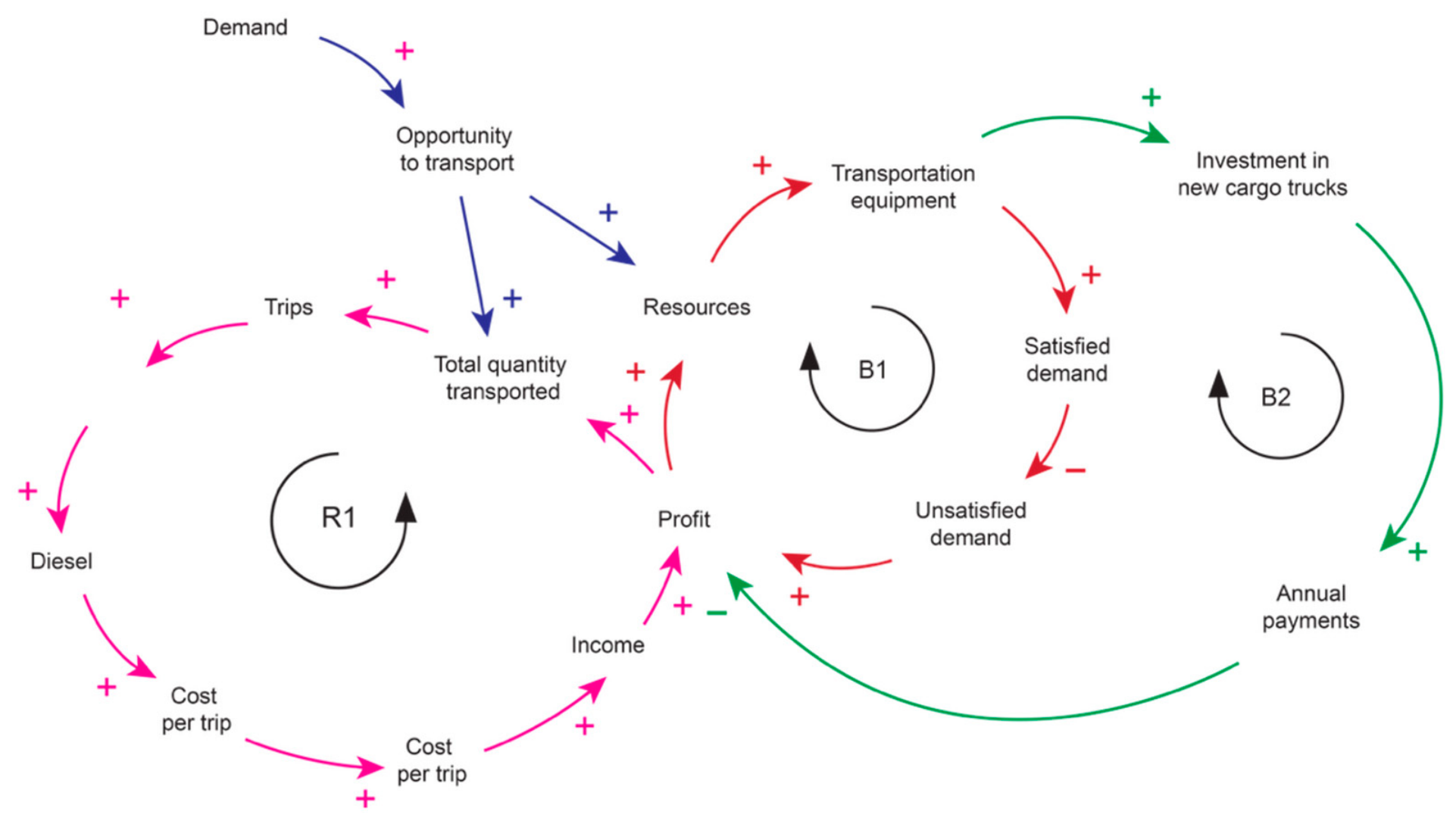
Construction of the causal diagram. As a second step, the variables identified in the previous stage were linked, using the studies [30,31] as a reference, resulting in Figure 2, which presents the causal diagram of the case under study.
The causal diagram presented illustrates the interrelationships among the main variables involved in the potato transport model. The system consists of feedback loops that explain both the growth dynamics and the equilibrium dynamics within it.
The diagram begins with transport demand, which determines the opportunities available to the company for transporting the product. On the left side is the first feedback reinforcement loop (R1), which illustrates that as the quantity of product transported increases, the number of trips made also increases, resulting in a greater number of kilometers traveled per vehicle and higher diesel consumption for operation; it then indicates that, as consumption increases, so does the cost per trip, thereby increasing the price—that is, revenue—and, consequently, profit, leading back to a greater quantity of product transported.
On the other hand, regarding the balances, first, describe balancing loop (B1), noting that as transportation opportunities increase, so will resources—both financial and material—which implies greater investment (vehicle fleet) and, therefore, higher annual payments for vehicles purchased on credit, either partially or fully with financial institution support, thus decreasing annual profit and increasing material resources.
Conversely, for balance (B2), as the vehicle fleet increases, greater demand will be met, consequently reducing unmet demand, which leads to an increase in profit and, therefore, the organization’s resources (B2).
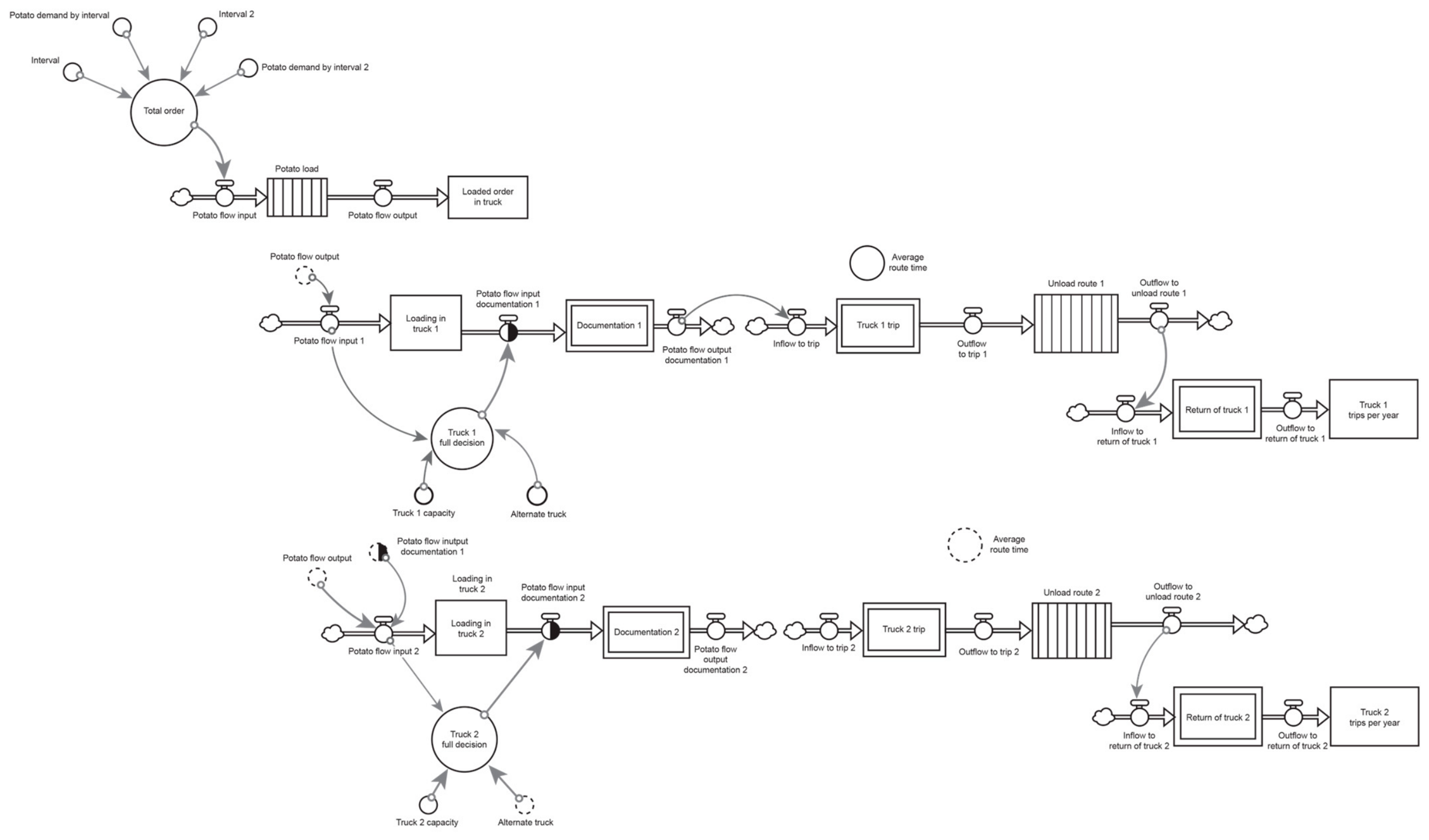
Formulation of the Forrester model and its associated equations. At this point, there are a higher number of variables and parameters for its operation and the derivation of results. To this end, a series of figures are presented showing the different structures that make up the designed model, based on studies conducted by [32,33], in which time is measured in days to forecast demand and annual behaviors within the organization. The organization’s operational area, Figure 3, is presented.
The procedure for completing a trip is shown, regardless of the assigned destination. To establish the total order received, the quantity requested by the customer and the time intervals between orders are entered. An unlimited stock is used in the first row to calculate the total number of tons loaded during the simulated cycle. Based on this demand, the product is loaded onto the truck to begin the trip while simultaneously deciding whether it is necessary to fill another truck to meet the total requested demand. Following these steps, the administrative department prepares the documentation (order records, health and tax documentation, among others), and the truck proceeds to the destination; unloads the product; and returns to the point of origin, completing the entire trip for each truck.
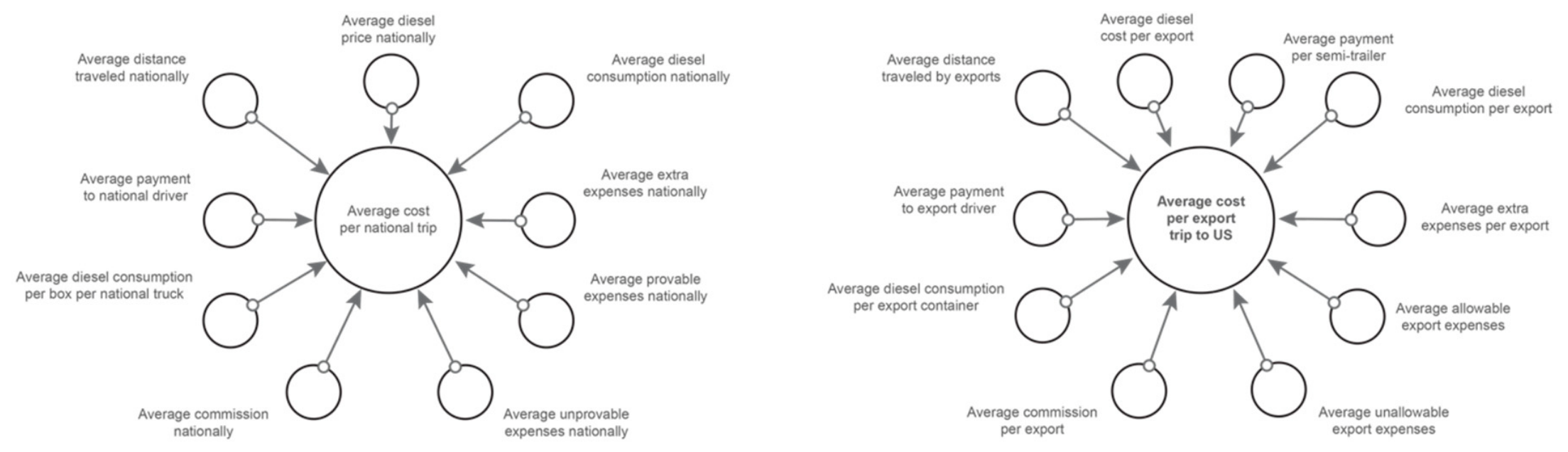
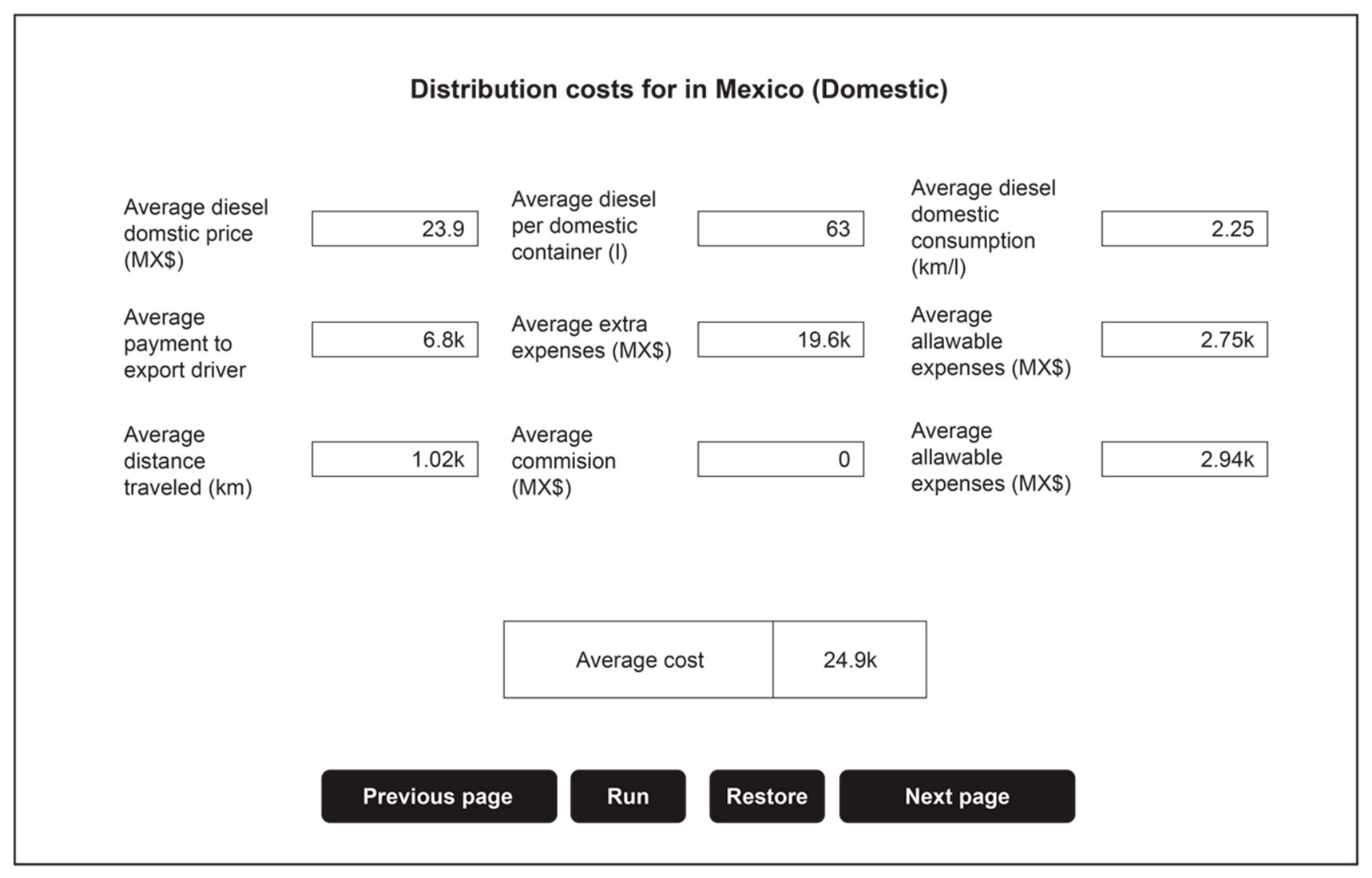
In turn, two types of trips are managed—domestic and export—generating different costs, as shown in Figure 4.
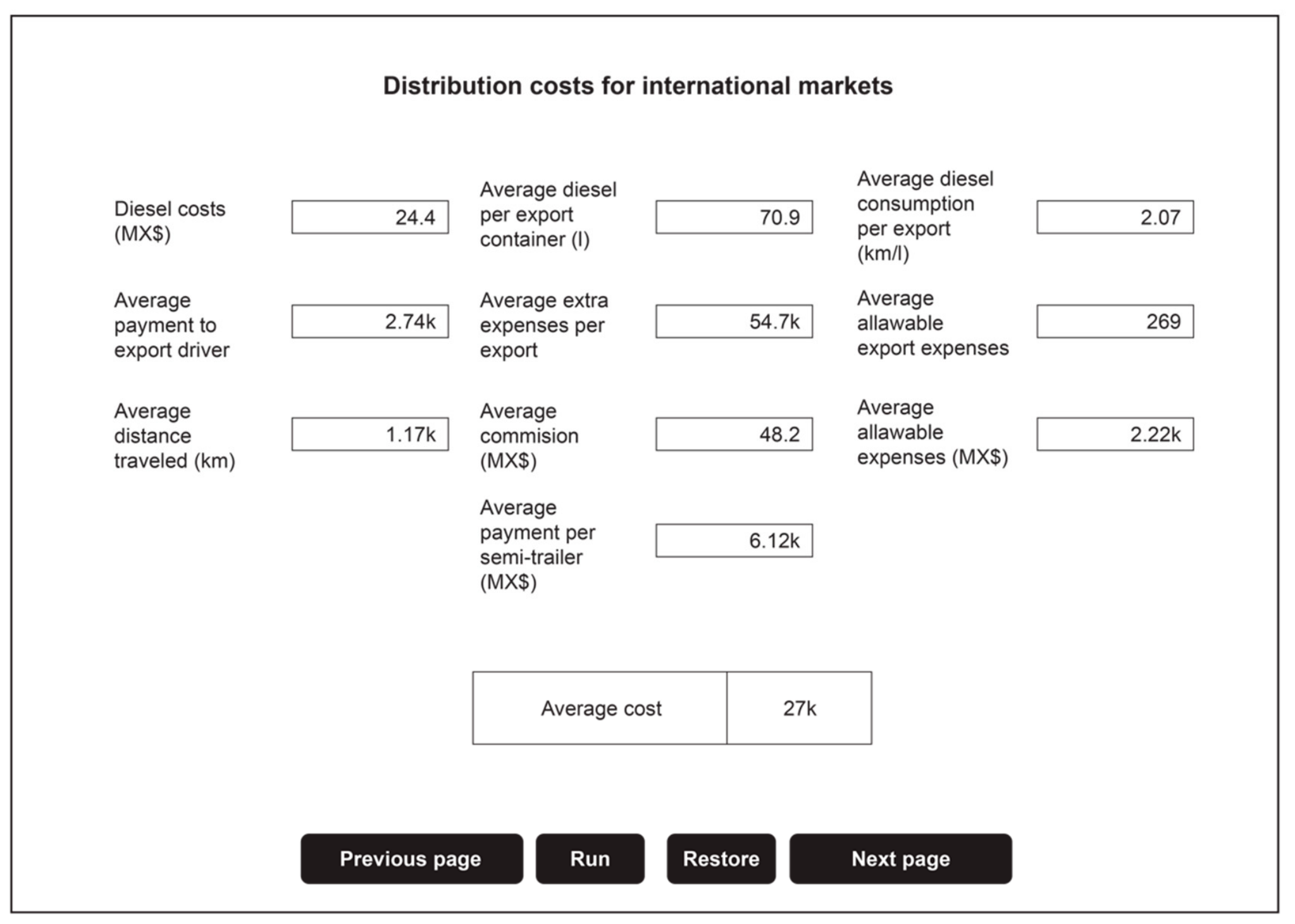
When it comes to domestic trips, nine variables are taken into account to calculate the average cost (24.9 k MX$): distances traveled (1283 km), driver payments (6800 MX$), the price of diesel (23.9 $/L), diesel fuel efficiency (2.25 km/L), diesel consumption per container per national truck (63 L/truck), verifiable (2936 MX$) and non-verifiable (2750 MX$) expenses, extras (19.6 MX$), and commission (0 $MX). Meanwhile, the calculation of the average cost per export trip (27 k MX$) considers the same variables, incorporating an additional one: distances traveled (1173 km), driver payments (2735 MX$), the price of diesel (24.36 $/L), diesel fuel efficiency (2.07 km/L), diesel consumption per container per national truck (70.86 L/truck), verifiable (2217 MX$) and non-verifiable (269 MX$) expenses, extras (54.69 MX$), and commission (48.20 MX$); the average payment per semi-trailer (6121 MX$), that is, the cost of transporting the product across the border.
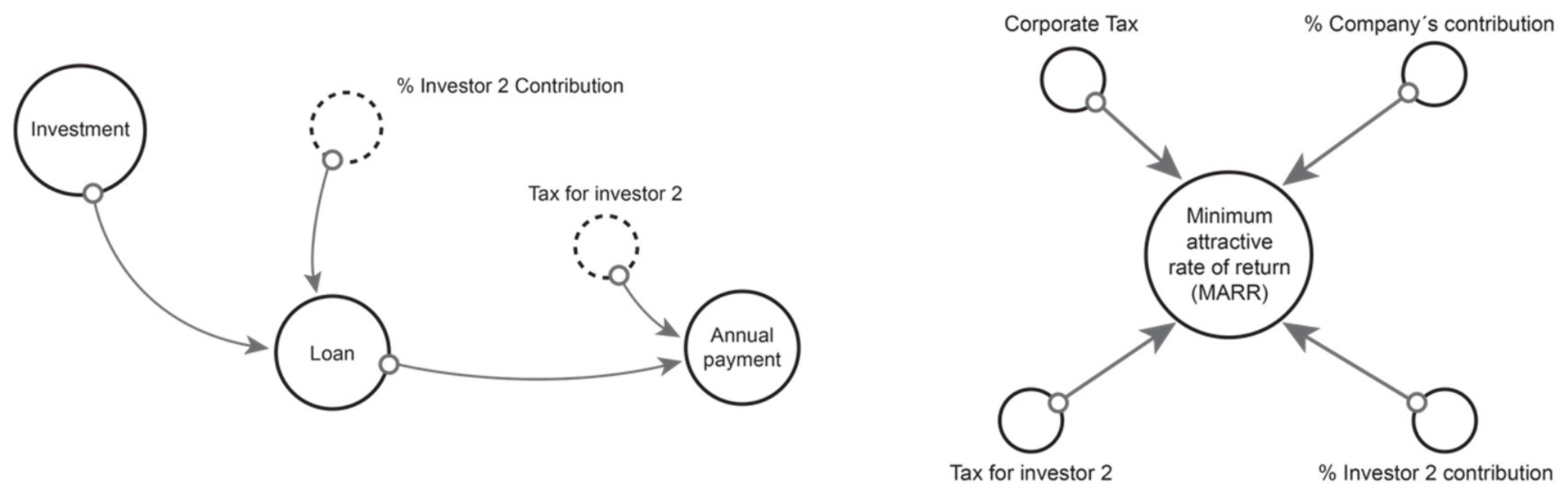
On the other hand, the purpose of the model is to evaluate the profitability of investing in a new vehicle to expand the fleet; therefore, Figure 5 consists of the factors involved in investing and the payments it entails.
This section pertains to the investment to be made and the need to involve an investor in addition to the company itself. Similarly, this section presents the calculation of the Minimum Attractive Rate of Return (MARR), which is used to determine the final financial indicators alongside the information disclosed in the income statement shown in Figure 6.
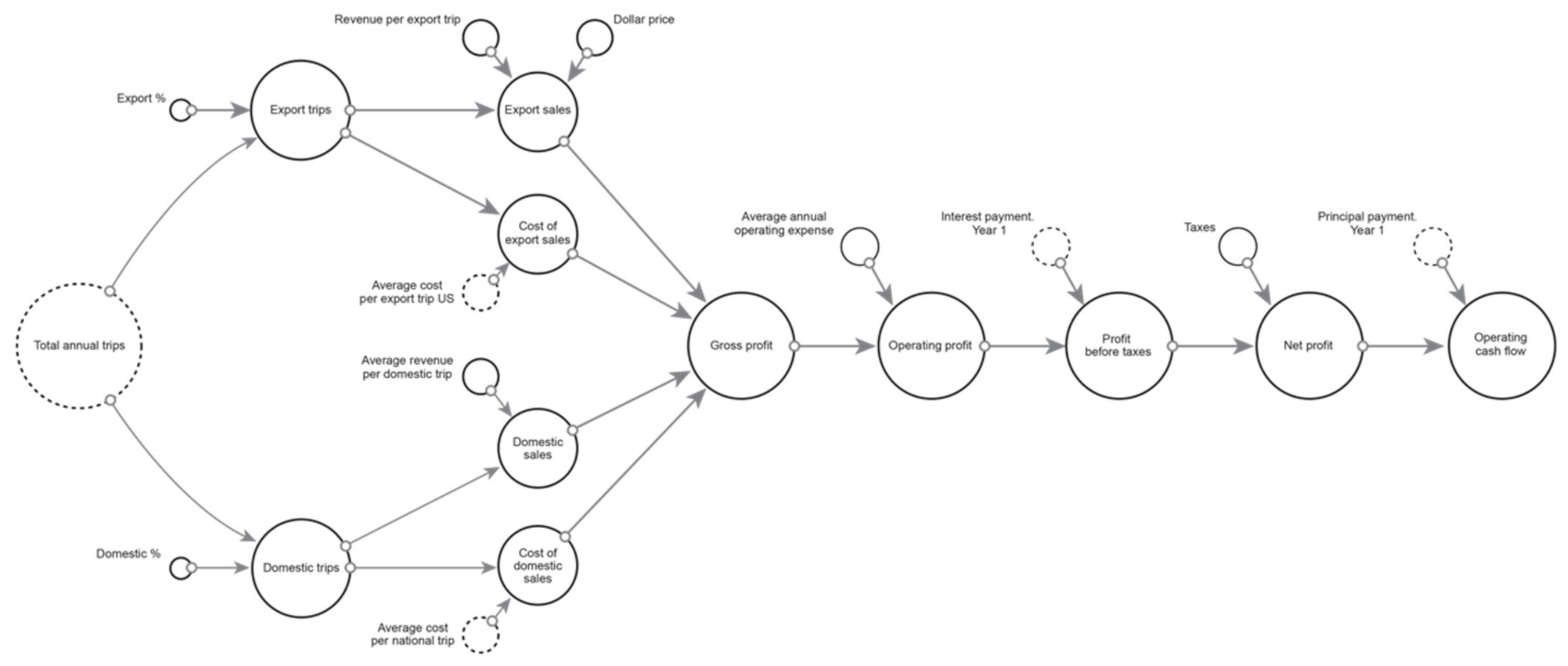
In this income statement, everything is based on the trips made, separating domestic trips from those intended for export and the revenues and costs they entail separately to obtain the economic results pertaining to an income statement.
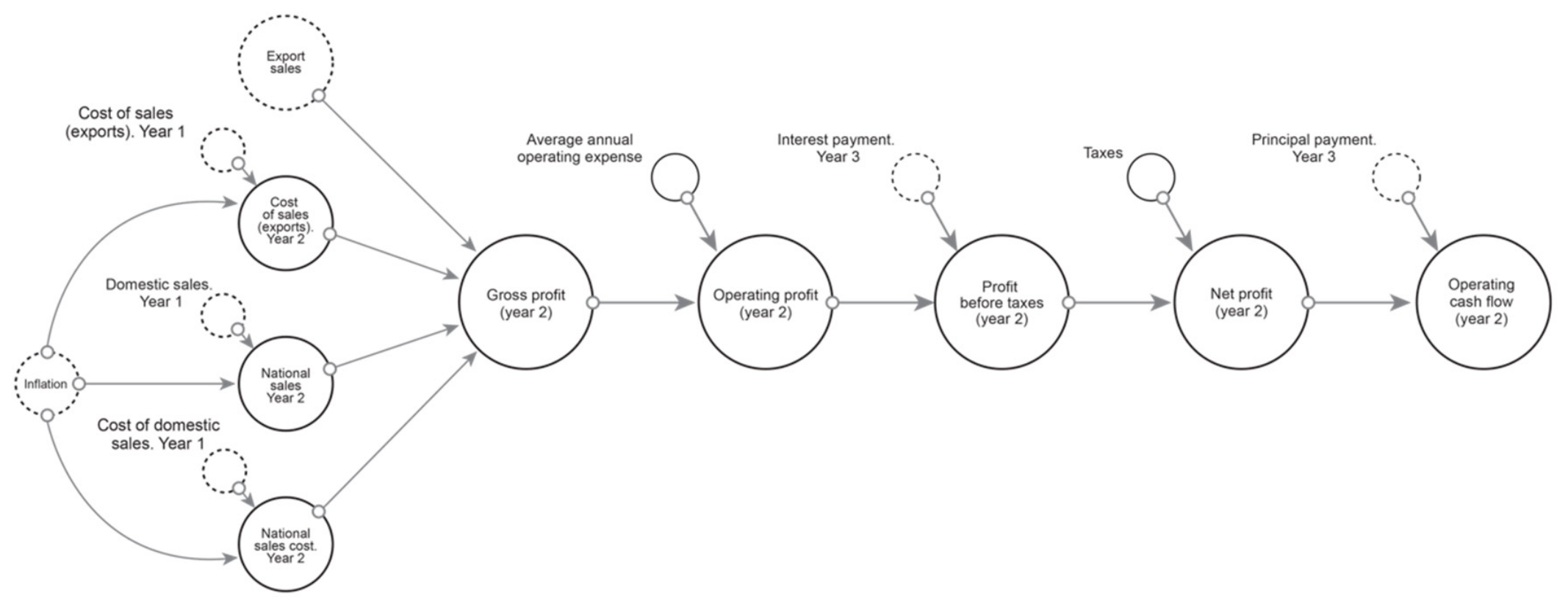
Meanwhile, to calculate the income statements for the projected years, the same structure is followed with the addition of an extra variable, as shown in Figure 7.
Following the same structure as the current year, future calculations incorporate inflation trends, which affect revenue and cost variables denominated in local currency. Annual payments corresponding to the investment made are included in each of these income statements, taking into account loan requirements.
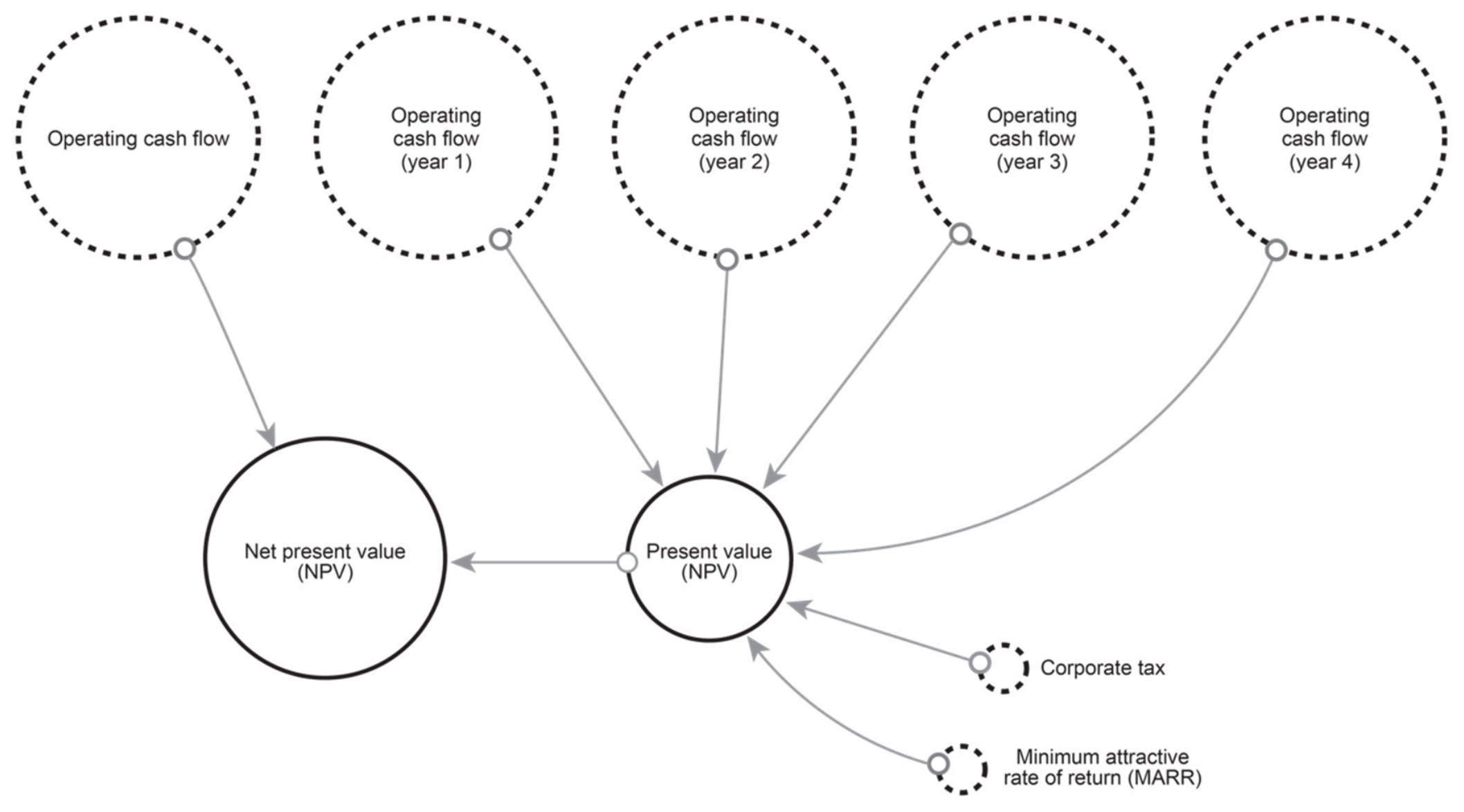
Once the annual results are available, it is possible to obtain the results of the financial indicators, starting with the NPV, as shown in Figure 8.
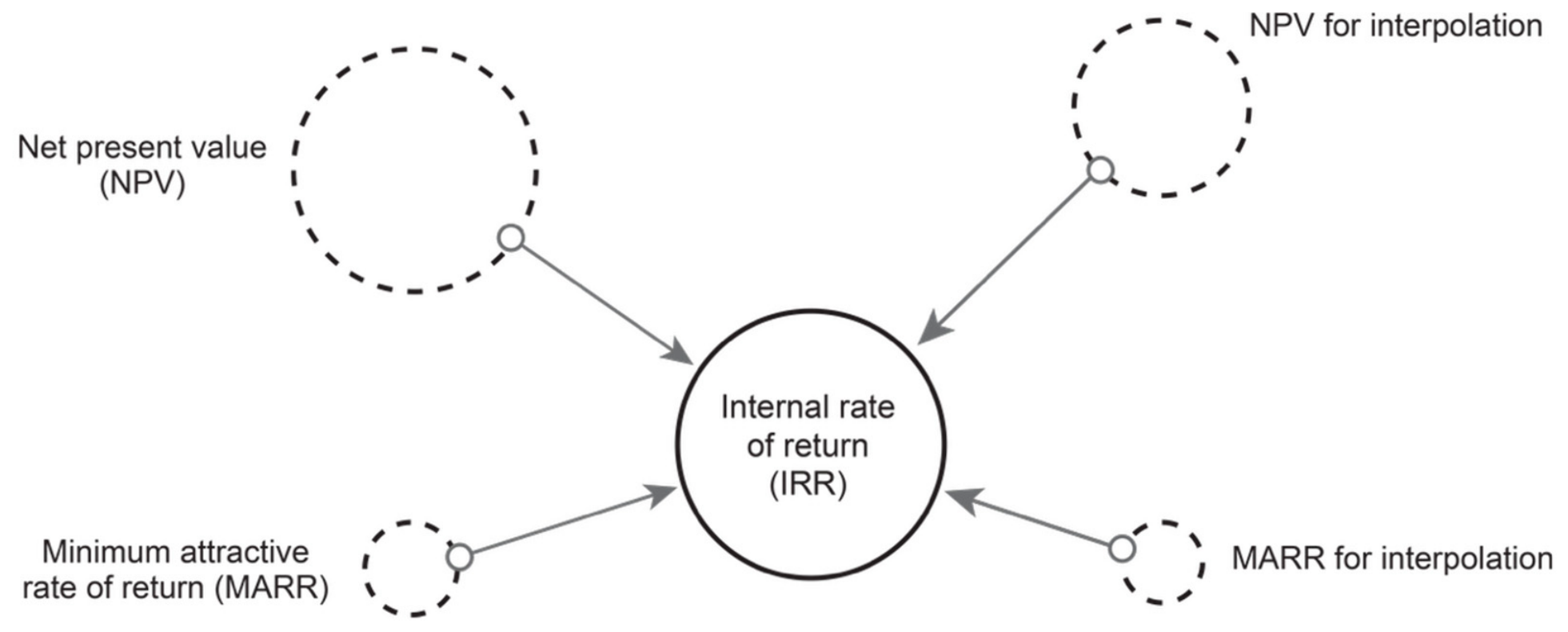
Starting from the operating cash flow for each year, the NPV is obtained by integrating the MARR and interest into the calculation. In addition to being an indicator, the NPV serves as an input for calculating the internal rate of return, as shown in Figure 9.
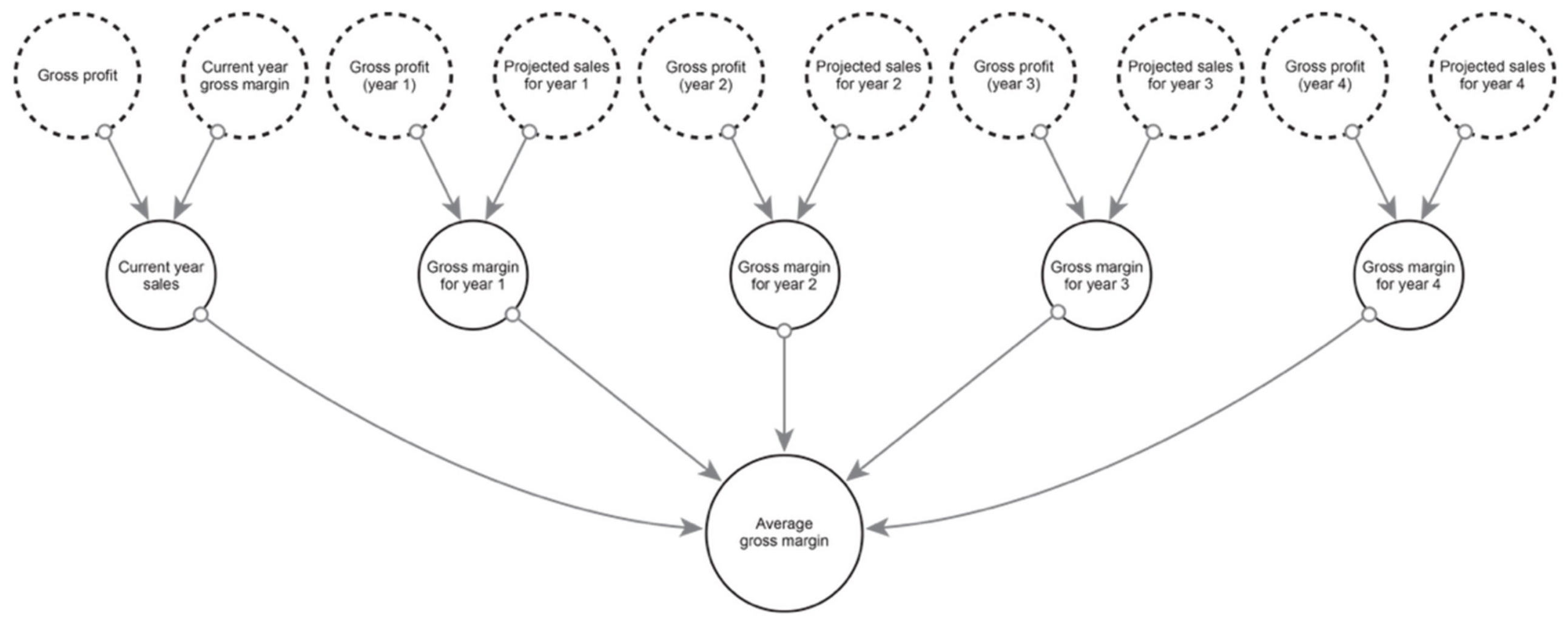
The Internal Rate of Return (IRR) was calculated through interpolation using the equalization formulas. Furthermore, the calculation of profit margins is presented as the final indicator (see Figure 10).
As the model shows, the margin is calculated annually to determine its average value over the specified time.
Equations are considered from different Forrester diagrams as follows:
Level, oven, and conveyors:
L o a d e d   o r d e r   i n   t r u c k t                                                         = L o a d e d   o r d e r   i n   t r u c k ( t d t ) + ( P o t a t o   f l o w   o u t p u t )   x   d t
P o t a t o   L o a d t = P o t a t o   l o a d ( t d t ) + ( P o t a t o   f l o w   i n p u t   P o t a t o   f l o w   o u t p u t )   x   d t
D o c u m e n t a t i o n   1 t = D o c u m e n t a t i o n   1 ( t d t )                                 + ( P o t a t o   f l o w   i n p u t d o c u m e n t a t i o n   1                                                         P o t a t o   f l o w   o u t p u t   d o c u m e n t a t i o n   1 ) d t
Inflow and outflow:
P o t a t o   i n f l o w   2 = P o t a t o   f l o w   o u t p u t P o t a t o   f l o w   i n p u t   d o c u m e n t a t i o n   1
I n f l o w   t o   r e t u r n   o f   t r u c k 1 = o u t f l o w   t o   u n l o a d   r o u t e   1
o u t f l o w   t o   t r i p   2 = o v e n   o u t f l o w
Auxiliary:
A n n u a l   P a y m e n t = L o a n   ×   ( ( T a x   f o r   i n v e s t o r   2   ×   ( 1 + T a x   f o r   i n v e s t o r   2 ) ^ 4 ) / ( ( ( 1 + T a x   f o r   i n v e s t o r   2 ) ^ 4 ) 1 ) )
A v e r a g e   G r o s s   M a r g i n                                                               = ( C u r r e n t   Y e a r S a l e s + G r o s s   M a r g i n   f o r   Y e a r   1                                                               + G r o s s   M a r g i n   f o r   Y e a r   2 + G r o s s   M a r g i n   f o r   Y e a r   3                                                               + G r o s s   M a r g i n   f o r   Y e a r   4 ) / 5
C o s t   o f   d o m e s t i c   s a l e s = D o m e s t i c   T r i p s   ×   A v e r a g e   c o s t   p e r   n a t i o n a l   t r i p
Parameters:
  • Average diesel consumption nationally = 2.25 km/L
  • Average diesel consumption per container per national truck = 63 L/truck
  • Average diesel consumption per export = 2.07 km/L
  • Average diesel consumption per export container = 70.86 L/truck
  • Average diesel cost per export = 24.36 MX$/L
  • Average diesel price nationally = 23.9 MX$/L
  • Average distance traveled by exports = 1173 km/truck
  • Average distance traveled nationally = 848 km/truck
  • Average extra expenses nationally = 19.60 MX$/truck
  • Average extra expenses per export = 54.68 MX$/truck
Each of the equations plays an important role in the model; the equations are presented below: Equation (1) serves to show the total amount of potatoes loaded by all trucks during the cycle time, while Equation (2) represents the time it takes to load the product onto any truck, since an equation involving conveyors functions similarly to a conveyor belt: what enters remains for a set period and exits at the end of the established period.
On the other hand, the inflow and outflow equations, such as those presented in Equations (4) and (5), allow us to determine the daily inflows of tons of potatoes and trucks in transit, as well as the daily outflows of potatoes and trucks.
Auxiliary equations allow different variables to be related to generate a value; for example, in the case of Equation (7), the Annual Payment is calculated as the result of the interaction between the interest that the stakeholders seek to generate and the percentage that each would cover of the investment to be made by applying financial formulas. Similarly, the Average Gross Margin is calculated as the average of the sum of the gross profit margin per year over five annualized periods.
Simulation and validation of the current model. At this stage, once the model runs as intended, validation proceeds, validating the relative error percentage method, which is applied by [34,35], indicating the accuracy of the results (see Table 2).
R e l a t i v e   e r r o r   % = S i m u l a t e d   d a t a   r e a l   d a t a r e a l   d a t a × 100 = 494 473 473 × 100 = 4.44 %
Noting that the results obtained are less than 5%, the simulation meets the validation criterion. These indicators were selected for the validation test because they are influenced by direct and indirect variables on both the operational and financial sides of the organization; furthermore, their selection is based on their relevance in determining the final investment.
Selection of scenarios using the FUCA and TOPSIS multi-criteria analysis methods. In this stage, similar to [36,37], the 15 scenarios generated using both methods were analyzed, noting the specific ranking obtained for each one. First, a comparative matrix was applied using the variables of interest, with the Likert scale implemented to weight each variable and evaluate them using both methods, noting the specific ranking obtained for each, as shown in the following Table 3.
By clarifying the values to be considered and what each one means, the following comparative matrix of variables is completed in Table 4.
By assigning a weight to each variable relative to the others, we obtain the total weight, which is then used to calculate the total weight of each variable in the following normalized matrix in Table 5.
By dividing the value assigned to each cell by the total sum of the corresponding column in the comparison matrix, the first four columns are obtained. Once the total sum is calculated, and each value is divided by that total to obtain the weight for the variable, which is then converted into a percentage. These results were presented to the organization, which chose to round the weights of each variable to the validated values and use them to perform the multi-criteria analyses, starting with TOPSIS (Table 6).
The results show that the optimistic scenarios occupy the top positions in the ranking, with the highest NPV values standing out due to their superior indicator values, which indicate greater profitability and economic viability. In contrast, the pessimistic scenarios are at the bottom of the ranking, with negative NPV values and unfavorable internal rates of return, reflecting conditions that are not viable for investment. For their part, the current scenarios show intermediate performance, indicating that, while they are operationally sustainable, they do not reach the levels of profitability observed under more favorable conditions.
The global value is obtained by applying the formula:
C i = d i d i +   d i +
First, di is calculated, which is equivalent to the geometric distance of the alternative from the worst possible option, and di+ is calculated, which is equal to the geometric distance of the alternative from the best possible option. This step is done by applying normalized matrices to convert the original values into dimensionless data and defining ideals using Excel macros. This is followed by the FUCA method (Table 7).
The results show that the optimistic scenarios continue to rank at the top of the list. In contrast, the pessimistic scenarios rank at the bottom, and the current scenarios remain in the middle. It is important to note that, unlike the TOPSIS method, in the FUCA method the global value (GV) exhibits inverse behavior, where a lower GV is associated with a better position in the ranking.
The GV in this method is obtained by first ranking the values in each column from lowest to highest (1–15), and then multiplying the resulting value by the weight assigned to the corresponding criterion. Once all the data is available, the resulting values for each scenario are summed. The lower the result, the more favorable the scenario. Occasionally, there may be a tie among the results, and to resolve it, the results obtained by applying the TOPSIS method are used as a reference.
To obtain the results for the 15 scenarios, variations were introduced in the following variables: U.S. dollar exchange rate, export %, and domestic %. Both methods show negative NPV and IRR values, indicating that if these scenarios were to occur, the company would not be able to meet the expected levels of net profit generated.
The weight assigned to each of the criteria to be optimized was established based on the organization’s experience in the distribution process: NPV (25%), IRR (30%), Gross Margin (15%), and Net Margin (30%), aiming for a total result value of 100%.
Both methods analyze the behavior of the results according to the variation in the input variables, thus defining the best scenarios within the set of possibilities. The comparison of results is shown in Table 8.
As shown in the table above, when comparing the 15 scenarios using both analyses, similar results are obtained, yielding different results for the current and pessimistic scenarios, while the 5 optimistic scenarios yield the most favorable results for the organization. Therefore, obtaining the same top rankings provides a solid basis for trusting the results of the analysis. The system dynamics methodology requires evaluating various critical variables that are important for decision-making using optimization criteria to select the best among different scenarios. In this regard, FUCA and TOPSIS provide answers to the same variables, which can be compared to determine that the results are similar, thereby providing a mathematical basis for the decision.
Finally, to select the scenarios, two techniques were used: (1) the technique for order of preference by similarity (TOPSIS), a multicriteria method whose aim is to rank in order of choice a certain number of alternatives based on a set of favorable or unfavorable criteria; and (2) Faire Un Choix Adéquat (FUCA), which is based on a linear combination of the ranks that each alternative obtains with respect to each individual criterion. Finally, we integrated the solution for the producers into a series of visual elements that help with and allow for interaction with the system in the most simple and user-friendly manner; buttons and graphical elements were used for their understanding and were supported by the graphical user interface.
Development of the graphical user interface. As a final step, the graphical interface was designed to provide users with access to interact with a certain number of variables within the simulation according to the scenarios they deem relevant, following the approach used by [38,39] in their respective case studies.
As part of this final phase, various screens are presented showing the information used to inform decision-making. Figure 11 shows the transport costs associated with journeys made in Mexico and displays various data relating to the variables of greatest importance to the company.
Data is presented relating to the model’s performance indicators, with a summary at the end of the average cost derived from diesel prices per liter consumed, fuel consumption per container by the available lorries, and the fuel consumption associated with transporting the cargo to various destinations in Mexico (as well as verifiable and non-verifiable payments made to drivers, and the distances traveled).
Similarly, but in the case of lorries carrying freight heading towards the border with Mexico for international markets, Figure 12 presents the same indicators, whilst also including an additional one relating to the coupling of the load to a semi-trailer in the international markets.
Data is presented relating to the model’s performance indicators for international transportation to the USA.
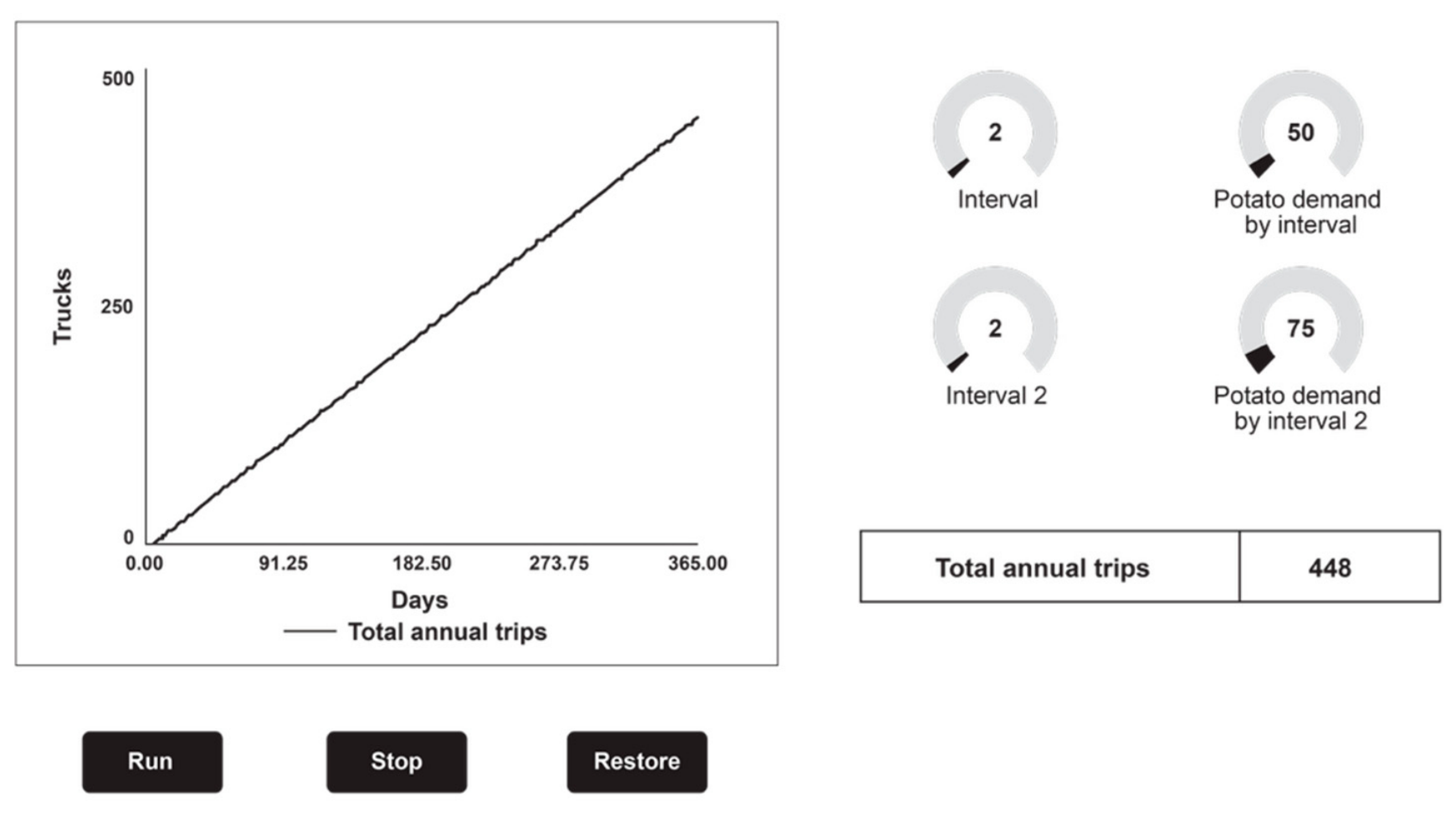
Within this interface, interaction with the variables that impact the number of trips taken is presented first, as shown in Figure 13.
Demand behavior is key as the baseline input for the simulation and for obtaining results for the indicators of interest. To this end, a process-focused interface was designed, defining demand values and the intervals between order receipt, in order to determine the total number of trips the organization has the capacity to handle.
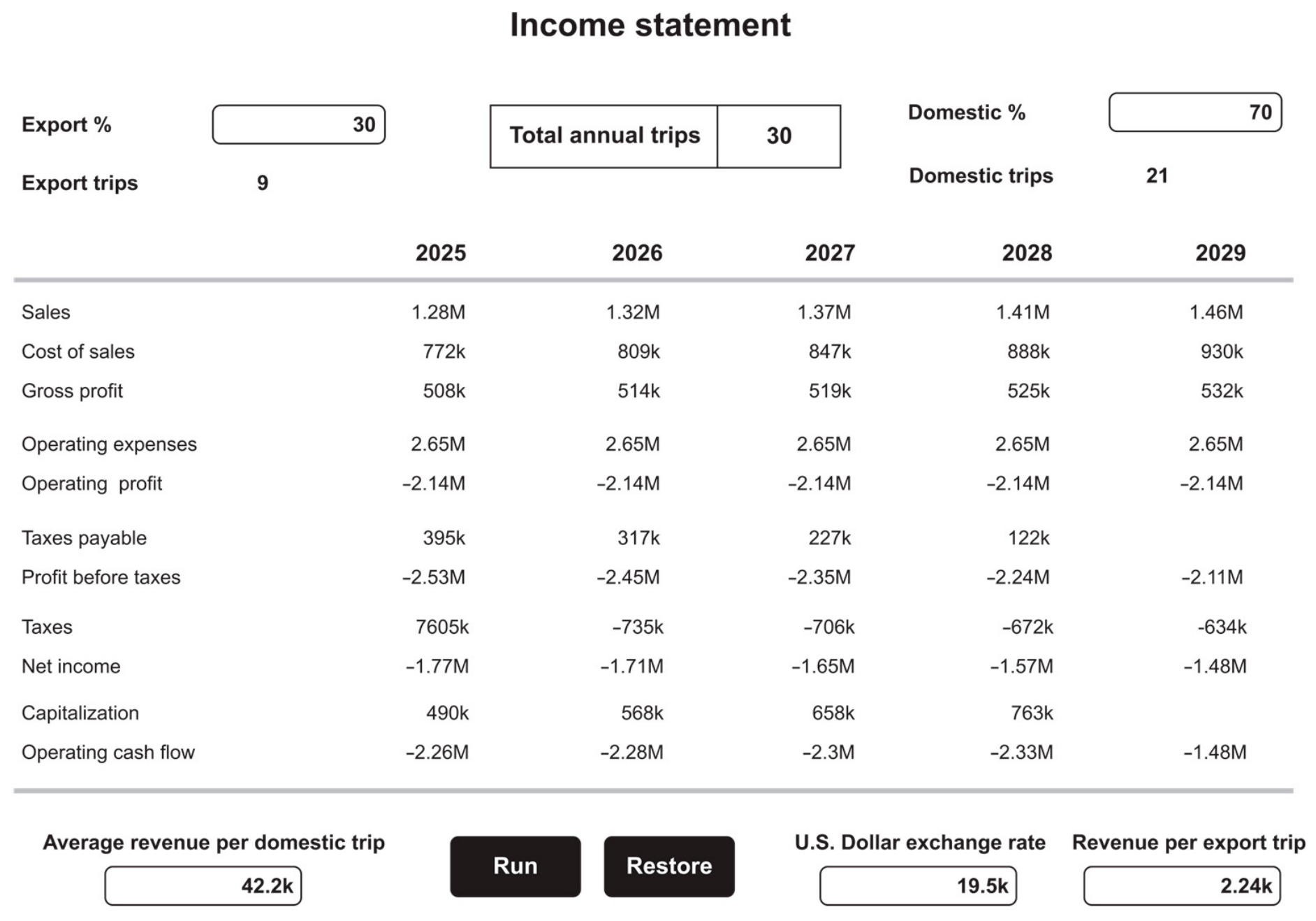
In turn, it displays the resulting income statement based on the values assigned to the variables of interest available to the user, as shown in Figure 14.
As shown in Figure 14, this interface allows users to view the results generated in the income statement based on the modified variables related to both operational aspects and economic factors. Using this tool, it is possible to analyze the evolution of indicators such as revenue, costs, operating income, and cash flow over a 5-year horizon, facilitating the identification of trends and critical points, such as the persistence of negative results in certain periods. The inclusion of operating profit is because the organization needs to know the figure after expenses related to each trip and before making the payments required by law; in turn, interest expense and principal repayment are shown due to the requirement to repay the loan requested for investment in the vehicle fleet (results from the amortization schedule). Furthermore, the ability to modify parameters in real time and run simulations enables us to evaluate the direct impact of operational decisions on profitability.
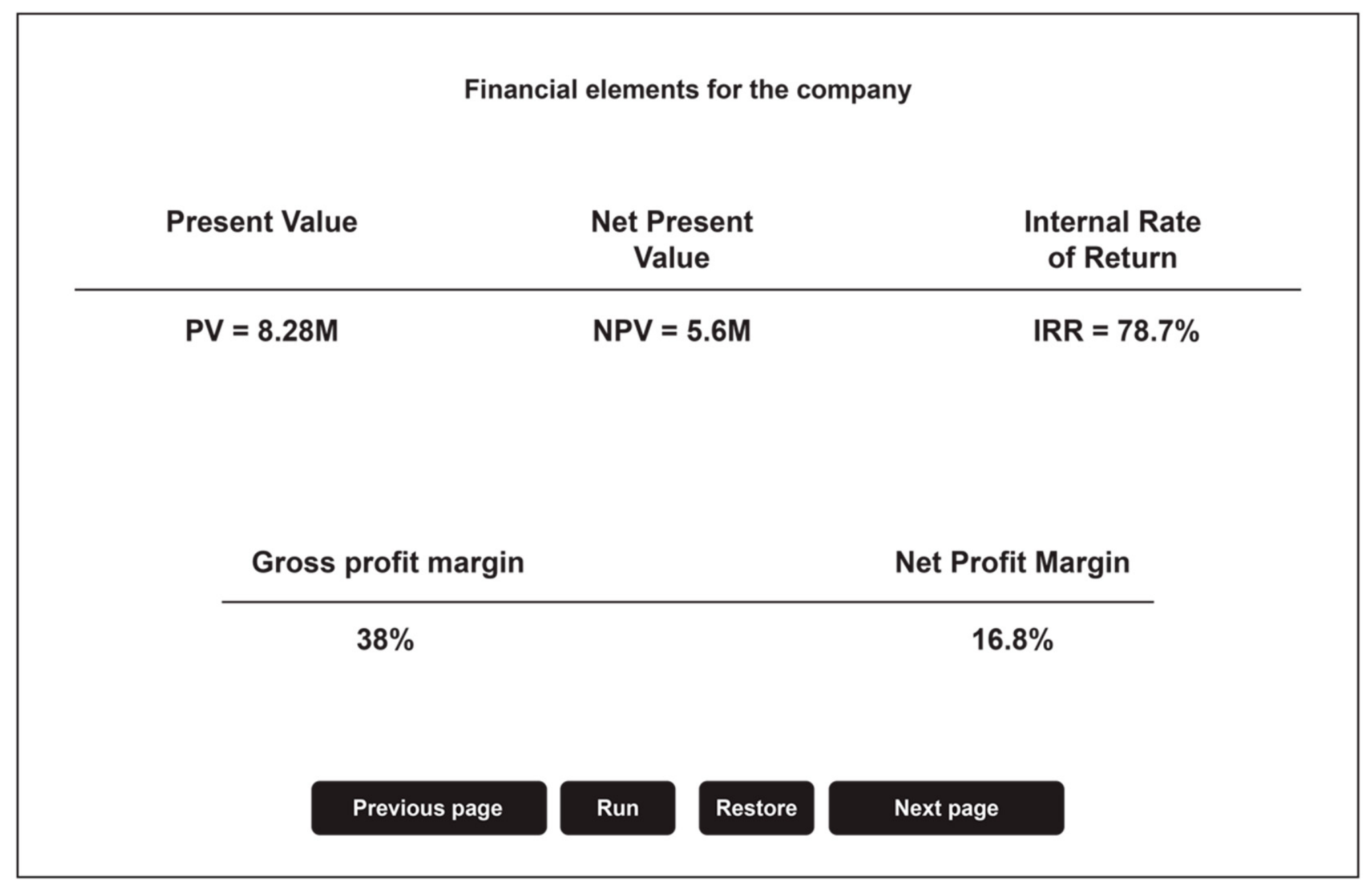
Furthermore, as an important complement to the financial assessment, the financial factors taken into account in the final decision-making process are presented; Figure 15 shows the GUI displaying these values.
This GUI displays the key elements relating to the values of the PV, NPV and IRR indicators, as well as the gross profit margin and net profit margin, for an analysis process that can be observed as a result of simulating various scenarios to support data-driven decision-making. The VP allows you to determine the exact present value of your future profits, whilst the IRR provides information on future returns based on the initial investment; the IRR enables you to see the average annual rate of return generated by the project. The profit margin allows the company to assess its operational efficiency and the health of its business model in light of market risks.

5. Discussion

This study evaluated the feasibility of acquiring new transport units using a system dynamics model, accompanied by a comparison of results with other case studies that share stages of the applied methodology.
The definition of variables constitutes a critical phase in the construction of system dynamics models, as it determines the model’s ability to represent reality. In particular, Ji et al. [40] integrate operational and economic variables that capture the system’s complexity, while Rahman et al. [41] emphasize the segmentation of economic factors affecting logistics. For their part, Pluchinotta et al. [42] highlight the challenge of integrating soft and intangible variables into a model. In comparison, the present study incorporated exogenous and endogenous variables corresponding to the organization’s logistics and economy.
Furthermore, the use of causal diagrams allows for the representation of system behavior through nonlinear relationships between variables and identifies feedback loops. This approach has proven effective for the analysis of dynamic systems, representing the flow of resources in decision-making [43,44,45]. In the present study, these diagrams allow us to visualize the cumulative impact of variables such as demand.
In turn, constructing the model using Forrester diagrams allowed us to represent the system’s flows and accumulations in a structured manner to analyze its behavior over time. Kaur and Kander [46] demonstrate improvements in the system’s sustainability, while Hamdy et al. [47] incorporate the impact on reducing air pollution. Likewise, Ghaemi and Hosseunlou [48] highlight the balance between demand and system capacity. In this study, its application allowed for the integration of operational and economic variables into a single model.
With regard to scenario simulation, the results show that return on investment depends on specific operating conditions. Saflor et al. [49] use simulation to identify the ideal, unconstrained conditions for improving a logistics system. Meanwhile, Kipruto and Sauerbrei [50] validate results using relative error, while Guiguet and Pons [51] rely on visual validation by expert users, with these two tests applied to the created model.
Decision-making is strengthened through the integration of multi-criteria methods, which allow for the simultaneous evaluation of multiple variables. In this context, Broniewicz and Ogrodnik [52] and Hajduk [53] highlight the usefulness of the TOPSIS method in investment and logistics problems, while Kabashkin [54] addresses the selection of transportation routes. These authors agree that multi-criteria methods allow for the selection of alternatives under conditions of uncertainty.
Finally, one of the most significant contributions of this study is the development of a graphical interface that facilitates interaction with the model. In this regard, Mantegui and Veas [55] and Marlow et al. [56] emphasize that user interaction and participation improve the design, usability, and adoption of the interface. For their part, Shen et al. [57] point out how visual interfaces facilitate interaction between decision-makers and complex simulation models. Compared to these approaches, the interface developed in this study allows for the manipulation of variables and the visualization of results in real time, representing an advantage in terms of usability.
Unlike previous studies that focused on isolated approaches to logistics optimization or simulation, this research integrates system dynamics, multi-criteria decision-making methods, and a graphical user interface into a single framework applied to the Mexican agricultural sector. This combination provides a practical tool for evaluating fleet investment decisions under conditions of uncertainty and seasonal demand, thereby contributing to the literature on agricultural logistics and strategic transportation planning.

6. Conclusions

This study developed a system dynamics model to evaluate the economic viability of fleet acquisition in a potato distribution company, integrating financial indicators, logistics costs, and operational variables within a dynamic simulation environment. The model was complemented by multi-criteria analysis methods and a graphical interface that facilitated scenario evaluation and decision-making support.
The key variables associated with this decision were selected by senior management, and after a weighting exercise based on company data—which was analyzed in a comparative matrix—the corresponding weights were assigned.
The validation tests applied to the variables—total annual trips, sales, gross margin, and net margin—have a relative error percentage of less than 5%, which establishes that the model is valid and reliable according to Barlas’s proposal.
The results showed that variables such as fuel price, demand variability, load capacity, and trip frequency significantly influence the profitability of fleet expansion, highlighting the sensitivity of investment decisions to changes in operational and market conditions. The simulation approach allowed for the identification of the conditions under which the acquisition of new units is financially viable, particularly in scenarios of sustained demand and efficient resource utilization.
From a theoretical perspective, the study highlights the potential of combining system dynamics with multi-criteria analysis to evaluate long-term logistics investment decisions. From a practical perspective, the proposed model helps transportation companies anticipate operational and financial impacts before expanding their fleets, thereby contributing to more resilient and competitive agricultural supply chain.
These findings are particularly relevant to Mexico’s agricultural sector, where transportation availability directly affects the marketing of perishable products such as potatoes. Logistical efficiency has become a key factor in maintaining product quality and competitiveness against lower-cost imports from the United States. Additionally, factors such as fuel price fluctuations, exchange rate volatility, inflation, climate conditions, and regulatory changes may influence transportation profitability and the long-term behavior of the system.
The main contribution of this research lies in the development of a reproducible decision-support framework that integrates system dynamics, multicriteria analysis, and a graphical interface applied to agricultural logistics. The proposed methodology follows a structured process for variable selection, scenario simulation, validation, and multicriteria evaluation, allowing its adaptation to other transportation and supply chain contexts with similar operational conditions.
Research studies on system dynamics using MCDM are limited; therefore, the findings of this study provide the scientific and academic community with an empirical study applied to a real-world case. The incorporation of the FUCA and TOPSIS multi-criteria analysis methods enables the selection of the best scenario based on overall scores derived from various selection methods during the scenario selection phase—as part of the system dynamics methodology—to proceed to the graphical user interface design phase
The methodology implemented can be adapted to other agricultural distribution systems and logistics sectors where investment decisions depend on dynamic interactions between costs, demand, and operational constraints. Consequently, the study demonstrates the potential of system dynamics-based simulation tools to improve investment planning and reduce uncertainty in complex supply chain environments.
Future research. As future lines of research, we propose expanding the model by incorporating variables that more accurately capture the complexity of the logistics system, such as maintenance costs, mechanical failures, downtime, and operational constraints. Additionally, another line of research involves incorporating sustainability criteria—including CO2 emissions and energy consumption—to assess the environmental impact of fleet procurement decisions.

Author Contributions

Conceptualization, A.C.V.-H. and R.H.A.-M.; methodology, E.A.L.-L.; software, A.C.V.-H.; validation, A.C.V.-H., R.H.A.-M. and E.A.L.-L.; formal analysis, E.A.L.-L.; investigation, A.C.V.-H. and R.H.A.-M.; resources, E.A.L.-L.; writing—original draft preparation, A.C.V.-H.; writing—review and editing, A.C.V.-H. and E.A.L.-L.; project administration, E.A.L.-L. All authors have read and agreed to the published version of the manuscript.

Funding

This research received no external funding.

Institutional Review Board Statement

Not applicable.

Informed Consent Statement

Not applicable.

Data Availability Statement

The original contributions presented in this study are included in the article. Further inquiries can be directed to the corresponding author.

Acknowledgments

The authors gratefully acknowledge ITSON (Instituto Tecnológico de Sonora) for its support through the (PROFAPI 2026) and SECIHITI for its support of the ITSON National Laboratory for Transportation Systems and Logistics.

Conflicts of Interest

The authors declare no conflicts of interest.

Abbreviations

The following abbreviations are used in this manuscript:
SDSystem Dynamics
GUIGraphical User Interface
MCDMMulticriteria decision-making
TOPSISTechnique for Order of Preference by Similarity to Ideal Solution
FUCAFaire Un Choix Adéquat
RReinforcement loop
BBalancing loop
MARRMinimum Attractive Rate of Return
NPVNet Present Value
PVPresent Value
IRRInternal Rate of Return
USUnited States

Appendix A

Appendix A.1

AuthorsPrincipal Contributions
Lasso [5]Studied parcel delivery routes using computational simulation and constraint analysis to improve delivery times, reduce travel distances, and lower courier system costs.
Van Tang et al. [6]Developed a multi-objective optimization model combined with genetic algorithms to minimize agricultural logistics costs and environmental impact while considering capacity and delivery time windows.
Acosta-Agudelo et al. [7]Analyzed agricultural intermediaries and proposed collaborative shipment agreements for products of similar origin to reduce transportation and distribution costs.
Shahbahrami et al. [8]Applied system dynamics to simulate pharmaceutical supply chain performance over 24 months, evaluating policies and visualizing impacts on profits and product trends.
Kamran et al. [9]Designed a multi-objective, multi-period, and multi-product simulation model for production, distribution, facility location, allocation, and inventory decisions.
Zhang and Wang [10]Proposed a dynamic programming model based on adaptive ant colony optimization to improve routing efficiency, reduce transportation costs, and minimize cargo losses.
Hamoudi et al. [11]Achieved a 15% reduction in operating costs and a 20% improvement in delivery times using dynamic programming with real-world constraints such as traffic and capacity.
Rodríguez et al. [12]Developed a genetic algorithm-based mathematical model for distribution scenario simulation, reducing operating costs by 25% and improving delivery times by 20%.
Yang and Chang [13]Applied the savings algorithm to redesign distribution routes, improving vehicle load factors, mileage efficiency and reducing logistics costs.
Iparraguirre and Coral [14]Developed advanced routing technologies and real-time decision-making systems for dynamic logistics environments while identifying infrastructure limitations.
Álvarez et al. [15]Established three logistical optimization models focused on minimizing distance, time, or combined economic cost across regional, urban, and local scenarios.
Jiang et al. [16]Integrated dynamic demand behavior with genetic algorithms for route optimization, reducing carbon emissions and lowering total logistics costs by 17.13%.
Katon et al. [17]Used system dynamics to generate and evaluate 12 supply chain scenarios, selecting the most efficient based on minimizing product shortages.
Liu et al. [18]Proposed a system dynamics model emphasizing agility and flexibility indicators through cause–effect analysis to optimize organizational performance.
Jonsdottir et al. [19]Demonstrated that system dynamics is an innovative tool for sustainable business model development, enabling scenario evaluation and identification of strategic leverage points.
Jin et al. [20]Identified SD applications in inventory management, risk management, supply chain financing, and ecological supply chain management.
Cadenas et al. [21]Developed a mathematical SD model integrating strategic thinking, project management, and production using differential equations to explain system growth and decline patterns.
Łatuszyńska and Borawska [22]Evaluated SD models for strategic investment decision-making by incorporating feedback loops, delays, and nonlinear business dynamics.
Khakdaman et al. [23]Integrated regulations, sustainability trends, technological investments, and environmental requirements into SD models for sustainable supply chain assessment.
Dongle and Khalafalla [24]Created a modeling framework for policy and resource dynamics in construction, highlighting regulatory reform and workforce training as key to reducing project cost overruns by 28%.

Appendix A.2. Examples of Equations Related to the Explanation of Certain Figures in the Final Model

Figure 3. Operational process model for carrying out a trip
Potato_demand_by_interval = 50
UNITS: ton
Potato_demand_by_interval_2 = 75
UNITS: ton
Total_order = PULSE(Potato_demand_by_interval, 1, Interval) + PULSE(Potato_demand_by_interval_2, 2, Interval_2)
UNITS: ton/days
Potato_flow_input = Total_order {UNIFLOW}
UNITS: ton/Days
Potato_load(t) = Potato_load(t − dt) + (Potato_flow_input − Potato_flow_output) × dt {CONVEYOR}
INIT Potato_load = 0
TRANSIT TIME = 0.028
Potato_flow_output = CONVEYOR OUTFLOW
UNITS: ton/Days
Loaded_order_in_truck(t) = Loaded_order_in_truck(t − dt) + (Potato_flow_output) × dt {NON-NEGATIVE}
INIT Loaded_order_in_truck = 0
UNITS: ton
Potato_flow_input_1 = Potato_flow_output {UNIFLOW}
UNITS: ton/Days
Loading_in_truck_1(t) = Loading_in_truck_1(t − dt) + (Potato_flow_input_1 − Potato_flow_input_documentation_1) × dt {NON-NEGATIVE}
INIT Loading_in_truck_1 = IF(Potato_flow_input_1) = 50 THEN Truck_1_capacity ELSE Alternate_truck
UNITS: ton
Truck_1_full_decision = IF Potato_flow_input_1 ≥ 50 THEN Truck_1_capacity ELSE Alternate_truck
UNITS: tons/day
Truck_1_capacity = 50
UNITS: tons/day
Alternate_truck = 0
UNITS: tons/day
Potato_flow_input_documentation_1 = Truck_1_full_decision {UNIFLOW}
INFLOW MULTIPLIER = 1/50
UNITS: ton/Days
Documentation_1(t) = Documentation_1(t − dt) + (Potato_flow_input_documentation_1 − Potato_flow_output_documentation_1) × dt {OVEN}
INIT Documentation_1 = 0
COOK TIME = 0.5
CAPACITY = 1
ACCEPT MULTIPLE BATCHES
UNITS: camion
Potato_flow_output_documentation_1 = OVEN OUTFLOW
UNITS: Truck/Days
inflow_to_trip = Potato_flow_output_documentation_1 {UNIFLOW}
UNITS: camion/Days
Truck_1_trip(t) = Truck_1_trip(t − dt) + (inflow_to_trip − outflow_to_trip_1) × dt {OVEN}
INIT Truck_1_trip = 0
COOK TIME = Average_route_time
CAPACITY = 1
ACCEPT MULTIPLE BATCHES
UNITS: camion
Average_route_time = 0.4
UNITS: days
outflow_to_trip_1 = OVEN OUTFLOW
UNITS: camion/Days
Unload_route_1(t) = Unload_route_1(t − dt) + (outflow_to_trip_1 − outflow_to_unload_route_1) × dt {CONVEYOR}
INIT Unload_route_1 = 0
TRANSIT TIME = RANDOM(0.33, 4)
CONTINUOUS
ACCEPT MULTIPLE BATCHES
UNITS: camion
outflow_to_unload_route_1 = CONVEYOR OUTFLOW
UNITS: camion/Days
Inflow_to_return_of_truck_1 = outflow_to_unload_route_1 {UNIFLOW}
UNITS: Trucks/Days
Return_of_truck_1(t) = Return_of_truck_1(t − dt) + (Inflow_to_return_of_truck_1 − Outflow_to_return_1) × dt {OVEN}
INIT Return_of_truck_1 = 0
COOK TIME = Average_route_time
CAPACITY = 1
ACCEPT MULTIPLE BATCHES
UNITS: Trucks
Outflow_to_return_1 = OVEN OUTFLOW
UNITS: Trucks/Days
Truck_1_trips_per_year(t) = Truck_1_trips_per_year(t − dt) + (Outflow_to_return_1) × dt {NON-NEGATIVE}
INIT Truck_1_trips_per_year = 0
UNITS: Trucks
Potato_flow_input_2 = Potato_flow_output − (Potato_flow_input_documentation_1) {UNIFLOW}
UNITS: tons/Days
Loading_in_truck_2(t) = Loading_in_truck_2(t − dt) + (Potato_flow_input_2 − Potato_flow_input_documentation_2) × dt {NON-NEGATIVE}
INIT Loading_in_truck_2 = 0
UNITS: ton
Truck_2_full_decision = IF Potato_flow_input_2 ≥ 50 THEN Truck_2_capacity ELSE Alternate_truck
UNITS: tons/day
Truck_2_capacity = 50
UNITS: tons/day
Potato_flow_input_documentation_2 = Truck_2_full_decision {UNIFLOW}
INFLOW MULTIPLIER = 1/50
UNITS: ton/Days
Documentation_2(t) = Documentation_2(t − dt) + (Potato_flow_input_documetion_2 − Potato_flow_output_documentation_2) × dt {OVEN}
INIT Documentation_2 = 0
COOK TIME = 0.5
CAPACITY = 1
ACCEPT MULTIPLE BATCHES
UNITS: Truck
Potato_flow_input_2 − (Potato_flow_input_documentation_2) {UNIFLOW}
UNITS: ton/Days
inflow_to_trip_2 = Potato_flow_output_documentation_2 {UNIFLOW}
UNITS: Truck/Days
Truck_2_trip(t) = Truck_2_trip(t − dt) + (inflow_to_trip_2 − outflow_to_trip_2) × dt {OVEN}
INIT Truck_2_trip = 0
COOK TIME = Average_route_time
CAPACITY = 1
ACCEPT MULTIPLE BATCHES
UNITS: Truck
outflow_to_trip_2 = OVEN OUTFLOW
UNITS: Truck/Days
Unload_route_2(t) = Unload_route_2(t − dt) + (outflow_to_trip_2 − outflow_to_unload_route_2) × dt {CONVEYOR}
INIT Unload_route_2 = 0
TRANSIT TIME = RANDOM(0.33, 4)
CONTINUOUS
ACCEPT MULTIPLE BATCHES
UNITS: Truck
outflow_to_unload_route_2 = CONVEYOR OUTFLOW
UNITS: Truck/Days
Inflow_to_return_of_truck_2 = outflow_to_unload_route_2 {UNIFLOW}
UNITS: Trucks/Days
Return_of_truck_2(t) = Return_of_truck_2(t − dt) + (Inflow_to_return_of_truck_2 − Outflow_to_return_2) × dt {OVEN}
INIT Return_of_truck_2 = 0
COOK TIME = Average_route_time
CAPACITY = 1
ACCEPT MULTIPLE BATCHES
UNITS: Trucks
Outflow_to_return_2 = OVEN OUTFLOW
UNITS: Trucks/Days
Truck_2_trips_per_year(t) = Truck_2_trips_per_year(t − dt) + (Outflow_to_return_2) × dt {NON-NEGATIVE}
INIT Truck_2_trips_per_year = 0
UNITS: Trucks
Figure 4. Average cost model per domestic and export trip
Average_allowable_export_expenses = 2217
UNITS: MX$/Truck
Average_commission_nationally = 0
UNITS: MX$/Truck
Average_commission_per_export = 48.2
UNITS: MX$/Truck
  • Average_cost_per_national_trip = ((Average_distance_traveled_nationally/Average_diesel_consumption_nationally) × Average_diesel_price_nationally) + (Average_diesel_consumption_per_box_per_national_truck × Average_diesel_price_nationally) + Average_payment_to_national_driver + Average_extra_expenses_nationally + Average_provable_expenses_nationally + Average_commission_nationally + Average_unprovable_expenses_nationally
UNITS: MX$/Truck
  • Average_cost_per_export_trip_to_US = ((Average_distance_traveled_by_exports/Average_diesel_consumption_per_export) × Average_diesel_cost_per_export) + (Average_diesel_consumption_per_export_container × Average_diesel_cost_per_export) + Average_payment_to_export_driver + Average_extra_expenses_per_export + Average_allowable_export_expenses + Average_unallowable_export_expenses + “Average_payment_per_semi-trailer” + Average_commission_per_export
UNITS: MX$/Truck
Average_diesel_consumption_nationally = 2.25
UNITS: km/liter
Average_diesel_consumption_per_box_per_national_truck = 63
UNITS: litro/camion
Average_diesel_consumption_per_export = 2.07
UNITS: km/liter
Average_diesel_consumption_per_export_container = 70.86
UNITS: litro/camion
Average_diesel_cost_per_export = 24.36
UNITS: MX$/liter
Average_diesel_price_nationally = 23.9
UNITS: MX$/liter
Average_distance_traveled_by_exports = 1173
UNITS: km/truck
Average_distance_traveled_nationally = 1283
UNITS: km/truck
Average_extra_expenses_nationally = 19.6
UNITS: MX$/truck
Average_extra_expenses_per_export = 54.69
UNITS: MX$/truck
“Average_payment_per_semi-trailer” = 6121
UNITS: MX$/truck
Average_payment_to_export_driver = 2735
UNITS: MX$/truck
Average_payment_to_national_driver = 6800
UNITS: MX$/truck
Average_provable_expenses_nationally = 2936
UNITS: MX$/truck
Average_unallowable_export_expenses = 269
UNITS: MX$/truck
Average_unprovable_expenses_nationally = 2750
UNITS: MX$/truck
Figure 5. Annuity calculation model for investment payments
Investment = 2478364
UNITS: MX$
“%_Investor_2_Contribution” = 1
UNITS: dmnl
Loan = Investment × “%_Investor_2_Contribution”
UNITS: MX$
Tax_for_investor_2 = 0.1595
UNITS: dmnl
Annual_Payment = Loan × ((Tax_for_investor_2 × (1 + Tax_for_investor_2)^4)/(((1 + Tax_for_investor_2)^4) − 1))
UNITS: MX$
Corporate_Tax = 0.15
UNITS: dmnl
“%_Company’s_Contribution” = 0
UNITS: dmnl
“Minimum_Attractive_Rate_of_Return_(MARR)”= (Corporate_Tax × “%_Company’s_Contribution”) + (Tax_for_investor_2 × “%_Investor_2_Contribution”)
UNITS: dmnl
Figure 6. Income statement model for the current year.
Total_annual_trips = Truck_1_trips_per_year + Truck_2_trips_per_year + Truck_3_trips_per_year + Truck_4_trips_per_year + Truck_5_trips_per_year + “Truck_6_trips_per_year + Truck_6_trips_per_year
UNITS: Trucks
Export_% = 30
UNITS: dmnl
Domestic_% = 70
UNITS: dmnl
Export_trips = Total_annual_trips × (Export_%/100)
UNITS: Truck
Domestic_Trips = Total_annual_trips × (Domestic_%/100)
UNITS: Truck
Revenue_per_export_trip = 2241
UNITS: dollar/truck
Dollar_price = 19.5
UNITS: MX$/dollar
Export_sales = Export_trips × Revenue_per_export_trip × Dollar_price
UNITS: MX$
Cost_of_export_sales = Export_trips × Average_cost_per_export_trip_to_US
UNITS: MX$
Average_revenue_per_domestic_trip = 42236
UNITS: MX$/truck
Domestic_sales = Domestic_Trips × Average_revenue_per_domestic_trip
UNITS: MX$
Cost_of_domestic_sales = Domestic_Trips × Average_cost_per_national_trip
UNITS: MX$
Gross_profit = Export_sales + Domestic_sales − Cost_of_export_sales − Cost_of_domestic_sales
UNITS: MX$
Average_annual_operating_expense = 2645196
UNITS: MX$
Operating_profit = Gross_profit − Average_annual_operating_expense
UNITS: MX$
“Interest_payment,_Year_1” = Loan × Tax_for_investor_2
UNITS: MX$
Profit_before_taxes = Operating_profit − “Interest_payment,_Year_1”
UNITS: MX$
Taxes = 30
UNITS: dmnl
Net_profit = Profit_before_taxes × ((100 − Taxes)/100)
UNITS: MX$
“Principal_payment,_Year_1” = Annual_Payment − “Interest_payment,_Year_1”
UNITS: MX$
Operating_cash_flow = Net_profit − “Principal_payment,_Year_1”
UNITS: MX$
Figure 7. One-year projected income statement model
Inflation = 4.76
UNITS: dmnl
“Cost_of_sales_(exports)_Year_1” = Cost_of_export_sales × (1 + (Inflation/100))
UNITS: MX$
Domestic_sales_Year_1 = Domestic_sales × (1 + (Inflation/100))
UNITS: MX$
Cost_of_domestic_sales_Year_1 = Cost_of_domestic_sales × (1 + (Inflation/100))
UNITS: MX$
Gross_profit_Year_1 = Export_sales + Domestic_sales_Year_1 − “Cost_of_sales_(exports)_Year_1” − Cost_of_domestic_sales_Year_1
UNITS: MX$
Operating_profit_Year_1 = Gross_profit_Year_1 − Average_annual_operating_expense
UNITS: MX$
Profit_before_taxes_Year_1 = Operating_profit_Year_1 − Taxis_payment_year_2
UNITS: MX$
Net_profit_Year_1 = Profit_before_taxes_Year_1 × ((100 − Taxes)/100)
UNITS: MX$
Operating_cash_flow_Year_1 = Net_profit_Year_1 − Principal_payment_Year_2
UNITS: MX$
Figure 8. NPV indicator calculation model
Operating_cash_flow_Year_2 = Net_profit_Year_2 − Principal_payment_Year_3
UNITS: MX$
Operating_cash_flow_Year_3 = Net_profit_Year_3 − Principal_payment_Year_4
UNITS: MX$
Operating_cash_flow_Year_4 = Net_profit_Year_4
UNITS: MX$
“Net_Present_Value_(NPV)” = “Present_value_(PV)” − Operating_cash_flow
UNITS: MX$
“Present_value_(PV)” = (Operating_cash_flow_Year_1/((1 + “Minimum_Attractive_Rate_of_Return_(MARR)”)^1)) + (Operating_cash_flow_Year_2/((1 + “Minimum_Attractive_Rate_of_Return_(MARR)”)^2)) + (Operating_cash_flow_Year_3/((1 + “Minimum_Attractive_Rate_of_Return_(MARR)”)^3)) + (Operating_cash_flow_Year_4/((1 + Corporate_Tax)^4))
UNITS: MX$
Figure 9. Model for calculating IRR
“Internal_Rate_of_Return_(IRR)” = (((0 − “Net_Present_Value_(NPV)”)/(MIN(NPV_for_interpolation −”Net_Present_Value_(NPV)”, − 0.0001))) × (MARR_for_interpolation − “Minimum_Attractive_Rate_of_Return_(MARR)”) + “Minimum_Attractive_Rate_of_Return_(MARR)”) × 100
UNITS: dmnl
Figure 10. Average gross margin model
“Current-Year_Gross_Margin” = Export_sales + Domestic_sales
UNITS: MX$
Gross_profit_Year_2 = Export_sales + Domestic_sales_Year_2 − “Cost_of_sales_(exports)_Year_2” − Cost_of_domestic_sales_Year_2
UNITS: MX$
Gross_profit_Year_3 = Export_sales + Domestic_sales_Year_3 − “Cost_of_sales_(exports)_Year_3” − Cost_of_domestic_sales_Year_3
UNITS: MX$
Gross_profit_Year_4 = Export_sales + Domestic_sales_Year_4 − “Cost_of_sales_(exports)_Year_4” − Cost_of_domestic_sales_Year_4
UNITS: MX$
Projected_Sales_for_Year_1 = Export_sales + Domestic_sales_Year_1
UNITS: MX$
Projected_Sales_for_Year_2 = Export_sales + Domestic_sales_Year_2
UNITS: MX$
Projected_Sales_for_Year_3 = Export_sales + Domestic_sales_Year_3
UNITS: MX$
Projected_Sales_for_Year_4 = Export_sales + Domestic_sales_Year_4
UNITS: MX$
“Current-Year_Sales” = (Gross_profit/(MAX (1,”Current − Year_Gross_Margin”))) × 100
UNITS: dmnl
Gross_Margin_for_Year_1 = (Gross_profit_Year_1/(MAX (1,Projected_Sales_for_Year_1))) ×100
UNITS: dmnl
Gross_Margin_for_Year_2 = (Gross_profit_Year_2/(MAX (1,Projected_Sales_for_Year_2))) ×100
UNITS: dmnl
Gross_Margin_for_Year_3 = (Gross_profit_Year_3/(MAX (1,Projected_Sales_for_Year3))) ×100
UNITS: dmnl
Gross_Margin_for_Year_4 = (Gross_profit_Year_4/(MAX (1,Projected_Sales_for_Year_4))) × 100
UNITS: dmnl
Average_Gross_Margin = (“Current − Year_Sales” + Gross_Margin_for_Year_1 + Gross_Margin_for_Year_2 + Gross_Margin_for_Year_3 + Gross_Margin_for_Year_4)/5
UNITS: dmnl

References

  1. Ministry of Agriculture and Rural Development. Agri-Food Overview. 2020. Available online: https://nube.agricultura.gob.mx/panorama_dgsiap/ (accessed on 6 January 2026).
  2. CONPAPA. Org.mx. 2023. Available online: https://www.conpapa.org.mx/publicacion/avancesdesiembra-160625 (accessed on 7 September 2024).
  3. Government of Mexico. Agriculture in the State of Sonora. 2020. Available online: https://www.sonora.gob.mx/datos/agricultura (accessed on 6 January 2026).
  4. Secretariat of Agriculture, Livestock, Water Resources, Fisheries and Aquaculture. In Annual Report of Results 2024; Reliance Industries Limited: Mumbai, India, 2024; Available online: https://sagarhpa.sonora.gob.mx/media/attachments/2025/02/25/informe-anual-de-resultados-2024-sagarpa-vf-oficio-anexos.pdf (accessed on 9 January 2026).
  5. Lasso, L. Computational simulation and greedy algorithm for calculating the minimum-cost route. Sci. Tech. 2023, 28, 86–92. [Google Scholar] [CrossRef]
  6. Nguyen, V.T.; Pham, Q.D.; Nguyen, T.N.; Bui, Q.-B. Modeling and solving a multi-trip multi-distribution center vehicle routing problem with lower-bound capacity constraints. Comput. Ind. Eng. 2022, 172, 108597. [Google Scholar] [CrossRef]
  7. Acosta-Agudelo, M.; Giraldo, D.; Velez-Acosta, L.; Fernandez, J. Analysis of the Role of Intermediaries in the Traditional Agricultural Market. Case Study: Antioquia, Colombia. Lasallista Res. J. 2021, 18, 7–24. [Google Scholar] [CrossRef]
  8. Shahbahrami, E.; Kalhor, R.; Amerzadeh, M.; Hasani, M.; Kiani, M. A dynamic management model for sustainable drug supply chain in hospital pharmacies in Iran. BMC Health Serv. Res. 2024, 24, 1205. [Google Scholar] [CrossRef] [PubMed]
  9. Kamran, M.; Kia, R.; Goodarzian, F.; Ghasemi, P. A new vaccine supply chain network under COVID-19 conditions considering system dynamics: Artificial intelligence algorithms. Socio-Econ. Plan. Sci. 2023, 85, 101378. [Google Scholar] [CrossRef]
  10. Zhang, Y.; Wang, L. A Dynamic Scheduling Method for Logistics Supply Chain Based on Adaptive Ant Colony Algorithm. Int. J. Comput. Intell. Syst. 2024, 17, 198. [Google Scholar] [CrossRef]
  11. Hamoudi, K.; Bellaouar, A.; Petiot, R. A model of systems dynamics for physical flow analysis in a distribution supply chain. Transp. Telecommun. J. 2021, 22, 98–108. [Google Scholar] [CrossRef]
  12. Rodríguez, J.V.; Cómbita Niño, J.P.; Parra Negrete, K.A.; Mercado, D.C.; Fontalvo, L.A. Optimization of the distribution logistics network: A case- -study of the metalworking industry in Colombia. Procedia Comput. Sci. 2022, 198, 524–529. [Google Scholar] [CrossRef]
  13. Yang, T.; Chang, Y. Research on Logistics Distribution Routes Optimization Based on the Saving Algorithm. In Proceedings of the 6th International Conference on Management Sciences and Engineering Management, Dalian, China, 6–8 June 2025; pp. 77–83. [Google Scholar] [CrossRef]
  14. Iparraguirre, G.; Coral, M. A systematic review of automatic route generation systems. Interfases 2025, 21, 179–207. [Google Scholar] [CrossRef]
  15. Alvarez, P.; Serrano, A.; Lerga, I.; Faulín, J. Optimizing freight delivery routes: The time-distance dilemma. Transp. Res. Part A 2024, 190, 104283. [Google Scholar] [CrossRef]
  16. Jiang, X.; Liu, X.; Fubin Pan, F.; Han, Z. Optimizing Cold Chain Distribution Routes Considering Dynamic Demand: A Low-Emission Perspective. Sustainability 2024, 16, 2013. [Google Scholar] [CrossRef]
  17. Katon, Y.; Handani, D.; Artana, K.; Lumirang, M.; Aprilia, P. A System Dynamics Model to Improve Logistics Cost Efficiency in Fertilizer Distribution Outside Java (Gresik–Medan). Eng. Innov. 2024, 9, 45–56. [Google Scholar] [CrossRef]
  18. Liu, P.; Atifeh, M.; Khorshidnia, M.; Taheri, S. System Dynamics: An Approach to Modeling Supply Chain Performance Measurement. Technol. Econ. Dev. Econ. 2023, 29, 1291–1317. [Google Scholar] [CrossRef]
  19. Jonsdottir, A.; Johannsdottir, L.; Davidsdottir, B. Systematic literature review on system dynamic modeling of sustainable business model strategies. Clean. Environ. Syst. 2024, 13, 100200. [Google Scholar] [CrossRef]
  20. Jin, Y.; Jiang, C.; Shen, Y.; Shi, Y.; Xu, F. A Review of Research on System Dynamics in Supply Chain Management. Supply Chain. Sustain. Res. 2024, 3, 82–103. [Google Scholar] [CrossRef]
  21. Cadenas-Anaya, C.; Guaita, W.; Rodriguez-Monroy, C. Model based on system dynamics for project portfolio management in industries. J. Appl. Res. Technol. 2022, 20, 369–386. [Google Scholar] [CrossRef]
  22. Łatuszyńska, M.; Borawska, A. Business Strategy Modeling: System Dynamics Approach. Eur. Res. Stud. J. 2024, 27, 657–668. [Google Scholar] [CrossRef]
  23. Kahkdaman, M.; Dullaert, W.; Inghels, D.; Keeken, M.; Wissink, P. A System Dynamics Supply Chain Analysis for the Sustainability Transition of European Rolled Aluminum Products. Sustainability 2024, 16, 8892. [Google Scholar] [CrossRef]
  24. Dongla, M.; Khalafalla, M. Modeling Policy and Resource Dynamics in the Construction Sector of Developing Countries: A System Dynamics Approach Using Sudan as a Case Study. arXiv 2026, arXiv:2601.02405. [Google Scholar] [CrossRef]
  25. Uleman, J.F.; Stronks, K.; Rutter, H.; Arah, O.A.; Rod, N.H. Mapping complex public health problems with causal loop diagrams. Int. J. Epidemiol. 2024, 53, dyae091. [Google Scholar] [CrossRef]
  26. Reinholtz, K.; Shahroudi, K.E.; Lawrence, S. LLM-Powered, Expert-Refined Causal Loop Diagramming via Pipeline Algebra. Systems 2025, 13, 784. [Google Scholar] [CrossRef]
  27. Lugo-Niebla, J.R.; Lagarda-Leyva, E.A.; Acosta-Quintana, M.P.G.; Portugal-Vásquez, J.; Naranjo-Flores, A.A.; Bueno-Solano, A. System Dynamics Modeling and Multicriteria Analysis Methods for Selecting Scenarios in a Harness Assembling Plant. Systems 2025, 13, 936. [Google Scholar] [CrossRef]
  28. Paradowski, B.; Wątróbski, J.; Sałabun, W. Novel coefficients for improved robustness in multi-criteria decision analysis. Artif. Intell. Rev. 2025, 58, 298. [Google Scholar] [CrossRef]
  29. Baydaş, M.; Yılmaz, M.; Jović, Ž.; Stević, Ž.; Özuyar, S.E.G.; Özçil, A. A comprehensive MCDM assessment for economic data: Success analysis of maximum normalization, CODAS, and fuzzy approaches. Financ. Innov. 2024, 10, 105. [Google Scholar] [CrossRef]
  30. Uleman, J.; Luijten, M.; Abdo, W.; Vyrastekova, J.; Gerhardus, A.; Runge, J.; Hulvej, N.; Verhagen, M. Triangulation for causal loop diagrams: Constructing biopsychosocial models using group model building, literature review, and causal discovery. npj Complex. 2024, 1, 19. [Google Scholar] [CrossRef]
  31. Chama-Chiliba, C.; Sachingongu, N.; Cassidy, R.; Binyaruka, P.; Chansa, C.; Semwanga, A.; Borghi, J. Using causal loop diagrams to explore the maternal and child health system response to payment for performance in Zambia, and its generalizability across settings. SSM-Health Syst. 2025, 5, 100082. [Google Scholar] [CrossRef]
  32. Paredes, A.; Orejuela, J.; Osorio, J. Understanding the Relationships between Sustainability Performance Functions in Fresh Food Supply Chain Design Using System Dynamics. Int. J. Food Syst. Dyn. 2025, 16, 417–428. [Google Scholar] [CrossRef]
  33. Lagarda, E.; Ruiz, A.; Morales, L. A System Dynamics Approach to Valorize Overripe Figs in the Brewing of Artisanal Beer. Sustainability 2024, 16, 1627. [Google Scholar] [CrossRef]
  34. Yang, K.; Zhou, L.; Huang, H.; Zheng, X.; Guo, H.; Zhang, X. System dynamics modeling and simulation of exercise-based health promotion in the context of population aging. Sci. Rep. 2025, 15, 29329. [Google Scholar] [CrossRef]
  35. Su, D.; Rao, H.; Wang, S.; Pan, Y.; Xu, Y.; Hou, L. Study of Error Flow for Hydraulic System Simulation Models for Construction Machinery Based on the State-Space Approach. Actuators 2024, 13, 14. [Google Scholar] [CrossRef]
  36. Singh, V.; Dube, M.; Nagasampige, M.; Trivedi, R. TOPSIS-based factor analytic model for the assessment of agricultural development in the state of Uttar Pradesh, India. Opsearch 2024, 62, 37–54. [Google Scholar] [CrossRef]
  37. Yang, C. A novel Pythagorean fuzzy FUCA-driven MCGDM algorithm for evaluating green economy-oriented corporate sustainability. Sci. Rep. 2025, 16, 1656. [Google Scholar] [CrossRef] [PubMed]
  38. Rehman, A.; Abidi, M.; Usmani, Y.; Mian, S.; Alkhalefah, H. Development of an Intuitive GUI-Based Fuzzy Multi-Criteria Decision Model for Comprehensive Hospital Service Quality Evaluation and Indexing. Axioms 2023, 12, 921. [Google Scholar] [CrossRef]
  39. Lee, M.; Kang, D.; Joi, Y.; Yoon, J.; Kim, Y.; Kim, J.; Kang, M.; Oh, D.; Shin, S.; Cho, J. Graphical user interface design to improve understanding of the patient-reported outcome symptom response. PLoS ONE 2023, 18, e0278465. [Google Scholar] [CrossRef]
  40. Ji, X.; Zhai, Y.; Fu, S.; Lu, C. Towards the sustainable development of a logistics system model: A system dynamics approach. PLoS ONE 2023, 18, e0279687. [Google Scholar] [CrossRef] [PubMed]
  41. Rahman, M.; Al-Kindi, M.; Shaban, A.; Al, N. A System Dynamics Modeling Approach for Investigating the Factors Affecting Logistics at a National Level. In Proceedings of the 2nd GCC International Conference on Industrial Engineering and Operations Management, Muscat, Oman, 1–3 December 2024. [Google Scholar] [CrossRef]
  42. Pluchinotta, I.; Zhou, K.; Zimmermann, N. Dealing with soft variables and data scarcity: Lessons learned from quantification in a participatory system dynamics modeling process. Syst. Dyn. Rev. 2024, 40, sdr.1770. [Google Scholar] [CrossRef]
  43. Walch, M.; Neubauer, M.; Schildorfer, W.; Schirrer, A. Modeling interrelations between C-ITS impact categories: A system-dynamics approach using causal loop diagrams. Eur. Transp. Res. Rev. 2024, 16, 60. [Google Scholar] [CrossRef]
  44. Rubino, G.; Gattuso, D.; Gronalt, M. Modeling the Interactions Between Smart Urban Logistics and Urban Access Management: A System Dynamics Perspective. Appl. Sci. 2025, 15, 7882. [Google Scholar] [CrossRef]
  45. Liu, W.; Liu, Z. Simulation Analysis of Supply Chain Resilience of Prefabricated Building Projects Based on System Dynamics. Buildings 2023, 13, 2629. [Google Scholar] [CrossRef]
  46. Kaur, G.; Kander, R. System Dynamics for Manufacturing: Supply Chain Simulation of Hemp-Reinforced Polymer Composite Manufacturing for Sustainability. Sustainability 2025, 17, 765. [Google Scholar] [CrossRef]
  47. Hamdy, A.; Ezzat, E.; Mahmound, T.; Ahmed, A.; Ahmed, E. System Dynamic Modeling for Assessment of Transportation Policies in the Greater Cairo Metropolitan Area. Int. J. Sustain. Dev. Plan. 2024, 19, 4389–4399. [Google Scholar] [CrossRef]
  48. Ghaemi, S.; Hosseinlou, H. Modeling the Urban Freight-Transportation System Using the System Dynamics Approach. Systems 2023, 11, 409. [Google Scholar] [CrossRef]
  49. Saflor, C.; Martin, A.; Marlon, E.; Jarder, S.; Munsayac, F.; Agulto, R. Scenario-based simulation for evaluating trade-offs among efficiency, effectiveness, and equity in emergency response routing: A Monte Carlo approach and MATLAB. Eng. Proc. 2026, 128, 40. [Google Scholar] [CrossRef]
  50. Kipruto, E.; Sauerbrei, W. Evaluating Prediction Performance: A Simulation Study Comparing Penalized and Classical Variable Selection Methods in Low-Dimensional Data. Appl. Sci. 2025, 15, 7443. [Google Scholar] [CrossRef]
  51. Guiguet, A.; Pons, D. A Validation Framework for Bulk Distribution Logistics Simulation Models. Logistics 2025, 9, 3. [Google Scholar] [CrossRef]
  52. Broniewicz, E.; Ogrodnik, K. Application Potential of MCDM/MCDA Methods in Transport—Literature Review and Case Study. Sustainability 2025, 17, 7671. [Google Scholar] [CrossRef]
  53. Hajduk, S. Multi-Criteria Analysis in the Decision-Making Approach for the Linear Ordering of Urban Transport Based on TOPSIS Technique. Energies 2021, 15, 274. [Google Scholar] [CrossRef]
  54. Kabashkin, I. Model of Multi-Criteria Decision-Making for the Selection of Transportation Alternatives Based on a Transport Needs Hierarchy Framework and the Application of Petri Nets. Sustainability 2023, 15, 12444. [Google Scholar] [CrossRef]
  55. Mantegui, R. Intelligent User Interface for Decision Support in Drug Development. In Proceedings of the IUI’23 Companion: Companion Proceedings of the 28th International Conference on Intelligent User Interfaces, Sydney, Australia, 27–31 March 2023. [Google Scholar] [CrossRef]
  56. Marlow, N.; Eckert, M.; Gwilt, I.; Carson-Chahhoud, K. Graphical User Interface Development for a Hospital-Based Predictive Risk Tool: Protocol for a Co-Design Study. JMIR Res. Protoc. 2023, 12, e47717. [Google Scholar] [CrossRef]
  57. Shen, Z.; Chen, G.; Tu, W.; Yang, Y.; Li, T.; Xu, L.; Han, D. Human-computer interaction interface design of flight simulator based on situation awareness. Sci. Rep. 2024, 14, 27842. [Google Scholar] [CrossRef]
Figure 1. System Dynamics Methodology. Source: own elaboration.
Logistics 10 00126 g001
Figure 2. Causal diagram of the case under study. Note: the + symbol indicates a variable are growing, and − symbol indicate a variable decrease during the dynamic explanation. R, represents a reinforcement loop; and B, represents a balancing loop. Source: Own elaboration.
Logistics 10 00126 g002
Figure 3. Operational process model for carrying out a trip. Note: Trucks 2 through 7 follow the same structure as the previous truck. Source: Own elaboration.
Logistics 10 00126 g003
Figure 4. Average cost model per domestic and export trip. Source: Own elaboration.
Logistics 10 00126 g004
Figure 5. Annuity calculation model for investment payments. Note: The result is integrated into the amortization table. Source: Own elaboration.
Logistics 10 00126 g005
Figure 6. Income statement model for the current year. Source: Own elaboration.
Logistics 10 00126 g006
Figure 7. One-year projected income statement model. Note: The model is repeated three more times for the final 4-year forecast. Source: Own elaboration.
Logistics 10 00126 g007
Figure 8. NPV indicator calculation model. Note: The same model structure is followed to obtain NPV for interpolating IRR). Source: Own elaboration.
Logistics 10 00126 g008
Figure 9. Model for calculating IRR. Source: Own elaboration.
Logistics 10 00126 g009
Figure 10. Average gross margin model. Source: Own elaboration.
Logistics 10 00126 g010
Figure 11. Distribution costs in domestic transportation (GUI). Source: Own elaboration.
Logistics 10 00126 g011
Figure 12. Distribution costs for international transportation (GUI). Source: Own elaboration.
Logistics 10 00126 g012
Figure 13. Total annual trips (GUI). Source: Own elaboration.
Logistics 10 00126 g013
Figure 14. Income statement (GUI). Note: The negative values shown on the income statement reflect revenue and expenses for a single month, not for the entire year, in order to protect the confidentiality of the company’s information. Source: Own elaboration.
Logistics 10 00126 g014
Figure 15. Financial elements for the company (GUI). Source: Own elaboration.
Logistics 10 00126 g015
Table 1. Variables considered for the system dynamics model.
DiagramVariable or ParameterDescription
Causal LoopsDemandTons of potatoes that customers seek to transport each day. Presented mainly in multiples of 50.
Transportation opportunityDemand that other companies cannot meet and, therefore, can be filled.
TripsThese are the number of trips vehicles make to complete a delivery.
Kilometers traveledTotal kilometers traveled per trip by each vehicle.
DieselAmount of diesel each vehicle uses to complete each trip.
Cost per tripTotal of all expenses involved in completing a trip.
RevenuePayments the company receives for its services
ProfitNet income (revenue minus operating costs).
Quantity transportedAmount of potatoes transported from the producer to the customer
ResourcesAmount of machinery, equipment, personnel, money, etc., required for the organization’s operations.
Transportation equipmentNumber of trailers and boxes needed to provide the distribution service.
Satisfied demandNumber of trips requested by the customer that were completed.
Unmet demandNumber of trips requested by the customer that were not carried out.
Investment Amount of money required to purchase new transportation equipment
Annual paymentsAnnual amount to be paid to cover the investor’s contribution and corresponding interest.
Forrester Loading time Represents the time it takes to load the truck with the quantity requested by the customer.
DocumentationEquivalent to the time it takes to complete the paperwork to begin the trip.
Travel timeThis is the time it takes to reach each of the destinations included in the routes under study.
Truck tripsThese are the total number of trips made by each truck individually.
% Export This is the percentage of total trips made for export.
InvestmentAmount to be invested in the purchase of a new vehicle to meet increased demand.
Annual paymentAnnual payment to cover the purchase of the vehicle on credit.
Source: Prepared by the author using data provided by the company’s CEO (2025).
Table 2. Relative error percentage of the selected variables.
VariableReal DataSimulated Data% Relative Error
Total annual trips4734944.44%
Sales 22,155,10621.1 M4.76%
Gross margin38.05%41.3%4.60%
Net margin11.4%11.9%4.39%
Source: Prepared by the author using data provided by the company’s CEO (2025).
Table 3. Likert scale.
ValueConceptComments
1Equal importanceCriterion A is just as important as criterion B
3Moderate importanceExperience and judgment slightly favor criterion A over B
5Strong importanceExperience and judgment strongly favor criterion A over B
7Very strong importanceCriterion A is much more important than criterion B
9Extreme importanceThe greater importance of criterion A over B is beyond all doubt
2, 4, 6, and 8Intermediate valuesIntermediate values between the previous ones, when it is necessary to make distinctions
Source: Prepared by the author using data provided by the company’s CEO (2025).
Table 4. Comparative matrix.
NPVIRRGross MarginNet Margin
NPV11/331
IRR3131/3
Gross margin1/31/311
Net margin1311
5.33334.666783.3333
Source: Own elaboration.
Table 5. Normalized matrix.
SumWeightingPercentage AchievedValidated Percentage
0.190.070.380.300.930.233523.35%25%
0.560.210.380.101.250.313031.30%30%
0.060.070.130.300.560.139713.97%15%
0.190.640.130.301.260.313831.38%30%
111141100%100%
Source: Own elaboration.
Table 6. TOPSIS multi-criteria analysis.
ScenarioGlobal ValueRankNPV
Max
0.25
IRR (%)
Max
0.3
Gross Margin (%)
Max
0.15
Net Margin (%)
Max
0.3
Current 10.679062,980,00067.9030.212
Current 20.635672,400,00064.2028.810.8
Current 30.590381,830,00059.4027.39.51
Current 40.542691,280,00052.8025.78.22
Current 50.485310723,00042.6024.16.88
Optimistic 1117,320,00077.8039.620
Optimistic 20.953726,710,00076.6038.519
Optimistic 30.901235,990,00075.4037.217.9
Optimistic 40.857445,400,00073.9035.916.9
Optimistic 50.808654,750,00071.9034.615.7
Pessimistic 10.232811−384,000−19.3020.94.31
Pessimistic 20.139912−624,000−54.7220.13.66
Pessimistic 30.120913−1,000,000−47.2018.92.61
Pessimistic 40.106514−1,240,000−47.2018.11.94
Pessimistic 50.090315−1,580,000−47.2016.80.96
Source: Own elaboration.
Table 7. FUCA multi-criteria analysis.
ScenarioGlobal ValueRankNPV
Max
0.25
IRR (%)
Max
0.3
Gross Margin (%)
Max
0.15
Net Margin (%)
Max
0.3
Current 17.862,980,00067.9030.212
Current 27.982,400,00064.2028.810.8
Current 38101,830,00059.4027.39.51
Current 48.1111,280,00052.8025.78.22
Current 58.212723,00042.6024.16.88
Optimistic 17.317,320,00077.8039.620
Optimistic 27.426,710,00076.6038.519
Optimistic 37.535,990,00075.4037.217.9
Optimistic 47.645,400,00073.9035.916.9
Optimistic 57.754,750,00071.9034.615.7
Pessimistic 18.314−384,000−19.3020.94.31
Pessimistic 28.415−624,000−54.7220.13.66
Pessimistic 38.212−1,000,000−47.2018.92.61
Pessimistic 489−1,240,000−47.2018.11.94
Pessimistic 57.86−1,580,000−47.2016.80.96
Source: Own elaboration.
Table 8. Comparison of TOPSIS and FUCA multi-criteria analyses.
TOPSISAnalysisFUCA
RankGlobal ValueScenarioGlobal ValueRank
60.6790Current 17.86
70.6356Current 27.98
80.5903Current 3810
90.5426Current 48.111
100.4853Current 58.212
11Optimistic 17.31
20.9537Optimistic 27.42
30.9012Optimistic 37.53
40.8574Optimistic 47.64
50.8086Optimistic 57.75
110.2328Pessimistic 18.314
120.1399Pessimistic 28.415
130.1209Pessimistic 38.212
140.1065Pessimistic 489
150.0903Pessimistic 57.86
Source: Own elaboration.
Disclaimer/Publisher’s Note: The statements, opinions and data contained in all publications are solely those of the individual author(s) and contributor(s) and not of MDPI and/or the editor(s). MDPI and/or the editor(s) disclaim responsibility for any injury to people or property resulting from any ideas, methods, instructions or products referred to in the content.