Article

Speed or Green? Strategic Trade-Offs in Online Delivery Options Across UK Retail and Logistics

Department of Civil and Logistics Engineering, Aston University, Birmingham B4 7ET, UK
*
Author to whom correspondence should be addressed.
Logistics 2026, 10(6), 124; https://doi.org/10.3390/logistics10060124
Submission received: 30 March 2026 / Revised: 22 May 2026 / Accepted: 29 May 2026 / Published: 2 June 2026
(This article belongs to the Section Last Mile, E-Commerce and Sales Logistics)

Abstract

Background: The rapid growth of e-commerce has intensified the tension between customer expectations for fast, convenient delivery and the need for more sustainable last-mile logistics. While existing studies have examined speed, price, sustainability, and convenience as separate delivery attributes, less attention has been given to how these dimensions are combined and presented in consumer-facing delivery options. Methods: This study adopts a mixed-methods approach, combining a systematic literature review with structured analysis of publicly available delivery offers on websites across the UK retail and logistics sectors. Results: The findings show that delivery design remains strongly shaped by speed, price visibility, and convenience, while sustainability signals are rarely embedded at the point of customer choice. Although the literature highlights growing interest in green logistics, observed delivery menus suggest a persistent gap between sustainability commitments and their implementation at checkout. Five delivery strategy archetypes are identified, illustrating how firms configure trade-offs among fast delivery, affordability, sustainability signalling, and convenience. Conclusions: The study contributes a four-pillar choice architecture framework for understanding online delivery design. It highlights the need for clearer sustainability communication, greener default options, and stronger alignment among firm strategy, consumer decision-making, and policy support in last-mile delivery.

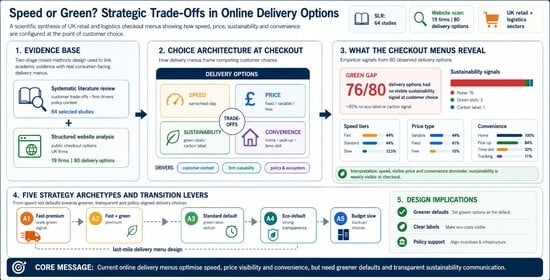
Graphical Abstract

1. Introduction

In recent years, e-commerce has developed exponentially as an integral part of human life, especially after the COVID-19 pandemic [1]. In addition, companies have expanded with a variety of delivery methods and focused on fast delivery to increase their competitive advantage. For instance, Amazon experimented with drones to deliver products 30 min after customers place their online orders [2].
The increase in online purchasing necessitates additional delivery journeys, which have unanticipated effects on traffic and the environment [3]. The driving forces behind customer loyalty to the online business are energy efficiency and logistics service quality, both of which are critical for lowering energy consumption and promoting sustainable development under the circular economy [4]. In terms of the environment, it is stated that carbon emissions due to urban last-mile delivery are estimated to increase by over 30% by 2030. In addition, if faster delivery induces consumers to make more orders but small ones, it would hold, and delivery-related emissions would account for a greater portion of the company’s total emissions, making it a more pressing issue for the business to resolve [5]. Regarding traffic, with the increase in vehicles commuting to serve fast delivery, it can cause congestion, besides carbon emissions [6].

1.1. Research Gap

There are many existing studies that have researched delivery services from several viewpoints. While, behavioural operations and consumer research have explored the willingness to pay/wait and sustainable delivery preferences, supply chain management has focused on operational optimisation and firm capabilities [7], and transportation economics has examined regulatory instruments such as road pricing, carbon pricing and low-emission zones [8]; these strands remain only partially connected. In particular, limited attention has been given to how consumer preferences, firm delivery strategies and policy pressures are jointly reflected in the delivery options presented at checkout [9]. In addition, these limitations point to a single integrated gap, namely, (1) the lack of an integrated perspective that combines consumer, firm and policy angles; (2) insufficient attention to how delivery menus are designed; and (3) weak or absent sustainability signalling to customers at the point of choice.

1.2. Research Rationale

Customers usually consider the advantages and expenses in pursuing additional value of service [3]. As a result, firms have a tension of balancing three core values in delivery, such as speed, price, and sustainability, to meet customers’ satisfaction. For the businesses, the perceived value of the quality of e-commerce delivery generates customer pleasure, which in turn drives customer loyalty, then drives profits and growth (service–profit chain) [1]. From the consumers’ perspective, there is a gap between attitudes and their actual behaviours in pursuing sustainability. Moreover, convenience should be considered as the fourth factor in delivery. Comprehending the interaction among these four characteristics is crucial for elucidating present delivery methods and finding solutions towards more sustainable e-commerce logistics. Online delivery offers design has a significant impact on how consumers behave and how the environment is affected. The viability of moving towards more sustainable delivery systems without sacrificing service quality or pricing can be better understood by methodically analysing how four factors are balanced within these offers.

1.3. Significance of the Research

This research plays an important role in filling the research gap. Firstly, by combining corporate strategy, policy issues, and consumer behaviour into one comprehensive study, it enhances the literature on e-commerce and sustainable logistics. The study expands on current conceptualisations of delivery decision-making by including convenience as an independent pillar in addition to speed, cost, and sustainability. Secondly, the findings can help find the insights into what companies actually offer customers in delivery. From that, more effective service design and pricing strategies of eco-delivery options can be suggested. Thirdly, the research can find what the constraints and supports of regulation and policy to companies in maintaining service quality for customers are. This is particularly relevant for regulators considering instruments such as low-emission zones, urban road pricing, carbon-related transport charges, delivery time-window restrictions and support for parcel lockers or low-emission vehicle infrastructure. It is especially important for regulators who want to affect consumer preferences and business conduct in urban freight and last-mile delivery systems.

1.4. Scope and Approach of the Research

This study focuses on online delivery services within the UK retail and logistics sectors. It investigates how online retailers and logistics providers design consumer-facing delivery options around four key dimensions: speed, price, sustainability, and convenience. Using a systematic literature review alongside a structured analysis of publicly available online delivery offerings, the study examines the trade-offs embedded in these delivery choices and how they are communicated to customers. The research does not use individual-level personal data or primary data collection methods such as surveys or interviews. Instead, it synthesises existing academic evidence with publicly available website data to identify how firms configure delivery options and balance competing priorities related to speed, cost, environmental sustainability, and service convenience.

1.5. Research Aims and Objectives

The first objective of this study is to delve into how customers’ preferences and trade-offs for delivery speed, cost, and sustainability are affected by financial willingness to pay (WTP), social norms, and environmental aspects. Next, it will examine the organisational, technical, and environmental (TOE) factors that encourage retail and logistics companies to balance the four pillars and implement sustainable delivery methods. In addition, this study aims to assess how government regulations and policies enable the shift to sustainable last-mile delivery while preserving service quality and affordability. E-commerce choice architecture is structurally determined by the intersection of three forces: demand-side consumer preferences, supply-side firm capabilities, and regulatory boundaries. Another purpose of this study is to create a conceptual framework for future logistics and retail sector strategies that incorporates Speed, Price, Sustainability, and Convenience.

2. Materials and Methods

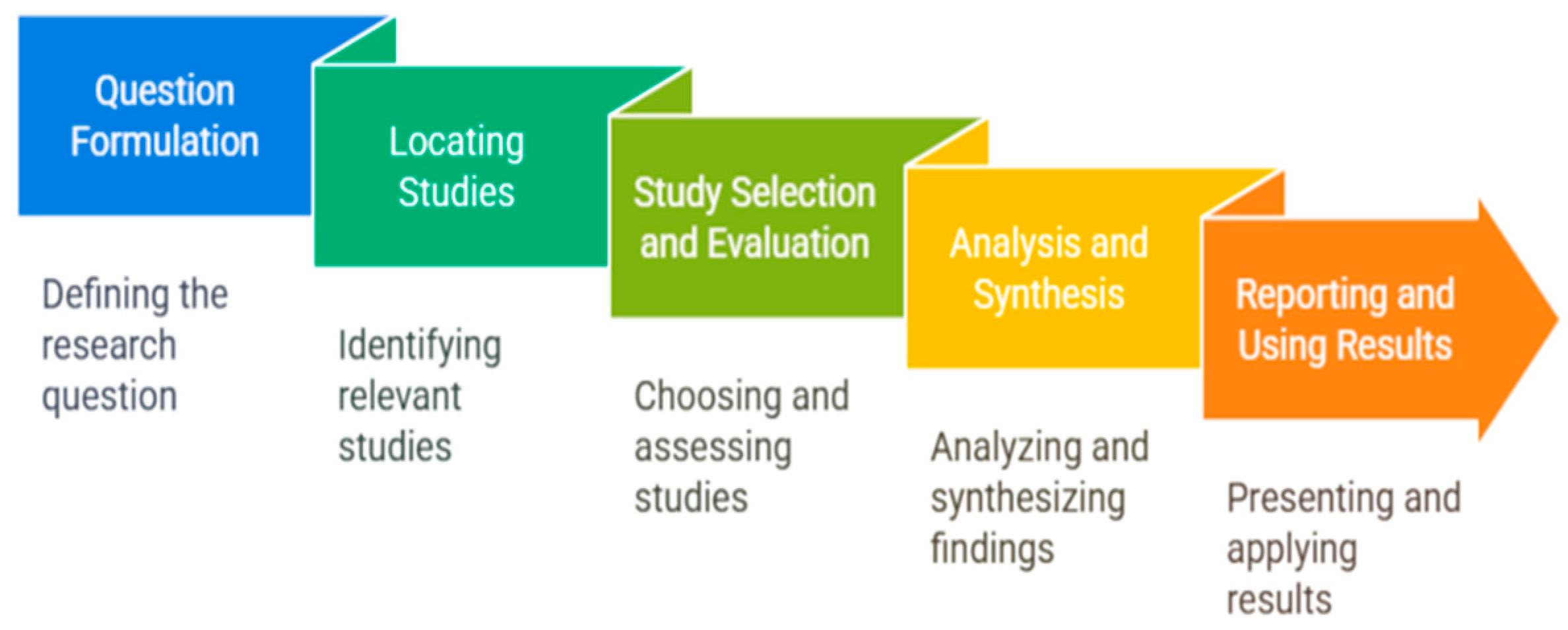
This study adopts the SLR methodology to find, compile, and assess relevant studies pertaining to delivery in online shopping. When employing SLR, it is essential to make sure that the process is clear, repeatable, and less biased. As a result, this study adhered to the five-step principles of the Denyer and Tranfield methodology that other SLR frequently use (see Figure 1). The first two parts cover the initial stage of question formulation. The procedures for finding and choosing pertinent studies, as well as for evaluating and synthesising them, are clearly outlined in this section. Reporting the results is the last stage [10]. In addition, this paper also employs structured web-scraping from firms’ websites in retail and logistics working mainly in the UK. The reason for applying the web-scraping method is to ensure that the study was based on real consumer-facing data rather than theoretical firm commitments. Web-scraping was used to directly assess real-world delivery menus.
The combination of SLR and the web-scraping method is a two-stage mixed-methods design: Stage 1—The SLR identifies the four delivery-design pillars and summarises findings on customer trade-offs, firm-level drivers and policy context; Stage 2—Structured website content analysis shows how these pillars appear in real consumer-facing delivery options. The SLR indicates a significant industry trend towards sustainable logistics; however, the empirical web data shows not the majority of firms offer green signals. These differences were not considered methodological errors. The integration point between the two stages was the coding framework: the SLR was first used to identify the four delivery-design pillars and associated sub-dimensions, which then informed the deductive coding of website delivery options in Stage 2. The empirical website data were subsequently compared with the literature-derived expectations to identify areas of alignment and divergence, particularly the green gap.

2.1. Question Formulation

In the planning stage, a process of evaluation including research questions and search strategy was established. After choosing a topic, researching emerging fields related to the topic was conducted to narrow down the scope. Next, based on the research gap and research rationale, three research questions were formed with the aim of problematisation and gap-spotting.
  • How do financial, social, and environmental factors shape customers’ preferences for delivery speed, price, and sustainability in online shopping?
  • How do technological, organisational, and environmental drivers influence how retail and logistics firms balance delivery speed, pricing, sustainability, and convenience in their service offerings?
  • What policies and regulatory mechanisms support retailers, logistics providers, and consumers in adopting more sustainable delivery options while maintaining service quality and affordability?

2.2. Locating Studies

Through the topic, a set of search terms was constructed from keywords in the topic, as illustrated in Table 1. The terms related to delivery, online shopping, and sustainability were presented and linked using Boolean operators within the study scope.
For more efficient and accurate searches, predefined search phrases were applied to article titles, abstracts, and keywords in the Web of Science (WoS) and Scopus databases. These databases cover a large number of reputable publications and are the most widely used for literature searches. Table 2 presents the broad inclusion and exclusion criteria.

2.3. Study Selection and Evaluation

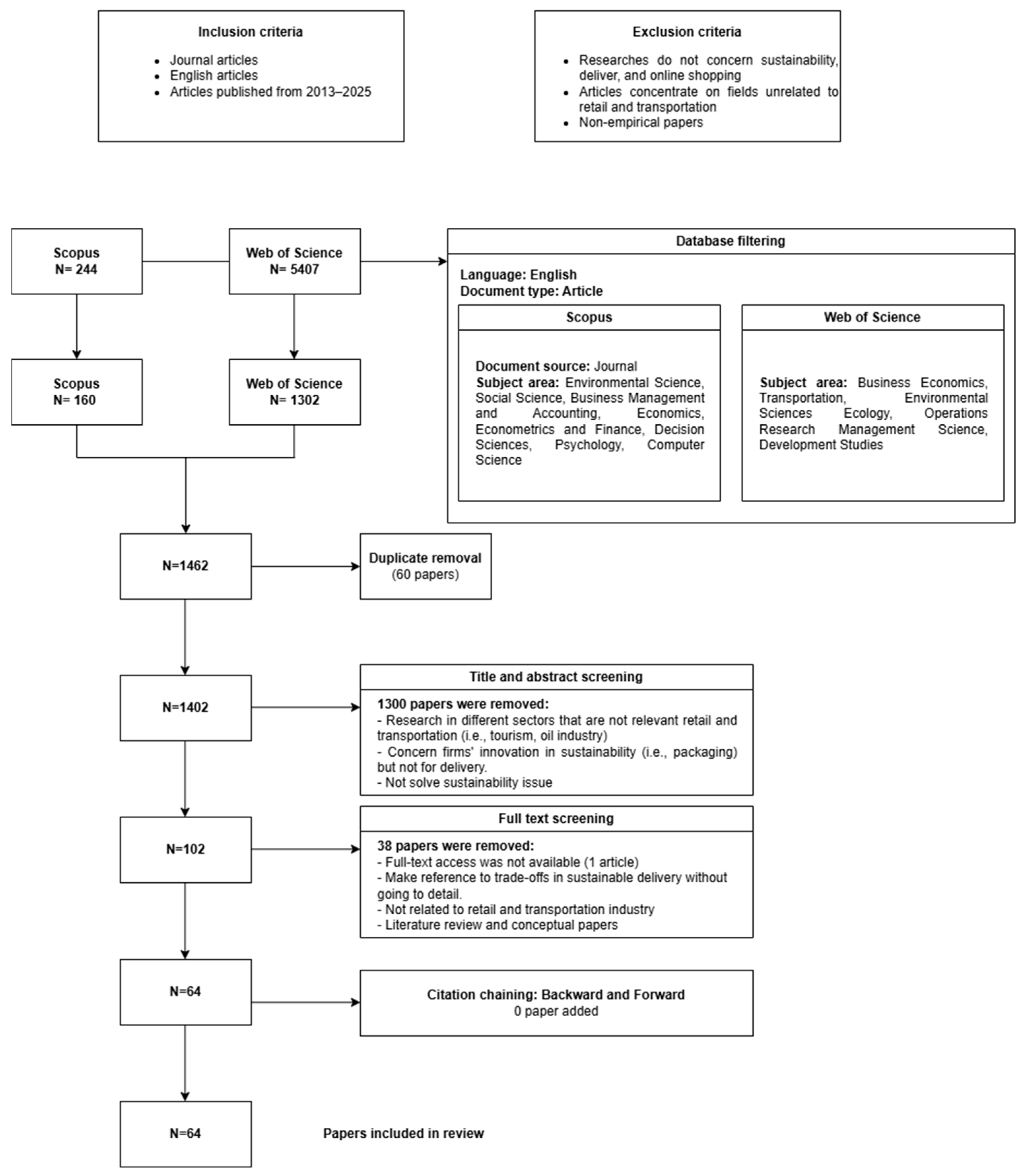
The two subsequent stages of the selection procedure were (1) title and abstract assessment and (2) full-text assessment. First, the title and abstract of each article were examined to determine how relevant they were to the study’s objectives. Articles with content about sustainable delivery and reaction discussion of government, businesses, and consumers towards sustainability in online shopping were involved in the next process. The factors led to the removal of irrelevant items in Figure 2. It is because many papers did not concentrate on the topic required, so the number was reduced considerably. In the second stage, the articles that were kept were thoroughly examined to see if they might answer the study questions. Finally, 64 papers were selected to include in the review.
In particular, the review was carried out by several researchers in order to improve dependability and lessen subjectivity. At least two reviewers independently completed the title, abstract, and full-text screening; discrepancies were settled by discussion and consensus. To guarantee consistency in inclusion and exclusion judgements, a third reviewer was engaged where needed.
After selecting 64 papers included in the review, the Mixed Methods Appraisal Tool (MMAT) was applied to appraise the quality of papers used in the study. A list of questions was built as the criteria to judge whether each paper is useful or not (see Table 3). There are three answers for each question, such as “Yes”, “No”, and “Can’t tell” [12]. For example, the answer is “Yes” if the paper can answer the question, “No” for the opposite, and the “Can’t tell” response means that the paper reports information too unclear to give a specific answer. The “No” or “Can’t tell” response to one or both screening questions might indicate that the paper is not an empirical study and will be excluded. The paper is high quality with all “Yes” answers. Next, a moderate-quality paper has one or two answers with “No” or “Can’t tell”. Finally, the paper is low quality with a majority of “No” or “Can’t tell” answers.
Regarding the impact on inclusion and interpretation, no papers were excluded only based on lower methodological quality. Instead, the appraisal results were used to guide the synthesis process: results from lower-quality studies were interpreted more cautiously and given less weight, and systematic weaknesses found throughout the dataset were used to identify gaps in the current literature and suggest future research directions.
To assess the robustness of the findings, a sensitivity analysis was conducted using the Mixed Methods Appraisal Tool (MMAT). Studies were first appraised for methodological quality, and then categorised into higher- and lower-quality groups based on their MMAT scores. The analysis was subsequently repeated by excluding lower-quality studies to evaluate whether the core themes and conclusions remained consistent. In addition, sensitivity checks were performed across different source types (peer-reviewed versus web/grey literature) and methodological approaches (qualitative, quantitative, and mixed methods). The results were compared to identify any variations in thematic patterns, ensuring that the final conclusions were not disproportionately influenced by lower-quality or heterogeneous sources (see Appendix A.1).

2.4. Analysis and Synthesis

The final selection of papers read in depth was analysed and synthesised. As a background for the following review, the findings across the articles will be viewed as per the research objectives. Then, theme codes in NVIVO were applied to categorise and group the extracted information into distinct analytical codes. Subsequently, the findings across these coded categories were cross-examined to identify overarching themes and behavioural patterns. The four main pillars—speed, price, sustainability, and convenience—were conceptualised directly by this structured synthesis approach, which served as the theoretical basis for the integrated conceptual framework suggested in this study.

2.5. Reporting and Using the Results

The descriptive and thematic analysis results are presented in this study, followed by a discussion of the connections between these findings. The results will be used to give a comprehensive understanding of the four pillars of online delivery: speed, price, sustainability, and convenience.

2.6. Data Collection of Web-Scraping

Web-scraping of delivery policy data from selected retail and logistics companies was used to create the empirical dataset. The data were publicly available and non-personal, and that collection complied with relevant website terms where applicable. The ‘Web Scraper’ extension for Google Chrome (Free Web Scraping—webscraper.io) was used as a data scraper tool. The extraction protocol depended on identifying consistent CSS selectors within the document object model of the checkout pages. The chosen companies were restricted to UK-based firms to ensure consistency and allow meaningful cross-sector observation. The reason for choosing the UK is that it is one of the most developed and widely used e-commerce markets in the world, with fierce logistical competition and extremely high customer expectations for delivery timeliness. Firms were intentionally selected based on their market size, national coverage, and the availability of diverse online delivery options. The number of companies chosen is 19. Firm L1 has the highest number of delivery options with 8 options; meanwhile, firm S2 offers the lowest quantity with 2 delivery options. Firm identities are anonymous in the analysis to adhere to ethical standards. All information was collected from websites that were archived at the time of collection. For transparency and replicability, the data sources are listed in the table below (see in Table 4).
Delivery options details were scraped between 30 September and 31 October 2025. The majority of data captured was at the final checkout stage that customers could see before completing their transaction rather than at the landing page. Customer baskets were simulated because final delivery fees, time slots, and options are frequently generated dynamically based on basket contents and postal codes. The postal codes chosen were in the central area of Birmingham city, UK. The baskets scenario was under the free-shipping threshold. In terms of the counting rule, granular time slots were grouped under a single service tier that was counted as one distinct delivery architectural option rather than multiple separate options. Where automated scraping was insufficient, dynamic content (such as expanded delivery menus and interactive checkout features) was manually examined and recorded to assure completeness. After scraping, the data was synthesised in an Excel file to manage and create charts used in the analysis part. Data extraction followed predefined coding rules. For example, “Sustainability delivery offer” was indicated when delivery options specifically mentioned environmental characteristics, including green delivery slots or carbon-neutral delivery. Screenshots were kept as an audit trail, and manual data collection adhered to a defined framework and detailed navigation guide. A second researcher independently reproduced a part of the observations to establish dependability, and any conflicts were settled by comparing the records and using predetermined coding guidelines. Throughout the data collection process, periodic cross-checks were carried out to ensure protocol consistency and adherence. Finally, data cleaning steps involve standardising conflicting terminology, eliminating duplicate entries, and clarifying business names to align with the four-pillars framework.

3. Results

3.1. Descriptive Overview

By descriptively analysing the publication year, research methodology, geographic location, and themes, this section gives a summary of the reviewed literature. In addition, this section gives insights about how firms have behaved empirically to balance the four pillars in online delivery through data scraping. Pricing tactics and sustainability goals are significantly misaligned, according to data analysis.

3.1.1. Studies’ Characteristics

Out of these studies, 32 studies were conducted in Europe, with the highest number of research papers. The majority of articles in Europe studied sustainable delivery and environmental impacts, such as [1,13,14,15,16,17,18,19,20,21,22,23,24,25,26,27,28,29,30,31,32,33,34,35,36,37,38,39,40,41,42]. Regarding article [43], the author analysed consumer preferences and behaviour in last-mile delivery. Asia is the region with the second highest number of research papers [44,45,46,47,48,49,50,51,52,53,54,55,56,57,58,59,60,61,62]. Meanwhile, 11 studies were implemented in America [3,63,64,65,66,67,68,69,70,71,72]. The remaining articles came from Australia [73] and New Zealand [74].
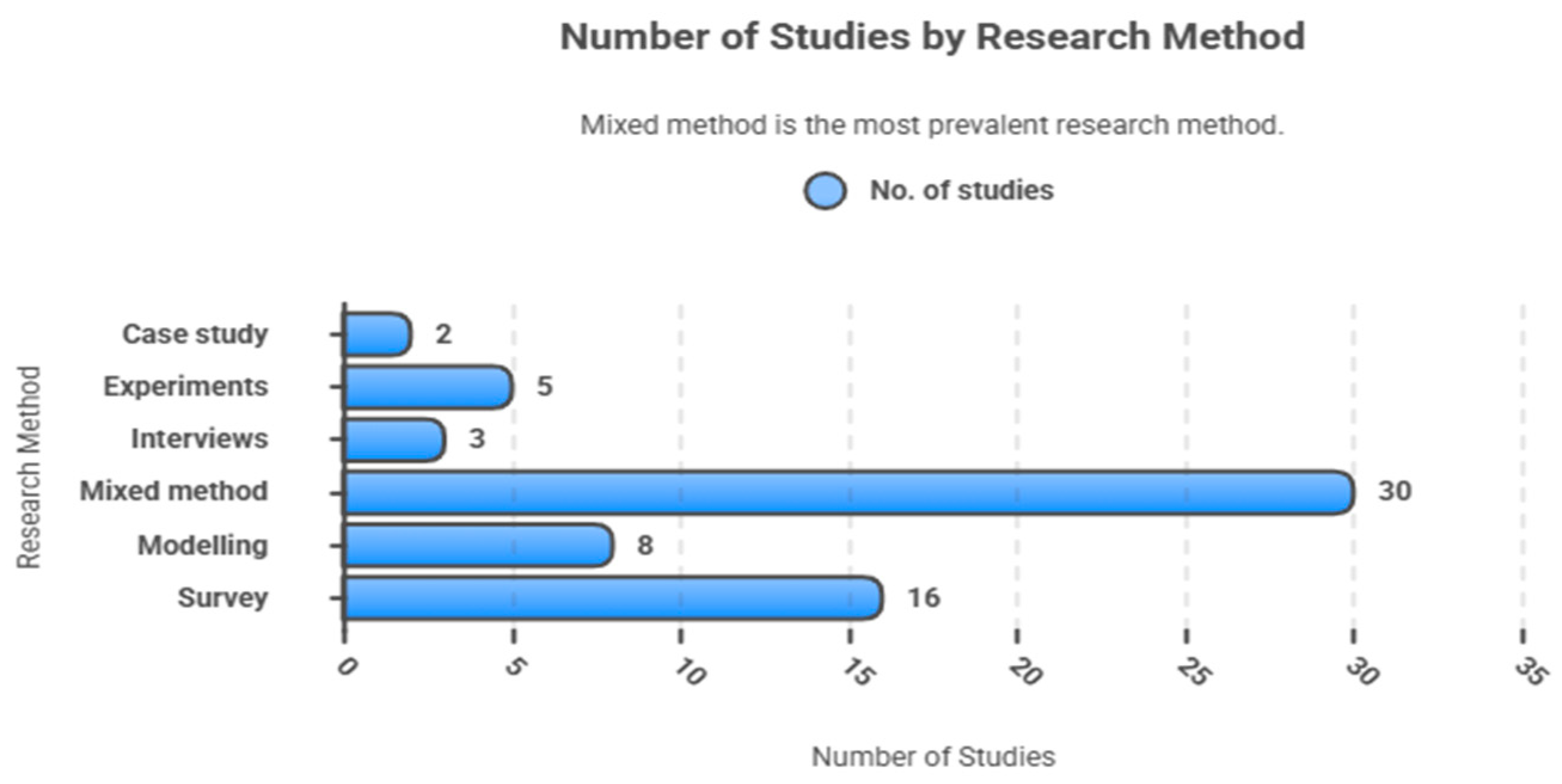
Thirty studies opted for mixed methods [3,14,18,20,22,23,24,25,26,29,31,32,33,34,40,43,44,45,46,48,54,56,59,60,62,64,65,66,67,71]. In contrast, only two studies used the case study method [13,74], and they both researched consumer behaviour and sustainable delivery. The details of studies’ characteristics are shown in Appendix A.2.

3.1.2. Distribution by Year

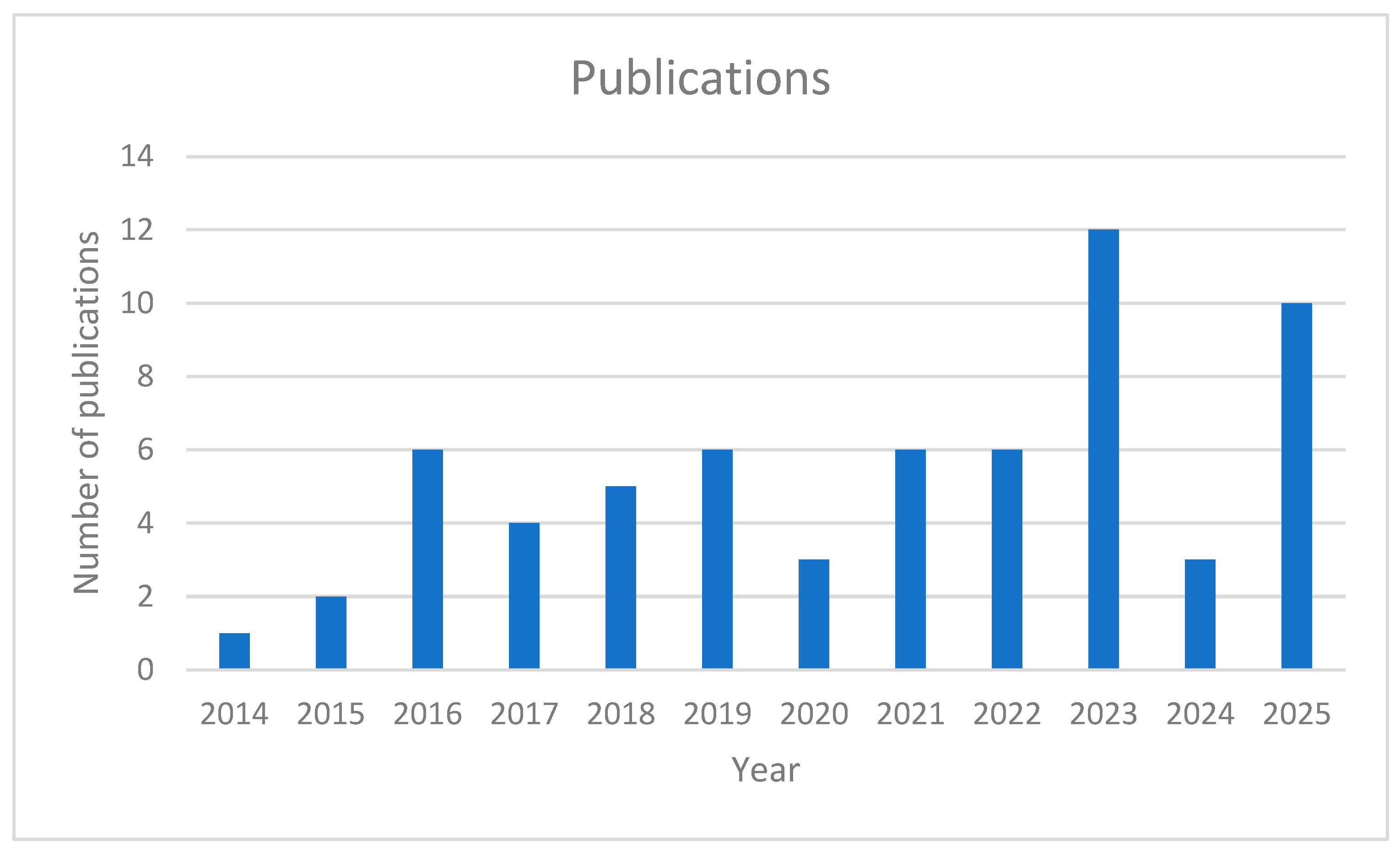
Knowing how this field of study has changed over time offers important insights into the evolution of academic interest in sustainable logistics. The temporal distribution of the chosen literature shows a clear upward tendency over the decade prior, as seen in Figure 3.
Figure 3 indicates the number of articles published annually. The study of the impacts of logistics on the environment began in 2014 and also witnessed the lowest quantity of publications. Remarkably, most of the research papers were issued in 2023, with 12 out of 64 papers, implying the growing concern about sustainable delivery since then.

3.1.3. Distribution by Research Methodologies

To comprehend how empirical data is collected and analysed on this subject, it is crucial to look at the methodological approaches used across the chosen literature. The examined articles cover a wide variety of research designs, as shown in Figure 4, which reflects the complexity of last-mile logistics research.
The selected research papers use six different methods in total (Figure 4). It is clear that the mixed method is the most popular method, with the appearance in 30 articles. In this set of articles, it commonly includes the combination of surveys, interviews, modelling, etc. Specifically, there are two research papers applying case studies to investigate customers’ decisions [13] and alternative delivery options [74].

3.1.4. Speed Tier and Price Type Distribution

The results from empirical data are described and explained in the next four sub-sections.
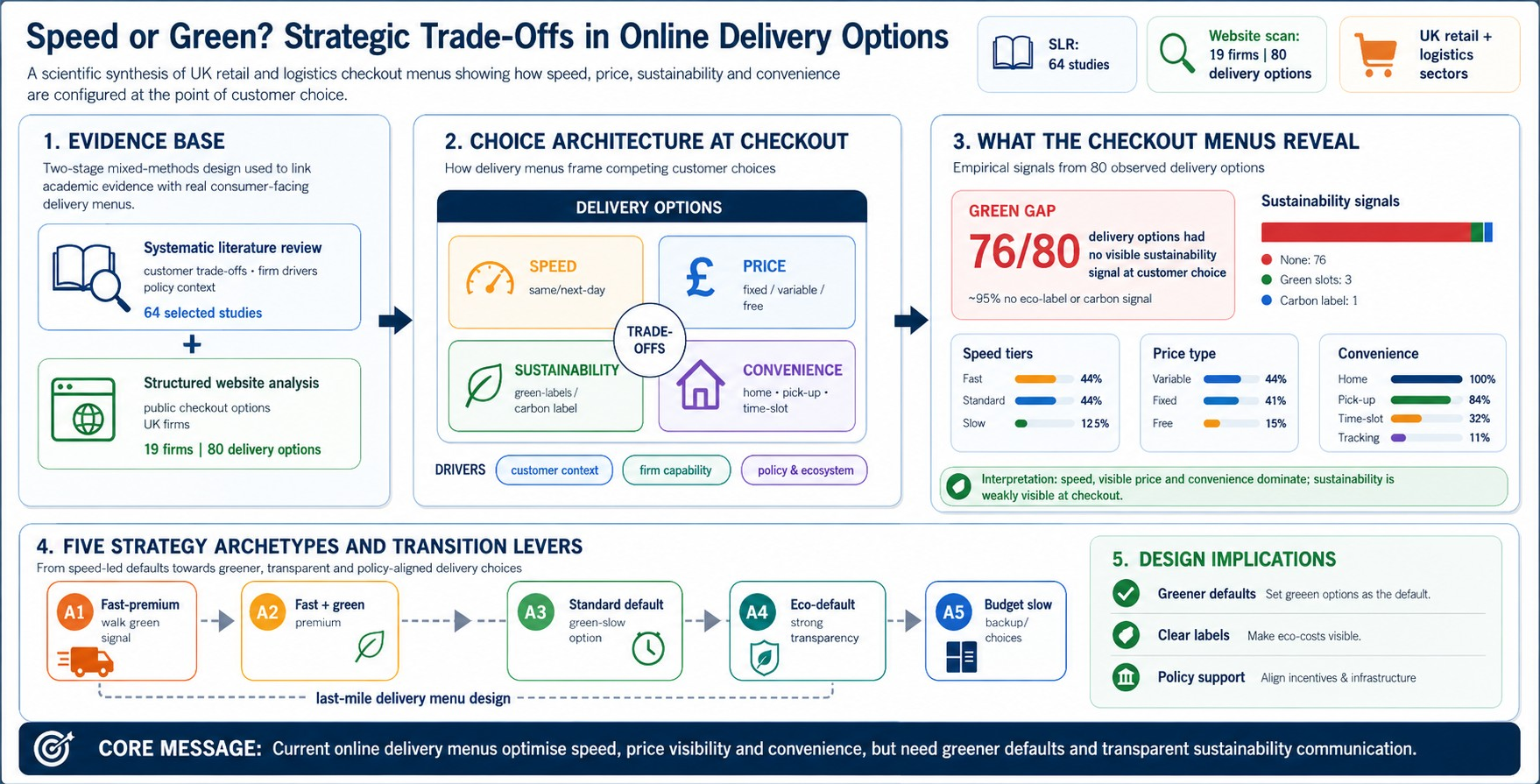
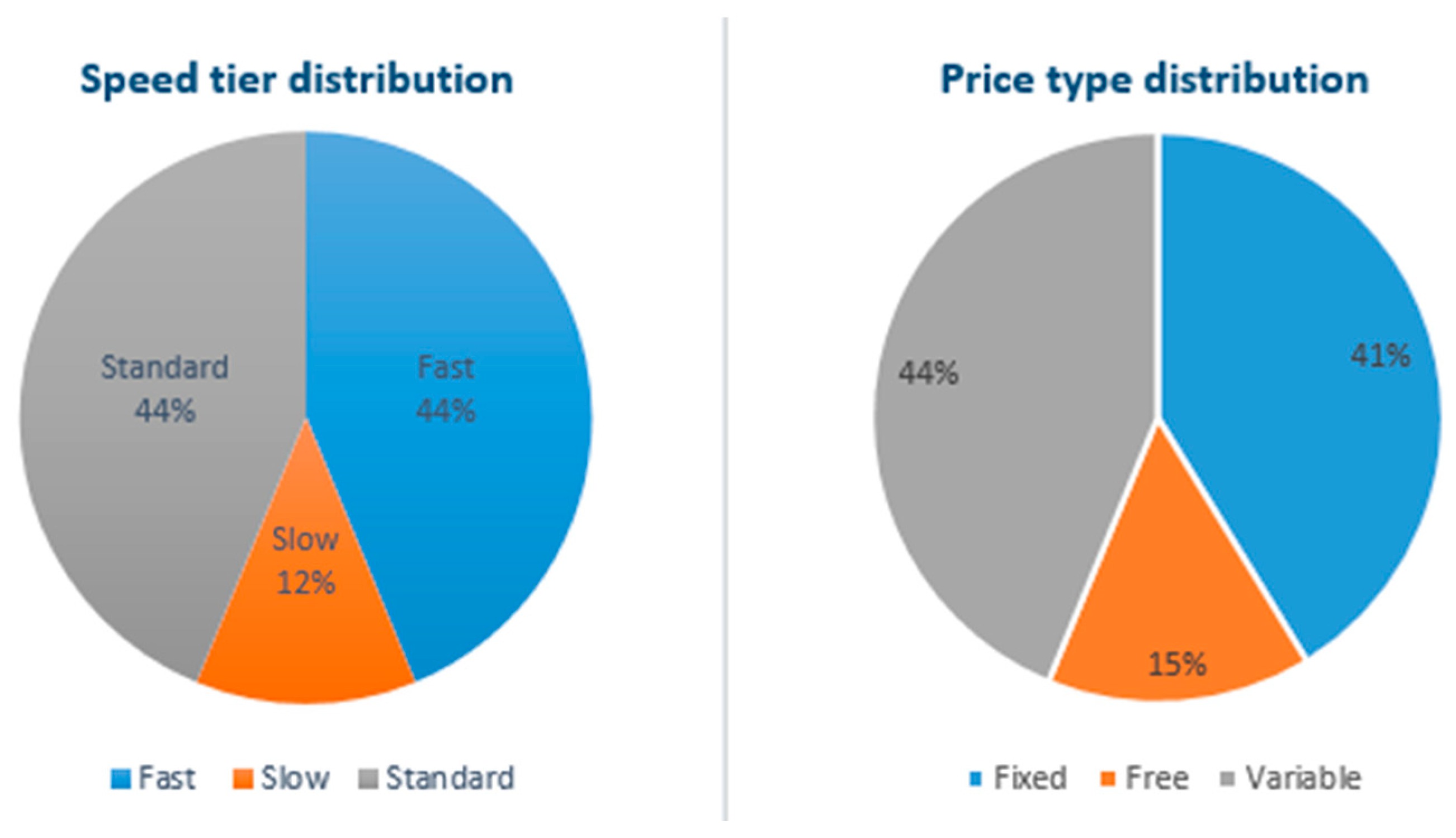
Each company in both the retail and logistics sectors has variable delivery choices offered to customers. The speed tier is divided into three types: fast, slow, and standard in 80 delivery options observed in total. Figure 5 shows the majority of delivery options focus on fast delivery (same day, next day), with the proportion of 44% (35 delivery options). Another noteworthy observation is that slow delivery (3–5 days, >5 days) accounts for the least percentage among the three kinds, with only 13% (10 delivery options). In addition, the proportion of standard delivery (2–3 days, Scheduled) is the same as fast delivery, with 44% (35 delivery options). Therefore, according to the empirical data, the observed delivery menus suggest a two-tier market dominated by fast and standard delivery options, while slower or explicitly consolidated options remain comparatively limited.
Regarding price structure, the market mainly employs variable fees (44%), and this portion is higher than the fixed fee by 3%. The variable fee usually changes according to the time slot and the weight of parcels. Meanwhile, free delivery is available in only 15% of the observed cases. As a result, the dominance of fixed and variable fees indicates that logistics costs are partially passed on to consumers. With the data collected from companies, all the fee types are published on their websites for consumers’ access. Customers can usually see the fee when choosing the delivery option in the checkout step. Furthermore, there is a price discrepancy in delivery options. For example, F1 provides “home delivery” and “home next-day delivery” with the fee of £3.99 (£3.99 is approximately equal to 5.35 USD (£1 = 1.34 USD at the exchange rate on 21 May 2026)) and £5.99, respectively. The delivery choice with a shorter lead-time costs more than the counterpart. This example illustrates the presence of speed-based price differentiation within individual firm menus. However, because price structures vary by basket value, delivery slot and delivery geography, the study does not estimate a market-wide average premium.

3.1.5. Sustainability Offers Distribution

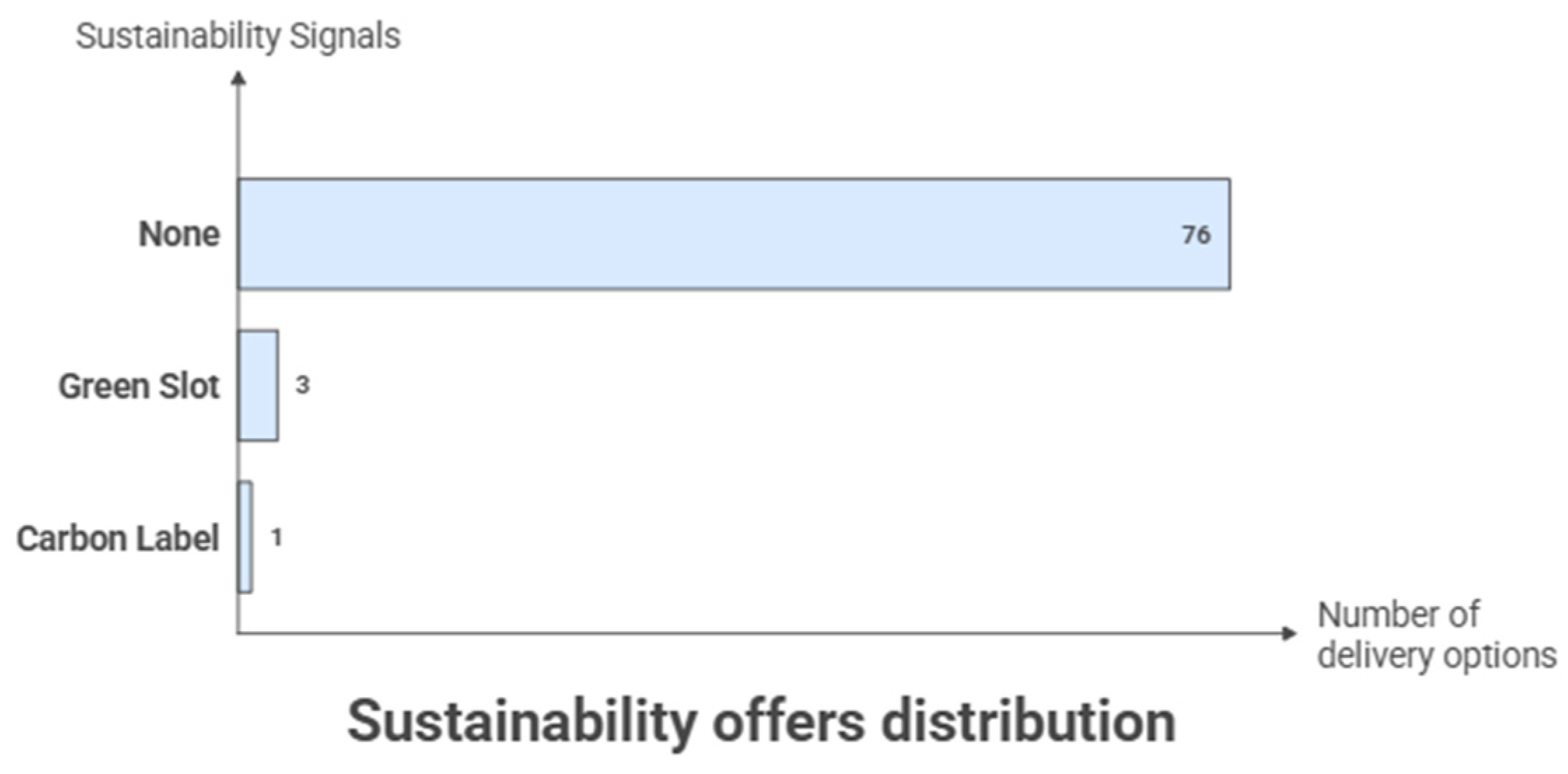
Examining the real option architecture that customers are faced with at checkout is essential as we move from theoretical frameworks to practical implementation. The fact about the incorporation of sustainability signals in present delivery options is revealed by the empirical data taken from the e-commerce interfaces, as shown in Figure 6.
Figure 6 shows the data collected from 19 companies, with 80 delivery options provided. However, it can be seen from the chart that the majority of firms offer 76 delivery options without sustainability signals. On the other hand, there are only four companies in the retail sector that give three green slot choices and one carbon label option. This sustainability-offer gap should not be seen as an apparent absence of internal environmental activity by these companies, but rather as a restricted visibility of sustainability at the point of decision. Green initiatives may already be carried out in the back end by retailers and shipping companies.

3.1.6. Convenience Offers Distribution

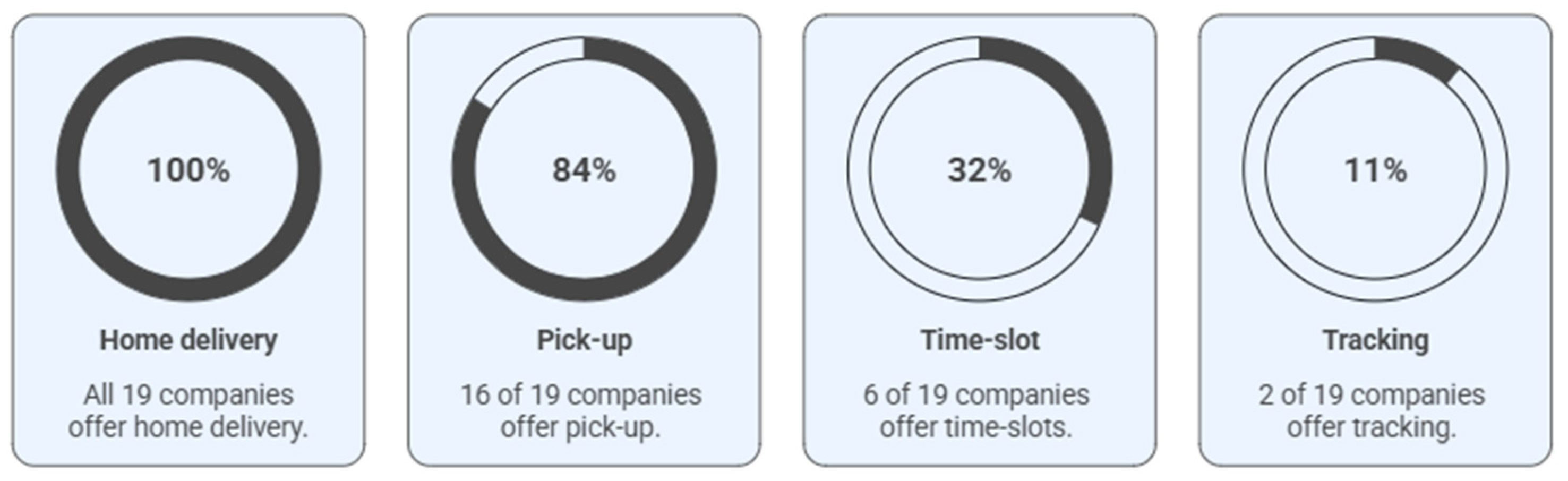
Convenience is a key factor influencing the customer’s checkout experience, along with sustainability and speed. Figure 7 illustrates the distribution of specific value-added convenience features explicitly marketed to consumers.
Almost all companies provide both home delivery and pick-up options for customers when doing online shopping. Firstly, home delivery has the highest number of firm offerings to customers, with 19 companies. Next, in terms of the pick-up choice (including store pick-up and collection points), there are fewer firms providing it than the home delivery option, with three firms. Furthermore, time slots and tracking are additional attributes combined with home delivery and pick-up options to increase convenience to customers. There are six companies giving time slots and only two companies giving tracking. As a consequence, firms still prioritise home delivery to optimise the convenience for customers. However, tracking service seems to be the minority distinction. It is important to be cautious when interpreting the limited explicit visibility of monitoring services; this does not mean that the logistical process lacks tracking capabilities. Instead, it strongly implies that e-commerce companies no longer need to promote real-time parcel monitoring as a competitive differentiation at the checkout interface because it has become very standardised.

3.2. Classification of Online Delivery Strategies

Based on the four last-mile delivery pillars—speed, price, sustainability, and convenience—this section creates a typology of online delivery strategies. Five main archetypes were found, each of which represent a particular arrangement of the four pillars. The classification was developed by evaluating the 80 extracted delivery options against five structural thresholds observed at the checkout interface: (1) Dominant speed tier (e.g., express/same-day versus standard delivery), (2) Fee structure (e.g., premium pricing, flat rates, or free shipping thresholds), (3) Sustainability signalling (the explicit presence or complete absence of eco-labels and green slots), (4) Convenience features (e.g., direct home delivery versus collection networks), and (5) Transparency (visibility of real time tracking and time-slot precision). The following parts offer an analytical explanation of each method, while Table 5 summarises these archetypes and their notable features.

3.2.1. The Market Polarisation: A1 and A5

The first archetype, A1: Fast-premium (weak green signal) prioritises speed and convenience. It likely targets customers who have urgent orders or who are time-sensitive and willing to pay a high premium. For example, F2 offers “standard home delivery” at £2.95 but “same-day home delivery” at £7.95. Nevertheless, this method exerts a strong negative influence on the operation. Specifically, firms have to spend more money on human resources and vehicles to adapt to the high demand for urgent delivery. Next, due to time pressure, firms can find challenges in consolidation to reduce the transportation distance, which aligns with the opinion of [63]. Therefore, more vehicles travel, which will lead to high CO2 emissions into the atmosphere.
Conversely, the archetype A5: Budget slow/consolidated + pick-up/lockers arranges affordability and operational efficiency over speed. For example, S1 provides customers with store pick-up slots. The price, which ranges from £0 to £2, is highly reasonable. This strategy targets customers with high price sensitivity, such as low-income people. From operational perspectives, this typology facilitates effective route planning, lowers the number of unsuccessful deliveries, and supports cost savings. Environmental advantages could result from consolidation and fewer deliveries, even though sustainability is not stated clearly.

3.2.2. The Green Nudge: A3

A more balanced approach between sustainability and operational efficiency is represented by the third archetype, A3: Standard-default + green-slow option. Standard delivery speeds are set as the default option, while slower, greener delivery alternatives are offered alongside. Firm S3 gives customers a standard home delivery option designed with time slots and the price range from £4.5 to £5. Planned shoppers and environmentally aware customers who are willing to wait longer are the primary goals of this tactic. From the viewpoint of operations, this model supports cost savings and emissions reduction by enabling higher levels of delivery consolidation and route optimisation. This archetype shows a clearer trade-off between speed and sustainability than fast delivery-focused methods.

3.2.3. The Niche Strategies: A2 and A4

The second archetype, A2: Fast + green-premium, combines fast delivery and sustainability signals (green slots and carbon label). For instance, S5 offers “1 h home delivery” with green slots for customers. Environmentally conscious customers who prefer quick delivery but are ready to pay more for greener solutions are the target customers for this archetype. This approach has significant operational challenges because it requires a large investment in green transportation, low-emission technologies, or offsetting mechanisms in order to combine speedy delivery with sustainability. Consequently, this typology represents an expensive, complicated delivery approach that aims to balance environmental responsibility with speed.
Archetype A4 concentrates on consumers who place strong value on environmental responsibility and transparency in delivery services. By adopting responsible consumption habits, consumers can reduce the carbon emissions associated with online shopping [45]. Businesses that use this method aim to boost consumer trust and promote eco-friendly decisions. Operationally, this strategy gains from better consolidation and fewer delivery externalities but requires ongoing investment in green logistics solutions.

3.3. Typology Synthesis

The structure and communication of delivery options notably differ between logistics providers and retail businesses. Retail companies typically use consumer-facing delivery techniques that include a variety of convenience elements, such as time slot selection and integrated tracking, as well as high transparency and clear price information. In the retail industry, sustainability signals are more often included at the point of decision, especially when slower eco-options are offered alongside faster ones or delivery slots with green labels.
In contrast, logistics companies have a more operationally focused approach when it comes to pricing and sustainability. Delivery speed remains a core offering, but pricing structures are often variable. Environmental commitments are not usually linked directly to individual delivery options. As a result, consumers and business customers are less frequently presented with explicit trade-offs among speed, price, and sustainability within the delivery menu itself.
The cross-sector perspectives and typology findings give this proposed conceptual framework empirical proof.
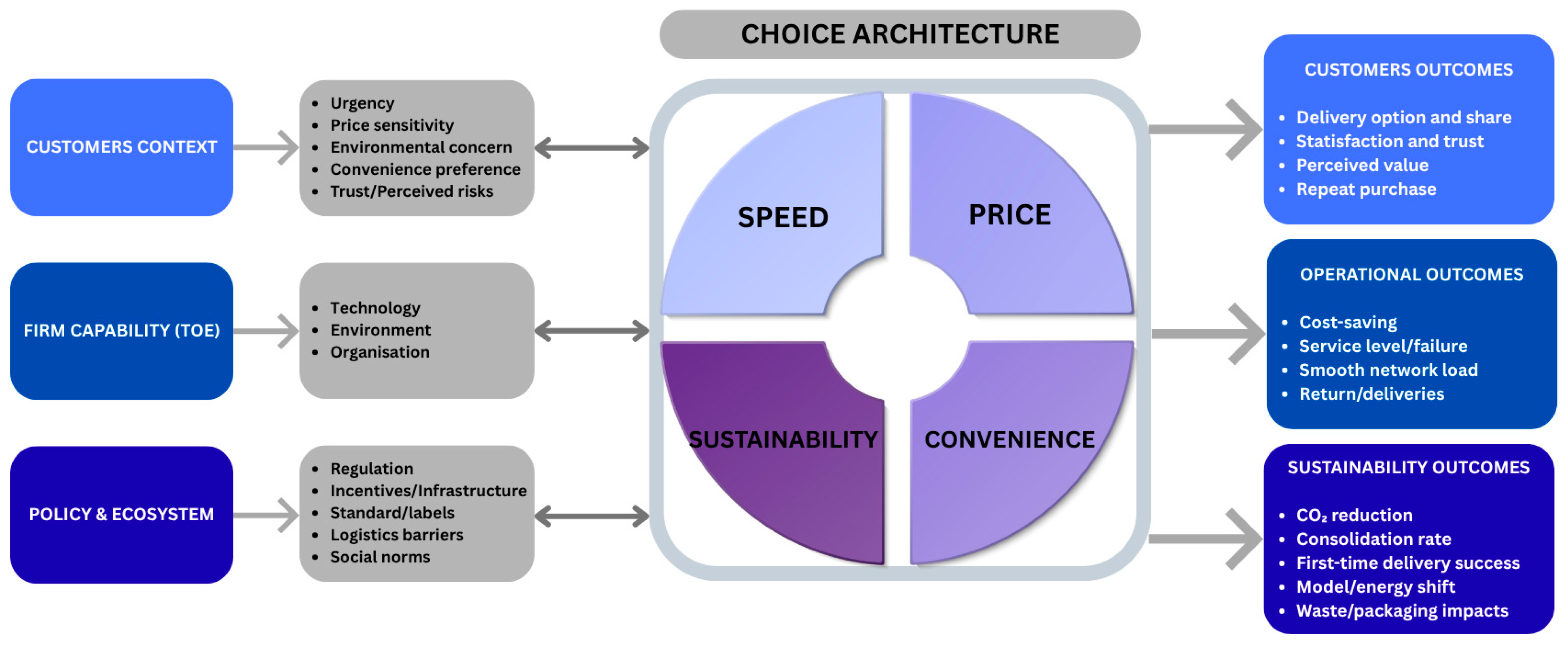
The framework in Figure 8 demonstrates that customer context, firm capability, and policy and ecosystem are considered as the main elements in designing choice architecture that combines four pillars in online delivery. Firstly, the customer context indicates that their wants when using service and firms need to be based on these to set up their services. For example, time pressure from customers’ urgency will make firms create a fast delivery design. Next, firm-level delivery strategies serve as a layer of mediation between upstream drivers, including organisational goals, environmental needs, and technology capabilities. Furthermore, by influencing corporate incentives and consumer decision-making environments, policy and regulatory systems further moderate these connections. Within the choice architecture design process, four core elements will interact with each other and imply the trade-offs among them.
Corresponding to three inputs, there are three outcomes: customer, operational, and sustainability outcomes. In terms of customer outcomes, customer satisfaction is mainly adapted to increase repeat purchases. When it comes to operational outcomes, they concentrate on cost savings and ensure smooth operation. Finally, about sustainability outcomes, they will be shown through a reduction in environmental impacts such as CO2 reduction, energy shift, etc. In conclusion, instead of viewing online delivery systems as static service offers, this synthesis supports the idea that they are dynamic interaction spaces.

3.4. Firm Capabilities (TOE) as Drivers for Strategy Balancing

3.4.1. Motivations

Almost all companies prioritise delivery cost more than other concerns [14,46]. It is found that green supply chain management in general and sustainable delivery specifically help a firm’s operating expenses and profitability improve due to the better customer satisfaction and loyalty [47]. This finding aligns with the majority of studies researching how sustainability influences the supply chain and logistics [15,48,49,64].
Secondly, in [64], it is indicated that customer demand is a common market-related motivator for green projects. The sustainable transportation goal is to satisfy the growing need for mobility while protecting and enhancing human health, the environment, economic development, and social justice [16]. Therefore, if customer demand is met, it will increase customer satisfaction, which is a driver for re-purchase intention [17].
Thirdly, many firms are attracted by the benefits of delivery alternatives. For example, the pick-up option has been employed more by firms alongside other traditional delivery methods. According to [65], pick-up systems’ benefits are a positive for companies’ image and encourage more environmentally sensitive consumers to use the system. There are two studies that have the same point about pick-up choice advantages [18,74]. Meanwhile, the authors mentioned that while the total cost savings are a trade-off between the rise in the fixed cost of operating the collection-and-delivery points (CDPs) and the cost savings incurred in the last mile, the cost savings in the last mile are directly linked to the overall demand attracted to the CDPs [50]. In the viewpoint of [19], the pick-up option creates a competitive advantage for firms and performance enhancement for customers.
In addition, organisational culture and corporate social responsibility (CSR) play a vital role in solidifying the idea of less pressure from internal and external stakeholders to harmonise with the environment [51]. Accordingly, the government’s support is inspirational for firms, and there is an increasing need for it to pursue CSR [1,20]. Firms mainly take advantage of infrastructure and taxation support [3,21,52].

3.4.2. Barriers

Firms have to face many challenges in offering customers sustainable delivery. Firstly, firms have difficulties in balancing speed, sustainability, price, and convenience. The higher the value for the social costs of CO2 emissions, the greater necessity for control increases [44]. In the four pillars, convenience is said to be the biggest challenge for firms [53]. As it is noted, firms must ensure the service level while implementing environmentally friendly technologies and organisational arrangements [22]. The optimal retail price rises in proportion to the unit cost and the perceived value of the delivery service if the retailer offers free delivery [54]. Finding other delivery alternatives is a way for firms to balance speed and convenience [23]. However, many businesses and supply chains may require a slower speed in order to incorporate sustainability measures [55].
Secondly, the consumer gap is another obstacle that firms face. A study showed the shortage of interaction between customers and firms can prevent them from pursuing sustainable delivery [24]. The consumers’ cooperation is not efficient in delivery, causing firms’ failure [1,66]. Furthermore, customers’ attitudes do not align with their actual buying behaviour. For example, they are environmentally concerned but are not satisfied when being charged extra fees for green delivery options [25,45,73].
Thirdly, lack of resources creates constraints not only in sustainable delivery but also in general operations. E-commerce is said to be environmentally better than traditional physical stores [26]; but sustainable last-mile distribution faces a challenging task due to the complexity of urban freight and logistics [27]. Next, the human resources shortage is considered one of the greatest barriers in strategic sustainable delivery [46,64]. Inconsistency in providing various delivery options will lead to a lack of information transparency [28,29] and suboptimal benefits in cargo consolidation operations [67].
Last but not least, key factors in the last mile need to cope with rising customer demands and transportation volumes due to the expanding flow of e-commerce orders [30]. In terms of delivery, it was discovered that delivery deadlines had a considerable impact on the average delay [63,68]. It is implied that time pressure can make parcel consolidation harder [31,69]. Due to the large distances between customers and pick-up points, combining the time and location for several deliveries can also make coordination more difficult. For instance, all deliveries must be made when authorised individuals are available to accept them [31,32]. Later-hour deliveries may become increasingly important in the future because the time windows provided do not align with working schedules [33].

3.5. Policy and Government Regulations Influence on Sustainable Online Delivery

Transitioning from passive spectators to active ecosystem architects is the main responsibility of policymakers. One of the most important factors supporting logistic service providers’ (LSPs’) environmental sustainability is green government backing [14]. The government shows a strong role in enforcing standardisation in finance and infrastructure. Providing the greatest infrastructure to support e-commerce parcel deliveries with the fewest feasible social and environmental externalities is the administration’s action [1,21]. In terms of finance, transport pricing can be viewed as a tool used by the government to create fair competition and level playing fields in the various transportation industries. Consequently, many cities have already implemented urban pricing, which can be area-based, cordon-based, distance-based, emission-based, or a mix of these, to decrease the number of vehicles in the city centre or in particular city zones/time slots [17].
On the other hand, policymakers still face challenges in supporting firms to pursue sustainable delivery. Firstly, the government has to solve the existing consequences of e-commerce. Noise; pollution; traffic, accidents; the use of non-renewable fossil fuels; the loss of greenfield sites and open spaces due to the development of transportation infrastructure; and an increase in waste products like tires, oil, and other materials are all detrimental effects of the growing traffic volume on the city. In addition, a lack of information is also a constraint. Specifically, the biggest obstacle to the effective implementation of measures and solutions, particularly in light of the demands of sustainable development, is a lack of data, particularly with regard to vehicle classification, routes, transportation demand, etc [29].

3.6. Customer Context: Preferences, Urgency, and Trade-Off Behaviours

SLR reveals consumers’ shopping behaviour and their reaction to sustainable delivery offers. According to [34,35,56], customers are willing to make financial contributions to offset environmental delivery impacts. Some studies show that customers’ WTP is to increase their satisfaction, commitment, and loyalty [70]; but they are reluctant to change their behaviour [3]. However, it is indicated that consumers are not willing to pay any extra cost for sustainable delivery [20,46]. Regarding willingness to wait (WTW), customers can wait for a longer time provided that they can save costs and help reduce environmental impacts [36,37].
Consumers consider convenience as a decision factor. They usually prefer home delivery and time flexibility when choosing delivery options [38,57,58]. Customers’ brand attitude is also a competing effect on customers’ purchase intention [59]. Additionally, some consumers want their financial contribution as an exchange for their rights and satisfaction enhanced [60,70]. Next, social norms are also shown to influence customers’ WTP, such as carbon offsets for airline tickets and rural mobility behaviour [28,71]. Firms’ reputation and information transparency are important to consumers’ behaviour. Specifically, a customer’s WTP for a premium depends on firms’ CSR brand [13] and clear information on their ecological footprint [39,61].
Customers who are price-sensitive will consider price to be the dominant factor in selecting sustainable delivery options [72]. Customers were found to be willing to pay at least a 10% premium, with a maximum price premium of no more than 25% [62]. Furthermore, demographics also create discrepancies in buying behaviour. For example, green transportation is more attractive to students, the working population, and younger people (under 40) [40,41]. According to [42], compared to customers with low levels of regional identification, those with high levels of regional identity were more likely to feel thankful and committed. Based on findings, customers usually have to trade off money and time when choosing sustainable delivery options [28,43].
The sensitivity analysis indicates that the main findings are robust across variations in study quality and source type. Excluding lower-quality studies did not significantly alter the identified themes related to digital technology integration, performance impacts, and adoption barriers. However, some insights, particularly those related to emerging technologies and implementation challenges, were more prominent in the grey literature, suggesting that these areas remain underrepresented in peer-reviewed research. Overall, the consistency of results across different analytical scenarios supports the reliability of the study’s conclusions (see Appendix A.1).

4. Discussion

This section explores the implications of the empirical findings for businesses, policymakers, and consumers by using the typology of online distribution systems and insights from the systematic literature review. This discussion highlights the contrast emerging between the system literature suggestions and practical observations. Firstly, the literature indicates growing green logistics adoption, but observed menus show limited sustainability signals. Secondly, the literature suggests customers may respond to clear sustainability information; delivery menus rarely present such information at checkout. Next, the literature supports delivery consolidation/collection points; however, pick-up options from observation are common but not usually framed as green.
In terms of firms, the results show that delivery menus serve as choice structures that allow businesses to actively shape customer choices. The popularity of fast-defaults archetypes suggests that delivery speed continues to be prioritised in online delivery design, often at the expense of sustainability. On the other hand, there is a green gap when the study indicates that firms have increasingly opted for sustainable deliveries [1]. For example, the gap is practically shown through the absence of sustainability signals, with 95% of the checkouts displaying no eco-labels or carbon-offset indicators. Therefore, businesses need to redesign their choice architecture to meet sustainability objectives without sacrificing profitability. Retailers should use nudging rather than a neutral list of present shipping options. According to the typology, the Archetype A3: Standard-default + green-slow option is a technique that strikes a balance between operational efficiency and sustainability. The current data shows that sustainable options are commonly presented as “standard”. Therefore, firms should elevate “green slots” to the default position. However, green defaults should be applied cautiously. In order to prevent customer misunderstanding, perceptions of worse service quality, and potential checkout abandonment, businesses should openly express any trade-offs associated with greener solutions, such as longer lead times or higher costs. Along with that, firms can adjust the relative convenience of alternative options to attract customers.
Reducing the convenience penalties related to sustainable delivery alternatives is one important aspect for businesses. Therefore, companies looking to encourage sustainable delivery should try to preserve flexibility and trustworthiness in addition to lengthening lead times. A study suggested that customers might select products from the CDPs using eco-friendly methods by relocating the CDPs and providing incentives [50]. Moreover, offering clients a slower delivery option throughout the checkout process is beneficial for online shops. By increasing the variety of delivery alternatives, it is also less likely that consumers will give up on their purchase because of long delivery delays, because they still have options and can choose a delivery method that best suits their requirements [28]. To avoid greenwashing, transparent communication of how and why certain delivery options (like green-labelled delivery slots) reduce the environmental impact can enhance consumer trust and support informed decision-making.
Regarding policymakers, according to the findings, the number of delivery options without sustainability signals is the highest, which requires regulatory intervention. Meanwhile, it is said that government support is the main motivation for firms to pursue sustainability. In order to verify sustainability claims, drive green purchasing, and improve the environmental and social performance of goods and procedures, eco-labels should be applied [75]. About archetype A5, it shows that collection points are economically viable. Therefore, parcel lockers and low-emission vehicles (LEVs) are supported to be adopted by carriers and service operators [3]. By incorporating locker networks into urban planning and providing logistics companies with subsidies for EV charging infrastructure, policymakers could accelerate this trend.
In terms of customer context, empirical findings and SLR insights emphasise the role of information and defaults in shaping consumer delivery choices. Archetypes express the impacts of delivery choice architecture on firms’ operations, which would lead to influencing customer behaviour. According to the literature, consumers are less attentive to abstract environmental appeals and more responsive to clear labels, transparent information, and simplified options [39]. Providing comparative data, such as showing how various delivery methods affect the environment, might encourage more environmentally friendly decisions, especially when paired with a few trade-offs for convenience. For example, advertising LEVs’ usage when offering delivery options to consumers could be reinforced with information about the level of emissions that could be saved by this alternative. The likelihood of raising demand for the greener options increases with the amount of information provided on the delivery options [3].
Therefore, it is not appropriate to consider the three stakeholder groups separately. Customers react to the selections and information provided at checkout; businesses translate these incentives into visible delivery choices, price structures, and sustainability signals; and policy instruments alter the incentives and restrictions under which businesses build delivery menus. Therefore, alignment among regulatory design, firm-level service architecture, and consumer decision settings is essential for sustainable last-mile delivery.
Overall, this discussion shows that businesses, policymakers, and consumers have to collaborate to achieve sustainable delivery outcomes. To move delivery systems toward more sustainable configurations without compromising service quality or price, regulatory frameworks, behavioural nudges, and delivery menu design must operate together.

5. Conclusions

5.1. Research Limitations

Although this research offers important empirical insights, it is important to recognise a few limitations. First, a static view of the market is captured by cross-sectional web-scraping, which is the methodology’s essential method. This method provides insight into the supply side, but it is unable to capture what customers actually select. As a result, it is unable to identify the true green slots adoption rate. In addition, due to website features, some kinds of information are limited to access by a web-scraping tool; so, they were collected manually. Thirdly, based on information that was visible to the public, the study classified delivery attributes. This raises the possibility of “greenwashing,” in which businesses exaggerate their sustainability initiatives, or “greenhushing,” in which businesses use consolidation to increase efficiency but do not advertise it as “green”. Finally, the scope of the dataset is UK-centric. The results may not be entirely applicable to different geographical locations or regulatory environments, despite the fact that this permits in-depth comparison and relevance to contemporary policy discussions. Countries with different infrastructure, customer expectations, and governmental frameworks may have very different delivery methods and sustainability concerns.

5.2. Research Implications

From a theoretical perspective, the study contributes to changing the viewing of the four pillars as separated metrics to an integrated conceptual framework of choice architecture. The study offers an assessment tool that clarifies how businesses implement strategic trade-offs by presenting a fresh five-archetype typology.
From a managerial perspective, businesses need to redesign delivery outcomes by organising, framing, and default positioning delivery alternatives in addition to making operational investments. Enhancing transparency and lowering convenience fees for sustainable delivery are crucial levers for promoting greener options without compromising consumer happiness.
From a policy perspective, the “Green Gap” empirical data reveals an important market failure. Policies that favour low-emission transportation, delivery consolidation, and transparency are more likely to be successful when they match the consumer decision environment and firm-level initiatives. Policymakers can use the typology as a structured view to evaluate how various delivery methods react to incentives and regulatory pressures.

5.3. Future Research

Future research should focus on three key areas to expand these findings. Firstly, future research could broaden the analysis’ geographic and sectoral focus to look at how delivery methods differ among nations, legal systems, or modes of transportation. A deeper understanding of how national infrastructure and policy frameworks influence delivery systems may be obtained through comparative research.
Secondly, the economic and environmental effects of various delivery models could be evaluated using quantitative techniques. A more thorough assessment of sustainability results would be possible if delivery strategies were connected to emissions data, cost structures, or performance indicators. Furthermore, dynamic pricing should be applied effectively if it is performed in a way that makes the increases seem reasonable and fair to customers [76].
Lastly, as technology, customer expectations, and regulatory demands continue to evolve, future studies might examine how delivery techniques have changed over time. Understanding how businesses modify delivery menus over time and whether sustainability-oriented tactics gain prominence as environmental concerns grow would be especially beneficial from long-term studies.

Author Contributions

Conceptualisation, M.A. and T.M.T.N.; methodology, M.A., T.M.T.N. and R.H.; software, T.M.T.N.; validation, M.A. and R.H.; formal analysis, T.M.T.N. and M.A.; investigation, T.M.T.N.; resources, T.M.T.N. and M.A.; data curation, T.M.T.N.; writing—original draft preparation, T.M.T.N., M.A. and R.H.; writing—review and editing, T.M.T.N., M.A. and R.H.; visualisation, T.M.T.N.; supervision, M.A.; project administration, M.A. All authors have read and agreed to the published version of the manuscript.

Funding

The research received no external funding.

Institutional Review Board Statement

Not applicable.

Informed Consent Statement

Not applicable.

Data Availability Statement

The original contributions presented in this study are included in the article. Further inquiries can be directed to the corresponding author.

Conflicts of Interest

The authors declare no conflicts of interest.

Abbreviations

The following abbreviations are used in this manuscript:
SLRSystematic Literature Review
CSR Corporate Social Responsibility
WTPWillingness to pay
WTW Willingness to wait
LSPLogistic Service Provider
TOETechnology–Organisation–Environment
CDPsCollection-and-delivery points
LEVs Low-emission vehicles
MMAT Mixed Methods Appraisal Tool

Appendix A

Appendix A.1

Table A1. Sensitivity analysis based on study quality and source type.
Sensitivity FactorApproach AppliedImpact on FindingsInterpretation
Study quality (MMAT)Exclusion of lower-quality studiesNo major change in core themesFindings are robust to quality variation
Source typePeer-reviewed vs. grey/web sourceMinor variation in emerging trendsGrey literature highlights early-stage insights
Methodological approachQualitative vs. quantitative vs. mixedConsistent patterns across methodsConvergence strengthens validity
Technology coverageExclusion of niche/emerging technologiesSlight reduction in diversity of applicationsCore technologies remain dominant
Time periodEarly vs. recent publicationsIncreased emphasis on technologies/green practices in recent studiesReflects evolution, not inconsistency

Appendix A.2

Table A2. Characteristics of the studies included in the SLR.
No.Ref No.StudyAuthorPublisherYearCountryThemesMethod
1[44]A strategic decision-making model considering the social costs of carbon dioxide emissions for sustainable supply chain managementTseng, S.-C.; Hung, S.-W.Journal of Environmental Management2014TaiwanConsumer behaviour; Pricing and costMixed method
2[46]Barriers to the Implementation of Strategic Corporate Social Responsibility in ShippingYuen, K.F.; Lim, J.M.Asian Journal of Shipping and Logistics2016SingaporeConsumer behaviour; Sustainable deliveryMixed method
3[56]The design of a sustainable location–routing–inventory model considering consumer environmental behaviorTang, J.; Ji, S.; Jiang, L.Sustainability (Switzerland)2016ChinaConsumer behaviour; Pricing and costMixed method
4[22]Eco-labeling and sustainable urban freight transport: How much are people willing to pay for green logistics ?Polinori, P.; Marcucci, E.; Gatta, V.; Bigerna, S.; Andrea Bollino, C.; Micheli, S.International Journal of Transport Economics2018ItaliaConsumer behaviour; Pricing and costMixed method
5[62]The effects of customer perception and participation in sustainable supply chain management: A smartphone industry studyKim, H.; Lee, C.W.Sustainability (Switzerland)2018KoreaConsumer behaviour; Pricing and costMixed method
6[53]Supporting sustainability by promoting online purchase through enhancement of online convenienceSaha, S.K.; Duarte, P.; Silva, S.C.; Zhuang, G.Environment, Development and Sustainability2021ChinaConsumer behaviour; Sustainable deliveryModelling
7[35]The perceived value of environmental sustainability for consumers in the air travel industry: A choice-based conjoint analysisNúñez Alfaro, V.; Chankov, S.Journal of Cleaner Production2022GermanyConsumer behaviour; Pricing and costModelling
8[14]Investigating the environmental awareness of Logistics Service Providers. The case of ItalyRosano, M.; Cagliano, A.C.; Mangano, G.Cleaner Logistics and Supply Chain2022ItaliaSustainable delivery; Last-mile logisticsMixed method
9[1]To Green or Not to Green: The E-Commerce-Delivery QuestionVilla, R.; Serrano, M.; García, T.; González-Carreño, G.Sustainability (Switzerland)2023SpainConsumer behaviour; Pricing and costSurvey
10[34]Environmental impact of business-to-consumer e-commerce: Does it matter to consumers?Biancolin, M.; Rotaris, L.Research in Transportation Business and Management2023ItaliaConsumer behaviour; Sustainable deliveryMixed method
11[41]Intergenerational differences of consumers’ perception related to the value of green logistics: A focus on transport, packaging, and waste managementPutz, L.-M.; Pfoser, S.; Plasch, M.Sustainable futures2025AustriaConsumer behaviour; Sustainable deliverySurvey
12[3]Sustainable last mile delivery alternatives: Influencing factors and willingness to useAmaya, J.; Encarnación, T.; Cantillo, V.Transportation Research Part D: Transport and Environment2025AmericaConsumer behaviour; Sustainable deliveryMixed method
13[37]The role of the new ecological paradigm scale on the willingness to pay and willingness to wait for e-commerce deliveriesBaiwir, T.; Limbourg, S.; Cools, M.International Journal of Sustainable Transportation2025BelgiumConsumer behaviour; Sustainable deliverySurvey
14[58]Do people really want fast and precisely scheduled delivery? E-commerce customers’ valuations of home delivery timingOyama, Y; Fukuda, D; Imura, N; Nishinari, KJournal of retailing and consumer services2024JapanConsumer behaviour; Pricing and costModelling
15[25]Segmentation of e-customers in terms of sustainable last-mile deliveryKiba-Janiak, M; Cheba, K; Mucowska, M; de Oliveira, LKInst badan gospodarczych2022PolandConsumer behaviour; Sustainable deliveryMixed method
16[45]Pioneering Eco-Cart: Carbon Reduction Solutions for Thai Online ShoppersUt-Tha, VManagement & marketing2023ThailandConsumer behaviour; Sustainable deliveryMixed method
17[23]The next day, free delivery myth unravelled Possibilities for sustainable last mile transport in an omnichannel environmentRai, HB; Verlinde, S; Macharis, CInternational journal of retail & distribution management2018BelgiumConsumer behaviour; Sustainable deliveryMixed method
18[43]Grocery or @grocery: A stated preference investigation in Rome and MilanMaltese, I; Le Pira, M; Marcucci, E; Gatta, V; Evangelinos, CResearch in transportation economics2021ItaliaConsumer behaviour; Pricing and costMixed method
19[33]Exploring home delivery service attributes: Sustainability versus delivery expectations during the COVID-19 pandemicKotzab, H; Hüseyinoglu, IOY; Sen, I; Mena, CJournal of retailing and consumer services2024Germany, Turkey, AmericaConsumer behaviour; Sustainable deliveryMixed method
20[20]Last-mile strategies in e-commerce. Identifying barriers to sustainability from online retailers’ perspectivesGonzález-Romero, I; Ortiz-Bas, A; Prado-Prado, JCResearch in transportation business and management2025SpainSustainable delivery; Last-mile logisticsMixed method
21[17]Should I wait or should I go? Encouraging customers to make the more sustainable delivery choiceKokkinou, A; Quak, H; Mitas, O; Mandemakers, AResearch in transportation economics2023Belgium, NetherlandsConsumer behaviour; Pricing and costExperiments
22[39]Sharing is caring: How non-financial incentives drive sustainable e-commerce deliveryRai, HB; Broekaert, C; Verlinde, S; Macharis, CTransportation research part d-transport and environment2021BelgiumConsumer behaviour; Sustainable deliveryExperiments
23[27]E-groceries: Sustainable last mile distribution in city planningBjorgen, A; Bjerkan, KY; Hjelkrem, OAResearch in transportation economics2019NorwaySustainable delivery; Last-mile logisticsSurvey
24[36]Can higher delivery costs promote greener practices? Consumer behaviour insights from BarcelonaSavall-Mañó, M; Hook, H; Abouelela, MJournal of retailing and consumer services2025SpainConsumer behaviour; Pricing and costSurvey
25[67]Evaluating the environmental impacts of online shopping: A behavioral and transportation approachJaller, M; Pahwa, ATransportation research part d-transport and environment2020AmericaSustainable delivery; Last-mile logisticsMixed method
26[40]A public transport-based crowdshipping concept as a sustainable last-mile solution: Assessing user preferences with a stated choice experimentFessler, A; Thorhauge, M; Mabit, S; Haustein, STransportation research part a-policy and practice2022DenmarkConsumer behaviour; Sustainable deliveryMixed method
27[65]An investigation of consumer intention to use pick-up point services for last-mile distribution in a developing countryNeto, LG; Vieira, JGVJournal of retailing and consumer services2023BrazilConsumer behaviour; Sustainable deliveryMixed method
28[16]Are consumers sensitive to large retailers’ sustainable practices? A semiotic analysis in the French contextKessous, A; Boncori, AL; Paché, GJournal of retailing and consumer services2016FranceConsumer behaviour; Sustainable deliveryInterviews
29[74]Acceptability of collection and delivery points from consumers’ perspective: A qualitative case study of Christchurch cityKedia, A; Kusumastuti, D; Nicholson, ACase studies on transport policy2017New ZealandConsumer behaviour; Sustainable deliveryCase study
30[32]Alternative e-commerce delivery policies A case study concerning the effects on carbon emissionsHeshmati, S; Verstichel, J; Esprit, E; Vanden Berghe, GEuro journal on transportation and logistics2019ItaliaConsumer behaviour; Sustainable deliveryMixed method
31[51]Green Supply Chain Management as a Determinant of Corporate Social Responsibility and Corporate ReputationYanginlar, G; Fidan, Y; Küllük, STurkish journal of business ethics2021TurkeySustainable delivery; Last-mile logisticsSurvey
32[21]Green logistics—measures for reducing CO2Antoni, A; Peric, M; Cisic, DPomorstvo-scientific journal of maritime research2015HungarySustainable delivery; Last-mile logisticsSurvey
33[47]Associating the motivation with the practices of firms going green: the moderator role of environmental uncertaintyLo, SM; Shiah, YASupply chain management-an international journal2016TaiwanSustainable delivery; Last-mile logisticsSurvey
34[70]The impact of retailers’ sustainability and price on consumers’ responses in different cultural contextsTascioglu, M; Eastman, J; Bock, D; Manrodt, K; Shepherd, CDInternational review of retail distribution and consumer research2019America, TurkeyConsumer behaviour; Pricing and costExperiments
35[64]To Green or Not to Green Trucking? Exploring the Canadian CaseJovanovic, N; Zolfagharinia, H; Peszynski, KTransportation research part d-transport and environment2020CanadaSustainable delivery; Last-mile logisticsMixed method
36[52]An evaluation of logistics policy enablers between Taiwan and the UKChang, CH; Lai, PLMaritime business review2017TaiwanLast-mile logistics; Technology adoptionSurvey
37[18]Assessing economic, social and ecological impact of parcel-delivery interventions in integrated simulationBell, L; Spinler, S; Winkenbach, M; Müller, VTransportation research part d-transport and environment2023GermanyPricing and cost; Sustainable deliveryMixed method
38[69]Determinants of parcel locker adoption for last-mile deliveries in urban and suburban areasEncarnación, T; Amaya, JTransportation journal2025AmericaConsumer behaviour; Sustainable deliveryModelling
39[60]Competitive sustainable processes and pricing decisions in omnichannel closed-up supply chains under different channel power structuresJena, SK; Meena, PJournal of retailing and consumer services2022IndiaConsumer behaviour; Pricing and costMixed method
40[50]Investigating the financial impact of collection-and-delivery points in last-mile E-commerce distributionRautela, H; Janjevic, M; Winkenbach, MResearch in transportation business and management2021SingaporeConsumer behaviour; Pricing and costModelling
41[66]Configuring the Last-Mile in Business-to-Consumer E-RetailingLim, SFWT; Winkenbach, MCalifornia management review2019AmericaConsumer behaviour; Sustainable deliveryMixed method
42[38]Would customers be willing to use an alternative (chargeable) delivery concept for the last mile?Hagen, T; Scheel-Kopeinig, SResearch in transportation business and management2021GermanyConsumer behaviour; Pricing and costSurvey
43[31]Consolidation through resourcing in last-mile logisticsHagberg, J; Hulthén, KResearch in transportation business and management2022SwedenConsumer behaviour; Sustainable deliveryMixed method
44[54]Eliminating the Inconvenience of Carrying: Optimal Pricing of Delivery Service for RetailersGuo, XL; Li, B; Liu, Y; Liang, LService science2017ChinaConsumer behaviour; Pricing and costMixed method
45[57]How perceived corporate social responsibility affects consumer citizenship behavior? Investigating the mediating roles of perceived employee behavior and consumer company identificationUtkarsh; Singh, HMarketing intelligence & planning2023Ấn ĐộConsumer behaviour; Sustainable deliverySurvey
46[63]Same-day delivery time-guarantee problem in online retailFotouhi, H; Miller-Hooks, ECommunications in transportation research2023AmericaConsumer behaviour; Pricing and costModelling
47[73]Are Retail Consumers Willing to Pay for All Circular Products? A Study on Consumer Perception of the Circular Economy in RetailToth-Peter, A; Cheema, S; de Oliveira, RT; Nguyen, TBusiness strategy and the environment2025AustraliaConsumer behaviour; Pricing and costSurvey
48[48]Hard dimensions evaluation in sustainable supply chain management for environmentally adaptive and mitigated adverse eco-effect environmental policiesAfghah, M; Sajadi, SM; Razavi, SM; Taghizadeh-Yazdi, MBusiness strategy and the environment2023IranSustainable delivery; Last-mile logisticsMixed method
49[26]Measuring transport related CO2 emissions induced by online and brick-and-mortar retailingCarling, K; Han, MJ; Håkansson, J; Meng, XL; Rudholm, NTransportation research part d-transport and environment2015SwedenConsumer behaviour; Sustainable deliveryMixed method
50[13]CSR: retailer activities vs. consumer buying decisionsElg, U; Hultman, JInternational journal of retail & distribution management2016SwedenConsumer behaviour; Sustainable deliveryCase study
51[49]A study of the influence of sustainable management activities on customer satisfaction and long-term orientation in the shipping industry: evidence from users of Korean flagged shipping serviceShin, Y; Thai, VVInternational journal of shipping and transport logistics2016KoreaConsumer behaviour; Sustainable deliverySurvey
52[72]Pricing and Demand Management for Integrated Same-Day and Next-Day Delivery SystemsBanerjee, D; Erera, AL; Toriello, ATransportation science2025AmericaConsumer behaviour; Pricing and costModelling
53[29]Assessment of freight transport flows in the city centre based on the Szczecin example—Methodological approach and resultsKijewska, K; Iwan, S; Konicki, W; Kijewski, DResearch in transportation business and management2017PolandSustainable delivery; Last-mile logisticsMixed method
54[28]From rush to responsibility: Evaluating incentives on online fashion customers’ willingness to waitDietl, M; Voigt, S; Kuhn, HTransportation research part d-transport and environment2024GermanyConsumer behaviour; Pricing and costSurvey
55[71]Do online consumers value corporate social responsibility more in times of uncertainty? Evidence from online auctions conducted during the onset of the COVID-19 pandemicManikas, AS; Kroes, JR; Mattingly, ES; McBrayer, GAJournal of electronic commerce research2023AmericaConsumer behaviour; Sustainable deliveryMixed method
56[42]Corporate social responsibility, emotions, and consumer loyalty in the food retail context: Exploring the moderating effect of regional identityFernández-Ferrín, P; Castro-González, S; Bande, BCorporate social responsibility and environmental management2020SpainConsumer behaviour; Sustainable deliveryExperiments
57[68]The Same-Day Delivery Problem for Online PurchasesVoccia, SA; Campbell, AM; Thomas, BWTransportation science2019AmericaSustainable delivery; Last-mile logisticsModelling
58[19]What’s in the parcel locker? Exploring customer value in e-commerce last mile deliveryVakulenko, Y; Hellström, D; Hjort, KJournal of business research2018SwedenConsumer behaviour; Sustainable deliveryInterviews
59[30]Service innovation in e-commerce last mile delivery: Mapping the e-customer journeyVakulenko, Y; Shams, P; Hellström, D; Hjort, KJournal of business research2019SwedenConsumer behaviour; Sustainable deliveryInterviews
60[15]A metaheuristic for the time-dependent vehicle routing problem considering driving hours regulations—An application in city logisticsRincon-Garcia, N; Waterson, B; Cherrett, TJ; Salazar-Arrieta, FTransportation research part a-policy and practice2018UKConsumer behaviour; Pricing and costExperiments
61[59]Influence of corporate social responsibility and brand attitude on purchase intentionArachchi, HADM; Samarasinghe, GDSpanish journal of marketing-esic2023Sri LankaConsumer behaviour; Sustainable deliveryMixed method
62[61]Corporate social responsibility and the socially conscious Vietnamese Gen Z consumer: Prioritizing philanthropy over profitsPhan, TA; Nguyen, TTTJournal of global scholars of marketing science2025VietnamConsumer behaviour; Sustainable deliverySurvey
63[24]Exploring Logistics-as-a-Service to integrate the consumer into urban freightBeckers, J; Cardenas, I; Le Pira, M; Zhang, JElsevier sci ltd2023BelgiumConsumer behaviour; Pricing and costMixed method
64[55]Speed matters for supply chain communication to acquire superior firm performance: carbon footprint communicationLin, CC; Chiao, YC; Chang, YCJournal of business & industrial marketing2025TaiwanConsumer behaviour; Sustainable deliverySurvey

References

  1. Villa, R.; Serrano, M.; García, T.; González, G. To Green or Not to Green: The E-Commerce-Delivery Question. Sustainability 2023, 15, 12161. [Google Scholar] [CrossRef]
  2. Liu, Y.-F.; Ling, I.-L. The Faster the Better? Delivery Time Preference for Online Shopping: An Abstract. In Marketing at the Confluence Between Entertainment and Analytics, Proceedings of the 2016 Academy of Marketing Science (AMS) World Marketing Congress; Springer: Cham, Switzerland, 2017; p. 705. [Google Scholar] [CrossRef]
  3. Amaya, J.; Encarnacion, T.; Cantillo, V. Sustainable last mile delivery alternatives: Influencing factors and willingness to use. Transp. Res. 2025, 139, 104574. [Google Scholar] [CrossRef]
  4. Zheng, B.; Wang, H.; Golmohammadi, A.-M.; Goli, A. Impacts of logistics service quality and energy service of Business to Consumer (B2C) online retailing on customer loyalty in a circular economy. Sustain. Energy Technol. Assess. 2022, 52, 102333. [Google Scholar] [CrossRef]
  5. Hu, C.; Long, X.; Sun, J.; Zhang, D.J. Green E-commerce: Environmental Impact of Fast Delivery. SSRN Electron. J. 2024. [Google Scholar] [CrossRef]
  6. Kellner, F. Exploring the impact of traffic congestion on CO2 emissions in freight distribution networks. Logist. Res. 2016, 9, 21. [Google Scholar] [CrossRef]
  7. Tetteh, F.K.; Kwateng, K.O.; Mensah, J. Enhancing carbon neutral supply chain performance: Can green logistics and pressure from supply chain stakeholders make any differences? Sustain. Account. Manag. Policy J. 2025, 16, 521–551. [Google Scholar] [CrossRef]
  8. Samuel, S.A. Carbon pricing mechanisms for reducing greenhouse gas emissions and encouraging sustainable industrial practices. World J. Adv. Res. 2025, 25, 1–24. [Google Scholar] [CrossRef]
  9. Olsson, J.; Hellström, D.; Pålsson, H. Framework of Last Mile Logistics Research: A Systematic Review of the literature. Sustainability 2019, 11, 7131. [Google Scholar] [CrossRef]
  10. Huong, D.G.; Azmat, M.; Hadeed, R. Exploring big data analytics adoption for sustainable manufacturing supply Chains: Insights from a TOE-guided systematic review. Clean. Logist. Supply Chain 2025, 16, 100256. [Google Scholar] [CrossRef]
  11. Mihi-Ramirez, A.; Girdauskiene, L. The relationship between knowledge and green logistics: A theoretical approach. Inžinerinė Ekon. 2013, 24, 267–274. [Google Scholar] [CrossRef]
  12. Archibald, M.; Wiebe, S.; Rieger, K.; Linton, J.; Woodgate, R. Mixed Methods Appraisal Tool (MMAT); BMJ Publishing Group Limited (BMJ): London, UK, 2021; Volume 11, p. 039246. [Google Scholar] [CrossRef]
  13. Elg, U.; Hultman, J. CSR: Retailer activities vs consumer buying decisions. Int. J. Retail Distrib. Manag. 2016, 44, 640–657. [Google Scholar] [CrossRef]
  14. Rosano, M.; Cagliano, A.C.; Mangano, G. Investigating the environmental awareness of Logistics Service Providers. The case of Italy. Clean. Logist. Supply Chain 2022, 5, 100083. [Google Scholar] [CrossRef]
  15. Rincon-Garcia, N.; Waterson, B.; Cherrett, T.J.; Salazar-Arrieta, F. A metaheuristic for the time-dependent vehicle routing problem considering driving hours regulations—An application in city logistics. Transp. Res. Part A 2018, 137, 429–446. [Google Scholar] [CrossRef]
  16. Kessous, A.; Boncori, A.-L.; Paché, G. Are consumers sensitive to large retailers’ sustainable practices? A semiotic analysis in the French context. J. Retail. Consum. Serv. 2016, 32, 117–130. [Google Scholar] [CrossRef]
  17. Kokkinou, A.; Quak, H.; Mitas, O.; Mandemakers, A. Should I wait or should I go? Encouraging customers to make the more sustainable delivery choice. Res. Transp. Econ. 2023, 103, 101388. [Google Scholar] [CrossRef]
  18. Bell, L.; Spinler, S.; Winkenbach, M.; Müller, V. Assessing economic, social and ecological impact of parcel-delivery interventions in integrated simulation. Transp. Res. Part D 2023, 121, 103817. [Google Scholar] [CrossRef]
  19. Vakulenko, Y.; Hellström, D.; Hjort, K. What’s in the parcel locker? Exploring customer value in e-commerce last mile delivery. J. Bus. Res. 2017, 88, 421–427. [Google Scholar] [CrossRef]
  20. González-Romero, I.; Ortiz-Bas, A.; Prado-Prado, J.C. Last-mile strategies in e-commerce. Identifying barriers to sustainability from online retailers’ perspectives. Res. Transp. Bus. Manag. 2025, 60, 101367. [Google Scholar] [CrossRef]
  21. Antoni, A.; Perić, M.; Čišić, D. Green logistics—Measures for reducing CO2. Pomorstvo 2015, 29, 45–51. [Google Scholar]
  22. Polinori, P.; Marcucci, E.; Gatta, V.; Bigerna, S.; Bollino, C.A.; Micheli, S. Eco-labeling and sustainable urban freight transport: How much are people willing to pay for green logistics? Eur. Transp. Conf. 2018, 45, 631–658. [Google Scholar] [CrossRef]
  23. Rai, H.B.; Verlinde, S.; Macharis, C. The next day, free delivery myth unravelled possibilities for sustainable last mile transport in an omnichannel environment. Int. J. Retail Distrib. Manag. 2018, 47, 41–53. [Google Scholar] [CrossRef]
  24. Beckers, J.; Cardenas, I.; Pira, M.L.; Zhang, J. Exploring Logistics-as-a-Service to integrate the consumer into urban freight. Res. Transp. Econ. 2023, 101, 101354. [Google Scholar] [CrossRef]
  25. Kiba-Janiak, M.; Cheba, K.; Mucowska, M.; de Oliveira, L.K. Segmentation of e-customers in terms of sustainable last-mile delivery. Oecon. Copernic. 2022, 13, 1117–1142. [Google Scholar] [CrossRef]
  26. Carling, K.; Han, M.; Håkansson, J.; Meng, X.; Rudholm, N. Measuring transport related CO2 emissions induced by online and brick-and-mortar retailing. Transp. Res. Part D Transp. Environ. 2015, 40, 28–42. [Google Scholar] [CrossRef]
  27. Bjørgen, A.; Bjerkan, K.Y.; Hjelkrem, O.A. E-groceries: Sustainable last mile distribution in city planning. Res. Transp. Econ. 2019, 87, 100805. [Google Scholar] [CrossRef]
  28. Dietl, M.; Voigt, S.; Kuhn, H. From rush to responsibility: Evaluating incentives on online fashion customers’ willingness to wait. Transp. Res. Part D 2024, 133, 104280. [Google Scholar] [CrossRef]
  29. Kijewska, K.; Iwan, S.; Konicki, W.; Kijewski, D. Assessment of freight transport flows in the city centre based on the Szczecin example—Methodological approach and results. Res. Transp. Bus. Manag. 2017, 24, 59–72. [Google Scholar] [CrossRef]
  30. Vakulenkoa, Y.; Shams, P.; Hellström, D.; Hjort, K. Service innovation in e-commerce last mile delivery: Mapping the ecustomer journey. J. Bus. Res. 2019, 101, 461–468. [Google Scholar] [CrossRef]
  31. Hagberg, J.; Hulthén, K. Consolidation through resourcing in last-mile logistics. Res. Transp. Bus. Manag. 2022, 45, 100834. [Google Scholar] [CrossRef]
  32. Heshmati, S.; Verstichel, J.; Esprit, E.; Berghe, G.V. Alternative e-commerce delivery policies A case study concerning the effects on carbon emissions. Euro J. Transp. Logist. 2019, 8, 217–248. [Google Scholar] [CrossRef]
  33. Kotzab, H.; Hüseyinoğlu, I.; Şen, I.; Mena, C. Exploring home delivery service attributes: Sustainability versus delivery expectations during the COVID-19 pandemic. J. Retail. Consum. Serv. 2024, 78, 103769. [Google Scholar] [CrossRef]
  34. Biancolin, M.; Rotaris, L. Environmental impact of business-to-consumer e-commerce: Does it matter to consumers? Res. Transp. Bus. Manag. 2023, 52, 101087. [Google Scholar] [CrossRef]
  35. Alfaro, V.N.; Chankov, S. The perceived value of environmental sustainability for consumers in the air travel industry: A choice-based conjoint analysis. J. Clean. Prod. 2022, 380, 134936. [Google Scholar] [CrossRef]
  36. Savall-Mano, M.; Hook, H.; Abouelela, M. Can higher delivery costs promote greener practices? Consumer behaviour insights from Barcelona. J. Retail. Consum. Serv. 2025, 86, 104343. [Google Scholar] [CrossRef]
  37. Baiwira, T.; Limbourga, S.; Cools, M. The role of the new ecological paradigm scale on the willingness to pay and willingness to wait for e-commerce deliveries. Int. J. Sustain. Transp. 2025, 19, 1091–1104. [Google Scholar] [CrossRef]
  38. Hagen, T.; Scheel-Kopeinig, S. Would customers be willing to use an alternative (chargeable) delivery concept for the last mile? Res. Transp. Bus. Manag. 2021, 39, 100626. [Google Scholar] [CrossRef]
  39. Rai, H.B.; Broekaert, C.; Verlinde, S.; Macharis, C. Sharing is caring: How non-financial incentives drive sustainable e-commerce delivery. Transp. Res. Part D 2021, 93, 102794. [Google Scholar] [CrossRef]
  40. Fessler, A.; Thorhauge, M.; Mabit, S.; Haustein, S. A public transport-based crowdshipping concept as a sustainable last-mile solution: Assessing user preferences with a stated choice experiment. Transp. Res. Part A 2022, 158, 210–223. [Google Scholar] [CrossRef]
  41. Putz-Egger, L.-M.; Pfoser, S.; Plasch, M. Intergenerational differences of consumers’ perception related to the value of green logistics: A focus on transport, packaging, and waste management. Sustain. Futures 2025, 9, 100458. [Google Scholar] [CrossRef]
  42. Fernández-Ferrín, P.; Castro-González, S.; Bande, B. Corporate social responsibility, emotions, and consumer loyalty in the food retail context: Exploring the moderating effect of regional identity. Corp. Soc. Responsib. Environ. Manag. 2020, 28, 648–666. [Google Scholar] [CrossRef]
  43. Maltese, I.; Pira, M.L.; Marcucci, E.; Gatta, V.; Evangelinos, C. Grocery or @grocery: A stated preference investigation in Rome and Milan. Res. Transp. Econ. 2021, 87, 101096. [Google Scholar] [CrossRef]
  44. Tseng, S.-C.; Hung, S.-W. A strategic decision-making model considering the social costs of carbon dioxide emissions for sustainable supply chain management. J. Environ. Manag. 2014, 133, 315–322. [Google Scholar] [CrossRef]
  45. Ut-Tha, V. Pioneering Eco-Cart: Carbon Reduction Solutions for Thai Online Shoppers. Manag. Mark. 2023, 18, 515–536. [Google Scholar] [CrossRef]
  46. Yuen, K.F.; Lim, J.M. Barriers to the Implementation of Strategic Corporate Social Responsibility in Shipping. Asian J. Shipp. Logist. 2016, 32, 49–57. [Google Scholar] [CrossRef]
  47. Lo, S.M.; Shiah, Y.-A. Associating the motivation with the practices of firms going green: The moderator role of environmental uncertainty. Supply Chain Manag. Int. J. 2016, 21, 485–498. [Google Scholar] [CrossRef]
  48. Afghah, M.; Sajadi, S.M.; Razavi, S.M.; Taghizadeh-Yazdi, M. Hard dimensions evaluation in sustainable supply chain management for environmentally adaptive and mitigated adverse eco-effect environmental policies. Bus. Strategy Environ. 2023, 32, 5044–5067. [Google Scholar] [CrossRef]
  49. Shin, Y.; Thai, V.V. A study of the influence of sustainable management activities on customer satisfaction and long-term orientation in the shipping industry: Evidence from users of Korean flagged shipping service. Int. J. Shipp. Transp. Logist. 2016, 8, 1–20. [Google Scholar] [CrossRef]
  50. Rautela, H.; Janjevic, M.; Winkenbach, M. Investigating the financial impact of collection-and-delivery points in last-mile E-commerce distribution. Res. Transp. Bus. Manag. 2022, 45, 100681. [Google Scholar] [CrossRef]
  51. Yangınlar, G.; Fidan, Y.; Küllük, S. Green Supply Chain Management as a Determinant of Corporate Social Responsibility and Corporate Reputation. Turk. J. Bus. Ethics 2021, 15, 84–108. [Google Scholar]
  52. Chang, C.-H.; Lai, P.-L. An evaluation of logistics policy enablers between Taiwan and the UK. Marit. Bus. Rev. 2017, 2, 2–20. [Google Scholar] [CrossRef]
  53. Saha, S.K.; Duarte, P.; Silva, S.C.; Zhuang, G. Supporting sustainability by promoting online purchase through enhancement of online convenience. Environ. Dev. Sustain. 2021, 23, 7251–7272. [Google Scholar] [CrossRef]
  54. Guo, X.; Li, B.; Liu, Y.; Liang, L. Eliminating the Inconvenience of Carrying: Optimal Pricing of Delivery Service for Retailers. Serv. Sci. 2017, 9, 181–191. [Google Scholar] [CrossRef]
  55. Lin, C.-C.; Chiao, Y.-C.; Chang, Y.-C. Speed matters for supply chain communication to acquire superior firm performance: Carbon footprint communication. J. Bus. Ind. Mark. 2025, 40, 925–940. [Google Scholar] [CrossRef]
  56. Tang, J.; Ji, S.; Jiang, L. The Design of a Sustainable Location-Routing-Inventory Model Considering Consumer Environmental Behavior. Sustainability 2016, 8, 211. [Google Scholar] [CrossRef]
  57. Utkarsh; Singh, H. How perceived corporate social responsibility affects consumer citizenship behavior? Investigating the mediating roles of perceived employee behavior and consumer company identification. Mark. Intell. Plan. 2023, 41, 1037–1053. [Google Scholar] [CrossRef]
  58. Oyama, Y.; Fukuda, D.; Imura, N.; Nishinari, K. Do people really want fast and precisely scheduled delivery? E-commerce customers’ valuations of home delivery timing. J. Retail. Consum. Serv. 2024, 78, 103711. [Google Scholar] [CrossRef]
  59. Arachchi, H.D.M.; Samarasinghe, G. Influence of corporate social responsibility and brand attitude on purchase intention. Span. J. Mark. 2023, 27, 389–406. [Google Scholar] [CrossRef]
  60. Jena, S.K.; Meena, P. Competitive sustainable processes and pricing decisions in omnichannel closed-up supply chains under different channel power structures. J. Retail. Consum. Serv. 2022, 69, 103114. [Google Scholar] [CrossRef]
  61. Phan, T.A.; Nguyen, T.T.T. Corporate social responsibility and the socially conscious Vietnamese Gen Z consumer: Prioritizing philanthropy over profits. J. Glob. Sch. Mark. Sci. 2025, 35, 458–480. [Google Scholar] [CrossRef]
  62. Kim, H.; Lee, C.W. The Effects of Customer Perception and Participation in Sustainable Supply Chain Management: A Smartphone Industry Study. Sustainability 2018, 10, 2271. [Google Scholar] [CrossRef]
  63. Fotouhi, H.; Miller-Hooks, E. Same-day delivery time-guarantee problem in online retail. Commun. Transp. Res. 2023, 3, 100105. [Google Scholar] [CrossRef]
  64. Jovanovic, N.; Zolfagharinia, H.; Zolfagharinia, H. To Green or Not to Green Trucking? Exploring the Canadian Case. Transp. Res. Part D 2020, 88, 102591. [Google Scholar] [CrossRef]
  65. Neto, L.G.; Vieira, J.G.V. An investigation of consumer intention to use pick-up point services for last-mile distribution in a developing country. J. Retail. Consum. Serv. 2023, 74, 103425. [Google Scholar] [CrossRef]
  66. Lim, S.F.W.T.; Winkenbach, M. Configuring the Last-Mile in Businessto-Consumer E-Retailing. Calif. Manag. Rev. 2019, 61, 132–154. [Google Scholar] [CrossRef]
  67. Jaller, M.; Pahwa, A. Evaluating the environmental impacts of online shopping: A behavioral and transportation approach. Transp. Res. Part D 2020, 80, 102223. [Google Scholar] [CrossRef]
  68. Voccia, S.A.; Campbell, A.M.; Thomas, B.W. The Same-Day Delivery Problem for Online Purchases. Transp. Sci. 2019, 53, 167–184. [Google Scholar] [CrossRef]
  69. Encarnación, T.; Amaya, J. Determinants of parcel locker adoption for last-mile deliveries in urban and suburban areas. Transp. J. 2025, 64, 12031. [Google Scholar] [CrossRef]
  70. Tascioglu, M.; Eastman, J.; Bock, D.; Manrodt, K.; Shepherd, C.D. The impact of retailers’ sustainability and price on consumers’ responses in different cultural contexts. Int. Rev. Retail Distrib. Consum. Res. 2019, 29, 430–455. [Google Scholar] [CrossRef]
  71. Manikas, A.S.; Kroes, J.R.; Mattingly, E.S.; Mattingly, G.A. Do online consumers value corporate social responsibility more in times of uncertainty? Evidence from online auctions conducted during the onset of the COVID-19 pandemic. J. Electron. Commer. Res. 2023, 24, 298–319. [Google Scholar]
  72. Banerjee, D.; Erera, A.L.; Toriello, A. Pricing and Demand Management for Integrated Same-Day and Next-Day Delivery Systems. Transp. Sci. 2025, 59, 279–300. [Google Scholar] [CrossRef]
  73. Toth-Peter, A.; Cheema, S.; de Oliveira, R.T.; Nguyen, T. Are Retail Consumers Willing to Pay for All Circular Products? A Study on Consumer Perception of the Circular Economy in Retail. Bus. Strategy Environ. 2025, 34, 6111–6134. [Google Scholar] [CrossRef]
  74. Kedia, A.; Kusumastuti, D.; Nicholson, A. Acceptability of collection and delivery points from consumers’ perspective: A qualitative case study of Christchurch city. Case Stud. Transp. Policy 2017, 5, 587–595. [Google Scholar] [CrossRef]
  75. Yenipazarli, A. The economics of eco-labeling: Standards, costs and prices. Int. J. Prod. Econ. 2015, 170, 275–286. [Google Scholar] [CrossRef]
  76. Neubert, M. A Systematic Literature Review of Dynamic Pricing Strategies. Int. Bus. Res. 2022, 15, 1–17. [Google Scholar] [CrossRef]
Figure 1. Denyer and Tranfield’s five-step principles for SLR, adapted by the authors from [10].
Logistics 10 00124 g001
Figure 2. Search and selection strategy.
Logistics 10 00124 g002
Figure 3. Yearly publication trends.
Logistics 10 00124 g003
Figure 4. Research method employed.
Logistics 10 00124 g004
Figure 5. Speed tier and price type distribution.
Logistics 10 00124 g005
Figure 6. Distribution of sustainability offer types.
Logistics 10 00124 g006
Figure 7. Convenience offers among 19 companies.
Logistics 10 00124 g007
Figure 8. Four-pillars model of online delivery design.
Logistics 10 00124 g008
Table 1. Specification of search terms used in the systematic review.
DatabaseSearch FieldSearch String
ScopusTITLE-ABS-KEY(fast delivery OR last mile) AND (sustainable* OR green) AND (logistics OR retail* OR online shopping) AND willingness to pay*
Web of
Science
Topic (title, abstract, author keywords, and keywords plus)(fast delivery OR last mile) AND (sustainable* OR green) AND (logistics OR retail* OR online shopping) AND willingness to pay*
Time span2013–2025
Table 2. Criteria for including and excluding papers.
CriteriaRational
Inclusion
- Publication since 2013. The term “green logistics” appeared in 2013 by Antonio Mihi-Ramirez, and Lina Girdauskiene [11].

- Publications included academic journals, conference papers, peer-reviewed publications
- The year 2013 reflects the rise of e-commerce-driven green delivery concerns. The article in 2013 by Antonio Mihi-Ramirez, and Lina Girdauskiene gave understanding of logistics’ impact on the environment. Therefore, other related publications since 2013 can provide more updated information to analyse.
- Choosing this criterion helps enhance the quality and availability of this research topic.
- Papers in the field of business, management, transportation, technology, and environment- To guarantee that every potential area related to the study was addressed.
Exclusion
- Non-English language papers
- Papers do not focus on fast delivery
Because of the limited language capability of the authors.
Not the main research objective.
Table 3. Quality appraisal questions.
NoMethodological Quality CriteriaResponses
YesNoCan’t TellComments
1Are there clear research questions?
2Does the data collected make it possible to answer the research questions?
3Does the data sufficiently support the interpretation of the results?
4Is there coherence among qualitative data sources, collection, analysis and interpretation?
5Are the different components of the study effectively integrated to answer the research question?
6Do the different components of the study adhere to the quality criteria of each tradition of the methods involved?
7Is there an adequate rationale for using a mixed-methods design to address the research question?
Table 4. Types of businesses included in the webpage scan.
Firm IDFirm TypeSectorData Source Type
S1-S2-S3-S4-S5SupermarketRetailOfficial company website
F1-F2-F3-F4-F5Fast fashion
E1-E2-E3-E4-E5E-commerce
L1-L2-L3-L4LogisticsTransportation
Total companies: 19 companies
Table 5. Delivery strategy archetypes identified from website content analysis.
Archetype (Label)Speed TierFee StructureSustainability Delivery OfferConvenience DesignTransparencyEvidence BasisLikely Target SegmentOperational Implications
A1 Fast-premiumFastFixed
Variable
Free
NoneHome delivery
Pick-up
Time slot
Tracking
Price shownFirm: S1, S3, S4, S5; F1, F2, F3, F4, F5; E1, E2, E4, E5; L1, L2, L3, L4Urgent
Low price sensitivity
High operational costs
Hard consolidation
High CO2 emissions
A2 Fast + green-premiumFastFixed
Variable
Green slots
Carbon label
Home delivery
Time slot
Price shown
Eco shown
Firm: S5, E2Green consumers
Low price sensitivity
Hard operations
High investment in green solutions
A3 Standard-default + green-slow optionStandardFixed
Variable
Free
Green slotsHome delivery
Time slot
Price shown
Eco shown
Firm: S3, S4, S5Planned customers
Environmental conscious customers
High consolidation
Cost saving
A4 Eco-default (opt-out fast) + strong transparencyStandard/SlowFixed
Variable
Green slots
Carbon label
Home deliveryPrice shown
Eco shown
Firm: S3, S4, S5, E2Customers concerning environmental impacts transparencyReinforce customers’ trust
Investment in green solutions
A5 Budget slow/consolidated + pick-up/lockersStandard/SlowFixed
Variable
Free
NoneHome delivery
Pick-up
Time slot
Tracking
Price shownFirm: S1, S2, S3, S4, S5; F1, F2, F3, F4, F5; E1, E2, E3, E4, E5; L1, L2, L3, L4High price sensitivity (Example: low-income customers)Cost saving
Failed deliveries reduction
Disclaimer/Publisher’s Note: The statements, opinions and data contained in all publications are solely those of the individual author(s) and contributor(s) and not of MDPI and/or the editor(s). MDPI and/or the editor(s) disclaim responsibility for any injury to people or property resulting from any ideas, methods, instructions or products referred to in the content.