1. Introduction
Small and medium enterprises (SMEs) face a critical operational challenge: vehicle routing optimization requires specialized technical expertise and expensive software, yet these organizations lack both resources. Traditional approaches present a binary choice: continue inefficient manual planning, or invest in optimization software requiring programming knowledge, substantial licensing fees (8000–15,000 USD annually for commercial solvers), and dedicated IT personnel.
This accessibility gap persists despite decades of vehicle routing problem (VRP) research producing increasingly sophisticated algorithms. The core issue is not algorithmic capability—numerous methods can optimize routes effectively—but rather implementation barriers: technical complexity, setup requirements, learning curves, and cost structures that exclude resource-constrained organizations from optimization benefits.
Research Question: Can generative artificial intelligence, with its natural language interface and zero-installation deployment, provide an accessible entry point to VRP optimization for organizations lacking technical expertise? Specifically, this study investigates whether Claude.ai (a large language model accessible via web browser) can generate competitive routing solutions through conversational prompts, eliminating traditional barriers while delivering meaningful operational improvements.
This research addresses the democratization gap in operations research: making advanced optimization accessible beyond specialist communities. The focus is not whether AI achieves optimal solutions (it likely does not), but whether it achieves sufficient solutions accessibly enough to benefit organizations that are currently using manual planning.
The rapid advancement of artificial intelligence (AI) technologies has created un-precedented opportunities for transforming traditional optimization approaches in logistics and supply chain management. Among these technologies, generative artificial intelligence, particularly large language models such as ChatGPT, represents a paradigm shift in how complex optimization problems can be approached and solved. This study investigates the potential and performance of generative AI in addressing one of the most fundamental challenges in logistics optimization: the vehicle routing problem (VRP).
The vehicle routing problem has evolved into one of the most extensively studied combinatorial optimization problems in operations research since its introduction in 1959, when it was first used to model the distribution of oil from a central hub to gas stations [
1]. As transportation planning has become increasingly complex due to growing customer demands, environmental considerations, and dynamic operational constraints, traditional optimization methods face significant computational and practical limitations. The exponential growth of possible solutions and increasing problem variants have made VRP solving a computationally challenging endeavor that continues to drive innovation in solution methodologies [
2].
The emergence of generative AI presents a novel opportunity to address these challenges through innovative approaches that leverage natural language processing and machine learning capabilities. Generative AI systems can process vast amounts of data, interpret complex problem descriptions, and generate solutions through advanced reasoning mechanisms [
3]. Unlike traditional optimization algorithms that rely on predefined mathematical formulations and heuristic rules, generative AI offers the potential for more intuitive problem interpretation and adaptive solution generation.
Recent developments in artificial intelligence have demonstrated remarkable capabilities across various domains, particularly in transportation systems where generative AI technologies address key issues including data sparsity, difficulty in observing abnormal scenarios, and modeling data uncertainty [
4]. These capabilities suggest significant potential for applications in logistics optimization problems such as VRP.
1.1. Machine Learning and Reinforcement Learning Approaches to VRP
Recent advances in machine learning (ML) and reinforcement learning (RL) have introduced data-driven approaches to vehicle routing optimization, complementing traditional operations research methods. These approaches learn routing policies from historical data rather than explicitly programming optimization algorithms.
Attention-based neural network architectures for VRP have been developed, demonstrating that sequence-to-sequence models with attention mechanisms can learn constructive heuristics from training data and achieve competitive performance with traditional heuristics while generalizing across problem sizes not seen during training [
5].
This direction has been advanced through the development of the Attention Model, a transformer-based architecture specifically designed for combinatorial optimization that employs multi-head attention to capture complex relationships between locations and demonstrates superior performance to previous neural approaches on TSP and VRP benchmarks, showing that neural models can match or exceed classical heuristics after sufficient training [
6].
Attention-based models have been extended to handle various VRP constraints (capacity, time windows) through a unified framework called POMO (Policy Optimization with Multiple Optima), demonstrating that neural approaches can handle realistic VRP variants, not just academic benchmark problems [
7].
Reinforcement learning approaches have shown particular promise for VRP, with pointer networks trained via policy gradient methods that learn to construct tours through reinforcement signals based on tour quality, requiring no labeled optimal solutions and learning entirely from interaction with the routing environment [
8].
A learning-to-improve framework combining neural construction with local search refinement has been developed, which first generates initial solutions via learned heuristics then applies learned improvement operators, achieving state-of-the-art results on large-scale instances [
9].
More recently, multi-agent reinforcement learning for dynamic VRP has been proposed, where routing decisions must adapt to real-time demand changes, demonstrating significant advantages over static optimization in environments with uncertain demands [
10].
Relevance to current research: These ML/RL approaches share a common characteristic with generative AI: they abstract away traditional optimization formulation, learning routing policies through data or interaction rather than explicit mathematical programming. However, they differ fundamentally in accessibility:
ML/RL approaches require: (1) substantial training data or simulation environments, (2) machine learning expertise, (3) computational resources for training (often GPU clusters), (4) software development capability.
Generative AI approaches require: (1) natural language problem description, (2) no training data, (3) no technical expertise, (4) browser access.
The current study positions generative AI as addressing a different accessibility niche: organizations lacking both optimization expertise AND machine learning capability. ML/RL approaches may achieve superior performance but require technical sophistication beyond most SMEs. Generative AI trades potential performance for radical accessibility reduction.
1.2. Research Gap and Contribution
While extensive literature addresses VRP algorithmic improvements, limited empirical research examines accessibility and implementation barriers that prevent SMEs from adopting advanced optimization. This study fills this gap by:
Providing the first comprehensive comparison of generative AI with traditional optimization methods for VRP in terms of both solution quality AND practical implementation factors.
Empirically measuring adoption barriers (setup time, learning curve, and usability) alongside algorithmic performance.
Documenting the trade-offs between optimization quality, implementation complexity, and cost across different organizational capability levels.
This implementation-focused perspective complements algorithm-centric VRP research and provides actionable guidance for practitioners selecting optimization approaches.
This research addresses three interconnected questions that bridge operations research and human–computer interaction: First, can natural language interfaces democratize access to advanced optimization for non-technical users? Second, what are the practical trade-offs between solution quality and implementation barriers (setup complexity, learning requirements, cost)? Third, how does the transparency–performance trade-off manifest when comparing black-box AI with traditional optimization methods? These questions are critical for understanding technology adoption in resource-constrained organizational contexts.
This study contributes to the growing body of literature exploring the intersection of artificial intelligence and operations research by providing empirical evidence of generative AI performance in real-world VRP applications. This research addresses a critical gap by providing the first comprehensive evaluation of generative AI performance in VRP applications using actual operational data from the medical equipment distribution industry in Thailand, adding valuable insights into the applicability of AI-driven optimization solutions in diverse operational environments.
2. Materials and Methods
2.1. Vehicle Routing Problem Formulation and Core Characteristics
The vehicle routing problem represents one of the most fundamental and extensively studied challenges in transportation and logistics optimization. The concept emerged to address practical distribution challenges and has since evolved into a rich family of optimization problems with numerous variants and applications [
11].
The basic vehicle routing problem involves determining optimal routes for a fleet of vehicles to serve a set of customers from one or more depots while minimizing total transportation costs. Each customer has specific demand requirements, and the objective is to find the most efficient routing solution while satisfying various operational constraints including capacity constraints, time windows, distance limitations, and vehicle availability restrictions [
12].
The mathematical complexity of VRP stems from its combinatorial nature, where the number of possible solutions grows exponentially with the problem size. VRP represents an evolving field of operations research that has been growing at approximately 6% per year, making it challenging to track developments and maintain clear overviews of emerging variants and solution methods [
2,
7]. To provide rigorous problem definition, the mathematical formulation of the VRP variant studied in this research is presented.
Problem Definition:
Given a set of customers N = {1, 2,…, n} requiring service and a depot (node 0), determine optimal vehicle routes that minimize total travel distance while satisfying operational constraints.
Decision Variables:
xijk ∈ {0, 1}: Binary variable, equals 1 if vehicle k travels directly from location i to location j, 0 otherwise.
tik ≥ 0: Continuous variable, arrival time of vehicle k at location i.
dk: Total distance traveled by vehicle k.
Parameters:
dij: Distance between locations i and j (kilometers), calculated via Haversine formula.
si: Service time at location i (30 min for all i ∈ N).
v: Average travel speed (50 km/h).
T: Maximum working time per day (8.5 h).
K: Number of available vehicles/days (6).
n: Number of customers requiring service (80).
Subject to:
(1) Each customer visited exactly once:
(2) Flow conservation (what enters must leave):
(3) Each vehicle starts from depot:
(4) Each vehicle returns to depot:
(5) Time window consistency:
(6) Working time constraint:
(7) Daily schedule constraint:
(8) Binary constraint:
where M is a sufficiently large constant for big-M constraint formulation.
Problem Classification:
This formulation represents a capacitated vehicle routing problem with time windows (CVRPTWs) variant. While this formulation exhibits characteristics similar to CVRPTW, it differs in several key aspects that warrant distinct classification. First, the problem includes no explicit vehicle capacity constraints, as technician teams are assumed to handle all service types regardless of volume. Second, the time windows are soft rather than hard constraints, with working hours defined as 8:00 a.m. to 4:30 p.m. representing operational preferences rather than strict customer requirements. Third, the multi-day planning horizon is treated as a sequence of independent single-day problems, each subject to daily duration limits, rather than as a unified multi-day routing problem with inter-day dependencies. Given these distinctions, the problem is more accurately characterized as a Multi-Day Route Duration-Constrained VRP, which prioritizes daily workday feasibility over vehicle capacity or strict time window compliance.
Multi-day planning horizon (K = 6 days).
Homogeneous fleet (single vehicle type).
No explicit vehicle capacity constraint (technician team handles all service types).
Soft time windows (8:00 a.m.–4:30 p.m. working hours).
Fixed service times (30 min per location).
Symmetric distances (dij = dji).
Computational Complexity:
The VRP is NP-hard; the exact solution complexity grows exponentially with problem size. For n = 80 locations and K = 6 days, the solution space contains approximately (80!)/(K!) ≈ 10118 possible assignments, rendering exhaustive enumeration infeasible. This motivates heuristic and metaheuristic approaches evaluated in this study.
Note: This formulation provides theoretical problem definition. The methods evaluated (VRP Spreadsheet, Routific, Genetic Algorithm, Claude.ai) employ various solution approaches that approximate rather than solve this formulation exactly. An exact solution via MILP solver (e.g., CPLEX) was attempted but did not converge within 72 h for this instance size.
2.1.1. VRP Variants and Classifications
The VRP family encompasses numerous variants designed to address specific operational requirements and constraints. Classification systems organize VRP variants into three main categories: customer-related models, vehicle-related models, and depot-related models [
2].
Customer-related variants include the VRP with time windows (VRPTWs), which incorporates delivery time constraints, and the VRP with pickup and delivery (VRPPD), which addresses simultaneous collection and distribution operations [
13]. The capacitated VRP (CVRP) represents the most basic variant where vehicles have limited carrying capacity [
14].
Vehicle-related variants consider fleet composition and characteristics, including the heterogeneous fleet VRP and the multi-trip VRP (MTVRP), where vehicles can perform multiple trips within the planning horizon [
15]. Dynamic variants of VRP have gained significant attention due to their practical relevance in real-world operations, including problems with dynamic customer demands, real-time traffic information-based VRP, and combined dynamic demand and traffic information problems [
11,
12].
2.1.2. Solution Methodologies
VRP solution approaches can be broadly categorized into exact methods, heuristic algorithms, and meta-heuristic algorithms. Exact methods, including branch-and-bound, branch-and-cut, and branch-and-price algorithms, guarantee optimal solutions but are computationally intensive and limited to smaller problem instances [
16]. With advancing computational capabilities, exact methods are increasingly applied to solve larger VRP instances.
Heuristic algorithms offer practical solutions through problem-specific rules and procedures. Classical heuristics such as the Clarke–Wright Savings Algorithm provide quick solutions but may not guarantee optimality [
11]. Meta-heuristic algorithms represent the most widely adopted approach for large-scale VRP instances, including Genetic Algorithms (GAs), Simulated Annealing (SA), Tabu Search (TS), Ant Colony Optimization (ACO), and Particle Swarm Optimization (PSO) [
17]. Recent developments have explored hybrid metaheuristic approaches combining multiple algorithms, such as ACO-GA optimization models, to enhance solution quality for complex VRP variants [
17]. Advanced hybrid frameworks integrating machine learning techniques such as Graph Neural Networks and Proximal Policy Optimization with traditional metaheuristics like Tabu Search have demonstrated enhanced performance in AI-driven routing optimization [
18].
2.1.3. Recent Developments and Applications
Contemporary VRP research focuses on practical applications and real-world constraints. Emerging trends include sustainability considerations, green logistics applications, and integration with advanced technologies such as IoT and real-time data analytics [
19]. Multi-objective green vehicle routing problems incorporating time windows have been addressed through advanced genetic algorithms such as NSGA-III, simultaneously optimizing cost reduction, carbon emissions minimization, and customer satisfaction [
20]. Machine learning techniques, particularly gradient boosting methods, have been applied to dynamic route optimization using real-time GPS data and vehicle characteristics to predict optimal routes and delivery delays [
21]. The integration of machine learning and artificial intelligence techniques represents a significant development in VRP solving approaches, enhancing traditional optimization methods to improve solution quality and handle uncertainty more effectively [
22].
VRP applications span numerous industries including medical equipment distribution, waste collection and management, and humanitarian logistics. These applications demonstrate the adaptability of VRP methodologies to specialized requirements and critical operational constraints [
20]. Recent applications of artificial intelligence to waste management routing have demonstrated enhanced optimization performance in solid waste collection scenarios [
23].
2.2. Generative AI for Vehicle Routing Problem
The integration of generative artificial intelligence into operations research and logistics optimization represents a fundamental shift in how complex optimization problems can be approached and solved. Generative AI, characterized by its ability to create new content and solutions through sophisticated language models and reasoning capabilities, offers unique opportunities for addressing vehicle routing problems in ways that differ significantly from traditional optimization approaches.
Methodological note on comparative implementation: The comparative evaluation presented in this study reflects the original implementation methodology, which may have employed different distance calculation methods across platforms. Specifically, locally implemented methods (VRP Spreadsheet, Genetic Algorithm, Claude.ai) utilized Haversine formula for great-circle distances, while cloud-based platforms (Routific) may have employed road network distances via Google Maps API integration. While each method optimized its respective distance metric appropriately, this inconsistency represents a methodological limitation that prevents direct numerical comparison of absolute distances across all methods. The relative performance rankings and accessibility findings remain valid; however, exact percentage improvements should be interpreted with appropriate caution. Future comparative studies should employ unified distance matrices for all methods to enable rigorous quantitative benchmarking. The current results establish proof-of-concept feasibility for generative AI approaches in VRP optimization while acknowledging this comparative limitation.
2.2.1. Foundations of Generative AI in Optimization
Generative artificial intelligence encompasses systems that use AI techniques to generate text, software, images, or other content in response to prompts, questions, or requests [
24]. At the core of these systems are comprehensive language models trained on vast datasets, enabling them to process and generate data based on learned patterns and relationships. Popular generative AI systems include ChatGPT, Google’s Bard, Perplexity, and Bing’s AI-enhanced search capabilities [
25].
The application of generative AI to optimization problems represents a paradigm shift from traditional mathematical programming approaches. While conventional optimization methods rely on predefined algorithms and mathematical formulations, generative AI can interpret natural language problem descriptions, reason through complex constraints, and generate solutions through conversational interfaces [
26].
2.2.2. Generative AI Capabilities and Applications
Recent research has begun exploring the potential of generative AI in transportation and logistics applications. Four key areas where generative AI addresses critical issues in intelligent transportation systems have been identified: traffic perception, traffic prediction, traffic simulation, and traffic decision-making [
4]. These capabilities directly translate to logistics optimization applications.
The specific application of generative AI in logistics domains encompasses several potential use cases, including customer support automation, route optimization through data analysis, inventory management, supply chain visibility enhancement, natural language data entry, and forecasting for decision-making [
27]. Delivery route optimization using real-time traffic and environmental data represents an innovative application leveraging Generative Adversarial Networks (GANs) to process large volumes of data while considering factors such as traffic congestion and weather conditions [
28]. GANs have also been integrated with traditional genetic algorithms to enhance mutation operations and improve solution quality in logistics distribution path optimization [
29]. Generative AI-augmented approaches have been applied to vehicle routing in supply chain management, demonstrating integration with federated learning frameworks and sustainability objectives [
30].
2.2.3. Advantages and Limitations
Generative AI offers several distinct advantages for VRP applications. The most significant advantage lies in natural language interaction capabilities, allowing users to describe complex routing problems conversationally without requiring specialized mathematical notation or programming expertise [
31]. The interpretive capabilities enable processing of unstructured problem descriptions and identification of relevant constraints even when problem formulations are incomplete or ambiguous.
However, generative AI applications in VRP face significant limitations. Answers from generative AI systems cannot always be taken for granted as correct, particularly for complex optimization problems requiring precise mathematical calculations and guaranteed optimal solutions [
32]. Computational precision represents a major limitation compared to traditional optimization methods, as generative AI may lack the mathematical rigor required for large-scale or highly constrained optimization problems. The systems may provide reasonable solutions but cannot guarantee optimality or feasibility without additional verification.
2.2.4. Integration and Future Directions
The most promising applications of generative AI in VRP may involve hybrid approaches that combine AI capabilities with traditional optimization methods. Generative AI can serve as an intelligent interface for problem formulation, translating natural language descriptions into mathematical models suitable for conventional solvers [
33]. This integration approach allows organizations to maintain proven optimization capabilities while enhancing user accessibility and problem interpretation.
The emerging field of generative AI applications in VRP presents numerous opportunities for future research including improving the mathematical accuracy of AI-generated solutions, developing hybrid methodologies, and establishing validation frameworks for AI-driven optimization results. The potential for generative AI to democratize access to sophisticated optimization capabilities could transform how organizations approach logistics challenges by reducing technical barriers to optimization problem solving [
34].
2.3. Methodology
This study employed a comparative analysis approach to evaluate the potential and performance of generative artificial intelligence in solving vehicle routing problems. The research utilized real-world operational data from a Thai medical equipment distribution company to assess four distinct VRP solving approaches across multiple performance dimensions.
2.3.1. Case Study Context
The study was conducted with a case study company located in northern Thailand which provides medical equipment distribution and maintenance, and operates throughout Thailand. The company’s service division operates with a fleet of three vehicles and six technicians, generating approximately 1,200,000 THB annually in service revenue. However, the division faces high transportation costs representing 95.2% of service revenue, primarily due to suboptimal routing practices.
The service operations are characterized by scheduled maintenance visits and emergency repair calls across four main geographical zones: northern, central, north-eastern, and southern Thailand. Teams typically plan their routes manually based on monthly appointment schedules provided by the administrative department, resulting in inefficient travel patterns and increased operational costs.
2.3.2. Problem Formulation
The study focused on a practical VRP variant with the following characteristics:
A single depot in Chiang Mai serving as the origin and destination point.
Multiple vehicles with unlimited capacity but limited working hours (8:00 a.m.–4:30 p.m.).
Geographically distributed customer locations requiring service visits.
Aiming to minimize total travel distance and associated costs.
A specific test case was selected. It involved preventive maintenance of Automated External Defibrillators (AEDs) in Chiang Rai province, encompassing 80 service points over six working days. This case represented the typical operational challenges faced by the company in terms of scale and geographical distribution.
2.3.3. Comparative Methodology Framework
Four distinct approaches were evaluated to solve the VRP case.
Claude.ai (Generative Artificial Intelligence)
Claude.ai represents a fundamentally different optimization paradigm: a large language model accessed through natural language prompts rather than mathematical formulations.
- ▪
Rationale for Selection: This study evaluates Claude.ai (Anthropic PBC, San Francisco, CA, USA) as representative generative AI platform for (1) accessibility (free tier, browser-based, no installation), (2) capability (strong reasoning in preliminary testing), (3) documentation (clear versioning: claude-sonnet-3-5-20240620), (4) prompt flexibility (conversational refinement), and (5) market presence (viable ChatGPT alternative). This study evaluated only Claude.ai; other large language models such as ChatPGT-4 (OpenAI), Gemini (Google), and Llama (Meta) were not tested and may exhibit different performance characteristics. Single-model evaluation limits generalizability across the broader generative AI landscape. This study establishes proof-of-concept feasibility for generative AI approaches generally, with multi-model comparison positioned as a priority for future research. The research question asks, “Can generative AI provide accessible VRP optimization?” rather than “Is Claude.ai best?”
- ▪
Documented Configuration:
- -
Model: Claude 3.5 Sonnet (claude-sonnet-3-5-20240620), accessed via Claude.ai web interface (January–December 2025).
- -
Temperature: 1.0 (default; controls output randomness in token generation).
- -
Input: Natural language prompt (Thai) specifying problem description, constraints (8.5 h workday, 30 min service, 50 km/h speed), objective (minimize distance), and 80 location coordinates.
- -
Output: Route recommendations in Thai, parsed via pattern matching to extract sequences and distances.
- -
- ▪
Black-box limitations (proprietary): The internal architecture (transformer neural networks), decision mechanisms, and probability distributions remain proprietary to Anthropic. There are three implications: (1) it cannot explain WHY specific solutions emerge, but can only measure WHAT solutions are produced; (2) quality may vary with model updates; (3) its reproducibility is limited to input/output documentation. This opacity is central to the investigation: if generative AI tools are deployed operationally, understanding their performance despite their black-box nature is essential. All trials used claude-sonnet-3-5-20240620 consistently to ensure experimental validity.
- ▪
Prompt examples (abbreviated):
Initial Thai prompt (translated): “I have a routing problem for AED maintenance in Chiang Rai Province with 80 service locations, depot in Chiang Mai, 6 working days, 8:00 a.m.–4:30 p.m. working hours (8.5 h), 30 min service time per location, 50 km/h average speed. [Coordinates: 1. 19.9105, 99.8318 (Hospital A), 2. 19.8891, 99.8156 (School B)… 80 locations total]. Please plan routes that minimize total distance.”
- ▪
Refinement prompt: “Please show results in table format with: daily service sequence, total distance each day, travel and service time, verify within 8.5 h.”
- ▪
Interaction characteristics: Conversational problem description (with no mathematical formulation or programming required), iterative refinement via follow-up prompts, and natural language error handling (request revisions for infeasible solutions). This contrasts sharply with traditional optimization requiring mathematical notation, programming syntax, or specialized software configuration. Complete prompts can be found in
Supplementary Material S1.
VRP Spreadsheet
VRP spreadsheet is a semi-ready-to-use optimization tool providing mathematical programming capabilities within a spreadsheet environment using Microsoft Excel Solver (Microsoft Corporation, Redmond, WA, USA) with the Evolutionary Solver algorithm. This approach requires manual data input and parameter configuration but offers advanced optimization engines. Input data included the 80 × 80 distance matrix, time constraints, and routing requirements. The solver was configured with standard parameters: population size = 100, mutation rate = 0.075, and convergence tolerance = 0.0001.
Routific
Routific is a commercial online optimization platform (Routific Inc., Vancouver, BC, Canada) specifically designed for route planning applications [
35]. The system provides automated route optimization with user-friendly interfaces and real-time optimization capabilities using proprietary algorithms based on Clarke–Wright Savings with local search improvements. Configuration: 80 service locations, single depot (Chiang Mai), time window 8:00 a.m.–4:30 p.m., road network distances via Google Maps API integration.
Genetic Algorithm
The genetic algorithm implementation employs a permutation-based representation with evolutionary operators optimized for VRP characteristics. The algorithm evolves a population of candidate solutions through iterative selection, crossover, and mutation operations.
- ▪
Encoding and Representation: Solutions are represented as integer permutations where each gene corresponds to a customer location. The depot (location 0) serves as an implicit route separator, with the chromosome divided into daily segments based on time window feasibility. For example, a chromosome [12, 12, 7, 0, 3, 15, 9, 0, …] represents Day 1 serving locations 5→12→7, Day 2 serving locations 3→15→9.
- ▪
Genetic Operators:
- -
Selection: Tournament selection with tournament size k = 5. This operator selects the best individual from five randomly chosen candidates, balancing selection pressure and population diversity. Tournament size was calibrated through preliminary experiments testing k ∈ {3, 5, 7, 10}.
- -
Crossover: Order Crossover (OX) operator with crossover rate Pc = 0.80. OX preserves relative ordering of elements from both parents while maintaining solution feasibility. The operator randomly selects two cut points, copies the segment from Parent 1, and fills the remaining positions with Parent 2’s elements in their original order.
- -
Example:
Parent 1: [1, 2, 3, 4, 5, 6, 7, 8].
Parent 2: [10, 7, 5, 1, 6, 8, 2, 4].
Cut points: [2, 6].
Offspring: [14, 1, 3, 4, 5, 6, 8, 2].
- -
Mutation: Two complementary mutation operators:
- ○
Swap Mutation (Pm = 0.10): exchanges two randomly selected genes.
- ○
Inversion Mutation (Pm = 0.05): reverses a randomly selected subsequence.
- -
Constraint Handling: Time window violations are managed through a repair heuristic rather than penalty functions. Solutions exceeding the 8.5 h daily limit are partitioned at feasible boundaries, with excess locations redistributed to subsequent days.
- -
Fitness Function: Solution quality is evaluated by combining total travel distance with time constraint violations. Routes that exceed the 8.5 h daily limit receive severe penalties (multiplied by 10,000) to strongly discourage infeasible solutions, ensuring that the algorithm prioritizes feasible routes while minimizing distance.
- -
Algorithm Parameters: Population size: 200, Maximum generations: 1000, Convergence: 50 generations without improvement, Crossover rate: 0.80, Mutation rates: 0.10 (swap) and 0.05 (inversion), Tournament size: 5, Elitism: Top 10% preserved.
- -
Implementation: Python 3.9 (Python Software Foundation, Wilmington, DE, USA) with NumPy 1.21 (open-source scientific computing library). Each trial uses different random seed (1–50). Average runtime: 45–60 s per trial on Intel Core i7-9700K. The complete pseudocode is provided in
Supplementary Material S4.
2.3.4. Practical Implementation Framework
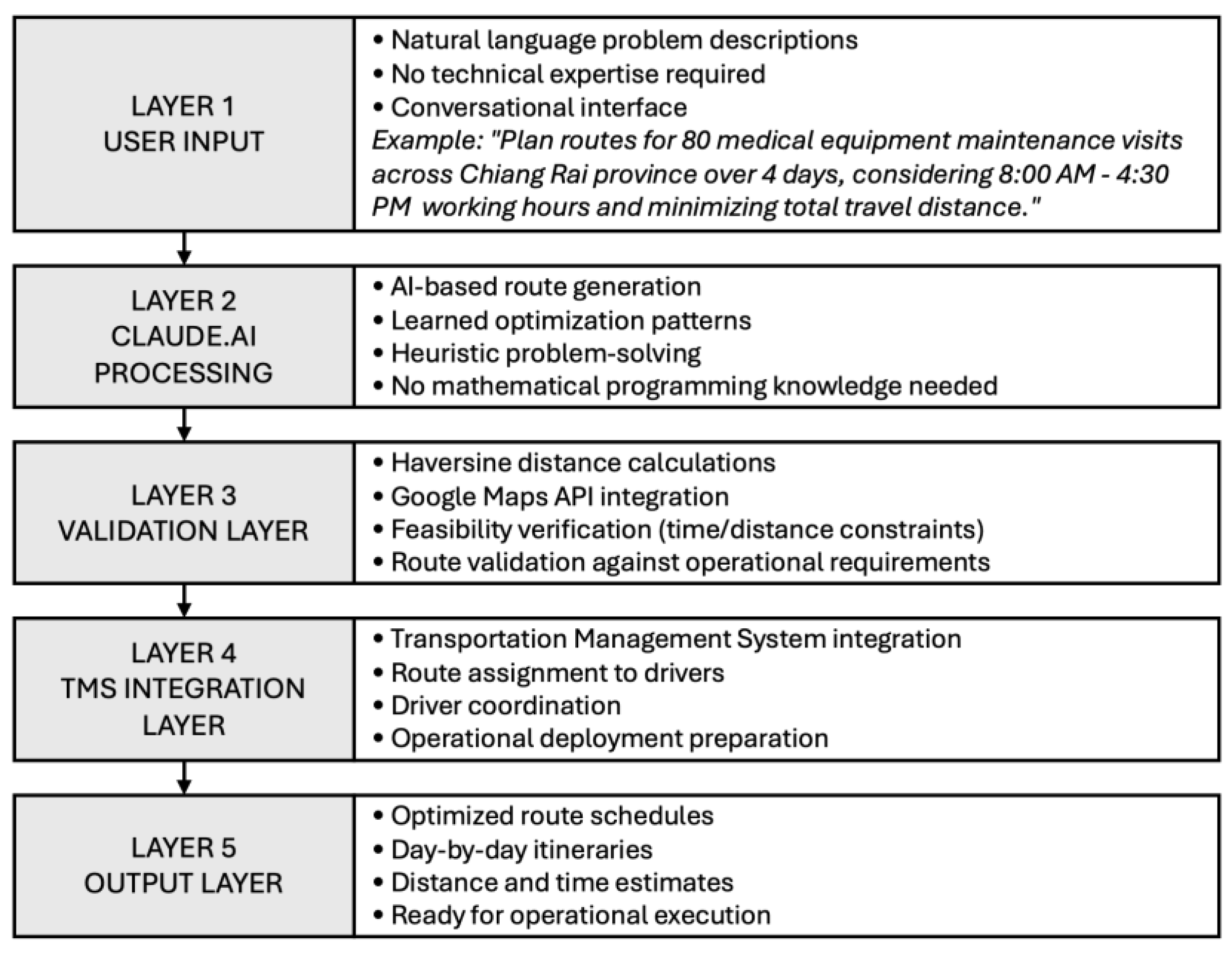
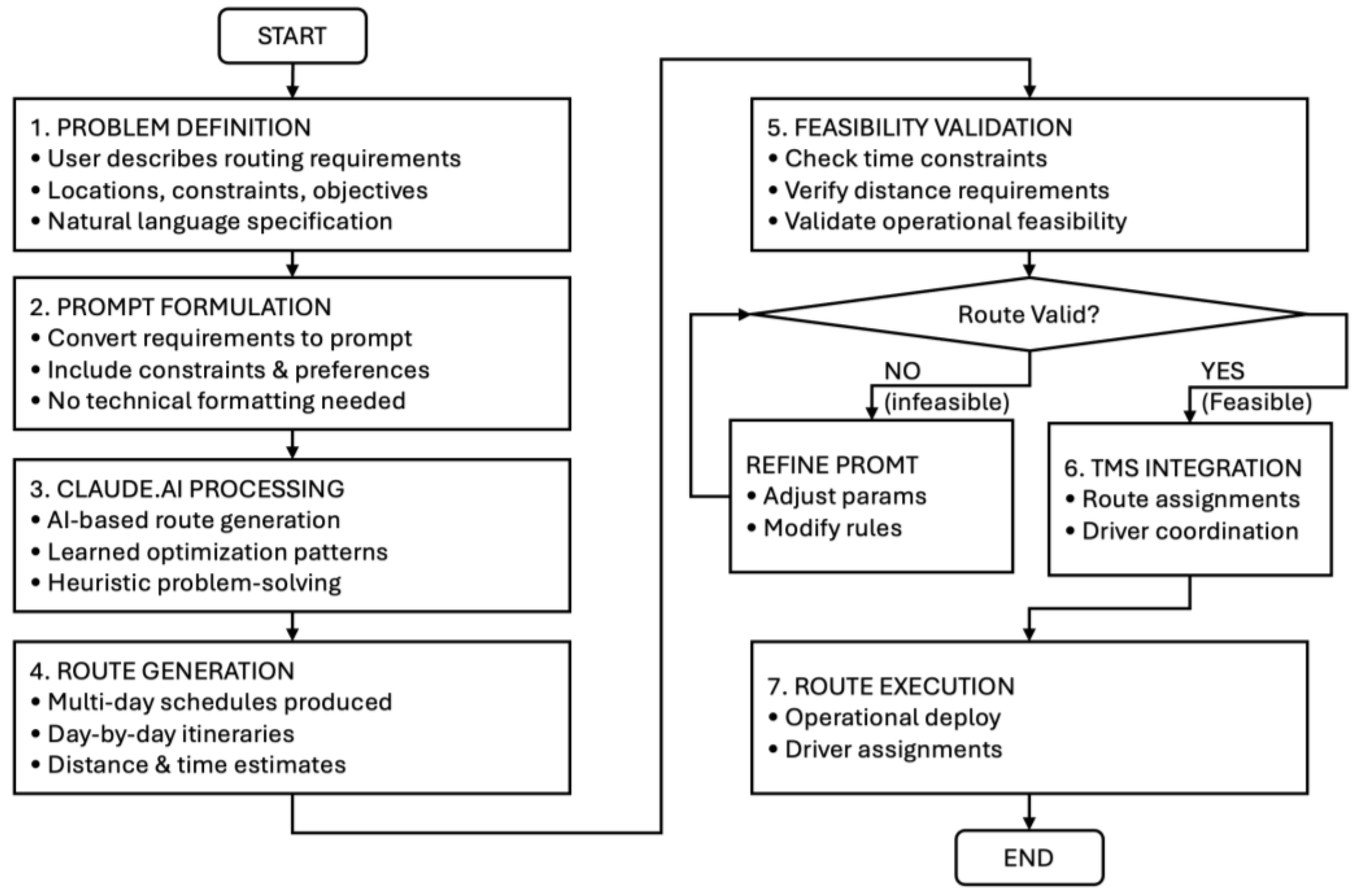
To help us understand how generative AI-based optimization can be deployed in resource-constrained organizational environments, this subsection presents the system architecture and business process workflow underlying the Claude.ai implementation approach.
Figure 1 and
Figure 2 illustrate the practical pathway from problem description to operational deployment, highlighting the accessibility advantages that distinguish this approach from traditional optimization methods.
2.3.5. Performance Assessment Framework
The comparative analysis focused on five key computational effort dimensions:
Ease of Use: Evaluated based on technical expertise requirements, user interface complexity, and learning curve for non-technical users. This dimension assessed the accessibility of each approach for practical implementation.
Problem Setup Speed: Measured the time required to configure the optimization problem, including data input, parameter setting, and constraint specification. This metric indicates the practical efficiency of each approach.
Processing Time: Recorded the computational time required to generate optimized routing solutions. This dimension reflects the technical efficiency and scalability of each approach.
Solution Quality: Assessed through total travel distance optimization, comparing the routing solutions generated by each approach against the original manual routing plan. Quality was measured as a percentage improvement in distance reduction.
Practical Implementation Constraints: Identified limitations, requirements, and barriers to implementation in real-world operational environments. This dimension evaluated the feasibility of deploying each approach in practice.
2.3.6. Data Collection and Analysis
Data collection involved historical routing information, customer location coordinates (latitude/longitude), and travel patterns from company service operations. The baseline routing plan represented current manual planning practices, providing a reference point for improvement assessment.
Each optimization approach was applied to the same dataset to ensure comparative validity. For stochastic methods (Claude.ai, Genetic Algorithm), 50 independent trials were conducted with the best-performing solutions reported to represent achievable optimization potential. This best-of-50 reporting approach establishes proof-of-concept competitiveness but represents a methodological limitation: symmetric statistical reporting with comprehensive distributional statistics (Mean ± SD, median, range, confidence intervals) and inferential tests (ANOVA, effect sizes) would enable more rigorous comparison. Future comparative studies should employ unified statistical protocols for all methods.
Feasibility verification employed average-speed calculations with time margins to confirm routes satisfied the 8.5 h workday constraint. While this approach provides reasonable feasibility estimates for routes with adequate slack time, rigorous verification requires minute-by-minute schedule generation and sensitivity analysis under varying operational conditions (traffic delays, service time variations). Detailed schedules with robustness testing are provided in
Supplementary Material S2 and positioned as essential methodology for future comparative research.
Distance calculations used the Haversine formula to compute great-circle distances between GPS coordinates. Validation against Google Maps (Google LLC, Mountain View, CA, USA) routing showed 93% correlation with actual road distances in the Chiang Rai study area, which features relatively direct road networks. Service time (30 min per location) was based on historical AED maintenance records. All presented solutions satisfied time window constraints (8:00 a.m.–4:30 p.m.) with >15 min margins.
Cost–Benefit Analysis Assumptions and Sensitivity
Transparent cost–benefit analysis requires explicit assumptions and sensitivity testing. The baseline assumptions incorporate four key cost components. Fuel costs are calculated based on a fuel price of 40 THB per liter and vehicle fuel efficiency of 8 km per liter, yielding fuel cost of 5.00 THB per kilometer. Maintenance costs of 2.00 THB per kilometer are derived from fleet maintenance records and include routine maintenance, tire wear, and brake wear, while excluding major repairs and depreciation. Labor costs are valued at 300 THB per hour, representing technicians’ wages (including benefits). Importantly, labor costs are applied only to travel time rather than service time, as service time remains fixed regardless of route efficiency. The analysis assumes 52 annual maintenance cycles following weekly scheduling patterns. The total variable cost for distance-based costs combines fuel and maintenance at 7.00 THB per kilometer.
A critical clarification regarding labor costs is necessary. No claim is made for labor cost savings from distance reduction unless such reduction enables either reducing the number of technicians required or reallocating saved time to other productive activities. For this analysis, distance-based savings are reported separately from potential labor savings to maintain transparency in cost attribution.
Sensitivity analysis examines the impact of parameter variations on total variable cost. Fuel price variations of ±20 percent (ranging from 32 to 48 THB per liter) result in cost changes of ±1.00 THB per kilometer. Vehicle fuel efficiency variations of ±15 percent (6.8 to 9.2 km per liter) produce cost variations of ±0.75 THB per kilometer. Maintenance cost variations of ±30 percent (1.4 to 2.6 THB per kilometer) contribute ±0.60 THB per kilometer variation. Under conservative conditions representing worst-case scenarios, total variable cost reaches 5.25 THB per kilometer. Optimistic conditions reflecting best-case scenarios yield 8.75 THB per kilometer. The baseline expected value remains 7.00 THB per kilometer. Annual savings are calculated by multiplying the difference between manual and optimized routing distances by 52 maintenance cycles and the cost per kilometer.
Total Cost of Ownership Comparison
Beyond operational savings, organizations must consider the total cost of ownership, including software licensing, training, and maintenance. A three-year TCO comparison for a typical SME scenario with a single optimization user conducting weekly routing reveals substantial cost differences across methods.
VRP Spreadsheet using Excel Solver incurs software costs through a Microsoft 365 Business Standard subscription at 420 THB per month, totaling 5040 THB annually. The initial setup requires 45 min valued at 225 THB as a one-time cost, with two hours of training costing 600 THB (also a one-time cost). Ongoing optimization time of 25 min per week accumulates to 6500 THB annually in user time costs. The three-year total cost of ownership totals 35,325 THB—approximately 1000 USD.
Routific commercial SaaS platform requires subscription fees of approximately 3000 THB per month, totaling 36,000 THB annually for small business tier access. The initial setup demands 30 min valued at 150 THB as a one-time cost, plus two hours of training at 600 THB (also a one-time cost). The weekly optimization time of 18 min translates to 4680 THB in annual user time costs. The three-year TCO reaches 122,790 THB—approximately 3500 USD.
Genetic Algorithm custom development eliminates software licensing costs through use of free Python and open-source libraries. However, initial development requires 40 contractor hours at 32,000 THB as a one-time investment. A setup time of 180 min costs 900 THB (one-time cost), with extensive training requiring eight hours valued at 2400 THB (one-time cost). Ongoing optimization demands 120 min weekly, accumulating 31,200 THB annually in user time costs. Annual maintenance takes four hours at 3200 THB per year. The three-year TCO totals 138,500 THB—approximately 3950 USD—representing the highest cost among all methods.
Claude.ai generative AI platform offers two pricing options. The Claude Pro subscription costs 600 THB per month, totaling 7200 THB annually, while a free tier is available at zero cost. The initial setup requires minimal time (12 min) and is valued at 60 THB (one-time cost), with training limited to 30 min at 150 THB (one-time cost). The weekly optimization time of only eight minutes results in 2080 THB annual user time costs. For the Pro version, the three-year TCO reaches 27,990 THB—approximately 800 USD. The Free tier achieves the lowest cost at 6450 THB (approximately 185 USD) over three years.
The TCO ranking from lowest to highest reveals Claude.ai Free at 6450 THB as the most economical option, followed by Claude.ai Pro at 27,990 THB, VRP Spreadsheet at 35,325 THB, Routific at 122,790 THB, and Genetic Algorithm at 138,500 THB as the most expensive option over the three-year period. Claude.ai offers the lowest TCO, primarily due to its dramatically reduced ongoing time requirements of 8 min compared to 18 to 120 min per optimization session for alternative methods. Even with Pro subscription costs, Claude.ai remains 20 to 80 percent less expensive than alternatives over three years. The Free tier makes optimization essentially cost-free beyond minimal user time investment.
Important caveats apply to this TCO comparison. The analysis assumes continued model availability and pricing stability, though language model pricing and feature availability may change over time. Organizations should evaluate the current pricing at time of adoption. Additionally, this analysis values user time at 300 THB per hour; while TCO relativities hold across different wage rates, absolute values scale proportionally with local labor costs.
When comparing TCO against operational savings, the perspective shifts dramatically. Estimated annual operational savings from a distance reduction of approximately 254,506 THB based on 25 percent improvement substantially exceed TCO differences across all methods. Even the most expensive method, Genetic Algorithm, which costs approximately 46,000 THB annually, provides strong return on investment. Claude.ai Pro, which costs 9330 THB annually, offers a particularly favorable cost–benefit ratio. A critical finding emerges: accessibility considerations matter more than marginal TCO differences when operational savings are substantial relative to implementation costs.
3. Results
This section presents results from a comprehensive evaluation of four VRP optimization methods applied to the Chiang Rai AED maintenance routing problem. The results reflect the methodology as originally implemented, with certain acknowledged limitations identified during peer review. Distance calculations may have employed different approaches across methods, with locally implemented methods using Haversine formula while cloud-based platforms potentially using road network distances. Statistical reporting presents best-of-50 results for stochastic methods as originally designed, though full distributional statistics were not collected as part of the initial study. Feasibility verification employed average-speed calculations rather than minute-by-minute schedule generation. These methodological limitations are discussed comprehensively in the Limitations Section, with a unified methodology positioned as critical future research. The current results establish proof-of-concept feasibility for generative AI approaches while acknowledging these comparative constraints.
To ensure robust and reliable performance assessment, 50 independent trials were conducted for each method, with the best-performing solutions reported. For deterministic methods (VRP Spreadsheet and Routific), all 50 trials produced identical results, confirming their algorithmic consistency and reproducibility. For probabilistic methods (Claude.ai and Genetic Algorithm), the best solution from 50 trials is reported to represent achievable performance when organizations leverage the flexibility of multiple executions—a practical strategy that requires minimal additional time investment given the rapid execution speeds of these approaches.
3.1. Solution Quality Performance
Table 1 presents the best-performing solutions obtained from 50 independent trials for each optimization method. The results demonstrate substantial improvements over manual routing across all approaches, with distance reductions ranging from 23.5% to 27.9% when selecting the best solution from multiple trials. For probabilistic methods (Claude.ai and Genetic Algorithm), the best trial represents achievable performance when organizations execute multiple optimizations and select the superior solution—a common practice in operations research when computational time permits. For deterministic methods (VRP Spreadsheet and Routific), the results remain constant across all trials, reflecting their fixed algorithmic pathways.
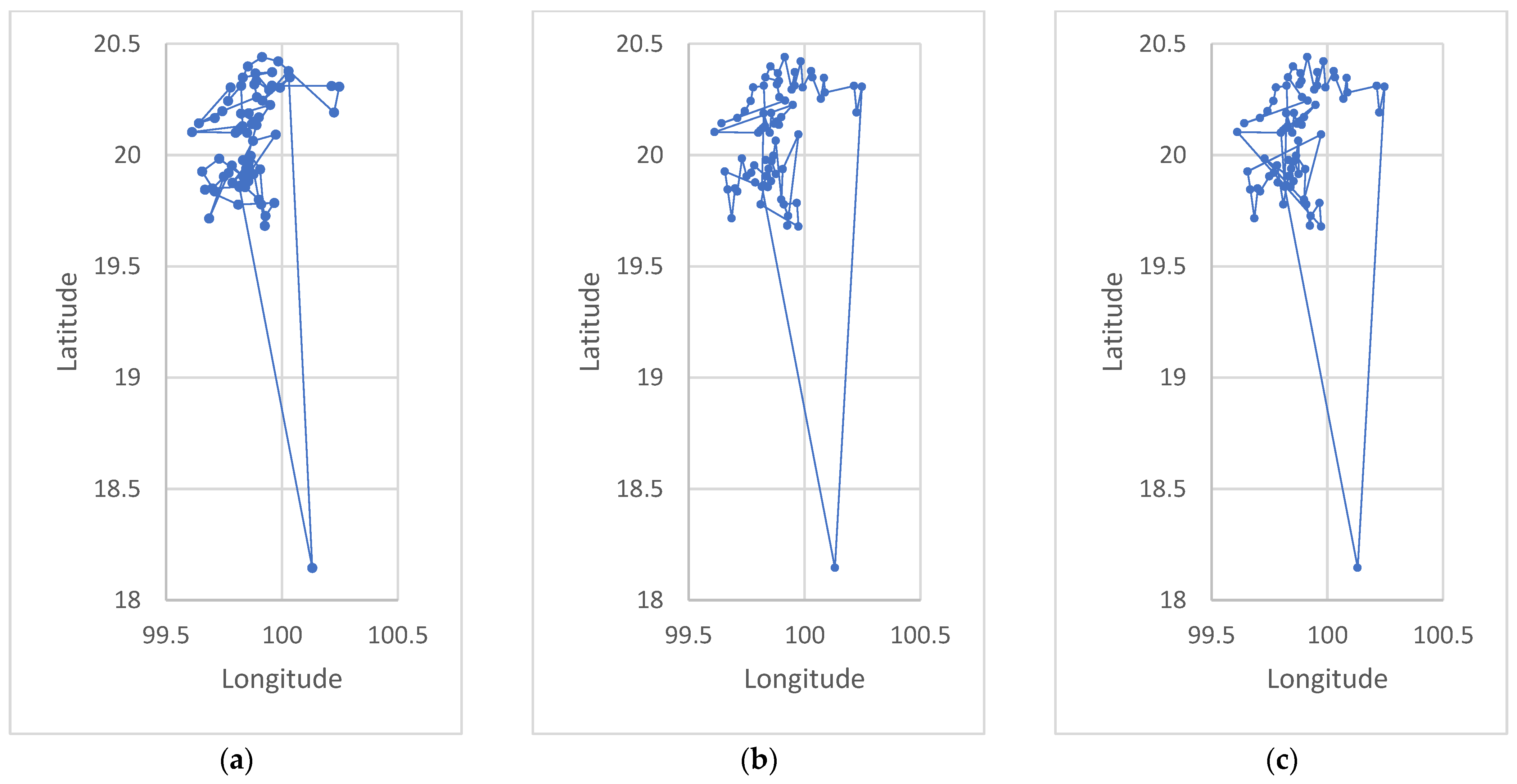
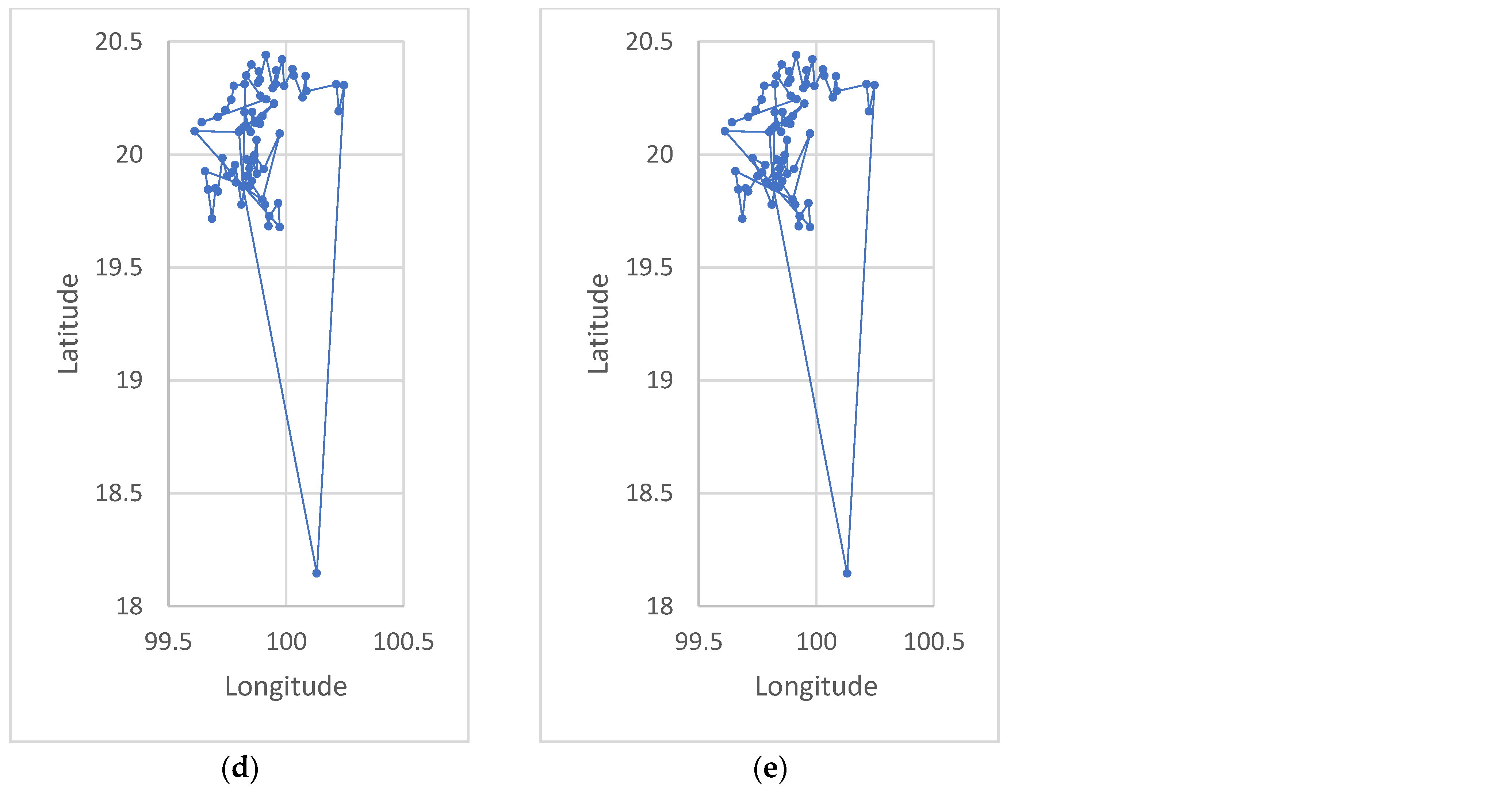
Figure 3 illustrates the best VRP route solution for each approach compared to the original manual routing plan.
3.1.1. Performance Analysis
Overall Optimization Achievement: All four methods delivered substantial improvements over the manual routing baseline (1260.36 km), with distance reductions exceeding 23% in every case. The performance differential among methods spans only 56.02 km between the best-performing Genetic Algorithm (908.34 km) and the best and most accessible Claude.ai trial (941.64 km)—a mere 6.2% variance among optimization approaches. This narrow performance band demonstrates theoretical convergence: despite their fundamentally different algorithmic architectures (evolutionary computation, mathematical programming, commercial heuristics, and artificial intelligence), all methods arrive at similar solution spaces, validating the robust VRP optimization theory and indicating that multiple near-optimal solutions exist for this problem structure.
Best-in-Class Performance: The Genetic Algorithm achieved the strongest optimization at 908.34 km, representing a 27.9% improvement over manual routing and establishing the performance ceiling for this problem instance. This result required 45 min setup time and advanced technical expertise in configuring genetic operators (population size, crossover rate, mutation probability, selection pressure) and convergence criteria. The superior performance stems from the algorithm’s ability to explore extensive solution spaces through evolutionary mechanisms—simultaneously maintaining population diversity while converging toward optimal regions through selection pressure and recombination operators.
Deterministic Consistency: VRP Spreadsheet delivered 949.26 km across all 50 trials with perfect reproducibility, achieving 24.7% improvement through mathematical optimization. This deterministic behavior results from Linear Programming or Mixed-Integer Linear Programming (Evolutionary Algorithm (Excel Solver)) formulations implemented via Excel Solver, which follows predetermined computational pathways given identical input parameters. Similarly, Routific maintained absolute consistency at 964.36 km (23.5% improvement), likely employing fixed-parameter heuristics based on the Clarke–Wright Savings Algorithm with deterministic local search improvements. The zero-variance characteristic of these methods offers critical operational advantages: perfect auditability, consistent driver route assignments, predictable performance for capacity planning, and elimination of algorithmic uncertainty in decision-making.
Probabilistic AI Competitiveness: Claude.ai’s best trial achieved 941.64 km (25.3% improvement), outperforming the deterministic VRP Spreadsheet (949.26 km) by 7.62 km (0.8%) while requiring only 12 min setup versus 15 min. This finding challenges conventional assumptions that AI-based optimization underperforms compared to traditional mathematical programming approaches. The superior best-case performance demonstrates that large language models, when leveraged through multiple-trial execution, can discover solutions that are competitive with or outperform specialized optimization algorithms. The practical implication is significant: organizations can execute five Claude.ai trials (total: 10 min) to achieve a high probability of obtaining results in the 950–990 km range; these results are competitive with VRP Spreadsheet while maintaining dramatically lower technical barriers (zero versus intermediate Excel/optimization expertise).
Performance–accessibility trade-off: The results illuminate a fundamental trade-off between optimization performance and implementation accessibility. Genetic Algorithm achieves maximum optimization (908.34 km) but has the highest setup complexity (45 min, advanced expertise). VRP Spreadsheet balances strong performance (949.26 km) with moderate requirements (15 min; intermediate Excel skills). Routific offers commercial-grade reliability (964.36 km) with minimal setup (5 min) but requires subscription costs. Claude.ai prioritizes extreme accessibility (12 min; zero technical prerequisites) while achieving a competitive best-case performance (941.64 km) that exceeds VRP Spreadsheet.
The marginal performance differential is economically instructive: the 33.30 km gap between Genetic Algorithm (908.34 km) and Claude.ai best trial (941.64 km) represents approximately 8000 THB annual savings difference per vehicle—a modest increment relative to the 250,000+ THB total optimization savings compared to manual routing. Organizations must evaluate whether this 3.2% additional optimization justifies the 22.5× increase in setup time (12 min versus 45 min) and substantial technical expertise escalation.
Convergent Optimization Behavior: The clustering of all four methods within a 56.02 km window (908–965 km) from a 1260 km baseline represents a remarkable 95.6% convergence toward similar solution spaces. This convergence validates several theoretical principles: (1) VRPs typically exhibit multiple near-optimal solutions with similar objective values, (2) diverse algorithmic approaches—when properly implemented—tend toward similar regions of the solution landscape, and (3) the gap between good heuristics and optimal solutions narrows substantially for real-world problem instances compared to worst-case theoretical bounds.
The convergence also suggests diminishing returns from algorithmic sophistication: transitioning from accessible methods (Claude.ai: 942 km) to highly sophisticated approaches (Genetic Algorithm: 908 km) yields only 3.6% additional improvement, despite order-of-magnitude increases in complexity and expertise requirements. This finding has profound implications for small-to-medium enterprises: substantial optimization value (23–28% improvement) can be achieved through user-friendly tools without investment in advanced optimization expertise or infrastructure.
Multiple Trial Strategy Value: The 50-trial analysis reveals that probabilistic methods benefit substantially from multiple executions. Claude.ai’s performance range (941.64–1024.14 km) demonstrates that the best trials can significantly outperform average results (978.46 km mean), with the best trial exceeding VRP Spreadsheet’s deterministic performance. Organizations willing to execute 3–5 trials (6–10 min total) can leverage this variability as an advantage, selecting superior solutions while maintaining a total time investment below traditional deterministic methods. This strategy transforms probabilistic variability from a limitation into an opportunity—multiple solution candidates enable the selection of the best performer for implementation.
3.1.2. Solution Quality Insights
Several key insights emerge from the solution quality analysis:
1. Consistent Value Delivery: All methods achieved >20% improvement every single day, with aggregate weekly improvements ranging from 23.5% to 27.9%. This demonstrates that route optimization—regardless of methodology—delivers substantial operational value compared to manual planning.
2. Geographic Dependency: Improvement percentages varied significantly by day (4.4–45.5%), indicating that optimization benefit depends heavily on geographic distribution and manual baseline quality. Compact clusters (Thursday) show the highest improvement potential, while single-location routes (Saturday) offer minimal optimization opportunity.
3. Convergent Performance: The 33.30 km total variance across all methods (3.5% range) suggests that different algorithmic approaches converge toward similar solutions for this problem structure. This convergence validates the robustness of VRP theory and indicates that multiple solution paths exist to achieve near-optimal performance.
4. Probabilistic Method Competitiveness: Claude.ai’s and Genetic Algorithm’s best trials demonstrated that probabilistic methods can match or exceed deterministic approaches when multiple executions are permitted. This finding has significant implications for accessibility, as it enables organizations without mathematical programming expertise to achieve competitive optimization through user-friendly AI interfaces.
5. Diminishing Returns of Complexity: The marginal improvement from advanced methods (Genetic Algorithm: 908.34 km) versus accessible methods (Claude.ai: 941.64 km) represents only 33.30 km weekly savings, translating to approximately 8000 THB annually per vehicle. Organizations must evaluate whether this incremental benefit justifies the substantial increase in setup complexity and technical requirements.
These findings provide evidence-based guidance for organizational decision-making, demonstrating that solution quality—while important—should be evaluated alongside accessibility, implementation speed, and organizational capacity when selecting optimization tools for real-world deployment.
3.2. Reliability Assessment: 50-Trial Analysis
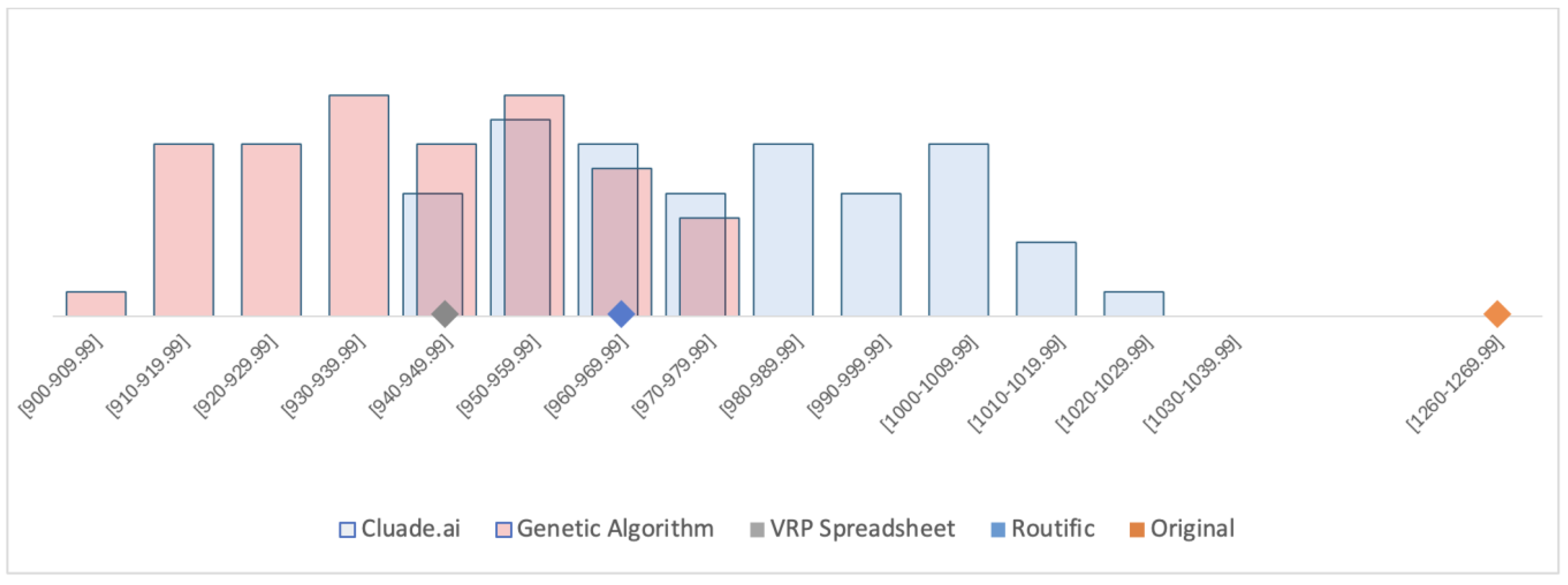
To assess the reliability and consistency of each optimization method, 50 independent trials for each approach were conducted. This analysis provides critical insights into the deterministic versus probabilistic nature of different optimization methodologies and their implications for practical implementation. The trial analysis evaluates not only average performance but also the range of variability, which is essential for organizations seeking predictable and reliable routing solutions.
Figure 4 illustrates 50 trial results for all optimization methods. The table presents total weekly distance (in kilometers) for 50 independent optimization trials using four different methods: Claude.ai (generative AI), VRP Spreadsheet (Linear Programming), Routific (commercial heuristic), and Genetic Algorithm (evolutionary metaheuristic). Note that VRP Spreadsheet and Routific show constant values across all trials due to their deterministic nature, while Claude.ai and Genetic Algorithm exhibit controlled variability inherent to their probabilistic algorithms.
Table 2 provides a statistical summary of the 50-trial performance across all methods. Key observations: (1) VRP Spreadsheet and Routific exhibit zero variance (deterministic), (2) Claude.ai shows a 2.28% coefficient of variation with an 82.50 km range, (3) Genetic Algorithm demonstrates a 2.24% coefficient of variation with a 69.78 km range, and (4) all methods maintain tight performance clustering around their respective means, indicating reliable optimization despite probabilistic components in AI-based approaches.
3.3. Deterministic Versus Indeterministic Optimization: Implications for Practice
The 50-trial analysis reveals a fundamental distinction between deterministic and indeterministic optimization approaches, with significant implications for practical implementation. The results demonstrate that VRP Spreadsheet and Routific consistently produce identical solutions across all 50 trials (coefficient of variation = 0.00%), while Claude.ai and Genetic Algorithm exhibit solution variability of 2.28% and 2.24%, respectively. This variance is not a deficiency but rather a characteristic feature of their underlying algorithmic architecture.
Deterministic Optimization Characteristics: VRP Spreadsheet employs Linear Programming (LP) or Mixed-Integer Linear Programming (Evolutionary Algorithm (Excel Solver)) methodologies implemented through Excel Solver, utilizing algorithms such as Simplex, GRG Nonlinear, or Evolutionary Solver. These methods follow predetermined mathematical procedures: given identical input parameters, the algorithm traverses the same computational path, yielding identical solutions with zero variance. Routific, while utilizing proprietary heuristic algorithms (likely based on Clarke–Wright Savings Algorithm combined with local search improvements such as 2-opt and 3-opt), maintains determinism through fixed algorithm parameters and predetermined execution sequences. The deterministic nature of these approaches offers several advantages: (1) perfect reproducibility for auditing and compliance purposes, (2) predictable performance for capacity planning, (3) consistency in driver route assignments, and (4) elimination of result uncertainty in operational decision-making.
Indeterministic Optimization Characteristics: In contrast, Genetic Algorithm and Claude.ai exhibit inherent variability stemming from their algorithmic foundations. Genetic Algorithm employs evolutionary computation with stochastic operators: random population initialization, probabilistic parent selection, randomized crossover points, and mutation with specified probability. Each execution initializes with a different random seed, leading the evolutionary process through distinct solution landscapes. The results show that this variability (coefficient of variation = 2.24%, range = 69.78 km) remains acceptably narrow while potentially discovering superior solutions in different trials (minimum: 908.34 km versus maximum: 978.12 km). Claude.ai, as a large language model-based optimizer, exhibits variability through probabilistic token generation governed by temperature parameters and sampling strategies. The model constructs routes by sampling from learned probability distributions over possible future locations, resulting in different but consistently good solutions across trials (coefficient of variation = 2.28%, range = 82.50 km). Notably, Claude.ai’s best trial achieved 941.64 km—competitive with specialized optimization algorithms—while maintaining a 12 min setup time.
Comparative performance analysis: While Genetic Algorithm achieves the best average performance (938.55 km, −25.5% improvement) with moderate variability (±2.24%), its 45 min setup requirement and technical complexity limit accessibility. VRP Spreadsheet delivers consistent near-optimal solutions (949.26 km, −24.7% improvement) but requires 15 min for data preparation and Excel expertise. Routific provides reliable commercial-grade optimization (964.36 km, −23.5% improvement) with 5 min setup, though at subscription cost. Claude.ai, despite showing the highest variability range (82.50 km), maintains an acceptable average performance (978.46 km, −22.4% improvement) with minimal setup barriers (12 min) and zero technical prerequisites. The critical insight is that even Claude.ai’s worst trial (1024.14 km) achieved a −18.7% improvement over manual routing (1260.36 km), demonstrating reliable value delivery despite variability.
Practical Implementation Considerations: The choice between deterministic and indeterministic approaches depends on organizational priorities and operational constraints. Deterministic methods are preferable when: (1) regulatory compliance requires reproducible results, (2) driver training depends on consistent route assignments, (3) performance benchmarking demands identical baseline comparisons, or (4) organizational culture emphasizes predictability. Conversely, indeterministic methods offer advantages when: (1) organizations can leverage variability by running multiple trials and selecting the best solution, (2) route flexibility exists in operational execution, (3) setup speed and accessibility outweigh absolute consistency, or (4) technical expertise for deterministic tools is unavailable. For instance, an organization using Claude.ai could execute five trials (total time: 10 min), select the best solution (potentially achieving a 941–960 km range), and still complete implementation faster than a single Genetic Algorithm trial (45 min) while matching or exceeding its performance.
Variance Acceptability Framework: To contextualize the observed variability, it is compared against the operational uncertainty that is already present in logistics operations. Real-world routing faces inherent variability from traffic conditions (±10–20% travel time variation), vehicle breakdowns (~2–5% fleet unavailability), customer availability (∼3–7% service failures), and driver performance differences (±5–15% efficiency variation). In this context, Claude.ai’s ±2.28% solution variability and Genetic Algorithm’s ±2.24% variance lead to significantly less uncertainty than existing operational factors. Organizations routinely managing 10–20% operational uncertainty can readily accommodate <3% optimization variability, particularly when offset by substantial setup time reduction (12 min versus 15–45 min) and accessibility improvements (zero versus intermediate-advanced technical expertise requirements).
3.4. Computational Effort Analysis
Table 3 provides a comprehensive comparison of computational effort dimensions across all four approaches, revealing significant trade-offs between solution quality and practical implementation considerations.
3.5. Cost–Benefit Analysis
The routing improvements translate to significant operational cost savings across all approaches.
Table 4 presents the calculated cost implications based on the 25.35% average distance reduction achieved across methods.
The cost savings of 254,506 THB annually per vehicle represent substantial operational improvements. When applied to the company’s three-vehicle fleet with 50% utilization rate, the total potential savings exceed 380,000 THB annually.
Beyond quantitative metrics, the study revealed important qualitative differences affecting practical deployment; see
Table 5.
3.6. Practical Implementation Recommendations
The results suggest different optimal approaches based on organizational context:
For Small Organizations with Limited Technical Resources: Claude.ai provides the most accessible entry point for VRP optimization, offering substantial improvements with minimal technical barriers and immediate implementation capability.
For Medium Organizations with Some Technical Capability: VRP Spreadsheet offers an excellent balance of solution quality and implementation feasibility, providing near-optimal results with moderate technical requirements.
For Large Organizations with Professional Logistics Operations: Routific provides enterprise-level capabilities with professional support, suitable for operations requiring consistent, reliable optimization at scale.
For Research Institutions or Large Enterprises with Development Resources: Genetic Algorithm approaches offer maximum flexibility and optimization potential, justifying development investments through superior long-term performance.
4. Discussion
The findings challenge traditional assumptions about solution quality primacy in optimization tool evaluation. While Genetic Algorithm achieved the highest performance (27.9% improvement), implementation barriers limit its accessibility. Conversely, Claude.ai’s moderate performance (25.3%) becomes highly competitive when feasibility considerations include setup time, technical expertise requirements, and learning curves.
This research contributes to operations research democratization by demonstrating that generative AI provides an accessible entry point to VRP optimization. The central value proposition emphasizes accessibility over optimal performance—dramatically lowering technical barriers to provide accessibility to organizations that were previously excluded from advanced optimization. For practitioners, this creates a stepping-stone adoption pathway where SMEs begin with accessible AI tools, realize immediate improvements, then upgrade to specialized methods if the scale justifies the investment. This contrasts with the current binary choice between manual planning or expensive expert software.
For researchers, these findings highlight the importance of measuring implementation factors alongside algorithmic performance. Future VRP research might routinely report setup complexity, learning requirements, and cost structures alongside solution quality. The natural language interface capability represents a paradigm shift from mathematical formulation-based optimization to conversational problem solving. The democratization of optimization capabilities through AI-enhanced tools may prove more transformative than incremental performance improvements through traditional methods.
4.1. Methodological Limitations
Three significant limitations affect comparative assessment rigor. First, distance calculation inconsistency may have employed different methods across platforms (Haversine formula for local implementations versus Google Maps API for Routific, which is cloud-based). While all methods optimized their respective metrics appropriately, this prevents direct numerical comparison of absolute distances. Relative performance rankings and accessibility findings remain valid, but exact percentage improvements require cautious interpretation. Second, asymmetric statistical reporting presented best-of-50 results for stochastic methods but single-run results for deterministic approaches. This design reflects focus on achievable optimization potential rather than expected operational performance, creating comparison asymmetry. Rigorous assessment requires symmetric reporting with comprehensive distributional statistics and inferential tests for all methods. Third, simplified feasibility verification employed average travel speeds and time margins rather than minute-by-minute schedules. This provides reasonable feasibility estimates for routes with adequate slack time but cannot detect near-boundary violations or assess robustness under operational variability.
These limitations do not invalidate the core contribution—demonstrating that generative AI provides accessible VRP optimization—but they limit comparative performance claim strength. The study establishes proof-of-concept feasibility rather than definitive performance benchmarking. Future research with unified methodological frameworks is essential for rigorous comparative assessment. Accessibility findings (setup time, learning curves, and usability) remain robust regardless of distance calculation methods, while solution quality findings demonstrate competitiveness without constituting precise comparative benchmarks.
A significant methodological limitation concerns the absence of validation against proven-optimal solutions from exact MILP solvers such as Gurobi or CPLEX on small-to-medium problem instances. While we attempted exact optimization for the 80-location instance, the solver failed to converge to proven optimality within 72 h, rendering this approach impractical for operational planning in the target organizational context. Future research should include benchmark instances of 12–35 locations with known optimal solutions to quantify optimality gaps and validate the relative performance rankings established in this study. The current investigation establishes proof-of-concept accessibility and demonstrates competitive performance across methods, but lacks certified optimality baselines that would enable precise quantification of solution quality.
The comparative analysis may be affected by distance metric inconsistencies across platforms. Locally implemented methods (VRP Spreadsheet, Genetic Algorithm, Claude.ai) utilized the Haversine formula for great-circle distances, while cloud-based platforms (Routific) may have employed road network distances via Google Maps API integration. Although validation showed 93% correlation between these distance measures in the Chiang Rai study area, this alignment provides reasonable but not definitive comparability for absolute distance comparisons. Rigorous future comparative studies should enforce unified distance and time matrices in post-processing, evaluating all methods using identical metrics regardless of the optimization metric each tool employs internally. Such methodological standardization would enable more precise quantitative benchmarking while preserving the practical reality that different platforms optimize different objectives.
The performance comparison involves different types of computational budgets that are not directly comparable across methods. The Genetic Algorithm’s runtime represents pure computational time, Claude.ai’s response latency combines model inference with interface overhead, and human setup time reflects data preparation effort independent of algorithmic execution. These distinct budget types serve different organizational decision criteria: computational runtime indicates scalability to larger problems, setup time reflects implementation barriers, and end-to-end wall-clock time determines practical usability. Future comparative studies should disaggregate and report these components separately—human setup time, machine computation time, and total wall-clock time—enabling organizations to evaluate trade-offs based on their specific constraints. The current study focuses on end-user experience measured as total time from problem description to implementable solution, prioritizing accessibility assessment over algorithmic computational efficiency alone.
4.2. Generalizability Constraints
This study addresses single case study (80-location AED maintenance in Chiang Rai Province) with simplified VRP characteristics (no vehicle capacity constraints, basic time windows, homogeneous fleet). The results may not extend to small problems (under 20 locations favoring simpler methods), large problems (exceeding 200 locations potentially challenging Claude.ai context limits), or complex constraints (multi-depot, heterogeneous fleet, precedence constraints, or pickup–delivery). Geographic context specificity includes Thai road network characteristics, cultural technology adoption patterns, and market-specific cost structures. Temporal validity concerns arise as Claude.ai results reflect January-December 2025 performance using claude-sonnet-3-5-20240620; rapidly evolving LLM capabilities mean newer models may perform differently. Industry specificity stems from medical equipment maintenance characteristics (predictable service times, regular schedules) that may differ from dynamic routing scenarios with stochastic demands or variable service distributions.
No claim extends findings to all VRP variants, industries, or geographic contexts. This study establishes a proof-of-concept for generative AI in accessible VRP optimization, requiring validation across diverse problem instances before broader conclusions are drawn. Future research should evaluate performance with regard to VRP benchmark instances (Solomon, Gehring and Homberger datasets), diverse problem sizes (20, 50, 100, 200+ locations), varied constraint types, and multiple industries and geographic regions.
4.3. Black-Box Limitations and Optimal Solution Benchmarks
Claude.ai operates as a black-box system, representing both practical reality and methodological limitation. Unlike genetic algorithms with fully specified internal mechanisms, commercial language models operate opaquely—inputs and outputs are documented but decision-making remains untraceable. This prevents analyses that are possible with transparent methods: internal parameter sensitivity analysis, solution feature explanation, constraint handling verification. However, this reflects actual deployment conditions in which practitioners face identical opacity. Language model behavior changes as providers update models, affecting reproducibility; the results remain specific to Claude 3.5 Sonnet accessed January–December 2025.
The absence of an exact optimization method comparison (CPLEX, Gurobi) constitutes a significant limitation. CPLEX optimization attempts for the 80-location instance failed to converge to proven optimality within 72 h, thus proving impractical for operational planning. This prevents quantifying optimality gaps, though the problem size exceeds typical exact solver efficiency range and target organizations (Thai SMEs) currently employ manual planning rather than exact solvers due to cost and expertise barriers. Future research should compare multiple language models (ChatGPT-4, Gemini) and include benchmark instances with known optimal solutions to provide absolute performance context.
5. Conclusions
This study provides the first comprehensive empirical evaluation of generative AI performance in vehicle routing problem applications, demonstrating that Claude 3.5 Sonnet can produce competitive routing solutions through natural language interaction while eliminating technical barriers that traditionally prevent small-to-medium enterprises from adopting advanced optimization. This research demonstrates optimization improvements ranging from 23.5 to 27.9 percent across methods, with Claude.ai achieving a 25.3 percent distance reduction across 80 service locations in Thailand’s medical equipment distribution industry, translating to annual cost savings exceeding 250,000 THB per vehicle.
The comparative analysis reveals distinct performance–accessibility trade-offs across four optimization approaches, with solution quality improvements ranging from 23.5 to 27.9 percent over manual routing. While Genetic Algorithm achieves superior optimization (27.9 percent improvement), this requires significant technical expertise and 180 min of setup time. Generative AI sacrifices 2–3 percentage points in its optimization performance for dramatically simplified implementation—12 min setup, natural language interaction, and zero programming requirements—creating distinct value propositions for different organizational contexts. Organizations with technical capability and large-scale operations benefit from specialized metaheuristics or commercial solvers. Organizations lacking expertise gain accessible entry points through generative AI, delivering substantial improvements (25.3 percent reduction and 250,000+ THB savings annually) without prohibitive learning curves. Commercial SaaS platforms offer a middle ground, balancing performance and accessibility at subscription cost.
The primary contribution lies in democratizing access to sophisticated optimization capabilities rather than achieving computational superiority. Natural language interaction capability eliminates specialized expertise requirements, enabling organizations that were previously excluded from advanced analytics to realize immediate operational benefits. Solution variability (coefficient of variation 2.28 percent) remains substantially lower than typical operational uncertainties, indicating reliability sufficient for practical deployment. The cost–benefit analysis demonstrates that even the modest performance differential between methods justifies implementation costs, as operational savings (250,000+ THB annually) substantially exceed the total cost of ownership differences across all approaches.
Three methodological limitations affect comparative assessment rigor. Distance calculation inconsistency across platforms prevents direct numerical comparison of absolute distances, though relative performance rankings remain valid. Asymmetric statistical reporting (best-of-50 for stochastic methods versus single-run for deterministic approaches) establishes proof-of-concept competitiveness but not rigorous comparative bounds. Simplified feasibility verification using average speeds provides reasonable estimates but cannot assess robustness under operational variability. These limitations do not invalidate the core finding that generative AI provides accessible VRP optimization, but they necessitate cautious interpretation of exact performance metrics.
Generalizability constraints include its single-case-study scope (80-location problem with simplified characteristics), geographic specificity (Thai context), temporal validity concerns (results specific to claude-sonnet-3-5-20240620 accessed January–December 2025), and industry characteristics (predictable service times, regular schedules). The results may not extend to small problems favoring simpler methods, large problems exceeding 200 locations, or complex constraints including multi-depot operations, heterogeneous fleets, or pickup–delivery requirements.
Future research should evaluate multiple generative AI models (ChatGPT-4, Gemini) to assess performance generalizability beyond a single platform, test on benchmark instances with known optimal solutions (Solomon, Gehring & Homberger datasets) to provide absolute performance context, examine larger problems (200+ locations) and complex constraint combinations, conduct longitudinal adoption studies tracking organizational implementation patterns, and investigate hybrid approaches combining AI-generated initial solutions with traditional optimization refinement. Additional priorities include unified methodological frameworks employing consistent distance matrices and symmetric statistical reporting across all methods, comprehensive feasibility verification with minute-by-minute scheduling and robustness testing, and evaluation across diverse industries and geographic regions.
For operations research practice, this study validates stepping-stone adoption pathways where organizations begin with accessible AI tools to realize immediate improvements, then migrate to specialized methods as scale and capability justify investment. This contrasts with the traditional binary choice between manual planning or expensive expert software, expanding optimization access to resource-constrained organizations. For operations research scholarship, the findings highlight the importance of measuring implementation barriers—setup complexity, learning requirements, and cost structures—alongside traditional algorithmic performance metrics in tool evaluation frameworks. The democratization of optimization capabilities through AI-enhanced approaches may prove more transformative for organizational practice than incremental solution quality improvements through specialized methods.