1. Introduction
Global food supply chains face intense sustainability-driven pressures demanding environmental protection, social responsibility, and transparent operations. Stakeholders, including governments, international buyers, and consumers, now require auditable proof of compliance rather than mere promises of responsible sourcing. Consequently, sustainability has transitioned from a voluntary public relations exercise into a strategic prerequisite for market access and long-term competitiveness, especially in export-heavy sectors [
1,
2]. Firms are increasingly evaluated on their observable, accountable conduct, necessitating operational mechanisms that translate abstract commitments into verifiable outcomes.
To secure legitimacy and market access, firms rapidly adopt practices like resource efficiency, waste minimization, and sustainable sourcing [
3]. Yet, although a robust body of literature links these sustainability practices to enhanced operational efficiency, cost reductions, and overall business performance [
2,
4,
5], the empirical consensus remains inconsistent. Studies across diverse institutional settings frequently report weak, indirect, or non-significant effects, suggesting that the mere adoption of sustainability practices does not necessarily guarantee performance improvements [
2,
5].
This inconsistency arises because sustainability initiatives frequently remain fragmented, internally oriented, and disconnected from core operational routines [
2,
3]. As these practices span complex, multi-stage supply chains, they increase coordination and monitoring demands. Lacking effective integration mechanisms, these initiatives inflate operational costs and managerial burdens without yielding measurable performance gains [
5,
6]. Because organizations routinely fail to systematically document and verify activities across the sourcing, processing, and distribution stages, their sustainability efforts devolve into symbolic, compliance-driven exercises rather than strategic drivers of performance [
7]. This critical visibility gap underscores the urgent need for operational mechanisms that convert stated intentions into auditable, performance-enhancing outcomes.
These observations highlight the need to identify operational mechanisms that explain not only whether sustainability practices influence performance, but how this influence materializes in practice. In sustainability-driven markets, where buyers and regulators increasingly require auditable evidence rather than stated intentions, the absence of such mechanisms can limit firms’ ability to convert sustainability commitments into credible and performance-relevant outcomes.
From a logistics perspective, these challenges reflect limitations in supply chain visibility, coordination, and information integration across multiple operational stages. In food supply chains, sustainability practices often span sourcing, processing, storage, and distribution activities, requiring consistent monitoring and synchronized information flows. Without effective mechanisms to capture and integrate process-level data, firms may face difficulties in coordinating sustainability-related activities across logistics nodes, thereby constraining their ability to achieve reliable operational and performance outcomes.
Traceability implementation emerges as an important operational mechanism in this context. While traceability enables firms to systematically capture and integrate data regarding product origin [
8,
9], and significantly bolsters food safety and recall efficiency [
10,
11], the existing literature has largely conceptualized traceability as a technological or compliance-oriented system rather than treating it as a routinized organizational capability. By institutionalizing data capture and verification, traceability transforms internally oriented sustainability commitments into visible, auditable routines. Despite its clear potential to mediate the relationship between sustainability practices and business performance, empirical validation of this mechanism remains scarce, particularly within the fragmented information flows of export-oriented food supply chains in emerging economy contexts [
12].
Thailand provides a highly relevant empirical context for examining this tension. As a leading global food exporter, Thailand’s food-processing industry contributes substantially to national export earnings and plays a central role in global agri-food supply chains [
13]. Because major categories like rice, poultry, seafood, and processed foods are heavily export-oriented, Thai food processors operate under intense pressure to meet stringent certification frameworks mandated by major markets such as the United States and the European Union. In these markets, sustainability and transparency expectations increasingly extend beyond traditional product quality and safety concerns [
14]. This creates a significant operational challenge: although many Thai firms have adopted sustainability practices simply to maintain market access, their ability to translate these efforts into consistent business performance improvements remains highly uneven. In practice, these firms frequently implement traceability systems as compliance-oriented systems rather than embedding them as integrated operational mechanisms that actually support sustainability execution and information transparency.
However, prior studies have largely examined traceability as a technological or compliance-oriented system, with limited attention to its role as a routinized operational mechanism that links sustainability practices to business performance. This gap is particularly critical in export-oriented food supply chain contexts, where the ability to transform sustainability initiatives into verifiable and performance-relevant outcomes remains underexplored. This gap limits the theoretical understanding of how sustainability practices are translated into performance outcomes through operational mechanisms.
To address these missing links, this study investigates how Thai food processors translate sustainability practices into tangible business performance, specifically examining traceability implementation as the operational mechanism that bridges this gap. Moving beyond traditional direct-effect analyses, a mediation-based structural modeling approach is employed to simultaneously evaluate both the direct impact of sustainability initiatives and the mediating role of traceability implementation. By empirically unpacking this mechanism, this study contributes to the sustainable supply chain literature by demonstrating how traceability implementation functions as a mediating operational mechanism that enables export-oriented food-processing firms to convert sustainability practices into measurable business performance outcomes.
2. Literature Review and Theoretical Background
The transition toward sustainability-driven food supply chains necessitates a multidimensional understanding of how strategic intent translates into operational reality. While sustainability practices, traceability implementation, and business performance are increasingly recognized as interdependent, prior research has largely treated these domains as parallel rather than integrated streams. This section unpacks these conceptual linkages to expose critical gaps in the literature and explicitly positions traceability implementation as an important operational mechanism connecting sustainability to performance within export-oriented food supply chain contexts.
Historically, scholars have examined sustainability initiatives, traceability systems, and performance outcomes from isolated or partially integrated perspectives. As detailed in
Table 1, existing research rigorously documents how sustainability enhances operational responsibility and how traceability supports safety and compliance. However, the literature reveals an important empirical gap, as integrated models explaining how sustainability practices are converted into measurable business performance through concrete operational mechanisms remain limited.
Because contemporary firms are evaluated under intense stakeholder-driven transparency pressures, Stakeholder Theory provides an appropriate interpretive foundation for addressing this gap. This theoretical lens suggests that firms cannot secure legitimacy merely by adopting responsible practices; instead, accountability must be demonstrated through observable and verifiable operational routines. Accordingly, traceability implementation is conceptualized not as a technological tool alone, but as an accountability-enabling mechanism that translates sustainability practices into verifiable performance outcomes aligned with stakeholder expectations.
2.1. Sustainability Practices (SP)
Growing concerns regarding climate change, environmental degradation, and social responsibility have positioned sustainability as a strategic orientation rather than a mere regulatory checkbox. In the food sector, Sustainability Practices (SP) encompass structured organizational routines—including responsible sourcing, efficient resource utilization, and waste reduction—that integrate environmental and social considerations into core operational activities. Rather than representing isolated or symbolic initiatives, SP reflects a firm’s capability to systematically reduce environmental impacts as part of its ongoing operational strategy, an expectation increasingly reinforced by regulators, international buyers, and consumers [
1,
3,
22,
23].
In Thailand’s export-oriented food-processing context, these practices are further reinforced by national development frameworks such as the Bio-Circular-Green (BCG) Economy model, which explicitly promotes circular resource use and environmentally responsible manufacturing as prerequisites for industrial competitiveness [
24,
25]. These policy directions emphasize that sustainability should be institutionalized as an operational capability embedded in production and logistics systems, rather than treated as a peripheral or compliance-driven activity.
A substantial body of empirical research supports the premise that sustainability drives business performance. Integrating sustainability into supply chain management is frequently associated with enhanced operational efficiency, cost reductions, and strengthened corporate reputation [
2,
3]. Recent evidence from manufacturing and food-related industries corroborates that when sustainability-oriented practices are embedded within core processes, they generate improvements in both financial and non-financial performance [
4,
5].
Beyond environmental management, sustainability practices in contemporary food supply chains increasingly encompass broader organizational responsibilities, including social accountability, stakeholder engagement, ethical sourcing, operational resilience, and long-term resource governance. A holistic sustainability perspective emphasizes the integration of environmental, economic, and social dimensions across supply chain activities to ensure both organizational competitiveness and long-term stakeholder value creation. Recent studies further suggest that sustainability-oriented firms are more capable of strengthening supply chain adaptability, enhancing stakeholder trust, and improving transparency under increasingly complex global supply chain environments [
1].
Despite this supportive evidence, findings regarding the sustainability–performance relationship remain inconsistent. Studies across diverse regulatory and institutional settings often report weak, indirect, or non-significant effects [
2,
5]. These inconsistencies suggest that performance outcomes depend not merely on adoption, but on implementation quality. Sustainability initiatives frequently remain fragmented or loosely coordinated, limiting their integration into verifiable operational routines [
2,
3]. When practices span multiple supply chain stages without effective monitoring mechanisms, they increase managerial complexity and operational costs without generating observable performance improvements [
5,
6].
Sustainability practices are more likely to generate performance benefits when they extend beyond symbolic commitments and become visible and auditable processes. In many firms, however, limited documentation and weak cross-functional integration may reduce the reliability of sustainability-related activities, thereby constraining their contribution to measurable business performance [
7]. This implementation gap highlights the need for operational mechanisms that render sustainability practices more visible and verifiable, a role that can be fulfilled by traceability implementation.
In logistics-intensive food supply chains, the effectiveness of sustainability practices depends on the firm’s ability to coordinate activities and maintain visibility across multiple operational stages. This includes integrating information flows with material flows to ensure that sustainability-related activities are consistently implemented and monitored throughout the supply chain.
2.2. Traceability Implementation (TI)
Rising stakeholder expectations for safety, sustainability, and transparency have elevated traceability from a logistical function to a core supply chain imperative. Defined as the ability to track product movement and transformation through systematic data capture [
8,
9], traceability is widely recognized for enhancing food safety, recall efficiency, and regulatory compliance [
10,
11]. Recent studies suggest that blockchain- and IoT-enabled traceability systems enhance supply chain visibility, real-time monitoring, and data verification across logistics operations [
11,
12,
26].
In addition, recent supply chain studies highlight that blockchain and IoT systems improve integration and data security across interconnected logistics activities. By enabling synchronized information exchange and tamper-resistant data verification, these technologies strengthen coordination among supply chain actors and improve the reliability of traceability records. Such capabilities are particularly important in reducing the visibility gap, where sustainability-related activities performed internally may not be consistently visible or verifiable across external supply chain networks.
However, prior literature has predominantly conceptualized traceability as a static technological system or a compliance-driven tool [
8,
27,
28], with limited attention to how it functions as an embedded organizational capability.
Traceability Implementation (TI) is conceptualized as a set of routinized operational practices, including systematic monitoring, data validation, and verification, that capture Critical Tracking Events (CTEs) and Key Data Elements (KDEs). Drawing on the U.S. FDA Food Traceability Final Rule as a rigorous benchmark for food traceability implementation [
29], TI is operationalized across four dimensions: receiving, processing and packing, storing and shipping, and traceability planning.
This multidimensional perspective positions traceability as an accountability-oriented operational mechanism that enhances supply chain transparency. By reducing information asymmetry and institutionalizing data reliability, TI serves as an operational bridge that transforms internal sustainability commitments into visible, auditable, and performance-relevant outcomes. Accordingly, traceability can be understood as an embedded organizational capability rather than a standalone technological system.
Beyond visibility and verification functions, traceability implementation also enables the routinization of sustainability-related practices across supply chain operations. By systematically documenting sourcing, processing, handling, and distribution activities, traceability reduces information asymmetry, strengthens cross-functional coordination, improves auditability, and enhances the consistency of operational decision-making. These mechanisms allow sustainability commitments to become operationally embedded and performance-relevant rather than remaining primarily compliance-oriented initiatives. In this sense, traceability implementation functions as an organizational execution mechanism that translates sustainability intentions into verifiable and operationally embedded supply chain outcomes.
2.3. Business Performance (BP)
Business performance captures the extent to which firms translate strategic initiatives into measurable organizational outcomes. Contemporary supply chain research conceptualizes performance as a multidimensional construct rather than relying solely on financial indicators. While traditional frameworks such as the Balanced Scorecard emphasize financial results, customer satisfaction, internal process efficiency, and learning and growth as key drivers of competitiveness [
30], the increasing importance of sustainability has led to broader performance evaluation frameworks. The Sustainability Balanced Scorecard extends this perspective by incorporating environmental and social dimensions, enabling firms to assess how sustainability initiatives contribute to overall performance [
31].
This multidimensional perspective is particularly relevant for food supply chains, where firms must simultaneously ensure financial viability, operational reliability, regulatory compliance, and socially responsible production. Recent studies in agri-food systems and circular economy contexts further confirm that performance measurement should integrate both economic and sustainability-related outcomes [
31,
32]. In transparency-sensitive sectors such as food processing, stakeholders increasingly evaluate performance not only based on profitability but also on environmental responsibility, social accountability, and supply chain reliability.
Recent studies also emphasize the importance of advanced monitoring and forecasting systems in improving supply chain performance. Data-driven forecasting approaches supported by artificial intelligence and optimization techniques can enhance inventory planning, operational responsiveness, and logistics coordination across supply chain activities. These capabilities reinforce the role of information visibility and predictive monitoring in supporting operational efficiency and multidimensional business performance within modern supply chains.
Despite this conceptual advancement, empirical research remains limited in explaining how specific operational mechanisms influence multidimensional performance outcomes. This limitation is especially evident in emerging-market food supply chains, where increasing demands for transparency often exceed organizational capabilities.
To address this gap, this study conceptualizes business performance as a multidimensional construct encompassing financial, operational, customer-related, environmental, and social outcomes, aligned with the Sustainability Balanced Scorecard framework. In addition, business performance in this study incorporates logistics-related outcomes, including operational reliability, supply chain responsiveness, and process efficiency, which are critical for sustaining performance in traceability-driven and sustainability-oriented supply chains.
2.4. Theoretical Lens: Stakeholder Theory
Stakeholder Theory provides an important conceptual foundation for understanding why organizational legitimacy requires firms to support sustainability initiatives with credible and accountable operational practices. The theory posits that businesses operate within complex networks of interdependent actors such as customers, regulators, communities, employees, and supply chain partners, whose expectations shape strategic priorities and organizational behavior [
33].
Contemporary developments in stakeholder theory extend beyond the recognition of multiple stakeholder groups by emphasizing the importance of continuous responsibility, responsiveness, and credible engagement. Freeman (2020) [
34] argues that value creation is inherently relational, suggesting that organizational legitimacy must be established through observable and responsible actions rather than symbolic commitments.
This relational perspective implies that sustainability is not merely a strategic declaration but a relational obligation that must be demonstrated through observable organizational behavior. In sustainability-driven markets, firms are evaluated not only based on their stated commitments but also on what stakeholders can verify and assess.
This expectation is particularly evident in food supply chains, where safety, ethical sourcing, and environmental responsibility are highly visible and sensitive issues. In such contexts, stakeholders increasingly rely on documented, auditable, and transparent information to evaluate corporate conduct. Consequently, when sustainability practices remain internally focused or insufficiently verified, stakeholder trust and perceived legitimacy may be constrained, regardless of managerial intent.
Within this theoretical lens, traceability implementation is conceptualized as an accountability-enabling mechanism. By embedding systematic monitoring, documentation, and verification into daily supply chain routines, traceability reduces information asymmetry and enhances the visibility of sustainability practices, providing tangible evidence of responsible sourcing, production, and logistics activities.
Stakeholder Theory thus offers a theoretical explanation for the proposed conceptual framework. It explains why sustainability practices require verifiable operational mechanisms to translate into legitimacy and performance-related outcomes. Based on this logic, the present study employs a Structural Equation Modeling (SEM) framework to examine the mediating role of traceability implementation in the relationship between sustainability practices and business performance. This perspective also addresses the gap identified in
Table 1 by positioning traceability implementation not only as a compliance mechanism but as an accountability-based process aligned with increasing stakeholder demands for transparency.
Rather than proposing a new theoretical perspective, this study extends the application of Stakeholder Theory within the sustainability–performance literature by explaining how accountability is operationally enacted through traceability routines. In this framing, traceability implementation serves as an organizational mechanism that makes sustainability practices visible, verifiable, and performance-relevant across supply chain activities.
3. Conceptual Framework and Hypothesis Development
3.1. Conceptual Framework
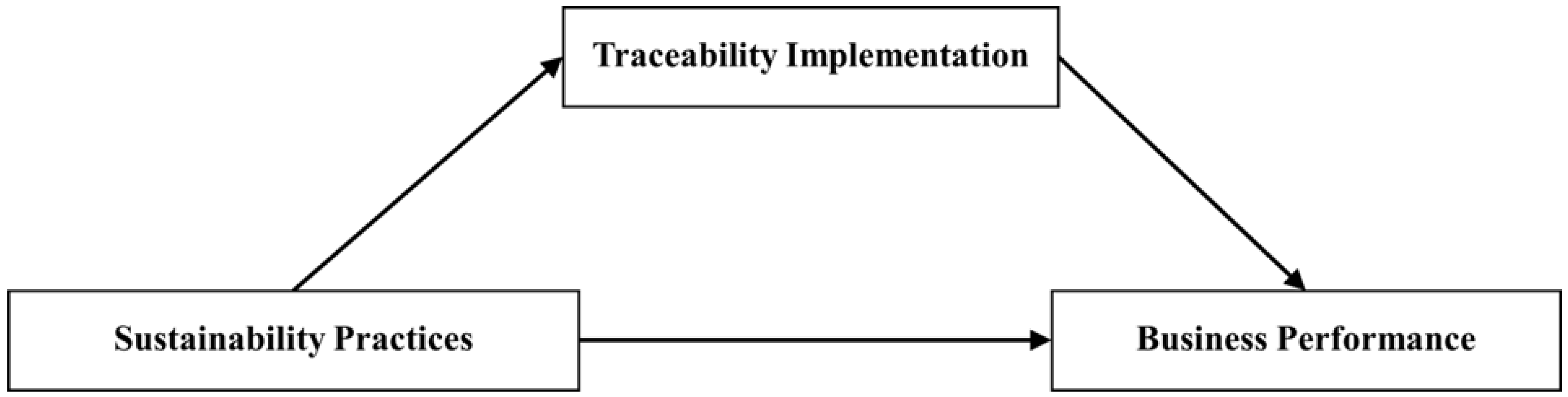
Grounded in the relational imperatives of Stakeholder Theory, this study advances a conceptual framework to explicitly map how sustainability practices (SP) influence business performance (BP), and to isolate how traceability implementation (TI) functions as an important operational mechanism within Thailand’s export-oriented food supply chain context. The architecture of this framework focuses on the interplay among these three core analytical components.
While the framework acknowledges the theoretical premise that sustainability practices can exert a direct positive influence on business performance through internal efficiency gains and reputational advantages, these benefits may not be consistently realized or externally validated in isolation. In stakeholder-driven markets, the demand for verifiable proof of responsible conduct creates strong organizational requirements for systematic monitoring, rigorous documentation, and supply chain transparency.
To satisfy these rigorous accountability demands, firms are compelled to institutionalize traceability implementation as a structured set of operational routines. Accordingly, the proposed model conceptualizes TI as a visibility- and accountability-enhancing mechanism that actively operationalizes SP. By systematically capturing information and ensuring process transparency, TI directly bolsters business performance by improving operational control, reducing risk exposure, and generating the highly credible, auditable sustainability evidence that stakeholders trust. Together, these theorized direct and indirect pathways, illustrated in
Figure 1, form the conceptual foundation for the specific hypotheses developed below.
3.2. Hypothesis Development
3.2.1. Sustainability Practices and Traceability Implementation
To satisfy stakeholder demands for responsible sourcing and environmentally sound production, firms must move beyond rhetoric and actively demonstrate operational compliance. Within complex food supply chains, committing to sustainability inherently increases the organizational need for process visibility, systematic documentation, and robust information flows. Prior research emphasizes that without effective coordination and monitoring, sustainability initiatives frequently impose managerial burdens rather than generating value. Consequently, as firms deepen their sustainability practices, they are operationally compelled to invest in traceability implementation to monitor, document, and communicate these activities across multiple supply chain stages. Traceability provides the supporting information infrastructure required to successfully execute sustainability mandates.
Hypothesis 1. Sustainability Practices (SP) have a positive effect on Traceability Implementation (TI).
3.2.2. Traceability Implementation and Business Performance
Traceability implementation directly drives supply chain visibility by hardwiring systematic tracking, documentation, and data integration into receiving, processing, storage, and distribution activities. By actively dismantling information asymmetry, these rigorous practices improve recall preparedness and ensure strict compliance with food safety and sustainability standards. Furthermore, by generating verifiable and highly credible data, traceability enhances stakeholder confidence, facilitates market access, and improves operational reliability. Existing literature confirms that robust traceability systems enhance risk management and operational resilience. Consequently, firms that institutionalize advanced traceability routines are more likely to achieve improved operational, reputational, and multidimensional business performance.
Hypothesis 2. Traceability Implementation (TI) positively affects Business Performance (BP).
3.2.3. Sustainability Practices and Business Performance
Sustainability practices generate direct business value by improving resource efficiency, reducing waste, enhancing product quality, and strengthening corporate reputation. A growing body of empirical research indicates that integrating environmental and social initiatives into core operations can lead to cost savings, improved process efficiency, and more favorable stakeholder perceptions. Although prior studies suggest that the magnitude of these performance effects may vary across regulatory environments and market conditions, the efficiency and reputational benefits associated with sustainable operations generally contribute positively to firm performance.
Hypothesis 3. Sustainability Practices (SP) positively affect Business Performance (BP).
3.2.4. The Mediating Role of Traceability Implementation
While sustainability practices establish the strategic intent for responsible operations, achieving measurable business performance requires firms to operationalize this intent through appropriate accountability mechanisms. As highlighted by Stakeholder Theory, firms are evaluated not only by economic outcomes but also by their ability to provide credible and verifiable evidence of responsible conduct.
Traceability implementation fulfills this role by enabling firms to monitor, document, and verify sustainability-related activities across supply chain stages. Without such mechanisms, sustainability practices may remain symbolic, limiting their performance impact.
Therefore, traceability implementation is proposed as a key mediating mechanism linking sustainability practices to business performance, particularly in emerging-market food supply chains.
Hypothesis 4. Traceability Implementation (TI) mediates the relationship between Sustainability Practices (SP) and Business Performance (BP).
4. Methods
To empirically test the hypothesized relationships among sustainability practices (SP), traceability implementation (TI), and business performance (BP), this study adopts a quantitative, survey-based research design. Structural Equation Modeling (SEM) is employed to evaluate the proposed framework, as it enables the simultaneous estimation of multiple latent constructs and interdependent relationships within a mediation structure. This approach facilitates a robust assessment of both measurement validity and structural relationships, consistent with established practices in sustainable supply chain research.
4.1. Sampling and Data Collection
The empirical context of this study is Thailand’s food-processing sector, which plays a central role in national and global food supply chains and operates under increasing sustainability and traceability requirements. The target population comprised medium- and large-sized food-processing manufacturers officially registered with the Department of Industrial Works (DIW), the Federation of Thai Industries (FTI), and the Thai SME-GP procurement registry.
A purposive sampling approach was employed to ensure coverage across key subsectors of the Thai food-processing industry. Firms were selected based on major industry classifications in Thailand, including fruits and vegetables, meat processing, fisheries, and beverages.
Data collection was conducted between July and December 2024 using a structured questionnaire. A total of 452 questionnaires were distributed, and 388 responses were returned, representing a response rate of 85.8%. Data screening procedures were subsequently performed to ensure data completeness and accuracy. Multivariate outliers were identified using Mahalanobis distance calculated across all observed variables. Cases exceeding the critical chi-square value at (
p <0.001) with degrees of freedom equal to the number of measured indicators were excluded [
35]. Based on this criterion, 26 responses were removed, resulting in a final sample of 362 usable responses (usable response rate = 80.1%).
To enhance data validity, the survey targeted knowledgeable key informants, including firm owners, senior executives, department managers, and designated representatives responsible for sustainability and traceability activities. Data were collected through multiple channels, including electronic mail, direct telephone communication, and online survey platforms. All responses were recorded using standardized instruments and coding procedures to minimize potential mode bias. To ensure data integrity and confidentiality, all online survey responses were collected through secure survey platforms with restricted access controls. No personally identifiable information was requested from participants, and all responses were anonymized prior to analysis. Access to the collected data was limited to the research team and stored in password-protected systems to minimize unauthorized access and data manipulation risks.
To minimize potential data collection bias, respondents were informed that participation was voluntary and that all responses would remain strictly confidential. The questionnaire avoided requesting sensitive commercial information or personally identifiable data in order to reduce social desirability bias and encourage accurate reporting of internal operational practices. These procedures were implemented in accordance with institutional ethical guidelines for human-subject research in Thailand.
Potential non-response bias was assessed using the extrapolation method proposed by Armstrong and Overton [
36]. Independent sample t-tests comparing early respondents (first quartile) and late respondents (final quartile) revealed no statistically significant differences across key firm characteristics and primary constructs (
p > 0.05), suggesting that non-response bias is unlikely to threaten the statistical validity of the findings.
Prior to full-scale data collection, the questionnaire was reviewed by three academic experts and two industry practitioners to establish content validity. The Index of Item Objective Congruence (IOC) was used to assess item–construct alignment, applying a retention threshold of IOC > 0.50 [
37]. One item was removed and several items were refined for clarity and contextual relevance. Subsequently, a pilot test involving 30 firms was conducted to evaluate reliability and wording clarity. Cronbach’s alpha values ranged from 0.892 to 0.962 across constructs, exceeding the recommended threshold of 0.70 [
35], thereby supporting the internal consistency of the measurement scales prior to the main survey.
4.2. Measures
To ensure construct validity, all latent variables were operationalized using multiple reflective indicators adapted from established literature and contextualized for the food supply chain. All measurement items were anchored on a five-point Likert scale ranging from 1 (strongly disagree) to 5 (strongly agree). The complete measurement instrument is provided in
Table A1. Detailed measurement items, construct dimensions, and supporting references are provided in
Table A1 to facilitate construct transparency and future replication studies.
4.2.1. Measurement of Sustainability Practices (SP)
Sustainability Practices (SP) were operationalized using a three-item reflective scale capturing the extent to which firms embed sustainability-oriented routines into their operations. These items reflect key aspects of sustainability, including resource efficiency, waste minimization, responsible sourcing, and environmentally conscious manufacturing. This measurement approach aligns with the Bio-Circular-Green (BCG) framework and prior sustainable supply chain research [
2,
3].
Although the construct primarily emphasizes operational sustainability routines associated with environmental and resource-efficiency dimensions, this contextual focus reflects the dominant sustainability priorities currently emphasized within Thailand’s export-oriented food-processing sector.
4.2.2. Measurement of Traceability Implementation (TI)
Traceability Implementation (TI) was measured using four reflective items derived from the U.S. FDA Food Traceability Final Rule [
29]. These items correspond to key operational dimensions, including receiving, processing and packing, storing and shipping, and traceability governance, which capture Critical Tracking Events (CTEs) and Key Data Elements (KDEs). Consistent with established SEM methodologies, these four items were modeled as reflective indicators of an overarching TI construct, precisely because they collectively represent a unified, organization-wide routinized capability rather than isolated operational tasks. While these dimensions capture distinct operational activities, they are theoretically interconnected through shared organizational traceability routines and governance processes within the supply chain system.
Firms with stronger traceability implementation capability are expected to demonstrate consistently higher implementation levels across these operational traceability activities, thereby supporting the reflective specification within the covariance-based SEM framework.
4.2.3. Measurement of Business Performance (BP)
Business Performance (BP) was measured as a six-item reflective construct capturing financial, customer, internal process, learning and growth, social, and environmental outcomes. This multidimensional approach aligns with the Sustainability Balanced Scorecard framework and captures both economic and non-economic performance dimensions [
30,
31].
4.3. Data Analysis
A two-step SEM procedure was employed, separating the evaluation of the measurement model from the structural model. Prior to analysis, the dataset was screened for missing values, outliers, and normality assumptions. Multicollinearity in the structural model was assessed using Variance Inflation Factor (VIF) values obtained from SPSS Statistics Version 26 (IBM Corp., Armonk, NY, USA) regression analysis. All VIF values remained below the recommended threshold of 5 [
35,
38].
To assess potential common method bias (CMB), Harman’s single-factor test was conducted using all measurement items included in this study. The first unrotated factor accounted for 33.913% of the total variance, which was below the recommended threshold of 50%, suggesting that common method bias was unlikely to substantially affect the study results [
35].
4.3.1. Measurement Model Evaluation
The measurement model was evaluated using Confirmatory Factor Analysis (CFA). Convergent validity was assessed through standardized factor loadings, composite reliability (CR), and average variance extracted (AVE). All factor loadings exceeded 0.60, CR values were above 0.70, and AVE values surpassed 0.50, indicating satisfactory convergent validity [
35,
38].
Discriminant validity was assessed using the Fornell–Larcker criterion. The square root of the AVE for each construct exceeded its correlations with other constructs, thereby supporting adequate discriminant validity. In addition, the measurement model demonstrated good overall fit to the data, satisfying commonly accepted goodness-of-fit criteria (CFI > 0.95, TLI > 0.95, RMSEA < 0.06, SRMR < 0.08) [
35,
38].
These model fit thresholds are consistent with recommendations commonly adopted in SEM research and covariance-based model evaluation studies.
4.3.2. Structural Model Evaluation
Following validation of the measurement model, the structural model was estimated to test the hypothesized relationships. Mediation effects were assessed using a bias-corrected bootstrapping procedure with replacement based on 5,000 resamples to generate 95% confidence intervals [
39]. This advanced resampling approach bypasses assumptions of multivariate normality and provides the widely used, statistically powerful method for assessing indirect effects, supporting the study’s objective of unpacking how traceability implementation operationalizes sustainability into performance.
Bootstrapping procedures are widely recommended for mediation testing because they provide more robust estimation of indirect effects without relying on normality assumptions.
The mediation effect size was also evaluated using the Variance Accounted For (VAF) approach to assess the practical significance of the indirect effect within the structural relationship.
4.4. Ethical Considerations
To ensure data integrity and participant protection, all research procedures adhered to institutional and international ethical guidelines for research involving human participants. Prior to participation, all respondents were informed about this study’s objectives, assured of anonymity, and provided voluntary consent. To reduce the risk of social desirability bias, no personally identifiable or commercially sensitive information was collected. This approach encouraged respondents to provide accurate and unbiased information regarding their organizational practices.
This study was reviewed and granted an exemption by the Kasetsart University Research Ethics Committee (Certificate of Exemption No. COE67/058).
5. Results
5.1. Organizational and Respondent Characteristics
The final dataset comprises 362 valid responses from food-processing firms across Thailand, providing a robust empirical basis for the structural model. As presented in
Table 2, the sample reflects a diverse representation of key export-oriented segments, including fruits and vegetables (29.27%), meat processing (23.83%), fisheries (18.39%), and beverages (15.80%). This distribution is consistent with the structure of Thailand’s food-processing sector, where these segments play a central role in both domestic production and export activities.
The structural characteristics of the sampled firms align well with the organizational requirements necessary to test complex sustainability and traceability mechanisms. The majority of these firms (88.16%) possess more than a decade of operational history, ensuring that this study captures deeply embedded supply chain routines rather than nascent or temporary initiatives. Furthermore, reflecting the financial and structural capacity required to institutionalize formal traceability infrastructures, the sample is appropriately weighted toward large (61.92%) and medium-sized (28.24%) enterprises, with over half (52.33%) reporting annual sales revenues exceeding THB 500 million.
To guarantee the reliability and accuracy of the self-reported data, responses were strictly sourced from key informants occupying authoritative, decision-making roles. With the vast majority of respondents serving as managers (41.53%), supervisors (17.94%), senior managers/executives (13.62%), or firm owners (9.30%), this informant profile provides informed assessments of both high-level sustainability strategy and floor-level traceability execution. Overall, these demographic parameters confirm the suitability of the dataset for evaluating firm-level capabilities within demanding, formal food supply chain environments.
5.2. Measurement Model Assessment
Table 3 presents the results of construct reliability and convergent validity. All standardized factor loadings were significant (
p < 0.001) and exceeded 0.60. Cronbach’s alpha values ranged from 0.714 to 0.879, and composite reliability values were above 0.70, confirming internal consistency. The Average Variance Extracted (AVE) values for sustainability practices (0.595), traceability implementation (0.693), and business performance (0.603) exceeded the 0.50 threshold, supporting convergent validity.
To confirm that the theorized constructs were empirically distinct, discriminant validity was rigorously evaluated using the Fornell–Larcker criterion (see
Table 4). The square root of the AVE for every construct was strictly greater than its corresponding inter-construct correlations, providing evidence that each latent variable captures a unique theoretical dimension.
5.3. Descriptive Statistics and Correlation Analysis
Table 4 presents the descriptive statistics and correlation matrix, providing critical preliminary insights into the nomological network of the constructs. The high mean scores reflect a sample of operationally mature firms exhibiting advanced levels of sustainability practices, traceability implementation, and business performance. As theoretically anticipated, all inter-construct correlations are positive and statistically significant, establishing initial support for the hypothesized directional pathways.
To assess potential multicollinearity in the structural model, variance inflation factor (VIF) values were examined using SPSS Statistics Version 26 (IBM Corp., Armonk, NY, USA) regression analysis. The VIF values for all predictor constructs were below the recommended threshold of 5 (VIFs = 1.782), indicating that multicollinearity was not a concern in the structural model. Although the constructs were moderately to highly correlated, the observed correlations remained within acceptable statistical thresholds. Coupled with the Fornell–Larcker results, in which the square roots of the AVEs exceed the off-diagonal correlations, these findings indicate that multicollinearity is unlikely to be a concern and further support the distinctiveness of the constructs. This correlation structure provides a stable foundation for the subsequent structural path estimations.
5.4. Structural Model and Model Fit
The structural model demonstrated a good fit to the data. The chi-square statistic was 92.980 with 58 degrees of freedom, resulting in a /df ratio of 1.603. Fit indices exceeded recommended thresholds (CFI = 0.990, TLI = 0.986, RMSEA = 0.041).
Additionally, the RMSEA-based PClose value of 0.832 indicates a close fit, indicating that the proposed structural model fits the observed data well [
35,
40]. Consequently, this model fit supports proceeding with the hypothesis testing for both the direct and mediated pathways.
5.5. Main Effect Model
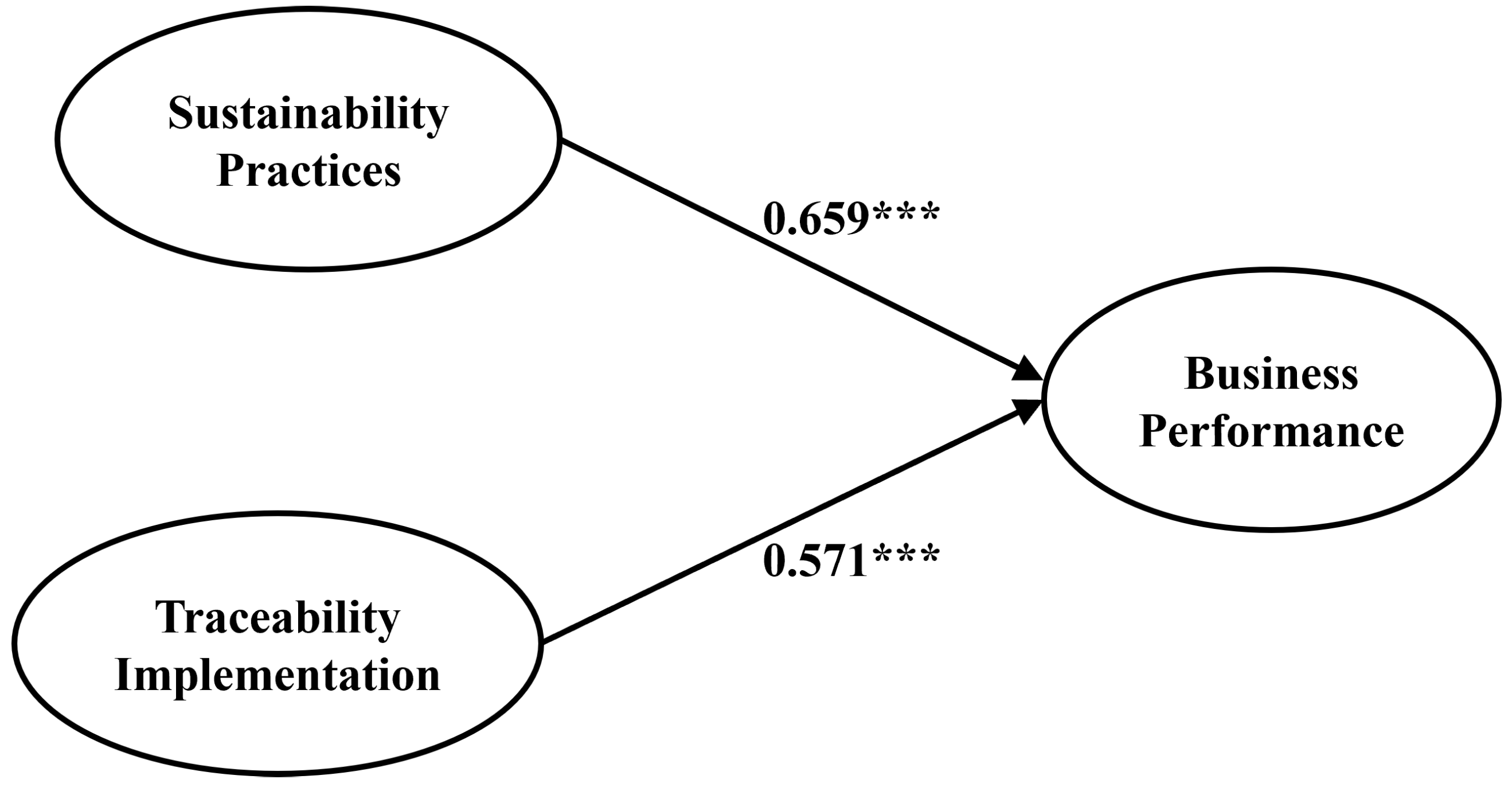
Prior to examining mediation effects, a main-effects model was estimated to assess the direct influence of sustainability practices and traceability implementation on business performance. As shown in
Figure 2, the analysis yields empirical support for the proposed direct predictors. Sustainability practices exert a significant direct effect on business performance (
= 0.659,
p < 0.001), indicating that sustainable operations independently generate substantial business value. Similarly, traceability implementation demonstrates a substantial direct effect (
= 0.571,
p < 0.001), supporting its independent contribution as a performance-enhancing operational capability.
The main-effects model also demonstrated very good fit to the empirical data ( = 103.174, df = 89, /df = 1.159, CFI = 0.997, TLI = 0.995, RMSEA = 0.021, PClose = 0.999), all within recommended thresholds.
5.6. Mediation Model and Hypothesis Testing
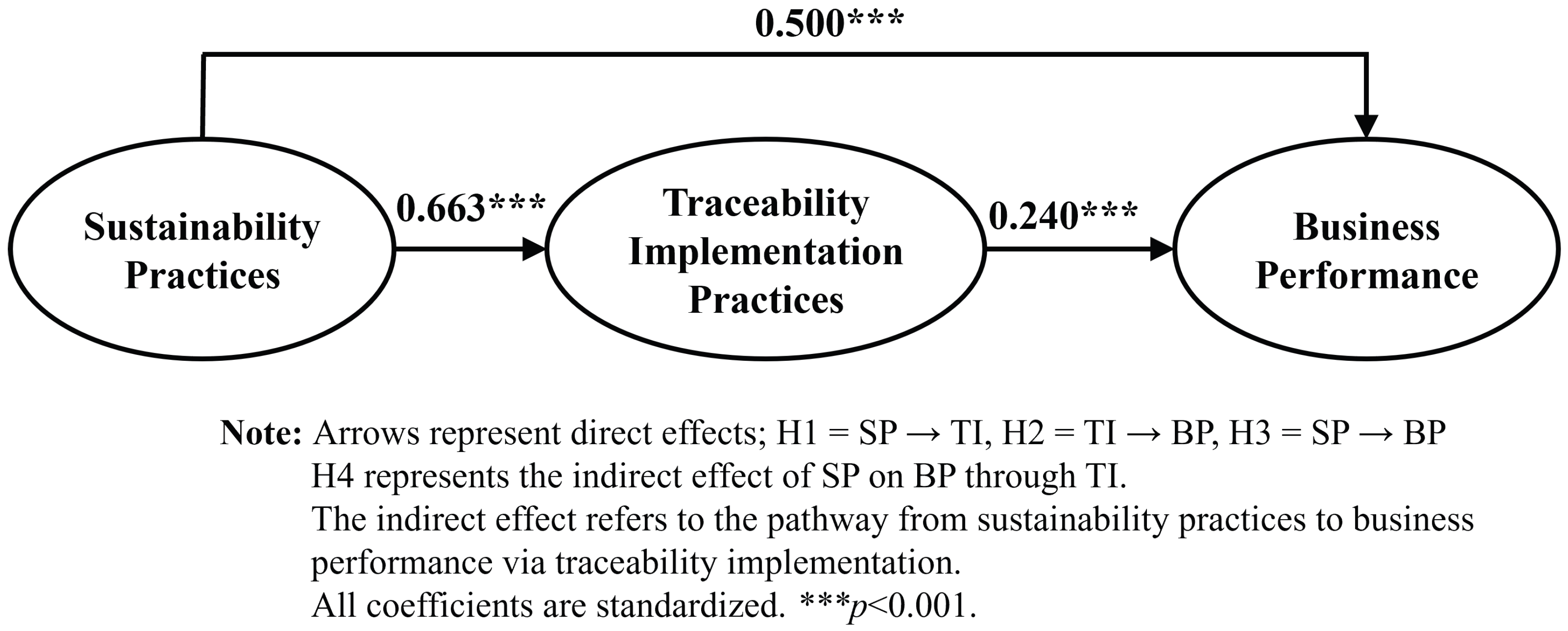
The full mediation model was then estimated using bootstrapping to examine whether traceability implementation serves as the mechanism linking sustainability practices to business performance.
Table 5 and
Figure 3 present the standardized path coefficients and bias-corrected 95% confidence intervals, providing empirical support for all four hypothesized relationships.
Hypothesis 1. Sustainability practices exert a strong, statistically significant positive effect on traceability implementation (β = 0.663, p < 0.001). This finding supports H1, providing empirical support that sustainability commitments operationally encourage firms to develop formal traceability infrastructures.
Hypothesis 2. Traceability implementation significantly drives business performance (β = 0.240, p < 0.001). This supports H2, suggesting that traceability functions not merely as a compliance tool, but as a core performance-enhancing capability.
Hypothesis 3. The direct effect of sustainability practices on business performance remains robust and highly significant (β = 0.500, p < 0.001). This finding supports H3, indicating that the internal efficiency and reputational gains derived from sustainability hold intrinsic, direct business value.
Hypothesis 4. Most importantly, the structural analysis confirms a highly significant positive indirect effect of sustainability practices on business performance through traceability implementation (β = 0.159). The bootstrapped 95% bias-corrected confidence interval excludes zero [0.095, 0.251], thus supporting H4 and indicating partial mediation.
This partial mediation finding is the key finding of the structural model: it indicates that while sustainability directly enhances performance, these baseline benefits are significantly amplified and stabilized when routed through the accountability mechanism of traceability. Ultimately, these results provide empirical evidence that firms achieve superior, multidimensional performance when their sustainable capabilities are backed by structured, transparency-enhancing traceability systems, confirming its important role in sustainability-driven food supply chains.
6. Discussion
6.1. Key Findings in Context: Resolving the Empirical Void
This study addresses a persistent empirical tension in sustainable supply chain literature: why do sustainability initiatives frequently fail to generate consistent performance gains across diverse organizational contexts? The findings help explain this inconsistency by demonstrating that while sustainability practices inherently generate baseline operational benefits, their full strategic value remains constrained without a structured operational mechanism that enables monitoring, documentation, and verification, such as traceability implementation.
The significant direct effect of sustainability on business performance confirms that initiatives such as resource efficiency and waste reduction inherently drive cost control and process efficiency [
3,
4]. Informal insights gathered from industry managers corroborate this, noting that waste reduction stabilizes operations even prior to the formalization of tracking systems. Importantly, this provides strong evidence that sustainability practices are not merely symbolic, but yield measurable baseline performance benefits. However, the mediation analysis reveals a more complex reality: these foundational benefits are significantly enhanced and stabilized when they are operationalized through structured traceability routines. Sustainability practices create an organizational demand for systematic monitoring [
15,
41]. By answering this demand, traceability provides the credible, verifiable evidence required by external stakeholders, transforming internal efficiencies into robust, market-facing performance advantages [
11,
12,
42].
In addition to its mediating role, traceability implementation also exerts a direct effect on business performance. The significant effect of traceability implementation on performance highlights its role in reducing uncertainty, improving recall preparedness, and enhancing overall logistics reliability [
8,
10]. However, the mediation analysis further indicates that these benefits are strengthened when sustainability practices are supported by traceability implementation. Taken together, the findings suggest that sustainability practices influence business performance in two complementary ways: directly through internal efficiency and reputational gains, and indirectly by prompting the implementation of traceability routines that render such practices visible, verifiable, and operationally reliable. In this sense, sustainability practices matter on their own, but their performance effects become more consistent and robust when they are operationalized through structured traceability processes.
Supporting this mechanism, the strong positive relationship between sustainability practices and traceability implementation suggests that sustainability-oriented strategies create an organizational demand for systematic monitoring, documentation, and reliable information flows. Firms pursuing environmental and social objectives are increasingly required to demonstrate compliance, consistency, and accountability across sourcing, processing, and logistics operations. This observation aligns with earlier research emphasizing that sustainability strategies necessitate systems capable of ensuring transparency and information reliability in order to maintain operational control and accountability [
15,
41]. This interpretation is further reinforced by more recent studies demonstrating that traceability-based information systems enhance transparency and accountability by enabling firms to provide credible and verifiable sustainability evidence to external stakeholders, thereby strengthening performance outcomes [
11,
12,
42].
In addition, the significant effect of traceability implementation on business performance underscores its role as a performance-enhancing operational capability. By improving supply chain visibility, recall preparedness, and data accuracy, traceability implementation reduces uncertainty and strengthens logistics reliability, thereby contributing to improved performance outcomes. These findings are consistent with prior research demonstrating that effective traceability supports risk management, regulatory compliance, and operational resilience in food supply chains [
8,
10], while extending this literature by empirically demonstrating how traceability functions as a mechanism that translates sustainability initiatives into business-relevant outcomes.
Taken together, the findings clarify why similar sustainability initiatives may produce different performance outcomes across firms. Sustainability practices explain why sustainability matters for business performance, while traceability implementation explains how these practices are transformed into visible, verifiable, and performance-relevant outcomes. Rather than replacing the direct effects of sustainability practices, traceability implementation strengthens and stabilizes them by embedding accountability and transparency into daily operational routines. This distinction helps reconcile mixed findings in prior research and highlights the importance of examining not only sustainability adoption, but also the mechanisms through which sustainability is operationalized within supply chains.
6.2. Theoretical Implications
This study contributes to sustainable supply chain research by clarifying how traceability implementation helps explain the inconsistent relationship between sustainability practices and business performance. Prior research has often treated sustainability as a strategic posture or operational practice, while giving less attention to the accountability mechanisms through which such practices become visible and performance-relevant.
From a Stakeholder Theory perspective, the findings suggest that sustainability practices create expectations for responsible conduct, but traceability implementation provides the operational routines through which such responsibility can be documented, verified, and communicated. In this sense, the contribution of this study lies not in proposing a new theory, but in extending the application of Stakeholder Theory to the operational level of food supply chains.
By positioning traceability implementation as an accountability-enabling mechanism, this study helps explain how sustainability practices are translated into measurable business outcomes through routinized monitoring, documentation, and verification activities. This interpretation also highlights a more specific theoretical explanation of the SP → TI → BP pathway and shows how stakeholder accountability can be enacted through supply chain operations. This interpretation also highlights how operational accountability mechanisms may help reduce information asymmetry and strengthen stakeholder confidence in sustainability-oriented food supply chains.
6.3. Practical Implications
For supply chain executives and export-oriented manufacturers, these findings suggest a critical shift in operational strategy. Sustainability practices and traceability implementation should no longer be managed as separate or parallel initiatives. Instead, traceability must be integrated as the operational mechanism that supports sustainability, transforming compliance-related data into a strategic resource that enhances buyer confidence, ensures audit readiness, and facilitates access to highly regulated international markets [
21,
42].
Second, firms should leverage integrated traceability routines to strengthen supply chain resilience. In high-risk food categories, routinized traceability reduces recall uncertainty and mitigates logistics disruptions by enabling more accurate and timely information flows [
8,
10].
The practical relevance of traceability implementation may also vary across food industry segments due to differences in product characteristics, perishability, regulatory exposure, and supply chain complexity. For example, meat and fishery processors often require stricter traceability controls because of higher food safety risks and export certification requirements, whereas fruit and vegetable processors may place greater emphasis on freshness monitoring and logistics coordination. Although the present study focuses on the overall structural relationships across the food-processing sector, these industry-specific operational conditions may shape the effectiveness and implementation priorities of traceability systems in supporting sustainability and business performance outcomes.
For policymakers and regulators, the findings highlight the importance of aligning domestic frameworks with global standards such as ISO 22005 and the U.S. FDA Food Traceability Rule. Targeted capacity-building initiatives are essential to support medium-sized enterprises in institutionalizing traceability practices, ensuring their ability to compete in transparency-driven global markets.
For medium-sized food enterprises, the findings suggest that sustainability initiatives may generate stronger business outcomes when supported by structured traceability implementation mechanisms. However, many firms in Thailand’s food sector continue to face financial, technological, and organizational barriers in operationalizing traceability systems. Policymakers may therefore strengthen sustainability-driven competitiveness among medium-sized food enterprises by supporting the adoption of traceability-enabling infrastructure through targeted financial incentives, shared digital traceability platforms, technical training programs, and interoperable data standards. Such support mechanisms may help resource-constrained firms translate sustainability practices into measurable operational and export performance improvements while improving supply chain transparency, regulatory compliance, and export readiness within global food supply chains.
From a logistics perspective, integrating traceability into core supply chain operations enhances process-level visibility and coordination across sourcing, processing, storage, and distribution stages. This integration improves the reliability of sustainability execution and strengthens overall supply chain performance.
Beyond operational and regulatory benefits, the findings also highlight broader societal and market implications of sustainability-oriented traceability systems. In increasingly transparency-driven food markets, traceability implementation can strengthen consumer confidence, improve supply chain accountability, and support public trust in product safety and sustainability claims. These mechanisms are particularly important in export-oriented food supply chain contexts, where stakeholder expectations regarding ethical sourcing, environmental responsibility, and supply chain transparency continue to intensify [
3,
7].
From a broader sustainability perspective, integrated sustainability and traceability practices may also contribute to long-term supply chain resilience, resource efficiency, and sustainable market competitiveness. By improving information reliability and operational coordination across supply chain actors, firms are better positioned to respond to regulatory changes, market uncertainty, and evolving consumer preferences in global food systems [
4,
6].
The empirical findings reported above provide the basis for a deeper examination of the mechanism through which sustainability practices translate into business performance outcomes.
For practitioners, the findings suggest that traceability implementation should not be treated merely as a compliance requirement or documentation exercise. Instead, firms may derive greater business value when traceability routines are operationally integrated into sourcing, processing, inventory management, and supplier coordination activities. In practice, firms should prioritize the development of standardized traceability protocols, cross-functional data integration routines, supplier verification mechanisms, and real-time monitoring systems to improve the consistency and auditability of sustainability-related operations.
The findings also suggest that firms with limited technological and financial resources may benefit from phased traceability implementation strategies. Rather than attempting full-scale digital transformation immediately, firms may begin by strengthening internal documentation accuracy, Critical Tracking Event (CTE) recording practices, and supplier-level traceability coordination before expanding toward more advanced digital traceability infrastructures such as blockchain or IoT-enabled systems.
6.4. Mediation Pathway (H4): The Execution Gap
The mediation effect size was further assessed using the Variance Accounted For (VAF) approach. The VAF value was 25.7%, indicating partial mediation. These findings indicate that traceability implementation functions as an important operational execution mechanism rather than a full transmission pathway. This result suggests that traceability implementation partially mediates the relationship between sustainability practices and business performance, while sustainability practices also maintain a substantial direct effect on business performance outcomes.
Importantly, the findings also suggest that sustainability practices retain substantial intrinsic performance value independent of traceability implementation, while traceability strengthens the operational consistency, auditability, and external credibility of sustainability-related activities.
The partial mediation observed in the structural model provides empirical support for the existence of an execution gap. The confirmation of the SP → TI → BP pathway (H4) provides empirical support for the proposed accountability-oriented operational mechanism underlying the sustainability–performance relationship. These findings further suggest that sustainability practices generate both intrinsic operational benefits and accountability-enhancing effects through traceability implementation.
This dual mechanism highlights that sustainability practices independently contribute to performance improvements, while traceability implementation enhances the consistency, credibility, and verifiability of these effects. Rather than substituting the role of sustainability, traceability amplifies and stabilizes its impact [
41].
The observed partial mediation structure also suggests that additional organizational and institutional mechanisms may influence how sustainability practices translate into business performance. Factors such as organizational learning capability, digital readiness, supply chain integration, stakeholder pressure, and managerial commitment may further strengthen or constrain the effectiveness of traceability implementation across different operational contexts. These findings suggest that traceability implementation represents one important accountability-oriented operational mechanism within a broader set of organizational and institutional influences shaping sustainability–performance relationships.
Firms that adopt sustainability practices without corresponding traceability routines may experience an execution gap, where internal efforts remain insufficiently visible to external stakeholders, thereby limiting reputational and financial returns [
7,
11]. In contrast, integrating traceability implementation ensures that sustainability commitments are translated into auditable and performance-relevant outcomes. At the same time, the findings also suggest that traceability implementation should not be interpreted as the sole explanation for sustainability-related performance improvements. Alternative explanations, including operational efficiency gains, reputational advantages, organizational learning, and stakeholder trust development, may independently contribute to business performance outcomes. This interpretation helps explain why sustainability practices maintain a substantial direct effect on business performance even in the presence of traceability implementation.
From a broader theoretical perspective, the findings also contribute to ongoing debates regarding whether accountability mechanisms primarily function as compliance-oriented controls or as capability-enhancing organizational routines. The present findings support the latter perspective by suggesting that traceability implementation may strengthen the operational embedding and credibility of sustainability practices rather than functioning merely as a regulatory reporting mechanism.
These findings suggest that examining sustainability adoption alone is insufficient. Greater attention should be directed toward the operational mechanisms through which sustainability is implemented, governed, and validated across supply chain activities.
6.5. Contextual Interpretation: Thailand’s Export-Oriented Food Supply Chain Context
Thailand’s export-oriented food supply chains provide a demanding context in which global export pressures encourage rapid capability development. In Thailand’s processing sector, sustainability practices are frequently catalyzed by stringent external certification demands, creating a strong operational need for traceability to provide auditable proof.
Crucially, these findings support the proposed theoretical sequencing and provide contextual support for the proposed sequencing relative to alternative models that position technological adoption as the starting point. When traceability is implemented merely as a reactionary compliance hurdle without a foundational sustainability strategy, it devolves into a stagnant record-keeping exercise, limiting its strategic value [
41,
42]. The model suggests that sustainability can establish the strategic mandate before traceability is effectively leveraged as a performance-driving capability, highlighting the institutional logic required to compete in modern stakeholder-driven markets.
Although the proposed framework is theoretically grounded, the cross-sectional nature of the data does not permit definitive causal inference. Alternative relationship sequences may also exist and should be further examined through longitudinal or comparative research designs.
7. Conclusions
This study helps clarify a critical tension in sustainable supply chain management: how abstract sustainability commitments are successfully converted into measurable business performance. The analysis of 362 export-oriented food processors provides empirical evidence that traceability implementation functions as an operational mechanism linking sustainability practices to performance outcomes. The findings support a partial mediation structure, suggesting that while sustainability practices generate baseline efficiency and reputational gains, their performance benefits are strengthened when supported by structured, transparency-enhancing traceability routines.
The theoretical contribution of this research lies in clarifying how Stakeholder Theory can be operationalized through traceability routines in food supply chain operations. Future research may benefit from adopting mixed-method approaches, such as case studies, ethnographic observations, and buyer–supplier dyadic analysis, to further explore how traceability routines are implemented and sustained in practice. The supported SP → TI → BP pathway suggests that in transparency-driven markets, organizational legitimacy and performance depend not just on adopting responsible practices, but on the operational capacity to systematically verify and document them.
For supply chain executives and policymakers, the findings suggest that sustainability and traceability can no longer be managed as siloed or parallel initiatives. For export-oriented food-processing firms facing intense stakeholder scrutiny, traceability should be structurally integrated as an important operational mechanism for sustainability. This integration transforms compliance data into a strategic asset that secures buyer confidence, enhances operational reliability, and unlocks access to highly regulated global markets.
While this study offers robust empirical insights, it is naturally bounded by its cross-sectional design and specific focus on Thailand’s food-processing sector. Because a cross-sectional approach captures a specific temporal snapshot, it limits definitive causal inferences regarding how these capabilities evolve. Future research should prioritize longitudinal studies to dynamically map how the pathways between sustainability intent and traceability execution mature over time. Additionally, conducting comparative cross-country analyses or applying mixed-method approaches across different institutional environments would further examine the boundary conditions of this accountability-driven framework.
8. Limitations and Future Research
While this study establishes a useful empirical basis for the mediating role of traceability, its boundaries present useful directions for future research. First, the cross-sectional research design inherently restricts causal inference and captures a static snapshot of organizational capabilities. Because sustainability practices and traceability implementation are inherently dynamic routines that are continually shaped by organizational learning and evolving regulatory pressures, future research should prioritize longitudinal designs. Tracking the SP → TI → BP trajectory over time would provide deeper insights into how these accountability mechanisms evolve, adapt, and become institutionalized within supply chains.
Second, regulatory environments, digital readiness, and stakeholder expectations may vary substantially across industries and international supply chain settings. Future research should therefore examine the proposed framework across multiple institutional and cross-country contexts to better understand how macro-level conditions influence the effectiveness of traceability implementation and sustainability governance mechanisms.
Third, although the sustainability practices construct demonstrated satisfactory reliability and validity, its operationalization in this study primarily emphasized environmental and resource-efficiency dimensions aligned with BCG-oriented sustainability initiatives commonly adopted within Thailand’s food-processing industry. Consequently, broader social sustainability dimensions, such as labor practices, fair sourcing, employee welfare, supplier responsibility, and community engagement, were not explicitly incorporated into the measurement model. Future research should therefore extend the sustainability construct by integrating more comprehensive social and governance-related dimensions to improve construct comprehensiveness and generalizability while better reflecting the multidimensional nature of sustainability practices in global food supply chains.
Fourth, while the quantitative SEM approach provides rigorous macro-level theory testing, it cannot fully capture the micro-foundational nuances of managerial interpretation or daily inter-organizational negotiation. Future research may benefit from adopting mixed-method approaches, including in-depth case studies, ethnographic observations, and buyer–supplier dyadic data, to better understand how traceability routines are enacted, sustained, and occasionally resisted in operational settings.
Finally, future research should expand the nomological network of this framework by examining critical boundary conditions. Incorporating potential moderators such as firm size, degree of supply chain integration, technological maturity, including blockchain or IoT readiness, and export market exposure will help clarify which organizational profiles derive the greatest performance benefits from these systems. Ultimately, understanding how digital innovations co-evolve with evidence-based sustainability governance remains an important direction for enhancing transparency and accountability in global food supply chains.
This study relied primarily on self-reported perceptual data collected from single respondents within each firm, which may introduce potential common method bias and subjective evaluation effects despite the procedural and statistical remedies applied. Although Harman’s single-factor test suggested that common method bias was unlikely to substantially affect the findings, the possibility of residual bias cannot be fully excluded. In addition, business performance was assessed using perceptual organizational performance indicators rather than objective financial or operational records. Future research may therefore benefit from incorporating longitudinal designs, multi-informant data sources, and objective performance indicators to strengthen causal interpretation and enhance methodological robustness.
In addition, the empirical context of this study was limited to export-oriented food-processing firms operating in Thailand. Accordingly, the findings should be interpreted within the institutional, regulatory, and operational conditions specific to Thailand’s food supply chain environment. While certain implications may be relevant to similar export-oriented emerging economy contexts, caution should be exercised when generalizing the findings to other industries, countries, or supply chain structures with different regulatory pressures, technological maturity levels, and stakeholder expectations. Future comparative studies across multiple countries and supply chain contexts would help further assess the broader applicability of the proposed framework.