

Effects of Circular Economy Principles, Technological Integration, and Sustainable Supply Chain Management Practices on Green Supply Chain and Organizational Performance


Abstract
1. Introduction
- R.O1: To examine the influence of circular economy principles on the environmental performance of supply chains.
- R.O2: To analyze the role of technological integration in enhancing green supply chain sustainability.
- R.O3: To evaluate how sustainable supply chain practices contribute to the effectiveness of green supply chain management.
- R.O4: To assess the impact of green supply chain performance on overall organizational performance.
2. Literature Review
3. Methodology
3.1. Research Design
3.2. Participants
3.3. Data Collection Methods
3.4. Measurement Model Assessment
3.5. Structural Model Assessment
3.6. Model Fit
4. Results
4.1. Hypothesis Testing (Structural Model Results)
4.2. Summary of Hypothesis Testing
4.3. Robustness Analysis
4.3.1. Robustness of Sample Size Adequacy
4.3.2. Multicollinearity and Estimation Stability
4.3.3. Stability of Structural Effects
4.3.4. Predictive Robustness
4.3.5. Global Model Fit Robustness
5. Discussion
5.1. Implications for Theory
5.2. Implications for Practice and Policy
5.3. Limitations and Future Research Directions
6. Conclusions
Author Contributions
Funding
Institutional Review Board Statement
Informed Consent Statement
Data Availability Statement
Conflicts of Interest
Appendix A
| Part I: Company’s Background | ||
| Industry of operations Years of company’s operations Does your company has its own supply chain | ||
| Part II: About you | ||
| Years of your professional experience Highest educational degree earned | ||
| Part III: Measuring Impact of Circular Economy, Sustainable Supply Chain Management Practices, & Technology on Green Performance of Supply Chain | ||
| Circular Economy | Likert Scale | Reference |
| Reduce 1: My organization actively works to reduce waste in its operations | 1 2 3 4 5 | Del Giudice et al., 2020 [49] |
| Reduce 2: We implement strategies that minimize the use of non-renewable resources | 1 2 3 4 5 | Del Giudice et al., 2020 [49] |
| Reduce 3: We prioritize product durability to reduce the frequency of replacement | 1 2 3 4 5 | Liu & Wang, 2022 [6] |
| Reuse 1: Our organization has a formal policy for reusing materials and products | 1 2 3 4 5 | Lengyel et al., 2021 [50] |
| Reuse 2: We actively seek opportunities to repurpose products before disposal | 1 2 3 4 5 | Del Giudice et al., 2020 [49] |
| Reuse 3: Our supply chain includes processes for recovering and reusing components | 1 2 3 4 5 | Del Giudice et al., 2020 [49] |
| Recycle 1: We have effective systems in place for recycling materials within our operations. | 1 2 3 4 5 | Lengyel et al., 2021 [50] |
| Recycle 2: Recycling is a key component of our waste management strategy | 1 2 3 4 5 | Liu & Wang, 2022 [6] |
| Recycle 3: We regularly measure and report our recycling rates. | 1 2 3 4 5 | Del Giudice et al., 2017 [30] |
| Sustainable Supply Chain Management Practices | ||
| Closed-loop 1: We have implemented closed-loop systems to ensure that materials are reused within the supply chain | 1 2 3 4 5 | De Angelis et al., 2018 [34] |
| Closed-loop 2: Our organization tracks and manages the lifecycle of products to facilitate closed-loop recycling | 1 2 3 4 5 | De Angelis et al., 2018 [34] |
| Closed-loop 3: Closed-loop systems are integrated into our core supply chain practices | 1 2 3 4 5 | De Angelis et al., 2018 [34] |
| Stakeholder Collaboration 1: We actively collaborate with stakeholders to enhance our sustainability efforts | 1 2 3 4 5 | Farooq & Yen, 2024 [51] |
| Stakeholder Collaboration 2: Our organization engages with suppliers and customers to improve supply chain sustainability | 1 2 3 4 5 | Farooq & Yen, 2024 [51] |
| Stakeholder Collaboration 3: We involve multiple stakeholders in developing and implementing our sustainability strategies | 1 2 3 4 5 | Farooq & Yen, 2024 [51] |
| Supplier Sustainability 1: We assess the sustainability practices of our suppliers as part of our procurement process | 1 2 3 4 5 | Kafa, Hani, & El Mhamedi, 2013 [52] |
| Supplier Sustainability 2: Supplier sustainability is a key criterion in our supplier selection process | 1 2 3 4 5 | Kafa, Hani, & El Mhamedi, 2013 [52] |
| Supplier Sustainability 3: We regularly review and support our suppliers’ sustainability initiatives | 1 2 3 4 5 | Kafa, Hani, & El Mhamedi, 2013 [52] |
| Technology | ||
| AI 1: We use AI to enhance demand forecasting and inventory management | 1 2 3 4 5 | Vandana et al., 2024 [53] |
| AI 2: AI is integrated into our supply chain operations to improve efficiency | 1 2 3 4 5 | Vandana et al., 2024 [53] |
| AI 3: Our organization leverages AI for predictive maintenance and operational optimization | 1 2 3 4 5 | Vandana et al., 2024 [53] |
| Big Data Analytics 1: Big data analytics is used to optimize our supply chain processes | 1 2 3 4 5 | Balcıoğlu, Y.S. et al., 2024 [35] |
| Big Data Analytics 2: We analyze large datasets to gain insights into supply chain performance | 1 2 3 4 5 | Balcıoğlu, Y.S. et al., 2024 [35] |
| Big Data Analytics 3: Big data analytics helps us in making informed decisions regarding supply chain management | 1 2 3 4 5 | Balcıoğlu, Y.S. et al., 2024 [35] |
| Block-chain 1: Blockchain technology is utilized to enhance transparency and traceability in our supply chain | 1 2 3 4 5 | Nozari, 2024 [36] |
| Block-chain 2: We use blockchain to manage and secure transactional data across our supply chain | 1 2 3 4 5 | Nozari, 2024 [36] |
| Block-chain 3: Blockchain is integrated into our supply chain to facilitate decentralized data management | 1 2 3 4 5 | Nozari, 2024 [36] |
| Green Performance of Supply Chain | ||
| Resource Efficiency 1: Our supply chain operations are designed to use resources more efficiently | 1 2 3 4 5 | Sarker, Moktadir, & Santibanez-Gonzalez, 2024 [39] |
| Resource Efficiency 2: We continuously seek ways to improve resource utilization in our supply chain | 1 2 3 4 5 | Sarker, Moktadir, & Santibanez-Gonzalez, 2024 [39] |
| Resource Efficiency 3: Resource efficiency is a key performance indicator in our supply chain management | 1 2 3 4 5 | Sarker, Moktadir, & Santibanez-Gonzalez, 2024 [39] |
| Operational Efficiency 1: We measure and improve the operational efficiency of our supply chain processes | 1 2 3 4 5 | Sarker, Moktadir, & Santibanez-Gonzalez, 2024 [39] |
| Operational Efficiency 2: Our organization implements practices that enhance operational efficiency | 1 2 3 4 5 | Sarker, Moktadir, & Santibanez-Gonzalez, 2024 [39] |
| Operational Efficiency 3: Operational efficiency is regularly assessed and optimized in our supply chain | 1 2 3 4 5 | Sarker, Moktadir, & Santibanez-Gonzalez, 2024 [39] |
| Carbon Footprint 1: We actively monitor and reduce the carbon footprint of our supply chain activities | 1 2 3 4 5 | Sarker, Moktadir, & Santibanez-Gonzalez, 2024 [39] |
| Carbon Footprint 2: Carbon footprint reduction is a priority in our supply chain management strategy | 1 2 3 4 5 | Sarker, Moktadir, & Santibanez-Gonzalez, 2024 [39] |
| Carbon Footprint 3: We set targets and track progress on reducing our supply chain’s carbon footprint | 1 2 3 4 5 | Sarker, Moktadir, & Santibanez-Gonzalez, 2024 [39] |
| Part IV: Measuring Organizational Performance | ||
| Competitive Advantage 1: Our sustainability initiatives contribute to a competitive advantage in the market | 1 2 3 4 5 | Sundarakani et al., 2024 [44] |
| Competitive Advantage 2: We leverage green practices to differentiate ourselves from competitors | 1 2 3 4 5 | Sundarakani et al., 2024 [44] |
| Competitive Advantage 3: Our organization’s performance in sustainability has strengthened our market position | 1 2 3 4 5 | Sundarakani et al., 2024 [44] |
| Market Share 1: Our green supply chain practices have positively impacted our market share | 1 2 3 4 5 | Sundarakani et al., 2024 [44] |
| Market Share 2: We have seen growth in market share as a result of our sustainability efforts | 1 2 3 4 5 | Sundarakani et al., 2024 [44] |
| Market Share 3: Sustainability initiatives are a key driver in increasing our market share | 1 2 3 4 5 | Sundarakani et al., 2024 [44] |
| Profit 1: Our sustainability practices have led to an increase in profitability | 1 2 3 4 5 | Sundarakani et al., 2024 [44] |
| Profit 2: We track the financial benefits resulting from our green supply chain practices | 1 2 3 4 5 | Sundarakani et al., 2024 [44] |
| Profit 3: Investing in sustainability has positively affected our bottom line | 1 2 3 4 5 | Sundarakani et al., 2024 [44] |
References
- Davidavičienė, V.; Al Majzoub, M. Performance of reverse logistics in electronic commerce: A case study from Lebanon and Syria. Transport 2021, 36, 260–282. [Google Scholar] [CrossRef] [Scilit]
- Geissdoerfer, M.; Savaget, P.; Bocken, N.M.P.; Hultink, E.J. The circular economy—A new sustainability paradigm? J. Clean. Prod. 2017, 143, 757–768. [Google Scholar] [CrossRef] [Scilit]
- Ellen MacArthur Foundation. Completing the Picture: How the Circular Economy Tackles Climate Change; Ellen MacArthur Foundation: Cowes, UK, 2019; Available online: https://www.ellenmacarthurfoundation.org/completing-the-picture (accessed on 20 September 2025).
- Reddy, K. Circular economy: Reimagining sustainable business strategies. Sustainability 2023, 15, 3498–3512. [Google Scholar] [CrossRef] [Scilit]
- Korhonen, J.; Honkasalo, A.; Seppälä, J. Circular economy: The concept and its limitations. Ecol. Econ. 2018, 143, 37–46. [Google Scholar] [CrossRef] [Scilit]
- Liu, Z.; Wang, M. Improving circular supply chain performance through green innovations: The moderating role of economic policy uncertainty. Sustainability 2022, 14, 16888. [Google Scholar] [CrossRef] [Scilit]
- Miemczyk, J.; Howard, M.; Johnsen, T.E. Dynamic development and execution of closed-loop supply chains: A natural resource-based view. Supply Chain. Manag. Int. J. 2016, 21, 453–469. [Google Scholar] [CrossRef] [Scilit]
- Masi, D.; Kumar, V.; Garza-Reyes, J.A.; Godsell, J. Towards a more circular economy: Exploring the awareness, practices, and barriers from a supply chain perspective. Supply Chain Manag. Int. J. 2018, 23, 576–598. [Google Scholar] [CrossRef] [Scilit]
- Zhu, Q.; Lai, K.-H. Enhancing supply chain operations with extended corporate social responsibility practices by multinational enterprises: Social capital perspective from Chinese suppliers. Int. J. Prod. Econ. 2019, 213, 1–12. [Google Scholar] [CrossRef] [Scilit]
- Hojnik, J.; Ruzzier, M. What drives eco-innovation? A review of an emerging literature. Environ. Innov. Soc. Transit. 2016, 19, 31–41. [Google Scholar] [CrossRef] [Scilit]
- Micheli, G.J.L.; Cagno, E.; Mustillo, G.; Trianni, A. Green supply chain management drivers, practices and performance: A comprehensive study on the moderators. J. Clean. Prod. 2020, 259, 121024. [Google Scholar] [CrossRef] [Scilit]
- Porter, M.E.; van der Linde, C. Toward a new conception of the environment-competitiveness relationship. J. Econ. Perspect. 1995, 9, 97–118. [Google Scholar] [CrossRef] [Scilit]
- Choi, T.-M.; Kumar, S.; Yue, X.; Chan, H.L. Disruptive technologies and operations management in the Industry 4.0 era and beyond. Prod. Oper. Manag. 2021, 30, 3189–3196. [Google Scholar] [CrossRef] [Scilit]
- Ferreira, B.; Reis, J.C.G. Artificial intelligence in supply chain management: A systematic literature review and guidelines for future research. In Industrial Engineering and Operations Management, Proceedings of the 29th IJCIEOM—International Joint Conference on Industrial Engineering and Operations Management, Lisbon, Portugal, 28–30 June 2023; Springer: Berlin/Heidelberg, Germany, 2023. [Google Scholar] [CrossRef] [Scilit]
- Singh, S.K.; El-Kassar, A.-N. Role of big data analytics in developing sustainable capabilities. J. Clean. Prod. 2019, 213, 1264–1273. [Google Scholar] [CrossRef] [Scilit]
- Sarkis, J.; Kouhizadeh, M.; Zhu, Q. Blockchain Technology for Sustainable Supply Chain Management: A Bibliometric Analysis. J. Ind. Ecol. 2024, 28, 45–58. [Google Scholar] [CrossRef] [Scilit]
- Kshetri, N. 1 Blockchain’s roles in meeting key supply chain management objectives. Int. J. Inf. Manag. 2018, 39, 80–89. [Google Scholar] [CrossRef] [Scilit]
- Treiblmaier, H. The impact of the blockchain on the supply chain: A theory-based research framework and a call for action. Supply Chain. Manag. Int. J. 2018, 23, 545–559. [Google Scholar] [CrossRef] [Scilit]
- Nogueira, E.; Gomes, S.; Lopes, J.M. Triple Bottom Line, Sustainability, and Economic Development: What Binds Them Together? A Bibliometric Approach. Sustainability 2023, 15, 6706. [Google Scholar] [CrossRef] [Scilit]
- Rehman Khan, S.A.; Yu, Z. Green supply chain management practices and firm performance: Evidence from the automotive industry. J. Clean. Prod. 2021, 317, 128554. [Google Scholar] [CrossRef] [Scilit]
- Hariyani, D.; Hariyani, P.; Mishra, S.; Sharma, M.K. Leveraging digital technologies for advancing circular economy practices and enhancing life cycle analysis: A systematic literature review. Waste Manag. Bull. 2024, 2, 69–83. [Google Scholar] [CrossRef] [Scilit]
- Ba Awain, A.M.S.; Al-Ansi, A.M.; Jaboob, M. Green Supply Chain Management: A Comprehensive Review of Research, Applications and Future Directions. Manag. Prod. Eng. Rev. 2023, 14, 118–133. [Google Scholar] [CrossRef] [Scilit]
- Shen, Z.M.; Sun, Y. Strengthening supply chain resilience during COVID-19: A case study of JD.com. J. Oper. Manag. 2023, 69, 359–383. [Google Scholar] [CrossRef] [Scilit]
- Zhu, Q.; Sarkis, J.; Lai, K.H. Green supply chain management: Pressures, practices and performance within the Chinese automobile industry. J. Clean. Prod. 2007, 15, 1041–1052. [Google Scholar] [CrossRef] [Scilit]
- Hart, S.L. A natural resource-based view of the firm. Acad. Manag. Rev. 1995, 20, 986–1014. [Google Scholar] [CrossRef] [Scilit]
- Li, X.; Li, Y.; Li, G.; Xu, J. Sustainable supply chain management practices and performance: The moderating effect of stakeholder pressure. Humanit. Soc. Sci. Commun. 2025, 12, 336. [Google Scholar] [CrossRef] [Scilit]
- Zejjari, I.; Benhayoun, I. The use of artificial intelligence to advance sustainable supply chain: Retrospective and future avenues explored through bibliometric analysis. Discov. Sustain. 2024, 5, 174. [Google Scholar] [CrossRef] [Scilit]
- Kirchherr, J.; Reike, D.; Hekkert, M. Conceptualizing the circular economy: An analysis of 114 definitions. Resour. Conserv. Recycl. 2018, 127, 221–232. [Google Scholar] [CrossRef] [Scilit]
- Geng, Y.; Doberstein, B. Developing the circular economy in China: Challenges and opportunities for achieving ‘leapfrog development’. Int. J. Sustain. Dev. World Ecol. 2008, 15, 231–239. [Google Scholar] [CrossRef] [Scilit]
- Del Giudice, M.; Khan, Z.; De Silva, M. The Microlevel Actions Undertaken by Owner-Managers in Improving the Sustainability Practices of Cultural and Creative Small and Medium Enterprises: A United Kingdom–Italy Comparison. J. Organ. Behav. 2017, 38, 1396–1414. [Google Scholar] [CrossRef] [Scilit]
- Chen, Y.S.; Lai, S.B.; Wen, C.T. The influence of green innovation performance on corporate advantage in Taiwan. J. Bus. Ethics 2006, 67, 331–339. [Google Scholar] [CrossRef] [Scilit]
- Boons, F.; Lüdeke-Freund, F. Business models for sustainable innovation: State-of-the-art and steps towards a research agenda. J. Clean. Prod. 2013, 45, 9–19. [Google Scholar] [CrossRef] [Scilit]
- Carbone, V.; Moatti, V. Towards greener supply chains: An institutional perspective. Int. J. Logist. Res. Appl. 2011, 14, 253–267. [Google Scholar] [CrossRef] [Scilit]
- De Angelis, R.; Howard, M.; Miemczyk, J. Supply chain management and the circular economy: Towards the circular supply chain. Prod. Plan. Control. 2018, 29, 425–437. [Google Scholar] [CrossRef] [Scilit]
- Balcıoğlu, Y.S.; Çelik, A.A.; Altındağ, E. Integrating Blockchain Technology in Supply Chain Management: A Bibliometric Analysis of Theme Extraction via Text Mining. Sustainability 2024, 16, 10032. [Google Scholar] [CrossRef] [Scilit]
- Nozari, H.; Abdi, H.; Szmelter-Jarosz, A.; Motevalli, S.H. Design of dual-channel supply chain network based on the Internet of Things under uncertainty. Math. Comput. Appl. 2024, 29, 118. [Google Scholar] [CrossRef] [Scilit]
- Melnyk, S.A.; Davis, E.W.; Spekman, R.E.; Sandor, J. Metrics and performance measurement in operations management: Dealing with the metrics maze. J. Oper. Manag. 2004, 22, 231–242. [Google Scholar] [CrossRef]
- Baird, K.; Harrison, G.; Reeve, R. Success of Activity Management Practices: The Influence of Organizational and Cultural Factors. Account. Financ. 2007, 47, 47–67. [Google Scholar] [CrossRef] [Scilit]
- Sarker, R.; Moktadir, M.A.; Santibanez-Gonzalez, E.D.R. Understanding the evolution of flexible supply chain in the business. Int. J. Prod. Res. 2024, in press. [Google Scholar] [CrossRef] [Scilit]
- Stroumpoulis, A.; Kopanaki, E.; Chountalas, P.T. Enhancing sustainable supply chain management through digital transformation: A comparative case study analysis. Sustainability 2024, 16, 6778. [Google Scholar] [CrossRef] [Scilit]
- Raman, R.; Sreenivasan, A.; Ma, S.; Patwardhan, A.; Nedungadi, P. Green Supply Chain Management Research Trends and Linkages to UN Sustainable Development Goals. Sustainability 2023, 15, 15848. [Google Scholar] [CrossRef] [Scilit]
- Zhu, Q.; Sarkis, J.; Lai, K.H. Green supply chain management implications for closing the loop. Transp. Res. Part E Logist. Transp. Rev. 2008, 44, 1–18. [Google Scholar] [CrossRef] [Scilit]
- Nazir, S.; Zhaolei, L.; Mehmood, S.; Nazir, Z. Impact of Green Supply Chain Management Practices on the Environmental Performance of Manufacturing Firms Considering Institutional Pressure as a Moderator. Sustainability 2024, 16, 2278. [Google Scholar] [CrossRef] [Scilit]
- Sundarakani, B.; Manikas, I.; Gunasekaran, A. The role of digital transformation in achieving sustainable supply chain management in Industry 4.0: An editorial review perspective. Int. J. Logist. Res. Appl. 2024, 27, 843–851. [Google Scholar] [CrossRef] [Scilit]
- Glover, J.L.; Champion, D.; Daniels, K.J.; Dainty, A.J.D. An Institutional Theory perspective on sustainable practices across the dairy supply chain. Int. J. Prod. Econ. 2014, 152, 102–111. [Google Scholar] [CrossRef] [Scilit]
- Mayer, K.J.; Sparrowe, R.T. Integrating Theories in AMJ Articles. Acad. Manag. J. 2013, 56, 917–922. [Google Scholar] [CrossRef] [Scilit]
- Flynn, B.B.; Koufteros, X.; Lu, G. On theory in supply chain uncertainty and its implications for supply chain integration. J. Supply Chain. Manag. 2018, 52, 3–27. [Google Scholar] [CrossRef] [Scilit]
- Kock, N.; Hadaya, P. Minimum sample size estimation in PLS-SEM: The inverse square root and gamma-exponential methods. Inf. Syst. J. 2018, 28, 227–261. [Google Scholar] [CrossRef] [Scilit]
- Del Giudice, M.; Chierici, R.; Mazzucchelli, A.; Fiano, F. Supply chain management in the era of circular economy: The moderating effect of big data. Int. J. Logist. Manag. 2020, 32, 337–356. [Google Scholar] [CrossRef] [Scilit]
- Lengyel, P.; Bai, A.; Gabnai, Z.; Mustafa, O.M.A.; Balogh, P.; Péter, E.; Tóth-Kaszás, N.; Németh, K. Development of the concept of circular supply chain management—A systematic review. Processes 2021, 9, 1740. [Google Scholar] [CrossRef] [Scilit]
- Farooq, M.; Buzdar, H.Q.; Yen, Y.Y.; Bakhsh, A. Integrating AI in sustainable writing: An empirical investigation of the technology acceptance model in Asian social sciences. J. Logist. Inform. Serv. Sci. 2024, 11, 324–338. [Google Scholar] [CrossRef] [Scilit]
- Kafa, N.; Hani, Y.; El Mhamedi, A. Sustainability Performance Measurement for Green Supply Chain Management. IFAC Proc. Vol. 2013, 46, 71–78. [Google Scholar] [CrossRef] [Scilit]
- Vandana, M.; Naveena, M.; Ellaturu, N.; Lavanya Kumari, T.; Bambuwala, S.; Rajalakshmi, M. AI-Driven Solutions for Supply Chain Management. J. Inform. Educ. Res. 2024, 4, 861–868. [Google Scholar] [CrossRef] [Scilit]


| Topic | Main Findings | Citations |
|---|---|---|
| Circular Economy Principles | Transitioning to circular economy practices, including recycling, reusing, and reducing waste, can lead to significant resource conservation and waste reduction. | [29,30] |
| Emphasis on durable, renewable, and repairable technologies enhances sustainability and operational efficiency. | [31] | |
| Green Innovation | Adoption of green innovations improves product quality, market share, and operational efficiency by enhancing recycling, remanufacturing, and resource efficiency. | [6,32] |
| Green innovations contribute to competitive advantage by aligning with regulatory demands and consumer preferences for environmentally friendly products. | [30,33] | |
| Sustainable Supply Chain Management | Implementing sustainable supply chain practices, such as closed-loop systems and value creation, can improve resource efficiency and mitigate environmental impacts. | [34,35] |
| Integration of digital technologies like AI, IoT, and blockchain enhances supply chain transparency and efficiency, supporting sustainable practices. | [36,37] | |
| Performance Measurement | Effective performance measurement systems are essential for evaluating the impact of green and circular economy practices on supply chain efficiency and effectiveness. | [38,39] |
| Balancing financial and non-financial metrics is critical for comprehensive performance evaluation in green supply chain management. | [26,40] | |
| Technology Integration | Integration of advanced technologies such as AI, blockchain, and quantum computing plays a pivotal role in enhancing supply chain sustainability and operational efficiency. | [36,41] |
| Technologies like AI and IoT optimize demand forecasting, inventory management, and logistics, contributing to better environmental and economic outcomes. | [28,37] | |
| Environmental and Social Impacts | Green supply chain practices not only contribute to environmental sustainability but also enhance social welfare by improving working conditions and community engagement. | [27,42] |
| Social sustainability is integral to green supply chain management, focusing on ethical practices and community development. | [40,41] |
| Author(s) (Year) | Circular Economy | Technological Integration | Sustainable SCM Practices | Green Innovation | Blockchain | Internet of Things (IOT) | Performance Measurement | Environmental & Social Impact | Competitive Pressure | Green Purchasing |
|---|---|---|---|---|---|---|---|---|---|---|
| Hart (1995) [25] | X | X | x | x | ||||||
| Porter & van der Linde (1995) [12] | x | X | x | X | ||||||
| Chen et al. (2006) [31] | x | X | x | x | ||||||
| Geng & Doberstein (2008) [29] | x | X | x | x | X | |||||
| Zhu et al. (2008) [42] | x | x | x | |||||||
| Kirchherr et al. (2018) [28] | x | x | x | x | x | |||||
| Masi et al. (2018) [8] | x | x | x | x | ||||||
| Kshetri (2018) [17] | x | x | x | x | ||||||
| Treiblmaier (2018) [18] | x | x | x | x | ||||||
| Korhonen et al. (2018) [5] | x | x | x | x | ||||||
| Ellen MacArthur Foundation (2019) [3] | x | x | x | |||||||
| Zhu & Lai (2019) [9] | x | x | x | x | ||||||
| Micheli et al. (2020) [11] | x | x | x | x | ||||||
| Geissdoerfer et al. (2017) [2] | x | x | x | |||||||
| Carbone & Moatti, V (2011) [33] | x | x | x | x | ||||||
| Davidavičiene & Al Majzoub (2021) [1] | x | x | ||||||||
| Ba Awain et al. (2023) [22] | x | x | x | x | ||||||
| Li et al. (2025) [26] | x | x | x | x | ||||||
| De Angelis et al. (2018) [34] | x | x | x | x | ||||||
| Zejjari & Benhayoun (2024)[27] | x | x | x | x | ||||||
| Sarker et al. (2024) [39] | x | x | x | x | x | x | ||||
| Nazir et al. (2024) [43] | x | x | x | x | x | |||||
| Raman et al. (2023) [41] | x | x | x | x | ||||||
| Sundarakani et al. (2024) [44] | x | x | x |
| Variable | Mean | Std. Deviation |
|---|---|---|
| Circular Economy | 3.92 | 0.78 |
| Sustainable SCM Practices | 4.05 | 0.71 |
| Technology Integration | 3.78 | 0.84 |
| Green Supply Chain Performance | 3.88 | 0.69 |
| Organizational Performance | 3.95 | 0.65 |
| Respondent’s Years of Experience | Percentage |
|---|---|
| 1–2 years | 5.71% |
| 3–5 years | 23.42% |
| 6–10 years | 38.74% |
| More than 10 years | 32.13% |
| Years of Operations | Percentage |
|---|---|
| 1–2 years | 8.41% |
| 3–5 years | 9.31% |
| 6–10 years | 29.73% |
| More than 10 years | 52.55% |
| Educational Degree | Percentage |
|---|---|
| High School | 18.62% |
| Bachelor | 22.22% |
| Master | 21.62% |
| DBA | 17.72% |
| PhD | 19.82% |
| Construct | Score |
|---|---|
| Circular economy | 0.707 |
| Green performance | 0.880 |
| Organizational performance | 0.770 |
| Sustainable SCM | 0.717 |
| Technology | 0.570 |
| Constructs | HTMT Ratio |
|---|---|
| Green performance/Circular economy | 0.443 |
| Circular economy/Org. performance | 0.613 |
| Circular economy/Sustainable SCM | 0.22 |
| Circular economy/Technology | 0.372 |
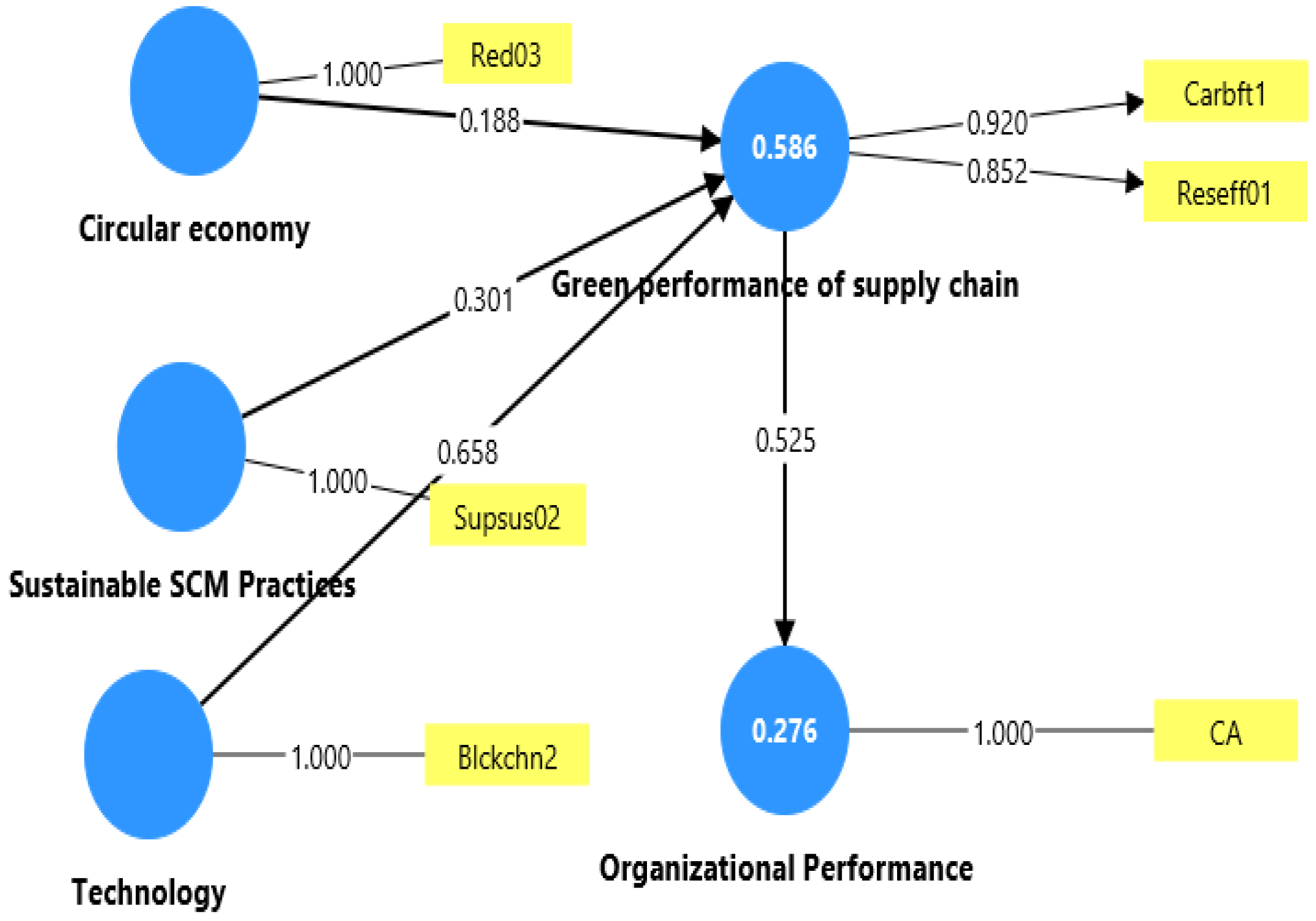
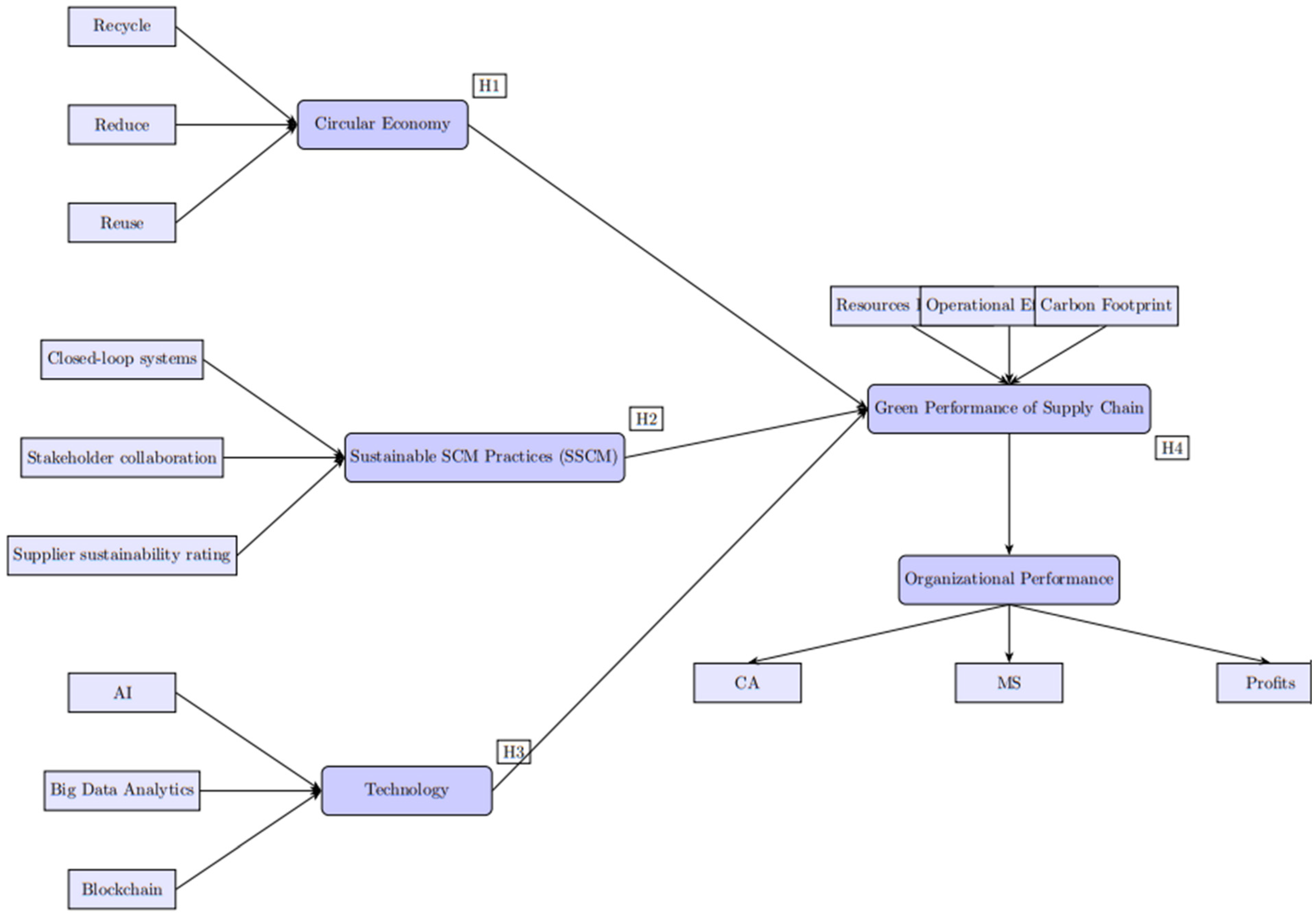
| Hypothesis | Relationship | Path Coefficient (β) | Result |
|---|---|---|---|
| H1 | Circular Economy → Green Supply Chain Performance | 0.188 | Supported |
| H2 | Technology Integration → Green Supply Chain Performance | 0.658 | Supported |
| H3 | Sustainable SCM Practices → Green Supply Chain Performance | 0.301 | Supported |
| H4 | Green Supply Chain Performance → Organizational Performance | 0.525 | Supported |
Disclaimer/Publisher’s Note: The statements, opinions and data contained in all publications are solely those of the individual author(s) and contributor(s) and not of MDPI and/or the editor(s). MDPI and/or the editor(s) disclaim responsibility for any injury to people or property resulting from any ideas, methods, instructions or products referred to in the content. |
© 2026 by the authors. Licensee MDPI, Basel, Switzerland. This article is an open access article distributed under the terms and conditions of the Creative Commons Attribution (CC BY) license.
Share and Cite
Davidaviciene, V.; Diab, B.; Al Majzoub, M. Effects of Circular Economy Principles, Technological Integration, and Sustainable Supply Chain Management Practices on Green Supply Chain and Organizational Performance. Logistics 2026, 10, 93. https://doi.org/10.3390/logistics10040093
Davidaviciene V, Diab B, Al Majzoub M. Effects of Circular Economy Principles, Technological Integration, and Sustainable Supply Chain Management Practices on Green Supply Chain and Organizational Performance. Logistics. 2026; 10(4):93. https://doi.org/10.3390/logistics10040093
Chicago/Turabian StyleDavidaviciene, Vida, Bassel Diab, and Mohamad Al Majzoub. 2026. "Effects of Circular Economy Principles, Technological Integration, and Sustainable Supply Chain Management Practices on Green Supply Chain and Organizational Performance" Logistics 10, no. 4: 93. https://doi.org/10.3390/logistics10040093
APA StyleDavidaviciene, V., Diab, B., & Al Majzoub, M. (2026). Effects of Circular Economy Principles, Technological Integration, and Sustainable Supply Chain Management Practices on Green Supply Chain and Organizational Performance. Logistics, 10(4), 93. https://doi.org/10.3390/logistics10040093