2. Literature Review
The circular economy (CE) model is widely adopted by companies to balance economic performance and environmental sustainability. Employing circular economy practices in models leads to numerous benefits to businesses [
1,
2]. These advantages include waste reduction, resource conservation, and extended product lifetimes. CE enhances firm sustainability by extending product lifetimes through systematic screening, repair, and sharing activities [
3]. The 3R framework (Reduce, Reuse, and Recycle) is the predominant conceptual approach for CE implementation found in the academic literature [
11]. This approach delivers a systematic method for optimizing resource use and managing waste. This framework guides organizations away from linear operational models and toward circular ones. Firms often achieve this outcome by transforming their business models from traditional ownership to product sharing facilitated by service-based models [
8].
In the literature, there are several studies that mainly focused on optimizing CE strategies in various industries and fields [
12]. Reddy and Kumar [
9] investigate hybrid manufacturing–remanufacturing systems, assuming that remanufacturing does not reduce demand for new products. Their analysis specifically investigates capacity decisions, balancing trade-offs between disposal, penalty, and holding costs. A model by Shokohyar et al. [
13] analyzes the performance of sustainable product service systems by incorporating both environmental and economic impacts over the product lifecycle. Rabta [
10] introduces a “circular indicator” that determines optimal order quantities and associated costs and revenues, successfully showing that circular products are economically justifiable. Jayakumar et al. [
14] apply this analysis to the electronics industry, examining how laptop manufacturers could optimize both production and collection quantities while simultaneously assessing economic and environmental impacts. However, none of them discuss optimizing refilling programs in the beverage industry as a CE practice.
Among various sectors, the beverage industry is well-suited to adopting CE strategies due to its compact packaging and high-volume sales nature [
4]. Packaging in the beverage industry plays a fundamental role in product promotion, but it also contributes significantly to waste generation [
15]. Reducing packaging waste has become a critical issue for this sector, and the literature provides extensive research in the field of life cycle assessment (LCA) of beverage packaging [
16,
17,
18,
19,
20,
21]. One of the critical issues in packaging in this sector is the high volume of single-use glass bottles due to difficulties in reusing them. For instance, manufacturers and policymakers are seeking to develop new strategies aiming to optimize the washing performance and other operations related to implementing returnable glass bottle systems [
5,
6].
Studies show that reuse practices achieve higher performance than other packaging initiatives [
22]. However, some studies also emphasize the necessity of further investigation to compare reusable and single-use packaging systems for food and beverages using life cycle analysis methods, considering different scenarios and usage conditions [
23]. The combination of refilling and recycling practices for glass bottles can be an effective environmental strategy that also creates local jobs [
24]. However, the efficiency of the reusing practice in the beverage industry is more sensitive to the collection system’s performance and collection rate than the recycling practice [
25]. Therefore, implementing reusable bottle programs requires further investment in collection infrastructure to reach a high performance of the reverse logistics system and increasing customer awareness to minimize the behavioral uncertainty [
26,
27].
While refilling returnable glass bottles offers long-term cost advantages, its success relies crucially on customer collaboration for bottle returns [
7]. Moreover, implementing refilling and reusing systems demands substantial investment in collection and screening processes, which results in higher operational and reverse logistics costs [
8,
28]. Considering factors such as the number of reuse cycles and transportation costs, Simon et al. [
29] emphasize the importance of comparing refill systems against recycling models. In addition, the damage rate and the quality of reusable bottles can be other important factors, as the literature indicates that transporting defective bottles poses another challenge by increasing greenhouse gas emissions and the transportation costs of reverse logistics [
30]. Consequently, effective management strategies are required to optimize the flow of reusable bottles and minimize inherent inefficiencies in the refilling system.
Research Gap and Contribution
Despite extensive research on CLSC and CE practices, there remains a gap in understanding the strategic interactions between manufacturers and collectors in refillable-bottle systems. Specifically, this gap concerns how investment levels in communication efforts and reverse logistics depend on the quality of reusable packaging and its price. This gap motivates our study, which explicitly models the joint strategic interaction between a manufacturer’s communication efforts and a collector’s investments in reverse logistics and return incentives. Our model takes into account factors such as the quality of reusable bottles, damage rates, and customer participation. Accordingly, our study delivers the following contributions that advance both theory and practice:
Theoretical contribution. This study contributes to the analytical CLSC literature by integrating communication and operational decisions into a single decentralized refill system model. Specifically, it introduces communication effort as a strategic demand driver while simultaneously modeling bottle quality, captured through the proportion of undamaged reusable bottles, and the unit price of reused bottles as a contractual transfer between the players. By deriving closed-form Stackelberg equilibrium solutions, the analysis identifies conditions under which improvements in bottle quality or changes in the reusable bottle price alter optimal pricing, communication efforts, and reverse logistics investment. The results reveal that these effects depend on market sensitivity and cost parameters, generating conditional strategic responses.
Managerial contribution. From a practical standpoint, the findings demonstrate that effective refill programs require coordinated strategic decisions across the forward and reverse channels. The analysis shows that improving bottle quality reduces reverse-flow losses and can justify stronger communication efforts, ultimately expanding both demand and collection performance. Furthermore, the model shows how the unit cost of reusable bottles affects product pricing and marketing intensity (communication), potentially shifting costs to consumers or, under certain market conditions, encouraging demand expansion to offset higher reuse costs. These insights provide guidance for managers and policymakers in designing deposit-refund schemes, allocating communication budgets, investing in bottle durability, and structuring reuse pricing agreements. Overall, the study underscores that enhancing bottle quality and carefully managing reusable bottle pricing are central levers for achieving profitability in beverage refill systems.
3. Model Description
This paper presents a game theory model for the beverage industry, focusing on glass bottle refilling, to evaluate the impact of factors such as investment in bottle collection, communication to increase customers’ awareness, and bottle quality in terms of damage rate. In this section, we explain the main assumptions and then formulate the game theory model to maximize the manufacturer’s and the collector’s profits.
This study discusses a game with two main players: a manufacturer
M (he) and a bottle-collecting company
W (she). The beverage manufacturer sells his products in reusable glass bottles at a unit selling price,
p, and a unit production cost,
b. The collector is responsible for investing in collection infrastructures and collecting reusable bottles from the final customers. The priority of
M is receiving the reusable bottles from
W with the unit price
r, and if he needs more bottles rather than the capacity of the collector, he will purchase new ones from another supplier with the unit price,
a. This is due to this fact that not necessarily all the sold bottles will be returned for reusing as some of the customers may not be interested in or a part of the reusable bottles in the market may be damaged before or even during the collection procedure. Moreover,
W sends damaged and overused bottles that have already been reused more than a specific number of times to a recycler. On average
W sells
percent of the collected bottles to a recycler with the unit price,
u. So,
is the expected percentage of perfect reusable bottles that
W sends to
M for refilling. For the damaged bottles, we only consider the collection cost,
c, and for the remaining, there is also a unit cost equal to
x as the operation costs to prepare the bottles for reusing them (e.g., washing, removing the labels, and sending them to
M). Both
c and
x include the relevant transportation cost as well.
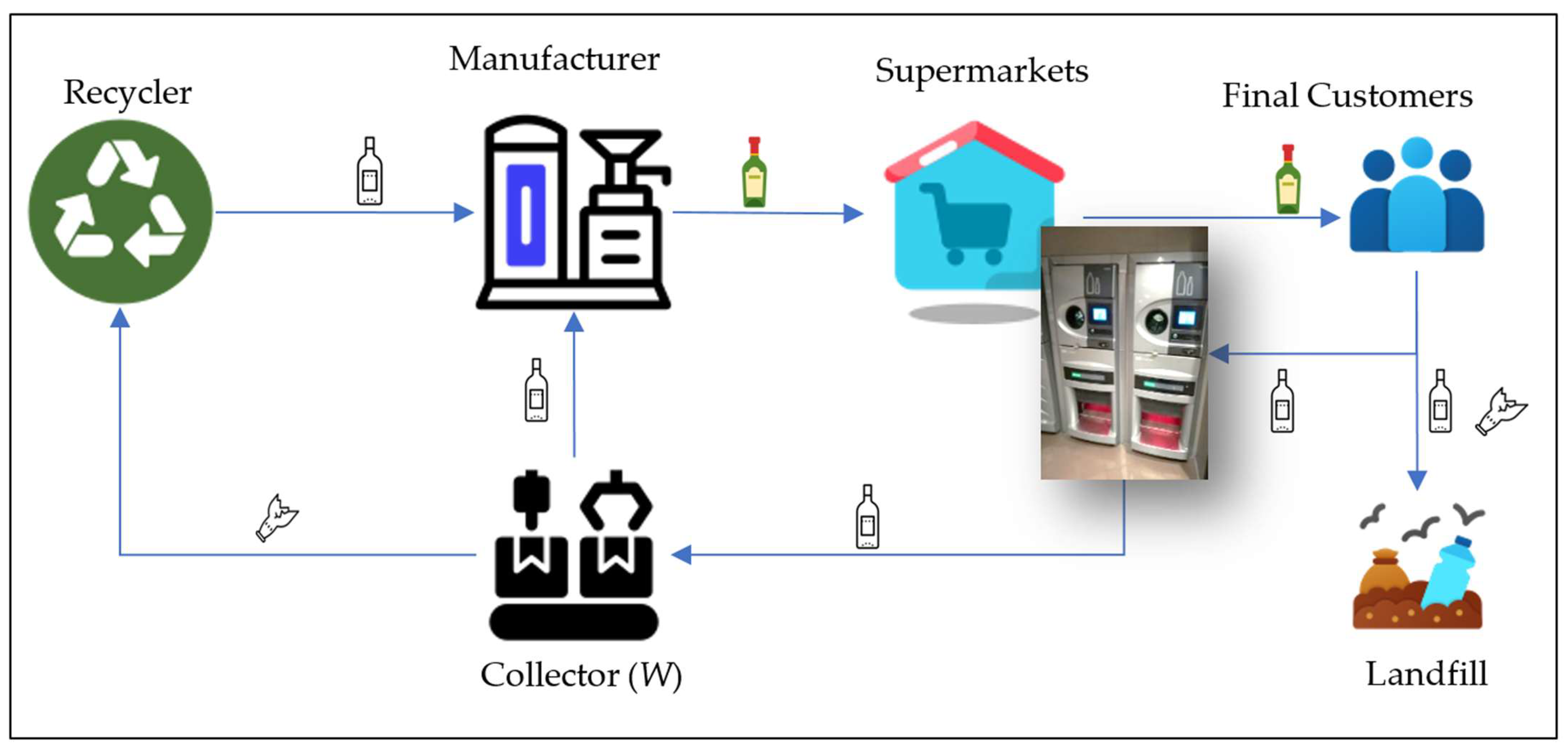
Figure 1 indicates the flow of the glass bottles between different points, including the producer, supermarkets, final customers, collection infrastructures, the collector, and the recycler.
On the one hand, the market demand relies on the product price, p, as well as the effort related to increasing awareness about the positive impacts of reusing glass bottles among consumers, which can positively increase the demand rate. This investment can take several forms, such as improved labeling that highlights reuse benefits, point-of-sale information in supermarkets, and communication campaigns that emphasize the environmental gains from bottle reuse. From now on, we call the investment related to this goal “communication efforts”. So, considering α as the potential market size, we will define demand rate as in which and are the effects of price and communication effort on product demand, and G is the investment level in communication effort.
On the other hand, the collection rate, R, depends on the investment in the collection systems, L, the cost that W pays to customers for returning each unit bottle, s, which is called return incentive cost, and the average percentage of green customers, e, who care about environmental issues even without reimbursement incentives. Accordingly, we define the collection rate as in which and are the effects of payment to customers for returning the bottles and the effect of investment in collection systems, respectively.
In this study, the manufacturer and the collector operate as independent, profit-maximizing entities. They also focus on optimizing distinct decision variables that are partially misaligned in terms of incentives. The manufacturer controls product pricing and communication efforts that influence demand, while the collector determines refund incentives and infrastructure investments that affect collection rates. These decisions are strategically interdependent, and each player’s optimal strategy depends on the other player’s anticipated response. So, this study adopts a game-theoretic framework that best matches these types of analysis. Based on what we explained in this section, we can summarize the main assumptions of this paper as follows:
Assumption 1. The reuse of beverage packaging systems (e.g., glass bottles) operates as a closed-loop supply chain, where glass bottles circulate between the manufacturer, the market, customers, collectors, and back again for reuse as many times as possible before being sent to the recycler. This assumption is aligned with case studies such as reWINE (https://www.rewine.cat/en/project (accessed on 10 December 2025)) and closed-loop supply chain models for reusing, such as the study by [8]. Assumption 2.
The model assumes a sequential decision process in which the manufacturer acts as the leader and the collector responds strategically. This hierarchy reflects common power structures in the beverage industry, where producers typically control pricing and branding decisions, while collection operators adjust their operational policies accordingly [31,32]. Assumption 3.
In our framework, communication investment (e.g., environmental labeling, point-of-sale messaging, and targeted awareness campaigns) directly influences consumer demand for beverages sold in reusable bottles. This assumption reflects empirical findings in circular business model research showing that consumer participation in reuse systems increases when environmental benefits are clearly communicated and understood [33]. Assumption 4.
We assume that the collection rate is positively affected by both investments in reverse logistics infrastructure and monetary return incentives. Improved accessibility and convenience of return systems, together with financial motivation, increase consumers’ likelihood of returning used bottles, thereby strengthening the reverse flow in refill programs [2]. Assumption 5.
Not all collected bottles are suitable for refilling. A fraction of returned bottles is assumed to be damaged, overused, or otherwise unsuitable for reuse. According to the literature on circular economy practices [34], this reflects the operational reality of reuse practice, where breakage, wear, and handling damage reduce the success of reuse programs. Moreover, if the number of reusable bottles supplied by the collector is insufficient to meet total demand, the manufacturer purchases new bottles from an external supplier [8,35]. Assumption 6.
Demand and collection rates are modeled as linear functions, while investments in communication and collection infrastructure are represented by convex (quadratic) cost functions. The linear structure provides a tractable way to capture first-order economic effects and clearly identify the strategic interactions among pricing, communication, refund incentives, and infrastructure decisions. The quadratic investment costs reflect increasing marginal expenditures as effort expands, capturing resource limitations, diminishing marginal efficiency, and growing operational complexity [2,32]. Table 1 summarizes all the model parameters and variables. Accordingly, we provide the objective functions of the manufacturer and the collector as follows, aiming to maximize their profits. In this model,
M determines the optimal values for his unit selling price and his communication effort, and
W determines the unit return incentive cost and the investment level in the collection infrastructure.
Equation (1) maximizes the total profit of the manufacturer by optimizing decision variables
p and
G. The first term,
, calculates the total profit considering
as the unit profit if
M uses new bottles for all the market demand,
D. The second term,
, is the additional profit that
M gains by refilling the bottles considering the part of the collected bottles,
, that he receives from
W for reusing. Accordingly,
is the part of the collected batch that contains perfect reusable bottles, and
is the additional profit that
M obtains from this strategy per unit of reusable bottle compared to filling a new bottle. Finally, for the communication effort, we use a quadratic form that is widely employed in game theory models to support the concavity assumptions [
36,
37]. So,
is the quadratic convex form to calculate the investment in communication effort, considering
as the efficiency of the investment to measure its impact on the objective function, and
G is the total investment.
Equation (2) maximizes the total profit for the W by optimizing the decision variables L and s. In this equation, calculates the profit from selling the reusable bottles to M, excluding the collection costs, defines the total collection costs, including the payable fees to the customers, and is the profit from selling the damaged bottles to the supplier for recycling them. Moreover, is the quadratic convex form to calculate the investment in the collection system, L, when shows the efficiency of the investment and measures its impact on the profit function of W.
4. Equilibrium Analysis
Considering a Stackelberg game, in the first step, M is the leader and decides about using the refilling system and investing in the communication; then, W sets her optimal investment in the collection system, , and optimal unit return incentive cost, , considering the decision variables of M; finally, M takes this information to optimally set his strategies regarding the optimal communication effort level, , and the optimal unit price, .
Proposition 1.
When M decides to participate in the glass bottle refilling program, W determines the investment amount needed for the collection infrastructure, as well as her unit return incentive cost, by optimizing her profit function. Equations (3) and (4) are used to calculate the optimal values for s and L, respectively. In addition, M specifies his optimal strategies concerning the level of communication effort and the unit selling price of his products in the market. Equations (5) and (6) are used to determine the optimal values for p and G, respectively.
Proof. To prove this proposition, calculate and considering and . Then, define and by substituting and into while considering and . □
Condition 1.
The optimal communication effort level and the optimal unit product price will be feasible if .
Proof. The determinant value of the Hessian matrix related to Equation (1) must be greater than zero, and accordingly, we will have . □
Condition 2.
The optimal investment in the collection system and the optimal unit return incentive cost will be feasible if .
Proof. The determinant value of the Hessian matrix related to Equation (2) equals and to have a local maximum, it must be greater than zero. Note that the Hessian matrix is
. □
Condition 3. The optimal strategies for , , , and , will be feasible if , , , and .
Proof. According to Conditions 1 and 2, all the denominators of Equations (3)–(6) are greater than zero (, , , and ) as and . Therefore, to check the feasibility of the optimal values for numerical examples, all the numerators of the aforementioned equations have to gain values greater than zero. So, , , , and . □
Now, based on the optimal values of the decision variables, it is possible to calculate the optimal demand rate, , as well as the optimal collection rate, .
Proposition 2.
Considering the optimal strategies for M and W, Equations (7) and (8) compute the optimal demand rate and the optimal collection rate, respectively.
Proof. Substitute the optimal solutions, which are Equations (3)–(6), into and . As the collection rate itself depends on the demand rate (), its optimal solution is more complicated compared to the optimal demand rate. □
Condition 4.
The optimal demand rate () as well as the optimal collection rate () are feasible if and .
Proof. According to Conditions 1 and 2, , and , resulting in . So, to ensure and , only positive values for and are acceptable to have feasible solutions. □
Proposition 3.
Given the optimal strategies of the players, M and W, Equation (9) and Equation (10) calculate the optimal profits for the manufacturer and the collector, respectively.
Proof. Substitute the optimal solutions of the optimal strategies, which are Equations (3)–(6), into Equations (1) and (2) to obtain and, respectively. □
Condition 5.
The necessary condition to have feasible optimal profits ( and ) for the manufacturer and the collector is having and .
Proof. To satisfy Condition 1 () and Condition 2 (), we will have and . Therefore, and only if and . □
5. Discussion
In this section, we provide a comparative analysis to further discuss the model. The following propositions detail the analytical impact of parameter changes on the optimal strategies.
Proposition 4.
When the manufacturer increases the unit product price, , the collector will increase the unit return incentive cost while decreasing investment in collection infrastructure. Increasing the price generates an increase equal to in the refund price, as well as a decrease equal to in investment in collection systems by the collector.
Proof. Calculate the derivative of and with respect to p, which leads to and , respectively. According to Condition 1, ; hence, we can conclude that and , indicating that by increasing the unit selling price, the collector will raise the unit payment for customers returning bottles, while reducing her investment in the collection system. □
The analytical results of Proposition 4 indicate that increasing the manufacturer’s unit product price negatively affects the demand rate and consequently reduces the collection rate as well. In response, the collector prefers to reduce her long-term investment in the collection systems,
, as her market size declines. However, she tries to compensate for the loss of volume by offering more direct incentives to final customers to increase the number of returned glass bottles. So, there will be an increase in the unit return incentive cost,
, paid by the collector. This proposition aligns with the findings of the research by [
38], which emphasize appropriate pricing decisions that benefit the entire supply chain or the main entities in the value chain.
Proposition 5.
By increasing investment in communication efforts, we can expect a decrease in the unit return incentive cost and an increase in investments in collection systems. For each unit increment in , there will be a corresponding decrease in incentive payments to customers equal to for returning bottles, as well as an increase equal to in the investment in collection systems.
Proof. Calculate the derivative of and with respect to G, resulting in and respectively. According to Condition 1, ; so, and , which indicate that increasing the investment related to the communication effort will reduce refunding fees to customers but require the collector to invest more in the collection systems. □
Proposition 5 emphasizes the vital role of the manufacturer’s investment in communication effort,
, in decisions about collection programs. In other words, increased investment in
G can simultaneously raise both the overall market demand rate and the return rate of bottles. This synergistic effect allows the collector to strategically reduce the unit return incentive cost,
. The resources saved by these incentives can then be redirected to invest in collection systems,
, ultimately improving operational efficiency and the overall collection rate. This dynamic illustrates that greater investment in communication enables collectors to shift resources from short-term incentives to long-term infrastructure investments. This proposition emphasizes the crucial role of information sharing and communication in closed-loop supply chains that can positively impact the return rate and profitability of the entities inside the supply chain [
2,
39,
40].
Proposition 6.
The average percentage of perfect reusable glass bottles will affect the manufacturer’s decision on his unit selling price. On the one hand, if , by increasing the percentage of perfect items, , in the collected batches, the manufacturer decreases his unit product price. On the other hand, if , there will be an increase in p. For each unit increase in , the manufacturer will decrease/increase p at an amount of .
Proof. Calculate the derivatives of with respect to , which leads to . According to Condition 1, , and based on Condition 2, . So, if , then ; otherwise, we can conclude that . □
This proposition reveals the role of quality in adopting circular economy practices, such as reuse. In other words, higher quality provides greater opportunities for reusing products by increasing their longevity [
31,
35,
41]. Moreover, according to the next proposition, increasing the quality and, accordingly, reducing the damage rate will encourage the manufacturer to invest more in this communication effort as there is a greater possibility for increasing the collection rate due to more available reusable products (in our case, bottles) on the consumer side [
41].
Proposition 7.
Increasing leads to a greater investment in communication. For each unit increase in , the manufacturer will increase investment in the advertisement at a value of .
Proof. Calculate the derivative of with respect to , resulting in . According to Conditions 1 and 2, . Moreover, the price of a new bottle is greater than the price of a reused bottle . So, , which indicates an increase in the investment level of the communication effort. □
Following Propositions 6 and 7, the quality of the reusable bottles can be defined by the percentage of perfect reusable glass bottles, . Quality plays a crucial role in optimizing both the unit price of the product and the level of investment in communication. By increasing the possibility of obtaining perfect glass bottles (higher ), the manufacturer is likely to invest more in communication, , due to the higher return rate. However, the pricing decision is conditional on the critical analytical factor . When , it can be interpreted that the manufacturer’s communication impact, λ, on market demand is relatively weak or the effect of price, , on market demand is much higher than the effect of communication. In this case, the manufacturer typically adopts a conventional approach and decreases the unit selling price, , to increase his sales. When , we can interpret this as a strong environmental communication impact on market demand, and the manufacturer adopts a strategy of increasing product price,, as this condition assures a sufficient market size through appropriate communication.
Proposition 8.
If , the greater the , the greater the return incentive when , and the greater the investment in collection infrastructure by the collector. One unit increase in increases and with a value of , and , respectively.
Proof. If , then, considering Condition 2, we can conclude and if . □
Proposition 8 indicates that the collector will have the opportunity to increase her investment in the collection infrastructure when the quality of the reusable bottles is higher. Moreover, she may increase refund incentives in specific cases () to boost the collection rate and eventually achieve higher revenue.
Proposition 9.
The higher the quality of the reusable bottles in terms of the rate of perfectly collected bottles, , the higher the demand rate, D, and the higher collection rate, R, if . The change in the demand and collection rate regarding the changes in the , equals and , respectively.
Proof. Calculate the derivatives of and with respect to , which results in and , respectively. According to the assumptions , and based on Conditions 1 and 2, , which leads to the conclusion . Moreover, if , then . □
The aforementioned proposition underscores the need to improve the collection infrastructure to ensure the maximum collection rate of perfect bottles. In other words, the minimum damage rate increases both the demand and the collection rate, providing an opportunity to scale up the refilling program. Moreover, both partners, including the manufacturer and the collector, can benefit from this condition, scaling up their business models and aiming to enhance their profits while promoting reuse as a circular economy practice in their industry. This proposition underscores the importance of product quality in scaling collection programs to implement circular practices, such as reusing and recycling, drawing on existing studies [
31,
37].
To provide a numerical example, we assume
,
,
,
,
,
,
,
,
,
,
,
,
,
,
. These values ensure satisfying both Conditions 1 and 2. Moreover,
,
,
, and
. Accordingly,
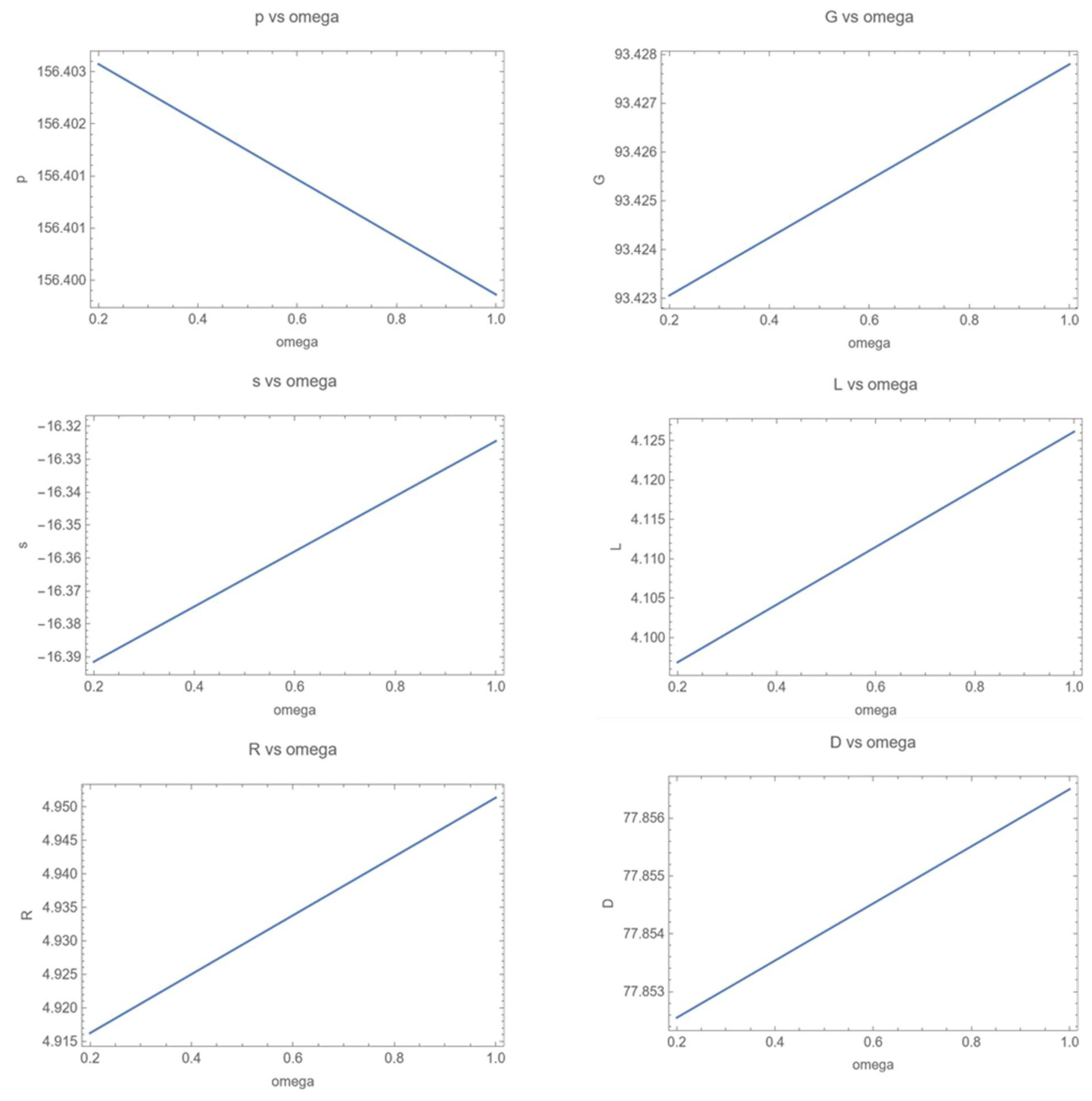
Figure 2 shows the changes in the optimal decisions based on the changes in the
.
Proposition 10.
If , by increasing the unit cost of a reused bottle (the fee that the manufacturer pays the collector per unit of reusable bottle), r, the manufacturer increases his unit product price, and if , then, increasing r reduces the optimal unit selling price of the manufacturer. Increasing one unit in r leads to a fluctuation equal to in the optimal p.
Proof. Calculate the derivative of with respect to , which leads to . According to Conditions 1 and 2, and . So, if , then , and otherwise, . □
This proposition highlights the important impact of reverse logistics costs on the fees for reusable products. To encourage manufacturers and collectors to invest more in circular economy practices, it is essential to analyze the reverse logistics system in relation to the final price of reusable products [
2].
Proposition 11.
The higher the unit cost of the reusable bottle, r, the lower the manufacturer’s investment in communication. Specifically, increasing r by one unit reduces the optimal communication investment level, , by .
Proof. Calculate the derivative of with respect to leading to . According to Conditions 1 and 2, . So, as , then . □
According to Propositions 9 and 10, when the manufacturer faces an increased cost for reusing bottles, r, the analytical result shows he reduces his investment in communication, . This is due to a direct cost-mitigation strategy to optimize his total profit. The pricing decision, however, is strictly conditional on the analytical factor . If , the interpretation is that the impact of communication, λ, is lower than the impact of product price, β, on demand. However, despite the negative impact of price on demand, the manufacturer increases the unit product price while reducing his investment in communication, aiming to offset the additional cost imposed by the collector. In other words, simply reducing spending on communication cannot fully compensate for the increased costs associated with the collector. If , the manufacturer reduces the unit selling price, , as he can increase his sales to increase the volume of collected bottles. So, he can compensate for the increase in the price of the reused bottles by increasing the total demand. However, also in this case, he will reduce investment in communication despite , which can be interpreted as a highly impactful communication effort on demand. The reason is related to the investment cost, , besides the lower difference between the price of new and reused bottles after increasing r.
Proposition 12.
The greater the , the greater the return incentive if , and the greater the investment in collection infrastructure by the collector. One unit increase in r can lead to , and can lead to a unit increase in the and , respectively.
Proof. Calculate and , which results in and respectively. Considering Conditions 2, and accordingly and if . □
According to Proposition 12, increasing the unit price of the reusable bottle gives the collector the opportunity to increase her revenue and, accordingly, invest more in reverse logistics infrastructure and refund incentives.
Proposition 13.
The higher the unit cost of a reused bottle, , the less the demand rate, D, and the less the collection rate, R, if . The change in the demand and collection rate regarding the changes in the , equals and , respectively.
Proof. As and and according to Conditions 1 and 2, , , and if
, then as well. □
This proposition indicates that the higher cost of reusable bottles negatively affects demand and collection rates.
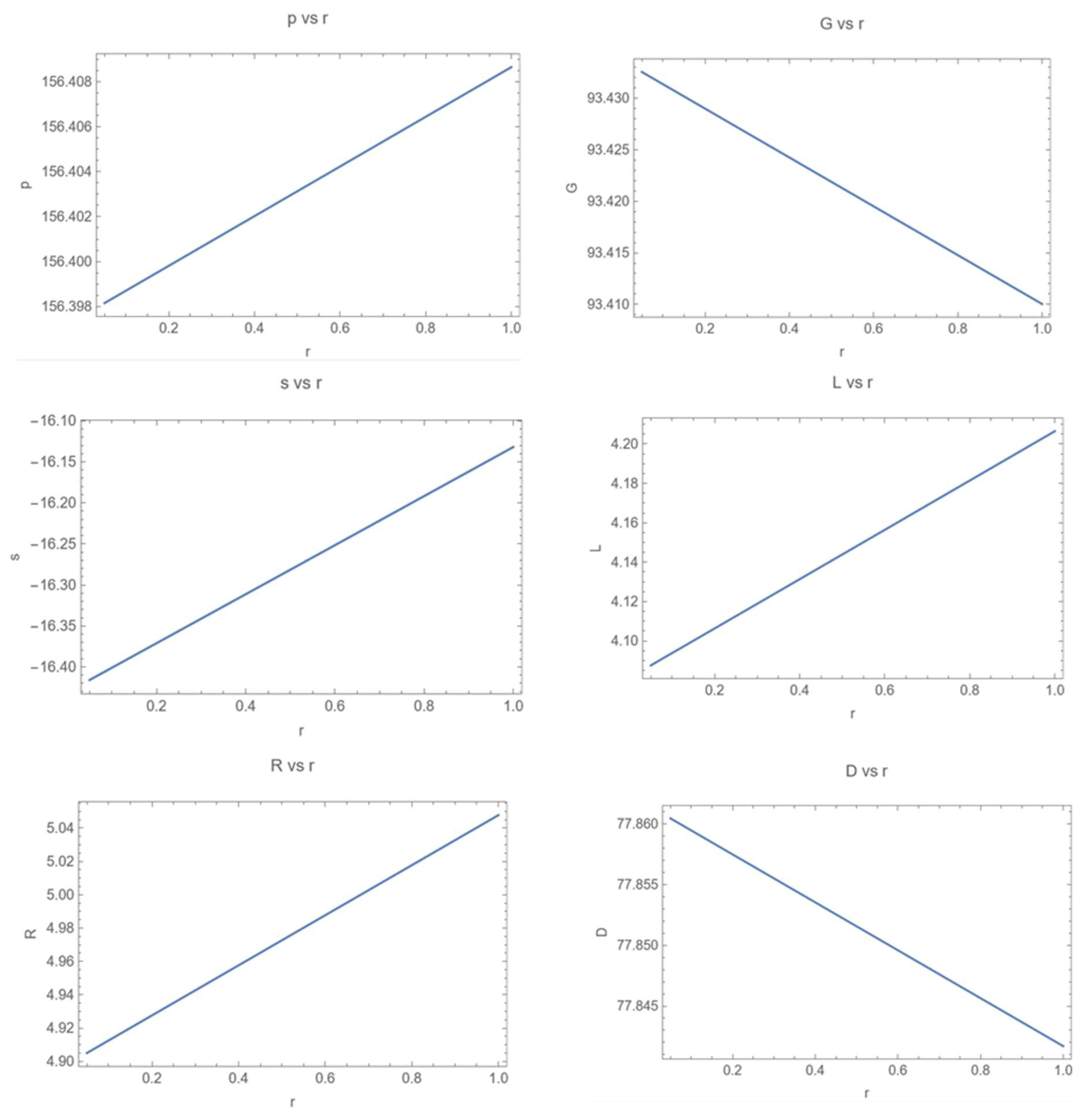
Figure 3 shows the changes in the optimal solutions based on the changes in the unit price of the reusable bottle,
r.
Table 2 summarizes the analysis outputs according to the propositions and indicates how sensitive the optimal decisions are to the main parameters
and
r.
6. Theoretical and Managerial Insights
According to the results and propositions related to our analysis, we summarize the main theoretical implications and the managerial insights for developing refilling models in the beverage industry as follows.
6.1. Theoretical Implications
The analysis contributes to understanding strategic interdependence in decentralized refill systems by showing how forward-channel decisions shape reverse-logistics incentives. The results indicate that the manufacturer’s pricing decision directly affects the collector’s optimal refund and infrastructure strategies. A higher product price increases the refund incentive offered by the collector while discouraging long-term investment in reverse logistics infrastructure. In contrast, greater communication effort expands demand and collection volumes, allowing the collector to rely less on costly incentives and instead allocate more resources to infrastructure development. These findings highlight the substitutive and complementary relationships between marketing effort and reverse logistics investments in decentralized circular systems. Moreover, in some cases, a higher proportion of undamaged bottles directly strengthens the collector’s incentives to increase both the return incentive and infrastructure investment. This result reveals that quality improvements not only affect the manufacturer’s strategic decisions but also amplify reverse-channel investment when reuse is sufficiently profitable.
The model further demonstrates that bottle quality, captured through the proportion of undamaged reusable bottles, plays a strategic role in the system. Improvements in bottle quality reduce losses in the reverse channel and can alter optimal pricing and communication efforts depending on market sensitivity conditions. Under specific parameter configurations, higher quality may justify an increase in product price while simultaneously stimulating greater communication effort and infrastructure expansion.
In addition, the unit price of reusable bottles functions as a strategic transfer variable that redistributes incentives between the manufacturer and the collector. The analysis shows that increases in the cost of reusable bottles may be passed on to consumers through a higher product price or offset by adjustments in communication effort aimed at sustaining demand, depending on the relative effectiveness and cost of communication. Beyond its effect on the manufacturer’s decisions, a higher reusable bottle price also directly encourages the collector to raise refund incentives and expand infrastructure investment when standard concavity conditions hold. This finding establishes the reusable bottle price as a coordination mechanism that can intensify reverse-channel investment by improving the collector’s margin on reusable bottles.
For academics and researchers, these results extend the literature on closed-loop supply chains by explicitly integrating communication efforts, reverse logistics investment, and pricing considering quality parameter within a unified Stackelberg structure. The framework can serve as a benchmark model for future studies examining coordination contracts, different collection systems, or dynamic reuse environments.
6.2. Managerial Insights
From a managerial perspective, the findings suggest that refill programs require coordinated decisions across pricing, communication, and reverse logistics policies rather than isolated operational improvements. First, excessive reliance on high product pricing can undermine reverse logistics development by encouraging refund incentives over long-term infrastructure investment. Managers should therefore balance pricing strategies with demand-expanding communication initiatives.
Second, investing in bottle quality and reducing damage rates emerges as a critical lever for improving system performance. Higher-quality bottles reduce reverse-channel losses, increase effective reuse volumes, and create conditions under which communication investments become more profitable. Moreover, improving bottle quality not only benefits the manufacturer but also motivates the collector to increase both return incentives and infrastructure investment. This implies that quality improvements can directly stimulate reverse-channel expansion when reuse is sufficiently profitable. Practical actions may include adopting more durable bottle designs, improving handling processes, and implementing collection technologies that reduce breakage.
Third, an increase in the cost of reusable bottles directly influences the manufacturer’s optimal product price and communication effort. Under certain market conditions, a higher cost of reusable bottles is passed on to consumers through a higher retail price, which may weaken demand and reduce incentives for investment in reverse logistics. Under alternative parameter conditions, the manufacturer may adjust pricing and communication decisions to preserve demand levels. In addition, a higher reusable bottle price strengthens the collector’s incentive to raise refund payments and expand collection infrastructure. Therefore, reusable bottle pricing should be designed carefully, as it affects not only retail pricing but also the intensity of reverse logistics investment. These results highlight the importance of aligning reusable bottle pricing with market responsiveness and communication effectiveness to sustain both profitability and collection performance.
Overall, the results indicate that successful refill systems depend on aligning bottle quality investments, communication spending, and reuse pricing policies to achieve mutually beneficial outcomes for both channel members.
For industry managers, the findings provide guidance on how to structure pricing policies, communication budgets, and investment in bottle quality in a coordinated manner to scale refill programs sustainably. For policymakers designing circular packaging regulations, the results highlight the importance of ensuring that reuse margins remain sufficiently attractive relative to recycling, as this directly influences private-sector incentives to invest in collection infrastructure. Overall, the study offers a structured decision framework to help stakeholders evaluate how adjustments to pricing, quality standards, or refund levels may propagate through the entire refill system.