1. Introduction
Recent industry trends such as extensive outsourcing, supplier base consolidation, and lean production practices have increased operational interdependencies and reduced buffers against uncertainty, thereby heightening supply chain vulnerability [
1]. These risks could result from catastrophic events or disturbances imposed by the actions of humans, potentially causing significant financial and operational challenges that could ultimately threaten business continuity [
2,
3]. In recent years, supply chain risk (SCR) and their adverse effects on operational continuity and firm performance have drawn a lot of interest from supply chain management (SCM) experts and practitioners [
4,
5]. This increasing uncertainty emphasizes the necessity of exploring supply chain robustness (SCROB) and supply chain resilience (SCRES), as they are critical abilities for maintaining business performance [
6,
7,
8]. Supply Chain Risk Management (SCRM), which helps companies reduce risks and maintain operations, has become a crucial strategic competency in response to these issues [
9,
10]. In order to lessen the negative impact of disruptions on supply chain operations, SCRM includes risk mitigation techniques applied to information flows and products from suppliers to ultimate customers [
11].
Resilience and robustness are two fundamental concepts in risk management. SCRES refers to a company’s capacity to withstand disruptions, recover to its initial state, or adapt toward a more favorable position following a disturbance [
12]. In contrast, SCROB represents the capacity to maintain intended performance despite disruptions [
13]. Resilient supply chains can withstand shocks, get back to business as usual, and keep a competitive advantage [
14,
15]. Therefore, developing and implementing effective SCRES strategies within SCM holds great potential for strengthening supply chains against unexpected challenges. Recently, a number of industries’ supply networks have been put to the test by the COVID-19 epidemic, which has resulted in production halts, delayed reaction times, and shortages of supplies [
16]. This situation underscores the need to evaluate how companies can deploy supply chain risk management (SCRM) practices to mitigate the impact of disruptions. While SCRM has been widely studied (e.g., [
14]), the interactions between SCRM practices, disruptions, SCRES, and SCROB remain underexplored. This paper aims to address these gaps by providing a research model that examines how SCRM practices enhance SCRES and SCROB by mitigating disruption impacts. This research makes two main contributions. First, it responds to calls from academics for more empirical investigation of SCRM, supply chain resilience (SCRES), and robustness (SCROB), as well as the application of Organizational Information Processing Theory (OIPT) and Dynamic Capabilities Theory (DCT) in the context of SCRM (e.g., [
17,
18]).
Despite these demands, few studies have examined the connections between SCRM, robustness, and resilience at the same time, and no earlier research has looked into how disruption impacts mediate these relationships. Furthermore, there is still a lack of empirical research in emerging economies, especially in Morocco, where supply chains are subject to particular institutional and structural limitations, such as reliance on informal coordination mechanisms, limited supply chain visibility, uneven digitalization, reliance on foreign sourcing and supply chain vulnerability. These traits influence how businesses handle risks and react to disruptions, suggesting that SCRM may affect robustness and resilience through context-specific pathways that have not received enough attention in the literature.
Second, this study builds on previous conceptual work by integrating Dynamic Capabilities Theory (DCT) and Organizational Information Processing Theory (OIPT) to provide new insights into how firms deploy SCRM practices to mitigate the effects of supply chain disruptions (e.g., [
19]). By addressing the key gaps, this research offers original empirical contributions that enhance both theoretical understanding and practical applications in supply chain risk management.
2. Literature Review
2.1. Theoretical Background
Few studies have examined how firms might develop resilience through the application of SCRM methods to lessen the effects of disruptions, despite prior research emphasizing the significance of resilience in a firm’s capacity to manage supply chain disturbances through the implementation of SCRM practices to mitigate disruption impacts. To explore how SCRM practices can reduce these impacts and enhance SCRES and SCROB, we draw on the DCV and OIP theories.
2.1.1. Dynamic Capabilities Theory
Expanding upon the RBV, the DCT emphasizes the restoration and adaptability of current resources [
20,
21]. Repetitive activities based on tacit knowledge give organizations a competitive edge through the acquisition of dynamic capabilities [
22]. According to DCT, in order for businesses to react to unanticipated events, they must integrate, create, and reconfigure both internal and external capabilities and disruptive threats and to quickly change environments [
21]. Effective supply chain risk management requires flexibility and adaptation in the face of unpredictability, which is highlighted by this theory.
In this context, SCRM develops as a dynamic capability that reshapes how firms ensure their survival during disruptions [
23]. By integrating and reconfiguring operational capabilities, especially through SCRM practices, firms can improve SCRES and partners during times of disruption. Thus, SCRM acts as a strategic mechanism to manage uncertainty and safeguard the business’s competitive edge in the face of external challenges.
Previous research supports this perspective, identifying SCRM practices as vital for preparing for risks, responding to, and recovering from unforeseen disruptions [
24,
25]. Moreover, scholars have examined how supply chain partners utilize dynamic capabilities to adapt to market changes and disruptions, often mobilizing cross-organizational processes to do so [
26]. This suggests that effective adaptation to disruptions goes beyond individual firms and requires coordinated action across the supply chain.
Therefore, an invaluable framework for comprehending how businesses and supply chain partners manage resources and capabilities to handle risks and disruptions is provided by dynamic capabilities [
27,
28]. To effectively respond to disruptions, firms must realign their resources and processes, emphasizing the need for continuous adaptation and learning [
29]. This highlights how crucial SCRM is as a dynamic capability that makes this realignment possible and improves the supply chain’s overall resilience.
2.1.2. Organizational Information Processing Theory
Organizations must successfully manage and process information in order to overcome complexity and uncertainty, according to Organizational Information Processing Theory (OIPT), which is essential for success in dynamic and unpredictable contexts [
30]. This theory states that aligning information processing capabilities with environmental demands is vital, especially for supply chains exposed to risks such as supply disruptions, demand fluctuations, and operational failures [
31]. Organizations can enhance their information processing skills and prepare for, handle, and recover from disruptions by utilizing structural, process, and technological advances tools [
32]. When these competencies are effectively developed, organizations improve their overall performance [
33].
Effective information processing is key to making timely and informed decisions, which are essential for maintaining SCRES and SCROB. This is particularly important in the context of supply chain disruptions, where the ability to process information rapidly can determine an organization’s ability to recover. By applying OIPT principles, firms can create a framework that supports the development of dynamic capabilities to manage risks more effectively [
31]. The OIPT framework further emphasizes the importance of formalizing processes for collecting and interpreting critical information. This improves an organization’s preparedness, helping to reduce the impacts of disruptions and strengthen overall resilience [
34,
35]. In this context, SCRM practices emerge as essential capability. These practices are not only learned and implemented within organizations but are also shared and refined across supply chain partners. By guaranteeing supply chain robustness and bolstering resilience in the face of numerous interruptions, SCRM aims to improve business performance [
18]. By integrating OIPT with SCRM, firms can better configure and manage resources to address the uncertainty and complexity of supply chain risks. Thus, OIPT offers a solid theoretical framework for comprehending how firms manage information to cope with uncertainty. In the specific context of SCRM, applying OIPT principles allows firms to develop the dynamic capabilities required to enhance their resilience and robustness during disruptions.
2.2. Hypotheses Development and Research Model
2.2.1. The Impact of SCRM on Disruption Risks
Operational and disruption risks are the two primary categories into which supply chain risks occur [
36,
37]. Operational risks are associated with routine disturbances in supply chain activities, such as fluctuations in lead times and demand. Disruption risks, on the other hand, relate to rare but significant occurrences, such as the COVID-19 pandemic, which exemplifies the severity of such disruptions and highlights the necessity of plans to handle these important occurrences [
17].
To address and mitigate disruption risks, researchers have proposed various SCRM tools, incorporating four interrelated processes: risk identification, risk assessment, risk mitigation, and risk control [
27,
38]. The ultimate goal of SCRM practices is to limit the impacts of disruptions that threaten the continuity of operations within the supply chain [
28], making SCRM an essential component for the survival and success of a business.
SCRM is widely regarded as essential in lessening the impact of disturbances. Effective SCRM practices are known to reduce supply chain vulnerability and minimize the impact of disruptions. This proactive approach is crucial in preventing minor issues from escalating into significant disruptions. Reference [
39] emphasizes that implementing robust SCRM strategies helps maintain supply chain continuity during disruptive events. Similarly, [
40] argues that strong SCRM frameworks enable firms to manage risks effectively, reducing their vulnerability to disruptions. Reference [
14] reinforces this perspective, asserting that SCRM practices enhance the resilience of the supply network to interruptions and its ability to recover, which is essential for maintaining operational stability.
Risk Identification
Risk identification is a fundamental component of SCRM, allowing firms to detect potential disruptions early. References [
5,
41] stress the importance of regular screening to accurately identify risk sources. Early detection is essential, as the severity of a disruption’s impact is closely linked to how quickly risks are identified [
28]. Given the complexity of supply chains and the limitations of resources, effective risk identification is critical for optimizing SCRM efficiency [
14].
Risk Assessment
Risk assessment refers to the process of analyzing risks to determine their likelihood and possible impact after they have been recognized. This process helps prioritize risks and allocate resources effectively. According to [
42], risk assessment includes both qualitative and quantitative analysis to assess the severity and probability of risks. Reference [
43] emphasizes that risk assessment enables firms to understand the potential consequences of various risks, guiding the development of appropriate mitigation strategies. Reference [
44] suggests that risk assessment should also consider the interdependencies between different risks and their cumulative effects on the supply chain.
Risk Mitigation
In order to improve supply chain resilience, risk mitigation entails putting procedures into place that decrease the potential or impact of risks that have been identified. Reference [
12] argues that risk mitigation strategies include diversifying suppliers, building safety stocks, and creating flexible transportation options. Reference [
40] underscores the importance of developing contingency plans and ensuring redundancy within the supply chain to ensure continuity during disruptions. Reference [
45] suggests that fostering collaborative relationships with suppliers and customers is an effective risk mitigation strategy, promoting the exchange of knowledge and collaborative problem-solving.
Risk Control
Risk control is the process for regularly evaluating and modifying risk management plans to guarantee their efficacy. To do this, risk management plans must be reviewed and updated on a regular basis in light of new information and evolving circumstances. Reference [
14] stresses that risk control is essential for maintaining an adaptive and responsive supply chain. Reference [
27] adds that effective risk control requires robust performance metrics and feedback mechanisms to assess the success of risk mitigation efforts. Reference [
46] suggests that technological advancements, such as real-time data analytics and supply chain visibility tools, can enhance risk control by providing timely insights into potential disruptions.
Given that effective SCRM requires a coordinated effort across all key processes, risk identification, assessment, mitigation, and control to reduce the impact of supply chain disruptions, we suggest the following hypothesis:
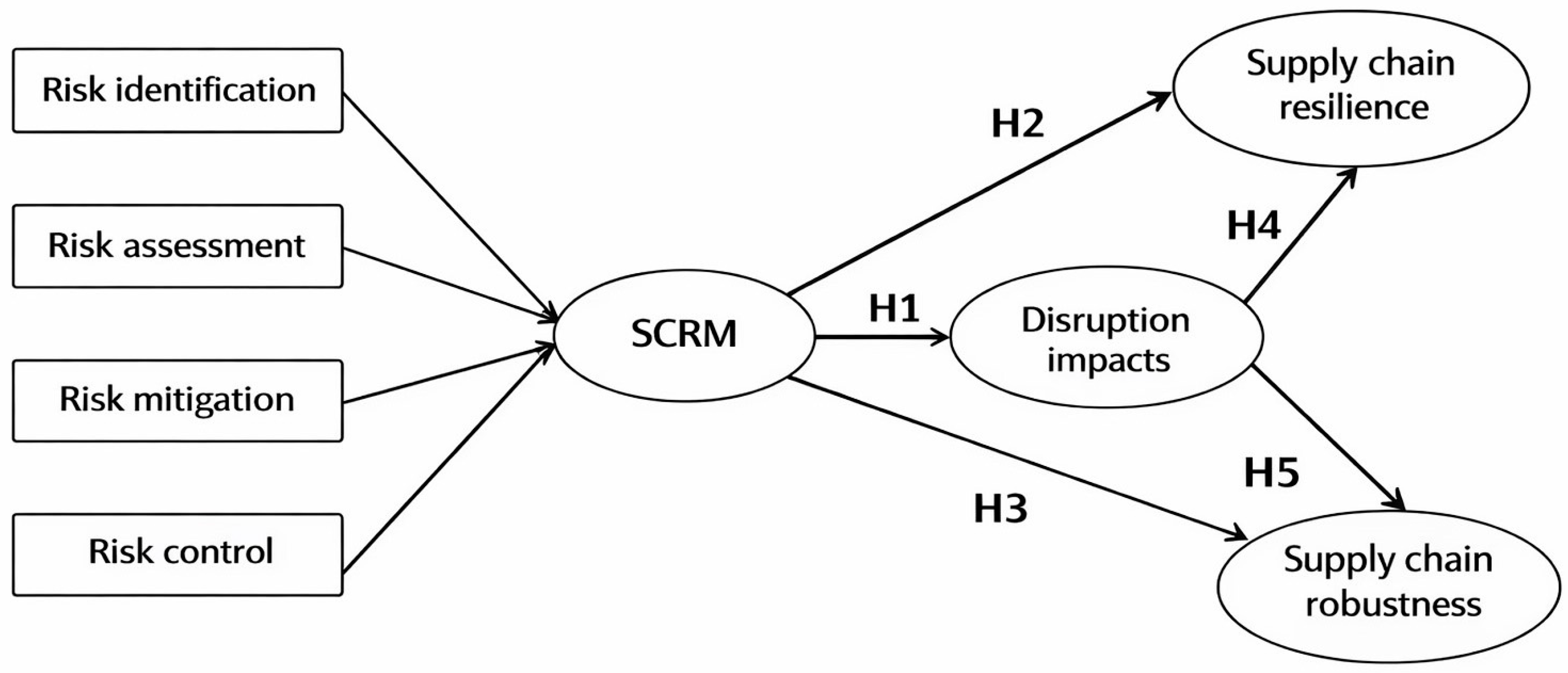
H1. Supply chain risk management practices, specifically, risk identification, assessment, mitigation, and control, have a significant positive effect on mitigating disruption impacts in the supply chain.
2.2.2. The Impact of SCRM on SC Resilience and Robustness
The ability of a supply chain to foresee, react to, and recover from disturbances while preserving operations at a satisfactory level is known as SCRES [
24]. In contrast, supply chain robustness refers to the capacity to sustain operational performance under various conditions without being significantly impacted by disruptions [
40]. Despite their close relationship, resilience and robustness represent conceptually different abilities. In order to sustain operations in the face of possible disruptions, supply chain robustness is essentially an ex ante capability that emphasizes preventive measures, redundancy, and structural stability. Resilience, on the other hand, is an ex post capability that emphasizes flexibility, adaptive response, and recovery following disruptions. Resilience allows the supply chain to adjust, learn, and regain performance in the face of unforeseen circumstances, whereas robustness seeks to prevent deviation from regular operations. Understanding how SCRM practices affect each outcome through various mechanisms requires being able to distinguish between these two constructs. Consequently, both resilience and robustness are essential for ensuring the long-term stability and efficiency of supply chain operations in the face of unforeseen challenges. The relationship between SCRM and these two key attributes has been widely recognized in the literature. Several studies suggest that implementing effective SCRM practices can enhance both resilience and robustness by reducing vulnerabilities and strengthening the capacity of the supply network to tolerate interruptions [
17,
18,
28,
34,
47]. To achieve this, firms must adopt a combination of proactive and reactive risk management strategies that enable them to anticipate potential threats and mitigate their impact [
48].
One of the key ways in which SCRM contributes to supply chain resilience is through structured risk identification, assessment, mitigation, and control. By continuously monitoring and managing risks, firms develop adaptive capabilities that enable them to react quickly to disturbances [
12]. For example, having well-defined contingency plans and alternative sourcing strategies ensures operational continuity during unexpected events [
49]. In addition, fostering collaboration with supply chain partners enhances resilience by facilitating information sharing and joint problem-solving, making the entire network more agile and responsive [
45].
Beyond resilience, SCRM also plays a crucial role in strengthening supply chain robustness. Measures such as supplier diversification, maintaining safety stocks, and incorporating redundancies reduce firms’ exposure to potential disruptions [
40]. These strategies ensure that supply chains remain functional even in volatile environments. Furthermore, incorporating cutting-edge technologies, like supply chain visibility tools and real-time data analytics, enhances robustness by providing timely insights and enabling informed decision-making [
16]. Empirical evidence supports these claims, for instance, [
19] found that firms with well-established SCRM practices demonstrated higher resilience and were better equipped to maintain operations during disruptions. Similarly, [
29] highlighted that effective SCRM strategies significantly contribute to improving supply chain robustness. Given these findings, it is reasonable to hypothesize that SCRM has a direct and positive impact on both resilience and robustness. Therefore, we propose the following hypotheses:
H2. SCRM practices have a significant positive effect on supply chain resilience.
H3. SCRM practices have a significant positive effect on supply chain robustness.
2.2.3. The Impact of Disruptions on Supply Chain Resilience and Robustness
Supply chain environments are inherently exposed to various sources of uncertainty and vulnerability [
12]. Disruptions, whether caused by natural disasters, geopolitical events, or operational failures, can expose weaknesses within supply chains by affecting processes, structures, and interdependencies among supply chain partners. These disruptions often result in delays, increased costs, and lost sales, ultimately weakening a supply chain’s ability to maintain operational continuity [
50]. As such, disruptions serve as real-world tests of a supply chain’s preparedness and the effectiveness of its risk management strategies. This underscores the importance of not only managing routine operational risks but also developing contingency plans for high-impact, low-frequency events.
From a conceptual perspective, disruption impacts affect supply chain robustness and resilience through distinct mechanisms. Robustness is primarily challenged during the disruption phase, as severe impacts directly impair the supply chain’s ability to absorb shocks and maintain operational performance. In contrast, resilience is mainly affected in the post-disruption phase, where high disruption impacts constrain recovery processes, learning, and adaptive responses.
The literature clearly distinguishes between the effects of disruptions on supply chain robustness and resilience. Robustness refers to a supply chain’s ability to absorb shocks and maintain its intended level of performance during a disruption, whereas resilience reflects its ability to recover, adapt, and potentially improve following the disruptive event. From this perspective, disruption impacts undermine robustness by directly impairing the supply chain’s capacity to sustain operations under stress. At the same time, severe or prolonged disruption impacts weaken resilience by constraining recovery processes, learning mechanisms, and adaptive responses.
Prior studies support this distinction [
2,
51] show that disruptions can significantly degrade operational performance, thereby weakening robustness when supply chains are unable to absorb shocks effectively. Similarly, refs. [
12,
34] argue that disruptions expose latent vulnerabilities that hinder recovery and adaptation, negatively affecting resilience. Although related, robustness and resilience are therefore affected through different mechanisms: robustness is challenged during the disruption phase, while resilience is primarily affected in the post-disruption recovery and adaptation phase.
Although resilience and robustness are closely related, they represent complementary but non-identical capabilities. Disruption impacts undermine robustness by reducing performance stability during unexpected events, while they weaken resilience by limiting the supply chain’s capacity to recover, reconfigure, and adapt after the disruption has occurred. This distinction justifies the formulation of two separate hypotheses addressing the negative effects of disruption impacts on robustness and resilience.
Accordingly, disruption impacts are expected to weaken both robustness and resilience, albeit through different pathways related to resistance during disruption and recovery after disruption. Therefore, the following hypotheses are proposed:
H4. Supply chain resilience is negatively influenced by disruption impacts.
H5. Supply chain robustness is negatively influenced by disruption impacts.
2.2.4. The Mediating Role of Disruption Impacts in the Relationship Between SCRM, SCRES and SCROB
Numerous scholars have investigated the direct relationship between SCRM practices and the resilience and robustness of supply chains. Research by [
28,
34,
47] suggests that firms actively engaging in SCRM practices are better equipped to develop resilient and robust supply chains. By proactively identifying potential risks and implementing mitigation strategies, companies can strengthen their ability to endure disruptions and recover efficiently [
52].
In parallel, the existing literature highlights the significant impact of disruptions on SCRES and SCROB Studies by [
2,
49] emphasize that disruptions challenge the stability of supply chains, testing their ability to sustain operations and recover effectively. Since resilience and robustness are defined by a supply chain’s capacity to resist and adjust to unexpected events, it becomes essential to understand how disruptions influence these attributes and how firms can mitigate their effects. This perspective underscores the critical role of SCRM practices not only in directly enhancing supply chain resilience and robustness but also in managing disruption impacts. During periods of disruption, the firm’s capacity to evolve and deploy its resources and capabilities through SCRM enables it to minimize negative consequences and maintain operational continuity.
The current study examines disruption impacts as a mediating variable between SCRM practices, supply chain robustness and resilience. SCRM practices may not completely mitigate disruptions, even though they try to foresee, reduce, and address possible risks. As a result, disruptions continue to have a big impact on SC performance. Theoretically and based on Dynamic Capabilities Theory (DCT), SCRM represents the firm’s capacity to detect, seize, and reconfigure resources in response to external shocks, which lessens the detrimental effects of disruptions on resilience and robustness. In the same way, Organizational Information Processing Theory (OIPT) asserts that companies should improve their information-processing capacities in order to identify and address disruptions and reduce their effects. According to empirical research, SCRM practices operate by reducing the impact and consequences of disruptions rather than directly improving resilience or robustness [
24,
34]. Therefore, modeling disruption impact as a mediator enables both the assessment of any direct effects and the identification of the indirect mechanism through which SCRM practices enhance supply chain robustness and resilience.
Based on the arguments presented earlier, that SCRM practices help mitigate disruption impacts (Hypothesis 1), that SCRM practices influence supply chain resilience and robustness (Hypotheses 2 and 3), and that disruption impacts affect resilience and robustness (Hypotheses 4 and 5), we propose that SCRM practices also exert an indirect effect on supply chain resilience and robustness by reducing disruption impacts. Otherwise, the effectiveness of SCRM practices is not only reflected in their direct influence on resilience and robustness but also in their capacity to mitigate the adverse effects of disruptions, ultimately strengthening the overall supply chain.
Building on these insights and the various SCRM practices discussed, this study formulates the succeeding hypotheses:
H6. Disruption impacts mediate the relationship between supply chain risk management (SCRM) practices and supply chain resilience (SCRES).
H7. Disruption impacts mediate the relationship between supply chain risk management (SCRM) practices and supply chain robustness (SCROB).
Building on the preceding discussion,
Figure 1 presents the research model developed in this study to examine the relationships between supply chain risk management (SCRM) practices, disruption impacts, supply chain resilience (SCRES), and supply chain robustness (SCROB). In this model, SCRM is conceptualized as a higher-order construct composed of four key processes: risk identification, risk assessment, risk mitigation, and risk control. Together, these processes reflect the systematic efforts undertaken by firms to anticipate supply chain risks and manage their consequences. The model assumes that SCRM practices influence supply chain outcomes through both direct and indirect mechanisms. On the one hand, SCRM practices are expected to reduce the severity of disruption impacts (H1), highlighting their preventive and mitigating role. On the other hand, SCRM is hypothesized to directly strengthen supply chain resilience (H2) and supply chain robustness (H3), by supporting adaptive recovery capabilities and reinforcing structural resistance to disruptions. Disruption impacts are also explicitly incorporated into the model as a key explanatory factor. It is assumed that higher disruption impacts weaken supply chain robustness by impairing performance during disruptive events (H5), while simultaneously constraining recovery and adaptation processes, thereby negatively affecting supply chain resilience (H4). This distinction reflects the different temporal and functional roles of robustness and resilience in disruption contexts.
Finally, the model considers disruption impacts as a mediating mechanism linking SCRM practices to both resilience and robustness. Accordingly, disruption impacts are hypothesized to mediate the relationship between SCRM practices and supply chain resilience (H6), as well as between SCRM practices and supply chain robustness (H7). This approach allows the model to capture not only the direct effects of SCRM on supply chain capabilities, but also the extent to which these effects operate through the management of disruption impacts.
3. Methodology
This study conducted a survey among manufacturing companies in Morocco using a structured questionnaire specifically developed for this research. The survey focused on seven key constructs: disruption impacts, risk identification, risk assessment, risk mitigation, risk control, supply chain robustness, and supply chain resilience. The measurement items for each construct were revised from established research [
14,
17,
28,
34,
47].
To ensure content validity, four academic experts reviewed the questionnaire and assessed the relevance of each item. The choice of four experts is consistent with recommendations in the literature, which suggest that 3 to 10 experts are sufficient to obtain reliable judgments on item relevance [
53,
54,
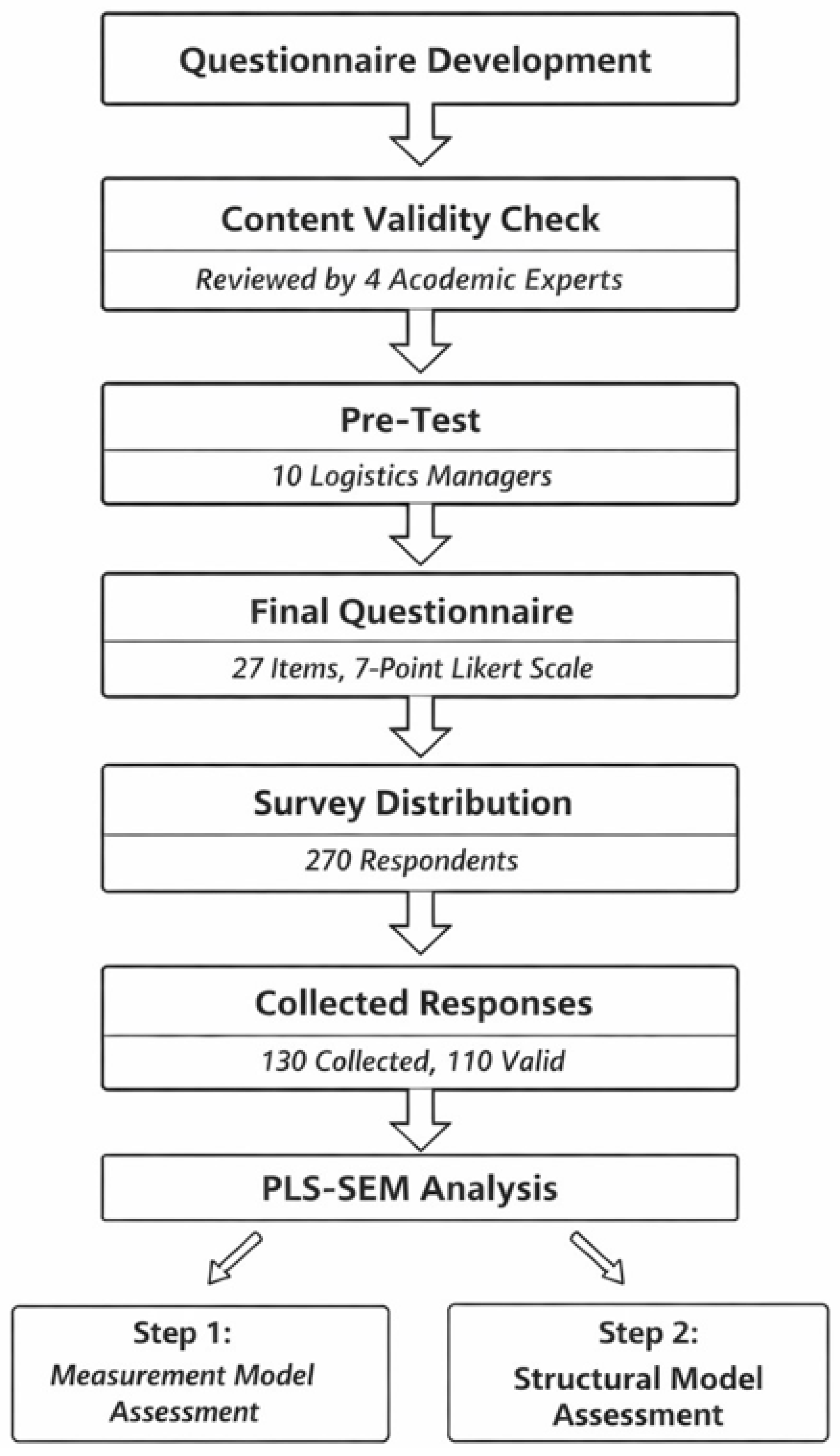
55]. This number strikes a balance between obtaining diverse expert opinions and maintaining practical feasibility. Additionally, a pre-test was conducted with a sample of 10 logistics managers to refine the clarity of the items and minimize the risk of non-response bias. Based on their feedback, the final questionnaire was structured with 27 items, measured using a seven-point Likert scale (1 = strongly disagree, 7 = strongly agree).
The finalized questionnaire was distributed to a target sample of 270 respondents, primarily logistics managers, while other relevant managerial roles were included when necessary. A total of 130 responses were collected, achieving a response rate of 48.14%, of which 110 responses were deemed valid for analysis.
The collected responses exceeded the minimum sample size requirement for performing Partial Least Squares Structural Equation Modeling (PLS-SEM) [
56]. For this study, partial least squares structural equation modeling (PLS-SEM) was chosen over covariance-based structural equation modeling (CB-SEM) for a number of methodological and practical reasons. First, for CB-SEM, which usually needs larger samples to generate accurate estimates, the sample size (N = 110) is comparatively small. Second, because PLS-SEM effectively manages complex path models, it is better suited for the complex research model that includes several constructs (SCRM, SCRES, SCROB) and a mediating variable (disruption impacts). Third, PLS-SEM is suitable for exploratory and predictive studies like this one, which looks at the connections between supply chain capabilities and SCRM practices in the Moroccan context, where there is little empirical data. Lastly, PLS-SEM ensures robust evaluation of both construct validity and hypothesized relationships because it does not assume multivariate normality and permits simultaneous evaluation of measurement and structural models [
57].
The analysis followed a two-step approach:
Measurement model assessment: Evaluating the reliability and validity of the constructs.
Structural model assessment: Examining the hypothesized relationships within the model [
56].
Figure 2 illustrates the steps of the adopted methodology.
4. Data Analysis and Results
4.1. Measurement Model Assessment
To analyze the data, Partial Least Squares Structural Equation Modeling (PLS-SEM) was employed, which is particularly appropriate for small sample sizes. The analysis was conducted using SmartPLS [
58], concentrating on assessing the seven constructs’ discriminant validity, convergent validity, and internal consistency.
First, composite reliability and Cronbach’s alpha were used to assess internal consistency, two widely accepted measures of reliability. According to [
59], a reliability coefficient above 0.7 is considered acceptable. As shown in
Table 1, all seven constructs meet this threshold, indicating strong internal consistency. More specifically, Cronbach’s alpha values for all constructs exceeded 0.7, demonstrating that the items within each construct are highly correlated and consistently measure the same concept. Similarly, composite reliability (CR) values were also above 0.7, reinforcing the robustness of the measurement scales. Unlike Cronbach’s alpha, CR considers item loadings, making it particularly useful for estimating internal consistency in complex models. Consequently, these results confirm that the measurement scales are reliable and stable.
In addition to reliability, The Average Variance Extracted (AVE) was employed to assess convergent validity. AVE calculates the percentage of variance that a concept captures in comparison to variance caused by measurement error [
60]. According to [
61], an AVE value greater than 0.5 is required to establish convergent validity. As indicated in
Table 2, the AVE values for the seven constructs range from 0.625 to 0.770, thus exceeding the recommended threshold. This means that more than 50% of the variance in each construct is described by its indicators, ensuring that the measurement items effectively capture their intended theoretical concepts. Therefore, these results provide strong evidence of convergent validity.
Furthermore, each construct was evaluated for discriminant validity to make sure it is sufficiently different from the others [
62]. To achieve this, two complementary approaches were used, namely the Fornell–Larcker Criterion and Cross-Loadings Analysis. First, Using the Fornell–Larcker Criterion, the square root of each construct’s AVE is compared to its correlations with other constructs [
63]. According to this criterion, a construct in the model should have a stronger association with itself than with any other construct [
64]. As shown in
Table 2, the findings show satisfactory discriminant validity by confirming that each component has a stronger relationship with its own indicators than with other constructs.
Second, a Cross-Loadings Analysis was performed to assess discriminant validity, which requires that each measurement item loads more strongly on its intended construct than on any other construct. This step is crucial to verify that each item mainly reflects the theoretical construct it is intended to measure, rather than capturing aspects of other constructs. If items exhibit substantial cross-loadings, the conceptual distinctiveness between constructs may be weakened, which can distort the estimation of structural relationships. In such cases, observed associations may result from measurement overlap instead of genuine theoretical links between constructs [
57,
61].
As shown in
Table 3, all items satisfy this requirement. For example, risk_assessment_2 loads 0.836 on the Risk Assessment construct, while its cross-loadings on other constructs range from 0.110 to 0.773. Similarly, disrupt_impacts_2 loads 0.911 on Disruption Impacts and much lower on the other constructs (0.132–0.217). Items for supply chain resilience and robustness also exhibit the highest correlations with their respective constructs (e.g., Sup_Chain_Resilience_3: 0.891 on resilience vs. 0.023–0.581 on others; Sup_Chain_Robustness_2: 0.859 on robustness vs. −0.193–0.390 on others).
These results confirm that each item predominantly measures its intended construct, ensuring the discriminant validity of the measurement model. Together with previously reported reliability and convergent validity metrics, this demonstrates that all constructs are well-defined and accurately measured, providing a solid foundation for the subsequent structural model analysis.
4.2. Structural Model Analysis
The main aim of this section is to evaluate the proposed structural model and examine the hypothesized relationships among the study constructs. Partial Least Squares Structural Equation Modeling (PLS-SEM) was employed, with a bootstrapping procedure used to assess the significance of the structural paths.
For each hypothesized relationship, the following statistics were calculated, following [
57]:
- -
Standardized path coefficient (β): represents the strength and direction of the relationship.
- -
Standard deviation (SD): reflects the variability of the path coefficient across the bootstrap samples.
- -
t-value: obtained by dividing β by its SD, used to test whether the path coefficient differs significantly from zero.
- -
p-value: indicates the statistical significance of the path; a relationship was considered significant if p < 0.05.
Table 4 presents the results of the hypothesis testing, including the standardized path coefficients (β), Standard deviation (SD) t-values, and
p-values, showing which hypotheses were supported.
Hypothesis 1 is rejected, as the effect of supply chain risk management (SCRM) on disruptions is weak and statistically insignificant (β = 0.182, p = 0.322). Hypothesis 2 is accepted, indicating a significant positive relationship between SCRM and supply chain resilience (β = 0.696, p < 0.01), suggesting that improvements in SCRM practices are associated with higher resilience. Similarly, Hypothesis 3 is accepted, showing that SCRM positively influences supply chain robustness (β = 0.448, p < 0.01).
For Hypothesis 4, disruptions do not significantly affect supply chain resilience (β = −0.052, p = 0.552), and thus the hypothesis is rejected. This result may be explained by the fact that resilient supply chains are designed to adapt and recover from disruptions, so their core functions are maintained despite shocks. In contrast, Hypothesis 5 is accepted, as disruptions negatively and significantly impact supply chain robustness (β = −0.210, p = 0.018).
Regarding mediation effects, Hypothesis 6 is rejected, indicating that disruptions do not significantly mediate the relationship between SCRM and resilience (β = −0.010, p = 0.704). Similarly, Hypothesis 7 is rejected, showing that disruptions do not significantly mediate the relationship between SCRM and robustness (β = −0.038, p = 0.403).
The second aim of this section is to assess the model’s fit and validity, several key indicators were examined. First, the coefficient of determination (R
2) evaluates the explanatory power of the model, with a recommended threshold above 0.1 [
65]. Second, the predictive relevance (Q
2) was analyzed using the Stone–Geisser Q
2 values, which should be greater than zero to confirm the model’s predictive validity [
57]. Finally, the global goodness-of-fit (GoF) metric was considered, which provides a single measure of overall model quality by combining the measurement and structural model performance, where a value exceeding 0.1 indicates an acceptable model fit.
As summarized in
Table 5, the research model exhibits satisfactory overall quality, with a high GoF and varying levels of explanatory power and predictive relevance based on R
2 and Q
2 criteria. The findings suggest that supply chain resilience is well explained and predicted, reflecting strong explanatory power and predictive relevance. Supply chain robustness shows moderate explanatory power, indicating that the model captures this construct reasonably well. However, the impact of disruptions demonstrates low explanatory power and limited predictive relevance, suggesting that additional variables may be required to better account for this aspect.
5. Discussion
This paper aims to provide and investigates the relationships between SCRM practices, disruption impacts, and supply chain resilience and robustness. Using a sample of Moroccan manufacturing firms, the results of the investigation support three out of seven hypotheses of the initially proposed conceptual model and we found strong support for the direct effects of SCRM on resilience and robustness, but limited evidence for the mediation role of disruption impacts.
The results confirm the ideas of [
17] about the role of recovery efforts in resilience-building by showing that SCRM practices considerably improve supply chain resilience. Because SCRM techniques enable businesses to predict, evaluate, and effectively respond to risks, they have a beneficial impact on resilience. This confirms the arguments of [
14,
47,
66], who emphasized that proactive risk management processes enable firms to absorb shocks and recover their planned performance levels. Similarly, the positive effect of SCRM practices on robustness supports the work of [
29,
40], who highlighted that effective SCRM practices significantly contribute to improving supply chain robustness.
Furthermore, the study’s results indicate that SCRM practices do not significantly reduce the direct impact of disruptions. This finding contrasts with prior studies such as those by [
2], which highlight the role of proactive SCRM practices, such as risk identification and mitigation, in reducing disruption severity [
39] similarly emphasized the importance of collaboration and information sharing in mitigating disruption impacts. However, this association seems weaker in the Moroccan industrial context, perhaps as a result of low adoption of cutting-edge technology like digital collaboration tools and real-time data analytics, as well as infrastructure and logistical limitations that increase disruptive effects. Despite these limitations, supply chain resilience and robustness are nevertheless directly improved by SCRM methods through increased operational coordination, internal readiness, and adaptability. From a theoretical perspective, Dynamic Capabilities Theory (DCT) proposes that SCRM strengthens organizations’ ability to adapt and recover by enabling them to perceive, absorb, and reorganize resources in response to shocks. In the same way, Organizational Information Processing Theory (OIPT) highlights how efficient data collection, processing, and use improves decision-making and operational continuity in the face of uncertainty. Therefore, SCRM helps to preserve performance and enhance the firm’s capacity to respond effectively, which explains the observed direct benefit on resilience and robustness even though it cannot completely prevent disruptions in the Moroccan setting.
Thus, the results indicate that disruptions have a significant negative impact on supply chain robustness but do not directly affect resilience. This aligns with prior research of [
16,
19] which suggests that supply chain robustness is more immediately impacted by disruptions, while resilience is a longer-term adaptive capability. Robustness relies on structural stability and operational continuity, meaning that severe disruptions, such as the COVID-19 crisis, can compromise a supply chain’s ability to maintain performance without immediate recovery mechanisms in place. However, the lack of a significant direct impact of disruptions on resilience suggests that firms perceive resilience as a process-driven capability, allowing them to recover over time despite temporary operational difficulties.
Finally, the analysis rejects the idea that disruption impacts mediate the association between supply chain robustness or resilience and SCRM practices, this study finds that SCRM practices directly influence these outcomes without necessarily reducing disruption impacts first. One possible explanation is that firms in the studied context focus more on long-term adaptive capabilities rather than short-term disruption impact reduction. This could reflect resource constraints or a lack of real-time data integration, limiting the ability of firms to proactively control immediate disruption effects.
6. Conclusions
This study examined the adoption of supply chain risk management practices in the Moroccan manufacturing context and their role in mitigating disruption impacts, enhancing supply chain resilience, and improving supply chain robustness. Using structural equation modeling, the measurement model incorporated seven constructs derived from the established literature, while the structural model tested direct and indirect relationships among the variables. Hypotheses were formulated to assess the direct effects: SCRM on disruption impacts (H1), SCRM on SCRES (H2), SCRM on SCROB (H3), disruption impacts on SCRES (H4), and disruption impacts on SCROB (H5), and the indirect effects of SCRM on SCRES and SCROB were also evaluated.
Findings revealed that SCRM practices did not significantly reduce disruption impacts, suggesting a potential focus on long-term resilience and robustness over immediate disruption mitigation in the Moroccan context. However, SCRM practices showed a statistically significant positive influence on both SCRES and SCROB, aligning with prior work.
Furthermore, disruption impacts were found to negatively affect SCROB but exhibited no significant direct influence on SCRES. This supports arguments by some authors who posit that robustness reflects immediate structural responses to disruptions, whereas resilience entails adaptive, longer-term recovery capabilities. Notably, while the study postulated an indirect mediation effect of disruption impacts on the relationship between SCRM and SCRES/SCROB, results indicated that SCRM practices enhance resilience and robustness directly, rather than through reducing disruption impacts. This implies that SCRM’s value lies in proactively building adaptive and structural capacities, independent of short-term disruption mitigation.
A central theoretical contribution of this study lies in positioning disruption impacts as a mediating factor between supply chain resilience and robustness and SCRM practices. Our findings show that resilience and robustness arise not only from implementing SCRM practices but also from how these practices mitigate and reconfigure the impacts of disruptions, in contrast to previous research that typically assumed a direct relationship between risk management practices and resilience outcomes. By elucidating how businesses convert risk management practices into protective and adaptive skills, this promotes the implementation of the dynamic capabilities concept. In doing so, our study challenges the dominant assumption of a linear SCRM–resilience and robustness link and provides a more nuanced explanation of the causal pathways that allow organizations to navigate uncertainty.
Additionally, this study contributes to the literature on supply chain risk management by incorporating Dynamic Capabilities Theory and Organizational Information Processing Theory to explain how firms leverage SCRM practices to enhance resilience and robustness. Furthermore, it provides empirical evidence from an underexplored context, offering insights into the challenges and strategies of Moroccan manufacturing firms.
On a practical level, the findings emphasize the critical role of investing in SCRM practices to build resilient and robust supply chains. Managers should focus on risk identification, assessment, mitigation, and control to strengthen their firms’ ability to withstand and recover from disruptions. Additionally, firms operating in similar environments may benefit from adopting advanced technologies to improve real-time disruption management and enhance overall supply chain performance.
7. Limitations and Future Research Directions
Despite its contributions, this study has several limitations that offer opportunities for future research. First, the empirical analysis is limited to the Moroccan manufacturing sector and is based on 110 valid responses. Future studies could extend this research to other Moroccan industries, such as the service sector, to examine whether the observed relationships hold across different economic contexts.
Second, the study focuses on a single country. Conducting similar research in other national contexts would provide deeper insights into how SCRM practices are adopted and how they influence supply chain resilience and robustness across different institutional and environmental settings. Cross-country comparisons would also enhance the external validity and generalizability of the findings.
Third, although the sample size is adequate for PLS-SEM analysis, future research could benefit from larger samples to further strengthen the robustness of the results.
In addition, this study relies exclusively on a quantitative survey approach. Future research could adopt a mixed-methods design by incorporating qualitative case studies or interviews to complement the survey findings and provide a richer understanding of how SCRM practices are implemented in practice.
Finally, this research examined a specific set of SCRM practices. Future investigations could explore additional factors, such as digital transformation, organizational culture, leadership, and supply chain collaboration, to further explain the development of supply chain resilience and robustness.