
Article

Sustainability Through Additive Manufacturing Operations: A Comparative Industrial Analysis with a Life Cycle Assessment Case Study of Türkiye


by
Saliha Karadayi-Usta
Industrial Engineering Department, Istinye University, Istanbul 34396, Türkiye
Logistics 2026, 10(1), 7; https://doi.org/10.3390/logistics10010007

Submission received: 24 November 2025 / Revised: 20 December 2025 / Accepted: 23 December 2025 / Published: 26 December 2025

Abstract

Background: Additive manufacturing (AM), commonly known as 3D printing, is transforming global production systems with sustainability at its core. The global AM market growth underscores the urgency of evaluating its environmental implications. Methods: This study aims to (1) identify Life Cycle Assessment (LCA) factors influencing additively manufactured products across aerospace, automotive, medical devices, industrial equipment, energy, construction, and consumer electronics industries; (2) determine the relative importance of these factors using Adaptive Choice-Based Conjoint (ACBC) analysis within a Türkiye case study; and (3) assign sustainability levels for each industry via the PrOPPAGA technique. Since LCA quantifies environmental impacts throughout a product’s life cycle, from raw material extraction to end-of-life, this research assesses the sustainability dimensions of AM operations by examining energy consumption, emissions, and waste generation. Results: The findings provide practical and managerial insights for industry stakeholders seeking to enhance sustainable practices in AM. Conclusions: The study introduces a novel sustainability evaluation framework integrating ACBC and PrOPPAGA methods, offering a significant theoretical contribution to the literature on sustainable manufacturing.

1. Introduction

Additive manufacturing (AM), also known as 3D printing, is revolutionizing operations management by enabling the direct fabrication of complex geometries from digital models, thereby enhancing agility, customization, and sustainability in production systems. Its strategic importance lies in its capacity to support decentralized manufacturing, reduce lead times, and optimize resource utilization [1]. Recent advances such as multi-material printing and the integration of artificial intelligence (AI) for process optimization have further expanded AM’s operational potential, allowing for real-time defect detection, adaptive control, and intelligent automation [2]. Moreover, AM is increasingly aligned with Industry 4.0 and Industry 5.0 paradigms, where cyber-physical systems and human-centric smart manufacturing converge to create resilient and sustainable production ecosystems [3]. These developments underscore AM’s transformative role in reshaping operations management, not only through technological innovation but also by redefining strategic frameworks for competitiveness and sustainability in the digital age [4].
AM plays a pivotal role in advancing circular economy principles and sustainable development within operations and supply chains. By enabling localized, on-demand production, AM reduces transportation needs and associated emissions, while minimizing material waste through precise layer-by-layer fabrication [5]. Its capacity for modular design and part consolidation supports product life extension and easier disassembly, which are key tenets of circularity [6]. Furthermore, AM facilitates the use of recyclable and bio-based materials, contributing to resource efficiency and environmental stewardship [7]. The integration of AM with Industry 4.0 technologies such as IoT and AI enhances traceability and closed-loop supply chain management, enabling smarter reuse and remanufacturing strategies [8]. Conceptual frameworks also highlight how AM supports circular economy implementation through strategic decisions involving supply chain actors, technology maturity, and operational practices [9]. These capabilities position AM not only as a technological innovation but also as a catalyst for sustainable transformation in manufacturing and logistics systems.
The AM industry includes many stakeholders from both electronics and manufacturing industries; for instance, General Electric and Hewlett-Packard are known as leading AM patent owners, while 3D Systems, ExOne, and Stratasys companies are focusing on the design and production side of AM machines and 3D printers [10]. In addition, many industry reports present an expected growth of the AM market og 24% between 2023 and 2025, and the AM market is projected to triple in size between 2020 and 2026.
The AM literature identifies gaps in sustainability in terms of integration challenges and social sustainability [11,12]; healthcare applications in terms of standardization and quality [13,14], development, and integration of new business models [15]; optimization of design and process parameters; and multi-material challenges [16,17].
Despite these advancements, the environmental implications of AM remain underexplored, particularly in terms of Life Cycle Assessment (LCA) factors that influence sustainability outcomes. Given the urgency to align AM practices with global sustainability goals, this study is motivated by the need to address sustainability gaps by systematically evaluating environmental impacts across the entire product life cycle, focusing on Türkiye as a case study. This research aims to bridge the gap between rapid technological adoption and sustainable development, ensuring that AM growth does not compromise environmental and social objectives. To validate the research gap, a structured search was conducted in the Scopus database for the period 2021–2026. The query results revealed that the term “Additive Manufacturing” returned 62,910 articles, while “Life Cycle Analysis” yielded 11,423 articles. However, when both terms were combined, only 77 publications were identified. This stark contrast highlights the limited number of studies directly addressing the intersection of AM and LCA, despite the growing importance of sustainability in advanced manufacturing. These findings objectively confirm the novelty and relevance of this research, which aims to bridge this gap by integrating Life Cycle Assessment with advanced decision-making techniques for additive manufacturing operations.
Hence, this research has the aim of examining the key LCA factors of the aerospace, automotive, medical devices, industrial equipment, energy, construction, and consumer electronics industries, conducting an ACBC methodology by using utility values of the LCA factors, and evaluating the sustainability levels of each industry using the PrOPPAGA technique within a Türkiye case study.
This study develops a comprehensive sustainability evaluation framework for Additive Manufacturing (AM) by integrating Life Cycle Assessment (LCA) with advanced decision-making techniques. Specifically, the study aims to identify key LCA factors influencing the environmental performance of AM products across multiple industries, determine their relative importance through Adaptive Choice-Based Conjoint (ACBC) analysis within the context of Türkiye, and assign sustainability levels using the PrOPPAGA (Procedimento de Ordenação por Pesos e Padrões Gaussianos—Ordering Procedure by Weights and Gaussian Patterns) method. By addressing critical gaps in sustainability integration and providing actionable insights for stakeholders, this research seeks to guide the AM industry toward environmentally responsible growth while contributing a novel methodological approach to the sustainable manufacturing literature.
ACBC is a powerful tool for understanding the preferences and priorities of stakeholders across various contexts by simulating real-world decision-making processes, with advantages over other traditional methodologies. For example, ACBC’s iterative nature, where participants refine their choices through multiple stages, leads to more accurate and reliable data on stakeholder preferences [18]. Furthermore, the PrOPPAGA technique provides a scoring mechanism [19] for the aerospace, automotive, medical devices, industrial equipment, energy, construction, and consumer electronics industries within a Türkiye case study. This technique is well-suited for sustainability analysis due to its well-structured base, ability to integrate many criteria at the same time, and inclusive appraisal capabilities [20,21,22]. By combining ACBC and PrOPPAGA, this research has the purpose of presenting a sturdy conceptual model for assessing and enhancing sustainability practices for these particular case-study industries.
The findings of the research emphasize the substantial variability in sustainability performance across industries adopting additive manufacturing. Automotive emerges as the most balanced and sustainable sector, driven by efficient material use and moderate energy consumption, whereas consumer electronics and construction exhibit the weakest profiles due to excessive energy demand and high waste generation. Aerospace and medical devices demonstrate strong compliance with environmental standards and superior material efficiency, yet their overall sustainability is constrained by extensive post-processing requirements and logistical challenges. These insights highlight the need for tailored strategies to enhance sustainability outcomes in different industrial contexts.
The contributions of this research are threefold. First, it introduces a novel sustainability evaluation framework that integrates ACBC analysis with the PrOPPAGA method, bridging preference modeling and probabilistic ranking for multi-industry comparison. Second, it operationalizes Life Cycle Assessment factors through utility-based weighting, offering a structured and replicable approach for sustainability assessment in additive manufacturing. Third, it provides empirical insights from a Türkiye case study, contributing to both theory and practice by demonstrating how advanced decision-making techniques can guide strategic sustainability improvements across diverse industrial contexts.
The subsequent sections of this manuscript delineate a comprehensive literature review to contextualize the research gap, followed by the methodological framework utilizing ACBC and PrOPPAGA. The study then proceeds to an empirical application and corroboration of the proposed model, and concludes with a synthesis of the findings and final remarks.

2. Literature Review

AM has an important influence on the aerospace industry by enabling the production of complex, lightweight, and high-performance components. Various AM methods are employed in aerospace, including powder bed fusion, directed energy deposition, and material extrusion [23,24]. AM is used to produce various aerospace components, including turbine blades, fuel nozzles, and lightweight structural parts [25]. AM allows for the creation of highly complex shapes as single homogeneous parts, which are not feasible with traditional manufacturing methods [26].
Secondly, AM is revolutionizing the automotive industry by enabling the production of intricate, lightweight, and customized components that traditional manufacturing methods cannot easily replicate. AM allows for the creation of complex geometries and highly customized parts, which are particularly beneficial for prototyping and low-volume production [27,28]. By enabling topology optimization and parts consolidation, AM helps in reducing the weight of automotive components, which can enhance vehicle performance and fuel efficiency [29]. AM accelerates the product development cycle by allowing rapid prototyping, which helps in quickly iterating and refining designs [30]. AM processes typically generate less waste compared to traditional manufacturing methods, contributing to more sustainable production practices [31,32].
Thirdly, AM has significantly impacted the medical field by enabling the production of highly customized and complex medical devices. AM allows for the creation of patient-specific implants and prosthetics, which can be tailored to fit individual anatomical requirements, improving clinical outcomes and patient satisfaction [33]. Customized surgical guides assist in complex procedures by providing precise templates for surgeons, enhancing surgical accuracy and reducing operation times [34]. AM is advancing in the field of bioprinting, where it is used to create tissue and organ models for medical research and drug testing [35]. In addition, anatomical models produced via AM are used for educational purposes and pre-surgical planning, providing detailed and accurate representations of patient-specific anatomies [36,37].
AM enables complex and customized components with high precision and efficiency for industrial equipment production. AM plays a vital role in Industry 4.0 by reducing spare parts inventory costs and enabling the production of discontinued parts. This is achieved through its high degree of design freedom and the ability to produce customized parts on demand [38]. The integration of digital twin (DT) models and evolutionary algorithms in AM design processes helps in optimizing part geometry and reducing manual design efforts, thereby enhancing product performance and reducing costs [39,40].
AM is increasingly being utilized in the energy industry to enhance efficiency, sustainability, and innovation. AM is being used to improve efficiency and reduce the costs of hydrogen energy components through rapid prototyping and design freedom [41]. Moreover, the use of advanced materials, including conductive polymers and biodegradable composites, supports the development of customized solutions for renewable energy [42]. Large Format AM is supporting the production of complex, lightweight, and high-performing parts on-site, which are particularly beneficial for the oil and gas sector. This technology allows for the fabrication of large monolithic parts, reducing production lead times and human intervention [43,44].
AM is increasingly being recognized for its transformative potential in the construction industry. AM allows for the rapid development of 3D structures with minimal personnel and resources, significantly reducing waste production [45]. The technology enables the creation of complex geometrical designs that are difficult or impossible to achieve with traditional methods, enhancing both structural and mechanical performance for the construction industry [46]. Concrete is a primary material used in AM for construction, allowing for innovative applications such as buildings, bridges, and urban furniture [47]. AM processes are being applied to infrastructure construction, improving productivity and safety [48,49].
AM allows for the rapid prototyping and production of customized electronic components, which are crucial for the fast-paced consumer electronics market [16]. The ability to produce parts directly from Computer-Aided Design models without the need for auxiliary inputs like fixtures and cutting tools streamlines the design and production process [50]. It facilitates the manufacturing of complex geometries and the integration of various functions into single components, enhancing the performance and functionality of electronic devices [51].
LCA is a critical methodology for evaluating the environmental impacts of products throughout their life cycle, from raw material extraction to end-of-life disposal [52]. This approach is particularly relevant in the context of AM, which is increasingly used across various industries such as aerospace, automotive, medical devices, industrial equipment, energy, construction, and consumer electronics. The LCA- and AM-related papers are presented in Table 1, including the methodology and findings details.
Although this study primarily addresses environmental pillars within the LCA framework, social and economic dimensions are indirectly considered through criteria such as resource efficiency, energy use, and emissions reduction. These factors influence cost implications and societal well-being by promoting sustainable resource management and reducing health-related risks associated with environmental impacts. Thus, while not explicitly modeled, these dimensions are embedded in the environmental indicators applied.
As substantiated by recent scholarly contributions, AM is increasingly recognized for its potential to reduce environmental impacts, enable sustainable and financially viable production, and offer technical advantages such as complexity, lightweight structures, and rapid prototyping. Studies highlight its benefits across sectors including aerospace, automotive, medical devices, energy, and construction, emphasizing reduced waste, social benefits, and resource efficiency.
However, challenges remain, particularly regarding energy consumption and limitations in LCA methodologies, which require the integration of circular design principles and improved risk indicators. Overall, AM demonstrates strong promise for eco-friendly and innovative manufacturing, though further research is needed to address its environmental and methodological shortcomings.
The applied methodologies across the reviewed studies include systematic literature reviews (often using the PRISMA framework), comparative case studies, exploratory case studies, conceptual frameworks, Monte Carlo simulation-based sensitivity analyses, and comparative analyses. Notably, no ACBC or PrOPPAGA study was identified among the current publications.
Consequently, this research is impelled by the necessity to construct a robust analytical framework for prioritizing sustainability determinants in AM. This is achieved through the synergistic integration of ACBC and PrOPPAGA, the mechanics of which are elucidated in the subsequent sections.

3. Methodology

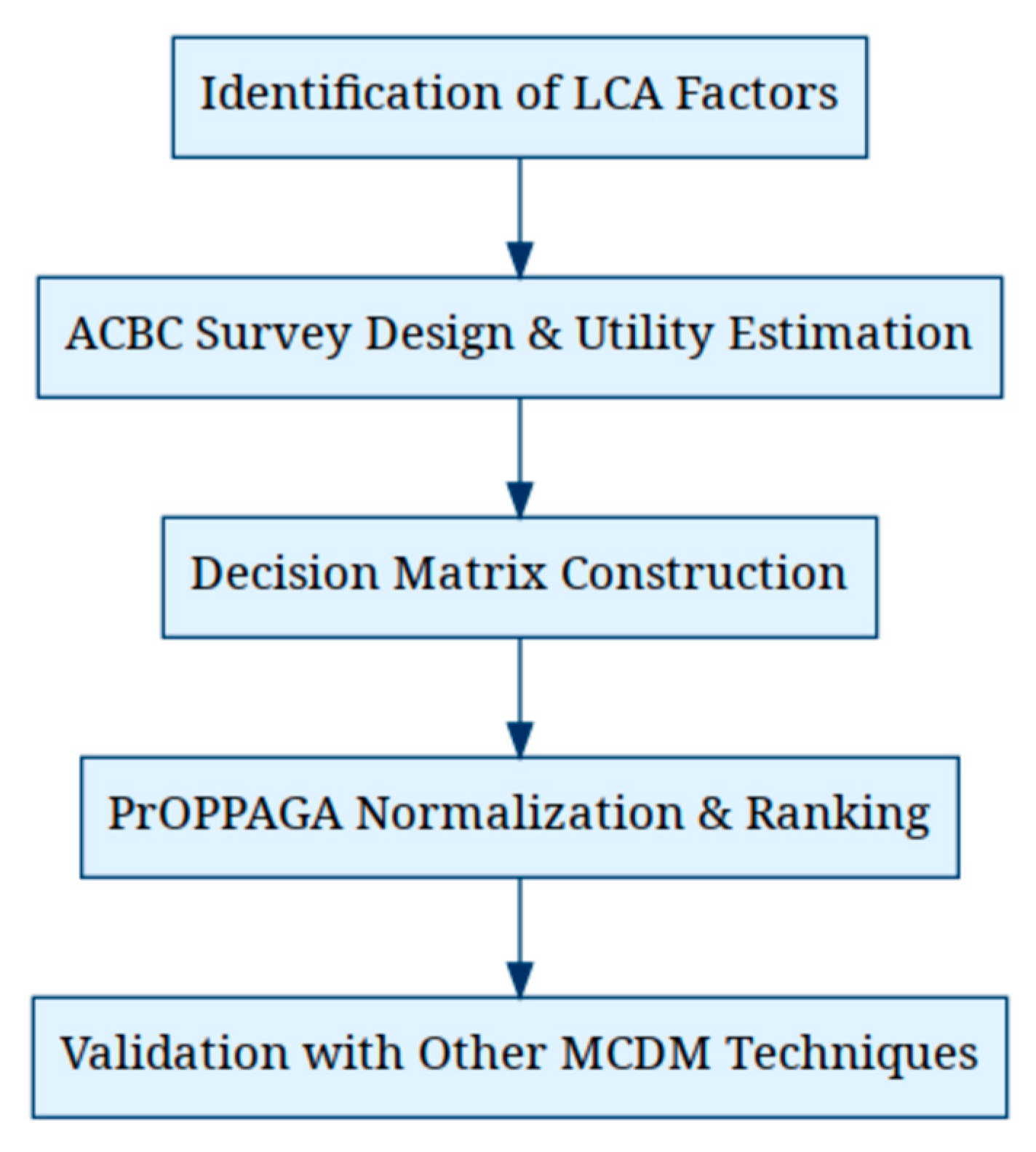
The research design adopted in this study involves five key steps: (1) identifying critical LCA factors that influence the sustainability of additively manufactured products across aerospace, automotive, medical devices, industrial equipment, energy, construction, and consumer electronics industries; (2) conducting a dynamic survey using Lighthouse Studio 9.16.16 software with industry representatives in order to collect data for a multiple-case study design to determine the importance levels (utility scores) of each LCA sub-factor through ACBC analysis supported by Hierarchical Bayesian Regression; (3) using these utility scores of sub-factors as initial consideration points to extract an LCA factor-to-industry-type decision matrix; (4) evaluating the industries in collaboration with AM expert authorities; and (5) assigning a sustainability level for each industry. The subsequent sections provide detailed explanations of the techniques applied. See Figure A1.

3.1. Adaptive Choice-Based Conjoint (ACBC)

Conjoint analysis, derived from the term “CONsidered JOINTly”, is a statistical technique that evaluates participant choices to identify trade-offs among multiple attributes [64]. It is widely applied in product and service development, pricing research, and competitive positioning [64,65]. Existing applications include assessing performance levels of consumption attributes [66], analyzing business process variants, predicting purchase intentions and operational decisions, and evaluating cooperatives’ financial conditions [67]. These examples demonstrate the suitability of conjoint analysis for AM operations.
In practice, customers and stakeholders often assess many factors simultaneously when selecting a product or service package, and managers incorporate these preferences into design, production, and pricing strategies. To introduce new offerings, detailed surveys are typically required to capture all possible scenarios; however, such surveys can be time-consuming and costly. Conjoint analysis simplifies this process by presenting respondents with a limited set of variations [64]. Participants rank or score product/service packages based on their attributes, enabling researchers to calculate overall utility, representing benefits or attractiveness, and predict how pricing changes with feature adjustments [64].
Conjoint analysis can be implemented in several forms, including traditional (full-profile), adaptive, and choice-based approaches. The selection of the appropriate type depends on factors such as sample size, attribute complexity, survey length, and data collection method [64]. The adoption of ACBC analysis was predicated on the direct engagement of active supply chain practitioners, with the survey instrument dynamically configured via Sawtooth Software’s Lighthouse Studio. Relative to traditional conjoint methods, ACBC demonstrates superior predictive validity and significantly attenuated standard errors. A key feature of ACBC is the “Build Your Own” (BYO) task, which allows participants to configure their preferred product or service package [68].
ACBC combines adaptive information gathering with the realism of choice-based data. Participants first define their ideal product or service configuration, after which the software presents customized options based on BYO responses. This approach generates realistic scenarios by offering combinations that reflect actual consumer decision-making, making the process more engaging and accurate [64].
Despite its advantages, ACBC has limitations: surveys take longer to complete. Although this method requires elevated programming complexity and is exclusively contingent upon digital interfaces, it offers distinct advantages. It is generally contraindicated for studies with limited attribute sets (under four). Notwithstanding this constraint, the method demonstrates superior utility by (1) maintaining validity with constrained respondent pools, (2) effectively managing complex attribute arrays, (3) suitability for pricing studies, (4) ability to handle a large number of features, and (5) maintaining participant engagement through interactive attribute combinations.

3.2. Hierarchical Bayesian Regression

Given that the prospective respondents are company representatives with structured decision-making processes, a Bayesian approach is appropriate for ACBC analysis [69]. In Bayesian regression, individual knowledge and prior experiences are incorporated into parameter estimation, reducing the risk of incorrect decisions by combining prior information with observed data [70]. The approach involves specifying prior distributions for model parameters and updating them with observed data using likelihood functions to obtain posterior distributions [71].
Unlike classical regression, which assumes fixed parameters and relies solely on sample data, Bayesian regression treats parameters as random variables and integrates prior knowledge—either noninformative or conjugate—with sample information [71]. Hierarchical Bayesian (HB) regression extends this concept by estimating individual-level parameters (betas) while borrowing strength from the overall dataset, resulting in more stable and accurate estimates [68].
HB is widely used in market research to understand consumer preferences and optimize product or service offerings. By leveraging multiple observations and incorporating both individual and aggregate data, HB provides robust estimates even with small sample sizes. This makes it particularly suitable for conjoint analysis and volumetric choice modeling, where participant-level insights are critical for designing competitive and customer-oriented solutions [68].

3.3. Priority Observed from the Presumption of Gaussian Attitude of Alternatives (PrOPPAGA)

PrOPPAGA represents a sophisticated decision-making paradigm that integrates stochastic distributions to model preference uncertainty within multifaceted environments. Introduced by Dos Santos and Dos Santos (2021) [19], this framework postulates that alternative attributes exhibit Gaussian behavior. Operationally, when assessing diverse alternatives, PrOPPAGA computes a measure of central tendency for each criterion while capturing dispersion through a normal distribution [19]. Crucially, the deployment of this method obviates the necessity for rigorous verification of the Gaussian assumption; thus, strict goodness-of-fit tests are not a prerequisite [21].
The procedural framework encompasses four distinct phases: (1) delineation of relevant factors, (2) formulation of the decision matrix, (3) data standardization, and (4) synthesis of results [19]. The standardization phase is paramount, as raw performance metrics often differ in scale. To rectify this heterogeneity, PrOPPAGA normalizes values into a unit interval (0 to 1) by utilizing the mean (μ) and standard deviation (σ) of each column. These statistical moments characterize the Gaussian curve—possessing an integral area of 1—which is exploited to derive probabilities. While the underlying algorithm may appear intricate, it is readily operationalized via standard functions in commercial Excel 2025 spreadsheet software [19,21,22].
p i j = 1 2 π σ j   d i j e x p x μ j 2 2 σ j 2   d x
Following the computation of normalized metrics and their corresponding weights, the framework proceeds to data aggregation. This step generates a composite cardinality score for every alternative, serving as the determinant for ranking; specifically, alternatives are ordered such that elevated scores correspond to heightened preference. The governing equation is expressed as:
v i = j = 1 n w j p i j
where w j represents the weight ascribed to the respective criteria [19] (in this study, they are assumed to be equal).
The integrated approach combining ACBC and PrOPPAGA will be explained in detail hereafter.

4. Application

Survey Design for Multiple-Case Study

Given the study’s focus on the deployment of AM across diverse sectors, outreach was conducted in October 2025 via the professional networking platform, LinkedIn. Invitations were extended to representatives from 84 Turkish enterprises; subsequently, 17 consented to participate (detailed participant profiles are provided in Table 2).
The survey was developed using Sawtooth Software’s Lighthouse Studio 9.16.16 for the multiple-case study, which enables dynamic online questionnaires that adapt based on participants’ initial preferences. This adaptive design allows the software to interpret user choices and remove irrelevant scenarios, thereby enhancing engagement by presenting questions aligned with participants’ interests. In the first stage, respondents complete a “Build-Your-Own” task (see Table 3), where they configure their preferred options and define their ideal scenarios.
In this study, the term “factor” is used in alignment with the conventions of the ACBC methodology, which defines each main attribute under evaluation as a factor, and the corresponding measurable variations (e.g., high, moderate, low) as levels within that factor. While these levels may be interpreted as categories of a construct, they are treated as integral components of the factor structure in ACBC analysis for utility estimation and preference modeling. This terminology is consistent with established literature and the technical specifications of Sawtooth Software’s Lighthouse Studio, which was used to design and implement the survey.
Although the Build-Your-Own (BYO) interface permits participants to specify optimal configurations, operational realities frequently diverge, necessitating the consideration of nuanced sub-factors. ACBC analysis simulates these authentic decision-making dynamics by isolating the most favored attribute bundles from a complex set of alternatives [76]. During the preliminary phase, respondents designate their preferred parameters via the BYO protocol. Thereafter, utility scores are derived through quantitative estimation using Hierarchical Bayesian (HB) Regression.
Participants are presented with dynamic scenarios where they indicate preferences. Lighthouse Studio records each response and adapts subsequent questions accordingly, adding “must-have” sub-factors or removing those marked as “not acceptable.” This adaptive mechanism generates new question sets aligned with participant priorities. The resulting Hierarchical Bayesian Regression outputs, including utility scores, are summarized in Table 4.
In the subsequent step, participants were asked to evaluate each industry in terms of main factors (see Table 5) by considering all sub-factors. The data are gathered both as text (Table 5) and on a 1–9 scale (Table 6).
Next, after constructing a decision matrix, PrOPPAGA normalizes the data (Table 6) and provides the results with final weights and final ranks of alternatives (Table 7).
Accordingly, the automotive sector demonstrates the highest overall sustainability performance among the analyzed industries. This is primarily due to its balanced material efficiency (0.83), moderate energy consumption (0.50), and strong post-processing capabilities (0.76). While its raw material score (0.56) is not the highest, the combination of efficient manufacturing and compliance with environmental certifications (0.50) positions automotive as the most sustainable option in additive manufacturing applications.
Both industrial equipment and the energy sector share similar sustainability profiles, ranking second overall. Their strengths lie in transportation impact (0.85) and moderate manufacturing waste (0.55), which indicate efficient logistics and waste management practices. However, their energy consumption (0.50) and post-processing needs (0.39) remain areas for improvement. Despite these limitations, their balanced performance across multiple factors ensures strong competitiveness in sustainable AM operations.
Aerospace exhibits excellent scores in raw material type (0.88), material efficiency (0.83), and environmental certifications (0.91), reflecting its reliance on advanced, high-performance materials and strict regulatory compliance. However, its sustainability is hindered by very low energy efficiency (0.09) and high post-processing requirements (0.11), which significantly increase resource consumption and operational complexity.
The construction sector shows mixed sustainability performance. While it benefits from strong post-processing capabilities (0.76) and transportation impact (0.85), it suffers from extremely high energy consumption (0.91) and manufacturing waste (0.82). These factors indicate that current additive manufacturing practices in construction require substantial optimization to reduce environmental burdens.
Medical devices score highly in raw material type (0.88) and certifications (0.91), reflecting stringent quality and safety standards. However, the sector faces challenges in transportation impact (0.03) and post-processing needs (0.11), which limit its overall sustainability performance. These findings suggest that while material selection is strong, logistical and operational improvements are necessary.
Consumer electronics ranks lowest in sustainability due to excessive energy consumption (0.91) and manufacturing waste (0.96). Additionally, poor scores in raw material type (0.03) and product longevity (0.01) highlight significant weaknesses in material sustainability and life cycle management. This sector requires urgent interventions to improve resource efficiency and reduce environmental impact.
Consequently, the utility of PrOPPAGA transcends the mere ordinal ranking of alternatives; it explicitly incorporates a clustering and grouping mechanism. This dual functionality empowers industrial stakeholders to conduct rigorous self-assessment, thereby contextualizing their sustainability performance within the broader additive manufacturing ecosystem.
Future research could explore differential weighting approaches, such as entropy or AHP-based methods, to assess the sensitivity of sustainability rankings under varying prioritization schemes.
To verify the stability of the obtained rankings, AHP-Gaussian, MOORA, COPRAS, MOOSRA, MABAC, WASPAS, and VIKOR are employed in the following section to compare and confirm the robustness and consistency of the findings.

5. Validation and Discussion

The PrOPPAGA technique streamlines the often resource-intensive processes of survey design and data collection, offering a structured framework for evaluating sustainability indicators via utility scores and decision matrices. However, to ensure the reliability of this ranking procedure, it is crucial to benchmark the findings against established methodologies. Table 8 compares the PrOPPAGA rankings with results derived from AHP-Gaussian, MOORA, COPRAS, MOOSRA, MABAC, WASPAS, and VIKOR.
By interpreting the comparison table (Table 8), automotive consistently ranks at or near the top across most methods (Rank 1 in PrOPPAGA, AHP-Gaussian, MOORA, and WASPAS; Rank 2 in COPRAS and VIKOR). This confirms its strong sustainability performance.
Aerospace shows variability. For instance, it ranks 4 in PrOPPAGA, 1 in COPRAS and VIKOR, and 2 in several others. This suggests that its performance is highly sensitive to the weighting and normalization approach of each method.
Medical Devices is ranked low by most methods (Rank 6 in PrOPPAGA and others) but, surprisingly, Rank 1 in MOOSRA and WASPAS. This indicates that certain criteria (possibly certifications and material type) heavily influence these methods.
Industrial Equipment and Energy Sector remain consistently mid-ranked (mostly 2–4), showing stable performance across methodologies.
Construction and Consumer Electronics are consistently at the bottom across all methods, confirming their poor sustainability profile regardless of the decision-making technique.
As it can be clearly observed from the comparison table, the rankings obtained through PrOPPAGA are largely consistent with other well-established MCDM methods, particularly for top-performing (automotive) and low-performing (consumer electronics and construction) industries. Minor variations, such as aerospace and medical devices shifting positions under certain methods, highlight the influence of methodological differences in weighting and aggregation. This consistency validates the robustness of PrOPPAGA while demonstrating its alignment with widely accepted approaches.
As can be seen from the current AM-related LCA articles, most studies focus on environmental benefits such as reduced waste, improved resource efficiency, and lower emissions, while highlighting technical advantages like lightweight structures and complex geometries. However, significant gaps remain in integrating comprehensive sustainability frameworks, particularly those combining advanced decision-making techniques with LCA for multi-industry comparisons.
Ranking discrepancies are expected because each MCDM family makes different assumptions about how criteria are scaled, combined, and penalized. In this study, PrOPPAGA uses probability/Gaussian normalization and additive aggregation with equal weights, which tends to reward balanced, all-round performance. By contrast, methods such as MOORA/MOOSRA apply ratio or vector normalization and can be more sensitive to extreme values on a subset of criteria; WASPAS blends weighted-sum and weighted-product models, so a very strong score on a few dimensions can disproportionately lift an alternative; COPRAS explicitly separates benefit vs. cost sums and may penalize cost-type criteria more sharply; VIKOR is a compromise/closest-to-ideal method that emphasizes the largest regret (worst gap), pushing solutions with even one weak dimension down; and MABAC ranks by distance from a boundary area, making it responsive to the spread of normalized scores.
Applied to these results, these mechanics explain why Automotive remains at or near the top across most methods (its profile is balanced, so it performs well under additive and compromise rules), while Aerospace shifts (rank 1–4) because some methods reward its many very high “benefit” criteria (materials, certifications) whereas others penalize its cost-type weaknesses (energy, post-processing). The occasional first-place appearance of Medical Devices in MOOSRA/WASPAS reflects compensatory aggregation: strong performance on a few decisive criteria (e.g., raw material quality, certifications) can dominate multiplicative/ratio forms even when some costs are higher. In short, mid-tier movement across methods largely reflects normalization choice, aggregation operator, and benefit/cost polarity; the top- and bottom-rank stability (e.g., Automotive vs. Consumer Electronics/Construction) signals that the core conclusion is robust. This study recommends viewing the methods as complementary lenses: check benefit/cost treatment, inspect dispersion and outlier sensitivity, and rely on rank-correlation across methods to judge consensus rather than any single ordering.
Furthermore, there are numerous papers concentrating on sector-specific applications of AM, such as aerospace, automotive, and medical devices, with a primary focus on technical performance, material properties, and process optimization rather than holistic sustainability assessment. Most studies emphasize energy consumption, material efficiency, and waste reduction at the process level, but they rarely integrate comprehensive LCA frameworks that account for multi-industry comparisons and decision-making under uncertainty.
For business decision-makers, the rankings and factor profiles provide concrete levers to improve sustainability performance in AM operations. Automotive firms can consolidate their advantage by setting energy-intensity targets (kWh per part), expanding powder/consumables reuse and recycling programs (reuse ratio, % recycled feedstock), and optimizing post-processing (hours/steps per part) to reduce cost-type impacts. Industrial equipment and energy sectors (second tier) should prioritize logistics efficiency (average transport distance) and waste minimization (scrap rate) while investing in process monitoring to curb variability that drives rework. Aerospace and medical devices, strong on materials and certifications, can address their weaker dimensions by electrification/efficiency upgrades for metal powder bed fusion, surface-finishing route optimization, and facility-level environmental management systems (e.g., ISO 14001 [73] conformance rate). Construction and consumer electronics would benefit from design-for-manufacture and end-of-life strategies (design consolidation, take-back and material separation), low-energy equipment selection, and support-structure reduction through topology optimization.
For policymakers in Türkiye, the results suggest targeted instruments: investment incentives or tax credits for low-energy AM equipment, standards and reporting requirements on energy and waste (annual disclosure of kWh/part and scrap/reuse KPIs), green public procurement criteria favoring certified AM suppliers (ISO 14001 [73]/IATF 16949 [75]), and pilot “living-lab” programs that co-fund powder recycling and post-processing efficiency projects. These actions translate the study’s environmental focus into measurable, sector-specific key performance indicators (kWh/part, scrap/reuse %, recycled feedstock %, post-processing hours, transport distance, certification conformance) and provide a pragmatic pathway for businesses and regulators, while acknowledging that future work will expand representativeness and incorporate social/economic pillars.
In conclusion, this research proposes an analytical conceptual model for evaluating and prioritizing sustainability factors in additive manufacturing across multiple industries by combining ACBC analysis and the PrOPPAGA technique to fill the identified gap in the literature.

6. Conclusions

Additive manufacturing has emerged as a transformative technology in modern production systems, offering unprecedented opportunities for customization, resource efficiency, and decentralized manufacturing. Its alignment with sustainability goals makes it a critical enabler of circular economy principles and environmentally responsible practices. However, as AM adoption accelerates across diverse industries, understanding its life cycle impacts becomes essential to ensure that technological progress does not compromise ecological integrity. This study addresses this need by developing a comprehensive analytical framework that evaluates sustainability factors through advanced decision-making techniques, providing actionable insights for aerospace, automotive, medical devices, industrial equipment, energy, construction, and consumer electronics sectors.
The findings indicate that sustainability performance in additive manufacturing varies significantly across industries, with automotive emerging as the most balanced and sustainable sector, while consumer electronics and construction exhibit the lowest scores due to high energy consumption and waste generation. Aerospace and medical devices demonstrate strong material efficiency and compliance with environmental certifications but are penalized by extensive post-processing needs and logistical challenges. These results highlight the importance of industry-specific strategies for improving sustainability in AM operations.
This work holds substantial managerial and practical value by providing a structured decision-support framework that enables industry stakeholders to identify critical sustainability factors, prioritize improvement areas, and benchmark their performance against other sectors. By integrating ACBC and PrOPPAGA, the study offers actionable insights for resource allocation, process optimization, and strategic planning, helping organizations align additive manufacturing practices with environmental and regulatory goals.
This research makes several distinct and significant theoretical contributions, particularly regarding advancing sustainability assessment methodologies for additive manufacturing. First, it introduces a novel integration of ACBC analysis with the PrOPPAGA technique, bridging behavioral preference modeling and probabilistic ranking under uncertainty. Second, it expands the application of multi-criteria decision-making approaches to a multi-industry context, enabling comparative sustainability evaluation across diverse sectors. Third, it contributes to the LCA literature by operationalizing utility-based weighting of factors, offering a structured and replicable framework for future studies.
It is important to interpret the findings of this study within the context of its limitations. Primarily, the research is focused on a single geographical context, Türkiye, which suggests that caution should be exercised when extrapolating these conclusions to different regions with different regulatory frameworks, market dynamics, and technological maturity. Secondly, the sample size of industry representatives, while adequate for exploratory analysis, is relatively small and may not fully capture the diversity of stakeholder perspectives. Thirdly, the study assumes equal weighting of LCA factors in the PrOPPAGA method, which could oversimplify real-world prioritization where certain factors may carry more strategic importance. Finally, the analysis primarily considers environmental dimensions of sustainability, leaving social and economic aspects for future research.
Further research could explore expanding the proposed framework to include social and economic dimensions of sustainability, applying the methodology to different geographical contexts for cross-country comparisons, and incorporating dynamic weighting schemes that reflect industry-specific priorities. Additionally, future studies could integrate real-time data from IoT-enabled AM systems to enhance decision-making accuracy and investigate the role of emerging technologies such as AI and blockchain in improving transparency and traceability within sustainable additive manufacturing supply chains.

Funding

This research received no external funding.

Institutional Review Board Statement

The study was conducted in accordance with Istanbul University Ethics Committee for Research in Social and Human Sciences, and the protocol was approved by the Ethics Committee of 25-010 on 25 October 2025.

Informed Consent Statement

Informed consent was obtained from all subjects involved in the study.

Data Availability Statement

The data presented in this study are available on request from the corresponding author.

Conflicts of Interest

The author declares no conflicts of interest.

Appendix A

Figure A1. Methodological Flow Chart.
Logistics 10 00007 g0a1
Table A1. BYO Survey Questions with Definitions.
LCA FactorsSub-FactorsDefinitions
Material EfficiencyVery HighUtilization ≥ 90%, minimal scrap, optimized topology
HighUtilization 75–89%, low scrap, moderate optimization
ModerateUtilization 50–74%, noticeable scrap, limited optimization
LowUtilization < 50%, high scrap, poor optimization
Energy ConsumptionHigh>10 kWh per part or equivalent high energy demand
Moderate5–10 kWh per part
Low<5 kWh per part
Manufacturing WasteHigh>1 kg waste per part, low recycling
Moderate0.5–1 kg waste per part
Low0.1–0.5 kg waste per part
Very Low<0.1 kg waste per part
Transportation ImpactHigh>500 km average transport distance
Moderate200–500 km
Low50–199 km
Very Low<50 km
Product LongevityVery High>10 years expected lifespan
High7–10 years
Moderate3–6 years
Low<3 years
End-of-Life OptionsGoodRecyclability > 80%, established take-back programs
ModerateRecyclability 50–79%
LimitedRecyclability 20–49%
PoorRecyclability < 20%
Post-Processing NeedsExtensive>5 steps, >10 h, high cost
High3–5 steps, 5–10 h
Moderate1–2 steps, 2–5 h
LowMinimal finishing, <2 h

References

  1. Khajavi, S.H.; Salmi, M.; Holmström, J. Operations Management of Additive Manufacturing. In Advances in Production Management Systems. Production Management Systems for Volatile, Uncertain, Complex, and Ambiguous Environments; Thürer, M., Riedel, R., von Cieminski, G., Romero, D., Eds.; Springer Nature: Cham, Switzerland, 2024; pp. 353–377. [Google Scholar] [CrossRef]
  2. Altun, F.; Bayar, A.; Hamzat, A.K.; Asmatulu, R.; Ali, Z.; Asmatulu, E. AI-Driven Innovations in 3D Printing: Optimization, Automation, and Intelligent Control. J. Manuf. Mater. Process. 2025, 9, 329. [Google Scholar] [CrossRef]
  3. Dehghan, S.; Sattarpanah Karganroudi, S.; Echchakoui, S.; Barka, N. The Integration of Additive Manufacturing into Industry 4.0 and Industry 5.0: A Bibliometric Analysis (Trends, Opportunities, and Challenges). Machines 2025, 13, 62. [Google Scholar] [CrossRef]
  4. Ben Said, L.; Ayadi, B.; Alharbi, S.; Dammak, F. Recent Advances in Additive Manufacturing: A Review of Current Developments and Future Directions. Machines 2025, 13, 813. [Google Scholar] [CrossRef]
  5. Keskin, M.H.; Koray, M.; Kaya, E.; Fidan, M.M.; Söğüt, M.Z. Additive Manufacturing for Remedying Supply Chain Disruptions and Building Resilient and Sustainable Logistics Support Systems. Sustainability 2025, 17, 2783. [Google Scholar] [CrossRef]
  6. Shah, D. Circular Economy and Sustainable Additive Manufacturing: A New Model for Product Life Cycle Management. Int. J. Manag. 2025, 15, 31–53. [Google Scholar]
  7. Ponis, S.; Aretoulaki, E.; Maroutas, T.N.; Plakas, G.; Dimogiorgi, K. A Systematic Literature Review on Additive Manufacturing in the Context of Circular Economy. Sustainability 2021, 13, 6007. [Google Scholar] [CrossRef]
  8. de Mattos Nascimento, D.L.; de Oliveira-Dias, D.; Moyano-Fuentes, J.; Maqueira Marín, J.M.; Garza-Reyes, J.A. Interrelationships between circular economy and Industry 4.0: A research agenda for sustainable supply chains. Bus. Strategy Environ. 2024, 33, 575–596. [Google Scholar] [CrossRef]
  9. Hettiarachchi, B.D.; Brandenburg, M.; Seuring, S. Connecting additive manufacturing to circular economy implementation strategies: Links, contingencies and causal loops. Int. J. Prod. Econ. 2022, 246, 108414. [Google Scholar] [CrossRef]
  10. Statista. Available online: https://www.statista.com/topics/1969/additive-manufacturing-and-3d-printing/ (accessed on 29 October 2025).
  11. Priyadarshini, J.; Singh, R.K.; Mishra, R.; Chaudhuri, A.; Kamble, S. Supply chain resilience and improving sustainability through additive manufacturing implementation: A systematic literature review and framework. Prod. Plan. Control. 2025, 36, 309–332. [Google Scholar] [CrossRef]
  12. Naghshineh, B.; Ribeiro, A.; Jacinto, C.; Carvalho, H. Social impacts of additive manufacturing: A stakeholder-driven framework. Technol. Forecast. Soc. Change 2021, 164, 120368. [Google Scholar] [CrossRef]
  13. Singh, B.J.; Sehgal, R.; Singh, R.P. Additive manufacturing in biomedical and healthcare sector: An umbrella review. Int. J. Interact. Des. Manuf. 2023, 1–33. [Google Scholar] [CrossRef]
  14. Haleem, A.; Javaid, M. 3D printed medical parts with different materials using additive manufacturing. Clin. Epidemiol. Glob. Heal. 2020, 8, 215–223. [Google Scholar] [CrossRef]
  15. Savolainen, J.; Collan, M. Industrial Additive Manufacturing Business Models-What Do We Know from the Literature? In Technical, Economic and Societal Effects of Manufacturing 4.0: Automation, Adaption and Manufacturing in Finland and Beyond; Collan, M., Ed.; Springer International Publishing: Cham, Switzerland, 2020; pp. 115–130. [Google Scholar] [CrossRef]
  16. Kannan, G.B.; Rajendran, D.K. A review on status of research in metal additive manufacturing. In Advances in 3D Printing and Additive Manufacturing Technologies; Wimpenny, D.I., Pandey, P.M., Kumar, L.J., Eds.; Springer: Singapore, 2016; pp. 95–100. [Google Scholar] [CrossRef]
  17. Fakhr Ghasemi, A.; Pinto Duarte, J. A Systematic Review of Innovative Advances in Multi-Material Additive Manufacturing: Implications for Architecture and Construction. Materials 2025, 18, 1820. [Google Scholar] [CrossRef]
  18. Wackershauser, V.; Lichters, M.; Vogt, B. Predictive Validity in Choice-Based Conjoint Analysis: A Comparison of Hypothetical and Incentive-Aligned ACBC with Incentive-Aligned CBC: An Abstract. In Developments in Marketing Science: Proceedings of the Academy of Marketing Science; Springer Nature: Cham, Switzerland, 2018; pp. 815–816. [Google Scholar] [CrossRef]
  19. dos Santos, F.B.; dos Santos, M. Choice of armored vehicles on wheels for the Brazilian Marine Corps using PrOPPAGA. Procedia Comput. Sci. 2022, 199, 301–308. [Google Scholar] [CrossRef]
  20. Sen, B.; Bhowmik, A.; Kumar, R.; Kanabar, B.; Thulasiram, R.; Patta, V.K. Evaluating sustainability in superalloy machining: An MCDM-based approach. Int. J. Adv. Manuf. Technol. 2025, 137, 563–585. [Google Scholar] [CrossRef]
  21. Diniz, B.P.; de Moura Pereira, D.A.; Pereira Júnior, E.L.; Lellis Moreira, M.Â.; dos Santos, M.; Simões Gomes, C.F. Selection of Water Flow Sensors: An Approach using the PrOPPAGA Method. Procedia Comput. Sci. 2023, 230, 641–650. [Google Scholar] [CrossRef]
  22. Salgado, N.F.; da Silva, P.A.L.; da Silva Júnior, O.S.; Portella, A.G.; Moreira MÂ, L.; dos Santos, M. Application of the PrOPPAGA Method in the evaluation of returnable stretches in the context of the processes of early extension of railway concessions. Procedia Comput. Sci. 2023, 221, 277–284. [Google Scholar] [CrossRef]
  23. Getachew, M.T.; Shiferaw, M.Z.; Ayele, B.S. Recent Advances of Additive Manufacturing for Aerospace Industries: Methods, Materials, Challenges, and Future Outlooks. In Sustainable Development Research in Manufacturing, Process Engineering, Green Infrastructure, and Water Resources: Advancement of Science and Technology; Fanta, S.W., Tenagashaw, M.W., Tigabu, M.T., Gedilu, E.Y., Eds.; Springer Nature: Cham, Switzerland, 2025; pp. 47–82. [Google Scholar] [CrossRef]
  24. Debnath, B.; Shakur, M.S.; Tanjum, F.; Rahman, M.A.; Adnan, Z.H. Impact of Additive Manufacturing on the Supply Chain of Aerospace Spare Parts Industry—A Review. Logistics 2022, 6, 28. [Google Scholar] [CrossRef]
  25. Kabbe, N.; Lohar, A.; Panchaxarimath, A.; Tiwary, V. Revolutionizing Aerospace Industries through Additive Manufacturing: Innovations, Challenges, and Prospects. J. Aeronaut. Astronaut. Aviat. 2024, 56, 593–602. [Google Scholar] [CrossRef]
  26. Getachew, M.T.; Shiferaw, M.Z.; Ayele, B.S. The Current State of the Art and Advancements, Challenges, and Future of Additive Manufacturing in Aerospace Applications. Adv. Mater. Sci. Eng. 2023, 2023, 8817006. [Google Scholar] [CrossRef]
  27. Bal, S. Advanced manufacturing techniques: Modeling, production methods, and digital data processing. In A Textbook on Additive Manufacturing Technologies; Kumar, M.H., Ed.; Nova Science Publishers, Inc.: Hauppauge, NY, USA, 2024; pp. 139–164. [Google Scholar]
  28. Chen, L.; Ng, N.P.H.; Jung, J.; Moon, S.K. Additive Manufacturing for Automotive Industry: Status, Challenges and Future Perspectives. In Proceedings of the 2023 IEEE International Conference on Industrial Engineering and Engineering Management (IEEM); IEEM: Singapore, 2023; pp. 1431–1436. [Google Scholar] [CrossRef]
  29. Mohammed, R.; Shaik, A.S.; Mohammed, S.; Bunga, K.K.; Aggala, C.; Babu, B.P.; Badruddin, I.A. Advancements and Challenges in Additive Manufacturing: Future Directions and Implications for Sustainable Engineering. Adv. Sustain. Sci. Eng. Technol. 2025, 7, 0250108. [Google Scholar] [CrossRef]
  30. Tuazon, B.J.; Custodio, N.A.V.; Basuel, R.B.; Reyes, L.A.D.; Dizon, J.R.C. 3D Printing Technology and Materials for Automotive Application: A Mini-Review. In Key Engineering Materials; KEM; Trans Tech Publications Ltd.: Bäch, Switzerland, 2022; Volume 913, pp. 3–16. [Google Scholar] [CrossRef]
  31. Sivasubramanian, P.; Kumar, P.; Pradeepkumar, C. Additive manufacturing in automotive and aerospace technologies: Advancements, applications, and case studies. In Additive Manufacturing Materials and Technology; Rangappa, S.M., Ayyappan, V., Siengchin, S., Eds.; Elsevier: Amsterdam, The Netherlands, 2024; pp. 85–98. [Google Scholar] [CrossRef]
  32. Woldesilassiea, T.L.; Lemu, H.G.; Gutema, E.M. Impacts of Adopting Additive Manufacturing Process on Supply Chain: Systematic Literature Review. Logistics 2024, 8, 3. [Google Scholar] [CrossRef]
  33. Mobarak, M.H.; Abid, A.S.; Munna, M.S.; Dutta, M.; Rimon, M.I.H. Additive manufacturing in biomedical: Applications, challenges, and prospects. Hybrid Adv. 2025, 10, 100467. [Google Scholar] [CrossRef]
  34. Soni, N.; Leo, P. Artificial Recreation of Human Organs by Additive Manufacturing. In Mechanical Engineering in Biomedical Applications Bio-3D Printing, Biofluid Mechanics, Implant Design, Biomaterials, Computational Biomechanics, Tissue Mechanics; Srivastava, J.P., Kozak, D., Ranjan, V., Kumar, P., Kumar, R., Tayal, S., Eds.; Wiley: Hoboken, NJ, USA, 2024; pp. 23–42. [Google Scholar] [CrossRef]
  35. Ruban, R.; Rajashekhar, V.S.; Nivedha, B.; Mohit, H.; Sanjay, M.R.; Siengchin, S. Role of Additive Manufacturing in Biomedical Engineering. In Tracts in Additive Manufacturing; Part F3251; Springer Nature: Cham, Switzerland, 2024; pp. 139–157. [Google Scholar] [CrossRef]
  36. Singh, A.B. Transforming Healthcare: A Review of Additive Manufacturing Applications in the Healthcare Sector. Eng. Proc. 2024, 72, 2. [Google Scholar] [CrossRef]
  37. Lemma, T.; Lemu, H.G.; Gutema, E.M. Studying the Moderating Effects of Additive Manufacturing Best Practices Between Supply Chain Complexity and its Performance. Logistics 2024, 8, 112. [Google Scholar] [CrossRef]
  38. Kumar, A.; Singh, G.; Singh, R.P.; Pandey, P.M. Role of additive manufacturing in industry 4.0 for maintenance engineering. In Research Anthology on Cross-Industry Challenges of Industry 4.0; IGI Global: Hershey, PA, USA, 2021; Volume 2–4, pp. 709–728. [Google Scholar] [CrossRef]
  39. Savolainen, J.; Urbani, M.; Piili, H. Towards a Framework for Self-Evolving Products in Additive Manufacturing. IFAC-PapersOnLine 2025, 59, 1277–1282. [Google Scholar] [CrossRef]
  40. Karadayi-Usta, S. Sustainable additive manufacturing supply chains with a plithogenic stakeholder analysis: Waste reduction through digital transformation. CIRP J. Manuf. Sci. Technol. 2024, 55, 261–271. [Google Scholar] [CrossRef]
  41. Mesecke, L.; Meyer, I.; Oel, M.; Lachmayer, R. Challenges and potentials for additive manufacturing of hydrogen energy components: A review. Int. J. Hydrog. Energy 2025, 113, 198–219. [Google Scholar] [CrossRef]
  42. Benitez, I.B. Innovations in Electrical Engineering Using 3D Printing Technology: A Review. In Proceedings of the 2nd International Conference on IT Innovations and Knowledge Discovery 2024, Manama, Bahrain, 13–15 April 2025. [Google Scholar] [CrossRef]
  43. Trolese, A.; Nicastro, R.; Nespolo, V.; De Santis, M.; Caltanisetta, F.; Boughdachi, A. Leveraging Robotic Large Format Additive Manufacturing (LFAM) to Introduce Post-Industrial Recycled Polymers and Composites into the Production of New Applications in the Energy Sector On-Site. In Proceedings of the Society of Petroleum Engineers-ADIPEC, Abu Dhabi, United Arab Emirates, 4–7 November 2024. [Google Scholar] [CrossRef]
  44. Verboeket, V.; Krikke, H. Additive Manufacturing: A Game Changer in Supply Chain Design. Logistics 2019, 3, 13. [Google Scholar] [CrossRef]
  45. Bayat, M.; Kharel, S.; Li, J. On the Effects of Additive Manufacturing on Affordable Housing Development: A Review. Sustainability 2025, 17, 5328. [Google Scholar] [CrossRef]
  46. Martins, J.; Correia, M.S.; Almeida, H.A.; Vasco, J.C. Impact of Support Structures on the Mechanical Behaviour of Components Produced by Extrusion-Based Additive Manufacturing. In Tracts in Additive Manufacturing; Part F3253; Springer Nature: Cham, Switzerland, 2024; pp. 25–42. [Google Scholar] [CrossRef]
  47. Tarhan, Y.; Craveiro, F.; Bartolo, H. An Overview of Binder Materials’ Sustainability for 3D Printing in Construction. In Tracts in Additive Manufacturing; Part F3254; Springer Nature: Cham, Switzerland, 2024; pp. 291–302. [Google Scholar] [CrossRef]
  48. Bhardwaj, A.; Jones, S.Z.; Kalantar, N.; Pei, Z.; Vickers, J.; Wangler, T.; Zavattieri, P.; Zou, N. Additive Manufacturing Processes for Infrastructure Construction: A Review. J. Manuf. Sci. Eng. 2019, 141, 1–37. [Google Scholar] [CrossRef]
  49. Handfield, R.B.; Aitken, J.; Turner, N.; Boehme, T.; Bozarth, C. Assessing Adoption Factors for Additive Manufacturing: Insights from Case Studies. Logistics 2022, 6, 36. [Google Scholar] [CrossRef]
  50. Pramanik, D.; Roy, N.; Kuar, A.S. Additive Manufacturing of Polymer Materials: Recent Developments. In Encyclopedia of Materials: Plastics and Polymers; Hashmi, M.S.J., Ed.; Elsevier: Amsterdam, The Netherlands, 2022; Volume 1–4, pp. 105–114. [Google Scholar] [CrossRef]
  51. Syed-Khaja, A.; Stoll, T.; Franke, J. Investigations in selective laser melting as manufacturing technology for the production of high-temperature mechatronic integrated devices. In Proceedings of the 2016 11th International Microsystems, Packaging, Assembly and Circuits Technology Conference (IMPACT), Taipei, Taiwan, 26–28 October 2016; pp. 247–250. [Google Scholar] [CrossRef]
  52. Gangadhari, R.K.; Karadayi-Usta, S.; Lim, W.M. Breaking barriers toward a net-zero economy. Nat. Resour. Forum 2025, 49, 138–159. [Google Scholar] [CrossRef]
  53. Cardoso, F.N.; da Filho, J.C.P.; de Lira, M.N.S.; de Guimarães, C.S. Assessment of Greenhouse Gas Emissions, Energy Demand and Solid Waste Generation Between Two Manufacturing Processes: A Case Study. Recycling 2025, 10, 163. [Google Scholar] [CrossRef]
  54. Favi, C.; Murgese, L.; Villazzi, N.; Gallozzi, S.; Mandolini, M.; Marconi, M. Integrating life cycle engineering into design for additive manufacturing: A review. J. Manuf. Syst. 2025, 82, 599–631. [Google Scholar] [CrossRef]
  55. Falsafi, A.; Togiani, A.; Colley, A.; Varis, J.; Horttanainen, M. Life cycle assessment in circular design process: A systematic literature review. J. Clean. Prod. 2025, 521, 146188. Available online: https://lutpub.lut.fi/handle/10024/170434 (accessed on 11 October 2025). [CrossRef]
  56. Borda, F.; La Rosa, A.D.; Filice, L.; Gagliardi, F. Environmental comparison of opposing manufacturing strategies at changing of energy sources, EoL approaches and shape peculiarity for an automotive component. Adv. Mater. Process. Technol. 2024, 1–21. [Google Scholar] [CrossRef]
  57. Výtisk, J.; Kočí, V.; Honus, S.; Vrtek, M. Current options in the life cycle assessment of additive manufacturing products. Open Eng. 2020, 9, 674–682. [Google Scholar] [CrossRef]
  58. Lunetto, V.; Catalano, A.R.; Priarone, P.C.; Settineri, L. Comments about the human health risks related to additive manufacturing. Smart Innov. Syst. Technol. 2019, 130, 95–104. [Google Scholar] [CrossRef]
  59. Kokare, S.; Oliveira, J.P.; Godina, R. Life cycle assessment of additive manufacturing processes: A review. J. Manuf. Syst. 2023, 68, 536–559. [Google Scholar] [CrossRef]
  60. Soares, B.; Ribeiro, I.; Cardeal, G.; Leite, M.; Carvalho, H.; Peças, P. Social life cycle performance of additive manufacturing in the healthcare industry: The orthosis and prosthesis cases. Int. J. Comput. Integr. Manuf. 2021, 34, 327–340, Correction in Int. J. Comput. Integr. Manuf. 2021, 34, i. https://doi.org/10.1080/0951192X.2021.1897238. [Google Scholar] [CrossRef]
  61. Choudhary, N.; Sharma, V.; Kumar, P. Sustainability assessment framework of biomedical scaffolds: Additive manufacturing versus traditional manufacturing. J. Clean. Prod. 2023, 418, 138118. [Google Scholar] [CrossRef]
  62. Mecheter, A.; Tarlochan, F.; Kucukvar, M. A Review of Conventional versus Additive Manufacturing for Metals: Life-Cycle Environmental and Economic Analysis. Sustainability 2023, 15, 12299. [Google Scholar] [CrossRef]
  63. Garcia, F.L.; da Moris, V.A.S.; Nunes, A.O.; Silva, D.A.L. Environmental performance of additive manufacturing process—An overview. Rapid Prototyp. J. 2018, 24, 1166–1177. [Google Scholar] [CrossRef]
  64. Orme, B.K. Getting Started with Conjoint Analysis: Strategies for Product Design and Pricing Research, 1st ed.; Research Publishers, LLC: Manhattan Beach, CA, USA, 2010. [Google Scholar]
  65. Karadayi-Usta, S.; Serdarasan, S. Defining and modeling risks in service supply chains. Int. J. Ind. Eng. Theory Appl. Pract. 2021, 28, 52–74. [Google Scholar]
  66. Bo-Hyun, B. Using conjoint analysis for a value estimation of the consumption attributes of online performances. Cogent Bus. Manag. 2023, 10, 2264563. [Google Scholar] [CrossRef]
  67. Martins, F.S.; Lucato, W.C. Structural production factors’ impact on the financial performance of agribusiness cooperatives in Brazil. Int. J. Oper. Prod. Manag. 2018, 38, 606–635. [Google Scholar] [CrossRef]
  68. Sawtooth Software. Available online: https://sawtoothsoftware.com/resources/technical-papers/acbc-technical-paper (accessed on 29 October 2025).
  69. Atar, B. Basit Doğrusal Regresyon Analizi ile Hiyerarşik Doğrusal Modeller Analizinin Karşılaştırılması. J. Meas. Eval. Educ. Psychol. 2010, 1, 78–84. [Google Scholar]
  70. Şıklar, E. Regresyon Analizinde Bayesci Yaklaşım. Anadolu Üniversitesi İktisadi Ve İdari Bilim. Fakültesi Derg. 1999, 15, 113–122. [Google Scholar]
  71. Genç, A.; Karadavut, U.; Palta, Ç. Lineer Olmayan Bayesci Regresyon Ve Tarım Alanında Bir Uygulama. TÜBAV Bilim Derg. 2010, 3, 250–258. [Google Scholar]
  72. AS9100; Quality Systems—Aerospace—Model for Quality Assurance in Design, Development, Production, Installation and Servicing. SAE International: Warrendale, PA, USA, 2016.
  73. ISO 14001:2015; Environmental Management Systems—Requirements with Guidance for Use. ISO: Geneva, Switzerland, 2015.
  74. ISO 13485:2016; Medical Devices—Quality Management Systems—Requirements for Regulatory Purposes. ISO: Geneva, Switzerland, 2016.
  75. IATF 16949:2016; Automotive Quality Management System Requirements. IATF Global Oversight: Birmingham, UK, 2016.
  76. Cunningham, C.; Deal, K.; Chen, Y. Adaptive Choice-Based Conjoint Analysis. Patient 2010, 3, 257–273. [Google Scholar] [CrossRef] [PubMed]
Table 1. LCA- and AM-related publications.
PublicationResearch DomainResearch DesignResults
Cardoso et al. (2025) [53]AerospaceA comparative case studyAM gives lower environmental pollution values in comparison to conventional manufacturing
Favi et al. (2025) [54]Systematic literature review, PRISMA framework AM technologies enable eco-friendly and financially sustainable production.
Falsafi et al. (2025) [55]AutomotivePRISMA frameworkCircular design must be integrated into LCA
Borda et al., 2024 [56]Comparative analysisSubtractive Manufacturing is less environmentally impacting than AM
Výtisk et al., 2020 [57]LCA is good for evaluating AM in terms of material and energy flows
Lunetto et al., 2019 [58]Systematic reviewThere are risk indicators for applying LCA for AM
Kokare et al., 2023 [59]There are shortcomings in the LCA of AM
Soares et al., 2021 [60]Medical
Devices
Case studyThere are social benefits of AM
Choudhary et al., 2023 [61]Conceptual frameworkAM provides managerial measures for the healthcare sector
Mecheter et al., 2023 [62]Industrial EquipmentMonte Carlo simulation, sensitivity analysis The electricity utilization is eco-friendly in AM use
Garcia et al., 2018 [63]Systematic reviewEnergy consumption is an important concern
Mesecke et al., 2025 [41]EnergySystematic reviewHydrogen energy components can be produced by AM
Trolese et al., 2024 [43]Case studyComplexity, lightweight characteristics, and high-performance are available through AM
Bayat et al., 2025 [45]ConstructionSystematic reviewMinimal personnel and resources, significantly reducing waste production
Martins et al., 2024 [46]Exploratory case studyComplex geometrical designs are easy to handle with AM
Kannan and Rajendran, 2016 [16]Consumer ElectronicsSystematic reviewRapid prototyping is available through AM
Pramanik et al., 2022 [50]CAD enables direct production
Table 2. Participants of the case study.
Industry TypeRole in CompanyExperience in This Field of Work
1Advanced metal productionInnovation and Product Developer14 years
2Aviation industryTechnical manager16 years
3Aerospace and drone parts Factory manager21 years
4Laser welding and 3D printingFounder11 years
5Laser technologies, metal machinesSales manager11 years
6Metal and machine productionSales manager7 years
7CAD software developmentIndustrial sales manager9 years
83D metal printingGeneral manager12 years
9SLM solutionsGeneral manager19 years
10Industrial machine production Product owner6 years
113D technology solutionsSales specialist5 years
12CAD, CAM, CAE software providerProduct owner3 years
13Metal and metal powder supplierBusiness development engineer3 years
14Automation machines productionSales operations administrator4 years
15Manufacturing intelligence service providerIndustrial engineer2 years
16Industrial machine production Systems engineer2 years
173D technology solutionsProduct manager2 years
Table 3. BYO survey questions.
LCA FactorsSub-FactorsLCA FactorsSub-Factors
Raw
Material
Type [53,54,59,62]
Carbon fiber compositesTransportation Impact [9]High
Metal powdersModerate
Biocompatible metalsLow
PolymersVery Low
SteelProduct
Longevity [15]
Very high
High-temperature alloysHigh
Concrete mixturesModerate
Bio-based materialsLow
ThermoplasticsEnd-of-Life
Options [7]
Good
PolymersModerate
Resins Limited
Conductive inksPoor
Ceramics Post-Processing Needs [28]Extensive
Material
Efficiency [54,59]
Very highHigh
High Moderate
ModerateLow
LowEnvironmental Certifications [7,15,60,61]AS9100 [72]
Energy
Consumption [62,63]
High ISO 14001 [73]
ModerateISO 13485 [74]
LowIATF 16949 [75]
Manufacturing Waste [56,58]High FDA compliance
ModerateCE marking
LowLEED
Very LowRoHS
WEEE
For the definitions of high/moderate/low terms, refer to Table A1.
Table 4. Utility scores of LCA sub-factors.
FactorsSub-FactorsUtility Scores (%)FactorsSub-FactorsUtility Scores (%)
Raw
Material
Type
Carbon fiber composites10Transportation
Impact
High10
Metal powders20Moderate25
Biocompatible metals8Low35
Polymers12Very Low30
Steel10Product
Longevity
Very high30
High-temperature alloys8High30
Concrete mixtures5Moderate25
Bio-based materials7Low15
Thermoplastics7End-of-Life
Options
Good30
Resins5Moderate30
Conductive inks3Limited25
Ceramics5Poor15
Material
Efficiency
Very high30Post-Processing NeedsExtensive25
High25High30
Moderate25Moderate25
Low20Low20
Energy
Consumption
High40Environmental
Certifications
AS9100 [72]15
Moderate35ISO 14001 [73]20
Low25ISO 13485 [74]15
Manufacturing WasteHigh15IATF 16949 [75]10
Moderate30FDA compliance10
Low35CE marking10
Very Low20LEED8
RoHS6
WEEE6
Table 5. Evaluation of LCA factors for each industry type by experts’ opinions in terms of sub-factors.
LCA FactorsAerospace Automotive Medical Devices Industrial Equipment Energy Sector Construction Consumer Electronics
Raw Material TypeHigh-performance metal powders (Titanium, Inconel), carbon fiber compositesMetal powders (Aluminum, Titanium), polymers (ABS, Nylon)Biocompatible metals (Titanium, Cobalt-Chrome), medical-grade polymersTool steels, stainless steel, engineering polymersHigh-temperature alloys, ceramics, polymersConcrete mixtures, recycled polymers, bio-based materialsThermoplastics (PLA, ABS), resins, conductive inks
Material EfficiencyVery high due to topology optimization and lightweightingHigh; optimized designs reduce material useVery high; patient-specific designs minimize wasteHigh; AM enables repair and remanufacturingHigh; optimized for thermal and mechanical performanceModerate; depends on design and materialModerate; small parts often require supports
Energy ConsumptionHigh, especially for metal AM processes like Electron Beam MeltingModerate; varies by part complexity and materialHigh due to precision and sterilization needsModerate to high, depending on part sizeModerate; varies by applicationModerate; large-scale printers varyModerate; varies by printer and batch size
Manufacturing WasteLow; near-net-shape production minimizes scrapLow; AM reduces tooling and scrapVery low; customized production avoids excessModerate; depends on support structuresModerate; depends on complexityModerate; AM reduces formwork wasteModerate; failed prints and supports contribute
Transportation ImpactReduced via localized production of critical partsLower due to localized spare part productionReduced by producing near hospitals or clinicsReduced via on-site or regional productionReduced via rapid part replacementReduced via on-site printingReduced via localized production
Product LongevityVery high; parts are durable and optimized for performanceHigh; durable components with extended lifeVery high; implants and tools are long-lastingHigh; AM parts extend equipment lifeHigh; AM improves efficiency and durabilityHigh; structural components are durableLow to moderate; rapid obsolescence
End-of-Life OptionsModerate; recycling of high-grade alloys is possibleGood; metals are recyclable, polymers less soLimited; disposal protocols vary by materialModerate; metals recyclable, polymers less soModerate; recycling possible for metalsLimited; recycling of printed concrete is complexPoor; mixed materials complicate recycling
Post-Processing NeedsExtensive (heat treatment, surface finishing, inspection)Moderate (machining, painting, assembly)High (polishing, sterilization, testing)Moderate (heat treatment, machining)Moderate (coating, testing)Low to moderate (finishing, curing)Moderate (cleaning, curing, assembly)
Environmental CertificationsStrong compliance (AS9100 [72], ISO 14001 [73])ISO 14001 [73], IATF 16949 [75]ISO 13485 [74], FDA complianceISO 14001 [73], CE markingISO 14001 [73], industry-specific standardsLEED, ISO 14001 [73]RoHS, WEEE, ISO 14001 [73]
Table 6. Decision matrix of LCA factors for each industry by experts’ evaluations.
Raw Material TypeMaterial EfficiencyEnergy ConsumptionManufacturing WasteTransportation ImpactProduct LongevityEnd-of-Life OptionsPost-Processing NeedsEnvironmental Certifications
Aerospace 998879789
Automotive 897878768
Medical
Devices
998989589
Industrial
Equipment
887768678
Energy Sector 887768678
Construction 776667567
Consumer
Electronics
666574357
1–9 scale, where 1 = Very Low Impact or Intensity, 9 = Very High Impact or Intensity.
Table 7. PrOPPAGA results.
Raw Material TypeMaterial EfficiencyEnergy ConsumptionManufacturing WasteTransportation ImpactProduct LongevityEnd-of-Life OptionsPost-Processing NeedsEnvironmental CertificationsFinal WeightFinal Rank
Aerospace 0.880.830.090.250.340.820.870.110.910.564
Automotive 0.560.830.500.250.340.610.870.760.500.581
Medical
Devices
0.880.830.090.070.030.820.330.110.910.456
Industrial Equipment 0.560.500.500.550.850.610.630.390.500.562
Energy
Sector
0.560.500.500.550.850.610.630.390.500.562
Construction 0.190.170.910.820.850.360.330.760.090.505
Consumer Electronics 0.030.030.910.960.340.010.020.950.090.377
Table 8. Ranking of the industries in terms of LCA factors via other methodologies.
PrOPPAGAAHP-GaussianMOORACOPRAS MOOSRAMABACWASPASVIKOR
Aerospace 42212221
Automotive 11127132
Medical Devices 66661613
Industrial Equipment 23335354
Energy Sector 23335344
Construction 55553566
Consumer Electronics 77773777
Disclaimer/Publisher’s Note: The statements, opinions and data contained in all publications are solely those of the individual author(s) and contributor(s) and not of MDPI and/or the editor(s). MDPI and/or the editor(s) disclaim responsibility for any injury to people or property resulting from any ideas, methods, instructions or products referred to in the content.