Unveiling the Antihyperglycemic Potential of Arctium lappa L. (Asteraceae): Traditional Application, Phytochemistry, and Molecular Insights
 , , ,
, , ,
Abstract
1. Introduction

2. Methodology
3. A. lappa: Botanical Review and Distribution


4. Traditional Uses of A. lappa

| Region/Country | Used Plant Part | Used Form and Method | Traditional Indication | References |
|---|---|---|---|---|
| China | Seeds, roots | Decoctions, infusions | “Clearing heat and thirst” (Xiaoke); metabolic symptoms | [40,45] |
| Japan | Roots (gobo) | Dietary use, Decoction | Blood sugar reduction; metabolic syndrome prevention | [43,45] |
| Republic of Korea | Roots, leaves | Infusion, Powder | Blood sugar control; hepatoprotection | [46] |
| India (Himalaya) | Roots | Folk remedy | Inflammation-related dermatological issues | [44] |
| Greece (Macedonia) | Roots | Raw, Decoction | Detoxification; anti-inflammatory support | [40] |
| Italy (Molise) | Roots, Stems | Decoction, Raw | Depurative effects; dietary metabolic support | [41] |
| Iran (Khuzestan) | Roots, leaves | Decoction, Infusion | Traditional management of diabetes | [47] |
| Serbia (Pirot district) | Roots, fruits | Tea, Infusion | Blood purification; traditional glucose control | [48] |
| Kazakhstan and Central Asia | Roots | Decoction, Infusion | Prevention of “sugar disease”; body cleansing | [49] |
| Türkiye (Anatolia) | Roots | Infusion | Antihyperglycemic and antioxidant activities | [50] |
| Bulgaria/Romania | Roots | Infusion, Extract | Glucose lowering; digestive support | [22,51] |
5. Phytochemical Profile
5.1. Reported Compounds
5.2. Extraction and Analytical Characterization
| Compound Name | Plant Part | Extraction Method | SAR Insights | Study Model | Mechanism | Ref. |
|---|---|---|---|---|---|---|
| LIGNANS (Subclass: Dibenzylbutyrolactones) | ||||||
| Arctiin | Seeds/Fruit | Hydroethanolic extraction; column chromatography | Lignan glycoside; serves as a precursor (prodrug) that requires conversion to arctigenin for maximum activity. | In vivo (STZ-induced diabetic rats) | Improves glucose tolerance; reduces fasting blood glucose; inhibits NF-κB. | [65] |
| Arctigenin | Seeds/Roots | Ethanol extraction; silica gel chromatography; HPLC | Dibenzylbutyrolactone skeleton; the methoxy groups and lactone ring are critical for activating the AMPK pathway. | In vivo (db/db mice); in vitro (HepG2 cells) | Potent AMPK activator; increases GLUT4 translocation; inhibits gluconeogenesis. | [60] |
| LIGNANS (Subclass: Other Lignans/Furanofurans) | ||||||
| Lappaol A | Seeds | Methanol extraction | Sesquilignan structure | In vitro | Potent anti-inflammatory activity; inhibits NO production and pro-inflammatory cytokines (TNF-α and IL-6), which are key drivers of insulin resistance. | [66] |
| Lappaol C | Seeds | Methanol extraction | Complex lignin scaffold | In vitro | Exhibits strong antioxidant properties; protects hepatic cells from oxidative stress; and enhances glucose consumption in insulin-resistant cells. | [52] |
| Lappaol F | Seeds | Methanol extraction | Antioxidant phenolic groups | In vitro | Modulates the NF-κB signaling pathway; reduces cellular inflammation; and protects pancreatic β-cells from apoptosis (cell death). | [67] |
| Diarctigenin | Seeds | Methanol extraction | Dimeric form of arctigenin | In vitro | Shows higher potency than monomeric arctigenin in certain assays; significantly enhances glucose uptake in skeletal muscle and inhibits PTP1B (a negative regulator of insulin signaling). | [68] |
| PHENOLIC ACIDS (Subclass: Caffeoylquinic Acids) | ||||||
| Chlorogenic acid | Leaves/Roots | Ultrasound-assisted extraction; aqueous solution/ethanol | An ester of caffeic acid and quinic acid; multiple vicinal hydroxyl (-OH) groups allow for high-affinity hydrogen bonding with α-glucosidase. | In vitro (enzymatic); In vivo (SHR rats) | Strong inhibition of α-glucosidase and α-amylase; reduces hepatic glucose output. | [52,53] |
| Caffeic acid | Roots | Methanol extraction; HPLC | Simple phenolic structure with a catechol group; the dihydroxy configuration is essential for potent antioxidant activity and protection of β-cells. | In vitro (cell-based); in vivo (STZ-rats) | Scavenges ROS; increases glucose uptake via GLUT4 translocation. | [69,70] |
| Cynarin (1,3-Dicaffeoylquinic acid) | Roots/Leaves | Aqueous/ethanol extraction | Dicaffeoylquinic acid isomer; the presence of two caffeoyl groups enhances its ability to inhibit glucose-6-phosphatase. | In vitro (hepatic microsomes) | Inhibits glucose-6-phosphate translocase; hepatoprotective effects. | [58,61,71] |
| 1,5-Dicaffeoylquinic acid | Roots | Hydroethanolic extraction | Isomer of cynarin; the spatial orientation of the caffeoyl groups increases its inhibitory potency against aldose reductase. | In vitro (aldose reductase assay) | Inhibits aldose reductase; prevents diabetic complications like cataracts. | [72] |
| CARBOHYDRATES/POLYSACCHARIDES (Subclass: Fructans) | ||||||
| Inulin | Roots | Hot water extraction; ethanol precipitation | High degree of polymerization (DP > 10) with β(2 ⟶ 1) glycosidic bonds; structural resistance to human digestion allows it to reach the colon intact. | In vivo (high-fat diet mice/clinical) | Acts as a prebiotic; increases GLP-1 secretion; improves insulin sensitivity and gut microbiota composition. | [59,61,73] |
| Inulooligosaccharides | Roots | Enzymatic hydrolysis of inulin; water extraction | Shorter chain length (DP 3–10); higher solubility than inulin. The specific β-linkages promote the growth of Bifidobacterium. | In vitro (fermentation model); in vivo (rat) | Stimulates short-chain fatty acid (SCFA) production; lowers postprandial glucose. | [74] |
| Burdock Fructooligosaccharides (BFOs) | Roots | Aqueous extraction; Membrane filtration | A complex mixture of fructooligosaccharides unique to A. lappa; the branching and chain length distribution are key to its antihyperglycemic potency. | In vivo (STZ-induced diabetic mice) | Protects islet β-cells from oxidative stress; regulates hepatic glycogen synthesis. | [75,76] |
| TERPENOIDS (Subclass: Sesquiterpenes/Guaianolides) | ||||||
| Dehydrocostus lactone | Roots | Methanol extraction; Supercritical CO2 extraction | Sesquiterpene lactone; contains an exocyclic double bond that reacts with thiol groups in proteins (Michael addition), enhancing its anti-inflammatory and insulin-sensitizing effects. | In vitro (adipocytes); in vivo (mice) | Inhibits NF-κB signaling; improves insulin sensitivity; reduces adipocyte differentiation. | [77,78] |
| Costunolide | Roots/Leaves | Ethanol extraction; Steam distillation | Germacranolide structure; the α-methyleneγ-lactone moiety is essential for its ability to induce antioxidant enzymes via the Nrf2 pathway. | In vivo (STZ-rats); in vitro (cell-based) | Protects β-cells from oxidative damage; promotes glucose-stimulated insulin secretion (GSIS). | [79,80] |
| SULFUR-CONTAINING COMPOUNDS (Subclass: Polyynes/Thiophenes) | ||||||
| Arctinol | Roots | Methanol/Ethyl acetate extraction; Column chromatography | Thiophene derivative with an alcohol side chain; the sulfur atom in the heterocyclic ring enhances its ability to stabilize free radicals and inhibit oxidative damage. | In vitro (DPPH/ABTS assays) | Potent antioxidant; protects pancreatic β-cells from oxidative stress-induced apoptosis. | [81,82] |
| Arctinal | Roots | Methanol extraction | Thiophene derivative with an aldehyde group; the electrophilic nature of the aldehyde group allows it to interact with specific enzymatic residues, potentially inhibiting carbohydrate-digesting enzymes. | In vitro (enzymatic) | Antioxidant; moderate α-glucosidase inhibition; antimicrobial activity. | [63] |
| Sulfur-containing acetylenes | Roots | Petroleum ether or Hexane extraction; Silica gel chromatography | Characterized by a chain of conjugated triple bonds with sulfur substitutions; the high degree of unsaturation makes them potent lipophilic antioxidants that protect cell membranes. | In vitro (cellular assays) | Reduces lipid peroxidation; modulates glucose transporters; antimicrobial activity. | [81,83] |
| LIPIDS (Subclass: Fatty Acids) | ||||||
| Linoleic acid | Seeds | Hexane extraction; Soxhlet extraction | Polyunsaturated fatty acid (PUFA) with two double bonds; crucial for maintaining cell membrane fluidity and acts as a precursor to anti-inflammatory eicosanoids. | In vivo (animal models) | Improves insulin sensitivity; reduces chronic low-grade inflammation associated with obesity. | [38] |
| Oleic acid | Seeds | Cold pressing; Solvent extraction | Monounsaturated fatty acid (MUFA) with one double bond; provides energy and supports metabolic health by reducing oxidative stress in adipocytes. | In vivo (animal models) | Enhances glucose uptake in peripheral tissues; protects against lipotoxicity. | [38] |
| Palmitic acid | Seeds | Soxhlet extraction | Saturated fatty acid; provides structural stability to cell membranes, although excess levels can be linked to insulin resistance. | In vitro/in vivo | Component of cell membranes; studies often focus on its role in metabolic regulation. | [38,84] |
| Pentadecanal | Roots/Leaves | Solvent extraction | Saturated long-chain aldehyde (C15H30O); contributes to the hydrophobic antioxidant capacity of the lipid fraction. | In vitro | Antioxidant activity; stabilizes lipid membranes against peroxidation. | [57] |
| OTHER COMPOUNDS (Subclass: Flavonoids/Sterols) | ||||||
| Quercetin | Leaves/Flowers | Hydroethanolic extraction; Column chromatography | Pentahydroxyflavone; the 3′, 4′-dihydroxy groups on the B-ring and the 3-OH group on the C-ring are essential for inhibiting glucose-6-phosphatase. | In vitro; in vivo (STZ mice) | Enhances insulin secretion; inhibits α-glucosidase; reduces gluconeogenesis. | [52,53,85] |
| Rutin | Leaves | Aqueous/Methanol extraction | Glycoside form of quercetin (quercetin-3-O-rutinoside); the sugar moiety improves water solubility and bioavailability in the gut compared to the aglycone. | In vivo (HFD-rats) | Antioxidant; protects against diabetic nephropathy; improves glucose uptake. | [52,53,86] |
| β-sitosterol | Roots/Seeds | Chloroform or Hexane extraction | Phytosterol with a 4-desmethyl sterol skeleton; its structure is similar to cholesterol, allowing it to compete for absorption and modulate membrane-bound transporters. | In vivo (diabetic rats) | Lowers cholesterol; improves fasting blood glucose; stimulates insulin secretion. | [55,56] |
6. Pharmacological Evidence of Antihyperglycemic Activity
| Model/Study Type | Plant Part/Form Used | Dose/Duration | Key Mechanisms of Action | Pharmacological Effect | References |
|---|---|---|---|---|---|
| In vitro (enzyme inhibition) | Root extract | 100–1000 µg/mL | Inhibition of α-glucosidase and α-amylase | Reduction in postprandial hyperglycemia | [22,27,28] |
| In vitro (antioxidant tests: DPPH, ABTS) | Polysaccharides/fructans (roots) | 0.5–5 mg/mL | ↓ ROS; ↑ activity of antioxidant enzymes (SOD, CAT, GPx) | Antioxidant protection of β-cells, cytoprotection | [24,45,54] |
| In vitro (adipocytes 3T3-L1) | Arctigenin/arctiin (lignans) | 10–50 µM | Modulation of PPAR-γ; stimulation of lipolysis | Reduction in adipogenesis, improvement of lipid metabolism | [90,91,94] |
| In vitro (β-cell culture/oxidative stress model) | Dicaffeoylquinic acids | 25–100 µM | Protection against oxidative stress; stabilization of β-cells | Improved insulin secretion | [61,64,73] |
| In vivo (STZ (T1DM-like)) | Aqueous/alcoholic root extract | 200–400 mg/kg (28 days) | ↑ Insulin sensitivity; ↑ GLUT4 expression | Lower fasting glucose levels | [28,95] |
| In vivo (type 2 diabetes model) | Ethanolic leaf extract | 150–300 mg/kg (21–28 days) | Suppression of NF-κB; ↓ TNF-α | Anti-inflammatory effect, improved glycemia | [55,90] |
| In vivo (obesity + insulin resistance) | Arctigenin (pure compound) | 10–20 mg/kg (4–6 weeks) | Activation of AMPK; reduced lipogenesis | Improved glucose utilization, decreased insulin resistance | [91,94] |
| In vivo (liver protection in diabetes) | Fructans/inulin (roots) | 100 mg/kg (28 days) | ↑ Antioxidant activity of liver; ↓ oxidative stress markers | Hepatoprotective effect | [24,96] |
| In vivo (lipid profile correction) | Seed extract | 200 mg/kg (28 days) | Regulation of lipid metabolism (↓ LDL, ↑ HDL) | Reduced risk of dyslipidemia-related complications | [51,62] |
| In vivo (neuroprotection) | Lignans (arctigenin/arctiin) | 5–10 mg/kg (14–21 days) | ↓ NO production; suppression of inflammation; antioxidant activity | Neuroprotective effect in diabetic complications | [63] |
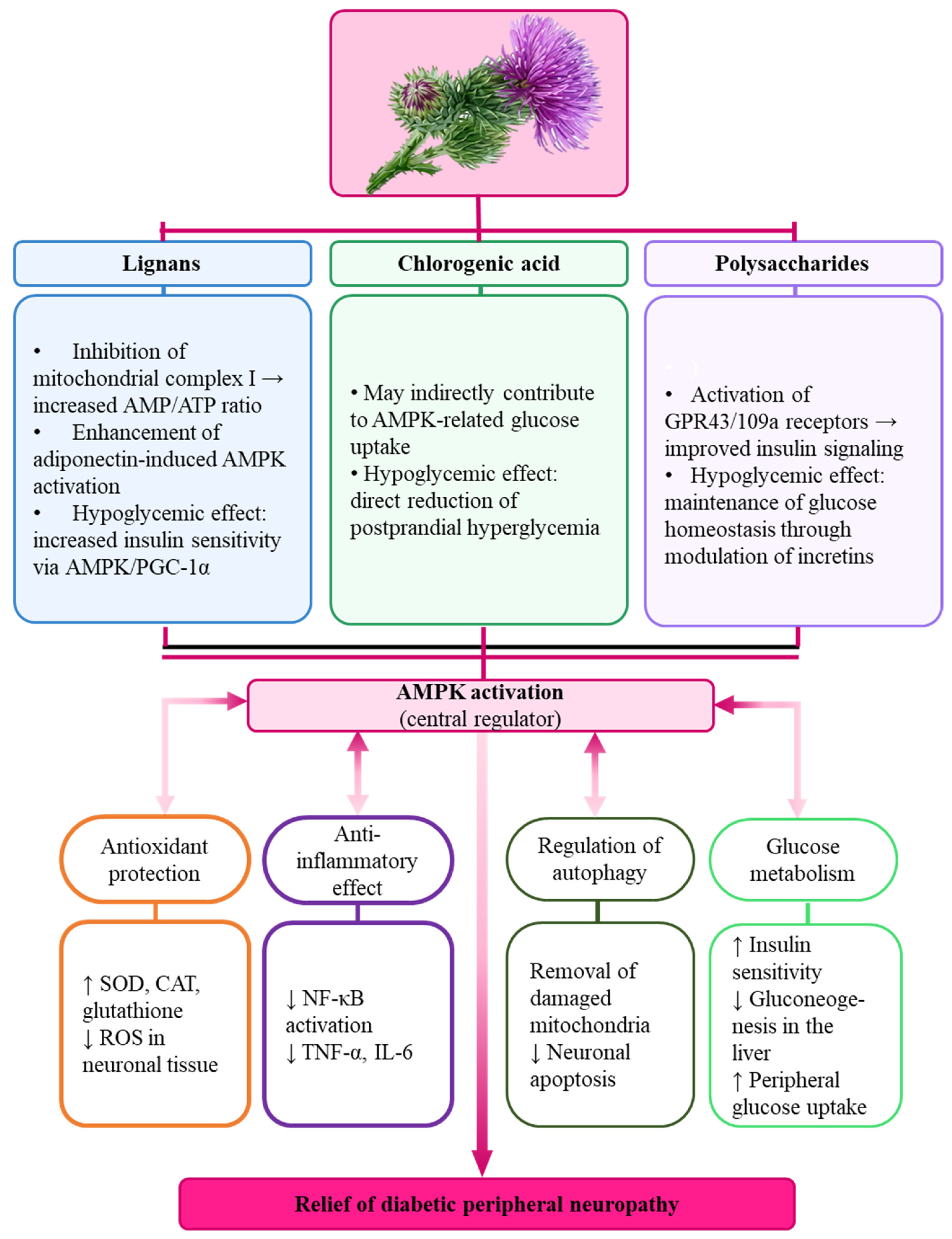
7. Molecular Mechanisms Underlying Antihyperglycemic Action
| Compound/Group | Molecular Mechanisms | Pharmacological Effect (Antidiabetic + Related Effects) | Model | Ref. |
|---|---|---|---|---|
| AXIS 1: Enzyme Inhibition | ||||
| Chlorogenic acid | Inhibition of α-glucosidase; antioxidant activity | Antihyperglycemic effect; protection of β-cells | In vitro (phenolic profiling and antioxidant-related evaluation) | [52,53,54] |
| General phenolic complex | Inhibition of carbohydrate hydrolases (α-glucosidase/α-amylase) | Overall antihyperglycemic and cytoprotective effects | In vitro (phenolic profiling and antioxidant assays) | [45,52,53,54] |
| AXIS 2: Antioxidant and Anti-inflammatory | ||||
| Dicaffeoylquinic acids (including cynarin) | Protection of β-cells; strong antioxidant and anti-inflammatory activity | Reduction in serum glucose; improvement of insulin secretion | In vitro (SAR/free radical scavenging assays; compound isolation and analysis) | [61,64,73] |
| Polysaccharides (roots) | ↓ ROS; ↑ activity of antioxidant enzymes (SOD, CAT, GPx) | Hepatoprotective and antioxidant effects in diabetes | In vitro + in vivo (antioxidant assays; animal models) | [24,45] |
| Quercetin and its derivatives | Antioxidant; membrane stabilization | Reduction in oxidative stress; cytoprotection | In vitro (phenolic profiling; antioxidant evaluation) | [52,53] |
| Caffeic acid | Antioxidant; modulation of carbohydrate-metabolizing enzymes | Antihyperglycemic activity; improvement of glucose metabolism | In vitro (phenolic profiling/UPLC-MS identification) | [52,53] |
| Sulfur-containing polyacetylenes | Antioxidant and anti-inflammatory mechanisms | Potential benefit in inflammatory metabolic disturbances | In vitro (compound isolation and structural identification) | [63] |
| AXIS 3: AMPK and Insulin Signaling | ||||
| Arctigenin (lignan) | Associated with AMPK signaling pathways; suppression of NF-κB; ↓ NO production | Improved insulin sensitivity; anti-inflammatory and neuroprotective effects | In vitro + in vivo (cell models; NO inhibition; antihyperglycemic animal models) | [88,91,94] |
| Arctiin (lignan) | Downregulation of inflammatory markers (e.g., NO, cytokines) | Tissue protection; anti-inflammatory activity | In vitro + in vivo (NO inhibition assay; C. elegans model) | [62,90] |
| AXIS 4: Gut Microbiota and Prebiotic | ||||
| Fructans/inulin | Observed shifts in gut microbiota composition | Mild antihyperglycemic effect; prebiotic activity | In vitro + in vivo (antioxidant assays; animal experiments) | [24,59] |

8. Safety, Toxicity and Dosage Considerations
| Parameter | Key Findings | Dose/Values | Route/Model | Source Type | Ref. |
|---|---|---|---|---|---|
| Acute Oral LD50 | Low acute toxicity | >2000–5000 mg/kg | Oral, Rodents | Primary Study | [101] |
| Arctigenin NOAEL | High risk (non-oral) | <6 mg/kg/day | Subcutaneous/Parenteral, Dogs (A. tomentosum) | Primary Study | [100] |
| Oral LOAEL | Myocardial/renal damage | 12–36 mg/kg | Oral, Rats (A. tomentosum) | Primary Study | [100,101] |
| ALFE Extract | Ethanolic fruit (seed) extract | LD50 > 5000 mg/kg | Oral, Rats | Primary Study | [101] |
| HED Estimate | Illustrative calculation only | ~2.8 g/day | Extrapolated for 70 kg Adults | Review/Estimate | [102] |
| Traditional Dose | Aqueous decoction (dried root) | Variable traditional ranges | Oral, Human | Pharmacopeial Reference (EMA) | [36] |
9. Conclusions
Author Contributions
Funding
Institutional Review Board Statement
Informed Consent Statement
Data Availability Statement
Acknowledgments
Conflicts of Interest
References
- Zhou, B.; Rayner, A.W.; Gregg, E.W.; Sheffer, K.E.; Carrillo-Larco, R.M.; Bennett, J.E.; Shaw, J.E.; Paciorek, C.J.; Singleton, R.K.; Pires, A.B. Worldwide Trends in Diabetes Prevalence and Treatment from 1990 to 2022: A Pooled Analysis of 1108 Population-Representative Studies with 141 Million Participants. Lancet 2024, 404, 2077–2093. [Google Scholar] [CrossRef]
- WHO Diabetes. Available online: https://www.who.int/news-room/fact-sheets/detail/diabetes (accessed on 18 January 2026).
- IDF The Diabetes Atlas. Available online: https://diabetesatlas.org/ (accessed on 18 January 2026).
- Cho, N.H.; Shaw, J.E.; Karuranga, S.; Huang, Y.; da Rocha Fernandes, J.D.; Ohlrogge, A.W.; Malanda, B. IDF Diabetes Atlas: Global Estimates of Diabetes Prevalence for 2017 and Projections for 2045. Diabetes Res. Clin. Pract. 2018, 138, 271–281. [Google Scholar] [CrossRef] [PubMed]
- Di Magno, L.; Di Pastena, F.; Bordone, R.; Coni, S.; Canettieri, G. The Mechanism of Action of Biguanides: New Answers to a Complex Question. Cancers 2022, 14, 3220. [Google Scholar] [CrossRef]
- Palmer, S.C.; Tendal, B.; Mustafa, R.A.; Vandvik, P.O.; Li, S.; Hao, Q.; Tunnicliffe, D.; Ruospo, M.; Natale, P.; Saglimbene, V. Sodium-Glucose Cotransporter Protein-2 (SGLT-2) Inhibitors and Glucagon-like Peptide-1 (GLP-1) Receptor Agonists for Type 2 Diabetes: Systematic Review and Network Meta-Analysis of Randomised Controlled Trials. BMJ 2021, 372, m4573. [Google Scholar] [CrossRef] [PubMed]
- Prasad-Reddy, L.; Isaacs, D. A Clinical Review of GLP-1 Receptor Agonists: Efficacy and Safety in Diabetes and Beyond. Drugs Context 2015, 4, 212283. [Google Scholar] [CrossRef]
- Sendekie, A.K.; Netere, A.K.; Kasahun, A.E.; Belachew, E.A. Medication Adherence and Its Impact on Glycemic Control in Type 2 Diabetes Mellitus Patients with Comorbidity: A Multicenter Cross-Sectional Study in Northwest Ethiopia. PLoS ONE 2022, 17, e0274971. [Google Scholar] [CrossRef]
- Patel, M.R. Financial Toxicity in Diabetes: The State of What We Know. Curr. Diabetes Rep. 2025, 25, 32. [Google Scholar] [CrossRef]
- Thewjitcharoen, Y.; Yenseung, N.; Malidaeng, A.; Nakasatien, S.; Chotwanvirat, P.; Krittiyawong, S.; Wanothayaroj, E.; Himathongkam, T. Effectiveness of Long-Term Treatment with SGLT2 Inhibitors: Real-World Evidence from a Specialized Diabetes Center. Diabetol. Metab. Syndr. 2017, 9, 96. [Google Scholar] [CrossRef] [PubMed]
- Stevenson-Hoare, J.; Leonenko, G.; Escott-Price, V. Comparison of Long-Term Effects of Metformin on Longevity between People with Type 2 Diabetes and Matched Non-Diabetic Controls. BMC Public Health 2023, 23, 804. [Google Scholar] [CrossRef]
- Kooti, W.; Farokhipour, M.; Asadzadeh, Z.; Ashtary-Larky, D.; Asadi-Samani, M. The Role of Medicinal Plants in the Treatment of Diabetes: A Systematic Review. Electron. Physician 2016, 8, 1832–1842. [Google Scholar] [CrossRef]
- Chang, C.L.T.; Lin, Y.; Bartolome, A.P.; Chen, Y.-C.; Chiu, S.-C.; Yang, W.-C. Herbal Therapies for Type 2 Diabetes Mellitus: Chemistry, Biology, and Potential Application of Selected Plants and Compounds. Evid. Based Complement. Altern. Med 2013, 2013, 378657. [Google Scholar] [CrossRef]
- Salleh, N.H.; Zulkipli, I.N.; Mohd Yasin, H.; Ja’afar, F.; Ahmad, N.; Wan Ahmad, W.A.N.; Ahmad, S.R. Systematic Review of Medicinal Plants Used for Treatment of Diabetes in Human Clinical Trials: An ASEAN Perspective. Evid. Based Complement. Altern. Med. 2021, 2021, 5570939. [Google Scholar] [CrossRef]
- Willcox, M.L.; Elugbaju, C.; Al-Anbaki, M.; Lown, M.; Graz, B. Effectiveness of Medicinal Plants for Glycaemic Control in Type 2 Diabetes: An Overview of Meta-Analyses of Clinical Trials. Front. Pharmacol. 2021, 12, 777561. [Google Scholar] [CrossRef] [PubMed]
- Mahmoud, V.L.; Shayesteh, R.; Foong Yun Loh, T.K.; Chan, S.W.; Sethi, G.; Burgess, K.; Lee, S.H.; Wong, W.F.; Looi, C.Y. Comprehensive Review of Opportunities and Challenges of Ethnomedicinal Plants for Managing Type 2 Diabetes. Heliyon 2024, 10, e39699. [Google Scholar] [CrossRef] [PubMed]
- Yedjou, C.G.; Grigsby, J.; Mbemi, A.; Nelson, D.; Mildort, B.; Latinwo, L.; Tchounwou, P.B. The Management of Diabetes Mellitus Using Medicinal Plants and Vitamins. Int. J. Mol. Sci. 2023, 24, 9085. [Google Scholar] [CrossRef] [PubMed]
- Chan, Y.-S.; Cheng, L.-N.; Wu, J.-H.; Chan, E.; Kwan, Y.-W.; Lee, S.M.-Y.; Leung, G.P.-H.; Yu, P.H.-F.; Chan, S.-W. A Review of the Pharmacological Effects of Arctium lappa (Burdock). Inflammopharmacology 2011, 19, 245–254. [Google Scholar] [CrossRef] [PubMed]
- Shyam, M.; Sabina, E.P. Harnessing the Power of Arctium lappa Root: A Review of Its Pharmacological Properties and Therapeutic Applications. Nat. Prod. Bioprospect. 2024, 14, 49. [Google Scholar] [CrossRef]
- İlgün, S.; Karatoprak, G.Ş.; Polat, D.Ç.; Şafak, E.K.; Yıldız, G.; Küpeli Akkol, E.; Sobarzo-Sánchez, E. Phytochemical Composition and Biological Activities of Arctium minus (Hill) Bernh.: A Potential Candidate as Antioxidant, Enzyme Inhibitor, and Cytotoxic Agent. Antioxidants 2022, 11, 1852. [Google Scholar] [CrossRef]
- Watanabe, S.; Yamabe, S.; Shimada, M. Arctium lappa Lam. and Its Related Lignans Improve Hyperglycemia and Dyslipidemia in Diabetic Rodent Models: A Systematic Review and Meta-Analysis. Nutraceuticals 2022, 2, 335–349. [Google Scholar] [CrossRef]
- Fierascu, R.C.; Georgiev, M.I.; Fierascu, I.; Ungureanu, C.; Avramescu, S.M.; Ortan, A.; Georgescu, M.I.; Sutan, A.N.; Zanfirescu, A.; Dinu-Pirvu, C.E. Mitodepressive, Antioxidant, Antifungal and Anti-Inflammatory Effects of Wild-Growing Romanian Native Arctium lappa L. (Asteraceae) and Veronica Persica Poiret (Plantaginaceae). Food Chem. Toxicol. 2018, 111, 44–52. [Google Scholar] [CrossRef]
- Tian, X.; Sui, S.; Huang, J.; Bai, J.-P.; Ren, T.-S.; Zhao, Q.-C. Neuroprotective Effects of Arctium lappa L. Roots against Glutamate-Induced Oxidative Stress by Inhibiting Phosphorylation of P38, JNK and ERK 1/2 MAPKs in PC12 Cells. Environ. Toxicol. Pharmacol. 2014, 38, 189–198. [Google Scholar] [CrossRef] [PubMed]
- Liu, W.; Wang, J.; Zhang, Z.; Xu, J.; Xie, Z.; Slavin, M.; Gao, X. In Vitro and in Vivo Antioxidant Activity of a Fructan from the Roots of Arctium lappa L. Int. J. Biol. Macromol. 2014, 65, 446–453. [Google Scholar] [CrossRef]
- Gao, H.; Jiang, X.-W.; Yang, Y.; Liu, W.-W.; Xu, Z.-H.; Zhao, Q.-C. Isolation, Structure Elucidation and Neuroprotective Effects of Caffeoylquinic Acid Derivatives from the Roots of Arctium lappa L. Phytochemistry 2020, 177, 112432. [Google Scholar] [CrossRef]
- Maruta, Y.; Kawabata, J.; Niki, R. Antioxidative Caffeoylquinic Acid Derivatives in the Roots of Burdock (Arctium lappa L.). J. Agric. Food Chem. 1995, 43, 2592–2595. [Google Scholar] [CrossRef]
- Tousch, D.; Bidel, L.P.R.; Cazals, G.; Ferrare, K.; Leroy, J.; Faucanié, M.; Chevassus, H.; Tournier, M.; Lajoix, A.-D.; Azay-Milhau, J. Chemical Analysis and Antihyperglycemic Activity of an Original Extract from Burdock Root (Arctium lappa). J. Agric. Food Chem. 2014, 62, 7738–7745. [Google Scholar] [CrossRef]
- Mondal, S.C.; Eun, J.-B. Mechanistic Insights on Burdock (Arctium lappa L.) Extract Effects on Diabetes Mellitus. Food Sci. Biotechnol. 2022, 31, 999–1008. [Google Scholar] [CrossRef]
- Chen, M.; Xu, J.; Wang, Y.; Wang, Z.; Guo, L.; Li, X.; Huang, L. Arctium lappa L. Polysaccharide Can Regulate Lipid Metabolism in Type 2 Diabetic Rats through the SREBP-1/SCD-1 Axis. Carbohydr. Res. 2020, 494, 108055. [Google Scholar] [CrossRef]
- Eric Brussell, D. Medicinal Plants of Mt. Pelion, Greece. Econ. Bot. 2004, 58, S174–S202. [Google Scholar] [CrossRef]
- Annunziata, G.; Barrea, L.; Ciampaglia, R.; Cicala, C.; Arnone, A.; Savastano, S.; Nabavi, S.M.; Tenore, G.C.; Novellino, E. Arctium lappa Contributes to the Management of Type 2 Diabetes Mellitus by Regulating Glucose Homeostasis and Improving Oxidative Stress: A Critical Review of in Vitro and in Vivo Animal-Based Studies. Phytother. Res. 2019, 33, 2213–2220. [Google Scholar] [CrossRef] [PubMed]
- Ha, M.-S.; Yook, J.S.; Lee, M.; Suwabe, K.; Jeong, W.-M.; Kwak, J.-J.; Soya, H. Exercise Training and Burdock Root (Arctium lappa L.) Extract Independently Improve Abdominal Obesity and Sex Hormones in Elderly Women with Metabolic Syndrome. Sci. Rep. 2021, 11, 5175. [Google Scholar] [CrossRef] [PubMed]
- POWO Arctium lappa L. Available online: http://powo.science.kew.org/taxon/urn:lsid:ipni.org:names:178385-1 (accessed on 17 January 2026).
- GBIF Arctium lappa L. Available online: https://www.gbif.org/species/7353729 (accessed on 17 January 2026).
- Flora of China Arctium lappa. Available online: http://www.efloras.org/florataxon.aspx?flora_id=2&taxon_id=200023153 (accessed on 19 January 2026).
- European Medicines Agency Community Herbal Monograph on Arctium lappa L., Radix; EMA: London, UK, 2010.
- Li, S.-Z. Ben Cao Gang Mu (Compendium of Materia Medica), Republished ed.; Foreign Languages Press: Beijing, China, 2003. [Google Scholar]
- Mir, S.A.; Dar, L.A.; Ali, T.; Kareem, O.; Rashid, R.; Khan, N.A.; Chashoo, I.A.; Bader, G.N. Arctium lappa: A Review on Its Phytochemistry and Pharmacology. In Edible Plants in Health and Diseases; Masoodi, M.H., Rehman, M.U., Eds.; Springer: Singapore, 2022; pp. 327–348. ISBN 978-981-16-4958-5. [Google Scholar]
- Amankulova, T.B.; Moldakarsyzova, A.Z.; Tugelbekoa, G.A.; Zhelderbaeva, M.K.; Mukhamedzhanova, A.Z.; Dzhunusova, M.K.; Nurgaliyeva, A.K. Evaluation of the Biochemical State of the Body in Experimental Diabetes Mellitus and the Implementation of Research Results in the Educational Process. Bull. South Kazakhst. Med. Acad. 2022, 1, 328–334. [Google Scholar]
- Tsioutsiou, E.E.; Giordani, P.; Hanlidou, E.; Biagi, M.; De Feo, V.; Cornara, L. Ethnobotanical Study of Medicinal Plants Used in Central Macedonia, Greece. Evid. Based Complement. Altern. Med. 2019, 2019, 1–22. [Google Scholar] [CrossRef]
- Menale, B.; Amato, G.; Di Prisco, C.; Muoio, R. Traditional Uses of Plants in North-Western Molise (Central Italy). Delpinoa 2006, 48, 29–36. [Google Scholar]
- Saraçi, A.; Damo, R. A Historical Overview of Ethnobotanical Data in Albania (1800s–1940s). Ethnobiol. Conserv. 2021, 10. [Google Scholar] [CrossRef]
- Mukhamejanova, J.; Kuandykova, A.B.; Azimbaeva, G.E. Yelken tyezhapyrak (Arctium lappa) osimdiginik kurramyndagy with durumen titrimetriyalylyk adispenn anyktau. In Proceedings of the Innovative Technologies in Transport: Education, Science, Practice, Almaty, Kazakhstan, 18 April 2018; pp. 288–290. [Google Scholar]
- Singh, H.; Kumar, S.; Arya, A. Ethno-Dermatological Relevance of Medicinal Plants from the Indian Himalayan Region and Its Implications on Cosmeceuticals: A Review. J. Drug Res. Ayurvedic Sci. 2023, 8, 97. [Google Scholar] [CrossRef]
- Jiang, Y.; Yu, J.; Li, Y.; Wang, L.; Hu, L.; Zhang, L.; Zhou, Y. Extraction and Antioxidant Activities of Polysaccharides from Roots of Arctium lappa L. Int. J. Biol. Macromol. 2019, 123, 531–538. [Google Scholar] [CrossRef]
- Das, G.; Shin, H.-S.; Patra, J.K. Key Health Benefits of Korean Ueong Dry Root Extract Combined Silver Nanoparticles. Int. J. Nanomed. 2022, 17, 4261. [Google Scholar] [CrossRef]
- Negahdari, S. Ethnobotanical Study of Medicinal Plants Used for Management of Diabetes Mellitus in the East of Khuzestan, Southwest Iran. J. Biochem. Phytomed. 2023, 2, 7–10. [Google Scholar] [CrossRef]
- Marković, M.; Pljevljakušić, D.; Papović, O.; Stankov, J.V. Ethnopharmacological Use of Burdock (Arctium lappa) in the Pirot County. Pirot. Zb. 2022, 47, 133–142. [Google Scholar] [CrossRef]
- Ydyrys, A. An Overview of Medical Uses and Chemical Composition of Arctium Tomentosum Mill. Eng. Sci. 2023, 26, 984. [Google Scholar] [CrossRef]
- Tunçtürk, R.; Tunçtürk, M. Investigation of Antioxidant Activity, Total Phenolic and Flavonoid Substance Amounts and Dualex Values of Burdock (Arctium lappa L.) Plant. In Proceedings of the 10th International Mediterranean Symposium on Medicinal and Aromatic Plants (MESMAP-10), Istanbul, Turkey, 25–27 April 2024; Volume 1, pp. 85–95. [Google Scholar]
- Petkova, N.; Hambarlyiska, I.; Tumbarski, Y.; Vrancheva, R.; Raeva, M.; Ivanov, I. Phytochemical Composition and Antimicrobial Properties of Burdock (Arctium lappa L.) Roots Extracts. Biointerface Res. Appl. Chem. 2022, 12, 2826–2842. [Google Scholar]
- Ferracane, R.; Graziani, G.; Gallo, M.; Fogliano, V.; Ritieni, A. Metabolic Profile of the Bioactive Compounds of Burdock (Arctium lappa) Seeds, Roots and Leaves. J. Pharm. Biomed. Anal. 2010, 51, 399–404. [Google Scholar] [CrossRef]
- Lou, Z.; Wang, H.; Zhu, S.; Zhang, M.; Gao, Y.; Ma, C.; Wang, Z. Improved Extraction and Identification by Ultra Performance Liquid Chromatography Tandem Mass Spectrometry of Phenolic Compounds in Burdock Leaves. J. Chromatogr. A 2010, 1217, 2441–2446. [Google Scholar] [CrossRef]
- Carlotto, J.; de Souza, L.M.; Baggio, C.H.; Werner, M.F.d.P.; Maria-Ferreira, D.; Sassaki, G.L.; Iacomini, M.; Cipriani, T.R. Polysaccharides from Arctium lappa L.: Chemical Structure and Biological Activity. Int. J. Biol. Macromol. 2016, 91, 954–960. [Google Scholar] [CrossRef] [PubMed]
- de Souza, A.R.C.; Stefanov, S.; Bombardelli, M.C.; Corazza, M.L.; Stateva, R.P. Assessment of Composition and Biological Activity of Arctium lappa Leaves Extracts Obtained with Pressurized Liquid and Supercritical CO2 Extraction. J. Supercrit. Fluids 2019, 152, 104573. [Google Scholar] [CrossRef]
- de Souza, A.R.C.; Guedes, A.R.; Rodriguez, J.M.F.; Bombardelli, M.C.; Corazza, M.L. Extraction of Arctium lappa Leaves Using Supercritical CO2+ Ethanol: Kinetics, Chemical Composition, and Bioactivity Assessments. J. Supercrit. Fluids 2018, 140, 137–146. [Google Scholar] [CrossRef]
- Rodriguez, J.M.F.; de Souza, A.R.C.; Krüger, R.L.; Bombardelli, M.C.M.; Machado, C.S.; Corazza, M.L. Kinetics, Composition and Antioxidant Activity of Burdock (Arctium lappa) Root Extracts Obtained with Supercritical CO2 and Co-Solvent. J. Supercrit. Fluids 2018, 135, 25–33. [Google Scholar] [CrossRef]
- Ishiguro, Y.; Onodera, S.; Benkeblia, N.; Shiomi, N. Variation of Total FOS, Total IOS, Inulin and Their Related-Metabolizing Enzymes in Burdock Roots (Arctium lappa L.) Stored under Different Temperatures. Postharvest Biol. Technol. 2010, 56, 232–238. [Google Scholar] [CrossRef]
- Milani, E.; Koocheki, A.; Golimovahhed, Q.A. Extraction of Inulin from Burdock Root (Arctium lappa) Using High Intensity Ultrasound. Int. J. Food Sci. Technol. 2011, 46, 1699–1704. [Google Scholar] [CrossRef]
- Gu, Y.; Sun, X.; Ye, J.; He, L.; Yan, S.; Zhang, H.; Hu, L.; Yuan, J.; Yu, Q. Arctigenin Alleviates ER Stress via Activating AMPK. Acta Pharmacol. Sin. 2012, 33, 941–952. [Google Scholar] [CrossRef] [PubMed]
- Zheng, Z.; Wang, X.; Liu, P.; Li, M.; Dong, H.; Qiao, X. Semi-Preparative Separation of 10 Caffeoylquinic Acid Derivatives Using High Speed Counter-Current Chromatogaphy Combined with Semi-Preparative HPLC from the Roots of Burdock (Arctium lappa L.). Molecules 2018, 23, 429. [Google Scholar] [CrossRef]
- Qin, Z.-B.; Ding, L.-F.; Wang, X.; Huang, L.-J.; Liang, M.; Bin, J.; Luo, N.; Deng, L.; Guo, Y.-D. Lignans from the Seeds of Arctium lappa L. (Burdock) and Their Inhibitory Effects on Nitric Oxide Production. Phytochem. Lett. 2019, 34, 43–49. [Google Scholar] [CrossRef]
- Washino, T.; Kobayashi, H.; Ikawa, Y. Structures of Lappaphen-a and Lappaphen-b, New Guaianolides Linked with a Sulfur-Containing Acetylenic Compound, from Arctium lappa L. Agric. Biol. Chem. 1987, 51, 1475–1480. [Google Scholar] [CrossRef]
- Jiang, X.-W.; Bai, J.-P.; Zhang, Q.; Hu, X.-L.; Tian, X.; Zhu, J.; Liu, J.; Meng, W.-H.; Zhao, Q.-C. Caffeoylquinic Acid Derivatives from the Roots of Arctium lappa L. (Burdock) and Their Structure–Activity Relationships (SARs) of Free Radical Scavenging Activities. Phytochem. Lett. 2016, 15, 159–163. [Google Scholar] [CrossRef]
- Li, L.; Zhang, Y.; Xiao, F.; Wang, Z.; Liu, J. Arctiin Attenuates Lipid Accumulation, Inflammation and Oxidative Stress in Nonalcoholic Fatty Liver Disease through Inhibiting MAPK Pathway. Qual. Assur. Saf. Crops Foods 2022, 14, 105–114. [Google Scholar] [CrossRef]
- Shoeb, M.; Rahman, M.M.; Nahar, L.; Delazar, A.; Jaspars, M.; Macmanus, S.M. Bioactive Lignans from the Seeds of Centaurea Macrocephala. DARU J. Pharm. Sci. 2004, 12, 87–93. [Google Scholar]
- Sun, Q.; Liu, K.; Shen, X.; Jin, W.; Jiang, L.; Saeed Sheikh, M.; Hu, Y.; Huang, Y. Lappaol F, a Novel Anticancer Agent Isolated from Plant Arctium lappa L. Mol. Cancer Ther. 2014, 13, 49–59. [Google Scholar] [CrossRef] [PubMed]
- Zhang, C.-C.; Geng, C.-A.; Huang, X.-Y.; Zhang, X.-M.; Chen, J.-J. Antidiabetic Stilbenes from Peony Seeds with PTP1B, α-Glucosidase, and DPPIV Inhibitory Activities. J. Agric. Food Chem. 2019, 67, 6765–6772. [Google Scholar] [CrossRef] [PubMed]
- Kwon, Y.K.; Choi, S.J.; Kim, C.R.; Kim, J.K.; Kim, Y.-J.; Choi, J.H.; Song, S.-W.; Kim, C.-J.; Park, G.G.; Park, C.-S. Antioxidant and Cognitive-Enhancing Activities of Arctium lappa L. Roots in Aβ1-42-Induced Mouse Model. Appl. Biol. Chem. 2016, 59, 553–565. [Google Scholar] [CrossRef]
- Taher, M.A.; Abdul-Hussain, D.A.; Hasan, H.F.; Fahmi, Z.M.; Luaibi, O.K.; Ali, M.G. Hypolipidemic Effect of Caffeic Acid Isolated from Arctium lappa Cultivated in Iraq, in Hyperlipidemic Rat Model. Iraqi J. Pharm. Sci. 2015, 24, 18–24. [Google Scholar] [CrossRef]
- Lim, D.W.; Kim, M.; Yoon, M.; Lee, J.; Lee, C.; Um, M.Y. 1, 3-Dicaffeoylquinic Acid as an Active Compound of Arctium lappa Root Extract Ameliorates Depressive-like Behavior by Regulating Hippocampal Nitric Oxide Synthesis in Ovariectomized Mice. Antioxidants 2021, 10, 1281. [Google Scholar] [CrossRef] [PubMed]
- Al-Snafi, A.E. Phenolics and Flavonoids Contents of Medicinal Plants, as Natural Ingredients for Many Therapeutic Purposes-A Review. IOSR J. Pharm. 2020, 10, 42–81. [Google Scholar]
- Carlotto, J.; da Silva, L.M.; Dartora, N.; Maria-Ferreira, D.; Sabry, D.d.A.; PS Filho, A.; de Paula Werner, M.F.; Sassaki, G.L.; Gorin, P.A.; Iacomini, M. Identification of a Dicaffeoylquinic Acid Isomer from Arctium lappa with a Potent Anti-Ulcer Activity. Talanta 2015, 135, 50–57. [Google Scholar] [CrossRef]
- Watanabe, A.; Sasaki, H.; Miyakawa, H.; Nakayama, Y.; Lyu, Y.; Shibata, S. Effect of Dose and Timing of Burdock (Arctium lappa) Root Intake on Intestinal Microbiota of Mice. Microorganisms 2020, 8, 220. [Google Scholar] [CrossRef] [PubMed]
- Yuan, P.; Shao, T.; Han, J.; Liu, C.; Wang, G.; He, S.; Xu, S.; Nian, S.; Chen, K. Burdock Fructooligosaccharide as an α-Glucosidase Inhibitor and Its Antidiabetic Effect on High-Fat Diet and Streptozotocin-Induced Diabetic Mice. J. Funct. Foods 2021, 86, 104703. [Google Scholar] [CrossRef]
- Zhu, L.; Ding, M.; Liu, L.; Yuan, P.; Shao, T.; Liu, C.; Xi, C.; Han, J.; Zhou, Y.; Zhang, D.; et al. Burdock Fructooligosaccharide Protects Against Diabetic Nephropathy in Mice by Regulating Nrf2 Signaling. Pharmacol. Res. Perspec. 2025, 13, e70094. [Google Scholar] [CrossRef]
- Hong, W.; Chen, X.; Xiao, J.; Chen, G.; Yang, J.; Zhang, P.; Zhang, Z. Dehydrocostus Lactone Attenuates Atherogenesis by Promoting Cholesterol Efflux and Inhibiting Inflammation via TLR2/PPAR-γ/NF-κB Signaling Pathway. Mol. Med. 2025, 31, 243. [Google Scholar] [CrossRef]
- Kaur, R.; Sharma, P.; Bhardwaj, U.; Kaur, R. Dehydrocostus Lactone: A Comprehensive Review on Its Isolation, Chemical Transformations, and Pharmacological Potential. Discov. Chem. 2025, 2, 131. [Google Scholar] [CrossRef]
- El Khatib, N.; Morel, S.; Hugon, G.; Rapior, S.; Carnac, G.; Saint, N. Identification of a Sesquiterpene Lactone from Arctium lappa Leaves with Antioxidant Activity in Primary Human Muscle Cells. Molecules 2021, 26, 1328. [Google Scholar] [CrossRef]
- Chauhan, D.S.; Gupta, P.; Pottoo, F.H.; Amir, M. Secondary Metabolites in the Treatment of Diabetes Mellitus: A Paradigm Shift. CDM 2020, 21, 493–511. [Google Scholar] [CrossRef] [PubMed]
- Washino, T.; Yoshikura, M.; Obata, S. New Sulfur-Containing Acetylenic Compounds from Arctium lappa. Agric. Biol. Chem. 1986, 50, 263–269. [Google Scholar] [CrossRef]
- Ivanova, S.; Ivanova, A.; Todorova, M.; Gledacheva, V.; Nikolova, S. Echinops as a Source of Bioactive Compounds—A Systematic Review. Pharmaceuticals 2025, 18, 1353. [Google Scholar] [CrossRef]
- Nishioka, M. Aromatic Sulfur Compounds Other than Condensed Thiophenes in Fossil Fuels: Enrichment and Identification. Energy Fuels 1988, 2, 214–219. [Google Scholar] [CrossRef]
- Gasimova, S.A.; Novruzov, E.N.; Mehdiyeva, N.P. The Study of Chemical Composition of Fatty Oil from the Seeds of Arctium lappa L. ANAS Rep. 2018, 74, 80–84. [Google Scholar]
- Mondal, S.C.; Lee, W.-H.; Eun, J.-B. Ultrasonic Extraction of Reducing Sugar and Polyphenols from Burdock (Arctium lappa L.) Root Waste and Evaluation of Antioxidants and α-Glucosidase Inhibition Activity. Biomass Convers. Biorefinery 2024, 14, 18619–18636. [Google Scholar] [CrossRef]
- Predes, F.S.; Ruiz, A.L.; Carvalho, J.E.; Foglio, M.A.; Dolder, H. Antioxidative and in Vitro Antiproliferative Activity of Arctium lappa Root Extracts. BMC Complement. Altern. Med. 2011, 11, 25. [Google Scholar] [CrossRef] [PubMed]
- Xu, Z.; Ju, J.; Wang, K.; Gu, C.; Feng, Y. Evaluation of Hypoglycemic Activity of Total Lignans from Fructus Arctii in the Spontaneously Diabetic Goto-Kakizaki Rats. J. Ethnopharmacol. 2014, 151, 548–555. [Google Scholar] [CrossRef] [PubMed]
- Xu, Z.; Gu, C.; Wang, K.; Ju, J.; Wang, H.; Ruan, K.; Feng, Y. Arctigenic Acid, the Key Substance Responsible for the Hypoglycemic Activity of Fructus Arctii. Phytomedicine 2015, 22, 128–137. [Google Scholar] [CrossRef] [PubMed]
- Ahangarpour, A.; Heidari, H.; Oroojan, A.A.; Mirzavandi, F.; Esfehani, K.N.; Mohammadi, Z.D. Antidiabetic, Hypolipidemic and Hepatoprotective Effects of Arctium lappa Root’s Hydro-Alcoholic Extract on Nicotinamide-Streptozotocin Induced Type 2 Model of Diabetes in Male Mice. Avicenna J. Phytomed. 2017, 7, 169. [Google Scholar]
- Su, S.; Wink, M. Natural Lignans from Arctium lappa as Antiaging Agents in Caenorhabditis Elegans. Phytochemistry 2015, 117, 340–350. [Google Scholar] [CrossRef]
- Awale, S.; Lu, J.; Kalauni, S.K.; Kurashima, Y.; Tezuka, Y.; Kadota, S.; Esumi, H. Identification of Arctigenin as an Antitumor Agent Having the Ability to Eliminate the Tolerance of Cancer Cells to Nutrient Starvation. Cancer Res. 2006, 66, 1751–1757. [Google Scholar] [CrossRef]
- Li, X.; Zhao, Z.; Kuang, P.; Shi, X.; Wang, Z.; Guo, L. Regulation of Lipid Metabolism in Diabetic Rats by Arctium lappa L. Polysaccharide through the PKC/NF-κB Pathway. Int. J. Biol. Macromol. 2019, 136, 115–122. [Google Scholar] [CrossRef]
- Wang, Y.; Zhang, N.; Kan, J.; Zhang, X.; Wu, X.; Sun, R.; Tang, S.; Liu, J.; Qian, C.; Jin, C. Structural Characterization of Water-Soluble Polysaccharide from Arctium lappa and Its Effects on Colitis Mice. Carbohydr. Polym. 2019, 213, 89–99. [Google Scholar] [CrossRef]
- Park, S.Y.; Hong, S.S.; Han, X.H.; Hwang, J.S.; Lee, D.; Ro, J.S.; Hwang, B.Y. Lignans from Arctium lappa and Their Inhibition of LPS-Induced Nitric Oxide Production. Chem. Pharm. Bull. 2007, 55, 150–152. [Google Scholar] [CrossRef]
- Cao, J.; Li, C.; Zhang, P.; Cao, X.; Huang, T.; Bai, Y.; Chen, K. Antidiabetic Effect of Burdock (Arctium lappa L.) Root Ethanolic Extract on Streptozotocin-Induced Diabetic Rats. Afr. J. Biotechnol. 2012, 11, 9079. [Google Scholar] [CrossRef]
- Moro, T.M.A.; Clerici, M.T. Burdock (Arctium lappa L) Roots as a Source of Inulin-Type Fructans and Other Bioactive Compounds: Current Knowledge and Future Perspectives for Food and Non-Food Applications. Food Res. Int. 2021, 141, 109889. [Google Scholar] [CrossRef] [PubMed]
- Ong, K.W.; Hsu, A.; Tan, B.K.H. Chlorogenic Acid Stimulates Glucose Transport in Skeletal Muscle via AMPK Activation: A Contributor to the Beneficial Effects of Coffee on Diabetes. PLoS ONE 2012, 7, e32718. [Google Scholar] [CrossRef]
- Singh, S.K.; Thakur, K.; Sharma, V.; Saini, M.; Sharma, D.; Vishwas, S.; Kakoty, V.; Pal, R.S.; Chaitanya, M.; Babu, M.R. Exploring the Multifaceted Potential of Chlorogenic Acid: Journey from Nutraceutical to Nanomedicine. S. Afr. J. Bot. 2023, 159, 658–677. [Google Scholar] [CrossRef]
- Li, L.; Qiu, Z.; Qiao, Y.; Bai, X.; Zhu, W.; Li, Z.; Zheng, Z. Immunomodulatory Effects of Inulin-Type Fructans from Arctium lappa L. by Targeting Gut Microbiota and Their Metabolites. Food Chem. 2025, 467, 142308. [Google Scholar] [CrossRef]
- Aitynova, A.; Ibragimova, N.; Shalakhmetova, T.; Vassilyeva, K.; Issayeva, D. Cytotoxicity, Acute, and Sub-Chronic Toxicity of the Arctium tomentosum Mill. Root Extract. J. Appl. Biol. Biotechnol. 2024, 12, 67–73. [Google Scholar] [CrossRef]
- Wu, R.; Sun, Y.; Zhou, T.; Zhu, Z.; Zhuang, J.; Tang, X.; Chen, J.; Hu, L.; Shen, X. Arctigenin Enhances Swimming Endurance of Sedentary Rats Partially by Regulation of Antioxidant Pathways. Acta Pharmacol. Sin. 2014, 35, 1274–1284. [Google Scholar] [CrossRef] [PubMed]
- Nair, A.B.; Jacob, S. A Simple Practice Guide for Dose Conversion between Animals and Human. J. Basic Clin. Pharm. 2016, 7, 27–31. [Google Scholar] [CrossRef] [PubMed]
| Kingdom | Plantae |
|---|---|
| Phylum | Tracheophyta |
| Class | Magnoliopsida |
| Order | Asterales |
| Family | Asteraceae |
| Genus | Arctium L. |
| Species | Arctium lappa L. |
Disclaimer/Publisher’s Note: The statements, opinions and data contained in all publications are solely those of the individual author(s) and contributor(s) and not of MDPI and/or the editor(s). MDPI and/or the editor(s) disclaim responsibility for any injury to people or property resulting from any ideas, methods, instructions or products referred to in the content. |
© 2026 by the authors. Licensee MDPI, Basel, Switzerland. This article is an open access article distributed under the terms and conditions of the Creative Commons Attribution (CC BY) license.
Share and Cite
Uzbekova, A.A.; Kozhanova, K.K.; Kadyrbayeva, G.; Tursubekova, B.I.; Amantayeva, M.; Zhandabayeva, M.A.; Tleubayeva, M.I.; Beyatli, A. Unveiling the Antihyperglycemic Potential of Arctium lappa L. (Asteraceae): Traditional Application, Phytochemistry, and Molecular Insights. Foods 2026, 15, 794. https://doi.org/10.3390/foods15040794
Uzbekova AA, Kozhanova KK, Kadyrbayeva G, Tursubekova BI, Amantayeva M, Zhandabayeva MA, Tleubayeva MI, Beyatli A. Unveiling the Antihyperglycemic Potential of Arctium lappa L. (Asteraceae): Traditional Application, Phytochemistry, and Molecular Insights. Foods. 2026; 15(4):794. https://doi.org/10.3390/foods15040794
Chicago/Turabian StyleUzbekova, Amangul A., Kaldanay K. Kozhanova, Gulnara Kadyrbayeva, Bayan I. Tursubekova, Meruyert Amantayeva, Moldir A. Zhandabayeva, Meruyert I. Tleubayeva, and Ahmet Beyatli. 2026. "Unveiling the Antihyperglycemic Potential of Arctium lappa L. (Asteraceae): Traditional Application, Phytochemistry, and Molecular Insights" Foods 15, no. 4: 794. https://doi.org/10.3390/foods15040794
APA StyleUzbekova, A. A., Kozhanova, K. K., Kadyrbayeva, G., Tursubekova, B. I., Amantayeva, M., Zhandabayeva, M. A., Tleubayeva, M. I., & Beyatli, A. (2026). Unveiling the Antihyperglycemic Potential of Arctium lappa L. (Asteraceae): Traditional Application, Phytochemistry, and Molecular Insights. Foods, 15(4), 794. https://doi.org/10.3390/foods15040794