3.1. Characterization of Lupine and Obtained by Compression Milling Lupine Flours
The proximate composition (g 100 g
−1) and the bioactivity of the two lupine flours used in the formulation of lamb burgers, designated as Flour 1 and Flour 2, are shown in
Table 1. The pH values of the lupine flours showed no statistically significant differences between Flour 1 (5.6 ± 0.1) and Flour 2 (5.7 ± 0.0). Moisture content was significantly lower in Flour 2 compared to Flour 1. Both flours exhibited high protein levels and no significant differences were observed between them. This is consistent with lupine’s well-documented high protein content, which ranges between 30% and 42%, with variations attributed to the specific lupin variety [
36]. Moreover, lupin proteins offer several additional benefits, including their improved ease of handling from a technological standpoint and having a higher denaturation temperature compared to animal proteins [
37]. Meanwhile, Flour 1 contained significantly more fiber than Flour 2, the inclusion of which in meat products could be beneficial for human health, improving digestive function and contributing to the regulation of lipid metabolism [
38]. Fat content was significantly higher in Flour 2. In this context, although lupine is classified as a legume and not traditionally considered an oilseed crop, its seeds contain a substantial amount of oil, ranging from 5% to 20% crude oil based on the total seed weight [
39] which is in line with our results. Regarding fatty acid composition monounsaturated fatty acids (MUFAs) showed the highest percentage (58.4–58.8%;
p < 0.01), with oleic acid (C18:1) being the predominant fatty acid (
Table S1) (
p < 0.001) followed by polyunsaturated fatty acids (PUFA) (27.3–27.6%;
p < 0.01) and by saturated fatty acids (SFA) (13.1–13.2%). The predominant fatty acids amongst the SFA were palmitic acids (C16:0), whereas the most abundant PUFA was linoleic acid (C18:2 n-6). Although these differences are subtle, the higher PUFA content in Flour 2 could impart greater nutritional value due to the well-known benefits of PUFA on cardiovascular health [
40]. However, PUFAs are structurally more susceptible to oxidation, and their higher oxidation rate negatively impacts meat quality by promoting sensory deterioration and the formation of harmful compounds [
41]. No significant differences were observed in total SFA. One of the most notable differences was observed in the concentration of phenolic compounds, which was more than doubled in Flour 2 (74.0 mg 100 g
−1) compared to the Flour 1 (36.8 mg 100 g
−1). However, despite this substantial increase, the antioxidant activity did not significantly differ between flours, suggesting that either the phenolic profile was qualitatively different or that the matrix effects limited the expression of antioxidant potential. Previous studies have highlighted that not all phenolics contribute equally to antioxidant performance, and their effectiveness may depend on structure, solubility, and interactions with other components [
42]. In line with our results, previous studies by Lampart-Szczapa et al. [
43] evaluated different lupin seed products and found no correlation between antioxidant properties and phenolic compounds content. Other antioxidants like alkaloids, tocopherols, or bioactive peptides might be involved in this bioactivity. Several studies have demonstrated that the degree of milling is positively correlated with nutrient bioaccessibility [
44,
45]. In general, the effect of milling depends on the parameters of the process, but, generally, increasing temperatures or pressures increase the bioavailability of bioactive compounds, including phenolic compounds [
46]. This more intense process could promote extensive cell rupture during the operation, which enhances nutritional bioaccessibility. Changes in the specific phenolic profile of lupine flour during the flour production process were not evaluated in the present study, which limits the interpretation of the observed results.
3.3. Color Changes in Lamb Burgers with Lupine Flour Treated by High Hydrostatic Pressure
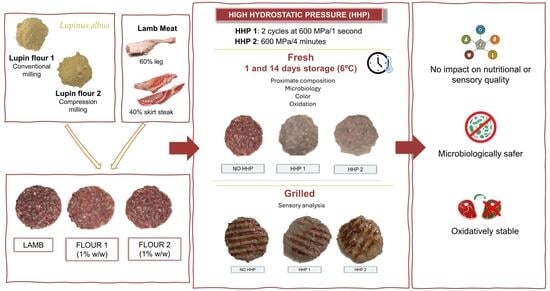
Table 3 shows the two-way ANOVA results evaluating the effects of treatment and formulation, as well as their interaction, on instrumental color parameters (CIE L*, a*, b*, Chroma, and Hue) of lamb burgers at day 1. HHP significantly influenced all color parameters of lamb burgers at day 1 (
p ≤ 0.001), confirming its strong impact on visual appearance of fresh burgers. Formulation effects (lupine flour addition) were significant only for CIE b* and Chroma, while a significant treatment × formulation interaction was also detected for these same parameters.
Instrumental colors of lamb burgers formulated with different lupine flours, evaluated after HHP treatment and during refrigerated storage, are shown in
Table 4. On day 1, within each group, no significant differences in lightness CIE L* were observed between formulations, suggesting that neither Flour 1 nor Flour 2 influenced the initial lightness. The lowest L* values were observed in the non-high-pressure-treated group, with values ranging from 46.7 in lamb burgers to 47.3 in Flour 1 formulation. Application of HHP markedly increased lightness in both treatments (HHP1 and HHP2). Other authors have reported an increase in L* values in beef M. biceps femoris samples after HHP treatment (350–600 MPa) [
50]. According to Cheftel & Culioli, [
51], this “whitening/brightening” effect induced by HHP processing could be attributed to globin denaturation, displacement or release heme iron, and oxidation of the ferrous atom. Regarding CIE a* parameter values were not affected by the flour inclusion. Values were highest in NO HHP samples, showing lower redness in HHP samples. HHP2 (1 cycle 600 MPa/4 min) showed lower values than HHP1 (2 cycles 600 MPa/1 s). The changes in redness of meat after HHP is mainly due to myoglobin modification.
Meat color is largely determined by both the concentration of myoglobin and its chemical form. Upon exposure to air, freshly cut meat undergoes oxygen binding to myoglobin, producing oxymyoglobin, which imparts the bright red appearance commonly linked to freshness. The reduction in red color intensity after HHP is primarily attributed to changes in protein configuration and protein denaturation triggered by HHP, a phenomenon extensively documented in meat products. These effects are mainly due to the conversion of oxymyoglobin to metmyoglobin and the denaturation of globin chains, both of which lead to a paler or brownish appearance [
52].
For yellowness (CIE b*), non-HHP samples showed similar values between formulations at day 1. However, in HHP1, Flour 2 presented significantly higher b* values than the Lamb and Flour 1, while in HHP2 no significant differences were found initially. This would explain the significant interaction between treatment and formulation (
Table 3). Chroma followed a similar pattern, with HHP1 Flour 2 showing higher values compared with the other formulations, whereas no significant differences were observed in HHP2 at day 1. Hue values were not affected by formulation, although they were higher in HHP-treated samples than in NO HHP samples. Overall, HHP application induced changes in all color parameters, while formulation effects were limited to b* and Hue.
Two-way ANOVA of color parameters after 14 days of storage comparing treatments (HHP1 vs. HHP2) and formulations (Lamb vs. Flour 1 vs. Flour 2) are shown in
Table 3. After 14 days of storage, HHP application of two short cycles or one long treatment (HHP1 vs. HHP2) significantly affected all color parameters (
p ≤ 0.001). Formulation effects (flour addition) were significant for CIE a*, b*, Chroma, and Hue, indicating that the addition of flour influenced redness, yellowness, saturation, and hue values. Significant treatment × formulation interactions were observed for CIE L*, a*, b*, and Chroma. Individual changes were detailed at day 14 (
Table 4); lightness showed no significant differences among formulations in HHP1, with values ranging from 55.4 to 55.9, whereas in HHP2, Flour 1 exhibited significantly higher L* (58.2) compared with Lamb (57.0) and Flour 2 (57.6) (
p ≤ 0.5). Redness (a*) differed among formulations only in HHP1, with Flour 1 showing higher values (4.0) than Lamb and Flour 2 (3.1), while no significant differences were observed in HHP2 formulations. Yellowness showed no formulation effect in HHP1, while in HHP2 Flour 1 exhibited significantly lower values than Lamb and Flour 2. A similar trend was observed for Chroma, where HHP1 did not differ across formulations; however, in HHP2, Flour 1 was significantly lower than the other two formulations. Regarding Hue, significant formulation effects were found in both treatments: in HHP1, Flour 1 had lower values than Lamb and Flour 2, while in HHP2, Flour 1 was also lower compared with Lamb and Flour 2.
Storage time (changes day 1 vs. day 14,
Table 4) had no significant effect on lightness values, except in lamb burgers treated with HHP2. In HHP1 burgers, a* values significantly increased after 14 days in samples containing Flour 1, whereas in HHP2 a significant decrease was observed in the control samples. Yellowness (b*) values increased in burgers with Flour 1 and HH1 and decreased in lamb with HHP2. Chroma followed a similar trend, showing a significant increase in the control and Flour 1 samples under HHP1, and in the control and Flour 2 samples under HHP2, suggesting a reduction in color intensity. The Hue angle significantly increased in the control samples under HHP2.
The decline in redness (CIE a*) during refrigerated storage is mainly attributed to the oxidation of oxymyoglobin or deoxymyoglobin into brownish metmyoglobin, as well as myoglobin denaturation [
52]. Lightness also typically increases over storage. These shifts can influence purchase decisions; however, color changes in HHP-treated burgers are generally less pronounced [
12]. The visual appearance of food plays a fundamental role in consumers’ perception of quality and strongly influences purchasing decisions. In addition, the absence of significant effects from flour addition may also be beneficial for its inclusion in lamb burger formulations.
However, HHP treatment induced noticeable changes in burger appearance. The color alterations observed after HHP are consistent with previous studies on beef and poultry burgers treated at 400–600 MPa, where myoglobin denaturation and conversion to metmyoglobin resulted in whitening and discoloration [
50,
52]. Nonetheless, other studies have reported that these HHP-induced visual changes generally disappear after cooking [
53].
Regarding differences between HHP1 vs. HHP2, they were evidenced in the two way-ANOVA at day 14 (
Table 3) but they could also be appreciated at day 1 (
Table 4). In general, lightness was lower in HHP1 than in HHP2, indicating that whitening induced effect was more marked in HHP2. CIE a* values in HHP2 were generally lower than in HHP1 (2 cycles), indicating a decrease in redness at the longer one cycle of HHP. Similarly, the decrease in yellowness after HHP was less intense in HHP1 (two cycles) than in HHP2 (long cycle). Therefore, the discoloration often induced in meat products after HHP treatment was less intense when the two short cycles were applied. In this regard, Timon et al. [
12] reported greater color changes at higher pressure levels (600 vs. 400 MPa) and found that two cycles caused more color alteration than a single cycle under the same conditions in chicken burgers. The current results indicate that the application of short HHP cycles opens the door to mitigate the noticeable color changes induced after HHP.
3.4. Oxidative Status of Lamb Burgers with Lupine Flour and Treated by High Hydrostatic Pressure
At day 1, HHP treatment had a significant effect on lipid and protein oxidation of burgers (
Table 3). Formulation also significantly influenced lipid oxidation, whereas no effect was observed on protein oxidation. No significant treatment × formulation interactions were detected for lipid and protein oxidation.
The initial lipid oxidation levels ranged from 0.1 to 0.3 mg MDA kg
−1 across the three burger formulations (with 2 lupines flour) and HHP treatments (
Table 5). At day 1, lipid oxidation levels were generally low across all samples, as expected with freshly prepared meat systems. However, statistically significant differences were observed between formulations within the same treatment group for both NO HHP and HHP1. In both, burgers with Flour 2 showed the lowest oxidation values (
p < 0.001). In the NO HHP group, burgers with Flour 1 showed the highest oxidation levels; this trend was not found the other HHP burgers. The MDA values of samples subjected to HHP2 treatment were the highest, around 0.3 mg, with no significant differences observed among formulations. These findings are consistent with previous studies, indicating that HHP reduces the oxidative stability of fresh meat [
54]. In agreement with the present results, Ma et al. [
54] observed increased TBARS values in M. longissimus dorsi beef samples subjected to pressures ≥400 MPa at 20 °C and 40 °C. On the other hand, protein oxidation did not show significant differences among formulations at day 1 with carbonyl values ranging from 2.5 to 4.1 nmol mg protein
−1. Values of HHP-treated burgers were higher than non-treated, in line with lipid oxidation.
At day 14, according to the two-way ANOVA (
Table 3) both HHP treatment (HHP 1 vs. HHP2) and formulation had significant effects on lipid oxidation, while protein oxidation was influenced only by HHP treatment. A significant treatment × formulation interaction was observed for lipid and protein oxidation. Under HHP1, burgers formulated with Flour 2 exhibited the lowest MDA value (0.1 mg kg
−1), significantly lower than both the control (0.5 mg kg
−1) and the Flour 1 (0.4 mg kg
−1) (
p ≤ 0.001) (
Table 5). Under HHP2, a similar trend was observed; burgers formulated with Flour 2 exhibited the lowest MDA value (0.3 mg kg
−1), significantly lower than both the Flour 1 (0.6 mg kg
−1) and the highest value was found in the control (0.9 mg kg
−1) (
p ≤ 0.001). On the other hand, MDA values were higher in HHP2 than in HHP1 confirming that a longer pressurization time intensified lipid oxidation. Nevertheless, burgers containing Flour 1 (at HHP2) Flour 2 (at HHP1 and HHP2) still showed the greatest oxidative stability (0.3 mg kg
−1;
p ≤ 0.001).
At day 14, the highest levels of protein oxidation were detected in the samples containing Flour 2 treated with HHP1 (5.9 nmols mg protein
−1;
p < 0.01), contrarily to lipid oxidation results. In contrast, same flour samples subjected to HHP2 exhibited the lowest carbonyl contents in line with lipid oxidation. This differential effect at HHP1 and HHP2 is in agreement with the interaction between HHP and formulation (
Table 3).
During the refrigerated storage (changes day 1 vs. day 14,
Table 5), TBA-RS significantly increased in all burgers except in those with Flour 2. Protein oxidation significantly increased in all HHP-treated burgers except in Lamb and Flour 2 burgers at HHP1.
As far as we are concerned, the application of lupine flour to meat products is underexplored. The available literature mainly focuses on the characterization of the nutritional composition and beneficial properties of lupine seeds [
55,
56]. The lower oxidation observed in burgers containing lupin flour, compared to control samples, might be attributed to the presence of natural antioxidants such as phenolic compounds, alkaloids and tocopherols found in lupin seeds. In our study, the compression milling process of Flour 2 may have further enhanced the bioavailability of these antioxidants, resulting in a slight protective effect. Several studies have reported that pressure levels ranging from 300 to 600 MPa are critical thresholds for initiating lipid oxidation in fresh lamb pork, beef, and poultry [
18,
52]. This oxidation process can result in rancidity, the development of off-flavors, and a reduction in shelf life; however, the inclusion of lupine flour may delay this process due to the incorporation of antioxidant compounds into the meat matrix, which may be effective in mitigating oxidation. Similarly, D’Arrigo et al., [
13], demonstrated that the addition of broccoli and cauliflower by-product ingredients recognized for their high polyphenolic content enhanced the oxidative stability of samples subjected to HHP.
Regarding the effect of HHP on protein oxidation, some authors [
57] reported that treatments at 600 MPa for 6 min in pork altered the degradation pattern of myofibrillar proteins due to increased cathepsin activity, which could lead to enhanced protein oxidation; however, other studies [
58] have indicated that legume-derived antioxidants like phenolic compounds can mitigate protein oxidation during storage or processing, which could partially explain the behavior observed in our study. Regarding the differential and unexpected effect of Flour 2 addition in HHP1 and HHP2, it should be added that protein oxidation has been less studied and remains less understood, mainly due to its complex chemistry, limited analytical methods, and the traditional focus on lipid oxidation and microbial spoilage as the primary causes of quality loss [
58].
During refrigerated storage, lipid oxidation increased significantly, confirming that storage promoted the formation of secondary oxidation products. Protein oxidation also rose significantly during storage reflecting ongoing oxidative damage to proteins. However, burgers formulated with Flour 1 and especially with Flour 2 showed an enhanced lipid oxidative stability. This might be attributed to the antioxidants from lupines flour which could persist in the HHP-treated burgers during the storage. The effects of HHP (HHP1 vs. HHP2) and the type of lupine flour (Flour 1 vs. Flour 2) showed significant interactions for lipid and protein oxidation at day 14 (
Table 3) which reflect the complexity of the reactions evaluated. The interactions between HHP and lupine flour were also significant for all color parameters. These results indicate that the effects of HHP (two cycles vs. one long cycle) on lamb burger quality are modulated by the presence and type of lupine flour, highlighting a clear interaction between processing intensity and ingredient functionality.
The reduced lipid oxidation in burgers containing compression-milled lupine flour (Flour 2) after HHP treatment is likely due to the higher availability of phenolic compounds acting as radical scavengers, whose effectiveness may be enhanced by pressure-induced modifications of meat proteins and microstructure. A similar effect would be applied to color changes at day 14 which were modulated by type of flour and the processing conditions applied.
3.5. Microbial Counts in Lamb Burgers with Lupine Flour Treated by High Hydrostatic Pressure
The results of the two-way ANOVA assessing the effects of treatment, formulation, and their interaction on the different microorganisms at day 1 (
Table 3) showed that HHP treatment exerted a highly significant effect (
p ≤ 0.001) on mesophilic, psychrophilic, molds and yeasts, total coliforms, and
E. coli, while
S. aureus was significantly affected at
p ≤ 0.01. In contrast, no significant differences were observed for
C. perfringens. Neither formulation nor the treatment × formulation interaction had a significant impact on any of the evaluated microorganisms. These findings indicate that HHP treatment was the main determinant of microbial reduction at day 1, regardless of formulation.
Table 6 displays the microbial counts in lamb burgers for each treatment and formulation (CFU g
−1) at 1 and 14 days of storage. At day 1, mesophilic counts were high in all formulations not subjected to HHP treatment, with values above 7 log CFU g
−1 regardless of the flour type used (no flour, Flour 1 or Flour 2), indicating an initially elevated microbial load, likely attributable to pre-processing handling and to the intrinsic characteristics of lamb meat. In contrast, burgers subjected to HHP1 and HHP2 exhibited a drastic reduction in mesophilic counts at day 1, dropping to values between 3.7 and 4.5 log CFU g
−1. These reductions reflect the well-documented bactericidal effect of HHP, attributed to cell membrane disruption and protein denaturalization [
59].
For psychrophilic counts a similar pattern was observed. NO HHP samples exhibited the highest counts (7.6–7.8 log CFU g
−1), whereas both HHP1 and HHP2 treatments significantly reduced the counts to approximately 1 log CFU g
−1. Psychrophilic microorganisms are well-adapted to grow at low temperatures, which is often associated with a higher proportion of unsaturated and branched-chain fatty acids in their membranes, which help maintain membrane fluidity and low-temperature functionality [
60]. Some authors have pointed out that the cell wall and membranes of microorganisms, as well as membrane fluidity, may be factors influencing an organism’s pressure sensitivity [
61], which could explain the higher susceptibility of these microorganisms to pressure; however, further research is still needed in this regard.
Mold and yeast counts were also significantly reduced by HHP, with reduction of around 2.2 log CFU g
−1.
Staphylococcus aureus counts in untreated burgers ranged between 2.2 and 2.6 log CFU g
−1 across formulations, whereas after HHP treatment, the counts fell below the detection limit of the method (<2 log CFU g
−1).
Clostridium perfringens remained below detection limits (<1 log CFU g
−1) in all samples. At day 1, NO HHP samples presented total coliforms levels of 2.8–3.2 log CFU g
−1 and
E. coli of approximately 1.2–1.4 log CFU g
−1. Total coliforms and
E. coli were both significantly reduced by HHP. In contrast, both HHP1 and HHP2 treatments reduced these counts to below the detection limits (<1 log CFU g
−1). The drastic reduction in coliforms, as well as in mesophilics and psychrophilics, at 600 MPa is consistent with studies showing 2–5 log cycle reductions and complete inactivation of Gram-negative bacteria under similar conditions [
59,
62]
At 14 days of storage, the two-way ANOVA (
Table 3) showed that there were no significant main effects of treatment (HHP1 vs. HHP2) on mesophiles, psychrophiles, molds and yeasts,
S. aureus,
C. perfringens, total coliforms, or
E. coli. Therefore, from a microbiological point of view, the application of two short HHP cycles had a similar effect as an equivalent (on time) long one. However, formulation had a significant effect on mesophiles (
p ≤ 0.05), while treatment-by-formulation interactions were significant for molds and yeasts and
S. aureus.
The microbiological counts after 14 days of storage are shown in
Table 6. Mesophilic counts increased in HHP-treated samples compared with day 1, reaching values of 4.6–5.0 log CFU g
−1 in HHP1 and up to 6.6 log CFU g
−1 in one HHP2 formulation. This increase could be hypothesized to be related to microbial recovery or repair of sublethal injury during storage. As previously suggested by other authors, when microorganisms are exposed to chemical or physical processes that do not cause complete inactivation, they may enter a sublethally injured but reversible state [
63].
Psychrophilic counts followed a similar trend. At day 14, an increase in psychrophilic levels was observed in the HHP-treated groups, with values of 3.5–4.6 log CFU g
−1 in HHP1 samples and 2.6–4.5 log CFU g
−1 in HHP2. These findings indicate that although HHP is effective in reducing psychrophilic populations initially, surviving sublethally injured cells may recover and proliferate under refrigerated conditions, particularly in nutrient-rich environments such as meat emulsions. The partial recovery of psychrotrophic populations during storage has also been observed in
L. monocytogenes surviving sublethal HHP treatments, confirming the potential for microbial regrowth under refrigeration [
64].
At day 14, molds and yeasts showed differences between formulations in HHP1, with values ranging from 1.0 to 2.0 log CFU g
−1 and with lower values in burgers with flours, whereas no significant differences were observed among formulations in HHP2.
Staphylococcus aureus remained at very low levels after 14 days, with counts close to 2 log CFU g
−1 in HHP1 and HHP2 samples and with no significant differences between formulations. These low levels suggest that HHP prevented significant growth of this pathogen during storage.
Clostridium perfringens remained undetectable across most treatments indicating no relevant risk associated with this microorganism. Finally, both total coliforms and
E. coli stayed below the detection limit throughout storage in all HHP-treated samples with no recovery observed at day 14. These findings align with earlier work by Silhavy et al., [
62], which highlighted the sensitivity of Gram-negative bacteria to HHP. The complete inactivation and sustained absence of coliforms and
E. coli suggest that HHP is particularly effective against Gram-negative facultative anaerobes in meat matrices.
Regarding the effect of storage time (changes day 1 vs. day 14), mesophilic counts remained unchanged during storage at HHP1; however, in HHP2, lamb burgers and those with Flour 2 significantly increased. After refrigerated storage, psychrotrophic counts increased in all HHP-treated samples, indicating partial recovery. Only burgers treated at HHP2 with Flour 2 showed low similar counts at day 14 as at day 1. Refrigerated storage led to a significant increase in molds and yeasts in HHP1-treated samples, except in those with Flour 2, which remained constant, indicating partial recovery, whereas HHP2 samples remained stable over 14 days. This suggests that longer HHP is more effective in controlling fungal growth during storage, and this would be the only advantage of long cycles compared to short cycles from a microbiological point of view. Refrigerated storage had no significant effect on
S. aureus,
C. perfringens, total coliforms, or
E. coli counts in HHP-treated lamb burgers, indicating that these microorganisms remained stable over 14 days. These results highlight the efficacy of HHP in ensuring microbiological stability, with storage time having minimal impact on key pathogenic and spoilage microorganisms [
65]. The incorporation of the flour did not exert a significant impact on the overall microbiological profile; in any case, it generally did not have a detrimental effect (only observed for mesophilics in HHP2 burgers with flour 2) and even contributed to improved control of molds and psychrotrophic counts under certain HHP conditions. This outcome may be partly attributed to the antimicrobial properties of phenolic compounds, although their contribution remained marginal when compared with the pronounced reductions achieved by HHP.
From a microbiological perspective, the application of two short HHP cycles (600 MPa for 1 s) produced effects comparable to those of a single, longer cycle of equivalent total duration (600 MPa for 4 min). The beneficial effect of multi-pulse application has been previously demonstrated at microbial level [
17]. Previous work has shown that applying two cycles at 600 MPa/1 s can be more effective in reducing microbial counts than a single cycle (600 MPa/1 s) although the two-cycle treatment also produced more color alterations in chicken burgers, leading to a light gray–blue appearance [
12]. In our study, the longer treatment at 600 MPa (HHP2) was only more effective in reducing mold and yeast counts. However, that treatment also exerted a stronger influence on instrumental color changes and oxidation parameters, potentially compromising the final quality of the product. As far as we are concerned, this is the first time that the application of two cycles has been shown to provide a clear advantage over longer single-cycle treatments (equivalent on time), not only from a microbiological point of view but also from a meat quality perspective. Therefore, the application of HHP1 appears to confer greater advantages than HHP2 since the time of utilization of the HHP equipment at the commercial level would be similar.
3.6. Sensory Analysis
The organoleptic properties of meat products are predominantly governed by the compositional ingredients used in their formulation and by the technological processes applied. No significant differences were found in sensory attributes of the grilled burgers, including general appearance, odor intensity, taste intensity, texture, unpleasant taste, and overall evaluation—due to treatment, formulation, or their interaction (
Table 3).
Table 7 provides a detailed description of the sensory attributes of lamb burgers formulated with
Lupinus albus flours and subjected to HHP treatment. Scores for general appearance, odor intensity, taste intensity and overall acceptability remained consistently high across all samples (6.8–7.9), and no statistically significant differences were observed. Texture scores remained within acceptable consumer levels (≥6.0), with no significant differences among formulations. Unpleasant taste was minimal across all samples, indicating that the incorporation of the sweet lupin variety, whether in normal flour or flour obtained by compression milling, did not lead to the development of off-flavors or negatively impact the overall sensory acceptance at the concentration used.
The sensory evaluation demonstrated that the inclusion of
Lupinus albus flour—Flour 1 or 2—did not negatively affect the sensory attributes of lamb burgers, regardless of HHP treatment. Reviews highlight that processed lupin fractions possess a neutral flavor and are white in color, attributes that support their use as functional ingredients in meat systems [
66]. The sensory evaluation supports the high acceptability of the lupin flour and increases its potential for use in food formulations or in gluten-free products. The results of the sensory analysis confirm that the level of addition of flour chosen (1%
w/
w) was adequate to avoid the rejection of the consumers but provided beneficial antioxidant effects. Previous research also has demonstrated that lupin flour can be incorporated into meat products without compromising sensory quality. Alrahaife & Abu-Alruz [
49] revealed that the incorporation of
Lupinus albus flour at levels of 5%, 10%, and 15% in beef burgers did not negatively affect key sensory parameters, such as color, flavor, juiciness, or overall acceptability. In our study, those high levels received lower scores, when initially, the limit of admission of lupine flour was evaluated to set the levels added to the burgers.
Despite the important effect of HHP on instrumental color or in lipid and protein oxidation in the fresh burgers, panelists did not perceive differences in any of the parameters evaluated in the grilled burgers (No HHP vs. HHP). This observation is consistent with previous studies reporting that the inclusion of
Brassica by-products and the application of HHP did not adversely affect the sensory characteristics of lamb burgers [
13]. Comparable findings have been described in pork systems, where paste addition and HHP did not significantly modify the sensory attributes of grilled burgers [
67]. Overall, these results reinforce the feasibility of incorporating lupin-based ingredients into meat matrices processed by HHP without compromising consumer acceptability when the purchase decision does not depend on the fresh appearance of the product.



 ,
,