Construction of an Evaluation System for Big Food Concept Education and Its Behavioral Impact Mechanism Among College Students—An Empirical Study Based on a Survey of Students


Abstract
1. Introduction
2. Research Design and Methods
2.1. Research Hypotheses
2.2. Definition of the Big Food Concept
2.3. Survey Participants
2.4. Research Methods
2.5. Principles for Constructing the Evaluation System
3. Results and Discussion
3.1. Construction of the College Students’ Big Food Concept Education Evaluation System
3.1.1. Dimensions and Indicator Setting for the Evaluation System
3.1.2. Determination of Indicator Weights
3.1.3. Establishment of Evaluation Criteria
3.2. Current Big Food Concept Education Effects on College Students and Validation of the Education Evaluation System
3.2.1. Analysis of the Current Effects of Big Food Concept Education on College Students
3.2.2. Reliability and Validity Testing of the Evaluation System
3.2.3. Applicability Analysis of the Evaluation System
3.3. Impact of Big Food Concept Education on Student Behavior and Its Mechanism of Action
3.3.1. Definition of Research Variables
3.3.2. Model Construction and Fit
3.3.3. Analysis of Impact Relationships
3.4. Explanation of the Action Mechanism
4. Conclusions
Supplementary Materials
Author Contributions
Funding
Institutional Review Board Statement
Informed Consent Statement
Data Availability Statement
Conflicts of Interest
References
- Liu, Y.; Zhou, Y. Reflections on China’s food security and land use policy under rapid urbanization. Land Use Policy 2021, 109, 105699. [Google Scholar] [CrossRef] [Scilit]
- The State Council information Office of the People’s Republic of China. Press Conference on Guiding Principles of 3rd Plenary Session of 20th CPC Central Committee. 2024. Available online: http://english.scio.gov.cn/pressroom/node_9008479.html (accessed on 26 December 2025).
- The State Council of the People’s Republic of China. China Exerts Efforts to Build Diversified Food Supply System. 2025. Available online: https://english.www.gov.cn/news/202502/24/content_WS67bbc0c9c6d0868f4e8efe91.html (accessed on 26 December 2025).
- United Nations World Food Programme. China and Global Food Policy Report 2024 Building a Sustainable and Diversified Food Supply to Foster Agrifood Systems Transformation. 2025. Available online: http://www.wfpchinacoe.net/2025-10/29/content_118148473.shtml (accessed on 5 January 2026).
- Wu, D.F.; Wang, Q.Y.; Jia, S.S. Evolution Characteristics of China’s Big Food Concept Economic Statistics Data Under the Perspective of Food Security. Guangdong Nongye Kexue 2025, 52, 149–164. [Google Scholar]
- Chen, K.-Z.; Xu, M. Meeting low-carbon and food security objectives of China agri-food system under the greater food approach: Status quo, challenges, and pathways. Issues Agric. Econ. 2023, 6, 58–77. [Google Scholar]
- Fan, S.; Chen, K.-Z.; Zhao, W.; Si, W. 2024 China and Global Food Policy Report: Building a Sustainable and Diversified Food Supply to Foster Agri-Food Systems Transformation; Academy of Global Food Economists and Policy: Beijing, China, 2024. [Google Scholar]
- Regulatory Documents of the State Council. Opinions of the General Office of the State Council on Adopting a Greater Food Concept and Building a Diversified Food Supply System. 2024. Available online: https://www.lawinfochina.com/display.aspx?id=43621&lib=law (accessed on 27 January 2026).
- Long, W.-J.; Fan, S.-G. Building a diversified food supply system with a big food approach. Res. Agric. Mod. 2025, 44, 233–243. [Google Scholar]
- Long, W.; Meng, T.; Tian, X.; Fan, S. China’s food security and food system governance: Recent developments and global implications. Food Policy 2025, 137, 103000. [Google Scholar] [CrossRef] [Scilit]
- Wang, L.; Wang, H.; Wang, Z.; Jiang, H.; Li, W.; Wang, S.; Hao, L.; Zhang, B.; Ding, G. Interpretation of healthy diet campaign in healthy China initiative 2019–2030. China CDC Wkly. 2021, 3, 346–349. [Google Scholar] [CrossRef] [Scilit]
- Zhang, K. China Pushes ‘Big Food’ Concept, Tapping Into Forests and Oceans to Secure Supply. 2024. Available online: https://www.yicaiglobal.com/news/china-pushes-big-food-concept-to-build-diversified-food-supply-system#:~:text=China%20continues%20to%20promote%20the%20%22big%20food%22,supply%20system%20to%20ensure%20national%20food%20security (accessed on 27 December 2025).
- Fan, S.; Zhu, Y.; Fang, X. Big food vision and food security in China. Agric. Rural Stud. 2023, 1, 7. [Google Scholar]
- Yang, W. Research on the Practical Effectiveness of Ideological and Political Education in University Archives Museums in the New Era—A Case Study of Zhejiang University of Finance and Economics. Res. Adv. Educ. 2024, 3, 23–32. [Google Scholar] [CrossRef] [Scilit]
- Li, Y.; Zhang, C.; Xu, H.; Yang, Y.; Lu, H.; Deng, L. Strategies for Automated Identification of Food Waste in University Cafeterias: A Machine Vision Recognition Approach. Appl. Sci. 2025, 15, 5036. [Google Scholar] [CrossRef] [Scilit]
- Radhakrishnan, G.; Manivannan, S.; Karmegam, D. Interventions for reducing food waste and behavioural change among students in higher education institutions—A systematic review. Clean. Waste Syst. 2024, 9, 100180. [Google Scholar] [CrossRef] [Scilit]
- Dyrbye-Wright, O.; Stull, V.J.; Grabow, M.L.; Patz, J. Strategies to Curb Food Waste on University Campuses: A Scoping Review. J. Sustain. Res. 2025, 7, e250034. [Google Scholar] [CrossRef] [Scilit]
- Sahadeo, S.; Naicker, A.; Makanjana, O.; Olaitan, O.O. Awareness, knowledge and attitudes of food and nutrition sustainability, and food choice drivers among university students. Front. Sustain. Food Syst. 2025, 9, 1589413. [Google Scholar] [CrossRef] [Scilit]
- Qian, L.; Li, F.; Cao, B.; Wang, L.; Jin, S. Determinants of food waste generation in Chinese university canteens: Evidence from 9192 university students. Resour. Conserv. Recycl. 2021, 167, 105410. [Google Scholar] [CrossRef] [Scilit]
- Zhang, Y. Impact of dietary habit changes on college students physical health insights from a comprehensive study. Sci. Rep. 2025, 15, 9953. [Google Scholar] [CrossRef] [Scilit] [PubMed]
- Kabasakal-Cetin, A.; Aksaray, B.; Sen, G. The role of food literacy and sustainable and healthy eating behaviors in ultra-processed foods consumption of undergraduate students. Food Qual. Prefer. 2024, 119, 105232. [Google Scholar] [CrossRef] [Scilit]
- Meriç, Ç.S.; Yılmaz, H.Ö. The role of healthy diet literacy in promoting sustainable and healthy eating behaviors in Türkiye: Implications for environmental health. BMC Public Health 2025, 25, 3945. [Google Scholar] [CrossRef] [Scilit]
- Ares, G.; De Rosso, S.; Mueller, C.; Philippe, K.; Pickard, A.; Nicklaus, S.; van Kleef, E.; Varela, P. Development of food literacy in children and adolescents: Implications for the design of strategies to promote healthier and more sustainable diets. Nutr. Rev. 2024, 82, 536–552. [Google Scholar] [CrossRef] [Scilit]
- Guiné, R.P.; Florença, S.G.; Aparício, G.; Cardoso, A.P.; Ferreira, M. Food literacy scale: Validation through exploratory and confirmatory factor analysis in a sample of portuguese university students. Nutrients 2022, 15, 166. [Google Scholar] [CrossRef] [Scilit]
- Guglielmetti, M.; Rosi, A.; Dinu, M.; Fiorini, S.; Martini, D.; Ferraris, C. Validation of an Italian questionnaire on knowledge and perceived effects on health of Mediterranean Diet and other dietary patterns: The NUTRIDIET questionnaire. Nutr. Metab. Cardiovasc. Dis. 2025, 36, 104264. [Google Scholar] [CrossRef] [Scilit] [PubMed]
- Zhu, J.; Wang, R.; Xu, L.; Liu, X. Agricultural trade and China’s food security under the greater food approach. Issues Agric. Econ. 2023, 5, 36–48. [Google Scholar]
- Chang, K.B.; Wooden, A.; Rosman, L.; Altema-Johnson, D.; Ramsing, R. Strategies for reducing meat consumption within college and university settings: A systematic review and meta-analysis. Front. Sustain. Food Syst. 2023, 7, 1103060. [Google Scholar] [CrossRef] [Scilit]
- The Agroecology, Climate Resilience, and Food Justice Lab (ACRAF). Campus Food System Sustainability. Available online: https://blogs.scu.edu/agroecology/diversification-project/campus-food-systems/ (accessed on 26 December 2025).
- Jo, H.S.; Jung, S.M. Evaluation of food labeling policy in Korea: Analyzing the Community Health Survey 2014–2017. J. Korean Med. Sci. 2019, 34, e211. [Google Scholar] [CrossRef] [Scilit]
- Babich, R.; Smith, S. “Cradle to grave”: An analysis of sustainable food systems in a university setting. J. Culin. Sci. Technol. 2010, 8, 180–190. [Google Scholar] [CrossRef] [Scilit]
- Cancellieri, U.G.; Petruccelli, I.; Cicero, L.; Milani, A.; Bonaiuto, F.; Bonaiuto, M. Reputation and emotion: How the mind drives our food preferences and choices. Food Qual. Prefer 2022, 101, 104637. [Google Scholar] [CrossRef] [Scilit]


| Classification Item | Classification Category | Frequency (n) | Percentage (%) |
|---|---|---|---|
| Gender | Male | 599 | 47.3 |
| Female | 669 | 52.7 | |
| Grade | Freshman | 363 | 28.6 |
| Sophomore | 396 | 31.2 | |
| Junior | 311 | 24.5 | |
| Senior | 198 | 15.7 | |
| Place of Origin | Inland Rural | 534 | 42.1 |
| Inland Urban | 454 | 35.8 | |
| Coastal Urban | 280 | 22.1 | |
| Monthly Household Income | CNY ≤ 5000 | 276 | 21.8 |
| CNY 5001–8000 | 489 | 38.6 | |
| CNY 8001–12,000 | 325 | 25.6 | |
| CNY ≥ 12,001 | 178 | 14.0 | |
| Exposure to Big Food Concept Education | Never | 398 | 31.4 |
| Occasionally | 625 | 49.3 | |
| Frequently | 245 | 19.3 |
| Dimension Name (A) | Dimension Description (B) | Specific Indicators (C) |
|---|---|---|
| Cognitive Dimension | Reflects students’ understanding of the core principles of the Big Food Concept | 1. Understanding of the Big Food Concept 2. Understanding of Diversified Food Supply Systems 3. Understanding of Food Security Strategies 4. Understanding of Ecological Sustainability |
| Affective Dimension | Captures students’ emotional attitudes toward food, labor, and nature | 5. Food Appreciation 6. Labor Gratitude 7. Ecological Empathy 8. Policy Agreement |
| Value Dimension | Represents students’ judgment and adherence to food-related values | 9. Healthy Eating Values 10. Responsibility and Duty Values 11. Conservation and Environmental Protection Values 12. Synergistic Development Values |
| Behavioral Dimension | Comprises students’ actual performance in dietary consumption and practical participation in Big Food Concept-related activities | 13. Food Conservation Behavior 14. Healthy Consumption Behavior 15. Ecological Protection Behavior 16. Practical Participation Behavior |
| Indicator Code | Specific Indicator | Dimension | Indicator Weight | Weight Ranking |
|---|---|---|---|---|
| C13 | Food Conservation Behavior | Behavioral Dimension | 0.098 | 1 |
| C2 | Understanding of Diversified Food Supply Systems | Cognitive Dimension | 0.087 | 2 |
| C14 | Healthy Consumption Behavior | Behavioral Dimension | 0.082 | 3 |
| C15 | Ecological Protection Behavior | Behavioral Dimension | 0.081 | 4 |
| C16 | Practical Participation Behavior | Behavioral Dimension | 0.081 | 5 |
| C10 | Responsibility and Duty Values | Value Dimension | 0.076 | 6 |
| C3 | Understanding of Food Security Strategies | Cognitive Dimension | 0.071 | 7 |
| C1 | Understanding of the Big Food Concept | Cognitive Dimension | 0.066 | 8 |
| C4 | Understanding of Ecological Sustainability | Cognitive Dimension | 0.063 | 9 |
| C9 | Healthy Eating Values | Value Dimension | 0.050 | 10 |
| C11 | Conservation and Environmental Protection Values | Value Dimension | 0.048 | 11 |
| C12 | Synergistic Development Values | Value Dimension | 0.047 | 12 |
| C5 | Food Appreciation | Affective Dimension | 0.040 | 13 |
| C6 | Labor Gratitude | Affective Dimension | 0.039 | 14 |
| C7 | Ecological Empathy | Affective Dimension | 0.036 | 15 |
| C8 | Policy Agreement | Affective Dimension | 0.035 | 16 |
| Dimension | Number of Items | Total Score Range | Mean Score (M) | Standard Deviation (SD) | Dimension Score (%) | Dimension Weight | Weight Ranking |
|---|---|---|---|---|---|---|---|
| Cognitive | 12 | 12–60 | 3.07 | 0.68 | 61.38 | 0.287 | 2 |
| Affective | 10 | 10–50 | 3.27 | 0.59 | 65.42 | 0.150 | 4 |
| Value | 10 | 10–50 | 3.21 | 0.62 | 64.15 | 0.221 | 3 |
| Behavioral | 10 | 10–50 | 3.14 | 0.71 | 62.87 | 0.342 | 1 |
| Overall Score | 42 | 42–210 | 3.19 | 0.56 | 63.72 | 1.000 | — |
| Dimension | Specific Manifestation | Awareness/Agreement Rate (%) |
|---|---|---|
| Cognitive | Have heard of the Big Food Concept | 82.3 |
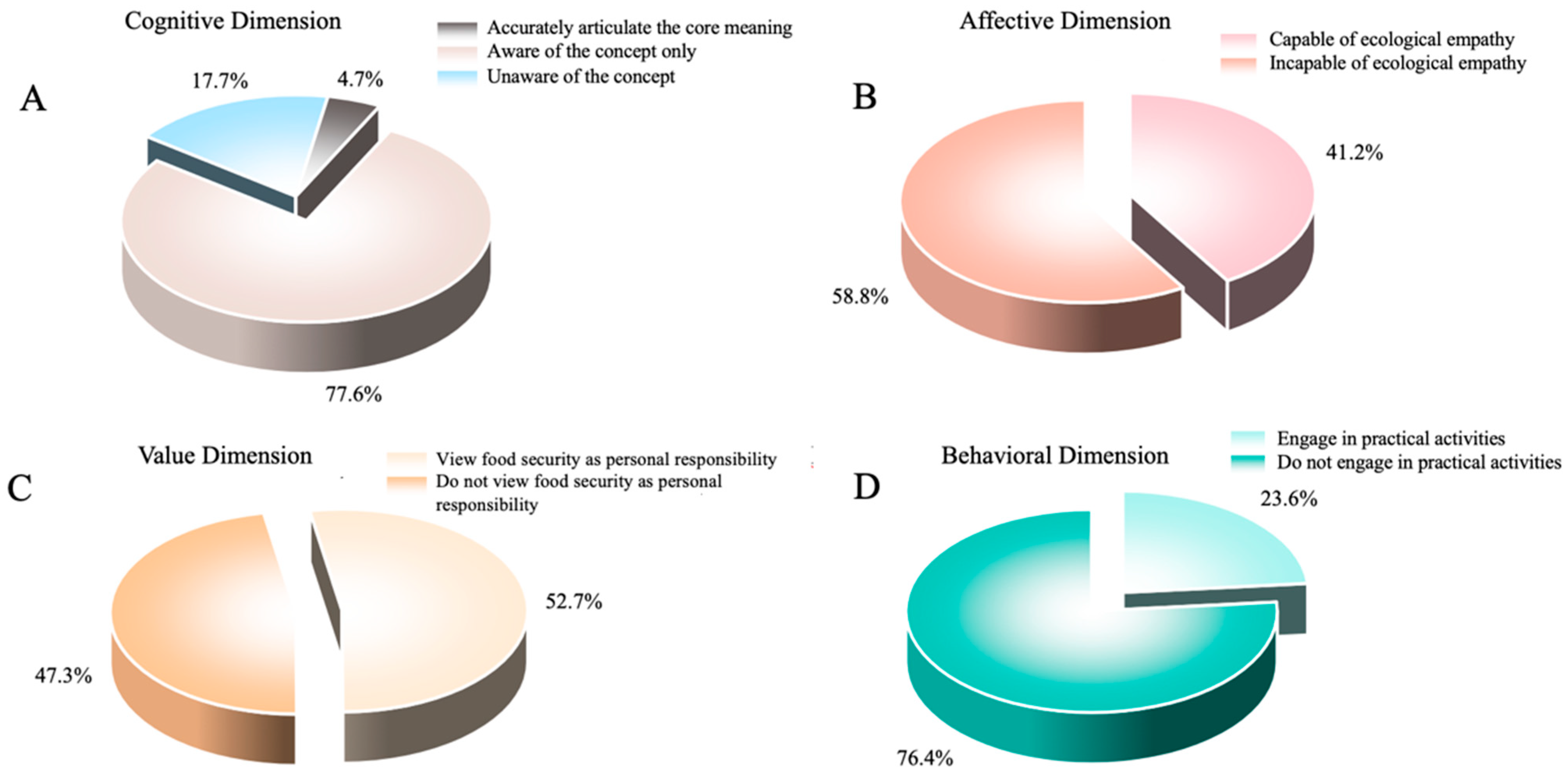
| Can accurately articulate its core meaning | 4.7 | |
| Understand staple food security-related issues | 78.6 | |
| Understand diversified supply systems (e.g., “Forest Food Bank,” “Blue Granary”) * | <30.0 | |
| Affective | Cherish food | 76.8 |
| Express gratitude for farmers’ labor | 69.3 | |
| Experience ecological empathy for food resource protection | 41.2 | |
| Agree with national food security policies | Significant regional variation (coastal > inland) | |
| Value | Identify with healthy eating values | 86.5 |
| Emphasize food conservation | 79.8 | |
| View food security as a personal responsibility | 52.7 | |
| Concerned about the sustainability of food production | 43.5 | |
| Behavioral | Practice daily food conservation | 68.4 |
| Tend to choose healthy foods | 72.1 | |
| Participate in Big Food Concept-related practical activities | 23.6 | |
| Actively promote the concept of the Big Food Concept * | <15.0 |
| Dimension | Cronbach’s α Coefficient | Composite Reliability (CR) | Average Variance Extracted (AVE) | Expert Consensus Coefficient |
|---|---|---|---|---|
| Cognitive | 0.843 | 0.865 | 0.532 | 0.86 |
| Affective | 0.817 | 0.841 | 0.518 | 0.86 |
| Value | 0.832 | 0.857 | 0.526 | 0.86 |
| Behavioral | 0.851 | 0.872 | 0.541 | 0.86 |
| Overall Scale | 0.892 | 0.905 | 0.524 | 0.86 |
| Influence Path | Effect Value | β Value | 95% Confidence Interval (CI) | Significance (p) |
|---|---|---|---|---|
| Direct Effect (X → Y) | 0.237 | 0.237 | [0.185, 0.289] | <0.001 |
| Total Indirect Effect | 0.586 | — | [0.521, 0.653] | <0.001 |
| Path 1 (X → M1 → M3 → Y) | 0.207 | 0.324 | [0.162, 0.253] | <0.001 |
| Path 2 (X → M2 → M3 → Y) | 0.174 | 0.286 | [0.131, 0.218] | <0.001 |
| Path 3 (X → M1 → M2 → M3 → Y) | 0.205 | 0.318 | [0.158, 0.252] | <0.001 |
| Indirect Effect of Value Dimension (M3 → Y) | — | 0.413 | [0.352, 0.474] | <0.001 |
Disclaimer/Publisher’s Note: The statements, opinions and data contained in all publications are solely those of the individual author(s) and contributor(s) and not of MDPI and/or the editor(s). MDPI and/or the editor(s) disclaim responsibility for any injury to people or property resulting from any ideas, methods, instructions or products referred to in the content. |
© 2026 by the authors. Licensee MDPI, Basel, Switzerland. This article is an open access article distributed under the terms and conditions of the Creative Commons Attribution (CC BY) license.
Share and Cite
He, Y.; Tang, R.; Hu, M.; Chen, F.; Gao, X.; Li, D.; Liu, Y. Construction of an Evaluation System for Big Food Concept Education and Its Behavioral Impact Mechanism Among College Students—An Empirical Study Based on a Survey of Students. Foods 2026, 15, 776. https://doi.org/10.3390/foods15040776
He Y, Tang R, Hu M, Chen F, Gao X, Li D, Liu Y. Construction of an Evaluation System for Big Food Concept Education and Its Behavioral Impact Mechanism Among College Students—An Empirical Study Based on a Survey of Students. Foods. 2026; 15(4):776. https://doi.org/10.3390/foods15040776
Chicago/Turabian StyleHe, Yong, Ruirui Tang, Minlun Hu, Fang Chen, Xiaoqian Gao, Dandan Li, and Yaowen Liu. 2026. "Construction of an Evaluation System for Big Food Concept Education and Its Behavioral Impact Mechanism Among College Students—An Empirical Study Based on a Survey of Students" Foods 15, no. 4: 776. https://doi.org/10.3390/foods15040776
APA StyleHe, Y., Tang, R., Hu, M., Chen, F., Gao, X., Li, D., & Liu, Y. (2026). Construction of an Evaluation System for Big Food Concept Education and Its Behavioral Impact Mechanism Among College Students—An Empirical Study Based on a Survey of Students. Foods, 15(4), 776. https://doi.org/10.3390/foods15040776