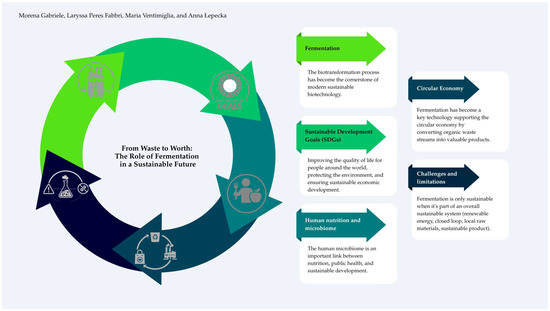
From Waste to Worth: The Role of Fermentation in a Sustainable Future


Abstract
1. Introduction—Sustainability and the Challenges of Contemporary Food Systems
2. Fermentation and Sustainable Development Goals (SDGs)
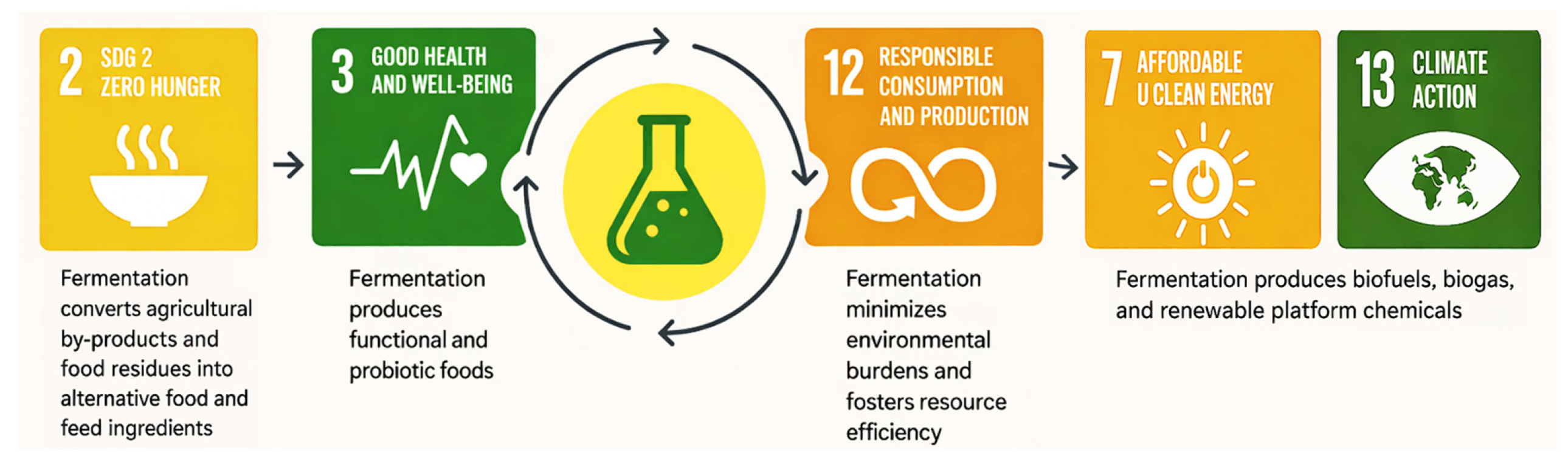
- Indicator 2.1.1 (Prevalence of undernourishment) is relevant to fermentation contributions to alternative protein sources;
- Indicator 2.3.1 (Volume of production per labour unit by classes of farming/pastoral/forestry enterprise size) can be influenced by fermentation-enhanced biostimulants and biofertilizers;
- Indicator 12.5.1 (National recycling rate, tons of material recycled) reflects fermentation’s role in valorizing bioeconomy side streams;
- Indicator 7.2.1 (Renewable energy share in total final energy consumption) captures biofuels and biogas production through fermentation;
- Indicator 13.2.1 (Number of countries that have communicated the establishment or operationalization of an integrated policy/strategy/plan which increases their ability to adapt to the adverse impacts of climate change, and foster climate resilience and low greenhouse gas emissions development in a manner that does not threaten food production (including a national adaptation plan, nationally determined contribution, national communication, biennial update report or other)) aligns with fermentation-based climate resilience technologies.
3. Definition and Types of Fermentation, the Importance of the Fermenta-Tion Process
3.1. Definition and Functional Role of Fermentation
3.2. Major Types of Fermentation
3.2.1. Classification by Metabolic Pathway
3.2.2. Classification by Production System Configuration
3.3. Strategic Importance in Food Systems and Human Nutrition
4. Fermentation in the Circular Bioeconomy
5. Valorization of Organic Waste Through Fermentation
5.1. Single-Cell Protein (SCP)
5.2. Biofuels
5.3. Organic Acids
5.4. Bioactive Compounds
5.5. Enzymes
6. Precision Fermentation—A Biotechnological Tool of the Future
7. Microbiome and Fermentation as an Element of a Health Strategy
8. Postbiotics and Sustainable Development
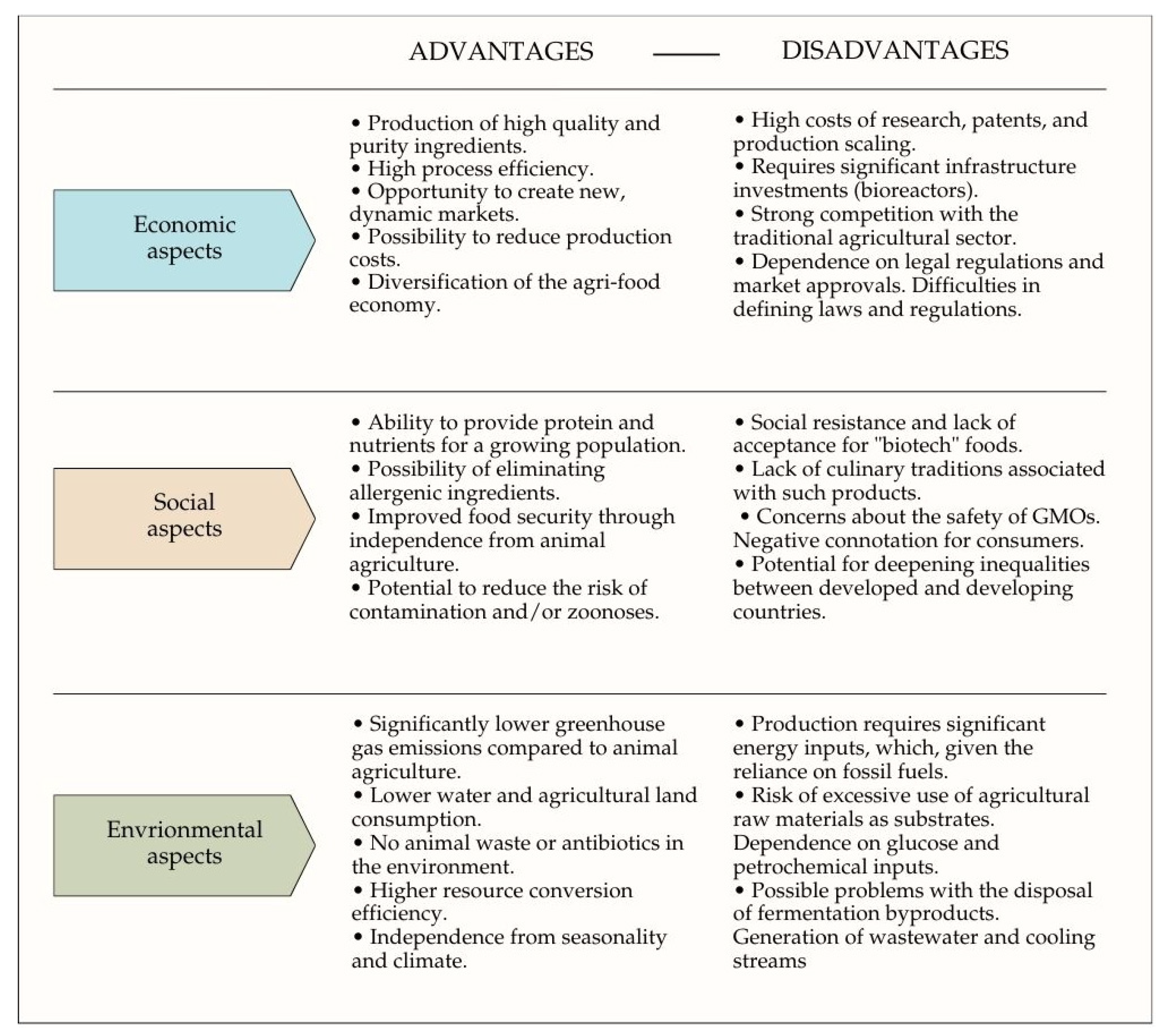
9. Challenges and Limitations of Fermentation-Based Waste Valorization
10. Concluding Perspectives
- −
- Resilient supply chains ensuring consistent feedstock quality,
- −
- Low-energy pretreatment and decentralized processing (e.g., solid-state fermentation),
- −
- Efficient downstream recovery strategies,
- −
- Clear regulatory frameworks for food-grade and feed applications,
- −
- Scaling technology and transferring knowledge to industry, while maintaining process safety and stability,
- −
- Life cycle assessment and environmental impact analysis to ensure real climate and environmental benefits,
- −
- Building social acceptance and consumer awareness of biotechnological value recovery methods,
- −
- Integrating fermentation with other bioprocess technologies within integrated biorefinery production systems.
Author Contributions
Funding
Institutional Review Board Statement
Informed Consent Statement
Data Availability Statement
Acknowledgments
Conflicts of Interest
Abbreviations
| SDGs | Sustainable Development Goals |
| GHG | Green-house gas |
| LAB | Lactic acid bacteria |
| SmF | Submerged fermentation |
| SSF | Solid-state fermentation |
| SCP | Single-cell protein |
| BDO | 2,3-butanediol |
| LCA | Life cycle assessment |
| LA | Lactic acid |
| CA | Citric acid |
| AA | Acetic acid |
| PFA | Precision Fermentation Alliance |
| FFE | Food Fermentation Europe |
| GRAS | Generally Recognized As Safe |
| FDA | Food and Drug Administration |
| EU | European Union |
References
- Willett, W.; Rockström, J.; Loken, B.; Springmann, M.; Lang, T.; Vermeulen, S.; Garnett, T.; Tilman, D.; DeClerck, F.; Wood, A.; et al. Food in the Anthropocene: The EAT–Lancet Commission on Healthy Diets from Sustainable Food Systems. Lancet 2019, 393, 447–492. [Google Scholar] [CrossRef]
- Crippa, M.; Solazzo, E.; Guizzardi, D.; Monforti-Ferrario, F.; Tubiello, F.N.; Leip, A. Food Systems Are Responsible for a Third of Global Anthropogenic GHG Emissions. Nat. Food 2021, 2, 198–209. [Google Scholar] [CrossRef] [PubMed]
- Intergovernmental Panel on Climate Change. AR6 Synthesis Report Climate Change 2023. Available online: https://www.ipcc.ch/report/ar6/syr/ (accessed on 27 January 2026).
- Food and Agriculture Organization of the United Nations. The State of Food Security and Nutrition in the World 2023. Urbanization, Agrifood Systems Transformation and Healthy Diets Across the Rural–Urban Continuum. 2023. Available online: https://www.fao.org/3/cc3017en/cc3017en.pdf (accessed on 27 January 2026).
- Roy, P.; Mohanty, A.K.; Dick, P.; Misra, M. A Review on the Challenges and Choices for Food Waste Valorization: Environmental and Economic Impacts. ACS Environ. Au 2023, 3, 58–75. [Google Scholar] [CrossRef] [PubMed]
- Food and Agriculture Organization of the United Nations. Trade Policy Supportive of Food Security and Nutrition. Available online: https://www.fao.org/3/cc6079en/cc6079en.pdf (accessed on 27 January 2026).
- United Nations Environment Programme. Food Waste Index Report 2024. Available online: https://www.unep.org/resources/publication/food-waste-index-report-2024 (accessed on 27 January 2026).
- United Nations. The 17 Goals. Available online: https://sdgs.un.org/goals#icons (accessed on 16 December 2025).
- European Commission. A New Circular Economy Action Plan: For a Cleaner and More Competitive Europe; Communication from the Commission to the European Parliament, the Council, the European Economic and Social Committee and the Committee of the Regions, COM(2020) 98 final; European Commission: Brussels, Belgium, 2020. Available online: https://eur-lex.europa.eu/legal-content/EN/TXT/HTML/?uri=CELEX:52020DC0098 (accessed on 16 December 2025).
- Kosseva, M.R.; Webb, C. Food Industry Wastes: Assessment and Recuperation of Commodities, 1st ed.; Food Science and Technology, International Series; Academic Press: Cambridge, MA, USA, 2013; pp. 1–338. [Google Scholar] [CrossRef]
- Adil, M.Z.; Oztekin, S.; Aziz, A.; Gunal-Koroglu, D.; Capanoglu, E.; Moreno, A.; Khalid, W.; Esatbeyoglu, T. Fermentation-Based Valorization of Agro-Industrial Cereal Waste and By-Products. Trends Food Sci. Technol. 2025, 168, 105464. [Google Scholar] [CrossRef]
- Faria, D.J.; Carvalho, A.P.A.d.; Conte-Junior, C.A. Valorization of Fermented Food Wastes and Byproducts: Bioactive and Valuable Compounds, Bioproduct Synthesis, and Applications. Fermentation 2023, 9, 920. [Google Scholar] [CrossRef]
- Marti-Quijal, F.J.; Remize, F.; Meca, G.; Ferrer, E.; Ruiz, M.J.; Barba, F.J. Fermentation in fish and by-products processing: An overview of current research and future prospects. Curr. Opin. Food Sci. 2020, 31, 9–16. [Google Scholar] [CrossRef]
- Kuo, C.C.; Chen, D.; Jiménez-Flores, R.; Wick, M.; Campanella, O. Valorization of byproducts from meat and dairy industries through fermentation to produce peptides. Sustain. Food Technol. 2024, 2, 1469–1475. [Google Scholar] [CrossRef]
- Peres Fabbri, L.; Cavallero, A.; Vidotto, F.; Gabriele, M. Bioactive Peptides from Fermented Foods: Production Approaches, Sources, and Potential Health Benefits. Foods 2024, 13, 3369. [Google Scholar] [CrossRef]
- Marco, M.L.; Heeney, D.; Binda, S.; Cifelli, C.J.; Cotter, P.D.; Foligné, B.; Gänzle, M.; Kort, R.; Pasin, G.; Pihlanto, A.; et al. Health Benefits of Fermented Foods: Microbiota and Beyond. Curr. Opin. Biotechnol. 2017, 44, 94–102. [Google Scholar] [CrossRef]
- Leeuwendaal, N.K.; Stanton, C.; O’Toole, P.W.; Beresford, T.P. Fermented Foods, Health and the Gut Microbiome. Nutrients 2022, 14, 1527. [Google Scholar] [CrossRef]
- Teng, T.S.; Chin, Y.L.; Chai, K.F.; Chen, W.N. Fermentation for future food systems: Precision fermentation can complement the scope and applications of traditional fermentation. EMBO Rep. 2021, 22, e52680. [Google Scholar] [CrossRef]
- Verma, K.; Duhan, P.; Pal, D.; Verma, P.; Bansal, P. Precision Fermentation for the next Generation of Food Ingredients: Opportunities and Challenges. Future Foods 2025, 12, 100750. [Google Scholar] [CrossRef]
- Artola, A.; Font, X.; Moral-Vico, J.; Sánchez, A. The Role of Solid-State Fermentation to Transform Existing Waste Treatment Plants Based on Composting and Anaerobic Digestion into Modern Organic Waste-Based Biorefineries, in the Framework of Circular Bioeconomy. Front. Chem. Eng. 2024, 6, 1463785. [Google Scholar] [CrossRef]
- United Nations. Revised List of Global Sustainable Development Goal Indicators. Available online: https://unstats.un.org/sdgs/indicators/official%20revised%20list%20of%20global%20sdg%20indicators.pdf (accessed on 16 December 2025).
- Çakmakçi, R.; Çakmakçi, S.; Çakmakçi, M.F. Principles of Environmentally Sustainable Agriculture for Building Resilient and Resource-Efficient Food Systems. Turk. J. Biol. 2025, 49, 550–584. [Google Scholar] [CrossRef] [PubMed]
- Kumar, S.; Sindhu, S.S.; Kumar, R. Biofertilizers: An ecofriendly technology for nutrient recycling and environmental sustainability. Curr. Res. Microbial Sci. 2022, 3, 100094. [Google Scholar] [CrossRef] [PubMed]
- Siddikey, F.; Jahan, I.; Hormoni; Hasan, T.; Nishi, N.J.; Hasan, S.M.K.; Rahman, N.; Al Faik, A.; Hossain, M.A. Enzyme technology in the food industry: Molecular Mechanisms, Applications, and sustainable innovations. Food Sci. Nutr. 2025, 13, e70927. [Google Scholar] [CrossRef]
- Ewing, T.A.; Nouse, N.; van Lint, M.; van Haveren, J.; Hugenholtz, J.; van Es, D.S. Fermentation for the Production of Biobased Chemicals in a Circular Economy: A Perspective for the Period 2022–2050. Green Chem. 2022, 24, 6373–6405. [Google Scholar] [CrossRef]
- Oyedeji, S.; Patel, N.; Krishnamurthy, R.; Fatoba, P.O. Agricultural Wastes to Value-Added Products: Economic and Environmental Perspectives for Waste Conversion. In Biowaste to Value-Added Products; Bayer, T., Kircher, M., Eds.; Advances in Biochemical Engineering/Biotechnology; Springer: Cham, Switzerland, 2024; Volume 191, pp. 215–248. [Google Scholar] [CrossRef]
- Crowther, T.W.; Rappuoli, R.; Corinaldesi, C.; Danovaro, R.; Donohue, T.J.; Huisman, J.; Stein, L.Y.; Timmis, J.K.; Timmis, K.; Anderson, M.Z.; et al. Scientists’ Call to Action: Microbes, Planetary Health, and the Sustainable Development Goals. Cell 2024, 187, 5195–5216. [Google Scholar] [CrossRef]
- Ma, Y.; Freitas, H.; Dias, M.C. Strategies and prospects for biostimulants to alleviate abiotic stress in plants. Front. Plant Sci. 2022, 13, 1024243. [Google Scholar] [CrossRef]
- Colla, G.; Hoagland, L.; Ruzzi, M.; Cardarelli, M.; Bonini, P.; Canaguier, R.; Rouphael, Y. Biostimulant action of protein hydrolysates: Unraveling their effects on plant physiology and microbiome. Front. Plant Sci. 2017, 8, 2202. [Google Scholar] [CrossRef] [PubMed]
- Malécange, M.; Sergheraert, R.; Teulat, B.; Mounier, E.; Lothier, J.; Sakr, S. Biostimulant properties of protein hydrolysates: Recent advances and future challenges. Int. J. Mol. Sci. 2023, 24, 9714. [Google Scholar] [CrossRef]
- Di Sario, L.; Boeri, P.; Matus, J.T.; Pizzio, G.A. Plant Biostimulants to Enhance Abiotic Stress Resilience in Crops. Int. J. Mol. Sci. 2025, 26, 1129. [Google Scholar] [CrossRef]
- Meena, D.C.; Birthal, P.S.; Kumara, T.M.K. Biostimulants for sustainable development of agriculture: A bibliometric content analysis. Discov. Agric. 2025, 3, 2. [Google Scholar] [CrossRef]
- Food and Agriculture Organization of the United Nations Rome 1998. Available online: https://www.fao.org/4/x0560e/x0560e00.htm (accessed on 16 December 2025).
- Madigan, M.T.; Martinko, J.M.; Parker, J. Brock Biology of Microorganisms; Prentice Hall: Upper Saddle River, NJ, USA, 1997; Volume 11. [Google Scholar]
- Behera, S.S.; Ray, R.C.; Das, U.; Panda, S.K.; Saranraj, P. Microorganisms in Fermentation. In Essentials in Fermentation Technology; Springer: Cham, Switzerland, 2019; pp. 1–39. [Google Scholar] [CrossRef]
- Oliphant, K.; Allen-Vercoe, E. Macronutrient Metabolism by the Human Gut Microbiome: Major Fermentation by-Products and Their Impact on Host Health. Microbiome 2019, 7, 91. [Google Scholar] [CrossRef]
- Wang, G.; Xie, L.; Huang, Z.; Xie, J. Recent Advances in Polysaccharide Biomodification by Microbial Fermentation: Production, Properties, Bioactivities, and Mechanisms. Crit. Rev. Food Sci. Nutr. 2024, 64, 12999–13023. [Google Scholar] [CrossRef]
- Sharma, R.; Garg, P.; Kumar, P.; Bhatia, S.K.; Kulshrestha, S. Microbial Fermentation and Its Role in Quality Improvement of Fermented Foods. Fermentation 2020, 6, 106. [Google Scholar] [CrossRef]
- Gänzle, M.G. Lactic Metabolism Revisited: Metabolism of Lactic Acid Bacteria in Food Fermentations and Food Spoilage. Curr. Opin. Food Sci. 2015, 2, 106–117. [Google Scholar] [CrossRef]
- Szutowska, J. Functional Properties of Lactic Acid Bacteria in Fermented Fruit and Vegetable Juices: A Systematic Literature Review. Eur. Food Res. Technol. 2020, 246, 357–372. [Google Scholar] [CrossRef]
- Sarris, D.; Papanikolaou, S. Biotechnological Production of Ethanol: Biochemistry, Processes and Technologies. Eng. Life Sci. 2016, 16, 307–329. [Google Scholar] [CrossRef]
- Dequin, S.; Casaregola, S. The Genomes of Fermentative Saccharomyces. Comptes Rendus Biol. 2011, 334, 687–693. [Google Scholar] [CrossRef] [PubMed]
- Barbosa, C.; Mendes-Faia, A.; Lage, P.; Mira, N.P.; Mendes-Ferreira, A. Genomic Expression Program of Saccharomyces cerevisiae along a Mixed-Culture Wine Fermentation with Hanseniaspora guilliermondii. Microb. Cell Fact. 2015, 14, 124. [Google Scholar] [CrossRef]
- Ahn, D.-H.; Ko, Y.-S.; Prabowo, C.P.S.; Lee, S.Y. Microbial Production of Propionic Acid through a Novel β-Alanine Route. Metab. Eng. 2026, 93, 219–231. [Google Scholar] [CrossRef]
- Derman, Ü.C.; Erdem, A.; Alemdar, F.; Türker, M. Kinetics of Fermentative Production of Propionic Acid on a Range of Carbon and Nitrogen Sources Using Acidipropionibacterium acidipropionici. Food Biosci. 2024, 57, 103507. [Google Scholar] [CrossRef]
- Santos, I.M.T.S.; Ramirez Brenes, R.G.; Figueiredo, F.R.; Prata, D.M.; Ramirez, N.I.B.; Pereira, N. Sustainable Production of Propionic Acid from Xylose and Glycerol by Acidipropionibacterium acidipropionici DSM 4900: A Biorefinery Approach. Processes 2025, 13, 3556. [Google Scholar] [CrossRef]
- Zigová, J.; Šturdík, E. Advances in Biotechnological Production of Butyric Acid. J. Ind. Microbiol. Biotechnol. 2000, 24, 153–160. [Google Scholar] [CrossRef]
- Román-Camacho, J.J.; García-García, I.; Santos-Dueñas, I.M.; García-Martínez, T.; Mauricio, J.C. Latest Trends in Industrial Vinegar Production and the Role of Acetic Acid Bacteria: Classification, Metabolism, and Applications—A Comprehensive Review. Foods 2023, 12, 3705. [Google Scholar] [CrossRef] [PubMed]
- Sun, W.; Shahrajabian, M.H.; Lin, M. Research Progress of Fermented Functional Foods and Protein Factory-Microbial Fermentation Technology. Fermentation 2022, 8, 688. [Google Scholar] [CrossRef]
- Gangakhedkar, P.S.; Deshpande, H.W.; Törős, G.; El-Ramady, H.; Elsakhawy, T.; Abdalla, N.; Shaikh, A.; Kovács, B.; Mane, R.; Prokisch, J. Fermentation of Fruits and Vegetables: Bridging Traditional Wisdom and Modern Science for Food Preservation and Nutritional Value Improvements. Foods 2025, 14, 2155. [Google Scholar] [CrossRef]
- Šelo, G.; Planinić, M.; Tišma, M.; Tomas, S.; Koceva Komlenić, D.; Bucić-Kojić, A. A Comprehensive Review on Valorization of Agro-Food Industrial Residues by Solid-State Fermentation. Foods 2021, 10, 927. [Google Scholar] [CrossRef] [PubMed]
- Chilakamarry, C.R.; Mimi Sakinah, A.M.; Zularisam, A.W.; Sirohi, R.; Khilji, I.A.; Ahmad, N.; Pandey, A. Advances in Solid-State Fermentation for Bioconversion of Agricultural Wastes to Value-Added Products: Opportunities and Challenges. Bioresour. Technol. 2022, 343, 126065. [Google Scholar] [CrossRef] [PubMed]
- Hölker, U.; Lenz, J. Solid-State Fermentation—Are There Any Biotechnological Advantages? Curr. Opin. Microbiol. 2005, 8, 301–306. [Google Scholar] [CrossRef] [PubMed]
- Allwood, J.G.; Wakeling, L.T.; Bean, D.C. Fermentation and the Microbial Community of Japanese Koji and Miso: A Review. J. Food Sci. 2021, 86, 2194–2207. [Google Scholar] [CrossRef]
- Catalán, E.; Sánchez, A. Solid-State Fermentation (SSF) versus Submerged Fermentation (SmF) for the Recovery of Cellulases from Coffee Husks: A Life Cycle Assessment (LCA) Based Comparison. Energies 2020, 13, 2685. [Google Scholar] [CrossRef]
- Prabhu, G.; Bhat, D.; Bhat, R.M.; Selvaraj, S. A Critical Look at Bioproducts Co-Cultured Under Solid State Fermentation and Their Challenges and Industrial Applications. Waste Biomass Valorization 2022, 13, 3095–3111. [Google Scholar] [CrossRef]
- Singhania, R.R.; Patel, A.K.; Soccol, C.R.; Pandey, A. Recent advances in solid-state fermentation. Biochem. Eng. J. 2009, 44, 13–18. [Google Scholar] [CrossRef]
- Finkler, A.T.J.; Weber, M.Z.; Fuchs, G.A.; Scholz, L.A.; de Lima Luz, L.F., Jr.; Krieger, N.; Mitchell, D.A.; de Matos Jorge, L.M. Estimation of heat and mass transfer coefficients in a pilot packed-bed solid-state fermentation bioreactor. Chem. Eng. J. 2021, 408, 127246. [Google Scholar] [CrossRef]
- Nagao, N.; Matsuyama, T.; Yamamoto, H.; Toda, T. A Novel Hybrid System of Solid State and Submerged Fermentation with Recycle for Organic Solid Waste Treatment. Process Biochem. 2003, 39, 37–43. [Google Scholar] [CrossRef]
- Li, Y.; Peng, X.; Chen, H. Comparative Characterization of Proteins Secreted by Neurospora sitophila in Solid-State and Submerged Fermentation. J. Biosci. Bioeng. 2013, 116, 493–498. [Google Scholar] [CrossRef]
- Mrudula, S.; Murugammal, R. Production of cellulase by Aspergillus niger under submerged and solid state fermentation using coir waste as a substrate. Braz. J. Microbiol. 2011, 42, 1119–1127. [Google Scholar] [CrossRef]
- Guerrero-Urrutia, C.; Volke-Sepulveda, T.; Figueroa-Martinez, F.; Favela-Torres, E. Solid-state fermentation enhances inulinase and invertase production by Aspergillus brasiliensis. Process Biochem. 2021, 108, 169–175. [Google Scholar] [CrossRef]
- Biesebeke, R.; Ruijter, G.; Rahardjo, Y.S.P.; Hoogschagen, M.J.; Heerikhuisen, M.; Levin, A.; Driel, K.G.A.; Schutyser, M.A.I.; Dijksterhuis, J.; Zhu, Y.; et al. Aspergillus Oryzae in Solid-State and Submerged Fermentations. FEMS Yeast Res. 2002, 2, 245–248. [Google Scholar] [CrossRef][Green Version]
- Ryan, A.S.; Alamoudi, S.M.; Kalantan, A.A.; Abudukadeer, K.; Hasan, A.T.; Yasser, Q.A. Citric acid production by Aspergillus niger through submerged and solid-state fermentation: An overview. Int. J. Biochem. Physiol. 2024, 9, 000242. [Google Scholar] [CrossRef]
- Rahman, M.S.; Soltani, S.; LaPointe, G.; Karboune, S.; Fliss, I. Lactic Acid Bacteria: Beyond Fermentation to Bio-Protection against Fungal Spoilage and Mycotoxins in Food Systems. Front. Microbiol. 2025, 16, 1580670. [Google Scholar] [CrossRef]
- Sawant, S.S.; Park, H.-Y.; Sim, E.-Y.; Kim, H.-S.; Choi, H.-S. Microbial Fermentation in Food: Impact on Functional Properties and Nutritional Enhancement—A Review of Recent Developments. Fermentation 2025, 11, 15. [Google Scholar] [CrossRef]
- Tata, A.; Massaro, A.; Miano, B.; Petrin, S.; Antonelli, P.; Peruzzo, A.; Pezzuto, A.; Favretti, M.; Bragolusi, M.; Zacometti, C.; et al. A Snapshot, Using a Multi-Omic Approach, of the Metabolic Cross-Talk and the Dynamics of the Resident Microbiota in Ripening Cheese Inoculated with Listeria innocua. Foods 2024, 13, 1912. [Google Scholar] [CrossRef] [PubMed]
- Ji, J.; Jiang, X.; Song, P.; Yang, Q.; Sun, M.; Dong, Z.; Lu, Y.; Dou, S.; Dong, L. Multi-Omics Insights into Microbial Interactions and Fermented Food Quality. Microorganisms 2025, 13, 2679. [Google Scholar] [CrossRef]
- Nadar, C.G.; Fletcher, A.; Moreira, B.R.d.A.; Hine, D.; Yadav, S. Waste to Protein: A Systematic Review of a Century of Advancement in Microbial Fermentation of Agro-industrial Byproducts. Compr. Rev. Food Sci. Food Saf. 2024, 23, e13375. [Google Scholar] [CrossRef]
- Dhiman, S.; Kumar, A.; Sharma, K.; Dhewa, T. Microbial Bioprocessing of Food and Agro-Industrial Residues for a Sustainable Circular Economy. Ind. J. Microbiol. 2025, 65, 1452–1483. [Google Scholar] [CrossRef] [PubMed]
- He, D.; Cui, C. Fermentation of Organic Wastes for Feed Protein Production: Focus on Agricultural Residues and Industrial By-Products Tied to Agriculture. Fermentation 2025, 11, 528. [Google Scholar] [CrossRef]
- Mia, M.d.S.; Ahmed, M.d.M.; Zzaman, W. Valorization of Food Waste into Functional Ingredients Supports a Sustainable Strategy for the Food Industry. Discov. Food 2025, 5, 275. [Google Scholar] [CrossRef]
- Dessie, W.; Xin, F.; Zhang, W.; Jiang, Y.; Wu, H.; Ma, J.; Jiang, M. Opportunities, Challenges, and Future Perspectives of Succinic Acid Production by Actinobacillus succinogenes. Appl. Microbiol. Biotechnol. 2018, 102, 9893–9910. [Google Scholar] [CrossRef]
- Mao, Y.; Li, G.; Chang, Z.; Tao, R.; Cui, Z.; Wang, Z.; Tang, Y.; Chen, T.; Zhao, X. Metabolic Engineering of Corynebacterium glutamicum for Efficient Production of Succinate from Lignocellulosic Hydrolysate. Biotechnol. Biofuels 2018, 11, 95. [Google Scholar] [CrossRef]
- Rawat, R.; Singh, P.; Singh, R. Single-Cell Protein and Biodiesel Production from Agro-Industrial Waste. In Agro-Waste to Microbe Assisted Value Added Product: Challenges and Future Prospects, 1st ed.; Saha, S.P., Mazumdar, D., Roy, S., Mathur, P., Eds.; Springer: Berlin/Heidelberg, Germany, 2024; pp. 135–156. [Google Scholar] [CrossRef]
- Ray, R.C.; Behera, S.S.; Awogbemi, O.; Sooch, B.S.; Thatoi, H.; Rath, S.; Aguilar-Rivera, N. Beyond Enzymes and Organic Acids, Solid-State Fermentation as an Alternative for Valorizing Fruits and Vegetable Wastes into Novel Bio-Products in a Circular Economy: A Critical Review. AIMS Microbiol. 2025, 11, 462–500. [Google Scholar] [CrossRef]
- Zhou, J.; Ma, H.; Lv, P.; Su, W.; Wang, Q.; Gao, M.; Qin, H. Life Cycle Assessment of Fuel Ethanol Production from Food Waste in Consideration of By-Product Utilization. Processes 2023, 11, 1672. [Google Scholar] [CrossRef]
- Zheng, X.; Wang, J.; Huang, J.; Xu, X.; Tang, J.; Hou, P.; Han, W.; Li, H. Environmental Impact Assessment of a Combined Bioprocess for Hydrogen Production from Food Waste. Waste Manag. 2024, 173, 152–159. [Google Scholar] [CrossRef] [PubMed]
- Vanapalli, K.R.; Bhar, R.; Maity, S.K.; Dubey, B.K.; Kumar, S.; Kumar, V. Life Cycle Assessment of Fermentative Production of Lactic Acid from Bread Waste Based on Process Modelling Using Pinch Technology. Sci. Total Environ. 2023, 905, 167051. [Google Scholar] [CrossRef] [PubMed]
- Perveen, I.; Syed, Q.; Ayyub, H.; Mehboob, A.; Abbas, N.; Saleem, Y.; Mumtaz, A.; Koser, N.; Akram, F.; Sultan, H.; et al. Advancements in Sustainable Lactic Acid Production: Revolutionizing Biorefineries by Harnessing Genetically Engineered LAB and Lignocellulosic Biomass. Discov. Appl. Sci. 2025, 7, 1350. [Google Scholar] [CrossRef]
- Peterson, E.C.; Hermansen, C.; Yong, A.; Siao, R.; Chua, G.G.; Ho, S.; Busran, C.T.; Teo, M.; Thong, A.; Weingarten, M.; et al. Two-Stage Bioconversion of Cellulose to Single-Cell Protein and Oil via a Cellulolytic Consortium. Fermentation 2025, 11, 72. [Google Scholar] [CrossRef]
- Khatami, K.; Qazanfarzadeh, Z.; Jiménez-Quero, A. Fungal Fermentation: The Blueprint for Transforming Industrial Side Streams and Residues. Bioresour. Technol. 2026, 440, 133426. [Google Scholar] [CrossRef] [PubMed]
- Sganzerla, W.G.; Tena, M.; Sillero, L.; Magrini, F.E.; Sophiatti, I.V.M.; Gaio, J.; Paesi, S.; Forster-Carneiro, T.; Solera, R.; Perez, M. Application of Anaerobic Co-Digestion of Brewery by-Products for Biomethane and Bioenergy Production in a Biorefinery Concept. Bioenergy Res. 2023, 16, 2560–2573. [Google Scholar] [CrossRef]
- Lynch, C.D.; Cerrone, F.; O’Connor, K.E.; O’Connell, D.J. Feeding Secondary Fermentations with Mammalian and Fungal Culture Waste Streams Increases Productivity and Resource Efficiency. RSC Sustain. 2024, 2, 1868–1882. [Google Scholar] [CrossRef]
- Nasseri, A.T.; Rasoul-Ami, S.; Morowvat, M.H.; Ghasemi, Y. Single Cell Protein: Production and Process. Am. J. Food Technol. 2011, 6, 103–116. [Google Scholar] [CrossRef]
- Ciani, M.; Lippolis, A.; Fava, F.; Rodolfi, L.; Niccolai, A.; Tredici, M.R. Microbes: Food for the future. Foods 2021, 10, 971. [Google Scholar] [CrossRef]
- Zhuang, Z.; Wan, G.; Lu, X.; Xie, L.; Yu, T.; Tang, H. Metabolic engineering for single-cell protein production from renewable feedstocks and its applications. Adv. Biotechnol. 2024, 2, 35. [Google Scholar] [CrossRef]
- Humpenöder, F.; Bodirsky, B.L.; Weindl, I.; Lotze-Campen, H.; Linder, T.; Popp, A. Projected environmental benefits of replacing beef with microbial protein. Nature 2022, 605, 90–96. [Google Scholar] [CrossRef]
- Ayele, G.; Admassu, H.; Mosisa, G.; Desalegn, A.; Abeje, M. Fruit Waste Potential for Single Cell Protein Production in Addis Ababa City, Ethiopia: A Review. Food Sci. Nutr. 2025, 13, e71177. [Google Scholar] [CrossRef] [PubMed]
- Dunuweera, A.N.; Nikagolla, D.N.; Ranganathan, K. Fruit Waste Substrates to Produce Single-Cell Proteins as Alternative Human Food Supplements and Animal Feeds Using Baker’s Yeast (Saccharomyces cerevisiae). J. Food Qual. 2021, 2021, 9932762. [Google Scholar] [CrossRef]
- Mensah, J.K.M.; Twumasi, P. Use of Pineapple Waste for Single Cell Protein (SCP) Production and the Effect of Substrate Concentration on the Yield. J. Food Process Eng. 2017, 40, e12478. [Google Scholar] [CrossRef]
- Ahmed, M.G.; Gouda, S.A.; Donia, S.; Hassanein, N.M. Production of Single Cell Protein by Fungi from Different Food Wastes. Biomass Convers. Biorefinery 2025, 15, 5447–5462. [Google Scholar] [CrossRef]
- Khan, M.K.I.; Asif, M.; Razzaq, Z.U.; Nazir, A.; Maan, A.A. Sustainable Food Industrial Waste Management through Single Cell Protein Production and Characterization of Protein Enriched Bread. Food Biosci. 2022, 46, 101406. [Google Scholar] [CrossRef]
- Svensson, S.E.; Bucuricova, L.; Ferreira, J.A.; Souza Filho, P.F.; Taherzadeh, M.J.; Zamani, A. Valorization of Bread Waste to a Fiber- and Protein-Rich Fungal Biomass. Fermentation 2021, 7, 91. [Google Scholar] [CrossRef]
- Sar, T.; Larsson, K.; Fristedt, R.; Undeland, I.; Taherzadeh, M.J. Demo-Scale Production of Protein-Rich Fungal Biomass from Potato Protein Liquor for Use as Innovative Food and Feed Products. Food Biosci. 2022, 47, 101637. [Google Scholar] [CrossRef]
- Pillaca-Pullo, O.S.; Lopes, A.M.; Estela-Escalante, W.D. Reusing Wastewater from Coffea Arabica Processing to Produce Single-cell Protein Using Candida sorboxylosa: Optimizing of Culture Conditions. Biotechnol. Prog. 2024, 40, e3393. [Google Scholar] [CrossRef]
- Cripwell, R.A.; Favaro, L.; Viljoen-Bloom, M.; van Zyl, W.H. Consolidated Bioprocessing of Raw Starch to Ethanol by Saccharomyces cerevisiae: Achievements and Challenges. Biotechnol. Adv. 2020, 42, 107579. [Google Scholar] [CrossRef]
- Narisetty, V.; Zhang, L.; Zhang, J.; Sze Ki Lin, C.; Wah Tong, Y.; Loke Show, P.; Kant Bhatia, S.; Misra, A.; Kumar, V. Fermentative Production of 2,3-Butanediol Using Bread Waste—A Green Approach for Sustainable Management of Food Waste. Bioresour. Technol. 2022, 358, 127381. [Google Scholar] [CrossRef]
- Prasoulas, G.; Gentikis, A.; Konti, A.; Kalantzi, S.; Kekos, D.; Mamma, D. Bioethanol Production from Food Waste Applying the Multienzyme System Produced On-Site by Fusarium xxysporum F3 and Mixed Microbial Cultures. Fermentation 2020, 6, 39. [Google Scholar] [CrossRef]
- Ntaikou, I.; Menis, N.; Alexandropoulou, M.; Antonopoulou, G.; Lyberatos, G. Valorization of Kitchen Biowaste for Ethanol Production via Simultaneous Saccharification and Fermentation Using Co-Cultures of the Yeasts Saccharomyces cerevisiae and Pichia stipitis. Bioresour. Technol. 2018, 263, 75–83. [Google Scholar] [CrossRef]
- Zhang, J.; Jia, B. Enhanced Butanol Production Using Clostridium beijerinckii SE-2 from the Waste of Corn Processing. Biomass Bioenergy 2018, 115, 260–266. [Google Scholar] [CrossRef]
- Qureshi, N.; Cotta, M.A.; Saha, B.C. Bioconversion of Barley Straw and Corn Stover to Butanol (a Biofuel) in Integrated Fermentation and Simultaneous Product Recovery Bioreactors. Food Bioprod. Process 2014, 92, 298–308. [Google Scholar] [CrossRef]
- Azman, N.F.; Abdeshahian, P.; Kadier, A.; Nasser Al-Shorgani, N.K.; Salih, N.K.M.; Lananan, I.; Hamid, A.A.; Kalil, M.S. Biohydrogen Production from De-Oiled Rice Bran as Sustainable Feedstock in Fermentative Process. Int. J. Hydrogen Energy 2016, 41, 145–156. [Google Scholar] [CrossRef]
- Marone, A.; Massini, G.; Patriarca, C.; Signorini, A.; Varrone, C.; Izzo, G. Hydrogen Production from Vegetable Waste by Bioaugmentation of Indigenous Fermentative Communities. Int. J. Hydrogen Energy 2012, 37, 5612–5622. [Google Scholar] [CrossRef]
- Mustapha, S.I.; Anekwe, I.M.S.; Akpasi, S.O.; Muritala, K.B.; Tetteh, E.K.; Joel, A.S.; Isa, Y.M. Biomass conversion for sustainable hydrogen generation: A comprehensive review. Fuel Process Technol. 2025, 272, 108210. [Google Scholar] [CrossRef]
- Vandenberghe, L.P.S.; Karp, S.G.; de Oliveira, P.Z.; de Carvalho, J.C.; Rodrigues, C.; Soccol, C.R. Solid-State Fermentation for the Production of Organic Acids. In Current Developments in Biotechnology and Bioengineering, 1st ed.; Pandey, A., Larroche, C., Soccol, C.R., Eds.; Elsevier: Philadelphia, PA, USA, 2018; pp. 415–434. [Google Scholar] [CrossRef]
- John, R.P.; Nampoothiri, K.M.; Pandey, A. Simultaneous Saccharification and Fermentation of Cassava Bagasse for L-(+)-Lactic Acid Production Using Lactobacilli. Appl. Biochem. Biotechnol. 2006, 134, 263–272. [Google Scholar] [CrossRef]
- Pleissner, D.; Demichelis, F.; Mariano, S.; Fiore, S.; Navarro Gutiérrez, I.M.; Schneider, R.; Venus, J. Direct Production of Lactic Acid Based on Simultaneous Saccharification and Fermentation of Mixed Restaurant Food Waste. J. Clean. Prod. 2017, 143, 615–623. [Google Scholar] [CrossRef]
- Wee, Y.-J.; Yun, J.-S.; Park, D.-H.; Ryu, H.-W. Biotechnological Production of l(+)-Lactic Acid from Wood Hydrolyzate by Batch Fermentation of Enterococcus faecalis. Biotechnol. Lett. 2004, 26, 71–74. [Google Scholar] [CrossRef]
- Costa, S.; Summa, D.; Semeraro, B.; Zappaterra, F.; Rugiero, I.; Tamburini, E. Fermentation as a Strategy for Bio-Transforming Waste into Resources: Lactic Acid Production from Agri-Food Residues. Fermentation 2020, 7, 3. [Google Scholar] [CrossRef]
- Roukas, T.; Kotzekidou, P. Pomegranate Peel Waste: A New Substrate for Citric Acid Production by Aspergillus niger in Solid-State Fermentation under Non-Aseptic Conditions. Environ. Sci. Poll. Res. 2020, 27, 13105–13113. [Google Scholar] [CrossRef]
- Odu, N.; Uzah, G.; Akani, N. Optimization of Citric Acid Production by Aspergillus niger and Candida tropicalis for Solid State Fermentation Using Banana Peel Substrate. J. Life Bio Sci. Res. 2020, 1, 51–60. [Google Scholar] [CrossRef]
- Dhillon, G.S.; Brar, S.K.; Verma, M.; Tyagi, R.D. Enhanced Solid-State Citric Acid Bio-Production Using Apple Pomace Waste through Surface Response Methodology. J. Appl. Microbiol. 2011, 110, 1045–1055. [Google Scholar] [CrossRef] [PubMed]
- Roukas, T.; Kotzekidou, P. Production of Citric Acid from Brewery Wastes by Surface Fermentation Using Aspergillus niger. J. Food Sci. 1986, 51, 225–228. [Google Scholar] [CrossRef]
- de Oliveira, P.Z.; de Souza Vandenberghe, L.P.; Rodrigues, C.; de Melo Pereira, G.V.; Soccol, C.R. Exploring Cocoa Pod Husks as a Potential Substrate for Citric Acid Production by Solid-State Fermentation Using Aspergillus niger Mutant Strain. Process Biochem. 2022, 113, 107–112. [Google Scholar] [CrossRef]
- Wang, X.; Sun, W.; Sun, S.; Cheng, S.; Campos, L.C.; Li, Z. Process Optimization and Bioaugmentation for Enhanced Acetic Acid Fermentation from Kitchen Waste. J. Water Process Eng. 2025, 78, 108690. [Google Scholar] [CrossRef]
- Tanamool, V.; Chantarangsee, M.; Soemphol, W. Simultaneous Vinegar Fermentation from a Pineapple By-Product Using the Co-Inoculation of Yeast and Thermotolerant Acetic Acid Bacteria and Their Physiochemical Properties. 3 Biotech 2020, 10, 115. [Google Scholar] [CrossRef]
- Pawar, P.R.; Rao, P.; Prakash, G.; Lali, A.M. Organic Waste Streams as Feedstock for the Production of High Volume-Low Value Products. Environ. Sci. Pollut. Res. 2021, 28, 11904–11914. [Google Scholar] [CrossRef]
- Nwamba, M.C.; Sun, F.; Mukasekuru, M.R.; Song, G.; Harindintwali, J.D.; Boyi, S.A.; Sun, H. Trends and Hassles in the Microbial Production of Lactic Acid from Lignocellulosic Biomass. Environ. Technol. Innov. 2021, 21, 101337. [Google Scholar] [CrossRef]
- de la Torre, I.; Ladero, M.; Santos, V.E. Production of D-Lactic Acid by L. Delbrueckii Growing on Orange Peel Waste Hydrolysates and Model Monosaccharide Solutions: Effects of PH and Temperature on Process Kinetics. Biomass Convers. Biorefin 2019, 9, 565–575. [Google Scholar] [CrossRef]
- Chen, Y.; Yang, Y.; Liu, X.; Shi, X.; Wang, C.; Zhong, H.; Jin, F. Sustainable production of formic acid and acetic acid from biomass. Mol. Catal. 2023, 545, 113199. [Google Scholar] [CrossRef]
- Fregapane, G.; Rubio-Fernández, H.; Salvador, M. Influence of fermentation temperature on semi-continuous acetification for wine vinegar production. Eur. Food Res. Technol. 2001, 213, 62–66. [Google Scholar] [CrossRef]
- Ortega-Hernández, E.; Martinez-Alvarado, L.; Acosta-Estrada, B.A.; Antunes-Ricardo, M. Solid-State Fermented Pineapple Peel: A Novel Food Ingredient with Antioxidant and Anti-Inflammatory Properties. Foods 2023, 12, 4162. [Google Scholar] [CrossRef]
- Schmidt, C.G.; Gonçalves, L.M.; Prietto, L.; Hackbart, H.S.; Furlong, E.B. Antioxidant Activity and Enzyme Inhibition of Phenolic Acids from Fermented Rice Bran with Fungus Rizhopus oryzae. Food Chem. 2014, 146, 371–377. [Google Scholar] [CrossRef] [PubMed]
- Zhou, R.; Ren, Z.; Ye, J.; Fan, Y.; Liu, X.; Yang, J.; Deng, Z.-Y.; Li, J. Fermented Soybean Dregs by Neurospora Crassa: A Traditional Prebiotic Food. Appl. Biochem. Biotechnol. 2019, 189, 608–625. [Google Scholar] [CrossRef] [PubMed]
- Leite, P.; Belo, I.; Salgado, J.M. Co-Management of Agro-Industrial Wastes by Solid-State Fermentation for the Production of Bioactive Compounds. Ind. Crops Prod. 2021, 172, 113990. [Google Scholar] [CrossRef]
- Sousa, B.A.; Correia, R.T.P. Phenolic Content, Antioxidant Activity and Antiamylolytic Activity of Extracts Obtained from Bioprocessed Pineapple and Guava Wastes. Brazilian J. Chem. Eng. 2012, 29, 25–30. [Google Scholar] [CrossRef]
- Sadh, P.K.; Chawla, P.; Duhan, J.S. Fermentation Approach on Phenolic, Antioxidants and Functional Properties of Peanut Press Cake. Food Biosci. 2018, 22, 113–120. [Google Scholar] [CrossRef]
- Dulf, F.V.; Vodnar, D.C.; Dulf, E.-H.; Pintea, A. Phenolic Compounds, Flavonoids, Lipids and Antioxidant Potential of Apricot (Prunus armeniaca L.) Pomace Fermented by Two Filamentous Fungal Strains in Solid State System. Chem. Cent. J. 2017, 11, 92. [Google Scholar] [CrossRef]
- Abd Razak, D.L.; Abd Rashid, N.Y.; Jamaluddin, A.; Sharifudin, S.A.; Abd Kahar, A.; Long, K. Cosmeceutical Potentials and Bioactive Compounds of Rice Bran Fermented with Single and Mix Culture of Aspergillus oryzae and Rhizopus oryzae. J. Saudi Soc. Agri Sci. 2017, 16, 127–134. [Google Scholar] [CrossRef]
- Buenrostro-Figueroa, J.J.; Velázquez, M.; Flores-Ortega, O.; Ascacio-Valdés, J.A.; Huerta-Ochoa, S.; Aguilar, C.N.; Prado-Barragán, L.A. Solid State Fermentation of Fig (Ficus carica L.) by-Products Using Fungi to Obtain Phenolic Compounds with Antioxidant Activity and Qualitative Evaluation of Phenolics Obtained. Process Biochem. 2017, 62, 16–23. [Google Scholar] [CrossRef]
- Gligor, O.; Mocan, A.; Moldovan, C.; Locatelli, M.; Crișan, G.; Ferreira, I.C. Enzyme-assisted extractions of polyphenols–A comprehensive review. Trends Food Sci. Technol. 2019, 88, 302–315. [Google Scholar] [CrossRef]
- López-Cárdenas, F.; Ochoa-Reyes, E.; Baeza-Jiménez, R.; Tafolla-Arellano, J.C.; Ascacio-Valdés, J.A.; Buenrostro-Figueroa, J.J. Solid-state fermentation as a sustainable tool for extracting phenolic compounds from cascalote pods. Fermentation 2023, 9, 823. [Google Scholar] [CrossRef]
- Kumar, D.; Yadav, K.K.; Muthukumar, M.; Garg, N. Production and Characterization of Alpha-Amylase from Mango Kernel by Fusarium Solani NAIMCC-F-02956 Using Submerged Fermentation. J. Environ. Biol. 2013, 34, 1053–1058. Available online: https://pubmed.ncbi.nlm.nih.gov/24555336/ (accessed on 12 December 2025). [PubMed]
- Balakrishnan, M.; Jeevarathinam, G.; Kumar, S.K.S.; Muniraj, I.; Uthandi, S. Optimization and Scale-up of α-Amylase Production by Aspergillus Oryzae Using Solid-State Fermentation of Edible Oil Cakes. BMC Biotechnol. 2021, 21, 33. [Google Scholar] [CrossRef]
- Wang, J.; Zhou, L.; Yin, C.; Gui, L.; Bao, L.; Wu, F.; Zhang, Y.; Zhang, Y. Production of Extracellular Enzymes by a Termite-nest-related Bacillus siamensis YC-9 in Solid-state Fermentation on Agricultural By-products. Biofuels Bioprod. Biorefining 2021, 15, 1087–1094. [Google Scholar] [CrossRef]
- Ezeh, N.O.; Nwagu, T.N.T.; Amadi, O.C.; Okolo, B.; Moneke, A.; Agu, R. Extracellular Pectinase Production from a Novel Yarrowia phangngaensis XB3 Grown on Banana Waste and Its Application in Fruit Juice Clarification. Biocatal. Agric. Biotechnol. 2023, 47, 102614. [Google Scholar] [CrossRef]
- Azizah; Hidayah, A.A.; Amelia, R.; Wiyono, H.T.; Siswoyo; Muzakhar, K. Pectinase Production of Aspergillus sp. VTM5 Through Solid State Fermentation Using Coffee Pulp Substrate and Its Purification. In Proceedings of the 4th International Conference on Life Sciences and Biotechnology (ICOLIB 2021); Atlantis Press International BV: Dordrecht, The Netherlands, 2023; pp. 492–500. [Google Scholar] [CrossRef]
- Shet, A.R.; Muhsinah, A.B.; Alhazmi, A.Y.; Achappa, S.; Desai, S.V.; Mahnashi, M.H.; Muddapur, U.M.; Khan, A.A.; Shaikh, I.A. Bioprocessing of Agro-Industrial Waste for Maximization of Pectinase Production by a Novel Native Strain Aspergillus cervinus ARS2 Using Statistical Approach. Separations 2022, 9, 438. [Google Scholar] [CrossRef]
- de Castro, R.J.S.; Ohara, A.; Nishide, T.G.; Bagagli, M.P.; Gonçalves Dias, F.F.; Sato, H.H. A Versatile System Based on Substrate Formulation Using Agroindustrial Wastes for Protease Production by Aspergillus niger under Solid State Fermentation. Biocatal. Agric. Biotechnol. 2015, 4, 678–684. [Google Scholar] [CrossRef]
- Carvalho, A.S.S.; Sales, J.C.S.; do Nascimento, F.V.; Ribeiro, B.D.; Souza, C.E.C.d.; Lemes, A.C.; Coelho, M.A.Z. Lipase Production by Yarrowia lipolytica in Solid-State Fermentation Using Amazon Fruit By-Products and Soybean Meal as Substrate. Catalysts 2023, 13, 289. [Google Scholar] [CrossRef]
- Godoy, M.G.; Gutarra, M.L.E.; Castro, A.M.; Machado, O.L.T.; Freire, D.M.G. Adding Value to a Toxic Residue from the Biodiesel Industry: Production of Two Distinct Pool of Lipases from Penicillium simplicissimum in Castor Bean Waste. J. Ind. Microbiol. Biotechnol. 2011, 38, 945–953. [Google Scholar] [CrossRef] [PubMed]
- Barros, K.d.S.; de Assis, C.F.; Jácome, M.C.d.M.B.; de Azevedo, W.M.; Ramalho, A.M.Z.; dos Santos, E.S.; Passos, T.S.; Junior, F.C.d.S.; Damasceno, K.S.F.d.S.C. Bati Butter as a Potential Substrate for Lipase Production by Aspergillus terreus NRRL-255. Foods 2023, 12, 564. [Google Scholar] [CrossRef]
- Dhingra, M.; Singh, J. Enzymes in food industry and their regulatory oversight. In Microbes in the Food Industry; Scrivener Publishing LLC: Beverly, MA, USA, 2023; pp. 249–274. [Google Scholar] [CrossRef]
- Arnau, J.; Yaver, D.; Hjort, C.M. Strategies and challenges for the development of industrial enzymes using fungal cell factories. In Grand Challenges in Fungal Biotechnology; Springer International Publishing: Cham, Switzerland, 2020; pp. 179–210. [Google Scholar] [CrossRef]
- Augustin, M.A.; Hartley, C.J.; Maloney, G.; Tyndall, S. Innovation in precision fermentation for food ingredients. Crit. Rev. Food Sci. Nutr. 2024, 64, 6218–6238. [Google Scholar] [CrossRef]
- Cho, S.; Jung, S.Y.; Eun, H.; Lee, S.Y. Precision fermentation for producing food ingredients. Curr. Opin. Food Sci. 2025, 61, 101242. [Google Scholar] [CrossRef]
- Precision Fermentation Alliance. Precision Fermentation Alliance and Food Fermentation Europe Finalize a Refined Definition of Precision Fermentation. 2024. Available online: https://www.prnewswire.com/news-releases/precision-fermentation-alliance-and-food-fermentation-europe-finalize-a-refined-definition-of-precision-fermentation-302070553.html (accessed on 16 December 2025).
- Knychala, M.M.; Boing, L.A.; Ienczak, J.L.; Trichez, D.; Stambuk, B.U. Precision fermentation as an alternative to animal protein, a review. Fermentation 2024, 10, 315. [Google Scholar] [CrossRef]
- Regulation (EU) 2015/2283 of the European Parliament and of the Council of 25 November 2015 on Novel Foods, Amending Regulation (EU) No 1169/2011 of the European Parliament and of the Council and Repealing Regulation (EC) No 258/97 of the European Parliament and of the Council and Commission Regulation (EC) No 1852/2001. Available online: https://eur-lex.europa.eu/legal-content/EN/TXT/PDF/?uri=CELEX:32015R2283 (accessed on 19 January 2026).
- Mukherjee, A.; Gómez-Sala, B.; O’Connor, E.M.; Kenny, J.G.; Cotter, P.D. Global regulatory frameworks for fermented foods: A review. Front. Nutr. 2022, 9, 902642. [Google Scholar] [CrossRef] [PubMed]
- Directive 2001/18/EC of the European Parliament and of the Council of 12 March 2001 on the Deliberate Release into the Environment of Genetically Modified Organisms and Repealing Council Directive 90/220/EEC. Available online: https://eur-lex.europa.eu/legal-content/EN/TXT/PDF/?uri=CELEX:32001L0018 (accessed on 19 January 2026).
- Regulation (EC) No 1829/2003 of the European Parliament and of the Council of 22 September 2003 on Genetically Modified Food and Feed. Available online: https://eur-lex.europa.eu/legal-content/EN/TXT/PDF/?uri=CELEX:32003R1829 (accessed on 19 January 2026).
- Commission Regulation (EC) No 641/2004 of 6 April 2004 on Detailed Rules for the Implementation of Regulation (EC) No 1829/2003 of the European Parliament and of the Council as Regards the Application for the Authorisation of New Genetically Modified Food and Feed, the Notification of Existing Products and Adventitious or Technically Unavoidable Presence of Genetically Modified Material Which has Benefited from a Favourable Risk Evaluation. Available online: https://eur-lex.europa.eu/legal-content/EN/TXT/PDF/?uri=CELEX:32004R0641 (accessed on 19 January 2026).
- Regulation (EC) No 1333/2008 of the European Parliament and of the Council of 16 December 2008 on Food Additives. Available online: https://eur-lex.europa.eu/legal-content/EN/TXT/PDF/?uri=CELEX:32008R1333 (accessed on 19 January 2026).
- Regulation (Eu) No 1169/2011 of the European Parliament and of the Council of 25 October 2011 on the Provision of Food Information to Consumers, Amending Regulations (EC) No 1924/2006 and (EC) No 1925/2006 of the European Parliament and of the Council, and Repealing Commission Directive 87/250/EEC, Council Directive 90/496/EEC, Commission Directive 1999/10/EC, Directive 2000/13/EC of the European Parliament and of the Council, Commission Directives 2002/67/EC and 2008/5/EC and Commission Regulation (EC) No 608/2004. Available online: https://eur-lex.europa.eu/legal-content/EN/TXT/PDF/?uri=CELEX:32011R1169 (accessed on 19 January 2026).
- Regulation (EC) No 1830/2003 of the European Parliament and of the Council of 22 September 2003 Concerning the Traceability and Labelling of Genetically Modified Organisms and the Traceability of Food and Feed Products Produced from Genetically Modified Organisms and Amending Directive 2001/18/EC. Available online: https://eur-lex.europa.eu/legal-content/EN/TXT/PDF/?uri=CELEX:32003R1830 (accessed on 19 January 2026).
- Ajanaku, P.O.; Olojede, A.O.; Ajanaku, C.O.; Egharevba, G.O.; Agaja, F.O.; Joseph, C.B.; Thomas, R.M. Novel Fermentation Techniques for Improving Food Functionality: An Overview. Fermentation 2025, 11, 509. [Google Scholar] [CrossRef]
- Kossmann, H.; Karslioglu, Ö.Ö.; Breunig, P. From Moo to Microbes: Pathways for precision fermentation in recombinant protein production. J. Agri Food Res. 2025, 22, 102056. [Google Scholar] [CrossRef]
- Nielsen, M.B.; Meyer, A.S.; Arnau, J. The next food revolution is here: Recombinant microbial production of milk and egg proteins by precision fermentation. Annu. Rev. Food Sci. Technol. 2024, 15, 173–187. [Google Scholar] [CrossRef]
- Rout, S.; Srivastav, P.P. Recent trends in the production of proteins by Precision Fermentation for improving the Quality and Attributes of Food: Role of Genetic engineering towards next generation of food production. Microbe 2025, 8, 100551. [Google Scholar] [CrossRef]
- David, L.H.; Juliano, P.; Ridoutt, B. The role of techno-economic and life cycle assessment in guiding precision fermentation towards sustainable food production. Trends Food Sci. Technol. 2025, 168, 105488. [Google Scholar] [CrossRef]
- Grossmann, L. Sustainable media feedstocks for cellular agriculture. Biotechnol. Adv. 2024, 73, 108367. [Google Scholar] [CrossRef] [PubMed]
- Borrego-Ruiz, A.; Gonzalez-Domenech, C.M.; Borrego, J.J. The role of fermented vegetables as a sustainable and health-promoting nutritional resource. Appl. Sci. 2024, 14, 10853. [Google Scholar] [CrossRef]
- Callens, K.; Fontaine, F.; Sanz, Y.; Bogdanski, A.; D ‘Hondt, K.; Lange, L.; Smidt, H.; Van Overbeek, L.; Kostic, T.; Maguin, E.; et al. Microbiome-based solutions to address new and existing threats to food security, nutrition, health and agrifood systems’ sustainability. Front. Sustain. Food Syst. 2022, 6, 1047765. [Google Scholar] [CrossRef]
- Severino, A.; Tohumcu, E.; Tamai, L.; Dargenio, P.; Porcari, S.; Rondinella, D.; Venturini, I.; Maida, M.; Gasbarrini, A.; Cammarota, G.; et al. The microbiome-driven impact of western diet in the development of noncommunicable chronic disorders. Best. Pract. Res. Clin. Gastroenterol. 2024, 72, 101923. [Google Scholar] [CrossRef]
- Singh, A.; Kumar, S. Exploring the Functionality of Microbes in Fermented Foods: Technological Advancements and Future Directions. Fermentation 2025, 11, 300. [Google Scholar] [CrossRef]
- Cheng, M.; McCarl, B.; Fei, C. Climate change and livestock production: A literature review. Atmosphere 2022, 13, 140. [Google Scholar] [CrossRef]
- Ross, F.C.; Patangia, D.; Grimaud, G.; Lavelle, A.; Dempsey, E.M.; Ross, R.P.; Stanton, C. The interplay between diet and the gut microbiome: Implications for health and disease. Nat. Rev. Microbiol. 2024, 22, 671–686. [Google Scholar] [CrossRef]
- Birgovan, A.L.; Lakatos, E.S.; Cioca, L.I.; Paul, N.L.; Vatca, S.D.; Kis, E.; Pacurariu, R.L. Harnessing Microbial Power for a Sustainable Future Food System. Microorganisms 2025, 13, 2217. [Google Scholar] [CrossRef]
- Ma, L.C.; Zhao, H.Q.; Wu, L.B.; Cheng, Z.L.; Liu, C. Impact of the microbiome on human, animal, and environmental health from a One Health perspective. Sci. One Health 2023, 2, 100037. [Google Scholar] [CrossRef]
- Lares-Michel, M.; Reyes-Castillo, Z.; Housni, F.E. Towards the characterisation of sustainable diet’s gut microbiota composition and functions: A narrative review. Gut Microbiome 2023, 4, e15. [Google Scholar] [CrossRef]
- Tangestani, H.; Emamat, H.; Ghalandari, H.; Shab-Bidar, S. Whole grains, dietary fibers and the human gut microbiota: A systematic review of existing literature. Recent. Patent Food Nutr. Agri 2020, 11, 235–248. [Google Scholar] [CrossRef]
- Carey, C.N.; Paquette, M.; Sahye-Pudaruth, S.; Dadvar, A.; Dinh, D.; Khodabandehlou, K.; Liang, F.; Mishra, E.; Sidhu, M.; Brown, R.; et al. The environmental sustainability of plant-based dietary patterns: A scoping review. J. Nutr. 2023, 153, 857–869. [Google Scholar] [CrossRef]
- Thierry, A.; Baty, C.; Marché, L.; Chuat, V.; Picard, O.; Lortal, S.; Valence, F. Lactofermentation of vegetables: An ancient method of preservation matching new trends. Trends Food Sci. Technol. 2023, 139, 104112. [Google Scholar] [CrossRef]
- Rook, G.A. Regulation of the immune system by biodiversity from the natural environment: An ecosystem service essential to health. Proc. Nat. Acad. Sci. USA 2013, 110, 18360–18367. [Google Scholar] [CrossRef]
- Salminen, S.; Collado, M.C.; Endo, A.; Hill, C.; Lebeer, S.; Quigley, E.M.; Sanders, M.E.; Shamir, R.; Swann, J.R.; Szajewska, H.; et al. The International Scientific Association of Probiotics and Prebiotics (ISAPP) consensus statement on the definition and scope of postbiotics. Nat. Rev. Gastroenterol. Hepatol. 2021, 18, 649–667. [Google Scholar] [CrossRef] [PubMed]
- Vinderola, G.; Sanders, M.E.; Salminen, S. The concept of postbiotics. Foods 2022, 11, 1077. [Google Scholar] [CrossRef]
- Franco, W. Postbiotics and parabiotics derived from bacteria and yeast: Current trends and future perspectives. CyTA-J. Food 2024, 22, 2425838. [Google Scholar] [CrossRef]
- Cuevas-González, P.F.; Liceaga, A.M.; Aguilar-Toalá, J.E. Postbiotics and paraprobiotics: From concepts to applications. Food Res. Int. 2020, 136, 109502. [Google Scholar] [CrossRef]
- Kumar, A.; Green, K.M.; Rawat, M. A comprehensive overview of postbiotics with a special focus on discovery techniques and clinical applications. Foods 2024, 13, 2937. [Google Scholar] [CrossRef] [PubMed]
- Aggarwal, S.; Sabharwal, V.; Kaushik, P.; Joshi, A.; Aayushi, A.; Suri, M. Postbiotics: From emerging concept to application. Front. Sustain. Food Syst. 2022, 6, 887642. [Google Scholar] [CrossRef]
- Ozma, M.A.; Moaddab, S.R.; Hosseini, H.; Khodadadi, E.; Ghotaslou, R.; Asgharzadeh, M.; Abbasi, A.; Kamounah, F.S.; Maleki, L.A.; Ganbarov, K.; et al. A critical review of novel antibiotic resistance prevention approaches with a focus on postbiotics. Crit. Rev. Food Sci. Nutr. 2024, 64, 9637–9655. [Google Scholar] [CrossRef]
- Vera-Santander, V.E.; Mani-López, E.; López-Malo, A.; Jiménez-Munguía, M.T. Use of whey for a sustainable production of postbiotics with potential bioactive metabolites. Sustain. Food Technol. 2024, 2, 1101–1112. [Google Scholar] [CrossRef]
- Mafe, A.N.; Büsselberg, D. Probiotics and postbiotics for green control of foodborne pathogens: Intelligent detection and biopreservation strategies for safer foods. Foods 2025, 14, 3281. [Google Scholar] [CrossRef]
- Thorakkattu, P.; Khanashyam, A.C.; Shah, K.; Babu, K.S.; Mundanat, A.S.; Deliephan, A.; Deokar, G.S.; Santivarangkna, C.; Nirmal, N.P. Postbiotics: Current trends in food and pharmaceutical industry. Foods 2022, 11, 3094. [Google Scholar] [CrossRef]
- Mishra, B.; Mishra, A.K.; Mohanta, Y.K.; Yadavalli, R.; Agrawal, D.C.; Reddy, H.P.; Panda, J. Postbiotics: The new horizons of microbial functional bioactive compounds in food preservation and security. Food Prod. Process Nutr. 2024, 6, 28. [Google Scholar] [CrossRef]
- Mosca, A.; Abreu, Y.; Abreu, A.T.; Gwee, K.A.; Ianiro, G.; Tack, J.; Nguyen, T.V.H.; Hill, C. The clinical evidence for postbiotics as microbial therapeutics. Gut Microbes 2022, 14, 2117508. [Google Scholar] [CrossRef] [PubMed]
- Malagón-Rojas, J.N.; Mantziari, A.; Salminen, S.; Szajewska, H. Postbiotics for preventing and treating common infectious diseases in children: A systematic review. Nutrients 2020, 12, 389. [Google Scholar] [CrossRef] [PubMed]
- Ali Ijaz Malik, M.; Zeeshan, S.; Khubaib, M.; Ikram, A.; Hussain, F.; Yassin, H.; Qazi, A. A Review of Major Trends, Opportunities, and Technical Challenges in Biodiesel Production from Waste Sources. Energy Convers. Manag. 2024, 23, 100675. [Google Scholar] [CrossRef]
- Gkrintzali, G.; Georgiev, M.; Matas, R.G.; Maggiore, A.; Giarnecchia, R.; Verloo, D.; Bottex, B. EFSA’s Activities on Emerging Risks in 2022. EFSA Support Publ. 2024, 21. [Google Scholar] [CrossRef]
- Sant’Ana Júnior, D.B.; Kelbert, M.; Hermes de Araújo, P.H.; de Andrade, C.J. Physical Pretreatments of Lignocellulosic Biomass for Fermentable Sugar Production. Sustain. Chem. 2025, 6, 13. [Google Scholar] [CrossRef]
- Chen, J.; Ma, X.; Liang, M.; Guo, Z.; Cai, Y.; Zhu, C.; Wang, Z.; Wang, S.; Xu, J.; Ying, H. Physical–Chemical–Biological Pretreatment for Biomass Degradation and Industrial Applications: A Review. Waste 2024, 2, 451–473. [Google Scholar] [CrossRef]
- Kucharska, K.; Rybarczyk, P.; Hołowacz, I.; Łukajtis, R.; Glinka, M.; Kamiński, M. Pretreatment of Lignocellulosic Materials as Substrates for Fermentation Processes. Molecules 2018, 23, 2937. [Google Scholar] [CrossRef]
- Vasco-Correa, J.; Shah, A. Techno-Economic Bottlenecks of the Fungal Pretreatment of Lignocellulosic Biomass. Fermentation 2019, 5, 30. [Google Scholar] [CrossRef]
- Tan, Y.; Zhu, Y.; Wijffels, R.H.; Zhang, H.; Scott, W.T.; Xu, Y.; Martins dos Santos, V. Controlling Metabolic Stability of Food Microbiome for Stable Indigenous Liquor Fermentation. NPJ Biofilms Microbiomes 2025, 11, 124. [Google Scholar] [CrossRef]
- Vermelho, A.B.; Cardoso, V.d.S.; Domingos, L.T.S.; Akamine, I.T.; Amenu, B.; Osei, B.K.; Neves Junior, A. Advancements in Microbial Applications for Sustainable Food Production. Foods 2025, 14, 3427. [Google Scholar] [CrossRef]
- Li, T.; Chen, X.; Chen, J.; Wu, Q.; Chen, G. Open and Continuous Fermentation: Products, Conditions and Bioprocess Economy. Biotechnol. J. 2014, 9, 1503–1511. [Google Scholar] [CrossRef]
- Leonov, P.S.; Flores-Alsina, X.; Gernaey, K.V.; Sternberg, C. Microbial Biofilms in Biorefinery—Towards a Sustainable Production of Low-Value Bulk Chemicals and Fuels. Biotechnol. Adv. 2021, 50, 107766. [Google Scholar] [CrossRef] [PubMed]
- Stanbury, P.F.; Whitaker, A.; Hall, S.J. Chapter 10—The Recovery and Purification of Fermentation Products. In Principles of Fermentation Technology, 3rd ed.; Stanbury, P.F., Whitaker, A., Hall, S.J., Eds.; Elsevier: New York, NY, USA, 2017; pp. 619–686. [Google Scholar] [CrossRef]
- Santos, A.G.; de Albuquerque, T.L.; Ribeiro, B.D.; Coelho, M.A.Z. In Situ Product Recovery Techniques Aiming to Obtain Biotechnological Products: A Glance to Current Knowledge. Biotechnol. Appl. Biochem. 2021, 68, 1044–1057. [Google Scholar] [CrossRef] [PubMed]
- Gawal, P.M.; Subudhi, S. Advances and Challenges in Bio-Based 2,3-BD Downstream Purification: A Comprehensive Review. Bioresour. Technol. Rep. 2023, 24, 101638. [Google Scholar] [CrossRef]
- Cabeza, C.; Ahmed, A.E.G.; Minauf, M.; Wieland, K.; Harasek, M. Starch Hydrolysates, Their Impurities and the Role of Membrane-Based Technologies as a Promising Sustainable Purification Method at Industrial Scale. Food Res. Int. 2025, 209, 116300. [Google Scholar] [CrossRef]



| Microorganism/Product | Substrate | SSF vs. SmF | Key Observation | Reference |
|---|---|---|---|---|
| Neurospora sitophila– cellulases | Wheat straw | SSF >> SmF | Higher cellulase activity in SSF | [60] |
| Aspergillus niger– cellulases | Coir waste | SSF >> SmF | SSF significantly increases cellulase activity | [61] |
| Aspergillus brasiliensis–inulinase/invertase | Agro residues | SSF > SmF | SSF improves enzyme production | [62] |
| Aspergillus oryzae– secreted proteins | Defined medium | Mode-dependent | Different growth/product profiles in SSF vs. SmF | [63] |
| Aspergillus niger–citric acid (industrial) | Sugars/molasses | SmF preferred | Commercial citric acid is mainly produced via SmF | [64] |
| Source of Waste | Microorganism | Product Obtained | References |
|---|---|---|---|
| Mango, prickly custard apple, pineapple, papaya, banana, mangosteen, cashew apple, cacao, jackfruit, and pomegranate | Saccharomyces cerevisiae | Single-cell proteins | [90] |
| Pineapple waste | Saccharomyces cerevisiae | Single-cell proteins | [91] |
| Orange, banana, sugarcane, garlic, and potato peels | Aspergillus niger | Single-cell proteins | [92] |
| Banana peel, citrus peel, carrot pomace, and potato peel | Saccharomyces cerevisiae | Single-cell proteins | [93] |
| Bread waste | Rhizopus delemar CBS 145940 | Protein biomass | [94] |
| Potato protein liquor | Rhizopus delemar | Protein biomass | [95] |
| Coffee wastewater | Candida sorboxylosa | Single-cell proteins | [96] |
| Source of Waste | Microorganism | Product Obtained | References |
|---|---|---|---|
| Leftover bread | Enterobacter ludwigii | 2,3-butanediol | [98] |
| Food waste | Fusarium oxysporum Saccharomyces cerevisiae | Ethanol | [99] |
| Kitchen waste | Saccharomyces cerevisiae and Pichia stipites | Ethanol | [100] |
| Corn by-products | Clostridium beijerinckii | Butanol | [101,102] |
| De-oiled rice bran | Clostridium acetobutylicum YM1 | Biohydrogen | [103] |
| Vegetable waste | Buttiauxella sp. 4, Rahnella sp. 10 and Raoultella sp. 47 | Biohydrogen | [104] |
| Source of Waste | Microorganism | Product Obtained | References |
|---|---|---|---|
| Cassava bagassa | Lactobacillus casei and Lactobacillus delbrueckii | Lactic acid | [107] |
| Restaurant waste | Streptococcus sp. Lactobacillus sp. | Lactic acid | [108] |
| Wood hydrolyzate | Enterococcus faecalis | Lactic acid | [109] |
| Orange peel | Lactobacillus delbrueckii | Lactic acid | [110] |
| Ricotta whey and pear residues | Lactobacillus casei DSM 20011 | Lactic acid | [110] |
| Pomegranate peel waste | Aspergillus niger | Citric acid | [111] |
| Banana peel | Aspergillus niger | Citric acid | [112] |
| Apple pomace | Aspergillus niger | Citric acid | [113] |
| Brewery wastes | Aspergillus niger | Citric acid | [114] |
| Cocoa pod husks | Aspergillus niger | Citric acid | [115] |
| Kitchen waste | Lactobacillus plantarum | Acetic acid | [116] |
| Pineapple peels | Acetobacter pasteurianus FPB2-3 | Acetic acid | [117] |
| Switchgrass, wheat straw, and sugarcane straw | Moorella thermoacetica and Aurantiochytrium limacinum | Acetic acid | [118] |
| Source of Waste | Microorganism | Product Obtained | References |
|---|---|---|---|
| Pineapple peels | Lactobacillus plantarum, Lactobacillus rhamnosus, and Aspergillus oryzae | Phenolic compounds, Antioxidant and anti-inflammatory activity | [123] |
| Rice bran | Rizhopus oryzae | Ferulic acid, gallic acid, and antioxidant activity | [124] |
| Soybean dregs | Neurospora crassa | Prebiotics | [125] |
| Crude olive pomace | Aspergillus niger | Phenolic compounds, antioxidant activity | [126] |
| Pineapple and guava wastes | Rhizopus oligosporus | Phenolic content, antioxidant activity, and antiamylolytic activity | [127] |
| Peanut press cake | Aspergillusawamori | Phenolic and antioxidant properties | [128] |
| Apricot press residues | Aspergillus niger and Rhizopus oligosporus | Quercetin 3-acetyl-glucoside, chlorogenic acid, neochlorogenic acid, rutin | [129] |
| Source of Waste | Microorganism | Product Obtained | References |
|---|---|---|---|
| Mango kernel | Fusarium solani | α-amylase | [134] |
| Groundnut, coconut, and sesame oil cakes | Aspergillus oryzae | α-amylase | [135] |
| Corn pericarp, rice bran, and wheat bran | Bacillus siamensis YC-9 | Protease, α-amylase, and cellulase | [136] |
| Banana peel | Yarrowia phangngaensis | Pectinases | [137] |
| Coffee pulp | Aspergillus sp. VTM5 | Pectinase | [138] |
| Peels of orange, banana, carrot, lemon, sweet lime, and apple | Aspergillus. cervinus ARS2 | Pectinase | [139] |
| Wheat bran, soybean meal | Aspergillus niger | Protease | [140] |
| Andiroba oil cake and soybean meal | Yarrowia lipolytica | Lipase | [141] |
| Castor bean biodiesel | Penicillium simplicissimum | Lipase | [142] |
Disclaimer/Publisher’s Note: The statements, opinions and data contained in all publications are solely those of the individual author(s) and contributor(s) and not of MDPI and/or the editor(s). MDPI and/or the editor(s) disclaim responsibility for any injury to people or property resulting from any ideas, methods, instructions or products referred to in the content. |
© 2026 by the authors. Licensee MDPI, Basel, Switzerland. This article is an open access article distributed under the terms and conditions of the Creative Commons Attribution (CC BY) license.
Share and Cite
Gabriele, M.; Peres Fabbri, L.; Ventimiglia, M.; Łepecka, A. From Waste to Worth: The Role of Fermentation in a Sustainable Future. Foods 2026, 15, 664. https://doi.org/10.3390/foods15040664
Gabriele M, Peres Fabbri L, Ventimiglia M, Łepecka A. From Waste to Worth: The Role of Fermentation in a Sustainable Future. Foods. 2026; 15(4):664. https://doi.org/10.3390/foods15040664
Chicago/Turabian StyleGabriele, Morena, Laryssa Peres Fabbri, Maria Ventimiglia, and Anna Łepecka. 2026. "From Waste to Worth: The Role of Fermentation in a Sustainable Future" Foods 15, no. 4: 664. https://doi.org/10.3390/foods15040664
APA StyleGabriele, M., Peres Fabbri, L., Ventimiglia, M., & Łepecka, A. (2026). From Waste to Worth: The Role of Fermentation in a Sustainable Future. Foods, 15(4), 664. https://doi.org/10.3390/foods15040664