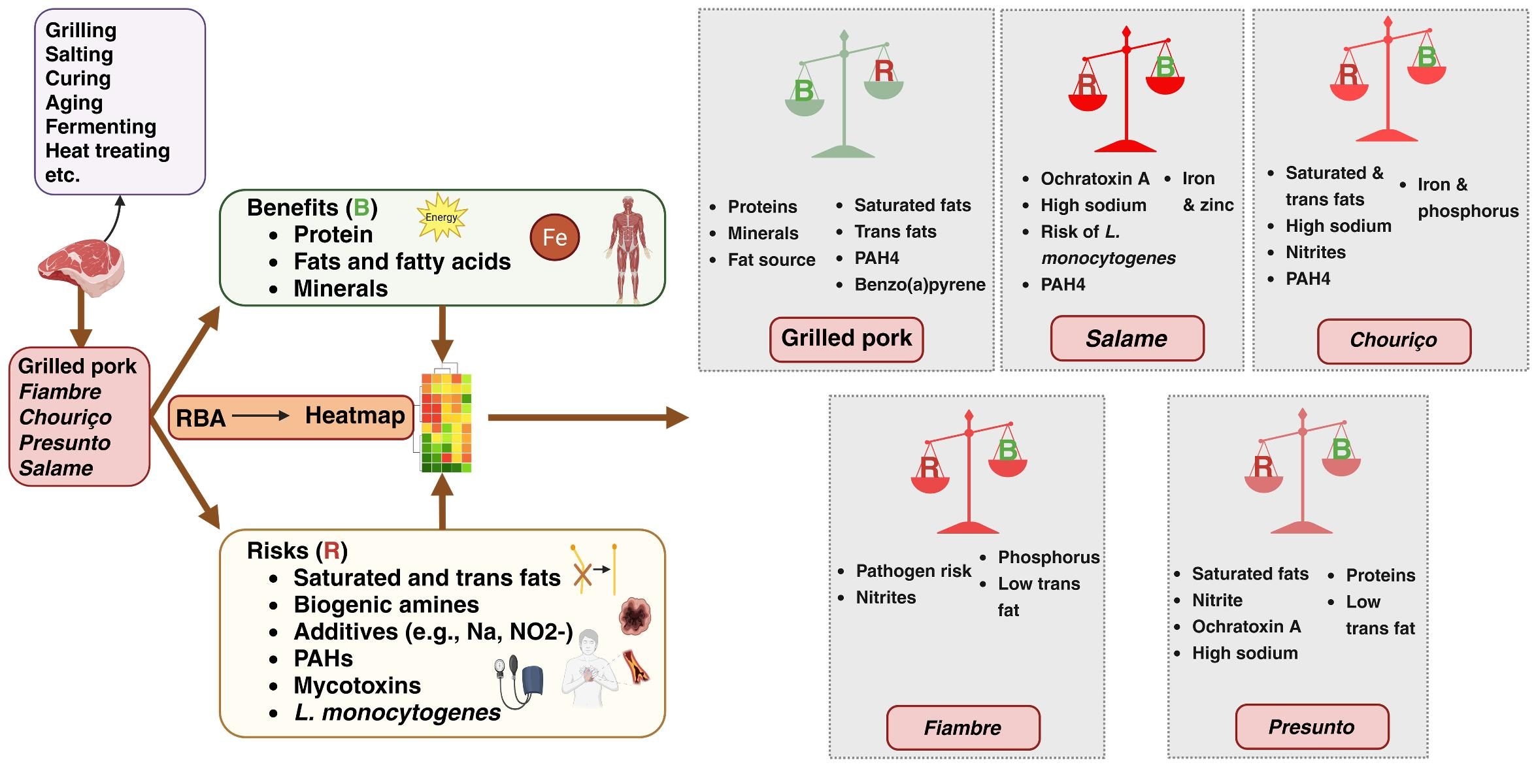
A Heatmap-Based Risk–Benefit Assessment of Traditional and Processed Meat Products




Abstract
1. Introduction
2. Materials and Methods
2.1. Study Design
2.2. The Risk–Benefit Question
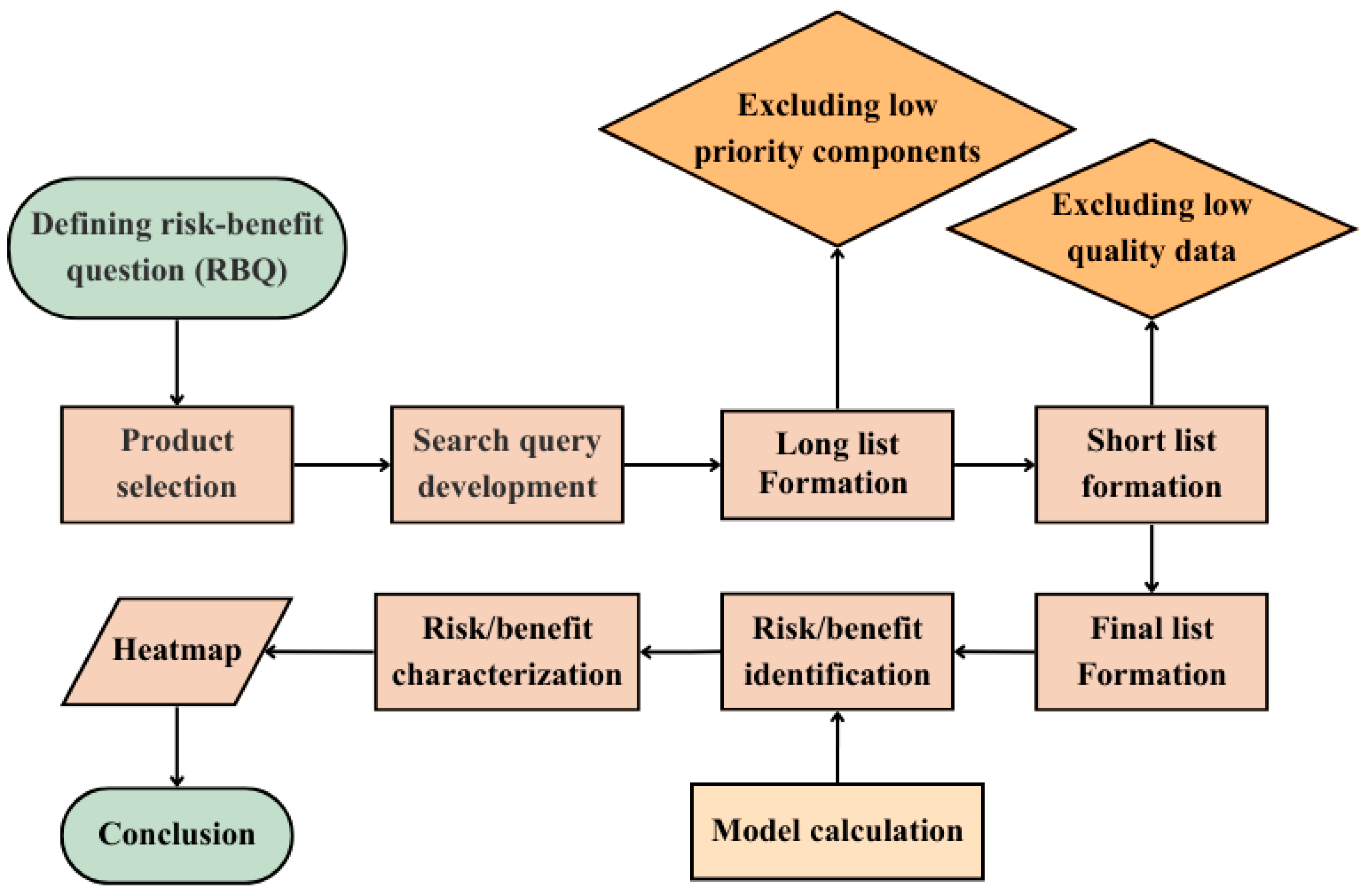
2.3. The Risk–Benefit Assessment Design
2.4. Selection of Meat Products
2.5. Literature Reviewing, Data Collection Methods and Databases
2.5.1. Determining the Food Components for Each Food Product
2.5.2. Nutritional Data
2.5.3. Microbiological and Toxicological Data
2.5.4. Reference Values and Sources
2.6. RBA Model and Calculation Methods
2.7. Heatmap Development and Interpretation
2.8. Statistical Analysis
3. Results and Discussions
3.1. Selection of Hazardous Components
3.2. Risk Identification and Characterization
3.3. Benefit Identification and Characterization
3.4. Heatmap-Based Risk–Benefit Assessment
3.5. Study Strengths and Limitations
4. Conclusions
Supplementary Materials
Author Contributions
Funding
Institutional Review Board Statement
Informed Consent Statement
Data Availability Statement
Acknowledgments
Conflicts of Interest
Abbreviations
| RBA | Risk–Benefit Assessment |
| RBQ | Risk–Benefit Question |
| EFSA | European Food Safety Authority |
| CFU | Colony Forming Unit |
| DRV | Daily Reference Value |
| TDI | Tolerable Daily Intake |
| PAH4 | Polycyclic Aromatic Hydrocarbons 4 |
| Reg | Regulation values |
| MoE | Margin of Exposure |
| IARC | International Agency for Research on Cancer |
| NA | Not Applicable |
| NR | Not Reported |
| BMDL | Lower Confidence Limit |
| PortFIR | Portuguese Food Information Resource |
| DALY | Disability-Adjusted Life Years |
References
- Whitton, C.; Bogueva, D.; Marinova, D.; Phillips, C.J.C. Are We Approaching Peak Meat Consumption? Analysis of Meat Consumption from 2000 to 2019 in 35 Countries and Its Relationship to Gross Domestic Product. Animals 2021, 11, 3466. [Google Scholar] [CrossRef] [PubMed]
- FAO. Food Balance Sheets 2010–2022—Global, Regional and Country Trends; FAOSTAT Analytical Brief Series, No. 91; FAO: Rome, Italy, 2024. [Google Scholar] [CrossRef]
- McAfee, A.J.; McSorley, E.M.; Cuskelly, G.J.; Moss, B.W.; Wallace, J.M.W.; Bonham, M.P.; Fearon, A.M. Red Meat Consumption: An Overview of the Risks and Benefits. Meat Sci. 2010, 84, 1–13. [Google Scholar] [CrossRef] [PubMed]
- Spiro, A.; Hill, Z.; Stanner, S. Meat and the Future of Sustainable Diets—Challenges and Opportunities. Nutr. Bull. 2024, 49, 572–598. [Google Scholar] [CrossRef] [PubMed]
- Steenson, S.; Buttriss, J.L. The Challenges of Defining a Healthy and ‘Sustainable’ Diet. Nutr. Bull. 2020, 45, 206–222. [Google Scholar] [CrossRef]
- Liu, D.; Shi, Q.; Cheng, G.; Huang, Q.; Li, S. Worldwide Burden Attributable to Diet High in Red Meat from 1990 to 2019. Arch. Med. Sci. AMS 2023, 19, 1–15. [Google Scholar] [CrossRef]
- Henchion, M.; Moloney, A.P.; Hyland, J.; Zimmermann, J.; McCarthy, S. Review: Trends for Meat, Milk and Egg Consumption for the next Decades and the Role Played by Livestock Systems in the Global Production of Proteins. Animal 2021, 15, 100287. [Google Scholar] [CrossRef]
- Mustapa, M.A.C.; Baba, Y.; Baishakhy, S.D.; Kallas, Z. Evolving Appetites: Current Evidence and Future Perspectives in Terms of Meat Substitutes in Europe. Food Sci. Nutr. 2025, 13, e4753. [Google Scholar] [CrossRef]
- Syrpas, M.; Smiliotopoulos, T.; Adamberg, S.; Adamberg, K.; Ağagündüz, D.; Brouwer-Brolsma, E.M.; Burtscher, J.; Perry, M.C.G.; Cerjak, M.; Chandolias, K.; et al. Mapping Fermented Food Prevalence and Intake Across European Regions: Results from the PIMENTO Study. Preprints 2025, 2025112200. [Google Scholar] [CrossRef]
- Caro, I.; Fernández-Soto, F.; Mateo, J. Dry-Ripened Chorizo. In Production of Traditional Mediterranean Meat Products; Lorenzo, J.M., Domínguez, R., Pateiro, M., Munekata, P.E.S., Eds.; Springer: New York, NY, USA, 2022; pp. 1–10. ISBN 978-1-0716-2103-5. [Google Scholar]
- Martuscelli, M.; Serio, A.; Capezio, O.; Mastrocola, D. Safety, Quality and Analytical Authentication of Halāl Meat Products, with Particular Emphasis on Salami: A Review. Foods 2020, 9, 1111. [Google Scholar] [CrossRef]
- Domínguez, R.; Pateiro, M.; Teixeira, A.; Pérez-Alvarez, J.A.; Santos, E.M.; Trindade, M.A.; Munekata, P.E.S.; Lorenzo, J.M. Dry-Cured Ham. In Production of Traditional Mediterranean Meat Products; Lorenzo, J.M., Domínguez, R., Pateiro, M., Munekata, P.E.S., Eds.; Springer: New York, NY, USA, 2022; pp. 57–65. ISBN 978-1-0716-2103-5. [Google Scholar]
- Giromini, C.; Givens, D.I. Benefits and Risks Associated with Meat Consumption during Key Life Processes and in Relation to the Risk of Chronic Diseases. Foods 2022, 11, 2063. [Google Scholar] [CrossRef]
- Liu, Y.; Zhu, C.; Song, H.; Che, M.; Xu, B.; An, B. Temporal Trends in Disability Adjusted Life Year and Mortality for Colorectal Cancer Attributable to a High Red Meat Diet in China from 1990 to 2021: An Analysis of the Global Burden of Disease Study 2021. BMC Gastroenterol. 2024, 24, 476. [Google Scholar] [CrossRef]
- Lescinsky, H.; Afshin, A.; Ashbaugh, C.; Bisignano, C.; Brauer, M.; Ferrara, G.; Hay, S.I.; He, J.; Iannucci, V.; Marczak, L.B.; et al. Health Effects Associated with Consumption of Unprocessed Red Meat: A Burden of Proof Study. Nat. Med. 2022, 28, 2075–2082. [Google Scholar] [CrossRef]
- Johnston, B.; De Smet, S.; Leroy, F.; Mente, A.; Stanton, A. Non-Communicable Disease Risk Associated with Red and Processed Meat Consumption—Magnitude, Certainty, and Contextuality of Risk? Anim. Front. 2023, 13, 19–27. [Google Scholar] [CrossRef]
- Nauta, M.J.; Andersen, R.; Pilegaard, K.; Pires, S.M.; Ravn-Haren, G.; Tetens, I.; Poulsen, M. Meeting the Challenges in the Development of Risk-Benefit Assessment of Foods. Trends Food Sci. Technol. 2018, 76, 90–100. [Google Scholar] [CrossRef]
- Tijhuis, M.J.; de Jong, N.; Pohjola, M.V.; Gunnlaugsdóttir, H.; Hendriksen, M.; Hoekstra, J.; Holm, F.; Kalogeras, N.; Leino, O.; van Leeuwen, F.X.R.; et al. State of the Art in Benefit–Risk Analysis: Food and Nutrition. Food Chem. Toxicol. 2012, 50, 5–25. [Google Scholar] [CrossRef] [PubMed]
- Assunção, R.; Alvito, P.; Brazão, R.; Carmona, P.; Fernandes, P.; Jakobsen, L.S.; Lopes, C.; Martins, C.; Membré, J.-M.; Monteiro, S.; et al. Building Capacity in Risk-Benefit Assessment of Foods: Lessons Learned from the RB4EU Project. Trends Food Sci. Technol. 2019, 91, 541–548. [Google Scholar] [CrossRef]
- Thomsen, S.T.; de Boer, W.; Pires, S.M.; Devleesschauwer, B.; Fagt, S.; Andersen, R.; Poulsen, M.; van der Voet, H. A Probabilistic Approach for Risk-Benefit Assessment of Food Substitutions: A Case Study on Substituting Meat by Fish. Food Chem. Toxicol. 2019, 126, 79–96. [Google Scholar] [CrossRef]
- Mihalache, O.A.; Dellafiora, L.; Dall’Asta, C. Risk–Benefit Assessment of Shifting from Traditional Meat-Based Diets to Alternative Dietary Patterns. EFSA J. 2022, 20, e200919. [Google Scholar] [CrossRef]
- Boué, G.; Ververis, E.; Niforou, A.; Federighi, M.; Pires, S.M.; Poulsen, M.; Thomsen, S.T.; Naska, A. Risk–Benefit Assessment of Foods: Development of a Methodological Framework for the Harmonized Selection of Nutritional, Microbiological, and Toxicological Components. Front. Nutr. 2022, 9, 951369. [Google Scholar] [CrossRef]
- National Institute of Health Dr. Ricardo Jorge, I.P.-INSA. Food Composition Table, v 7.0 [Online Database]. Lisbon. 2025. Available online: https://portfir.insa.min-saude.pt (accessed on 18 September 2024).
- The National Food, Nutrition and Physical Activity Survey (IAN AF). Red Meat Intake, by Sex. Available online: https://www.ian-af.up.pt/en/red-meat-intake-by-sex (accessed on 27 September 2024).
- The National Food, Nutrition and Physical Activity Survey (IAN AF). Processed Meat Intake, by Sex. Available online: https://www.ian-af.up.pt/en/processed-meat-intake-by-sex (accessed on 27 September 2024).
- European Food Safety Authority (EFSA). DRV Finder—Dietary Reference Values for Nutrients. Available online: https://multimedia.efsa.europa.eu/drvs/index.htm (accessed on 3 October 2024).
- Carnesecchi, E.; Mostrag, A.; Ciacci, A.; Roncaglioni, A.; Tarkhov, A.; Gibin, D.; Sartori, L.; Benfenati, E.; Yang, C.; Dorne, J.L.C.M. OpenFoodTox: EFSA’s Chemical Hazards Database (Version 6) [Data Set]. 2023. Available online: https://zenodo.org/records/8120114 (accessed on 2 February 2026).
- Doyle, M.E.; Glass, K.A. Sodium Reduction and Its Effect on Food Safety, Food Quality, and Human Health. Compr. Rev. Food Sci. Food Saf. 2010, 9, 44–56. [Google Scholar] [CrossRef] [PubMed]
- Efsa, S.C.; Hougaard Bennekou, S.; Allende, A.; Bearth, A.; Casacuberta, J.; Castle, L.; Coja, T.; Crépet, A.; Halldorsson, T.I.; Hoogenboom, R.; et al. Statement on the Use and Interpretation of the Margin of Exposure Approach. EFSA J. 2025, 23, e9606. [Google Scholar] [CrossRef]
- Swaminathan, B.; Gerner-Smidt, P. The Epidemiology of Human Listeriosis. Microbes Infect. 2007, 9, 1236–1243. [Google Scholar] [CrossRef] [PubMed]
- Wang, X.H.; Ren, H.Y.; Wang, W.; Bai, T.; Li, J.X. Evaluation of Key Factors Influencing Histamine Formation and Accumulation in Fermented Sausages. J. Food Saf. 2015, 35, 395–402. [Google Scholar] [CrossRef]
- Chung, B.Y.; Park, S.Y.; Byun, Y.S.; Son, J.H.; Choi, Y.W.; Cho, Y.S.; Kim, H.O.; Park, C.W. Effect of Different Cooking Methods on Histamine Levels in Selected Foods. Ann. Dermatol. 2017, 29, 706–714. [Google Scholar] [CrossRef]
- Bedale, W.; Sindelar, J.J.; Milkowski, A.L. Dietary Nitrate and Nitrite: Benefits, Risks, and Evolving Perceptions. Meat Sci. 2016, 120, 85–92. [Google Scholar] [CrossRef]
- Strosnider, H.; Azziz-Baumgartner, E.; Banziger, M.; Bhat, R.V.; Breiman, R.; Brune, M.-N.; DeCock, K.; Dilley, A.; Groopman, J.; Hell, K.; et al. Workgroup Report: Public Health Strategies for Reducing Aflatoxin Exposure in Developing Countries. Environ. Health Perspect. 2006, 114, 1898–1903. [Google Scholar] [CrossRef]
- Ostry, V.; Malir, F.; Toman, J.; Grosse, Y. Mycotoxins as Human Carcinogens—The IARC Monographs Classification. Mycotoxin Res. 2017, 33, 65–73. [Google Scholar] [CrossRef]
- Bukowska, B.; Mokra, K.; Michałowicz, J. Benzo[a]Pyrene—Environmental Occurrence, Human Exposure, and Mechanisms of Toxicity. Int. J. Mol. Sci. 2022, 23, 6348. [Google Scholar] [CrossRef]
- Boström, C.-E.; Gerde, P.; Hanberg, A.; Jernström, B.; Johansson, C.; Kyrklund, T.; Rannug, A.; Törnqvist, M.; Victorin, K.; Westerholm, R. Cancer Risk Assessment, Indicators, and Guidelines for Polycyclic Aromatic Hydrocarbons in the Ambient Air. Environ. Health Perspect. 2002, 110, 451–488. [Google Scholar] [CrossRef]
- Paulsen, P.; Hagen, U.; Bauer, F. Changes in Biogenic Amine Contents, Non-Protein Nitrogen and Crude Protein during Curing and Thermal Processing of M. Longissimus, Pars Lumborum of Pork. Eur. Food Res. Technol. 2006, 223, 603–608. [Google Scholar] [CrossRef]
- Perelló, G.; Martí-Cid, R.; Castell, V.; Llobet, J.M.; Domingo, J.L. Concentrations of Polybrominated Diphenyl Ethers, Hexachlorobenzene and Polycyclic Aromatic Hydrocarbons in Various Foodstuffs before and after Cooking. Food Chem. Toxicol. 2009, 47, 709–715. [Google Scholar] [CrossRef] [PubMed]
- Hospital, X.F.; Carballo, J.; Fernández, M.; Arnau, J.; Gratacós, M.; Hierro, E. Technological Implications of Reducing Nitrate and Nitrite Levels in Dry-Fermented Sausages: Typical Microbiota, Residual Nitrate and Nitrite and Volatile Profile. Food Control 2015, 57, 275–281. [Google Scholar] [CrossRef]
- Kim, H.-J.; Cho, J.; Kim, D.; Park, T.S.; Jin, S.K.; Hur, S.J.; Lee, S.K.; Jang, A. Effects of Gochujang (Korean Red Pepper Paste) Marinade on Polycyclic Aromatic Hydrocarbon Formation in Charcoal-Grilled Pork Belly. Food Sci. Anim. Resour. 2021, 41, 481–496. [Google Scholar] [CrossRef] [PubMed]
- Martins, E.A.; Leal Germano, P.M. Listeria monocytogenes in Ready-to-Eat, Sliced, Cooked Ham and Salami Products, Marketed in the City of São Paulo, Brazil: Occurrence, Quantification, and Serotyping. Food Control 2011, 22, 297–302. [Google Scholar] [CrossRef]
- Ruiz-Capillas, C.; Jiménez-Colmenero, F. Biogenic Amine Content in Spanish Retail Market Meat Products Treated with Protective Atmosphere and High Pressure. Eur. Food Res. Technol. 2004, 218, 237–241. [Google Scholar] [CrossRef]
- Horsch, A.M.; Sebranek, J.G.; Dickson, J.S.; Niebuhr, S.E.; Larson, E.M.; Lavieri, N.A.; Ruther, B.L.; Wilson, L.A. The Effect of pH and Nitrite Concentration on the Antimicrobial Impact of Celery Juice Concentrate Compared with Conventional Sodium Nitrite on Listeria monocytogenes. Meat Sci. 2014, 96, 400–407. [Google Scholar] [CrossRef]
- Prencipe, V.A.; Rizzi, V.; Acciari, V.; Iannetti, L.; Giovannini, A.; Serraino, A.; Calderone, D.; Rossi, A.; Morelli, D.; Marino, L.; et al. Listeria monocytogenes Prevalence, Contamination Levels and Strains Characterization throughout the Parma Ham Processing Chain. Food Control 2012, 25, 150–158. [Google Scholar] [CrossRef]
- Alfaia, C.M.; Castro, M.F.; Reis, V.A.; Prates, J.M.; de Almeida, I.T.; Correia, A.D.; Dias, M.A. Changes in the Profile of Free Amino Acids and Biogenic Amines During the Extended Short Ripening of Portuguese Dry-Cured Ham. Food Sci. Technol. Int. 2004, 10, 297–304. [Google Scholar] [CrossRef]
- Pizzolato Montanha, F.; Anater, A.; Burchard, J.F.; Luciano, F.B.; Meca, G.; Manyes, L.; Pimpão, C.T. Mycotoxins in Dry-Cured Meats: A Review. Food Chem. Toxicol. 2018, 111, 494–502. [Google Scholar] [CrossRef]
- Meza-Bone, G.A.; Meza Bone, J.S.; Cedeño, Á.; Martín, I.; Martín, A.; Maddela, N.R.; Córdoba, J.J. Prevalence of Listeria monocytogenes in RTE Meat Products of Quevedo (Ecuador). Foods 2023, 12, 2956. [Google Scholar] [CrossRef] [PubMed]
- Anderegg, J.; Fischer, M.; Dürig, J.; Die, A.; Lacroix, C.; Meile, L. Detection of Biogenic Amines and Tyramine-Producing Bacteria in Fermented Sausages from Switzerland. J. Food Prot. 2020, 83, 1512–1519. [Google Scholar] [CrossRef] [PubMed]
- Casoni, D. Spectrophotometric Determination and Assessment of Potential Health Risk of Nitrite from Meat and Processed Meat Products. Stud. Univ. Babeș-Bolyai Chem. 2019, 2, 265–277. [Google Scholar] [CrossRef]
- Armorini, S.; Altafini, A.; Zaghini, A.; Roncada, P. Ochratoxin A in Artisan Salami Produced in Veneto (Italy). Food Addit. Contam. Part B 2016, 9, 9–14. [Google Scholar] [CrossRef]
- Hitzel, A.; Pöhlmann, M.; Schwägele, F.; Speer, K.; Jira, W. Polycyclic Aromatic Hydrocarbons (PAH) and Phenolic Substances in Meat Products Smoked with Different Types of Wood and Smoking Spices. Food Chem. 2013, 139, 955–962. [Google Scholar] [CrossRef]
- Lucumi-Banguero, R.S.; Ramírez-Toro, C.; Bolívar, G.A. Potential Use of Lactic Acid Bacteria with Pathogen Inhibitory Capacity as a Biopreservative Agent for Chorizo. Processes 2021, 9, 1582. [Google Scholar] [CrossRef]
- Commission Regulation (EU) 2024/2895 of 20 November 2024 Amending Regulation (EC) No 2073/2005 as Regards Listeria monocytogenes. 2024. Available online: https://eur-lex.europa.eu/eli/reg/2024/2895/oj/eng (accessed on 1 July 2024).
- Schirone, M.; Esposito, L.; D’Onofrio, F.; Visciano, P.; Martuscelli, M.; Mastrocola, D.; Paparella, A. Biogenic Amines in Meat and Meat Products: A Review of the Science and Future Perspectives. Foods 2022, 11, 788. [Google Scholar] [CrossRef]
- Valente, I.M.; Sousa, C.S.; Guido, L.F. Impact of the Smoking Process on Biogenic Amine Levels in Traditional Dry-Cured Chorizo. Separations 2023, 10, 585. [Google Scholar] [CrossRef]
- Bayatı, M.H.M.A.; Cengiz, M.F. Influence of Plants and Spices on the Formation of Biogenic Amines in Meat. Mediterr. Agric. Sci. 2024, 37, 27–31. [Google Scholar] [CrossRef]
- Barbieri, F.; Tabanelli, G.; Montanari, C.; Dall’Osso, N.; Šimat, V.; Smole Možina, S.; Baños, A.; Özogul, F.; Bassi, D.; Fontana, C.; et al. Mediterranean Spontaneously Fermented Sausages: Spotlight on Microbiological and Quality Features to Exploit Their Bacterial Biodiversity. Foods 2021, 10, 2691. [Google Scholar] [CrossRef]
- Miguélez-Arrizado, M.J.; Bover-Cid, S.; Latorre-Moratalla, M.L.; Vidal-Carou, M.C. Biogenic Amines in Spanish Fermented Sausages as a Function of Diameter and Artisanal or Industrial Origin. J. Sci. Food Agric. 2006, 86, 549–557. [Google Scholar] [CrossRef]
- Roselino, M.N.; Maciel, L.F.; Sirocchi, V.; Caviglia, M.; Sagratini, G.; Vittori, S.; Taranto, M.P.; Cavallini, D.C.U. Analysis of Biogenic Amines in Probiotic and Commercial Salamis. J. Food Compos. Anal. 2020, 94, 103649. [Google Scholar] [CrossRef]
- Papavergou, E.J.; Savvaidis, I.N.; Ambrosiadis, I.A. Levels of Biogenic Amines in Retail Market Fermented Meat Products. Food Chem. 2012, 135, 2750–2755. [Google Scholar] [CrossRef] [PubMed]
- Shen, Q.; Zeng, X.; Kong, L.; Sun, X.; Shi, J.; Wu, Z.; Guo, Y.; Pan, D. Research Progress of Nitrite Metabolism in Fermented Meat Products. Foods 2023, 12, 1485. [Google Scholar] [CrossRef]
- Bertuci, M.L.; Bis Souza, C.V.; Alves, C.A.; Todorov, S.D.; Penna, A.L.B.; Barretto, A.C.d.S. Bioprotective and Technological Roles of Lactic Acid Bacteria in Reduced-Sodium Fermented Sausages. Foods 2025, 14, 3758. [Google Scholar] [CrossRef]
- Laranjo, M.; Potes, M.E.; Elias, M. Role of Starter Cultures on the Safety of Fermented Meat Products. Front. Microbiol. 2019, 10, 853. [Google Scholar] [CrossRef]
- Xu, Y.; Zhu, Y. Complete Replacement of Nitrite with a Lactobacillus fermentum on the Quality and Safety of Chinese Fermented Sausages. Front. Microbiol. 2021, 12, 704302. [Google Scholar] [CrossRef]
- Patarata, L.; Fernandes, L.; Silva, J.A.; Fraqueza, M.J. The Risk of Salt Reduction in Dry-Cured Sausage Assessed by the Influence on Water Activity and the Survival of Salmonella. Foods 2022, 11, 444. [Google Scholar] [CrossRef]
- Zhang, Y.; Zhang, Y.; Jia, J.; Peng, H.; Qian, Q.; Pan, Z.; Liu, D. Nitrite and Nitrate in Meat Processing: Functions and Alternatives. Curr. Res. Food Sci. 2023, 6, 100470. [Google Scholar] [CrossRef]
- Ma, L.; Hu, L.; Feng, X.; Wang, S. Nitrate and Nitrite in Health and Disease. Aging Dis. 2018, 9, 938–945. [Google Scholar] [CrossRef]
- Munekata, P.E.S.; Pateiro, M.; Tomasevic, I.; Domínguez, R.; da Silva Barretto, A.C.; Santos, E.M.; Lorenzo, J.M. Functional Fermented Meat Products with Probiotics—A Review. J. Appl. Microbiol. 2022, 133, 91–103. [Google Scholar] [CrossRef] [PubMed]
- Pleadin, J.; Lešić, T.; Milićević, D.; Markov, K.; Šarkanj, B.; Vahčić, N.; Kmetič, I.; Zadravec, M. Pathways of Mycotoxin Occurrence in Meat Products: A Review. Processes 2021, 9, 2122. [Google Scholar] [CrossRef]
- Rodrigues, P.; Silva, D.; Costa, P.; Abrunhosa, L.; Venâncio, A.; Teixeira, A. Mycobiota and Mycotoxins in Portuguese Pork, Goat and Sheep Dry-Cured Hams. Mycotoxin Res. 2019, 35, 405–412. [Google Scholar] [CrossRef] [PubMed]
- Bui-Klimke, T.R.; Wu, F. Ochratoxin A and Human Health Risk: A Review of the Evidence. Crit. Rev. Food Sci. Nutr. 2015, 55, 1860–1869. [Google Scholar] [CrossRef]
- Adeyeye, S.A.O.; Ashaolu, T.J. Polycyclic Aromatic Hydrocarbons Formation and Mitigation in Meat and Meat Products. Polycycl. Aromat. Compd. 2022, 42, 3401–3411. [Google Scholar] [CrossRef]
- Roseiro, L.C.; Gomes, A.; Patarata, L.; Santos, C. Comparative Survey of PAHs Incidence in Portuguese Traditional Meat and Blood Sausages. Food Chem. Toxicol. 2012, 50, 1891–1896. [Google Scholar] [CrossRef]
- Vicente, F.; Pereira, P.C. Pork Meat Composition and Health: A Review of the Evidence. Foods 2024, 13, 1905. [Google Scholar] [CrossRef]
- Wang, D.; Cheng, F.; Wang, Y.; Han, J.; Gao, F.; Tian, J.; Zhang, K.; Jin, Y. The Changes Occurring in Proteins during Processing and Storage of Fermented Meat Products and Their Regulation by Lactic Acid Bacteria. Foods 2022, 11, 2427. [Google Scholar] [CrossRef]
- Jiménez-Colmenero, F.; Ventanas, J.; Toldrá, F. Nutritional Composition of Dry-Cured Ham and Its Role in a Healthy Diet. Meat Sci. 2010, 84, 585–593. [Google Scholar] [CrossRef]
- Elías, M.; Carrascosa, A.V. Characterisation of the Paio Do Alentejo, a Traditional Portuguese Iberian Sausage, in Respect to Its Safety. Food Control 2010, 21, 97–102. [Google Scholar] [CrossRef]
- Latunde-Dada, G.O.; Kajarabille, N.; Rose, S.; Arafsha, S.M.; Kose, T.; Aslam, M.F.; Hall, W.L.; Sharp, P.A. Content and Availability of Minerals in Plant-Based Burgers Compared with a Meat Burger. Nutrients 2023, 15, 2732. [Google Scholar] [CrossRef]
- Fairweather-Tait, S. The Role of Meat in Iron Nutrition of Vulnerable Groups of the UK Population. Front. Anim. Sci. 2023, 4, 1142252. [Google Scholar] [CrossRef]
- Yang, B.; Chen, H.; Stanton, C.; Ross, R.P.; Zhang, H.; Chen, Y.Q.; Chen, W. Review of the Roles of Conjugated Linoleic Acid in Health and Disease. J. Funct. Foods 2015, 15, 314–325. [Google Scholar] [CrossRef]
- Farquhar, W.B.; Edwards, D.G.; Jurkovitz, C.T.; Weintraub, W.S. Dietary Sodium and Health. JACC 2015, 65, 1042–1050. [Google Scholar] [CrossRef] [PubMed]
- Vidal, V.A.S.; Paglarini, C.S.; Lorenzo, J.M.; Munekata, P.E.S.; Pollonio, M.A.R. Salted Meat Products: Nutritional Characteristics, Processing and Strategies for Sodium Reduction. Food Rev. Int. 2023, 39, 2183–2202. [Google Scholar] [CrossRef]
- Scheers, N.; Rossander-Hulthen, L.; Torsdottir, I.; Sandberg, A.-S. Increased Iron Bioavailability from Lactic-Fermented Vegetables Is Likely an Effect of Promoting the Formation of Ferric Iron (Fe3+). Eur. J. Nutr. 2016, 55, 373–382. [Google Scholar] [CrossRef]
- Commission Regulation (EU) 2023/2108 of 6 October 2023 Amending Annex II to Regulation (EC) No 1333/2008 of the European Parliament and of the Council and the Annex to Commission Regulation (EU) No 231/2012 as Regards Food Additives Nitrites (E 249-250) and Nitrates (E 251-252). 2023. Available online: https://eur-lex.europa.eu/eli/reg/2023/2108/oj/eng (accessed on 1 July 2024).
- Todorovic, S.; Akpinar, A.; Assunção, R.; Bär, C.; Bavaro, S.L.; Berkel Kasikci, M.; Domínguez-Soberanes, J.; Capozzi, V.; Cotter, P.D.; Doo, E.-H.; et al. Health Benefits and Risks of Fermented Foods—The PIMENTO Initiative. Front. Nutr. 2024, 11, 1458536. [Google Scholar] [CrossRef]
- Sar, T.; Bogovic Matijasic, B.; Danilovic, B.; Gamero, A.; Gandía, M.; Krausova, G.; Martínez-Villaluenga, C.; Peñas, E.; Bagherzadehsurbagh, E.; Cemali, Ö.; et al. A Systematic Review of Health Promoting Effects of Consumption of Whey-Based Fermented Products on Adults. Front. Nutr. 2025, 12, 1651365. [Google Scholar] [CrossRef]
- Harsa, H.S.; González Domenech, C.M.; Prvulović, M.; Agirbasli, Z.; Bagherzadehsurbagh, E.; Simeunović, V.; Naziri, E.; Adesemoye, E.; Yigit Cinar, A.; Mukherjee, A.; et al. The Effects of Lactobacillus and/or Bifidobacterium in Fermented Foods on Cognitive Health: A Systematic Review. Front. Nutr. 2025, 12, 1682419. [Google Scholar] [CrossRef]
- Abbaspour, N. Fermentation’s Pivotal Role in Shaping the Future of Plant-Based Foods: An Integrative Review of Fermentation Processes and Their Impact on Sensory and Health Benefits. Appl. Food Res. 2024, 4, 100468. [Google Scholar] [CrossRef]
- Liu, H.; Xu, X.; Cui, H.; Xu, J.; Yuan, Z.; Liu, J.; Li, C.; Li, J.; Zhu, D. Plant-Based Fermented Beverages and Key Emerging Processing Technologies. Food Rev. Int. 2023, 39, 5844–5863. [Google Scholar] [CrossRef]


| Hazard Type | Hazardous Component |
|---|---|
| Microbiological | L. monocytogenes |
| Toxicological | Histamine |
| Nitrite | |
| Aflatoxins | |
| Ochratoxin A | |
| Polycyclic Aromatic Hydrocarbons 4 (PAH4) | |
| Benzo(a)pyrene |
| Food | Component | Component Value | Regulated Amount/Reference Point | Intake (mg/kg bw 1) | Margin of Exposure | Reference |
|---|---|---|---|---|---|---|
| Grilled Pork | L. monocytogenes | NR 2 | 100 CFU 3/g | 0 | NA 2 | - |
| Grilled Pork | Histamine | 4.10 mg/kg | 150 mg/kg | 0.00305 | NA | [38] |
| Grilled Pork | Nitrite | NR | 0.07 mg/kg | 0 | NA | - |
| Grilled Pork | Aflatoxins | NR | 0.0004 mg/kg bw/day | 0 | NR | - |
| Grilled Pork | Ochratoxin A | NR | 0.01 mg/kg bw/day | 0 | NR | - |
| Grilled Pork | PAH4 | 0.11 mg/kg | 0.34 mg/kg bw/day | 0.00008 | 4011.68 | [39] |
| Grilled Pork | Benzo(a)pyrene | 0.03 mg/kg | 0.07 mg/kg bw/day | 0.00002 | 2980.57 | [39] |
| Chouriço | L. monocytogenes | NR | 100 CFU/g | 0 | NA | - |
| Chouriço | Histamine | 5 mg/kg | 150 mg/kg | 0.00150 | NA | [38] |
| Chouriço | Nitrite | 25 mg/kg | 0.07 mg/kg | 0.00750 | NA | [40] |
| Chouriço | Aflatoxins | NR | 0.0004 mg/kg bw/day | 0 | NR | - |
| Chouriço | Ochratoxin A | NR | 0.01 mg/kg bw/day | 0 | NR | - |
| Chouriço | PAH4 | 0.70 mg/kg | 0.34 mg/kg bw/day | 0.00021 | 1613.29 | [39] |
| Chouriço | Benzo(a)pyrene | 0.00180 mg/kg | 0.07 mg/kg bw/day | 0.000001 | 129,990.71 | [41] |
| Fiambre | L. monocytogenes | 800 CFU/g | 100 CFU/g | 0 | NA | [42] |
| Fiambre | Histamine | 0.27 mg/kg | 150 mg/kg | 0.00008 | NA | [43] |
| Fiambre | Nitrite | 100 mg/kg | 0.07 mg/kg | 0.03 | NA | [44] |
| Fiambre | Aflatoxins | NR | 0.0004 mg/kg bw/day | 0 | NR | - |
| Fiambre | Ochratoxin A | NR | 0.01 mg/kg bw/day | 0 | NR | - |
| Fiambre | PAH4 | NR | 0.34 mg/kg bw/day | 0 | NR | - |
| Fiambre | Benzo(a)pyrene | NR | 0.07 mg/kg bw/day | 0 | NR | - |
| Presunto | L. monocytogenes | 22.50 CFU/g | 100 CFU/g | 0 | NA | [45] |
| Presunto | Histamine | 6.05 mg/kg | 150 mg/kg | 0.001815 | NA | [46] |
| Presunto | Nitrite | 100 mg/kg | 0.07 mg/kg | 0.03 | NA | - |
| Presunto | Aflatoxins | NR | 0.0004 mg/kg bw/day | 0 | NR | - |
| Presunto | Ochratoxin A | 0.08 mg/kg | 0.01 mg/kg bw/day | 0.000024 | 400.88 | [47] |
| Presunto | PAH4 | NR | 0.34 mg/kg bw/day | 0 | NR | - |
| Presunto | Benzo(a)pyrene | NR | 0.07 mg/kg bw/day | 0 | NR | - |
| Salame | L. monocytogenes | 3802 CFU/g | 100 CFU/g | 0 | NA | [48] |
| Salame | Histamine | 235.69 mg/kg | 150 mg/kg | 0.07071 | NA | [49] |
| Salame | Nitrite | 14.75 mg/kg | 0.07 mg/kg | 0.00093 | NA | [50] |
| Salame | Aflatoxins | NR | 0.0004 mg/kg bw/day | 0 | NR | - |
| Salame | Ochratoxin A | 103.69 mg/kg | 0.01 mg/kg bw/day | 0.01556 | 0.62 | [51] |
| Salame | PAH4 | 6.51 mg/kg | 0.34 mg/kg bw/day | 0.00132 | 258.46 | [52] |
| Salame | Benzo(a)pyrene | 0.89 mg/kg | 0.07 mg/kg bw/day | 0.00016 | 428.13 | [52] |
| Food | Component | Value in Serving | DRVs | Contribution of the Food (%) |
|---|---|---|---|---|
| Grilled Pork | Protein | 8.53 g | 46.2 g | 18.46 |
| Grilled Pork | Lipid | 21.35 g | M 1 55.55 g F 1 44.44 g | M 8.00 F 10.01 |
| Grilled Pork | Total saturated fatty acids | 7.67 g | As low as possible | NA 2 |
| Grilled Pork | Linoleic acid | 2.59 g | M 11.11 g F 8.89 g | M 0.97 F 1.22 |
| Grilled Pork | Total trans fatty acids | 0.18 g | As low as possible | NA |
| Grilled Pork | Sodium | 101.40 mg | 2000 mg | 5.07 |
| Grilled Pork | Potassium | 144.82 mg | 3500 mg | 4.14 |
| Grilled Pork | Calcium | 17.68 mg | 750 mg 3 | 2.36 |
| Grilled Pork | Phosphorus | 43.16 mg | 550 mg | 7.85 |
| Grilled Pork | Magnesium | 32.76 mg | M 350 mg F 300 mg | M 9.36 F 10.92 |
| Grilled Pork | Iron | 0.44 mg | M 6 mg F 7 mg 4 | M 7.37 F 6.31 |
| Grilled Pork | Zinc | 0.94 mg | M 10.13 mg F 8.23 mg | M 9.61 F 11.78 |
| Chouriço | Protein | 4.19 g | 46.2 g | 9.07 |
| Chouriço | Lipid | 9.25 g | M 55.55 g F 44.44 g | M 3.47 F 4.34 |
| Chouriço | Total saturated fatty acids | 3.19 g | As low as possible | NA |
| Chouriço | Linoleic acid | 0.91 | M 11.11 g F 8.89 g | M 0.34 F 0.43 |
| Chouriço | Total trans fatty acids | 0.03 | As low as possible | NA |
| Chouriço | Sodium | 517 mg | 2000 mg | 25.88 |
| Chouriço | Potassium | 60.90 mg | 3500 mg | 1.74 |
| Chouriço | Calcium | 5.57 mg | 750 mg | 0.74 |
| Chouriço | Phosphorus | 50.40 mg | 550 mg | 9.16 |
| Chouriço | Magnesium | 4.41 mg | M 350 mg F 300 mg | M 1.26 F 1.47 |
| Chouriço | Iron | 0.55 mg | M 6 mg F 7 mg | M 9.10 F 7.80 |
| Chouriço | Zinc | 0.65 mg | M 10.13 mg F 8.23 mg | M 6.68 F 8.19 |
| Fiambre | Protein | 3.21 g | 46.2 g | 6.94 |
| Fiambre | Lipid | 0.97 g | M 55.55 g F 44.44 g | M 0.36 F 0.45 |
| Fiambre | Total saturated fatty acids | 0.32 g | As low as possible | NA |
| Fiambre | Linoleic acid | 0.12 g | M 11.11 g F 8.89 g | M 0.04 F 0.05 |
| Fiambre | Total trans fatty acids | 0 | As low as possible | NA |
| Fiambre | Sodium | 196.70 mg | 2000 mg | 9.84 |
| Fiambre | Potassium | 69.30 mg | 3500 mg | 1.98 |
| Fiambre | Calcium | 2.24 mg | 750 mg | 0.30 |
| Fiambre | Phosphorus | 56.70 mg | 550 mg | 10.31 |
| Fiambre | Magnesium | 3.29 mg | M 350 mg F 300 mg | M 0.94 F 1.10 |
| Fiambre | Iron | 0.7 mg | M 6 mg F 7 mg | M 2.33 F 2.00 |
| Fiambre | Zinc | 1.4 mg | M 10.13 mg F 8.23 mg | M 2.95 F 3.61 |
| Presunto | Protein | 5.25 g | 46.2 g | 11.36 |
| Presunto | Lipid | 2.69 g | M 55.55 g F 44.44 g | M 1.01 F 1.26 |
| Presunto | Total saturated fatty acids | 0.86 g | As low as possible | NA |
| Presunto | Linoleic acid | 0.25 g | M 11.11 g F 8.89 g | M 0.09 F 0.12 |
| Presunto | Total trans fatty acids | 0 | As low as possible | NA |
| Presunto | Sodium | 539.70 mg | 2000 mg | 26.99 |
| Presunto | Potassium | 121.80 mg | 3500 mg | 3.48 |
| Presunto | Calcium | 4.83 mg | 750 mg | 0.64 |
| Presunto | Phosphorus | 42.00 mg | 550 mg | 7.64 |
| Presunto | Magnesium | 8.61 mg | M 350 mg F 300 mg | M 2.46 F 2.87 |
| Presunto | Iron | 0.42 mg | M 6 mg F 7 mg | M 7.00 F 6.00 |
| Presunto | Zinc | 0.82 mg | M 10.13 mg F 8.23 mg | M 6.68 F 8.19 |
| Salame | Protein | 4.10 g | 46.2 g | 8.86 |
| Salame | Lipid | 7.90 g | M 55.55 g F 44.44 g | M 2.96 F 3.70 |
| Salame | Total saturated fatty acids | 2.71 g | As low as possible | NA |
| Salame | Linoleic acid | 0.78 g | M 11.11 g F 8.89 g | M 0.29 F 0.36 |
| Salame | Total trans fatty acids | 0.02 g | As low as possible | NA |
| Salame | Sodium | 483.00 mg | 2000 mg | 24.15 |
| Salame | Potassium | 29.40 mg | 3500 mg | 0.84 |
| Salame | Calcium | 5.25 mg | 750 mg | 0.70 |
| Salame | Phosphorus | 42.00 mg | 550 mg | 7.64 |
| Salame | Magnesium | 4.62 mg | M 350 mg F 300 mg | M 1.32 F 1.54 |
| Salame | Iron | 0.48 mg | M 6 mg F 7 mg | M 8.05 F 6.90 |
| Salame | Zinc | 0.90 mg | M 10.13 mg F 8.23 mg | M 9.27 F 11.36 |
| Food Products | |||||||
|---|---|---|---|---|---|---|---|
| Category | Components | Sex | Grilled Pork | Chouriço | Presunto | Fiambre | Salame |
| Nutrients (g per serving/% of food contribution per serving) | Proteins | FM | |||||
| Lipids | M | ||||||
| F | |||||||
| Fatty acids, total saturated (g) | FM | ||||||
| Linoleic acid | M | ||||||
| F | |||||||
| Fatty acids, total trans (g) | FM | ||||||
| Sodium | FM | ||||||
| Potassium | FM | ||||||
| Calcium | FM | ||||||
| Phosphorus | FM | ||||||
| Magnesium | M | ||||||
| F | |||||||
| Iron | M | ||||||
| F | |||||||
| Zinc | M | ||||||
| F | |||||||
| Hazards (Regulation/Margin of exposure) | L. monocytogenes (Reg) | FM | |||||
| Histamine (Reg) | FM | ||||||
| Nitrite (Reg) | FM | ||||||
| Ochratoxin A (MoE) | FM | ||||||
| PAH4 (MoE) | FM | ||||||
| Benzo(a)pyrene (MoE) | FM | ||||||
Disclaimer/Publisher’s Note: The statements, opinions and data contained in all publications are solely those of the individual author(s) and contributor(s) and not of MDPI and/or the editor(s). MDPI and/or the editor(s) disclaim responsibility for any injury to people or property resulting from any ideas, methods, instructions or products referred to in the content. |
© 2026 by the authors. Licensee MDPI, Basel, Switzerland. This article is an open access article distributed under the terms and conditions of the Creative Commons Attribution (CC BY) license.
Share and Cite
Bagherzadehsurbagh, E.; Laranjo, M.; Assunção, R. A Heatmap-Based Risk–Benefit Assessment of Traditional and Processed Meat Products. Foods 2026, 15, 661. https://doi.org/10.3390/foods15040661
Bagherzadehsurbagh E, Laranjo M, Assunção R. A Heatmap-Based Risk–Benefit Assessment of Traditional and Processed Meat Products. Foods. 2026; 15(4):661. https://doi.org/10.3390/foods15040661
Chicago/Turabian StyleBagherzadehsurbagh, Erfan, Marta Laranjo, and Ricardo Assunção. 2026. "A Heatmap-Based Risk–Benefit Assessment of Traditional and Processed Meat Products" Foods 15, no. 4: 661. https://doi.org/10.3390/foods15040661
APA StyleBagherzadehsurbagh, E., Laranjo, M., & Assunção, R. (2026). A Heatmap-Based Risk–Benefit Assessment of Traditional and Processed Meat Products. Foods, 15(4), 661. https://doi.org/10.3390/foods15040661