Article

LC-MS/MS for Simultaneous Determination and Isomer Separation of 12 Glucocorticoid Residues in Multiple Aquatic Foods


1
East China Sea Fisheries Research Institute, Chinese Academy of Fishery Sciences, Shanghai 200090, China
2
Division of Glycoscience, Department of Chemistry, KTH Royal Institute of Technology, AlbaNova University Center, Roslagstullbacken 21, 114 21 Stockholm, Sweden
*
Author to whom correspondence should be addressed.
Foods 2026, 15(4), 652; https://doi.org/10.3390/foods15040652
Submission received: 20 January 2026 / Revised: 4 February 2026 / Accepted: 9 February 2026 / Published: 11 February 2026
(This article belongs to the Special Issue Aquatic Products Processing and Preservation Technology)

Abstract

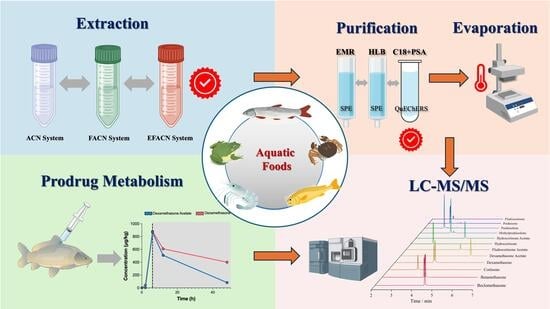
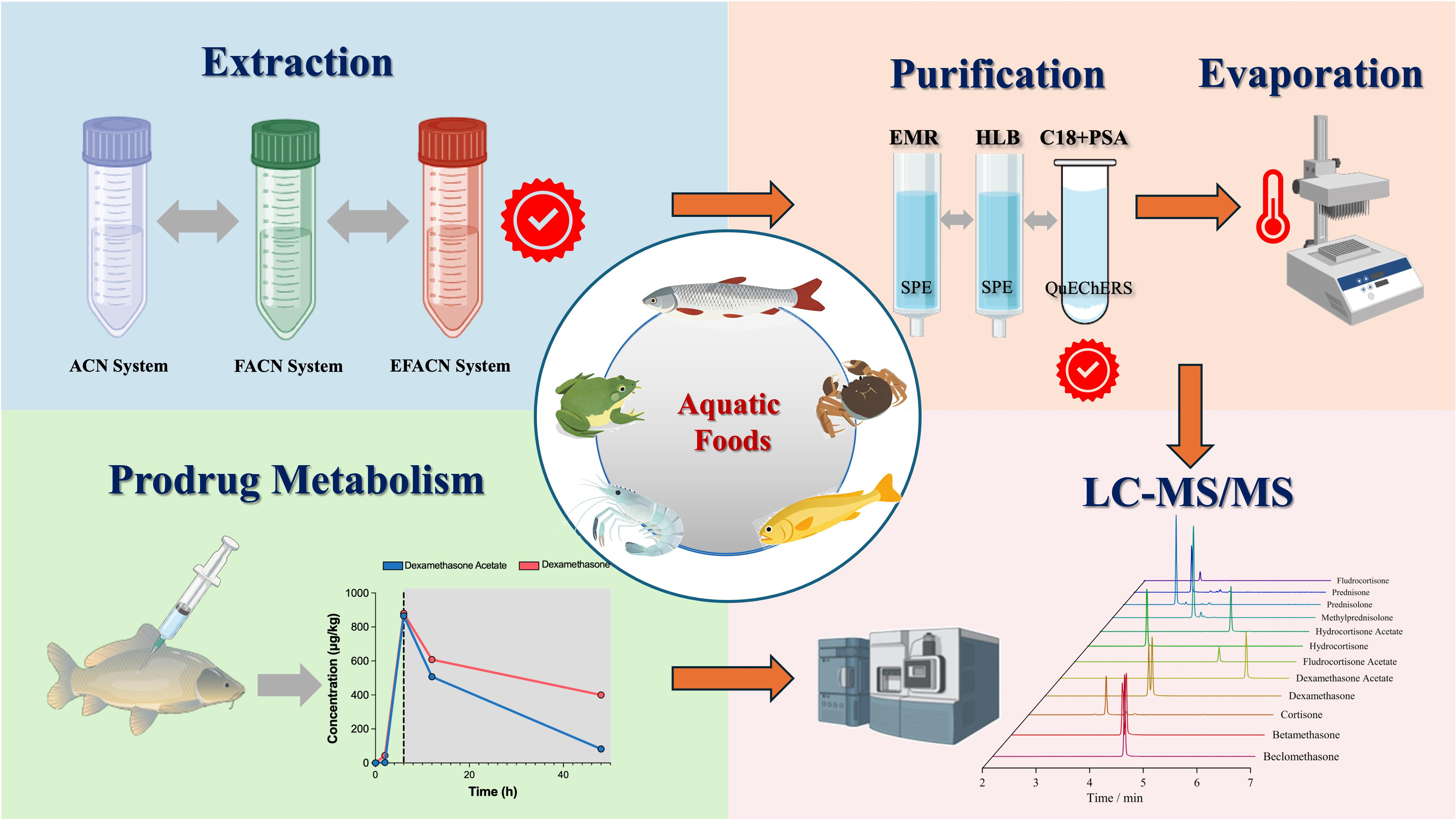
Glucocorticoid (GC) residues present in aquatic products raise food safety concerns, as their chronic dietary intake may pose potential risks of endocrine and metabolic disruption. For the first time, a sensitive and reliable liquid chromatography–tandem mass spectrometry (LC-MS/MS) method was developed and validated herein for the simultaneous determination of 12 GCs residues, including critical isomeric pairs and acetate ester derivatives, in a variety of aquatic foods, employing deuterated isotopic internal standards. Key optimizations included using a pentafluorophenyl column for effective isomer separation, a synergistic extraction system for high recovery, and QuEChERS purification to mitigate matrix effects. The method exhibited excellent linearity (r2 > 0.996) and high accuracy (recoveries 97.3–99.3%), and the intra- and inter-day precision values were below 3% in five representative aquatic matrices, with a limit of detection (LOD) and a limit of quantification (LOQ) of 0.5 μg/kg and 0.75 μg/kg, respectively. Animal experiments confirmed the in vivo retention of acetate derivatives, justifying their inclusion in monitoring. Real sample analysis of 18 market samples revealed the presence of cortisone and hydrocortisone in 17 samples. This represents the first reported LC-MS/MS method that provides a sensitive, reliable tool for regulatory monitoring of GC residues in diverse aquatic products, thereby supporting food safety assurance.

Graphical Abstract

1. Introduction

Glucocorticoids (GCs) are fundamental steroid hormones that regulate metabolism, immune response, and stress responsiveness across most vertebrates [1]. Their potent anti-inflammatory and immunosuppressive properties have led to extensive applications in human and veterinary medicine for decades [2,3]. Notably, the livestock and aquaculture industries utilize synthetic GCs to control inflammation, reduce transport mortality, and mitigate stress in intensified farming systems [4]. While international regulatory bodies, such as the European Union (EU) and the U.S. Food and Drug Administration (FDA), have established maximum residue limits (MRLs) for GCs in terrestrial livestock (chicken muscle and liver) [5], a critical regulatory gap remains for aquatic species. In many regions, GC use in aquaculture is either poorly restricted or lacks defined MRLs. This regulatory ambiguity, coupled with the rapid intensification of aquaculture, heightens the risk of illegal or off-label use, thus rendering robust monitoring of aquatic products an urgent priority [6].
Beyond direct administration, GCs enter aquatic ecosystems as persistent environmental contaminants via wastewater effluent and agricultural runoff [7,8,9]. Their increasing detection in surface waters and sediments underscores their environmental retention [10]. Exposure to these environmentally relevant concentrations can induce adverse effects on reproduction, growth, immune function, and gene expression in various fish and invertebrate species [11]. For instance, low nanogram-per-liter levels of synthetic GCs can alter transcriptional pathways associated with glucose metabolism and immune response in model organisms like zebrafish [12]. Consequently, farmed aquatic species face a dual exposure risk: direct administration within aquaculture systems and chronic exposure via contaminated water, creating a complex residue profile [13].
The transfer of these residues through the food chain constitutes a significant hazard to consumers [13]. Chronic dietary intake of synthetic GC residues may lead to potential endocrine and metabolic effects such as hyperglycemia and imbalances in fluid homeostasis [14]. An often-overlooked aspect of this risk is the metabolism of administered prodrugs. In practice, lipophilic acetate ester derivatives, such as dexamethasone acetate, are frequently used to prolong drug action [15]. Conventional monitoring that targets only the parent drug may significantly underestimate the total residue burden if the intact esters persist in tissues. This analytical gap necessitates methods capable of simultaneously detecting both parent compounds and their key esters.
Developing such methods is challenging because aquatic matrices, including fish, shrimp, and crab, are notoriously complex due to their high content of proteins, lipids, and pigments [16]. These components often co-extract with target analytes, leading to severe ion suppression or compromised accuracy in mass spectrometry [17,18]. While several methods exist, many are limited in scope and are not optimized for the diverse matrix challenges posed by various aquatic species [19]. To address these issues, this study established and validated a reliable liquid chromatography-tandem mass spectrometry (LC-MS/MS) method for the simultaneous determination of 12 GCs, covering both structural and metabolic groups. These GCs represent structurally diverse classes commonly used in veterinary medicine for their anti-inflammatory and immunosuppressive effects. They include drugs frequently administered in aquaculture and livestock, as well as environmentally persistent compounds detected in aquatic systems. Several are also regulated with established MRLs in various jurisdictions. Notably, the inclusion of isomeric pairs and acetate prodrugs addresses key analytical challenges, ensuring the method supports comprehensive monitoring of both parent compounds and their metabolites. This approach provides a robust technical platform for strengthening food safety monitoring and regulatory oversight in the aquaculture industry.

2. Materials and Methods

2.1. Experimental Materials

All reagents and chemicals used in this study were of analytical or chromatography grade. The glucocorticoid standards, including prednisone, prednisolone, hydrocortisone, cortisone, dexamethasone, betamethasone, 6-methylprednisolone, triamcinolone acetonide, triamcinolone, clobetasol propionate, dexamethasone acetate, hydrocortisone acetate, hydrocortisone-D3, beclomethasone-D5, betamethasone-D5, cortisone-D8, methylprednisolone-D3, prednisolone-D6, prednisone-D8, and fludrocortisone-D5, each with a purity of >95%, were procured from Dr. Ehrenstorfer (Augsburg, Germany). LC-grade methanol (CH3OH), acetonitrile (CH3CN), formic acid (HCOOH), and ammonium acetate (CH3COONH4) were supplied by Merck (Darmstadt, Germany). Ethylenediaminetetraacetic acid disodium salt (Na2EDTA·2H2O), dibasic sodium phosphate (Na2HPO4·12H2O), citric acid (C6H8O7·H2O), sodium hydroxide (NaOH), and sodium chloride (NaCl) were sourced from Shanghai Acmec Biochemical Co., Ltd. (Shanghai, China). The sorbents for dispersive solid-phase extraction (d-SPE), including primary secondary amine (PSA) and octadecylsilane (C18), were purchased from Agilent Technologies (Agilent, Santa Clara, CA, USA). The solid-phase extraction (SPE) cartridges, EMR-Lipid (600 mg, 6 mL, Agilent) and Oasis HLB cartridges (500 mg, 6 mL, Waters, Milford, MA, USA) were obtained from Shanghai Yue Peng Trade Co., Ltd. (Shanghai, China). 0.22 µm polytetrafluoroethylene (PTFE) syringe filters were provided by Tianjin Branch billion Lung Experimental Equipment Co., Ltd. (Tianjin, China). Deionized water (18.2 MΩ) was produced using a Milli-Q water purification system (Millipore Co., Burlington, MA, USA).
Single standard stock solutions of glucocorticoid standards were prepared in methanol at concentrations of 100 μg/mL, respectively, with hydrocortisone-D3, beclomethasone-D5, betamethasone-D5, cortisone-D8, methylprednisolone-D3, prednisolone-D6, prednisone-D8, and fludrocortisone-D5 serving as isotope surrogates. The standard working solutions were derived from further dilutions of these stock solutions. The isotope surrogate hydrocortisone-D3, beclomethasone-D5, and methylprednisolone-D3 were diluted in methanol to a concentration of 1 μg/mL, while the others were adjusted to 10 μg/mL. The standards and isotope surrogate solutions were stored in amber glass bottles at −20 °C, in darkness. A 10 M NaOH was prepared by dissolving 40.0 g of NaOH in 100 mL deionized water. A Mcllvaine-Na2EDTA (pH 5.0) buffer was prepared by dissolving 1.29 g of citric acid, 1.09 g of Na2HPO4·12H2O and 3.92 g of Na2EDTA·2H2O in deionized water; the resulting mixture was then adjusted to pH 5.0 with 10 M NaOH solution and diluted to a final volume of 100 mL.

2.2. Sample Preparation

Grass carp, large yellow croaker, Chinese mitten crab, shrimp and bullfrog were collected from the local market in Shanghai during March 2025. The sampling procedures for all species (n = 3) were prepared followed the National Standard of the People’s Republic of China, Practice of sampling plans for aquatic products (GB/T 30891-2014) [20]. For grass carp and large yellow croaker, the edible parts were sliced and combined into one sample after removing the head, fishbone, and guts. The edible parts of Chinese mitten crab and shrimp were extracted and collected. Muscle tissue was collected along with interstitial fluid. The muscles of shrimp were picked up without the shrimp head, shell and intestinal gland. Then, the collected tissues were mixed, homogenized for 5 min using a high-pressure homogenizer (1.5 Kw, Genizer, Los Angeles, CA, USA) and stored at −20 °C in the dark prior to the analysis.
A 2.00 g homogenized sample was weighed into a 50 mL centrifuge tube. Then, 25 µL of the mixed internal standard working solution was added, followed by vortex mixing for 30 s. Subsequently, 2.0 mL of Mcllvaine-Na2EDTA buffer and 8.0 mL of acetonitrile containing 2% (v/v) FA were added to the tube, respectively. The mixture was extracted via vortex-mixing for 10 min and then subjected to ultrasonically (160 W) in a water bath for 15 min. Thereafter, 2.0 g of NaCl was added, and the tube was vortexed for 30 s. The mixture was centrifuged (16RXII, Hitachi, Tokyo, Japan) at 10,000 r/min for 10 min at 4 °C. The resulting supernatant was carefully transferred into a clean centrifuge tube and subjected to d-SPE using 50 mg each of C18 and PSA sorbent, followed by vortexing for 30 s, and centrifuged at 4000 r/min for 5 min. The entire supernatant was transferred to a glass centrifuge tube and dried under a gentle nitrogen stream at 40 °C. The residue was reconstituted in 1 mL of acetonitrile/water (4:6, v:v) and filtered through a 0.22 μm PTFE filter membrane for LC-MS/MS analysis.

2.3. LC-MS/MS Analysis

A Waters ACQUITY I-Class liquid chromatography system coupled with a Waters ACQUITY Xevo TQ-XS mass spectrometer) was used for the detection of GCs. The chromatographic separation was achieved on a Kinetex F5 column (100 × 3.0 mm, 2.6 µm, Phenomenex, Los Angeles, CA, USA). The mobile phases consisted of solvent A (0.1% FA + 1 mmol/L ammonium acetate in water) and solvent B (acetonitrile). The flow rate was 0.3 mL/min and the column temperature was 40 °C. A gradient elution as follows: 20% B for 0.5 min, 20% B to 50% B over 5.5 min, ramping to 80% B over 1.5 min, held for 1.5 min at 80% B, followed by a return to 20% B within 0.1 min and 0.9 min at 20% B for re-equilibration. The injection volume was 5 μL.
Mass spectrometry was operated in multiple reaction monitoring (MRM) mode with electrospray ionization (ESI+) in the positive mode. The highest intensity of product ion was used as the quantification ion, and the second one was applied to confirm the analyte. MRM transitions for the GCs and the isotope surrogates are listed in Table 1. The desolvation temperature was 500 °C, and the gas flow was 1000 L/h. The gas flow for the cone was 150 L/h and for the nebulizer was 7.0 bar. Capillary voltage was 0.35 kV. MassLynx 4.2 (Waters) was used for instrument control, data acquisition, and analysis. Statistical analyses were analyzed using Student’s test (t-test) in Microsoft Excel 2016 (Microsoft, Redmond, WA, USA), with statistical significance set at p < 0.05. Data distribution was visualized in GraphPad Prism 10 (GraphPad Software, San Diego, CA, USA).

2.4. Method Validation

The method’s linearity, accuracy, precision, limit of detection (LOD) and limit of quantification (LOQ) were evaluated and validated in-house according to the SANTE/11312/2021 guidelines [21]. The solvent calibration curves were prepared by the peak area ratios of GCs to the isotope standard plotted against the concentration. Linearity was assessed using the coefficient of determination (r2) and regression analysis, with a linear regression model using 1/x2 weighting. Accuracy was determined by calculating the mean recoveries at three different spiked concentrations (0.75, 7.5, and 20 µg/kg) with six parallel measurements in each aquatic matrix. Precision was assessed by calculating relative standard deviations (RSDs) for intra-day and inter-day variations. The intra-assay precision is presented over three concentrations (n = 6), and the inter-assay precision was calculated at each spiking concentration in triplicate. LOD and LOQ were determined based on peak-to-peak signal-to-noise (S/N) ratios of 3 and 10, respectively, by analyzing blank samples spiked with serial dilutions of the target compounds (from low to high concentrations), ensuring detectable quantitative and qualitative ions.
Matrix effect (ME) was evaluated by comparing GC signals in matrix and solvent using a standard solution prepared in the sample solution and pure solvent, according to Equation (1) [22]. A value of ME% = 0 suggests no matrix effects, a lower value indicates signal suppression (<0), and a higher value signifies signal enhancement (>0).
M E % = R e s p o n s e m a t r i x R e s p o n s e s o l v e n t R e s p o n s e s o l v e n t 100 %

2.5. Animals

Healthy crucian carps (mean body weight, 250 ± 20 g) were acquired from the market, and placed in a tank which supplied with circulating water. The water temperature was adjusted to 20 ± 2 °C. The fish were acclimatized for one week before administration and were fed with a drug-free commercial diet. On the day before drug administration, the fish were not fed. Animal care and handling were performed in accordance with the guidelines of the Institutional Animal Care and Use Committee in East China Sea Fisheries Research Institute, Chinese Academy of Fisheries Science (ECSF-JG-2025-01).

2.6. Drug Administration and Sampling

During the pharmacokinetics study, all fish were given a single dose of 1.5 mg/kg body weight of dexamethasone acetate via intramuscular injection. Crucian carps were randomly divided into 6 groups of 5 individuals with the temperature at 20 °C (n = 5). Muscle samples were collected at 0, 2, 6, 12, 24, and 48 h post-injection. During sampling time points, muscle tissues from five fish were collected and homogenized using a refiner at each sampling time point, then marked and immediately frozen at −80 °C. Several experimental fish were randomly selected one day prior to administration to prepare blank samples.

2.7. Applicability of the Established Analytical Method

Monitoring was conducted to determine GCs residues in aquatic foods currently distributed in the Shanghai market. A total of 18 samples (n = 3) were collected from both online and offline sources in June 2025. GC levels were quantified based on the validated analytical method.

3. Results and Discussion

3.1. Optimization of LC-MS/MS Conditions

The optimization of mass spectrometry (MS) conditions was prioritized to ensure high sensitivity for the 12 target GCs and 8 isotope surrogates. Upon direct infusion of standard solutions (100 ng/mL), both positive (ESI+) and negative (ESI) electrospray ionization modes were evaluated. The ESI+ mode yielded significantly higher signal intensities for all analytes, likely due to the efficient protonation of the basic steroid backbone and its functional groups. Consequently, ESI+ was selected for subsequent analysis. These results are consistent with those reported in previous literature [23]. Key MS parameters, including precursor and product ions, fragment voltage, and collision energy (CE), were individually optimized to maximize the signal of [M+H]+ ions and ensure robust sensitivity for the selected transitions (Table 1).
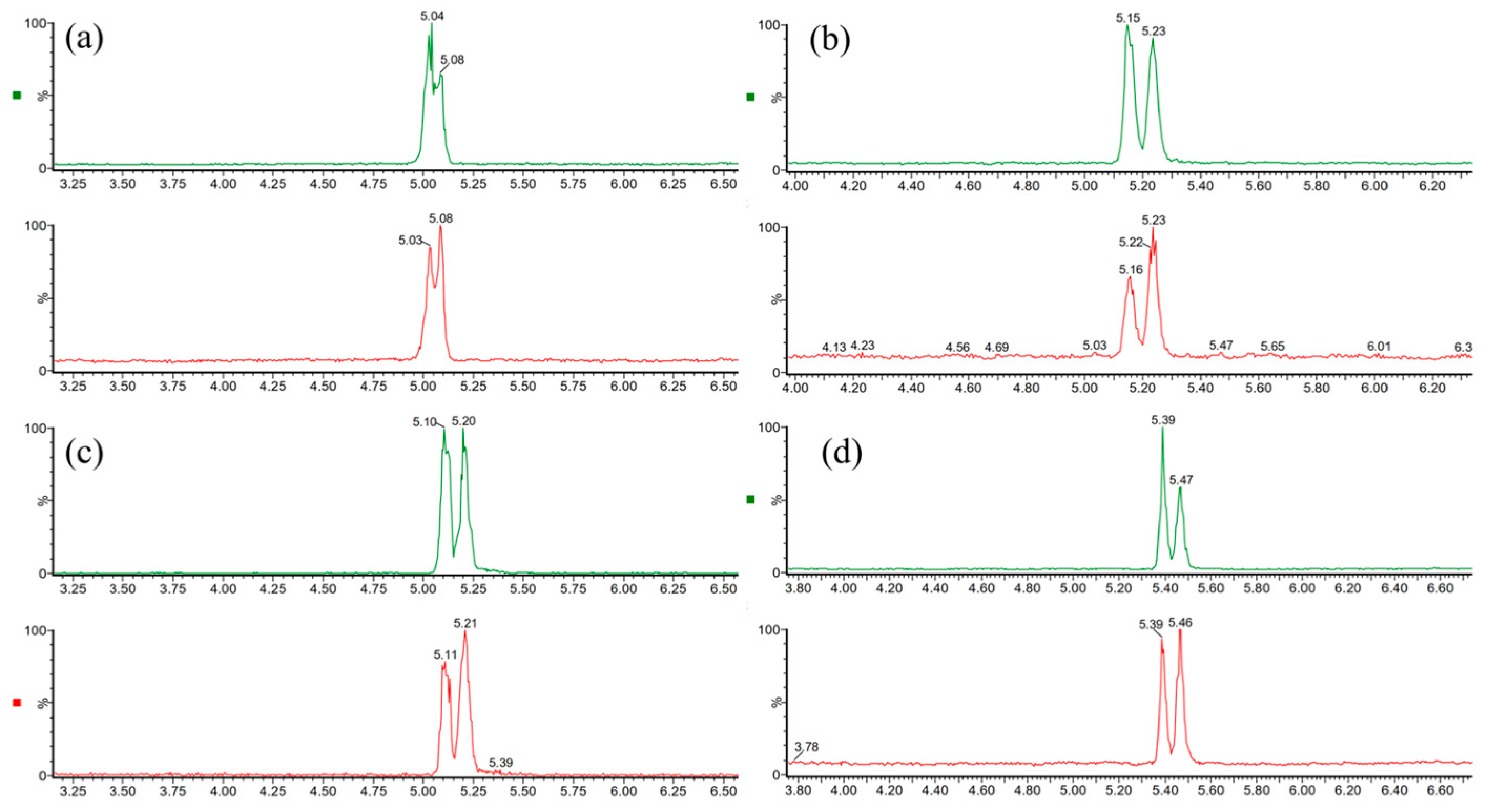
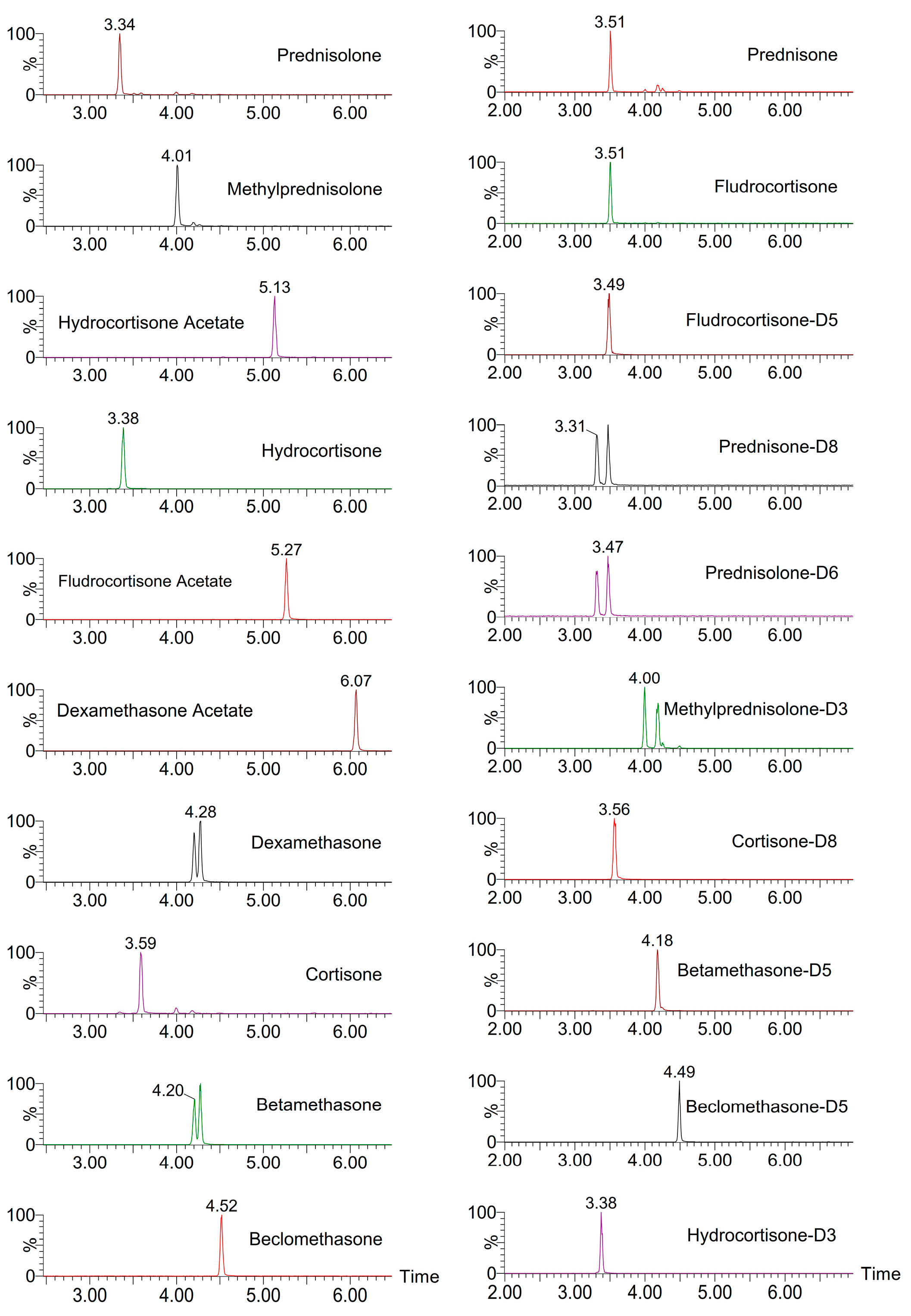
A major challenge in GCs analysis is the chromatographic separation of isomeric and isobaric pairs, such as betamethasone/dexamethasone, prednisolone/cortisone and prednisolone-D6/prednisone-D8, which share identical or near-identical mass-to-charge ratios (m/z). Inadequate separation of these species can lead to erroneous quantification, as mass spectrometry alone cannot distinguish them [24]. The initial results obtained with conventional C18 columns were unsatisfactory or resolving betamethasone and dexamethasone. To achieve effective chromatographic resolution of these two compounds, a comparative evaluation of columns with different stationary phase chemistries was conducted. In this study, four columns were systematically assessed, including Poroshell 120 EC-C18 (2.1 × 100 mm, 2.7 µm, Agilent), Endeavorsil C18 (2.1 × 100 mm, 1.8 µm, Dikma, Beijing, China), BEH C18 (2.1 × 100 mm, 1.7 µm, Waters) and Kinetex F5 (2.1 × 100 mm, 2.6 µm) columns. As shown in Figure 1, the chromatographic separation of betamethasone and dexamethasone differed significantly among the four tested columns. For the three C18-based stationary phases (EC-C18, Endeavorsil C18, and BEH C18), the chromatograms (Figure 1a–c) showed severe peak overlap or incomplete resolution between the two analytes. Specifically, the EC-C18 column (Figure 1a) showed partial co-elution with overlapping peak profiles, resulting in a low resolution. Similarly, the Endeavorsil C18 (Figure 1b) and BEH C18 columns (Figure 1c) failed to achieve baseline separation. The poor separation performance of these C18 columns can be attributed to their dominant reliance on hydrophobic interactions; betamethasone and dexamethasone differ only in the configuration of the methyl group at the C16 position, leading to highly similar hydrophobicity and thus weak discriminative interactions with the nonpolar C18 chains [23]. In contrast, the Kinetex F5 column (Figure 1d), which features a pentafluorophenyl (PFP) stationary phase, achieved excellent peak separation of betamethasone and dexamethasone. The symmetrical peak shapes and well-resolved elution profiles confirmed the superior selectivity of the F5 column. This enhanced separation efficiency arises from the unique multi-interaction mechanism of the PFP stationary phase, which combines hydrophobic interactions with additional π–π stacking, dipole–dipole, and hydrogen-bonding interactions [25]. The electron-withdrawing fluorine atoms on the PFP ring amplify the polarity difference between the two isomers: the α-methyl group in betamethasone induces a slight electron density change at the C16 position compared to the β-methyl group in dexamethasone, leading to differential binding affinities with the PFP stationary phase. These specific intermolecular interactions effectively amplify the chromatographic difference between the two analytes, enabling complete resolution. The corresponding total ion current (TIC) chromatograms (Figure 2) clearly illustrate the improved peak sharpness, higher signal-to-noise ratio, and reduced tailing achieved with the ammonium fluoride-formic acid system, confirming its suitability as the optimized mobile phase additive for subsequent GCs analysis.

3.2. Optimization of Extraction

In the search for an optimal extraction solvent tailored to protein-rich aquatic matrices, a preliminary comparison was conducted between methanol and acetonitrile, two commonly used organic solvents for steroid extraction. Although methanol exhibited strong solubilizing power for polar GCs, it had a critical drawback: the co-extraction of excessive lipids, pigments, and other hydrophobic matrix components, resulting in turbid extracts with high matrix interference. Methanol not only complicated subsequent purification steps but also increased the risk of ion suppression in mass spectrometry [26]. In contrast, acetonitrile demonstrated superior selectivity by efficiently precipitating matrix proteins through denaturation. Additionally, acetonitrile’s lower viscosity facilitated clearer phase separation during centrifugation, reducing the carryover of lipid-soluble interferences [27]. Based on these advantages, acetonitrile was selected as the primary organic solvent for the extraction process.
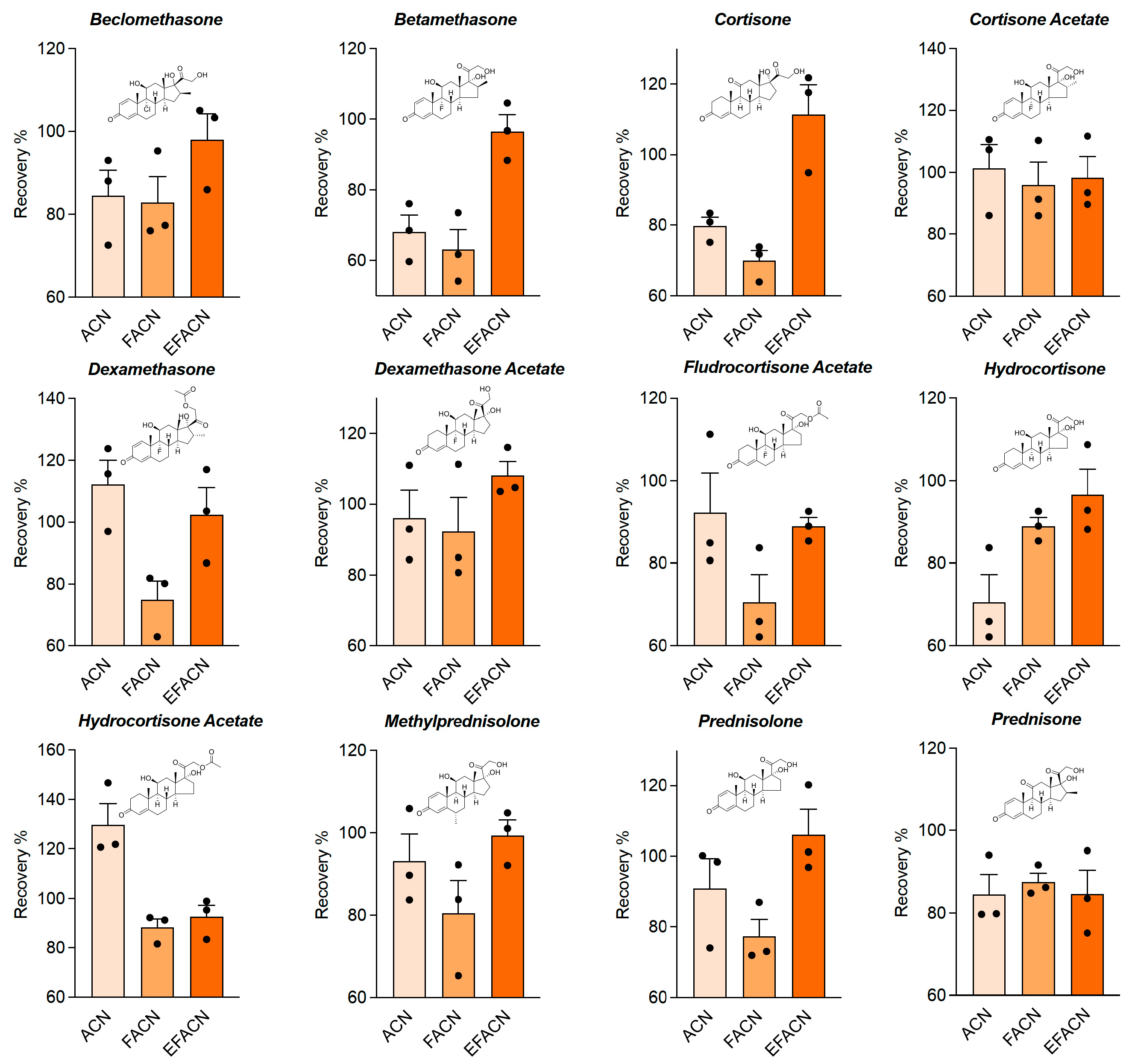
To ensure consistent and efficient extraction of the GCs from complex aquatic matrices, three extraction systems were systematically compared: (i) 80% (v/v) aqueous acetonitrile (ACN); (ii) acetonitrile containing 2% (v/v) FA (FACN); and (iii) a sequential system consisting of 2.0 mL Mcllvaine-Na2EDTA buffer followed by 8.0 mL of 2% (v/v) FA in acetonitrile (EFACN). As detailed in Figure 3, the performances of these systems varied considerably across the analyte set. The ACN system yielded inconsistent recoveries, ranging from suboptimal values (68.1% for betamethasone and 70.6% for hydrocortisone) to excessively high ones (129.7% for hydrocortisone acetate). Similarly, the FACN system showed improved but still variable recoveries for some compounds, such as dexamethasone acetate (79.8%) and hydrocortisone (89.0%), while others like betamethasone (63.2%) remained low. This inconsistency likely stems from the inability of organic solvent alone, even when acidified, to fully disrupt the protein-analyte binding or to effectively chelate metal ions that may complex with certain GCs [28]. In contrast, the EFACN system provided markedly more consistent and satisfactory recoveries, with values for all twelve analytes falling within the acceptable range of 80–120%. For most compounds, recoveries were tightly clustered between 90% and 110%, demonstrating the robustness of this approach. The superior performance of the EFACN protocol can be attributed to the synergistic action of the Mcllvaine-Na2EDTA buffer, which chelates interfering metal ions and maintains a stable pH, and the acidified acetonitrile, which promotes protein precipitation and analyte release [29]. Consequently, the EFACN system was selected as the optimized extraction procedure, providing a reliable foundation for the accurate quantification of trace glucocorticoid residues in diverse aquatic products.
The recovery profiles clearly validate the superiority of the EFACN system, as it not only achieves consistent and high recoveries across all twelve GCs with diverse structural and polarity characteristics but also maintains robustness in the complex aquatic matrix. Consequently, this synergistic extraction protocol was established as the final method, laying a critical foundation for the accurate and reliable quantification of trace GCs in protein-rich aquatic products.

3.3. Optimization of Purification

Initial extracts from aquatic matrices contained substantial co-extracted lipids, phospholipids, and pigments, which not only induce severe matrix effects in mass spectrometry but also pose a risk of long-term instrument fouling [30]. Thus, an effective cleanup step is indispensable to ensure quantitative accuracy and method reliability. Two types of SPE cartridges, EMR-Lipid and HLB cartridges, were evaluated. Although these cartridges are promoted for rapid, solvent-efficient cleanup, our results revealed unsatisfactory performance for this multi-residue GC analysis (Table 2). For the EMR-Lipid SPE cartridge, most GCs exhibited recoveries ranging from 83.50% to 102.00%. However, the recoveries of key analytes, such as betamethasone (83.9%) and dexamethasone acetate (83.6%) were consistently below 85%, indicating partial loss of target analytes during the SPE process. The HLB cartridge performed even more poorly, with highly inconsistent recoveries across the 12 GCs. Notably, prednisone achieved a mere 52.40% recovery, far below the 70% threshold for reliable quantification. Meanwhile, betamethasone exhibited an abnormally high recovery of 142.00%, which may be attributed to matrix-enhanced ionization or incomplete removal of interferences that co-elute with the analyte. Additionally, hydrocortisone (79.40%) and dexamethasone (78.30%) also showed suboptimal recoveries with the HLB cartridge. These results suggest that the sorbent materials in EMR-Lipid and HLB cartridges undergo non-specific hydrophobic or dipole–dipole interactions with the steroid backbone of GCs, and the rapid flow-through mechanism of SPE provides insufficient contact time for selective discrimination between analytes and matrix interferences [31].
Given the limitations of SPE, we turned to a more adaptable d-SPE approach based on the QuEChERS methodology, which allows for precise tuning of sorbent combinations to target diverse interferences. We tested three QuEChERS sorbent formulations: 100 mg C18, 100 mg PSA, and a mixed formulation of 50 mg C18 + 50 mg PSA. PSA acts as a weak anion exchanger, effectively removing polar organic acids, sugars, and fatty acids [32], whereas C18 excels at adsorbing non-polar lipids and pigments [33], which are abundant in species such as Chinese mitten crab, large yellow croaker, turbot and eels. As shown in Table 2, the single-sorbent formulations failed to balance purification efficiency and analyte recovery. For the 100 mg C18 sorbent, recoveries varied widely from 82.7% to 115.2%, with elevated recoveries likely resulting from incomplete removal of matrix components that enhance signal response. Similarly, the 100 mg PSA sorbent yielded inconsistent recoveries (85.4–108.6%), indicating inadequate sequestration of non-polar lipids and potential competitive adsorption between polar interferences and target GCs. In striking contrast, the mixed sorbent formulation (50 mg C18 + 50 mg PSA) achieved superior performance across all 12 target GCs. Recoveries consistently fell within the range of 70–120% for all target GCs while significantly reducing matrix background. This optimized formulation effectively removes both polar and non-polar interferences without substantially adsorbing the analytes, thereby ensuring reliable quantification and method robustness. Consequently, the 50 mg PSA + 50 mg C18 combination was selected as the optimal d-SPE cleanup protocol for subsequent analyses.

3.4. Optimization of Evaporation

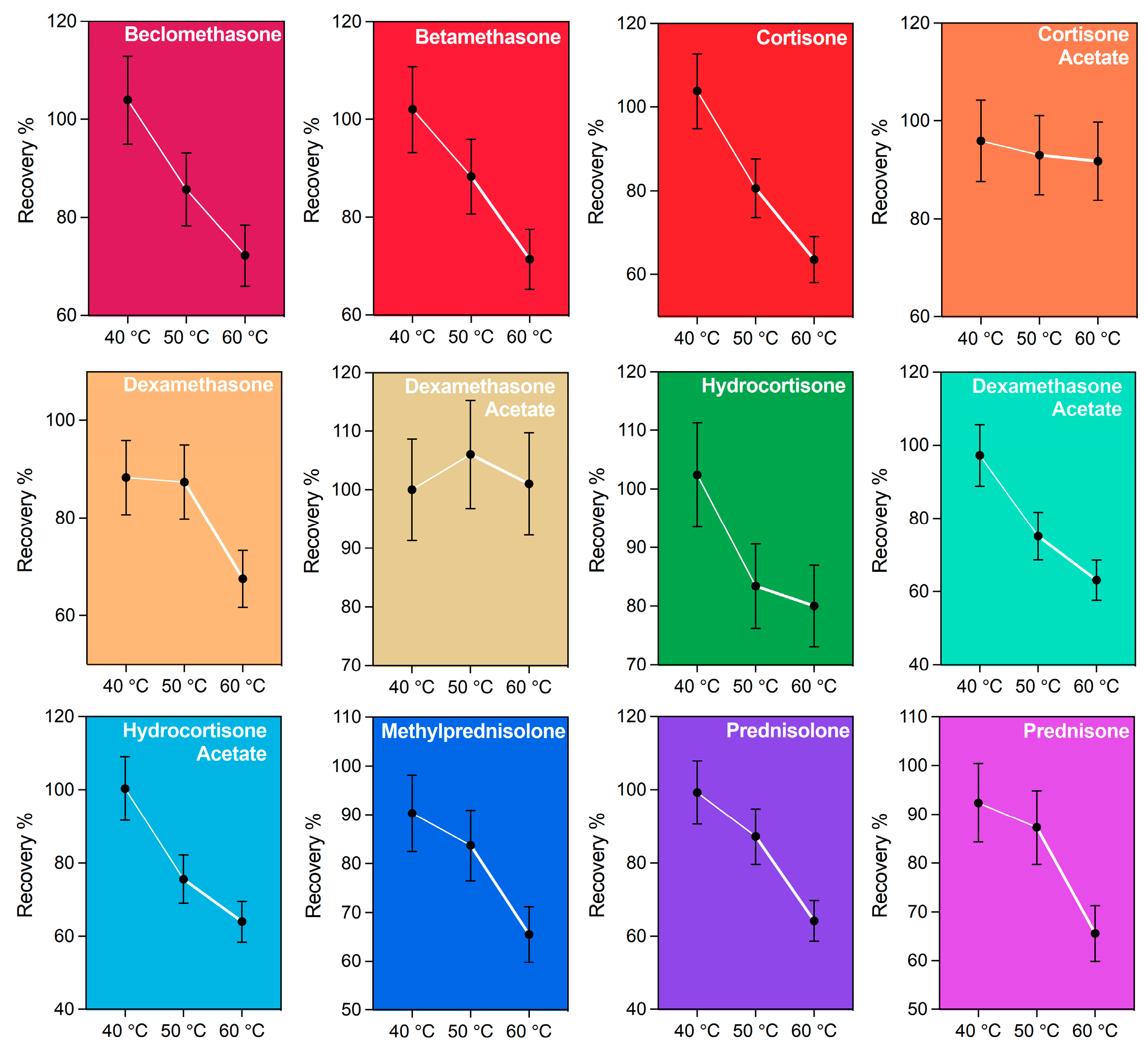
To establish a safe and effective evaporation temperature, a systematic temperature gradient experiment was conducted, with extracts dried at 40 °C, 50 °C, and 60 °C. As shown in Figure 4, the recovery rates for the majority of target analytes exhibited a pronounced inverse correlation with increasing temperature. For instance, the recoveries of betamethasone, cortisone, and hydrocortisone decreased markedly from >97% at 40 °C to approximately 63–71% at 60 °C, indicating significant thermal degradation or potential adsorption losses at elevated temperatures. Notably, certain acetate derivatives, such as cortisone acetate and dexamethasone acetate, demonstrated greater thermal stability across the tested range, though the overall trend supported the use of a lower temperature for universal applicability. In contrast, evaporation at 40 °C consistently maintained the integrity and recovery of all analytes within the acceptable quantitative range. Consequently, 40 °C was established as the standardized temperature for the nitrogen drying step.

3.5. Matrix Effect

Matrix effects (ME) are a critical challenge in electrospray ionization (ESI)-LC-MS/MS analysis, as co-extracted matrix components can interfere with analyte ionization, leading to either signal suppression or enhancement, particularly in complex biological samples such as aquatic products [34,35]. These effects can compromise method sensitivity, accuracy, and precision, potentially leading to biased quantitative results if not properly addressed. The magnitude of matrix effects is highly dependent on analyte structural properties, matrix composition, and sample preparation efficiency, necessitating systematic evaluation for each target analyte in the established analytical workflow [36].
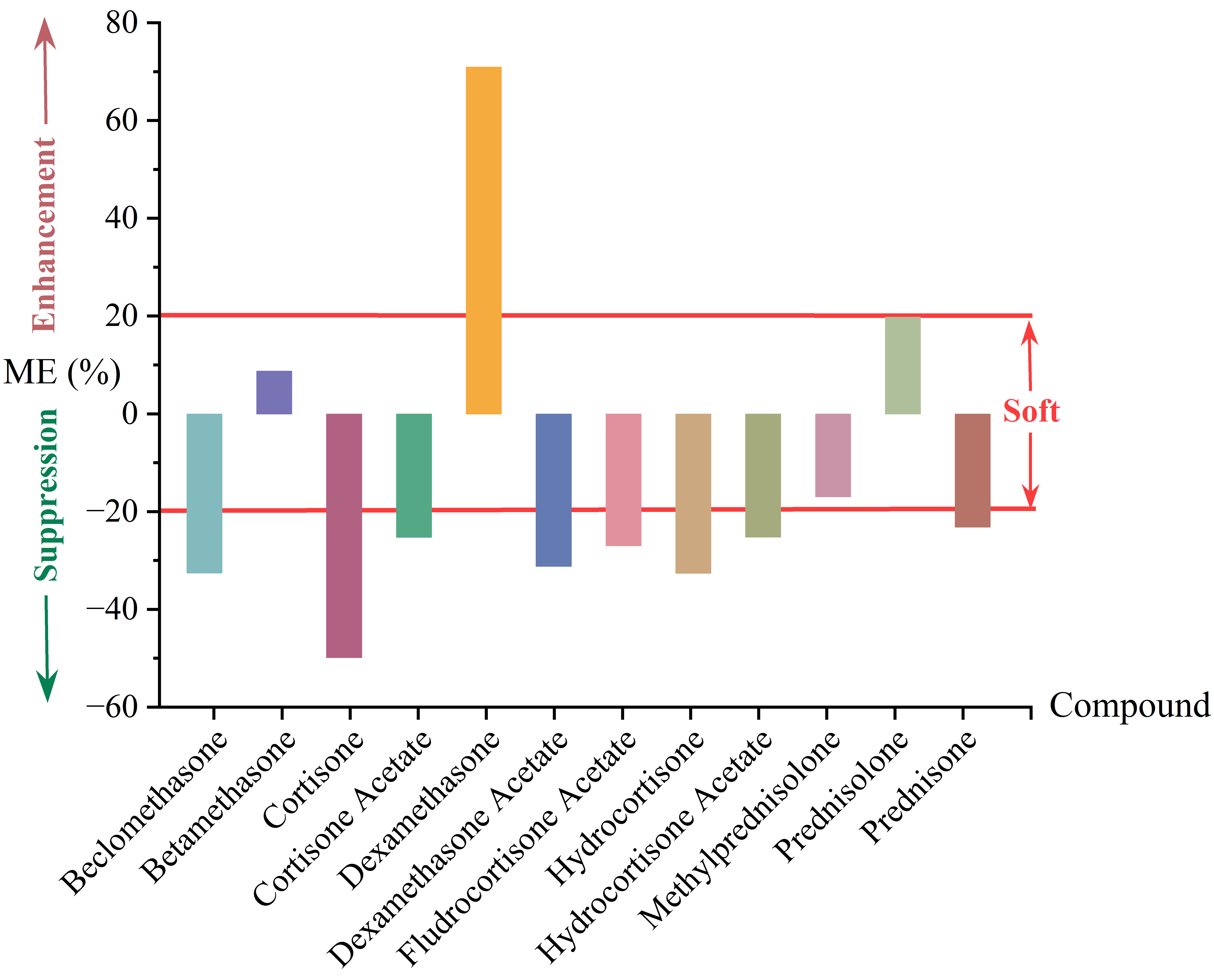
In this study, matrix effects of the 12 GCs were evaluated in the matrix of Chinese mitten crab (Eriocheir sinensis), a representative aquatic species with high lipid and pigment contents that generally induces pronounced matrix effects. As shown in Figure 5, the results exhibited a wide spectrum of ionization influences, ranging from significant suppression to pronounced enhancement, which underscores the compound-dependent nature of this phenomenon. Notable signal suppression (ranging from approximately −16% to −50%) was observed for several analytes, including cortisone (−49.9%), hydrocortisone (−32.6%), beclomethasone (−32.5%), and dexamethasone acetate (−31.2%). Conversely, significant signal enhancement was evident for dexamethasone (+71.0%) and, to a lesser extent, for prednisolone (+19.8%) and betamethasone (+8.7%). The majority of compounds exhibited moderate suppression within the range of −25% to −49%.
To mitigate these effects and ensure reliable quantification, several strategies were implemented in this method. Specifically, quantitation was performed using deuterated isotope-labeled internal standards to reduce the matrix effect [37]. This approach effectively compensates for the net ionization impact (suppression or enhancement) for each individual analyte, ensuring accurate and precise measurement across all target compounds despite the observed variability in matrix effects.

3.6. Analysis of Acetate Ester Prodrugs

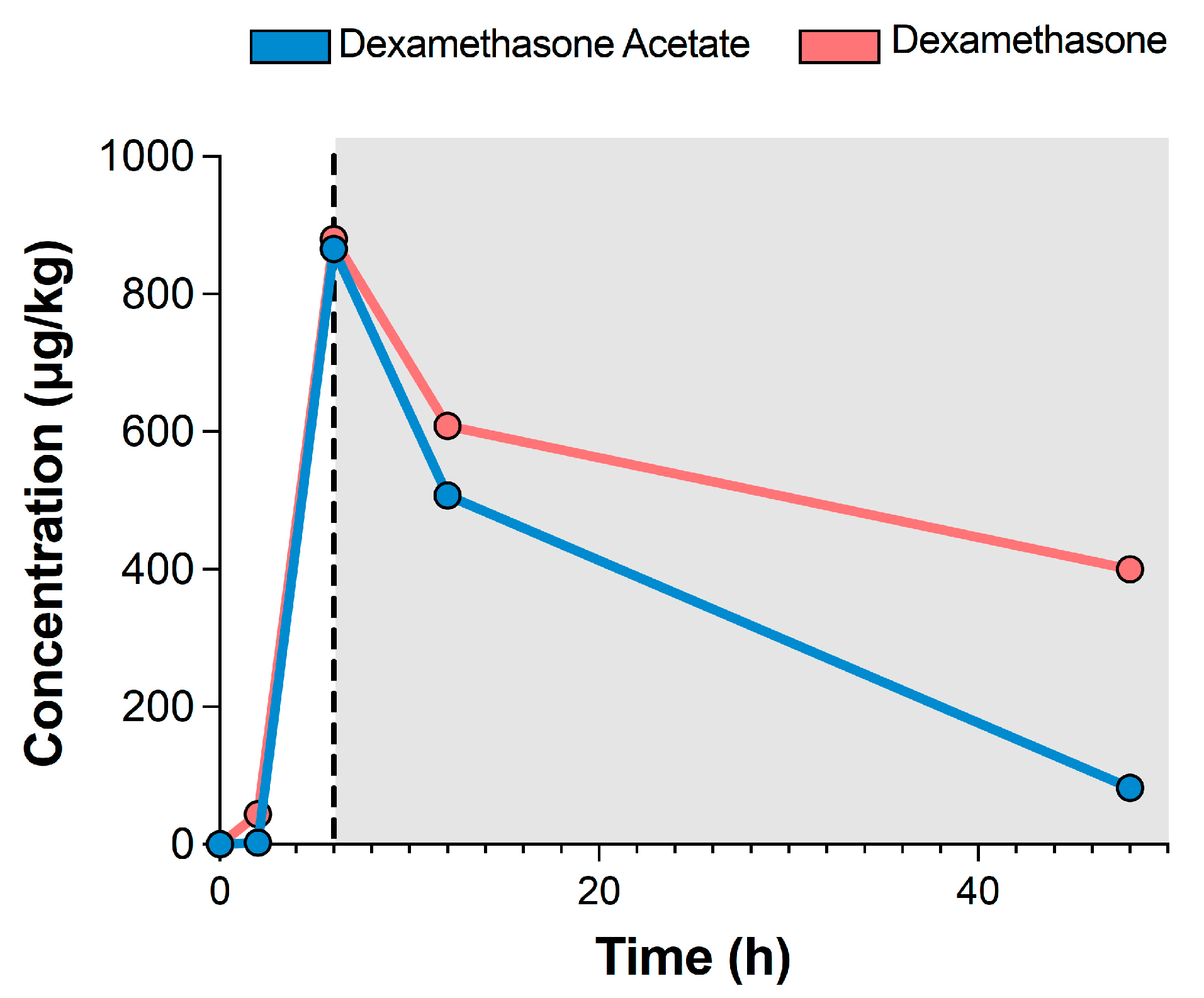
In aquaculture, glucocorticoids are frequently administered in the form of acetate ester prodrugs, such as cortisone acetate, dexamethasone acetate, fludrocortisone acetate, and hydrocortisone acetate, to enhance lipophilicity and prolong therapeutic activity. Although the parent compounds are considered the primary active forms, monitoring only the parent drug may underestimate the total residue burden if the intact ester persists in edible tissues. To clarify the in vivo kinetic behavior of such esters, an animal metabolism study was conducted using dexamethasone acetate (DXM-Ace) as a representative compound. The pharmacokinetic experiment was conducted on crucian carp (Carassius auratus) via intramuscular injection of DXM-Ace (1.5 mg/kg), with muscle samples were collected at 0, 2, 6, 12, 24, and 48 h post-injection. The concentrations of both DXM-Ace and its deacetylated metabolite dexamethasone (DXM) were quantified using the developed method. The results revealed that DXM-Ace was not immediately or completely hydrolyzed to DXM in vivo. As shown in Figure 6, DXM-Ace remained detectable throughout the 48 h sampling period, with its concentration peaking at 6 h (865.5 μg/kg) and still measurable at 48 h (82.5 μg/kg). Concurrently, DXM concentrations also peaked at 6 h (880 μg/kg) and remained elevated at 48 h (400 μg/kg). Notably, DXM-Ace did not undergo immediate hydrolysis to DXM upon in vivo exposure; instead, it maintained substantial concentrations throughout the experiment, indicating inherent metabolic stability of the acetylated moiety in the aquatic organism. While the potential interconversion between DXM-Ace and DXM is beyond the scope of this study, the persistent presence of the acetylated derivative itself necessitates its inclusion in residue analysis.
The retention of acetate derivatives like DXM, cortisone acetate, and hydrocortisone acetate in fish tissues underscores a significant analytical gap in traditional food safety screenings. As discussed in the introduction, GCs are frequently administered in their esterified forms to enhance lipophilicity and prolong therapeutic action. Our results demonstrate that if monitoring protocols focus exclusively on parent compounds, the total residue burden in aquatic products would be substantially underestimated. The observed 48 h retention of DXM-Ace indicates that the acetate group provides a reservoir effect, potentially extending the window of exposure for consumers. These findings underscore the analytical and regulatory importance of including acetate ester derivatives in multiresidue monitoring programs. A comprehensive method must therefore be capable of simultaneously quantifying both the prodrug and its hydrolytic metabolite to accurately reflect the total residue exposure and support scientifically grounded food safety evaluations.

3.7. Method Validation

3.7.1. Linearity, LOD and LOQ

Following the establishment and optimization of the analytical method, it was validation was performed using standard solutions and blank aquatic product matrices to ensure reliability for quantitative analysis. To evaluate linearity, a series of calibration standards ranging from 1.5 to 200 μg/L were prepared, and the signal response ratio of each target GC to the deuterated isotopic internal standards was determined (Table S1). As summarized in Table 3, the calibration curves exhibited excellent linearity with determination coefficients (r2) ranging from 0.9962 to 0.9996. This superior linear performance can be attributed to the high sensitivity of the derivatized target analytes and their excellent stability throughout the entire analytical process.
The LOD and LOQ were determined via six replicate analyses (n = 6) of serially diluted low-concentration matrix-matched standard solutions of GCs. Consistent with international analytical standards, LOD was defined as a signal-to-noise (S/N) ratio of ≥3, while LOQ was set at an S/N ratio of ≥10 [38]. Through this systematic evaluation, the LOD and LOQ of the proposed method were determined to be 0.5 µg/kg and 0.75 µg/kg, respectively, across all target GCs and tested aquatic matrices. These data demonstrate that the established method possesses excellent sensitivity for the quantification of trace GCs in complex aquatic matrices. Notably, the determined LOQ is consistent with China’s national maximum residue limit (MRL) of betamethasone in the muscle of cattle and pig products, indicating the method’s suitability for regulatory compliance monitoring. To the best of our knowledge, the proposed method exhibits superior sensitivity compared with previously reported analytical methodologies for GC determination in aquatic products, which is particularly critical for the detection of ultra-trace GC residues that may persist in aquatic organisms.

3.7.2. Accuracy and Precision of the Method

The accuracy and precision of the established method were assessed by spiking three concentration levels of GCs into blank matrices of five aquatic species: grass carp, large yellow croaker, Chinese mitten crab, shrimp, and bullfrog. Accuracy, expressed as recovery (%), was evaluated for each matrix and calculated from 18 replicate measurements per spiking level (3 independent days × 6 replicates per concentration). Precision was quantified as the relative standard deviation (RSD), covering both intra-day (repeatability) and inter-day (reproducibility) precision.
Recoveries and intra-day precision were reported as average values across the three spiking levels (0.75, 7.5, and 20 µg/kg) with six replicates per level (n = 6) within a single analytical batch. Inter-day precision (n = 18) was determined from three independent daily batches, with six replicates analyzed for each concentration level per batch. As summarized in Tables S2–S6, recoveries of the target GCs ranged from 97.3% to 99.3% across all three spiking levels and five matrices, indicating excellent agreement between the measured and spiked concentrations.
Intra-day precision reflects the consistency of the results obtained within a single analytical batch (repeatability), while inter-day precision characterizes the method’s stability across independent batches or days (reproducibility). Notably, both intra- and inter-day precisions (<3%) were far less than 15%, a threshold widely accepted for reliable quantitative analysis of trace residues in complex matrices [39]. These findings demonstrate that the established analytical method is accurate and precise for the quantification of target GCs in diverse aquatic food matrices, validating its robustness for routine residual monitoring.

3.8. Real Sample Analysis

To further validate the applicability and robustness of the proposed method in real-world scenarios, 18 aquatic product samples, including grass carp, bream, common carp, shrimp, and bullfrog, were randomly collected from local markets in Shanghai and Jiangsu Province, China. All samples were processed strictly according to the established sample preparation protocol and subsequently analyzed by LC-MS/MS. As summarized in Table S7, detectable levels of cortisone and hydrocortisone were found in 17 of the 18 tested samples. These results demonstrate that the proposed method not only exhibits reliable performance for spiked samples but also demonstrates excellent applicability for the analysis of incurred samples. The successful detection of cortisone and hydrocortisone in most market samples confirms the method’s ability to capture trace GC residues in complex matrices under practical analytical conditions, under real conditions further validates its suitability for routine monitoring of GC residues in aquatic products.

4. Conclusions

In this study, we established for the first time a reliable and comprehensive LC-MS/MS method for the simultaneous determination of 12 glucocorticoids, including isomeric pairs and acetate ester derivatives, in diverse aquatic matrices. The method overcomes key analytical challenges through systematic optimization of chromatographic separation, sample extraction, and cleanup procedures. The use of a pentafluorophenyl column enabled baseline resolution of critical isomer pairs, while the optimized extraction and QuEChERS purification systems synergistically reduce matrix interference and ensure high recoveries (97.3–99.3%) across complex matrices. Notably, the method achieves superior sensitivity (LOD = 0.5 μg/kg, LOQ = 0.75 μg/kg), consistent with national MRLs, and exhibits robust precision (RSD < 3%) for both intra- and inter-day analyses. The in vivo metabolism study further highlighted the importance of monitoring acetate prodrugs, as dexamethasone acetate persisted in fish muscle for up to 48 h, emphasizing the necessity of including these prodrugs in monitoring to avoid underestimating total residue burden. Real sample analysis confirmed the method’s applicability, detecting GC residues in 94.4% of market samples. This work provides a robust, multi-residue platform that enhances the monitoring capacity for glucocorticoid residues in aquatic products, supporting food safety regulation and consumer protection. Future studies could extend this method to additional matrices and combine it with high-throughput sample preparation techniques to further enhance its practicality for large-scale surveillance.

Supplementary Materials

The following supporting information can be downloaded at: https://www.mdpi.com/article/10.3390/foods15040652/s1, Table S1: Corresponding deuterated isotope-labeled internal standard for GCs; Table S2: Recovery and precision results for the determination of GCs in grass carp; Table S3: Recovery and precision results for the determination of GCs in large yellow croaker; Table S4: Recovery and precision results for the determination of GCs in Chinese mitten crab; Table S5: Recovery and precision results for the determination of GCs in shrimp; Table S6: Recovery and precision results for the determination of GCs in bullfrog; Table S7: Content of GCs in aquatic foods detected using the developed method.

Author Contributions

Conceptualization, S.L. and Y.T.; software, F.H.; validation, S.L. and J.Z.; formal analysis, F.H.; investigation, D.H.; data curation, F.H. and J.Z.; writing—original draft preparation, S.L.; writing—review and editing, Y.T.; visualization, S.L. and Y.T.; funding acquisition, S.L. and Y.T. All authors have read and agreed to the published version of the manuscript.

Funding

This research was funded by the Central Public-interest Scientific Institution Basal Research Fund, ECSFR, CAFS (No. 2024TD01) and Shanghai Agricultural and Rural Sector Standards Pre-Development Project (No. Y-SC-023-2025).

Institutional Review Board Statement

Animal care and handling were performed in accordance with the guidelines of the Institutional Animal Care and Use Committee in East China Sea Fisheries Research Institute, Chinese Academy of Fisheries Science (approval code: ECSF-JG-2025-01; approval date: 3 January 2025).

Informed Consent Statement

Not applicable.

Data Availability Statement

The original contributions presented in this study are included in this article/Supplementary Materials. Further inquiries can be directed to the corresponding author.

Conflicts of Interest

The authors declare no conflicts of interest.

References

  1. Mehl, A.; Hudel, L.; Bücker, M.; Morlock, G.E. Validated screening method for 81 multiclass veterinary drug residues in food via online-coupling high-throughput planar solid-phase extraction to high-performance liquid chromatography-orbitrap tandem mass spectrometry. J. Agric. Food Chem. 2022, 70, 10886–10898. [Google Scholar] [CrossRef]
  2. Ten Cate, D.; Gerritsen, S.M.; Wientjes, M.H.M.; Popa, C.; den Broeder, A.A.; van Herwaarden, N. Prospective cohort study on course and prediction of pain after intramuscular glucocorticoids in patients with inflammatory arthritis or osteoarthritis. Ann. Rheum. Dis. 2025, 84, 1662–1663. [Google Scholar] [CrossRef]
  3. Cheng, T.; Chen, J.D.; Dong, X.H.; Yang, Q.H.; Liu, H.Y.; Zhang, S.; Xie, S.W.; Zhang, W.; Deng, J.M.; Tan, B.P.; et al. Protective effect of steroidal saponins on heat stress in the liver of largemouth bass (Micropterus salmoides) revealed by metabolomic analysis. Aquac. Rep. 2025, 33, 101875. [Google Scholar] [CrossRef]
  4. Divari, S.; Cuccato, M.; Fanelli, A.; Cannizzo, F.T. Development of a droplet digital PCR assay to detect illicit glucocorticoid administration in bovine. PLoS ONE 2022, 17, e0271613. [Google Scholar] [CrossRef] [PubMed]
  5. Yang, Y.H.; Xue, Z.Z.; Meng, R.; Wu, Z.; Li, Z.J.; Zhang, W.; Ge, S.H. Determination of eight kinds of glucocorticoids residues in chicken muscle with on-line clean-up combined HPLC-MS/MS. Acta Chromatogr. 2022, 34, 267–275. [Google Scholar] [CrossRef]
  6. Hamilton, C.M.; Winter, M.J.; Margiotta-Casaluci, L.; Owen, S.F.; Tyler, C.R. Are synthetic glucocorticoids in the aquatic environment a risk to fish? Environ. Int. 2022, 162, 107163. [Google Scholar] [CrossRef]
  7. Cole, A.R.; Brooks, B.W. Global occurrence of synthetic glucocorticoids and glucocorticoid receptor agonistic activity, and aquatic hazards in effluent discharges and freshwater systems. Environ. Pollut. 2023, 329, 121638. [Google Scholar] [CrossRef]
  8. Li, N.; Zheng, J.; Yu, L.D.; Tong, Y.J.; Gong, X.Y.; Hou, Y.; Chen, G.S.; Xu, J.Q.; Zhu, F.; Ouyang, G.F. Green, mildly synthesized bismuth-based MOF for extraction of polar glucocorticoids in environmental water. J. Hazard. Mater. 2024, 461, 132477. [Google Scholar] [CrossRef]
  9. Pan, X.D.; Han, J.L.; Xu, X.M. Quantification of 37 glucocorticoids in chicken muscle by UHPLC-Q-Orbitrap-MS with parallel reaction monitoring. Anal. Methods 2023, 15, 3967–3974. [Google Scholar] [CrossRef]
  10. Silva, M.A.L.E.; da Silva, R.L.; Teixeira, T.P.; Rocha, T.L.; Marcon, M. Glucocorticoids as emerging pollutants in surface water: A systematic review on their global occurrence and distribution. Environ. Res. 2025, 273, 121280. [Google Scholar] [CrossRef]
  11. LaLone, C.A.; Villeneuve, D.L.; Olmstead, A.W.; Medlock, E.K.; Kahl, M.D.; Jensen, K.M.; Durhan, E.J.; Makynen, E.A.; Blanksma, C.A.; Cavallin, J.E.; et al. Effects of a glucocorticoid receptor agonist, dexamethasone, on fathead minnow reproduction, growth, and development. Environ. Toxicol. Chem. 2012, 31, 611–622. [Google Scholar] [CrossRef] [PubMed]
  12. Wang, C.C.; Li, M.; Gui, W.Y.; Shi, H.C.; Wang, P.; Chen, J.R.; Fent, K.; Zhang, K.; Dai, J.Y.; Li, X.; et al. Prednisolone accelerates embryonic development of zebrafish via glucocorticoid receptor signaling at low concentrations. Environ. Sci. Technol. 2023, 57, 15794–15805. [Google Scholar] [CrossRef] [PubMed]
  13. Guo, C.; Wu, C.L.; Zhang, Z.H.; Tan, S.J.; Chen, S.M.; Chen, G. Simultaneous determination of 58 glucocorticoid residues in milk by ultra-high performance liquid chromatography-tandem mass spectrometry. J. Chromatogr. A 2024, 1719, 464734. [Google Scholar] [CrossRef]
  14. Yang, L.Q.; Sun, L.; Fan, L.X.; He, L.N.; Ma, J.M. A method for the simultaneous determination of 68 veterinary drug residues in foods for special medical purposes using ultra-high-performance liquid chromatography-triple-time-of-flight mass spectrometry. J. Food Compos. Anal. 2025, 145, 107806. [Google Scholar] [CrossRef]
  15. Wang, D.; Jiang, Q.; Li, P.R.; Yu, C.N.; Yuan, R.X.; Dong, Z.F.; Meng, T.T.; Hu, F.Q.; Wang, J.W.; Yuan, H. Orally administrated precision nanomedicine for restoring the intestinal barrier and alleviating inflammation in treatment of inflammatory bowel disease. ACS Appl. Mater. Interfaces 2025, 17, 10986–11001. [Google Scholar] [CrossRef]
  16. Tang, Y.Y.; Yang, G.X.; Ma, Y.Q.; Huang, D.M.; Zhai, W.L.; Fodjo, E.K.; Zhang, X.; Li, S.M.; Zhang, W.Y.; Shi, Y.F.; et al. Development, validation, and implementation of an ultratrace analysis method for the determination of moenomycin A in aquatic animal products. Anal. Bioanal. Chem. 2024, 416, 745–757. [Google Scholar] [CrossRef]
  17. Yang, G.X.; Tang, Y.Y.; Liu, X.X.; Wang, L.L.; Qin, L.X.; Li, D.; Shen, X.S.; Kong, C.; Zhai, W.L.; Fodjo, E.K.; et al. Determination of free glycidol and total free monochloropropanediol in fish and krill oil with simple aqueous derivatization and high-performance liquid chromatography-tandem mass spectrometry. Foods 2024, 13, 2340. [Google Scholar] [CrossRef] [PubMed]
  18. Wu, X.L.; Ding, Z.M. Evaluation of matrix effects for pesticide residue analysis by QuEChERs coupled with UHPLC-MS/MS in complex herbal matrix. Food Chem. 2023, 405, 134755. [Google Scholar] [CrossRef]
  19. Chen, R.; Chen, L.; Du, M.Y.; Guo, Q.Z.; Zhong, C.P.; Zhang, J.; Yu, X.Q. High-throughput determination of multiclass chemical hazards in poultry muscles and eggs using UPLC-MS/MS. Foods 2025, 14, 1660. [Google Scholar] [CrossRef]
  20. GB/T 30891; Practice of Sampling Plans for Aquatic Products. General Administration of Quality Supervision, Inspection and Quarantine of the People’s Republic of China. Standardization Administration of the People’s Republic of China: Beijing, China, 2014.
  21. Tang, Y.Y.; Yang, G.X.; Fodjo, E.K.; Wang, S.Y.; Zhai, W.L.; Si, W.S.; Xia, L.; Kong, C. Improved LC/MS/MS Quantification Using Dual Deuterated Isomers as the Surrogates: A Case Analysis of Enrofloxacin Residue in Aquatic Products. Foods 2023, 12, 224. [Google Scholar] [CrossRef]
  22. Tang, Y.Y.; Yang, G.X.; Liu, X.X.; Qin, L.X.; Zhai, W.L.; Fodjo, E.K.; Shen, X.S.; Wang, Y.; Lou, X.Y.; Kong, C. Rapid sample enrichment, novel derivatization, and high sensitivity for determination of 3-chloropropane-1,2-diol in soy sauce via high-performance liquid chromatography-tandem mass spectrometry. J. Agric. Food Chem. 2023, 71, 15388–15397. [Google Scholar] [CrossRef] [PubMed]
  23. Yan, Y.H.; Ai, L.F.; Zhang, H.C.; Kang, W.J.; Zhang, Y.; Lian, K.Q. Development of an automated and high-throughput analytical platform for screening 39 glucocorticoids in animal-derived food for doping control. Microchem. J. 2021, 165, 106142. [Google Scholar] [CrossRef]
  24. Shammout, M.J.A.; Basci, N.E. Validated ultra performance liquid chromatography-tandem mass spectrometric method for determination of betamethasone or dexamethasone in pharmaceuticals. Curr. Pharm. Anal. 2018, 14, 68–75. [Google Scholar] [CrossRef]
  25. Croes, K.; Goeyens, L.; Baeyens, W.; Van Loco, J.; Impens, S. Optimization and validation of a liquid chromatography tandem mass spectrometry (LC/MSₙ) method for analysis of corticosteroids in bovine liver: Evaluation of Keyhole Limpet β-glucuronidase/sulfatase enzyme extract. J. Chromatogr. B-Anal. Technol. Biomed. Life Sci. 2009, 877, 635–644. [Google Scholar] [CrossRef]
  26. Song, J.G.; Cao, C.; Li, J.W.; Xu, Y.J.; Liu, Y. Development and validation of a QuEChERS-LC-MS/MS method for the analysis of phenolic compounds in rapeseed oil. J. Agric. Food Chem. 2019, 67, 4105–4112. [Google Scholar] [CrossRef]
  27. Busato, M.A.D.; Bondan, A.P.; Bastiani, M.F.; Lizot, L.F.; Hahn, R.Z.; Antunes, M.V.; Linden, R. Determination of meropenem in capillary plasma microsamples using LC-MS/MS. Bioanalysis 2024, 16, 443–452. [Google Scholar] [CrossRef]
  28. Miossec, C.; Mille, T.; Lanceleur, L.; Monperrus, M. Simultaneous determination of 42 pharmaceuticals in seafood samples by solvent extraction coupled to liquid chromatography-tandem mass spectrometry. Food Chem. 2020, 322, 126765. [Google Scholar] [CrossRef]
  29. Ochi, N. Simultaneous determination of eight underivatized biogenic amines in salted mackerel fillet by ion-pair solid-phase extraction and volatile ion-pair reversed-phase liquid chromatography-tandem mass spectrometry. J. Chromatogr. A 2019, 1601, 115–120. [Google Scholar] [CrossRef]
  30. Liu, J.P.; Liu, S.Y.; Zhang, S.A.; Peng, L.; Lei, L.M. Coupling high-throughput magnetic-bead-based immunoaffinity with LC-MS/MS analysis for quantifying cylindrospermopsin in different fish tissues. Anal. Chem. 2026, 98, 944–952. [Google Scholar] [CrossRef]
  31. Wang, J.; Li, Z.H.; Shu, J.C.; Wei, Z.C.; Chen, S.Q.; Zhao, H.Y.; Luo, J.; Yang, H.M.; You, Y.Y.; Chen, M.J.; et al. Strengthening mechanism of water content reduction in electrolytic manganese residue by sodium oleate. J. Environ. Chem. Eng. 2025, 13, 116887. [Google Scholar] [CrossRef]
  32. Chen, Y.; Cai, W.K.; Lin, Z.F.; Ma, Y.; Wu, Y.X.; Li, D.D.; Zhang, Z.H.; Wang, Y.K.; Chen, Y.W.; Wang, C.Z. A modified QuEChERS method using single-sorbent combined with LC-MS/MS for simultaneous determination of four phenolic pesticide residues in fruits and vegetables. J. Food Compos. Anal. 2026, 149, 108820. [Google Scholar] [CrossRef]
  33. Tolgyesi, A.; Gonsalves, C.; Benes, E.; Simon, A.; Sharma, V.K. Analysis of N-methyl-2-pyrrolidone and its hydroxy metabolite at low concentration level in water samples using liquid chromatography tandem mass spectrometry. J. Chromatogr. A 2026, 1766, 466599. [Google Scholar] [CrossRef]
  34. Parla, A.; Kabir, A.; Kostakis, M.; Furton, K.G.; Mavrogeorgos, G.; Tataropoulou, K.; Armefti, A.; Samanidou, V.; Thomaidis, N.; Vrcek, I.V.; et al. Quantitation of intact parabens in human breast milk from lactating women via fabric-phase sorptive extraction coupled with LC-ESI-MS/MS. Microchem. J. 2025, 216, 114774. [Google Scholar] [CrossRef]
  35. Wang, Y.Y.; Diao, Z.P.; Qu, Y.C.; Fan, K.; Feng, C.; Lv, B.; Yu, Y.L.; Geng, Z. LC-MS/MS quantification of omadacycline in human plasma for therapeutic drug monitoring: Method development and clinical application. Sci. Rep. 2025, 15, 27728. [Google Scholar] [CrossRef] [PubMed]
  36. Tong, J.H.; Zhao, W.K.; Wang, K.M.; Zhu, F.Y.; Deng, D.Y.; Xiao, L.T. Quantitative analysis of ethylene precursor ACC in plant samples by liquid chromatography-tandem mass spectrometry. BMC Plant Biol. 2025, 25, 920. [Google Scholar] [CrossRef] [PubMed]
  37. Su, C.H.; Tan, P.W.; Kao, T.H. Establishment of a QuEChERS-FaPEx rapid analytical method for n-nitrosamines in meat products. Molecules 2025, 31, 32. [Google Scholar] [CrossRef] [PubMed]
  38. Yang, S.P.; Shencheng, Y.N.; Zhao, Y.M.; Zhou, M.Z.; Abdallah, M.F.; Gao, Y.; Gao, M.; Zhang, R.; Liu, S.Y.; Li, Y. Development and validation of an LC-MS/MS method for a sensitive quantitation of livestock and poultry meat allergens. Food Chem. 2025, 493, 145965. [Google Scholar] [CrossRef]
  39. Ragab, M.; Khaled, O.; Eissa, F.; Medhat, M. Optimization and validation of a rapid LC-MS/MS method for the detection and quantification of illegal dyes in olive oil from Egyptian markets. Food Chem. 2025, 488, 144924. [Google Scholar] [CrossRef]
Figure 1. Chromatogram of betamethasone and dexamethasone in different columns. (a) EC-C18; (b) Endeavorsil C18; (c) BEH C18; (d) Kinetex F5.
Foods 15 00652 g001
Figure 2. LC-MS/MS chromatogram of GCs (10 ng/mL) and the isotope surrogates.
Foods 15 00652 g002
Figure 3. Analysis of GCs in different extraction conditions.
Foods 15 00652 g003
Figure 4. Recoveries of GCs at different evaporation temperature.
Foods 15 00652 g004
Figure 5. Matrix effects of GCs after sample preparation of Chinese Mitten Crab.
Foods 15 00652 g005
Figure 6. DXM-Ace and DXM concentration determined in muscles during the experiment.
Foods 15 00652 g006
Table 1. MS/MS parameters of GCs and the isotope surrogates.
CompoundsPrecursor Ion (m/z)Product Ions (m/z)CE a (eV)
Beclomethasone409.2391.1 *6
121.040
Betamethasone393.2373.2 *4
355.030
Cortisone361.2163.1 *25
105.146
Dexamethasone393.2373.2 *10
355.010
Dexamethasone Acetate435.2415.2 *6
309.110
Fludrocortisone381.5105.1 *50
91.160
Fludrocortisone Acetate423.2238.9 *24
120.947
Hydrocortisone363.2121.1 *27
327.215
Hydrocortisone Acetate405.2309.214
121.1 *26
Methylprednisolone375.2357.1 *10
339.110
Prednisolone361.2343.110
147.2 *20
Prednisone359.2341.110
147.2 *24
Hydrocortisone-D3366.3121.220
Beclomethasone-D5414.6396.28
Betamethasone-D5398.6312.815
Cortisone-D8369.2169.120
Methylprednisolone-D3378.6360.28
Prednisolone-D6367.5139.015
Prednisone-D8367.5139.015
Fludrocortisone-D5386.3348.220
a CE: Collision energy; * Quantification ion.
Table 2. Recoveries of GCs under different purification conditions.
GCsPurification AgentRecovery % (n = 3)
Mean ± SD
BeclomethasoneEMR SPE99.2 ± 7.01
HLB SPE113.9 ± 8.05
C18 100 mg92.9 ± 3.11
PSA 100 mg89.6 ± 7.88
C18 50 mg, PSA 50 mg98.5 ± 6.96
BetamethasoneEMR SPE83.9 ± 5.93
HLB SPE142.0 ± 10.05
C18 100 mg92.9 ± 6.95
PSA 100 mg88.6 ± 5.88
C18 50 mg, PSA 50 mg96.1 ± 6.80
CortisoneEMR SPE92.00 ± 6.51
HLB SPE103.8 ± 7.34
C18 100 mg90.5 ± 10.02
PSA 100 mg86.8 ± 8.37
C18 50 mg, PSA 50 mg93.5 ± 6.62
Cortisone AcetateEMR SPE83.5 ± 5.91
HLB SPE95.9 ± 6.78
C18 100 mg112.3 ± 6.15
PSA 100 mg108.6 ± 9.79
C18 50 mg, PSA 50 mg101.5 ± 7.18
DexamethasoneEMR SPE91.7 ± 6.48
HLB SPE78.3 ± 5.54
C18 100 mg91.5 ± 4.74
PSA 100 mg90.1 ± 9.26
C18 50 mg, PSA 50 mg97.3 ± 6.88
Dexamethasone AcetateEMR SPE83.6 ± 5.91
HLB SPE100.0 ± 7.07
C18 100 mg82.7 ± 4.88
PSA 100 mg85.4 ± 6.26
C18 50 mg, PSA 50 mg102.2 ± 7.23
Fludrocortisone AcetateEMR SPE95.3 ± 6.74
HLB SPE102.4 ± 7.24
C18 100 mg100.2 ± 5.75
PSA 100 mg86.8 ± 9.12
C18 50 mg, PSA 50 mg90.2 ± 6.38
HydrocortisoneEMR SPE95.4 ± 6.75
HLB SPE79.4 ± 5.61
C18 100 mg105.4 ± 9.24
PSA 100 mg95.2 ± 3.88
C18 50 mg, PSA 50 mg107.2 ± 7.58
Hydrocortisone AcetateEMR SPE102.0 ± 7.22
HLB SPE85.9 ± 6.07
C18 100 mg95.7 ± 8.74
PSA 100 mg90.3 ± 6.55
C18 50 mg, PSA 50 mg100.4 ± 7.10
MethylprednisoloneEMR SPE88.9 ± 6.28
HLB SPE110.3 ± 7.80
C18 100 mg115.2 ± 4.74
PSA 100 mg86.2 ± 8.86
C18 50 mg, PSA 50 mg92.5 ± 6.54
PrednisoloneEMR SPE87.3 ± 6.17
HLB SPE119.3 ± 8.43
C18 100 mg92.6 ± 4.52
PSA 100 mg90.4 ± 6.71
C18 50 mg, PSA 50 mg96.4 ± 6.82
PrednisoneEMR SPE89.6 ± 6.33
HLB SPE52.4 ± 3.71
C18 100 mg92.6 ± 8.11
PSA 100 mg90.1 ± 7.25
C18 50 mg, PSA 50 mg89.7 ± 6.34
Table 3. Linearity results in calibration ranges.
CompoundCalibrationCoefficients (r2)
BeclomethasoneY = 0.0678135x − 0.01077560.998111
BetamethasoneY = 0.0951838x + 0.02556870.996983
CortisoneY = 0.0729256x + 0.08242810.999549
DexamethasoneY = 0.0453136x − 0.008367390.996281
Dexamethasone AcetateY = 0.0696831x − 0.03252690.997315
FludrocortisoneY = 0.00846428x + 0.01637160.997428
Fludrocortisone AcetateY = 0.0147391x − 0.001583680.996197
HydrocortisoneY = 0.0774449x + 0.5580530.997338
Hydrocortisone AcetateY = 0.0210717x + 0.003766240.996252
MethylprednisoloneY = 0.0485324x + 0.0614960.999653
PrednisoloneY = 0.0775587x + 0.04448620.999321
PrednisoneY = 0.0534778x + 0.001519480.996224
Disclaimer/Publisher’s Note: The statements, opinions and data contained in all publications are solely those of the individual author(s) and contributor(s) and not of MDPI and/or the editor(s). MDPI and/or the editor(s) disclaim responsibility for any injury to people or property resulting from any ideas, methods, instructions or products referred to in the content.