Review

Moulds and Mycotoxins in the Meat Production Chain from Slaughterhouse to Market: A Scoping Review on Aspergillus and Penicillium Isolation


by
Melissa Alves Rodrigues
1,2,*,
Lais Freitas
1,3,4,
Letícia Estevinho
3,4,
Claudemar Oliveira
3,4,
Rosa Capita
5,6 and
Alexandra Esteves
7,8,9
1
Doctoral School, University of León (ULE), Campus de Vegazana, E-24007 León, Spain
2
Netherlands Food and Consumer Product Safety Authority (NVWA), P.O. Box 43006, 3540 AA Utrecht, The Netherlands
3
Centro de Investigação de Montanha (CIMO), Instituto Politécnico de Bragança, Campus de Santa Apolónia, 5300-252 Bragança, Portugal
4
Laboratório para a Sustentabilidade e Tecnologia em Regiões de Montanha, Instituto Politécnico de Bragança, Campus de Santa Apolónia, 5300-253 Bragança, Portugal
5
Department of Food Hygiene and Technology, Veterinary Faculty, University of León, E-24071 León, Spain
6
Institute of Food Science and Technology, University of León, E-24071 León, Spain
7
Department of Veterinary Science, School of Agrarian and Veterinary Science (ECAV), University of Trás-os-Montes e Alto Douro (UTAD), 5000-801 Vila Real, Portugal
8
Veterinary and Animal Research Center (CECAV), University of Trás-os-Montes e Alto Douro (UTAD), 5000-801 Vila Real, Portugal
9
AL4AnimalS Associated Laboratory for Animal and Veterinary Science, 5000-801 Vila Real, Portugal
*
Author to whom correspondence should be addressed.
Foods 2026, 15(4), 630; https://doi.org/10.3390/foods15040630
Submission received: 24 January 2026 / Revised: 4 February 2026 / Accepted: 6 February 2026 / Published: 9 February 2026
(This article belongs to the Section Food Microbiology)

Abstract

Fungal contamination of meat and meat products represents a significant concern for food safety, particularly due to the potential presence of mycotoxin-producing moulds. This scoping review aimed to map the occurrence and distribution of Aspergillus and Penicillium species along the meat production chain, from slaughterhouse environments to retail products, and to identify associated mycotoxins when reported. A systematic literature search was conducted in the PubMed database, complemented by a search in Google Scholar in accordance with Preferred Reporting Items for Systematic Reviews for Scoping Reviews (PRISMA-ScR) guidelines. Eligible studies reported the isolation of Aspergillus and/or Penicillium species from meat, meat products, or meat-processing environments under natural contamination conditions. The results indicate that both genera are frequently detected throughout the production chain, particularly at processing and storage stages, with several studies reporting species known for mycotoxin production. In addition, the presence of these moulds in processing environments highlights potential implications for both food safety and occupational exposure. However, information on mould occurrence in meat, edible offal, meat products and meat processing environments remains scarce, fragmented and heterogeneous. Overall, this review highlights existing knowledge gaps and underscores the need for harmonised monitoring strategies and further research addressing fungal contamination and mycotoxin risks along the meat production chain.

1. Introduction

Moulds, including species belonging to the Aspergillus and Penicillium genera, are well known to cause spoilage in food products. Meat and meat products are among the main foodstuffs that may deteriorate under their influence [1]. Fungal cells can be found in the air, on surfaces, in water, on equipment, in food manufacturing ingredients, and on workers [1,2]. Although some mould species may exert protective effects against undesirable microorganisms, others can produce toxic secondary metabolites [1].
Mycotoxins are secondary metabolites mainly produced by filamentous fungi and are considered an increasing health hazard, as some of them may cause organ damage, immunosuppression, certain types of cancer, or death [3]. Mycotoxin contamination of meat and meat products has been documented to occur through different routes, namely: (i) carry-over from animals exposed to contaminated feed; (ii) contamination originating from the environment; and (iii) contamination via spices and raw materials used during the processing phase [4].
Environmental and technological factors, such as temperature (10–45 °C), pH (1.5–10), and water activity (≥0.6), strongly influence the occurrence and growth of moulds in meat and meat products [2]. Aspergillus and Penicillium species, which can grow under a wide range of environmental conditions, are frequently associated with mycotoxin production in meat products [5,6] and have been identified at different stages and settings of the meat chain.
Several Aspergillus and Penicillium species are known to produce a wide range of mycotoxins [7]. In meat products, A. flavus, A. niger, A. ochraceus, A. parasiticus, A. steynii, A. subramaniannii, A. versicolor, and A. westerdijkiae are among the mycotoxin-producing moulds that have been isolated. In addition, numerous Penicillium spp. have also been identified, including P. aurantiogriseum, P. brevicompactum, P. chrysogenum, P. citrinum, P. commune, P. crustosum, P. cyclopium, P. expansum, P. glabrum, P. griseofalvum, P. nordicum, P. oxalicum, P. palitans, P. polonicum, P. roquefortii, P. rugulosum, P. verrucosum, and P. viridicatum [6].
The Commission Regulation (EU) 2023/915 [8] establishes, among other contaminants, maximum levels of mycotoxins in foodstuffs in Annexe I. However, no maximum limits for mycotoxins in meat and meat products are currently set. Among the most toxic mycotoxins reported in meat, aflatoxin B1 (AFB1) and ochratoxin A (OTA) are the most frequently detected [4]. Between 1990 and 2025, several studies have been reported the detection of mycotoxins, including in offal samples collected from slaughterhouses in Mozambique [9]; in meat products and raw materials from meat processing facilities in Croatia [10], Italy [11], Egypt [12], Portugal [13], and Spain [14]; and in meat products purchased in Croatia [15,16], Cyprus [17], and Italy [18]. A detailed overview is provided in Supplementary Table S1.
Aflatoxins, which are classified as carcinogenic and genotoxic compounds, are mainly produced by A. flavus and A. parasiticus [19]. Between 1990 and 2025, aflatoxins have been reported in poultry livers and gizzards sampled in slaughterhouses in Mozambique [9], in spices used in meat processing [12] and in meat products sampled in meat processing facilities and markets [12,15,17].
Aflatoxin B1 (AFB1), the most frequently detected aflatoxin in food, is classified as a Group 1 carcinogen by the International Agency for Research on Cancer (IARC) [3,20]. After ingested, AFB1 is metabolised in the liver into several reactive metabolites, including aflatoxin-8,9-epoxide, which can bind to cellular proteins, causing acute toxicity, or form adducts with DNA, leading to hepatocarcinogenesis. In addition, AFB1 metabolism generates reactive oxygen species and produces aflatoxin M1 (AFM1), a hydroxylated metabolite that retains toxicological properties comparable to those of AFB1 [9]. It has been recommended that foods intended for human consumption should not contain more than 10 μg/kg of total aflatoxins, with AFB1 not exceeding 5 μg/kg [3].
Ochratoxin A (OTA), another major contaminant of meat products, is classified as a Group 2B carcinogen by IARC and is produced by several mould species belonging to both the Aspergillus and the Penicillium genera [4]. OTA is frequently detected in the kidneys of slaughtered animals, and pork consumption, particularly in Eastern Europe, has historically been an important source of human exposure. Due to its ability to bioaccumulate in monogastric species, OTA is commonly found in edible pig tissues and pork products [4]. In the meat industry, A. ochraceus, P. nordicum, and P. verrucosum are among the most common producers of OTA [7,19]. Although no European Union (EU)-wide legal limits have been established for OTA in meat, several European countries have previously established national maximum levels. Available literature indicates that Denmark, Estonia, Romania and Slovakia had set maximum permitted OTA concentrations, while Italy had developed national guidelines for recommended maximum OTA levels [19,21]. More recently, in Italy, the Sezione Sicurezza Alimentare—Comitato Nazionale per la Sicurezza Alimentare (CNSA) issued an opinion on May 2021, reinforcing the reference level of 1 µg/kg for OTA in pork products, as initially established by Circular No. 10 from the Ministry of Health, dated 9 June 1999 [22].
Several studies have demonstrated that specific conditions, such as temperature, relative humidity, pH, and water activity (aw), can promote the uncontrolled growth of moulds, including Aspergillus and Penicillium. In addition, inadequate environmental hygiene and suboptimal production practices can further enhance mould proliferation and the production of the aforementioned mycotoxins in meat and meat products [4]. Furthermore, certain species, such as A. fumigatus, as well as chronic exposure to mycotoxins through inhalation and dermal exposure to mycotoxins (e.g., AFB1), may represent occupational health hazards for workers along the meat production chain [2].
Although several reviews have addressed fungal contamination of meat and meat products, none have comprehensively examined the occurrence of fungal species across different stages of production and marketing, including both product and environmental samples. This review aims to address this gap by providing an overview of Aspergillus and Penicillium species, particularly those capable of producing mycotoxins that may contaminate the environment, meat, and meat products in slaughterhouses, meat processing facilities, and meat markets. Specifically, this review seeks to identify which species are associated with contamination of these facilities, discuss the potential implications for occupational health and food safety, evaluate the risk of mycotoxin production based on the isolated species, and highlight gaps in the literature regarding the occurrence and mycotoxigenic potential of these fungi in meat and related environments.

2. Materials and Methods

2.1. Database Search Strategy

The study aimed to conduct a scoping review of the available literature on the isolation of fungi belonging to the genera Aspergillus and Penicillium along the meat production chain (slaughterhouses, meat processing facilities, and retail markets). The search protocol was in line with the Preferred Reporting Items for Systematic Reviews for Scoping Reviews (PRISMA-ScR) guidelines [23].
Between 7th October and 18th November 2025, a structured literature search was conducted in the PubMed database, complemented by a Google Scholar search by one reviewer. Studies published between 1990 and 2025 were considered eligible. Limitations related to the database search strategy are acknowledged and discussed in the Section 3.5.
The search strategy was designed to broadly capture the presence of fungi and mycotoxins along the meat production chain of food-producing animals. The following Boolean search strings were used at the PubMed database: (a) Aspergillus AND meat OR meat products; (b) fungi AND farm AND feed; (c) fungi AND meat; (d) fungi AND meat processing plants; (e) fungi AND meat products; (f) moulds AND animal feed; (g) moulds AND animals; (h) moulds AND bovine health: (i) moulds AND bovine AND abortion; (j) moulds AND bovine AND respiratory; (k) moulds AND bovine AND aspergillosis; (l) moulds AND poultry; (m) moulds AND swine; (n) moulds AND sheep; (o) moulds AND meat; (p) moulds AND slaughterhouse; (q) moulds AND meat market: (r) (moulds AND meat) OR (moulds AND slaughterhouses); (s) Penicillium AND meat OR meat products; (t) yeasts AND slaughterhouse.
The following Boolean search strings were used at the Google Scholar database: (a) Aspergillus AND meat OR meat products; (b) moulds OR yeasts AND meat; (c) moulds OR yeasts AND slaughterhouses; (d) Penicillium AND meat OR meat products.
A total of 3374 records were initially screened by title and abstract. Of these, 3183 records were excluded because they were not within the scope of this review. Full texts of 191 articles were assessed for retrieval.

2.2. Eligibility Criteria

Of the articles selected for eligibility assessment, 123 were excluded for one or more of the following reasons:
(i)
written in a language other than English, Spanish, Portuguese or Dutch;
(ii)
full text unavailable or no longer accessible;
(iii)
not original research articles or not yet accepted for publication;
(iv)
the study applied artificial inoculation of fungi;
(v)
use of fungal isolates from previous studies or culture collections (e.g., focusing only on secondary analyses, such as mycotoxin production) without reporting original occurrence data from the meat production chain;
(vi)
fails to specify the fungal species isolated;
(vii)
focused solely on mycotoxin occurrence due to a lack of fungal isolation data;
(viii)
unclear sampling location (not specified if the sampling occurred specifically in the slaughterhouse, meat processing facilities, or market).

2.3. Study Selection and Data Extraction

The first phase aimed to collect all data on fungal species isolated at the stages of the meat production chain mentioned. However, due to heterogeneity across studies in methodology and reporting formats, the analysis was refined into a scoping review of the isolation of filamentous fungi in slaughterhouses, meat processing facilities, and meat markets, focusing on Aspergillus and Penicillium, given their relevance as mycotoxin-producing genera and potential impact on human health.
The initial data collection, based on 68 articles, focused on all isolated fungal species (moulds and yeasts), recording the sampling site, the type of facility, the sort of meat or meat products processed on that facility (e.g., in slaughterhouses it was registered the slaughtered animal species), the number of isolates of each fungal species, the percentage frequency of isolates, the number of positive samples, the percentage frequency of positive samples, the types of samples from which the species were isolated, the country where the study was conducted, and the corresponding reference.
After this, based on that database, only species belonging to the genera Aspergillus and Penicillium were selected. A total of 16 articles were excluded at this stage for not reporting the isolation of Aspergillus spp. and/or Penicillium spp. Species reported in the original studies under outdated nomenclature but currently assigned to these genera were not included, as current taxonomic assignments were not systematically verified. This approach provided a clear and reproducible framework for species inclusion, focusing on species with clearly identifiable names within the Aspergillus and Penicillium genera, although some data may have been excluded. This limitation is acknowledged and discussed in the Section 3.5.
Given the wide variability in identification and quantification methodologies across studies and the lack of consistency in how results were presented, it was decided that only the isolated Aspergillus and Penicillium species would be reported, along with the specific facilities, types of facilities, products, and countries in which they were detected, to provide an overall perspective on the distribution of these species within the mentioned settings. Thus, information on the absolute and relative frequency of isolates or positive samples was not included.
The charted data were then summarised descriptively, using tables to highlight distributions across production stages and sample types. As mentioned, no quantitative synthesis was performed due to heterogeneity in study designs, sampling methods, and reporting practices. Moreover, no in-depth assessment of the quality of the included studies was conducted. The primary aim was to map the extent and nature of the available evidence rather than to evaluate its methodological rigour, since the considerable heterogeneity among studies regarding sampling approaches, identification methods, and reporting practices would have limited the applicability and meaningfulness of a formal quality assessment. Following data analysis, this review protocol was registered in the Open Science Framework (OSF) Registries (https://doi.org/10.17605/OSF.IO/9SCDG).

3. Results and Discussion

3.1. Literature Search Results

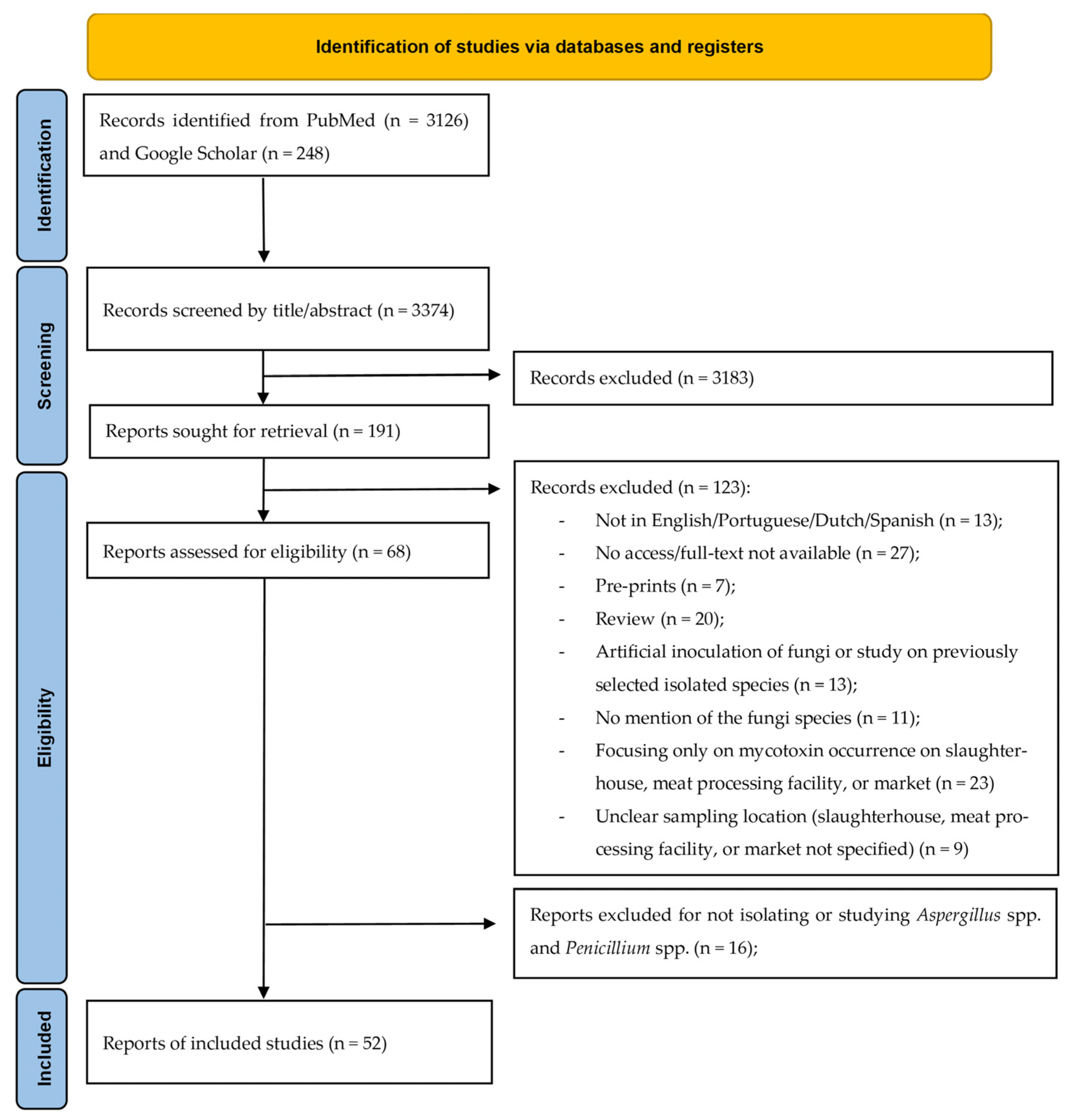
The literature search yielded 3374 records. After application of the predefined eligibility criteria, 52 studies were included in the scoping review for further analysis. An overview of the selection process is presented in Figure 1. The included studies, conducted between 1990 and 2025, originated from 24 geographical regions and were predominantly observational.
The included studies were carried out in Argentina (n = 2) [24,25]; Austria (n = 2) [26,27]; Brazil (n = 3) [28,29,30]; China (n = 1) [31]; Croatia (n = 3) [10,15,32]; Denmark (n = 1) [33]; Egypt (n = 8) [12,34,35,36,37,38,39,40]; Greece (n = 1) [41]; India (n = 1) [42]; Iraq (n = 3) [43,44,45]; Italy (n = 7) [11,26,46,47,48,49,50]; Japan (n = 1) [51]; Korea (n = 2) [52,53]; Nigeria (n = 4) [54,55,56,57]; Norway (n = 2) [58,59]; Pakistan (n = 1) [60]; Portugal (n = 2) [13,61]; Saudi Arabia (n = 3) [38,62,63]; Serbia (n = 1) [64]; Slovakia (n = 1) [65]; Slovenia (n = 1) [66]; Spain (n = 2) [67,68]; Sweden (n = 1) [69]; and Turkey (n = 1) [70]. Both Peintner et al. [26] and Aljazzar et al. [38] presented data from more than one country within a single study.
Seventeen studies were conducted in the slaughterhouse, sampling air, equipment, meat, workers’ nasal swabs, water, surfaces, and tools (Table S2, Supplementary Materials). Twenty-four studies reported the isolation of Aspergillus spp. and/or Penicillium spp. in meat processing facilities, mainly from air and meat products (Table S3, Supplementary Materials. Fourteen studies focused on retail meat markets and sampled meat and meat products (Table S4, Supplementary Materials).
Based on the studies included in the scoping review, the occurrence of moulds along the meat production chain was analysed by genus, starting with Aspergillus spp., due to their high prevalence and clinical relevance.

3.2. Aspergillus spp. Isolation Across the Meat Production Chain

Fungi isolated from meat production settings may represent both potential meat-borne pathogens and occupational hazards [2]. Aspergillus species, which are among the leading causes of human mould infections, can affect the health of both immunocompetent and immunocompromised individuals, causing hypersensitivity reactions, chronic pulmonary infections, and, in severe cases, life-threatening invasive disease infections [2,71]. Following inhalation or direct inoculation of Aspergillus conidia, infection may develop locally or disseminate systemically [72].
In addition to their clinical relevance, several Aspergillus species are able to produce mycotoxins, such as AFB1 and OTA [61]. Aspergillus flavus is a major producer of AFB1, and high occupational exposure risks associated with inhalation of this toxin have been reported for other mycotoxins [61]. Occupational exposure to AFB1 among poultry slaughterhouse workers has been documented and may occur through inhalation or dermal absorption [73]. However, studies specifically assessing occupational exposure to mycotoxins in meat industry environments remain limited.
Aspergillus fumigatus, followed by A. flavus, A. terreus, and A. niger, is of particular clinical relevance, being considered the primary etiologic agent of invasive aspergillosis [2,61]. This species is also capable of producing immunosuppressive secondary metabolites, such as gliotoxin, and has been associated with respiratory symptoms including asthma, allergic sinusitis, cough, and bronchial hyperresponsiveness [2].
Beyond occupational exposure, Aspergillus spp. may colonise edible organs, meat, and meat products, contributing to mycotoxin production under favourable conditions [37,56,74,75,76]. The production of AFB1 by A. flavus and A. parasiticus and of OTA by A. ochraceus and A. westerdijkiae on dry-cured meat products has been confirmed. In addition, sterigmatocystin production by A. versicolor has been reported [6]. Other mycotoxins, including aflatoxin B2, aflatoxin G1, aflatoxin G2, cyclopiazonic acid, 3-nitropropionic acid, fumonisin B2, penicillic acid, xanthomegnin, viomellein, and vioxanthin, have also been produced by Aspergillus spp. isolated from meat products and spices used in meat processing [12,13,19,77,78]. The most common mycotoxin-producing Aspergillus spp. previously detected on meat products are presented in Table 1.
Mycotoxin production in contaminated meat products is influenced by factors such as aw and temperature. The production of AFB1 by A. flavus and A. parasiticus, for instance, is favoured at aw ≥ 0.80 and ≥0.84, respectively, at a temperature range of 12 to 35 °C [80]. Aspergillus ochraceus is reported to produce OTA at aw ≥ 0.87 and under 12–35 °C [80].
The main Aspergillus species isolated in slaughterhouses, meat processing facilities, and meat markets are presented in Table 2. An overview of the remaining Aspergillus species isolated is presented in Table S5 (Supplementary Materials).
To better characterise the distribution of Aspergillus spp., results are presented according to the main contamination routes, including air, surfaces and equipment, and food matrices.

3.2.1. Aspergillus spp. Isolated from the Air and Nasal Swabs

Aspergillus flavus, A. fumigatus, A. niger, A. sydowii, A. terreus, and A. versicolor are among the Aspergillus species detected in the air in different sorts of slaughterhouses (Table 2). Moreover, A. fumigatus, A. niger, A. sydowii, and A. versicolor were also isolated from the production environment (including air) of a meat production facility (Table 2).
From an occupational health perspective, exposure to bioaerosols, containing airborne fungi and mycotoxins, represents a health risk [61]. Notably, A. flavus and A. niger, among the Aspergillus species with mycotoxigenic and clinical relevance, have also been detected in nasal swabs collected from slaughterhouse workers (Table 2), highlighting inhalation as a relevant route of exposure. Seasonal variation, temperature, relative humidity, building materials, facility age, and ventilation conditions significantly influence fungal concentrations and species diversity in indoor environments [2,59].
High airborne spore loads may also contribute to secondary contamination and growth of toxigenic fungi on meat and meat products [59]. Facility design and layout influence air circulation patterns and may promote airborne dissemination of fungal spores onto products and contact surfaces [2,59]. The adoption of standardised sampling protocols and complementary identification methods would improve the comparability and reliability of Aspergillus spp. prevalence data in these environments.

3.2.2. Aspergillus spp. Isolated from Surfaces, Equipment, Facilities, Tools, and Vectors

Aspergillus sydowii, A. terreus, A. versicolor, A. flavus, A. fumigatus, and A. niger are reported across multiple studies on surfaces, including floors and walls, in slaughterhouse environments (Table 2). Additional Aspergillus species were isolated from equipment, facilities, and tools (Table S5). Since contamination and growth of mycotoxigenic fungi may result from inadequate hygiene of rooms and equipment [59], these findings underscore the importance of effective cleaning and disinfection practices.
The implementation of regular and standardised fungal monitoring programmes for surfaces, integrated into Standard Sanitary Operating Procedures (SSOPs), is essential to enhance food safety [2]. Moreover, A. flavus, A. fumigatus, A. parasiticus, A. niger, and A. ochraceus were isolated from houseflies in slaughterhouse settings (Table 2), highlighting the role of vectors in fungal dissemination and reinforcing the need for effective pest control measures.

3.2.3. Aspergillus spp. Isolated from Offal, Meat, Meat Products and Raw Materials

Several Aspergillus species, including A. flavus, A. fumigatus, A. niger, A. ochraceus, A. terreus, and A. versicolor, were isolated from offal samples (Table 2). Furthermore, carcass samples and meat swabs yielded A. flavus, A. fumigatus, A. niger, A. ochraceus, A. sydowii, A. terreus, and A. versicolor (Table 2). However, these species are not consistently reported across studies, likely because few investigations include sampling of meat swabs and offal. Consequently, although a range of Aspergillus species has been identified, only a limited number of studies report them in these sample types.
In meat products sampled at the processing stage, a broader diversity of species was reported, including A. nomius, A. parasiticus, A. tamarii, and A. westerdijkiae (Table 2). The presence of mycotoxigenic fungi on meat and meat products may result from airborne contamination, contaminated raw materials, and inadequate hygienic handling and processing conditions [2,59]. Mechanical damage to products, such as cracks in dry-cured meat products, creates favourable microclimatic conditions for mould growth. Therefore, producers must ensure adequate equipment performance and optimised processing conditions [59]. In addition, fungal contamination of animals at slaughter has been suggested as a potential source of cross-contamination within slaughterhouse environments [30].
Aspergillus flavus and A. niger were also detected in samples of spices used in meat processing (Table 2). Although many spices possess antifungal properties, they can also be contaminated by moulds. Species from the genera Aspergillus and Penicillium are among the most common contaminants [19]. Under poor storage and processing conditions, spices such as black pepper and nutmeg may become contaminated with aflatoxins and OTA [19].
In addition to Good Manufacturing Practices (GMP) and hygiene control, the application of biocontrol agents has been proposed as a promising strategy to limit the growth of mycotoxigenic Aspergillus species in dry-cured meat products [6]. Debaryomyces hansenii has demonstrated antifungal activity against A. parasiticus and A. westerdijkiae, while bacterial species such as Staphylococcus xylosus have shown inhibitory effects against A. flavus, A. parasiticus, and A. westerdijkiae, as well as against the production of AFB1 and OTA [6].

3.3. Penicillium spp. Isolation Across the Meat Production Chain

The growth of toxigenic moulds is favoured in environments with high relative humidity and moderated temperatures [6]. Penicillium spp. are among the most common filamentous fungi in the food processing industry, proliferating at lower to mid temperatures and tolerating low aw (0.78–0.83) [2,19].
Certain Penicillium species, such as P. nalgiovense and P. salamii, which have been used as starter cultures, are beneficial in meat processing, especially during ripening. They can enhance the sensory qualities of the product and form a protective biofilm on the casing of specific meat products, inhibiting undesirable microorganisms [1]. However, spoilage species such as P. nordicum or P. verrucosum, found in different meat products, can produce mycotoxins (Table 3).
As previously mentioned, aw and temperature affect mycotoxin production in meat products. It has been reported that the production of OTA by P. verrucosum is favoured at aw ≥ 0.85 and at a temperature range of 2 to 34 °C [80]. On the other hand, it has been documented that P. commune produces cyclopiazonic acid over a range of aw ≥ 0.90 and at 12–30 °C [80].
The main Penicillium species isolated in slaughterhouses, meat processing facilities, and meat markets are presented in Table 4. An overview of the remaining Penicillium species isolated is presented in Table S6 (Supplementary Materials).

3.3.1. Penicillium spp. Isolated from the Environment and Vectors

Penicillium aurantiogriseum, P. brevicompactum, P. chrysogenum, P. citrinum, P. commune, P. crustosum, P. expansum, P. nordicum, P. polonicum, and P. roqueforti are among the Penicillium species which have been reported in the air and surface samples collected in slaughterhouses, as well as in the environment (including air) of meat processing facilities (Table 4). Furthermore, P. aurantiogriseum and P. verrucosum were previously isolated from houseflies in the slaughterhouse setting (Table 4).
The findings underscore the fact that mycotoxigenic Penicillium species may spread in the environment through the air, surfaces, and vectors, representing a potential source of contamination of offal, carcasses, meat, and meat samples.
Microorganisms such as airborne fungi may be easily carried through the air in slaughterhouses that do not provide adequate separation between dirty or outdoor areas and clean areas [56]. In addition, Alapont et al. [68] have already concluded that the air in the ripening chambers of dry-cured ham is an important source of Penicillium contamination. In meat processing plants, as the air pressure gradient in the sorting room is higher, there is a chance of migration of aerosolised spores to the neighbouring production rooms, so it is important to adjust the air pressure gradients and guarantee a clear segregation between clean and unclean areas [59]. Furthermore, in order to decrease the spore concentration in the air, it is recommended to improve air circulation [59].
Moreover, moulds have been isolated from the walls and ceilings of slaughterhouses, salting, brining, and washing rooms, as well as from production materials such as sticks, nets, towels, brushes, and trucks, which harboured spores of the associated mycobiota [59], reinforcing the importance of the sanitization and disinfection of the facilities and tools. Additionally, it is highly recommended to implement strict vector control protocols in order to prevent cross-contamination.

3.3.2. Penicillium spp. Isolated from Meat and Meat Products

Across the studied meat chain settings, P. aurantiogriseum, P. chrysogenum, P. citrinum, and P. nordicum have been identified in meat samples, including carcasses (Table 4). Penicillium spp. presence on these samples may result from environmental contamination, as previously discussed, and inadequate sanitation [40,56].
Additionally, P. aurantiogriseum, P. brevicompactum, P. chrysogenum, P. citrinum, P. commune, P. crustosum, P. italicum, P. expansum, P. nordicum, P. polonicum, P. roqueforti, and P. verrucosum have also been isolated from meat product samples (Table 4).
Numerous studies have shown that several factors can allow uncontrolled mould growth on dry-cured meat surfaces. These factors include specific temperatures, pH values, and water activity, as well as physical characteristics such as casing cracks, the presence or absence of a crust (as in prosciuttos), or insufficient washing and brushing. Such conditions can promote the production of mycotoxins by superficial Penicillium species. This route of contamination is considered significant in dry-cured meat products [4].
In meat products, the addition of salts, such as NaCl, lowers aw [76]. Many of the isolated Penicillium species tolerate low aw, and several Penicillium species found, such as P. brevicompactum, P. citrinum, P. nordicum, and P. polonicum, are known to grow well even in the presence of 5% NaCl [76].
Also, the temperature used for ripening influences mould growth and their ability to produce mycotoxins [6]. As previously noted, Penicillium spp. proliferate at low to mid temperatures. For instance, P. nordicum can grow at temperatures between 10 and 25 °C [80]. Furthermore, since traditional meat products sold in the markets and fairs are often prepared in households under highly inconsistent and uncontrolled conditions, the occurrence and diversity of isolated moulds may be linked to the climatic conditions of the production region [15].
Moreover, the application of spices during meat processing may represent a contamination stage. Spices are mainly imported from developing countries with tropical and subtropical climates, where high temperatures, heavy rainfall, and humidity often promote fungal growth and increase the risk of mycotoxin contamination. As previously mentioned, some spices are particularly susceptible to contamination by toxigenic moulds, with Aspergillus and Penicillium being the most common contaminants. Furthermore, spices are often left to dry on the ground in open-air conditions, and poor outdoor hygiene further enhances mould growth and mycotoxin production [4].
Considering the findings presented, the importance of maintaining strict hygienic conditions in these environments is evident, as they play a key role in preventing and controlling the contamination and spread of Penicillium spp. Good hygiene practices, along with effective cleaning, disinfection, and monitoring protocols, are essential to minimise fungal proliferation and ensure safer meat production [2]. Additionally, proper control of ingredients used in meat product formulation should not be overlooked [20], nor should the implementation of effective vector control programmes.
Furthermore, some native microorganisms, such as specific yeast species, act as biocontrol agents (alone or in combination) against some Penicillium spp. Debaryomyces hansenii has been described as possessing antifungal activity to reduce the growth of P. nordicum and P. verrucosum. Other yeasts and bacterial species, such as Candida zeynaloides and Staphylococcus xylosus, have also been evaluated for their effects on P. nordicum growth and OTA production in dry-cured meat products [6]. Also, the antifungal properties of various plant extracts, particularly essential oils, are being investigated for use in meat and meat products, although their practical application in the meat industry remains limited and underdeveloped [6].

3.4. Risk Assessment of Fungal Contamination and Mycotoxin Exposure in Meat Production

Most of the relevant Aspergillus and Penicillium species isolated from the meat production chain environments reviewed appear to be globally ubiquitous. The greatest diversity of these genera is observed during the meat processing stage. Certain species, such as A. nomius, A. westerdijkiae, P. cyclopium, P. nordicum, P. palitans, and P. rugulosum were exclusively isolated from meat processing plants (Table 2 and Table 4). However, the higher number of studies reporting Aspergillus and Penicillium spp. in processing plants likely reflects a research gap in slaughterhouses and retail environments rather than true differences in contamination levels. Nevertheless, it is suggested that the processing stage is particularly critical. It combines conditions that favour fungal growth and mycotoxin production, and it may also introduce additional contamination through raw materials, such as spices. Although subsequent processing steps may reduce fungal contamination in slaughterhouses and processing plants, products at the market stage are already available for consumption, leaving limited opportunities for intervention.
Despite the lack of comparative studies across all stages of the meat production and distribution chain, occupational exposure is hypothesised to be highest in slaughterhouses, followed by meat processing plants. This assumption is supported by the elevated levels of airborne dust and direct contact with contaminated tissues, particularly in lairage areas and during bleeding or evisceration. However, this conclusion remains to be confirmed scientifically. The humid environment and the presence of high levels of organic substrates in slaughterhouses further promote fungal growth [2]. In meat processing plants, ripening chambers may also represent an exposure risk, although data on this are limited.
Mycotoxins occur naturally in spices, particularly susceptible to contamination by mycotoxigenic fungi [81]. During handling and processing, dry products, such as spices, can release mould spores and mycotoxins [82], creating an additional route of occupational exposure through inhalation of contaminated dust. Airborne OTA concentrations have been reported to range from <0.003 to 1.45 ng/m3 during nutmeg processing, and from <0.003 ng/m3 to 8.15 ng/m3 during black pepper processing [83]. Airborne OTA has also been detected in environmental and personal samples from workplaces where spice blends are used to prepare meat sausages [84]. These findings suggest that spices and other non-meat ingredients may contribute to environmental contamination by fungal spores and mycotoxins in meat processing plants.
Exposure to mycotoxins can occur via inhalation, dermal absorption, and ingestion. Importantly, some studies suggest that inhalation exposure may be more relevant for health effects than dietary intake [73]. Thus, it can be inferred that occupational exposure in meat production settings can lead to high localised exposure over time, potentially exceeding dietary intake from meat, as it may involve both inhalation and dermal absorption of mycotoxins.
In terms of dietary exposure from meat consumption, the latest European Food Safety Authority (EFSA) Scientific Opinion on OTA identified preserved meat as an important contributor to chronic intake, particularly pork ham, preserved meats, and sausages [85]. However, data on mycotoxin occurrence in meat and meat products remain limited, and no specific maximum limits for OTA or other mycotoxins are currently established in EU legislation [6]. According to the Food and Agriculture Organisation of the United Nations (FAO) database on worldwide mycotoxin regulations [86], which requires updating, some EU Member States (Denmark, Estonia, Italy, Romania, and Slovakia) had previously set national limits for mycotoxins in meat, as already mentioned. Similar regulations were also set in non-EU countries such as Serbia, Montenegro, and Ukraine. Reported maximum levels ranged from 0.5 to 5 µg/kg for AFB1 and from 1 µg/kg to 20 µg/kg for OTA. Harmonised regulatory limits for mycotoxins in meat and meat products are still lacking.
To strengthen risk assessment, research should prioritise linking fungi detected in the meat production environment with mycotoxin levels in products. Dietary exposure should be evaluated by comparing measured mycotoxin concentrations with reference values, such as tolerable daily intake. Occupational exposure should be assessed by integrating airborne mycotoxin and fungal data with epidemiological and biomonitoring information.
Regular and standardised fungal monitoring of air and surfaces, integration of mould control into sanitation programmes, pest control, and the control of environmental parameters are also essential. Although routine monitoring may be impractical in small-scale slaughterhouses and meat processing facilities, sporadic analyses should be encouraged. It should be noted, however, that assessing the risk of mycotoxin contamination based solely on fungal isolation is unreliable, as mycotoxins can persist in products and environment even in the absence of detectable fungal growth [2]. Moreover, not all isolated mycotoxigenic fungi will necessarily produce toxins, as mycotoxin formation strongly depends on environmental and substrate factors such as temperature, water activity, and pH.
Producers should implement Hazard Analysis and Critical Control Points (HACCP)-based programmes to reduce fungal and mycotoxin contamination. Key measures include controlling room temperature, removing excessive surface mould from products, ensuring adequate airflow, maintaining effective sanitation [4] and the use of certified, high-quality raw materials. Proper storage and handling of raw materials are also recommended to minimise environmental contamination. Furthermore, to reduce occupational exposure and food contamination, preventive measures such as hand hygiene, the use of personal protective equipment, and worker training and awareness programmes should be implemented [2].

3.5. Knowledge Gaps and Review Limitations

Overall, few studies have assessed the isolation of Aspergillus and Penicillium spp. and their associated mycotoxins in fresh meat. In addition, there is a lack of studies evaluating the presence and concentrations of moulds, including Aspergillus and Penicillium, and their mycotoxins in air and on surfaces of cold stores and transport vehicles, and how this relates to contamination of products sold in markets and supermarkets. Similarly, there is limited research on the economic impact of isolating mycotoxigenic Aspergillus and Penicillium throughout the meat production chain. Moreover, a key research gap is the lack of studies linking environmental fungal loads to contamination levels in meat and meat products. This leaves open the question of how effectively product contamination can be prevented by controlling specific environmental parameters. It also remains unclear which parameters should be prioritised for monitoring and control.
In slaughterhouses, studies tracing the occurrence of moulds, including Aspergillus and Penicillium spp., carried by slaughtered animals on meat and edible offal, and their impact on carcass and offal rejection, are scarce. There is also a lack of data assessing the occupational burden posed by Aspergillus and Penicillium, and their mycotoxins, in these facilities, as well as effective control, cleaning, and disinfection strategies for environmental moulds.
In meat processing plants, research is limited regarding the occupational exposure to Aspergillus and Penicillium and their mycotoxins. Moreover, to the best of the authors’ knowledge, there are no studies investigating the isolation and concentration of these moulds and mycotoxins on packaging materials used in meat processing plants. Additionally, their relationship to contamination of packaged products has not been explored. Furthermore, there is still little information on optimal strategies for environmental control, cleaning, and disinfection.
At meat markets, there is a lack of studies tracing the origin of Aspergillus and Penicillium and linking contamination to previous stages of the production chain or to contamination occurring at the market itself. Similarly, data on the isolation of moulds, including Aspergillus and Penicillium, from surfaces, air, and tools in meat markets, and their relationship with contamination of meat and meat products, are scarce.
This scoping review has some inherent limitations that should be acknowledged. Firstly, although careful and systematic procedures were followed, the screening and selection of studies were performed by a single author. Secondly, the number of databases searched is considered limited. In addition, the selection of databases may have affected which studies were included. PubMed was used as the primary source due to its high relevance and comprehensive coverage of literature within the scope of this review. While other databases such as Scopus, ScienceDirect, and Web of Science could have been included, they often overlap significantly with PubMed, and including them might have led to a high number of duplicate records. To complement this approach and capture a broader spectrum of studies, Google Scholar was also searched. This allowed for the identification of less-cited articles and publications in journals in the field of food microbiology and meat production with lower impact, which might not be indexed in PubMed. However, these studies may not have been subject to the same scientific rigour or indexing criteria as PubMed-indexed publications.
One final limitation of this study is that only species clearly identified within the Aspergillus and Penicillium genera were considered for inclusion, leading to the exclusion of species originally reported under outdated nomenclature that may currently belong to these genera. Consequently, some relevant data may not have been captured. A full taxonomic assessment of these species was not feasible within the scope of the study and would have required more extensive verification and standardisation. This approach was therefore adopted to focus on species with clearly identifiable, up-to-date names within Aspergillus and Penicillium, providing a clear and reproducible framework for species inclusion.

4. Conclusions

To the best of the authors’ knowledge, this is the first review addressing the occurrence of Aspergillus and Penicillium spp. across slaughterhouses, meat processing plants, and markets, highlighting their relevance for both food safety and occupational health. Although species-specific frequencies could not be compared due to methodological differences across studies, the evidence shows that these genera are present at all stages of meat and meat product production and across multiple matrices, including air, water, surfaces, equipment, raw materials, and final products. Their occurrence is likely underestimated in certain settings, particularly slaughterhouses, and several identified species are known mycotoxin producers, reinforcing their importance beyond spoilage. Fungal occurrence in the meat production chain is likely underestimated, as monitoring primarily targets bacteria. This is compounded by limited research, a lack of standardised protocols and guidelines for fungi, and low regulatory focus on mycotoxins, despite their role in spoilage and potential health risks. Fungal contamination in the meat sector is strongly influenced by environmental and technological factors, including temperature, humidity, hygiene practices, facility design, and handling conditions. The frequent detection of Aspergillus spp. in processing environments and among workers highlights the relevance of occupational exposure, which remains insufficiently explored.
Despite numerous reports of mould isolation, data on mycotoxin occurrence in meat matrices are limited and heterogeneous, underscoring the need for harmonised monitoring approaches. Overall, this review emphasises the integration of fungal surveillance into food safety management systems and the need for future research on mycotoxin production under real processing conditions, occupational exposure, and effective prevention and control strategies in the meat sector.

Supplementary Materials

The following supporting information can be downloaded at: https://www.mdpi.com/article/10.3390/foods15040630/s1, Table S1: Detection of mycotoxins in offal, meat, and meat products from slaughterhouses, meat manufacturers, and meat markets across 10 studies (1990–2025); Table S2: Overview of fungal contamination, focused on Aspergillus spp. and Penicillium spp., reported in slaughterhouses across 17 studies (1990–2025); Table S3: Overview of fungal contamination, focused on Aspergillus spp. and Penicillium spp., reported in meat manufacturers across 24 studies (1990–2025); Table S4: Overview of fungal contamination, focused on Aspergillus spp. and Penicillium spp., reported in retail meat markets across 14 studies (1990–2025); Table S5: Overview on other isolated Aspergillus spp. from samples in slaughterhouses, meat manufacturers, and retail meat markets; Table S6: Overview on other isolated Penicillium spp. from samples in slaughterhouses, meat manufacturers, and retail meat markets.

Author Contributions

Conceptualisation, methodology, and writing—original draft preparation, M.A.R.; writing—review and editing, A.E., C.O., M.A.R., L.E., L.F. and R.C.; supervision, A.E., L.E. and R.C.; funding acquisition, A.E. All authors have read and agreed to the published version of the manuscript.

Funding

The authors would like to thank CECAV and their support by the projects UIDB/CVT/00772/2020 (DOI:10.54499/UIDB/00772/2020) and LA/P/0059/2020 of the Portuguese Science and Technology Foundation (FCT).

Institutional Review Board Statement

Not applicable.

Informed Consent Statement

Not applicable.

Data Availability Statement

The original contributions presented in this study are included in the article/Supplementary Materials. Further inquiries can be directed to the corresponding author.

Acknowledgments

The views and opinions expressed in this paper are those of the author and do not reflect the official policy or position of the Nederlandse Voedsel-en Warenautoriteit (NVWA) nor the Dutch Government.

Conflicts of Interest

The authors declare no conflicts of interest.

References

  1. Stefanello, A.; Gasperini, A.M.; Copetti, M.V. Ecophysiology of OTA-producing fungi and its relevance in cured meat products. Curr. Opin. Food Sci. 2022, 45, 100838. [Google Scholar] [CrossRef]
  2. Alves Rodrigues, M.; Teiga-Teixeira, P.; Esteves, A. Occurrence of moulds and yeasts in the slaughterhouse: The underestimated role of fungi in meat safety and occupational health. Foods 2025, 14, 1320. [Google Scholar] [CrossRef] [PubMed]
  3. Gheorghe-Irimia, R.A.; Tăpăloagă, D.; Tăpăloagă, P.R.; Ilie, L.I.; Șonea, C.; Serban, A.I. Mycotoxins and essential oils—From a meat industry hazard to a possible solution: A brief review. Foods 2022, 11, 3666. [Google Scholar] [CrossRef] [PubMed]
  4. Pleadin, J.; Lešić, T.; Milićević, D.; Markov, K.; Šarkanj, B.; Vahčić, N.; Zadravec, M. Pathways of mycotoxin occurrence in meat products: A review. Processes 2021, 9, 2122. [Google Scholar] [CrossRef]
  5. Magistà, D.; Susca, A.; Ferrara, M.; Logrieco, A.F.; Perrone, G. Penicillium species: Crossroad between quality and safety of cured meat production. Curr. Opin. Food Sci. 2017, 17, 36–40. [Google Scholar] [CrossRef]
  6. Andrade, M.J.; Delgado, J.; Rodríguez, M.; Núñez, F.; Córdoba, J.J.; Peromingo, B. Mycotoxins in meat products. Meat Sci. 2025, 227, 109850. [Google Scholar] [CrossRef]
  7. Ráduly, Z.; Szabó, L.; Madar, A.; Pócsi, I.; Csernoch, L. Toxicological and medical aspects of Aspergillus-derived mycotoxins entering the feed and food chain. Front. Microbiol. 2020, 10, 2908. [Google Scholar] [CrossRef]
  8. European Commission (EC). Commission Regulation (EU) 2023/915 of 25 April 2023 on maximum levels for certain contaminants in food and repealing Regulation (EC) No 1881/2006. Off. J. Eur. Union 2023, L119, 103–157. [Google Scholar]
  9. Sineque, A.R.; Macuamule, C.L.; Dos Anjos, F.R. Aflatoxin B1 contamination in chicken livers and gizzards from industrial and small abattoirs, measured by ELISA technique in Maputo, Mozambique. Int. J. Environ. Res. Public Health 2017, 14, 951. [Google Scholar] [CrossRef]
  10. Pleadin, J.; Zadravec, M.; Brnić, D.; Perković, I.; Škrivanko, M.; Kovačević, D. Moulds and mycotoxins detected in the regional speciality fermented sausage ‘Slavonski kulen’ during a 1-year production period. Food Addit. Contam. Part A 2017, 34, 282–290. [Google Scholar] [CrossRef]
  11. Iacumin, L.; Chiesa, L.; Boscolo, D.; Manzano, M.; Cantoni, C.; Orlic, S.; Comi, G. Moulds and ochratoxin A on surfaces of artisanal and industrial dry sausages. Food Microbiol. 2009, 26, 65–70. [Google Scholar] [CrossRef] [PubMed]
  12. Aziz, N.H.; Youssef, Y.A. Occurrence of aflatoxins and aflatoxin-producing moulds in fresh and processed meat in Egypt. Food Addit. Contam. 1991, 8, 321–331. [Google Scholar] [CrossRef]
  13. Rodrigues, P.; Silva, D.; Costa, P.; Abrunhosa, L.; Venâncio, A.; Teixeira, A. Mycobiota and mycotoxins in Portuguese pork, goat and sheep dry-cured hams. Mycotoxin Res. 2019, 35, 405–412. [Google Scholar] [CrossRef] [PubMed]
  14. Rodríguez, A.; Rodríguez, M.; Martín, A.; Delgado, J.; Córdoba, J.J. Presence of ochratoxin A on the surface of dry-cured Iberian ham after initial fungal growth in the drying stage. Meat Sci. 2012, 92, 728–734. [Google Scholar] [CrossRef] [PubMed]
  15. Zadravec, M.; Vahčić, N.; Brnić, D.; Markov, K.; Frece, J.; Beck, R.; Pleadin, J. A study of surface moulds and mycotoxins in Croatian traditional dry-cured meat products. Int. J. Food Microbiol. 2020, 317, 108459. [Google Scholar] [CrossRef]
  16. Vulić, A.; Vahčić, N.; Hengl, B.; Gross-Bošković, A.; Jurković, M.; Kudumija, N.; Pleadin, J. Assessment of possible human exposure to ochratoxin A in Croatia due to the consumption of dry-cured and fermented meat products. Food Addit. Contam. Part A 2016, 33, 1428–1434. [Google Scholar] [CrossRef]
  17. Ulusoy, B.H.; Hecer, C.; Sayıner, S.; Kaya Yıldırım, F. Presence of aflatoxins and ochratoxin A in samarella (tsamarella), a traditional dried-cured meat of Cyprus. J. Food Sci. Technol. 2022, 59, 3002–3009. [Google Scholar] [CrossRef]
  18. Altafini, A.; Fedrizzi, G.; Roncada, P. Occurrence of ochratoxin A in typical salami produced in different regions of Italy. Mycotoxin Res. 2019, 35, 141–148. [Google Scholar] [CrossRef]
  19. Mastanjević, K.; Kovačević, D.; Nešić, K.; Krstanović, V.; Habschied, K. Traditional meat products—A mycotoxicological review. Life 2023, 13, 2211. [Google Scholar] [CrossRef]
  20. Lešić, T.; Vulić, A.; Vahčić, N.; Šarkanj, B.; Hengl, B.; Kos, I.; Pleadin, J. The occurrence of five unregulated mycotoxins most important for traditional dry-cured meat products. Toxins 2022, 14, 476. [Google Scholar] [CrossRef]
  21. Vila-Donat, P.; Marín, S.; Sanchis, V.; Ramos, A.J. A review of the mycotoxin adsorbing agents, with an emphasis on their multi-binding capacity, for animal feed decontamination. Food Chem. Toxicol. 2018, 114, 246–259. [Google Scholar] [CrossRef] [PubMed]
  22. Sezione Sicurezza Alimentare—CNSA (National Committee for Food Safety). Opinion of 11 May 2021; CNSA: Rome, Italy. 2021. Available online: https://www.salute.gov.it/new/it/pubblicazione/parere-cnsa-micotossine-non-regolamentate-ocratossina-formaggi-e-prodotti-base-di/ (accessed on 1 February 2026).
  23. Tricco, A.C.; Lillie, E.; Zarin, W.; O’Brien, K.K.; Colquhoun, H.; Levac, D.; Moher, D.; Peters, M.D.; Horsley, T.; Weeks, L.; et al. PRISMA extension for scoping reviews (PRISMA-ScR): Checklist and explanation. Ann. Intern. Med. 2018, 169, 467–473. [Google Scholar] [CrossRef] [PubMed]
  24. Castellari, C.; Quadrelli, A.M.; Laich, F. Surface mycobiota on Argentinean dry fermented sausages. Int. J. Food Microbiol. 2010, 142, 149–155. [Google Scholar] [CrossRef] [PubMed]
  25. Canel, R.S.; Wagner, J.R.; Stenglein, S.A.; Ludemann, V. Indigenous filamentous fungi on the surface of Argentinean dry fermented sausages produced in Colonia Caroya (Córdoba). Int. J. Food Microbiol. 2013, 164, 81–86. [Google Scholar] [CrossRef]
  26. Peintner, U.; Geiger, J.; Pöder, R. The mycobiota of speck, a traditional Tyrolean smoked and cured ham. J. Food Prot. 2000, 63, 1399–1403. [Google Scholar] [CrossRef]
  27. Haas, D.; Posch, J.; Schmidt, S.; Wüst, G.; Sixl, W.; Feierl, G.; Marth, E.; Reinthaler, F.F. A case study of air-borne culturable microorganisms in a poultry slaughterhouse in Styria, Austria. Aerobiologia 2005, 21, 193–201. [Google Scholar] [CrossRef]
  28. de Almeida, T.S.; Dos Santos, B.A.; Stefanello, A.; Dos Santos, I.D.; Fracari, J.C.; Silva, M.; Giongo, C.; Wagner, R.; Nalério, E.S.; Copetti, M.V. Spontaneously growing fungi on the surface and processing areas of matured sheep ham and volatile compounds produced. Food Res. Int. 2023, 173, 113287. [Google Scholar] [CrossRef]
  29. Parussolo, G.; Bernardi, A.O.; Garcia, M.V.; Stefanello, A.; dos Santos Silva, T.; Copetti, M.V. Fungi in air, raw materials and surface of dry fermented sausage produced in Brazil. LWT 2019, 108, 190–198. [Google Scholar] [CrossRef]
  30. Spanamberg, A.; Casagrande, R.A.; Araujo, R.; Driemeier, D.; Ferreiro, L. Airsacculitis-Molds Isolated from Lungs of Broilers from Slaughterhouse under Control of the Federal Inspection Service. Acta Sci. Vet. 2025, 53, 29. [Google Scholar] [CrossRef]
  31. Wen, R.; Li, X.A.; Han, G.; Chen, Q.; Kong, B. Fungal community succession and volatile compound dynamics in Harbin dry sausage during fermentation. Food Microbiol. 2021, 99, 103764. [Google Scholar] [CrossRef]
  32. Comi, G.; Orlic, S.; Redzepovic, S.; Urso, R.; Iacumin, L. Moulds isolated from Istrian dried ham at the pre-ripening and ripening level. Int. J. Food Microbiol. 2004, 96, 29–34. [Google Scholar] [CrossRef]
  33. Sørensen, L.M.; Jacobsen, T.; Nielsen, P.V.; Frisvad, J.C.; Koch, A. Mycobiota in the processing areas of two different meat products. Int. J. Food Microbiol. 2008, 124, 58–64. [Google Scholar] [CrossRef]
  34. Ismail, M.A.; Abou Elala, A.H.; Nassar, A.; Michail, D.G. Fungal contamination of beef carcasses and the environment in a slaughterhouse. Food Microbiol. 1995, 12, 441–445. [Google Scholar] [CrossRef]
  35. Ismail, M.A.; Zaky, Z.M. Evaluation of the mycological status of luncheon meat with special reference to aflatoxigenic moulds and aflatoxin residues. Mycopathologia 1999, 146, 147–154. [Google Scholar] [CrossRef] [PubMed]
  36. Refai, M.K.; Niazi, Z.M.; Aziz, N.H.; Khafaga, N.E.M. Incidence of aflatoxin B1 in the Egyptian cured meat basterma and control by γ-irradiation. Food/Nahrung 2003, 47, 377–382. [Google Scholar] [CrossRef] [PubMed]
  37. Darwish, W.S.; Elabbasy, M.T.; Morshdy, A. Prevalence of different mould genera in raw edible offal of cattle, camel and sheep. Glob. J. Agric. Food Safety Sci. 2014, 1, 213–224. [Google Scholar]
  38. Aljazzar, A.; El-Ghareeb, W.R.; 37, W.S.; Abdel-Raheem, S.M.; Ibrahim, A.M. Mold contamination of buffalo and cattle meat and offal: A comparative study. Buffalo Bull. 2021, 40, 59–69. [Google Scholar]
  39. Mohamed, H.M.; Aljasir, S.F.; Moftah, R.F.; Younis, W. Mycological evaluation of frozen meat with special reference to yeasts. Vet. World 2023, 16, 571. [Google Scholar] [CrossRef]
  40. Hussein, M.A.; Tharwat, A.E.; Ali, R.M.; Abo-Almagd, E.E.; Fakhry, B.A. Prevalence of mould and aflatoxin in raw and heat-treated meat products. J. Adv. Vet. Res. 2023, 13, 1252–1256. [Google Scholar]
  41. Papagianni, M.; Ambrosiadis, I.; Filiousis, G. Mould growth on traditional Greek sausages and penicillin production by Penicillium isolates. Meat Sci. 2007, 76, 653–657. [Google Scholar] [CrossRef]
  42. Humbal, C.; Joshi, S.K.; Trivedi, U.K.; Gautam, S. Evaluating the colonization and distribution of fungal and bacterial bio-aerosol in Rajkot, western India using multi-proxy approach. Air Qual. Atmos. Health 2019, 12, 693–704. [Google Scholar] [CrossRef]
  43. Al-Fattly, H.H.H.H. Comparative study of bacteria and fungi air polluted slaughterhouse of Al-Diwaniya city. Kufa J. Vet. Med. Sci. 2013, 4, 81–89. [Google Scholar] [CrossRef]
  44. Qasim, A.M.; Minnat, T.R.; Kadhim, T.J. Isolation and identification of some zoonotic bacteria and fungi from butchers and sheep slaughterhouses in Baghdad mayoralty. Biochem. Cell. Arch. 2021, 21, 2. [Google Scholar]
  45. Alsudani, A.A.; Al-Awsi, G.R.L. Role of the housefly as a biological vector for bacteria and fungi at some slaughterhouses. Pak. J. Biol. Sci. 2022, 25, 353–357. [Google Scholar] [CrossRef]
  46. Battilani, P.; Pietri, A.; Giorni, P.; Formenti, S.; Bertuzzi, T.; Toscani, T.; Virgili, R.; Kozakiewicz, Z. Penicillium populations in dry-cured ham manufacturing plants. J. Food Prot. 2007, 70, 975–980. [Google Scholar] [CrossRef]
  47. Paba, E.; Chiominto, A.; Marcelloni, A.M.; Proietto, A.R.; Sisto, R. Exposure to airborne culturable microorganisms and endotoxin in two Italian poultry slaughterhouses. J. Occup. Environ. Hyg. 2014, 11, 469–478. [Google Scholar] [CrossRef]
  48. Vallone, L.; Stella, S. Evaluation of antifungal effect of gaseous ozone in a meat processing plant. Ital. J. Food Saf. 2014, 3, 1680. [Google Scholar] [CrossRef][Green Version]
  49. Perrone, G.; Samson, R.A.; Frisvad, J.C.; Susca, A.; Gunde-Cimerman, N.; Epifani, F.; Houbraken, J. Penicillium salamii, a new species occurring during seasoning of dry-cured meat. Int. J. Food Microbiol. 2015, 193, 91–98. [Google Scholar] [CrossRef]
  50. Scaramuzza, N.; Diaferia, C.; Berni, E. Monitoring the mycobiota of three plants manufacturing Culatello (a typical Italian meat product). Int. J. Food Microbiol. 2015, 203, 78–85. [Google Scholar] [CrossRef]
  51. Mikami, N.; Toyotome, T.; Yamashiro, Y.; Sugo, K.; Yoshitomi, K.; Takaya, M.; Han, K.-H.; Fukushima, M.; Shimada, K. Dry-aged beef manufactured in Japan: Microbiota identification and their effects on product characteristics. Food Res. Int. 2021, 140, 110020. [Google Scholar] [CrossRef]
  52. Ryu, S.; Park, M.R.; Maburutse, B.E.; Lee, W.J.; Park, D.J.; Cho, S.; Hwang, I.; Oh, S.; Kim, Y. Diversity and characteristics of the meat microbiological community on dry aged beef. J. Microbiol. Biotechnol. 2018, 28, 105–108. [Google Scholar] [CrossRef]
  53. Lee, E.S.; Kim, J.H.; Kang, S.M.; Kim, B.M.; Oh, M.H. Inhibitory effects of ultraviolet-C light and thermal treatment on four fungi isolated from pig slaughterhouses in Korea. J. Anim. Sci. Technol. 2022, 64, 343. [Google Scholar] [CrossRef]
  54. Oyero, O.G.; Oyefolu, A.B. Natural occurrence of aflatoxin residues in fresh and sun-dried meat in Nigeria. Pan Afr. Med. J. 2010, 7, 1. [Google Scholar] [CrossRef]
  55. Arire, E.O.; Sulaimon, A.O.; Samuel, C.M. Microbial assessment of slaughter slabs at the Central Slaughterhouse of Ado Ekiti. Asian Res. J. Agric. 2022, 15, 102–107. [Google Scholar] [CrossRef]
  56. Ja’afaru, M.I.; Bernard, A.L.; Adeyemo, O.M.; Ogwuche, J.O. Isolation, prevalence of bacteria and fungi from carcasses and different locations within Yola abattoir and antimicrobial resistance profile of Escherichia coli O157:H7. Total Environ. Adv. 2024, 10, 200102. [Google Scholar] [CrossRef]
  57. Dada, T.A.; Ekwomadu, T.I.; Ngoma, L.; Mwanza, M. Biodiversity of Aspergillus species and their mycotoxin production potential in dry meat. Foods 2024, 13, 3221. [Google Scholar] [CrossRef]
  58. Asefa, D.T.; Gjerde, R.O.; Sidhu, M.S.; Langsrud, S.; Kure, C.F.; Nesbakken, T.; Skaar, I. Mould contaminants on Norwegian dry-cured meat products. Int. J. Food Microbiol. 2009, 128, 435–439. [Google Scholar] [CrossRef]
  59. Asefa, D.T.; Kure, C.F.; Gjerde, R.O.; Omer, M.K.; Langsrud, S.; Nesbakken, T.; Skaar, I. Fungal growth pattern, sources and factors of mould contamination in a dry-cured meat production facility. Int. J. Food Microbiol. 2010, 140, 131–135. [Google Scholar] [CrossRef]
  60. Adeeb, F.; Shooter, D. Emission and evolution of air-borne microflora in slaughter houses. Indoor Built Environ. 2003, 12, 179–184. [Google Scholar] [CrossRef]
  61. Viegas, C.; Faria, T.; Dos Santos, M.; Carolino, E.; Sabino, R.; Quintal Gomes, A.; Viegas, S. Slaughterhouses fungal burden assessment: A contribution for the pursuit of a better assessment strategy. Int. J. Environ. Res. Public Health 2016, 13, 297. [Google Scholar] [CrossRef]
  62. Berekaa, M.; Salama, K. Comprehensive assessment of microbiological and bioaerosol contaminants in Dammam slaughterhouse, Saudi Arabia. J. Pure Appl. Microbiol. 2015, 9, 69–78. [Google Scholar]
  63. Nasser, L.A. Molecular identification of isolated fungi, microbial and heavy metal contamination of canned meat products sold in Riyadh, Saudi Arabia. Saudi J. Biol. Sci. 2015, 22, 513–520. [Google Scholar] [CrossRef] [PubMed][Green Version]
  64. Vesković-Moračanin, S.M.; Borović, B.R.; Velebit, B.M.; Rašeta, M.P.; Milićević, D.R. Identification of mycobiota in Serbian slaughterhouses. Zb. Matice Srp. Prir. Nauke 2009, 117, 45–49. [Google Scholar] [CrossRef]
  65. Mižáková, A.D.; Pipová, M.O.; Turek, P.E. The occurrence of moulds in fermented raw meat products. Czech J. Food Sci. 2002, 20, 89–94. [Google Scholar] [CrossRef]
  66. Sonjak, S.; Ličen, M.; Frisvad, J.C.; Gunde-Cimerman, N. The mycobiota of three dry-cured meat products from Slovenia. Food Microbiol. 2011, 28, 373–376. [Google Scholar] [CrossRef]
  67. Núñez, F.; Rodríguez, M.M.; Bermúdez, M.E.; Córdoba, J.J.; Asensio, M.A. Composition and toxigenic potential of the mould population on dry-cured Iberian ham. Int. J. Food Microbiol. 1996, 32, 185–197. [Google Scholar] [CrossRef]
  68. Alapont, C.; López-Mendoza, M.C.; Gil, J.V.; Martínez-Culebras, P.V. Mycobiota and toxigenic Penicillium species on two Spanish dry-cured ham manufacturing plants. Food Addit. Contam. A 2013, 31, 93–104. [Google Scholar] [CrossRef]
  69. Hagmar, L.; Schütz, A.; Hallberg, T.; Sjöholm, A. Health effects of exposure to endotoxins and organic dust in poultry slaughter-house workers. Int. Arch. Occup. Environ. Health 1990, 62, 159–164. [Google Scholar] [CrossRef]
  70. Sandikci Altunatmaz, S.E.M.A.; Aydin, A.; Issa, G.; Aksu, F.; Dulger Altiner, D.; Aksu, H. Detection of airborne bacteria and fungi in meat plants. Int. Food Res. J. 2025, 32, 2. [Google Scholar] [CrossRef]
  71. Jenks, J.D.; Hoenigl, M. Treatment of aspergillosis. J. Fungi 2018, 4, 98. [Google Scholar] [CrossRef]
  72. Cadena, J.; Thompson, G.R.; Patterson, T.F. Aspergillosis: Epidemiology, diagnosis, and treatment. Infect. Dis. Clin. 2021, 35, 415–434. [Google Scholar] [CrossRef]
  73. Viegas, S.; Veiga, L.; Almeida, A.; dos Santos, M.; Carolino, E.; Viegas, C. Occupational exposure to aflatoxin B1 in a Portuguese poultry slaughterhouse. Ann. Occup. Hyg. 2015, 60, 176–183. [Google Scholar] [CrossRef] [PubMed]
  74. Peromingo, B.; Rodriguez, A.; Bernaldez, V.; Delgado, J.; Rodriguez, M. Effect of temperature and water activity on growth and aflatoxin production by Aspergillus flavus and Aspergillus parasiticus on cured meat model systems. Meat Sci. 2016, 122, 76–83. [Google Scholar] [CrossRef] [PubMed]
  75. Peromingo, B.; Andrade, M.J.; Delgado, J.; Sanchez-Montero, L.; Nunez, F. Biocontrol of aflatoxigenic Aspergillus parasiticus by native Debaryomyces hansenii in dry-cured meat products. Food Microbiol. 2019, 82, 269–276. [Google Scholar] [CrossRef]
  76. Zadravec, M.; Lešić, T.; Brnić, D.; Pleadin, J.; Kraak, B.; Jakopović, Ž.; Perković, I.; Vahčić, N.; Tkalec, V.J.; Houbraken, J. Regional distribution and diversity of Aspergillus and Penicillium species on Croatian traditional meat products. Int. J. Food Microbiol. 2023, 406, 110404. [Google Scholar] [CrossRef]
  77. Rojas, F.J.; Jodral, M.; Gosalvez, F.; Pozo, R. Mycoflora and toxigenic Aspergillus flavus in Spanish dry-cured ham. Int. J. Food Microbiol. 1991, 13, 249–255. [Google Scholar] [CrossRef]
  78. Martín, A.; Córdoba, J.J.; Núñez, F.; Benito, M.J.; Asensio, M.A. Contribution of a selected fungal population to proteolysis on dry-cured ham. Int. J. Food Microbiol. 2004, 94, 55–66. [Google Scholar] [CrossRef]
  79. El-Kady, I.; El-Maraghy, S.; Zohri, A.N. Mycotoxin producing potential of some isolates of Aspergillus flavus and Eurotium groups from meat products. Microbiol. Res. 1994, 149, 297–307. [Google Scholar] [CrossRef]
  80. Zadravec, M.; Markov, K.; Frece, J.; Perković, I.; Jakopović, Ž.; Lešić, T.; Mitak, M.; Pleadin, J. Toxigenic fungi and the occurrence of mycotoxins in traditional meat products. Croat. J. Food Sci. Technol. 2019, 11, 272–282. [Google Scholar] [CrossRef]
  81. Syamilah, N.; Nurul Afifah, S.; Effarizah, M.E.; Norlia, M. Mycotoxins and mycotoxigenic fungi in spices and mixed spices: A review. Food Res. 2022, 6, 30–46. [Google Scholar] [CrossRef]
  82. Mayer, S. Occupational exposure to mycotoxins and preventive measures. In Environmental Mycology in Public Health; Academic Press: London, UK, 2016; pp. 325–341. [Google Scholar] [CrossRef]
  83. Iavicoli, I.; Brera, C.; Carelli, G.; Caputi, R.; Marinaccio, A.; Miraglia, M. External and internal dose in subjects occupationally exposed to ochratoxin A. Int. Arch. Occup. Environ. Health 2002, 75, 381–386. [Google Scholar] [CrossRef]
  84. Jargot, D.; Melin, S. Characterization and validation of sampling and analytical methods for mycotoxins in workplace air. Environ. Sci. Process. Impacts 2013, 15, 633–644. [Google Scholar] [CrossRef]
  85. EFSA Panel on Contaminants in the Food Chain (CONTAM); Schrenk, D.; Bodin, L.; Chipman, J.K.; del Mazo, J.; Grasl-Kraupp, B.; Hogstrand, C.; Hoogenboom, L.; Leblanc, J.-C.; Nebbia, C.S.; et al. Risk Assessment of Ochratoxin A in Food. EFSA J. 2020, 18, e06113. [Google Scholar] [CrossRef]
  86. Food and Agriculture Organization of the United Nations (FAO). Worldwide Regulations for Mycotoxins in Food and Feed (2003); FAO: Rome, Italy, 2004; Available online: https://www.fao.org/4/y5499e/y5499e0g.htm (accessed on 1 February 2026).
Figure 1. PRISMA-ScR flowchart of literature search, inclusion and exclusion criteria, and data collection.
Foods 15 00630 g001
Table 1. The most common mycotoxin-producing Aspergillus spp. previously detected on meat products [6,13,19,79].
Aspergillus SpeciesMycotoxin
A. flavusAFB1, Cyclopiazonic Acid (CA), 3-nitroproprionic acid
A. nigerOTA, Fumonisin B2
A. nomiusAflatoxins B and G
A. ochraceusOTA, Penicillic acid, Xanthomegnin, Viomellein, Vioxanthin
A. parasiticusAFB1, AFG1
A. tamariiAFG1, AFG2
A. versicolorSterigmatocystin
A. westerdijkiaeOTA
Table 2. Aspergillus species isolated from slaughterhouses, meat processing facilities, and markets (1990–2025).
Fungi SpeciesLocation/StageSortPositive Sample(s)Country
A. flavusSlaughterhouse CamelLiver, lung, rumen, intestineEgypt [37]
CattleAirEgypt [34]; Nigeria [56]; Serbia [64]
Beef carcassEgypt [34]; Nigeria [56]
FloorEgypt [34]; Serbia [64]
Liver, lung, rumen, intestine, and head muscleEgypt [37]
WallEgypt [34]
WaterEgypt [34]
Slaughter ground scrapingsNigeria [56]
SheepLiver, lung, rumen, intestine, and head muscleEgypt [37]
Nasal swabs (butchers), meat swabsIraq [44]
PoultryAirAustria [27]
Non-definedAirIraq [43]
HousefliesIraq [45]
SurfacesNigeria [55]
Meat processingLamb/porkDry-cured meat production facility (outdoor air)Norway [59]
MixedPork leg (14- and 20-month curing periods), pork shoulder, goat, and sheepPortugal [13]
Prime beef rump steak and milled black pepper in spring months, nutmeg in winter and spring monthsSlovak Republic [65]
PorkHarbin dry sausages during fermentationChina [31]
SausageCroatia [32]
Non-definedSausageEgypt [12]
MarketBeefRound muscle, neck muscles, masseter muscles, liver, and kidneySaudi Arabia [38]
Beef/poultryCanned meat samples on DRBC; canned meat samples on Dichloran 18% GlycerolSaudi Arabia [63]
BufalloRound muscle, neck muscles, masseter muscles, liver, and kidneyEgypt [38]
MixedBarčianska salamiSlovak Republic [65]
Non-definedDried meat sample collected from five major markets Nigeria [54]
Dry MeatNigeria [57]
Frozen meat samples on DRBC and PDAEgypt [39]
Sausage, beef burger, and minced meat (raw meat products), and hot dog (heat-treated meat product)Egypt [40]
A. fumigatusSlaughterhouseCamelLiver, lung, rumen, intestine, and head muscleEgypt [37]
CattleAirEgypt [34]
Beef carcassEgypt [34]
FloorEgypt [34]
Liver, lung, rumen, intestine, and head muscleEgypt [37]
WallEgypt [34]
WaterEgypt [34]
SheepLiver, lung, rumen, intestine, and head muscleEgypt [37]
Meat swabsIraq [44]
PoultryAirAustria [27]; Italy [47]
LungsBrazil [30]
Non-definedHousefliesIraq [45]
Meat processingBeefBeefburgerEgypt [12]
Lamb/porkDry-cured meat production facility (hams, environment, outdoor air)Norway [59]
PorkAirItaly [50]
Non-definedDry-cured meat productsNorway [58]
MarketBeefLiver and kidneySaudi Arabia [38]
BufalloLiverEgypt [38]
Non-definedDried meat sample collected from five major markets Nigeria [54]
Dry MeatNigeria [57]
Frozen meat samples on DRBC and PDAEgypt [39]
Luncheon meat samples from two companiesEgypt [35]
Sausage, beef burger, and minced meat (raw meat products)Egypt [40]
A. nigerSlaughterhouseCamelLiver, lung, rumen, intestine, and head muscleEgypt [37]
Cattle AirEgypt [34]; Nigeria [56]
Beef carcassEgypt [34]; Nigeria [56]
FloorEgypt [34]
Liver, lung, rumen, intestine, and head muscleEgypt [37]
Slaughter ground scrapingsNigeria [56]
WallEgypt [34]
WaterEgypt [34]
PoultryAirItaly [47]
SheepNasal swabs (butchers), meat swabsIraq [44]
Liver, lung, rumen, intestine, and head muscleEgypt [37]
Non-definedAirIraq [43]
HousefliesIraq [45]
SurfacesNigeria [55]
Meat processing Lamb/porkDry-cured meat production facility (environment)Norway [59]
MixedMilled black pepper (summer and winter months) and nutmeg (spring months), emulsion Gombasek sausage (summer months)Slovak Republic [65]
PorkIberian hamSpain [67]
Non-definedSausageEgypt [12]
MarketBeefRound muscle, neck muscles, masseter muscles, liver, and kidneySaudi Arabia [38]
Beef/poultryCanned meat samples on DRBC and Dichloran 18% GlycerolSaudi Arabia [63]
BufalloRound muscle, neck muscles, masseter muscles, liver, and kidneyEgypt [38]
PorkCroatian traditional dry-cured meat productsCroatia [15]
Non-definedDry MeatNigeria [57]
Fresh and dried meat samples collected from five major marketsNigeria [54]
Frozen meat samples on DRBC and PDAEgypt [39]
Luncheon meat samples from two companiesEgypt [35]
Sausage, beef burger, and minced meat (raw meat products), and luncheon (heat-treated meat product)Egypt [40]
A. nomiusMeat processingMixedSheep (dry-cured ham)Portugal [13]
A. ochraceusSlaughterhouseCamelRumen and head muscleEgypt [37]
SheepRumen and intestineEgypt [37]
Non-definedHousefliesIraq [45]
Meat processingPork or mixedSausageArgentina [24,25]; Croatia [32]
Non-definedSausageEgypt [12]
MarketBeefNeck muscle and kidneySaudi Arabia [38]
Beef/poultryCanned meat samples on DRBC and Dichloran 18% GlycerolSaudi Arabia [63]
BufalloNeck muscle and kidneyEgypt [38]
PorkCroatian traditional dry-cured meat productsCroatia [15]
Non-definedDry MeatNigeria [57]
Sausage and beef burger (raw meat products), and luncheon, hot dog, and canned meat (heat-treated meat products)Egypt [40]
A. parasiticusSlaughterhouseNon-definedHousefliesIraq [45]
Meat processingMixedGoat (dry-cured ham)Portugal [13]
Sheep (dry-cured ham)Portugal [13]
Pork or mixedAir samples of processing roomsArgentina [24]
SausageArgentina [24]; Croatia [32]
Non-definedSausageEgypt [12]
MarketNon-definedBeef burger and minced meat (raw meat products)Egypt [40]
A. sydowiiSlaughterhouseCattleAir, water, floor, wall, beef inner surface of shoulder, and beef inner surface of thighEgypt [34]
Meat processingLamb/porkDry-cured meat production facility (environment)Norway [59]
PorkIberian hamSpain [67]
SausageCroatia [10]
MarketNon-definedDried meat sample collected from five major markets Nigeria [54]
Luncheon meat samples from one companyEgypt [35]
A. tamariiMeat processing PorkHarbin dry sausages during fermentationChina [31]
MarketNon-definedDry MeatNigeria [57]
Fresh and dried meat samples were collected from five major marketsNigeria [54]
A. terreusSlaughterhouseCamelLiver, rumen, intestine, lung, and head muscleEgypt [37]
CattleAirEgypt [34]; Serbia [64]
Beef carcassEgypt [34]
FloorEgypt [34]; Serbia [64]
Liver, rumen, intestine, and head muscleEgypt [37]
WallEgypt [34]; Serbia [64]
SheepRumen, intestine, and head muscleEgypt [37]
MarketBeefNeck muscles, liver, and kidneySaudi Arabia [38]
BufalloLiverEgypt [38]
Non-definedFresh and dried meat samples collected from five major marketsNigeria [54]
Luncheon meat samples from two companiesEgypt [35]
Sausage (raw meat product) Egypt [40]
A. versicolorSlaughterhouseCamelLiver, rumen, and head muscleEgypt [37]
CattleAir, water, floor, wall, beef carcass outer surface of shoulder, and beef inner surface of thighEgypt [34]
Intestine Egypt [37]
SheepLung, rumen, and intestineEgypt [37]
Meat processingLamb/porkDry-cured meat production facility (environment)Norway [59]
PorkDry-cured pork neck and dry-cured hamSlovenia [66]
Iberian hamSpain [67]
SausageCroatia [10]; Italy [11,50]
Non-definedAirBrazil [29]
MarketPorkCroatian traditional dry-cured meat productsCroatia [15]
A. westerdijkiaeMeat processingPorkPork leg (20 months curating period)Portugal [13]
SausageItaly [50]
Non-definedAir, sausageBrazil [29]
DRBC: Dichloran Rose Bengal Chloramphenicol agar; PDA: Potato Dextrose Agar.
Table 3. The most common mycotoxin-producing Penicillium spp. previously detected on meat products [6,19,79].
Penicillium SpeciesMycotoxin
P. aurantiogriseumPenicillic acid (PA), verrucosidin, terrestric acid, nephrotoxic glycopeptides
P. brevicompactumBotryodiploidin
P. chrysogenumSecalonic acid, PR toxin, roquefortine C
P. citrinumCitrinin
P.communeCyclopiazonic acid (CA)
P. crustosumTerrestric acid, penitrems, roquefortine C
P. cyclopiumPA, xanthomegnins
P. expansumPatulin, citrinin, chaetoglobosins, communesins, roquefortine C
P. glabrumCitromycetin
P. griseofulvumPatulin, griseofulvin, roquefortine C, CA
P. nordicumOTA, viridic acid (VA)
P. oxalicumSecalonic acids, roquefortine C
P. palitansCA
P. polonicumOTA, CA
P. roquefortiiPR toxin, roquefortine C
P. rugulosumRugulosin
P. variabileRugulosin
P. verrucosumOTA, citrinin
P. viridicatumPA, xanthoemegnins, VA
Table 4. Penicillium species isolated from slaughterhouses, meat processing facilities, and markets (1990–2025).
Fungi SpeciesLocation/StageSortPositive Sample(s)Country
P. aurantiogriseumSlaughterhouseCattleAir, water, wall, beef carcassEgypt [34]
Non-definedHousefliesIraq [45]
Meat processingPorkAir of dry-cured ham manufacturing plantsItaly [46]
Iberian hamSpain [67]
MarketBeef/poultryCanned meat samples on DRBCSaudi Arabia [63]
Non-definedLuncheon meat samples from two companiesEgypt [35]
P. brevicompactumSlaughterhouseCattleAir, floor, and wallSerbia [64]
Meat processingBeef/porkFermented sausage from two companies (spring and autumn) Denmark [33]
Lamb/porkDry-cured meat production facility (hams, Fenalår, environment, air)Norway [59]
MixedPork leg (20-month curing period), pork shoulder, goat, and sheepPortugal [13]
Pork or mixedAirArgentina [24]; Italy [46]
Dry-cured pork neck and dry-cured hamSlovenia [66]
Two liver pâté from plants (spring and autumn) Denmark [33]
SausageArgentina [24,25]; Italy [50]
Non-definedAirBrazil [29]
Dry-cured meat productNorway [58]
MarketPorkAll types of Speck (crust, fat, and meat)Austria/Italy [26]
Croatian traditional dry-cured meat productsCroatia [15]
Fat and meat of the Speck from farmers, meat from butcheries, and fat from industriesItaly [26]
Meat of the Speck (farmers) and fat and meat of the Speck (industries)Austria [26]
P. chrysogenumSlaughterhouseCattleAirEgypt [34]; Serbia [64]
Beef carcassEgypt [34]
FloorEgypt [34]; Serbia [64]
WallEgypt [34]; Serbia [64]
WaterEgypt [34]
Meat processingBeef/pork/small ruminantsFermented sausage plant (autumn)Denmark [33]
Pork leg (14-month curing period), goat, and sheepPortugal [13]
BeefBeefburgerEgypt [12]
Lamb/porkDry-cured meat production facility (hams, Fenalår, environment, air)Norway [59]
Pork or mixedAir Argentina [24]; Italy [46]
Dry-cured pork neckSlovenia [66]
Ham muscle Italy [46]
Iberian hamSpain [67]
SausageArgentina [24]; Croatia [32]; Italy [11,50]
Non-definedDry-cured meat productsNorway [58]
SausageBrazil [29]
MarketBeef/poultryCanned meat samples on DRBC and Dichloran 18% GlycerolSaudi Arabia [63]
PorkAll types of Speck (crust, fat, and meat)Austria/Italy [26]
Croatian traditional dry-cured meat productsCroatia [15]
Fat and meat of the Speck from farmers and industriesAustria [26]
Fat and meat of the Speck (industries)Italy [26]
Non-definedDried meat sample collected from five major markets Nigeria [54]
Luncheon meat samples from two companiesEgypt [35]
P. citrinumMeat processing PorkAir Italy [46]
Ham muscle Italy [46]
Ham portionItaly [46]
Harbin dry sausages during fermentationChina [31]
Pork leg (20 months curing period)Portugal [13]
SausageCroatia [32]
Non-definedAir, sausage casingBrazil [29]
Dry-cured meat productNorway [58]
MarketBeef/poultryCanned meat samples on DRBC and Dichloran 18% GlycerolSaudi Arabia [63]
Non-definedFrozen meat samples on DRBC and PDAEgypt [39]
P. communeMeat processingBeefSausageJapan [51]
Beef/porkTwo fermented sausage plants (spring and autumn)Denmark [33]
Lamb/porkDry-cured meat production facility (hams, environment, air)Norway [59]
MixedPork leg (14- and 20-month curing periods), pork shoulder, goat, and sheepPortugal [13]
Pork or mixedIberian hamSpain [67]
SausageArgentina [24]; Croatia [32]; Italy [11]
Non-definedDry-cured meat productNorway [58]
MarketPorkAll types of Speck (crust, fat, and meat)Austria/Italy [26]
Croatian traditional dry-cured meat productsCroatia [15]
Fat and meat of the Speck from butcheries and farmersAustria [26]
Fat and meat of the Speck from farmers and butcheriesItaly [26]
Non-definedVisibly mouldy traditional Greek sausagesGreece [41]
P. crustosumMeat processingLamb/porkDry-cured meat production facility (hams, Fenalår, environment, air)Norway [59]
MixedPork leg (14- and 20-month curing periods), pork shoulder, goat, and sheepPortugal [13]
PorkAirItaly [46]
Non-definedDry-cured meat productsNorway [58]
SausageBrazil [29]
MarketNon-definedFrozen meat samples on DRBC and PDAEgypt [39]
P. cyclopiumMeat processing Beef/porkFermented sausage plant in autumnDenmark [33]
BeefBeefburgerEgypt [12]
MixedGoatPortugal [13]
Non-definedKubeba, fresh meatEgypt [12]
P. glabrumMeat processingBeef/porkFermented sausage plant in autumnDenmark [33]
Lamb/porkDry-cured meat production facility (hams, environment, air)Norway [59]
Pork or mixedAir Argentina [24]; Italy [46]
Two liver pâté plants (spring and autumn)Denmark [33]
Non-definedAir, sausageBrazil [29]
MarketPorkFat of the Speck (industries) and meat of the Speck (farmers)Austria [26]
Fat and meat samples of Speck originating from farmers, butcheries, and industrial producersItaly [26]
All types of Speck (crust, fat, and meat)Austria/Italy [26]
P. griseofulvumMeat processingPorkAir Italy [46]
SausageItaly [11,50]
Non-definedAir, sausageBrazil [29]
MarketBeef/poultryCanned meat samples on DRBC agar and on Dichloran 18% Glycerol mediumSaudi Arabia [63]
Non-definedFrozen meat samples on DRBC and PDA mediaEgypt [39]
P. expansumSlaughterhousePoultryAirItaly [47]
Meat processingLambDry-cured meat production facility (Fenalår)Norway [59]
PorkAir Italy [46]
Iberian hamSpain [67]
SausageCroatia [32]; Italy [11];
Non-definedSausageEgypt [12]
Dry-cured meat productsNorway [58]
MarketNon-definedVisibly mouldy traditional Greek sausagesGreece [41]
P. italicumMeat processing Lamb/porkDry-cured meat production facility (air)Norway [59]
Non-definedSausageBrazil [29]; Egypt [12]
MarketNon-definedVisibly mouldy traditional Greek sausagesGreece [41]
P. nordicumMeat processingPork or mixedAirArgentina [24]; Italy [46]
Ham muscle Italy [46]
Pork leg (20-month curing period) and pork shoulderPortugal [13]
Salami, dry-cured pork neck and dry-cured hamSlovenia [66]
SausageArgentina [24]; Italy [11,50]; Slovenia [66]
P. palitansMeat processingBeef/porkFermented sausage plant in autumnDenmark [33]
Lamb/porkDry-cured meat production facility (Hams, Fenalår, Environment, Air)Norway [59]
Non-definedDry-cured meat productsNorway [58]
P. polonicumSlaughterhousePoultryAirItaly [47]
Meat processingPorkPork leg (20 months curing period)Portugal [13]
Salami and dry-cured hamSlovenia [66]
SausageCroatia [10]
Non-definedSausageBrazil [29]
MarketPorkCroatian traditional dry-cured meat productsCroatia [15]
P. roquefortiMeat processingBeef or porkFermented sausage plant (spring)Denmark [33]
LambDry-cured meat production facility (Fenalår)Norway [59]
PorkAirItaly [46]
Ham muscle Italy [46]
Non-definedDry-cured meat productsNorway [58]
SausageBrazil [29]
MarketPorkCroatian traditional dry-cured meat productsCroatia [15]
P. rugulosumMeat processingPorkIberian hamSpain [67]
P. variabileSlaughterhouseCattleThe outer surfaces of beef carcasses, including the shoulder and thighEgypt [34]
Meat processingNon-definedSausageEgypt [12]
MarketNon-definedLuncheon meat samples from a specific companyEgypt [35]
P. verrucosumSlaughterhouseNon-definedHousefliesIraq [45]
Meat processingPorkSausageCroatia [32]; Italy [11]
MarketPorkAll types of Speck (crust, fat, and meat)Austria/Italy [26]
Croatian traditional dry-cured meat productsCroatia [15]
Fat and meat of the Speck from butcheries, farmers, and industriesItaly [26]
Fat of the Speck (industries)Austria [26]; Italy [26]
Non-definedVisibly mouldy traditional Greek sausagesGreece [41]
P. viridicatumMeat processingMixedPork leg (20 months curing period)Portugal [13]
Pork or mixedIberian hamSpain [67]
SausageArgentina [24]; Italy [11]
Non-definedAirBrazil [29]
MarketNon-definedLuncheon meat samples from two companiesEgypt [35]
Visibly mouldy traditional Greek sausagesGreece [41]
DRBC: Dichloran Rose Bengal Chloramphenicol agar; PDA: Potato Dextrose Agar.
Disclaimer/Publisher’s Note: The statements, opinions and data contained in all publications are solely those of the individual author(s) and contributor(s) and not of MDPI and/or the editor(s). MDPI and/or the editor(s) disclaim responsibility for any injury to people or property resulting from any ideas, methods, instructions or products referred to in the content.