Omnivores, Flexitarians, Vegetarians, and Vegans Attach Different Importance to Eleven Motives for Daily Food Choice Decisions: Findings from 5111 UK Adults



Abstract
1. Introduction
1.1. Meat Reduction
1.2. Flexitarian Diet
1.3. Vegetarian and Vegan Diets
2. Research Aim and Empirical Strategy
3. Materials and Methods
3.1. Data, Dietary Groups, and Participants
3.2. Measurement of Food Choice Motives
3.2.1. Food Choice Motives
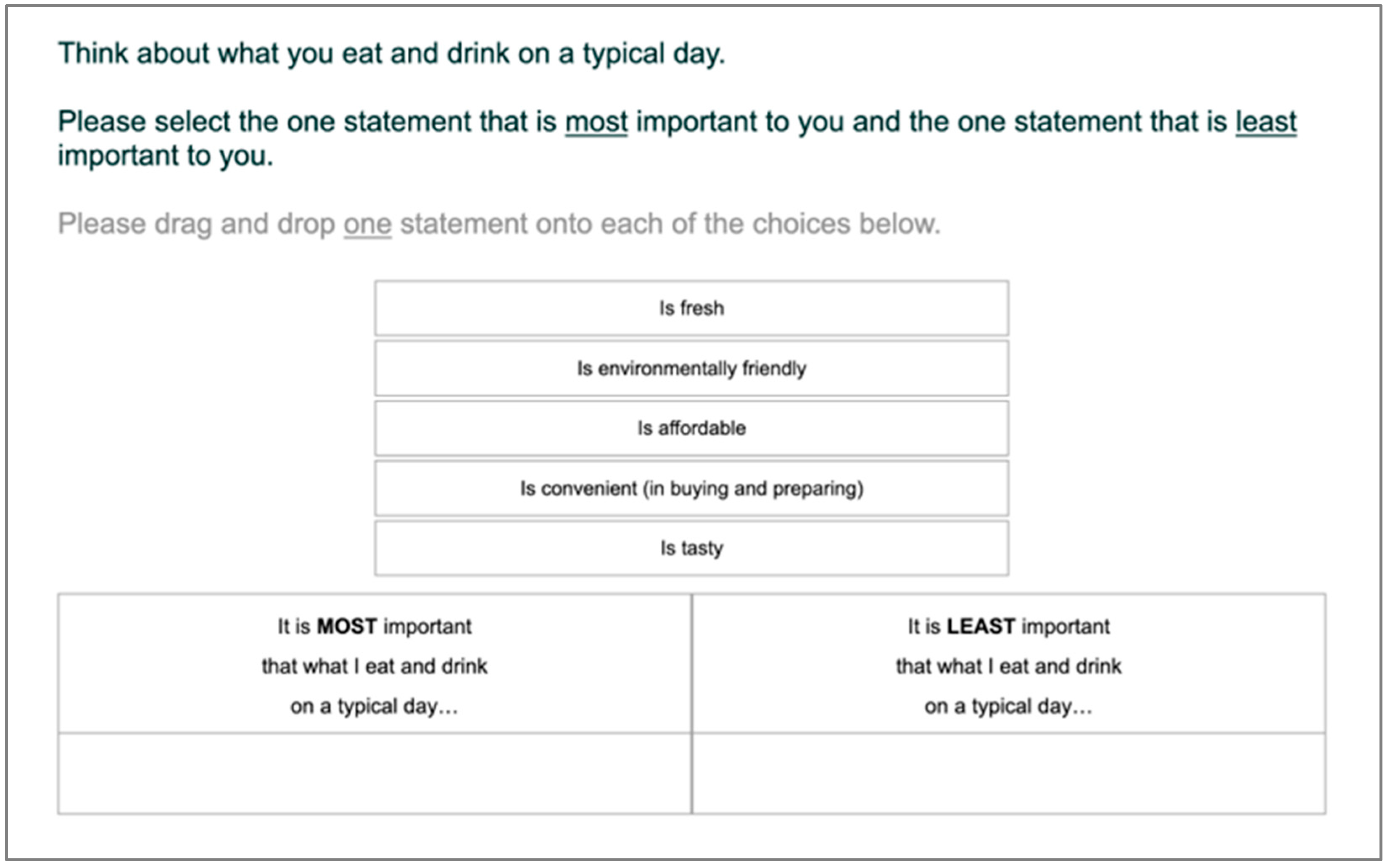
3.2.2. Case-1 Best–Worst Scaling
3.3. Participant Profiling and Data Collection
3.4. Data Cleaning and Analysis
3.4.1. Data Cleaning
3.4.2. Data Analysis
4. Results
4.1. Importance Scores of the Aggregate Sample
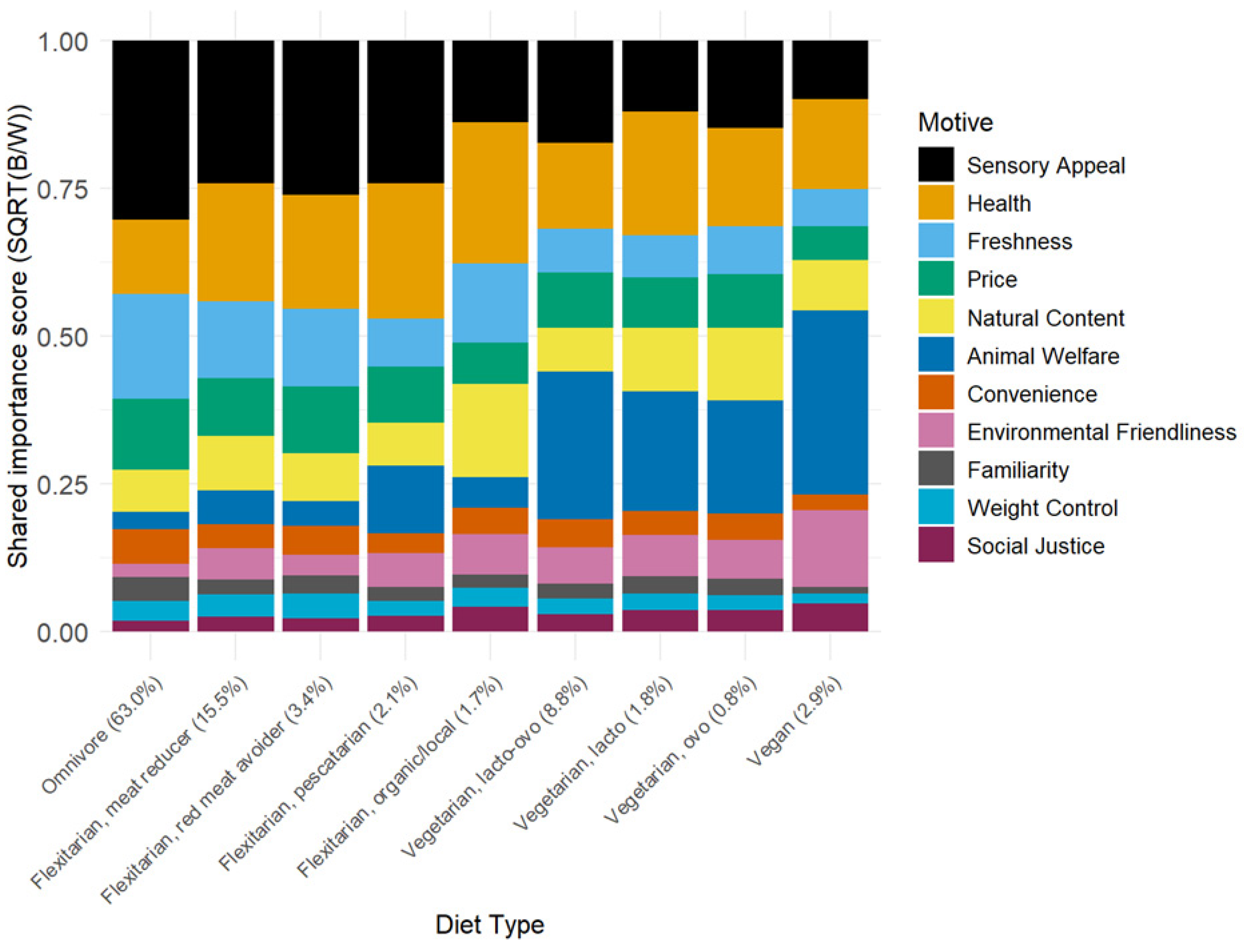
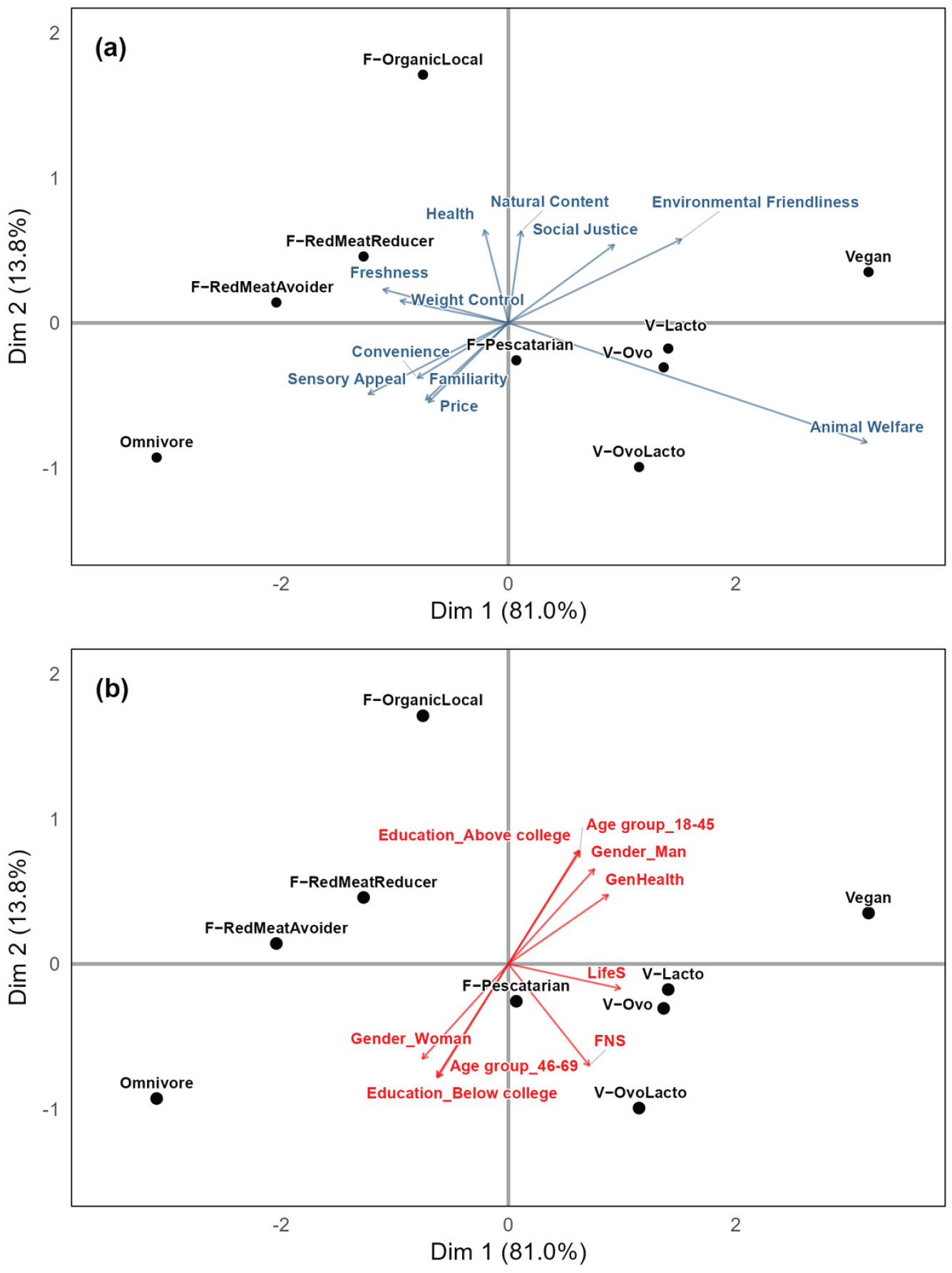
4.2. B–W Scores by Diet Group
5. Discussion
5.1. What Does the Relative Importance Assigned to Food Choice Motives Reveal About the Changes Required to Move Towards More Sustainable Food Practices?
5.1.1. Aggregate-Level Results
5.1.2. Diet Group Comparisons
5.2. Limitations and Suggestions for Future Research
5.2.1. Sample, Diet Groups and Food Choice Motives
5.2.2. Research Methodology
6. Conclusions
Supplementary Materials
Author Contributions
Funding
Institutional Review Board Statement
Informed Consent Statement
Data Availability Statement
Acknowledgments
Conflicts of Interest
References
- Harguess, J.M.; Crespo, N.C.; Hong, M.Y. Strategies to reduce meat consumption: A systematic literature review of experimental studies. Appetite 2020, 144, 104478. [Google Scholar] [CrossRef]
- Kwasny, T.; Dobernig, K.; Riefler, P. Towards reduced meat consumption: A systematic literature review of intervention effectiveness, 2001–2019. Appetite 2022, 168, 105739. [Google Scholar] [CrossRef]
- Ronto, R.; Saberi, G.; Leila Robbers, G.M.; Godrich, S.; Lawrence, M.; Somerset, S.; Fanzo, J.; Chau, J.Y. Identifying effective interventions to promote consumption of protein-rich foods from lower ecological footprint sources: A systematic literature review. PLoS Glob. Public Health 2022, 2, e0000209. [Google Scholar] [CrossRef] [PubMed]
- Wadi, N.M.; Cheikh, K.; Keung, Y.W.; Green, R. Investigating intervention components and their effectiveness in promoting environmentally sustainable diets: A systematic review. Lancet Planet. Health 2024, 8, e410–e422. [Google Scholar] [CrossRef]
- Willett, W.; Rockstrom, J.; Loken, B.; Springmann, M.; Lang, T.; Vermeulen, S.; Garnett, T.; Tilman, D.; DeClerck, F.; Wood, A.; et al. Food in the Anthropocene: The EAT-Lancet Commission on healthy diets from sustainable food systems. Lancet 2019, 393, 447–492. [Google Scholar] [CrossRef]
- Prescott, J. Taste Matters. Why We Like the Foods We Do; Reaktion Books: London, UK, 2012. [Google Scholar]
- Verain, M.C.D.; Dagevos, H.; Jaspers, P. Flexitarianism in the Netherlands in the 2010 decade: Shifts, consumer segments and motives. Food Qual. Prefer. 2022, 96, 104445. [Google Scholar] [CrossRef]
- Steptoe, A.; Pollard, T.M.; Wardle, J. Development of a measure of the motives underlying the selection of food: The Food Choice Questionnaire. Appetite 1995, 25, 267–284. [Google Scholar] [CrossRef] [PubMed]
- Pollard, T.M.; Steptoe, A.; Wardle, J. Motives underlying healthy eating: Using the Food Choice Questionnaire to explain variation in dietary intake. J. Biosoc. Sci. 1998, 30, 165–179. [Google Scholar] [CrossRef]
- Kim, G.; Oh, J.; Cho, M. Differences between Vegetarians and Omnivores in Food Choice Motivation and Dietarian Identity. Foods 2022, 11, 539. [Google Scholar] [CrossRef]
- Hopwood, C.J.; Piazza, J.; Chen, S.; Bleidorn, W. Development and validation of the motivations to Eat Meat Inventory. Appetite 2021, 163, 105210. [Google Scholar] [CrossRef]
- Graca, J.; Calheiros, M.M.; Oliveira, A. Attached to meat? (Un)Willingness and intentions to adopt a more plant-based diet. Appetite 2015, 95, 113–125. [Google Scholar] [CrossRef]
- Perez-Cueto, F.J.A.; Rini, L.; Faber, I.; Rasmussen, M.A.; Bechtold, K.-B.; Schouteten, J.J.; De Steur, H. How barriers towards plant-based food consumption differ according to dietary lifestyle: Findings from a consumer survey in 10 EU countries. Int. J. Gastron. Food Sci. 2022, 29, 100587. [Google Scholar] [CrossRef]
- Mussig, M.; Pfeiler, T.M.; Egloff, B. Why They Eat What They Eat: Comparing 18 Eating Motives Among Omnivores and Veg*ns. Front. Nutr. 2022, 9, 780614. [Google Scholar] [CrossRef]
- Miki, A.J.; Livingston, K.A.; Karlsen, M.C.; Folta, S.C.; McKeown, N.M. Using Evidence Mapping to Examine Motivations for Following Plant-Based Diets. Curr. Dev. Nutr. 2020, 4, nzaa013. [Google Scholar] [CrossRef]
- Lentz, G.; Connelly, S.; Mirosa, M.; Jowett, T. Gauging attitudes and behaviours: Meat consumption and potential reduction. Appetite 2018, 127, 230–241. [Google Scholar] [CrossRef]
- Wang, O.; Scrimgeour, F. Willingness to adopt a more plant-based diet in China and New Zealand: Applying the theories of planned behaviour, meat attachment and food choice motives. Food Qual. Prefer. 2021, 93, 104294. [Google Scholar] [CrossRef]
- Appleton, K.M.; Dinnella, C.; Spinelli, S.; Morizet, D.; Saulais, L.; Hemingway, A.; Monteleone, E.; Depezay, L.; Perez-Cueto, F.J.A.; Hartwell, H. Consumption of a High Quantity and a Wide Variety of Vegetables Are Predicted by Different Food Choice Motives in Older Adults from France, Italy and the UK. Nutrients 2017, 9, 923. [Google Scholar] [CrossRef] [PubMed]
- Krishnamurti, H.; Forestell, C.A. The role of vegetarianism, gender, and food choice motivations on vegetable intake among university students. J. Am. Coll. Health 2025, 73, 1940–1950. [Google Scholar] [CrossRef]
- Festinger, L. Cognitive Dissonance. Sci. Am. 1962, 207, 93–106. [Google Scholar] [CrossRef] [PubMed]
- Dagevos, H. Finding flexitarians: Current studies on meat eaters and meat reducers. Trends Food Sci. Technol. 2021, 114, 530–539. [Google Scholar] [CrossRef]
- Malek, L.; Umberger, W.J. How flexible are flexitarians? Examining diversity in dietary patterns, motivations and future intentions. Clean. Responsible Consum. 2021, 3, 100038. [Google Scholar] [CrossRef]
- De Backer, C.J.; Hudders, L. From Meatless Mondays to Meatless Sundays: Motivations for Meat Reduction among Vegetarians and Semi-vegetarians Who Mildly or Significantly Reduce Their Meat Intake. Ecol. Food Nutr. 2014, 53, 639–657. [Google Scholar] [CrossRef]
- Cliceri, D.; Spinelli, S.; Dinnella, C.; Prescott, J.; Monteleone, E. The influence of psychological traits, beliefs and taste responsiveness on implicit attitudes toward plant- and animal-based dishes among vegetarians, flexitarians and omnivores. Food Qual. Pref. 2018, 68, 276–291. [Google Scholar] [CrossRef]
- Hanras, E.; Mathieu, S.; Chevrier, B.; Boujut, E.; Dorard, G. Vegans, strict vegetarians, partial vegetarians, omnivores: Do they differ in food choice motives, coping, and quality of life? La Presse Médicale Open 2022, 3, 100033. [Google Scholar] [CrossRef]
- Sheen, F.; Lim, A.J.; Forde, C.G. Diversity among flexitarian consumers; stratifying meat reducers by their underlying motivations to move to a plant-based diet. Food Qual. Prefer. 2023, 112, 105022. [Google Scholar] [CrossRef]
- Dorard, G.; Mathieu, S. Vegetarian and omnivorous diets: A cross-sectional study of motivation, eating disorders, and body shape perception. Appetite 2021, 156, 104972. [Google Scholar] [CrossRef]
- Mullee, A.; Vermeire, L.; Vanaelst, B.; Mullie, P.; Deriemaeker, P.; Leenaert, T.; De Henauw, S.; Dunne, A.; Gunter, M.J.; Clarys, P.; et al. Vegetarianism and meat consumption: A comparison of attitudes and beliefs between vegetarian, semi-vegetarian, and omnivorous subjects in Belgium. Appetite 2017, 114, 299–305. [Google Scholar] [CrossRef]
- North, M.; Klas, A.; Ling, M.; Kothe, E. A qualitative examination of the motivations behind vegan, vegetarian, and omnivore diets in an Australian population. Appetite 2021, 167, 105614. [Google Scholar] [CrossRef]
- Dhont, K.; Ioannidou, M. Similarities and differences between vegetarians and vegans in motives for meat-free and plant-based diets. Appetite 2024, 195, 107232. [Google Scholar] [CrossRef]
- Jabs, J.; Devine, C.M.; Sobal, J. Model of the Process of Adopting Vegetarian Diets: Health Vegetarians and Ethical Vegetarians. J. Nutr. Edu 1998, 30, 196–202. [Google Scholar] [CrossRef]
- De Backer, C.J.; Hudders, L. Meat morals: Relationship between meat consumption consumer attitudes towards human and animal welfare and moral behavior. Meat Sci. 2015, 99, 68–74. [Google Scholar] [CrossRef]
- Verain, M.C.D.; Snoek, H.M.; Onwezen, M.C.; Reinders, M.J.; Bouwman, E.P. Sustainable food choice motives: The development and cross-country validation of the Sustainable Food Choice Questionnaire (SUS-FCQ). Food Qual. Prefer. 2021, 93, 104267. [Google Scholar] [CrossRef]
- Lindeman, M.; Vaananen, M. Measurement of ethical food choice motives. Appetite 2000, 34, 55–59. [Google Scholar] [CrossRef]
- Onwezen, M.C.; Reinders, M.J.; Verain, M.C.D.; Snoek, H.M. The development of a single-item Food Choice Questionnaire. Food Qual. Prefer. 2019, 71, 34–45. [Google Scholar] [CrossRef]
- Markovina, J.; Stewart-Knox, B.J.; Rankin, A.; Gibney, M.; de Almeida, M.D.V.; Fischer, A.; Kuznesof, S.A.; Poínhos, R.; Panzone, L.; Frewer, L.J. Food4Me study: Validity and reliability of Food Choice Questionnaire in 9 European countries. Food Qual. Prefer. 2015, 45, 26–32. [Google Scholar] [CrossRef]
- Louviere, J.J.; Flynn, T.N.; Marley, A.A.J. Best-Worst Scaling: Theory, Methods and Applications; Cambridge University Press: Cambridge, UK, 2015. [Google Scholar]
- Marley, A.A.J.; Louviere, J.J. Some probabilistic models of best, worst, and best-worst choices. J. Math. Psychol. 2005, 49, 464–480. [Google Scholar] [CrossRef]
- Hair, J.F.; Ortinau, D.J.; Harrison, D.E. Essentials of Marketing Research, 6th ed.; McGraw Hill Education: New York, NY, USA, 2024. [Google Scholar]
- Llobell, F.; Choisy, P.; Chheang, S.L.; Jaeger, S.R. Measurement and evaluation of participant response consistency in Case 1 Best-Worst-Scaling (BWS) in food consumer science. Food Qual. Prefer. 2025, 123, 105335. [Google Scholar] [CrossRef]
- Liem, D.G. The future of online or web-based research. Have you been BOTTED? Appetite 2025, 213, 108058. [Google Scholar] [CrossRef]
- Asioli, D.; Jaeger, S.R. Online consumer research: More attention needs to be given to data quality. Curr. Opin. Food Sci. 2025, 63, 101307. [Google Scholar] [CrossRef]
- ISO 20252:2019; Market, Opinion and Social Research, Including Insights and Data Analytics—Vocabulary and Service Requirements. International Organization for Standardization: Genève, Switzerland, 2019.
- Pliner, P.; Hobden, K. Development of a scale to measure the trait of food neophobia in humans. Appetite 1992, 19, 105–120. [Google Scholar] [CrossRef] [PubMed]
- Ware, J., Jr.; Kosinski, M.; Keller, S.D. A 12-Item Short-Form Health Survey: Construction of scales and preliminary tests of reliability and validity. Med. Care 1996, 34, 220–233. [Google Scholar] [CrossRef] [PubMed]
- Diener, E.; Inglehart, R.; Tay, L. Theory and Validity of Life Satisfaction Scales. Soc. Indic. Res. 2013, 112, 497–527. [Google Scholar] [CrossRef]
- Finn, A.; Louviere, J.J. Determining the Appropriate Response to Evidence of Public Concern—The Case of Food Safety. J. Public Policy Mark. 1992, 11, 12–25. [Google Scholar] [CrossRef]
- Thurstone, L.L. Psychophysical analysis. Am. J. Psychol. 1927, 38, 368–389. [Google Scholar] [CrossRef]
- Cochran, W.G.; Cox, G.M. Experimental Designs; Wiley: New York, NY, USA, 1992; p. 611. [Google Scholar]
- Jaeger, S.R.; Cardello, A.V. Factors affecting data quality of online questionnaires: Issues and metrics for sensory and consumer research. Food Qual. Prefer. 2022, 102, 104676. [Google Scholar] [CrossRef]
- Jaeger, S.R.; Chheang, S.L.; Llobell, F. Applications of the ErrVarNorm index in case 1 best-worst scaling and data quality insights. Food Qual. Prefer. 2026, 136, 105730. [Google Scholar] [CrossRef]
- Aizaki, H.; Fogarty, J. R packages and tutorial for case 1 best–worst scaling. J. Choice Model. 2023, 46, 100394. [Google Scholar] [CrossRef]
- Kuznetsova, A.; Brockhoff, P.B.; Christensen, R.H.B. lmerTest Package: Tests in Linear Mixed Effects Models. J. Stat. Softw. 2017, 82, 1–26. [Google Scholar] [CrossRef]
- Lenth, R.V. Emmeans: Estimated Marginal Means, Aka Least-Squares Means, R Package Version 1.7.2; R Foundation for Statistical Computing: Vienna, Austria, 2022.
- Kassambara, A.; Mundt, F. Factoextra: Extract and Visualize the Results of Multivariate Data Analyses; R Foundation for Statistical Computing: Vienna, Austria, 2016. [Google Scholar] [CrossRef]
- Jaeger, S.R.; Prescott, J.; Worch, T. Food neophobia modulates importance of food choice motives: Replication, extension, and behavioural validation. Food Qual. Prefer. 2022, 97, 104439. [Google Scholar] [CrossRef]
- Grant, N.; Wardle, J.; Steptoe, A. The relationship between life satisfaction and health behavior: A cross-cultural analysis of young adults. Int. J. Behav. Med. 2009, 16, 259–268. [Google Scholar] [CrossRef] [PubMed]
- Prescott, J.; Worch, T.; Chheang, S.L.; Jaeger, S.R. Food neophobia is associated with self-reported declines in both physical and mental health. In Proceedings of the EUROSENSE 2024: 11th European Conference on Sensory and Consumer Research, Dublin, Ireland, 8–11 September 2024. [Google Scholar]
- Henriquez Sanchez, P.; Ruano, C.; de Irala, J.; Ruiz-Canela, M.; Martinez-Gonzalez, M.A.; Sanchez-Villegas, A. Adherence to the Mediterranean diet and quality of life in the SUN Project. Eur. J. Clin. Nutr. 2012, 66, 360–368. [Google Scholar] [CrossRef] [PubMed]
- Prescott, J.; Chheang, S.L.; Jaeger, S.R. Food neophobia: Higher responsiveness to sensory properties but low engagement with foods generally. J. Sens. Stud. 2022, 37, e12771. [Google Scholar] [CrossRef]
- Bali, A.; Naik, R. The Impact of a Vegan Diet on Many Aspects of Health: The Overlooked Side of Veganism. Cureus 2023, 15, e35148. [Google Scholar] [CrossRef] [PubMed]
- Keller, C.; Siegrist, M. Does personality influence eating styles and food choices? Direct and indirect effects. Appetite 2015, 84, 128–138. [Google Scholar] [CrossRef] [PubMed]
- Goldberg, L.R. An alternative “description of personality”: The big-five factor structure. J. Pers. Soc. Psychol. 1990, 59, 1216–1229. [Google Scholar] [CrossRef]
- Reist, M.E.; Bleidorn, W.; Milfont, T.L.; Hopwood, C.J. Meta-analysis of personality trait differences between omnivores, vegetarians, and vegans. Appetite 2023, 191, 107085. [Google Scholar] [CrossRef]
- Plante, C.N.; Rosenfeld, D.L.; Plante, M.; Reysen, S. The role of social identity motivation in dietary attitudes and behaviors among vegetarians. Appetite 2019, 141, 104307. [Google Scholar] [CrossRef]
- Randers, L.; Thogersen, J. Meat, myself, and I: The role of multiple identities in meat consumption. Appetite 2023, 180, 106319. [Google Scholar] [CrossRef]
- Moskowitz, H. Food and Drink: Thoughts on Base Size in Sensory and Consumer Research. Edelweiss Appl. Sci. Technol. 2020, 4, 37–40. [Google Scholar] [CrossRef]
- Lockwood, A. Vegan Studies and Gender Studies. In The Routledge Handbook of Vegan Studies; Wright, L., Ed.; Routledge: New York, NY, USA, 2021; pp. 295–305. [Google Scholar]
- Sprake, E.F.; Russell, J.M.; Cecil, J.E.; Cooper, R.J.; Grabowski, P.; Pourshahidi, L.K.; Barker, M.E. Dietary patterns of university students in the UK: A cross-sectional study. Nutr. J. 2018, 17, 90. [Google Scholar] [CrossRef]
- Teucher, B.; Skinner, J.; Skidmore, P.M.; Cassidy, A.; Fairweather-Tait, S.J.; Hooper, L.; Roe, M.A.; Foxall, R.; Oyston, S.L.; Cherkas, L.F.; et al. Dietary patterns and heritability of food choice in a UK female twin cohort. Twin Res. Hum. Genet. 2007, 10, 734–748. [Google Scholar] [CrossRef]
- Furst, T.; Connors, M.; Bisogni, C.A.; Sobal, J.; Falk, L.W. Food choice: A conceptual model of the process. Appetite 1996, 26, 247–265. [Google Scholar] [CrossRef] [PubMed]
- Auger, P.; Devinney, T.M.; Louviere, J.J.; Burke, P.F. Do social product features have value to consumers? Int. J. Res. Mark. 2008, 25, 183–191. [Google Scholar] [CrossRef]
- Burke, P.F.; Rose, J.M.; Fifer, S.; Masters, D.; Kuegler, S.; Cabrera, A. A new subjective well-being index using anchored best-worst scaling. Soc. Sci. Res. 2024, 120, 103013. [Google Scholar] [CrossRef]
- Crocker, C.; Thomson, D.M.H. Anchored scaling in best-worst experiments: A process for facilitating comparison of conceptual profiles. Food Qual. Prefer. 2014, 33, 37–53. [Google Scholar] [CrossRef]
- Lagerkvist, C.J.; Kokko, S.; Karanja, N. Health in perspective: Framing motivational factors for personal sanitation in urban slums in Nairobi, Kenya, using anchored best-worst scaling. J. Water Sanit. Hyg. Dev. 2014, 4, 108–119. [Google Scholar] [CrossRef]
- Goldammer, P.; Annen, H.; Stöckli, P.L.; Jonas, K. Careless responding in questionnaire measures: Detection, impact, and remedies. Leadersh. Q. 2020, 31, 101384. [Google Scholar] [CrossRef]
- Schonlau, M.; Toepoel, V. Straightlining in Web survey panels over time. Surv. Res. Methods 2015, 9, 125–137. [Google Scholar] [CrossRef]



| Study | N (%) | Dietary Groups |
|---|---|---|
| 1 | 1365 (26.7) | All dietary groups allowed |
| 2 | 1330 (26.0) | Vegetarians and vegans excluded |
| 3 | 1096 (21.4) | Vegans excluded |
| 4 | 1320 (25.8) | Vegetarians and vegans excluded |
| Diet Group | Statements | N | % |
|---|---|---|---|
| Omnivore | I regularly eat red meat, fish, and chicken. | 3221 | 63.0 |
| Flexitarian (meat reducer) | I consciously reduce meat intake, but eat meat now and then. | 793 | 15.5 |
| Flexitarian (red meat avoider) | I do not eat red meat, but I eat fish, chicken, and other poultry. | 175 | 3.4 |
| Flexitarian (pescatarian) | I do not eat red meat or chicken, but I eat fish and shellfish. | 105 | 2.1 |
| Flexitarian (organic/local) | I eat organic and locally grown foods, with a great overlap with foods consumed in a vegetarian diet, yet also including certain kinds of meat. | 89 | 1.7 |
| Vegetarian (lacto-ovo) | I do not eat meat or fish, but I eat eggs and dairy products. | 450 | 8.8 |
| Vegetarian (lacto) | I do not eat meat, fish, or eggs, but I eat dairy products. | 90 | 1.8 |
| Vegetarian (ovo) | I do not eat meat, fish, or dairy products, but I eat eggs. | 42 | 0.8 |
| Vegan | I do not eat meat, and I do not use products of animal origin. | 146 | 2.9 |
| Characteristic | Overall | Omnivore 1 | Flexitarian, Meat Reducer | Flexitarian, Red Meat Avoider | Flexitarian, Pescatarian | Flexitarian, Organic/Local | Vegetarian, Lacto-Ovo | Vegetarian, Lacto | Vegetarian, Ovo | Vegan | p-Value 6 |
|---|---|---|---|---|---|---|---|---|---|---|---|
| N (%) | 5111 (100%) | 3221 (63.0%) | 793 (15.5%) | 175 (3.4%) | 105 (2.1%) | 89 (1.7%) | 450 (8.8%) | 90 (1.8%) | 42 (0.8%) | 146 (2.9%) | |
| Gender (%) | <0.001 | ||||||||||
| Woman | 53.5 | 49.6 | 59.0 | 68.6 | 71.4 | 57.3 | 63.3 | 61.1 | 69.0 | 35.6 | |
| Man | 46.1 | 50.2 | 40.4 | 31.4 | 27.6 | 42.7 | 35.6 | 38.9 | 28.6 | 63.0 | |
| Other | 0.4 | 0.2 | 0.6 | 0 | 1.0 | 0 | 1.1 | 0 | 2.4 | 1.4 | |
| Age Group (%) | <0.001 | ||||||||||
| 18–45 y.o. | 43.4 | 43.2 | 40.0 | 39.4 | 36.2 | 59.6 | 45.6 | 44.4 | 47.6 | 58.2 | |
| 46–69 y.o. | 56.6 | 56.8 | 60.0 | 60.6 | 63.8 | 40.4 | 54.4 | 55.6 | 52.4 | 41.8 | |
| Household Size (%) | 0.012 | ||||||||||
| 1–2 people | 56.6 | 55.6 | 58.5 | 60.0 | 73.3 | 40.4 | 56.0 | 61.1 | 66.7 | 56.8 | |
| 3–4 people | 36.5 | 37.1 | 34.3 | 33.1 | 22.9 | 47.2 | 38.9 | 35.6 | 19.0 | 39.0 | |
| 5 or more people | 6.7 | 7.1 | 6.6 | 6.9 | 2.9 | 12.4 | 4.9 | 3.3 | 14.3 | 4.1 | |
| Prefer not to answer | 0.3 | 0.2 | 0.6 | 0 | 1.0 | 0 | 0.2 | 0 | 0 | 0 | |
| Education 2 (%) | <0.001 | ||||||||||
| Higher educational attainment | 58.6 | 54.9 | 64.7 | 56.0 | 74.3 | 73.0 | 65.8 | 57.8 | 69.0 | 65.8 | |
| Lower educational attainment | 38.6 | 42.0 | 32.5 | 41.1 | 24.8 | 24.7 | 31.3 | 41.1 | 31.0 | 32.9 | |
| Other | 1.9 | 2.1 | 1.6 | 1.7 | 0 | 1.1 | 2.2 | 0 | 0 | 0.7 | |
| Prefer not to answer | 0.9 | 0.9 | 1.1 | 1.1 | 1.0 | 1.1 | 0.7 | 1.1 | 0 | 0.7 | |
| Employment (%) | <0.001 | ||||||||||
| Working full time (≥30 h per week) | 51.1 | 51.8 | 48.5 | 40.6 | 43.8 | 67.4 | 52.7 | 44.4 | 52.4 | 57.5 | |
| Working part-time (<30 h per week) | 16.8 | 15.7 | 17.8 | 22.3 | 23.8 | 11.2 | 18.4 | 23.3 | 11.9 | 21.9 | |
| Unpaid work/home duties | 5.7 | 5.3 | 6.2 | 8.0 | 2.9 | 3.4 | 8.2 | 8.9 | 7.1 | 2.1 | |
| Student | 2.7 | 2.7 | 1.9 | 3.4 | 0 | 2.2 | 3.3 | 6.7 | 7.1 | 1.4 | |
| Unemployed | 6.3 | 6.4 | 5.8 | 9.1 | 6.7 | 3.4 | 5.6 | 5.6 | 4.8 | 9.6 | |
| Retired | 14.5 | 15.3 | 16.9 | 14.9 | 17.1 | 6.7 | 9.6 | 6.7 | 9.5 | 6.8 | |
| Other | 1.9 | 2.0 | 2.0 | 1.1 | 1.0 | 3.4 | 1.3 | 3.3 | 4.8 | 0 | |
| Prefer not to answer | 0.9 | 0.7 | 0.9 | 0.6 | 4.8 | 2.2 | 0.9 | 1.1 | 2.4 | 0.7 | |
| Food Neophobia Score 3 | 33.2 (11.8) | 32.8 (12.0) | 31.7 (11.3) | 36.9 (11.4) | 31.5 (11.8) | 30.7 (10.2) | 35.7 (11.2) | 39.7 (12.0) | 38.9 (10.8) | 34.4 (10.8) | <0.001 |
| Overall General Health 4 | 3.0 (1.1) | 3.0 (1.1) | 2.9 (1.2) | 3.1 (1.1) | 2.9 (1.2) | 3.0 (1.3) | 3.2 (1.1) | 2.8 (1.1) | 3.2 (1.2) | 2.4 (1.1) | <0.001 |
| Missing data/Prefer not to answer (%) | 26.0 | 31.0 | 32.0 | 33.0 | 7.6 | 15.0 | 1.3 | 2.2 | 2.4 | 1.4 | |
| Life Satisfaction 5 | 6.6 (2.3) | 6.6 (2.3) | 6.6 (2.3) | 6.8 (2.1) | 6.5 (2.3) | 7.1 (1.9) | 6.6 (2.2) | 5.8 (2.5) | 6.3 (2.4) | 6.5 (2.4) | 0.021 |
| Prefer not to answer (%) | 0.2 | <0.1 | 0.1 | 0.0 | 0.0 | 0.0 | 0.2 | 3.3 | 2.4 | 0.0 |
| Food Choice Motive | Mean (B-W) | SD (B-W) | Relative Importance |
|---|---|---|---|
| Sensory Appeal | 2.2 a | 2.1 | 100 |
| Health | 1.3 b | 2.0 | 57 |
| Freshness | 1.1 bc | 1.7 | 55 |
| Price | 1.0 c | 2.3 | 43 |
| Natural Content | 0.3 d | 1.7 | 31 |
| Animal Welfare | −0.2 e | 2.3 | 21 |
| Convenience | −0.4 f | 2.5 | 21 |
| Env. Friendliness | −1.0 g | 2.1 | 14 |
| Familiarity | −1.0 g | 2.0 | 13 |
| Weight Control | −1.4 h | 2.6 | 13 |
| Social Justice | −1.8 i | 2.1 | 9 |
| Food Choice Motive | Omnivore (63.0%) | Flexitarian, Meat Reducer (15.5%) | Flexitarian, Red Meat Avoider (3.4%) | Flexitarian, Pescatarian (2.1%) | Flexitarian: Organic/Local (1.7%) | Vegetarian: Lacto-Ovo (8.8%) | Vegetarian: Lacto (1.8%) | Vegetarian: Ovo (0.8%) | Vegan (2.9%) |
|---|---|---|---|---|---|---|---|---|---|
| Sensory Appeal | 2.6 a | 1.8 a | 1.9 a | 1.9 a | 1.2 ab | 1.5 b | 0.9 bc | 0.9 ab | 0.5 c |
| Health | 1.1 c | 1.8 a | 1.9 a | 1.7 ab | 2.1 a | 1.2 b | 1.5 ab | 1.4 ab | 1.3 b |
| Freshness | 1.4 b | 1.0 b | 1.1 b | 0.5 cd | 1.0 bc | 0.2 cd | 0.1 c | 0.2 bc | 0.0 cd |
| Price | 1.3 b | 0.8 bc | 0.9 bc | 0.8 bcd | 0.1 cd | 0.6 c | 0.4 c | 0.5 b | −0.1 cd |
| Natural Content | 0.2 d | 0.6 c | 0.3 c | 0.3 cd | 1.3 ab | 0.2 d | 0.7 bc | 0.8 ab | 0.5 c |
| Animal Welfare | −0.9 g | −0.1 d | −0.5 d | 1.2 abc | −0.3 de | 2.3 a | 2.2 a | 2.2 a | 3.1 a |
| Convenience | −0.1 e | −1.0 e | −0.7 de | −1.3 e | −1.0 ef | −0.7 e | −1.2 d | −1.1 cd | −1.7 e |
| Env. Friendliness | −1.5 i | −0.3 d | −0.9 de | 0.0 d | 0.0 de | −0.1 d | 0.1 c | −0.1 bc | 1.3 b |
| Familiarity | −0.7 f | −1.5 f | −1.3 ef | −1.6 e | −2.0 g | −1.7 fg | −1.6 d | −1.6 d | −2.2 ef |
| Weight Control | −1.3 h | −1.4 ef | −1.1 def | −1.8 e | −1.5 fg | −2.1 g | −1.9 d | −2.1 d | −2.4 f |
| Social Justice | −2.1 j | −1.6 f | −1.7 f | −1.6 e | −0.9 def | −1.4 f | −1.1 d | −1.0 cd | −0.4 d |
Disclaimer/Publisher’s Note: The statements, opinions and data contained in all publications are solely those of the individual author(s) and contributor(s) and not of MDPI and/or the editor(s). MDPI and/or the editor(s) disclaim responsibility for any injury to people or property resulting from any ideas, methods, instructions or products referred to in the content. |
© 2026 by the authors. Licensee MDPI, Basel, Switzerland. This article is an open access article distributed under the terms and conditions of the Creative Commons Attribution (CC BY) license.
Share and Cite
Jaeger, S.R.; Andersen, G.B.H.; Prescott, J. Omnivores, Flexitarians, Vegetarians, and Vegans Attach Different Importance to Eleven Motives for Daily Food Choice Decisions: Findings from 5111 UK Adults. Foods 2026, 15, 617. https://doi.org/10.3390/foods15040617
Jaeger SR, Andersen GBH, Prescott J. Omnivores, Flexitarians, Vegetarians, and Vegans Attach Different Importance to Eleven Motives for Daily Food Choice Decisions: Findings from 5111 UK Adults. Foods. 2026; 15(4):617. https://doi.org/10.3390/foods15040617
Chicago/Turabian StyleJaeger, Sara R., Glenn B. H. Andersen, and John Prescott. 2026. "Omnivores, Flexitarians, Vegetarians, and Vegans Attach Different Importance to Eleven Motives for Daily Food Choice Decisions: Findings from 5111 UK Adults" Foods 15, no. 4: 617. https://doi.org/10.3390/foods15040617
APA StyleJaeger, S. R., Andersen, G. B. H., & Prescott, J. (2026). Omnivores, Flexitarians, Vegetarians, and Vegans Attach Different Importance to Eleven Motives for Daily Food Choice Decisions: Findings from 5111 UK Adults. Foods, 15(4), 617. https://doi.org/10.3390/foods15040617