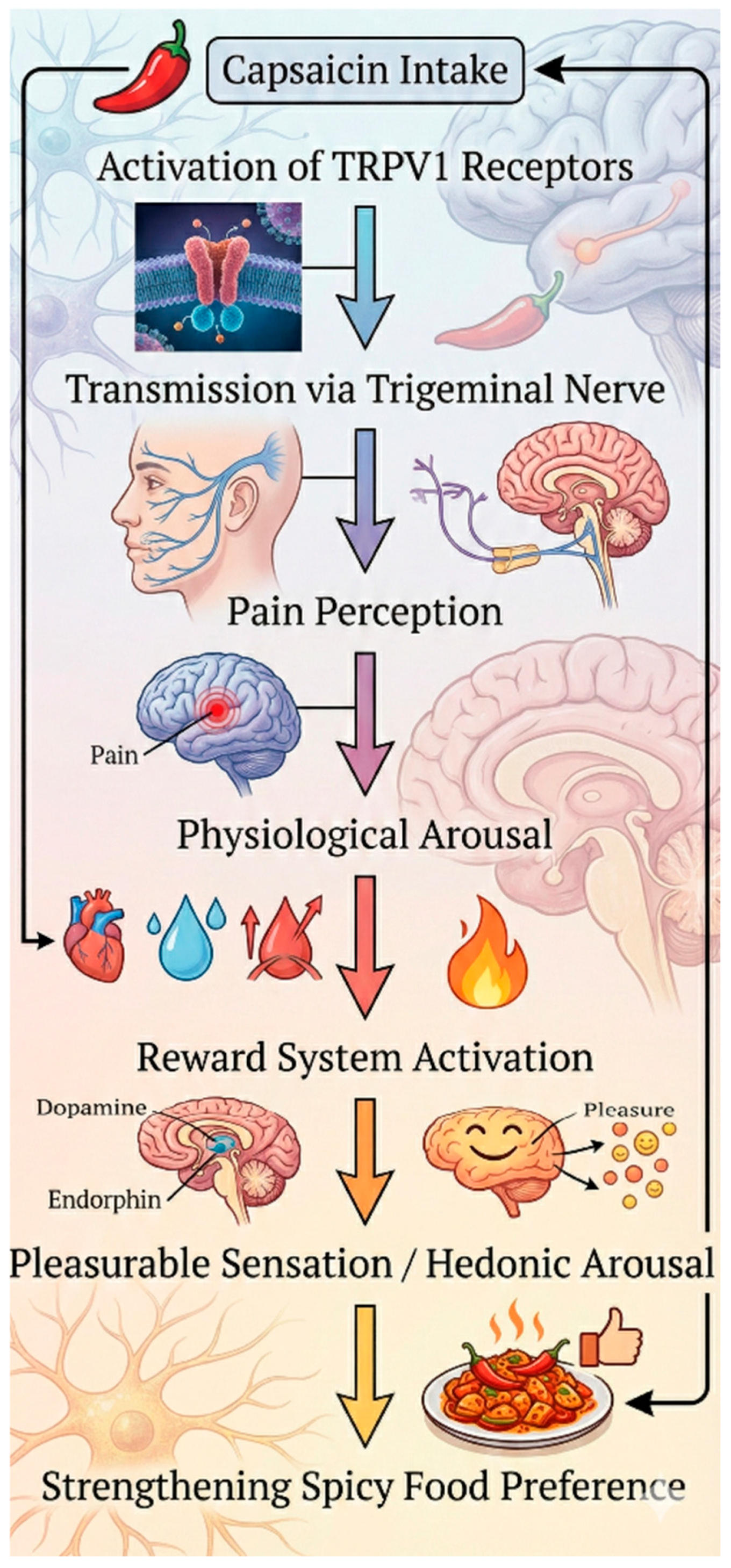
Spicy Personality: On the Relationship Between Personality Traits and the Preference for Spicy Foods


Abstract
1. Introduction
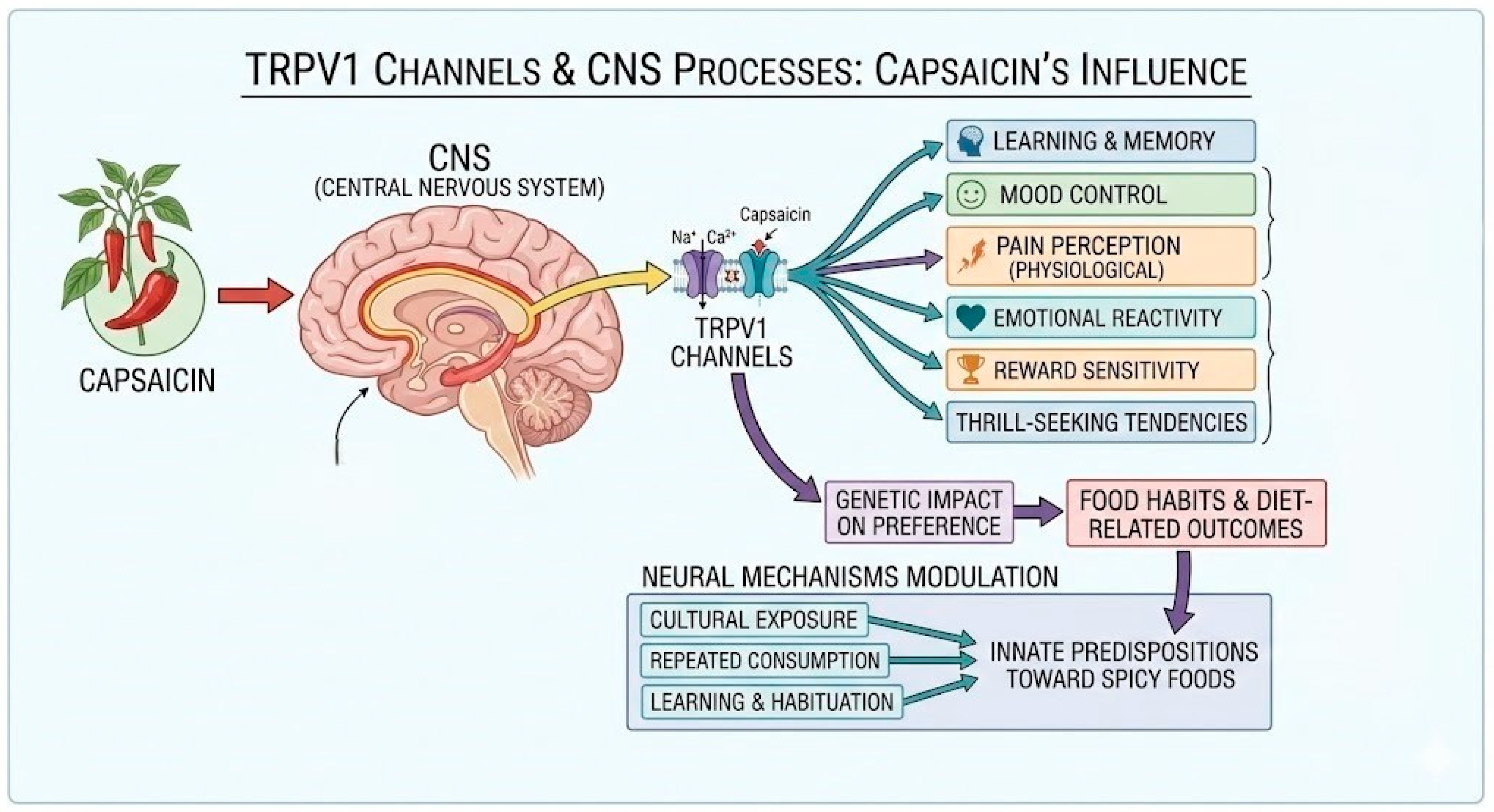
1.1. Genetic Underpinnings of the Preference for Spicy Food
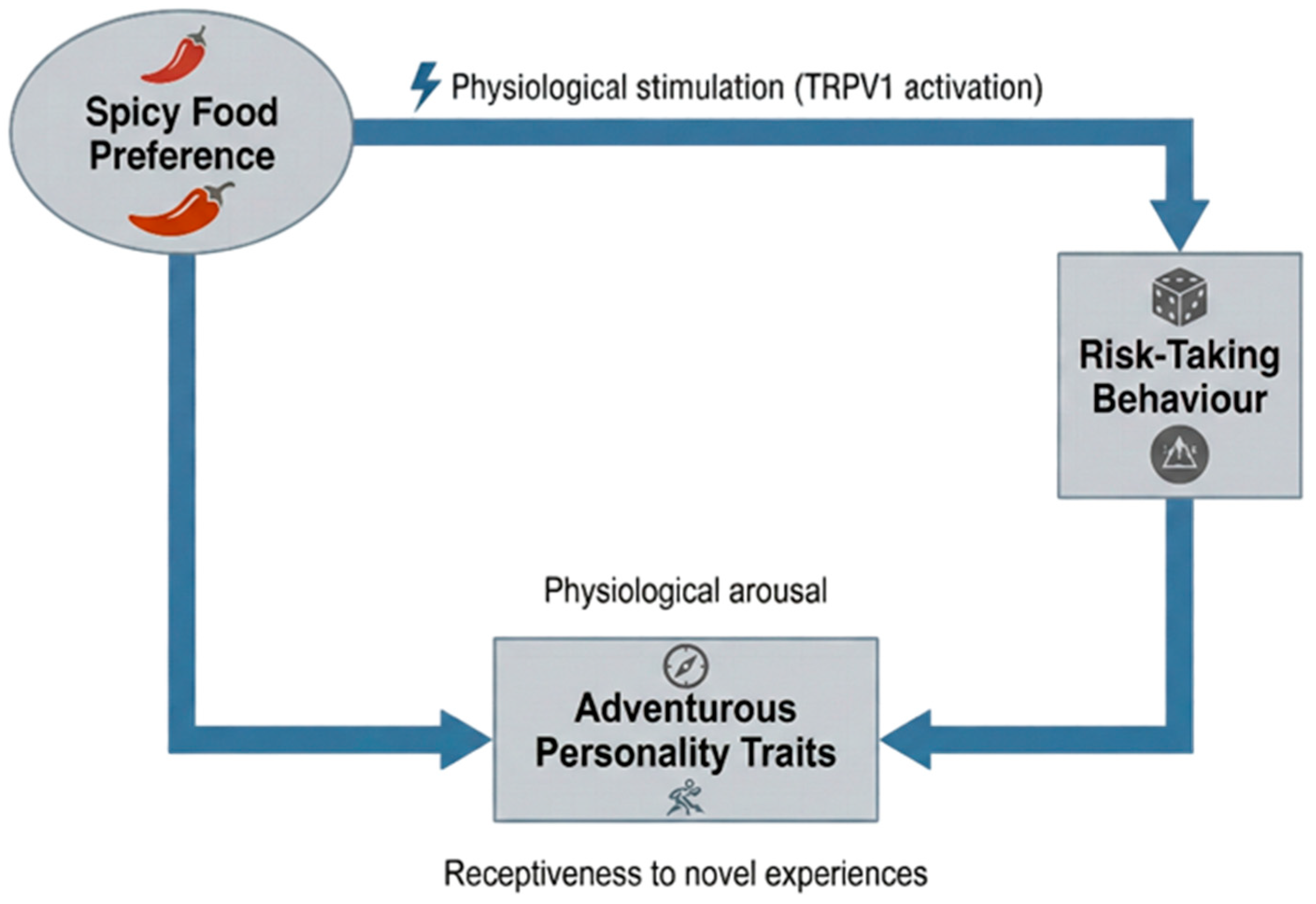
1.2. Personality and Cultural Influences on the Preference for Spicy Food
1.3. Sensory and Behavioural Mechanisms Shaping the Perception of Spicy Foods
2. Theoretical Background
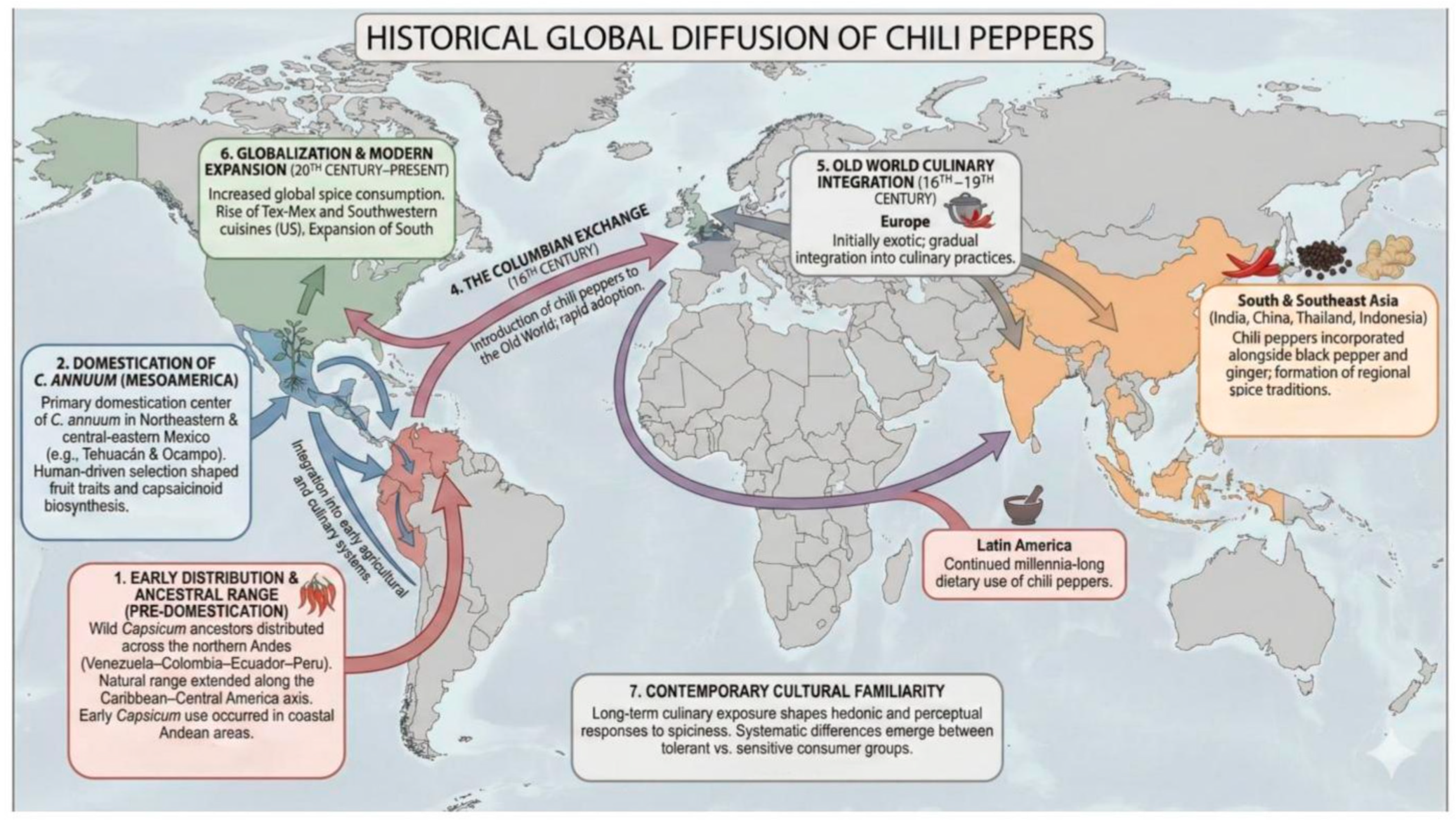
2.1. The History of Chili Pepper Consumption
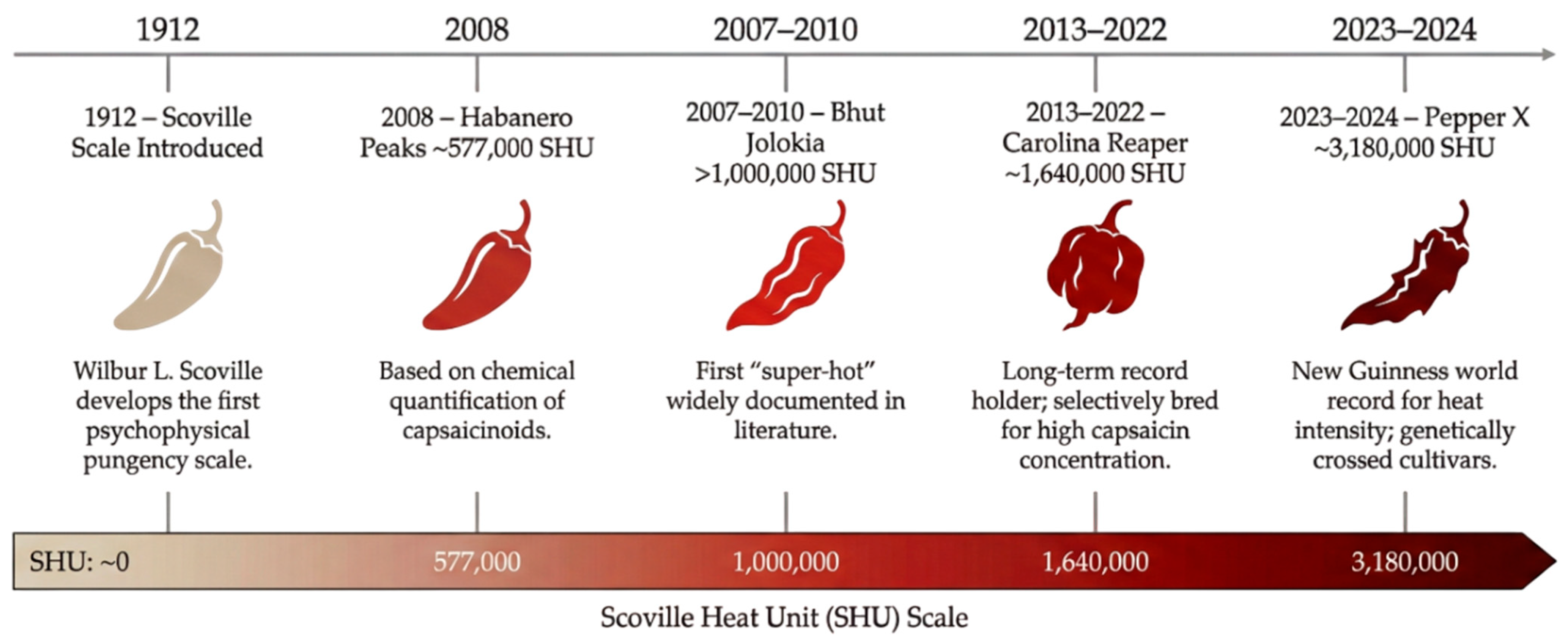
2.2. Evolution of Chili Pepper Spiciness: Measurement, Mechanisms, and Cultural Adaptation
2.3. Social Media, Spectacle, and the Performative Turn in Spicy Food Consumption
3. Multisensory Determinants of Preference for Spicy Food
4. The Evolution of Flavour (Or Taste) Preferences: From the Prenatal Stage Through to Childhood
5. Conclusions
Author Contributions
Funding
Institutional Review Board Statement
Informed Consent Statement
Data Availability Statement
Conflicts of Interest
References
- Cordell, G.A.; Araujo, O.E. Capsaicin: Identification, nomenclature, and pharmacotherapy. Ann. Pharmacother. 1993, 27, 330–336. [Google Scholar] [CrossRef]
- Ferrari, R. Writing narrative style literature reviews. Med. Writ. 2015, 24, 230–235. [Google Scholar] [CrossRef]
- Furley, P.; Goldschmied, N. Systematic vs. narrative reviews in sport and exercise psychology: Is either approach superior to the other? Front. Psychol. 2021, 12, 685082. [Google Scholar] [CrossRef]
- Behrens, M.; Gunn, H.; Ramos, P.; Meyerhof, W.; Wooding, S. Genetic, functional, and phenotypic diversity in TAS2R38-mediated bitter taste perception. Chem. Senses 2013, 38, 475–484. [Google Scholar] [CrossRef]
- Chamoun, E.; Mutch, D.M.; Allen-Vercoe, E.; Buchholz, A.C.; Duncan, A.M.; Spriet, L.L.; Guelph Family Health Study. A review of the associations between single nucleotide polymorphisms in taste receptors, eating behaviors, and health. Crit. Rev. Food Sci. Nutr. 2018, 58, 194–207. [Google Scholar] [CrossRef]
- Chen, P.J.; Antonelli, M. Conceptual models of food choice: Influential factors related to foods, individual differences, and society. Foods 2020, 9, 1898. [Google Scholar] [CrossRef] [PubMed]
- Dotson, C.; Babich, J.; Steinle, N. Genetic predisposition and taste preference: Impact on food intake and risk of chronic disease. Curr. Nutr. Rep. 2012, 1, 175–183. [Google Scholar] [CrossRef]
- Duffy, V.B.; Bartoshuk, L.M. Food acceptance and genetic variation in taste. J. Am. Diet. Assoc. 2000, 100, 647–655. [Google Scholar] [CrossRef]
- Li, Z.; Luo, Y.; Liu, W.; Chen, H. A systematic review of the relationship between taste and personality traits: Phenomena and possible mechanisms. Appetite 2025, 207, 107875. [Google Scholar] [CrossRef]
- Ramos-Lopez, O.; Martinez-Aceviz, Y.; Sobrevilla-Navarro, A.A.; Chavez-Mendez, J.R. Genetic influence on capsaicin tolerance: Precision nutrition implications for obesity handling. Lifestyle Genom. 2024, 17, 57–63. [Google Scholar] [CrossRef] [PubMed]
- Siebert, E.; Lee, S.-Y.; Prescott, M.P. Chili pepper preference development and its impact on dietary intake: A narrative review. Front. Nutr. 2022, 9, 1039207. [Google Scholar] [CrossRef]
- Żukowska, P.U.; Pepito, B.M.L.; Bolini, H.M.A.; Ross, C.F. Is this spicy? Investigation of factors that influence spicy food choices by US older adults. Food Qual. Prefer. 2025, 129, 105515. [Google Scholar] [CrossRef]
- Byrnes, N.K.; Hayes, J.E. Gender differences in the influence of personality traits on spicy food liking and intake. Food Qual. Prefer. 2015, 42, 12–19. [Google Scholar] [CrossRef]
- Fu, Y.; Deng, F.; Yang, S.; Xu, J. A bite of “masochism”: The psychological issues of eating spicy food. Adv. Psychol. Sci. 2018, 26, 1651–1660. [Google Scholar] [CrossRef]
- Wang, M.; Huang, W.; Xu, Y. Effects of spicy food consumption on overweight/obesity, hypertension and blood lipids in China: A meta-analysis of cross-sectional studies. Nutr. J. 2023, 22, 29. [Google Scholar] [CrossRef] [PubMed]
- Ma, C.; Song, Z.; Yan, X.; Zhao, G. Accounting for tastes: Do low-income populations have a higher preference for spicy foods? J. Chin. Sociol. 2018, 5, 17. [Google Scholar] [CrossRef]
- Cloninger, C.R.; Svrakic, D.M.; Przybeck, T.R. A psychobiological model of temperament and character. Arch. Gen. Psychiatry 1993, 50, 975–990. [Google Scholar] [CrossRef]
- Duffy, V.B.; Davidson, A.C.; Kidd, J.R.; Kidd, K.K.; Speed, W.C.; Pakstis, A.J.; Bartoshuk, L.M. Bitter receptor gene (TAS2R38), 6-n-propylthiouracil (PROP) bitterness and alcohol intake. Alcohol. Clin. Exp. Res. 2004, 28, 1629–1637. [Google Scholar] [CrossRef]
- Keskitalo, K.; Silventoinen, K.; Tuorila, H.; Perola, M.; Pietiläinen, K.H.; Rissanen, A.; Kaprio, J. Genetic and environmental contributions to food use patterns of young adult twins. Physiol. Behav. 2008, 93, 235–242. [Google Scholar] [CrossRef] [PubMed]
- van den Bree, M.B.; Eaves, L.J.; Dwyer, J.T. Genetic and environmental influences on eating patterns of twins aged ≥ 50 y. Am. J. Clin. Nutr. 1999, 70, 456–465. [Google Scholar] [CrossRef] [PubMed]
- Chahl, L. TRPV1 channels in the central nervous system as drug targets. Pharmaceuticals 2024, 17, 756. [Google Scholar] [CrossRef] [PubMed]
- Rozin, P.; Zellner, D. The role of Pavlovian conditioning in the acquisition of food likes and dislikes. Ann. N. Y. Acad. Sci. 1985, 443, 189–202. [Google Scholar] [CrossRef]
- Green, B.G.; Hayes, J.E. Individual differences in perception of bitterness from capsaicin, piperine and zingerone. Chem. Senses 2004, 29, 53–60. [Google Scholar] [CrossRef]
- Han, P.; Müller, L.; Hummel, T. Peri-threshold trigeminal stimulation with capsaicin increases taste sensitivity in humans. Chemosens. Percept. 2022, 15, 1–7. [Google Scholar] [CrossRef]
- Nolden, A.A.; Lenart, G.; Spielman, A.I.; Hayes, J.E. Inducible desensitization to capsaicin with repeated low-dose exposure in human volunteers. Physiol. Behav. 2024, 275, 114447. [Google Scholar] [CrossRef]
- Prescott, J.; Stevenson, R.J. Effects of oral chemical irritation on tastes and flavors in frequent and infrequent users of chili. Physiol. Behav. 1995, 58, 1117–1127. [Google Scholar] [CrossRef]
- Green, B.G. Chemesthesis: Pungency as a component of flavor. Trends Food Sci. Technol. 1996, 7, 415–420. [Google Scholar] [CrossRef]
- Lawless, H.T. Exploration of fragrance categories and ambiguous odors using multidimensional scaling and cluster analysis. Chem. Senses 1989, 14, 349–360. [Google Scholar] [CrossRef]
- Spence, C. Why is piquant/spicy food so popular? Int. J. Gastron. Food Sci. 2018, 12, 16–21. [Google Scholar] [CrossRef]
- Brown, M.; Hochman, A.; Micali, N. Emotional instability as a trait risk factor for eating disorder behaviors in adolescents: Sex differences in a large-scale prospective study. Psychol. Med. 2020, 50, 1783–1794. [Google Scholar] [CrossRef]
- Li, L.; Wang, F.; Wei, X.; Liang, Y.; Cui, Y.; Gao, F.; Zhu, Z. Transient receptor potential vanilloid 1 activation by dietary capsaicin promotes urinary sodium excretion by inhibiting epithelial sodium channel α subunit-mediated sodium reabsorption. Hypertension 2014, 64, 397–404. [Google Scholar] [CrossRef] [PubMed]
- Ni, D.; Smyth, H.E.; Cozzolino, D.; Gidley, M.J. Integrating effects of human physiology, psychology, and individual variations on satiety-An exploratory study. Front. Nutr. 2022, 9, 872169. [Google Scholar] [CrossRef] [PubMed]
- Okamoto, N.; Okumura, M.; Tadokoro, O.; Sogawa, N.; Tomida, M.; Kondo, E. Effect of single-nucleotide polymorphisms in TRPV1 on burning pain and capsaicin sensitivity in Japanese adults. Mol. Pain 2018, 14, 1744806918804439. [Google Scholar] [CrossRef] [PubMed]
- Shakeri, M.; Jafarirad, S.; Amani, R.; Cheraghian, B.; Najafian, M. A longitudinal study on the relationship between mother’s personality trait and eating behaviors, food intake, maternal weight gain during pregnancy and neonatal birth weight. Nutr. J. 2020, 19, 67. [Google Scholar] [CrossRef]
- Westerterp-Plantenga, M.S.; Smeets, A.; Lejeune, M.P. Sensory and gastrointestinal satiety effects of capsaicin on food intake. Int. J. Obes. 2005, 29, 682–688. [Google Scholar] [CrossRef]
- Cayeux, I.; Saint-Léger, C.; Starkenmann, C. Trigeminal sensations to enhance and enrich flavor perception-sensory approaches. Clin. Nutr. Open Sci. 2023, 47, 64–73. [Google Scholar] [CrossRef]
- Rhyu, M.-R.; Ozdener, M.H.; Lyall, V. Differential effect of TRPV1 modulators on neural and behavioral responses to taste stimuli. Nutrients 2024, 16, 3858. [Google Scholar] [CrossRef]
- Roukka, S.; Puputti, S.; Aisala, H.; Hoppu, U.; Seppä, L.; Sandell, M.A. The individual differences in the perception of oral chemesthesis are linked to taste sensitivity. Foods 2021, 10, 2730. [Google Scholar] [CrossRef]
- Spence, C. What is the link between personality and food behavior? Curr. Res. Food Sci. 2022, 5, 19–27. [Google Scholar] [CrossRef]
- Su, T.; Gao, X.; Li, H.; Zhang, L.; Han, P.; Chen, H. Frequent spicy food consumption is associated with reduced capsaicin and salty taste sensitivity but unchanged sour taste or intranasal trigeminal sensitivity. Food Qual. Prefer. 2022, 96, 104411. [Google Scholar] [CrossRef]
- Toontom, N.; Meenune, M.; Aguiar, L.K.; Posri, W. Exploring hotness and pungent odour thresholds among three groups of Thai chilli users. Int. J. Food Sci. Technol. 2024, 59, 8473–8489. [Google Scholar] [CrossRef]
- Yang, N.; Yang, Q.; Chen, J.; Fisk, I. Impact of capsaicin on aroma release and perception from flavoured solutions. LWT 2021, 138, 110613. [Google Scholar] [CrossRef]
- Small, D.M.; Prescott, J. Odor/taste integration and the perception of flavor. Exp. Brain Res. 2005, 166, 345–357. [Google Scholar] [CrossRef] [PubMed]
- Prescott, J. Introduction to the trigeminal sense: The role of pungency in food flavours. In Tastes & Aromas: The Chemical Senses in Science and Industry; Bell, G.A., Watson, A.J., Eds.; UNSW Press: Sydney, Australia, 1999; pp. 38–49. [Google Scholar]
- Lyu, C.; Schijvens, D.; Hayes, J.E.; Stieger, M. Capsaicin burn increases thickness discrimination thresholds independently of chronic chili intake. Food Res. Int. 2021, 149, 110702. [Google Scholar] [CrossRef]
- Simons, C.T.; O’Mahony, M.; Carstens, E. Taste suppression following lingual capsaicin pre-treatment in humans. Chem. Senses 2002, 27, 353–365. [Google Scholar] [CrossRef] [PubMed]
- Wang, S.; Bian, C.; Yang, J.; Arora, V.; Gao, Y.; Wei, F.; Chung, M.K. Ablation of TRPV1+ afferent terminals by capsaicin mediates long-lasting analgesia for trigeminal neuropathic pain. eNeuro 2020, 7, e0118-20. [Google Scholar] [CrossRef]
- Fischer, M.J.; Ciotu, C.I.; Szallasi, A. The mysteries of capsaicin-sensitive afferents. Front. Physiol. 2020, 11, 554195. [Google Scholar] [CrossRef]
- Naka, A.; Wolf, A.; Renner, B.; Mueller, C.A. A novel device for the clinical assessment of intranasal trigeminal sensitivity. Ann. Otol. Rhinol. Laryngol. 2014, 123, 428–433. [Google Scholar] [CrossRef] [PubMed]
- Byrnes, N.K.; Hayes, J.E. Personality factors predict spicy food liking and intake. Food Qual. Prefer. 2013, 28, 213–221. [Google Scholar] [CrossRef]
- Spence, C. Gastrophysics: The psychology of herbs and spices. In Proceedings of the Oxford Symposium on Food and Cookery, 2020; McWilliams, M., Ed.; Prospect Books: London, UK, 2021; pp. 11–40. [Google Scholar]
- Qin, Y. Spice up the moment: The influence of spicy taste on people’s metaphorical perspectives on time. Perception 2024, 53, 240–262. [Google Scholar] [CrossRef]
- Wang, X.; Geng, L.; Qin, J.; Yao, S. The potential relationship between spicy taste and risk seeking. Judgm. Decis. Mak. 2016, 11, 547–553. [Google Scholar] [CrossRef]
- Green, B.G. Studying taste as a cutaneous sense. Food Qual. Prefer. 2003, 14, 99–109. [Google Scholar] [CrossRef]
- Nolden, A.A. Biological Factors Involved in Sensory Responses to Chemesthetic Stimuli. Ph.D. Thesis, The Pennsylvania State University, University Park, PA, USA, 2016. [Google Scholar]
- Reinbach, H.C. Hot Spices: Effects on Appetite, Energy Intake and Sensory Properties of a Meal. Ph.D. Thesis, University of Copenhagen, Copenhagen, Denmark, 2008. [Google Scholar]
- Ludy, M.J.; Tucker, R.M.; Tan, S.Y. Chemosensory properties of pungent spices: Their role in altering nutrient intake. Chemosens. Percept. 2015, 8, 131–137. [Google Scholar] [CrossRef]
- Viana, F. Chemosensory properties of the trigeminal system. ACS Chem. Neurosci. 2010, 2, 38–50. [Google Scholar] [CrossRef] [PubMed]
- Trachootham, D.; Satoh-Kuriwada, S.; Lam-ubol, A.; Promkam, C.; Chotechuang, N.; Sasano, T.; Shoji, N. Differences in taste perception and spicy preference: A Thai–Japanese cross-cultural study. Chem. Senses 2018, 43, 65–74. [Google Scholar] [CrossRef] [PubMed]
- Sunanta, S. The globalization of Thai cuisine. In Canadian Council for Southeast Asian Studies Conference; York University: Toronto, ON, Canada, 2005; p. 3. [Google Scholar]
- Watanasin, R. Central Thai food culture and acculturation during World War II and the Vietnam war. Manusya 2020, 23, 205–223. [Google Scholar] [CrossRef]
- Rozin, P.; Schiller, D. The nature and acquisition of a preference for chili pepper by humans. Motiv. Emot. 1980, 4, 77–101. [Google Scholar] [CrossRef]
- Aguilar-Meléndez, A.; Vásquez-Dávila, M.A.; Manzanero-Medina, G.I.; Katz, E. Chile (Capsicum spp.) as food-medicine continuum in multiethnic Mexico. Foods 2021, 10, 2502. [Google Scholar] [CrossRef]
- Katz, E. Chili pepper, from Mexico to Europe: Food, imaginary and cultural identity. In Food, Imaginaries and Cultural Frontiers: Essays in Honour of Helen Macbeth; López, A.L., Aceves, L., Eds.; Universidad de Guadalajara: Guadalajara, Mexico, 2009; pp. 213–232. [Google Scholar]
- UNESCO. Traditional Mexican Cuisine—Ancestral, Ongoing Community Culture, the Michoacán Paradigm, UNESCO Intangible Cultural Heritage, 2010. Available online: https://ich.unesco.org/en/RL/traditional-mexican-cuisine-ancestral-ongoing-community-culture-the-michoacan-paradigm-00400 (accessed on 27 January 2026).
- Powis, T.G.; Gallaga Murrieta, E.; Lesure, R.; Lopez Bravo, R.; Grivetti, L.; Kucera, H.; Gaikwad, N.W. Prehispanic use of chili peppers in Chiapas, Mexico. PLoS ONE 2013, 8, e79013. [Google Scholar] [CrossRef] [PubMed]
- Byrnes, N.; Hayes, J.E. Behavioral measures of risk tasking, sensation seeking and sensitivity to reward may reflect different motivations for spicy food liking and consumption. Appetite 2016, 103, 411–422. [Google Scholar] [CrossRef]
- Khajarern, K. Emotional responses to different flavoured popcorns on watching different types of movies. Food Res. 2021, 5, 80–85. [Google Scholar] [CrossRef]
- Kim, H.-J.; Chung, S.-J.; Kim, K.-O.; Nielsen, B.; Ishii, R.; O’Mahony, M. A cross-cultural study of acceptability and food pairing for hot sauces. Appetite 2018, 123, 306–316. [Google Scholar] [CrossRef]
- Zhang, L.-L.; Zhao, L.; Zhang, Q.-B.; Shi, B.-L.; Zhong, K.; Wang, H.-Y.; Xie, R.; Liu, L.-Y. The effect of the pungent sensation elicited by Sichuan pepper oleoresin on the sensory perception of saltiness throughout younger and older age groups. Food Qual. Prefer. 2020, 86, 103987. [Google Scholar] [CrossRef]
- Chon, S.Y.; Kim, M.K. Spicy or not? Exploring kimchi’s spiciness perception across spicy food tolerant and sensitive groups. J. Food Sci. 2025, 90, e70331. [Google Scholar] [CrossRef]
- Andaleeb, R.; Chen, Y.; Liu, Z.; Zhang, Y.; Hussain, M.; Lu, Y.; Liu, Y. Cross-cultural sensory and emotions evaluation of chicken-spice blend by Chinese and Pakistani consumers. J. Sens. Stud. 2023, 38, e12815. [Google Scholar] [CrossRef]
- Kim, M.-R.; Chung, S.; Adhikari, K.; Shin, H.; Cho, H.; Nam, Y. Cross-cultural consumer acceptability for ethnic fermented sauce products: Comparisons among Korean, UAE, and US consumers. Foods 2020, 9, 1463. [Google Scholar] [CrossRef]
- Parker, G.H. The Relation of Smell, Taste, and the Common Chemical Sense in Vertebrates; J. B. Lippincott Company: Philadelphia, PA, USA, 1912. [Google Scholar]
- Yu, T.; Shah, B.P.; Hansen, D.R.; Park-York, M.; Gilbertson, T.A. Activation of oral trigeminal neurons by fatty acids is dependent upon intracellular calcium. Pflügers Arch. Eur. J. Physiol. 2012, 464, 227–237. [Google Scholar] [CrossRef][Green Version]
- Stevenson, R.J.; Prescott, J. The effects of prior experience with capsaicin on ratings of its burn. Chem. Senses 1994, 19, 651–656. [Google Scholar] [CrossRef]
- Endrizzi, L.; Cliceri, D.; Menghi, L.; Aprea, E.; Charles, M.; Monteleone, E.; Dinnella, C.; Spinelli, S.; Pagliarini, E.; Laureati, M.; et al. Relationships between intensity and liking for chemosensory stimuli in food models: A large-scale consumer segmentation. Foods 2022, 11, 5, Correction in Foods 2022, 11, 2174. [Google Scholar] [CrossRef]
- Lee, S.-H.; Hong, J.-H. Stress-driven shifts in sensory desire and food appetite. Food Qual. Prefer. 2026, 138, 105816. [Google Scholar] [CrossRef]
- Henrich, J.; Blasi, D.E.; Curtin, C.M.; Davis, H.E.; Hong, Z.; Kelly, D.R.; Kroupin, I. A cultural species and its cognitive phenotypes: Implications for philosophy. Rev. Philos. Psychol. 2023, 14, 349–386. [Google Scholar] [CrossRef]
- Schulz, J.; Bahrami-Rad, D.; Beauchamp, J.; Henrich, J. The origins of WEIRD psychology. SSRN Electron. J. 2018. [Google Scholar] [CrossRef]
- Henrich, J. WEIRD. In Open Encyclopaedia of Cognitive Science; Frank, M.C., Majid, A., Eds.; MIT Press: Cambridge, MA, USA, 2024. [Google Scholar] [CrossRef]
- Henrich, J.; Heine, S.J.; Norenzayan, A. The weirdest people in the world? Behav. Brain Sci. 2010, 33, 61–135. [Google Scholar] [CrossRef]
- Henrich, J.; Heine, S.J.; Norenzayan, A. Most people are not WEIRD. Nature 2010, 466, 29. [Google Scholar] [CrossRef] [PubMed]
- Kraft, K.H.; Brown, C.H.; Nabhan, G.P.; Luedeling, E.; de Jesus Luna Ruiz, J.; Coppens d’Eeckenbrugge, G.; Hijmans, R.J.; Gepts, P. Multiple lines of evidence for the origin of domesticated chili pepper, Capsicum annuum, in Mexico. Proc. Natl. Acad. Sci. USA 2014, 111, 6165–6170. [Google Scholar] [CrossRef]
- Aguilar-Meléndez, A.; Morrell, P.L.; Roose, M.L.; Kim, S.C. Genetic diversity and structure in semiwild and domesticated chiles (Capsicum annuum; Solanaceae) from Mexico. Am. J. Bot. 2009, 96, 1190–1202. [Google Scholar] [CrossRef]
- Chiou, K.L.; Lira-Noriega, A.; Gallaga, E.; Hastorf, C.A.; Aguilar-Meléndez, A. Interdisciplinary insights into the cultural and chronological context of chili pepper (Capsicum annuum var. annuum L.) domestication in Mexico. Proc. Natl. Acad. Sci. USA 2024, 121, e2413764121. [Google Scholar] [CrossRef]
- Tripodi, P.; Rabanus-Wallace, M.T.; Barchi, L.; Kale, S.; Esposito, S.; Acquadro, A.; Stein, N. Global range expansion history of pepper (Capsicum spp.) revealed by over 10,000 genebank accessions. Proc. Natl. Acad. Sci. USA 2021, 118, e2104315118. [Google Scholar] [CrossRef] [PubMed]
- Nunn, N.; Qian, N. The Columbian exchange: A history of disease, food, and ideas. J. Econ. Perspect. 2010, 24, 163–188. [Google Scholar] [CrossRef]
- Pickersgill, B. Relationships between weedy and cultivated forms in some species of chili peppers (genus Capsicum). Evolution 1971, 25, 683–691. [Google Scholar] [CrossRef] [PubMed]
- Martínez, O.; Arce-Rodríguez, M.L.; Hernández-Godínez, F.; Escoto-Sandoval, C.; Cervantes-Hernández, F.; Hayano-Kanashiro, C.; Ordaz-Ortiz, J.J.; Reyes-Valdés, M.H.; Razo-Mendivil, F.G.; Garcés-Claver, A.; et al. Transcriptome analyses throughout chili pepper fruit development reveal novel insights into the domestication process. Plants 2021, 10, 585. [Google Scholar] [CrossRef]
- Czarra, F.R. Spices: A Global History; Reaktion Books: London, UK, 2009. [Google Scholar]
- Freedman, P. History of spices. In Handbook of Eating and Drinking; Meiselman, H.L., Ed.; Springer: Cham, Switzerland, 2020; pp. 77–91. [Google Scholar]
- Hernández-Pérez, T.; Gómez-García, M.D.R.; Valverde, M.E.; Paredes-López, O. Capsicum annuum (hot pepper): An ancient Latin American crop with outstanding bioactive compounds and nutraceutical potential. A review. Compr. Rev. Food Sci. Food Saf. 2020, 19, 2972–2993. [Google Scholar] [CrossRef]
- Perry, L.; Dickau, R.; Zarrillo, S.; Holst, I.; Pearsall, D.M.; Piperno, D.R.; Berman, M.J.; Cooke, R.G.; Rademaker, K.; Ranere, A.J.; et al. Starch fossils and the domestication and dispersal of chili peppers (Capsicum spp. L.) in the Americas. Science 2007, 315, 986–988. [Google Scholar] [CrossRef]
- Spence, C. Ginger: The pungent spice. Int. J. Gastron. Food Sci. 2023, 33, 100793. [Google Scholar] [CrossRef]
- Spence, C. Sweet basil: An increasingly popular culinary herb. Int. J. Gastron. Food Sci. 2024, 36, 100927. [Google Scholar] [CrossRef]
- Spence, C. The king of spices: On pepper’s pungent pleasure. Int. J. Gastron. Food Sci. 2024, 35, 100900. [Google Scholar] [CrossRef]
- Van Bavel, J.J.; Mende-Siedlecki, P.; Brady, W.J.; Reinero, D.A. Contextual sensitivity in scientific reproducibility. Proc. Natl. Acad. Sci. USA 2016, 113, 6454–6459. [Google Scholar] [CrossRef] [PubMed]
- Lewin, K. Principles of Topological Psychology; Heider, F.; Heider, G.M., Translators; McGraw-Hill: New York, NY, USA, 1936. [Google Scholar]
- Nolden, A.A.; Hayes, J.E. Perceptual and affective responses to sampled capsaicin differ by reported intake. Food Qual. Prefer. 2017, 55, 26–34. [Google Scholar] [CrossRef]
- Rozin, P.; Mark, M.; Schiller, D. The role of desensitization to capsaicin in chili pepper ingestion and preference. Chem. Senses 1981, 6, 23–31. [Google Scholar] [CrossRef]
- Spence, C. Crossmodal contributions to the perception of piquancy/spiciness. J. Sens. Stud. 2018, 34, e12476. [Google Scholar] [CrossRef]
- Bosland, P.W.; Baral, J.B. ‘Bhut Jolokia’-The world’s hottest known chile pepper is a putative naturally occurring interspecific hybrid. HortScience 2007, 42, 222–224. [Google Scholar] [CrossRef]
- Scoville, W.L. Note on capsicums. J. Am. Pharm. Assoc. 1912, 1, 453–454. [Google Scholar] [CrossRef]
- Collins, M.D.; Wasmund, L.M.; Bosland, P.W. Improved method for quantifying capsaicinoids in capsicum using high-performance liquid chromatography. HortScience 1995, 30, 137–139. [Google Scholar] [CrossRef]
- Davis, C.B.; Markey, C.E.; Busch, M.A.; Busch, K.W. Determination of capsaicinoids in habanero peppers by chemometric analysis of UV spectral data. J. Agric. Food Chem. 2007, 55, 5925–5933. [Google Scholar] [CrossRef]
- Kachoosangi, R.T.; Wildgoose, G.G.; Compton, R.G. Carbon nanotube-based electrochemical sensors for quantifying the ‘heat’of chilli peppers: The adsorptive stripping voltammetric determination of capsaicin. Analyst 2008, 133, 888–895. [Google Scholar] [CrossRef]
- Moirangthem, S.S.; Gogoi, S.; Thongbam, P.D.; Ramya, K.T.; Fiyaz, R.A.; Pandey, D.S. Effect of sowing time and crop geometry on the capsaicinoid content in Bhoot Jolokia (Capsicum chinense Jacq.). J. Food Sci. Technol. 2014, 51, 1974–1981. [Google Scholar] [CrossRef] [PubMed][Green Version]
- Morozova, K.; Rodríguez-Buenfil, I.; López-Domínguez, C.; Ramírez-Sucre, M.; Ballabio, D.; Scampicchio, M. Capsaicinoids in chili habanero by flow injection with coulometric array detection. Electroanalysis 2019, 31, 844–850. [Google Scholar] [CrossRef]
- Ryu, W.K.; Kim, H.W.; Kim, G.D.; Rhee, H.I. Rapid determination of capsaicinoids by colorimetric method. J. Food Drug Anal. 2017, 25, 798–803. [Google Scholar] [CrossRef] [PubMed]
- Tejeda, L.; Vasquez Iriarte, P.E.; Ortiz, J.V.; Aliaga-Rossel, E.; Mollinedo, P.; Peñarrieta, J.M. Characterization of Bolivian chili peppers: Antioxidant capacity, total phenolic compounds, capsaicin and β-carotene concentration. Nutr. Food Sci. 2022, 52, 1314–1327. [Google Scholar] [CrossRef]
- Cao, E.; Cordero-Morales, J.F.; Liu, B.; Qin, F.; Julius, D. TRPV1 channels are intrinsically heat sensitive and negatively regulated by phosphoinositide lipids. Neuron 2013, 77, 667–679. [Google Scholar] [CrossRef]
- Caterina, M.J.; Schumacher, M.A.; Tominaga, M.; Rosen, T.A.; Levine, J.D.; Julius, D. The capsaicin receptor: A heat-activated ion channel in the pain pathway. Nature 1997, 389, 816–824. [Google Scholar] [CrossRef]
- Cheok, A.D. The influence of perceived spiciness on actual taste experience: An experimental study. Sci. Prepr. 2023. [Google Scholar] [CrossRef]
- Ludy, M.J.; Mattes, R.D. Comparison of sensory, physiological, personality, and cultural attributes in regular spicy food users and non-users. Appetite 2012, 58, 19–27. [Google Scholar] [CrossRef]
- Buettner, E. “Going for an Indian”: South Asian restaurants and the limits of multiculturalism in Britain. J. Mod. Hist. 2008, 80, 865–901. [Google Scholar] [CrossRef]
- Park, K. Ethnic foodscapes: Foreign cuisines in the United States. Food Cult. Soc. 2017, 20, 365–393. [Google Scholar] [CrossRef]
- Pilcher, J.M. Planet Taco: A Global History of Mexican Food; Oxford University Press: Oxford, UK, 2017. [Google Scholar]
- Govindarajan, V.S.; Sathyanarayana, M.N. Capsicum-production, technology, chemistry, and quality. Part V. Impact on physiology, pharmacology, nutrition, and metabolism; structure, pungency, pain, and desensitization sequences. Crit. Rev. Food Sci. Nutr. 1991, 29, 435–474. [Google Scholar] [CrossRef] [PubMed]
- Wahyuni, Y.; Ballester, A.R.; Sudarmonowati, E.; Bino, R.J.; Bovy, A.G. Secondary metabolites of Capsicum species and their importance in the human diet. J. Nat. Prod. 2013, 76, 783–793. [Google Scholar] [CrossRef]
- Zheng, Y.M.; Gao, H.Y.; Wang, H.Y.; Zhu, B.Q.; Shi, B.L.; Zhong, K.; Zhao, L. The relationship between Scoville Units and the suprathreshold intensity of sweeteners and Sichuan pepper oleoresins. J. Sens. Stud. 2021, 36, e12699. [Google Scholar] [CrossRef]
- Naves, E.R.; de Ávila Silva, L.; Sulpice, R.; Araújo, W.L.; Nunes-Nesi, A.; Peres, L.E.P.; Zsögön, A. Capsaicinoids: Pungency beyond Capsicum. Trends Plant Sci. 2019, 24, 109–120. [Google Scholar] [CrossRef]
- Smith, S.H. In the shadow of a pepper-centric historiography: Understanding the global diffusion of capsicums in the sixteenth and seventeenth centuries. J. Ethnopharmacol. 2015, 167, 64–77. [Google Scholar] [CrossRef] [PubMed]
- Blake, A.A. Flavour perception and the learning of food preferences. In Flavor Perception; Taylor, A.J., Roberts, D.D., Eds.; Blackwell Publishing: Oxford, UK, 2004; pp. 172–202. [Google Scholar]
- Canto-Flick, A.; Balam-Uc, E.; Bello-Bello, J.J.; Lecona-Guzmán, C.; Solís-Marroquín, D.; Avilés-Viñas, S.; Gómez-Uc, E.; López-Puc, G.; Santana-Buzzy, N.; Iglesias-Andreu, L.G. Capsaicinoids content in habanero pepper (Capsicum chinense Jacq.): Hottest known cultivars. HortScience 2008, 43, 1344–1349. [Google Scholar] [CrossRef]
- Popelka, P.; Jevinová, P.; Šmejkal, K.; Roba, P. Determination of capsaicin content and pungency level of different fresh and dried chilli peppers. Folia Vet. 2017, 61, 11–16. [Google Scholar] [CrossRef]
- Saikia, R.; Paswan, R.R.; Borah, B.K. Identification of a novel begomovirus betasatellite and occurrence of a viral complex associated with leaf curl disease in Bhut Jolokia in Assam. bioRxiv 2024. [Google Scholar] [CrossRef]
- Vázquez-Espinosa, M.; Olguín-Rojas, J.A.; Fayos, O.; González-de-Peredo, A.V.; Espada-Bellido, E.; Ferreiro-González, M.; Barroso, C.G.; Barbero, G.F.; Garcés-Claver, A.; Palma, M. Influence of fruit ripening on the total and individual capsaicinoids and capsiate content in Naga Jolokia peppers (Capsicum chinense Jacq.). Agronomy 2020, 10, 252. [Google Scholar] [CrossRef]
- Teixidor. Ranking 2024: The Hottest Chili Peppers in the World. Espècies Teixidor. Available online: https://teixidor.com/en/especias/chiles-mas-picantes-del-mundo/ (accessed on 14 July 2025).
- Robertson, K. ‘It Smelled Like Pain and Regret’: Inside the World of Competitive Hot Chilli Eaters. The Guardian, 1 April 2021. Available online: https://www.theguardian.com/food/2021/apr/01/competitive-hot-chilli-eaters-super-spicy-food-challenges (accessed on 14 July 2024).
- Grantham-Philips, W. Spicy Food Challenges have a Long History. Have They Become Too Extreme? The Independent, 11 September 2023. Available online: https://www.independent.co.uk/news/ap-massachusetts-new-york-associated-press-buffalo-wild-wings-b2409523.html (accessed on 14 July 2024).
- The Guardian. Teen with Heart Condition Died After Eating Spicy Tortilla Chip, Autopsy Finds. The Guardian, 16 May 2024. Available online: https://www.theguardian.com/us-news/article/2024/may/16/teen-dies-spicy-chip-challenge-pacqui-heart-condition-autopsy (accessed on 14 July 2024).
- Coates, A.E.; Hardman, C.A.; Halford, J.C.; Christiansen, P.; Boyland, E.J. Social media influencer marketing and children’s food intake: A randomized trial. Pediatrics 2019, 143, e20182554. [Google Scholar] [CrossRef] [PubMed]
- Folkvord, F.; van‘t Riet, J. The persuasive effect of advergames promoting unhealthy foods among children: A meta-analysis. Appetite 2018, 129, 245–251. [Google Scholar] [CrossRef]
- Qutteina, Y.; Hallez, L.; Mennes, N.; De Backer, C.; Smits, T. What do adolescents see on social media? A diary study of food marketing images on social media. Front. Psychol. 2019, 10, 2637. [Google Scholar] [CrossRef] [PubMed]
- Kang, E.; Lee, J.; Kim, K.H.; Yun, Y.H. The popularity of eating broadcast: Content analysis of “mukbang” YouTube videos, media coverage, and the health impact of “mukbang” on public. Health Inform. J. 2020, 26, 2237–2248. [Google Scholar] [CrossRef] [PubMed]
- Wu, Y.; Kemps, E.; Prichard, I. “Mind your figure! Watch, but don’t eat”: A content analysis of eating and appearance-related messages in eating videos on social media. Body Image 2025, 53, 101883. [Google Scholar] [CrossRef]
- Hordijk, D.J.; Andreotti, F.; van Zanten, H.H. Food system games for sustainability transformation-A review. Glob. Food Secur. 2025, 45, 100864. [Google Scholar] [CrossRef]
- Fischer, R.; Griffin, F.; England, S.; Garn, S.M. Taste thresholds and food dislikes. Nature 1961, 191, 1328. [Google Scholar] [CrossRef]
- Green, B.G. Oral chemesthesis: An integral component of flavour. In Flavor Perception; Taylor, A.J., Roberts, D.D., Eds.; Blackwell Publishing Ltd.: Oxford, UK, 2004; pp. 151–171. [Google Scholar] [CrossRef]
- Pramudya, R.C.; Seo, H.S. Time-dependent variation in oral irritation subqualities of capsaicin solution: Using Time-Intensity-Rate-All-That-Apply (TI-RATA) and Temporal Check-All-That-Apply (TCATA) methods. Food Qual. Prefer. 2023, 112, 104997. [Google Scholar] [CrossRef]
- Lawless, H.; Stevens, D.A. Effects of oral chemical irritation on taste. Physiol. Behav. 1984, 32, 995–998. [Google Scholar] [CrossRef]
- Stevenson, R.J.; Yeomans, M.R. Differences in ratings of intensity and pleasantness for the capsaicin burn between chili likers and non-likers: Implications for liking development. Chem. Senses 1993, 18, 471–482. [Google Scholar] [CrossRef]
- Törnwall, O.; Silventoinen, K.; Kaprio, J.; Tuorila, H. Why do some like it hot? Genetic and environmental contributions to the pleasantness of oral pungency. Physiol. Behav. 2012, 107, 381–389. [Google Scholar] [CrossRef]
- Spinelli, S.; De Toffoli, A.; Dinnella, C.; Laureati, M.; Pagliarini, E.; Bendini, A.; Braghieri, A.; Gallina Toschi, T.; Sinesio, F.; Torri, L.; et al. Personality traits and gender influence liking and choice of food pungency. Food Qual. Prefer. 2018, 66, 113–126. [Google Scholar] [CrossRef]
- Kish, G.B. Correlates of active-passive food preferences: Failure to confirm a relationship with alcoholism. Percept. Mot. Ski. 1970, 31, 839–847. [Google Scholar] [CrossRef] [PubMed]
- Kish, G.B.; Donnenwerth, G.V. Sex differences in the correlates of stimulus seeking. J. Consult. Clin. Psychol. 1972, 38, 42–49. [Google Scholar] [CrossRef]
- Kono, Y.; Kubota, A.; Taira, M.; Katsuyama, N.; Sugimoto, K. Effects of oral stimulation with capsaicin on salivary secretion and neural activities in the autonomic system and the brain. J. Dent. Sci. 2018, 13, 116–123. [Google Scholar] [CrossRef] [PubMed]
- Prescott, J. The generalizability of capsaicin sensitization and desensitization. Physiol. Behav. 1999, 66, 741–749. [Google Scholar] [CrossRef] [PubMed]
- Berry, D.N.; Simons, C.T. Assessing regional sensitivity and desensitization to capsaicin among oral cavity mucosae. Chem. Senses 2020, 45, 457–466. [Google Scholar] [CrossRef]
- van Neerven, S.G.A.; Mouraux, A. Capsaicin-induced skin desensitization differentially affects A-delta and C-fiber mediated heat sensitivity. Front. Pharmacol. 2020, 11, 615. [Google Scholar] [CrossRef]
- Arora, V.; Campbell, J.N.; Chung, M.K. Fight fire with fire: Neurobiology of capsaicin-induced analgesia for chronic pain. Pharmacol. Ther. 2021, 220, 107743. [Google Scholar] [CrossRef] [PubMed]
- Birch, L.L.; Marlin, D.W. I don’t like it; I never tried it: Effects of exposure on two-year-old children’s food preferences. Appetite 1982, 3, 353–360. [Google Scholar] [CrossRef] [PubMed]
- Lakkakula, A.; Geaghan, J.; Zanovec, M.; Pierce, S.; Tuuri, G. Repeated taste exposure increases liking for vegetables by low-income elementary school children. Appetite 2010, 55, 226–231. [Google Scholar] [CrossRef]
- Pliner, P. The effects of mere exposure on liking for edible substances. Appetite 1982, 3, 283–290. [Google Scholar] [CrossRef]
- Simons, C.T.; Boucher, Y.; Carstens, E. Suppression of central taste transmission by oral capsaicin. J. Neurosci. 2003, 23, 978–985. [Google Scholar] [CrossRef]
- Wardle, J.; Cooke, L.J.; Gibson, E.L.; Sapochnik, M.; Sheiham, A.; Lawson, M. Increasing children’s acceptance of vegetables: A randomized trial of parent-led exposure. Appetite 2003, 40, 155–162. [Google Scholar] [CrossRef]
- Zajonc, R.B. Attitudinal effects of mere exposure. J. Pers. Soc. Psychol. 1968, 9, 1–27. [Google Scholar] [CrossRef]
- Mennella, J.A.; Jagnow, C.P.; Beauchamp, G.K. Prenatal and postnatal flavor learning by human infants. Pediatrics 2001, 107, e88. [Google Scholar] [CrossRef]
- Spahn, J.M.; Callahan, E.H.; Spill, M.K.; Wong, Y.P.; Benjamin-Neelon, S.E.; Birch, L.; Black, M.M.; Cook, J.T.; Faith, M.S.; Mennella, J.A.; et al. Influence of maternal diet on flavor transfer to amniotic fluid and breast milk and children’s responses: A systematic review. Am. J. Clin. Nutr. 2019, 109, 1003S–1026S. [Google Scholar] [CrossRef] [PubMed]
- Garner, C.D. Infant Flavor Preference Influenced in utero and During Breastfeeding. InfantRisk Center. Available online: https://www.infantrisk.com/content/taste-preference-influenced-during-breastfeeding (accessed on 14 July 2024).
- Reimon, L.C.; Gouveia, A.; Carvalho, A.; Schmehr, J.N.; El Mehdi, M.; Moreira-Soto, R.D.; Ardanaz, C.G.; Bulk, J.; Rigoux, L.; Klemm, P.; et al. Fat sensory cues in early life program central response to food and obesity. Nat. Metab. 2025, 7, 2451–2473. [Google Scholar] [CrossRef] [PubMed]
- Wu, Q.; Suzuki, M. Parental obesity and overweight affect the body-fat accumulation in the offspring: The possible effect of a high-fat diet through epigenetic inheritance. Obes. Rev. 2006, 7, 201–208. [Google Scholar] [CrossRef] [PubMed]
- Ustun, B.; Reissland, N.; Covey, J.; Schaal, B.; Blissett, J. Flavor sensing in utero and emerging discriminative behaviors in the human fetus. Psychol. Sci. 2022, 33, 1651–1663. [Google Scholar] [CrossRef]
- Purves, D.; Augustine, G.J.; Fitzpatrick, D.; Hall, W.C.; LaMantia, A.-S.; McNamara, J.O.; Williams, S.M. (Eds.) Neuroscience, 2nd ed.; Sinauer: Sunderland, MA, USA, 2001. [Google Scholar]
- Logue, A.W.; Smith, M.E. Predictors of food preferences in adult humans. Appetite 1986, 7, 109–125. [Google Scholar] [CrossRef]
- Prescott, J.; Swain-Campbell, N. Responses to repeated oral irritation by capsaicin, cinnamaldehyde and ethanol in PROP tasters and non-tasters. Chem. Senses 2000, 25, 239–246. [Google Scholar] [CrossRef]
- Rozin, P.; Ebert, L.; Schull, J. Some like it hot: A temporal analysis of hedonic responses to chili pepper. Appetite 1982, 3, 13–22. [Google Scholar] [CrossRef]
- Rozin, P. Psychobiological perspectives on food preferences and avoidances. In Food and Evolution: Toward a Theory of Human Food Habits; Harris, M., Ross, E.B., Eds.; Temple University Press: Philadelphia, PA, USA, 1987; pp. 181–205. [Google Scholar]
- O’Neill, J.; Brock, C.; Olesen, A.E.; Andresen, T.; Nilsson, M.; Dickenson, A.H. Unravelling the mystery of capsaicin: A tool to understand and treat pain. Pharmacol. Rev. 2012, 64, 939–971. [Google Scholar] [CrossRef]
- Green, B.G.; Rentmeister-Bryant, H. Temporal characteristics of capsaicin desensitization and stimulus-induced recovery in the oral cavity. Physiol. Behav. 1998, 65, 141–149. [Google Scholar] [CrossRef]
- Breslin, P.A.S.; Gingrich, T.N.; Green, B.G. Ibuprofen as a chemesthetic stimulus: Evidence of a novel mechanism of throat irritation. Chem. Senses 2001, 26, 55–65. [Google Scholar] [CrossRef]
- Karrer, T.; Bartoshuk, L. Effects of capsaicin desensitization on taste in humans. Physiol. Behav. 1995, 57, 421–429. [Google Scholar] [CrossRef]
- Dessirier, J.M.; Simons, C.T.; Sudo, M.E.; Sudo, S.; Carstens, E. Sensitization, desensitization and stimulus-induced recovery of trigeminal neuronal responses to oral capsaicin and nicotine. J. Neurophysiol. 2000, 84, 1851–1862. [Google Scholar] [CrossRef] [PubMed]
- Szolcsányi, J. Forty years in capsaicin research for sensory pharmacology and physiology. Neuropeptides 2004, 38, 377–384. [Google Scholar] [CrossRef]
- Ludy, M.J.; Moore, G.E.; Mattes, R.D. The effects of capsaicin and capsiate on energy balance: Critical review and meta-analyses of studies in humans. Chem. Senses 2012, 37, 103–121. [Google Scholar] [CrossRef] [PubMed]
- Hayes, J.E. Types of chemesthesis I. Pungency and burn: Historical perspectives, word usage, and temporal characteristics. In Chemesthesis: Chemical Touch in Food and Eating; McDonald, S.T., Boilliet, D.A., Hayes, J.E., Eds.; Wiley-Blackwell: Oxford, UK, 2016; pp. 92–105. [Google Scholar]
- Terasaki, M.; Imada, S. Sensation seeking and food preferences. Pers. Individ. Differ. 1988, 9, 87–93. [Google Scholar] [CrossRef]
- Bègue, L.; Bricout, V.; Boudesseul, J.; Shankland, R.; Duke, A.A. Some like it hot: Testosterone predicts laboratory eating behavior of spicy food. Physiol. Behav. 2015, 139, 375–377. [Google Scholar] [CrossRef]
- Alley, T.R.; Burroughs, W.J. Do men have stronger preferences for hot, unusual, and unfamiliar foods? J. Gen. Psychol. 1991, 118, 201–214. [Google Scholar] [CrossRef]
- Jaeger, S.R.; Chheang, S.L.; Prescott, J. Variations in the strength of association between food neophobia and food and beverage acceptability: A data-driven exploratory study of an arousal hypothesis. Nutrients 2021, 13, 3657. [Google Scholar] [CrossRef]
- Golestanbagh, N.; Miraghajani, M.; Amani, R.; Symonds, M.E.; Neamatpour, S.; Haghighizadeh, M.H. Association of personality traits with dietary habits and food/taste preferences. Int. J. Prev. Med. 2021, 12, 92. [Google Scholar] [CrossRef]
- Chen, D.; Zhang, S.; Wu, Q.; Ren, M. You see what you eat: Effects of spicy food on emotion perception. Curr. Psychol. 2024, 43, 3275–3291. [Google Scholar] [CrossRef]
- Heidari, M.; Khodadadi Jokar, Y.; Madani, S.; Shahi, S.; Shahi, M.S.; Goli, M. Influence of food type on human psychological–behavioral responses and crime reduction. Nutrients 2023, 15, 3715. [Google Scholar] [CrossRef]
- Robinson, C.; Hooten, G.D.; Adams, K.; Flores, N. Savor the flavor: Consumer preferences and variety seeking associated with spicy foods. J. Food Distrib. Res. 2023, 54, 121–134. [Google Scholar] [CrossRef]
- Abdel-Salam, O.M.E. Preference for hot pepper: A complex interplay of personal, cultural, and pharmacological effects. Temperature 2016, 3, 39–40. [Google Scholar] [CrossRef]
- Nabhan, G.P. Why Some Like It Hot: Food, Genes and Cultural Diversity; Island Press: Washington, DC, USA, 2002. [Google Scholar]
- Wolowitz, H.M. Food preferences as an index of orality. J. Abnorm. Soc. Psychol. 1964, 69, 650–654. [Google Scholar] [CrossRef]
- Khan, S.; Arif, H.; Shahzadi, N.; Iqbal, M.M. The role of personality traits and mood in taste preference among university students. J. Pak. Psychiatr. Soc. 2022, 19, 27–31. [Google Scholar] [CrossRef]
- Ji, T.T.; Ding, Y.; Deng, H.; Jing, M.; Jiang, Q. Does “spicy girl” have a peppery temper? The metaphorical link between spicy tastes and anger. Soc. Behav. Pers. 2013, 41, 1379–1385. [Google Scholar] [CrossRef]
- Batra, R.K.; Ghoshal, T.; Raghunathan, R. You are what you eat: An empirical investigation of the relationship between spicy food and aggressive cognition. J. Exp. Soc. Psychol. 2017, 71, 42–48. [Google Scholar] [CrossRef]
- Rozin, P. Getting to like the burn of chili pepper: Biological, psychological, and cultural perspectives. In Chemical Senses, Volume 2: Irritation; Green, B.G., Mason, F.R., Kare, M.R., Eds.; Dekker: New York, NY, USA, 1990; pp. 230–247. [Google Scholar]
- Pickersgill, B. Genetic resources and breeding of Capsicum spp. Euphytica 1997, 96, 129–133. [Google Scholar] [CrossRef]



| Domain | Construct | Conceptual Definition | Underlying Mechanism | Representative Evidence |
|---|---|---|---|---|
| Biological (Neuro) | TRPV1 activation | Capsaicin stimulates heat/pain receptors, producing a burning sensation | TRPV1 channel; trigeminal pathway-central processing | [58,112,113] |
| Biological (Neuro) | Trigeminal-reward linkage | Physiological arousal from pungency links to reward responses | Trigeminal afferents- dopaminergic system | [27,36,119] |
| Biological (Adaptation) | Sensitization/desensitization | Repeated exposure alters burn perception (decrease/recovery) | Peripheral desensitization | [25,76,149,151] |
| Multisensory Integration | Crossmodal modulation | Pungency changes taste/aroma perception and release | Taste–odor–trigeminal integration | [42,43,70,102] |
| Physiological | Energy/metabolic effects | Spicy foods influence thermogenesis and energy balance | Autonomic/thermogenic responses | [56,115] |
| Psychological (Risk) | Risk-taking tendency | Disposition to seek high-arousal, uncertain situations | Reward sensitivity/sensation seeking | [17,53,147] |
| Personality | Neuroticism and neophobia | Emotional instability and avoidance of novelty/discomfort | Amygdala-driven stress/threat response | [11,12,34] |
| Individual Differences | Habitual spicy users | Regular consumers show distinct sensory/psychosocial profiles | Desensitization; learned reinforcement | [26,40,71,115] |
| Behavioural Outcomes | Preference/acceptance | Liking and choice of pungent foods | Hedonic arousal; reinforcement learning | [13,50,143,145] |
| Developmental | Exposure-based learning | Preference acquired via prenatal/early and repeated exposures | Flavor transfer; mere exposure effects | [62,77,124,154,155] |
| Genetics | Bitter/TAS2R and heritability | Genetic variation shapes taste and pungency-related responses | TAS2R38 variants; twin/heritability evidence | [4,8,10,18,19,144] |
| Cultural-Historical | Domestication and diffusion | Origins, domestication, and global spread of chili peppers | Genetic/archaeobotanical lines of evidence | [84,85,87,88,90,94,118] |
| Cultural-Societal | Culinary globalization | Why some societies embrace “the burn” | Migration, acculturation, culinary identity | [60,61,95,96,97,102,116] |
| Media and Marketing | Spicy challenges and influence | Media-driven diffusion of extreme spiciness and risk | Influencer/advertising effects; challenge culture | [78,131,132,133,134,135,137] |
| Measurement | Chemesthesis/taste tools | Measuring pungency/capsaicinoids and temporal burn | HPLC; electrochemical sensors; TI/TCATA | [49,105,107,110,141] |
| Pharmacology and Pain | Analgesia and neuropathic pain | Capsaicin modulates pain pathways and analgesia | TRPV1 modulation/ablation | [47,119,153] |
| Social-Affect | Spicy-emotion links | Pungency relates to affect, cognition, and metaphor | Emotional regulation; metaphorical mapping | [14,52,114,148] |
| Sensory Physiology | Thresholds and sensitivity | Individual/regional differences in oral irritation | Regional sensitivity; thickness/heat thresholds | [23,45,150] |
Disclaimer/Publisher’s Note: The statements, opinions and data contained in all publications are solely those of the individual author(s) and contributor(s) and not of MDPI and/or the editor(s). MDPI and/or the editor(s) disclaim responsibility for any injury to people or property resulting from any ideas, methods, instructions or products referred to in the content. |
© 2026 by the authors. Licensee MDPI, Basel, Switzerland. This article is an open access article distributed under the terms and conditions of the Creative Commons Attribution (CC BY) license.
Share and Cite
Uçuk, C.; Spence, C. Spicy Personality: On the Relationship Between Personality Traits and the Preference for Spicy Foods. Foods 2026, 15, 559. https://doi.org/10.3390/foods15030559
Uçuk C, Spence C. Spicy Personality: On the Relationship Between Personality Traits and the Preference for Spicy Foods. Foods. 2026; 15(3):559. https://doi.org/10.3390/foods15030559
Chicago/Turabian StyleUçuk, Ceyhun, and Charles Spence. 2026. "Spicy Personality: On the Relationship Between Personality Traits and the Preference for Spicy Foods" Foods 15, no. 3: 559. https://doi.org/10.3390/foods15030559
APA StyleUçuk, C., & Spence, C. (2026). Spicy Personality: On the Relationship Between Personality Traits and the Preference for Spicy Foods. Foods, 15(3), 559. https://doi.org/10.3390/foods15030559