Influence of Live Music and Tasting Assessment on Hedonic and Emotional Responses of Wine in Public Tasting Events †

 , ,
, ,  ,
,  ,
,  ,
,  ,
, 
Abstract
1. Introduction
2. Materials and Methods
2.1. Study Design and Participants
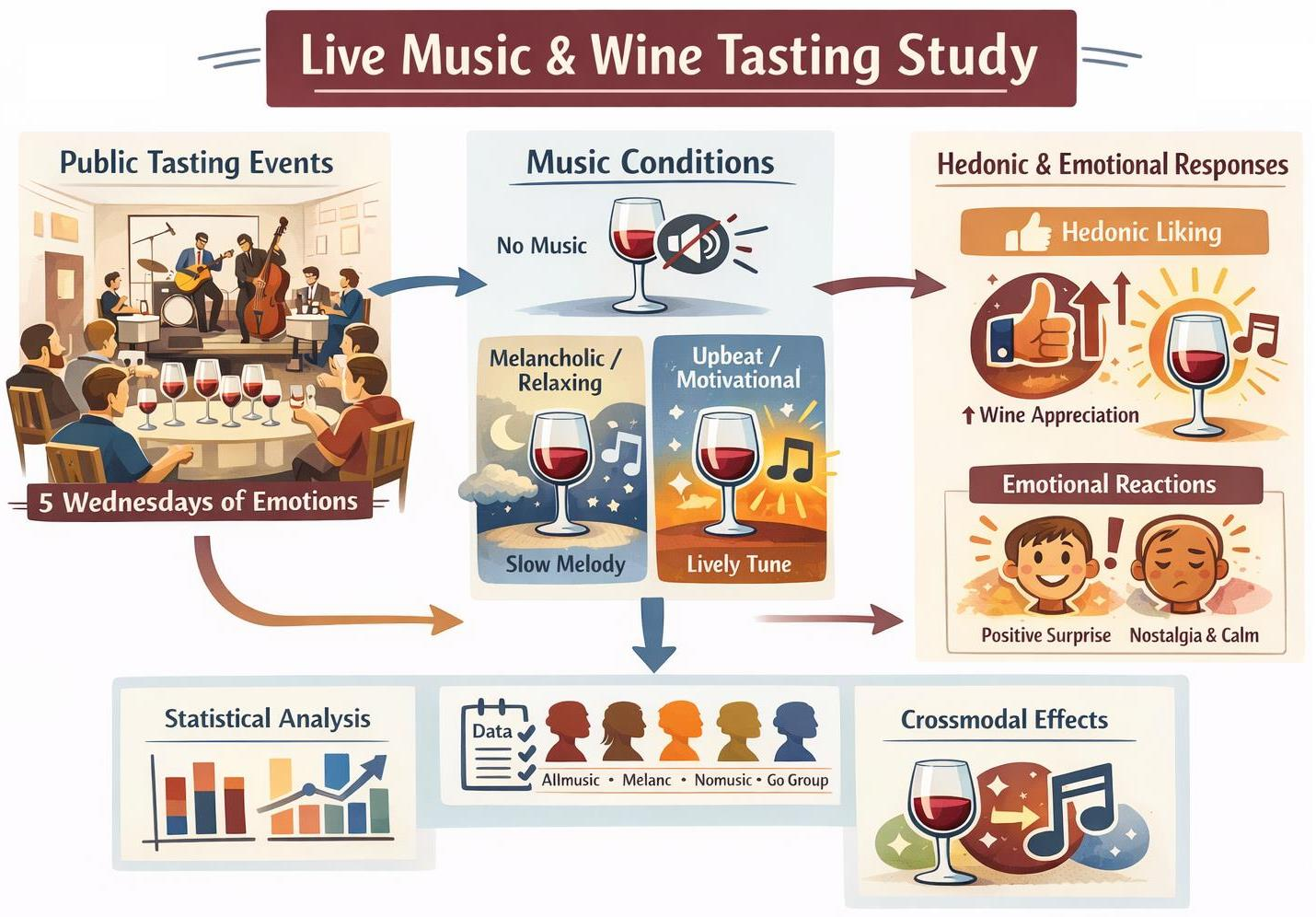
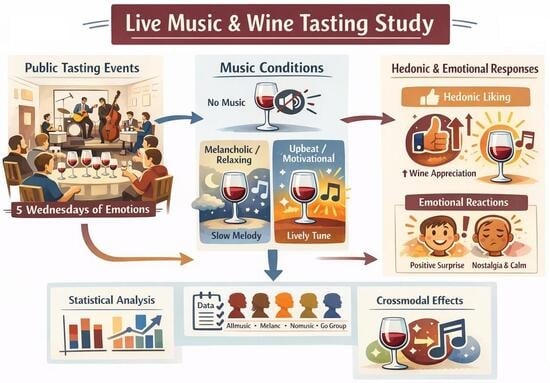
2.1.1. 5 Wednesdays of Emotions
2.1.2. Wine Used in the Study
2.2. Chemical Characterization of Wine
2.3. Questionnaire Structure
- -
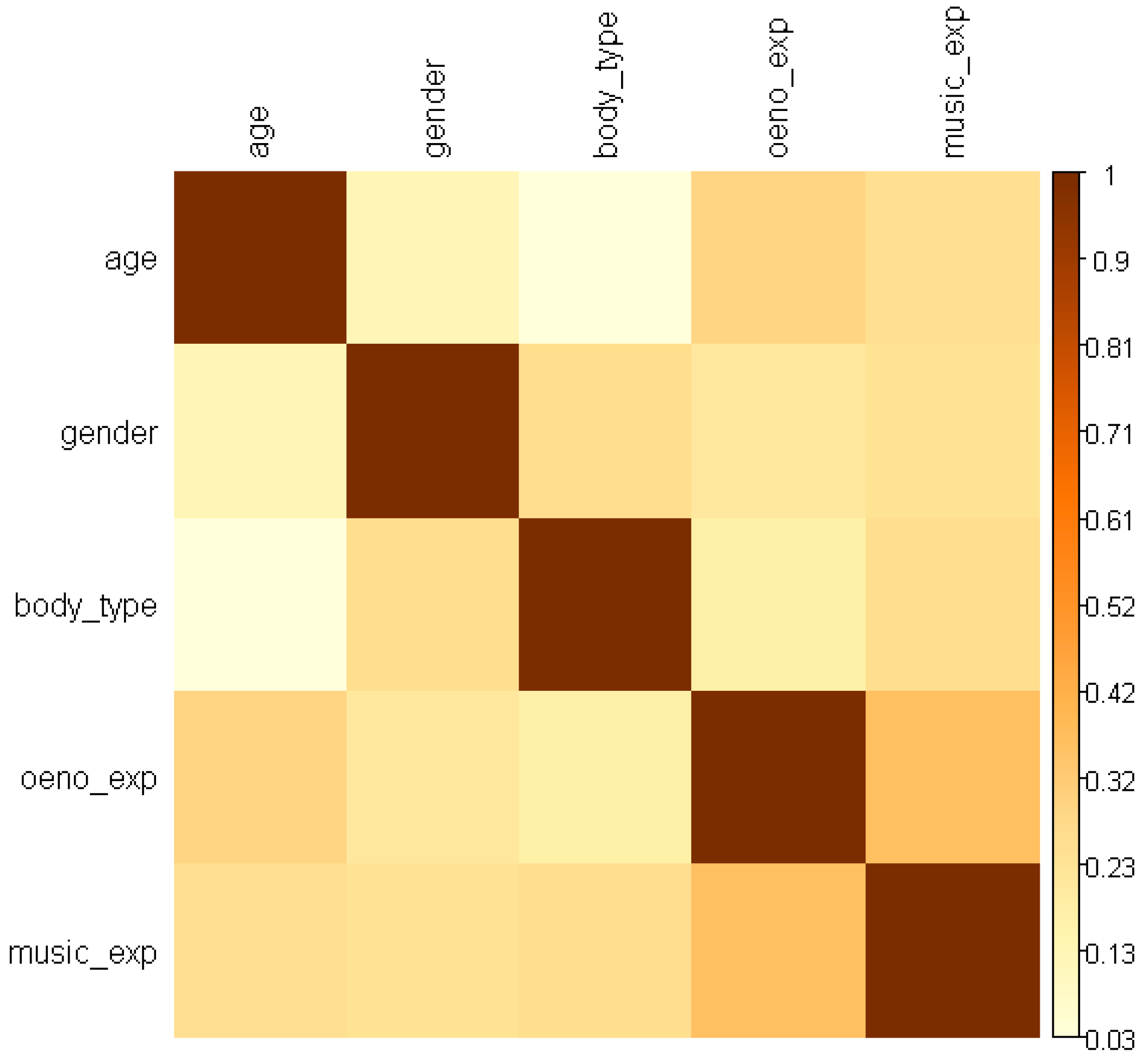
- Demographics: sex, age category, height, weight.
- -
- Hedonic and emotional ratings: each participant provided ordinal ratings on a 0–10 scale for:
- Hedonic judgments: wine alone (hedo), wine with music song 1 (hedo_mel), wine with music song 2 (hedo_upb).
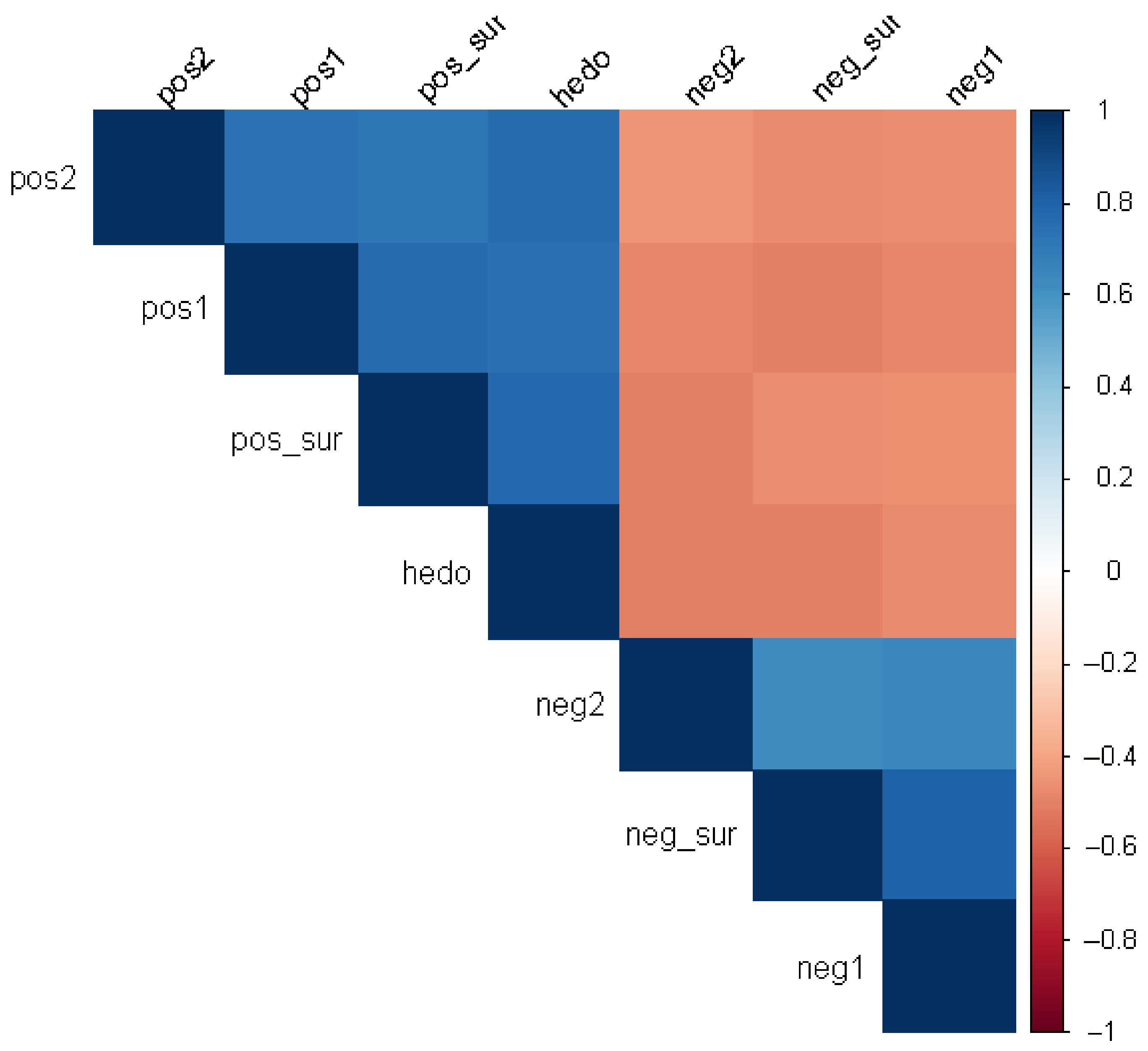
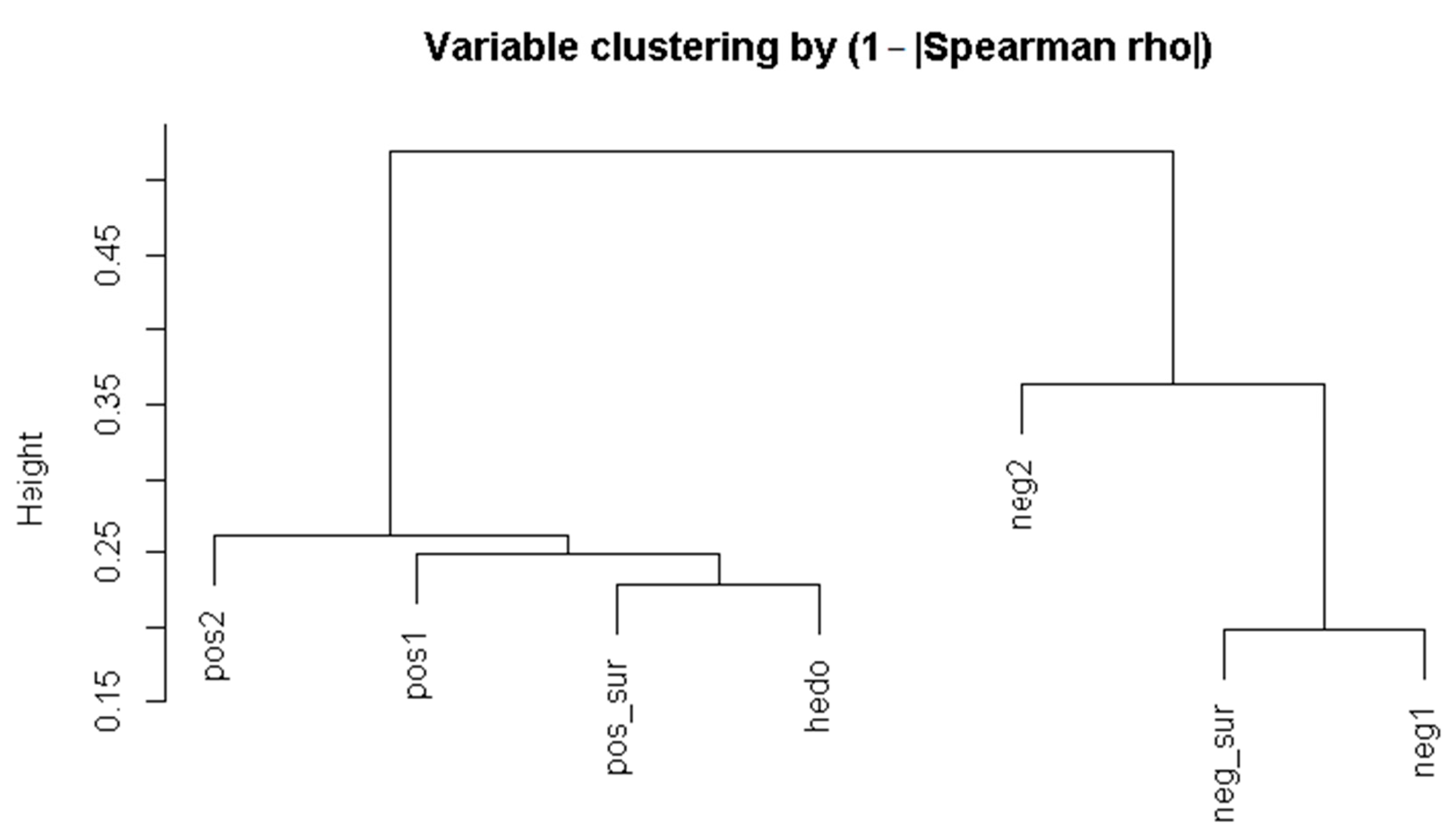
- Emotions: three positive emotions (pos_sur = positive surprise; pos1 = joy/happiness; pos2 = serenity/reliability) and three negative emotions (neg_sur = negative surprise; neg1 = disgust; neg2 = nostalgia/loss).
- -
- Two open-ended text fields for positive and negative emotional comments.
2.4. Tasting Protocol and Experimental Control
2.5. Statistical Analyses
3. Results and Discussion
3.1. Statistical Model Design
- Random effects:
- ○
- Participant ID (“id”).
- ○
- Tasting event (“event”).
- Fixed effects:
- ○
- Music condition: “cond”(“still” = no music, assumed as reference; “mel” = melancholic tune; “upb” = upbeat tune).
- ○
- Tasting order within event: “tasord” (reference = position 1).
- ○
- Wine identity: “wine” (reference = “wineX”).
- The music conditions show similar behavior and significance of the previous model, thus indicating that the cross-tasters do not influence the global evaluation of each wine
- The wines and the tasting order show a behaviour similar to that of the previous model, but the significance levels are lower
- The id-linked variance shows a very small difference (≈1.36 with respect to 1.35) thus indicating that multiple IDs reduce (as expected) the variability among tasters. The “event” variable continues showing zero variance, so the contribution of the event to the cumulative model is negligible.
- The variance associated with the “id” random effect was markedly higher (4.36 compared to 1.36 in previous models), likely reflecting both the smaller dataset and increased variability among individual tasters when evaluating the same wine multiple times
- The variance for the “event” random effect remained near zero, providing further support for the negligible impact of event-level factors
- music conditions continued to elicit significantly higher hedonic ratings compared to the reference (“still” = no music) condition, with strong statistical significance (p ≈ 2 × 10⁻¹⁰)
- The effect of tasting order was negative overall. A significant decrease in rating was observed when wineX was served in position 3, suggesting a potential positional influence that will be discussed in the following using complementary analytical approaches.
3.2. Hedonic Differences Across Wines
3.3. Music Effects on Hedonic Perception
- nomusic: when (impr_mel < 0) and (impr_upb < 0), meaning that the evaluator judged both musical excerpts as decreasing the wine’s hedonic rating.
- melanc: when (impr_mel > 0) and (impr_upb < 0), meaning that the evaluator judged mel to enhance the wine while upb diminished it.
- go: when (impr_mel < 0) and (impr_upb > 0), meaning that the evaluator judged mel to diminish the wine while upb improved it.
- allmusic: when (impr_mel > 0) and (impr_upb > 0), meaning that the music was judged to enhance the wine regardless of the emotional character of the excerpts.
3.4. Emotional Responses
4. Conclusions
Supplementary Materials
Author Contributions
Funding
Institutional Review Board Statement
Informed Consent Statement
Data Availability Statement
Acknowledgments
Conflicts of Interest
Appendix A

References
- Parr, W.V.; Mouret, M.; Blackmore, S.; Pelquest-Hunt, T.; Urdapilleta, I. Representation of complexity in wine: Influence of expertise. Food Qual. Prefer. 2011, 22, 647–660. [Google Scholar] [CrossRef]
- Taglieri, I.; Sanmartin, C.; Bianchi, A.; Dìaz-Guerrero, P.; Ferroni, G.; Tonacci, A.; Venturi, F. Emotional impact of red wine assessed through a multidisciplinary approach. Appl. Food Res. 2025, 5, 101497. [Google Scholar] [CrossRef]
- Bianchi, A.; Taglieri, I.; Macaluso, M.; Sanmartin, C.; Zinnai, A.; Venturi, F. Effect of Different Packaging Strategies on the Secondary Shelf Life of Young and Structured Red Wine. Foods 2023, 12, 2719. [Google Scholar] [CrossRef] [PubMed]
- Bianchi, A.; Pettinelli, S.; Pittari, E.; Paoli, L.; Sanmartin, C.; Pons, A.; Mencarelli, F.; Piombino, P. Accelerated oxygenation for the production of fortified (mystelle-type) sweet wines: Effects on the chemical and flavor profile. J. Sci. Food Agric. 2025, 105, 2021–2031. [Google Scholar] [CrossRef] [PubMed]
- Auffarth, B. Understanding smell—The olfactory stimulus problem. Neurosci. Biobehav. Rev. 2013, 37, 1667–1679. [Google Scholar] [CrossRef]
- Ferreira, V. 1—Volatile aroma compounds and wine sensory attributes. In Managing Wine Quality; Reynolds, A.G., Ed.; Woodhead Publishing: Sawston, UK, 2010; pp. 3–28. [Google Scholar]
- Sáenz-Navajas, M.-P.; Campo, E.; Culleré, L.; Fernández-Zurbano, P.; Valentin, D.; Ferreira, V. Effects of the Nonvolatile Matrix on the Aroma Perception of Wine. J. Agric. Food Chem. 2010, 58, 5574–5585. [Google Scholar] [CrossRef]
- Ferreira, V.; de la Fuente, A.; Sáenz-Navajas, M.P. Wine aroma vectors and sensory attributes. In Managing Wine Quality; Reynolds, A.G., Ed.; Woodhead Publishing: Sawston, UK, 2022; pp. 3–39. [Google Scholar]
- Yuan, W.; Guo, F.; Li, M.; Song, H. Effects of sensory cues on consumers’ wine taste perceptions and behavior: Evidence from a wine-tasting experiment. Int. J. Contemp. Hosp. Manag. 2024, 36, 4171–4191. [Google Scholar] [CrossRef]
- Bianchi, A.; Pacifico, S.; Santini, G.; Pettinelli, S.; Alfieri, G.; Modesti, M.; Bellincontro, A.; Sanmartin, C.; Pittari, E.; Piccolella, S.; et al. Carbonic or nitrogen maceration of wine grape: Biochemical differences of grape and wine using destructive and non-destructive approach. Food Chem. 2025, 487, 144782. [Google Scholar] [CrossRef]
- Motoki, K.; Marks, L.E.; Velasco, C. Reflections on Cross-Modal Correspondences: Current Understanding and Issues for Future Research. Multisens. Res. 2023, 37, 1–23. [Google Scholar] [CrossRef]
- Lalanne, C.; Lorenceau, J. Crossmodal integration for perception and action. J. Physiol. 2004, 98, 265–279. [Google Scholar] [CrossRef]
- Jessen, S.; Kotz, S.A. On the role of crossmodal prediction in audiovisual emotion perception. Front. Hum. Neurosci. 2013, 7, 369. [Google Scholar] [CrossRef] [PubMed]
- Di Stefano, N.; Spence, C. Perceiving temporal structure within and between the senses: A multisensory/crossmodal perspective. Atten. Percept. Psychophys. 2025, 87, 1811–1838. [Google Scholar] [CrossRef] [PubMed]
- Tonacci, A.; Billeci, L.; Burrai, E.; Sansone, F.; Conte, R. Comparative Evaluation of the Autonomic Response to Cognitive and Sensory Stimulations through Wearable Sensors. Sensors 2019, 19, 4661. [Google Scholar] [CrossRef] [PubMed]
- White, T.L.; Thomas-Danguin, T.; Olofsson, J.K.; Zucco, G.M.; Prescott, J. Thought for food: Cognitive influences on chemosensory perceptions and preferences. Food Qual. Prefer. 2020, 79, 103776. [Google Scholar] [CrossRef]
- Izard, C.E. Emotion theory and research: Highlights, unanswered questions, and emerging issues. Annu. Rev. Psychol. 2009, 60, 1–25. [Google Scholar] [CrossRef]
- Tonacci, A.; Billeci, L.; Di Mambro, I.; Marangoni, R.; Sanmartin, C.; Venturi, F.; Di Mambro, I.; Marangoni, R.; Sanmartin, C.; Venturi, F. Wearable sensors for assessing the role of olfactory training on the autonomic response to olfactory stimulation. Sensors 2021, 21, 770. [Google Scholar] [CrossRef]
- Kryklywy, J.H.; Ehlers, M.R.; Anderson, A.K.; Todd, R.M. From Architecture to Evolution: Multisensory Evidence of Decentralized Emotion. Trends Cogn. Sci. 2020, 24, 916–929. [Google Scholar] [CrossRef]
- Joy, A.; Charters, S.; Wang, J.J.; Grohmann, B. A multi-sensory and embodied understanding of wine consumption. J. Wine Res. 2020, 31, 247–264. [Google Scholar] [CrossRef]
- Malfeito-Ferreira, M. Fine wine recognition and appreciation: It is time to change the paradigm of wine tasting. Food Res. Int. 2023, 174, 113668. [Google Scholar] [CrossRef]
- Rodrigues, Á. Tourists’ Sensory Engagement and Emotional Response in Blind Wine Tasting. Gastron. Tour. 2025, 8, 187–201. [Google Scholar] [CrossRef]
- Wolff, M.; Morceau, S.; Folkard, R.; Martin-Cortecero, J.; Groh, A. A thalamic bridge from sensory perception to cognition. Neurosci. Biobehav. Rev. 2021, 120, 222–235. [Google Scholar] [CrossRef] [PubMed]
- Soudry, Y.; Lemogne, C.; Malinvaud, D.; Consoli, S.-M.; Bonfils, P. Olfactory system and emotion: Common substrates. Eur. Ann. Otorhinolaryngol. Head Neck Dis. 2011, 128, 18–23. [Google Scholar] [CrossRef] [PubMed]
- De Luca, R.; Botelho, D. The unconscious perception of smells as a driver of consumer responses: A framework integrating the emotion-cognition approach to scent marketing. AMS Rev. 2021, 11, 145–161. [Google Scholar] [CrossRef]
- Álvarez-Pato, V.M.; Sánchez, C.N.; Domínguez-Soberanes, J.; Méndoza-Pérez, D.E.; Velázquez, R. A Multisensor Data Fusion Approach for Predicting Consumer Acceptance of Food Products. Foods 2020, 9, 774. [Google Scholar] [CrossRef]
- Morquecho-Campos, P.; de Graaf, K.; Boesveldt, S. Smelling our appetite? The influence of food odors on congruent appetite, food preferences and intake. Food Qual. Prefer. 2020, 85, 103959. [Google Scholar] [CrossRef]
- Baccarani, A.; Brand, G.; Dacremont, C.; Valentin, D.; Brochard, R. The influence of stimulus concentration and odor intensity on relaxing and stimulating perceived properties of odors. Food Qual. Prefer. 2021, 87, 104030. [Google Scholar] [CrossRef]
- Fiegel, A.; Meullenet, J.-F.; Harrington, R.J.; Humble, R.; Seo, H.-S. Background music genre can modulate flavor pleasantness and overall impression of food stimuli. Appetite 2014, 76, 144–152. [Google Scholar] [CrossRef]
- Guedes, D.; Prada, M.; Lamy, E.; Garrido, M.V. Sweet music influences sensory and hedonic perception of food products with varying sugar levels. Food Qual. Prefer. 2023, 104, 104752. [Google Scholar] [CrossRef]
- Billeci, L.; Sanmartin, C.; Tonacci, A.; Taglieri, I.; Ferroni, G.; Marangoni, R.; Venturi, F. Wearable sensors to measure the influence of sonic seasoning on wine consumers in a live context: A preliminary proof-of-concept study. J. Sci. Food Agric. 2025, 105, 1484–1495. [Google Scholar] [CrossRef]
- Sinesio, F.; Moneta, E.; Di Marzo, S.; Zoboli, G.P.; Abbà, S. Influence of wine traits and context on liking, intention to consume, wine-evoked emotions and perceived sensory sensations. Food Qual. Prefer. 2021, 93, 104268. [Google Scholar] [CrossRef]
- Galmarini, M.V.; Silva Paz, R.J.; Enciso Choquehuanca, D.; Zamora, M.C.; Mesz, B. Impact of music on the dynamic perception of coffee and evoked emotions evaluated by temporal dominance of sensations (TDS) and emotions (TDE). Food Res. Int. 2021, 150, 110795. [Google Scholar] [CrossRef] [PubMed]
- Venturi, F.; Tonacci, A.; Ascrizzi, R.; Sansone, F.; Conte, R.; Pala, A.P.; Tarabella, A.; Sanmartin, C.; Taglieri, I.; Marangoni, R.; et al. “CANTINA 5.0”—A Novel, Industry 5.0-Based Paradigm Applied to the Winemaking Industry in Italy. Appl. Sci. 2024, 14, 4777. [Google Scholar] [CrossRef]
- Santini, G.; Bianchi, A.; Pettinelli, S.; Modesti, M.; Cerreta, R.; Bellincontro, A. Air speed and plastic crate vent-holes for wine grape quality during postharvest dehydration: Commercial and laboratory studies. J. Sci. Food Agric. 2023, 103, 7293–7301. [Google Scholar] [CrossRef] [PubMed]
- Bianchi, A.; Taglieri, I.; Rimbotti Antinori, V.; Palla, F.; Macaluso, M.; Ferroni, G.; Sanmartin, C.; Venturi, F.; Zinnai, A. A statistical approach to describe the ripening evolution of sangiovese grapes coming from different chianti classico sub-areas. Foods 2021, 10, 2292. [Google Scholar] [CrossRef]
- Bianchi, A.; Taglieri, I.; Venturi, F.; Sanmartin, C.; Ferroni, G.; Macaluso, M.; Palla, F.; Flamini, G.; Zinnai, A. Technological Improvements on FML in the Chianti Classico Wine Production: Co-Inoculation or Sequential Inoculation? Foods 2022, 11, 1011. [Google Scholar] [CrossRef]
- Raudenbush, S.W.; Bryk, A.S. Hierarchical Linear Models: Applications and Data Analysis Methods, 2nd ed.; Raudenbush, S.W., Bryk, A.S., Eds.; Sage Journals: Thousand Oaks, CA, USA, 2002; Volume 1. [Google Scholar]
- Dedrick, R.F.; Ferron, J.M.; Hess, M.R.; Hogarty, K.Y.; Kromrey, J.D.; Lang, T.R.; Niles, J.D.; Lee, R.S. Multilevel Modeling: A Review of Methodological Issues and Applications. Rev. Educ. Res. 2009, 79, 69–102. [Google Scholar] [CrossRef]
- Fernández-Castilla, B.; Jamshidi, L.; Declercq, L.; Beretvas, S.N.; Onghena, P.; Van den Noortgate, W. The application of meta-analytic (multi-level) models with multiple random effects: A systematic review. Behav. Res. Methods 2020, 52, 2031–2052. [Google Scholar] [CrossRef]
- Hollander, M.; Wolfe, D.A.; Chicken, E. (Eds.) Nonparametric Statistical Methods, 3rd ed.; John Wiley & Sons: Hoboken, NJ, USA, 2013. [Google Scholar]
- Kruskal, W.H.; Wallis, W.A. Use of Ranks in One-Criterion Variance Analysis. J. Am. Stat. Assoc. 1952, 47, 583–621. [Google Scholar] [CrossRef]
- Friedman, M. The Use of Ranks to Avoid the Assumption of Normality Implicit in the Analysis of Variance. J. Am. Stat. Assoc. 1937, 32, 675–701. [Google Scholar] [CrossRef]
- Hedges, L.V.; Olkin, I. (Eds.) Statistical Methods for Meta-Analysis; Academic Press: Cambridge, MA, USA, 2014. [Google Scholar]
- Lehmann, E.L.; Romano, J.P. (Eds.) Testing Statistical Hypotheses, 3rd ed.; Springer: New York, USA, 2005. [Google Scholar]
- Pearce, M.T. Music Perception. Oxf. Res. Encycl. Psychol. 2023, 5, 48. [Google Scholar] [CrossRef]
- North, A.C.; Hargreaves, D.J.; McKendrick, J. The influence of in-store music on wine selections. J. Appl. Psychol. 1999, 84, 271–276. [Google Scholar] [CrossRef]
- Spence, C.; Wang, Q. Wine and music (II): Can you taste the music? Modulating the experience of wine through music and sound. Flavour 2015, 4, 33. [Google Scholar] [CrossRef]
- Wang, Q.; Spence, C. Assessing the influence of music on wine perception among wine professionals. Food Sci. Nutr. 2017, 6, 295–301. [Google Scholar] [CrossRef] [PubMed]
- Spearman, C. The Proof and Measurement of Association Between Two Things. In Studies in Individual Differences: The Search for Intelligence; Jenkins, J.J., Paterson, D.G., Eds.; Appleton-Century-Crofts: East Norwalk, CT, USA, 1961; pp. 45–58. [Google Scholar]
- Galmarini, M.V.; Loiseau, A.-L.; Debreyer, D.; Visalli, M.; Schlich, P. Use of Multi-Intake Temporal Dominance of Sensations (TDS) to Evaluate the Influence of Wine on Cheese Perception. J. Food Sci. 2017, 82, 2669–2678. [Google Scholar] [CrossRef]
- Mesz, B.; Trevisan, M.A.; Sigman, M. The Taste of Music. Perception 2011, 40, 209–219. [Google Scholar] [CrossRef]
- Agresti, A.; Kateri, M. Categorical Data Analysis. In International Encyclopedia of Statistical Science; Lovric, M., Ed.; Springer: Berlin/Heidelberg, Germany, 2025; pp. 408–411. [Google Scholar]
- Grilli, L.; Rampichini, C. Multilevel models for ordinal data. In Modern Analysis of Customer Surveys: With Applications Using R; Kenett, R.S., Salini, S., Eds.; John Wiley & Sons: Hoboken, NJ, USA, 2011; pp. 391–411. [Google Scholar]
- Verhagen, J.V.; Engelen, L. The neurocognitive bases of human multimodal food perception: Sensory integration. Neurosci. Biobehav. Rev. 2006, 30, 613–650. [Google Scholar] [CrossRef]
- Seo, H.-S.; Hummel, T. Cross-Modal Integration in Olfactory Perception. In Springer Handbook of Odor; Buettner, A., Ed.; Springer International Publishing: Cham, Switzerland, 2017; pp. 115–116. [Google Scholar]
- Zhang, R.; Jia, W.; Shu, J.; Zou, L.; Shi, L. Flavor Experiences Augmentation Strategy for Fermented Dairy Products: Perspective of Multimodal Perception, Starter and Enhancer, and Processing. Food Rev. Int. 2024, 40, 2227–2255. [Google Scholar] [CrossRef]
- Dikecligil, G.N.; Gottfried, J.A. Odour aesthetics: Hedonic perception of olfactory stimuli. In The Routledge International Handbook of Neuroaesthetics; Skov, M., Nadal, M., Eds.; Routledge: London, UK, 2022; pp. 148–171. [Google Scholar]
- Wei, T.; Simko, V.R. R Package, “Corrplot”: Visualization of a Correlation Matrix, version 0.95; R Foundation for Statistical Computing: Vienna, Austria, 2024.
- Auguie, B.; Antonov, A. R Package, Package ‘gridExtra’: Miscellaneous Functions for” Grid” Graphics, version 2.3; R Foundation for Statistical Computing: Vienna, Austria, 2017.
- Venables, W.N.; Ripley, B.D. (Eds.) Modern Applied Statistics with S, 4th ed.; Springer Science & Business Media: New York, NY. USA, 2002. [Google Scholar]
- Dewey, M. R Package, metap: Meta-Analysis of Significance Values, version 1.13; R Foundation for Statistical Computing: Vienna, Austria, 2025.
- Christensen, R.H.B. R Package, Package “ordinal”: Regression Models for Ordinal Data, version 2023.12-4.1; R Foundation for Statistical Computing: Vienna, Austria, 2023. [Google Scholar]
- Martinez Arbizu, P. R Package, pairwiseAdonis: Pairwise Multilevel Comparison Using Adonis, version 0.4; R Foundation for Statistical Computing: Vienna, Austria, 2020.
- Fox, J. R Package, polycor: Polychoric and Polyserial Correlations, version 0.8-1; R Foundation for Statistical Computing: Vienna, Austria, 2022.
- Revelle, W. R Package, psych: Procedures for Psychological, Psychometric, and Personality Research, version 2.5.6; R Foundation for Statistical Computing: Vienna, Austria, 2020. [Google Scholar]
- Wickham, H. Reshaping data with the reshape package. J. Stat. Softw. 2007, 21, 1–20. [Google Scholar] [CrossRef]
- Wickham, H.; Averick, M.; Bryan, J.; Chang, W.; McGowan, L.D.; François, R.; Grolemund, G.; Hayes, A.; Henry, L.; Hester, J.; et al. Welcome to the Tidyverse. J. Open Source Softw. 2019, 4, 1686. [Google Scholar] [CrossRef]
- Oksanen, J.; Simpson, G.L.; Blanchet, F.G.; Kindt, R.; Legendre, P.; Minchin, P.R.; O’Hara, R.B.; Solymos, P.; Stevens, M.H.H.; Szoecs, E.; et al. R Package, Vegan: Community Ecology Package, version 2.7-2; R Foundation for Statistical Computing: Vienna, Austria, 2001. [Google Scholar]


| Wine Code | Type | Name | Cellar/Producer | Vintage | Variety | Denomination/Region |
|---|---|---|---|---|---|---|
| WineX | Red | Tavernello rosso | Cantine Caviro | 2024 | not specified | Table wine (Emilia-Romagna) |
| WineA | Rosé | L’Altro Punto di Vista | Podere La Chiesa | 2023 | Sangiovese (100%) | DOC-Terre di Pisa |
| WineB | Red | Terre di Casanova | Podere La Chiesa | 2023 | Sangiovese (100%) | Chianti DOCG |
| WineC | Red | Sabiniano di Casanova | Podere La Chiesa | 2021 | Sangiovese (60%), Cabernet Sauvignon (25%), Merlot (15%) | DOC-Terre di Pisa |
| WineD | White | Pinot Grigio “Borgo Tesis” | Fantinel | 2023 | Pinot Gris (100%) | DOC-Friuli Grave |
| WineE | Sparkling | Talento Brut Metodo Classico Etichetta Argento | Pittaro | 2022 | Chardonnay (80%) e Pinot Blanc (20%) | DOC-Friuli Grave |
| WineF | White | Friulano | Livio Felluga | 2023 | Friulano (100%) | DOC-Friuli Colli Orientali |
| WineG | White | Sauvignon | Pitars | 2023 | Sauvignon Blanc (100%) | DOC-Friuli Grave |
| WineH | Red | Schioppettino | La Sclusa | 2022 | Schioppettino (100%) | DOC-Friuli Colli Orientali |
| WineI | Red | Refosco dal Peduncolo Rosso | Ca’ Bolani | 2022 | Refosco dal peduncolo rosso (100%) | DOC-Friuli Aquileia |
| WineL | White | Villa Antinori | Marchesi Antinori | 2024 | Trebbiano Toscano, Malvasia, Pinot Blanc, Pinot Gris, Riesling (% not specified) | IGT-Toscana |
| WineM | Rosé | Scalabrone | Tenuta Guado al Tasso—Marchesi Antinori | 2024 | Cabernet sauvignon (40%), Merlot (30%), Syrah (30%) | DOC-Bolgheri |
| WineN | Red | Achelo | Tenuta La Braccesca—Marchesi Antinori | 2023 | Syrah (100%) | DOC-Cortona |
| WineO | Red | Il Grullaio | Usiglian del Vescovo | 2023 | Cabernet Sauvignon (50%), Merlot (50%) | IGT-Costa Toscana |
| WineP | Red | Valle delle Stelle | Brancatelli | 2021 | 100% Cabernet Sauvignon | IGT-Toscana |
| WineQ | Red | Midnight Star | Usiglian del Vescovo | 2018 | Sangiovese (100%) | IGT-Toscana |
| Contrast | Estimate | SE | df | z-Ratio | p-Value |
|---|---|---|---|---|---|
| still–mel | −0.7192256 | 0.08365979 | Inf | −8.597 | <0.0001 |
| still–upb | −0.9731513 | 0.08532845 | Inf | −11.405 | <0.0001 |
| mel–upb | −0.2539257 | 0.08809851 | Inf | −2.882 | 0.0110 |
Disclaimer/Publisher’s Note: The statements, opinions and data contained in all publications are solely those of the individual author(s) and contributor(s) and not of MDPI and/or the editor(s). MDPI and/or the editor(s) disclaim responsibility for any injury to people or property resulting from any ideas, methods, instructions or products referred to in the content. |
© 2026 by the authors. Licensee MDPI, Basel, Switzerland. This article is an open access article distributed under the terms and conditions of the Creative Commons Attribution (CC BY) license.
Share and Cite
Marangoni, R.; Taglieri, I.; Bianchi, A.; Sanmartin, C.; Díaz-Guerrero, P.; Tonacci, A.; Sansone, F.; Venturi, F. Influence of Live Music and Tasting Assessment on Hedonic and Emotional Responses of Wine in Public Tasting Events. Foods 2026, 15, 504. https://doi.org/10.3390/foods15030504
Marangoni R, Taglieri I, Bianchi A, Sanmartin C, Díaz-Guerrero P, Tonacci A, Sansone F, Venturi F. Influence of Live Music and Tasting Assessment on Hedonic and Emotional Responses of Wine in Public Tasting Events. Foods. 2026; 15(3):504. https://doi.org/10.3390/foods15030504
Chicago/Turabian StyleMarangoni, Roberto, Isabella Taglieri, Alessandro Bianchi, Chiara Sanmartin, Pierina Díaz-Guerrero, Alessandro Tonacci, Francesco Sansone, and Francesca Venturi. 2026. "Influence of Live Music and Tasting Assessment on Hedonic and Emotional Responses of Wine in Public Tasting Events" Foods 15, no. 3: 504. https://doi.org/10.3390/foods15030504
APA StyleMarangoni, R., Taglieri, I., Bianchi, A., Sanmartin, C., Díaz-Guerrero, P., Tonacci, A., Sansone, F., & Venturi, F. (2026). Influence of Live Music and Tasting Assessment on Hedonic and Emotional Responses of Wine in Public Tasting Events. Foods, 15(3), 504. https://doi.org/10.3390/foods15030504