


Bacteriocins for Safety of Animal-Derived Foods: Systematic Mapping, Multilevel MIC Analysis, Food-Matrix Applications, and Emerging Antiparasitic Evidence
 , ,
, ,  ,
,  and
and
Abstract
1. Introduction
2. Methods
2.1. Literature Search Strategy and Duplicate Removal
2.2. Bacteriocins Against Bacteria
2.2.1. Preliminary Filtering
2.2.2. MIC Evaluation and Statistical Analysis
2.2.3. Supplementary Mapping of Animal-Derived Food-Matrix Applications
2.2.4. Methodological Quality and Reporting Appraisal
2.2.5. Food Dose Versus MIC Comparability
2.3. Bacteriocins Against Parasites
3. Results
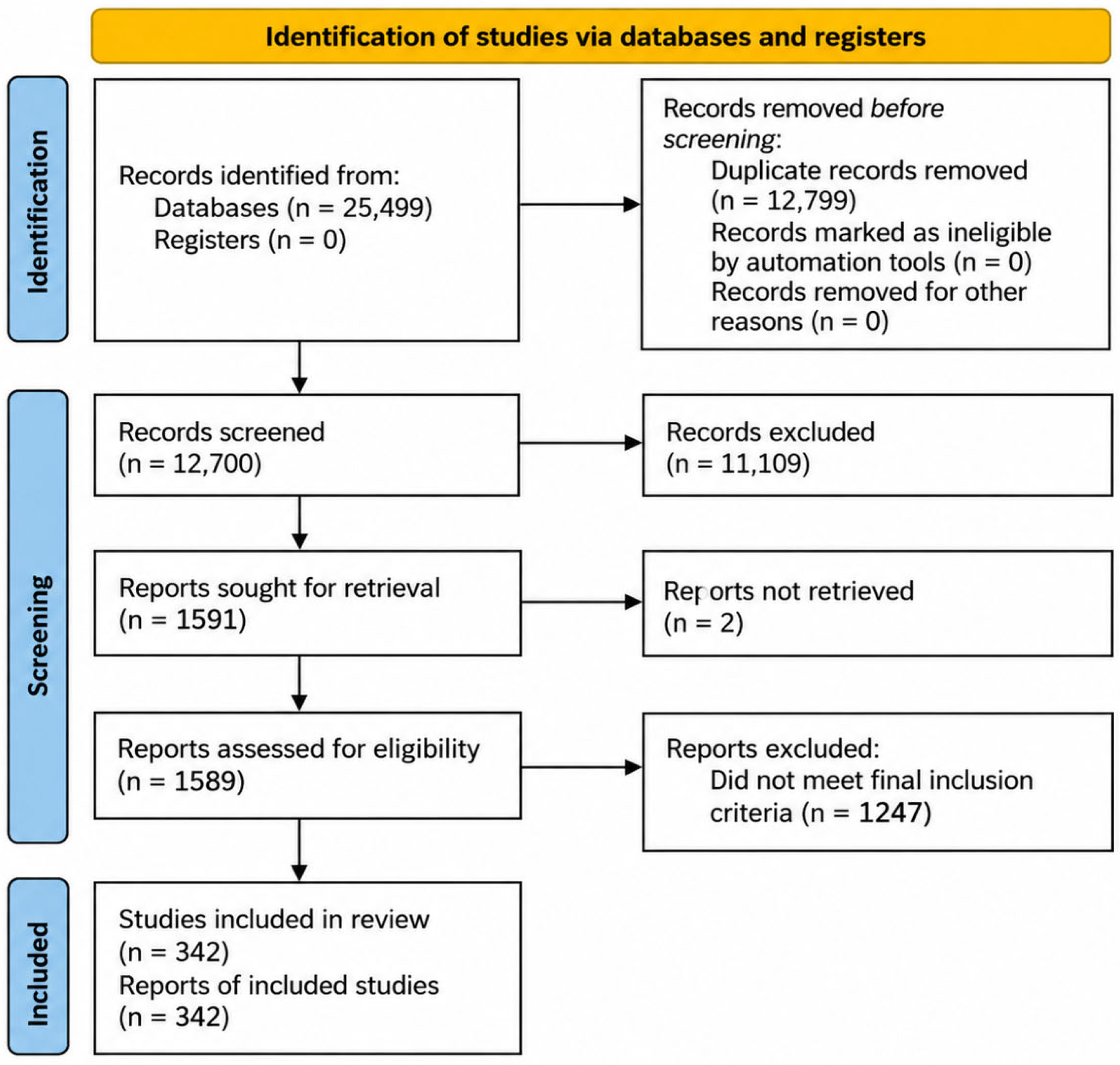
3.1. PRISMA Flow Diagram
3.2. Antibacterial MIC Evidence
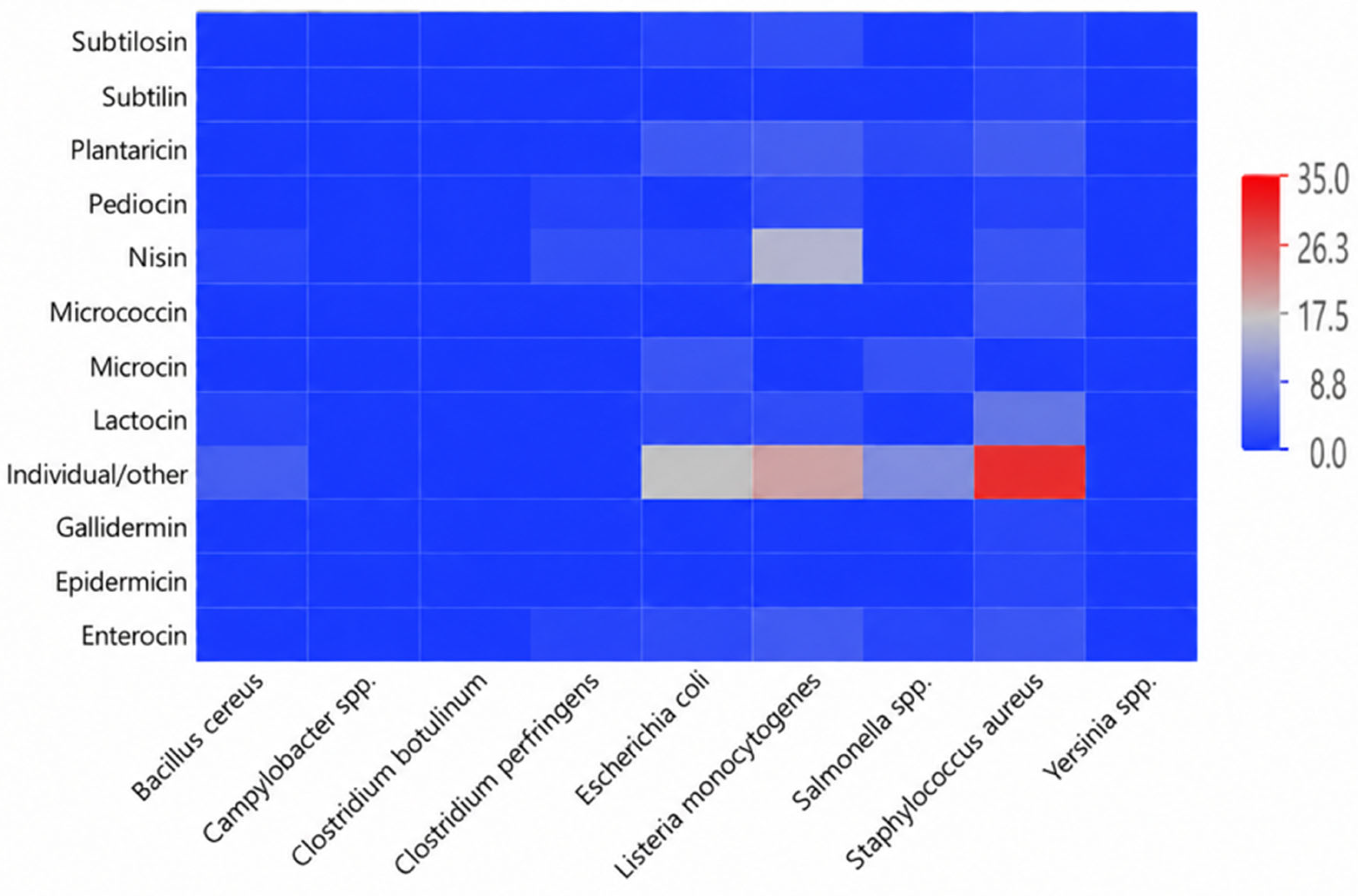
3.2.1. Evidence Coverage by Target and Bacteriocin Family
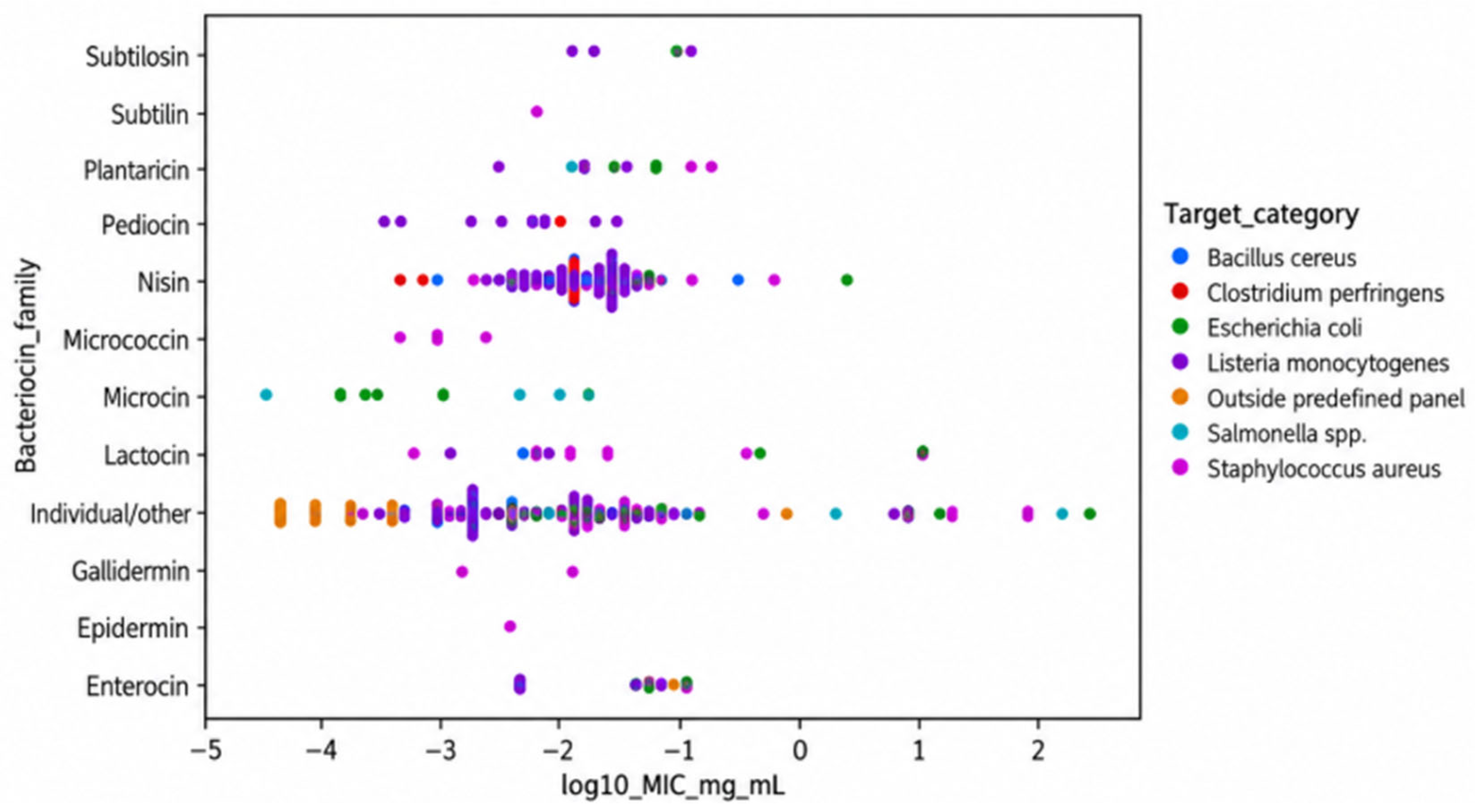
3.2.2. Descriptive MIC Distribution and Study-Target Summaries
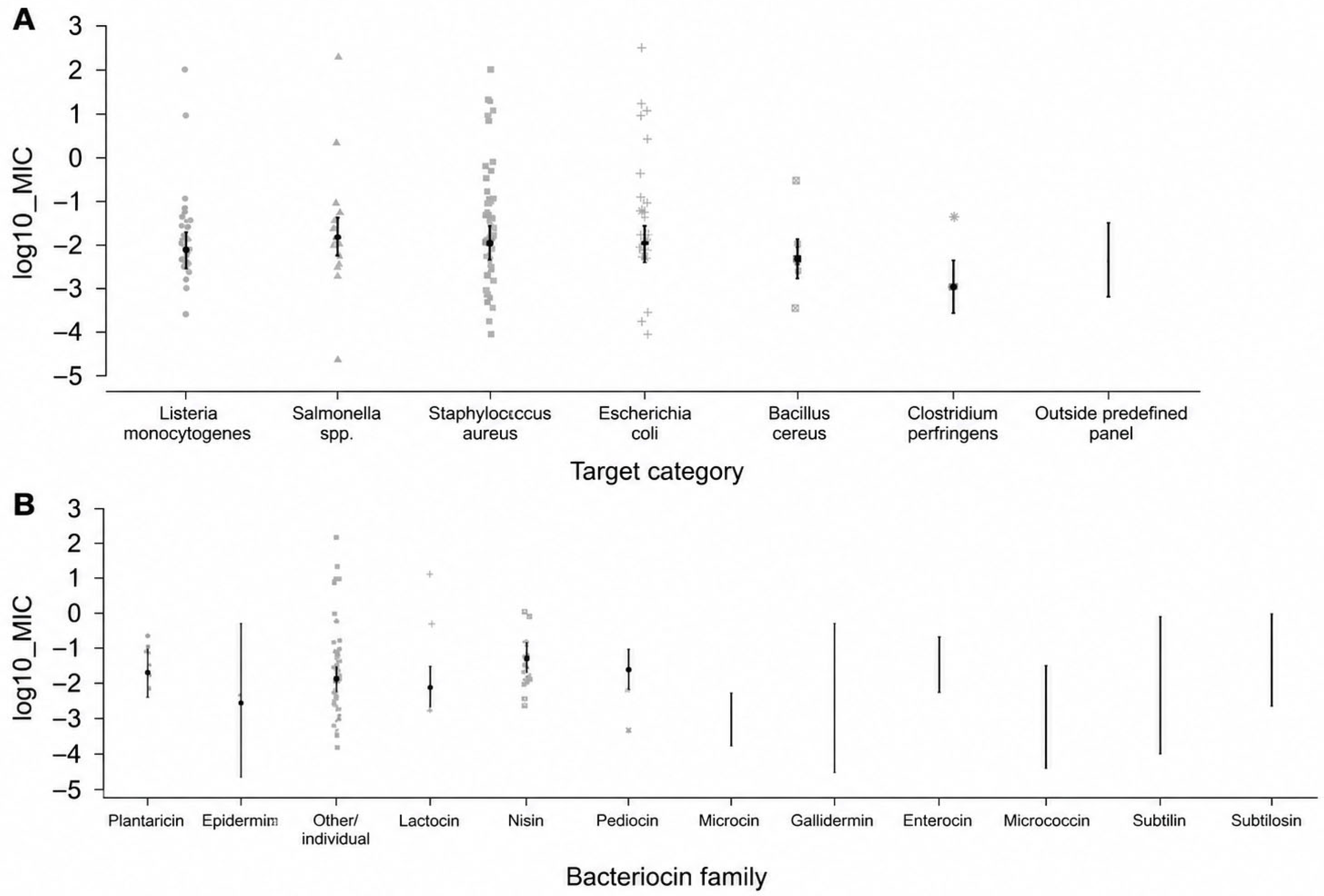
3.2.3. Multilevel Mixed-Effects Analysis
3.3. Methodological Quality and Reporting Appraisal
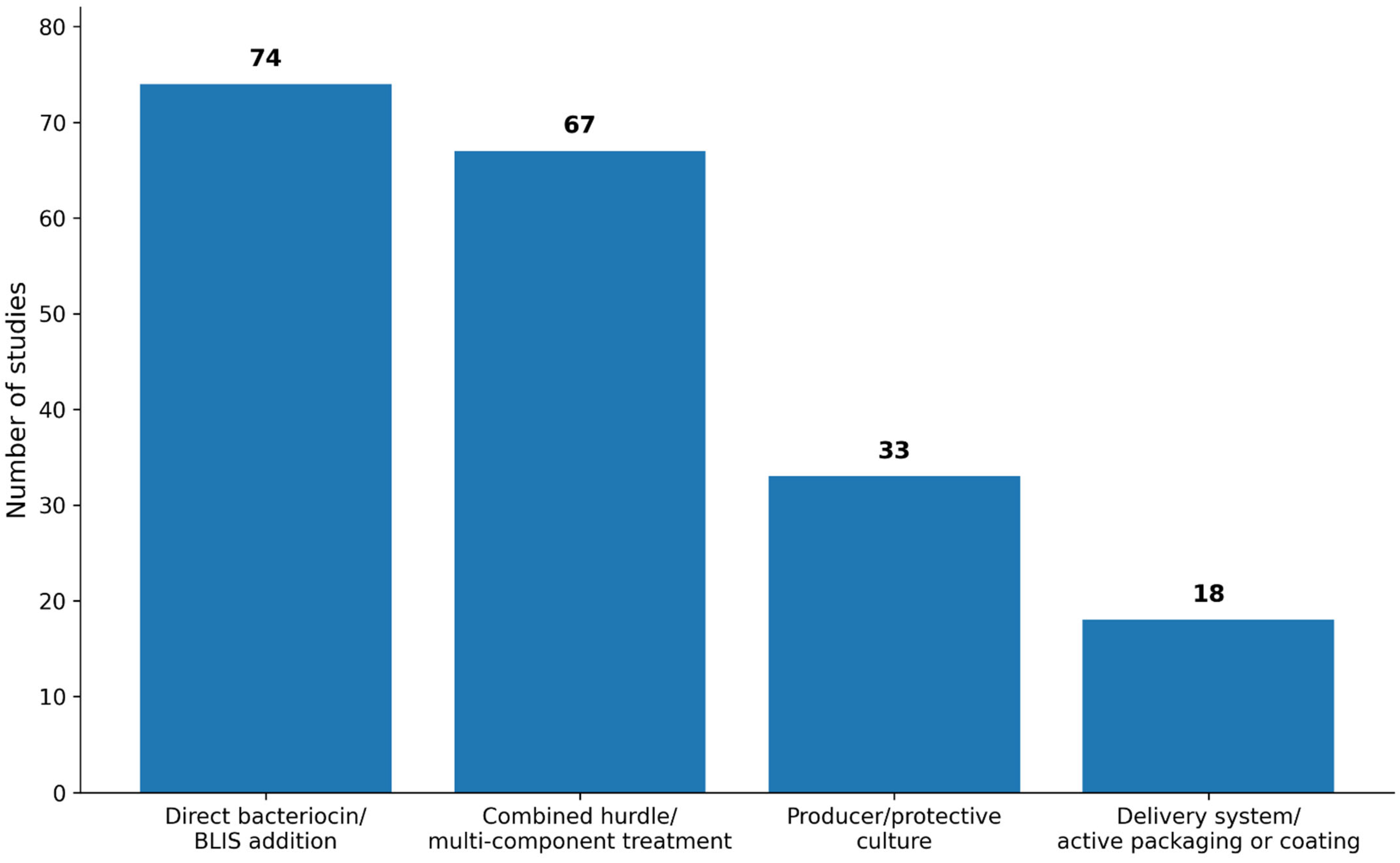
3.4. Bacteriocin Applications in Animal-Derived Food Matrices
3.5. Bacteriocins Against Parasites
4. Discussion
4.1. Antibacterial Activity
4.2. Translation to Animal-Derived Foods: Matrix Effects, Delivery and Hurdle Strategies
4.3. Emerging Antiparasitic Evidence: Therapeutic Models Are Not Food Biopreservation
4.4. Limitations
4.5. Future Quantitative Research Directions
5. Conclusions
Supplementary Materials
Author Contributions
Funding
Institutional Review Board Statement
Informed Consent Statement
Data Availability Statement
Acknowledgments
Conflicts of Interest
References
- Havelaar, A.H.; Kirk, M.D.; Torgerson, P.R.; Gibb, H.J.; Hald, T.; Lake, R.J.; Praet, N.; Bellinger, D.C.; de Silva, N.R.; Gargouri, N.; et al. World Health Organization Global Estimates and Regional Comparisons of the Burden of Foodborne Disease in 2010. PLoS Med. 2015, 12, e1001923. [Google Scholar] [CrossRef] [Scilit]
- Spagnolo, A.M.; Palma, F.; Amagliani, G.; Panunzio, M.F.; Montagna, M.T.; Alonzo, E.; Bonaccorsi, G.; Cairella, G.; Guberti, E.; Schiavano, G.F. Antimicrobial Resistance Along the Food Chain: Spread and Integrated Strategies for Mitigation and Control. Antibiotics 2026, 15, 311. [Google Scholar] [CrossRef] [Scilit]
- Barcenilla, C.; Ducic, M.; Lopez, M.; Prieto, M.; Alvarez-Ordonez, A. Application of Lactic Acid Bacteria for the Biopreservation of Meat Products: A Systematic Review. Meat Sci. 2022, 183, 108661. [Google Scholar] [CrossRef] [Scilit]
- Moatsou, G. Emerging Technologies for Improving Properties, Shelf Life, and Analysis of Dairy Products. Foods 2024, 13, 1078. [Google Scholar] [CrossRef] [Scilit]
- Sugrue, I.; Ross, R.P.; Hill, C. Bacteriocin Diversity, Function, Discovery and Application as Antimicrobials. Nat. Rev. Microbiol. 2024, 22, 556–571. [Google Scholar] [CrossRef] [Scilit]
- Kumariya, R.; Garsa, A.K.; Rajput, Y.S.; Sood, S.K.; Akhtar, N.; Patel, S. Bacteriocins: Classification, Synthesis, Mechanism of Action and Resistance Development in Food Spoilage Causing Bacteria. Microb. Pathog. 2019, 128, 171–177. [Google Scholar] [CrossRef] [Scilit]
- Pujato, S.A.; Mercanti, D.J.; Briggiler Marco, M.; Capra, M.L.; Quiberoni, A.; Guglielmotti, D.M. Bacteriocins from Lactic Acid Bacteria: Strategies for the Bioprotection of Dairy Foods. Front. Food Sci. Technol. 2024, 4, 1439891. [Google Scholar] [CrossRef] [Scilit]
- Prudêncio, C.V.; Dos Santos, M.T.; Vanetti, M.C.D. Strategies for the Use of Bacteriocins in Gram-Negative Bacteria: Relevance in Food Microbiology. J. Food Sci. Technol. 2015, 52, 5408–5417. [Google Scholar] [CrossRef] [Scilit]
- Leroy, F.; De Vuyst, L. Temperature and pH Conditions That Prevail during Fermentation of Sausages Are Optimal for Production of the Antilisterial Bacteriocin Sakacin K. Appl. Environ. Microbiol. 1999, 65, 974–981. [Google Scholar] [CrossRef] [Scilit]
- COMMISSION REGULATION (EC) No 2073/2005 of 15 November 2005 on Microbiological Criteria for Foodstuffs. Available online: https://eur-lex.europa.eu/eli/reg/2005/2073/oj (accessed on 21 January 2026).
- European Food Safety Authority (EFSA); European Centre for Disease Prevention and Control (ECDC). The European Union One Health 2024 Zoonoses Report. EFSA J. 2025, 23, e9759. [Google Scholar] [CrossRef] [Scilit]
- Amer, E.I.; Mossallam, S.F.; Mahrous, H. Therapeutic Enhancement of Newly Derived Bacteriocins against Giardia lamblia. Exp. Parasitol. 2014, 146, 52–63. [Google Scholar] [CrossRef] [Scilit]
- Elkhateeb, Y.A.M.; Hassanain, N.A.; Toaleb, N.I.; Shaapan, R.M. Probiotics as Antiparasitic Agents: Anti-Cryptosporidium Efficacy of Lactobacillus Species, Bacillus proteolyticus, and Cell-Free Supernatants in Experimentally Infected Mice. Res. Sq. 2025, preprint. [Google Scholar] [CrossRef] [Scilit]
- Schofs, L.; Sparo, M.D.; de Yaniz, M.G.; Lissarrague, S.; Domínguez, M.P.; Álvarez, L.I.; Sánchez Bruni, S.F. Antinematodic Effect of Enterococcus faecalis CECT7121 Using Trichinella spiralis as a Model of Nematode Infection in Mice. Exp. Parasitol. 2022, 241, 108358. [Google Scholar] [CrossRef] [Scilit]
- Vargová, M.; Revajová, V.; Lauková, A.; Hurníková, Z.; Dvorožňáková, E. Modulatory Effect of Beneficial Enterococci and Their Enterocins on the Blood Phagocytes in Murine Experimental Trichinellosis. Life 2023, 13, 1930. [Google Scholar] [CrossRef] [Scilit]
- Petrová, M.; Hurníková, Z.; Lauková, A.; Dvorožňáková, E. Antiparasitic Activity of Enterocin M and Durancin-like from Beneficial Enterococci in Mice Experimentally Infected with Trichinella spiralis. Microorganisms 2024, 12, 923. [Google Scholar] [CrossRef] [Scilit]
- Dvorožňáková, E.; Bucková, B.; Hurníková, Z.; Revajová, V.; Lauková, A. Effect of Probiotic Bacteria on Phagocytosis and Respiratory Burst Activity of Blood Polymorphonuclear Leukocytes (PMNL) in Mice Infected with Trichinella spiralis. Vet. Parasitol. 2016, 231, 69–76. [Google Scholar] [CrossRef] [Scilit]
- Bucková, B.; Hurníková, Z.; Lauková, A.; Revajová, V.; Dvorožňáková, E. The Anti-parasitic Effect of Probiotic Bacteria via Limiting the Fecundity of Trichinella spiralis Female Adults. Helminthologia 2018, 55, 102–111. [Google Scholar] [CrossRef] [Scilit]
- Vargová, M.; Hurníková, Z.; Revajová, V.; Lauková, A.; Dvorožňáková, E. Probiotic Bacteria Can Modulate Murine Macrophage Superoxide Production in Trichinella spiralis Infection. Helminthologia 2020, 57, 226–234. [Google Scholar] [CrossRef] [Scilit]
- Dvorožňáková, E.; Vargová, M.; Hurníková, Z.; Lauková, A.; Revajová, V. Modulation of Lymphocyte Subpopulations in the Small Intestine of Mice Treated with Probiotic Bacterial Strains and Infected with Trichinella spiralis. J. Appl. Microbiol. 2022, 132, 4430–4439. [Google Scholar] [CrossRef] [Scilit]
- El Shanawany, E.E.; Abdel-Razik, R.; Nofal, A.E.; Zalat, R.S.; Abouelmagd, F. Protective and Therapeutic Effects of Lactobacillus brevis PQ214320 and Bacillus subtilis PQ198038 Against Experimental Trichinella Infection. PLoS Negl. Trop. Dis. 2025, 19, e0013331. [Google Scholar] [CrossRef] [Scilit]
- El Temsahy, M.M.; Ibrahim, I.R.; Mossallam, S.F.; Mahrous, H.; Abdel Bary, A.; Abdel Salam, S.A. Evaluation of Newly Isolated Probiotics in the Protection against Experimental Intestinal Trichinellosis. Vet. Parasitol. 2015, 214, 303–314. [Google Scholar] [CrossRef] [Scilit]
- Hugas, M.; Garriga, M.; Aymerich, M.T.; Monfort, J.M. Inhibition of Listeria in Dry Fermented Sausages by the Bacteriocinogenic Lactobacillus sake CTC494. J. Appl. Bacteriol. 1995, 79, 322–330. [Google Scholar] [CrossRef] [Scilit]
- Motlagh, A.M.; Holla, S.; Johnson, M.C.; Ray, B.; Field, R.A. Inhibition of Listeria spp. in Sterile Food Systems by Pediocin AcH, a Bacteriocin Produced by Pediococcus acidilactici H. J. Food Prot. 1992, 55, 337–343. [Google Scholar] [CrossRef] [Scilit]
- Morgan, S.M.; Galvin, M.; Ross, R.P.; Hill, C. Evaluation of a Spray-Dried Lacticin 3147 Powder for the Control of Listeria monocytogenes and Bacillus cereus in a Range of Food Systems. Lett. Appl. Microbiol. 2001, 33, 387–391. [Google Scholar] [CrossRef] [Scilit]
- Balay, D.R.; Dangeti, R.V.; Kaur, K.; McMullen, L.M. Purification of Leucocin A for Use on Wieners to Inhibit Listeria monocytogenes in the Presence of Spoilage Organisms. Int. J. Food Microbiol. 2017, 255, 25–31. [Google Scholar] [CrossRef] [Scilit]
- Aasen, I.M.; Markussen, S.; Møretrø, T.; Katla, T.; Axelsson, L.; Naterstad, K. Interactions of the Bacteriocins Sakacin P and Nisin with Food Constituents. Int. J. Food Microbiol. 2003, 87, 35–43. [Google Scholar] [CrossRef] [Scilit]
- Mathur, H.; Field, D.; Rea, M.C.; Cotter, P.D.; Hill, C.; Ross, R.P. Bacteriocin-Antimicrobial Synergy: A Medical and Food Perspective. Front. Microbiol. 2017, 8, 1205. [Google Scholar] [CrossRef] [Scilit]
- EFSA Panel on Biological Hazards (BIOHAZ). Update of the List of Qualified Presumption of Safety (QPS) Recommended Microbiological Agents Intentionally Added to Food or Feed as Notified to EFSA 24: Suitability of Taxonomic Units Notified to EFSA Until March 2026. EFSA J. 2026, 24, e10155. [Google Scholar] [CrossRef] [Scilit]
- Axelsson, L.; Gaarder, M.Ø.; Holck, A.L.; Tengstrand, E.; Fagerlund, A.; Moen, B.; Heir, E. Measures for the inhibition of Listeria monocytogenes in a traditional Norwegian fermented fish product (rakfisk) and their effect on sensory attributes. Int. J. Food Microbiol. 2026, 444, 111453. [Google Scholar] [CrossRef] [Scilit]
- Son, N.-Y.; Moon, G.-S.; Turner, M.S.; Yuk, H.-G. Anti-listeria activity of newly isolated lactic acid bacteria from fermented foods and their application to smoked salmon (Coho). Int. J. Food Microbiol. 2025, 444, 111453. [Google Scholar] [CrossRef] [Scilit]
- Hospital, X.F.; Fernández, M.; Herranz, C.; Martín-Cabrejas, I.; Caballero, N.; Jiménez, B.; Sánchez-Martín, V.; Morales, P.; Haza, A.I.; Hierro, E.M. Control of Listeria monocytogenes in Nitrite-Reduced Mediterranean Dry-Fermented Sausages Using Two Bacteriocinogenic Pediococcus acidilactici Strains. Food Bioprocess Technol. 2025, 434, 111148. [Google Scholar] [CrossRef] [Scilit]
- Li, H.; Yang, Y.; Li, L.; Zheng, H.; Xiong, Z.; Hou, J.; Wang, L. Genome-Based Identification and Characterization of Bacteriocins Selectively Inhibiting Staphylococcus aureus in Fermented Sausages. Probiotics Antimicrob. Proteins 2025, 17, 2878–2893. [Google Scholar] [CrossRef] [Scilit]
- Ding, J.; Gao, M.; Xu, C.; Lv, W.; Liu, H.; Liu, S.; Zhao, D.; Zeng, X.; Zeng, H.; Xin, B.; et al. Megasin WSY10: A novel lantibiotic that inhibits methicillin-resistant Staphylococcus aureus (MRSA) in skim milk and preserves milk quality. LWT-Food Sci. Technol. 2025, 231, 118384. [Google Scholar] [CrossRef] [Scilit]
- Bouraqqadi, M.; Arbain, A.A.; Manni, L.; Bahafid, W.; Ananou, S. Novel Clean Label Approach: Assessment of Antimicrobial Potential of Combined Use of Aromatic and Medicinal Plants and Bacteriocin Against Salmonella enterica, Bacillus cereus and Staphylococcus aureus in Model Sausages. Trop. J. Nat. Prod. Res. 2025, 9, 1945. [Google Scholar] [CrossRef] [Scilit]
- Gao, Y.; Li, D. Antibacterial Mechanism of Garviecin LG34 Against S. aureus and L. monocytogenes and its Application in Milk Preservation. J. Food Prot. 2024, 87, 100345. [Google Scholar] [CrossRef] [Scilit]
- Sheoran, P.; Yadav, M.K.; Kumari, I.; Tiwari, S.K. Enterocin LD3 from Enterococcus hirae LD3 Inhibits the Growth of Salmonella enterica subsp. enterica serovar Typhimurium ATCC 13311 in Fruit Juice. Probiotics Antimicrob. Proteins 2024, 16, 1205–1213. [Google Scholar] [CrossRef] [Scilit]
- Gómez, J.S.; Vallejo, M.; Parada, R.B.; Marguet, E.R.; Bellomio, A.; Gianni de Carvalho, K. Exploring the bioactive potential of Enterococcus mundtii TW278: Synthesis and utilization of biomolecules in yogurt production. Food Biosci. 2024, 61, 104760. [Google Scholar] [CrossRef] [Scilit]
- Xu, H.; Su, X.; Zhou, H.; Du, X.; Xu, Y.; Wang, Z.; Chen, L.; Cai, K.; Xu, B. Polyvinyl alcohol/soybean isolate protein composite pad with enhanced antioxidant and antimicrobial properties induced by novel ternary nanoparticles for fresh pork preservation. Int. J. Biol. Macromol. 2024, 278, 134762. [Google Scholar] [CrossRef] [Scilit]
- Makhlouf, F.Z.; Bramki, A.; Smati, M.; Khaine, F.; Merouane, F.; Barkat, M. Purification and Characterization of Plantaricin PQ12: A Novel Bacteriocin from Lactiplantibacillus plantarum Isolated from Fermented Cucumbers, with Inhibitory Activity Against Foodborne Pathogens. ACS Food Sci. Technol. 2024, 4, 3088–3096. [Google Scholar] [CrossRef] [Scilit]
- Fernandes da Silva, C.G.; Santos Lopes, F.; Cardoso Vieira Valois, Á.F.; Prudêncio, C.V. Sensitivity of Salmonella Typhimurium to nisin in vitro and in orange juice under refrigeration. FEMS Microbiol. Lett. 2024, 371, fnae031. [Google Scholar] [CrossRef] [Scilit]
- Guo, X.; Ma, L.; Qiao, Z.; Luo, L.; Zhang, Y.; Wang, X.; Lü, X. The antibacterial mechanism of the novel bacteriocin LpH25 and the synergistic preservation effect of this bacteriocin and Nisin in fresh milk. LWT-Food Sci. Technol. 2024, 194, 115766. [Google Scholar] [CrossRef] [Scilit]
- Yong, Y.; Ahmad, H.N.; Gu, Y.; Zhu, X.; Wen, Y.; Guo, L.; Zhu, J. The synergistic effect of polyphenols and polypeptides for plant-based bioplastic film—Enhanced UV resistance, antioxidant and antibacterial performance. Food Chem. 2024, 460, 140746. [Google Scholar] [CrossRef] [Scilit]
- Meral Aktaş, H.; Erdoǧan, A.; Četin, B. Bacteriocin characterization of autochtonous Lactococcus lactis L54 and its application as starter culture for Beyaz cheese. Food Biosci. 2023, 53, 102739. [Google Scholar] [CrossRef] [Scilit]
- Biki, S.P.; Mahmud, S.; Akhter, S.; Rahman, M.H.; Ahmed, M. Bacteriocin production by Lactococcus lactis LL-HSTU-FPP strain isolated from fermented rice and evaluation of the biopreservation potentiality of bacteriocin on shrimp. J. Food Saf. 2023, 43, e13042. [Google Scholar] [CrossRef] [Scilit]
- Kusharyati, D.F.; Oedjijono, O.; Satwika, T.D.; Yulianti, D.M.; Mariana, A.; Rovik, A. Bacteriocinogenic Lactic Acid Bacteria Isolated from Mangrove Sediment in Indonesia: Growth Optimization, Bacteriocin Production, and its Application in Food Preservation. HAYATI J. Biosci. 2023, 30, 1121–1131. [Google Scholar] [CrossRef] [Scilit]
- Sen, C.; Ray, P.R.; Hossain, S.; Bhattacharyya, M.; Mondal, S.; Debnath, A. Influence of nisin on water activity, textural and other quality attributes of paneer (Indian cottage cheese) during storage. Food Humanit. 2023, 1, 1134–1144. [Google Scholar] [CrossRef] [Scilit]
- Shrestha, S.; Erdmann, J.J.; Riemann, M.; Kroeger, K.; Juneja, V.K.; Brown, T. Ready-to-Eat Egg Products Formulated with Nisin and Organic Acids to Control Listeria monocytogenes. J. Food Prot. 2023, 86, 100081. [Google Scholar] [CrossRef] [Scilit]
- Serra-Castelló, C.; Costa, J.C.C.P.; Jofré, A.; Bolívar, A.; Pérez-Rodríguez, F.; Bover-Cid, S. A mathematical model to predict the antilisteria bioprotective effect of Latilactobacillus sakei CTC494 in vacuum packaged cooked ham. Int. J. Food Microbiol. 2022, 363, 109491. [Google Scholar] [CrossRef] [Scilit]
- Xuan Nguyen, N.T.; Daniel, P.; Pilard, J.F.; Cariou, R.; Gigout, F.; Leroi, F. Antibacterial activity of plasma-treated polypropylene membrane functionalized with living Carnobacterium divergens in cold-smoked salmon. Food Control 2022, 137, 108903. [Google Scholar] [CrossRef] [Scilit]
- Silva, S.P.M.; Ribeiro, S.C.; Teixeira, J.A.; Silva, C.C.G. Application of an alginate-based edible coating with bacteriocin-producing Lactococcus strains in fresh cheese preservation. LWT-Food Sci. Technol. 2022, 153, 112486. [Google Scholar] [CrossRef] [Scilit]
- Shrestha, S.; Hariram, U. Control of Bacillus weihenstephanensis in Pasteurized Liquid Whole Eggs Formulated with Nisin. J. Food Prot. 2022, 85, 647–652. [Google Scholar] [CrossRef] [Scilit]
- Ansari, A.; Ibrahim, F.; Haider, M.S.; Aman, A. In vitro application of bacteriocin produced by Lactiplantibacillus plantarum for the biopreservation of meat at refrigeration temperature. J. Food Process. Preserv. 2022, 46, e16159. [Google Scholar] [CrossRef] [Scilit]
- Lei, W.; Hao, L.; You, S.; Yao, H.; Liu, C.; Zhou, H. Partial purification and application of a bacteriocin produced by probiotic Lactococcus lactis C15 isolated from raw milk. LWT-Food Sci. Technol. 2022, 169, 113917. [Google Scholar] [CrossRef] [Scilit]
- Ruiz-De Anda, D.; Casados-Vázquez, L.E.; Ozuna, C. The synergistic effect of thurincin H and power ultrasound: An alternative for the inactivation of Listeria innocua ATCC 33090 and Escherichia coli K-12 in liquid food matrices. Food Control 2022, 135, 108778. [Google Scholar] [CrossRef] [Scilit]
- Meng, F.; Zhu, X.; Zhao, H.; Nie, T.; Lü, F.; Lu, Z.; Lu, Y. A class III bacteriocin with broad-spectrum antibacterial activity from Lactobacillus acidophilus NX2-6 and its preservation in milk and cheese. Food Control 2021, 121, 107597. [Google Scholar] [CrossRef] [Scilit]
- Ceruso, M.; Liu, Y.; Gunther, N.W., IV; Pepe, T.; Anastasio, A.; Qi, P.X.; Tomasula, P.M.; Renye, J.A. Anti-listerial activity of thermophilin 110 and pediocin in fermented milk and whey. Food Control 2021, 125, 107941. [Google Scholar] [CrossRef] [Scilit]
- Corbalán, N.; Quiroga, M.; Masias, E.; Peralta, D.; Barros Velázquez, J.; Acuña, L.; Vincent, P. Antimicrobial activity of MccJ25(G12Y) against gram-negative foodborne pathogens in vitro and in food models. Int. J. Food Microbiol. 2021, 352, 109267. [Google Scholar] [CrossRef] [Scilit]
- Martinez-Rios, V.; Pedersen, M.; Pedrazzi, M.; Gkogka, E.; Smedsgaard, J.; Dalgaard, P. Antimicrobial effect of nisin in processed cheese—Quantification of residual nisin by LC-MS/MS and development of new growth and growth boundary model for Listeria monocytogenes. Int. J. Food Microbiol. 2021, 338, 108952. [Google Scholar] [CrossRef] [Scilit]
- Wahyuningtyas, A.N.; Arief, I.I.; Taufik, E. Application of Plantaricin as an Antimicrobial Substrate in the Milking Process to Maintain Milk Quality in Smallholder Dairy Farm; Aplikasi plantarisin sebagai substrat antimikroba dalam proses pemerahan untuk mempertahankan kualitas susu pada peternakan sapi perah rakyat. J. Ilmu Ternak Dan Vet. 2021, 26, 65–73. [Google Scholar] [CrossRef] [Scilit]
- Majumder, R.; Aditya, A.; Dey, S.; Siddique, J.F.; Anbalagan, N.; Devi, S.; Vaithilingam, M. Biopreservative action of bacteriocin from Pediococcus pentosaceus on the microbial load of apple juice. Indian J. Pharm. Educ. Res. 2021, 55, s242–s250. [Google Scholar] [CrossRef] [Scilit]
- Perez-Arauz, A.-O.; Rodriguez-Hernandez, A.-I.; del Rocio Lopez-Cuellar, M.; Martinez-Juarez, V.-M.; Chavarria-Hernandez, N. Films based on Pectin, Gellan, EDTA, and bacteriocin-like compounds produced by Streptococcus infantarius for the bacterial control in fish packaging. J. Food Process. Preserv. 2021, 45, e15006. [Google Scholar] [CrossRef] [Scilit]
- Bolívar, A.; Correia Peres Costa, J.C.; Posada-Izquierdo, G.D.; Bover-Cid, S.; Zurera, G.; Pérez-Rodríguez, F. Quantifying the bioprotective effect of Lactobacillus sakei CTC494 against Listeria monocytogenes on vacuum packaged hot-smoked sea bream. Food Microbiol. 2021, 94, 103649. [Google Scholar] [CrossRef] [Scilit]
- Bungenstock, L.; Abdulmawjood, A.A.; Reich, F. Suitability of lactic acid bacteria and deriving antibacterial preparations to enhance shelf-life and consumer safety of emulsion type sausages. Food Microbiol. 2021, 94, 103673. [Google Scholar] [CrossRef] [Scilit]
- Ma, J.; Yu, W.; Hou, J.; Han, X.; Shao, H.; Liu, Y. Characterization and production optimization of a broad-spectrum bacteriocin produced by Lactobacillus casei KLDS 1.0338 and its application in soybean milk biopreservation. Int. J. Food Prop. 2020, 23, 677–692. [Google Scholar] [CrossRef] [Scilit]
- Sharma, H.K.; Sharma, N.; Gautam, N. Efficacy of Purified Bacteriocin of “Brevibacillus laterosporus TK3” Against Listeria monocytogenes and Staphylococcus aureus in Chicken. Asian J. Dairy Food Res. 2020, 39, 147–152. [Google Scholar] [CrossRef] [Scilit]
- Martínez-Ramos, A.R.; Ibarra-Sánchez, L.A.; Amaya-Llano, S.L.; Miller, M.J. Evaluation of combinations of nisin, lauric arginate, and ε-polylysine to control Listeria monocytogenes in queso fresco. J. Dairy Sci. 2020, 103, 11152–11162. [Google Scholar] [CrossRef] [Scilit]
- Suarez, N.E.; Weckx, S.; Minahk, C.J.; Hebert, E.M.; Saavedra, L. Metagenomics-based approach for studying and selecting bioprotective strains from the bacterial community of artisanal cheeses. Int. J. Food Microbiol. 2020, 335, 108894. [Google Scholar] [CrossRef] [Scilit]
- Settier-Ramírez, L.; López-Carballo, G.; Gavara, R.; Hernández-Muñoz, P. PVOH/protein blend films embedded with lactic acid bacteria and their antilisterial activity in pasteurized milk. Int. J. Food Microbiol. 2020, 322, 108545. [Google Scholar] [CrossRef] [Scilit]
- García, M.J.; Ruíz, F.; Asurmendi, P.; Pascual, L.M.; Barberis, L.I. Searching potential candidates for development of protective cultures: Evaluation of two Lactobacillus strains to reduce Listeria monocytogenes in artificially contaminated milk. J. Food Saf. 2020, 40, e12723. [Google Scholar] [CrossRef] [Scilit]
- Çolaklar, M.; Mercanoglu Taban, B.M.; Aytaç, S.A.; Ozer, H.B.; Gürsoy, A.; Akçelîk, N. Application of bacteriocin-like inhibitory substances (BLIS)-producing probiotic strain of Lactobacillus plantarum in control of Staphylococcus aureus in white-brined cheese production. J. Agric. Sci.-Tarim Bilim. Derg. 2019, 25, 401–408. [Google Scholar] [CrossRef] [Scilit]
- Aymerich, T.; Rodríguez, M.; Garriga, M.; Bover-Cid, S. Assessment of the bioprotective potential of lactic acid bacteria against Listeria monocytogenes on vacuum-packed cold-smoked salmon stored at 8 °C. Food Microbiol. 2019, 83, 64–70. [Google Scholar] [CrossRef] [Scilit]
- Kaya, H.İ.; Şimşek, Ö. Characterization of pathogen-specific bacteriocins from lactic acid bacteria and their application within cocktail against pathogens in milk. LWT-Food Sci. Technol. 2019, 115, 108464. [Google Scholar] [CrossRef] [Scilit]
- Abd-El Hameed, Z.M.; Elsherif, W.M.A. Effect of Nisin as a Biopreservative on Shelf Life of Pasteurized Milk. Assiut Vet. Med. J. 2019, 65, 1–24. [Google Scholar] [CrossRef] [Scilit]
- Kondrotienė, K.; Kašėtienė, N.; Kaškonienė, V.; Stankevičius, M.; Kaškonas, P.; Šernienė, L.; Bimbiraitė-Survilienė, K.; Malakauskas, M.; Maruška, A. Evaluation of Fresh Cheese Quality Prepared with Newly Isolated Nisin Z-Producing Lactococcus lactis Bacteria. Probiotics Antimicrob. Proteins 2019, 11, 713–722. [Google Scholar] [CrossRef] [Scilit]
- Casquete, R.; Fonseca, S.C.; Pinto, R.; Castro, S.M.; Todorov, S.; Teixeira, P.; Vaz-Velho, M. Evaluation of the microbiological safety and sensory quality of a sliced cured-smoked pork product with protective cultures addition and modified atmosphere packaging. Food Sci. Technol. Int. Cienc. Y Tecnol. De Los. Aliment. Int. 2019, 25, 327–336. [Google Scholar] [CrossRef] [Scilit]
- Costa, J.C.C.P.; Bover-Cid, S.; Bolívar, A.; Zurera-Cosano, G.; Pérez-Rodríguez, D.F. Modelling the interaction of the sakacin-producing Lactobacillus sakei CTC494 and Listeria monocytogenes in filleted gilthead sea bream (Sparus aurata) under modified atmosphere packaging at isothermal and non-isothermal conditions. Int. J. Food Microbiol. 2019, 297, 72–84. [Google Scholar] [CrossRef] [Scilit]
- Sobral, D.; Pinto, M.S.; Martins Teodoro, V.A.; Bueno Costa, R.G.; Jacinto de Paula, J.C.; de Carvalho, A.F.; Machado Moreira, G.d.M. Nisin Reduces the Staphylococcus aureus Count Without Changing the Characteristics of Artisanal Minas Cheese from Araxa. J. Candido Tostes Dairy Inst. 2019, 74, 1–12. [Google Scholar] [CrossRef] [Scilit]
- Lv, X.; Ma, H.; Sun, M.; Lin, Y.; Bai, F.; Li, J.; Zhang, B. A novel bacteriocin DY4-2 produced by Lactobacillus plantarum from cutlassfish and its application as bio-preservative for the control of Pseudomonas fluorescens in fresh turbot (Scophthalmus maximus) fillets. Food Control 2018, 89, 22–31. [Google Scholar] [CrossRef] [Scilit]
- Ibarra-Sánchez, L.A.; Van Tassell, M.L.; Miller, M.J. Antimicrobial behavior of phage endolysin PlyP100 and its synergy with nisin to control Listeria monocytogenes in Queso Fresco. Food Microbiol. 2018, 72, 128–134. [Google Scholar] [CrossRef] [Scilit]
- Woraprayote, W.; Pumpuang, L.; Tosukhowong, A.; Zendo, T.; Sonomoto, K.; Benjakul, S.; Visessanguan, W. Antimicrobial biodegradable food packaging impregnated with Bacteriocin 7293 for control of pathogenic bacteria in pangasius fish fillets. LWT-Food Sci. Technol. 2018, 89, 427–433. [Google Scholar] [CrossRef] [Scilit]
- Duraisamy, S.; Balakrishnan, S.; Jayachandran, J.; Husain, F.; Kumarasamy, A. Effect of Bacillus cereus peptide conjugated with nanoporous silica on inactivation of Listeria monocytogenes in apple juice, as an ecofriendly preservative. Environ. Sci. Pollut. Res. 2018, 25, 29345–29355. [Google Scholar] [CrossRef] [Scilit]
- Barbosa, M.D.S.; Jurkiewicz, C.H.; Landgraf, M.; Todorov, S.D.; Franco, B.D. Effect of proteins, glucose and NaCl on growth, biosynthesis and functionality of bacteriocins of Lactobacillus sakei subsp. sakei 2a in foods during storage at 4 °C: Tests in food models. LWT-Food Sci. Technol. 2018, 95, 167–171. [Google Scholar] [CrossRef] [Scilit]
- Giello, M.; La Storia, A.; De Filippis, F.; Ercolini, D.; Villani, F. Impact of Lactobacillus curvatus 54M16 on microbiota composition and growth of Listeria monocytogenes in fermented sausages. Food Microbiol. 2018, 72, 1–15. [Google Scholar] [CrossRef] [Scilit]
- Rivas, F.P.; Cayré, M.E.; Campos, C.A.; Castro, M.P. Natural and artificial casings as bacteriocin carriers for the biopreservation of meats products. J. Food Saf. 2018, 38, e12419. [Google Scholar] [CrossRef] [Scilit]
- Abeer Mohammed, A.B.; Al-Saman, M.A.; Tayel, A.A. Antibacterial activity of fusion from biosynthesized acidocin/silver nanoparticles and its application for eggshell decontamination. J. Basic Microbiol. 2017, 57, 744–751. [Google Scholar] [CrossRef] [Scilit]
- Lourenço, A.; Kamnetz, M.B.; Gadotti, C.; Diez-Gonzalez, F. Antimicrobial treatments to control Listeria monocytogenes in queso fresco. Food Microbiol. 2017, 64, 47–55. [Google Scholar] [CrossRef] [Scilit]
- Aspri, M.; O’Connor, P.M.; Field, D.; Cotter, P.D.; Ross, P.; Hill, C.; Papademas, P. Application of bacteriocin-producing Enterococcus faecium isolated from donkey milk, in the bio-control of Listeria monocytogenes in fresh whey cheese. Int. Dairy J. 2017, 73, 1–9. [Google Scholar] [CrossRef] [Scilit]
- Arief, I.I.; Wulandari, Z.; Sinaga, E.S.; Situmorang, D.M. Application of purified bacteriocin from Lactobacillus plantarum IIA-1A5 as a bio-preservative of beef sausage. Pak. J. Nutr. 2017, 16, 444–450. [Google Scholar] [CrossRef] [Scilit]
- Yusra, Y.; Efendi, Y. Effect of the bacteriocin-producing Bacillus cereus strain HVR22 on the preservation of fish fillets. Pak. J. Nutr. 2017, 16, 299–305. [Google Scholar] [CrossRef] [Scilit]
- Bockelmann, W.; Koslowsky, M.; Goerges, S.; Scherer, S.; Franz, C.M.; Heller, K.J. Growth inhibition of Listeria monocytogenes by bacteriocin-producing Staphylococcus equorum SE3 in cheese models. Food Control 2017, 71, 50–56. [Google Scholar] [CrossRef] [Scilit]
- Lianou, A.; Kakouri, A.; Pappa, E.C.; Samelis, J. Growth interactions and antilisterial effects of the bacteriocinogenic Lactococcus lactis subsp. cremoris M104 and Enterococcus faecium KE82 strains in thermized milk in the presence or absence of a commercial starter culture. Food Microbiol. 2017, 64, 145–154. [Google Scholar] [CrossRef] [Scilit]
- Sarkar, P.; Bhunia, A.K.; Yao, Y. Impact of starch-based emulsions on the antibacterial efficacies of nisin and thymol in cantaloupe juice. Food Chem. 2017, 217, 155–162. [Google Scholar] [CrossRef] [Scilit]
- Sanchís, E.; Ghidelli, C.; Sheth, C.C.; Mateos, M.; Palou, L.; Pérez-Gago, M.B. Integration of antimicrobial pectin-based edible coating and active modified atmosphere packaging to preserve the quality and microbial safety of fresh-cut persimmon (Diospyros kaki Thunb. cv. Rojo Brillante). J. Sci. Food Agric. 2017, 97, 252–260. [Google Scholar] [CrossRef] [Scilit]
- Cui, H.Y.; Wu, J.; Li, C.Z.; Lin, L. Anti-listeria effects of chitosan-coated nisin-silica liposome on Cheddar cheese. J. Dairy Sci. 2016, 99, 8598–8606. [Google Scholar] [CrossRef] [Scilit]
- Leite, J.A.; Tulini, F.L.; Reis-Teixeira, F.B.D.; Rabinovitch, L.; Chaves, J.Q.; Rosa, N.G.D.; Cabral, H.; Cristina Pereira De Martinis, E.C.P. Bacteriocin-like inhibitory substances (BLIS) produced by Bacillus cereus: Preliminary characterization and application of partially purified extract containing BLIS for inhibiting Listeria monocytogenes in pineapple pulp. LWT-Food Sci. Technol. 2016, 72, 261–266. [Google Scholar] [CrossRef] [Scilit]
- Unlu, G.; Nielsen, B.; Ionita, C. Inhibition of Listeria monocytogenes in Hot Dogs by Surface Application of Freeze-Dried Bacteriocin-Containing Powders from Lactic Acid Bacteria. Probiotics Antimicrob. Proteins 2016, 8, 102–110. [Google Scholar] [CrossRef] [Scilit]
- Nandan, P.K.; Nagar, A. Isolation and identification of bacteriocin producing microbes using biochemical and molecular tools and analysis of its biopreservation potential. Asian J. Pharm. Clin. Res. 2016, 9, 278. [Google Scholar] [CrossRef] [Scilit]
- Lim, E.-s.; Lee, E.-w. Antilisterial activity of fresh cheese fermented by Lactobacillus paracasei BK57. Korean J. Microbiol. 2015, 51, 407–418. [Google Scholar] [CrossRef] [Scilit]
- Sihombing, D.E.; Arief, I.I.; Budiarti, S. Application of antimicrobial agents produced by Lactobacillus plantarum IIA-1A5 as natural preservative on beef during room temperature storage. Adv. J. Food Sci. Technol. 2015, 8, 251–255. [Google Scholar] [CrossRef] [Scilit]
- Barbosa, M.S.; Todorov, S.D.; Jurkiewicz, C.H.; Franco, B.D.G.M. Bacteriocin production by Lactobacillus curvatus MBSa2 entrapped in calcium alginate during ripening of salami for control of Listeria monocytogenes. Food Control 2015, 47, 147–153. [Google Scholar] [CrossRef] [Scilit]
- Chopra, L.; Singh, G.S.; Jena, K.K.; Verma, H.; Sahoo, D.K. Bioprocess development for the production of sonorensin by Bacillus sonorensis MT93 and its application as a food preservative. Bioresour. Technol. 2015, 175, 358–366. [Google Scholar] [CrossRef] [Scilit]
- Gerst, M.M.; Huang, E.; Zhang, L.; Yousef, A.E. Development of a New Paenibacillin-Producing Strain and Testing its Usability in Improving Food Safety. J. Food Sci. 2015, 80, M1538–M1543. [Google Scholar] [CrossRef] [Scilit]
- Ukuku, D.O.; Huang, L.; Sommers, C. Efficacy of Sanitizer Treatments on Survival and Growth Parameters of Escherichia coli O157:H7, Salmonella, and Listeria monocytogenes on Fresh-Cut Pieces of Cantaloupe During Storage. J. Food Prot. 2015, 78, 1288–1295. [Google Scholar] [CrossRef] [Scilit]
- Grande Burgos, M.J.; Lopez Aguayo, M.C.; Perez Pulido, R.; Galvez, A.; Lucas Lopez, R. Inactivation of Staphylococcus aureus in Oat and Soya Drinks by Enterocin AS-48 in Combination with Other Antimicrobials. J. Food Sci. 2015, 80, M2030–M2034. [Google Scholar] [CrossRef] [Scilit]
- Rodriguez-Rubio, L.; García, P.; Rodríguez, A.G.; Billington, C.; Hudson, J.A.; Martínez, B. Listeriaphages and coagulin C23 act synergistically to kill Listeria monocytogenes in milk under refrigeration conditions. Int. J. Food Microbiol. 2015, 205, 68–72. [Google Scholar] [CrossRef] [Scilit]
- de Oliveira Junior, A.A.; Silva de Araújo Couto, H.G.; Barbosa, A.A.T.; Carnelossi, M.A.G.; de Moura, T.R. Stability, antimicrobial activity, and effect of nisin on the physico-chemical properties of fruit juices. Int. J. Food Microbiol. 2015, 211, 38–43. [Google Scholar] [CrossRef] [Scilit]
- Anacarso, I.; Messi, P.; Condo, C.; Iseppi, R.; Bondi, M.; Sabia, C.; de Niederhaeusern, S. A bacteriocin-like substance produced from Lactobacillus pentosus 39 is a natural antagonist for the control of Aeromonas hydrophila and Listeria monocytogenes in fresh salmon fillets. LWT-Food Sci. Technol. 2014, 55, 604–611. [Google Scholar] [CrossRef] [Scilit]
- Khay, E.O.; Idaomar, M.; El Moussaoui, N.; Abrini, J. Application of a bacteriocin-like inhibitory substance producing Enterococcus durans E204 strain, isolated from camel milk, to control Listeria monocytogenes CECT 4032 in goat jben. Ann. Microbiol. 2014, 64, 313–319. [Google Scholar] [CrossRef] [Scilit]
- D’Souza, T.; Karwe, M.; Schaffner, D.W. Effect of high hydrostatic pressure on Salmonella inoculated into creamy peanut butter with modified composition. J. Food Prot. 2014, 77, 1664–1668. [Google Scholar] [CrossRef] [Scilit]
- Cálix-Lara, T.F.; Rajendran, M.; Talcott, S.T.; Smith, S.B.; Miller, R.A.; Castillo, A.; Sturino, J.M.; Taylor, T.M. Inhibition of Escherichia coli O157:H7 and Salmonella enterica on spinach and identification of antimicrobial substances produced by a commercial Lactic Acid Bacteria food safety intervention. Food Microbiol. 2014, 38, 192–200. [Google Scholar] [CrossRef] [Scilit]
- Gadotti, C.; Nelson, L.; Diez-Gonzalez, F. Inhibitory effect of combinations of caprylic acid and nisin on Listeria monocytogenes in queso fresco. Food Microbiol. 2014, 39, 1–6. [Google Scholar] [CrossRef] [Scilit]
- Kang, J.; Stasiewicz, M.J.; Murray, D.; Boor, K.J.; Wiedmann, M.; Bergholz, T.M. Optimization of combinations of bactericidal and bacteriostatic treatments to control Listeria monocytogenes on cold-smoked salmon. Int. J. Food Microbiol. 2014, 179, 1–9. [Google Scholar] [CrossRef] [Scilit]
- Soni, K.A.; Shen, Q.; Nannapaneni, R. Reduction of Listeria monocytogenes in cold-smoked salmon by bacteriophage P100, nisin and lauric arginate, singly or in combinations. Int. J. Food Sci. Technol. 2014, 49, 1918–1924. [Google Scholar] [CrossRef] [Scilit]
- Montiel, R.; Bravo, D.; Medina, M. Commercial biopreservatives combined with salt and sugar to control Listeria monocytogenes during smoked salmon processing. J. Food Prot. 2013, 76, 1463–1465. [Google Scholar] [CrossRef] [Scilit]
- Yu, L.; Liu, L.; Zhang, H.; Xie, Y.; Liu, H.; Kong, B.; Luo, Y. Effect of bactericine as a treatment for the control of Listeria monocytogenes in refrigerated meat products. Adv. Mater. Res. 2013, 781–784, 1322–1327. [Google Scholar] [CrossRef] [Scilit]
- Gao, Y.; Li, D.; Liu, X. Evaluation of the factors affecting the activity of sakacin C2 against E. coli in milk. Food Control 2013, 30, 453–458. [Google Scholar] [CrossRef] [Scilit]
- Nakamura, K.; Arakawa, K.; Kawai, Y.; Yasuta, N.; Chujo, T.; Watanabe, M.; Iioka, H.; Tanioka, M.; Nishimura, J.; Kitazawa, H.; et al. Food preservative potential of gassericin A-containing concentrate prepared from a cheese whey culture supernatant from Lactobacillus gasseri LA39. Anim. Sci. J. Nihon Chikusan Gakkaiho 2013, 84, 144–149. [Google Scholar] [CrossRef] [Scilit]
- Kingcha, Y.; Tosukhowong, A.; Zendo, T.; Roytrakul, S.; Luxananil, P.; Chareonpornsook, K.; Valyasevi, R.; Sonomoto, K.; Visessanguan, W. Anti-listeria activity of Pediococcus pentosaceus BCC 3772 and application as starter culture for Nham, a traditional fermented pork sausage. Food Control 2012, 25, 190–196. [Google Scholar] [CrossRef] [Scilit]
- Arief, I.I.; Jenie, B.S.L.; Suryati, T.; Ayuningtyas, G.; Fuziawan, A. Antimicrobial activity of bacteriocin from indigenous Lactobacillus plantarum 2C12 and its application on beef meatball as biopreservative. J. Indones. Trop. Anim. Agric. 2012, 37, 90–96. [Google Scholar] [CrossRef] [Scilit]
- Chouliara, E.; Kontominas, M.G. Combined Effect of Essential Oils and Nisin on the Survival of Listeria monocytogenes in Chicken Meat Packaged Aerobically at 4 °C. In Food Analysis and Preservation: Current Research Topics; Apple Academic Press: Toronto, ON, Canada, 2012; pp. 129–139. [Google Scholar] [CrossRef] [Scilit]
- Liu, G.; Wang, Y.; Gui, M.; Zheng, H.; Dai, R.; Li, P. Combined effect of high hydrostatic pressure and enterocin LM-2 on the refrigerated shelf life of ready-to-eat sliced vacuum-packed cooked ham. Food Control 2012, 24, 64–71. [Google Scholar] [CrossRef] [Scilit]
- Turgis, M.; Stotz, V.; Dupont, C.; Salmiéri, S.; Khan, R.A.; Lacroix, M.L. Elimination of Listeria monocytogenes in sausage meat by combination treatment: Radiation and radiation-resistant bacteriocins. Radiat. Phys. Chem. 2012, 81, 1185–1188. [Google Scholar] [CrossRef] [Scilit]
- Hereu, A.; Bover-Cid, S.; Garriga, M.; Aymerich, T. High hydrostatic pressure and biopreservation of dry-cured ham to meet the Food Safety Objectives for Listeria monocytogenes. Int. J. Food Microbiol. 2012, 154, 107–112. [Google Scholar] [CrossRef] [Scilit]
- Bigwood, T.; Hudson, J.A.; Cooney, J.; McIntyre, L.; Billington, C.; Heinemann, J.A.; Wall, F. Inhibition of Listeria monocytogenes by Enterococcus mundtii isolated from soil. Food Microbiol. 2012, 32, 354–360. [Google Scholar] [CrossRef] [Scilit]
- Castellano, P.H.; Aristoy, M.C.; Sentandreu, M.A.; Vignolo, G.M.; Toldrá, F. Lactobacillus sakei CRL1862 improves safety and protein hydrolysis in meat systems. J. Appl. Microbiol. 2012, 113, 1407–1416. [Google Scholar] [CrossRef] [Scilit]
- Humblot, C.; Perez-Pulido, R.; Akaki, D.; Loiseau, G.; Guyot, J.-P. Prevalence and Fate of Bacillus cereus in African Traditional Cereal-Based Foods Used as Infant Foods. J. Food Prot. 2012, 75, 1642–1645. [Google Scholar] [CrossRef] [Scilit]
- Rehaiem, A.; Martínez, B.; Manai, M.; Rodríguez, A.G. Technological Performance of the Enterocin A Producer Enterococcus faecium MMRA as a Protective Adjunct Culture to Enhance Hygienic and Sensory Attributes of Traditional Fermented Milk ‘Rayeb’. Food Bioprocess Technol. 2012, 5, 2140–2150. [Google Scholar] [CrossRef] [Scilit]
- Saá Ibusquiza, P.; Herrera, J.J.R.; Cabo, M.L. Comparison between the resistance of benzalkonium chloride-adapted and -nonadapted biofilms of Listeria monocytogenes to modified atmosphere packaging and nisin once transferred to mussels. J. Food Prot. 2011, 74, 1112–1118. [Google Scholar] [CrossRef] [Scilit]
- Grosulescu, C.; Juneja, V.K.; Ravishankar, S. Effects and interactions of sodium lactate, sodium diacetate, and pediocin on the thermal inactivation of starved Listeria monocytogenes on bologna. Food Microbiol. 2011, 8, 440–446. [Google Scholar] [CrossRef] [Scilit]
- Settanni, L.; Franciosi, E.; Cavazza, A.; Cocconcelli, P.S.; Poznanski, E. Extension of Tosèla cheese shelf-life using non-starter lactic acid bacteria. Food Microbiol. 2011, 28, 883–890. [Google Scholar] [CrossRef] [Scilit]
- Chang, J.Y.; Chang, H.C. Growth inhibition of foodborne pathogens by kimchi prepared with bacteriocin-producing starter culture. J. Food Sci. 2011, 76, M72–M78. [Google Scholar] [CrossRef] [Scilit]
- Collins, B.; Cotter, P.D.; Hill, C.; Ross, R.P. The impact of nisin on sensitive and resistant mutants of Listeria monocytogenes in cottage cheese. J. Appl. Microbiol. 2011, 110, 1509–1514. [Google Scholar] [CrossRef] [Scilit]
- dos Reis, F.B.; de Souza, V.M.; Thomaz, M.R.S.; Fernandes, L.P.; de Oliveira, W.P.; De Martinis, E.C.P. Use of Carnobacterium maltaromaticum cultures and hydroalcoholic extract of Lippia sidoides Cham. against Listeria monocytogenes in fish model systems. Int. J. Food Microbiol. 2011, 146, 228–234. [Google Scholar] [CrossRef] [Scilit]
- Halimi, B.E.; Dortu, C.M.; Argüelles Arias, A.; Thonart, P.; Joris, B.B.; Fickers, P. Antilisterial Activity on Poultry Meat of Amylolysin, a Bacteriocin from Bacillus amyloliquefaciens GA1. Probiotics Antimicrob. Proteins 2010, 2, 120–125. [Google Scholar] [CrossRef] [Scilit]
- Kouakou, P.; Ghalfi, H.; Dortu, C.M.; Evrard, P.; Thonart, P. Combined use of bacteriocin-producing strains to control Listeria monocytogenes regrowth in raw pork meat. Int. J. Food Sci. Technol. 2010, 45, 937–943. [Google Scholar] [CrossRef] [Scilit]
- Pal, V.; Pal, A.; Patil, M.; Ramana, K.V.; Jeevaratnam, K. Isolation, Biochemical Properties and Application of Bacteriocins from Pediococcus pentosaceous Isolates. J. Food Process. Preserv. 2010, 34, 1064–1079. [Google Scholar] [CrossRef] [Scilit]
- Stoyanova, L.G.; Ustyugova, E.A.; Sultimova, T.D.; Bilanenko, E.N.; Fedorova, G.B.; Khatrukha, G.S.; Netrusov, A.I. New antifungal bacteriocin-synthesizing strains of Lactococcus lactis ssp. Lactis as the perspective biopreservatives for protection of raw smoked sausages. Am. J. Agric. Biol. Sci. 2010, 5, 477–485. [Google Scholar] [CrossRef] [Scilit]
- Trinetta, V.; Floros, J.D.; Cutter, C.N. Sakacin a-containing pullulan film: An active packaging system to control epidemic clones of Listeria monocytogenes in ready-to-eat foods. J. Food Saf. 2010, 30, 366–381. [Google Scholar] [CrossRef] [Scilit]
- Maks, N.; Zhu, L.; Juneja, V.K.; Ravishankar, S. Sodium lactate, sodium diacetate and pediocin: Effects and interactions on the thermal inactivation of Listeria monocytogenes on bologna. Food Microbiol. 2010, 27, 64–69. [Google Scholar] [CrossRef] [Scilit]
- García, P.; Martínez, B.; Rodríguez, L.; Rodríguez, A. Synergy between the phage endolysin LysH5 and nisin to kill Staphylococcus aureus in pasteurized milk. Int. J. Food Microbiol. 2010, 141, 151–155. [Google Scholar] [CrossRef] [Scilit]
- Kaban, G.; Kaya, M.; Lücke, F.K. The effect of Lactobacillus sakei On the behavior of Listeria monocytogenes on sliced bologna-type sausages. J. Food Saf. 2010, 30, 889–901. [Google Scholar] [CrossRef] [Scilit]
- Nieto-Lozano, J.C.; Reguera-Useros, J.I.; Peláez-Martínez, M.d.C.; Sacristán-Pérez-Minayo, G.; Gutiérrez-Fernández, Á.J.; Hardisson de la Torre, A. The effect of the pediocin PA-1 produced by Pediococcus acidilactici against Listeria monocytogenes and Clostridium perfringens in Spanish dry-fermented sausages and frankfurters. Food Control 2010, 21, 679–685. [Google Scholar] [CrossRef] [Scilit]
- Tahiri, I.; Desbiens, M.; Kheadr, E.E.; Lacroix, C.C.; Fliss, I. Comparison of different application strategies of divergicin M35 for inactivation of Listeria monocytogenes in cold-smoked wild salmon. Food Microbiol. 2009, 26, 783–793. [Google Scholar] [CrossRef] [Scilit]
- Al-Nabulsi, A.A.; Osaili, T.M.; Al-Holy, M.A.; Shaker, R.R.; Ayyash, M.M.; Olaimat, A.N.; Holley, R.A. Influence of desiccation on the sensitivity of Cronobacter spp. to lactoferrin or nisin in broth and powdered infant formula. Int. J. Food Microbiol. 2009, 136, 221–226. [Google Scholar] [CrossRef] [Scilit]
- Jofré, A.; Aymerich, T.; Monfort, J.M.; Garriga, M. Application of enterocins A and B, sakacin K and nisin to extend the safe shelf-life of pressurized ready-to-eat meat products. Eur. Food Res. Technol. 2008, 228, 159–162. [Google Scholar] [CrossRef] [Scilit]
- Sparo, M.; Nuñez, G.G.; Castro, M.; Calcagno, M.L.; García Allende, M.A.; Ceci, M.; Najle, R.; Manghi, M. Characteristics of an environmental strain, Enterococcus faecalis CECT7121, and its effects as additive on craft dry-fermented sausages. Food Microbiol. 2008, 25, 607–615. [Google Scholar] [CrossRef] [Scilit]
- Cobo Molinos, A.; Abriouel, H.; Lucas Lopez, R.; Valdivia, E.; Ben Omar, N.; Galvez, A. Combined physico-chemical treatments based on enterocin AS-48 for inactivation of Gram-negative bacteria in soybean sprouts. Food Chem. Toxicol. Int. J. 2008, 46, 2912–2921. [Google Scholar] [CrossRef] [Scilit]
- Ravyts, F.; Barbuti, S.; Frustoli, M.A.; Parolarí, G.; Saccani, G.; De Vuyst, L.; Leroy, F. Competitiveness and antibacterial potential of bacteriocin-producing starter cultures in different types of fermented sausages. J. Food Prot. 2008, 71, 1817–1827. [Google Scholar] [CrossRef] [Scilit]
- Albano, H.C.; Oliveira, M.; Aroso, R.; Cubero, N.; Hogg, T.A.; Teixeira, P.C.M. Antilisterial activity of lactic acid bacteria isolated from “Alheiras” (traditional Portuguese fermented sausages): In situ assays. Meat Sci. 2007, 76, 796–800. [Google Scholar] [CrossRef] [Scilit]
- Millette, M.; Le-Tien, C.; Smoragiewicz, W.; Lacroix, M.L. Inhibition of Staphylococcus aureus on beef by nisin-containing modified alginate films and beads. Food Control 2007, 18, 878–884. [Google Scholar] [CrossRef] [Scilit]
- Marcos, B.; Aymerich, T.; Monfort, J.M.; Garriga, M. Use of antimicrobial biodegradable packaging to control Listeria monocytogenes during storage of cooked ham. Int. J. Food Microbiol. 2007, 120, 152–158. [Google Scholar] [CrossRef] [Scilit]
- Ghalfi, H.; Kouakou, P.; Duroy, M.; Daoudi, A.; Benkerroum, N.; Thonart, P. Antilisterial bacteriocin-producing strain of lactobacillus curvatus CWBI-B28 as a preservative culture in bacon meat and influence of fat and nitrites on bacteriocins production and activity. Food Sci. Technol. Int. 2006, 12, 325–333. [Google Scholar] [CrossRef] [Scilit]
- Schöbitz, R.P.; Bórquez, P.A.; Costa, M.E.; Ciampi, L.R.; Brito, C.C. Bacteriocin like substance production by Carnobacterium piscicola in a continuous system with three culture broths: Study of antagonism against Listeria monocytogenes on vacuum packaged salmon. Braz. J. Microbiol. 2006, 37, 52–57. [Google Scholar] [CrossRef] [Scilit]
- Grande, M.J.; Lucas, R.; Abriouel, H.; Valdivia, E.; Ben Omar, N.; Maqueda, M.; Martínez-Bueno, M.; Martínez-Cañamero, M.; Gálvez, A. Inhibition of toxicogenic Bacillus cereus in rice-based foods by enterocin AS-48. Int. J. Food Microbiol. 2006, 106, 185–194. [Google Scholar] [CrossRef] [Scilit]
- Vermeiren, L.; Devlieghere, F.; Vandekinderen, I.; Debevere, J. The interaction of the non-bacteriocinogenic Lactobacillus sakei 10A and lactocin S producing Lactobacillus sakei 148 towards Listeria monocytogenes on a model cooked ham. Food Microbiol. 2006, 23, 511–518. [Google Scholar] [CrossRef] [Scilit]
- Rodríguez-Mínguez, E.; Calzada, J.; Arqués, J.L.; Rodríguez-Gómez, J.M.; Núñez, M.; Medina, M. Antimicrobial activity of pediocin-producing Lactococcus lactis on Listeria monocytogenes, Staphylococcus aureus and Escherichia coli O157:H7 in cheese. Int. Dairy J. 2005, 15, 51–57. [Google Scholar] [CrossRef] [Scilit]
- Bromberg, R.; Moreno, I.; Delboni, R.R.; Cintra, H.C.; Oliveira, P.T. Characteristics of the bacteriocin produced by Lactococcus lactis subsp. cremoris CTC 204 and the effect of this compound on the mesophilic bacteria associated with raw beef. World J. Microbiol. Biotechnol. 2005, 21, 351–358. [Google Scholar] [CrossRef] [Scilit]
- Al-Holy, M.; Lin, M.; Rasco, B. Destruction of Listeria monocytogenes in sturgeon (Acipenser transmontanus) caviar by a combination of nisin with chemical antimicrobials or moderate heat. J. Food Prot. 2005, 68, 512–520. [Google Scholar] [CrossRef] [Scilit]
- Arqués, J.L.; Rodríguez-Mínguez, E.; Gaya, P.; Medina, M.; Núñez, M. Effect of combinations of high-pressure treatment and bacteriocin-producing lactic acid bacteria on the survival of Listeria monocytogenes in raw milk cheese. Int. Dairy J. 2005, 15, 893–900. [Google Scholar] [CrossRef] [Scilit]
- Cooksey, K. Effectiveness of antimicrobial food packaging materials. Food Addit. Contam. 2005, 22, 980–987. [Google Scholar] [CrossRef] [Scilit]
- Chung, Y.-K.; Vurma, M.; Turek, E.J.; Chism, G.W.; Yousef, A.E. Inactivation of barotolerant Listeria monocytogenes in sausage by combination of high-pressure processing and food-grade additives. J. Food Prot. 2005, 68, 744–750. [Google Scholar] [CrossRef] [Scilit]
- Soriano, A.; Ulmer, H.; Scannell, A.; Ross, R.; Hill, C.; García-Ruiz, A.; Arendt, E. Control of food spoiling bacteria in cooked meat products with nisin, lacticin 3147, and a lacticin 3147-producing starter culture. Eur. Food Res. Technol. 2004, 219, 6–13. [Google Scholar] [CrossRef] [Scilit]
- Mauriello, G.; Ercolini, D.; La Storia, A.; Casaburi, A.; Villani, F. Development of polythene films for food packaging activated with an antilisterial bacteriocin from Lactobacillus curvatus 32Y. J. Appl. Microbiol. 2004, 97, 314–322. [Google Scholar] [CrossRef] [Scilit]
- Ogunbanwo, S.T.; Sanni, A.I.; Onilude, A.A. Effect of bacteriocinogenic Lactobacillus spp. on the shelf life of fufu, a traditional fermented cassava product. World J. Microbiol. Biotechnol. 2004, 20, 57–63. [Google Scholar] [CrossRef] [Scilit]
- García, M.T.; Martínez-Cañamero, M.M.; Lucas, R.; Benomar, N.B.; Pérez-Pulido, R.; Gálvez, A.M. Inhibition of Listeria monocytogenes by enterocin EJ97 produced by Enterococcus faecalis EJ97. Int. J. Food Microbiol. 2004, 90, 161–170. [Google Scholar] [CrossRef] [Scilit]
- Franklin, N.B.; Cooksey, K.D.; Getty, K.J.K. Inhibition of Listeria monocytogenes on the surface of individually packaged hot dogs with a packaging film coating containing nisin. J. Food Prot. 2004, 67, 480–485. [Google Scholar] [CrossRef] [Scilit]
- Kalchayanand, N.; Dunne, C.P.; Sikes, A.; Ray, B. Inactivation of bacterial spores by combined action of hydrostatic pressure and bacteriocins in roast beef. J. Food Saf. 2003, 23, 219–231. [Google Scholar] [CrossRef] [Scilit]
- Yamazaki, K.; Suzuki, M.; Kawai, Y.; Inoue, N.; Montville, T.J. Inhibition of Listeria monocytogenes in cold-smoked salmon by Carnobacterium piscicola CS526 isolated from frozen surimi. J. Food Prot. 2003, 66, 1420–1425. [Google Scholar] [CrossRef] [Scilit]
- Garriga, M.; Aymerich, M.T.; Costa, S.; Monfort, J.M.; Hugas, M. Bactericidal synergism through bacteriocins and high pressure in a meat model system during storage. Food Microbiol. 2002, 19, 509–518. [Google Scholar] [CrossRef] [Scilit]
- Benkerroum, N.; Oubel, H.; Mimoun, L.B. Behavior of Listeria monocytogenes and Staphylococcus aureus in yogurt fermented with a bacteriocin-producing thermophilic starter. J. Food Prot. 2002, 65, 799–805. [Google Scholar] [CrossRef] [Scilit]
- Benkerroum, N.; Ghouati, Y.; Ghalfi, H.; Elmejdoub, T.; Roblain, D.; Jacques, P.; Thonart, P. Biocontrol of Listeria monocytogenes in a model cultured milk (lben) by in situ bacteriocin production from Lactococcus lactis ssp. lactis. Int. J. Dairy Technol. 2002, 55, 145–151. [Google Scholar] [CrossRef] [Scilit]
- Zuckerman, H.; Avraham, R.B. Control of growth of L. monocytogenes in fresh salmon using Microgard™ and Nisin. LWT-Food Sci. Technol. 2002, 35, 543–548. [Google Scholar] [CrossRef] [Scilit]
- Hugas, M.; Garriga, M.; Pascual, M.; Aymerich, M.; Monfort, J. Enhancement of sakacin K activity against Listeria monocytogenes in fermented sausages with pepper or manganese as ingredients. Food Microbiol. 2002, 19, 519–528. [Google Scholar] [CrossRef] [Scilit]
- Liang, Z.; Mittal, G.S.; Griffiths, M.W. Inactivation of Salmonella Typhimurium in orange juice containing antimicrobial agents by pulsed electric field. J. Food Prot. 2002, 65, 1081–1087. [Google Scholar] [CrossRef] [Scilit]
- Alpas, H.; Bozoǧlu, F.T. Recovery of Escherichia coli O157:H7 and Salmonella in milk and cream of chicken soup from high hydrostatic pressure (HHP) and bacteriocin applications upon storage. High Press. Res. 2002, 22, 685–687. [Google Scholar] [CrossRef] [Scilit]
- Pol, I.E.; Mastwujk, H.C.; Slump, R.A.; Popa, M.E.; Smid, E.J. Influence of food matrix on inactivation of Bacillus cereus by combinations of nisin, pulsed electric field treatment, and carvacrol. J. Food Prot. 2001, 64, 1012–1018. [Google Scholar] [CrossRef] [Scilit]
- Katla, T.; Møretrø, T.; Aasen, I.M.; Holck, A.L.; Axelsson, L.T.; Naterstad, K. Inhibition of Listeria monocytogenes in cold smoked salmon by addition of sakacin P and/or live Lactobacillus sakei cultures. Food Microbiol. 2001, 18, 431–439. [Google Scholar] [CrossRef] [Scilit]
- Lindström, M.; Mokkila, M.; Skyttä, E.; Hyytiä-Trees, E.; Lähteenmäki, L.; Hielm, S.; Ahvenainen, R.; Korkeala, H. Inhibition of growth of nonproteolytic Clostridium botulinum type B in sous vide cooked meat products is achieved by using thermal processing but not nisin. J. Food Prot. 2001, 64, 838–844. [Google Scholar] [CrossRef] [Scilit]
- Nykänen, A.; Weckman, K.; Lapveteläinen, A. Synergistic inhibition of Listeria monocytogenes on cold-smoked rainbow trout by nisin and sodium lactate. Int. J. Food Microbiol. 2000, 61, 63–72. [Google Scholar] [CrossRef] [Scilit]
- Alpas, H.; Bozoǧlu, F.T. The combined effect of high hydrostatic pressure, heat and bacteriocins on inactivation of foodborne pathogens in milk and orange juice. World J. Microbiol. Biotechnol. 2000, 16, 387–392. [Google Scholar] [CrossRef] [Scilit]
- Duffes, F.; Leroi, F.; Dousset, X.; Boyaval, P. Use of a bacteriocin producing Carnobacterium piscicola strain, isolated from fish, to control Listeria monocytogenes development in vacuum-packed cold-smoked salmon stored at 4 °C. Sci. Des. Aliment. 2000, 20, 153–158. [Google Scholar] [CrossRef] [Scilit]
- Schöbitz, R.P.; Zaror, T.M.; León, O.; Costa, M.E. A bacteriocin from Carnobacterium piscicola for the control of Listeria monocytogenes in vacuum-packaged meat. Food Microbiol. 1999, 16, 249–255. [Google Scholar] [CrossRef] [Scilit]
- Lauková, A.; Czikková, S.; Dobránsky, T.; Burdová, O. Inhibition of Listeria monocytogenes and Staphylococcus aureus by enterocin CCM 4231 in milk products. Food Microbiol. 1999, 16, 93–99. [Google Scholar] [CrossRef] [Scilit]
- Duffes, F.; Leroi, F.; Boyaval, P.; Dousset, X. Inhibition of Listeria monocytogenes by Carnobacterium spp. strains in a simulated cold smoked fish system stored at 4 degrees C. Int. J. Food Microbiol. 1999, 47, 33–42. [Google Scholar] [CrossRef] [Scilit]
- Knight, K.P.; Bartlett, F.M.; McKellar, R.C.; Harris, L.J. Nisin reduces the thermal resistance of Listeria monocytogenes Scott A in liquid whole egg. J. Food Prot. 1999, 62, 999–1003. [Google Scholar] [CrossRef] [Scilit]
- Boussouel, N.; Mathieu, F.; Benoit, V.; Linder, M.; Revol-Junelles, A.M.; Millière, J.B. Response surface methodology, an approach to predict the effects of a lactoperoxidase system, Nisin, alone or in combination, on Listeria monocytogenes in skim milk. J. Appl. Microbiol. 1999, 86, 642–652. [Google Scholar] [CrossRef] [Scilit]
- Ponce, E.; Pla, R.; Sendra, E.; Guamis, B.; Mor-Mur, M. Combined effect of nisin and high hydrostatic pressure on destruction of Listeria innocua and Escherichia coli in liquid whole egg. Int. J. Food Microbiol. 1998, 43, 15–19. [Google Scholar] [CrossRef] [Scilit]
- Carneiro de Melo, A.M.S.; Cassar, C.A.; Miles, R.J. Trisodium phosphate increases sensitivity of gram-negative bacteria to lysozyme and nisin. J. Food Prot. 1998, 61, 839–843. [Google Scholar] [CrossRef] [Scilit]
- Wan, J.; Harmark, K.; Davidson, B.E.; Hillier, A.J.; Gordon, J.B.; Wilcock, A.; Hickey, M.W.; Coventry, M.J. Inhibition of Listeria monocytogenes by piscicolin 126 in milk and Camembert cheese manufactured with a thermophilic starter. J. Appl. Microbiol. 1997, 82, 273–280. [Google Scholar] [CrossRef] [Scilit]
- Bunčić, S.; Avery, S.M.; Moorhead, S.M. Insufficient antilisterial capacity of low inoculum Lactobacillus cultures on long-term stored meats at 4 degrees C. Int. J. Food Microbiol. 1997, 34, 157–170. [Google Scholar] [CrossRef] [Scilit]
- Huang, J.; Lacroix, C.C.; Daba, H.; Simard, R.E. Growth of Listeria monocytogenes in milk and its control by pediocin 5 produced by Pediococcus acidilactici UL5. Int. Dairy J. 1994, 4, 429–443. [Google Scholar] [CrossRef] [Scilit]
- Campanini, M.; Pedrazzoni, I.; Barbuti, S.; Baldini, P. Behaviour of Listeria monocytogenes during the maturation of naturally and artificially contaminated salami: Effect of lactic-acid bacteria starter cultures. Int. J. Food Microbiol. 1993, 20, 169–175. [Google Scholar] [CrossRef] [Scilit]
- Vogel, R.F.; Pohle, B.S.; Tichaczek, P.S.; Hammes, W.P. The Competitive Advantage of Lactobacillus curvatus LTH 1174 in Sausage Fermentations is Caused by Formation of Curvacin A. Syst. Appl. Microbiol. 1993, 16, 457–462. [Google Scholar] [CrossRef] [Scilit]
- Delves-Broughton, J.; Williams, G.C.; Wilkinson, S. The use of the bacteriocin, nisin, as a preservative in pasteurized liquid whole egg. Lett. Appl. Microbiol. 1992, 15, 133–136. [Google Scholar] [CrossRef] [Scilit]
- Vesković Moračanin, S.; Turubatović, L.; Škrinjar, M.; Obradović, D. Antilisterial Activity of Bacteriocin Isolated from Leuconostoc mesenteroides ssp. mesenteroides IMAU:10231 in the Production of Sremska Sausages: Lactic Acid Bacteria Isolation, Bacteriocin Identification and Meat Application Experiments. Food Technol. Biotechnol. 2013, 51, 247–256. [Google Scholar]
- Kim, H.W.; Roh, I.W.; Kim, K.M.; Jang, I.S.; Ha, S.D.; Song, K.B.; Park, S.K.; Lee, W.Y.; Youn, K.; Bae, D.H. Antimicrobial Edible Film Developed from Defatted Corn Germ Meal Fermented by Bacillus subtilis. J. Microbiol. Biotechnol. 2006, 16, 597–604. [Google Scholar]
- Todorov, S.D.; LeBlanc, J.G.; Franco, B.D.G.M.; Vaz Velho, M. Bacteriocin-Producing Lactic Acid Bacteria for Biopreservation: Example of Application in Raw and Processed Salmon. In Lactobacillus: Classification, Uses and Health Implications; Nova Science Publishers: New York, NY, USA, 2012; pp. 65–92. [Google Scholar]
- Rodríguez, E.; Arqués, J.L.; Gaya, P.; Tomillo, J.; Núñez, M.; Medina, M. Behaviour of Staphylococcus aureus in Semi-Hard Cheese Made from Raw Milk with Nisin-Producing Starter Cultures. Milchwissenschaft 2000, 55, 633–635. [Google Scholar]
- Ambrose, H.W.; Anjana, B.; Jerlin Jovita, S.; Ramachandran, K.; Muthezhilan, R.; Sreekumar, G. Biopreservation of Value Added Marine Fishes Under Different Storage Conditions Using Bacteriocin from Lactobacillus sp. (AMETLAB27). IIOAB J. 2016, 7, 1–14. [Google Scholar]
- Tolba, A.; Hamdi, A.; Youssef, H.; Elsherif, W. Challenge of Nisin and Its Nanoparticles in Eliminating Listeria monocytogenes Inoculated in Chilled Minced Meat. J. Adv. Vet. Res. 2024, 14, 1136–1142. [Google Scholar]
- Castro, G.; Valbuena, E.; Bríez, W.; Sánchez, E. Comparation of Nisin and Lactococcus lactis subsp. lactis Cultures for Biopreservation of White Cheese. Rev. Cient. 2009, 19, 201–213. [Google Scholar]
- Aras Hisar, Ş.; Kaban, G.; Hisar, O.; Yanik, T.; Kaya, M. Effect of Lactobacillus sakei Lb706 on Behavior of Listeria monocytogenes in Vacuum-Packed Rainbow Trout Fillets. Turk. J. Vet. Anim. Sci. 2005, 29, 1039–1044. [Google Scholar]
- Benkerroum, N.; Ghouati, Y. Effet d'un levain mesophile producteur de bacteriocine sur Listeria. In Prospects for a Sustainable Dairy Sector in the Mediterranean: Proceedings of the Joint ANPA-EAAP-CIHEAM-FAO Symposium, Hammamet, Tunisia, 26–28 October 2000; Wageningen Academic Publishers: Leiden, The Netherlands, 2002; Volume 99, p. 220. [Google Scholar]
- Adetunji, V.O.; Olaoye, O.O. Effect of Sodium Chloride (NaCl) Concentrations and Temperature on Antimicrobial Activity of Bacteriocins Produced by Bacillus spp. on Soft Cheese. J. Pure Appl. Microbiol. 2011, 5, 61–69. [Google Scholar]
- Concha, R.; Farías, M.E.; Kümmerlin, R.; Sesma, F. Enterocin-35, a Bacteriocin with Activity against Listeria monocytogenes: Possible Use in the Food Industry. Rev. Latinoam. Microbiol. 1999, 41, 133–138. [Google Scholar]
- Trmčić, A.; Obermajer, T.; Čanžek Majhenič, A.; Rogelj, I.; Bogovič Matijašić, B. In-Situ Inhibition of Staphylococcus aureus by Lactic Acid Bacteria Consortia from Two Traditional Slovenian Raw Milk Cheeses. Mljekarstvo 2010, 60, 183–190. [Google Scholar]
- Arqués, J.L.; Rodríguez, L.; Medina, M. Inactivation of Gram-Positive Pathogens in Milk by Lactic Acid Bacteria Bacteriocins in Combination with the Lactoperoxidase System. Milchwissenschaft 2011, 66, 314–316. [Google Scholar]
- Soodsawaeng, P.; Butkhot, N.; Boonthai, T.; Vuthiphandchai, V.; Nimrat, S. Synergistic Antibacterial Effects of Bacteriocin Produced by Bacillus velezensis BUU004 and Medicinal Plant Extracts against Escherichia coli and Salmonella Typhimurium in Dried, Crushed, and Seasoned Squid. Int. Food Res. J. 2021, 28, 654–663. [Google Scholar] [CrossRef] [Scilit]
- Mojgani, N.; Ameli, M.; Vaseji, N.; Hejazi, M.A.; Torshizi, M.A.K.; Amirinia, C. Growth Control of Listeria monocytogenes in Experimental Cheese Samples by Lactobacillus casei RN 78 and Its Bacteriocin. Afr. J. Microbiol. Res. 2010, 4, 1044–1050. [Google Scholar]
- Messi, P.; Bondi, M.; Guerrieri, E.; Sabia, C.; Manicardi, G. Plantaricin 35d, a Biopreservative for the Control of Listeria monocytogenes in Smoked Salmon Samples. Ind. Aliment. 2000, 39, 343–348. [Google Scholar]
- Moon, G.S.; Kim, W.J.; Kim, M. Synergistic Effects of Bacteriocin-Producing Pediococcus acidilactici K10 and Organic Acids on Inhibiting Escherichia coli O157:H7 and Applications in Ground Beef. J. Microbiol. Biotechnol. 2002, 12, 936–942. [Google Scholar]
- Lauková, A.; Vlaemynck, G. Use of Bacteriocin Preparation with Antimicrobial Activity in Saint-Paulin Cheese. Bull. Vet. Inst. Pulawy 2003, 47, 497–505. [Google Scholar]
- Zhou, T.; Song, D. Purification and characterization of a novel bacteriocin from Lactiplantibacillus paraplantarum GS47. LWT—Food Sci. Technol. 2026, 239, 118965. [Google Scholar] [CrossRef] [Scilit]
- Zhuang, Y.; Li, Y.; Wang, B.; Fei, P.; Huang, B.; Zhang, Q. Development of Nisin-Grafted Chitosan Coating via Low-Temperature Enzymatic Method for Enhanced Preservation of Sea Bass. Foods 2025, 14, 4227. [Google Scholar] [CrossRef] [Scilit]
- Zhang, F.; Ding, J.; Liu, S.; Huang, G.; Deng, S.; Gao, M.; Liu, H.; Lv, W.; Zeng, X.; Xin, B.; et al. Mycoidesin, a novel lantibiotic, exhibits potent bacteriostatic activity against Listeria monocytogenes and effectively controls its growth in beef. Appl. Environ. Microbiol. 2025, 91, e00067-25. [Google Scholar] [CrossRef] [Scilit]
- Yu, S.; Qian, Y.; Gao, Q.; Yan, Y.; Huang, Y.; Wu, Z.; Luo, X.; Shen, J.; Liu, Y. Discovery, characterization, and application of a novel antimicrobial peptide produced by Lactiplantibacillus plantarum FB-2. Food Biosci. 2024, 58, 103663. [Google Scholar] [CrossRef] [Scilit]
- Heydari-Majd, M.; Shadan, M.R.; Rezaeinia, H.; Ghorani, B.; Bameri, F.; Sarabandi, K.; Khoshabi, F. Electrospun Plant Protein-Based Nanofibers Loaded with Sakacin as a Promising Bacteriocin Source for Active Packaging against Listeria monocytogenes in Quail Breast. Int. J. Food Microbiol. 2023, 391–393, 110143. [Google Scholar] [CrossRef] [Scilit]
- Iseppi, R.; Camellini, S.; Zurlini, C.; Cigognini, I.M.; Cannavacciuolo, M.; Messi, P. Essential Oils and Bacteriocin-Based Active Edible Coating: An Innovative, Natural and Sustainable Approach for the Control of Listeria monocytogenes in Seafoods. Appl. Sci. 2023, 13, 2562. [Google Scholar] [CrossRef] [Scilit]
- Mei, J.; Shen, Y.; Liu, W.; Lan, W.; Li, N.; Xie, J. Effectiveness of Sodium alginate active coatings containing bacteriocin EFL4 for the quality improvement of ready-to-eat fresh salmon fillets during cold storage. Coatings 2020, 10, 506. [Google Scholar] [CrossRef] [Scilit]
- Chhetri, V.; Prakitchaiwattana, C.J.; Settachaimongkon, S. A potential protective culture; halophilic Bacillus isolates with bacteriocin encoding gene against Staphylococcus aureus in salt added foods. Food Control 2019, 104, 292–299. [Google Scholar] [CrossRef] [Scilit]
- Kumari, K.; Sharma, S.; Kaundal, K. Production, purification and efficacy of bacteriocin isolated from natural lactic acid fermentation of wild himalayan fig fruit. J. Pure Appl. Microbiol. 2018, 12, 879–885. [Google Scholar] [CrossRef] [Scilit]
- Chen, H.; Zhong, Q. Lactobionic Acid Enhances the Synergistic Effect of Nisin and Thymol against Listeria monocytogenes Scott A in Tryptic Soy Broth and Milk. Int. J. Food Microbiol. 2017, 260, 36–41. [Google Scholar] [CrossRef] [Scilit]
- Huang, X.; Li, M.; Zhao, G.; Gao, X.; Zhang, Q.; Sun, L.; Liu, Y.; Xia, W. Optimization on Antimicrobial Effects of Natural Compound Preservative Against B. cereus and E. coli by RSM. Int. J. Pept. Res. Ther. 2012, 18, 383–389. [Google Scholar] [CrossRef] [Scilit]
- Broadbent, J.R.; Chou, Y.C.; Gillies, K.; Kondo, J.K. Nisin Inhibits Several Gram-Positive, Mastitis-Causing Pathogens. J. Dairy Sci. 1989, 72, 3342–3345. [Google Scholar] [CrossRef] [Scilit]
- Benkerroum, N.; Sandine, W.E. Inhibitory Action of Nisin Against Listeria monocytogenes. J. Dairy Sci. 1988, 71, 3237–3245. [Google Scholar] [CrossRef] [Scilit]
- Pumpuang, L.; Kingcha, Y.; Chaipreecha, W.; Petchkongkaew, A.; Woraprayote, W. Antibiofilm Properties of a Plantaricin J-Containing Culture Supernatant from Lactiplantibacillus plantarum AV3: Potential for Inhibiting and Reducing Bacterial Biofilms on Food-Contact Surfaces. J. Food Prot. 2026, 89, 100815. [Google Scholar] [CrossRef] [Scilit]
- Bennett, V.; Barker, G.; Sharp, A.; Birkett, V.L.; Williams, J.; Tourlomousis, P.; Upton, M. Epidermicin NI01 demonstrates potent in vivo activity in a murine model of methicillin-resistant Staphylococcus aureus skin infection. JAC-Antimicrob. Resist. 2026, 8, dlag115. [Google Scholar] [CrossRef] [Scilit]
- Ameen, F.A.; Soliman, M.E.; Hamdan, A.M.; Hammad, S.F. Extraction, Purification, and Characterization of a Bacteriocin from Marine Lactococcus lactis NAN6399: Evaluating Antioxidant and Antimicrobial Activities. Microorganisms 2026, 14, 1030. [Google Scholar] [CrossRef] [Scilit]
- Wang, Y.; Fu, X.; He, Y.; Ma, Y.; Meng, X.; Yang, Y.; Kong, L.; Guo, H. Pacin, a novel bacteriocin from Pseudomonas strain 166, exhibits anti-MRSA activity with low toxicity and high therapeutic potential. Microbiol. Spectr. 2026, 14, e0419825. [Google Scholar] [CrossRef] [Scilit]
- Wu, M.; Duan, F.; Chen, S.; Nie, Y.; Wang, Z.; Yang, Y.; Cai, X.; Li, J.; Ma, Z.; Meng, Q.; et al. Pan-genome guided identification and functional characterisation of three putative bacteriocin variants from Brevibacillus laterosporus. World J. Microbiol. Biotechnol. 2026, 42, 225. [Google Scholar] [CrossRef] [Scilit]
- Gardijan, L.; Malesevic, M.J.; Dinić, M.R.; Pavic, A.B.; Plackić, N.; Jovanović, G.N.; Kojić, M.O.O. Amino Acid Substitutions in Bacteriocin Lactolisterin BU Reveal Functional Domains Involved in Biological Activity Against Staphylococcus aureus. Molecules 2025, 30, 3134. [Google Scholar] [CrossRef] [Scilit]
- Liu, S.; Wang, J.; Liang, A.; Yang, Y.; Zhu, C.; Tang, J. Antibacterial Mechanism of Bacteriocin of Lactococcus lactis Q13 Against Methicillin-Resistant Staphylococcus aureus. Shipin Kexue/Food Sci. 2025, 46, 30–38. [Google Scholar] [CrossRef]
- Hasan, M.M.; Fahim, F.J.; Rana, S.; Uddin, S.; Tonny, M.F.S.; Sarkar, S.; Zinnah, K.M.A.; Altaf Hossain, F.M. Antimicrobial potential and stability of Lactobacillus acidophilus-derived bacteriocins against multidrug-resistant common foodborne pathogens. Appl. Food Res. 2025, 5, 100728. [Google Scholar] [CrossRef] [Scilit]
- Schofs, L.; Sparo, M.D.; Lissarrague, S.; de Yaniz, M.G.; Bistoletti, M.; Sánchez Bruni, S.F. Bacteriocin AP7121 as a potential treatment for surgical site infections by Staphylococcus aureus: In vitro/in vivo models. Microb. Pathog. 2025, 204, 107573. [Google Scholar] [CrossRef] [Scilit]
- Yadollahi, N.; Mohamadian, T.; Esmaeili, D.; Forohi, F. Design of recombinant bacteriocin fusion protein and evaluation of its anticancer and antibacterial activity. Microb. Pathog. 2025, 205, 107633. [Google Scholar] [CrossRef] [Scilit]
- Zhang, H.; Zhao, X.; Wang, X.; Wang, X.; Gu, J.; Liu, Z.; Kong, L.; Chen, J.; Ma, H. Discovery and Characterization of a Novel Bacteriocin PFS-3 Targeting Multidrug-Resistant Escherichia coli. Probiotics Antimicrob. Proteins 2025, 18, 5954–5969. [Google Scholar] [CrossRef] [Scilit]
- Chen, X.; Chen, H.; Yin, Y.; Mo, W.; Pei, Z.; Bai, H.; Zuo, Z.; Peng, H. Discovery and purification of GX-6: A novel bacteriocin with biotechnological potential against Salmonella typhimurium. Food Biosci. 2025, 68, 106422. [Google Scholar] [CrossRef] [Scilit]
- Salini, F.; Vermeulen, R.R.; Du Preez van Staden, A.; Comi, G.; Iacumin, L.; Dicks, L.M.T. Expression of Caseicin from Lacticaseibacillus casei and Lacticaseibacillus zeae Provides Insight into Antilisterial Class IIa Bacteriocins. Probiotics Antimicrob. Proteins 2025, 17, 3975–3985. [Google Scholar] [CrossRef] [Scilit]
- Esquivel-López, A.; Rocha-Mendoza, D.; Serrano-Maldonado, C.E.; Escobar-Zepeda, A.; Quirasco, M. Heterologous Expression of Bacteriocins from the Metagenome Mining of Cotija Cheese. Probiotics Antimicrob. Proteins 2025, 17, 3700–3712. [Google Scholar] [CrossRef] [Scilit]
- Ma, H.; Ding, Y.; Peng, J.; Li, Y.; Pan, R.; Long, Y.; Zhao, Y.; Guo, R.; Ma, Y. Identification and characterization of a novel bacteriocin PCM7-4 and its antimicrobial activity against Listeria monocytogenes. Microbiol. Res. 2025, 290, 127980. [Google Scholar] [CrossRef] [Scilit]
- de Farias, F.M.; Soria, M.C.; O’Connor, P.M.; Huang, X.; Buttimer, C.; Kamilari, E.; Deliephan, A.; Hill, D.; Fursenko, O.; Wiese, J.; et al. Leuconostoc lactis strain APC 3969 produces a new variant of cyclic bacteriocin leucocyclicin Q and displays potent anti-Clostridium perfringens activity. Sci. Rep. 2025, 15, 6372. [Google Scholar] [CrossRef] [Scilit]
- Yagi, A.; Sato, M.; Kikuchi, K.; Taniguchi, A.; Fukuda, T.; Uchida, R. Micrococcins from Peribacillus sp. KDM594; efficacy against vancomycin-resistant enterococci and drug metabolism in a silkworm model. J. Antibiot. 2025, 78, 481–487. [Google Scholar] [CrossRef] [Scilit]
- Sánchez-Ceja, M.G.; Esquivel-Alejo, J.L.; Medina-Estrada, R.I.; Jiménez-Mejía, R.; Santoyo, G.; López-Meza, J.E.; Loeza-Lara, P.D. Nisin or Chitosan Enhance the Antimicrobial Activity of Ceftiofur Against Antibiotic-Resistant Staphylococcus aureus and Have Antibiofilm Effects. Pathogens 2025, 14, 1217. [Google Scholar] [CrossRef] [Scilit]
- Li, M.; Che, X.; Sun, Q. Purification, Characterization and Antibacterial Mechanism of Plantaricin 2-1. Sci. Technol. Food Ind. 2025, 46, 136–146. [Google Scholar] [CrossRef]
- Zhou, Q.; Lou, Y.; Shan, C.; Ye, Z.; Wu, D.; Li, P.; Breukink, E.; Gu, Q. Regulatory effects of Lacticaseibacillus rhamnosus ZFM216 and its bacteriocin on intestinal microbiota in vitro. Food Biosci. 2025, 66, 106136. [Google Scholar] [CrossRef] [Scilit]
- Soltani, S.; Subirade, M.; Biron, E.; Cordella, C.; Romondetto, G.; Fliss, I. Stability and Antimicrobial Efficacy of Reuterin and Bacteriocins (Microcin J25, Nisin Z, and Pediocin PA-1) in Chitosan- and Carboxymethyl-Cellulose-Based Hydrogels. Microorganisms 2025, 13, 2249. [Google Scholar] [CrossRef] [Scilit]
- Oh, S.-E.; Heo, S.; Kim, M.; Moon, Y.; Lee, S.; Park, C.; Sung, H.; Lee, G.; Kim, J.; Sung, M.-H.; et al. Synthetic Plantaricins Derived from Lactiplantibacillus plantarum KM2 Induce Cell Lysis of Listeria monocytogenes. J. Microbiol. Biotechnol. 2025, 35, e2504006. [Google Scholar] [CrossRef] [Scilit]
- Hernandez-Mendoza, E.; Peña-Ramos, E.A.; Juneja, V.K.; Martínez-Téllez, M.Á.; González-Ríos, H.; Paredes-Aguilar, M.D.L.C.; Valenzuela-Melendres, M.; Aispuro-Hernández, E. Antagonistic Activity of Bacteriocin-like Inhibitory Substances from Enterococcus lactis Isolated from the Surface of Jalapeno Pepper against Foodborne Pathogens. Microbiol. Res. 2024, 15, 889–899. [Google Scholar] [CrossRef] [Scilit]
- Mu, Y.; Zhang, C.; Jin, C.Z.; Li, T.; Jin, F.; Lee, H.; Jin, L. Antibacterial activity and action mode of crude bacteriocin C2-1 from Ligilactobacillus salivarius C2-1 against Listeria monocytogenes CICC 21633. LWT-Food Sci. Technol. 2024, 193, 115765. [Google Scholar] [CrossRef] [Scilit]
- Chandrika, K.; Sachan, A. Biosynthesis of bacteriocin BacZY05-silver nanoconjugates and evaluation of their antibacterial properties. World J. Microbiol. Biotechnol. 2024, 40, 287. [Google Scholar] [CrossRef] [Scilit]
- Sharafi, T.; Ghaemi, E.A.; Rafiee, M.; Ardebili, A. Combination antimicrobial therapy: In vitro synergistic effect of anti-staphylococcal drug oxacillin with antimicrobial peptide nisin against Staphylococcus epidermidis clinical isolates and Staphylococcus aureus biofilms. Ann. Clin. Microbiol. Antimicrob. 2024, 7, 23. [Google Scholar] [CrossRef] [Scilit]
- Bernabé-Pérez, E.A.; Gaytán, P.; Juárez-González, V.R.; Hernández-García, I.J.; Tapia-Pastrana, G.; Quintero-Hernández, V.; Martínez-Martínez, L.L. Heterologous Production of Bacteriocin EMM1 from Pseudomonas Protegens and its Antimicrobial Activity Against Multidrug-Resistant Clinical Isolates. Int. J. Pept. Res. Ther. 2024, 30, 73. [Google Scholar] [CrossRef] [Scilit]
- Cui, M.; Wang, M.; Sun, H.; Yu, L.; Su, Z.; Zhang, X.; Zheng, Y.; Xia, M.; Shen, Y.; Wang, M. Identifying and characterization of novel broad-spectrum bacteriocins from the Shanxi aged vinegar microbiome: Machine learning, molecular simulation, and activity validation. Int. J. Biol. Macromol. 2024, 270, 132272. [Google Scholar] [CrossRef] [Scilit]
- Yadav, M.K.; Tiwari, S.K. Mechanism of Cell-Killing Activity of Plantaricin LD1 Against Escherichia coli ATCC 25922. Appl. Biochem. Biotechnol. 2024, 196, 7570–7587. [Google Scholar] [CrossRef] [Scilit]
- Landa, G.; Aguerri, L.; Irusta, S.; Mendoza, G.; Arruebo, M. PLGA nanoparticle-encapsulated lysostaphin for the treatment of Staphylococcus aureus infections. Int. J. Biol. Macromol. 2024, 271, 132563. [Google Scholar] [CrossRef] [Scilit]
- Contessa, C.R.; Moreira, E.C.; Moraes, C.C.; Burkert, J.F.d.M. Production and SERS characterization of bacteriocin-like inhibitory substances by LatiLactobacillus sakei in whey permeate powder: Exploring natural antibacterial potential. Bioprocess Biosyst. Eng. 2024, 47, 1723–1734. [Google Scholar] [CrossRef] [Scilit]
- Yang, Y.; Xu, Y.; Guo, W.; Luo, L.; Xiang, J. Screening and identification of a bacteriocin-producing lactic acid bacterium and its antibacterial effect on Staphylococcus aureus. Food Mach. 2024, 40, 35–40. [Google Scholar] [CrossRef]
- Al-Shimmary, S.M.; Al-Thwani, A.N. Synthesis and Characterization of Selenium-Enterolycin-A Nanohybrid System and Its Promising Biological Activities. BioNanoScience 2024, 14, 5203–5216. [Google Scholar] [CrossRef] [Scilit]
- Wang, C.; Le, N.T.M.; Kawada-Matsuo, M.; Hisatsune, J.; Sugawara, Y.; Arai, C.; Nakanishi, J.; Takeda, K.; Shiba, H.; Sugai, M.; et al. Ursoricin, a bacteriocin of Streptococcus ursoris, has potent activity against methicillin-resistant Staphylococcus aureus and vancomycin-resistant enterococci. Appl. Environ. Microbiol. 2024, 90, e0016224. [Google Scholar] [CrossRef] [Scilit]
- Yadav, M.K.; Tiwari, S.K. Weissellicin LM85 Purified from Weissella confusa LM85 Effluxes Potassium Ions and Depletes Proton Motive Force in Escherichia coli ATCC 25922. Int. J. Pept. Res. Ther. 2024, 30, 44. [Google Scholar] [CrossRef] [Scilit]
- Zhang, Y.-M.; Yang, L.-Y.; Ying, J.-P.; Fu, C.-M.; Wu, G.; Li, X.-R.; Zhang, Q.-L. A novel bacteriocin RSQ01 with antibacterial activity and its application and metabolomic mechanism in milk preservation. Food Control 2023, 151, 109823. [Google Scholar] [CrossRef] [Scilit]
- Duraisamy, S.; Sathyan, A.; Balakrishnan, S.; Subramani, P.; Prahalathan, C.; Kumarasamy, A. Bactericidal and non-cytotoxic activity of bacteriocin produced by Lacticaseibacillus paracasei F9-02 and evaluation of its tolerance to various physico-chemical conditions. Environ. Microbiol. 2023, 25, 2882–2896. [Google Scholar] [CrossRef] [Scilit]
- Rukying, N.; Ajingi, Y.S.; Nokyod, S.; Usman, J.N.; Ruengvisesh, S.; Rattanarojpong, T.; Pason, P.; Angsuthanasombat, C.; Jongruja, N. Design, expression and characterization of lactiscin—A novel broad-spectrum peptidic bacteriocin. Biocatal. Agric. Biotechnol. 2023, 52, 102811. [Google Scholar] [CrossRef] [Scilit]
- Jiang, Y.; Zhou, H.; Xin, W.; Xu, M.; He, X.; Zhang, Q.; Lin, L. Effect of Lactobacillus buchneri Bacteriocin BSXOl on Staphylococcus aureus and Its Biofilm Formation. J. Food Sci. Biotechnol. 2023, 42, 19–26. [Google Scholar] [CrossRef]
- Ren, Q.; Zhang, M.; Xue, R.; Liu, T.; Yang, Z.; Zhang, Y. Purification and characterization of a novel low-molecular-weight antimicrobial peptide produced by Lactiplantibacillus plantarum NMGL2. Int. J. Biol. Macromol. 2023, 248, 125932. [Google Scholar] [CrossRef] [Scilit]
- Oussama, B.K.; Fatima, S.; Djilali, B.; Rym, B. The Combined effect of Rosmarinus officinalis L essential oil and Bacteriocin BacLP01 from Lactobacillus plantarum against Bacillus subtilis ATCC11778. Trop. J. Nat. Prod. Res. 2023, 7, 2551–2557. [Google Scholar] [CrossRef] [Scilit]
- Ortiz-Rodríguez, T.; Mendoza-Acosta, F.; Martínez-Zavala, S.A.; Salcedo-Hernández, R.; Casados-Vázquez, L.E.; Bideshi, D.K.; Barboza-Corona, J.E. Thurincin H Is a Nonhemolytic Bacteriocin of Bacillus thuringiensis with Potential for Applied Use. Probiotics Antimicrob. Proteins 2023, 15, 955–966. [Google Scholar] [CrossRef] [Scilit]
- Jiang, Y.-H.; Xin, W.-G.; Yang, L.-Y.; Ying, J.-P.; Zhao, Z.-S.; Lin, L.-B.; Li, X.-Z.; Zhang, Q.-L. A novel bacteriocin against Staphylococcus aureus from Lactobacillus paracasei isolated from Yunnan traditional fermented yogurt: Purification, antibacterial characterization, and antibiofilm activity. J. Dairy Sci. 2022, 105, 2094–2107. [Google Scholar] [CrossRef] [Scilit]
- Heidari, Z.; Faezi Ghasemi, M.; Modiri, L. Antimicrobial activity of bacteriocin produced by a new Lati Lactobacillus curvatus sp. LAB-3H isolated from traditional yogurt. Arch. Microbiol. 2022, 204, 101. [Google Scholar] [CrossRef] [Scilit]
- Barbosa, J.C.; Silva, Í.C.; Caetano, T.; Mösker, E.; Seidel, M.; Lourenço, J.; Süssmuth, R.D.; Santos, N.C.; Gonçalves, S.; Mendo, S. Assessing the Potential of the Two-Peptide Lantibiotic Lichenicidin as a New Generation Antimicrobial. World J. Microbiol. Biotechnol. 2022, 38, 18. [Google Scholar] [CrossRef] [Scilit]
- Reyhani Poul, S.; Yeganeh, S.; Safari, R. Production of nanoliposomes carrying nisin with chitosan coating and evaluation of physical and antibacterial properties of the product against Bacillus cereus and Staphylococcus aureus. Iran. Food Sci. Technol. Res. J. 2022, 18, fa561–fa573. [Google Scholar] [CrossRef]
- Wu, D.; Dai, M.; Shi, Y.; Zhou, Q.; Li, P.; Gu, Q. Purification and characterization of bacteriocin produced by a strain of Lacticaseibacillus rhamnosus ZFM216. Front. Microbiol. 2022, 13, 1050807. [Google Scholar] [CrossRef] [Scilit]
- Du, R.; Ping, W.; Ge, J. Purification, characterization and mechanism of action of enterocin HDX-2, a novel class IIa bacteriocin produced by Enterococcus faecium HDX-2. LWT-Food Sci. Technol. 2022, 153, 112451. [Google Scholar] [CrossRef] [Scilit]
- Xu, X.; Peng, Z.; Xiong, S.; Xiao, M.; Huang, T.; Xiong, T. Screening of Bacteriocin-Producing Lactic Acid Bacteria: Isolation and Purification of and Antibacterial Mechanism of Bacteriocin. Food Sci. 2022, 43, 209–216. [Google Scholar] [CrossRef]
- Pei, J.; Huang, Y.; Ren, T.; Guo, Y.; Dang, J.; Tao, Y.; Zhang, Y.; Abd El-Aty, A.M. The Antibacterial Activity Mode of Action of Plantaricin YKX against Staphylococcus aureus. Molecules 2022, 27, 4280. [Google Scholar] [CrossRef] [Scilit]
- Ovchinnikov, K.V.; Kranjec, C.; Telke, A.A.; Kjos, M.; Thorstensen, T.; Scherer, S.; Carlsen, H.; Diep, D.B. A Strong Synergy Between the Thiopeptide Bacteriocin Micrococcin P1 and Rifampicin Against MRSA in a Murine Skin Infection Model. Front. Immunol. 2021, 12, 676534. [Google Scholar] [CrossRef] [Scilit]
- Peng, S.; Song, J.; Zeng, W.; Wang, H.; Zhang, Y.Q.; Xin, J.; Suo, H. A broad-spectrum novel bacteriocin produced by Lactobacillus plantarum SHY 21–2 from yak yogurt: Purification, antimicrobial characteristics and antibacterial mechanism. LWT-Food Sci. Technol. 2021, 142, 110955. [Google Scholar] [CrossRef] [Scilit]
- Li, H.-W.; Xiang, Y.-Z.; Zhang, M.; Jiang, Y.-H.; Zhang, Y.; Liu, Y.-Y.; Lin, L.-B.; Zhang, Q.-L. A novel bacteriocin from Lactobacillus salivarius against Staphylococcus aureus: Isolation, purification, identification, antibacterial and antibiofilm activity. LWT-Food Sci. Technol. 2021, 140, 110826. [Google Scholar] [CrossRef] [Scilit]
- Yan, H.; Lu, Y.; Li, X.; Yi, Y.; Wang, X.; Shan, Y.; Liu, B.; Zhou, Y.; Lü, X. Action mode of bacteriocin BM1829 against Escherichia coli and Staphylococcus aureus. Food Biosci. 2021, 39, 100794. [Google Scholar] [CrossRef] [Scilit]
- Selvam, D.; Thangarasu, A.; Shyu, D.J.H.; Neelamegam, R.; Muthukalingan, K.; Nagarajan, K. Antimicrobial Substance Produced by Pseudomonas aeruginosa Isolated from Slaughterhouse Sediment: Physicochemical Characterization, Purification, and Identification. Int. J. Pept. Res. Ther. 2021, 27, 887–897. [Google Scholar] [CrossRef] [Scilit]
- Taggar, R.; Jangra, M.; Dwivedi, A.; Bansal, K.; Patil, P.B.; Bhattacharyya, M.S.; Nandanwar, H.S.; Sahoo, D.K. Bacteriocin isolated from the natural inhabitant of Allium cepa against Staphylococcus aureus. World J. Microbiol. Biotechnol. 2021, 37, 20. [Google Scholar] [CrossRef] [Scilit]
- Heckler, C.; Sant’anna, V.; Brandelli, A.; Malheiros, P.S. Combined effect of carvacrol, thymol and nisin against Staphylococcus aureus and Salmonella Enteritidis. An. Acad. Bras. Ciênc. 2021, 93, e20210550. [Google Scholar] [CrossRef] [Scilit]
- Bindu, A.; Lakshmidevi, N. In vitro and in silico approach for characterization of antimicrobial peptides from potential probiotic cultures against Staphylococcus aureus and Escherichia coli. World J. Microbiol. Biotechnol. 2021, 37, 172. [Google Scholar] [CrossRef] [Scilit]
- Lynch, D.; Hill, C.; Field, D.; Begley, M. Inhibition of Listeria monocytogenes by the Staphylococcus capitis—Derived bacteriocin capidermicin. Food Microbiol. 2021, 94, 103661. [Google Scholar] [CrossRef] [Scilit]
- Nyhan, L.; Field, D.; Hill, C.; Callanan, M.; Begley, M. Investigation of combinations of rationally selected bioengineered nisin derivatives for their ability to inhibit Listeria in broth and model food systems. Food Microbiol. 2021, 99, 103835. [Google Scholar] [CrossRef] [Scilit]
- Wang, W.; Li, J.; Chi, H. Purification and Antimicrobial Mechanism of Amylocyclicin W5 Produced by Bacillus amyloliquefaciens DH8030. Shipin Kexue/Food Sci. 2021, 42, 29–34. [Google Scholar] [CrossRef]
- Xiang, Y.-Z.; Li, X.-Y.; Zheng, H.-L.; Chen, J.-Y.; Lin, L.-B.; Zhang, Q.-L. Purification and antibacterial properties of a novel bacteriocin against Escherichia coli from Bacillus subtilis isolated from blueberry ferments. LWT-Food Sci. Technol. 2021, 146, 111456. [Google Scholar] [CrossRef] [Scilit]
- Xu, C.; Fu, Y.; Liu, F.; Liu, Z.; Ma, J.; Jiang, R.; Song, C.; Jiang, Z.; Hou, J. Purification and Antimicrobial Mechanism of a Novel Bacteriocin Produced by Lactobacillus rhamnosus 1.0320. LWT 2021, 137, 110338. [Google Scholar] [CrossRef] [Scilit]
- Xiang, Y.-Z.; Zhang, Y.-M.; Liu, Y.-Y.; Zhang, M.; Lin, L.-B.; Zhang, Q.-L. Purification, characterization, and antibacterial and antibiofilm activity of a novel bacteriocin against Salmonella Enteritidis. Food Control 2021, 127, 108110. [Google Scholar] [CrossRef] [Scilit]
- Zhu, Y.; Zhou, Q.; Li, P.; Gu, Q. Purification, characterization, and mode of action of Paracin 54, a novel bacteriocin against Staphylococci. Appl. Microbiol. Biotechnol. 2021, 105, 6735–6748. [Google Scholar] [CrossRef] [Scilit]
- Qiao, Z.; Chen, J.; Zhou, Q.; Wang, X.; Shan, Y.; Yi, Y.; Liu, B.; Zhou, Y.; Lü, X. Purification, characterization, and mode of action of a novel bacteriocin BM173 from Lactobacillus crustorum MN047 and its effect on biofilm formation of Escherichia coli and Staphylococcus aureus. J. Dairy Sci. 2021, 104, 1474–1483. [Google Scholar] [CrossRef] [Scilit]
- Ulkuseven, E.; McCanna, D.J.; Subbaraman, L.N.; Jones, L. The Effect of Antimicrobial Peptides on the Viability of Human Corneal Epithelial Cells. Probiotics Antimicrob. Proteins 2021, 13, 518–526. [Google Scholar] [CrossRef] [Scilit]
- Ladha, G.; Jeevaratnam, K. Characterization of purified antimicrobial peptide produced by Pediococcus pentosaceus LJR1, and its application in preservation of white leg shrimp. World J. Microbiol. Biotechnol. 2020, 36, 72. [Google Scholar] [CrossRef] [Scilit]
- Lu, Y.; Rakhmanova, A.; Yan, H.; Li, X.; Wang, X.; Yi, Y.; Shan, Y.; Liu, B.; Zhou, Y.; Lü, X. Characterization, modes of action, and application of a novel broad-spectrum bacteriocin BM1300 produced by Lactobacillus crustorum MN047. Braz. J. Microbiol. 2020, 51, 2033–2048. [Google Scholar] [CrossRef] [Scilit]
- Yu, W.; Ma, J.; Chen, X.; Tan, Y.; Chen, P.; Zhu, X.; Liu, L. Expression and purification of recombinant Lactobacillus casei bacteriocin and analysis of its antibacterial activity; Expresión y purificación de la bacteriocina recombinante Lactobacillus casei y análisis de su actividad antibacteriana. CYTA J. Food 2020, 8, 301–308. [Google Scholar] [CrossRef] [Scilit]
- Lakshmanan, R.; Kalaimurugan, D.; Sivasankar, P.; Arokiyaraj, S.; Venkatesan, S. Identification and characterization of Pseudomonas aeruginosa derived bacteriocin for industrial applications. Int. J. Biol. Macromol. 2020, 165, 2412–2418. [Google Scholar] [CrossRef] [Scilit]
- Reiners, J.; Lagedroste, M.; Gottstein, J.; Adeniyi, E.T.; Kalscheuer, R.; Poschmann, G.; Stühler, K.; Smits, S.H.J.; Schmitt, L. Insights in the Antimicrobial Potential of the Natural Nisin Variant Nisin H. Front. Microbiol. 2020, 11, 573614. [Google Scholar] [CrossRef] [Scilit]
- Naimi, S.; Zirah, S.F.; Taher, M.B.; Théolier, J.; Fernandez, B.; Rebuffat, S.F.; Fliss, I. Microcin J25 Exhibits Inhibitory Activity Against Salmonella Newport in Continuous Fermentation Model Mimicking Swine Colonic Conditions. Front. Microbiol. 2020, 11, 988. [Google Scholar] [CrossRef] [Scilit]
- Qiao, X.; Du, R.; Wang, Y.; Han, Y.; Zhou, Z. Purification, characterization and mode of action of enterocin, a novel bacteriocin produced by Enterococcus faecium TJUQ1. Int. J. Biol. Macromol. 2020, 144, 151–159. [Google Scholar] [CrossRef] [Scilit]
- Yu, H.; Li, N.; Zeng, X.; Liu, L.; Wang, Y.; Wang, G.; Cai, S.; Huang, S.; Ding, X.; Song, Q.; et al. A Comprehensive Antimicrobial Activity Evaluation of the Recombinant Microcin J25 Against the Foodborne Pathogens Salmonella and E. coli O157:H7 by Using a Matrix of Conditions. Front. Microbiol. 2019, 10, 1954. [Google Scholar] [CrossRef] [Scilit]
- Wang, Y.; Qin, Y.; Zhang, Y.; Wu, R.; Li, P. Antibacterial mechanism of plantaricin LPL-1, a novel class IIa bacteriocin against Listeria monocytogenes. Food Control 2019, 97, 87–93. [Google Scholar] [CrossRef] [Scilit]
- Sheoran, P.; Tiwari, S.K. Enterocin LD3 from Enterococcus hirae LD3 causing efflux of intracellular ions and UV-absorbing materials in Gram-negative bacteria. J. Appl. Microbiol. 2019, 126, 1059–1069. [Google Scholar] [CrossRef] [Scilit]
- Jin, X.; Yao, J.; Fan, H.; Che, Y.; Pan, J.; Zhang, L.; Pan, X.; Gelbič, I.; Huang, T.; Guan, X. Heterologous expression and purification of BtCspB, a novel cold-shock protein-like bacteriocin from Bacillus thuringiensis BRC-ZYR2. World J. Microbiol. Biotechnol. 2019, 35, 23. [Google Scholar] [CrossRef] [Scilit]
- Melián, C.; Segli, F.; Gonzalez, R.; Vignolo, G.M.; Castellano, P.H. Lactocin AL705 as quorum sensing inhibitor to control Listeria monocytogenes biofilm formation. J. Appl. Microbiol. 2019, 127, 911–920. [Google Scholar] [CrossRef] [Scilit]
- Tseng, C.-C.; Murni, L.; Han, T.-W.; Arfiati, D.; Shih, H.-T.; Hu, S.-Y. Molecular Characterization and Heterologous Production of the Bacteriocin Peocin, a DNA Starvation/Stationary Phase Protection Protein, from Paenibacillus ehimensis NPUST1. Molecules 2019, 24, 2516. [Google Scholar] [CrossRef] [Scilit]
- Szendy, M.; Kalkhof, S.; Bittrich, S.; Kaiser, F.; Leberecht, C.; Labudde, D.; Noll, M. Structural change in GadD2 of Listeria monocytogenes field isolates supports nisin resistance. Int. J. Food Microbiol. 2019, 305, 108240. [Google Scholar] [CrossRef] [Scilit]
- Bédard, F.; Fliss, I.; Biron, E. Structure-Activity Relationships of the Bacteriocin Bactofencin A and Its Interaction with the Bacterial Membrane. ACS Infect. Dis. 2019, 5, 199–207. [Google Scholar] [CrossRef] [Scilit]
- Lestari, S.D.; Sadiq, A.L.; Safitri, W.A.; Dewi, S.S.; Prastiyanto, M.E. The antibacterial activities of bacteriocin Pediococcus acidilactici of breast milk isolate to against methicillin-resistant Staphylococcus aureus. J. Phys. Conf. Ser. 2019, 1374, 012021. [Google Scholar] [CrossRef] [Scilit]
- Yi, L.; Li, X.; Luo, L.; Lu, Y.; Yan, H.; Qiao, Z.; Lü, X. A novel bacteriocin BMP11 and its antibacterial mechanism on cell envelope of Listeria monocytogenes and Cronobacter sakazakii. Food Control 2018, 91, 160–169. [Google Scholar] [CrossRef] [Scilit]
- Yi, L.; Luo, L.; Lü, X. Efficient Exploitation of Multiple Novel Bacteriocins by Combination of Complete Genome and Peptidome. Front. Microbiol. 2018, 9, 1567. [Google Scholar] [CrossRef] [Scilit]
- Yu, H.; Ding, X.; Shang, L.; Zeng, X.; Liu, H.; Li, N.; Huang, S.; Wang, Y.; Wang, G.; Cai, S.; et al. Protective Ability of Biogenic Antimicrobial Peptide Microcin J25 Against Enterotoxigenic Escherichia coli-Induced Intestinal Epithelial Dysfunction and Inflammatory Responses IPEC-J2 Cells. Front. Cell. Infect. Microbiol. 2018, 8, 242. [Google Scholar] [CrossRef] [Scilit]
- Chakchouk-Mtibaa, A.; Sellem, I.; Kamoun, Y.; Smaoui, S.; Karray-Rebai, I.; Mellouli, L. Safety Aspect of Enterococcus faecium FL31 Strain and Antibacterial Mechanism of Its Hydroxylated Bacteriocin BacFL31 against Listeria monocytogenes. BioMed Res. Int. 2018, 2018, 5308464. [Google Scholar] [CrossRef] [Scilit]
- Bédard, F.; Hammami, R.; Zirah, S.F.; Rebuffat, S.F.; Fliss, I.; Biron, É. Synthesis, antimicrobial activity and conformational analysis of the class IIa bacteriocin pediocin PA-1 and analogs thereof. Sci. Rep. 2018, 8, 9029. [Google Scholar] [CrossRef] [Scilit]
- Bengtsson, T.; Lönn, J.; Khalaf, H.; Palm, E. The lantibiotic gallidermin acts bactericidal against Staphylococcus epidermidis and Staphylococcus aureus and antagonizes the bacteria-induced proinflammatory responses in dermal fibroblasts. Microbiologyopen 2018, 7, e00606. [Google Scholar] [CrossRef] [Scilit]
- Zimina, M.I.; Gazieva, F.; Pozo-Dengra, J.; Noskova, S.Y.; Prosekov, A.Y. Determination of the Intensity of Bacteriocin Production by Strains of Lactic Acid Bacteria and Their Effectiveness. Foods Raw Mater. 2017, 5, 108–117. [Google Scholar] [CrossRef] [Scilit]
- Al Seraih, A.A.; Belguesmia, Y.; Baah, J.; Szunerits, S.; Boukherroub, R.; Drider, D. Enterocin B3A-B3B produced by LAB collected from infant faeces: Potential utilization in the food industry for Listeria monocytogenes biofilm management. Antonie Van. Leeuwenhoek Int. J. Gen. Mol. Microbiol. 2017, 110, 205–219. [Google Scholar] [CrossRef] [Scilit]
- Chauhan, A.K.; Maheshwari, D.K.; Bajpai, V.K. Isolation and Preliminary Characterization of A Bacteriocin-Producer Bacillus Strain Inhibiting MRSA. Acta Biol. Hung. 2017, 68, 208–219. [Google Scholar] [CrossRef] [Scilit]
- Lozo, J.; Mirković, N.L.; O’Connor, P.M.; Malesevic, M.J.; Miljković, M.S.; Polović, N.Đ.; Jovčić, B.U.; Cotter, P.D.; Kojić, M.O.O. Lactolisterin BU, a Novel Class II Broad-Spectrum Bacteriocin from Lactococcus lactis subsp. lactis bv. diacetylactis BGBU1-4. Appl. Environ. Microbiol. 2017, 83, e01519-17. [Google Scholar] [CrossRef] [Scilit]
- Ullah, N.; Wang, X.; Wu, J.; Guo, Y.; Ge, H.; Li, T.; Khan, S.; Li, Z.; Feng, X. Purification and primary characterization of a novel bacteriocin, LiN333, from Lactobacillus casei, an isolate from a Chinese fermented food. LWT Food Sci. Technol. 2017, 84, 867–875. [Google Scholar] [CrossRef] [Scilit]
- Algburi, A.; Zehm, S.; Netrebov, V.; Bren, A.B.; Chistyakov, V.; Chikindas, M.L. Subtilosin Prevents Biofilm Formation by Inhibiting Bacterial Quorum Sensing. Probiotics Antimicrob. Proteins 2017, 9, 81–90. [Google Scholar] [CrossRef] [Scilit]
- Lauté-Caly, D.L.; Chevalier, M.; Flahaut, C.; Cudennec, B.; Al Atya, A.K.; Chataigné, G.; D’Inca, R.; Auclair, E.; Drider, D. The safe enterocin DD14 is a leaderless two-peptide bacteriocin with anti-Clostridium perfringens activity. Int. J. Antimicrob. Agents 2017, 49, 282–289. [Google Scholar] [CrossRef] [Scilit]
- Al Atya, A.K.; Belguesmia, Y.; Chataigne, G.; Ravallec, R.; Vachée, A.; Szunerits, S.; Boukherroub, R.; Drider, D. Anti-MRSA Activities of Enterocins DD28 and DD93 and Evidences on Their Role in the Inhibition of Biofilm Formation. Front. Microbiol. 2016, 7, 817. [Google Scholar] [CrossRef] [Scilit]
- Kaur, K.; Tarassova, O.; Dangeti, R.V.; Azmi, S.; Wishart, D.; McMullen, L.; Stiles, M. Characterization of a highly potent antimicrobial peptide microcin N from uropathogenic Escherichia coli. FEMS Microbiol. Lett. 2016, 363, fnw095. [Google Scholar] [CrossRef] [Scilit]
- Hsiao, H.-L.; Lin, S.-B.; Chen, L.-C.; Chen, H.-H. Hurdle Effect of Antimicrobial Activity Achieved by Time Differential Releasing of Nisin and Chitosan Hydrolysates from Bacterial Cellulose. J. Food Sci. 2016, 81, M1184–M1191. [Google Scholar] [CrossRef] [Scilit]
- Zommiti, M.; Almohammed, H.; Ferchichi, M. Purification and Characterization of a Novel Anti-Campylobacter Bacteriocin Produced by Lactobacillus curvatus DN317. Probiotics Antimicrob. Proteins 2016, 8, 191–201. [Google Scholar] [CrossRef] [Scilit]
- Ghrairi, T.; Hani, K. Enhanced bactericidal effect of enterocin A in combination with thyme essential oils against L. monocytogenes and E. coli O157:H7. J. Food Sci. Technol. 2015, 52, 2148–2156. [Google Scholar] [CrossRef] [Scilit]
- Pimentel-Filho, N.d.J.; Martins, M.C.d.F.; Nogueira, G.B.; Mantovani, H.C.; Vanetti, M.C.D. Bovicin HC5 and nisin reduce Staphylococcus aureus adhesion to polystyrene and change the hydrophobicity profile and Gibbs free energy of adhesion. Int. J. Food Microbiol. 2014, 190, 1–8. [Google Scholar] [CrossRef] [Scilit]
- Lü, X.; Yi, L.; Dang, J.; Dang, Y.; Liu, B. Purification of novel bacteriocin produced by Lactobacillus coryniformis MXJ 32 for inhibiting bacterial foodborne pathogens including antibiotic-resistant microorganisms. Food Control 2014, 46, 264–271. [Google Scholar] [CrossRef] [Scilit]
- Arguelles Arias, A.; Ongena, M.; Devreese, B.; Terrak, M.; Joris, B.; Fickers, P. Characterization of amylolysin, a novel lantibiotic from Bacillus amyloliquefaciens GA1. PLoS ONE 2013, 8, e83037. [Google Scholar] [CrossRef] [Scilit]
- Campion, A.; Casey, P.G.; Field, D.; Cotter, P.D.; Hill, C.; Ross, R.P. In vivo activity of nisin A and nisin V against Listeria monocytogenes in mice. BMC Microbiol. 2013, 13, 23. [Google Scholar] [CrossRef] [Scilit]
- Wladyka, B.; Wielebska, K.; Wloka, M.; Bocheńska, O.; Dubin, G.; Dubin, A.; Mak, P.X. Isolation, biochemical characterization, and cloning of a bacteriocin from the poultry-associated Staphylococcus aureus strain CH-91. Appl. Microbiol. Biotechnol. 2013, 97, 7229–7239. [Google Scholar] [CrossRef] [Scilit]
- Iancu, C.; Grainger, A.; Field, D.; Cotter, P.D.; Hill, C.; Ross, R.P. Comparison of the Potency of the Lipid II Targeting Antimicrobials Nisin, Lacticin 3147 and Vancomycin Against Gram-Positive Bacteria. Probiotics Antimicrob. Proteins 2012, 4, 108–115. [Google Scholar] [CrossRef] [Scilit]
- van Kuijk, S.J.; Noll, K.S.; Chikindas, M.L. The species-specific mode of action of the antimicrobial peptide subtilosin against Listeria monocytogenes Scott A. Lett. Appl. Microbiol. 2012, 54, 52–58. [Google Scholar] [CrossRef] [Scilit]
- Svetoch, E.A.; Eruslanov, B.V.; Levchuk, V.P.; Perelygin, V.V.; Mitsevich, E.V.; Mitsevich, I.P.; Stepanshin, J.; Dyatlov, I.A.; Seal, B.S.; Stern, N.J. Isolation of Lactobacillus salivarius 1077 (NRRL B-50053) and characterization of its bacteriocin, including the antimicrobial activity spectrum. Appl. Environ. Microbiol. 2011, 77, 2749–2754. [Google Scholar] [CrossRef] [Scilit]
- Piper, C.; Draper, L.A.; Cotter, P.D.; Ross, R.P.; Hill, C. A Comparison of the Activities of Lacticin 3147 and Nisin against Drug-Resistant Staphylococcus aureus and Enterococcus Species. J. Antimicrob. Chemother. 2009, 64, 546–551. [Google Scholar] [CrossRef] [Scilit]
- Svetoch, E.A.; Eruslanov, B.V.; Perelygin, V.V.; Mitsevich, E.V.; Mitsevich, I.P.; Borzenkov, V.N.; Levchuk, V.P.; Svetoch, O.E.; Kovalev, Y.N.; Stepanshin, Y.G.; et al. Diverse antimicrobial killing by Enterococcus faecium E 50-52 bacteriocin. J. Agric. Food Chem. 2008, 56, 1942–1948. [Google Scholar] [CrossRef] [Scilit]
- Line, J.E.; Svetoch, E.A.; Eruslanov, B.V.; Perelygin, V.V.; Mitsevich, E.V.; Mitsevich, I.P.; Levchuk, V.P.; Svetoch, O.E.; Seal, B.S.; Siragusa, G.R.; et al. Isolation and purification of enterocin E-760 with broad antimicrobial activity against gram-positive and gram-negative bacteria. Antimicrob. Agents Chemother. 2008, 52, 1094–1100. [Google Scholar] [CrossRef] [Scilit]
- Neetoo, H.; Ye, M.; Chen, H. Potential Antimicrobials to Control Listeria monocytogenes in Vacuum-Packaged Cold-Smoked Salmon Pâté and Fillets. Int. J. Food Microbiol. 2008, 123, 220–227. [Google Scholar] [CrossRef] [Scilit]
- Millette, M.; Dupont, C.; Shareck, F.; Ruiz, M.T.; Archambault, D.; Lacroix, M. Purification and identification of the pediocin produced by Pediococcus acidilactici MM33, a new human intestinal strain. J. Appl. Microbiol. 2008, 104, 269–275. [Google Scholar] [CrossRef] [Scilit]
- Elegado, F.B.; Abuel, B.J.A.; Te, J.T.J.; Calapardo, M.R.; Parungao, M.M. Antagonism Against Listeria spp. and Staphylococcus aureus by Bacteriocin-Producing Lactic Acid Bacteria Screened from the Intestine of Philippine Carabao, Using Polymerase Chain Reaction. Philipp. Agric. Sci. 2007, 90, 305–314. [Google Scholar]
- Shelburne, C.E.; An, F.Y.; Dholpe, V.; Ramamoorthy, A.; Lopatin, D.E.; Lantz, M.S. The spectrum of antimicrobial activity of the bacteriocin subtilosin A. J. Antimicrob. Chemother. 2007, 59, 297–300. [Google Scholar] [CrossRef] [Scilit]
- Rodgers, S.; Peiris, P.; Casadei, G. Inhibition of nonproteolytic Clostridium botulinum with lactic acid bacteria and their bacteriocins at refrigeration temperatures. J. Food Prot. 2003, 66, 674–678. [Google Scholar] [CrossRef] [Scilit]
- Destoumieux-Garzón, D.; Thomas, X.; Santamaria, M.; Goulard, C.; Barthélémy, M.; Boscher, B.; Bessin, Y.; Molle, G.; Pons, A.-M.; Letellier, L.; et al. Microcin E492 antibacterial activity: Evidence for a TonB-dependent inner membrane permeabilization on Escherichia coli. Mol. Microbiol. 2003, 49, 1031–1041. [Google Scholar] [CrossRef] [Scilit]
- Namasivayam, S.K.R.; Samrat, K.; Debnath, S.; Jayaprakash, C. Biocompatible Chitosan Nanoparticles Incorporated Bacteriocin (CSNps-B) Preparation for the Controlled Release and Improved Antibacterial Activity against Food-Borne Pathogenic Bacteria Listeria monocytogenes. Res. J. Pharm. Biol. Chem. Sci. 2015, 6, 625–631. [Google Scholar]
- Nilsson, L.; Chen, Y.; Chikindas, M.L.; Huss, H.H.; Gram, L.; Montville, T.J. Carbon Dioxide and Nisin Act Synergistically on Listeria monocytogenes. Appl. Environ. Microbiol. 2000, 66, 769–774. [Google Scholar] [CrossRef] [Scilit]
- Djadouni, F.; Miloud, H.; Mebrouk, K. Purification of Bacteriocin BacPC from Pediococcus pentosaceus sp. Suitable for Foods Preservation. Int. J. ChemTech Res. 2015, 8, 15–21. [Google Scholar]
- Lim, S.M. Synergistic Effect of Combined Treatment of Bacteriocin Produced by Enterococcus faecalis MJ-231 and Potassium Sorbate on Growth of Food-Borne Pathogenic Bacteria. Korean J. Microbiol. 2010, 46, 192–199. [Google Scholar]
- Meghrous, J.; Lacroix, C.; Simard, R. The Effects on Vegetative Cells and Spores of Three Bacteriocins from Lactic Acid Bacteria. Food Microbiol. 1999, 16, 105–114. [Google Scholar] [CrossRef] [Scilit]
- Sharma, B.R.; Jayant, D.; Rajshee, K.; Singh, Y.; Halami, P.M. Distribution and Diversity of Nisin Producing LAB in Fermented Food. Curr. Microbiol. 2021, 78, 3430–3438. [Google Scholar] [CrossRef] [Scilit]
- Qiao, Z.; Sun, H.; Zhou, Q.; Yi, L.; Wang, X.; Shan, Y.; Yi, Y.; Liu, B.; Zhou, Y.; Lü, X. Characterization and antibacterial action mode of bacteriocin BMP32r and its application as antimicrobial agent for the therapy of multidrug-resistant bacterial infection. Int. J. Biol. Macromol. 2020, 164, 845–854. [Google Scholar] [CrossRef] [Scilit]
- Yu, X.; Lu, N.; Wang, J.; Chen, Z.; Chen, C.; Regenstein, J.M.; Zhou, P. Effect of N-terminal modification on the antimicrobial activity of nisin. Food Control 2020, 114, 107227. [Google Scholar] [CrossRef] [Scilit]
- Abdhul, K.; Ganesh, M.; Shanmughapriya, S.; Vanithamani, S.; Kanagavel, M.; Anbarasu, K.; Natarajaseenivasan, K. Bacteriocinogenic potential of a probiotic strain Bacillus coagulans [BDU3] from Ngari. Int. J. Biol. Macromol. 2015, 79, 800–806. [Google Scholar] [CrossRef] [Scilit]
- Svetoch, E.A.; Eruslanov, B.V.; Kovalev, Y.N.; Mitsevich, E.V.; Mitsevich, I.P.; Levchuk, V.P.; Fursova, N.K.; Perelygin, V.V.; Stepanshin, Y.G.; Teymurasov, M.G.; et al. Antimicrobial Activities of Bacteriocins E 50-52 and B 602 Against Antibiotic-Resistant Strains Involved in Nosocomial Infections. Probiotics Antimicrob. Proteins 2009, 1, 136–142. [Google Scholar] [CrossRef] [Scilit]
- Du, H.; Zhou, L.; Lu, Z.; Bie, X.; Zhao, H.; Niu, Y.D.; Lu, F. Transcriptomic and proteomic profiling response of methicillin-resistant Staphylococcus aureus (MRSA) to a novel bacteriocin, plantaricin GZ1-27 and its inhibition of biofilm formation. Appl. Microbiol. Biotechnol. 2020, 104, 7957–7970. [Google Scholar] [CrossRef] [Scilit]
- Page, M.J.; McKenzie, J.E.; Bossuyt, P.M.; Boutron, I.; Hoffmann, T.C.; Mulrow, C.D.; Shamseer, L.; Tetzlaff, J.M.; Akl, E.A.; Brennan, S.E.; et al. The PRISMA 2020 statement: An updated guideline for reporting systematic reviews. BMJ 2021, 372, n71. [Google Scholar] [CrossRef] [Scilit]



| Target | MIC Observations | Distinct Bacteriocins | Studies |
|---|---|---|---|
| Staphylococcus aureus | 81 | 59 | 52 |
| Listeria monocytogenes | 124 | 50 | 34 |
| Escherichia coli | 35 | 29 | 29 |
| Salmonella spp. | 19 | 18 | 18 |
| Campylobacter spp. | 0 | 0 | 0 |
| Yersinia spp. | 0 | 0 | 0 |
| Clostridium perfringens | 4 | 4 | 2 |
| Bacillus cereus | 19 | 6 | 6 |
| Clostridium botulinum | 0 | 0 | 0 |
| Target | Study-Target Cells (k) | Unweighted Mean log10 MIC | Back-Transformed Mean, mg/mL | Range of Study-Target Mean log10 MIC | Interpretation |
|---|---|---|---|---|---|
| Staphylococcus aureus | 9 | −2.114 | 0.00768 | −3.075 to −1.269 | Descriptive only; no inverse-variance weighting |
| Escherichia coli | 3 | −2.258 | 0.00553 | −3.404 to −1.325 | Descriptive only; no inverse-variance weighting |
| Listeria monocytogenes | 6 | −2.025 | 0.00944 | −2.682 to −1.522 | Descriptive only; no inverse-variance weighting |
| Result | Estimate/Statistic | SE/SD | df | 95% CI/Variance | p |
|---|---|---|---|---|---|
| Global fixed effects (Type III tests; Satterthwaite degrees of freedom) | |||||
| Bacteriocin family | F = 3.568 | — | 11, 52.58 | — | <0.001 |
| Target category | F = 4.219 | — | 6, 115.42 | — | <0.001 |
| Model fit statistics | |||||
| REML deviance | 495.3 | — | — | — | — |
| Log likelihood/AIC/BIC | −247.6 | — | — | AIC = 539.3; BIC = 621.6 | — |
| Random-effects variance components | |||||
| Study_ID intercept | — | SD = 1.048 | — | Variance = 1.098 | — |
| Study_Strain intercept | — | SD = 0.124 | — | Variance = 0.015 | — |
| Bacteriocin intercept | — | SD = 0.123 | — | Variance = 0.015 | — |
| Residual | — | SD = 0.314 | — | Variance = 0.099 | — |
| Intervention Category | N | Typical Matrices/Implementation | Interpretation Relative to MIC |
|---|---|---|---|
| Direct bacteriocin/BLIS addition | 74 | Meat, milk/dairy/cheese, fish/seafood and mixed food models | Direct in-matrix challenge evidence, but dose depends on binding, diffusion, pH, salt and proteolysis; not assumed equivalent to broth MIC. |
| Combined hurdle/multi-component treatment | 67 | Refrigeration, acids, essential oils, heat, high pressure, cold plasma, chelators or other co-treatments | Observed efficacy cannot be assigned to the bacteriocin alone unless factorial controls isolate its contribution. |
| Producer/protective culture | 33 | Fermented meat, cheese/dairy, seafood and other challenge-test systems | Live-strain outcome may reflect bacteriocin plus other metabolites/competition; strain-specific safety assessment required. |
| Delivery system/active packaging or coating | 18 | Films, coatings, multilayers, encapsulation and surface delivery | Performance depends on release kinetics and surface loading; generally not numerically comparable with broth MIC. |
| Ref. | Parasite | Intervention | Evidence Category | Model | Key Result/Interpretation |
|---|---|---|---|---|---|
| [12] | Giardia lamblia | Bacteriocins from L. acidophilus P106 and L. plantarum P164 | Direct peptide exposure | In vitro + murine | P106: 58.3 ± 4.04% trophozoite reduction at 50 μg/mL; 81.63% reduction after five 50 μg/mouse doses. P164 weaker. |
| [13] | Cryptosporidium parvum | Mixed probiotics and cell-free supernatants | Sensitivity-tier postbiotic preprint | Murine | Mixed CFS gave the largest oocyst-shedding reduction; bacteriocin contribution is inseparable from enzymes/other metabolites. |
| [14] | Trichinella spiralis | E. faecalis CECT7121 and AP7121 | Direct peptide exposure + producer strain | In vitro + murine | Live strain reduced larval viability/burden; isolated AP7121 showed no larvicidal effect at tested concentrations. |
| [15] | Trichinella spiralis | Enterocin M, durancin-like + producer enterococci | Direct peptide exposure + producer strain | Murine | Enterocins and strains stimulated phagocytosis/respiratory burst; mechanistic direct-peptide evidence. |
| [16] | Trichinella spiralis | Enterocin M, durancin-like + producer enterococci | Direct peptide exposure + producer strain | Murine + ex vivo/in vitro | Adult reductions 43.8% and 16.4% for enterocin M and durancin-like; larval reductions 39.6% and 15.0%, respectively. |
| [17] | Trichinella spiralis | E. faecium CCM8558; E. durans ED26E/7; L. plantarum 17L/1; L. fermentum CCM7421 | Bacteriocinogenic/producer-strain (CCM7421 probiotic-only) | Murine | CCM8558 adult reduction 65% on d11; larval reductions 64%/49% on d25/d32; other strains also reduced larval burden. |
| [18] | Trichinella spiralis | Six probiotic strains including CCM8558 and ED26E/7 | Bacteriocinogenic/probiotic strains | Murine + ex vivo/in vitro | CCM8558 larval reductions 74%/56%; CCM8558 and ED26E/7 reduced female fecundity by about 94%. |
| [19] | Trichinella spiralis | E. faecium/E. durans/Lactobacillus strain panel | Producer/probiotic-strain mechanistic evidence | Murine | Strain-dependent modulation of macrophage superoxide production; mechanistic host-defense endpoint. |
| [20] | Trichinella spiralis | CCM8558, ED26E/7, CCM7421, 17L/1 | Producer/probiotic-strain mechanistic evidence | Murine | L. fermentum and L. plantarum restored CD4+ cells; all strains stimulated CD8+ responses. No isolated peptide tested. |
| [21] | Trichinella spiralis | L. brevis PQ214320; B. subtilis PQ198038 | Indirect probiotic-strain sensitivity evidence | Murine | Strong parasite reductions reported, but no bacteriocin was isolated or established as the causal factor in the current experiment. |
| [22] | Trichinella spiralis | L. plantarum P164; L. acidophilus P110; L. casei ATCC 7469 | Indirect/known-producer strain | Murine | P164 adult reductions 56.98–69.02%; larval reduction 87.92%. Current experiment used live probiotics, not isolated bacteriocin. |
Disclaimer/Publisher’s Note: The statements, opinions and data contained in all publications are solely those of the individual author(s) and contributor(s) and not of MDPI and/or the editor(s). MDPI and/or the editor(s) disclaim responsibility for any injury to people or property resulting from any ideas, methods, instructions or products referred to in the content. |
© 2026 by the authors. Licensee MDPI, Basel, Switzerland. This article is an open access article distributed under the terms and conditions of the Creative Commons Attribution (CC BY) license.
Share and Cite
De Fazio, R.; Di Ciccio, P.A.; Odore, R.; Musella, V.; Roncada, P.; Piras, C. Bacteriocins for Safety of Animal-Derived Foods: Systematic Mapping, Multilevel MIC Analysis, Food-Matrix Applications, and Emerging Antiparasitic Evidence. Foods 2026, 15, 3582. https://doi.org/10.3390/foods15203582
De Fazio R, Di Ciccio PA, Odore R, Musella V, Roncada P, Piras C. Bacteriocins for Safety of Animal-Derived Foods: Systematic Mapping, Multilevel MIC Analysis, Food-Matrix Applications, and Emerging Antiparasitic Evidence. Foods. 2026; 15(20):3582. https://doi.org/10.3390/foods15203582
Chicago/Turabian StyleDe Fazio, Rosario, Pierluigi Aldo Di Ciccio, Rosangela Odore, Vincenzo Musella, Paola Roncada, and Cristian Piras. 2026. "Bacteriocins for Safety of Animal-Derived Foods: Systematic Mapping, Multilevel MIC Analysis, Food-Matrix Applications, and Emerging Antiparasitic Evidence" Foods 15, no. 20: 3582. https://doi.org/10.3390/foods15203582
APA StyleDe Fazio, R., Di Ciccio, P. A., Odore, R., Musella, V., Roncada, P., & Piras, C. (2026). Bacteriocins for Safety of Animal-Derived Foods: Systematic Mapping, Multilevel MIC Analysis, Food-Matrix Applications, and Emerging Antiparasitic Evidence. Foods, 15(20), 3582. https://doi.org/10.3390/foods15203582