Edible Mushroom Polysaccharides as Functional Food Ingredients for Metabolic Health: Preparation, Techno-Functional Behavior, and Requirements for Translation


Abstract
1. Introduction
2. Preparation and Structural Features of EMPs
2.1. Fungal Sources and Material Categories
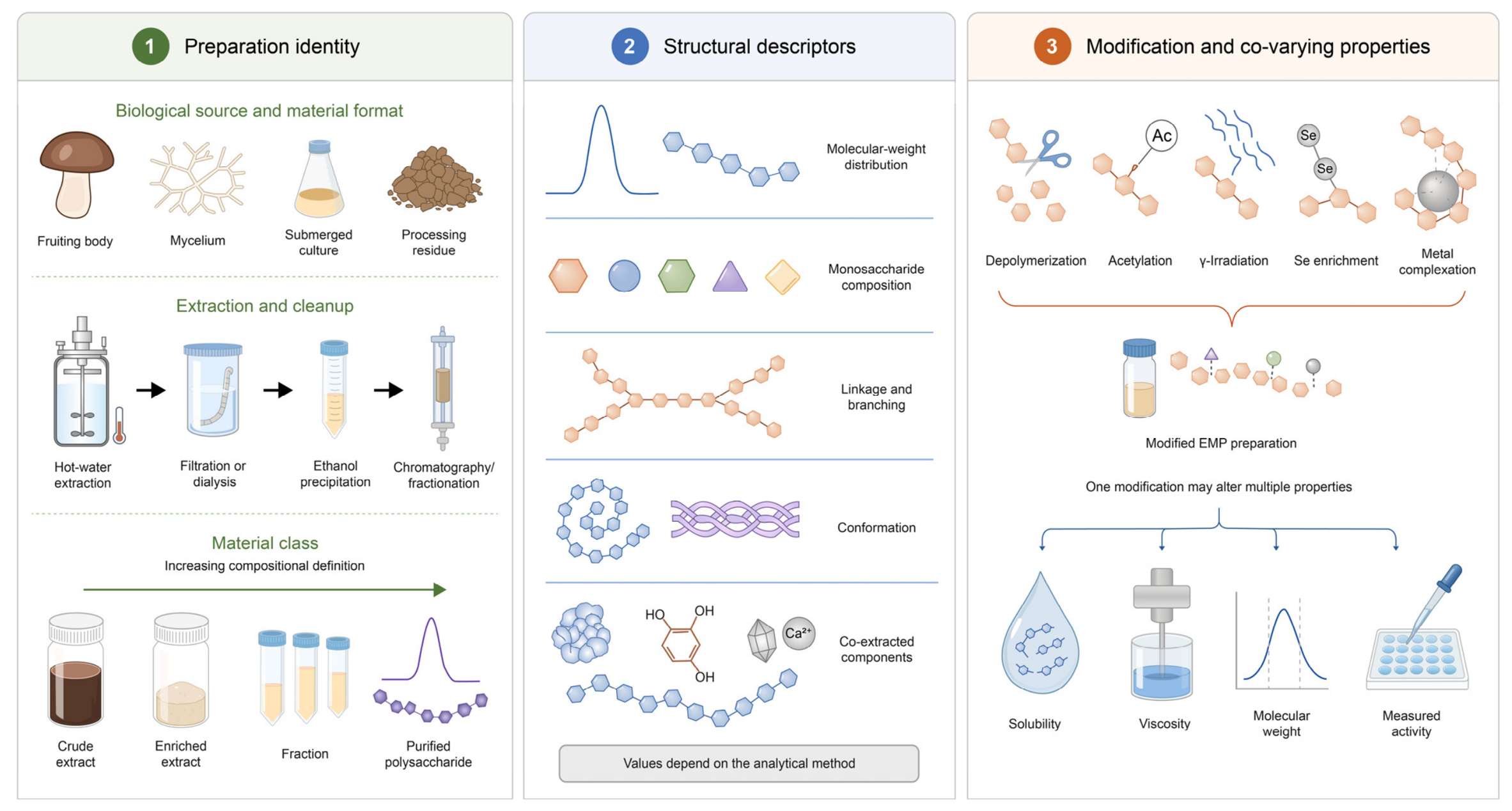
2.2. Extraction and Purification Routes

| Route | Principle and Effect on the Polysaccharide | Advantages | Limitations | EMP Example | Ref. |
|---|---|---|---|---|---|
| Hot-water extraction with ethanol precipitation | Diffusion of water-soluble glucans and heteropolysaccharides at near-boiling temperature; protein, phenolics and salts are co-extracted; high-Mw fractions are largely preserved | Food-grade solvents; simple equipment; reference route for comparison | Extraction over hours; high water and energy demand; wall-bound glucans are not recovered | L. edodes crude polysaccharide, the reference in a four-route comparison | [17,56] |
| Alkaline extraction | Alkali releases alkali-soluble, wall-bound β-glucans; chain degradation and loss of O-acetyl groups can occur | Access to water-insoluble glucans; higher recovery | Neutralization salts; structural alteration; effluent handling | L. edodes hot-alkaline route; F. velutipes, where alkali extraction gave a triple-helix β-glucan and water extraction an α-glucan-rich fraction | [56,66] |
| Enzyme-assisted extraction | Cell-wall-degrading enzymes release polysaccharides at moderate temperature and pH; enzyme protein can remain | Mild conditions; selectivity; low solvent demand | Enzyme cost; inactivation step; batch variability of enzyme preparations | Tremella fuciformis: adding ultrasound to enzymatic extraction lowered intrinsic viscosity | [17,67] |
| Ultrasound (acoustic field) | Cavitation ruptures the cell wall and drives solvent into the tissue; Mw and intrinsic viscosity decrease | Simple operation; short time; low temperature; higher yield | Long exposure degrades the polysaccharide; equipment cost | L. edodes ultrasound-water and ultrasound-alkaline routes | [56,60] |
| Microwave (electromagnetic field) | Dipole rotation and ionic migration disrupt hydrogen bonds; rapid heating; Mw decreases | Low solvent use; short time; good reproducibility | Uneven heating; energy consumption; degradation at long exposure | Auricularia auricula: microwave-assisted extract with higher solubility and lower Mw | [60,68] |
| Combined ultrasound–microwave | Cavitation and rapid heating applied together or in sequence | Higher yield and shorter time than either field alone | Two sets of process parameters to control and report | Ultrasonic/microwave-assisted extraction (UMAE) of A. polytricha, reported with product rheology | [13,60] |
| Pulsed electric field | Electroporation by short high-voltage pulses; non-thermal | Continuous operation; short time; suited to heat-sensitive polysaccharides | Energy consumption; long treatment damages polymer conformation | A. auricula polysaccharide, compared with microwave and ultrasound extraction | [60,69] |
| Mechanical field (high pressure, high-speed shearing) | Pressure or shear force opens the wall at low temperature; lower-Mw products reported | Short time; low solvent use; few by-products | Equipment cost; filtration or centrifugation required; yields below hot water in the two species examined | Schizophyllum commune and Clitocybe squamulosa (high pressure); Agaricus blazei α-glucan (high-speed shearing) | [60,61,62,70] |
| Deep eutectic solvents (DES, NaDES) | Hydrogen-bond acceptor–donor mixtures dissolve wall polysaccharides; the product can differ from the water extract in Mw and monosaccharide profile | Higher recovery than water; tunable composition; solvent reuse shown for a temperature-responsive system | Viscous solvent; separation from the polymer; food compatibility of the components varies; residual solvent and food-system behavior not yet reported | G. lucidum (ethanolamine–o-cresol); shiitake stalks (carnitine–urea); black truffle (betaine–citric acid with ultrasound) | [63,64,65] |
| Purification (graded ethanol precipitation, deproteinization, membrane and column steps) | Compositional definition increases; protein, phenolics and salts are removed | Clear structure–activity attribution; batch consistency | Lower yield; cost; loss of the techno-functional contribution of co-extracted components | L. edodes graded ethanol fractions; C. cicadae column fractions | [35,59] |
2.3. Structural Characteristics
2.4. Modification and Controlled Degradation
3. Metabolic Effects and Mechanisms
3.1. Preclinical Outcomes
3.2. Luminal Mechanisms
3.3. Microbiota-Dependent Mechanisms
3.4. Human Studies
4. Techno-Functional Behavior in Food Systems
4.1. Solubility and Rheology
4.2. Emulsifying Properties
4.3. Water Holding, Gelation and Protein Interaction
4.4. Interaction with Starch
4.5. Flavor and Aroma
4.6. Laboratory and Commercial Preparations
5. Requirements for Translation to Food Ingredients
5.1. Linked Preparation, Function and Outcome Measurements
5.2. Exposure Feasibility
5.3. Quality, Safety and Regulatory Status
6. Practical Reporting and Study-Design Priorities for EMP Food-Ingredient Translation
7. Limitations
8. Conclusions
Supplementary Materials
Author Contributions
Funding
Institutional Review Board Statement
Informed Consent Statement
Data Availability Statement
Acknowledgments
Conflicts of Interest
Abbreviations
| AAP | Auricularia auricula polysaccharide |
| APP | Auricularia polytricha polysaccharide |
| ARRIVE | Animal Research: Reporting of In Vivo Experiments |
| AUC | area under the curve |
| BMI | body mass index |
| D50 | median particle diameter |
| DES | deep eutectic solvent |
| DS | degree of substitution |
| EAI | emulsifying activity index |
| EMP | edible mushroom polysaccharide |
| ESI | emulsion stability index |
| FDA | U.S. Food and Drug Administration |
| FMT | fecal microbiota transplantation |
| GLP | Ganoderma lucidum polysaccharide |
| GLP-1 | glucagon-like peptide-1 |
| GRAS | generally recognized as safe |
| GRN | GRAS notice |
| HbA1c | glycated hemoglobin |
| HFD | high-fat diet |
| HPGPC | high-performance gel-permeation chromatography |
| hsCRP | high-sensitivity C-reactive protein |
| IC50 | half-maximal inhibitory concentration |
| IgE | immunoglobulin E |
| IL-6 | interleukin-6 |
| INFOGEST | standardized static in vitro digestion protocol developed by the INFOGEST network |
| Km | body-surface-area dose conversion factor |
| LDL-C | low-density lipoprotein cholesterol |
| Mw | weight-average molecular weight |
| NaDES | natural deep eutectic solvent |
| NAFLD | non-alcoholic fatty liver disease |
| NEFA | non-esterified fatty acids |
| OA | oleic acid |
| OGTT | oral glucose tolerance test |
| PDI | polydispersity index |
| pGI | predicted glycemic index |
| PYY | peptide YY |
| RCT | randomized controlled trial |
| RDS | rapidly digestible starch |
| SCFA | short-chain fatty acid |
| SPI | soy protein isolate |
| STZ | streptozotocin |
| T2DM | type 2 diabetes mellitus |
| TC | total cholesterol |
| TFP | Tremella fuciformis polysaccharide |
| TG | triglyceride |
| TIDieR | Template for Intervention Description and Replication |
| TNF-α | tumor necrosis factor-α |
| ΔH | enthalpy change |
References
- Food and Agriculture Organization of the United Nations. FAOSTAT: Crops and Livestock Products—Mushrooms and Truffles, Production Quantity, World; FAO: Rome, Italy, 2025; Available online: https://www.fao.org/faostat/en/#data/QCL (accessed on 11 August 2026).
- Singh, M.; Kamal, S.; Sharma, V.P. Status and trends in world mushroom production-III: World production of different mushroom species in 21st century. Mushroom Res. 2020, 29, 75–111. [Google Scholar] [CrossRef] [Scilit]
- Sari, M.; Prange, A.; Lelley, J.I.; Hambitzer, R. Screening of beta-glucan contents in commercially cultivated and wild growing mushrooms. Food Chem. 2017, 216, 45–51. [Google Scholar] [CrossRef] [Scilit]
- Vetter, J. The mushroom glucans: Molecules of high biological and medicinal importance. Foods 2023, 12, 1009. [Google Scholar] [CrossRef] [Scilit]
- Noguera, N.H.; Gigante, M.L. Technological properties and applications of mushroom-based ingredients in innovative food products. Crit. Rev. Food Sci. Nutr. 2026, 66, 5995–6009. [Google Scholar] [CrossRef] [Scilit]
- Chávez-Talavera, O.; Tailleux, A.; Lefebvre, P.; Staels, B. Bile acid control of metabolism and inflammation in obesity, type 2 diabetes, dyslipidemia, and nonalcoholic fatty liver disease. Gastroenterology 2017, 152, 1679–1694.e3. [Google Scholar] [CrossRef] [Scilit]
- Chen, F.; Gong, L. Bile acid–microbiota interactions in cardiometabolic diseases: Mechanisms and emerging therapeutic approaches. Front. Microbiol. 2025, 16, 1689026. [Google Scholar] [CrossRef] [Scilit]
- Florea, B.; Morar, D.; Kracunovic, C.M.; Velescu, S.; Iorgoni, V.; Nistor, P.; Degi, J.; Iancu, I.; Ardelean (Rusu), M.-L.; Cristina, R.T.; et al. Ganoderma lucidum as a functional bioactive candidate for glycemic regulation: Mechanisms, preclinical evidence, and clinical translation. Metabolites 2026, 16, 334. [Google Scholar] [CrossRef] [Scilit]
- Liu, X.; Luo, D.; Guan, J.; Chen, J.; Xu, X. Mushroom polysaccharides with potential in anti-diabetes: Biological mechanisms, extraction, and future perspectives: A review. Front. Nutr. 2022, 9, 1087826. [Google Scholar] [CrossRef] [Scilit]
- Bains, A.; Rani, R.; Tosif, M.M.; Goksen, G.; Sadh, P.K.; Kaushik, R.; Rusu, A.V.; Trif, M.; Chawla, P. Engineering smart hydrocolloid packaging using mushroom-derived polysaccharides for food safety and shelf-life enhancement. Food Chem. X 2026, 103945. [Google Scholar] [CrossRef] [Scilit]
- Rangel-Vargas, E.; Rodriguez, J.A.; Domínguez, R.; Lorenzo, J.M.; Sosa, M.E.; Andrés, S.C.; Rosmini, M.; Pérez-Alvarez, J.A.; Teixeira, A.; Santos, E.M. Edible mushrooms as a natural source of food ingredient/additive replacer. Foods 2021, 10, 2687. [Google Scholar] [CrossRef] [Scilit]
- See Toh, C.J.Y.; Bi, X.; Lee, H.W.; Yeo, M.T.Y.; Henry, C.J. Is mushroom polysaccharide extract a better fat replacer than dried mushroom powder for food applications? Front. Nutr. 2023, 10, 1111955. [Google Scholar] [CrossRef] [Scilit]
- Zhang, Z.; Ding, X.; Xu, Z.; Wu, X.; Yang, C.; Hao, J.; Chen, Y. Optimization of ultrasonic/microwave assisted extraction (UMAE) and rheological properties of polysaccharides from Auricularia polytricha. Am. J. Biochem. Biotechnol. 2020, 16, 112–124. [Google Scholar] [CrossRef] [Scilit]
- Hou, F.; Yang, S.; Ma, X.; Gong, Z.; Wang, Y.; Wang, W. Characterization of physicochemical properties of oil-in-water emulsions stabilized by Tremella fuciformis polysaccharides. Foods 2022, 11, 3020. [Google Scholar] [CrossRef] [Scilit]
- Lv, X.; Zhang, D.; Zhu, X.; Li, D.; Zhang, C. Emulsification stability of Auricularia auricula polysaccharides and its effect on steady-state properties of β-carotene embedding. Food Innov. Adv. 2024, 3, 360–371. [Google Scholar] [CrossRef] [Scilit]
- Han, X.; Yang, D.; Zhang, S.; Liu, X.; Zhao, Y.; Song, C.; Sun, Q. Characterization of insoluble dietary fiber from Pleurotus eryngii and evaluation of its effects on obesity-preventing or relieving effects via modulation of gut microbiota. J. Future Foods 2023, 3, 55–66. [Google Scholar] [CrossRef] [Scilit]
- Sun, Y.; He, H.; Wang, Q.; Yang, X.; Jiang, S.; Wang, D. A review of development and utilization for edible fungal polysaccharides: Extraction, chemical characteristics, and bioactivities. Polymers 2022, 14, 4454. [Google Scholar] [CrossRef] [Scilit]
- Zhang, X.; Duan, Y.; Xue, J.; Chen, S.; Wang, H. Edible mushroom polysaccharides: Structural characteristics, chemical modification strategies, and structure-activity relationship: A review. Int. J. Biol. Macromol. 2025, 320, 145888. [Google Scholar] [CrossRef] [Scilit]
- Zhao, C.; Aaqil, M.; He, R.; Kamil, M.; Zheng, J.; Guo, Y.; Zhang, Z.; Nawaz, T.; Zhang, F.; You, L.; et al. Process-programmed extraction–structure–activity relationships (ESAR) in edible and medicinal mushroom polysaccharides: A mechanistic and application-oriented framework. J. Adv. Res. 2026, 87, 1045–1077. [Google Scholar] [CrossRef] [Scilit]
- Liu, J.; Dai, Y.; Yang, W.; Chen, Z.-Y. Role of mushroom polysaccharides in modulation of GI homeostasis and protection of GI barrier. J. Agric. Food Chem. 2025, 73, 6416–6441. [Google Scholar] [CrossRef] [Scilit]
- Zhu, Y.; He, P.; Zhao, R.; Liu, Y.; He, X.-L.; Wang, K.; He, X.; Wang, K.-N.; Zhu, Y.-T.; Gao, X.; et al. Advances in antioxidant activities of edible mushroom polysaccharides: Status, influencing factors, mechanisms, and applications. Front. Nutr. 2026, 13, 1806859. [Google Scholar] [CrossRef] [Scilit]
- Giavasis, I. Bioactive fungal polysaccharides as potential functional ingredients in food and nutraceuticals. Curr. Opin. Biotechnol. 2014, 26, 162–173. [Google Scholar] [CrossRef] [Scilit]
- Ritota, M.; Manzi, P. Edible mushrooms: Functional foods or functional ingredients? A focus on Pleurotus spp. AIMS Agric. Food 2023, 8, 391–439. [Google Scholar] [CrossRef] [Scilit]
- Friedman, M. Mushroom polysaccharides: Chemistry and antiobesity, antidiabetes, anticancer, and antibiotic properties in cells, rodents, and humans. Foods 2016, 5, 80. [Google Scholar] [CrossRef] [Scilit]
- Miao, M.; Hamaker, B.R. Food matrix effects for modulating starch bioavailability. Annu. Rev. Food Sci. Technol. 2021, 12, 169–191. [Google Scholar] [CrossRef] [Scilit]
- Capuano, E. The behavior of dietary fiber in the gastrointestinal tract determines its physiological effect. Crit. Rev. Food Sci. Nutr. 2017, 57, 3543–3564. [Google Scholar] [CrossRef] [Scilit]
- Wang, Q.; Ellis, P.R. Oat β-glucan: Physico-chemical characteristics in relation to its blood-glucose and cholesterol-lowering properties. Br. J. Nutr. 2014, 112, S4–S13. [Google Scholar] [CrossRef] [Scilit]
- Grundy, M.M.-L.; Edwards, C.H.; Mackie, A.R.; Gidley, M.J.; Butterworth, P.J.; Ellis, P.R. Re-evaluation of the mechanisms of dietary fibre and implications for macronutrient bioaccessibility, digestion and postprandial metabolism. Br. J. Nutr. 2016, 116, 816–833. [Google Scholar] [CrossRef] [Scilit]
- Luo, Y.; Xu, Y.; Gu, Y.; Gao, J.; Liu, X.; Luo, Y. Hypoglycemic activity and mechanism of the small bowl of Auricularia auricula-judae polysaccharides before and after degradation: A study based on a type 2 diabetes mellitus (T2DM) mouse model. Food Qual. Saf. 2025, 9, fyaf053. [Google Scholar] [CrossRef] [Scilit]
- Li, P.; Xiong, C.; Huang, W. Gamma-irradiation-induced degradation of the water-soluble polysaccharide from Auricularia polytricha and its anti-hypercholesterolemic activity. Molecules 2022, 27, 1110. [Google Scholar] [CrossRef] [Scilit]
- Tao, Z.; Zou, Y.; Ye, Z.; Lin, J.; Zheng, Q. The intervention effects of Pleurotus citrinopileatus polysaccharides with different molecular weights on high-fat diet mice. Int. J. Biol. Macromol. 2025, 310, 143085. [Google Scholar] [CrossRef] [Scilit]
- Zhou, Y.; Jia, Y.; Xu, N.; Tang, L.; Chang, Y. Auricularia auricula-judae (Bull.) polysaccharides improve obesity in mice by regulating gut microbiota and TLR4/JNK signaling pathway. Int. J. Biol. Macromol. 2023, 250, 126172. [Google Scholar] [CrossRef] [Scilit]
- Zhang, R.; Xiao, C.; Yong, T.; Huang, L.; Hu, H.; Xie, Y.; Wu, Q. Grifola frondosa polysaccharide F2 ameliorates disordered glucose and lipid metabolism in prediabetic mice by modulating bile acids. Foods 2025, 14, 955. [Google Scholar] [CrossRef] [Scilit]
- Wang, Z.; Ouyang, Q.; Guo, H.; Li, H.; Liu, R. Antidiabetic effects of Agaricus bisporus polysaccharide in HFD/STZ-induced mice. Int. J. Biol. Macromol. 2026, 349, 150671. [Google Scholar] [CrossRef] [Scilit]
- Wang, Y.; Zeng, T.; Li, H.; Wang, Y.; Wang, J.; Yuan, H. Structural characterization and hypoglycemic function of polysaccharides from Cordyceps cicadae. Molecules 2023, 28, 526. [Google Scholar] [CrossRef] [Scilit]
- Zhang, Y.; Li, X.; Xu, S.; Li, J.; Shi, L.; Wang, Z.; Chen, P.; Jia, L.; Zhang, J. The acetylation of Ganoderma applanatum polysaccharides on ameliorating T2DM-induced hepatic and colonic injuries by modulating the Nrf2/Keap1–TLR4/NFκB–Bax/Bcl-2 pathways. Int. J. Biol. Macromol. 2025, 294, 140055. [Google Scholar] [CrossRef] [Scilit]
- Yu, M.; Yue, J.; Hui, N.; Zhi, Y.; Hayat, K.; Yang, X.; Zhang, D.; Chu, S.; Zhou, P. Anti-hyperlipidemia and gut microbiota community regulation effects of selenium-rich Cordyceps militaris polysaccharides on the high-fat diet-fed mice model. Foods 2021, 10, 2252. [Google Scholar] [CrossRef] [Scilit]
- Lv, X.-C.; Wu, Q.; Yuan, Y.-J.; Li, L.; Guo, W.-L.; Lin, X.-B.; Huang, Z.-R.; Rao, P.-F.; Ai, L.-Z.; Ni, L. Organic chromium derived from the chelation of Ganoderma lucidum polysaccharide and chromium(III) alleviates metabolic syndromes and intestinal microbiota dysbiosis induced by high-fat and high-fructose diet. Int. J. Biol. Macromol. 2022, 219, 964–979. [Google Scholar] [CrossRef] [Scilit]
- Wang, Y.; Ni, Z.; Li, J.; Shao, Y.; Yong, Y.; Lv, W.; Zhang, S.; Fu, T.; Chen, A. Cordyceps cicadae polysaccharides alleviate hyperglycemia by regulating gut microbiota and its metabolites in high-fat diet/streptozocin-induced diabetic mice. Front. Nutr. 2023, 10, 1203430. [Google Scholar] [CrossRef] [Scilit]
- Wang, G.; Xie, B.; Yang, X.; Wang, R.; Zhong, G.; Gao, L.; Chen, X.; Lin, M.; Huang, Q.; Zhang, C.; et al. The crosstalk between gut microbiota, metabolites and genes in diet-induced hepatic steatosis mice intervened with Cordyceps guangdongensis polysaccharides. Int. J. Biol. Macromol. 2024, 277, 134607. [Google Scholar] [CrossRef] [Scilit]
- Tian, L.; Roos, Y.H.; Gómez-Mascaraque, L.G.; Lu, X.; Miao, S. Tremella fuciformis polysaccharides: Extraction, physicochemical, and emulsion properties at different pHs. Polymers 2023, 15, 1771. [Google Scholar] [CrossRef] [Scilit]
- Dai, L.; Wang, Q.; Wang, L.; Huang, Q.; Hu, B. Using commercial bio-functional fungal polysaccharides to construct emulsion systems by associating with SPI. Foods 2025, 14, 215. [Google Scholar] [CrossRef] [Scilit]
- Hu, J.; Zhao, T.; Li, S.; Wang, Z.; Wen, C.; Wang, H.; Yu, C.; Ji, C. Stability, microstructure, and digestibility of whey protein isolate–Tremella fuciformis polysaccharide complexes. Food Hydrocoll. 2019, 89, 379–385. [Google Scholar] [CrossRef] [Scilit]
- Zhao, Y.; Shui, D.; Li, S.; Lin, X.; Liang, H.; Zhang, S.; Ji, C. Complexation behavior of Auricularia auricula polysaccharide and whey protein isolate: Characterization and potential beverage application. J. Food Process. Preserv. 2022, 46, e16340. [Google Scholar] [CrossRef] [Scilit]
- Li, H.; He, J.; Liu, Y.; Liu, X.; Liu, T. Auricularia auricula polysaccharide modulates rheological, thermal, and structural properties of wheat gluten via selective regulation of glutenin and gliadin. Foods 2026, 15, 136. [Google Scholar] [CrossRef] [Scilit]
- Wang, L.; Zhang, F.; Zheng, B.; Zhang, Y.; Pan, L. Stability and flavor of set yogurt fortified with Tremella fuciformis polysaccharide during cold storage. Curr. Res. Food Sci. 2023, 7, 100536. [Google Scholar] [CrossRef] [Scilit]
- Xu, Q.; Zhao, Q.; Li, W.; Lin, Y.; Liu, X.; Li, H. Synergistic emulsions of Tremella fuciformis polysaccharide and sodium caseinate enable melt-resistance and inhibit ice crystals in low-fat ice cream. Food Res. Int. 2026, 225, 118104. [Google Scholar] [CrossRef] [Scilit]
- Bai, M.; Huang, Z.; Zheng, X.; Hou, M.; Zhang, S. Polysaccharides from Trametes versicolor as a potential prebiotic to improve the gut microbiota in high-fat diet mice. Microorganisms 2024, 12, 1654. [Google Scholar] [CrossRef] [Scilit]
- Wu, J.; Guo, A.; Ni, Y.; Zhang, D.; Liu, H. Extracellular polysaccharides from Ganoderma lucidum as a functional ingredient: Improving the technological quality and bioactive properties of corn noodles. Foods 2026, 15, 2463. [Google Scholar] [CrossRef] [Scilit]
- Xiao, Z.; Zhou, J.; Chen, H.; Chen, X.; Wang, L.; Liu, D.; Kang, X. Synthesis, characterization and MAFLD prevention potential of Ganoderma lucidum spore polysaccharide-stabilized selenium nanoparticles. Int. J. Biol. Macromol. 2024, 282, 136962. [Google Scholar] [CrossRef] [Scilit]
- Ma, C.; Ni, L.; Sun, M.; Hu, F.; Guo, Z.; Zeng, H.; Sun, W.; Zhang, M.; Wu, M.; Zheng, B. Enhancing the hypolipidemic and functional properties of Flammulina velutipes root dietary fiber via steam explosion. Foods 2024, 13, 3621. [Google Scholar] [CrossRef] [Scilit]
- Liu, T.; Wang, N.; Xu, X.; Wang, D. Effect of high quality dietary fiber of Hericium erinaceus on lowering blood lipid in hyperlipidemia mice. J. Future Foods 2022, 2, 61–68. [Google Scholar] [CrossRef] [Scilit]
- Guo, K.; Liu, J.; Yao, Z.; Tan, Z.; Yang, T. Effect of soluble dietary fiber extracted from Lentinula edodes (Berk.) Pegler on lipid metabolism and liver protection in mice on high-fat diet. Front. Nutr. 2025, 12, 1537569. [Google Scholar] [CrossRef] [Scilit]
- Berger, R.G.; Bordewick, S.; Krahe, N.-K.; Ersoy, F. Mycelium vs. fruiting bodies of edible fungi—A comparison of metabolites. Microorganisms 2022, 10, 1379. [Google Scholar] [CrossRef] [Scilit]
- European Commission. Consultation Process on Novel Food Status: Consultations Submitted to Member States. Available online: https://food.ec.europa.eu/food-safety/novel-food/consultation-process-novel-food-status_en (accessed on 11 August 2026).
- Phosarith, N.; Siriwoharn, T.; Jirarattanarangsri, W. Comparison of the conventional, chemical, and ultrasound extraction of crude polysaccharides and their properties from Lentinula edodes (Berk.) Pegler. Foods 2025, 14, 2428. [Google Scholar] [CrossRef] [Scilit]
- Shu, Y.; Huang, Y.; Dong, W.; Fan, X.; Sun, Y.; Chen, G.; Zeng, X.; Ye, H. The polysaccharides from Auricularia auricula alleviate non-alcoholic fatty liver disease via modulating gut microbiota and bile acids metabolism. Int. J. Biol. Macromol. 2023, 246, 125662. [Google Scholar] [CrossRef] [Scilit]
- Liu, N.; Chen, X.; Song, J.; Chen, M.; Gong, P.; Jia, W.; Li, G. Hypoglycemic effects of Auricularia auricula polysaccharides on high fat diet and streptozotocin-induced diabetic mice using metabolomics analysis. Food Funct. 2021, 12, 9994–10007. [Google Scholar] [CrossRef] [Scilit]
- Ma, Y.; Liao, Z.; Kang, X.; Li, C.; Hu, G. Physicochemical properties, structural characterization, and in vitro binding capacity of polysaccharide fractions from the fruiting bodies of Lentinula edodes. J. Food Meas. Charact. 2024, 18, 6858–6871. [Google Scholar] [CrossRef] [Scilit]
- Zhang, H.; Jiang, F.; Tang, C.; Liu, Y.; Zhang, J. Prospects and applications of efficient physical field processing technologies for polysaccharide extraction and quality improvement in edible mushrooms: A systematic review. Int. J. Biol. Macromol. 2025, 301, 140412. [Google Scholar] [CrossRef] [Scilit]
- Chen, Z.; Yin, C.; Fan, X.; Ma, K.; Yao, F.; Zhou, R.; Shi, D.; Cheng, W.; Gao, H. Characterization of physicochemical and biological properties of Schizophyllum commune polysaccharide extracted with different methods. Int. J. Biol. Macromol. 2020, 156, 1425–1434. [Google Scholar] [CrossRef] [Scilit]
- Geng, X.; Guo, D.; Wu, B.; Wang, W.; Zhang, D.; Hou, S.; Bau, T.; Lei, J.; Xu, L.; Cheng, Y.; et al. Effects of different extraction methods on the physico-chemical characteristics and biological activities of polysaccharides from Clitocybe squamulosa. Int. J. Biol. Macromol. 2024, 259, 129234. [Google Scholar] [CrossRef] [Scilit]
- Cai, C.; Wang, Y.; Yu, W.; Wang, C.; Li, F.; Tan, Z. Temperature-responsive deep eutectic solvents as green and recyclable media for the efficient extraction of polysaccharides from Ganoderma lucidum. J. Clean. Prod. 2020, 274, 123047. [Google Scholar] [CrossRef] [Scilit]
- Wang, D.; Zhang, M.; Law, C.L.; Zhang, L. Natural deep eutectic solvents for the extraction of lentinan from shiitake mushroom: COSMO-RS screening and ANN-GA optimizing conditions. Food Chem. 2024, 430, 136990. [Google Scholar] [CrossRef] [Scilit]
- Wu, Y.; Hu, H.; Yang, G.; Chen, Y.; Zhong, X.; Li, S.; Pan, M.; Li, Y.; Zhang, J. Enhancing the black truffle polysaccharide extraction efficiency using a combination of natural deep eutectic solvents and ultrasound-assisted techniques. J. Food Meas. Charact. 2025, 19, 2208–2219. [Google Scholar] [CrossRef] [Scilit]
- Bu, T.; Ren, Y.; Yu, Y.; Wu, W.; Zhang, Z.; Hu, W.; Lu, J.; Wang, J.; Cai, M.; Yang, K.; et al. Effect of two different Flammulina velutipes polysaccharides on the physicochemical and digestive properties of rice starch and their interaction mechanisms. Food Biosci. 2024, 59, 104015. [Google Scholar] [CrossRef] [Scilit]
- Li, Y.; He, Y.; Zhang, H.; Ma, X. Effects of ultrasonic-enzymatic-assisted ethanol precipitation method on the physicochemical characteristics, antioxidant and hypoglycemic activities of Tremella fuciformis polysaccharides. Ultrason. Sonochem. 2023, 101, 106682. [Google Scholar] [CrossRef] [Scilit]
- Yao, J.; Zeng, J.Y.; Tang, Y.X.; Cheng, Y.R.; Li, T.Y.; Yang, J.; Zhang, Y.J. Effects of the extraction solvents on dissolution rate and antioxidant capacity of Auricularia auricula (Agaricomycetes) polysaccharides in vitro and in vivo. Int. J. Med. Mushrooms 2023, 25, 61–74. [Google Scholar] [CrossRef] [Scilit]
- Li, C.; Mao, X.; Xu, B. Pulsed electric field extraction enhanced anti-coagulant effect of fungal polysaccharide from Jew’s ear (Auricularia auricula). Phytochem. Anal. 2013, 24, 36–40. [Google Scholar] [CrossRef] [Scilit]
- Zhang, A.; Deng, J.; Liu, X.; He, P.; He, L.; Zhang, F.; Linhardt, R.J.; Sun, P. Structure and conformation of α-glucan extracted from Agaricus blazei Murill by high speed shearing homogenization. Int. J. Biol. Macromol. 2018, 113, 558–564. [Google Scholar] [CrossRef] [Scilit]
- Morris, G.A.; Adams, G.G.; Harding, S.E. On hydrodynamic methods for the analysis of the sizes and shapes of polysaccharides in dilute solution: A short review. Food Hydrocoll. 2014, 42, 318–334. [Google Scholar] [CrossRef] [Scilit]
- Liu, T.; Zhang, S.; Wang, N.; Xu, X.; Liu, H.; Wang, D.; Zhang, Y. Preparation and characterization of Auricularia cornea Ehrenb polysaccharide-Zn complex and its hypoglycemic activity through regulating insulin resistance in HepG2 cells. J. Food Qual. 2021, 2021, 4497128. [Google Scholar] [CrossRef] [Scilit]
- Warnasooriyaa, W.M.P.B.K.; Chaikaew, A.; Phongthai, S.; Unban, K.; Klangpetch, W.; Khumsap, T.; Rachtanapun, P.; Tangjaidee, P. Bioactive properties of selenium-enriched polysaccharides extracted from Pleurotus ostreatus using ultrasonic-assisted extraction. Curr. Res. Food Sci. 2025, 11, 101207. [Google Scholar] [CrossRef] [Scilit]
- Li, J.; Sun, Y.; Zhang, M.; Chen, M.; Liu, H.; Zhu, X.; Ren, F.; Zhou, L.; Wang, Z. Rice bran polysaccharides: Structure, modification, bioactivity, and application potential in food and health systems. Foods 2026, 15, 2194. [Google Scholar] [CrossRef] [Scilit]
- Xue, H.; Feng, J.; Tang, Y.; Wang, X.; Tang, J.; Cai, X.; Zhong, H. Research progress on the interaction of the polyphenol–protein–polysaccharide ternary systems. Chem. Biol. Technol. Agric. 2024, 11, 95. [Google Scholar] [CrossRef] [Scilit]
- Zong, X.; Zhang, H.; Zhu, L.; Deehan, E.C.; Fu, J.; Wang, Y.; Jin, M. Auricularia auricula polysaccharides attenuate obesity in mice through gut commensal Papillibacter cinnamivorans. J. Adv. Res. 2023, 52, 203–218. [Google Scholar] [CrossRef] [Scilit]
- Zhao, Y.-X.; Huang, L.; Wu, D.-T.; Li, J.; Lei, J.; Fu, M.-X.; Zhang, Q.; Qin, W. Catabolism of Dictyophora indusiata polysaccharide and its impacts on gut microbial composition during in vitro digestion and microbial fermentation. Foods 2023, 12, 1909. [Google Scholar] [CrossRef] [Scilit]
- Li, J.H.; Gu, F.T.; Yang, Y.; Zhao, Z.C.; Huang, L.X.; Zhu, Y.Y.; Chen, S.; Wu, J.Y. Simulated human digestion and fermentation of a high-molecular weight polysaccharide from Lentinula edodes mushroom and protective effects on intestinal barrier. Carbohydr. Polym. 2024, 343, 122478. [Google Scholar] [CrossRef] [Scilit]
- Ma, G.; Xu, Q.; Du, H.; Muinde Kimatu, B.; Su, A.; Yang, W.; Hu, Q.; Xiao, H. Characterization of polysaccharide from Pleurotus eryngii during simulated gastrointestinal digestion and fermentation. Food Chem. 2022, 370, 131303. [Google Scholar] [CrossRef] [Scilit]
- Sun, L.; Yuan, H.; Ma, H.; Wang, Y. Effects of Cordyceps cicadae polysaccharide on gut microbiota, the intestinal mucosal barrier, and inflammation in diabetic mice. Metabolites 2025, 15, 8. [Google Scholar] [CrossRef] [Scilit]
- Walter, J.; Armet, A.M.; Finlay, B.B.; Shanahan, F. Establishing or exaggerating causality for the gut microbiome: Lessons from human microbiota-associated rodents. Cell 2020, 180, 221–232. [Google Scholar] [CrossRef] [Scilit]
- Metwaly, A.; Kriaa, A.; Hassani, Z.; Carraturo, F.; Druart, C.; Trebicka, J.; Godoy, Y.; Schierwagen, R.; Bork, P.; Iyappan, A.; et al. A consensus statement on establishing causality, therapeutic applications and the use of preclinical models in microbiome research. Nat. Rev. Gastroenterol. Hepatol. 2025, 22, 343–356. [Google Scholar] [CrossRef] [Scilit]
- Wu, L.; Hu, Z.; Lv, Y.; Ge, C.; Luo, X.; Zhan, S.; Huang, W.; Shen, X.; Yu, D.; Liu, B. Hericium erinaceus polysaccharides ameliorate nonalcoholic fatty liver disease via gut microbiota and tryptophan metabolism regulation in an aged laying hen model. Int. J. Biol. Macromol. 2024, 273, 132735. [Google Scholar] [CrossRef] [Scilit]
- Zhang, L.; Liu, Z.-X.; Liu, Y.-H.; Chen, Y.; Chen, J.; Lu, C.-H. Auricularia auricula polysaccharides exert anti-inflammatory effects in hepatic fibrosis by the gut–liver axis and enhancing SCFA metabolism. J. Agric. Food Chem. 2025, 73, 4617–4629. [Google Scholar] [CrossRef] [Scilit]
- Abshori, N.F.; Wardhani, S.; Fatoni, F.; Fauzi, T.; Mardliyyah, R.; Negara, M.S.; Pradana, A.; Rampengan, D.; Arif, A.; Ahdi, I.; et al. Effects of Ganoderma lucidum polysaccharide peptide on inflammatory and metabolic biomarkers in obese patients with cardiometabolic syndrome: A randomized controlled trial. Curr. Drug Discov. Technol. 2026, 23, e15701638439377. [Google Scholar] [CrossRef] [Scilit]
- Morales, D.; Shetty, S.A.; López-Plaza, B.; Gómez-Candela, C.; Smidt, H.; Marín, F.R.; Soler-Rivas, C. Modulation of human intestinal microbiota in a clinical trial by consumption of a β-D-glucan-enriched extract obtained from Lentinula edodes. Eur. J. Nutr. 2021, 60, 3249–3265. [Google Scholar] [CrossRef] [Scilit]
- Dicks, L.; Jakobs, L.; Sari, M.; Hambitzer, R.; Ludwig, N.; Simon, M.-C.; Stehle, P.; Stoffel-Wagner, B.; Helfrich, H.-P.; Ahlborn, J.; et al. Fortifying a meal with oyster mushroom powder beneficially affects postprandial glucagon-like peptide-1, non-esterified free fatty acids and hunger sensation in adults with impaired glucose tolerance: A double-blind randomized controlled crossover trial. Eur. J. Nutr. 2022, 61, 687–701. [Google Scholar] [CrossRef] [Scilit]
- Johnen, J.; Waizenegger, J.; Ellinger, J.; Lütjohann, D.; Steffens, K.E.; Wagner, K.G.; Stoffel-Wagner, B.; Dolscheid-Pommerich, R.; Ellinger, S. Effects of regular consumption of a β-glucan-rich oyster mushroom powder on cholesterol metabolism in adults with moderately elevated LDL-cholesterol concentrations: A double-blind randomized controlled trial. Nutr. Metab. 2026, 23, 53. [Google Scholar] [CrossRef] [Scilit]
- Gitsomboon, S.; Ratanapornsompong, G.; Ongphiphadhanakul, B.; Thongpradit, S.; Chanprasertyothin, S.; Chailurtkit, L.; Nimitphong, H. Tremella fuciformis beverage improves glycated hemoglobin A1c and waist circumference in overweight/obese prediabetic subjects: A randomized controlled trial. BMC Nutr. 2024, 10, 44. [Google Scholar] [CrossRef] [Scilit]
- Saha, D.; Bhattacharya, S. Hydrocolloids as thickening and gelling agents in food: A critical review. J. Food Sci. Technol. 2010, 47, 587–597. [Google Scholar] [CrossRef] [Scilit]
- Dickinson, E. Hydrocolloids as emulsifiers and emulsion stabilizers. Food Hydrocoll. 2009, 23, 1473–1482. [Google Scholar] [CrossRef] [Scilit]
- Mussa, N.J.; Chaijan, M.; Thongkam, P.; Wongnen, C.; Kitpipit, W.; Çavdar, H.K.; Kim, S.R.; Panpipat, W. Rheological and gelling properties of chicken-mushroom hybrid gel for flexitarian-friendly functional food applications. Foods 2025, 14, 645. [Google Scholar] [CrossRef] [Scilit]
- Zhao, Y.; Zhang, Z.; Wang, L.; Li, W.; Du, J.; Zhang, S.; Chen, X. Hypolipidemic mechanism of Pleurotus eryngii polysaccharides in high-fat diet-induced obese mice based on metabolomics. Front. Nutr. 2023, 10, 1118923. [Google Scholar] [CrossRef] [Scilit]
- Tu, J.; Adhikari, B.; Brennan, M.A.; Cheng, P.; Bai, W.; Brennan, C.S. Interactions between sorghum starch and mushroom polysaccharides and their effects on starch gelatinization and digestion. Food Hydrocoll. 2023, 139, 108504. [Google Scholar] [CrossRef] [Scilit]
- Zhang, S.; Liu, Y.; Sun, T.; Liu, H.; Wang, D. The effects of Tremella fuciformis polysaccharide on the physicochemical, multiscale structure and digestive properties of Cyperus esculentus starch. Foods 2024, 13, 1425. [Google Scholar] [CrossRef] [Scilit]
- Zhang, X.; Fu, Y.; Wang, H.; Shen, Q.; Liu, Z.; Chi, Y. Possible role of Tremella fuciformis polysaccharide in modulating in vitro digestion of potato starch digesta. Food Chem. X 2025, 29, 102759. [Google Scholar] [CrossRef] [Scilit]
- Bu, T.; Kong, X.; Ren, Y.; Zhang, Z.; Hu, W.; Natallia, K.; Cai, M.; Sun, P.; Wu, W.; Yang, K. Effect of Flammulina velutipes polysaccharides on the quality and digestibility of fresh wet rice noodles: A study perspective from physicochemical and postprandial glucose homeostasis in vivo. Food Chem. 2025, 484, 144335. [Google Scholar] [CrossRef] [Scilit]
- Sun, L.; Zhang, Z.; Xin, G.; Sun, B.; Bao, X.; Wei, Y.; Zhao, X.; Xu, H. Advances in umami taste and aroma of edible mushrooms. Trends Food Sci. Technol. 2020, 96, 176–187. [Google Scholar] [CrossRef] [Scilit]
- Li, Y.; Ma, S.; Dong, J.; Cheng, Z.; Shen, R. Incorporation of mushroom powder: Enhancing structure and flavor in pea–mung bean composite protein. npj Sci. Food 2026, 10, 19. [Google Scholar] [CrossRef] [Scilit]
- Proserpio, C.; Lavelli, V.; Laureati, M.; Pagliarini, E. Effect of Pleurotus ostreatus powder addition in vegetable soup on β-glucan content, sensory perception, and acceptability. Food Sci. Nutr. 2019, 7, 730–737. [Google Scholar] [CrossRef] [Scilit]
- Hollowood, T.A.; Linforth, R.S.T.; Taylor, A.J. The effect of viscosity on the perception of flavour. Chem. Senses 2002, 27, 583–591. [Google Scholar] [CrossRef] [Scilit]
- Shao, P.; Yang, Y.; Li, Z.; Yang, J.; Zhang, G.; Zhang, J.; Wang, M. Ganoderma sinense soluble dietary fiber alleviates nonalcoholic fatty liver disease by regulating liver metabolism. eFood 2025, 6, e70079. [Google Scholar] [CrossRef] [Scilit]
- Wang, S.; Li, D.; Li, G.; Duan, N.; He, C.; Meng, J.; Cheng, Y.; Geng, X.; Hou, L.; Chang, M.; et al. Functional properties, rheological characteristics, simulated digestion, and fermentation by human fecal microbiota of polysaccharide from Morchella importuna. Foods 2024, 13, 2148. [Google Scholar] [CrossRef] [Scilit]
- U.S. Food and Drug Administration. Estimating the Maximum Safe Starting Dose in Initial Clinical Trials for Therapeutics in Adult Healthy Volunteers: Guidance for Industry. Available online: https://www.fda.gov/regulatory-information/search-fda-guidance-documents/estimating-maximum-safe-starting-dose-initial-clinical-trials-therapeutics-adult-healthy-volunteers (accessed on 11 August 2026).
- U.S. Food and Drug Administration. GRN No. 413: Beta Glucans Derived from Ganoderma lucidum Mycelium. Available online: https://www.hfpappexternal.fda.gov/scripts/fdcc/index.cfm?id=413&set=GRASNotices (accessed on 11 August 2026).
- U.S. Food and Drug Administration. GRN No. 997: Chitosan and Beta-1,3-Glucans from White Button Mushrooms. Available online: https://www.hfpappexternal.fda.gov/scripts/fdcc/index.cfm?id=997&set=GRASNotices (accessed on 11 August 2026).
- U.S. Food and Drug Administration. GRN No. 1124: Beta-Glucans from Hericium Erinaceus Strain BCRC 35669. Available online: https://www.hfpappexternal.fda.gov/scripts/fdcc/index.cfm?id=1124&set=GRASNotices (accessed on 11 August 2026).
- Chen, S.-N.; Nan, F.-H.; Liu, M.-W.; Yang, M.-F.; Chang, Y.-C.; Chen, S. Evaluation of immune modulation by β-1,3; 1,6 D-glucan derived from Ganoderma lucidum in healthy adult volunteers, a randomized controlled trial. Foods 2023, 12, 659. [Google Scholar] [CrossRef] [Scilit]
- European Commission. Commission Regulation (EU) 2023/915 on Maximum Levels for Certain Contaminants in Food. Available online: https://eur-lex.europa.eu/eli/reg/2023/915/oj (accessed on 11 August 2026).
- EFSA Panel on Nutrition, Novel Foods and Food Allergens (NDA); Turck, D.; Bohn, T.; Castenmiller, J.; de Henauw, S.; Hirsch-Ernst, K.I.; Maciuk, A.; Mangelsdorf, I.; McArdle, H.J.; Naska, A.; et al. Guidance on the scientific requirements for an application for authorisation of a novel food in the context of Regulation (EU) 2015/2283. EFSA J. 2024, 22, e8961. [Google Scholar] [CrossRef] [Scilit]
- Ali, S.B.; Smith, W. Agaricus bisporus mushroom anaphylaxis: A case report and review of the literature. J. Allergy Clin. Immunol. Glob. 2024, 3, 100324. [Google Scholar] [CrossRef] [Scilit]
- Electronic Code of Federal Regulations. 21 CFR § 101.81—Health Claims: Soluble Fiber from Certain Foods and Risk of Coronary Heart Disease (CHD). Available online: https://www.ecfr.gov/current/title-21/chapter-I/subchapter-B/part-101/subpart-E/section-101.81 (accessed on 11 August 2026).
- European Commission. Commission Regulation (EU) No 432/2012 Establishing a List of Permitted Health Claims Made on Foods. Available online: https://eur-lex.europa.eu/eli/reg/2012/432/oj (accessed on 11 August 2026).
- Health Canada. Oat Products and Blood Cholesterol Lowering: Summary of Assessment of a Health Claim About Oat Products and Blood Cholesterol Lowering. Available online: https://www.canada.ca/en/health-canada/services/food-nutrition/food-labelling/health-claims/assessments/products-blood-cholesterol-lowering-summary-assessment-health-claim-about-products-blood-cholesterol-lowering.html (accessed on 11 August 2026).
- Health Canada. Summary of Health Canada’s Assessment of a Health Claim About Barley Products and Blood Cholesterol Lowering. Available online: https://www.canada.ca/en/health-canada/services/food-nutrition/food-labelling/health-claims/assessments/assessment-health-claim-about-barley-products-blood-cholesterol-lowering.html (accessed on 11 August 2026).
- Health Canada. Summary of Health Canada’s Assessment of a Health Claim About Psyllium Products and Blood Cholesterol Lowering. Available online: https://www.canada.ca/en/health-canada/services/food-nutrition/food-labelling/health-claims/assessments/psyllium-products-blood-cholesterol-lowering-nutrition-health-claims-food-labelling.html (accessed on 11 August 2026).
- Wolever, T.M.S.; Tosh, S.M.; Gibbs, A.L.; Brand-Miller, J.; Duncan, A.M.; Hart, V.; Lamarche, B.; Thomson, B.A.; Duss, R.; Wood, P.J. Physicochemical properties of oat β-glucan influence its ability to reduce serum LDL cholesterol in humans: A randomized clinical trial. Am. J. Clin. Nutr. 2010, 92, 723–732. [Google Scholar] [CrossRef] [Scilit]
- Kerckhoffs, D.A.J.M.; Hornstra, G.; Mensink, R.P. Cholesterol-lowering effect of beta-glucan from oat bran in mildly hypercholesterolemic subjects may decrease when beta-glucan is incorporated into bread and cookies. Am. J. Clin. Nutr. 2003, 78, 221–227. [Google Scholar] [CrossRef] [Scilit]
- Whitehead, A.; Beck, E.J.; Tosh, S.; Wolever, T.M.S. Cholesterol-lowering effects of oat β-glucan: A meta-analysis of randomized controlled trials. Am. J. Clin. Nutr. 2014, 100, 1413–1421. [Google Scholar] [CrossRef] [Scilit]
- Jovanovski, E.; Yashpal, S.; Komishon, A.; Zurbau, A.; Blanco Mejia, S.; Ho, H.V.T.; Li, D.; Sievenpiper, J.; Duvnjak, L.; Vuksan, V. Effect of psyllium (Plantago ovata) fiber on LDL cholesterol and alternative lipid targets, non-HDL cholesterol and apolipoprotein B: A systematic review and meta-analysis of randomized controlled trials. Am. J. Clin. Nutr. 2018, 108, 922–932. [Google Scholar] [CrossRef] [Scilit]
- William, A.; Lachat, C.; Ahles, S.; Murphy, K.J.; Minihane, A.-M.; Weaver, C.; Shyam, S.; Rigutto-Farebrother, J. Delphi survey to gather feedback on a CONSORT extension proposal for nutrition intervention trials. Eur. J. Nutr. 2025, 64, 76. [Google Scholar] [CrossRef] [Scilit]
- Hoffmann, T.C.; Glasziou, P.P.; Boutron, I.; Milne, R.; Perera, R.; Moher, D.; Altman, D.G.; Barbour, V.; Macdonald, H.; Johnston, M.; et al. Better reporting of interventions: Template for intervention description and replication (TIDieR) checklist and guide. BMJ 2014, 348, g1687. [Google Scholar] [CrossRef] [Scilit]
- Brodkorb, A.; Egger, L.; Alminger, M.; Alvito, P.; Assunção, R.; Ballance, S.; Bohn, T.; Bourlieu-Lacanal, C.; Boutrou, R.; Carrière, F.; et al. INFOGEST static in vitro simulation of gastrointestinal food digestion. Nat. Protoc. 2019, 14, 991–1014. [Google Scholar] [CrossRef] [Scilit]
- Percie du Sert, N.; Hurst, V.; Ahluwalia, A.; Alam, S.; Avey, M.T.; Baker, M.; Browne, W.J.; Clark, C.; Cuthill, I.C.; Dirnagl, U.; et al. The ARRIVE guidelines 2.0: Updated guidelines for reporting animal research. PLoS Biol. 2020, 18, e3000410. [Google Scholar] [CrossRef] [Scilit]


| Preparation Contrast | Processing Variable | Measured Material Change | Study Design and Response | Food-Ingredient Implication | Ref. |
|---|---|---|---|---|---|
| Extraction-route contrast: Lentinula edodes crude polysaccharides | Hot-water, hot-alkaline, ultrasound-water and ultrasound-alkaline extraction | Yield range 12.9% to 35.2%; study-specific Mw not reported | Food-function and enzyme assays: swelling and inhibition varied by route | Shows that extraction route changes candidate ingredient properties; metabolic effects have not been tested in a food matrix | [56] |
| Depolymerization: Auricularia auricula-judae AAP-1 vs. DAAP-1 | H2O2–ascorbic acid/succinic acid degradation | Mw 119 to 59 kDa; PDI 2.63 to 1.68 | Enzyme assays and mice: lower IC50 values and stronger lipid/insulin responses | Matched contrast links Mw reduction with a stronger response; food-matrix behavior was not assessed | [29] |
| Process-induced depolymerization: Flammulina velutipes soluble dietary fiber | Steam-explosion process modification | Yield 4.64% to 8.73%; Mw 313 to 123 kDa | OA-HepG2 cells: TG suppression increased from 28.4% to 51.8% | Directly links processing to a cell response; relevance to whole-organism and food-matrix settings remains to be tested | [51] |
| Irradiation depolymerization: Auricularia polytricha APP vs. irradiated products | γ-Irradiation | Mw 6820 to 34 kDa; viscosity 133 to 4.8 mPa·s | Mice: serum TC fell from 5.93 to 4.37 mmol/L in the most degraded product | Links preparation, physical function and metabolism within one study; several irradiation-induced features still co-varied | [30] |
| Enzymatic-ultrasound depolymerization: Hericium erinaceus dietary fiber | Ultrasound-assisted enzymatic treatment | Mw peaks shifted downward; D50 particle size 314 to 177 μm | In vitro: lipase inhibition and bile-salt/cholesterol binding increased | Provides a paired in vitro link between treatment and activity; the animal arm did not compare native and treated materials | [52] |
| Deacetylation: native vs. deacetylated Auricularia auricula polysaccharides | Deacetylation | Native O-acetyl DS 0.25; O-acetyl group not detected after deacetylation | Mice: both improved NAFLD endpoints; part of the inflammatory response weakened after deacetylation | Modification effects are context-dependent; matched controls and inflammatory endpoints matter | [57] |
| Acetylation: Ganoderma applanatum GAP vs. A-GAP | Acetylation | DS 0.37; Mw 11.6 to 12.2 kDa | In vitro and mice: antioxidant and T2DM-related responses improved | Links substitution with activity changes; food-system behavior and matched exposure require separate evaluation | [36] |
| Element enrichment: Cordyceps militaris CMP vs. SeCMP | Biological selenium enrichment | Se content 0.10 to 5.14 mg/kg; Mw and monosaccharides not characterized | Mice: no advantage at 100 mg/kg; a stronger response occurred only at 200 mg/kg | Stronger response remains dose-confounded and cannot be assigned to enrichment alone | [37] |
| Metal complexation: Auricularia cornea ACEP vs. ACEP-Zn | Zn(II) chelation/complexation | Zn content 5.41 mg/g; apparent Mw (HPGPC) 35.5 to 32.7 kDa | Enzyme assays: α-glucosidase and α-amylase inhibition increased | Complexation changes assay behavior; regulatory and matrix implications require separate evaluation | [72] |
| Metal complexation: Ganoderma lucidum GLP vs. GLP-Cr | Cr(III) chelation | Post-complex structural characterization not repeated in the metabolic paper; unequal mass dosing | Mice: GLP-Cr generally improved glucose and lipid markers more than GLP | Activity comparison is informative but composition and dose accounting are incomplete | [38] |
| Study Type | Model or Population | Test Material | Exposure or Study Design | Main Findings | Ref. |
|---|---|---|---|---|---|
| Animal | HFD/STZ-induced diabetic mice | Auricularia auricula polysaccharide AAP-M | 200 mg/kg body weight for five weeks | Lower fasting and OGTT glucose than model controls | [58] |
| Animal | HFD/STZ-induced diabetic mice | Cordyceps cicadae polysaccharide CH-P | 800 mg/kg | Lower OGTT AUC, HbA1c, glucose and insulin; separate microbiota/indole tests | [39] |
| Animal with microbiota perturbation | High-fat-diet mice | Auricularia auricula polysaccharides | 50 or 100 mg/kg; 200 mg/kg in the perturbation study | Lower weight gain and improved metabolic indices; perturbation supported microbial participation | [32,76] |
| Animal | Diet-induced hepatic-steatosis mice | Cordyceps guangdongensis polysaccharides | 400 mg/kg/day | Improved weight, OGTT AUC and lipid measures; no single mediator isolated | [40] |
| Human RCT | 60 obese adults with cardiometabolic syndrome | Ganoderma lucidum polysaccharide peptide | 750 mg/day (540 mg/day β-glucan) for eight weeks | No between-group differences in the primary inflammatory endpoints or in lipid or BMI outcomes | [85] |
| Human RCT with food delivery | 57 randomized, 52 analyzed adults with untreated mild hypercholesterolemia | β-Glucan-enriched Lentinula edodes mixture | 10.4 g/day mixture providing 3.5 g/day fungal β-glucans for eight weeks | Microbiota composition changed; primary total cholesterol, lipid and inflammatory endpoints were unchanged | [86] |
| Human crossover RCT with food delivery | 22 adults with impaired glucose tolerance | Meal fortified with oven-dried Pleurotus ostreatus powder | 20 g powder providing 8.1 g β-glucans; acute crossover | GLP-1, NEFA and hunger AUC changed; the primary glucose endpoint was unchanged | [87] |
| Human RCT with food delivery | 46 adults with moderately elevated LDL-C | Pleurotus ostreatus powder beverage | 8.4 g/day powder providing 3 g/day β-glucans for four weeks | Primary LDL-C (+0.12 mmol/L; 95% CI −0.14 to 0.34) and major lipid endpoints were unchanged; the absorption-marker signal was exploratory | [88] |
| Human RCT with food delivery | 56 overweight/obese adults with prediabetes (28/28) | Tremella fuciformis beverage (boiled whole-mushroom extract, 15% w/v) | 180 mL once daily for 12 weeks; declared 6.4 g β-glucan per serving | Within-group decreases in HbA1c (6.03% to 5.96%) and waist circumference (95.2 to 93.5 cm); glucose tolerance, insulin indices and lipids unchanged; exploratory design | [89] |
| Functional Focus | Tested Preparation | Test System and Key Condition | Key Finding and Formulation Relevance | Ref. |
|---|---|---|---|---|
| Molecular size and rheology | Irradiated A. polytricha APP/RAPP | Aqueous dispersions; four irradiation levels | Mw decreased from 6820 to 34 kDa; viscosity decreased from 133 to 4.8 mPa·s. Thickening weakened across the series. | [30] |
| Fraction-dependent functionality | L. edodes P20 and fractions | Solubility and emulsion assays | Solubility increased from 44% to approximately 97%; EAI decreased from 2.86 to 1.32–1.70 m2/g. | [59] |
| Concentration-dependent rheology | UMAE-derived A. polytricha polysaccharide | 0.1–3.0% aqueous solutions; 25 °C | Newtonian at 0.1–0.5%; weak gel at ≥2.0%. Concentration changed the physical regime. | [13] |
| Emulsification | Commercial T. fuciformis polysaccharide | Palm-oil O/W emulsions; TFP and oil varied | At 0.8%, EAI was 0.98 m2/g and ESI was 88%; higher levels became overly viscous or gel-like. | [14] |
| Emulsion stability | A. auricula AAP-W | O/W emulsions; 0.1–3%; 30-day storage | Systems containing 1–3% remained uniform; those containing 0.1–0.5% separated. | [15] |
| Preparation format | Laboratory, crude and commercial T. fuciformis preparations | Emulsion assays across pH 2–10 | EAI and ESI profiles differed by preparation; laboratory TPS had the highest EAI and TPS-160 the highest ESI. | [41] |
| Protein-assisted emulsification | Commercial AAP or GLP with soy-protein isolate | pH and mixing ratio varied | SPI–AAP droplets were approximately 2 μm at pH 3 and 105 μm at pH 4, showing strong condition dependence. | [42] |
| Gluten interaction | A. auricula polysaccharide | Wheat gluten with 0–10% AAP | The response peaked at 8%; network performance weakened at 10%, defining a non-linear addition window. | [45] |
| Starch interaction | Water- and alkali-extracted F. velutipes polysaccharides (103 and 1150 kDa) with rice starch | 5–20% addition; pasting, retrogradation and in vitro digestion | Opposite effects on swelling and pasting viscosity; both reduced amylose leaching, retrogradation and RDS; pGI 92.4 to 78.7 at 10–20%. | [66] |
| Starch interaction in a finished food | Magnetically treated G. lucidum extracellular polysaccharide in corn noodles | 0.2–1.0% addition; cooking quality, texture and in vitro digestion | 0.6% was optimal: cooking loss −24.7%, breakage −46.7%; pGI 76.4 to 72.3. | [49] |
| Evaluation Dimension | Current EMP Studies | Mature Dietary-Fiber Comparator | Main Gap for Translation |
|---|---|---|---|
| Source and material specification | Studies include purified fractions, enriched extracts, dietary-fiber preparations, commercial polysaccharides and whole-mushroom matrices, with uneven characterization. | Eligible oat/barley β-glucan and psyllium sources, assays and serving contributions are specified in established claim frameworks [112,114,115,116]. | EMP material classes, compositional thresholds and assay specifications are not harmonized for claim-oriented comparison. |
| Function-relevant properties | Molecular weight, viscosity, binding and fermentation are measured unevenly and seldom in the preparations used for efficacy testing. | Human oat β-glucan studies link dose and physicochemical behavior with LDL-C response [117]. | Reported EMP mass cannot yet be interpreted consistently as a functionally active intake. |
| Food-matrix dependence | Selected preparations alter emulsions, gels and protein matrices, but function after processing, storage and digestion is rarely connected with metabolic testing. | Oat β-glucan lipid responses can vary with the delivery matrix [118]. | Retention of the relevant EMP property in finished foods remains poorly resolved. |
| Human endpoint support | Controlled studies use different preparation classes, populations and endpoints, with limited replication [85,86,87,88,89]. | Meta-analyses support LDL-C reduction for oat β-glucan and psyllium under defined intake conditions [119,120]. | Repeated human evidence is lacking for a consistent EMP preparation class and intake basis. |
| Intake and serving size | Animal mass-scale estimates, observed human intakes and selected matrix calculations overlap at gram scale, but retained function is unresolved. | Daily intake and per-serving contributions are defined for several soluble-fiber claim examples [112,114,115,116]. | Preparation-specific intake targets are not linked to retained function in the intended food matrix. |
| Regulatory status and claim substantiation | Novel Food and GRAS examples apply to individual preparations and intended uses [55,105,106,107]. | Established fiber examples connect source, amount, eligible food conditions and claim wording [112,113]. | Existing material-specific decisions cannot be generalized across EMP species, source parts or extraction routes. |
| Priority Area | Core Information | Context-Specific Information | Decision Supported |
|---|---|---|---|
| Source and preparation identity | Species; source part; cultivation or commercial source; batch or catalog information | Strain, cultivar or authentication details when source variation is central | Whether the tested material can be recognized and reproduced and whether two studies used the same source part, route and extraction conditions |
| Preparation and basic quality | Extraction and purification sequence; material class; yield basis; carbohydrate or glucan assay; protein, ash and moisture or solids basis | Batch comparison and process-relevant residual components, including residual reagents, by-products and element form for modified preparations | Whether separately prepared batches agree closely enough in composition to be treated as one preparation or must be compared as different preparations |
| Structural characterization | Molecular-weight method, calibrant and reported distribution; monosaccharide profile | Linkage, branching, conformation or other descriptors linked to the study hypothesis | Whether molecular-weight distributions obtained by the same method agree between preparations and which structural features can be related to processing, function or response |
| Exposure and product context | Dose basis; route; frequency; duration; food vehicle; actual intake where available | Serving size, addition level, meal timing, background diet and compliance | Whether the tested exposure can be delivered in the proposed food format |
| Food-system performance | Matrix composition, EMP concentration and the principal processing conditions | Dispersion, rheology, emulsion stability, gelation, texture, water retention or syneresis according to product type | Whether the preparation performs within a useful formulation window |
| Retained function and stability | Relevant processing steps and storage conditions; post-process characterization | Retained viscosity, binding, emulsification, network behavior, digestibility or fermentability | Whether the property of interest survives processing, storage and delivery and whether it agrees between preparations under matched conditions |
| Finished-product quality and sensory response | For formulated foods: recipe, EMP addition level, appearance and physical stability | Color, taste, aroma, mouthfeel, texture, overall acceptability and storage-related sensory change; panel or consumer method and evaluation conditions | Whether the proposed intake is compatible with product quality and consumption |
| Comparators and outcome reporting | Native, parent or matrix control; matching basis; numerical outcomes with units and uncertainty | Pathway-appropriate perturbation or mediation design when a mechanistic claim is pursued | Whether preparation, dose, matrix and mechanism effects can be distinguished |
Disclaimer/Publisher’s Note: The statements, opinions and data contained in all publications are solely those of the individual author(s) and contributor(s) and not of MDPI and/or the editor(s). MDPI and/or the editor(s) disclaim responsibility for any injury to people or property resulting from any ideas, methods, instructions or products referred to in the content. |
© 2026 by the authors. Licensee MDPI, Basel, Switzerland. This article is an open access article distributed under the terms and conditions of the Creative Commons Attribution (CC BY) license.
Share and Cite
Chen, M.; Zou, R.; Chen, J.; Zhang, Y.; Diao, H.; Xu, Y. Edible Mushroom Polysaccharides as Functional Food Ingredients for Metabolic Health: Preparation, Techno-Functional Behavior, and Requirements for Translation. Foods 2026, 15, 3514. https://doi.org/10.3390/foods15193514
Chen M, Zou R, Chen J, Zhang Y, Diao H, Xu Y. Edible Mushroom Polysaccharides as Functional Food Ingredients for Metabolic Health: Preparation, Techno-Functional Behavior, and Requirements for Translation. Foods. 2026; 15(19):3514. https://doi.org/10.3390/foods15193514
Chicago/Turabian StyleChen, Ming, Ruifan Zou, Jie Chen, Yuping Zhang, Huan Diao, and Yayuan Xu. 2026. "Edible Mushroom Polysaccharides as Functional Food Ingredients for Metabolic Health: Preparation, Techno-Functional Behavior, and Requirements for Translation" Foods 15, no. 19: 3514. https://doi.org/10.3390/foods15193514
APA StyleChen, M., Zou, R., Chen, J., Zhang, Y., Diao, H., & Xu, Y. (2026). Edible Mushroom Polysaccharides as Functional Food Ingredients for Metabolic Health: Preparation, Techno-Functional Behavior, and Requirements for Translation. Foods, 15(19), 3514. https://doi.org/10.3390/foods15193514