Effects of Conventional and Ultrasound-Assisted Washing on Pesticide Residue Reduction and Quality Characteristics of Purslane (Portulaca oleracea L.): An Artificial Surface Contamination Study


Abstract
1. Introduction
2. Materials and Methods
2.1. Sample Collection and Preparation
2.2. Chemicals and Reagents
2.3. Pesticides Selection
2.4. Preparation of Standard Solutions
2.5. Preparation of Contaminated Purslane Samples
2.6. Washing Treatments of Contaminated Purslane Samples
2.7. The Pesticide Extraction Process for LC-MS/MS and GC-MS/MS
2.8. LC-MS/MS and GC-MS/MS Analysis
2.9. Method Validation
2.10. Calculation of Pesticide Residue Reduction
2.11. Evaluation of Quality Characteristics of Fresh Purslane After Washing Treatments
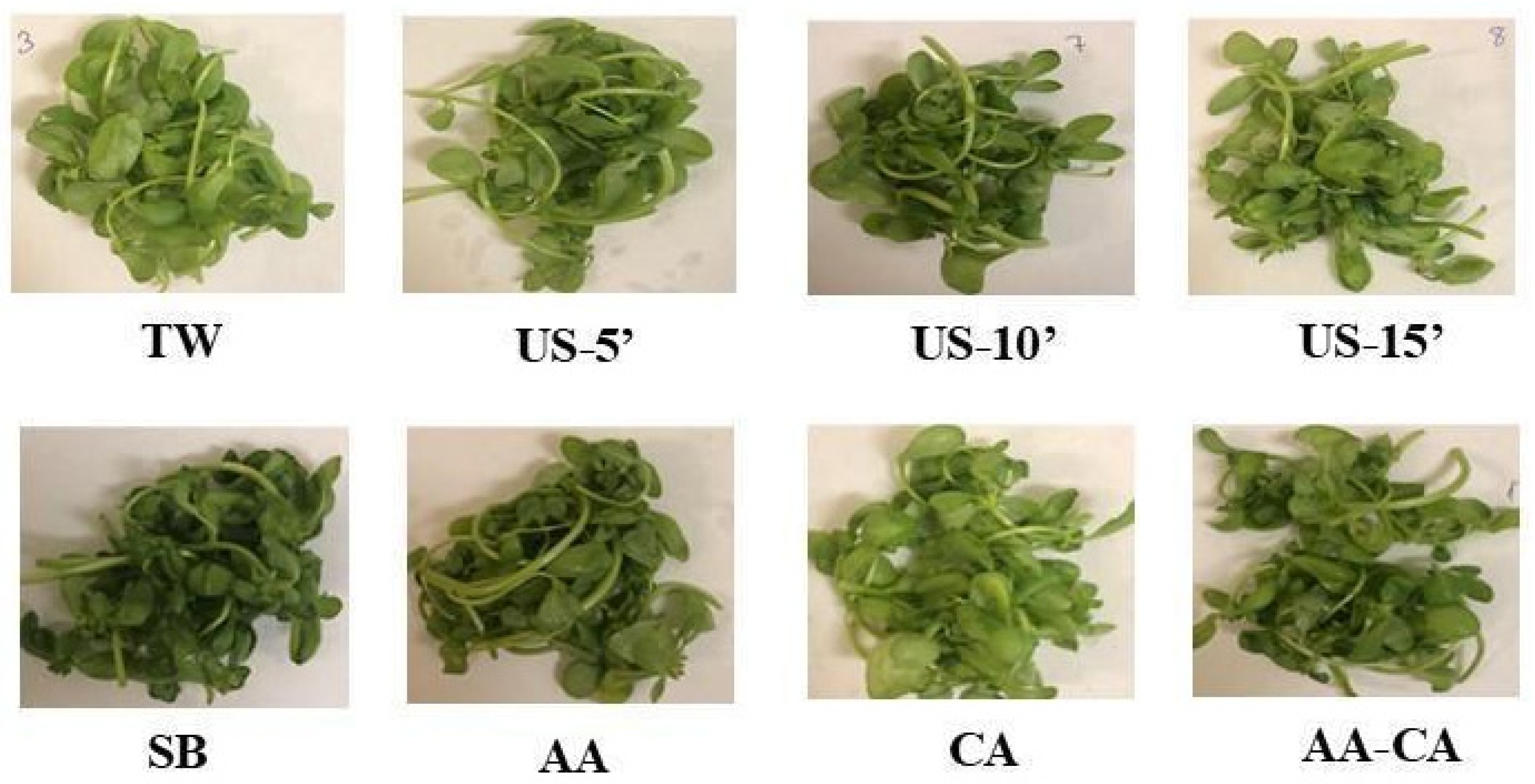
2.11.1. Color and Appearance
2.11.2. Titratable Acidity (TA), pH and Soluble Solid Content
- N = Normality of titrant, NaOH (mEq/mL).
- V = Volume of titrant (mL).
- Eq. wt. = Equivalent weight of citric acid (mg/mEq).
- W = mass of sample (g).
- 1000 = factor relating mg to grams (mg/g).
2.11.3. Spectrophotometric Methods
- Extraction
- Total Flavonoid Content (TFC)
- Total Phenolic Content (TPC)
- Chlorophyll content
- m = Purslane weight (g).
- V = Volume of extracted sample (mL).
- Determination of antioxidant activity by using the DPPH assay
2.11.4. Texture
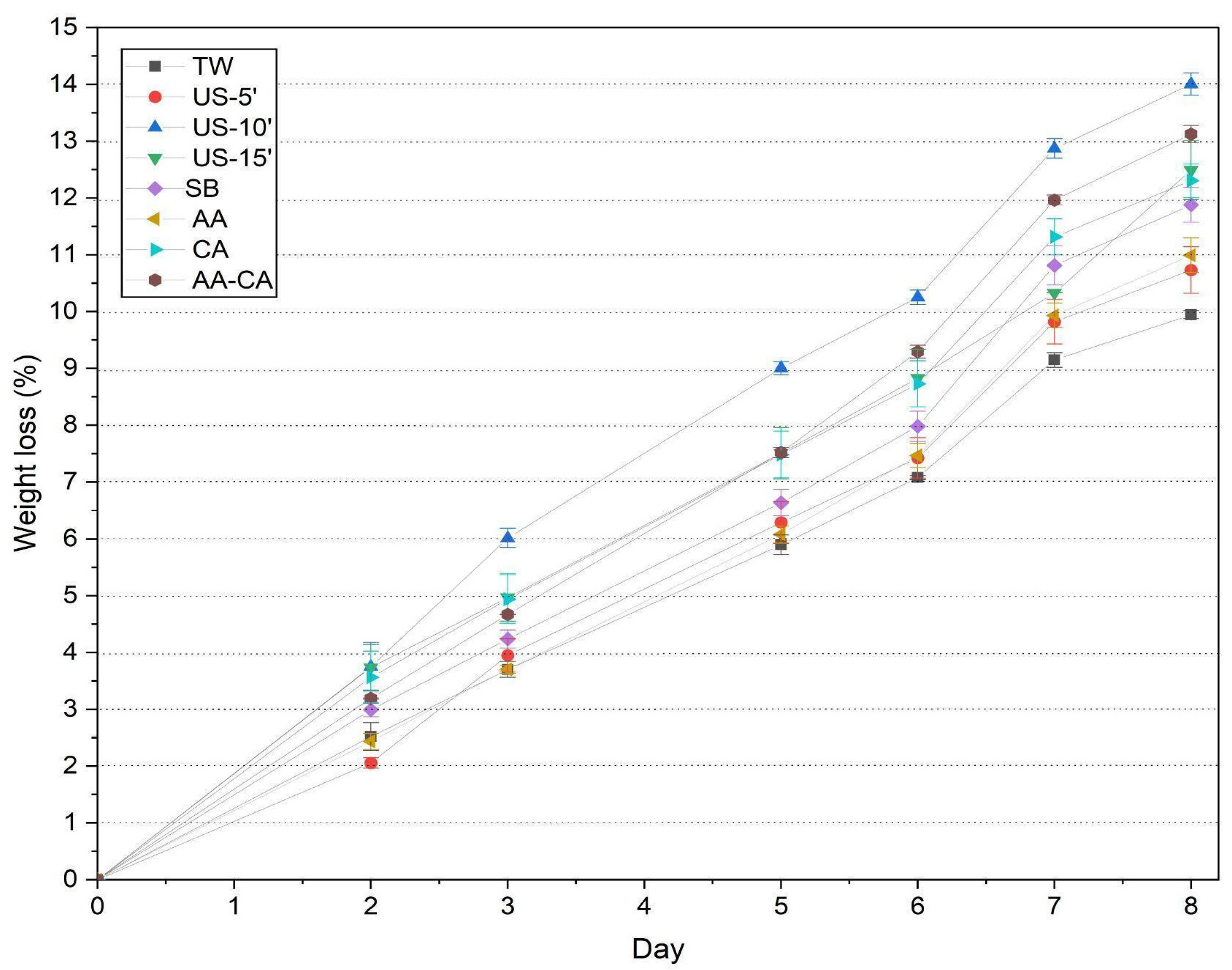
2.11.5. Weight Loss
2.12. Statistical Analysis
3. Results and Discussion
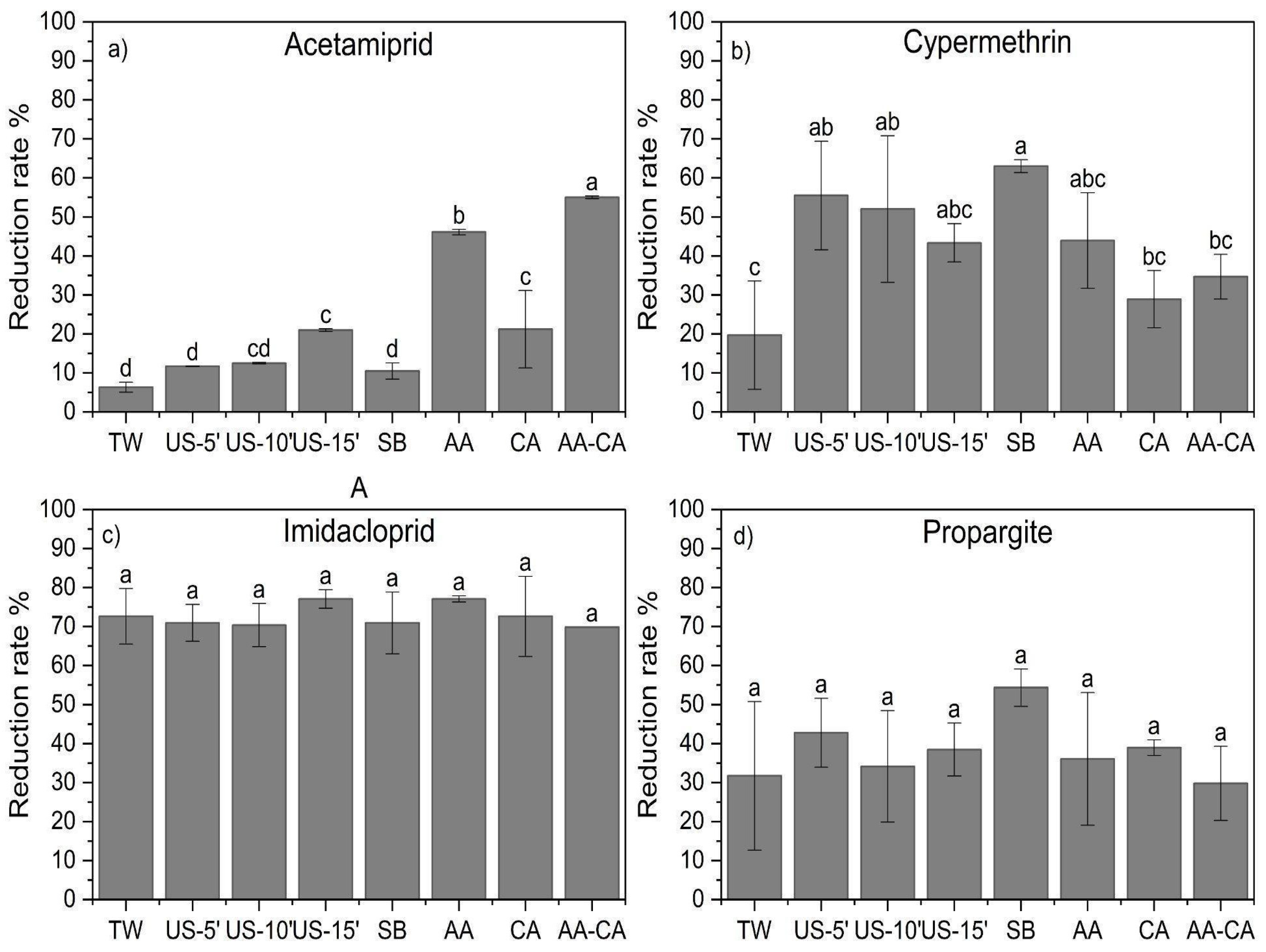
3.1. Pesticide Residue Reduction in Purslane After Washing Treatments
3.2. Verification of Pesticide Extraction and Detection Methods
3.3. Effect of Washing Treatments on the Quality Characteristics of Fresh Purslane
4. Conclusions
Author Contributions
Funding
Institutional Review Board Statement
Informed Consent Statement
Data Availability Statement
Conflicts of Interest
Abbreviations
| AA | 5% acetic acid (5 min) |
| AA-CA | 2.5% citric acid + 2.5% acetic acid solution (5 min) |
| ANOVA | One-way analysis of variance |
| CA | 5% citric acid solution (5 min) |
| CAS RN | Chemical Abstracts Service Registry Number |
| CE | Catechin equivalents |
| DPPH | 2,2-diphenyl-1-picrylhydrazyl |
| ESI+/ESI- | Electrospray ionization source operating in positive and negative modes |
| FDA | Food and Drug Administration |
| FW | Fresh weight |
| GAE | Gallic acid equivalents |
| GRAS | Generally recognized as safe |
| IUPAC | International Union of Pure and Applied Chemistry |
| LOD | Limit of detection |
| log P | Logarithm of octanol-water partition coefficient |
| LOQ | Limit of quantification |
| MRLs | Maximum residue limits |
| MRM | Multiple Reaction Monitoring |
| pKa | Dissociation constant |
| RH | Relative humidity |
| RSD | Relative standard deviation |
| RTs | Retention times |
| SB | 5% Sodium bicarbonate (5 min) |
| TA | Titratable acidity |
| TAC | Total antioxidant capacity |
| TE | Trolox equivalents |
| TFC | Total flavonoid content |
| TPC | Total phenolic content |
| TW | Tap water (5 min) |
| UAW | Ultrasound-assisted washing |
| US-5′ | Tap water (Ultrasound treatment for 5 min) |
| US-10′ | Tap water (Ultrasound treatment for 10 min) |
| US-15′ | Tap water (Ultrasound treatment for 15 min) |
Appendix A

| Name | IUPAC Name | CAS RN | Molar Mass (g/mol) | log P * | MRL for Purslane (mg/kg) | Solubility in Water | Structure |
|---|---|---|---|---|---|---|---|
| Acetamiprid | (E)-N1-[(6-chloro-3-pyridyl)methyl]-N2-cyano-N1-methylacetamidine | 135410-20-7 | 222.67 | 0.80 | 0.6 | High | C10H11ClN4, Insecticide Systemic |
| Propargite | 2-(4-tert-butylphenoxy)cyclohexyl prop-2-ynyl sulphite | 2312-35-8 | 350.7 | 5.70 | 0.01 * | Low | C19H26O4S, Acaricide, Insecticide Non-systemic |
| Cypermethrin | (RS)-α-cyano-3-phenoxybenzyl (1RS,3RS;1RS,3SR)-3-(2,2-dichlorovinyl)-2,2-dimethylcyclopropanecarboxy | 52315-07-8 | 416.3 | 6.60 | 0.7 | Low | C22H19Cl2NO3, Insecticide, Acaricide, Veterinary substance Non-systemic |
| Imidacloprid | (E)-1-(6-chloro-3-pyridylmethyl)-N-nitroimidazolidin-2-ylideneamine | 138261-41-3 | 255.66 | 0.57 | 0.01 * | High | C9H10ClN5O2, Insecticide, Veterinary substance Systemic |
| Acetamiprid MRM transitions; ESI+ | ||
| Precursor m/z | Product m/z | CE |
| 223 | 126.1 | −20.0 |
| 223 | 56.2 | −16.0 |
| 223 | 73.1 | −55.0 |
| Imidacloprid MRM transitions; ESI+ | ||
| Precursor m/z | Product m/z | CE |
| 256.1 | 175.0 | −20.0 |
| 256.1 | 209.0 | −17.0 |
| Cypermethrin MRM transitions; ESI− | ||
| Precursor m/z | Product m/z | CE |
| 163.0 | 127.0 | 5.0 |
| 163.0 | 91.0 | 10.0 |
| 181.1 | 152.1 | 22.0 |
| 181.1 | 127.1 | 22.0 |
| Propargite MRM transitions; ESI+ | ||
| Precursor m/z | Product m/z | CE |
| 368.2 | 231.1 | −11.0 |
| 368.2 | 175.1 | −17.0 |
| 368.2 | 57.1 | −21.0 |
| Sample | Acetamiprid (mg/kg) | Cypermethrin (mg/kg) | Imidacloprid (mg/kg) | Propargite (mg/kg) |
|---|---|---|---|---|
| Inoculated (Untreated) | 0.196 ± 0.003 a | 0.087 ± 0.001 a | 0.090 ± 0.001 a | 0.100 ± 0.006 a |
| TW | 0.183 ± 0.002 ab | 0.070 ± 0.012 ab | 0.025 ± 0.002 b | 0.071 ± 0.020 b |
| US-5′ | 0.173 ± 0.000 b | 0.039 ± 0.012 de | 0.026 ± 0.004 b | 0.060 ± 0.009 b |
| US-10′ | 0.171 ± 0.000 b | 0.042 ± 0.016 cde | 0.027 ± 0.002 b | 0.069 ± 0.015 b |
| US-15′ | 0.155 ± 0.001 c | 0.049 ± 0.004 bcde | 0.026 ± 0.002 b | 0.064 ± 0.007 b |
| SB | 0.175 ± 0.004 b | 0.032 ± 0.001 e | 0.026 ± 0.003 b | 0.048 ± 0.005 b |
| AA | 0.106 ± 0.001 d | 0.049 ± 0.011 bcde | 0.026 ± 0.001 b | 0.067 ± 0.018 b |
| CA | 0.154 ± 0.019 c | 0.062 ± 0.006 bc | 0.025 ± 0.002 b | 0.064 ± 0.002 b |
| AA-CA | 0.088 ± 0.001 e | 0.057 ± 0.005 bcd | 0.027 ± 0.001 b | 0.073 ± 0.010 b |
| Sample | Day 2 (%) | Day 3 (%) | Day 5 (%) | Day 6 (%) | Day 7 (%) | Day 8 (%) |
|---|---|---|---|---|---|---|
| TW | 2.52 ± 0.24 cde | 3.70 ± 0.14 d | 5.89 ± 0.17 d | 7.08 ± 0.04 d | 9.15 ± 0.13 f | 9.95 ± 0.07 e |
| US-5’ | 2.06 ± 0.09 e | 3.95 ± 0.29 d | 6.29 ± 0.37 cd | 7.42 ± 0.35 cd | 9.83 ± 0.39 e | 10.73 ± 0.41 d |
| US-10’ | 3.73 ± 0.42 a | 5.99 ± 0.17 a | 8.98 ± 0.11 a | 10.23 ± 0.13 a | 12.85 ± 0.17 a | 13.98 ± 0.20 a |
| US-15’ | 3.73 ± 0.40 a | 4.96 ± 0.42 b | 7.50 ± 0.45 b | 8.82 ± 0.50 b | 10.32 ± 0.01 de | 12.49 ± 0.52 bc |
| SB | 3.00 ± 0.12 bcd | 4.24 ± 0.16 cd | 6.64 ± 0.23 c | 7.99 ± 0.27 c | 10.82 ± 0.34 cd | 11.89 ± 0.30 c |
| AA | 2.43 ± 0.14 de | 3.70 ± 0.07 d | 6.08 ± 0.15 cd | 7.47 ± 0.21 cd | 9.93 ± 0.22 e | 10.99 ± 0.31 d |
| CA | 3.57 ± 0.46 ab | 4.94 ± 0.43 b | 7.49 ± 0.41 b | 8.73 ± 0.40 b | 11.32 ± 0.32 c | 12.31 ± 0.30 c |
| AA-CA | 3.19 ± 0.01 abc | 4.67 ± 0.01 bc | 7.52 ± 0.09 b | 9.29 ± 0.12 b | 11.96 ± 0.09 b | 13.13 ± 0.15 b |
References
- Yazici, I.; Türkan, I.; Sekmen, A.H.; Demiral, T. Salinity tolerance of purslane (Portulaca oleracea L.) is achieved by enhanced antioxidative system, lower level of lipid peroxidation and proline accumulation. Environ. Exp. Bot. 2007, 61, 49–57. [Google Scholar] [CrossRef] [Scilit]
- Kumar, A.; Sreedharan, S.; Kashyap, A.K.; Singh, P.; Ramchiary, N. A review on bioactive phytochemicals and ethnopharmacological potential of purslane (Portulaca oleracea L.). Heliyon 2022, 8, e08669. [Google Scholar] [CrossRef] [Scilit] [PubMed]
- Alu’datt, M.H.; Rababah, T.; Alhamad, M.N.; Al-Tawaha, A.; Al-Tawaha, A.R.; Gammoh, S.; Ereifej, K.I.; Al-Karaki, G.; Hamasha, H.R.; Tranchant, C.C.; et al. Herbal yield, nutritive composition, phenolic contents and antioxidant activity of purslane (Portulaca oleracea L.) grown in different soilless media in a closed system. Ind. Crops Prod. 2019, 141, 111746. [Google Scholar] [CrossRef] [Scilit]
- Chrysargyris, A.; Hajisolomou, E.; Xylia, P.; Tzortzakis, N. Ammonium to total nitrogen ratio affects the purslane (Portulaca oleracea L.) growth, nutritional, and antioxidant status. Heliyon 2023, 9, e21644. [Google Scholar] [CrossRef] [Scilit] [PubMed]
- Osma, E.; Özyiğit, İ.İ.; Demir, G.; Yaşar, Ü. Assessment of some heavy metals in wild type and cultivated purslane (Portulaca oleracea L.) and soils in Istanbul, Turkey. Fresenius Environ. Bull. 2014, 23, 2181–2189. [Google Scholar]
- Fenik, J.; Tankiewicz, M.; Biziuk, M. Properties and determination of pesticides in fruits and vegetables. TrAC Trends Anal. Chem. 2011, 30, 814–826. [Google Scholar] [CrossRef] [Scilit]
- Bashir, K.; Shikha, S.; Rattu, G.; Jan, K.; Krishna, P.M.; Pattanayek, S.K. Pesticide residues and their detection techniques in foods using sensors—A review. J. Food Sci. Technol. 2024, 62, 221–239. [Google Scholar] [CrossRef] [Scilit] [PubMed]
- Foong, S.Y.; Ma, N.L.; Lam, S.S.; Peng, W.; Low, F.; Lee, B.H.K.; Alstrup, A.K.O.; Sonne, C. A recent global review of hazardous chlorpyrifos pesticide in fruit and vegetables: Prevalence, remediation and actions needed. J. Hazard. Mater. 2020, 400, 123006. [Google Scholar] [CrossRef] [Scilit] [PubMed]
- Zhang, A.A.; Sutar, P.P.; Bian, Q.; Fang, X.M.; Ni, J.B.; Xiao, H.W. Pesticide residue elimination for fruits and vegetables: The mechanisms, applications, and future trends of thermal and non-thermal technologies. J. Future Foods 2022, 2, 223–240. [Google Scholar] [CrossRef] [Scilit]
- Sathish, P.; Thasale, R.; Kumar, D.; Mehta, T.G.; Limbachiya, R. Human health risk assessment of pesticide residues in vegetable and fruit samples in Gujarat State, India. Heliyon 2022, 8, e10876. [Google Scholar] [CrossRef] [Scilit] [PubMed]
- Bakirci, G.T.; Yaman Acay, D.B.; Bakirci, F.; Ötleş, S. Pesticide residues in fruits and vegetables from the Aegean Region, Turkey. Food Chem. 2014, 160, 379–392. [Google Scholar] [CrossRef] [Scilit] [PubMed]
- Hrynko, I.; Kaczyński, P.; Pietruszyńska, M.; Łozowicka, B. The effect of food thermal processes on the residue concentration of systemic and non-systemic pesticides in apples. Food Control 2023, 143, 109267. [Google Scholar] [CrossRef] [Scilit]
- Łozowicka, B.; Kaczyński, P.; Mojsak, P.; Rusiłowska, J.; Beknazarova, Z.; Ilyasova, G.; Absatarova, D. Systemic and non-systemic pesticides in apples from Kazakhstan and their impact on human health. J. Food Compos. Anal. 2020, 90, 103494. [Google Scholar] [CrossRef] [Scilit]
- Li, Z.; Wu, Y.; Wang, C. A SWMM-based screening model for estimating wastewater treatment burden of pesticides on the urban scale. Environ. Manag. 2022, 71, 785–794. [Google Scholar] [CrossRef] [Scilit] [PubMed]
- Kaushik, G.; Satya, S.; Naik, S.N. Food processing a tool to pesticide residue dissipation—A review. Food Res. Int. 2009, 42, 26–40. [Google Scholar] [CrossRef] [Scilit]
- Bajwa, U.; Sandhu, K.S. Effect of handling and processing on pesticide residues in food—A review. J. Food Sci. Technol. 2011, 51, 201–220. [Google Scholar] [CrossRef] [Scilit] [PubMed]
- Krol, W.J.; Arsenault, T.L.; Pylypiw, H.M.; Incorvia Mattina, M.J. Reduction of pesticide residues on produce by rinsing. J. Agric. Food Chem. 2000, 48, 4666–4670, Erratum in J. Agric. Food Chem. 2000, 48, 5788. [Google Scholar] [CrossRef] [Scilit] [PubMed]
- Acoglu, B.; Omeroglu, P.Y. Effectiveness of different type of washing agents on reduction of pesticide residues in orange (Citrus sinensis). LWT 2021, 147, 111690. [Google Scholar] [CrossRef] [Scilit]
- Tiryaki, O.; Polat, B. Effects of washing treatments on pesticide residues in agricultural products. J. Food Feed. Sci. Technol. 2023, 29, 1–11. [Google Scholar]
- Amir, R.M.; Randhawa, M.A.; Nadeem, M.; Ahmed, A.; Ahmad, A.; Khan, M.R.; Khan, M.A.; Kausar, R. Assessing and reporting household chemicals as a novel tool to mitigate pesticide residues in spinach (Spinacia oleracea). Sci. Rep. 2019, 9, 1125. [Google Scholar] [CrossRef] [Scilit] [PubMed]
- Azam, S.M.R.; Ma, H.; Xu, B.; Devi, S.; Siddique, M.A.B.; Stanley, S.L.; Bhandari, B.; Zhu, J. Efficacy of ultrasound treatment in the removal of pesticide residues from fresh vegetables: A review. Trends Food Sci. Technol. 2020, 97, 417–432. [Google Scholar] [CrossRef] [Scilit]
- Aydar, A.Y.; Aydın, T.; Karaiz, A.; Alabey, F.; Kothakota, A.; Raposo, A.; Abdullah Albaridi, N.; Pandiselvam, R. Effect of ultrasound assisted cleaning on pesticide removal and quality characteristics of Vitis vinifera leaves. Ultrason. Sonochem. 2023, 92, 106279. [Google Scholar] [CrossRef] [Scilit] [PubMed]
- Mir, S.A.; Dar, B.N.; Mir, M.M.; Sofi, S.A.; Shah, M.A.; Sidiq, T.; Sunooj, K.V.; Hamdani, A.M.; Mousavi Khaneghah, A. Current strategies for the reduction of pesticide residues in food products. J. Food Compos. Anal. 2022, 106, 104274. [Google Scholar] [CrossRef] [Scilit]
- Lozowicka, B.; Jankowska, M.; Hrynko, I.; Kaczynski, P. Removal of 16 pesticide residues from strawberries by washing with tap and ozone water, ultrasonic cleaning and boiling. Environ. Monit. Assess. 2016, 188, 51. [Google Scholar] [CrossRef] [Scilit] [PubMed]
- Liang, Y.; Wang, W.; Shen, Y.; Liu, Y.; Liu, X.J. Effects of home preparation on organophosphorus pesticide residues in raw cucumber. Food Chem. 2012, 133, 636–640. [Google Scholar] [CrossRef] [Scilit]
- Zhao, S.; Huang, X.; Chen, G.; Qin, H.; Xu, B.; Luo, Y.; Liao, Y.; Wang, S.; Yan, S.; Zhao, J. Causal inference and mechanism for unraveling the removal of four pesticides from lettuce (Lactuca sativa L.) via ultrasonic processing and various immersion solutions. Ultrason. Sonochem. 2024, 108, 106937. [Google Scholar] [CrossRef] [Scilit] [PubMed]
- Hsu, W.H.; Chen, S.Y.; Lin, J.H.; Yen, G.C. Application of saponins extract from food byproducts for the removal of pesticide residues in fruits and vegetables. Food Control 2022, 136, 108877. [Google Scholar] [CrossRef] [Scilit]
- Yang, L.; Zhou, J.; Feng, Y. Removal of pesticide residues from fresh vegetables by the coupled free chlorine/ultrasound process. Ultrason. Sonochem. 2022, 82, 105891. [Google Scholar] [CrossRef] [Scilit] [PubMed]
- Alenyorege, E.A.; Ma, H. Removal of pesticides from fresh-cut Chinese cabbage (Brassica rapa var. chinensis L.) by sequential multi-frequency ultrasound cleaning treatments. Food Humanit. 2023, 1, 958–965. [Google Scholar] [CrossRef] [Scilit]
- Taştan, P.; Taştan, Ö.; Sahyar, B.Y. Detection of pesticide residues in olive leaves from İzmir, Turkey. Int. J. Nat. Life Sci. 2022, 6, 1–11. [Google Scholar] [CrossRef] [Scilit]
- European Commission. Analytical Quality Control and Method Validation Procedures for Pesticide Residues Analysis in Food and Feed; Document No. SANTE/11312/2021; European Commission: Brussels, Belgium, 2021. [Google Scholar]
- Sahyar, B.Y.; Kaplan, M.; Ozsoz, M.; Celik, E.; Otles, S. Electrochemical xanthine detection by enzymatic method based on Ag doped ZnO nanoparticles by using polypyrrole. Bioelectrochemistry 2019, 130, 107327. [Google Scholar] [CrossRef] [Scilit] [PubMed]
- Tan, M.; Lin, Z.; Zu, Y.; Zhu, B.; Cheng, S. Effect of multiple freeze-thaw cycles on the quality of instant sea cucumber: Emphatically on water status of by LF-NMR and MRI. Food Res. Int. 2018, 109, 65–71. [Google Scholar] [CrossRef] [Scilit] [PubMed]
- Zhu, Y.; Du, X.; Zheng, J.; Wang, T.; You, X.; Liu, H.; Liu, X. The effect of ultrasonic on reducing anti-browning minimum effective concentration of purslane extract on fresh-cut potato slices during storage. Food Chem. 2021, 343, 128401. [Google Scholar] [CrossRef] [Scilit] [PubMed]
- Sánchez-González, M.J.; Sánchez-Guerrero, M.C.; Medrano, E.; Porras, M.E.; Baeza, E.J.; Lorenzo, P. Influence of pre-harvest factors on quality of a winter cycle, high commercial value, tomato cultivar. Sci. Hortic. 2015, 189, 104–111. [Google Scholar] [CrossRef] [Scilit]
- Tyl, C. pH and titratable acidity. In Nielsen’s Food Analysis, 6th ed.; Ismail, B.P., Nielsen, S.S., Eds.; Springer: Cham, Switzerland, 2024; p. 367. [Google Scholar] [CrossRef] [Scilit]
- Viacava, G.E.; Ayala-Zavala, J.F.; González-Aguilar, G.A.; Ansorena, M.R. Effect of free and microencapsulated thyme essential oil on quality attributes of minimally processed lettuce. Postharvest Biol. Technol. 2018, 145, 125–133. [Google Scholar] [CrossRef] [Scilit]
- Tao, T.; Ding, C.; Han, N.; Cui, Y.; Liu, X.; Zhang, C. Evaluation of pulsed light for inactivation of foodborne pathogens on fresh-cut lettuce: Effects on quality attributes during storage. Food Packag. Shelf Life 2019, 21, 100358, Erratum in Food Packag. Shelf Life 2021, 29, 100624. [Google Scholar] [CrossRef] [Scilit]
- Ozdal, T.; Ceylan, F.D.; Eroglu, N.; Kaplan, M.; Olgun, E.O.; Capanoglu, E. Investigation of antioxidant capacity, bioaccessibility and LC-MS/MS phenolic profile of Turkish propolis. Food Res. Int. 2019, 122, 528–536. [Google Scholar] [CrossRef] [Scilit] [PubMed]
- Irazoqui, M.; Romero, M.; Paulsen, E.; Barrios, S.; Pérez, N.; Faccio, R.; Lema, P. Effect of power ultrasound on quality of fresh-cut lettuce (cv. Vera) packaged in passive modified atmosphere. Food Bioprod. Process. 2019, 117, 138–148. [Google Scholar] [CrossRef] [Scilit]
- Kaynarca, G.B.; Kamer, D.D.A.; Yucel, E.; Simal Yılmaz, O.; Henden, Y.; Kaymaz, E.; Gumus, T. The potential of pectin-based films enriched with bioactive components for strawberry preservation: A sustainable and innovative coating. Sci. Hortic. 2024, 334, 113294. [Google Scholar] [CrossRef] [Scilit]
- Abdullah; Randhawa, M.A.; Akhtar, S.; Mansoor-Ul-Hassan; Asghar, A.; Sohaib, M.; Aadil, R.M.; Jahangir, M.A. Assessment of different washing treatments to mitigate imidacloprid and acetamaprid residues in spinach. J. Sci. Food Agric. 2016, 96, 3749–3754. [Google Scholar] [CrossRef] [Scilit] [PubMed]
- Yu, C.; Huang, X.; Fan, Y.; Deng, Z. A new household ultrasonic cleaning method for pyrethroids in cabbage. Food Sci. Hum. Wellness 2020, 9, 304–312. [Google Scholar] [CrossRef] [Scilit]
- Polat, B. Reduction of some insecticide residues from grapes with washing treatments. Turk. J. Entomol. 2021, 45, 125–137. [Google Scholar] [CrossRef] [Scilit]
- Holland, P.T.; Hamilton, D.; Ohlin, B.; Skidmore, M.W. Effects of storage and processing on pesticide residues in plant products. Pure Appl. Chem. 1994, 66, 335–356. [Google Scholar] [CrossRef] [Scilit]
- Liu, Y.; Wang, J.; Zhu, X.; Liu, Y.; Cheng, M.; Xing, W.; Wan, Y.; Li, N.; Yang, L.; Song, P. Effects of electrolyzed water treatment on pesticide removal and texture quality in fresh-cut cabbage, broccoli, and color pepper. Food Chem. 2021, 353, 129408. [Google Scholar] [CrossRef] [Scilit] [PubMed]
- Fillion, L.; Kilcast, D. Consumer perception of crispness and crunchiness in fruits and vegetables. Food Qual. Prefer. 2002, 13, 23–29. [Google Scholar] [CrossRef] [Scilit]
- Xu, Y.; Zhang, L.; Zhang, J.; Sun, J.; Yang, X.; Liu, D. Power ultrasound for the preservation of postharvest fruits and vegetables. Int. J. Agric. Biol. Eng. 2013, 6, 34–47. [Google Scholar] [CrossRef]
- Oladipo, E.K.; Oladipo, B.; Ojumu, T.V.; Caleb, O.J. Postharvest losses of tomato: Causes, spoilage mechanisms, and advances in conventional and emerging technologies for preservation. Food Res. Int. 2026, 227, 118247. [Google Scholar] [CrossRef] [Scilit] [PubMed]
- Dettling, M.; Indrawati, R.; Indriatmoko; Adhiwibawa, M.A.S.; Brotosudarmo, T.H.P.; Limantara, L. Chlorophyll values of local green vegetables common in Malang, East Java. In Proceedings of the International Conference on Applied Science, Malang, Indonesia, 2014; Malaysian Society of Plant Physiology (MSPP): Serdang, Malaysia, 2014; ISBN 978-967-10840-3-8. [Google Scholar]
- Hosikian, A.; Halim, R.; Lim, S.; Danquah, M.K. Chlorophyll extraction from microalgae: A review on the process engineering aspects. Int. J. Chem. Eng. 2010, 2010, 391632. [Google Scholar] [CrossRef] [Scilit]
- Xiong, W.; Meng, J.; Zhang, Y.; Fan, G.; Pan, C.; Shen, C.; Long, Y. Effect of alternating current electric fields on the preservation of fresh-cut Chinese cabbage and spinach. Innov. Food Sci. Emerg. Technol. 2025, 102, 104005. [Google Scholar] [CrossRef] [Scilit]
- Rodrigues, A.A.Z.; De Queiroz, M.E.L.R.; De Oliveira, A.F.; Neves, A.A.; Heleno, F.F.; Zambolim, L.; Freitas, J.F.; Morais, E.H.C. Pesticide residue removal in classic domestic processing of tomato and its effects on product quality. J. Environ. Sci. Health B 2017, 52, 850–857. [Google Scholar] [CrossRef] [Scilit] [PubMed]
- IUPAC. PPDB A to Z Index. Available online: https://sitem.herts.ac.uk/aeru/iupac/atoz.htm (accessed on 27 July 2026).
- European Commission. EU Pesticides Database-MRLs. Available online: https://ec.europa.eu/food/plant/pesticides/eu-pesticides-database/start/screen/mrls (accessed on 27 July 2026).
- National Center for Biotechnology Information. PubChem Compound Database. Available online: https://www.ncbi.nlm.nih.gov/pccompound (accessed on 27 August 2026).


| Sample Code | Washing Treatments |
|---|---|
| TW | Tap water (5 min) |
| US-5′ | Tap water (Ultrasound treatment, 5 min) |
| US-10′ | Tap water (Ultrasound treatment, 10 min) |
| US-15′ | Tap water (Ultrasound treatment, 15 min) |
| SB | 5% sodium bicarbonate solution (5 min) |
| AA | 5% acetic acid solution (5 min) |
| CA | 5% citric acid solution (5 min) |
| AA-CA | 2.5% citric acid + 2.5% acetic acid solution (5 min) |
| Validation Parameters | Acetamiprid | Cypermethrin | Imidacloprid | Propargite |
|---|---|---|---|---|
| Linear range (mg/kg) | 0.005–0.010–0.050–0.20 | 0.010–0.050–0.10–0.20 | 0.025–0.050–0.10–0.20 | 0.025–0.050–0.10–0.20 |
| Calibration Equations | y = 383,089.322x + 612.942 | y = 608,863x − 455 | y = 56,190.626x + 410.283 | y = 105,243x − 286 |
| R2 | 0.999 | 0.999 | 0.999 | 0.999 |
| LOD (mg/kg) | 0.0014 | 0.0020 | 0.0079 | 0.0046 |
| LOQ (mg/kg) | 0.0041 | 0.0060 | 0.0239 | 0.014 |
| Repeatability (RSD%) | 1.39 | 2.46 | 1.47 | 2.74 |
| Recovery % | 101.40 | 97.94 | 102.16 | 102.54 |
| Spike level (mg/kg) | 0.10 | 0.10 | 0.10 | 0.10 |
| Instrument | LC-MS/MS | GC-MS/MS | LC-MS/MS | GC-MS/MS |
| Sample Code | L* | a* | b* | ΔE |
|---|---|---|---|---|
| TW | 45.01 ± 1.66 a | −7.43 ± 0.40 a | 22.44 ± 1.24 abc | - |
| US-5′ | 45.08 ± 2.10 a | −7.61 ± 0.57 a | 23.06 ± 2.76 abc | 2.41 ± 0.59 b |
| US-10′ | 44.20 ± 1.87 a | −7.55 ± 0.44 a | 23.55 ± 2.21 ab | 2.80 ± 0.78 b |
| US-15′ | 44.87 ± 2.21 a | −7.43 ± 0.80 a | 21.60 ± 1.47 bc | 2.47 ± 0.70 b |
| SB | 38.80 ± 0.98 b | −6.96 ± 0.25 a | 20.63 ± 0.41 c | 6.51 ± 0.91 a |
| AA | 46.78 ± 1.14 a | −7.58 ± 0.46 a | 24.94 ± 0.76 a | 3.26 ± 0.64 b |
| CA | 44.48 ± 1.50 a | −7.53 ± 0.67 a | 23.48 ± 1.70 ab | 2.35 ± 0.20 b |
| AA-CA | 46.19 ± 1.95 a | −7.28 ± 0.47 a | 23.14 ± 1.90 abc | 2.36 ± 1.66 b |
| Sample | TA (%) | pH | oBrix | Chlorophyll A (mg/g) | Chlorophyll B (mg/g) | Firmness (N) | Flavonoid (mg CE/100 g of Fresh Weight) | TPC (mg GAE/100 g of Fresh Weight) | DPPH (mg TE/100 g of Fresh Weight) |
|---|---|---|---|---|---|---|---|---|---|
| TW | 0.38 ± 0.00 d | 5.17 ± 0.07 c | 1.80 ± 0.00 c | 90.69 ± 35.72 ab | 43.38 ± 6.77 ab | 13.19 ± 2.20 a | 210.68 ± 20.06 cd | 75.91 ± 8.56 ab | 74.63 ± 5.67 ab |
| US-5′ | 0.35 ± 0.05 d | 5.05 ± 0.14 d | 1.68 ± 0.10 de | 84.93 ± 4.83 abc | 53.88 ± 26.10 ab | 11.48 ± 1.75 ab | 313.84 ± 7.11 a | 75.84 ± 7.53 ab | 82.18 ± 13.02 a |
| US-10′ | 0.35 ± 0.05 d | 5.45 ± 0.10 b | 1.74 ± 0.13 cde | 93.67 ± 2.16 ab | 40.75 ± 5.95 ab | 8.54 ± 0.54 c | 252.66 ± 24.84 b | 78.21 ± 6.28 a | 74.08 ± 7.35 ab |
| US-15′ | 0.39 ± 0.05 d | 5.52 ± 0.10 b | 1.85 ± 0.12 c | 108.44 ± 12.48 a | 43.52 ± 0.38 ab | 10.54 ± 0.77 bc | 227.77 ± 14.30 c | 76.08 ± 4.00 ab | 71.43 ± 13.08 ab |
| SB | 0.19 ± 0.06 d | 8.61 ± 0.06 a | 2.68 ± 0.08 a | 94.55 ± 47.20 ab | 59.72 ± 23.26 a | 9.41 ± 1.18 bc | 164.47 ± 20.82 e | 52.16 ± 13.76 d | 39.33 ± 4.86 c |
| AA | 2.10 ± 0.13 a | 4.02 ± 0.01 e | 1.78 ± 0.04 cd | 67.24 ± 4.92 abc | 41.57 ± 3.71 ab | 8.43 ± 0.92 c | 173.33 ± 16.75 e | 66.02 ± 7.67 bc | 80.57 ± 3.60 a |
| CA | 1.79 ± 0.19 b | 3.61 ± 0.01 f | 2.05 ± 0.05 b | 41.86 ± 12.56 bc | 22.08 ± 0.74 b | 9.68 ± 0.74 bc | 196.12 ± 8.06 d | 81.71 ± 3.91 a | 76.64 ± 7.99 ab |
| AA-CA | 1.13 ± 0.03 c | 4.12 ± 1.44 e | 1.63 ± 0.05 e | 35.09 ± 1.13 c | 35.31 ± 0.65 ab | 11.29 ± 2.02 ab | 123.65 ± 3.50 f | 57.04 ± 3.13 cd | 64.65 ± 14.88 b |
Disclaimer/Publisher’s Note: The statements, opinions and data contained in all publications are solely those of the individual author(s) and contributor(s) and not of MDPI and/or the editor(s). MDPI and/or the editor(s) disclaim responsibility for any injury to people or property resulting from any ideas, methods, instructions or products referred to in the content. |
© 2026 by the authors. Licensee MDPI, Basel, Switzerland. This article is an open access article distributed under the terms and conditions of the Creative Commons Attribution (CC BY) license.
Share and Cite
Küçükduman, Y.; Ülkü, Ö.T.; Şahyar, B. Effects of Conventional and Ultrasound-Assisted Washing on Pesticide Residue Reduction and Quality Characteristics of Purslane (Portulaca oleracea L.): An Artificial Surface Contamination Study. Foods 2026, 15, 3317. https://doi.org/10.3390/foods15183317
Küçükduman Y, Ülkü ÖT, Şahyar B. Effects of Conventional and Ultrasound-Assisted Washing on Pesticide Residue Reduction and Quality Characteristics of Purslane (Portulaca oleracea L.): An Artificial Surface Contamination Study. Foods. 2026; 15(18):3317. https://doi.org/10.3390/foods15183317
Chicago/Turabian StyleKüçükduman, Yağmur, Özge Taştan Ülkü, and Buket Şahyar. 2026. "Effects of Conventional and Ultrasound-Assisted Washing on Pesticide Residue Reduction and Quality Characteristics of Purslane (Portulaca oleracea L.): An Artificial Surface Contamination Study" Foods 15, no. 18: 3317. https://doi.org/10.3390/foods15183317
APA StyleKüçükduman, Y., Ülkü, Ö. T., & Şahyar, B. (2026). Effects of Conventional and Ultrasound-Assisted Washing on Pesticide Residue Reduction and Quality Characteristics of Purslane (Portulaca oleracea L.): An Artificial Surface Contamination Study. Foods, 15(18), 3317. https://doi.org/10.3390/foods15183317