Article

From Germinated Pseudocereals to Functionalized Bread: The Role of the Food Matrix in Protein and Phenolic Bioaccessibility


by
Sena Roberts
1,2,
Funda Elmacıoğlu
3 and
Timur Hakan Barak
4,*
1
Department of Nutrition and Dietetics, Faculty of Health Sciences, Acibadem Mehmet Ali Aydinlar University, 34752 Istanbul, Türkiye
2
Department of Nutrition and Dietetics, Graduate School, Istinye University, 34010 Istanbul, Türkiye
3
Department of Nutrition and Dietetics, Faculty of Health Sciences, Istinye University, 34010 Istanbul, Türkiye
4
Department of Pharmacognosy, Faculty of Pharmacy, Acibadem Mehmet Ali Aydinlar University, 34752 Istanbul, Türkiye
*
Author to whom correspondence should be addressed.
Foods 2026, 15(18), 3280; https://doi.org/10.3390/foods15183280
Submission received: 13 August 2026 / Revised: 7 September 2026 / Accepted: 15 September 2026 / Published: 17 September 2026

Abstract

Despite the well-documented nutritional benefits of germinated pseudocereals, whether these benefits are preserved following bread incorporation remains unexplored. Bread incorporating germinated quinoa, amaranth, and buckwheat at 15% and 30% substitution was evaluated alongside the germinated materials using rheological, chemical, and in vitro digestion simulation methods. Except for amaranth, all formulations demonstrated lower hardness than the whole wheat control. Overall, quinoa and buckwheat breads yielded acceptable rheological quality. Germinated buckwheat exhibited the highest protein content (33.38 g/100 g DW); however, the protein contribution in incorporated bread remained below theoretically expected values. Germinated quinoa (61.5%) showed the highest in vitro protein bioaccessibility, and protein digestibility decreased with increasing substitution levels. Despite the lowest quantitative protein contribution, buckwheat-incorporated bread exhibited the highest protein digestibility among all formulations. Furthermore, buckwheat showed the highest phenolic content (1988 mg GAE/100 g) and flavonoid bioaccessibility (92.7%); however, these advantages were not reflected in the incorporated bread products. Germination-induced improvements do not necessarily translate into enhanced nutrient bioaccessibility in the final bread product. These findings are consistent with a critical role of the food matrix and suggest that germinated quinoa demonstrates the most consistent overall performance, while buckwheat shows advantages in protein digestibility and flavonoid bioaccessibility.

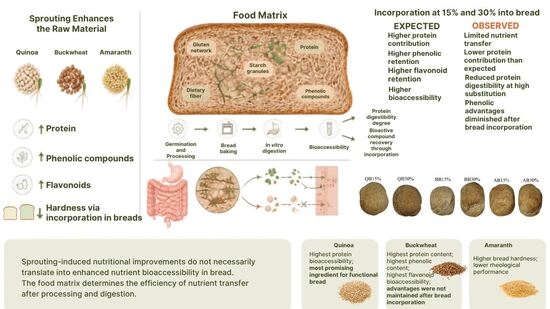
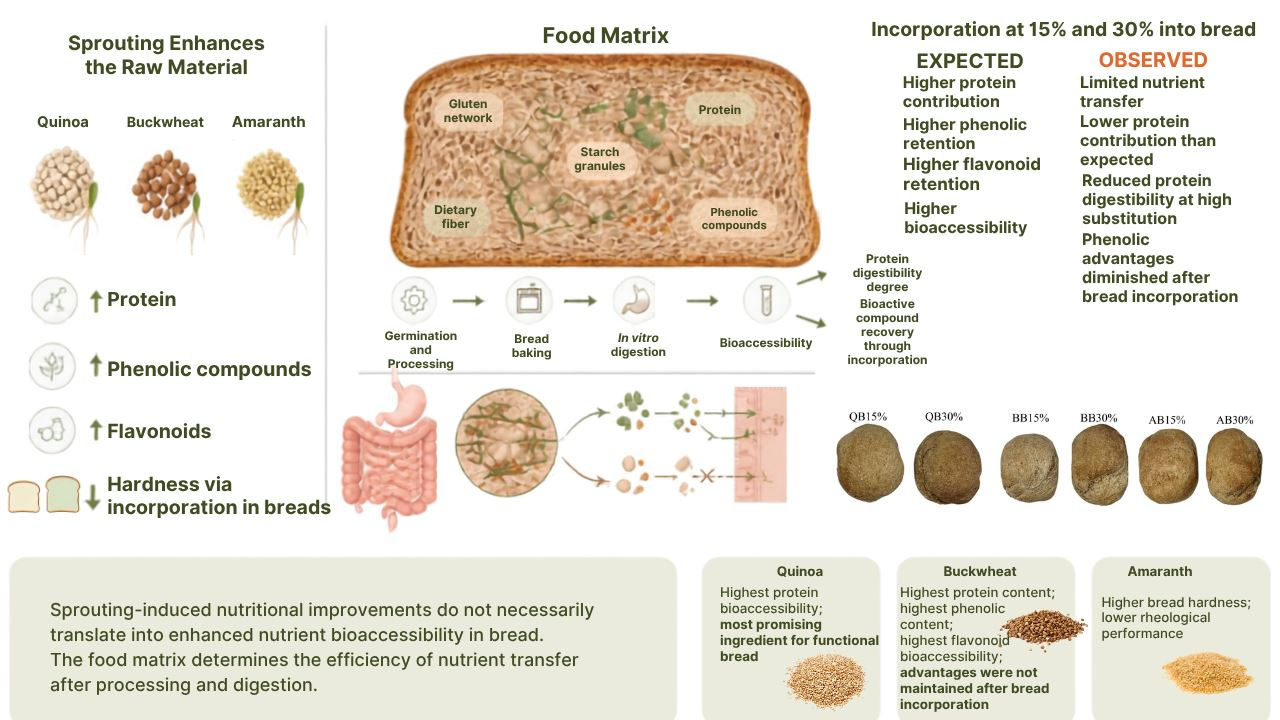
Graphical Abstract

1. Introduction

Cereals represent a major source of energy and nutrients for populations worldwide; however, they present marked nutritional limitations, including an incomplete amino acid profile, restricted bioactive compound content, and the predominance of key nutrients such as minerals in bound, poorly bioavailable forms, with further losses occurring during processing [1,2,3,4,5,6].
Pseudocereals have been consumed for thousands of years and are characterized by favorable agronomic sustainability and a nutritional profile distinct from that of cereals, despite sharing comparable starch content and processing characteristics. Although pseudocereals have been proposed as cereal substitutes, their relatively high antinutritional factor content restricts their direct application in food systems and frequently requires preprocessing, adding cost and resource expenditure. Germination represents a low-cost, easily applicable processing method that effectively minimizes antinutritional factors and improves the nutritional properties of pseudocereals, with an expanding body of literature consistently reporting favorable outcomes [7,8,9,10,11].
Developing functionalized bread products [12] through the incorporation of germinated pseudocereal materials has gained increasing attention as a strategy to enhance the nutritional profile of a widely consumed staple food. Previous studies have reported that a 15–30% substitution level of germinated pseudocereal flours yields improved bioactive compound content and protein quality and acceptable sensory and rheological properties. However, the functionalized character of such products is frequently inferred from the nutritional properties of the germinated raw ingredient rather than from evidence obtained from the final product. Enhanced protein, mineral, and bioactive compound bioaccessibility following germination is among the most consistently reported benefits in the literature; however, most existing studies have assessed bioaccessibility or bioavailability in raw germinated materials rather than in processed, consumer-ready products [8,13,14,15,16]. This gap leaves unanswered the critical question of whether germination-induced improvements are preserved through to the final product. Evaluating bioaccessibility in raw germinated ingredients inherently overlooks the food matrix interactions and processing effects encountered during subsequent preparation. Furthermore, to our knowledge, no study has simultaneously evaluated the transfer of germination-induced improvements in protein and phenolic bioaccessibility from three pseudocereals—quinoa, amaranth, and buckwheat—to a final incorporated bread product under identical processing conditions nor quantified this transfer using a recovery-based framework.
This study therefore aimed to evaluate the bioaccessibility of proteins and bioactive compounds, reported to be enhanced by germination, in the final bread product and assess the role of food matrix interactions and processing conditions in determining these outcomes.

2. Materials and Methods

The study materials comprised quinoa, buckwheat, and amaranth seeds, which are classified as pseudocereals in the literature. Bread incorporated with germinated pseudocereal flours at different substitution levels was prepared and analyzed. For comparative analysis, 100% whole wheat bread was used as the control.

2.1. Procurement of Materials

Commercially available white quinoa and amaranth were germinated following the procedure described below, whereas buckwheat was sourced in its commercially available pregerminated form. Other ingredients required for bread preparation (whole wheat flour, salt, and yeast) were purchased from local markets following the applied method. Incorporated bread was prepared using whole wheat flour alongside germinated pseudocereal flours at the specified substitution levels.

2.2. Procedure of Germination

No standardized germination protocol exists for pseudocereals; germination conditions differ across studies, as different temperature and humidity parameters stimulate distinct enzymatic processes and yield different outcomes [14]. In this study, the germination procedure was based on the principles of Majzoobi et al. [17], mainly aiming to achieve enzymatic activation and enhance bioactive compound and amino acid bioaccessibility. Germination was performed in a Nuve Test Cabinet TK-252 (Nüve Laboratory and Sterilization Technology, Ankara, Türkiye). As the warm and humid conditions required for enzymatic activation simultaneously favor pathogenic bacterial and fungal growth [16], all pseudocereal seeds were surface-sterilized before germination. Sterilization was performed following widely adopted surface decontamination protocols (70% ethanol for 1 min, followed by 1% NaOCl for 10–15 min and rinsing with distilled water) [18]. Sterilized seeds were placed on autoclaved moist filter paper in sterile Petri dishes under a laminar flow cabinet (Deltalab, Barcelona, Spain) and transferred to the test cabinet for germination under species-specific conditions.
Among pseudocereals, quinoa is the most broadly investigated in the context of germination and breadmaking [19,20,21]. White quinoa (Reis Royal White Quinoa, Istanbul, Türkiye) was germinated at 22 °C and 90–95% relative humidity and in darkness for 72 h, as preliminary checks at 48 h indicated insufficient sprout development. From 400 g of raw quinoa, 573 g of germinated quinoa was obtained following imbibition, which yielded 253 g of dried germinated quinoa (moisture content, 53.9%; dry matter, 46.1%).
Germination conditions for amaranth differ across literature [13,22,23]. The germination temperature was set at 26 °C, based on response surface methodology findings reporting this as the optimal temperature for maximizing phenolic content and antioxidant activity in amaranth germination [24]. Considering that amaranth germination conditions are particularly conducive to microbial contamination, particularly fungal growth [25], the abovementioned sterilization procedure was applied. Amaranth was germinated at 26 °C and 90% relative humidity and in darkness for up to 48 h. Germination was monitored at 24 and 48 h; as sprouts reached ideal size by 48 h, the procedure was terminated at this point. Dried germinated amaranth (137.2 g) was generated (moisture content, 48.0%; dry matter, 52.0%).

2.3. Procedure of Lyophilization

Following germination, all pseudocereal materials were pre-frozen at −70 °C (Arctiko Uluf P400 MV, Watertown, MA, USA) for 4 days as a pre-lyophilization step. Freeze-drying was subsequently performed for 4 days using a Lyovapor L-200 lyophilizer (BÜCHI Labortechnik AG, Flawil, Switzerland) at a shelf temperature of −60 °C and a chamber pressure of 0.005 mbar. Dry matter content was determined gravimetrically before and after lyophilization. Dried materials were immediately vacuum-packed and stored at −20 °C until use.

2.4. Methods

2.4.1. Experiment Planning

Three pseudocereals, including quinoa, amaranth, and buckwheat, were germinated and used for preparing incorporated bread at two substitution levels (15% and 30%), which yielded six incorporated bread formulations in total. To facilitate more comprehensive comparisons across selected analyses, a 100% whole wheat bread was prepared as the control. Bread preparation was based on the AACC 10-10B method [26], incorporating the substitution modifications described by Çetiner et al. [27,28,29].
For bread preparation, 130 g of whole wheat flour was used for the control bread. Incorporated bread contained 20 g of germinated lyophilized flour + 110 g of whole wheat flour at 15% substitution and 40 g of germinated lyophilized flour + 90 g of whole wheat flour at 30% substitution. All formulations contained 1.5% dry yeast and 1.5% salt. Doughs were proofed at 33 °C and 70% relative humidity for 55 min in a proofing chamber (Fimak Bakery and Gastronomy Machines, Istanbul, Türkiye) and subsequently baked with steam at 205 °C for 5 min, followed by 195 °C for 25 min in a professional convection oven (Fimak Bakery and Gastronomy Machines, Istanbul, Türkiye).

2.4.2. Rheological Analyses

Texture analysis
Texture analysis of all incorporated bread samples was performed according to AACC methods 74-09 and 74-10 [26] using CTX-CT3 Texture Analyzer (AMETEK Brookfield, Middleboro, MA, USA) with a P1 probe. Measurements were conducted on Days 1, 3, and 5, with three replicates per sample. On Day 5, samples fractured during compression and could not generate valid measurements; consequently, Day 5 data were excluded from the analysis. At the 30% substitution level, fracturing was also observed during the second compression cycle on Day 3. Each measurement comprised two compression cycles at a 1.00 mm/s test speed, which compressed bread to 50% of its original height, from which hardness and springiness values were derived. To characterize initial textural properties, work C1 and deformation parameters were exclusively analyzed for Day 1, as no storage data were available for these parameters. Accordingly, staling behavior was solely assessed on the basis of hardness values across storage days.
Color analysis
Crust and crumb color of the control and incorporated bread samples was measured using a High-Quality Colorimeter NR200 (Threenh, Guangzhou, China), following the principles of Nakov et al. [30]. Color was expressed in the CIE L*, a*, b* color space, where L* represents lightness, a* the red–green axis, and b* the yellow–blue axis. Three readings were taken at different points on both the crust and crumb surfaces; mean values were recorded.

2.4.3. Chemical Analyses

Dry matter determination
Following germination, dry matter content of germinated materials was determined gravimetrically before and after lyophilization. The dry matter content of bread samples was determined by drying 1.5 cm slices in a single layer at 105 °C for up to 8 h (P-Selecta Digiheat, Barcelona, Spain), with drying terminated upon reaching a constant weight to avoid protein degradation.
Soluble protein/peptide determination
Soluble protein content (albumin and globulin fractions) was determined using the Bradford [31] method using Coomassie Brilliant Blue G-250 reagent (Sigma-Aldrich, St. Louis, MO, USA). Albumin was extracted in distilled water (1 g/10 mL) and globulin in 500 mM NaCl in sodium phosphate buffer (1 g/20 mL), both at 4 °C for 4 h with magnetic stirring, followed by centrifugation at 10,000× g for 30 min (Allegra 64R, Beckman Coulter, Brea, CA, USA). Absorbance was measured at 595 nm (ThermoScientific Orion AQ-8100, Waltham, MA, USA) against a bovine serum albumin (BSA) standard curve (0–1000 µg/mL). All analyses were performed in triplicate.
Free amino acid (FAA) determination
The FAA contents of germinated pseudocereals, incorporated and control bread, and in vitro digestion fractions were determined using the modified o-phthaldialdehyde (OPA) method [32,33]. Samples were extracted in 6% HCl (1 h, room temperature (22 ± 2 °C)), centrifuged at 10,000× g for 10 min, and filtered through 0.45 µm syringe filters. OPA reagent was prepared in a 0.1 M borate buffer (pH, 9.5) with 0.1% sodium dodecyl sulfate (SDS) to enhance the solubility of bread protein matrices. L-leucine was used as the standard (0.05–1 mg/mL). Reaction mixture (50 µL sample + 200 µL OPA reagent) was incubated in darkness for 2–3 min; absorbance was measured at 340 nm within 5 min of reaction initiation. All analyses were performed in triplicate.
Total and soluble sugar content determination
Total sugar content was determined using the Lane–Eynon titration method (AOAC method 923.09) [34]. Reducing sugar content was measured using the phenol–sulfuric acid method [35].
Total phenolic (TPC) and flavonoid content (TFC) determination
The TPC of germinated pseudocereals, incorporated and control bread, and in vitro digestion fractions were determined using the Folin–Ciocalteu colorimetric method [36,37]. For both TPC and TFC analyses, 1 g of dried and ground material was extracted in 20 mL of 80% ethanol (30 min, room temperature (22 ± 2 °C), magnetic stirring) and centrifuged at 10,000× g for 10 min (Allegra 64R, Beckman Coulter, Brea, CA, USA), and the supernatant volume was recorded. For TPC, 0.5 mL of the diluted extract was mixed with 2.5 mL of Folin–Ciocalteu reagent and 0.5 mL of 7.5% Na2CO3 and incubated for 30 min in darkness at room temperature (22 ± 2 °C), and absorbance was measured at 765 nm. Results were expressed as mg GAE/100 g DW. For TFC, 1 mL of the diluted extract was mixed with 1 mL of 2% AlCl3 in methanol and incubated in darkness at room temperature, and absorbance was measured at 415 nm against a quercetin standard curve (10–80 µg/mL) [38]. Results are expressed as mg QUE/100 g DW. All measurements were performed using a UV-VIS spectrophotometer (ThermoScientific Orion AQ-8100, Waltham, MA, USA) in triplicate.

2.4.4. In Vitro Phenolic Compound and Protein Bioaccessibility Analyses

In vitro digestion simulation was performed following Barak et al. [39]. Before analysis, approximately 20 g of lyophilized germinated pseudocereal flour was extracted in 50 mL methanol for 72 h and subsequently re-lyophilized (Lyovapor L-200; BÜCHI Labortechnik AG, Flawil, Switzerland), yielding 900 mg (buckwheat), 880 mg (quinoa), and 720 mg (amaranth) of dry material. Samples were stored in 1.5 mL amber glass vials at −20 °C until analysis.
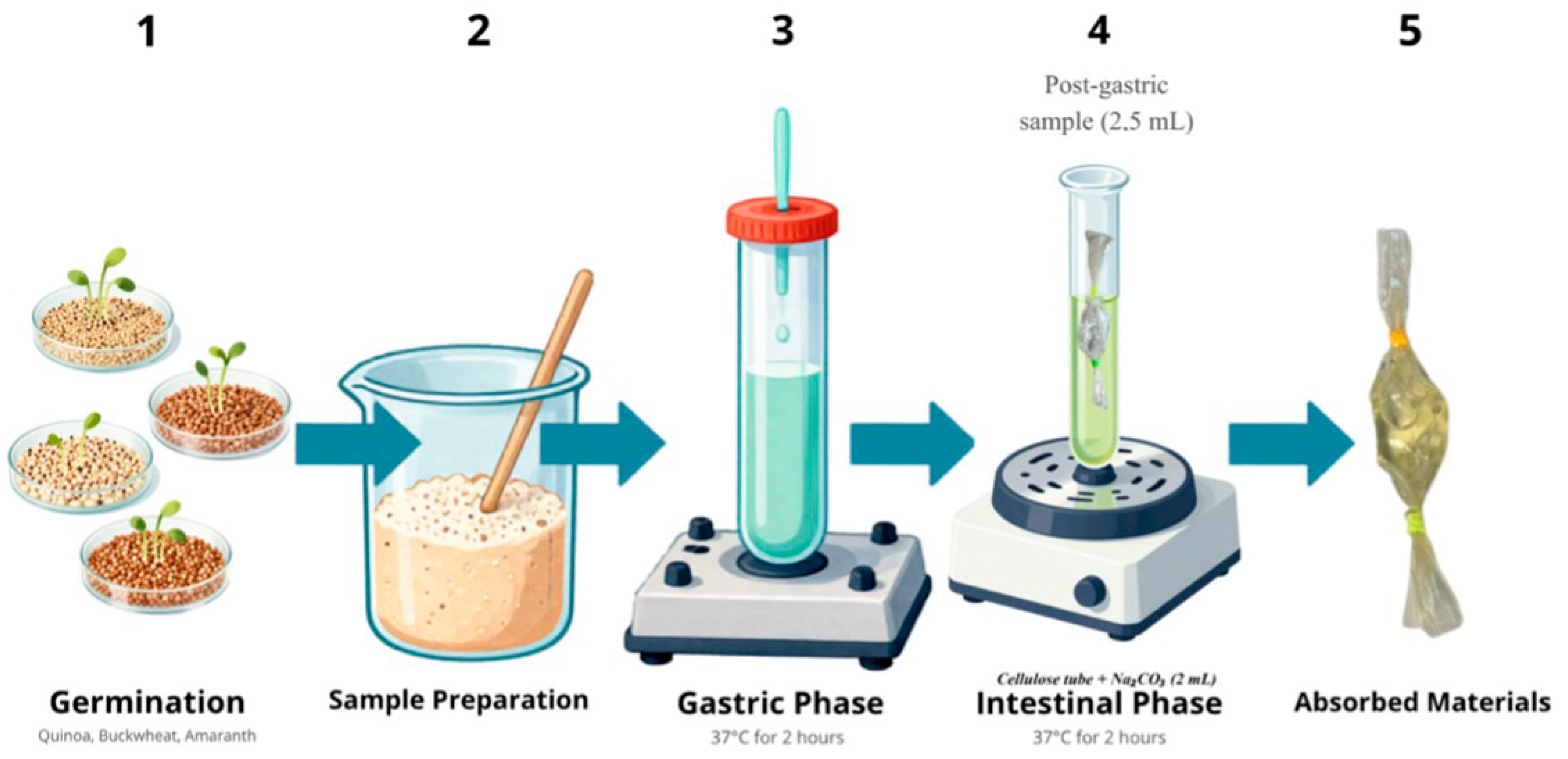
A 5500 μL sample solution was combined with a certain volume of gastric milieu, including pepsin enzyme and related electrolytes (pH, 2.0). To simulate peristaltic movement, the mixture was incubated in a shaking water bath at 37 °C for 2 h; subsequently, the enzymatic activity was halted by transferring samples to an ice bath. A 2 mL aliquot was collected as the post-gastric (PG) fraction. To simulate intestinal (IN) absorption, a dialysis membrane containing sufficient NaHCO3 to neutralize the acidic environment was introduced into the mixture, followed by adding bile acids and pancreatin. Following a further 2 h incubation, the contents of the dialysis membrane were collected as the IN fraction, representing the serum-available, bioaccessible portion. All fractions, including the non-digested (ND) sample, were stored at −20 °C until further analysis. A schematic representation of the in vitro digestion simulation procedure is presented in Figure 1.
Although in vitro digestion simulation was performed on germinated pseudocereal materials to assess protein and bioactive compound bioaccessibility, direct application of this procedure to incorporated bread was not conducted, as the low substitution levels (15% and 30%) would yield negligible detectable contributions. Instead, the impact of incorporation on bioactive compound content was evaluated by calculating the theoretical expected incorporation contribution, the actual incorporation-derived content, and the recovery percentage for each formulation. The theoretical enrichment contribution and recovery percentage for each formulation were calculated relative to the whole bread control, following the approaches described by Fidelis et al. [40] and Nouska et al. [41].
Protein digestibility degree
The protein digestibility of the study components was assessed following the method described by Torcello–Gómez et al. [42]. FAA determination was performed using the OPA method as previously described, following the referenced protocol. Post-digestion FAA release, representing the amino acids available for absorption, was expressed as µmol NH2 equivalents per mg protein. The degree of hydrolysis (DH%) was calculated according to the OPA method described by Nielsen et al. [43], using BSA as the calibration standard and htot value of 8.1 meqv/g protein. As total amino acid content could not be determined owing to laboratory constraints, it was estimated by multiplying total protein content by a conversion factor of 0.92, as recommended by the Food and Agriculture Organization [44].

2.5. Statistical Analysis

Statistical analyses were performed using IBM SPSS Statistics (version 20.0) (IBM Corp., Armonk, NY, USA). Data obtained from germinated pseudocereals, incorporated bread, and the whole wheat bread control were compared within and between groups using one-way ANOVA followed by Tukey’s HSD post hoc test. Differences were considered statistically significant at p < 0.05. For hardness data, a two-way mixed ANOVA was applied with bread formulation as the between-subjects factor and storage time as the within-subjects factor, including the formulation × storage time interaction term. Post hoc comparisons were performed using Bonferroni correction.

3. Results

3.1. Rheological Analysis

3.1.1. Texture

The rheological evaluation centered on the time-dependent staling behavior, hardness, and springiness of the bread samples. The hardness values on Days 1 and 3, alongside the springiness data, are presented in Table 1.
The rheological properties of the incorporated bread varied significantly depending on the grain type and substitution level. The hardness values on Day 1 ranged from 72.59 ± 2.27 N (BB15) to 135.5 ± 3.47 N (AB15), with amaranth-incorporated bread demonstrating significantly higher hardness than quinoa and buckwheat bread at both substitution levels (p < 0.001). By Day 3, hardness significantly increased in all formulations (p < 0.05), with the exception of AB15, which showed a non-significant increase (p = 0.060). Moreover, AB30 unexpectedly decreased in hardness from Day 1 to Day 3 (116.5 ± 0.62 vs. 113.6 ± 0.50 N), which suggests, despite being statistically significant (p < 0.001), an atypical staling behavior that can be associated with moisture redistribution or protein–starch interactions specific to high-level amaranth substitution. At the 30% substitution level, quinoa and buckwheat bread were statistically comparable in terms of hardness (p = 0.57), whereas amaranth bread remained significantly harder than both (p < 0.001). Springiness significantly decreased with increasing substitution levels in quinoa and amaranth bread samples (p < 0.001), whereas BB15 and BB30 exhibited no significant difference (p = 0.48). Overall, quinoa and buckwheat bread demonstrated acceptable textural profiles across both substitution levels, which supports their potential for functionalized bread development.

3.1.2. Color Analysis

The crust and crumb color parameters (L*, a*, and b*) differed significantly among bread formulations. The incorporated bread samples demonstrated lower L* values than the control bread, indicating a darkening of both the crust and crumbs with pseudocereal incorporation. This darkening tendency was the most pronounced in quinoa bread, wherein L* progressively decreased with increasing substitution levels (from 56.67 at 15% to 49.80 at 30%). Amaranth-incorporated bread showed the highest a* values in the crust (25.38 ± 2.93 at 15%), which reflected a distinctly reddish appearance, alongside the highest b* values across all groups, which indicates a more yellow-toned crumb and crust compared to the other formulations. The color information of the crumb and crusts of bread is presented in Table 2.

3.2. Chemical Analyses

The results of the chemical analyses, including those of dry matter, total sugar, reducing sugar, protein, free amino acids, total phenolic compound, and total flavonoid content, are presented in Table 3.

3.2.1. Dry Matter Determination

The dry matter contents of the germinated pseudocereals were 46.1%, 47.3%, and 48.0% for quinoa, buckwheat, and amaranth, respectively. For the incorporated and control bread, dry matter contents were: QB15, 59.2%; QB30, 59.1%; BB15, 61.5%; BB30, 63.5%; AB15, 63.3%; and AB30, 66.5%.

3.2.2. Protein and FAA Determination

Germinated buckwheat (33.38 g/100 g DW) exhibited the highest protein content of the germinated pseudocereals, followed by germinated amaranth (30.34 g/100 g DW) and germinated quinoa (21.25 g/100 g DW). The protein content of the incorporated bread varied according to grain type and substitution level. Quinoa-incorporated bread demonstrated the most marked increase with increasing substitution levels, increasing from 12.10 ± 0.20 g/100 g DW at 15% to 20.82 ± 1.10 g/100 g DW at 30% (72.1% increase). Buckwheat-incorporated bread contained 8.85 ± 0.10 and 13.75 ± 1.30 g/100 g DW at the 15% and 30% substitution levels, respectively (55.4% increase), remaining lower than the other formulations despite the relatively high protein content of the germinated ingredient. Amaranth-incorporated bread showed the highest absolute protein values among the incorporated bread samples (20.95 ± 0.10 and 23.86 ± 0.40 g/100 g DW at 15% and 30%, respectively); however, the increase with substitution level was comparatively modest (13.9%).
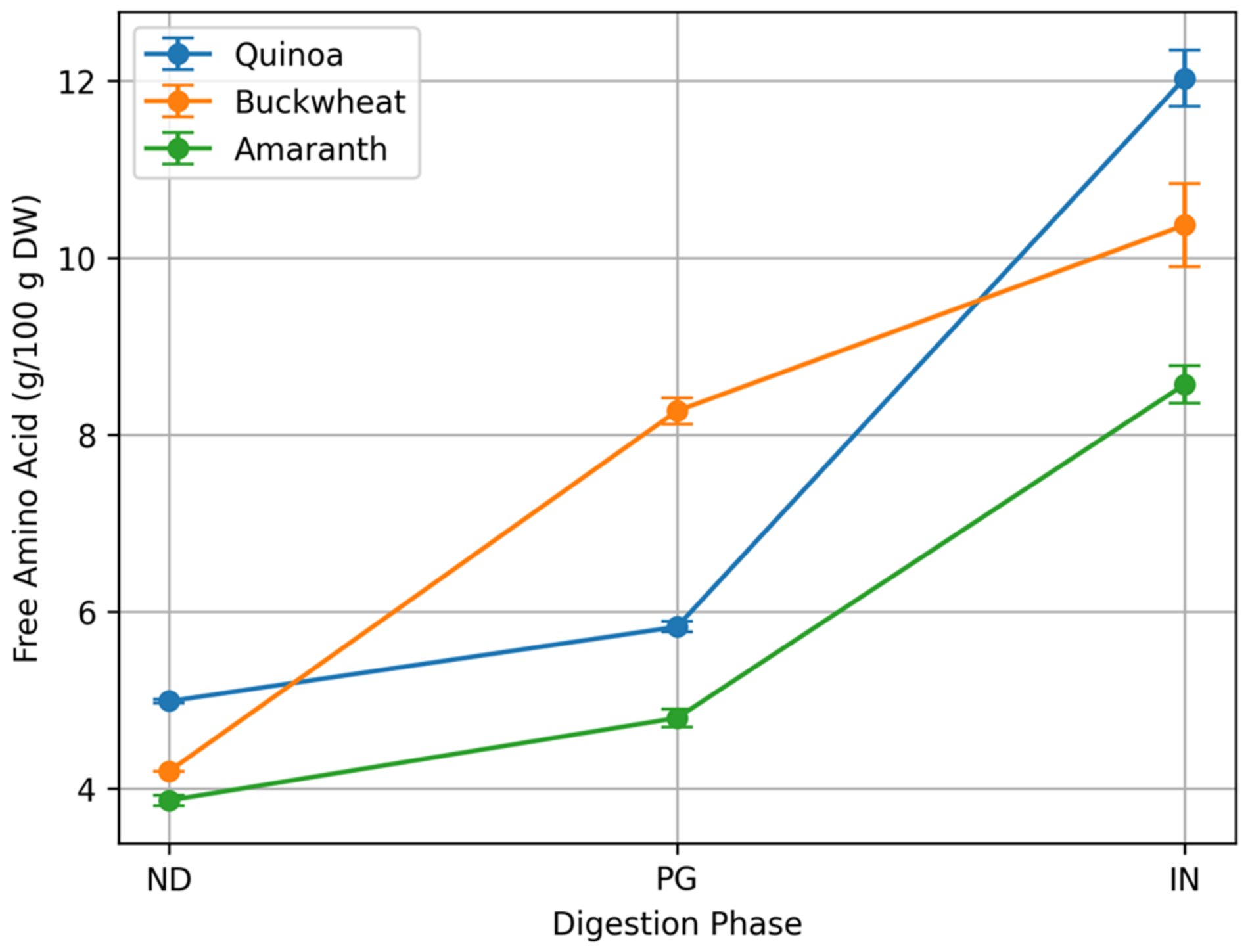
Germinated quinoa (4.99 ± 0.10 g/100 g DW) exhibited the highest FAA content of the germinated pseudocereals, followed by germinated buckwheat (4.20 ± 0.00) and germinated amaranth (3.87 ± 0.05). The FAA content of the incorporated bread only marginally increased with the 15% and 30% substitution levels across all grain types: quinoa bread, 7.50 ± 0.70–8.03 ± 0.98; buckwheat bread, 7.13 ± 0.40–7.30 ± 0.10; and amaranth bread, 6.65 ± 1.05–7.53 ± 0.40. In vitro digestion of germinated pseudocereals revealed a consistent and statistically significant increase in FAA release from the ND to the IN phases across all samples (one-way ANOVA, p < 0.001); this supports a biologically relevant trend in protein hydrolysis and amino acid liberation during digestion. Of note, this comparison was based on three samples; interpretations should be made accordingly. The free amino acid release across digestion phases is illustrated in Figure 2.
Germinated quinoa (61.5%) exhibited the highest protein bioaccessibility (BAc%) of the germinated pseudocereals, followed by buckwheat (33.7%) and amaranth (30.7%), with all digestion phase differences showing statistical significance (p < 0.001; Table S1).
As protein content alone does not reflect the degree of protein digestibility in the final product, the amount of free amino groups released per mg protein was further determined for both the germinated pseudocereals and the incorporated bread. These data were used for estimating the degree of protein digestibility in the bread samples. The estimated protein digestibility values are presented in Table 4.

3.2.3. TPC and TFC

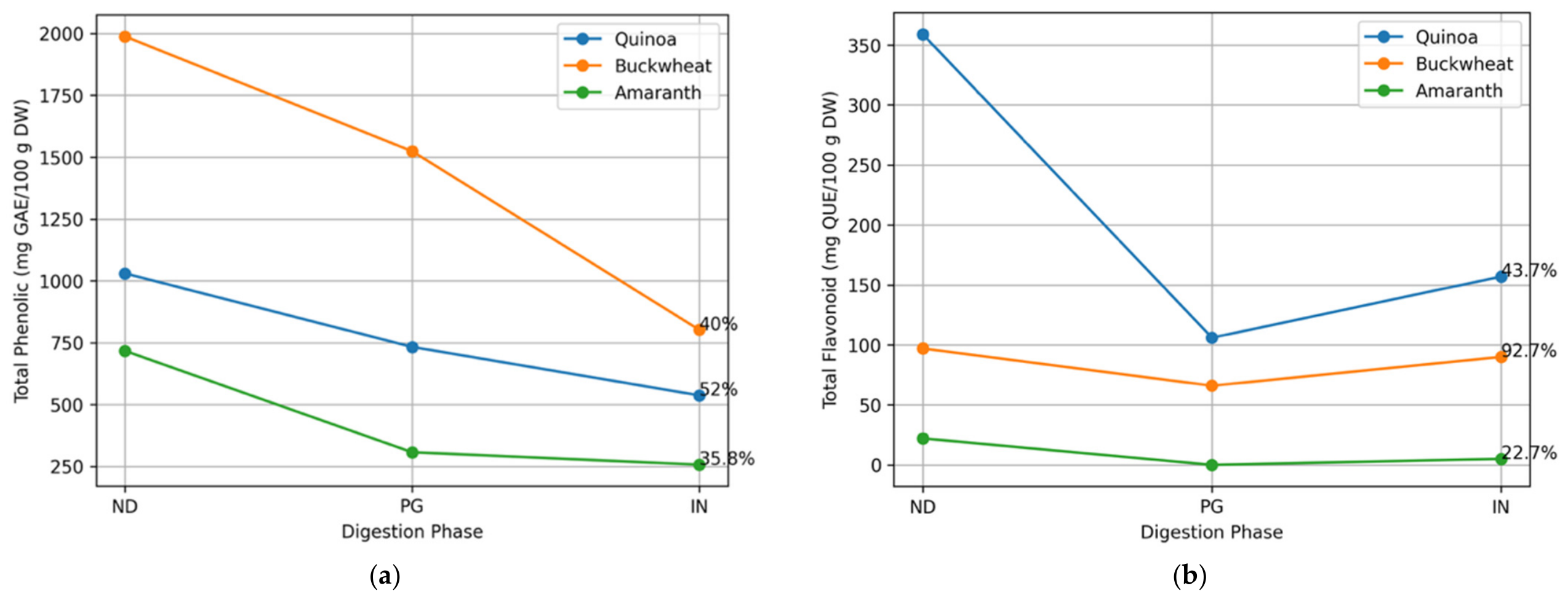
Germinated buckwheat (1988 ± 69 mg GAE/100 g DW) exhibited the highest TPC of the germinated pseudocereals, followed by germinated quinoa (1030 ± 17 mg GAE/100 g DW) and germinated amaranth (717 ± 49 mg GAE/100 g DW). The whole wheat bread control had a TPC of 1106 ± 90 mg GAE/100 g DW. In incorporated bread, TPC increased with substitution across all grain types; however, it remained below the control in most formulations. Buckwheat bread (from 613 ± 45 to 963 ± 86 mg GAE/100 g DW; 57.1% increase) demonstrated the most pronounced increase with substitution level, followed by amaranth (from 692 ± 68 to 828 ± 110 mg GAE/100 g DW; 19.7% increase) and quinoa bread (from 904 ± 56 to 1009 ± 56 mg GAE/100 g DW; 11.6% increase).
TFC followed a different pattern: germinated quinoa showed the highest TFC (359 ± 3 mg QE/100 g DW), markedly exceeding germinated buckwheat (97 ± 1 mg QE/100 g DW) and germinated amaranth (22 ± 0 mg QE/100 g DW). The whole wheat bread control contained 223 ± 22 mg QE/100 g DW. In incorporated bread, TFC increased with increasing substitution levels in all formulations, with the greatest relative increases noted in quinoa (from 88 ± 1.15 to 137 ± 0 mg QE/100 g DW; 55.7% increase) and buckwheat bread (from 38 ± 1.5 to 58 ± 10 mg QE/100 g DW; 52.6% increase), whereas amaranth demonstrated a more limited increase (from 34 ± 1.5 to 45 ± 0.5 mg QE/100 g DW; 32.4% increase). All incorporated bread values remained below those of the whole wheat control.
During in vitro digestion, TPC substantially decreased across all germinated pseudocereals from the ND to the IN phases. Quinoa (52%) showed the highest bioaccessibility (BAc%), followed by buckwheat (40%) and amaranth (35.8%). TFC revealed a distinct digestion pattern: buckwheat exhibited exceptionally high flavonoid bioaccessibility (92.7%), whereas quinoa (43.7%) and amaranth (22.7%) showed comparatively lower values. Notably, quinoa flavonoids exhibited a pronounced decrease in the PG phase followed by a partial recovery in the IN phase, which suggests phase-dependent stability differences (Figure 3; Table S2).
Theoretical incorporation contributions and recovery rates were calculated relative to the whole wheat bread control to further evaluate the contribution of pseudocereal incorporation to the bioactive compound content of bread (Table 5). For TPC, meaningful recovery was only observed at the 30% substitution level: quinoa bread demonstrated the highest recovery (75.7%), followed by buckwheat (31.4%) and amaranth (24.0%) bread. At the 15% substitution level, no quantifiable incorporation contribution above the control was detected in any formulation. For TFC, recovery was exclusively observed in 30% quinoa bread (19.0%), with other incorporated bread groups showing no detectable contribution. These results suggest that the expected bioactive compound contribution from germinated pseudocereals does not proportionally translate into the bread matrix and that a meaningful phenolic incorporation effect is only achievable at higher substitution levels and predominantly with quinoa.

4. Discussion

Incorporating pseudocereals into bread formulations has been widely reported to exert beneficial effects, improving the protein and amino acid profiles and contributing bioactive compounds to the final product. The high antioxidant capacity of pseudocereal components may further help delay oxidative deterioration in bread. Several studies have investigated the thermal properties of pseudocereal ingredient-incorporated bread matrices, with varying results reported across the literature. The characteristic properties and physicochemical contributions of starch and protein fractions generally explain the underlying mechanisms of thermal effects [45,46,47]. Miranda–Ramos and Haros [48] reported increased crumb firmness with increasing substitution levels in bread incorporated with combined quinoa, amaranth, and chia flours, which aligns with the higher hardness values observed in amaranth-incorporated bread in this study. By contrast, quinoa and buckwheat bread exhibited a decreasing hardness trend with increasing substitution levels, which resulted in softening, consistent with findings reported by Akturfan and Yalçın [49]. These findings suggest the grain-dependent effect of substitution level on textural properties, reflecting the distinct interaction mechanisms of quinoa, buckwheat, and amaranth within the gluten matrix. The higher retrogradation tendency and weaker structure-forming capacity of amaranth starch may account for the more pronounced hardness noted in amaranth-incorporated bread [50,51,52,53,54]. Furthermore, the incorporation of non-gluten pseudocereal proteins in the wheat dough system may dilute the gluten network, reducing its viscoelastic continuity and water-binding capacity. At higher incorporation levels, this network disruption becomes more pronounced, as pseudocereal proteins compete with gluten proteins for water and interfere with disulfide bond cross-linking during dough development, which results in a weaker, more rigid crumb structure upon baking [55,56]. The lower hardness values observed in QB30 on Days 1 and 3 compared with the other 30% incorporated bread may be attributed to the smaller starch granule size of quinoa compared to the other pseudocereal starches, which facilitates greater gelatinization and binding capacity within the bread matrix [57].
To evaluate the rheological properties of incorporated bread, color analysis was performed as an additional parameter. Incorporated bread exhibited significantly lower L* values than the whole wheat control, which indicates that darkening proportionally increased with the substitution level. Significantly higher a* and b* values in incorporated bread reflected a redder and yellower-toned appearance than the control, a trend consistent across both crust and crumb measurements and aligning with previously reported findings in the literature [52,53,54,57,58]. Maillard reactions and the contribution of natural pigments inherent to pseudocereal ingredients may explain the darker, redder, and yellower appearance of incorporated bread [59]. In particular, the marked darkening and browning observed in amaranth-incorporated bread crusts may be associated with the relatively high arginine and lysine content of amaranth, as these amino acids are among the most reactive participants in the Maillard reaction [60]. During baking, free amino acids react with reducing sugars—particularly glucose released during germination—through the Maillard reaction cascade, generating melanoidins responsible for the observed color changes. Germination further amplifies this effect by increasing the pool of reactive substrates, intensifying browning in germinated pseudocereal-incorporated bread [61].
Several studies have reported germination-induced elevations in reducing and total sugar contents; however, the reported values vary widely and are frequently based on nonstandardized analytical methods, which renders direct comparison with the present data challenging. Among the three pseudocereals, starch content follows the following order: buckwheat > quinoa > amaranth [62]. A considerable proportion of quinoa and amaranth polysaccharides exist in forms bound to phenolic acids, including ferulic and coumaric acids [63], which partly explains the relatively low monosaccharide release observed in amaranth during germination, owing to both its lower starch content and insufficient bound fraction degradation within the germination period applied. Furthermore, the optimal activity of α-amylase during germination reportedly peaks at approximately 6 days [64]. As the germination periods in this study were shorter, monosaccharide release may not have reached its maximum. Furthermore, the enzymatic breakdown of complex starch granules does not frequently cause increased monosaccharide content, as resistant starch formation may also occur as a competing outcome [65]. During baking, starch gelatinization disrupts the crystalline structure of starch granules, making them more susceptible to enzymatic hydrolysis. However, retrogradation upon cooling can reconstitute resistant starch fractions, particularly in amaranth, where the compact protein–starch matrix may further limit amylase accessibility [14].
Pseudocereals are characterized by a remarkably high protein content relative to that of conventional cereals, with reported values of 11.7–18.4%, 21.6–25.3%, and 13.0–14.5% for amaranth, buckwheat, and quinoa, respectively [66]. Germination further increases protein content and digestibility through enzymatic activation; however, some studies have reported a transient decrease attributed to the enzymatic degradation of antinutritional factors, including saponins [15,67,68]. However, the prevailing consensus supports a net increase in protein content following germination and has been reported to substantially increase protein content in pseudocereals; increases of up to 1.29-fold have been documented in quinoa varieties during germination [69], with amaranth and buckwheat demonstrating comparable increasing trends [15]. The present results align with this trend, with protein contents of 33.38, 30.34, and 21.25 g/100 g DW determined for germinated buckwheat, amaranth, and quinoa, respectively.
Among incorporated bread formulations, germinated buckwheat, despite having the highest protein content among the germinated pseudocereals, contributed the lowest protein content. This finding may be explained by the food matrix characteristics of buckwheat: it contains the highest polyphenol–protein complex ratio among the three pseudocereals, alongside elevated lysine and arginine contents and glucose as the predominant sugar released during germination, conditions that collectively facilitate Maillard reactions during baking. The inherently low thermal stability of buckwheat proteins further supports this explanation [70,71,72,73]. Nevertheless, despite its limited quantitative protein contribution, buckwheat-incorporated bread generated the highest NH2 release per mg protein in digestibility calculations, which indicates a constrained protein content but superior digestible protein quality, attributable to the vulnerability of buckwheat proteins to thermal and enzymatic degradation. Specifically, the thermal denaturation of buckwheat proteins leads to the formation of intermolecular disulfide bonds and protein aggregation; while aggregation reduces soluble protein content, the resulting denatured structures are more accessible to digestive proteases; this explains the paradoxical combination of low protein contribution but a high degree of hydrolysis in buckwheat-incorporated bread [74].
Among germinated pseudocereals, quinoa (4.99 g/100 g DW) demonstrated the highest FAA content, followed by buckwheat (4.20 g/100 g DW) and amaranth (3.87 g/100 g DW). The relatively low FAA content compared with total protein aligns with the literature [75,76] and reflects the natural dynamics of germination, during which FAAs are transiently accumulated and actively utilized as metabolic substrates throughout the process.
Incorporated bread exhibited a generally higher FAA content than raw germinated pseudocereals, which potentially reflects protein breakdown during fermentation and baking. However, FAA values remained below theoretically expected levels, potentially attributable to the gluten matrix of whole wheat flour: gluten forms a “continuous complex” with starch granules in the endosperm, serving as a physical barrier against digestive enzymes and processing. This matrix effect may restrict FAA release and detection in incorporated bread samples [77,78]. Pseudocereal incorporation increases protein content and modifies the amino acid profile of bread. Although pseudocereals are characterized by glutamic acid, aspartic acid, arginine, and lysine as dominant amino acids, incorporated bread formulations exhibit a shift toward glutamic acid, proline, leucine, aspartic acid, arginine, serine, and phenylalanine, a pattern reported to differ depending on the incorporation source and processing conditions [53,79]. Among the three pseudocereals, amaranth demonstrated the lowest FAA content, which may be partly explained by the resistance of sulfur-containing protein complexes to enzymatic hydrolysis during germination, as a substantial proportion of amaranth proteins are sulfur-rich [52].
Incorporated bread showed a significantly higher degree of protein digestibility than germinated pseudocereal materials alone; however, it decreased with increasing substitution levels. For example, among incorporated bread, BB15 exhibited the highest digestibility (75.8%), which declined to 50.0% at the 30% substitution level. This inverse association may reflect gluten network disruption by pseudocereal components at higher substitution levels, which causes the formation of tightly aggregated structures resistant to digestive enzymes [80,81]. Additional contributing factors encompass thermal denaturation and disulfide bond formation during baking, which diminish gluten protein digestibility [82] and the potential of food matrix proteins to form complexes with phytochemicals, dietary fiber, phytic acid, lipids, and carbohydrates, further limiting enzymatic access [83]. At higher substitution levels, the increasing concentration of flavonoids and phenolic acids abundant in buckwheat and quinoa may form covalent and non-covalent complexes with both gluten and pseudocereal proteins through oxidative cross-linking reactions. These protein–phenolic complexes exhibit a reduced susceptibility to pepsin and pancreatin hydrolysis, which contributes to the observed decrease in protein digestibility degree [84].
In addition to their protein content, pseudocereals are also valuable sources of bioactive compounds; delivering these compounds into the food matrix represents one of the primary objectives of pseudocereal incorporation in bread. However, the expected health benefits of these bioactive compounds rely on their bioaccessibility and bioavailability, both of which are governed by various factors [85]. As observed for protein, the contribution of TPC to incorporated bread was not proportional to the substitution level. Buckwheat-incorporated bread demonstrated a 57.1% increase in TPC from 15% to 30% substitution; this reflects the high phenolic content of buckwheat. By contrast, quinoa-incorporated bread exhibited only an 11.6% increase over the same range, potentially attributable to the highly conjugated nature of quinoa phenolics, which limits their extractability and contribution to the bread matrix relative to their total content [86].
Pseudocereals are incorporated into bread formulations to enhance nutritional properties and exploit their physicochemical characteristics, with incorporation levels of up to 28% reported to yield increased bioactive compound content, improved protein quality, satisfactory sensory properties, and enhanced digestibility [13,21,71,87,88]. However, the expected incorporation contribution is not frequently fully realized in the final product, which renders the assessment of actual recovery a crucial step in formulation development. Therefore, understanding the conditions under which this contribution is achieved or limited is essential for the development of more effective incorporated bread formulations [40,41]. In this study, no meaningful bioactive compound contribution above the whole wheat control was detected at the 15% substitution level for any formulation. At 30%, recovery varied across grain types, with quinoa bread (75.7%) showing the highest TPC recovery. For TFC, a meaningful recovery value was exclusively obtained in 30% quinoa bread (19%), with no quantifiable contribution in any other formulation.
The values reported in the literature are broadly consistent with the present findings: germinated quinoa reportedly yields gastric and IN phase recoveries of 87.6–116.7% and 89.6–124.5%, respectively, with an absorbable content of 7.4–10.9% and flavonoid recovery of 4.2–12.4% [89]. Bioaccessible phenolic content in germinated buckwheat sprouts reportedly reaches up to 90% [90]. However, direct comparison across studies remains challenging owing to methodological variability; INFOGEST 2.0 has been proposed as a standardized approach for assessing the in vitro bioaccessibility of bioactive compounds [91]. The limited bioactive compound recovery observed in incorporated bread in this study suggests the competing effects of the bread matrix: fermentation and thermal processing can promote phenolic release through protein denaturation while simultaneously causing bioactive compound degradation or enhancing antinutritional factor interactions [92,93,94]. Specifically, the thermal lability of rutin—the predominant flavonoid in buckwheat—renders it susceptible to degradation during baking, with progressive conversion to quercetin observed at temperatures exceeding 80 °C and significant losses reported at typical bread-baking temperatures [95]. The net outcome of these processes relies on the grain type, molecular characteristics of the bioactive compound, and specific processing conditions [94].
Several limitations of the present study should be acknowledged. First, bioactive compound and amino acid analyses were performed on a total content basis rather than profiling individual phenolic compounds or amino acid fractions, which limited the precision of bioaccessibility evaluation and precluded the calculation of the Digestible Indispensable Amino Acid Score (DIAAS); protein quality in enriched breads was therefore assessed via degree of protein digestibility using the OPA method. Second, and most critically, in vitro digestion simulation was not applied directly to the bread samples; the role of the food matrix in modulating bioaccessibility could therefore not be directly demonstrated and should be interpreted with caution. The recovery-based framework applied in this study provides an indirect estimate of incorporation efficiency but does not substitute for experimental bioaccessibility assessment of the final product, and no structural, microstructural, or molecular analyses were conducted to elucidate the underlying matrix-related mechanisms. Accordingly, the conclusions regarding food matrix effects are interpretive rather than mechanistic in nature. Future studies should incorporate direct in vitro digestion of bread matrices alongside structural and molecular analyses, individual phenolic and amino acid profiling, and DIAAS determination to provide a more comprehensive evaluation of the nutritional impact of germinated pseudocereal incorporation.

5. Conclusions

This study demonstrates that germination effectively improves the protein and bioactive compound content of quinoa, amaranth, and buckwheat; however, these enhancements do not automatically translate into proportional gains in the final bread product. The findings are consistent with the critical role of the food matrix in protein and phenolic compound bioaccessibility, with the extent of this effect varying by grain type and substitution level. Among the pseudocereals evaluated, quinoa demonstrated the most consistent overall performance across protein bioaccessibility, phenolic recovery, and rheological parameters, which suggests its suitability for functionalized bread development at the substitution levels tested. However, buckwheat exhibited superior protein digestibility and flavonoid bioaccessibility, which highlights the multifactorial nature of pseudocereal selection for bread incorporation and the need to prioritize parameters according to the intended nutritional objective. These findings suggest the critical significance of evaluating bioaccessibility in the final food product rather than in raw or minimally processed ingredients, underlining the need for optimized formulation strategies to maximize the nutritional contribution of germinated pseudocereals in bread matrices.

Supplementary Materials

The following supporting information can be downloaded at: https://www.mdpi.com/article/10.3390/foods15183280/s1, Table S1: Total protein and FAA in vitro bioaccessibility data of germinated pseudocereals; Table S2: In vitro bioaccessibility data of total bioactive components of germinated pseudocereals.

Author Contributions

Conceptualization, T.H.B., F.E. and S.R.; methodology, T.H.B., F.E. and S.R.; formal analysis, T.H.B. and S.R.; investigation, T.H.B., F.E. and S.R.; data curation, T.H.B., F.E. and S.R.; writing—original draft preparation, S.R.; writing—review and editing, T.H.B. and F.E.; visualization, T.H.B., F.E. and S.R.; supervision, T.H.B. and F.E.; project administration, F.E. and S.R.; funding acquisition, F.E. and S.R. All authors have read and agreed to the published version of the manuscript.

Funding

This study was supported by the Istinye University Scientific Research Projects Commission (BAP Project No. 2025/B32).

Institutional Review Board Statement

Not applicable.

Informed Consent Statement

Not applicable.

Data Availability Statement

The original contributions presented in this study are included in the article/Supplementary Materials. Further inquiries can be directed to the corresponding author.

Conflicts of Interest

The authors declare no conflicts of interest.

Abbreviations

The following abbreviations are used in this manuscript:
FAAfree amino acid
OPAo-phthaldialdehyde
TPCtotal phenolic content
TFCtotal flavonoid content
PGpost-gastric
INintestinal

References

  1. Huynh, N.; Van Camp, J.; Smagghe, G.; Raes, K. Improved Release and Metabolism of Flavonoids by Steered Fermentation Processes: A Review. Int. J. Mol. Sci. 2014, 15, 19369–19388. [Google Scholar] [CrossRef] [Scilit]
  2. Herreman, L.; Nommensen, P.; Pennings, B.; Laus, M.C. Comprehensive overview of the quality of plant- And animal-sourced proteins based on the digestible indispensable amino acid score. Food Sci. Nutr. 2020, 8, 5379–5391. [Google Scholar] [CrossRef] [Scilit]
  3. Hertzler, S.R.; Lieblein-Boff, J.C.; Weiler, M.; Allgeier, C. Plant Proteins: Assessing Their Nutritional Quality and Effects on Health and Physical Function. Nutrients 2020, 12, 3704. [Google Scholar] [CrossRef] [Scilit]
  4. Avelar, Z.; Pereira, R.N.; Vicente, A.A.; Rodrigues, R.M. Protein quality of cereals: Technological and functional perspectives. J. Cereal Sci. 2024, 117, 103922. [Google Scholar] [CrossRef] [Scilit]
  5. Foligni, R.; Glicerina, V.T.; Orkusz, A.; Mannozzi, C. Editorial: Cereals and cereal products: Nutritional and physicochemical characterization and novel foods. Front. Nutr. 2024, 11, 1446657. [Google Scholar] [CrossRef] [Scilit]
  6. Islam, M.Z.; Alam, M.N.; Rahman, A.; Rahman, M.M.; Rahman, M.M.; EL Sabagh, A. Comparatively Study on Nutritional Values of Cereal Crops, Their Requirements, Functions, and Deficiency in Health. Preprint 2024. [Google Scholar] [CrossRef] [Scilit]
  7. Fletcher, R.J. Pseudocereals, Overview. In Reference Module in Food Science; Elsevier: Amsterdam, The Netherlands, 2016. [Google Scholar] [CrossRef] [Scilit]
  8. Rodríguez, J.P.; Rahman, H.; Thushar, S.; Singh, R.K. Healthy and Resilient Cereals and Pseudo-Cereals for Marginal Agriculture: Molecular Advances for Improving Nutrient Bioavailability. Front. Genet. 2020, 11, 49. [Google Scholar] [CrossRef] [Scilit]
  9. Cao, H.; Wang, C.; Li, R.; Guan, X.; Huang, K.; Zhang, Y. Influence of sprouted oat flour substitution on the texture and in vitro starch digestibility of wheat bread. Food Chem. X 2022, 15, 100428. [Google Scholar] [CrossRef] [Scilit]
  10. Graziano, S.; Agrimonti, C.; Marmiroli, N.; Gullì, M. Utilisation and limitations of pseudocereals (quinoa, amaranth, and buckwheat) in food production: A review. Trends Food Sci. Technol. 2022, 125, 154–165. [Google Scholar] [CrossRef] [Scilit]
  11. Ali, A.A.; Ali, A.H.; Nassar, M.A.; Elgeilany, S.M.; Ezzat, S.M. Quinoa as a functional crop with emphasis on distribution, nutritional composition, and biological effects. Discov. Food 2025, 5, 285. [Google Scholar] [CrossRef] [Scilit]
  12. Frumuzachi, O.; Flanagan, A.; Rohn, S.; Mocan, A. The dichotomy between functional and functionalized foods—A critical characterization of concepts. Food Res. Int. 2025, 208, 116173. [Google Scholar] [CrossRef] [Scilit]
  13. Guardianelli, L.M.; Salinas, M.V.; Puppo, M.C. Quality of wheat breads enriched with flour from germinated amaranth seeds. Food Sci. Technol. Int. 2022, 28, 388–396. [Google Scholar] [CrossRef] [Scilit]
  14. Zheng, X.; Wang, Q.; Li, L.; Liu, C.; Ma, X. Recent advances in germinated cereal and pseudo-cereal starch: Properties and challenges in its modulation on quality of starchy foods. Food Chem. 2024, 458, 140221. [Google Scholar] [CrossRef] [Scilit]
  15. Thakur, P.; Kumar, K.; Dhaliwal, H.S. Nutritional facts, bio-active components and processing aspects of pseudocereals: A comprehensive review. Food Biosci. 2021, 42, 101170. [Google Scholar] [CrossRef] [Scilit]
  16. Müller, C.P.; Hoffmann, J.F.; Ferreira, C.D.; Diehl, G.W.; Rossi, R.C.; Ziegler, V. Effect of germination on nutritional and bioactive properties of red rice grains and its application in cupcake production. Int. J. Gastron. Food Sci. 2021, 25, 100379. [Google Scholar] [CrossRef] [Scilit]
  17. Majzoobi, M.; Wang, Z.; Teimouri, S.; Pematilleke, N.; Brennan, C.S.; Farahnaky, A. Unlocking the Potential of Sprouted Cereals, Pseudocereals, and Pulses in Combating Malnutrition. Foods 2023, 12, 3901. [Google Scholar] [CrossRef] [Scilit]
  18. Costa-Catala, J.; Bori, J.; Veciana-Nogués, M.T.; Latorre-Moratalla, M.L.; Vidal-Carou, M.C.; Comas-Basté, O. Influence of Seed Disinfection Treatments on the Germination Rate and Histamine-Degrading Activity of Legume Sprouts. Foods 2024, 13, 4105. [Google Scholar] [CrossRef] [Scilit]
  19. Abdel Samie, A.; Abd El-Hamied, A.; El-Naggar, E.; Abdelmegiud, M. Influences of raw and germinated quinoa seeds flour on the chemical, technological and sensory properties of pan bread. Arch. Agric. Sci. J. 2023, 6, 12–25. [Google Scholar] [CrossRef] [Scilit]
  20. Franco, W.; Evert, K.; Van Nieuwenhove, C. Quinoa Flour, the Germinated Grain Flour, and Sourdough as Alternative Sources for Gluten-Free Bread Formulation: Impact on Chemical, Textural and Sensorial Characteristics. Fermentation 2021, 7, 115. [Google Scholar] [CrossRef] [Scilit]
  21. Suárez-Estrella, D.; Cardone, G.; Buratti, S.; Pagani, M.A.; Marti, A. Sprouting as a pre-processing for producing quinoa-enriched bread. J. Cereal Sci. 2020, 96, 103111. [Google Scholar] [CrossRef] [Scilit]
  22. Guardianelli, L.M.; Salinas, M.V.; Puppo, M.C. Chemical and thermal properties of flours from germinated amaranth seeds. J. Food Meas. Charact. 2019, 13, 1078–1088. [Google Scholar] [CrossRef] [Scilit]
  23. Vento, M.; Della Croce, C.M.; Bellani, L.; Tassi, E.L.; Echeverria, M.C.; Giorgetti, L. Effect of Sprouting, Fermentation and Cooking on Antioxidant Content and Total Antioxidant Activity in Quinoa and Amaranth. Int. J. Mol. Sci. 2024, 25, 10972. [Google Scholar] [CrossRef] [Scilit]
  24. Paucar-Menacho, L.M.; Peñas, E.; Dueñas, M.; Frias, J.; Martínez-Villaluenga, C. Optimizing germination conditions to enhance the accumulation of bioactive compounds and the antioxidant activity of kiwicha (Amaranthus caudatus) using response surface methodology. LWT Food Sci. Technol. 2017, 76, 245–252. [Google Scholar] [CrossRef] [Scilit]
  25. Krasowska, P.; Skwaryło-Bednarz, B.; Kopacki, M. Influence of agrotechnical and varietal factors on biodiversity of fungi colonizing amaranth seeds. Acta Sci. Pol. Hortorum Cultus 2024, 23, 17–30. [Google Scholar] [CrossRef] [Scilit]
  26. AACC. Approved Methods of the American Association of Cereal Chemists, 10th ed.; AACC: St. Paul, MN, USA, 2000. [Google Scholar]
  27. AACC International. The AACC Approved Methods of Analysis, 11th ed.; AACC: St. Paul, MN, USA, 2010. [Google Scholar]
  28. Cetiner, B.; Shamanin, V.P.; Tekin-Cakmak, Z.H.; Pototskaya, I.V.; Koksel, F.; Shepelev, S.S.; Aydarov, A.N.; Ozdemir, B.; Morgounov, A.I.; Koksel, H. Utilization of Intermediate Wheatgrass (Thinopyrum intermedium) as an Innovative Ingredient in Bread Making. Foods 2023, 12, 2109. [Google Scholar] [CrossRef] [Scilit]
  29. Cetiner, B.; Acar, O.; Kahraman, K.; Sanal, T.; Koksel, H. An investigation on the effect of heat-moisture treatment on baking quality of wheat by using response surface methodology. J. Cereal Sci. 2017, 74, 103–111. [Google Scholar] [CrossRef] [Scilit]
  30. Nakov, G.; Temkov, M.; Damyanova, S.; Ivanova, S. The Effect of Whole Buckwheat Flour Addition on Physico-Chemical Characteristics, Biological Active Compounds and Fatty Acids Profile of Breads. Bull. Transilv. Univ. Brasov. Ser. II For. Wood Ind. Agric. Food Eng. 2022, 15, 161–176. [Google Scholar] [CrossRef] [Scilit]
  31. Bradford, M.M. A rapid and sensitive method for the quantitation of microgram quantities of protein utilizing the principle of protein-dye binding. Anal. Biochem. 1976, 72, 248–254. [Google Scholar] [CrossRef]
  32. Lee, K.S.; Drescher, D.G. Fluorometric amino-acid analysis with o-phthaldialdehyde (OPA). Int. J. Biochem. 1978, 9, 457–467. [Google Scholar] [CrossRef] [Scilit]
  33. Hernández, M.J.M.; Camañas, R.M.V.; Cuenca, E.M.; Alvarez-Coque, M.C.G. Determination of the protein and free amino acid content in a sample using o-phthalaldehyde and N-acetyl-L-cysteine. Analyst 1990, 115, 1125–1128. [Google Scholar] [CrossRef] [Scilit]
  34. AOAC International. Official Methods of Analysis of AOAC International; AOAC International: Rockville, MD, USA, 2000; Volume 17. [Google Scholar]
  35. DuBois, M.; Gilles, K.A.; Hamilton, J.K.; Rebers, P.A.; Smith, F. Colorimetric Method for Determination of Sugars and Related Substances. Anal. Chem. 1956, 28, 350–356. [Google Scholar] [CrossRef] [Scilit]
  36. Barak, T.H.; Kurt-Celep, İ.; Celep, E. Bioaccessibility and Functional Food Potential of Equisetum telmateia Ehrh. Against Diabetes-Induced Kidney Disorders. Foods 2024, 13, 4092. [Google Scholar] [CrossRef] [Scilit]
  37. Barak, T.H.; Bardakcı, H.; Kurt-Celep, İ.; Özdemir, K.; Celep, E. Evaluation of the influence of in vitro human digestion simulation on the chemical composition and bioactivities of Ziziphus jujuba Mill. Acta Aliment. 2022, 51, 105–114. [Google Scholar] [CrossRef] [Scilit]
  38. Ozdemir, K.; Barak, T.H.; Celep, I.K.; Savasan, O.; Kayıran, S.D.; Ozkan, E.E. Evaluation of Phytochemistry and Antidiabetic Potential of an Astragalus Species (Astragalus kurdicus Boiss.). Chem. Biodivers. 2024, 21, e202400699. [Google Scholar] [CrossRef] [Scilit]
  39. Barak, T.H.; Celep, E.; İnan, Y.; Yesilada, E. Influence of in vitro human digestion on the bioavailability of phenolic content and antioxidant activity of Viburnum opulus L. (European cranberry) fruit extracts. Ind. Crops Prod. 2019, 131, 62–69. [Google Scholar] [CrossRef] [Scilit]
  40. Fidelis, M.; Tienaho, J.; Meneguzzo, F.; Pihlava, J.-M.; Rudolfsson, M.; Järvenpää, E.; Imao, H.; Hellström, J.; Liimatainen, J.; Kilpeläinen, P.; et al. Spruce, pine and fir needles as sustainable ingredients for whole wheat bread fortification: Enhancing nutritional and functional properties. LWT 2024, 213, 117055. [Google Scholar] [CrossRef] [Scilit]
  41. Nouska, C.; Irakli, M.; Georgiou, M.; Lytou, A.E.; Skendi, A.; Bouloumpasi, E.; Chatzopoulou, P.; Biliaderis, C.G.; Lazaridou, A. Physicochemical Characteristics, Antioxidant Properties, Aroma Profile, and Sensory Qualities of Value-Added Wheat Breads Fortified with Post-Distillation Solid Wastes of Aromatic Plants. Foods 2023, 12, 4007. [Google Scholar] [CrossRef] [Scilit]
  42. Torcello-Gómez, A.; Dupont, D.; Jardin, J.; Briard-Bion, V.; Deglaire, A.; Risse, K.; Mechoulan, E.; Mackie, A. Human gastrointestinal conditions affect in vitro digestibility of peanut and bread proteins. Food Funct. 2020, 11, 6921–6932. [Google Scholar] [CrossRef] [Scilit]
  43. Nielsen, P.M.; Petersen, D.; Dambmann, C. Improved Method for Determining Food Protein Degree of Hydrolysis. J. Food Sci. 2001, 66, 642–646. [Google Scholar] [CrossRef] [Scilit]
  44. FAO. Dietary Protein Quality Evaluation in Human Nutrition; Report of an FAQ Expert Consultation; FAO Food Nutrition Paper; FAO: Rome, Italy, 2013; Volume 92, pp. 1–66. [Google Scholar]
  45. Wronkowska, M.; Haros, M.; Soral-Śmietana, M. Effect of Starch Substitution by Buckwheat Flour on Gluten-Free Bread Quality. Food Bioproc. Technol. 2013, 6, 1820–1827. [Google Scholar] [CrossRef] [Scilit]
  46. Cardone, G.; D’INcecco, P.; Pagani, M.A.; Marti, A. Sprouting improves the bread-making performance of whole wheat flour (Triticum aestivum L.). J. Sci. Food Agric. 2020, 100, 2453–2459. [Google Scholar] [CrossRef] [Scilit]
  47. Horstmann, S.W.; Atzler, J.J.; Heitmann, M.; Zannini, E.; Lynch, K.M.; Arendt, E.K. A comparative study of gluten-free sprouts in the gluten-free bread-making process. Eur. Food Res. Technol. 2019, 245, 617–629. [Google Scholar] [CrossRef] [Scilit]
  48. Miranda-Ramos, K.C.; Haros, C.M. Combined Effect of Chia, Quinoa and Amaranth Incorporation on the Physico-Chemical, Nutritional and Functional Quality of Fresh Bread. Foods 2020, 9, 1859. [Google Scholar] [CrossRef] [Scilit]
  49. Akturfan, M.; Yalçın, S. Utilizing Quinoa Flour for Functional Lavash Bread Production. Food Sci. Nutr. 2025, 13, e70533. [Google Scholar] [CrossRef] [Scilit]
  50. Coţovanu, I.; Mironeasa, S. Effects of molecular characteristics and microstructure of amaranth particle sizes on dough rheology and wheat bread characteristics. Sci. Rep. 2022, 12, 7883. [Google Scholar] [CrossRef] [Scilit]
  51. Coţovanu, I.; Mironeasa, S. Features of Bread Made from Different Amaranth Flour Fractions Partially Substituting Wheat Flour. Appl. Sci. 2022, 12, 897. [Google Scholar] [CrossRef] [Scilit]
  52. Jimenez, M.D.; Lobo, M.; Sammán, N. 12th IFDC 2017 Special Issue—Influence of germination of quinoa (Chenopodium quinoa) and amaranth (Amaranthus) grains on nutritional and techno-functional properties of their flours. J. Food Compos. Anal. 2019, 84, 103290. [Google Scholar] [CrossRef] [Scilit]
  53. Kowalski, S.; Mikulec, A.; Mickowska, B.; Buksa, K. Nutritional properties and amino acid profile of buckwheat bread. J. Food Sci. Technol. 2022, 59, 3020–3030. [Google Scholar] [CrossRef] [Scilit]
  54. Piga, A.; Conte, P.; Fois, S.; Catzeddu, P.; Del Caro, A.; Sanguinetti, A.M.; Fadda, C. Technological, Nutritional and Sensory Properties of an Innovative Gluten-Free Double-Layered Flat Bread Enriched with Amaranth Flour. Foods 2021, 10, 920. [Google Scholar] [CrossRef] [Scilit]
  55. Gasparre, N.; Rosell, C.M. Wheat gluten: A functional protein still challenging to replace in gluten-free cereal-based foods. Cereal Chem. 2023, 100, 243–255. [Google Scholar] [CrossRef] [Scilit]
  56. Hong, T.; Xu, D.; Jin, Y.; Wu, F.; Huang, G.; Zhong, X.; Zhang, J.; Xu, X. Gluten protein transformations during bread processing: Molecular and microstructural analysis. LWT 2025, 217, 117341. [Google Scholar] [CrossRef] [Scilit]
  57. Valencia-Chamorro, S.A. QUINOA. In Encyclopedia of Food Sciences and Nutrition; Elsevier: Amsterdam, The Netherlands, 2003; pp. 4895–4902. [Google Scholar] [CrossRef] [Scilit]
  58. Nasir, S.; Allai, F.M.; Gani, M.; Ganaie, S.; Gul, K.; Jabeen, A.; Majeed, D. Physical, Textural, Rheological, and Sensory Characteristics of Amaranth-Based Wheat Flour Bread. Int. J. Food Sci. 2020, 2020, 8874872. [Google Scholar] [CrossRef] [Scilit]
  59. Coţovanu, I.; Mironeasa, C.; Mironeasa, S. Incorporation of Buckwheat Flour at Different Particle Sizes and Distinctive Doses in Wheat Flour to Manufacture an Improved Wheat Bread. Foods 2023, 12, 1730. [Google Scholar] [CrossRef] [Scilit]
  60. Suárez, S.E.; Speroni, F.; Añón, M.C. Pseudocereal Proteins: Structural and Nutritional Properties, Applications in Food Matrices, In Vitro Digestibility, and Bioactivity. Sustain. Food Proteins 2025, 3, e70032. [Google Scholar] [CrossRef] [Scilit]
  61. Qi, Y.; Wang, W.; Yang, T.; Ding, W.; Xu, B. Maillard Reaction in Flour Product Processing: Mechanism, Impact on Quality, and Mitigation Strategies of Harmful Products. Foods 2025, 14, 2721. [Google Scholar] [CrossRef] [Scilit]
  62. Mir, N.A.; Riar, C.S.; Singh, S. Nutritional constituents of pseudo cereals and their potential use in food systems: A review. Trends Food Sci. Technol. 2018, 75, 170–180. [Google Scholar] [CrossRef] [Scilit]
  63. Zhu, F. Dietary fiber polysaccharides of amaranth, buckwheat and quinoa grains: A review of chemical structure, biological functions and food uses. Carbohydr. Polym. 2020, 248, 116819. [Google Scholar] [CrossRef] [Scilit]
  64. Gujjaiah, S. Evaluation of changes in α-amylase, β-amylase and protease during germination of cereals. Int. J. Agric. Sci. Res. 2013, 3, 55–62. [Google Scholar]
  65. Molska, M.; Reguła, J.; Zielińska-Dawidziak, M.; Tomczak, A.; Świeca, M. Starch and protein analysis in buckwheat (Fagopyrum esculentum Moench) sprouts enriched with probiotic yeast. LWT 2022, 168, 113903. [Google Scholar] [CrossRef] [Scilit]
  66. Zhang, W.; Boateng, I.D.; Xu, J.; Zhang, Y. Proteins from Legumes, Cereals, and Pseudo-Cereals: Composition, Modification, Bioactivities, and Applications. Foods 2024, 13, 1974. [Google Scholar] [CrossRef] [Scilit]
  67. Altıkardeş, E.; Güzel, N. Impact of germination pre-treatments on buckwheat and Quinoa: Mitigation of anti-nutrient content and enhancement of antioxidant properties. Food Chem. X 2024, 21, 101182. [Google Scholar] [CrossRef] [Scilit]
  68. Repo-Carrasco, R.; Espinoza, C.; Jacobsen, S.-E. Nutritional Value and Use of the Andean Crops Quinoa (Chenopodium quinoa) and Kañiwa (Chenopodium pallidicaule). Food Rev. Int. 2003, 19, 179–189. [Google Scholar] [CrossRef] [Scilit]
  69. Maldonado-Alvarado, P.; Pavón-Vargas, D.J.; Abarca-Robles, J.; Valencia-Chamorro, S.; Haros, C.M. Effect of Germination on the Nutritional Properties, Phytic Acid Content, and Phytase Activity of Quinoa (Chenopodium quinoa Willd). Foods 2023, 12, 389. [Google Scholar] [CrossRef] [Scilit]
  70. Luthar, Z.; Zhou, M.; Golob, A.; Germ, M. Breeding Buckwheat for Increased Levels and Improved Quality of Protein. Plants 2020, 10, 14. [Google Scholar] [CrossRef] [Scilit]
  71. Prieto-Vázquez del Mercado, P.; Mojica, L.; Morales-Hernández, N. Protein Ingredients in Bread: Technological, Textural and Health Implications. Foods 2022, 11, 2399. [Google Scholar] [CrossRef] [Scilit]
  72. Skrabanja, V.; Lærke, H.N.; Kreft, I. Protein-polyphenol interactions and in vivo digestibility of buckwheat groat proteins. Pflug. Arch. 2000, 440, R129–R131. [Google Scholar] [CrossRef] [Scilit]
  73. Yang, J.; Gu, Z.; Zhu, L.; Cheng, L.; Li, Z.; Li, C.; Hong, Y. Buckwheat digestibility affected by the chemical and structural features of its main components. Food Hydrocoll. 2019, 96, 596–603. [Google Scholar] [CrossRef] [Scilit]
  74. Jin, J.; Okagu, O.D.; Udenigwe, C.C. Differential Influence of Microwave and Conventional Thermal Treatments on Digestibility and Molecular Structure of Buckwheat Protein Isolates. Food Biophys. 2022, 17, 198–208. [Google Scholar] [CrossRef] [Scilit]
  75. Angermann, C.; Heinemann, B.; Nogueira, B.B.; Mai, H.; Bauer, P.; Hildebrandt, T.M. Balancing nutrient remobilization and photosynthesis: Proteomic insights into the dual role of lupin cotyledons after germination. Plant J. 2025, 123, e70357. [Google Scholar] [CrossRef] [Scilit]
  76. Kuo, Y.-H.; Rozan, P.; Lambein, F.; Frias, J.; Vidal-Valverde, C. Effects of different germination conditions on the contents of free protein and non-protein amino acids of commercial legumes. Food Chem. 2004, 86, 537–545. [Google Scholar] [CrossRef] [Scilit]
  77. Janssen, F.; Pauly, A.; Rombouts, I.; Jansens, K.J.A.; Deleu, L.J.; Delcour, J.A. Proteins of Amaranth (Amaranthus spp.), Buckwheat (Fagopyrum spp.), and Quinoa (Chenopodium spp.): A Food Science and Technology Perspective. Compr. Rev. Food Sci. Food Saf. 2017, 16, 39–58. [Google Scholar] [CrossRef] [Scilit]
  78. Shewry, P.R.; Halford, N.G. Cereal seed storage proteins: Structures, properties and role in grain utilization. J. Exp. Bot. 2002, 53, 947–958. [Google Scholar] [CrossRef] [Scilit]
  79. Mota, C.; Santos, M.; Mauro, R.; Samman, N.; Matos, A.S.; Torres, D.; Castanheira, I. Protein content and amino acids profile of pseudocereals. Food Chem. 2016, 193, 55–61. [Google Scholar] [CrossRef] [Scilit]
  80. Smith, F.; Pan, X.; Bellido, V.; Toole, G.A.; Gates, F.K.; Wickham, M.S.J.; Shewry, P.R.; Bakalis, S.; Padfield, P.; Mills, E.N.C. Digestibility of gluten proteins is reduced by baking and enhanced by starch digestion. Mol. Nutr. Food Res. 2015, 59, 2034–2043. [Google Scholar] [CrossRef] [Scilit]
  81. Sciarini, L.S.; Bustos, M.C.; Vignola, M.B.; Paesani, C.; Salinas, C.N.; Pérez, G.T. A study on fibre addition to gluten free bread: Its effects on bread quality and in vitro digestibility. J. Food Sci. Technol. 2017, 54, 244–252. [Google Scholar] [CrossRef] [Scilit]
  82. Ye, L.; Zheng, W.; Li, X.; Han, W.; Shen, J.; Lin, Q.; Hou, L.; Liao, L.; Zeng, X. The Role of Gluten in Food Products and Dietary Restriction: Exploring the Potential for Restoring Immune Tolerance. Foods 2023, 12, 4179. [Google Scholar] [CrossRef] [Scilit]
  83. Ohanenye, I.C.; Ekezie, F.-G.C.; Sarteshnizi, R.A.; Boachie, R.T.; Emenike, C.U.; Sun, X.; Nwachukwu, I.D.; Udenigwe, C.C. Legume Seed Protein Digestibility as Influenced by Traditional and Emerging Physical Processing Technologies. Foods 2022, 11, 2299. [Google Scholar] [CrossRef] [Scilit]
  84. Zhang, K.; Huang, J.; Wang, D.; Wan, X.; Wang, Y. Covalent polyphenols-proteins interactions in food processing: Formation mechanisms, quantification methods, bioactive effects, and applications. Front. Nutr. 2024, 11, 1371401. [Google Scholar] [CrossRef] [Scilit]
  85. Angelino, D.; Cossu, M.; Marti, A.; Zanoletti, M.; Chiavaroli, L.; Brighenti, F.; Del Rio, D.; Martini, D. Bioaccessibility and bioavailability of phenolic compounds in bread: A review. Food Funct. 2017, 8, 2368–2393. [Google Scholar] [CrossRef] [Scilit]
  86. Estivi, L.; Pellegrino, L.; Hogenboom, J.A.; Brandolini, A.; Hidalgo, A. Antioxidants of Amaranth, Quinoa and Buckwheat Wholemeals and Heat-Damage Development in Pseudocereal-Enriched Einkorn Water Biscuits. Molecules 2022, 27, 7541. [Google Scholar] [CrossRef] [Scilit]
  87. Aguiar, E.V.; Santos, F.G.; Centeno, A.C.L.S.; Capriles, V.D. Defining Amaranth, Buckwheat and Quinoa Flour Levels in Gluten-Free Bread: A Simultaneous Improvement on Physical Properties, Acceptability and Nutrient Composition through Mixture Design. Foods 2022, 11, 848. [Google Scholar] [CrossRef] [Scilit]
  88. Marak, N.R.; Das, P.; Das Purkayastha, M.; Baruah, L.D. Effect of quinoa (Chenopodium quinoa W.) flour supplementation in breads on the lipid profile and glycemic index: An in vivo study. Front. Nutr. 2024, 11, 1341539. [Google Scholar] [CrossRef] [Scilit]
  89. Zhang, Q.; Xing, B.; Sun, M.; Zhou, B.; Ren, G.; Qin, P. Changes in bio-accessibility, polyphenol profile and antioxidants of quinoa and djulis sprouts during in vitro simulated gastrointestinal digestion. Food Sci. Nutr. 2020, 8, 4232–4241. [Google Scholar] [CrossRef] [Scilit]
  90. Szawara-Nowak, D.; Bączek, N.; Zieliński, H. Antioxidant capacity and bioaccessibility of buckwheat-enhanced wheat bread phenolics. J. Food Sci. Technol. 2016, 53, 621–630. [Google Scholar] [CrossRef] [Scilit]
  91. Morales, D.; Iriondo-DeHond, A.; Fernández-Tomé, S. Application of the INFOGEST 2.0 standardized method to study the behavior of phenolic compounds throughout gastrointestinal digestion. Food Chem. 2025, 492, 145531. [Google Scholar] [CrossRef] [Scilit]
  92. Adebo, O.A.; Medina-Meza, I.G. Impact of Fermentation on the Phenolic Compounds and Antioxidant Activity of Whole Cereal Grains: A Mini Review. Molecules 2020, 25, 927. [Google Scholar] [CrossRef] [Scilit]
  93. Sęczyk, Ł.; Gawlik-Dziki, U.; Świeca, M. Influence of Phenolic-Food Matrix Interactions on In Vitro Bioaccessibility of Selected Phenolic Compounds and Nutrients Digestibility in Fortified White Bean Paste. Antioxidants 2021, 10, 1825. [Google Scholar] [CrossRef] [Scilit]
  94. Dostalíková, L.; Čepková, P.H.; Janovská, D.; Jágr, M.; Svoboda, P.; Dvořáček, V.; Viehmannová, I. The impact of germination and thermal treatments on bioactive compounds of quinoa (Chenopodium quinoa Willd.) seeds. Eur. Food Res. Technol. 2024, 250, 1457–1471. [Google Scholar] [CrossRef] [Scilit]
  95. Germ, M.; Árvay, J.; Vollmannová, A.; Tóth, T.; Golob, A.; Luthar, Z.; Kreft, I. The temperature threshold for the transformation of rutin to quercetin in Tartary buckwheat dough. Food Chem. 2019, 283, 28–31. [Google Scholar] [CrossRef] [Scilit]
Figure 1. Schematic representation of the in vitro digestion simulation procedure applied to germinated pseudocereal materials.
Foods 15 03280 g001
Figure 2. Free amino acid release during in vitro digestion of germinated pseudocereals. DW: dry weight; ND: non-digested; PG: post-gastric; IN: intestinal (serum-available fraction).
Foods 15 03280 g002
Figure 3. (a) Changes in TPC during in vitro digestion phases in germinated pseudocereals; (b) changes in TFC during in vitro digestion phases in germinated pseudocereals. DW: dry weight; ND: non-digested; PG: post-gastric; IN: intestinal (serum-available fraction).
Foods 15 03280 g003
Table 1. Hardness and springiness data of the incorporated bread.
Hardness (Staling)Deformation of Hardness (Springiness)
Day 1Day 3Day 1
Whole Wheat Bread124.2 ± 2.13 a153.0 ± 2.34 a24.95 ± 0.01 a
15% Quinoa-Incorporated Bread84.67 ± 2.13 c104.39 ± 2.07 a24.95 ± 0.01 a
30% Quinoa-Incorporated Bread74.90 ± 3.63 d90.06 ± 1.19 b22.45 ± 0.01 b
15% Buckwheat-Incorporated Bread72.59 ± 2.27 e89.37 ± 4.95 b17.49 ± 0.01 c
30% Buckwheat-Incorporated Bread76.62 ± 3.01 d103.93 ± 1.05 a17.51 ± 0.03 c
15% Amaranth-Incorporated Bread135.5 ± 3.47 a148.3 ± 7.79 a24.95 ± 0.01 a
30% Amaranth-Incorporated Bread116.5 ± 0.62 a113.6 ± 0.5 a22.45 ± 0.01 b
Different letters indicate statistically significant differences between the groups (p < 0.05).
Table 2. Color information of bread samples.
L*a*b*
Crust
Whole Wheat Bread57.58 ± 1.53 a11.93 ± 3.49 d29.74 ± 3.06 c
15% Quinoa-Incorporated Bread56.67 ± 0.69 a13.23 ± 0.39 d32.95 ± 0.97 b
30% Quinoa-Incorporated Bread49.80 ± 2.38 d17.49 ± 3.99 c34.80 ± 2.56 b
15% Buckwheat-Incorporated Bread52.83 ± 3.72 bc10.96 ± 1.79 d30.09 ± 3.07 c
30% Buckwheat-Incorporated Bread54.35 ± 4.56 ab12.30 ± 3.08 d30.58 ± 6.12 c
15% Amaranth-Incorporated Bread49.15 ± 2.52 d25.38 ± 2.93 a37.62 ± 1.08 a
30% Amaranth-Incorporated Bread50.24 ± 2.54 cd21.98 ± 2.09 b38.49 ± 1.52 a
Crumb
Whole Wheat Bread59.13 ± 1.78 a6.58 ± 0.65 cd20.85 ± 0.56 c
15% Quinoa-Incorporated Bread54.97 ± 0.97 bc9.19 ± 1.57 b26.44 ± 2.37 b
30% Quinoa-Incorporated Bread56.93 ± 2.39 ab6.46 ± 1.05 cd25.24 ± 0.8 b
15% Buckwheat-Incorporated Bread57.84 ± 0.25 ab6.25 ± 0.16 d19.03 ± 0.84 c
30% Buckwheat-Incorporated Bread51.83 ± 0.61 d10.23 ± 3.17 ab25.22 ± 3.17 b
15% Amaranth-Incorporated Bread52.62 ± 5.32 cd7.38 ± 0.73 c26.45 ± 0.84 b
30% Amaranth-Incorporated Bread51.02 ± 2.46 d11.44 ± 4.66 a32.05 ± 3.06 a
Color parameters (L*, a*, and b*) are analyzed using one-way analysis of variance (ANOVA); differences between the groups are assessed using Tukey’s multiple comparison test. Means within the same column followed by different letters are significantly different.
Table 3. Chemical composition of germinated pseudocereals, incorporated bread, and whole wheat bread control.
Dry Matter (%)Soluble Sugar (g Glucose eq/100 g DW)Total Sugar (g/100 g DW)Soluble Protein (Albumin + Globulin) (g/100 g DW)Total Protein (g/100 g DW)Total Amino Acid (0.92) (g/100 g DW)Free Amino Acid (g/100 g DW)Total Phenolic Compound (mg GAE/100 g DW)Total Flavonoid Content (mg QUE/100 g DW)
Germinated Quinoa46.13.8 ± 0.31 cd7.4416.6 ± 0.75 b21.25 ± 0.1 c19.554.99 ± 0.02 d1030 ± 17 b359 ± 3 a
Germinated Buckwheat47.31.26 ± 0.32 e2.6825.1 ± 0.17 a33.38 ± 0.1 a30.714.2 ± 0 d1988 ± 69 a97 ± 1 b
Germinated Amaranth481.22 ± 0.03 e1.523.7 ± 1.96 a30.34 ± 0.78 b27.913.87 ± 0.06 d717 ± 49 d22 ± 0 e
15% Quinoa-Incorporated Bread59.23.54 ± 0.4 d2.633.20 ± 0.45 f12.1 ± 0.2 e11.137.5 ± 0.7 ab904 ± 56 c88 ± 1.15 b
30% Quinoa-Incorporated Bread59.14.4 ± 0.2 c2.426.73 ± 2 d20.82 ± 1.1 c19.158.03 ± 0.98 a1009 ± 56 b137 ± 0 a
15% Buckwheat-Incorporated Bread61.60.97 ± 0.25 e2.152.33 ± 0.32 f8.85 ± 0.1 f8.147.13 ± 0.40 b613 ± 45 e38 ± 1.5 d
30% Buckwheat-Incorporated Bread63.54.97 ± 0.21 c2.724.47 ± 1.34 e13.75 ± 1.3 e12.657.3 ± 0.1 ab963 ± 86 bc58 ± 10 c
15% Amaranth-Incorporated Bread63.36.65 ± 0.33 b2.375.53 ± 0.77 de20.95 ± 0.1 c19.276.57 ± 1.05 c692 ± 68 de34 ± 1.5 d
30% Amaranth-Incorporated Bread66.57.28 ± 0.19 a3.137.73 ± 2.31 c23.86 ± 0.4 bc21.957.53 ± 0.40 ab828 ± 110 cd45 ± 0.5 cd
Whole Wheat Bread68 1106 ± 90 b223 ± 22 a
Data are analyzed using one-way ANOVA followed by Tukey’s multiple comparison test. Different letters indicate statistically significant differences between the groups (p < 0.05). DW: dry weight; GAE: gallic acid equivalents; QUE: quercetin equivalents.
Table 4. Released NH2 per mg protein based on total protein and free amino acid analysis and comparative digestibility assessment.
FAA (g Leu/100 g DW)Total Protein (g/100 g DW)NH2 Released (µmol NH2 eq/mg Protein)Protein Degree of Hydrolysis (%)
Germinated Quinoa 4.9921.251.79 d22.1
Germinated Buckwheat4.2033.380.96 d11.9
Germinated Amaranth3.8730.340.97 d12.0
15% Quinoa-Incorporated Bread7.5012.104.73 ab58.4
30% Quinoa-Incorporated Bread8.0320.822.94 c36.3
15% Buckwheat-Incorporated Bread7.138.856.14 a75.8
30% Buckwheat-Incorporated Bread7.3013.754.05 b50.0
15% Amaranth-Incorporated Bread6.6520.952.42 c29.9
30% Amaranth-Incorporated Bread7.5323.862.41 c29.8
Data are analyzed using one-way ANOVA followed by Tukey’s multiple comparison test. Different letters denote statistically significant differences between the groups (p < 0.001). DW: dry weight; FAA: free amino acid.
Table 5. Bioactive compound incorporation efficiency of incorporated bread compared with the whole wheat bread control.
Bioactive Compound ContentExpected Incorporation ContributionActual Incorporation-Derived ContentRecovery (%)
Total phenolic compound content (mg GAE/100 g DW)
15% Quinoa-Incorporated Bread904 ± 56153.2--
30% Quinoa-Incorporated Bread1009 ± 56306.323275.7
15% Buckwheat-Incorporated Bread613 ± 45296--
30% Buckwheat-Incorporated Bread963 ± 8659118631.4
15% Amaranth-Incorporated Bread692 ± 68106.6--
30% Amaranth-Incorporated Bread828 ± 1102135124
Total flavonoid content (mg QUE/100 g DW)
15% Quinoa-Incorporated Bread88 ± 1.1553.3--
30% Quinoa-Incorporated Bread137 ± 01072019
15% Buckwheat-Incorporated Bread38 ± 1.514.4--
30% Buckwheat-Incorporated Bread58 ± 1029--
15% Amaranth-Incorporated Bread34 ± 1.53.3--
30% Amaranth-Incorporated Bread45 ± 0.56.5--
Note: The bioactive compound content contributed by the whole wheat bread base is calculated proportionally according to the substitution level. For TPC: 942 and 777 mg/100 g DW at 15% and 30% substitution levels, respectively. For TFC: 190 and 157 mg/100 g DW at 15% and 30% substitution levels, respectively. DW: dry weight; GAE: gallic acid equivalents; QUE: quercetin equivalents.
Disclaimer/Publisher’s Note: The statements, opinions and data contained in all publications are solely those of the individual author(s) and contributor(s) and not of MDPI and/or the editor(s). MDPI and/or the editor(s) disclaim responsibility for any injury to people or property resulting from any ideas, methods, instructions or products referred to in the content.