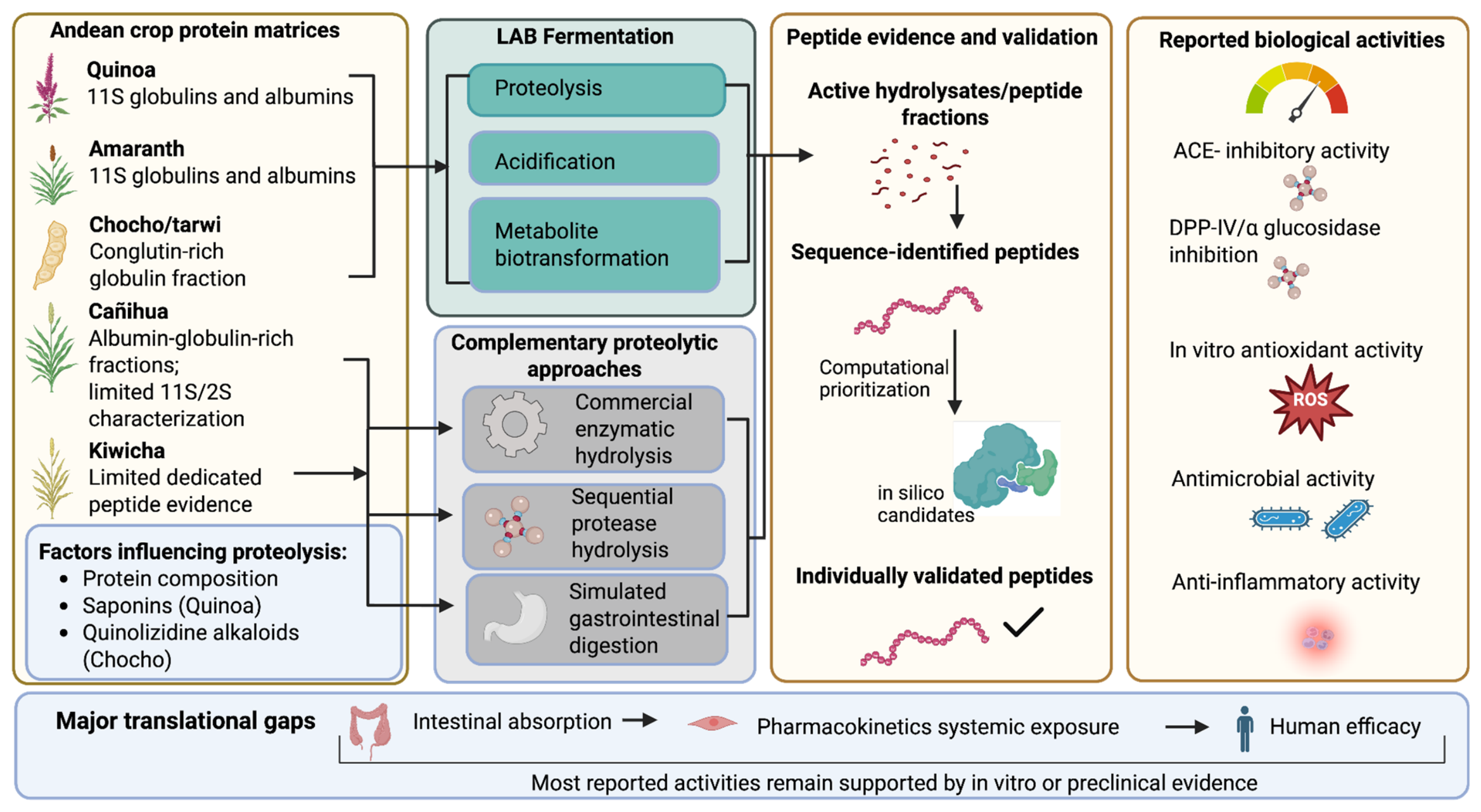
Bioactive Peptides from Andean Crops: Lactic Acid Bacteria Fermentation, Complementary Proteolysis, and Biological Activities

 , and
, and 
Abstract
1. Introduction
2. Proteomic Architecture and Secondary Metabolite Context of Andean Crops
3. Fermentation, Processing, and Peptidomic Characterization

| Crop | Processing Method | LAB Strain/Enzyme | Peptide or Fraction | Activity | Quantitative Evidence | Validation Status * | References |
|---|---|---|---|---|---|---|---|
| Quinoa | LAB fermentation + ultrafiltration/chromatographic purification | Lactobacillus paracasei CICC 20241 | NIFRPFAPEL | ACE inhibition | IC50 = 49.02 μM | Individual peptide validated | [21] |
| Quinoa | LAB fermentation + ultrafiltration/chromatographic purification | Lactobacillus paracasei CICC 20241 | AALEAPRILNL | ACE inhibition | IC50 = 79.72 μM | Individual peptide validated | [21] |
| Quinoa | Germination + LAB fermentation + fractionation | L. casei | VAHPVF | α-Glucosidase; ACE inhibition | Significant individual inhibition of α-glucosidase and ACE; peptide-specific IC50 not clearly reported. | Individual peptide tested | [50] |
| Quinoa | Germination + LAB fermentation + fractionation | L. casei | LAHMIVAGA | α-Glucosidase; ACE inhibition | Significant individual inhibition of α-glucosidase and ACE; peptide-specific IC50 not clearly reported. | Individual peptide tested | [50] |
| Quinoa | Mixed-strain fermentation + purification | Mixed bacterial culture | AGAAPE | Antibacterial | MIC = 5 mg/mL against E. coli and S. aureus | Individual peptide validated | [64] |
| Quinoa | Enzyme-assisted LAB fermentation + ultrafiltration | Lactobacillus paracasei; amylase + lipase pretreatment | 0–3 kDa fraction | ACE inhibition; antibacterial activity against E. coli | Quantitative ACE IC50 not reported; 0–3 kDa fraction showed the highest/stable ACE-inhibitory activity | Active fraction/hydrolysate | [65] |
| Amaranth | LAB fermentation | Enterococcus faecium LR9 | Fermented protein hydrolysate | ACE inhibition | 79.1 ± 2.6% ACE inhibition; L. mesenteroides 18C6: 68.0 ± 9.8%; Alcalase: 69.4 ± 1.2% | Active fraction/hydrolysate | [66] |
| Amaranth | LAB fermentation + peptide identification/in silico screening | E. faecium LR9 | IFQFPKTY | Predicted ACE-inhibitory activity | No experimental IC50 reported; prioritized by bioinformatics/molecular docking | In silico candidate | [66] |
| Amaranth | LAB fermentation + peptide identification/in silico screening | E. faecium LR9 | VIKPPSRAW | Predicted ACE-inhibitory activity | No experimental IC50 reported; prioritized by bioinformatics/molecular docking | In silico candidate | [66] |
| Amaranth | Enzymatic protein hydrolysis + chromatographic purification | Proteolytic hydrolysis; no LAB | SSEDIKE | Anti-inflammatory/immunomodulatory | Reduced CCL20 expression in activated Caco-2 cells; oral synthetic peptide reduced IgE/IgG1 and IL-5/IL-13 responses in a mouse food-allergy model | Individual peptide validated | [67,68] |
| Tarwi/chocho (L. mutabilis) | Enzymatic hydrolysis + ultrafiltration/size-exclusion chromatography + peptide synthesis | Alcalase + Neutrase | AVPFWM | ACE inhibition; DPP-IV inhibition; antioxidant activity | ACE IC50 = 6.38 ± 3.45 μM; DPP-IV IC50 = 133.0 ± 33.2 μM; ABTS = 3.17 ± 0.13 μmol TE/μmol peptide; ORAC = 2.66 ± 0.19 μmol TE/μmol peptide | Individual peptide validated | [17,69] |
| Tarwi/chocho (L. mutabilis) | Enzymatic hydrolysis + peptide synthesis | Alcalase + Neutrase | YSGWLGL | ACE inhibition; DPP-IV inhibition; antioxidant activity | ACE IC50 = 0.14 ± 0.01 μM; DPP-IV IC50 = 16.4 ± 1.0 μM; ABTS = 3.94 ± 0.06 μmol TE/μmol peptide; ORAC = 3.10 ± 0.09 μmol TE/μmol peptide | Individual peptide validated | [69] |
| Tarwi/chocho (L. mutabilis) | Enzymatic hydrolysis + peptide synthesis | Alcalase + Neutrase | AHAGFGMLY | ACE inhibition; DPP-IV inhibition; antioxidant activity | ACE IC50 = 0.69 ± 0.09 μM; DPP-IV IC50 = 1140 ± 457 μM; ABTS = 2.12 ± 0.04 μmol TE/μmol peptide; ORAC = 1.64 ± 0.10 μmol TE/μmol peptide | Individual peptide validated | [69] |
| Tarwi/chocho (L. mutabilis) | Enzymatic hydrolysis + LC-MS/MS + in silico prediction | Alcalase + Neutrase | FFSMKVM | Predicted ACE- and DPP-IV-inhibitory activity | PeptideRanker score = 0.809; no individual experimental IC50 reported | In silico candidate | [17] |
| Tarwi/chocho (L. mutabilis) | Sequential simulated gastrointestinal hydrolysis | Pepsin + pancreatin | Hydrolyzed γ-conglutin (Cgh) | DPP-IV inhibition; glucose uptake; gluconeogenesis | 100% DPP-IV inhibition at 5 mg/mL; 6.5-fold increase in glucose uptake; ~50% reduction in gluconeogenesis | Active fraction/hydrolysate | [70] |
| Tarwi/chocho (L. mutabilis) | Sequential gastrointestinal enzymatic hydrolysis + fractionation | Pepsin + pancreatin | RLGN, VNEGA, SEIGGA, SAPRST, GALGLGH, PQNLDL, AGGPQQR, PSELSGAAH, LPKHSDAD, LTFPGSAD | Predicted ACE-inhibitory activity; selected sequences also predicted as DPP-IV inhibitors | No individual experimental IC50 values reported | In silico candidate | [70] |
| Cañihua | Sequential enzymatic hydrolysis + ultrafiltration/size-exclusion chromatography | Neutrase + Alcalase | Fraction III (<3 kDa) | Antioxidant and ACE-inhibitory activity | Antioxidant activity = 3.18 μmol TE/mg; ACE inhibition = 78.4%; ACE IC50 = 55 μg/mL | Active fraction/hydrolysate | [39] |
| Cañihua | Sequential enzymatic hydrolysis + fractionation | Neutrase + Alcalase | LDKDYPKR | Associated with antioxidant and ACE-inhibitory active fractions | No individual activity reported; identified by LC-MS/MS in active fraction(s) | Sequence identified, not individually tested | [39] |
| Cañihua | Sequential enzymatic hydrolysis + fractionation | Neutrase + Alcalase | RLSAEKGVLYR | Associated with antioxidant and ACE-inhibitory active fractions | No individual activity reported; identified by LC-MS/MS in active fraction(s) | Sequence identified, not individually tested | [39] |
| Cañihua | Sequential enzymatic hydrolysis + fractionation | Neutrase + Alcalase | LFR | Associated with antioxidant and ACE-inhibitory active fractions | No individual activity reported; identified by LC-MS/MS in active fraction(s) | Sequence identified, not individually tested | [39] |
| Cañihua | Enzymatic hydrolysis + chromatographic purification | Alcalase or sequential pepsin–pancreatin digestion | Four purified antimicrobial peptide fractions | Antimicrobial activity against E. coli, S. aureus, and C. albicans | 28/216 hydrolysates showed ≥45% growth inhibition; four active fractions were purified. A glutelin-derived fraction showed 52% inhibition of S. aureus and 70% inhibition of C. albicans; ~95% inhibition was reported for E. coli. | Active fraction/hydrolysate | [20] |
4. Crop-Specific Evidence from Andean Food Matrices
5. Functional Properties and Bioactivities
5.1. ACE-Inhibitory Activity
5.2. Antioxidant Activity
5.3. DPP-IV and α-Glucosidase Inhibition
5.4. Antimicrobial Activity
5.5. Anti-Inflammatory Activity
5.6. Methodological Heterogeneity and Interpretation of Evidence
6. Molecular Mechanisms, Docking, and Structure–Activity Relationships
7. Gastrointestinal Stability and Bioaccessibility
8. Translational Challenges and Future Perspectives
| Domain/Principle | Scientific Basis | Translational Challenges | Future Perspectives/Research Frontiers | Key References |
|---|---|---|---|---|
| Raw Material Variability | Andean crops contain diverse protein matrices with latent bioactive peptides | High variability in saponins (0.22–15.04 mg/g), alkaloids (0.5–10%), protein composition → poor reproducibility | Standardized germplasm; genomic-assisted crop selection; controlled agro-processing systems | [73,153] |
| Antinutritional Compounds | Saponins and alkaloids influence enzymatic hydrolysis and microbial growth | Inhibition of LAB and proteases; altered peptide release kinetics | Coupled detoxification–fermentation systems; tolerant or engineered LAB strains | [37,73,155] |
| LAB Proteolysis | LAB release peptides via proteolytic systems (CEP + peptidases) | Strain-dependent variability; lack of reproducibility and control | CRISPR-engineered LAB; designer starter cultures; synthetic consortia | [37,44,155,166] |
| Fermentation Systems (SSF vs. SmF) | SSF mimics traditional systems; SmF allows industrial control | SSF: scaling issues, gradients; SmF: dilution, cost, downstream burden | Hybrid fermentation; smart/automated bioreactors | [159,160] |
| Process Optimization Trade-offs | Need to balance peptide yield, detoxification, and safety | Conflicting targets: debittering (≤0.002 g/100 g), saponin removal, microbial safety | AI-driven multi-objective optimization; digital twins | [37,155] |
| Peptide Multifunctionality | Selected peptides and peptide fractions show multiple in vitro bioactivities | Hard to validate multi-target effects in vivo; unclear structure–function relationships | Systems biology; network pharmacology; multitarget nutraceutical design | [35,163,164] |
| Sensory Constraints (Bitterness) | Hydrophobic and sequence-dependent peptide features can contribute to bitterness | Debittering reduces bioactivity; limits consumer acceptance | Selective enzymatic hydrolysis; smart encapsulation strategies | [82,90,167] |
| Encapsulation & Delivery | Protects peptides and masks taste | High cost; instability under heat/mechanical stress; scale-up issues | Nanoencapsulation; co-delivery systems; stimuli-responsive carriers | [83,168,171] |
| Bioavailability | Selected small peptides may cross the intestinal epithelium through carrier-mediated, paracellular, endocytic, or passive pathways | Peptide-specific transport, systemic exposure, and human pharmacokinetics remain largely uncharacterized | Organoid models; human pharmacokinetics; peptide engineering | [172,173,175] |
| Clinical Validation Gap | Preclinical evidence exists for selected peptides and hydrolysates | Human efficacy, dose–response relationships, and clinically relevant exposure remain largely unknown | Precision nutrition trials; biomarker-based interventions | [168,178] |
| Industrial Scale-Up | Fermentation is scalable but complex | High costs, purification challenges, batch variability | Process intensification; membrane filtration; green extraction | [37,180] |
| Gut Microbiome Interactions | Fermented Andean matrices have been associated with microbiome changes | Peptide-specific causality is unresolved because LAB, fibre, phenolics, organic acids, and other fermentation products may contribute | Purified-peptide studies and controlled fermented-matrix comparisons | [45,185] |
| Computational Prediction | In silico tools predict peptide bioactivity | Limited integration with experimental workflows | AI/ML peptide discovery; molecular docking pipelines | [69,85] |
| Sustainability & Crop Valorization | Andean crops are climate-resilient and nutrient-dense | Underutilized supply chains; limited industrial adoption | Sustainable biorefineries; global market integration | [6,95] |
| Functional Food Integration | Peptides incorporated into food systems | Matrix interactions reduce activity; sensory issues | Clean-label functional foods; plant-based innovations | [182,183] |
| Mechanistic Understanding | Mechanisms are well defined for some enzyme-inhibitory peptides but remain uncertain for many cellular or systemic effects | Limited mechanistic clarity in humans | Integrated in vitro–in vivo–in silico validation | [132,175,177,185] |
9. Conclusions
Author Contributions
Funding
Institutional Review Board Statement
Informed Consent Statement
Data Availability Statement
Acknowledgments
Conflicts of Interest
References
- Peighambardoust, S.H.; Karami, Z.; Pateiro, M.; Lorenzo, J.M. A Review on Health-Promoting, Biological, and Functional Aspects of Bioactive Peptides in Food Applications. Biomolecules 2021, 11, 631. [Google Scholar] [CrossRef] [Scilit] [PubMed]
- Alzaydi, A.; Barbhuiya, R.I.; Routray, W.; Elsayed, A.; Singh, A. Bioactive peptides: Synthesis, applications, and associated challenges. Food Bioeng. 2023, 2, 273–290. [Google Scholar] [CrossRef] [Scilit]
- Chen, H.; Sun, J.; Fang, H.; Lin, Y.; Wu, H.; Lin, D.; Yang, Z.; Zhou, Q.; Zhao, B.; Zhou, T.; et al. Food-derived bioactive peptides: Health benefits, structure–activity relationships, and translational prospects. J. Zhejiang Univ. Sci. B 2025, 26, 1037–1058. [Google Scholar] [CrossRef] [Scilit] [PubMed]
- Qiao, Q.; Chen, L.; Li, X.; Lu, X.; Xu, Q. Roles of dietary bioactive peptides in redox balance and metabolic disorders. Oxid. Med. Cell. Longev. 2021, 2021, 5582245. [Google Scholar] [CrossRef] [Scilit] [PubMed]
- Bersi, G.; Barberis, S.E.; Origone, A.L.; Adaro, M.O. Bioactive peptides as functional food ingredients. In Role of Materials Science in Food Bioengineering; Elsevier: Amsterdam, The Netherlands, 2018; pp. 147–186. ISBN 9780128114483. [Google Scholar]
- Quevedo-Olaya, J.L.; Schmiele, M.; Correa, M.J. Potentiasl of andean grains as substitutes for animal proteins in vegetarian and vegan diets: A nutritional and functional analysis. Foods 2025, 14, 2987. [Google Scholar] [CrossRef] [Scilit] [PubMed]
- Repo-Carrasco-Valencia, R.; Basilio-Atencio, J.; Luna-Mercado, G.I.; Pilco-Quesada, S.; Vidaurre-Ruiz, J. Andean ancient grains: Nutritional value and novel uses. Biol. Life Sci. Forum 2022, 8, 15. [Google Scholar] [CrossRef] [Scilit]
- Padulosi, S.; Amaya, K.; Jäger, M.; Gotor, E.; Rojas, W.; Valdivia, R. A holistic approach to enhance the use of neglected and underutilized species: The case of andean grains in Bolivia and Peru. Sustainability 2014, 6, 1283–1312. [Google Scholar] [CrossRef] [Scilit]
- Bojórquez-Velázquez, E.; Vidal-Limón, A.M.; Zamora-Briseño, J.A.; Llamas-García, M.L.; Barrera-Pacheco, A.; Espitia-Rangel, E.; de la Rosa, A.P.B. Comparative proteomics of amaranth and quinoa seeds reveals species-specific solubility traits of 11S globulins after Osborne and polarity-based extractions. J. Proteom. 2026, 327, 105621. [Google Scholar] [CrossRef] [Scilit] [PubMed]
- Guo, Y.; Han, J.; Yin, B.; Gu, R.; Chen, D.; He, Z.; Tang, C.; Wang, W. Modification of soybean 11S protein by fermentation: Antioxidant capacity, oxidative stability in emulsions and structural evolution. Foods 2026, 15, 199. [Google Scholar] [CrossRef] [Scilit] [PubMed]
- Souza, P.F.N. The forgotten 2S albumin proteins: Importance, structure, and biotechnological application in agriculture and human health. Int. J. Biol. Macromol. 2020, 164, 4638–4649. [Google Scholar] [CrossRef] [Scilit] [PubMed]
- El Hazzam, K.; Hafsa, J.; Sobeh, M.; Mhada, M.; Taourirte, M.; El Kacimi, K.; Yasri, A. An Insight into Saponins from Quinoa (Chenopodium quinoa Willd): A Review. Molecules 2020, 25, 1059. [Google Scholar] [CrossRef] [Scilit] [PubMed]
- Kholif, A.E. A review of effect of saponins on ruminal fermentation, health and performance of ruminants. Vet. Sci. 2023, 10, 450. [Google Scholar] [CrossRef] [Scilit] [PubMed]
- Li, C.; Liu, T.; Li, X.; Gao, W.; Lv, J.; Hu, G.; Li, C.; Liu, F.; Liu, X.; Meng, X. Review of quinoa fermentation: Product diversity, process optimization, and nutritional enhancement. Front. Nutr. 2025, 12, 1605558. [Google Scholar] [CrossRef] [Scilit] [PubMed]
- Behera, S.K.; Praharaj, A.B.; Chalikonda, G.; Srivani, G.; Mahapatra, N. Gut Microbiota as Signatures in Non-communicable Diseases and Mucosal Immunity. In Theranostics Approaches to Gastric and Colon Cancer; Raju, G.S.R., Bhaskar, L.V.K.S., Eds.; Diagnostics and Therapeutic Advances in GI Malignancies; Springer Singapore: Singapore, 2020; pp. 167–208. ISBN 978-981-15-2016-7. [Google Scholar]
- Raveschot, C.; Cudennec, B.; Coutte, F.; Flahaut, C.; Fremont, M.; Drider, D.; Dhulster, P. Production of bioactive peptides by lactobacillus species: From gene to application. Front. Microbiol. 2018, 9, 2354. [Google Scholar] [CrossRef] [Scilit] [PubMed]
- Chirinos, R.; Villasante-Bravo, N.; Aguilar-Galvez, A.; Figueroa-Merma, A.; Carpentier, S.; Pedreschi, R.; Campos, D. Antioxidant, antihypertensive and antidiabetic potential of peptidic fractions obtained from tarwi (Lupinus mutabilis) protein hydrolysate and identification of promising multifunctional bioactive peptides. Int. J. Food Sci. Technol. 2022, 57, 7402–7411. [Google Scholar] [CrossRef] [Scilit]
- Cruz-Casas, D.E.; Aguilar, C.N.; Ascacio-Valdés, J.A.; Rodríguez-Herrera, R.; Chávez-González, M.L.; Flores-Gallegos, A.C. Bioactive protein hydrolysates obtained from amaranth by fermentation with lactic acid bacteria and Bacillus species. Heliyon 2023, 9, e13491. [Google Scholar] [CrossRef] [Scilit] [PubMed]
- Ayala-Niño, A.; Rodríguez-Serrano, G.M.; Jiménez-Alvarado, R.; Bautista-Avila, M.; Sánchez-Franco, J.A.; González-Olivares, L.G.; Cepeda-Saez, A. Bioactivity of Peptides Released During Lactic Fermentation of Amaranth Proteins with Potential Cardiovascular Protective Effect: An In Vitro Study. J. Med. Food 2019, 22, 976–981. [Google Scholar] [CrossRef] [Scilit] [PubMed]
- Moscoso-Mujica, G.; Zavaleta, A.I.; Mujica, Á.; Arnao, I.; Moscoso-Neira, C.; Santos, M.; Sánchez, J. Antimicrobial peptides purified from hydrolysates of kanihua (Chenopodium pallidicaule Aellen) seed protein fractions. Food Chem. 2021, 360, 129951. [Google Scholar] [CrossRef] [Scilit] [PubMed]
- Li, S.; Du, G.; Shi, J.; Zhang, L.; Yue, T.; Yuan, Y. Preparation of antihypertensive peptides from quinoa via fermentation with Lactobacillus paracasei. Efood 2022, 3, e20. [Google Scholar] [CrossRef] [Scilit]
- Wei, Y.; Liu, Y.; Li, Y.; Wang, X.; Zheng, Y.; Xu, J.; Sang, S.; Liu, Y. A Novel Antihypertensive Pentapeptide Identified in Quinoa Bran Globulin Hydrolysates: Purification, In Silico Characterization, Molecular Docking with ACE and Stability against Different Food-Processing Conditions. Nutrients 2022, 14, 2420. [Google Scholar] [CrossRef] [Scilit] [PubMed]
- Repo-Carrasco-Valencia, R. Nutritional value and bioactive compounds in Andean ancient grains. Proceedings 2020, 53, 1. [Google Scholar] [CrossRef] [Scilit]
- Vidaurre-Ruiz, J.; Bender, D.; Schönlechner, R. Exploiting pseudocereals as novel high protein grains. J. Cereal Sci. 2023, 114, 103795. [Google Scholar] [CrossRef] [Scilit]
- Valcárcel-Yamani, B.; da Silva Lannes, S.C. Applications of Quinoa (Chenopodium quinoa Willd.) and Amaranth (Amaranthus Spp.) and Their Influence in the Nutritional Value of Cereal Based Foods. Int. J. Food Sci. Nutr. Eng. 2012, 2, 265–275. [Google Scholar]
- Burrieza, H.P.; Rizzo, A.J.; Pérez, O.E. Quinoa does not contain prolamins. Comments on “Quinoa protein: Composition, structure and functional properties”, Dakhili et al. (2019). Food Chem. 2020, 325, 126934. [Google Scholar] [CrossRef] [Scilit] [PubMed]
- Elsohaimy, S.A.; Refaay, T.M.; Zaytoun, M.A.M. Physicochemical and functional properties of quinoa protein isolate. Ann. Agric. Sci. 2015, 60, 297–305. [Google Scholar] [CrossRef] [Scilit]
- Carrazco-Peña, L.; Osuna-Castro, J.A.; De León-Rodríguez, A.; Maruyama, N.; Toro-Vazquez, J.F.; Morales-Rueda, J.A.; Barba de la Rosa, A.P. Modification of solubility and heat-induced gelation of amaranth 11S globulin by protein engineering. J. Agric. Food Chem. 2013, 61, 3509–3516. [Google Scholar] [CrossRef] [Scilit] [PubMed]
- Toimbayeva, D.; Saduakhasova, S.; Kamanova, S.; Kiykbay, A.; Tazhina, S.; Temirova, I.; Muratkhan, M.; Shaimenova, B.; Murat, L.; Khamitova, D.; et al. Prospects for the use of amaranth grain in the production of functional and specialized food products. Foods 2025, 14, 1603. [Google Scholar] [CrossRef] [Scilit] [PubMed]
- Chauhan, R.; Solanki, R.; Saiyed, M.; Saboo, B.; Shah, K. Global prevalence and clinical correlates of obesity in children and adolescents with type 1 diabetes: A systematic review and meta-analysis. Discov. Public Health 2026, 23, 396. [Google Scholar] [CrossRef] [Scilit]
- Martinez-Lopez, A.; Millan-Linares, M.C.; Rodriguez-Martin, N.M.; Millan, F.; Montserrat-de la Paz, S. Nutraceutical value of kiwicha (Amaranthus caudatus L.). J. Funct. Foods 2020, 65, 103735. [Google Scholar] [CrossRef] [Scilit]
- Gabur, I.; Simioniuc, D.P. Pearl lupin (Lupinus mutabilis). In Neglected and Underutilized Crops; Elsevier: Amsterdam, The Netherlands, 2023; pp. 413–436. ISBN 9780323905374. [Google Scholar]
- Garmidolova, A.; Desseva, I.; Mihaylova, D.; Lante, A. Bioactive Peptides from Lupinus spp. Seed Proteins-State-of-the-Art and Perspectives. Appl. Sci. 2022, 12, 3766. [Google Scholar] [CrossRef] [Scilit]
- Vega-Gálvez, A.; Miranda, M.; Vergara, J.; Uribe, E.; Puente, L.; Martínez, E.A. Nutrition facts and functional potential of quinoa (Chenopodium quinoa willd.), an ancient Andean grain: A review. J. Sci. Food Agric. 2010, 90, 2541–2547. [Google Scholar] [CrossRef] [Scilit] [PubMed]
- Caicedo, N.; Liscano, Y.; Oñate-Garzón, J. Bioactive Peptides from Quinoa (Chenopodium quinoa Willd.) as Modulators of the Gut Microbiome: A Scoping Review of Preclinical Evidence. Nutrients 2025, 17, 3215. [Google Scholar] [CrossRef] [Scilit] [PubMed]
- Dakhili, S.; Abdolalizadeh, L.; Hosseini, S.M.; Shojaee-Aliabadi, S.; Mirmoghtadaie, L. Quinoa protein: Composition, structure and functional properties. Food Chem. 2019, 299, 125161. [Google Scholar] [CrossRef] [Scilit] [PubMed]
- Carvajal-Larenas, F.E.; Linnemann, A.R.; Nout, M.J.R.; Koziol, M.; van Boekel, M.A.J.S. Lupinus mutabilis: Composition, Uses, Toxicology, and Debittering. Crit. Rev. Food Sci. Nutr. 2016, 56, 1454–1487. [Google Scholar] [CrossRef] [Scilit] [PubMed]
- Moscoso-Mujica, G.; Mujica, Á.; Chura, E.; Begazo, N.; Jayo-Silva, K.; Oliva, M. Kañihua (Chenopodium pallidicaule Aellen), an ancestral Inca seed and optimal functional food and nutraceutical for the industry: Review. Heliyon 2024, 10, e34589. [Google Scholar] [CrossRef] [Scilit] [PubMed]
- Chirinos, R.; Ochoa, K.; Aguilar-Galvez, A.; Carpentier, S.; Pedreschi, R.; Campos, D. Obtaining of peptides with in vitro antioxidant and angiotensin I converting enzyme inhibitory activities from cañihua protein (Chenopodium pallidicaule Aellen). J. Cereal Sci. 2018, 83, 139–146. [Google Scholar] [CrossRef] [Scilit]
- Mérida-López, J.; Pérez, S.J.; Morales, R.; Purhagen, J.; Bergenståhl, B.; Rojas, C.C. Comparison of the Chemical Composition of Six Canihua (Chenopodium pallidicaule) Cultivars Associated with Growth Habits and after Dehulling. Foods 2023, 12, 1734. [Google Scholar] [CrossRef] [Scilit] [PubMed]
- Ge, J.; Yang, Y.; Lu, H.; Wang, B.; Yang, H.; Guo, S. Effects of quinoa secondary metabolites on in vitro fermentation and gas production. Animals 2025, 15, 1522. [Google Scholar] [CrossRef] [Scilit] [PubMed]
- Timilsena, Y.P.; Phosanam, A.; Stockmann, R. Perspectives on saponins: Food functionality and applications. Int. J. Mol. Sci. 2023, 24, 13538. [Google Scholar] [CrossRef] [Scilit] [PubMed]
- Cortés-Avendaño, P.; Tarvainen, M.; Suomela, J.-P.; Glorio-Paulet, P.; Yang, B.; Repo-Carrasco-Valencia, R. Profile and Content of Residual Alkaloids in Ten Ecotypes of Lupinus mutabilis Sweet after Aqueous Debittering Process. Plant Foods Hum. Nutr. 2020, 75, 184–191. [Google Scholar] [CrossRef] [Scilit] [PubMed]
- Nong, N.T.P.; Hsu, J.-L. Bioactive Peptides: An Understanding from Current Screening Methodology. Processes 2022, 10, 1114. [Google Scholar] [CrossRef] [Scilit]
- Anaya-González, B.; Fernandez, E.D.L.C.; Alarcón, R.C.; Aycachi, R.A.M.; Zegarra, A.A.U.; Bazile, D. Quinoa-derived biopeptides with antioxidant activity and their applications in the pharmaceutical and food industries. Food Sci. Technol. 2025, 45, e00444. [Google Scholar] [CrossRef] [Scilit]
- Baquero Icaza, P.S.; Salinas Velasteguí, V.G.; Sandoval Espinoza, G.F.; Barreno Sánchez, M.J. Efecto de los péptidos bioactivos derivados de alimentos andinos inhibidores de la ECA en el control de la presión arterial: Una revisión sistemática. Rev. Multidiscip. Estud. Gen. 2025, 4, 1038–1053. [Google Scholar] [CrossRef] [Scilit]
- Singhania, R.R.; Patel, A.K.; Soccol, C.R.; Pandey, A. Recent advances in solid-state fermentation. Biochem. Eng. J. 2009, 44, 13–18. [Google Scholar] [CrossRef] [Scilit]
- Kashyap, R.; Narayan, K.S.; Vij, S. Evaluation of the antimicrobial attribute of bioactive peptides derived from colostrum whey fermented by Lactobacillus against diarrheagenic E. coli strains. J. Food Sci. Technol. 2023, 60, 211–221. [Google Scholar] [CrossRef] [Scilit] [PubMed]
- Chandra, P.; Vij, S. Molecular Characterization and Identification of Bioactive Peptides Producing Lactobacillus sps. Based on 16S rRNA Gene Sequencing. Food Biotechnol. 2018, 32, 1–14. [Google Scholar] [CrossRef] [Scilit]
- Obaroakpo, J.U.; Liu, L.; Zhang, S.; Lu, J.; Pang, X.; Lv, J. α-Glucosidase and ACE dual inhibitory protein hydrolysates and peptide fractions of sprouted quinoa yoghurt beverages inoculated with Lactobacillus casei. Food Chem. 2019, 299, 124985. [Google Scholar] [CrossRef] [Scilit] [PubMed]
- Ayyash, M.; Johnson, S.K.; Liu, S.-Q.; Mesmari, N.; Dahmani, S.; Al Dhaheri, A.S.; Kizhakkayil, J. In vitro investigation of bioactivities of solid-state fermented lupin, quinoa and wheat using Lactobacillus spp. Food Chem. 2019, 275, 50–58. [Google Scholar] [CrossRef] [Scilit] [PubMed]
- Dallagnol, A.M.; Pescuma, M.; De Valdez, G.F.; Rollán, G. Fermentation of quinoa and wheat slurries by Lactobacillus plantarum CRL 778: Proteolytic activity. Appl. Microbiol. Biotechnol. 2013, 97, 3129–3140. [Google Scholar] [CrossRef] [Scilit] [PubMed]
- Wang, H.; Zhang, S.; Sun, Y.; Dai, Y. ACE-Inhibitory Peptide Isolated from Fermented Soybean Meal as Functional Food. Int. J. Food Eng. 2013, 9, 1–8. [Google Scholar] [CrossRef] [Scilit]
- Ojha, K.S.; Mason, T.J.; O’Donnell, C.P.; Kerry, J.P.; Tiwari, B.K. Ultrasound technology for food fermentation applications. Ultrason. Sonochem. 2017, 34, 410–417. [Google Scholar] [CrossRef] [Scilit] [PubMed]
- Pihlanto, A. Lactic fermentation and bioactive peptides. In Lactic Acid Bacteria—R & D for Food, Health and Livestock Purposes; Kongo, J.M., Ed.; InTech: London, UK, 2013; ISBN 978-953-51-0955-6. [Google Scholar]
- Mirdhayati, I.; Zain, W.N.H.; Fatah, A.; Yokoyama, I.; Arihara, K. Purification of angiotensin converting enzyme inhibitory peptides and antihypertensive effect generated from Indonesian traditional fermented beef (Cangkuk). Anim. Biosci. 2024, 37, 1799–1808. [Google Scholar] [CrossRef] [Scilit] [PubMed]
- Rzhepakovsky, I.; Piskov, S.; Avanesyan, S.; Dudchik, N.; Sizonenko, M.; Timchenko, L.; Kurchenko, V.; Osadchy, A.; Nagdalian, A.; Jafari, S.M. Functional and health-promoting bioactivities of fractions derived from chicken embryo hydrolysates. Food Res. Int. 2025, 219, 117058. [Google Scholar] [CrossRef] [Scilit] [PubMed]
- Kan, M.; Ter, Z.Y.; Sofian-Seng, N.-S.; Chang, L.S.; Wang, S.; Lim, S.J. Recent advances on bioactive peptide fractionation methods. Food Bioprocess Technol. 2025, 18, 7032–7059. [Google Scholar] [CrossRef] [Scilit]
- Xie, Y.; Butler, M. Compositional profiling of protein hydrolysates by high resolution liquid chromatography-mass spectrometry and chemometric analysis. Food Chem. 2025, 487, 144756. [Google Scholar] [CrossRef] [Scilit] [PubMed]
- Guo, H.; Hao, Y.; Richel, A.; Everaert, N.; Chen, Y.; Liu, M.; Yang, X.; Ren, G. Antihypertensive effect of quinoa protein under simulated gastrointestinal digestion and peptide characterization. J. Sci. Food Agric. 2020, 100, 5569–5576. [Google Scholar] [CrossRef] [Scilit] [PubMed]
- Ayala-Niño, A.; Castañeda-Ovando, A.; Jaimez-Ordaz, J.; Rodríguez-Serrano, G.M.; Sánchez-Franco, J.A.; González-Olivares, L.G. Novel bioactive peptides sequences released by in vitro digestion of proteins isolated from Amaranthus hypochondriacus. Nat. Prod. Res. 2022, 36, 3485–3488. [Google Scholar] [CrossRef] [Scilit] [PubMed]
- Suárez, S.E.; Rabesona, H.; Ménard, O.; Jardin, J.; Anton, M.; Cristina Añón, M. Dynamic digestion of a high protein beverage based on amaranth: Structural changes and antihypertensive activity. Food Res. Int. 2024, 187, 114416. [Google Scholar] [CrossRef] [Scilit] [PubMed]
- Miles, A.J.; Wallace, B.A. Circular dichroism spectroscopy of membrane proteins. Chem. Soc. Rev. 2016, 45, 4859–4872. [Google Scholar] [CrossRef] [Scilit] [PubMed]
- Zhu, X.; Ren, M.; Zhang, Z.; Meng, F.; Li, Z.; Qin, Y.; Fang, Y.; Zhang, M. Isolation and characterization of quinoa antimicrobial peptides and its effect on the microbial diversity of fresh apple juice. Food Chem. 2025, 469, 142536. [Google Scholar] [CrossRef] [Scilit] [PubMed]
- Fan, X.; Ma, X.; Maimaitiyiming, R.; Aihaiti, A.; Yang, J.; Li, X.; Wang, X.; Pang, G.; Liu, X.; Qiu, C.; et al. Study on the preparation process of quinoa anti-hypertensive peptide and its stability. Front. Nutr. 2022, 9, 1119042. [Google Scholar] [CrossRef] [Scilit] [PubMed]
- Cruz-Casas, D.E.; Ramos-González, R.; Prado-Barragán, L.A.; Iliná, A.; Aguilar, C.N.; Rodríguez-Herrera, R.; Tsopmo, A.; Flores-Gallegos, A.C. Protein hydrolysates with ACE-I inhibitory activity from amaranth seeds fermented with Enterococcus faecium-LR9: Identification of peptides and molecular docking. Food Chem. 2025, 464, 141598. [Google Scholar] [CrossRef] [Scilit] [PubMed]
- Moronta, J.; Smaldini, P.L.; Docena, G.H.; Añón, M.C. Peptides of amaranth were targeted as containing sequences with potential anti-inflammatory properties. J. Funct. Foods 2016, 21, 463–473. [Google Scholar] [CrossRef] [Scilit]
- Moronta, J.; Smaldini, P.L.; Fossati, C.A.; Añon, M.C.; Docena, G.H. The anti-inflammatory SSEDIKE peptide from Amaranth seeds modulates IgE-mediated food allergy. J. Funct. Foods 2016, 25, 579–587. [Google Scholar] [CrossRef] [Scilit]
- Chirinos, R.; de Oliveira, T.V.; Guzmán, F.; Aguilar-Galvez, A.; Figueroa-Merma, A.; Pedreschi, R.; Campos, D. In vitro and in silico studies of antioxidant peptides from tarwi (Lupinus mutabilis) as inhibitors of angiotensin-converting enzyme and dipeptidyl peptidase IV enzyme. Int. J. Food Sci. Technol. 2023, 58, 5193–5202. [Google Scholar] [CrossRef] [Scilit]
- Muñoz, E.B.; Luna-Vital, D.A.; Fornasini, M.; Baldeón, M.E.; Gonzalez de Mejia, E. Gamma-conglutin peptides from Andean lupin legume (Lupinus mutabilis Sweet) enhanced glucose uptake and reduced gluconeogenesis in vitro. J. Funct. Foods 2018, 45, 339–347. [Google Scholar] [CrossRef] [Scilit]
- Tiengo, A.; Faria, M.; Netto, F.M. Characterization and ACE-inhibitory activity of amaranth proteins. J. Food Sci. 2009, 74, H121–H126. [Google Scholar] [CrossRef] [Scilit] [PubMed]
- Yao, Y.; Yang, X.; Shi, Z.; Ren, G. Anti-inflammatory activity of saponins from quinoa (Chenopodium quinoa Willd.) seeds in lipopolysaccharide-stimulated RAW 264.7 macrophages cells. J. Food Sci. 2014, 79, H1018–H1023. [Google Scholar] [CrossRef] [Scilit] [PubMed]
- Olivera-Montenegro, L.; Bugarin, A.; Marzano, A.; Best, I.; Zabot, G.L.; Romero, H. Production of Protein Hydrolysate from Quinoa (Chenopodium quinoa Willd.): Economic and Experimental Evaluation of Two Pretreatments Using Supercritical Fluids’ Extraction and Conventional Solvent Extraction. Foods 2022, 11, 1015. [Google Scholar] [CrossRef] [Scilit] [PubMed]
- Sen, A.; Sharma, G.; Tomer, N.; Sahaya Shibu, B.; Moin, S. Isolation, purification, and characterization of bioactive peptide from Chenopodium quinoa seeds: Therapeutic and functional insights. J. Appl. Pharm. Res. 2024, 12, 184–191. [Google Scholar] [CrossRef] [Scilit]
- Zhao, L.; Liao, J.; Zhao, H.; Feng, C. Identification of key metabolites in fermented quinoa and their α-glucosidase inhibitory mechanisms using widely targeted metabolomics and molecular simulation. Food Chem. 2025, 496, 146740. [Google Scholar] [CrossRef] [Scilit] [PubMed]
- Vilcacundo, R.; Martínez-Villaluenga, C.; Miralles, B.; Hernández-Ledesma, B. Release of multifunctional peptides from kiwicha (Amaranthus caudatus) protein under in vitro gastrointestinal digestion. J. Sci. Food Agric. 2019, 99, 1225–1232. [Google Scholar] [CrossRef] [Scilit] [PubMed]
- Paz, S.M.D.L.; Martinez-Lopez, A.; Villanueva-Lazo, A.; Pedroche, J.; Millan, F.; Millan-Linares, M.C. Identification and Characterization of Novel Antioxidant Protein Hydrolysates from Kiwicha (Amaranthus caudatus L.). Antioxidants 2021, 10, 645. [Google Scholar] [CrossRef] [Scilit] [PubMed]
- Chirinos, R.; Pedreschi, R.; Velásquez-Sánchez, M.; Aguilar-Galvez, A.; Campos, D. In vitro antioxidant and angiotensin I-converting enzyme inhibitory properties of enzymatically hydrolyzed quinoa (Chenopodium quinoa) and kiwicha (Amaranthus caudatus) proteins. Cereal Chem. 2020, 97, 949–957. [Google Scholar] [CrossRef] [Scilit]
- Intiquilla, A.; Jiménez-Aliaga, K.; Zavaleta, A.I.; Hernández-Ledesma, B. Production of Antioxidant Hydrolyzates from a Lupinus mutabilis (Tarwi) Protein Concentrate with Alcalase: Optimization by Response Surface Methodology. Nat. Prod. Commun. 2018, 13, 1934578X1801300626. [Google Scholar] [CrossRef] [Scilit]
- Castañeda-Rodríguez, W.A.; Rodríguez-Yparraguirre, A.J.; Rodríguez-Yparraguirre, C.D.; Maco-Vásquez, W.A.; Olivares-Espino, I.M.; Epifanía-Huerta, A.D.; Lara-Rivera, O.; Guarniz-Vásquez, E.; Moreno-Rojo, C.; Aguirre, E. Advances in Proteomics and Functional Foods from Fermentation and Bioencapsulation of Andean Grains and Tubers: Applications and Perspectives. Foods 2026, 15, 425. [Google Scholar] [CrossRef] [Scilit] [PubMed]
- Abdelshafy, A.M.; Rashwan, A.K.; Osman, A.I. Potential food applications and biological activities of fermented quinoa: A review. Trends Food Sci. Technol. 2024, 144, 104339. [Google Scholar] [CrossRef] [Scilit]
- Nardo, A.E.; Suárez, S.; Quiroga, A.V.; Añón, M.C. Amaranth as a source of antihypertensive peptides. Front. Plant Sci. 2020, 11, 578631. [Google Scholar] [CrossRef] [Scilit] [PubMed]
- Cruz-Casas, D.E.; Ramos-González, R.; Prado-Barragán, L.A.; Aguilar, C.N.; Rodríguez-Herrera, R.; Iliná, A.; Esparza-González, S.C.; Flores-Gallegos, A.C. Antihypertensive Amaranth Protein Hydrolysates Encapsulation in Alginate/Pectin Beads: Influence on Bioactive Properties upon In Vitro Digestion. Polysaccharides 2024, 5, 450–462. [Google Scholar] [CrossRef] [Scilit]
- Chirinos, R.; Cerna, E.; Pedreschi, R.; Calsin, M.; Aguilar-Galvez, A.; Campos, D. Multifunctional in vitro bioactive properties: Antioxidant, antidiabetic, and antihypertensive of protein hydrolyzates from tarwi (Lupinus mutabilis Sweet) obtained by enzymatic biotransformation. Cereal Chem. 2021, 98, 423–433. [Google Scholar] [CrossRef] [Scilit]
- Arámburo-Gálvez, J.G.; Tinoco-Narez-Gil, R.; Mora-Melgem, J.A.; Sánchez-Cárdenas, C.A.; Gracia-Valenzuela, M.H.; Flores-Mendoza, L.K.; Figueroa-Salcido, O.G.; Ontiveros, N. In Silico Hydrolysis of Lupin (Lupinus angustifolius L.) Conglutins with Plant Proteases Releases Antihypertensive and Antidiabetic Peptides That Are Bioavailable, Non-Toxic, and Gastrointestinal Digestion Stable. Int. J. Mol. Sci. 2024, 25, 12866. [Google Scholar] [CrossRef] [Scilit] [PubMed]
- Rizzello, C.G.; Lorusso, A.; Russo, V.; Pinto, D.; Marzani, B.; Gobbetti, M. Improving the antioxidant properties of quinoa flour through fermentation with selected autochthonous lactic acid bacteria. Int. J. Food Microbiol. 2017, 241, 252–261. [Google Scholar] [CrossRef] [Scilit] [PubMed]
- Peñarrieta, J.M.; Alvarado, J.A.; Akesson, B.; Bergenståhl, B. Total antioxidant capacity and content of flavonoids and other phenolic compounds in canihua (Chenopodium pallidicaule): An Andean pseudocereal. Mol. Nutr. Food Res. 2008, 52, 708–717. [Google Scholar] [CrossRef] [Scilit] [PubMed]
- Cizeikiene, D.; Gaide, I.; Basinskiene, L. Effect of Lactic Acid Fermentation on Quinoa Characteristics and Quality of Quinoa-Wheat Composite Bread. Foods 2021, 10, 171. [Google Scholar] [CrossRef] [Scilit] [PubMed]
- Cisneros-Yupanqui, M.; Pedreschi, R.; Aguilar-Galvez, A.; Chirinos, R.; Campos, D. Fractionation and Separation of Peptides with Antioxidant and Angiotensin-I Converting Enzyme Inhibitory Activities from a Quinoa (Chenopodium quinoa Willd.) Protein Hydrolysate. J. Microbiol. Biotechnol. Food Sci. 2022, 12, e2686. [Google Scholar] [CrossRef] [Scilit]
- Guo, H.; Hao, Y.; Yang, X.; Ren, G.; Richel, A. Exploration on bioactive properties of quinoa protein hydrolysate and peptides: A review. Crit. Rev. Food Sci. Nutr. 2023, 63, 2896–2909. [Google Scholar] [CrossRef] [Scilit] [PubMed]
- Mudgil, P.; Kilari, B.P.; Kamal, H.; Olalere, O.A.; FitzGerald, R.J.; Gan, C.-Y.; Maqsood, S. Multifunctional bioactive peptides derived from quinoa protein hydrolysates: Inhibition of α-glucosidase, dipeptidyl peptidase-IV and angiotensin I converting enzymes. J. Cereal Sci. 2020, 96, 103130. [Google Scholar] [CrossRef] [Scilit]
- González-Muñoz, A.; Valle, M.; Aluko, R.E.; Bazinet, L.; Enrione, J. Production of antihypertensive and antidiabetic peptide fractions from quinoa (Chenopodium quinoa Willd.) by electrodialysis with ultrafiltration membranes. Food Sci. Hum. Wellness 2022, 11, 1650–1659. [Google Scholar] [CrossRef] [Scilit]
- Carrera Macias, D.P.; Barreno Sánchez, M.J.; Baquero Icaza, P.S.; López Hernández, O.D. Péptidos bioactivos del chocho, amaranto y quinoa: Potencial terapéutico en diabetes tipo 2. Una revisión sistemática. Rev. Cient. Multi. G-Nerando 2025, 6, ág-6508. [Google Scholar] [CrossRef] [Scilit]
- Lovati, M.R.; Manzoni, C.; Castiglioni, S.; Parolari, A.; Magni, C.; Duranti, M. Lupin seed γ-conglutin lowers blood glucose in hyperglycaemic rats and increases glucose consumption of HepG2 cells. Br. J. Nutr. 2012, 107, 67–73. [Google Scholar] [CrossRef] [Scilit] [PubMed]
- Balakrishnan, G.; Schneider, R.G. The Role of Amaranth, Quinoa, and Millets for the Development of Healthy, Sustainable Food Products—A Concise Review. Foods 2022, 11, 2442. [Google Scholar] [CrossRef] [Scilit] [PubMed]
- Hernández-Pérez, T.; Paredes-López, O. Ancient Latin-American food crops: An overview of their nutraceutical and antiobesity peptides. Food Sci. Technol. Int. 2025, 32, 454–464. [Google Scholar] [CrossRef] [Scilit] [PubMed]
- Wu, W.; Xie, W.; Tan, Q.; Wu, L.; Zhu, S.; Zhu, H.; Qiu, J. Advance on anti-diabetic effects of protein hydrolysates and peptides derived from cereals and pseudocereals. E3S Web Conf. 2020, 189, 02030. [Google Scholar] [CrossRef] [Scilit]
- Mahankali, S.; Kalava, J.; Garapati, Y.; Domathoti, B.; Maddumala, V.R.; Sundramurty, V.P. A Treatment to Cure Diabetes Using Plant-Based Drug Discovery. Evid. Based Complement. Altern. Med. 2022, 2022, 8621665. [Google Scholar] [CrossRef] [Scilit] [PubMed]
- Orona-Tamayo, D.; Valverde, M.E.; Paredes-López, O. Bioactive peptides from selected latin American food crops—A nutraceutical and molecular approach. Crit. Rev. Food Sci. Nutr. 2019, 59, 1949–1975. [Google Scholar] [CrossRef] [Scilit] [PubMed]
- Dong, S.; Yang, X.; Zhao, L.; Zhang, F.; Hou, Z.; Xue, P. Antibacterial activity and mechanism of action saponins from Chenopodium quinoa Willd. husks against foodborne pathogenic bacteria. Ind. Crops Prod. 2020, 149, 112350. [Google Scholar] [CrossRef] [Scilit]
- Sun, X.; Yang, X.; Xue, P.; Zhang, Z.; Ren, G. Improved antibacterial effects of alkali-transformed saponin from quinoa husks against halitosis-related bacteria. BMC Complement. Altern. Med. 2019, 19, 46. [Google Scholar] [CrossRef] [Scilit] [PubMed]
- Rai, S.; Acharya-Siwakoti, E.; Kafle, A.; Devkota, H.P.; Bhattarai, A. Plant-Derived Saponins: A Review of Their Surfactant Properties and Applications. Sci 2021, 3, 44. [Google Scholar] [CrossRef] [Scilit]
- Pontificia Universidad Católica de Chile; McCartney, N.B.; Ahumada, M.I.; Muñoz, M.; Rosales, M.; Fierro, A.M.; Chorbadjian, R.A. Effects of saponin-rich quinoa (Chenopodium quinoa Willd.) bran and bran extract in diets of adapted and non-adapted quinoa pests in laboratory bioassays. Cienc. Investig. Agrar. 2019, 46, 125–136. [Google Scholar] [CrossRef] [Scilit]
- Stuardo, M.; San Martín, R. Antifungal properties of quinoa (Chenopodium quinoa Willd) alkali treated saponins against Botrytis cinerea. Ind. Crops Prod. 2008, 27, 296–302. [Google Scholar] [CrossRef] [Scilit]
- Foronda, C.G.; Lozano, M.; Ortiz, L.S. Quinoa saponins, biological controller against Cercospora coffeicola and Moniliophthora roreri. Hortic. Int. J. 2021, 5, 61–62. [Google Scholar] [CrossRef] [Scilit]
- Kilinc, O.K.; Ozgen, S.; Selamoglu, Z. Bioactivity of Triterpene Saponins from Quinoa (Chenopodium quinoa Willd.). Res. Rev. J. Biol. 2016, 4, 25–28. [Google Scholar]
- Mahdavi-Yekta, M.; Reihani, S.F.S.; Mohammadi, M. Antimicrobial Activity of Quinoa Protein Hydrolysate against Streptococcus pyogenes and Escherichia coli. J. Food Qual. 2023, 2023, 9993241. [Google Scholar] [CrossRef] [Scilit]
- Basim, S.; Kadum, H. The Antibacterial Activities of Bioactive Peptides Generated using Protein Extracted from Chia Seeds, and quinoa Seeds in Iraq. J. Med. Oral Biosci. 2024, 1, 11–23. [Google Scholar] [CrossRef] [Scilit]
- Mudgil, P.; Omar, L.S.; Kamal, H.; Kilari, B.P.; Maqsood, S. Multi-functional bioactive properties of intact and enzymatically hydrolysed quinoa and amaranth proteins. LWT 2019, 110, 207–213. [Google Scholar] [CrossRef] [Scilit]
- Reyes-Bautista, R.; Barajas-Segoviano, M.; Flores-Sierra, J.D.J.; Hernández-Mendoza, G.; Xoca-Orozco, L.Á. Biopéptidos derivados de los pseudocereales: Amaranto, Quinoa, Chía y Trigo sarraceno. TIP. Rev. Espec. Cienc. Quím.-Biológicas 2023, 26, e616. [Google Scholar] [CrossRef] [Scilit]
- Broekaert, W.F.; Cammue, B.P.A.; De Bolle, M.F.C.; Thevissen, K.; De Samblanx, G.W.; Richard, W. Biocidal proteins from plants. In Genes Involved in Plant Defense; Boller, T., Meins, F., Jr., Eds.; Springer: Vienna, Austria, 1993; pp. 209–240. ISBN 978-3-7091-9305-0. [Google Scholar]
- Lipkin, A.; Anisimova, V.; Nikonorova, A.; Babakov, A.; Krause, E.; Bienert, M.; Grishin, E.; Egorov, T. An antimicrobial peptide Ar-AMP from amaranth (Amaranthus retroflexus L.) seeds. Phytochemistry 2005, 66, 2426–2431. [Google Scholar] [CrossRef] [Scilit] [PubMed]
- Rivillas-Acevedo, L.; Soriano-García, M. Antifungal Activity of a Protean Extract from Amaranthus hypochondriacus Seeds. J. Mex. Chem. Soc. 2020, 51, 136–140. [Google Scholar] [CrossRef] [Scilit]
- Rueda, J.; Lobo, M.O.; Galdeano, C.M.; Samman, N.C. Quinoa protein hydrolysate as potential immunomodulators: Effects on cytokine production and macrophage activation. Plant Foods Hum. Nutr. 2025, 80, 73. [Google Scholar] [CrossRef] [Scilit] [PubMed]
- Khattib, H.; Pintel, N.; Khatib, S.; Rubinovich, L.; Avni, D. Young green quinoa as a sustainable functional crop with anti-inflammatory effects in macrophage cells. Sci. Rep. 2025, 15, 20308. [Google Scholar] [CrossRef] [Scilit] [PubMed]
- Pan, Y.; Zheng, J.; Wang, Z.; Lin, S.; Jia, H.; Pei, H.; Ju, R. Quinoa and colonic health: A review of bioactive components and mechanistic insights. Curr. Issues Mol. Biol. 2025, 47, 815. [Google Scholar] [CrossRef] [Scilit] [PubMed]
- Malek Mahdavi, A.; Javadivala, Z.; Khalili, Y.; Khalili, M. Effects of Quinoa (Chenopodium quinoa) on inflammatory mediators: A systematic review of preclinical studies. Inflammopharmacology 2023, 31, 241–251. [Google Scholar] [CrossRef] [Scilit] [PubMed]
- Martinez-Lopez, A.; Rivero-Pino, F.; Villanueva, A.; Toscano, R.; Grao-Cruces, E.; Marquez-Paradas, E.; Martin, M.E.; Montserrat-de la Paz, S.; Millan-Linares, M.C. Kiwicha (Amaranthus caudatus L.) protein hydrolysates reduce intestinal inflammation by modulating the NLRP3 inflammasome pathway. Food Funct. 2022, 13, 11604–11614. [Google Scholar] [CrossRef] [Scilit] [PubMed]
- Sandoval-Sicairos, E.S.; Milán-Noris, A.K.; Luna-Vital, D.A.; Milán-Carrillo, J.; Montoya-Rodríguez, A. Anti-inflammatory and antioxidant effects of peptides released from germinated amaranth during in vitro simulated gastrointestinal digestion. Food Chem. 2021, 343, 128394. [Google Scholar] [CrossRef] [Scilit] [PubMed]
- Montoya-Rodríguez, A.; Milán-Carrillo, J.; Dia, V.P.; Reyes-Moreno, C.; González de Mejía, E. Pepsin-pancreatin protein hydrolysates from extruded amaranth inhibit markers of atherosclerosis in LPS-induced THP-1 macrophages-like human cells by reducing expression of proteins in LOX-1 signaling pathway. Proteome Sci. 2014, 12, 30. [Google Scholar] [CrossRef] [Scilit] [PubMed]
- Barati, M.; Javanmardi, F.; Mousavi Jazayeri, S.M.H.; Jabbari, M.; Rahmani, J.; Barati, F.; Nickho, H.; Davoodi, S.H.; Roshanravan, N.; Mousavi Khaneghah, A. Techniques, perspectives, and challenges of bioactive peptide generation: A comprehensive systematic review. Comp. Rev. Food Sci. Food Saf. 2020, 19, 1488–1520. [Google Scholar] [CrossRef] [Scilit] [PubMed]
- Saubenova, M.; Oleinikova, Y.; Rapoport, A.; Maksimovich, S.; Yermekbay, Z.; Khamedova, E. Bioactive Peptides Derived from Whey Proteins for Health and Functional Beverages. Fermentation 2024, 10, 359. [Google Scholar] [CrossRef] [Scilit]
- Rahmi, A.; Arcot, J. In Vitro Assessment Methods for Antidiabetic Peptides from Legumes: A Review. Foods 2023, 12, 631. [Google Scholar] [CrossRef] [Scilit] [PubMed]
- Berisha, A.; Mukherjee, K.; Vilcinskas, A.; Spengler, B.; Römpp, A. High-resolution mass spectrometry driven discovery of peptidic danger signals in insect immunity. PLoS ONE 2013, 8, e80406. [Google Scholar] [CrossRef] [Scilit] [PubMed]
- Wang, J.; Liao, W.; Nimalaratne, C.; Chakrabarti, S.; Wu, J. Purification and characterization of antioxidant peptides from cooked eggs using a dynamic in vitro gastrointestinal model in vascular smooth muscle A7r5 cells. npj Sci. Food 2018, 2, 7. [Google Scholar] [CrossRef] [Scilit] [PubMed]
- Purcell, D.; Packer, M.A.; Hayes, M. Identification of Bioactive Peptides from a Laminaria digitata Protein Hydrolysate Using In Silico and In Vitro Methods to Identify Angiotensin-1-Converting Enzyme (ACE-1) Inhibitory Peptides. Mar. Drugs 2023, 21, 90. [Google Scholar] [CrossRef] [Scilit] [PubMed]
- Hernández-Ledesma, B.; Amigo, L.; Recio, I.; Bartolomé, B. ACE-inhibitory and radical-scavenging activity of peptides derived from beta-lactoglobulin f(19-25). Interactions with ascorbic acid. J. Agric. Food Chem. 2007, 55, 3392–3397. [Google Scholar] [CrossRef] [Scilit] [PubMed]
- Zhang, Q.; Zheng, L.; Luo, D.; Zhao, M. In vitro simulated gastrointestinal digestion stability of a neuroprotective octapeptide WCPFSRSF and prediction of potential bioactive peptides in its digestive fragments by multiple bioinformatics tools. J. Agric. Food Chem. 2023, 71, 6987–6998. [Google Scholar] [CrossRef] [Scilit] [PubMed]
- Bartolomei, M.; Cropotova, J.; Bollati, C.; Kvangarsnes, K.; d’Adduzio, L.; Li, J.; Boschin, G.; Lammi, C. Rainbow Trout (Oncorhynchus mykiss) as Source of Multifunctional Peptides with Antioxidant, ACE and DPP-IV Inhibitory Activities. Nutrients 2023, 15, 829. [Google Scholar] [CrossRef] [Scilit] [PubMed]
- Coscueta, E.R.; Batista, P.; Gomes, J.E.G.; da Silva, R.; Pintado, M.M. Screening of Novel Bioactive Peptides from Goat Casein: In Silico to In Vitro Validation. Int. J. Mol. Sci. 2022, 23, 2439. [Google Scholar] [CrossRef] [Scilit] [PubMed]
- Rivero-Pino, F.; Millan-Linares, M.C.; Montserrat-de-la-Paz, S. Strengths and limitations of in silico tools to assess physicochemical properties, bioactivity, and bioavailability of food-derived peptides. Trends Food Sci. Technol. 2023, 138, 433–440. [Google Scholar] [CrossRef] [Scilit]
- Manzanares, P.; Gandía, M.; Garrigues, S.; Marcos, J.F. Improving Health-Promoting Effects of Food-Derived Bioactive Peptides through Rational Design and Oral Delivery Strategies. Nutrients 2019, 11, 2545. [Google Scholar] [CrossRef] [Scilit] [PubMed]
- Corrochano, A.R.; Cal, R.; Kennedy, K.; Wall, A.; Murphy, N.; Trajkovic, S.; O’Callaghan, S.; Adelfio, A.; Khaldi, N. Characterising the efficacy and bioavailability of bioactive peptides identified for attenuating muscle atrophy within a Vicia faba-derived functional ingredient. Curr. Res. Food Sci. 2021, 4, 224–232. [Google Scholar] [CrossRef] [Scilit] [PubMed]
- Lacroix, I.M.E.; Li-Chan, E.C.Y. Food-derived dipeptidyl-peptidase IV inhibitors as a potential approach for glycemic regulation—Current knowledge and future research considerations. Trends Food Sci. Technol. 2016, 54, 1–16. [Google Scholar] [CrossRef] [Scilit]
- Xu, Q.; Zheng, L.; Huang, M.; Zhao, M. Collagen Derived Gly-Pro-Type Dpp-Iv Inhibitory Peptides: Structure-Activity Relationship, Inhibition Kinetics and Inhibition Mechanism. Food Chem. 2024, 441, 138370. [Google Scholar] [CrossRef] [Scilit] [PubMed]
- Fan, X.; Guo, H.; Teng, C.; Zhang, B.; Blecker, C.; Ren, G. Anti-Colon Cancer Activity of Novel Peptides Isolated from In Vitro Digestion of Quinoa Protein in Caco-2 Cells. Foods 2022, 11, 194. [Google Scholar] [CrossRef] [Scilit] [PubMed]
- Kolb, P.; Irwin, J.J. Docking screens: Right for the right reasons? Curr. Top. Med. Chem. 2009, 9, 755–770. [Google Scholar] [CrossRef] [Scilit] [PubMed]
- Nardo, A.E.; Suárez, S.E.; García Fillería, S.F.; Añón, M.C.; Quiroga, A.V. Multitarget amaranth peptides: ACE inhibition, ACE2 modulation, and bioavailability assessment. Plant Foods Hum. Nutr. 2026, 81, 7. [Google Scholar] [CrossRef] [Scilit] [PubMed]
- Suo, Q.; Yue, Y.; Wang, J.; Wu, N.; Geng, L.; Zhang, Q. Isolation, identification and in vivo antihypertensive effect of novel angiotensin I-converting enzyme (ACE) inhibitory peptides from Spirulina protein hydrolysate. Food Funct. 2022, 13, 9108–9118. [Google Scholar] [CrossRef] [Scilit] [PubMed]
- Ajayi, F.F.; Mudgil, P.; Jobe, A.; Antony, P.; Vijayan, R.; Gan, C.-Y.; Maqsood, S. Novel Plant-Protein (Quinoa) Derived Bioactive Peptides with Potential Anti-Hypercholesterolemic Activities: Identification, Characterization and Molecular Docking of Bioactive Peptides. Foods 2023, 12, 1327. [Google Scholar] [CrossRef] [Scilit] [PubMed]
- Pina, A.S.; Roque, A.C.A. Studies on the molecular recognition between bioactive peptides and angiotensin-converting enzyme. J. Mol. Recognit. 2009, 22, 162–168. [Google Scholar] [CrossRef] [Scilit] [PubMed]
- Montalvo-González, E.; de Jesús Rodríguez-Jiménez, J.M.; Romero-Garay, M.G.; Montaño-Martínez, E.; Lourdes García-Magaña, M. de Biologically Active Peptides from Lupin (Lupinus angustifolius L.) Grain. In Potential Health Benefits of Biologically Active Peptides Derived from Underutilized Grains: Recent Advances in their Isolation, Identification, Bioactivity and Molecular Analysis; Tovar-Pérez, E.G., Lugo-Radillo, A., Eds.; Bentham Science Publishers: Sharjah, United Arab Emirates, 2023; pp. 128–143. ISBN 9789815123340. [Google Scholar]
- Yongsawatdigul, J.; Hamzeh, A. Bioactive Peptides from Agriculture and Food Industry Co-Products: Peptide Structure and Health Benefits. In Innovation in the Food Sector Through the Valorization of Food and Agro-Food By-Products; Novo de Barros, A., Gouvinhas, I., Eds.; IntechOpen: London, UK, 2021; ISBN 978-1-83880-682-8. [Google Scholar]
- Matsui, T.; Kawasaki, T. Antihypertensive Effects of Bioactive Peptides Derived from Food Proteins. Development of Antihypertensive Food with Bioactive Sardine Muscle Peptide (Val-Tyr). J. Jpn. Soc. Nutr. Food Sci. 2000, 53, 77–85. [Google Scholar] [CrossRef] [Scilit][Green Version]
- Serena-Romero, G.; Ignot-Gutiérrez, A.; Conde-Rivas, O.; Lima-Silva, M.Y.; Martínez, A.J.; Guajardo-Flores, D.; Cruz-Huerta, E. Impact of In Vitro Digestion on the Digestibility, Amino Acid Release, and Antioxidant Activity of Amaranth (Amaranthus cruentus L.) and Cañihua (Chenopodium pallidicaule Aellen) Proteins in Caco-2 and HepG2 Cells. Antioxidants 2023, 12, 2075. [Google Scholar] [CrossRef] [Scilit] [PubMed]
- Barreno, M.J.; Recalde, R.; Salinas, G.; Yépez, F.; López, O.D.; Bustillos, A. Bioactive Peptides Derived from Food Sources: Bibliographic Review. Salud Cienc. Tecnol.-Ser. Conf. 2024, 3, 794. [Google Scholar] [CrossRef] [Scilit]
- Guerra, D.; Pozo, P. Análisis proximal y perfil de aminoácidos del aislado proteico del chocho andino ecuatoriano (Fabaceae: Lupinus mutabilis). InfoANALÍTICA 2018, 6, 55–66. [Google Scholar] [CrossRef] [Scilit]
- Liu, Y.; Li, M.; Guo, B.; Song, Q.; Zhang, Y.; Sun, Q.; Li, M. Analysis of unique volatile organic compounds in “Mianhua” made from wheat planted in arid alkaline land. Food Res. Int. 2024, 190, 114486. [Google Scholar] [CrossRef] [Scilit] [PubMed]
- Nakatani, E.; Sasai, M.; Miyazaki, H.; Tanaka, S.; Hirota, T.; Okura, T. Investigating the Transepithelial Transport and Enzymatic Stability of Lactononadecapeptide (NIPPLTQTPVVVPPFLQPE), a 19-Amino Acid Casein-Derived Peptide in Caco-2 Cells. J. Agric. Food Chem. 2024, 72, 12719–12724. [Google Scholar] [CrossRef] [Scilit] [PubMed]
- Miguel, M.; Dávalos, A.; Manso, M.A.; de la Peña, G.; Lasunción, M.A.; López-Fandiño, R. Transepithelial transport across Caco-2 cell monolayers of antihypertensive egg-derived peptides. PepT1-mediated flux of Tyr-Pro-Ile. Mol. Nutr. Food Res. 2008, 52, 1507–1513. [Google Scholar] [CrossRef] [Scilit] [PubMed]
- Álvarez-Olguín, M.A.; Beltrán-Barrientos, L.M.; Hernandez-Mendoza, A.; González-Córdova, A.F.; Vallejo-Cordoba, B. Current trends and perspectives on bioaccessibility and bioavailability of food bioactive peptides: In vitro and ex vivo studies. J. Sci. Food Agric. 2022, 102, 6824–6834. [Google Scholar] [CrossRef] [Scilit] [PubMed]
- Xu, Q.; Hong, H.; Wu, J.; Yan, X. Bioavailability of bioactive peptides derived from food proteins across the intestinal epithelial membrane: A review. Trends Food Sci. Technol. 2019, 86, 399–411. [Google Scholar] [CrossRef] [Scilit]
- Ruiz, K.B.; Biondi, S.; Oses, R.; Acuña-Rodríguez, I.S.; Antognoni, F.; Martinez-Mosqueira, E.A.; Coulibaly, A.; Canahua-Murillo, A.; Pinto, M.; Zurita-Silva, A.; et al. Quinoa biodiversity and sustainability for food security under climate change. A review. Agron. Sustain. Dev. 2014, 34, 349–359. [Google Scholar] [CrossRef] [Scilit]
- Gómez-Caravaca, A.M.; Iafelice, G.; Lavini, A.; Pulvento, C.; Caboni, M.F.; Marconi, E. Phenolic compounds and saponins in quinoa samples (Chenopodium quinoa Willd.) grown under different saline and nonsaline irrigation regimens. J. Agric. Food Chem. 2012, 60, 4620–4627. [Google Scholar] [CrossRef] [Scilit] [PubMed]
- Proaño, T.L.P.; García, C.D. Optimization of the debittering process in Lupinus mutabilis: Implications for safety and functional quality. Int. J. Environ. Sci. 2025, 2025, 6074–6081. [Google Scholar] [CrossRef] [Scilit]
- Jacobsen, S.E.; Mujica, A.; Jensen, C.R. The Resistance of Quinoa (Chenopodium quinoa Willd.) to Adverse Abiotic Factors. Food Rev. Int. 2003, 19, 99–109. [Google Scholar] [CrossRef] [Scilit]
- Hao, Q.; Li, X.; Mu, M.; Li, C.; Liu, J.; Xu, P.; Wu, J.; Yang, Z.; Li, S.; He, N. 3-Fucosyllactose alleviates DSS-induced mouse colitis through modulation of the PI3K-Akt signaling pathway: An integrated multi-omics analysis. J. Funct. Foods 2025, 127, 106789. [Google Scholar] [CrossRef] [Scilit]
- Hinojosa, L.; González, J.A.; Barrios-Masias, F.H.; Fuentes, F.; Murphy, K.M. Quinoa abiotic stress responses: A review. Plants 2018, 7, 106. [Google Scholar] [CrossRef] [Scilit] [PubMed]
- Wang, N.; Le, G.; Shi, Y.; Zeng, Y. Production of Bioactive Peptides from Soybean Meal by Solid State Fermentation with Lactic Acid Bacteria and Protease. Adv. J. Food Sci. Technol. 2014, 6, 1080–1085. [Google Scholar] [CrossRef] [Scilit]
- Farid, M.S.; Anjum, R.; Yang, Y.; Tu, M.; Zhang, T.; Pan, D.; Sun, Y.; Wu, Z. Recent trends in fermented plant-based analogues and products, bioactive peptides, and novel technologies-assisted fermentation. Trends Food Sci. Technol. 2024, 149, 104529. [Google Scholar] [CrossRef] [Scilit]
- Mitchell, D.A.; Berovič, M.; Krieger, N. Solid-State Fermentation Bioreactor Fundamentals: Introduction and Overview. In Solid-State Fermentation Bioreactors; Springer: Berlin/Heidelberg, Germany, 2006; pp. 1–12. ISBN 3-540-31285-4. [Google Scholar]
- Pandey, A. Solid-state fermentation. Biochem. Eng. J. 2003, 13, 81–84. [Google Scholar] [CrossRef] [Scilit]
- Tonini, S.; Tlais, A.Z.A.; Galli, B.D.; Helal, A.; Tagliazucchi, D.; Filannino, P.; Zannini, E.; Gobbetti, M.; Di Cagno, R. Lentils protein isolate as a fermenting substrate for the production of bioactive peptides by lactic acid bacteria and neglected yeast species. Microb. Biotechnol. 2024, 17, e14387. [Google Scholar] [CrossRef] [Scilit] [PubMed]
- Meneses Quelal, O.; Pulles, M.B. Nutritional, Functional and Microbiological Potential of Andean Lupinus mutabilis and Amaranthus spp. in the Development of Healthy Foods-A Review. Foods 2025, 14, 2059. [Google Scholar] [CrossRef] [Scilit] [PubMed]
- Rizzello, C.G.; Tagliazucchi, D.; Babini, E.; Sefora Rutella, G.; Taneyo Saa, D.L.; Gianotti, A. Bioactive peptides from vegetable food matrices: Research trends and novel biotechnologies for synthesis and recovery. J. Funct. Foods 2016, 27, 549–569. [Google Scholar] [CrossRef] [Scilit]
- Martoccia, M.; Disca, V.; Jaouhari, Y.; Bordiga, M.; Coïsson, J.D. Recent Approaches for Bioactive Peptides Production from Pulses and Pseudocereals. Molecules 2025, 30, 4304. [Google Scholar] [CrossRef] [Scilit] [PubMed]
- Sun-Waterhouse, D.; Wadhwa, S.S. Industry-Relevant Approaches for Minimising the Bitterness of Bioactive Compounds in Functional Foods: A Review. Food Bioprocess Technol. 2013, 6, 607–627. [Google Scholar] [CrossRef] [Scilit]
- Sun, X.; Okagu, O.D.; Udenigwe, C.C. Encapsulation technology for protection and delivery of bioactive peptides. In Biologically Active Peptides; Elsevier: Amsterdam, The Netherlands, 2021; pp. 331–356. ISBN 9780128213896. [Google Scholar]
- Atma, Y.; Murray, B.S.; Sadeghpour, A.; Goycoolea, F.M. Encapsulation of short-chain bioactive peptides (BAPs) for gastrointestinal delivery: A review. Food Funct. 2024, 15, 3959–3979. [Google Scholar] [CrossRef] [Scilit] [PubMed]
- Perry, S.L.; McClements, D.J. Recent Advances in Encapsulation, Protection, and Oral Delivery of Bioactive Proteins and Peptides using Colloidal Systems. Molecules 2020, 25, 1161. [Google Scholar] [CrossRef] [Scilit] [PubMed]
- Dissanayake, T.; Bandara, N. Protein-based encapsulation systems for codelivery of bioactive compounds: Recent studies and potential applications. Curr. Opin. Food Sci. 2024, 57, 101181. [Google Scholar] [CrossRef] [Scilit]
- Segura-Campos, M.; Chel-Guerrero, L.; Betancur-Ancona, D.; Hernandez-Escalante, V.M. Bioavailability of bioactive peptides. Food Rev. Int. 2011, 27, 213–226. [Google Scholar] [CrossRef] [Scilit]
- Indrati, R. Bioactive Peptides from Legumes and Their Bioavailability. In Legumes Research—Volume 2; Jimenez-Lopez, J.C., Clemente, A., Eds.; IntechOpen: London, UK, 2022; ISBN 978-1-80356-914-7. [Google Scholar]
- Bernkop-Schnürch, A.; Schmitz, T. Presystemic metabolism of orally administered peptide drugs and strategies to overcome it. Curr. Drug Metab. 2007, 8, 509–517. [Google Scholar] [CrossRef] [Scilit] [PubMed]
- Peng, S.; Song, H.; Chen, Y.; Li, S.; Guan, X. Oral Delivery of Food-derived Bioactive Peptides: Challenges and Strategies. Food Rev. Int. 2023, 39, 5297–5325. [Google Scholar] [CrossRef] [Scilit]
- Suárez, S.E.; Quiroga, A.; Sabbione, A.C.; Rodríguez, M.; Nardo, A.E.; Jardin, J.; Scilingo, A.; Tironi, V.; Speroni, F.; Añón, M.C. Multitarget peptides released by in vitro static gastrointestinal digestion of an amaranth protein beverage. Plant Foods Hum. Nutr. 2024, 80, 27. [Google Scholar] [CrossRef] [Scilit] [PubMed]
- Okagu, I.U.; Ndefo, J.C.; Aham, E.C.; Obeme-Nmom, J.I.; Agboinghale, P.E.; Aguchem, R.N.; Nechi, R.N.; Lammi, C. Lupin-Derived Bioactive Peptides: Intestinal Transport, Bioavailability and Health Benefits. Nutrients 2021, 13, 3266. [Google Scholar] [CrossRef] [Scilit] [PubMed]
- Wang, X.; Yang, Z.; Zhang, W.; Xing, L.; Luo, R.; Cao, S. Obstacles, research progress, and prospects of oral delivery of bioactive peptides: A comprehensive review. Front. Nutr. 2024, 11, 1496706. [Google Scholar] [CrossRef] [Scilit] [PubMed]
- Di, L. Strategic approaches to optimizing peptide ADME properties. AAPS J. 2015, 17, 134–143. [Google Scholar] [CrossRef] [Scilit] [PubMed]
- EFSA Panel on Dietetic Products, Nutrition and Allergies (NDA). General scientific guidance for stakeholders on health claim applications. EFSA J. 2016, 14, 4367. [Google Scholar] [CrossRef] [Scilit]
- Gilsenan, M.B. Nutrition & health claims in the European Union: A regulatory overview. Trends Food Sci. Technol. 2011, 22, 536–542. [Google Scholar] [CrossRef] [Scilit]
- Liao, W.; Sun, G.; Xu, D.; Wang, Y.; Lu, Y.; Sun, J.; Xia, H.; Wang, S. The Blood-Pressure-Lowering Effect of Food-Protein-Derived Peptides: A Meta-Analysis of Recent Clinical Trials. Foods 2021, 10, 2316. [Google Scholar] [CrossRef] [Scilit] [PubMed]
- Duffuler, P.; Bhullar, K.S.; de Campos Zani, S.C.; Wu, J. Bioactive peptides: From basic research to clinical trials and commercialization. J. Agric. Food Chem. 2022, 70, 3585–3595. [Google Scholar] [CrossRef] [Scilit] [PubMed]
- Bouglé, D.; Bouhallab, S. Dietary bioactive peptides: Human studies. Crit. Rev. Food Sci. Nutr. 2017, 57, 335–343. [Google Scholar] [CrossRef] [Scilit] [PubMed]
- Montoro-García, S.; Zafrilla-Rentero, M.P.; Celdrán-de Haro, F.M.; Piñero-de Armas, J.J.; Toldrá, F.; Tejada-Portero, L.; Abellán-Alemán, J. Effects of dry-cured ham rich in bioactive peptides on cardiovascular health: A randomized controlled trial. J. Funct. Foods 2017, 38, 160–167. [Google Scholar] [CrossRef] [Scilit]
- Fernández-Tomé, S.; Ashaolu, T.J.; Hernández-Ledesma, B. Exploration of the Nutritional and Functional Properties of Underutilized Grains as an Alternative Source for the Research of Food-Derived Bioactive Peptides. Nutrients 2023, 15, 351. [Google Scholar] [CrossRef] [Scilit] [PubMed]

| Crop | Protein Content (% Dry Weight) | Major Storage Protein Fractions | Key Amino Acid Features | Major Phytochemicals/Antinutritional Factors | References |
|---|---|---|---|---|---|
| Quinoa (C. quinoa Willd.) | 12.9–16.5 | 11S globulin (chenopodin) ≈ 37% 2S albumin ≈ 35% | Relatively high sulfur-amino-acid content compared with many cereals; however, methionine + cysteine may remain the limiting amino acids relative to FAO/WHO reference amino-acid patterns in some datasets | Triterpenoid saponins present at concentrations ranging from 0.22 to 15.04 mg/g, predominantly located in the pericarp | [21,34,35,36] |
| Amaranth (A. hypochondriacus L. and A. caudatus L.) | 13–19 | 11S globulin (amarantin) 16–35% Albumins 19–45% | Lysine content reported between 5.0 and 6.0 g/100 g protein in multiple studies; sulfur-containing amino acid content generally higher than in most cereals | Triterpenoid saponin content generally lower than in quinoa | [18,19] |
| Chocho/Tarwi (L. mutabilis Sweet) | 32.0–52.6 | Globulins ≈ 91–94% (predominantly 11S-type conglutins α, β, δ) Albumins ≈ 6% | Lysine content generally adequate relative to FAO/WHO patterns; methionine frequently identified as the limiting amino acid | High content of quinolizidine alkaloids (primarily lupanine and sparteine) in raw seeds | [33,37] |
| Cañihua (C. pallidicaule Aellen) | 15–19 (up to 20% in selected accessions) | Albumin- and globulin-rich fractions; specific 11S/2S distribution remains incompletely characterized | Lysine content reported around 5.0–5.8 g/100 g protein in available studies. | Triterpenoid saponin content generally lower than in quinoa | [20,38,39,40] |
Disclaimer/Publisher’s Note: The statements, opinions and data contained in all publications are solely those of the individual author(s) and contributor(s) and not of MDPI and/or the editor(s). MDPI and/or the editor(s) disclaim responsibility for any injury to people or property resulting from any ideas, methods, instructions or products referred to in the content. |
© 2026 by the authors. Licensee MDPI, Basel, Switzerland. This article is an open access article distributed under the terms and conditions of the Creative Commons Attribution (CC BY) license.
Share and Cite
Barba-Ostria, C.; Barreno-Sánchez, M.J.; Salazar-Garcés, L.F.; Guamán-Bautista, J.; Guamán, L.P. Bioactive Peptides from Andean Crops: Lactic Acid Bacteria Fermentation, Complementary Proteolysis, and Biological Activities. Foods 2026, 15, 2895. https://doi.org/10.3390/foods15162895
Barba-Ostria C, Barreno-Sánchez MJ, Salazar-Garcés LF, Guamán-Bautista J, Guamán LP. Bioactive Peptides from Andean Crops: Lactic Acid Bacteria Fermentation, Complementary Proteolysis, and Biological Activities. Foods. 2026; 15(16):2895. https://doi.org/10.3390/foods15162895
Chicago/Turabian StyleBarba-Ostria, Carlos, María José Barreno-Sánchez, Luis Fabián Salazar-Garcés, Jéssica Guamán-Bautista, and Linda P. Guamán. 2026. "Bioactive Peptides from Andean Crops: Lactic Acid Bacteria Fermentation, Complementary Proteolysis, and Biological Activities" Foods 15, no. 16: 2895. https://doi.org/10.3390/foods15162895
APA StyleBarba-Ostria, C., Barreno-Sánchez, M. J., Salazar-Garcés, L. F., Guamán-Bautista, J., & Guamán, L. P. (2026). Bioactive Peptides from Andean Crops: Lactic Acid Bacteria Fermentation, Complementary Proteolysis, and Biological Activities. Foods, 15(16), 2895. https://doi.org/10.3390/foods15162895