

Prebiotic Potential of Brewer’s Spent Grain Residual Solid After Enzymatic Hydrolysis: Evidence from a Colonic Fermentation Study

 ,
,  ,
,  ,
,  , and
, and
Abstract
1. Introduction
2. Materials and Methods
2.1. Raw Materials and Reagents
2.2. Enzymatic Hydrolysis of BSG
2.3. Characterization of BSG Samples
2.3.1. Scanning Electron Microscopy (SEM) Analysis
2.3.2. Differential Thermogravimetric Analysis (TGA)
2.3.3. Proximate Composition Analysis
2.3.4. Determination of Hydroxycinnamic Acid Profile
2.3.5. Determination of In Vitro Antioxidant Activity
2.3.6. Determination of Arabinoxylan Content and Feruloylation Degree
2.3.7. Determination of Total and Soluble Polyphenol Content
2.4. In Vitro Gastrointestinal Digestion
2.5. Preparation of Human Fecal Inoculum
2.6. In Vitro Colonic Fermentation System
2.7. Determination of Intestinal Microbial Metabolic Activity During In Vitro Colonic Fermentation
2.8. Determination of the Relative Abundance of Intestinal Bacterial Groups During In Vitro Colonic Fermentation
2.9. Statistical Analysis and Data Visualization
3. Results and Discussion
3.1. Chemical and Structural Characterization of BSG Samples
3.2. SCFA Production During In Vitro Colonic Fermentation
3.3. Modulation of the Human Gut Microbiota Composition During In Vitro Colonic Fermentation
4. Conclusions
Supplementary Materials
Author Contributions
Funding
Institutional Review Board Statement
Informed Consent Statement
Data Availability Statement
Acknowledgments
Conflicts of Interest
References
- Nyhan, L.; Sahin, A.W.; Schmitz, H.H.; Siegel, J.B.; Arendt, E.K. Brewers’ spent grain: An unprecedented opportunity to develop sustainable plant-based nutrition ingredients addressing global malnutrition challenges. J. Agric. Food Chem. 2023, 71, 10543–10564. [Google Scholar] [CrossRef] [PubMed]
- Ikram, S.; Huang, L.; Zhang, H.; Wang, J.; Yin, M. Composition and nutrient value proposition of brewers’ spent grain. J. Food Sci. 2017, 82, 2232–2242. [Google Scholar] [CrossRef] [PubMed]
- Henkin, J.M.; Mainali, K.; Sharma, B.K.; Yadav, M.P.; Ngo, H.; Sarker, M.I. A review of chemical and physical analysis, processing, and repurposing of brewers’ spent grain. Biomass 2025, 5, 42. [Google Scholar] [CrossRef]
- Bonifácio-Lopes, T.; Vilas-Boas, A.A.; Coscueta, E.R.; Costa, E.M.; Silva, S.; Campos, D.; Teixeira, J.A.; Pintado, M. Bioactive extracts from brewer’s spent grain. Food Funct. 2020, 11, 8963–8977. [Google Scholar] [CrossRef] [PubMed]
- Chetrariu, A.; Dabija, A. Brewer’s spent grains: Possibilities of valorization, a review. Appl. Sci. 2020, 10, 5619. [Google Scholar] [CrossRef]
- Tapia, D.; Quiñones, J.; Martínez, A.; Millahual, E.; Campagnol, P.C.B.; Sepúlveda, N.; Diaz, R. The silent revolution of brewer’s spent grain: Meat/food innovations through circularity, resource recovery, and nutritional synergy-a review. Foods 2025, 14, 3389. [Google Scholar] [CrossRef] [PubMed]
- Soto-Maldonado, C.; Espinosa, A.; Bucarey, J.L.; Fuentes, L. Functional benefits of brewer’s spent grain and the challenge of developing food ingredients for human health. Antioxidants 2026, 15, 247. [Google Scholar] [CrossRef] [PubMed]
- Bartolomé, B.; Santos, M.; Jiménez, J.J.; del Nozal, M.J.; Gómez-Cordovés, C. Pentoses and hydroxycinnamic acids in brewer’s spent grain. J. Cereal Sci. 2002, 36, 51–58. [Google Scholar] [CrossRef]
- Mandalari, G.; Faulds, C.B.; Sancho, A.I.; Saija, A.; Bisignano, G.; LoCurto, R.; Waldron, K.W. Fractionation and characterization of arabinoxylans from brewers’ spent grain and wheat bran. J. Cereal Sci. 2005, 42, 205–212. [Google Scholar] [CrossRef]
- Nkurunziza, D.; Kumorkiewicz-Jamro, A.; Yu, L.; Duggan, J.; Collins, H.; Pukala, T.; Bulone, V.; Coad, B.R. Differential release of biologically active cell-wall-bound phenolics from brewer’s spent grain using conventional and deep eutectic solvents. ACS Sustain. Chem. Eng. 2025, 13, 10794–10806. [Google Scholar] [CrossRef]
- Zheng, M.; Liu, Y.; Zhang, G.; Yang, Z.; Xu, W.; Chen, Q. The antioxidant properties, metabolism, application and mechanism of ferulic acid in medicine, food, cosmetics, livestock and poultry. Antioxidants 2024, 13, 853. [Google Scholar] [CrossRef] [PubMed]
- Lynch, K.M.; Strain, C.R.; Johnson, C.; Patangia, D.; Stanton, C.; Koc, F.; Gil-Martinez, J.; O’Riordan, P.; Sahin, A.W.; Ross, R.P.; et al. Extraction and characterisation of arabinoxylan from brewers’ spent grain and investigation of microbiome modulation potential. Eur. J. Nutr. 2021, 60, 4393–4411. [Google Scholar] [CrossRef] [PubMed]
- Reis, S.F.; Gullón, B.; Gullón, P.; Ferreira, S.; Maia, C.J.; Alonso, J.L.; Domingues, F.C.; Abu Ghannam, N. Evaluation of the prebiotic potential of arabinoxylans from brewer’s spent grain. Appl. Microbiol. Biotechnol. 2014, 98, 9365–9373. [Google Scholar] [CrossRef] [PubMed]
- Sajib, M.; Falck, P.; Sardari, R.R.R.; Mathew, S.; Grey, C.; Nordberg Karlsson, E.; Adlercreutz, P. Valorization of brewer’s spent grain to prebiotic oligosaccharide: Production, xylanase catalyzed hydrolysis, in-vitro evaluation with probiotic strains and in a batch human fecal fermentation model. J. Biotechnol. 2018, 268, 61–70. [Google Scholar] [CrossRef] [PubMed]
- Bonifácio-Lopes, T.; Teixeira, J.A.; Pintado, M. Current extraction techniques towards bioactive compounds from brewer’s spent grain—A review. Crit. Rev. Food Sci. Nutr. 2020, 60, 2730–2741. [Google Scholar] [CrossRef] [PubMed]
- Bonifácio-Lopes, T.; Castro, L.M.G.; Vilas-Boas, A.; Campos, D.; Teixeira, J.A.; Pintado, M. Impact of gastrointestinal digestion simulation on brewer’s spent grain green extracts and their prebiotic activity. Food Res. Int. 2023, 165, 112515. [Google Scholar] [CrossRef] [PubMed]
- Al-Shwafy, K.W.A.; Chadni, M.; Abg Zamari, M.H.H.; Ioannou, I. Enzymatic extraction of ferulic acid from brewer’s spent grain: Effect of physical pretreatments and optimization using design of experiments. Biocatal. Agric. Biotechnol. 2023, 49, 102779. [Google Scholar] [CrossRef]
- Bucci, P.L.; Martins, P.; Muñoz, R.; Meyer, A.S. Synergistic enzyme-assisted release of ferulic acid from brewer’s spent grain. Process Biochem. 2024, 143, 225–233. [Google Scholar] [CrossRef]
- Naibaho, J.; Korzeniowska, M.; Phimolsiripol, Y.; Gavahian, M. Value-added compounds from brewers’ spent grain to develop bioactive-enriched food ingredients: Recent advances in sustainable extraction and considerations for industrial application. Food Biosci. 2025, 71, 107351. [Google Scholar] [CrossRef]
- Sibhatu, H.K.; Jabasingh, S.A.; Yimam, A.; Ahmed, S. Ferulic acid production from brewery spent grains, an agro-industrial waste. LWT 2021, 135, 110009. [Google Scholar] [CrossRef]
- Bucci, P.L.; Casas, A.; Martins, P.; Meyer, A.H.; Cantero, D.A.; Muñoz, R. A comparative assessment of treatment methods to release ferulic and p-coumaric acids from brewer’s spent grains. Waste Manag. 2024, 188, 39–47. [Google Scholar] [CrossRef] [PubMed]
- Shen, Y.; Abeynayake, R.; Sun, X.; Ran, T.; Li, J.; Chen, L.; Yang, W. Feed nutritional value of brewers’ spent grain residue resulting from protease aided protein removal. J. Anim. Sci. Biotechnol. 2019, 10, 78. [Google Scholar] [CrossRef] [PubMed]
- Wagner, E.; Pería, M.E.; Ortiz, G.E.; Rojas, N.L.; Ghiringhelli, P.D. Valorization of brewer’s spent grain by different strategies of structural destabilization and enzymatic saccharification. Ind. Crops Prod. 2021, 163, 113329. [Google Scholar] [CrossRef]
- Zeng, J.; Huang, W.; Tian, X.; Hu, X.; Wu, Z. Brewer’s spent grain fermentation improves its soluble sugar and protein as well as enzymatic activities using Bacillus velezensis. Process Biochem. 2021, 111, 12–20. [Google Scholar] [CrossRef]
- Bonifácio-Lopes, T.; Catarino, M.D.; Vilas-Boas, A.A.; Ribeiro, T.B.; Campos, D.A.; Teixeira, J.A.; Pintado, M. Impact of circular brewer’s spent grain flour after in vitro gastrointestinal digestion on human gut microbiota. Foods 2022, 11, 2279. [Google Scholar] [CrossRef] [PubMed]
- Báez, J.; Fernández-Fernández, A.M.; Briozzo, F.; Díaz, S.; Dorgans, A.; Tajam, V.; Medrano, A. Effect of enzymatic hydrolysis of brewer’s spent grain on bioactivity, techno-functional properties, and nutritional value when added to a bread formulation. Biol. Life Sci. Forum 2021, 6, 100. [Google Scholar] [CrossRef]
- Paiva, C.F.; Almeida, T.S.F.; Arelhano, G.E.; Alvarado, A.V.R.; Menezes, M.B.; Argandoña, E.J.S.; Gomes, I.L.A.; Moya, A.M.T.M.; Filho, P.S.L.; Santos, E.F.D. Potential of brewer’s spent grain as a nutritional ingredient in bakery products. Plant Foods Hum. Nutr. 2024, 80, 12. [Google Scholar] [CrossRef] [PubMed]
- Liu, K.; Xie, Z.; Huang, Y.; Suo, H.; Zhao, G.; Wang, D. Brewers’ spent grain reborn via cellulase–xylanase hydrolysis and Lactobacillus acidophilus fermentation and their application in bread. Innov. Food Sci. Emerg. Technol. 2026, 107, 104352. [Google Scholar] [CrossRef]
- López-Linares, J.C.; Lucas, S.; García-Cubero, M.T.; Jiménez, J.J.; Coca, M. A biorefinery based on brewer`s spent grains: Arabinoxylans recovery by microwave assisted pretreatment integrated with butanol production. Ind. Crops Prod. 2020, 158, 113044. [Google Scholar] [CrossRef]
- Faulds, C.B.; Sancho, A.I.; Bartolomé, B. Mono- and dimeric ferulic acid release from brewer’s spent grain by fungal feruloyl esterases. Appl. Microbiol. Biotechnol. 2002, 60, 489–494. [Google Scholar] [CrossRef] [PubMed]
- Faulds, C.B.; Mandalari, G.; LoCurto, R.; Bisignano, G.; Waldron, K.W. Arabinoxylan and mono- and dimeric ferulic acid release from brewer’s grain and wheat bran by feruloyl esterases and glycosyl hydrolases from Humicola insolens. Appl. Microbiol. Biotechnol. 2004, 64, 644–650. [Google Scholar] [CrossRef] [PubMed]
- Marchese, L.; Kühl, K.I.P.; da Silva, J.C.G.; Mumbach, G.D.; Alves, R.F.; Alves, J.L.F.; Di Domenico, M. Exploring bioenergy prospects from malt bagasse: Insights through pyrolysis with multi-component kinetic analysis and thermodynamic parameter estimation. Renew. Energy 2024, 226, 120453. [Google Scholar] [CrossRef]
- Van de Velden, M.; Baeyens, J.; Brems, A.; Janssens, B.; Dewil, R. Fundamentals, kinetics and endothermicity of the biomass pyrolysis reaction. Renew. Energy 2010, 35, 232–242. [Google Scholar] [CrossRef]
- El-Sayed, S.A.; Khass, T.M.; Mostafa, M.E. Thermal degradation behaviour and chemical kinetic characteristics of biomass pyrolysis using TG/DTG/DTA techniques. Biomass Convers. Biorefinery 2024, 14, 17779–17803. [Google Scholar] [CrossRef]
- Horwitz, W.; Latimer, G.W. Official Methods of Analysis of AOAC International; AOAC International: Rockville, MD, USA, 2005. [Google Scholar]
- Kareparamban, J.A.; Nikam, P.H.; Jadhav, A.P.; Kadam, V.J. A Validated High-performance liquid chromatography method for estimation of ferulic acid in Asafoetida and polyherbal preparation. Indian J. Pharm. Sci. 2013, 75, 493–495. [Google Scholar] [CrossRef] [PubMed]
- Nadal, J.M.; Toledo, M.D.G.; Pupo, Y.M.; de Paula, J.P.; Farago, P.V.; Zanin, S.M. A stability-indicating HPLC-DAD method for determination of ferulic acid into microparticles: Development, validation, forced degradation, and encapsulation efficiency. J. Anal. Methods Chem. 2015, 2015, 286812. [Google Scholar] [CrossRef] [PubMed]
- Prior, R.L.; Wu, X.; Schaich, K. Standardized methods for the determination of antioxidant capacity and phenolics in foods and dietary supplements. J. Agric. Food Chem. 2005, 53, 4290–4302. [Google Scholar] [CrossRef] [PubMed]
- Valdenegro, M.; Bernales, M.; Knox, M.; Vinet, R.; Caballero, E.; Ayala-Raso, A.; Kučerová, D.; Kumar, R.; Viktorová, J.; Ruml, T.; et al. Characterization of fruit development, antioxidant capacity, and potential vasoprotective action of peumo (Cryptocarya alba), a native fruit of Chile. Antioxidants 2021, 10, 1997. [Google Scholar] [CrossRef] [PubMed]
- Rose, D.J.; Inglett, G.E. A method for the determination of soluble arabinoxylan released from insoluble substrates by xylanases. Food Anal. Methods 2011, 4, 66–72. [Google Scholar] [CrossRef]
- Carvajal-Millan, E.; Landillon, V.; Morel, M.-H.; Rouau, X.; Doublier, J.-L.; Micard, V. Arabinoxylan gels: Impact of feruloylation degree on structure and properties. Biomacromolecules 2005, 6, 309–317. [Google Scholar] [CrossRef] [PubMed]
- Singleton, V.L.; Orthofer, R.; Lamuela-Raventós, R.M. Analysis of total phenols and other oxidation substrates and antioxidants by means of folin-ciocalteu reagent. Methods Enzymol. 1999, 299, 152–178. [Google Scholar] [CrossRef]
- Minekus, M.; Alminger, M.; Alvito, P.; Ballance, S.; Bohn, T.; Bourlieu, C.; Carrière, F.; Boutrou, R.; Corredig, M.; Dupont, D.; et al. A standardized static in vitro digestion method suitable for food—An international consensus. Food Funct. 2014, 5, 1113–1124. [Google Scholar] [CrossRef] [PubMed]
- Silva, G.S.; Moreira, F.I.N.; de Albuquerque, T.M.R.; Abreu, T.L.; de Souza, E.G.T.; da Silva, L.R.; Marques, A.D.J.d.F.; Galvão, M.d.S.; Lima, M.d.S.; de Souza, E.L.; et al. Microencapsulated phenolic compounds from organic coffee husk: Impacts on human gut microbiota and in vitro prebiotic potential. Food Res. Int. 2025, 201, 115597. [Google Scholar] [CrossRef] [PubMed]
- Albuquerque, T.M.R.; Magnani, M.; Lima, M.d.S.; Castellano, L.R.C.; Souza, E.L. Effects of digested flours from four different sweet potato (Ipomoea batatas L.) root varieties on the composition and metabolic activity of human colonic microbiota in vitro. J. Food Sci. 2021, 86, 3707–3719. [Google Scholar] [CrossRef] [PubMed]
- Lu, S.; Cheng, D.; Yao, H.; Wen, Y.; Yu, Y.; Li, H.; Wang, J.; Sun, B. Cascade microbial metabolism of ferulic acid in vitro fermented by the human fecal inoculum. J. Agric. Food Chem. 2024, 72, 9807–9817. [Google Scholar] [CrossRef] [PubMed]
- Aguirre, M.; Ramiro-Garcia, J.; Koenen, M.E.; Venema, K. To pool or not to pool? Impact of the use of individual and pooled fecal samples for in vitro fermentation studies. J. Microbiol. Methods 2014, 107, 1–7. [Google Scholar] [CrossRef] [PubMed]
- Stewart, M.L.; Timm, D.A.; Slavin, J.L. Fructooligosaccharides exhibit more rapid fermentation than long-chain inulin in an in vitro fermentation system. Nutr. Res. 2008, 28, 329–334. [Google Scholar] [CrossRef] [PubMed]
- Sampaio, K.B.; Nascimento, D.d.S.; Garcia, E.F.; de Souza, E.L. An outlook on fluorescent in situ hybridization coupled to flow cytometry as a versatile technique to evaluate the effects of foods and dietary interventions on gut microbiota. Arch. Microbiol. 2022, 204, 469. [Google Scholar] [CrossRef] [PubMed]
- R Core Team. R: A Language and Environment for Statistical Computing; R Foundation for Statistical Computing: Vienna, Austria, 2026; Available online: https://www.R-project.org/ (accessed on 29 May 2026).
- Mussatto, S.I.; Dragone, G.; Roberto, I.C. Ferulic and p-coumaric acids extraction by alkaline hydrolysis of brewer’s spent grain. Ind. Crops Prod. 2007, 25, 231–237. [Google Scholar] [CrossRef]
- Ideia, P.; Sousa Ferreira, I.; Castilho, P.C. A novel and simpler alkaline hydrolysis methodology for extraction of ferulic acid from brewer’s spent grain. Foods 2020, 9, 600. [Google Scholar] [CrossRef] [PubMed]
- Huang, J.; Sun, Z.; Zhang, G.; Zhang, Z.; Sun, F.; Han, D.; Wang, J.; Zhao, J. Ferulic acid mediates microbial fermentation of arabinoxylan to enhance host immunity by suppressing TLR4/NF-κB signaling. Int. J. Biol. Macromol. 2025, 298, 139810. [Google Scholar] [CrossRef] [PubMed]
- Freeman, J.; Ward, J.L.; Kosik, O.; Lovegrove, A.; Wilkinson, M.D.; Shewry, P.R.; Mitchell, R.A.C. Feruloylation and structure of arabinoxylan in wheat endosperm cell walls from RNAi lines with suppression of genes responsible for backbone synthesis and decoration. Plant Biotechnol. J. 2017, 15, 1429–1438. [Google Scholar] [CrossRef] [PubMed]
- Li, Z.; Zhang, H.; He, L.; Hou, Y.; Che, Y.; Liu, T.; Xiong, S.; Zhang, X.; Luo, S.; Liu, C.; et al. Influence of structural features and feruloylation on fermentability and ability to modulate gut microbiota of arabinoxylan in in vitro fermentation. Front. Microbiol. 2023, 13, 1113601. [Google Scholar] [CrossRef] [PubMed]
- Demuth, T.; Edwards, V.; Bircher, L.; Lacroix, C.; Nyström, L.; Geirnaert, A. In vitro colon fermentation of soluble arabinoxylan is modified through milling and extrusion. Front. Nutr. 2021, 8, 707763. [Google Scholar] [CrossRef] [PubMed]
- Zhang, D.; Rudjito, R.C.; Pietiäinen, S.; Chang, S.-C.; Idström, A.; Evenäs, L.; Vilaplana, F.; Jiménez-Quero, A. Arabinoxylan supplemented bread: From extraction of fibers to effect of baking, digestion, and fermentation. Food Chem. 2023, 413, 135660. [Google Scholar] [CrossRef] [PubMed]
- Acosta-Estrada, B.A.; Gutiérrez-Uribe, J.A.; Serna-Saldívar, S.O. Bound phenolics in foods, a review. Food Chem. 2014, 152, 46–55. [Google Scholar] [CrossRef] [PubMed]
- Wang, T.; He, F.; Chen, G. Improving bioaccessibility and bioavailability of phenolic compounds in cereal grains through processing technologies: A concise review. J. Funct. Foods 2014, 7, 101–111. [Google Scholar] [CrossRef]
- Nignpense, B.E.; Francis, N.; Blanchard, C.; Santhakumar, A.B. Bioaccessibility and bioactivity of cereal polyphenols: A review. Foods 2021, 10, 1595. [Google Scholar] [CrossRef] [PubMed]
- Bijalwan, V.; Ali, U.; Kesarwani, A.K.; Yadav, K.; Mazumder, K. Hydroxycinnamic acid bound arabinoxylans from millet brans—Structural features and antioxidant activity. Int. J. Biol. Macromol. 2016, 88, 296–305. [Google Scholar] [CrossRef] [PubMed]
- Wang, L.; Wang, J.; Wang, J.; Guo, Z.; Li, Z.; Qiu, J.; Wang, L. Soluble and insoluble dietary fiber at different ratios: Hydration characteristics, rheological properties, and ameliorative effects on constipation. Food Chem. X 2024, 24, 101996. [Google Scholar] [CrossRef] [PubMed]
- Verni, M.; Pontonio, E.; Krona, A.; Jacob, S.; Pinto, D.; Rinaldi, F.; Verardo, V.; Díaz-de-Cerio, E.; Coda, R.; Rizzello, C.G. Bioprocessing of brewers’ spent grain enhances its antioxidant activity: Characterization of phenolic compounds and bioactive peptides. Front. Microbiol. 2020, 11, 1831. [Google Scholar] [CrossRef] [PubMed]
- Naibaho, J.; Korzeniowska, M.; Wojdyło, A.; Ayunda, H.M.; Foste, M.; Yang, B. Techno-functional properties of protein from protease-treated brewers’ spent grain (BSG) and investigation of antioxidant activity of extracted proteins and BSG residues. J. Cereal Sci. 2022, 107, 103524. [Google Scholar] [CrossRef]
- Naibaho, J.; Wojdyło, A.; Korzeniowska, M.; Laaksonen, O.; Föste, M.; Kütt, M.; Yang, B. Antioxidant activities and polyphenolic identification by UPLC-MS/MS of autoclaved brewers’ spent grain. LWT 2022, 162, 113612. [Google Scholar] [CrossRef]
- Outeiriño, D.; Costa-Trigo, I.; Paz, A.; Deive, F.J.; Rodríguez, A.; Domínguez, J.M. Biorefining brewery spent grain polysaccharides through biotuning of ionic liquids. Carbohydr. Polym. 2019, 203, 265–274. [Google Scholar] [CrossRef] [PubMed]
- Douge, M.; Nonus, M.; Thomasset, T.; Teissier, P.; Barbeau, J.-Y. ESEM study of the effects of hydrolytic enzymes on wheat bran structure. Microsc. Anal. 2004, 18, 21–22. [Google Scholar]
- Pasha, I.; Ahmad, F.; Usman, M. Elucidation of morphological characteristics, crystallinity, and molecular structures of native and enzyme modified cereal brans. J. Food Biochem. 2021, 45, e13768. [Google Scholar] [CrossRef] [PubMed]
- Borel, L.D.M.S.; Lira, T.; Ribeiro, J.A.; Ataíde, C.H.; Barrozo, M.A.S. Pyrolysis of brewer’s spent grain: Kinetic study and products identification. Ind. Crops Prod. 2018, 121, 388–395. [Google Scholar] [CrossRef]
- Gomez-Hernandez, E.; Hernández-Hernández, E.; Castro-Rosas, J.; Vázquez-García, R.A.; Cadena-Ramírez, A.; Jiménez-Villeda, B.E.; Gomez-Aldapa, C.A. High-energy milling as a pre-treatment alternative for lignocellulosic fibers derived from brewer’s spent grain. Polymers 2025, 17, 1156. [Google Scholar] [CrossRef]
- Calvete-Torre, I.; Sabater, C.; Montilla, A.; Moreno, F.J.; Riestra, S.; Margolles, A.; Ruiz, L. Physicochemical characterization and microbiota modulatory potential of brewer’s spent grain and arabinoxylan-derived fractions: A valorization study. LWT 2023, 185, 115107. [Google Scholar] [CrossRef]
- Knudsen, K.E.B. Microbial degradation of whole-grain complex carbohydrates and impact on short-chain fatty acids and health. Adv. Nutr. 2015, 6, 206–213. [Google Scholar] [CrossRef] [PubMed]
- Nagata, R.; Morioka, M.; Fukuma, N.; Hayashi, K.; Iwami, A.; Han, K.-H.; Fukushima, M. In vitro colonic fermentation characteristics of barley-koji differ from those of barley. Biosci. Biotechnol. Biochem. 2022, 86, 1286–1294. [Google Scholar] [CrossRef] [PubMed]
- Martínez-Subirá, M.; Cortijo Alfonso, M.E.; Friero, I.; Macià, A.; Pena, R.N.; Molinero, N.; Moreno-Arribas, M.V.; Rubió-Piqué, L.; Moralejo, M. Barley extrudates modulate the gut microbiome–metabolome axis in vitro through β-glucan fermentation and polyphenol biotransformation. Food Funct. 2026, 17, 4834–4849. [Google Scholar] [CrossRef] [PubMed]
- Xu, L.; Yu, Q.; Ma, L.; Su, T.; Zhang, D.; Yao, D.; Li, Z. In vitro simulated fecal fermentation of mixed grains on short-chain fatty acid generation and its metabolized mechanism. Food Res. Int. 2023, 170, 112949. [Google Scholar] [CrossRef] [PubMed]
- Schlörmann, W.; Keller, F.; Zetzmann, S.; Lorkowski, S.; Dawczynski, C.; Glei, M. Impact of processing degree on fermentation profile and chemopreventive effects of oat and waxy barley in LT97 colon adenoma cells. Eur. Food Res. Technol. 2021, 247, 569–578. [Google Scholar] [CrossRef]
- Paesani, C.; Sciarini, L.S.; Moiraghi, M.; Salvucci, E.; Prado, S.; Pérez, G.T.; Fabi, J.P. Human colonic in vitro fermentation of water-soluble arabinoxylans from hard and soft wheat alters Bifidobacterium abundance and short-chain fatty acids concentration. LWT 2020, 134, 110253. [Google Scholar] [CrossRef]
- Snelders, J.; Olaerts, H.; Dornez, E.; Van de Wiele, T.; Aura, A.-M.; Vanhaecke, L.; Delcour, J.A.; Courtin, C.M. Structural features and feruloylation modulate the fermentability and evolution of antioxidant properties of arabinoxylanoligosaccharides during in vitro fermentation by human gut derived microbiota. J. Funct. Foods 2014, 10, 1–12. [Google Scholar] [CrossRef]
- Zhang, Z.; Yang, P.; Zhao, J. Ferulic acid mediates prebiotic responses of cereal-derived arabinoxylans on host health. Anim. Nutr. 2022, 9, 31–38. [Google Scholar] [CrossRef] [PubMed]
- Niemi, P.; Aura, A.-M.; Maukonen, J.; Smeds, A.I.; Mattila, I.; Niemelä, K.; Tamminen, T.; Faulds, C.B.; Buchert, J.; Poutanen, K. Interactions of a lignin-rich fraction from brewer’s spent grain with gut microbiota in vitro. J. Agric. Food Chem. 2013, 61, 6754–6762. [Google Scholar] [CrossRef] [PubMed]
- Kruk, M.; Lalowski, P.; Płecha, M.; Ponder, A.; Rudzka, A.; Zielińska, D.; Trząskowska, M. Prebiotic potential of spent brewery grain—In vitro study. Food Chem. 2025, 463, 141254. [Google Scholar] [CrossRef] [PubMed]
- Gómez, B.; Míguez, B.; Veiga, A.; Parajó, J.C.; Alonso, J.L. Production, purification, and in vitro evaluation of the prebiotic potential of arabinoxylooligosaccharides from brewer’s spent grain. J. Agric. Food Chem. 2015, 63, 8429–8438. [Google Scholar] [CrossRef] [PubMed]
- Komeno, M.; Hayamizu, H.; Fujita, K.; Ashida, H. Two novel α-L-arabinofuranosidases from Bifidobacterium longum subsp. longum belonging to glycoside hydrolase family 43 cooperatively degrade arabinan. Appl. Environ. Microbiol. 2019, 85, e02582-18. [Google Scholar] [CrossRef] [PubMed]
- Rivière, A.; Moens, F.; Selak, M.; Maes, D.; Weckx, S.; De Vuyst, L. The ability of bifidobacteria to degrade arabinoxylan oligosaccharide constituents and derived oligosaccharides is strain dependent. Appl. Environ. Microbiol. 2014, 80, 204–217. [Google Scholar] [CrossRef] [PubMed]
- Walton, G.E.; Lu, C.; Trogh, I.; Arnaut, F.; Gibson, G.R. A randomised, double-blind, placebo controlled cross-over study to determine the gastrointestinal effects of consumption of arabinoxylan-oligosaccharides enriched bread in healthy volunteers. Nutr. J. 2012, 11, 36. [Google Scholar] [CrossRef] [PubMed]
- Kjølbæk, L.; Benítez-Páez, A.; Gómez Del Pulgar, E.M.; Brahe, L.K.; Liebisch, G.; Matysik, S.; Rampelli, S.; Vermeiren, J.; Brigidi, P.; Larsen, L.H.; et al. Arabinoxylan oligosaccharides and polyunsaturated fatty acid effects on gut microbiota and metabolic markers in overweight individuals with signs of metabolic syndrome: A randomized cross-over trial. Clin. Nutr. 2020, 39, 67–79. [Google Scholar] [CrossRef] [PubMed]
- Müller, M.; Hermes, G.D.A.; Canfora, E.E.; Holst, J.J.; Zoetendal, E.G.; Smidt, H.; Troost, F.; Schaap, F.G.; Damink, S.O.; Jocken, J.W.E.; et al. Effect of wheat bran derived prebiotic supplementation on gastrointestinal transit, gut microbiota, and metabolic health: A randomized controlled trial in healthy adults with a slow gut transit. Gut Microbes 2020, 12, e1704141. [Google Scholar] [CrossRef] [PubMed]
- Schupfer, E.; Pak, S.C.; Wang, S.; Micalos, P.; Jeffries, T.; Ooi, S.L.; Golombick, T.; Harris, G.; El-Omar, E. The effects and benefits of arabinoxylans on human gut microbiota—A narrative review. Food Biosci. 2021, 43, 101267. [Google Scholar] [CrossRef]
- Fehlner-Peach, H.; Magnabosco, C.; Raghavan, V.; Scher, J.U.; Tett, A.; Cox, L.M.; Gottsegen, C.; Watters, A.; Wiltshire-Gordon, J.D.; Segata, N.; et al. Distinct polysaccharide utilization profiles of human intestinal Prevotella copri isolates. Cell Host Microbe 2019, 26, 680–690.e5. [Google Scholar] [CrossRef] [PubMed]
- Vinelli, V.; Biscotti, P.; Martini, D.; Del Bo’, C.; Marino, M.; Meroño, T.; Nikoloudaki, O.; Calabrese, F.M.; Turroni, S.; Taverniti, V.; et al. Effects of dietary fibers on short-chain fatty acids and gut microbiota composition in healthy adults: A systematic review. Nutrients 2022, 14, 2559. [Google Scholar] [CrossRef] [PubMed]
- Zhang, Y.; Hu, J.; Tan, H.; Zhong, Y.; Nie, S. Akkermansia muciniphila, an important link between dietary fiber and host health. Curr. Opin. Food Sci. 2022, 47, 100905. [Google Scholar] [CrossRef]
- Zhang, Z.; Wang, J.; Dang, S.; Liu, X.; Zhang, Y.; Zhang, H. The worldview of Akkermansia muciniphila, a bibliometric analysis. Front. Microbiol. 2025, 16, 1500893. [Google Scholar] [CrossRef] [PubMed]
- Yang, J.; Bindels, L.B.; Segura-Munoz, R.R.; Martínez, I.; Walter, J.; Ramer-Tait, A.E.; Rose, D.J. Disparate metabolic responses in mice fed a high-fat diet supplemented with maize-derived non-digestible feruloylated oligo- and polysaccharides are linked to changes in the gut microbiota. PLoS ONE 2016, 11, e0146144. [Google Scholar] [CrossRef] [PubMed]
- Song, Y.; Wu, M.-S.; Tao, G.; Lu, M.-W.; Lin, J.; Huang, J.-Q. Feruloylated oligosaccharides and ferulic acid alter gut microbiome to alleviate diabetic syndrome. Food Res. Int. 2020, 137, 109410. [Google Scholar] [CrossRef] [PubMed]
- Miquel, S.; Martín, R.; Rossi, O.; Bermúdez-Humarán, L.G.; Chatel, J.M.; Sokol, H.; Thomas, M.; Wells, J.M.; Langella, P. Faecalibacterium prausnitzii and human intestinal health. Curr. Opin. Microbiol. 2013, 16, 255–261. [Google Scholar] [CrossRef] [PubMed]
- Damen, B.; Verspreet, J.; Pollet, A.; Broekaert, W.F.; Delcour, J.A.; Courtin, C.M. Prebiotic effects and intestinal fermentation of cereal arabinoxylans and arabinoxylan oligosaccharides in rats depend strongly on their structural properties and joint presence. Mol. Nutr. Food Res. 2012, 56, 1624–1637. [Google Scholar] [CrossRef] [PubMed]
- Jefferson, A.; Adolphus, K. The effects of intact cereal grain fibers, including wheat bran on the gut microbiota composition of healthy adults: A systematic review. Front. Nutr. 2019, 6, 33. [Google Scholar] [CrossRef] [PubMed]
- Gonen-Colak, B.; Turan-Demirci, B.; Büyüktuncer, Z. Modification of gut microbiome by cereal and pseudocereal consumption: A systematic review. Nutr. Rev. 2026. [Google Scholar] [CrossRef] [PubMed]
- Méndez-Encinas, M.A.; Valencia-Rivera, D.E.; Carvajal-Millan, E.; Astiazaran-García, H.; Micard, V.; Rascón-Chu, A. Fermentation of ferulated arabinoxylan from the maize bioethanol industry. Processes 2021, 9, 165. [Google Scholar] [CrossRef]
- Weimer, P.J. Degradation of cellulose and hemicellulose by ruminal microorganisms. Microorganisms 2022, 10, 2345. [Google Scholar] [CrossRef] [PubMed]
- Tamanai-Shacoori, Z.; Smida, I.; Bousarghin, L.; Loral, O.; Meuric, V.; Fong, S.B.; Bonnaure-Mallet, M.; Jolivet-Gougeon, A. Roseburia spp.: A marker of health? Future Microbiol. 2017, 12, 157–170. [Google Scholar] [CrossRef] [PubMed]
- Vacca, M.; Celano, G.; Calabrese, F.M.; Portincasa, P.; Gobbetti, M.; De Angelis, M. The controversial role of human gut Lachnospiraceae. Microorganisms 2020, 8, 573. [Google Scholar] [CrossRef] [PubMed]
- Heinen, G.D.; Garzón, A.G.; Cian, R.E.; Drago, S.R. Gastrointestinal and colonic bioaccessibility of calcium and ferulic acid from microcapsules made with brewer spent grain arabinoxylans. Int. J. Biol. Macromol. 2025, 292, 139237. [Google Scholar] [CrossRef] [PubMed]
- Liu, S.; Perez Donado, C.E.; Rose, D.J. Impact of ferulic and vanillic acids on soluble and insoluble dietary fiber utilization from maize bran by the human gut microbiota. Food Funct. 2025, 16, 5409–5420. [Google Scholar] [CrossRef] [PubMed]
- Zhang, X.; Xu, Z.; Liu, W.; Gao, B.; Xie, J.; Chen, T.; Li, E.; Li, B.; Li, C. Strategic alteration of arabinoxylan feruloylation enables selective shaping of the human gut microbiota. Food Hydrocoll. 2025, 160, 110818. [Google Scholar] [CrossRef]
- Pereira, G.V.; Abdel-Hamid, A.M.; Dutta, S.; D’Alessandro-Gabazza, C.N.; Wefers, D.; Farris, J.A.; Bajaj, S.; Wawrzak, Z.; Atomi, H.; Mackie, R.I.; et al. Degradation of complex arabinoxylans by human colonic Bacteroidetes. Nat. Commun. 2021, 12, 459. [Google Scholar] [CrossRef] [PubMed]
- Lynch, K.M.; Steffen, E.J.; Arendt, E.K. Brewers’ spent grain: A review with an emphasis on food and health. J. Inst. Brew. 2016, 122, 553–568. [Google Scholar] [CrossRef]
- Clavel, C.; Núñez-Gómez, V.; Ferrando, B.O.; Baenas, N.; Sánchez-Martínez, L.; González-Barrio, R.; Santaella, M.; Periago, M.J. Brewer’s spent gain flour: Chemical composition, functional properties, and influence on gut microbiota. Foods 2026, 15, 1931. [Google Scholar] [CrossRef] [PubMed]
- Hodgkinson, K.; El Abbar, F.; Dobranowski, P.; Manoogian, J.; Butcher, J.; Figeys, D.; Mack, D.; Stintzi, A. Butyrate’s role in human health and the current progress towards its clinical application to treat gastrointestinal disease. Clin. Nutr. 2023, 42, 61–75. [Google Scholar] [CrossRef] [PubMed]
- Dalile, B.; Van Oudenhove, L.; Vervliet, B.; Verbeke, K. The role of short-chain fatty acids in microbiota–gut–brain communication. Nat. Rev. Gastroenterol. Hepatol. 2019, 16, 461–478. [Google Scholar] [CrossRef] [PubMed]
- Naibaho, J.; Korzeniowska, M.; Sitanggang, A.B.; Lu, Y.; Julianti, E. Brewers’ spent grain as a food ingredient: Techno-processing properties, nutrition, acceptability, and market. Trends Food Sci. Technol. 2024, 152, 104685. [Google Scholar] [CrossRef]
- Czubaszek, A.; Wojciechowicz-Budzisz, A.; Spychaj, R.; Kawa-Rygielska, J. Effect of added brewer’s spent grain on the baking value of flour and the quality of wheat bread. Molecules 2022, 27, 1624. [Google Scholar] [CrossRef] [PubMed]



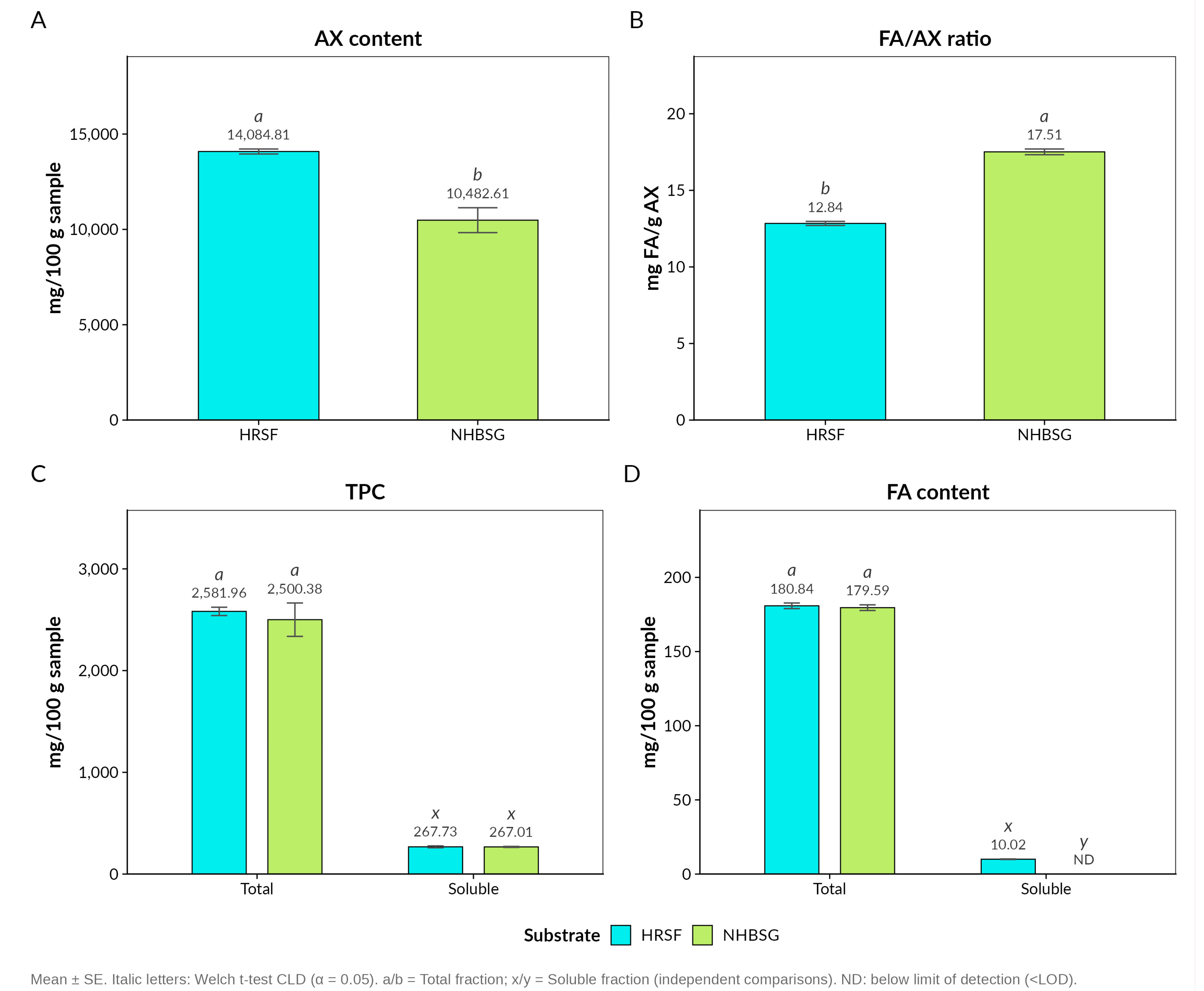
| Parameter | HRSF [g/100 g] | HLF [g/100 g] | NHBSG [g/100 g] |
|---|---|---|---|
| Moisture | 3.91 ± 0.04 | 97.90 ± 0.01 | 3.09 ± 0.05 |
| Ash | 2.90 ± 0.04 | 0.07 ± 0.01 | 2.73 ± 0.02 |
| Ether extract | 6.18 ± 0.00 | 0.20 ± 0.01 | 5.98 ± 0.04 |
| Protein | 18.37 ± 0.14 | 0.14 ± 0.01 | 19.85 ± 0.23 |
| Total dietary fiber | 43.37 | 0.71 | 48.67 |
| Insoluble fiber | 41.71 ± <0.01 | 0.29 ± 0.00 | 46.08 ± 0.00 |
| Soluble fiber | 1.66 ± 0.00 | 0.42 ± 0.00 | 2.59 ± 0.00 |
| Arabinoxylans | 14.08 ± 0.19 | 2.60 ± 0.19 | 10.48 ± 1.31 |
| Available carbohydrates | 25.27 | 0.98 | 19.68 |
| Total sugars | 11.98 ± 0.13 | 0.50 ± 0.08 | 7.91 ± 0.10 |
Disclaimer/Publisher’s Note: The statements, opinions and data contained in all publications are solely those of the individual author(s) and contributor(s) and not of MDPI and/or the editor(s). MDPI and/or the editor(s) disclaim responsibility for any injury to people or property resulting from any ideas, methods, instructions or products referred to in the content. |
© 2026 by the authors. Licensee MDPI, Basel, Switzerland. This article is an open access article distributed under the terms and conditions of the Creative Commons Attribution (CC BY) license.
Share and Cite
Vargas-Straube, M.J.; Rojas-Hidalgo, F.; de Oliveira, J.N.; Arancibia, B.; Albuquerque, T.M.d.; Bezerra, T.K.A.; de Souza, E.G.T.; de Souza, E.L.; Mariotti-Celis, M.S.; Zuñiga, M.E.; et al. Prebiotic Potential of Brewer’s Spent Grain Residual Solid After Enzymatic Hydrolysis: Evidence from a Colonic Fermentation Study. Foods 2026, 15, 2378. https://doi.org/10.3390/foods15132378
Vargas-Straube MJ, Rojas-Hidalgo F, de Oliveira JN, Arancibia B, Albuquerque TMd, Bezerra TKA, de Souza EGT, de Souza EL, Mariotti-Celis MS, Zuñiga ME, et al. Prebiotic Potential of Brewer’s Spent Grain Residual Solid After Enzymatic Hydrolysis: Evidence from a Colonic Fermentation Study. Foods. 2026; 15(13):2378. https://doi.org/10.3390/foods15132378
Chicago/Turabian StyleVargas-Straube, María José, Francisca Rojas-Hidalgo, Jordana Nunes de Oliveira, Boris Arancibia, Thatyane Mariano de Albuquerque, Taliana Kênia Alencar Bezerra, Eike Guilherme Torres de Souza, Evandro Leite de Souza, María Salomé Mariotti-Celis, María Elvira Zuñiga, and et al. 2026. "Prebiotic Potential of Brewer’s Spent Grain Residual Solid After Enzymatic Hydrolysis: Evidence from a Colonic Fermentation Study" Foods 15, no. 13: 2378. https://doi.org/10.3390/foods15132378
APA StyleVargas-Straube, M. J., Rojas-Hidalgo, F., de Oliveira, J. N., Arancibia, B., Albuquerque, T. M. d., Bezerra, T. K. A., de Souza, E. G. T., de Souza, E. L., Mariotti-Celis, M. S., Zuñiga, M. E., Fuentes, L., & Soto-Maldonado, C. (2026). Prebiotic Potential of Brewer’s Spent Grain Residual Solid After Enzymatic Hydrolysis: Evidence from a Colonic Fermentation Study. Foods, 15(13), 2378. https://doi.org/10.3390/foods15132378