Article

Combined Application of Ultra-High-Pressure Homogenization and Non-Saccharomyces Yeasts to Reduce Sulfites and Improve Wine Quality


Department of Chemistry and Food Technology, Escuela Técnica Superior de Ingeniería Agronómica, Alimentaria y de Biosistemas, Universidad Politécnica de Madrid, 28040 Madrid, Spain
*
Author to whom correspondence should be addressed.
Foods 2026, 15(13), 2271; https://doi.org/10.3390/foods15132271 (registering DOI)
Submission received: 24 April 2026 / Revised: 4 June 2026 / Accepted: 23 June 2026 / Published: 25 June 2026
(This article belongs to the Special Issue Factors Affecting Wine Quality and Flavor)

Abstract

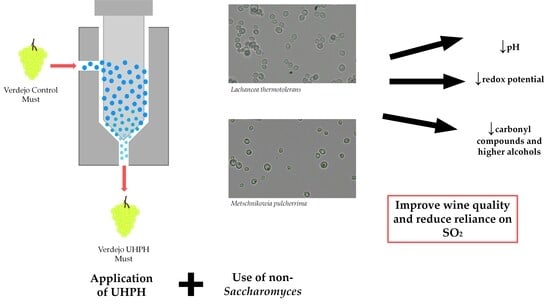
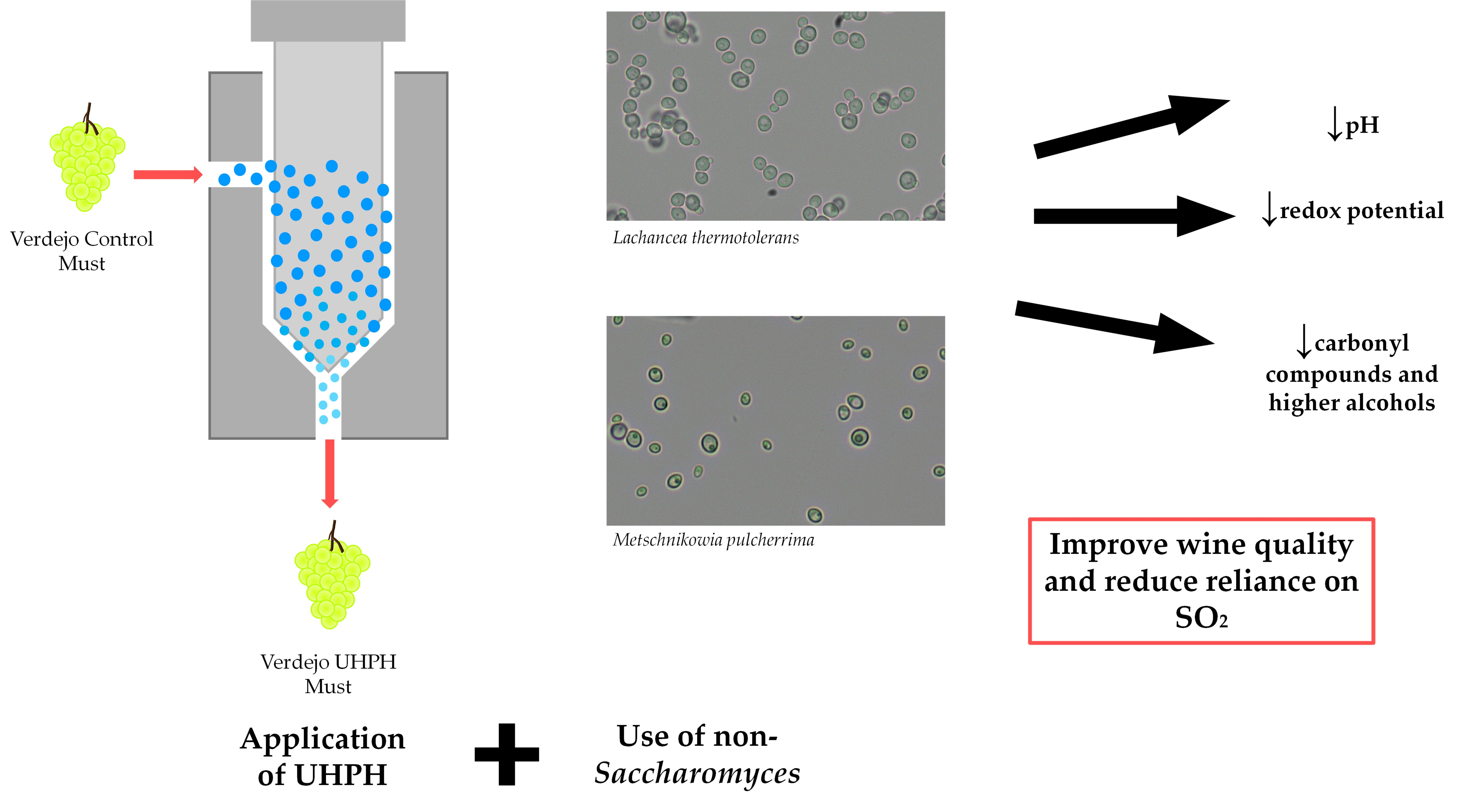
In recent years, the wine industry has searched for alternatives to reduce the use of sulfites, with ultra-high-pressure homogenization (UHPH) emerging as a promising technology. The objective of this study was to evaluate the combined effect of UHPH and non-Saccharomyces yeasts (Lachancea thermotolerans and Metschnikowia pulcherrima) on wine quality. To this end, fermentations were carried out using control Verdejo must, must treated with UHPH, and must treated with 50 mg/L SO2, using pure cultures and co-inoculations. Enological parameters, volatile compounds, colour, redox potential, and sensory profile were analyzed. The results showed that the co-inoculation of L. thermotolerans and M. pulcherrima reduced the final ethanol content by 0.5% (v/v) and increased lactic acid production, resulting in a decrease in pH of 0.3 units; however, L. thermotolerans in monoculture failed to implant properly in UHPH-treated must. In addition, wines from UHPH-treated musts exhibited 20% lower redox potential, suggesting that treatment with UHPH was effective in inactivating oxidative enzymes, as did those fermented with M. pulcherrima. Regarding volatile compounds, UHPH wines showed a 30% reduction in higher alcohols and carbonyl compounds, resulting in a characteristic aromatic profile that was positively evaluated in sensory analysis. In conclusion, the combination of UHPH and non-Saccharomyces yeasts represents an effective strategy for improving wine quality and reducing the use of sulfites.

Graphical Abstract

1. Introduction

Recently, there has been growing interest in reducing the use of additives such as sulfites in the wine industry. Their use can compromise wine quality by neutralizing aromas or causing the formation of undesirable aromas. In addition, high concentrations of sulfites carry certain health risks, such as nausea, headaches, stomach irritation, and respiratory problems in sensitive individuals [1,2]. In this context, new alternative technologies have emerged, such as the application of ultra-high-pressure homogenization (UHPH) to must.
UHPH is a technology capable of fragmenting particles suspended in a liquid when it is subjected to high pressures (200–600 MPa) through the passage of a valve [3]. This fragmentation is caused by shear forces, turbulence, and cavitation [4]. These forces also affect the microorganisms and spores present in the must, producing sterilization [5]. As it is not a thermal method, UHPH protects the sensory profile without affecting pigments or aromas [6]. Likewise, an inactivating effect on oxidative enzymes (polyphenol oxidase, PPOs) has been observed, which has a protective effect against oxidation and browning in white wines [7,8].
Due to its sterilizing capacity, UHPH is a very interesting technology to use in combination with non-Saccharomyces yeasts, which can present problems of implantation and low tolerance to sulfites. Due to their metabolic differences, non-Saccharomyces yeasts are a great strategy for adding diversity to wines or enhancing the aromatic profile of neutral varieties [9]. In this trial, two non-Saccharomyces yeasts were used: Lachancea thermotolerans (Lt) and Metschnikowia pulcherrima (Mp).
Lt is an acidifying yeast capable of producing up to 15 g/L of lactic acid under oenological conditions [10]. Lactic acid is a product of sugar metabolism, making it also interesting for reducing alcohol content [11,12,13]. An increase in the production of 2-phenylethyl acetate, with a rose petal aroma, has also been observed, which also improves the sensory profile [14].
Mp is of interest for its ability to produce pulcherriminic acid, which has an antimicrobial effect [15,16], and for its oxygen consumption, which reduces oxidative stress [17]. It also promotes the release of varietal aroma precursors, such as thiols and monoterpenes [18,19,20,21].
The objective of this study was to evaluate the combined effect of UHPH technology and inoculation with non-Saccharomyces yeasts as an alternative strategy in winemaking. This approach aims to reduce reliance on sulfites by exploiting the ability of UHPH to inactivate oxidative enzymes, while improving the chemical and sensory profiles of the wine thanks to the metabolic diversity of non-Saccharomyces yeast strains.

2. Materials and Methods

2.1. Strains Used in Fermentation

Three yeast strains, previously cultured in YPD liquid medium, were used for the fermentation of Verdejo grape must. Two successive passages were performed in YPD medium, inoculating 2% of the volume of the previous culture, for 48 h at 28 °C under constant agitation (120 rpm). Following this process, the cultures were verified by plating on YPD agar plates to confirm that they had reached a population of between 107 and 108 CFU/mL.
The must was inoculated by adding a volume of liquid culture (in YPD medium) equivalent to 2% of the total fermentation volume. The strains Lachancea thermotolerans BLIZZ™ (Lallemand Inc., Montreal, QC, Canada) and Metschnikowia pulcherrima M29 were evaluated individually and in mixed co-inoculation. In the co-inoculation, they were inoculated simultaneously in a 1:1 ratio, adding 2% (v/v) of each culture. The Saccharomyces cerevisiae 7 VA strain (EnotecUPM, Madrid, Spain) was used as the fermentation control. The initial population was confirmed by microbiological counting, ensuring it was around 106 CFU/mL in the must.

2.2. Verdejo Must

Fermentation was carried out with two types of Verdejo grape must: a control and one treated with UHPH at 3000 bar for 0.2 s, without exceeding 102 °C. Both musts come from a single batch of Verdejo grapes from the Comenge winery (Curiel del Duero, Valladolid, Spain), which was divided into two parts for the UHPH treatment. The grapes were harvested mechanically, and the musts were racked separately, pressed with a pneumatic press, and clarified at 4 °C. Before inoculation, Fourier transform infrared (FTIR) spectroscopy (OenoFOSS, FOSS Iberia, Barcelona, Spain) was used to determine the concentration of reducing sugars, total acidity expressed as tartaric acid, and nitrogen assimilable by yeast (Table 1).

2.3. Must Fermentation

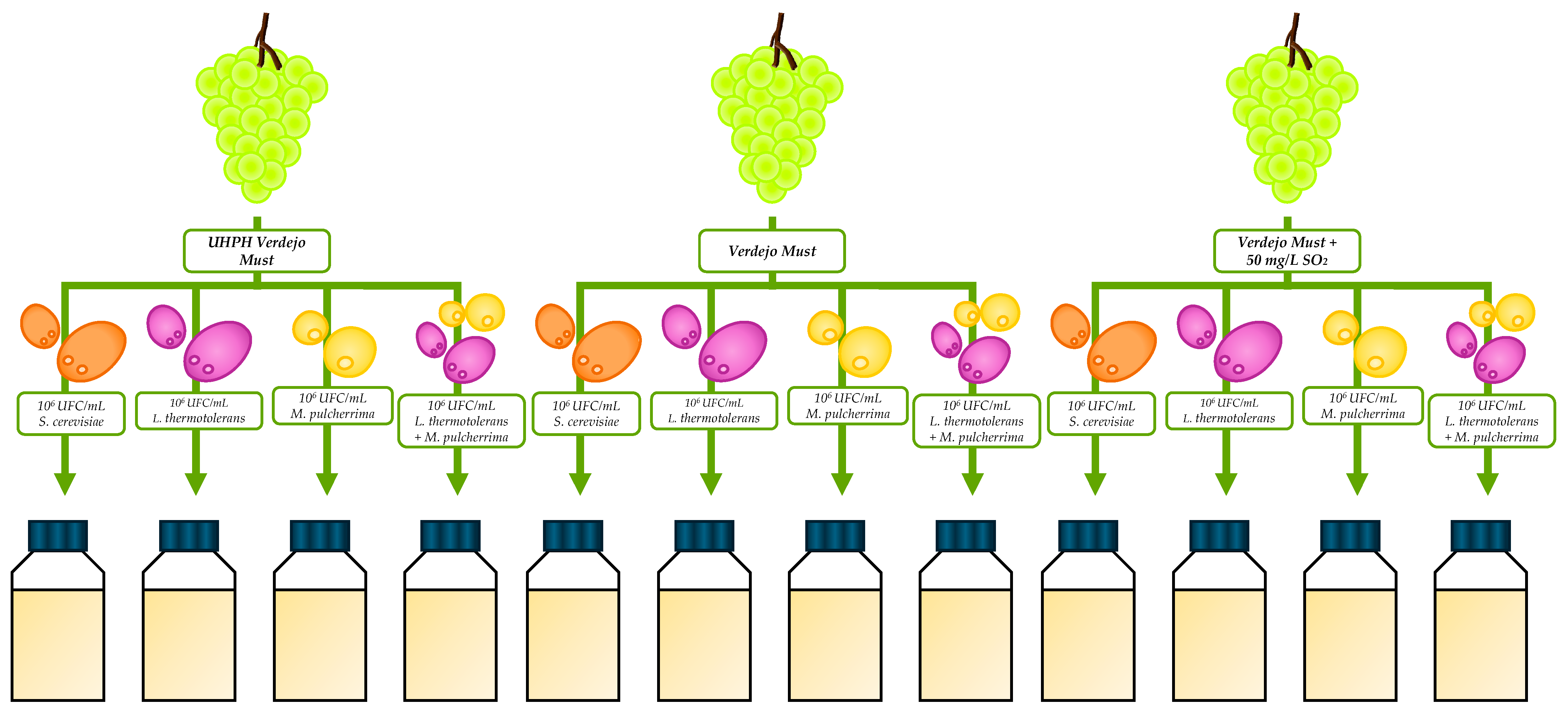
The effect of UHPH technology was evaluated by comparing parallel fermentations in 250 mL volumes using untreated Verdejo musts, musts processed by UHPH, and musts treated with 50 mg/L of SO2 (Figure 1). Fermentations were carried out at 20°C with Saccharomyces cerevisiae and sequential fermentations with Lachancea thermotolerans, Metschnikowia pulcherrima, or a co-inoculation of L. thermotolerans with M. pulcherrima, following the experimental design described below. All tests were performed in triplicate. On the 7th day of fermentation, S. cerevisiae 7VA was inoculated using the same inoculation protocol to complete the fermentation of sugars in those musts that had initially been inoculated with non-Saccharomyces yeasts.
Periodically, general oenological parameters were analyzed using FTIR, pH was measured, and lactic acid concentration was determined by enzymatic analysis. At the end of fermentation, redox potential and colorimetric parameters were evaluated, and a sensory analysis was performed.

2.4. Analysis of General Oenological Parameters

Daily, the pH evolution was determined using the FTIR optical system to track the kinetic evolution of fermentation and indirectly indicate yeast implantation. This system estimates pH through a mathematical prediction model based on mid-infrared absorption spectra. However, due to interference from CO2, ethanol and turbidity during active fermentation, these values may vary slightly in absolute precision compared to the baseline measurements obtained with a standard pH meter before fermentation. At the end of fermentation, FTIR analysis was performed to determine the ethanol content (% v/v), residual sugar content (g/L), volatile acidity (g/L acetic acid) and malic acid content (g/L). Final pH was determined using a pH 80 bench pH meter (XS Instruments, Carpi, Italy).

2.5. Enzyme Analysis

To evaluate the acidifying capacity of L. thermotolerans, lactic acid concentrations were determined using the A25 clinical chemistry analyser (Biosystems, Barcelona, Spain) using BioSystem’s L-lactic acid analysis kit.

2.6. Colour Analysis

Measurements of absorbance at 420, 520 and 620 nm, colour intensity, chroma, hue and CIELab coordinates were performed using the Smart Analysis spectrophotometer (DNA Phone, Parma, Italy) using a 1 cm path-length plastic cuvette. Before analysis, all samples were filtered through a 0.45 µm membrane filter to prevent light scattering caused by turbidity.
The colour of the samples was represented in CIELab coordinates, characterizing the colours based on the coordinates L*, a* and b*. The L* coordinate represents the brightness and can take values between 0 (black) and 100 (white). The a* coordinate can take negative (green) or positive (red) values. The b* coordinate indicates the position between blue (negative) and yellow (positive).
From the L*a*b* coordinates, chroma (C*) and hue (H*) parameters were obtained. The hue values represent red (0°), yellow (90°), green (180°), and blue (270°), and the chroma is proportional to the colour saturation, with grey represented by 0.
All the parameters were computed automatically by the instrument’s software.

2.7. Determination of Redox Potential

To determine the redox potential at the end of fermentation, the optical potentiometer with the HI73120 electrode (Hanna Instruments, Eibar, Guipuzkoa, Spain) was used.

2.8. Analysis of Fermentative Volatile Compounds

Analysis of fermentative volatile compounds was conducted on an Agilent Technologies 6850 gas chromatograph (Las Rozas, Madrid, Spain), integrated with a flame ionization detector (GC-FID) and a DB-624 column (60 m × 250 μm × 1.40 μm) according to the method described by [22].

2.9. Sensory Analysis

A descriptive sensory analysis evaluated visual, olfactory and taste parameters. The parameters were scored using a scale from 1 (lowest intensity) to 5 (highest intensity). The parameters analysed were colour intensity, tonality, turbidity, aromatic intensity, aromatic quality, herbs, floral, fruity, reduction and oxidation aromas, body, silkiness, bitterness, acidity and overall perception. The taste panel of trained experts who analysed the wines consisted of eight members of the Food Technology laboratory (ETSIAAB), including both genders and ages between 20 and 50 years old. All evaluators provided voluntary informed consent before participation. The sensory analysis took place in a tasting room with artificial lighting, with 30 mL of wine served per glass. The samples were tasted once in a blind tasting, and the order of the samples was randomized. The experts cleansed their palates between samples using breadsticks and water. This descriptive sensory evaluation method is an adaptation of the International Organization for Standardization (ISO) guidelines to the conditions of our research [23,24]. The study was conducted in accordance with the Declaration of Helsinki and approved by the Institutional Review Board (UPM Ethics Committee) of Universidad Politécnica de Madrid (AID-LAPPMLB-AMB-HUMANOS-20221026) on 14 November 2022.

2.10. Statistical Analysis

Statistical analyses were performed using RStudio 2024.9.0 (RStudio Team, Boston, MA, USA). Data are expressed as means and standard deviations. The results were subjected to one-way Analysis of Variance (ANOVA), and means were compared using Tukey’s test. Statistical significance was established at p < 0.05. Additionally, principal component analysis (PCA) and graphical representations were generated using the same software.

3. Results and Discussion

3.1. General Oenological Parameters

Table 2 summarizes the general oenological parameters analyzed at the end of fermentation. The ethanol content ranged between 12.3% and 15.7% (v/v), with significantly higher values (p < 0.05) in wines fermented from control must, consistent with the higher initial sugar concentration in this must. The potential of L. thermotolerans to produce wines with lower alcohol content has been previously reported and is a result of sugars being diverted to lactic acid production [11,12,13]. Although no reduction in ethanol content was observed in wines fermented solely with L. thermotolerans, wines co-inoculated with L. thermotolerans and M. pulcherrima exhibited a lower ethanol concentration.
Regarding residual sugar, no differences were observed among wines as a function of must type. However, wines fermented with non-Saccharomyces yeasts tended to show higher residual sugar levels compared to those fermented with Saccharomyces cerevisiae. Notably, one of the control wines co-inoculated with L. thermotolerans and M. pulcherrima did not complete fermentation, resulting in a mean final residual sugar concentration of 5 g/L. This may occur because the L. thermotolerans and M. pulcherrima strains used have a fermentation capacity of 9 g/L of ethanol and 4 g/L of ethanol, respectively, and the S. cerevisiae inoculated on the seventh day of fermentation may not have established itself under optimal conditions to finish consuming the sugars.
Volatile acidity ranged from 0.05 to 0.23 g/L acetic acid, very low values that are not associated with sensory defects and are consistent with those obtained in fermentations under similar conditions [25]. Concerning must type, differences were observed in wines fermented with S. cerevisiae, which showed higher volatile acidity in UHPH-treated musts and in wines fermented with L. thermotolerans, which exhibited lower volatile acidity when L. thermotolerans failed to implant, as can be seen from the absence of lactic acid production. In the control must, where L. thermotolerans was successfully implanted, wines showed increased volatile acidity. However, co-inoculation with L. thermotolerans and M. pulcherrima effectively reduced volatile acidity. This effect is due to the stronger respiratory metabolism of M. pulcherrima during early fermentation, which consumes oxygen and limits acetic acid synthesis, reducing volatile acidity [26].
Regarding pH, wines produced from UHPH-treated must and SO2-treated must exhibited lower pH values than those fermented from control must. pH and lactic acid concentration were also useful indicators of the implantation success of L. thermotolerans. In control must, L. thermotolerans successfully implanted both in monoculture and in co-inoculation, producing 2.9 g/L of lactic acid and decreasing pH by 0.3 units compared to wines fermented with S. cerevisiae. The absence of lactic acid production in UHPH-treated must and must treated with 50 mg/L SO2 suggests that L. thermotolerans did not ferment properly, potentially due to nutritional deficiency and sulfite concentrations exceeding the strain’s tolerance threshold (10–20 mg/L of free SO2) [27], respectively. Nevertheless, successful implantation occurred in co-inoculation with M. pulcherrima, with the highest lactic acid production observed in UHPH-treated must (4 g/L) and a corresponding pH reduction of 0.4 units.
With respect to malic acid, wines produced from UHPH-treated must exhibited lower malic acid concentrations. Additionally, a further decrease was observed in wines fermented with L. thermotolerans. This difference may be attributed to the capacity of certain L. thermotolerans strains to metabolize malic acid during fermentation [12].

3.2. pH Evolution

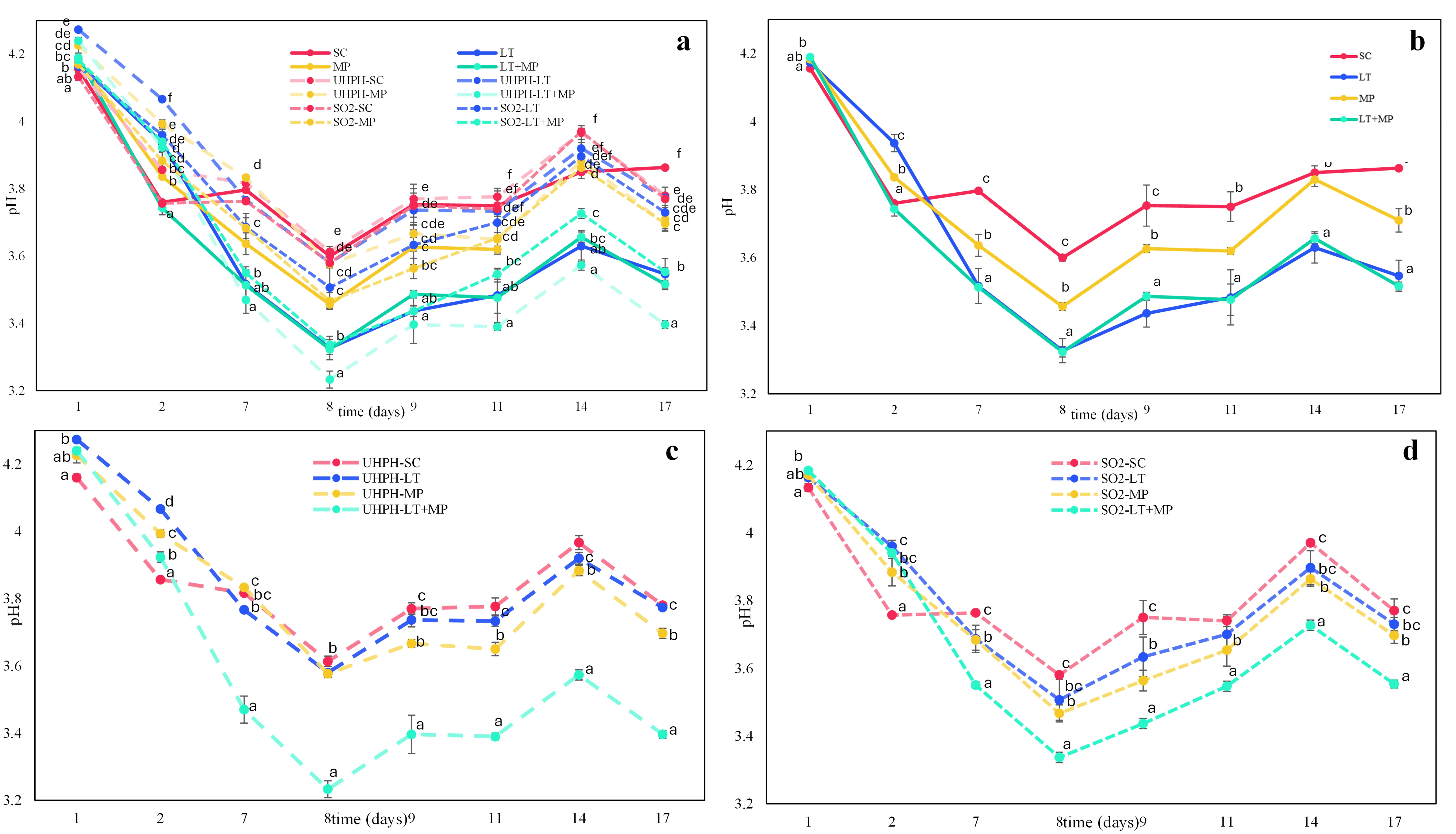
The pH of the samples was measured daily during fermentation (Figure 2). At the beginning of fermentation, pH values ranged from 4.14 to 4.28. On the second day, differences in pH began to appear between fermentations carried out with different yeast strains. By the seventh day, significant differences (p < 0.05) were observed in fermentations where L. thermotolerans successfully implanted, including control musts inoculated with L. thermotolerans, co-inoculations with L. thermotolerans and M. pulcherrima in control must, and co-inoculations in UHPH-treated must and must treated with 50 mg/L SO2. These fermentations exhibited pH values approximately 0.3 units lower than their counterparts fermented with S. cerevisiae. From day 9 onward, pH values stabilized. This rapid decrease in pH during the first week coincides with the exponential growth phase of L. thermotolerans, a period during which lactic acid is actively synthesized from sugars via lactate dehydrogenase [28]. From day 9 onward, pH values stabilized. This stabilization reflects the stop in lactic acid production, likely due to the accumulation of ethanol, which limits the viability of L. thermotolerans [25], as well as the sequential inoculation of S. cerevisiae on day 7, which shifts the metabolic process towards primary alcoholic fermentation without further acidification.
The results showed that wines produced from UHPH-treated must co-inoculated with L. thermotolerans and M. pulcherrima presented the lowest pH (3.397 ± 0.012), coinciding with the highest lactic acid production (4.0 ± 1.2 g/L). The second-lowest pH values were observed in wines fermented with L. thermotolerans in control must, as well as in co-inoculations of L. thermotolerans and M. pulcherrima in control must and in must treated with 50 mg/L SO2, with pH values around 3.5 and lactic acid concentrations ranging from 2.3 to 2.5 g/L.
The higher lactic acid production observed in coinoculated fermentations is consistent with previous reports describing a strong synergistic effect between L. thermotolerans and M. pulcherrima [11].

3.3. Colourimetric Analysis

Spectrophotometric analysis revealed significant differences in several colour parameters among the samples at a significance level of 0.05 (Table 3).
In terms of colour intensity (CI), the sum of absorbances at 420, 520, and 620 nm, wines fermented with S. cerevisiae exhibited significantly higher intensity than their counterparts, with statistically significant differences particularly evident in wines produced from must treated with 50 mg/L SO2. This greater CI is likely due to the antioxidant and protective effects of SO2 against the oxidation of polyphenols.
Regarding tonality, an indicator of the degree of browning in wines, no significant differences were observed among the samples.
For chroma, another parameter associated with colour intensity, higher values were detected in wines produced from UHPH-treated must. Additionally, greater chroma values were observed in wines fermented with S. cerevisiae and in those co-inoculated with L. thermotolerans and M. pulcherrima from UHPH-treated and SO2-treated musts.
In relation to hue, no significant differences were found between the different samples.
Brightness, expressed by the L* coordinate, showed significantly higher values in wines fermented with non-Saccharomyces yeasts, highlighting the antioxidant effect of M. pulcherrima, which prevents oxidation and therefore preserves wine brightness through the production of pulcherriminic acid. Wines produced from must treated with 50 mg/L SO2 also exhibited the highest brightness values, although these differences were not statistically significant.
Concerning the CIELab coordinates a* and b*, no significant differences were found for a*, with all samples displaying values close to zero, indicating the absence of pronounced green or red tonalities. In contrast, b* values followed a trend similar to chroma, with higher values observed in wines fermented from UHPH-treated must, reflecting a more intense yellow coloration. Increased yellow intensity was also detected in wines fermented with S. cerevisiae and in co-inoculations with L. thermotolerans and M. pulcherrima from UHPH-treated and SO2-treated musts.

3.4. Redox Potential Analysis

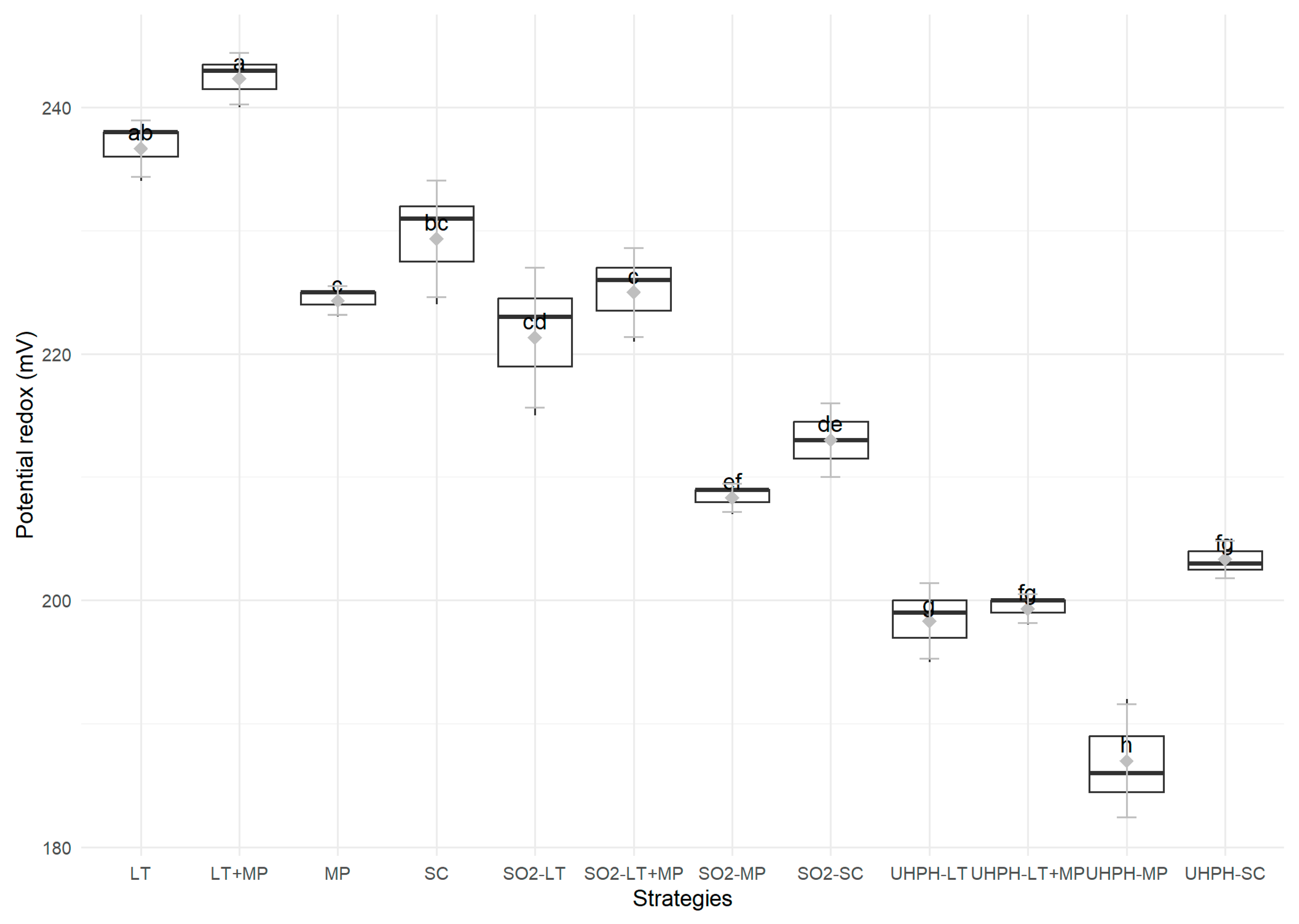
Redox potential was measured using an optical sensor. The results showed that wines produced from UHPH-treated must exhibited the lowest redox potential. This could suggest lower oxidative activity, potentially linked to the mitigation of oxidative enzymes such as polyphenol oxidase (PPO) during the pressure treatment [25]; however, further direct enzymatic analyses would be required to confirm this mechanism. The wines with the next-lowest potential were those fermented from must treated with 50 mg/L of SO2, which aligns with the well-known reducing and antioxidant properties of sulfites.
Regarding fermentative yeasts, a decrease in redox potential was observed in wines fermented with M. pulcherrima (Figure 3), highlighting its antioxidant capacity [26]. This effect is thought to be related to the intense respiratory metabolism of M. pulcherrima during the early stages of fermentation, which leads to rapid consumption of dissolved oxygen and creates a more reducing environment. In contrast, wines fermented with L. thermotolerans showed a higher redox potential.

3.5. Volatile Analysis

Table 4 presents the volatile compounds produced during fermentation, quantified by GC-FID. Total volatile concentrations ranged from approximately 1100 to 1700 mg/L. Fermentations carried out using UHPH-treated must exhibited lower total volatile production, which may be explained by its reduced nitrogen content [29,30]. Among the wines fermented from UHPH must, those fermented with M. pulcherrima, as well as those produced by co-inoculation of L. thermotolerans and M. pulcherrima, showed total volatile concentrations of 950 mg/L and 980 mg/L, respectively, compared to 1150 mg/L in wines fermented with S. cerevisiae. Conversely, among wines produced from must treated with sulfites, wines fermented with M. pulcherrima showed a higher volatile production than those fermented with S. cerevisiae.
Although UHPH-treated must resulted in an overall lower volatile content, these differences were mainly attributable to the reduced formation of carbonyl compounds and higher alcohols.
Regarding carbonyl compounds, an approximate 15% reduction in 2,3-butanediol production was observed in wines fermented from UHPH-treated must. This compound is a by-product of alcoholic fermentation with a slightly sweet–sour taste and no significant impact on aroma [31]. No significant differences were found among yeast strains within the same must. Higher acetaldehyde production was detected in wines fermented from UHPH must, tripling the levels observed in control must and doubling those found in SO2-treated must. This effect may be attributed to the low nitrogen availability in the must [32,33]. In terms of yeast species, non-Saccharomyces strains were able to reduce acetaldehyde production. No differences were observed in the concentrations of other carbonyl compounds.
With respect to higher alcohols, wines fermented from UHPH-treated must exhibited significantly lower concentrations, remaining below 400 mg/L, a threshold above which negative sensory effects may occur [34]. This reduction could be explained by the fact that, without constituting a stress factor for the yeast, the lower nitrogen content in the UHPH must may have provided fewer precursors for the Ehrlich pathway, which is involved in the synthesis of higher alcohols; alternatively, the higher nitrogen content in the other musts may have allowed for greater biomass growth, potentially leading to more vigorous fermentation kinetics [35,36]. However, non-Saccharomyces yeasts showed higher production of 1-propanol, isobutanol, 3-methyl-1-butanol, and 2-methyl-1-butanol. Concerning 2-phenylethanol, a compound associated with rose-like floral aromas, concentrations ranged between 10 and 14 mg/L, exceeding the sensory threshold of 10 mg/L [37]. Higher levels were found in wines fermented with L. thermotolerans, as previously reported in the literature [38].
Acetate esters are formed through the esterification of acyl-CoA with alcohols and, with the exception of ethyl acetate, are generally associated with fruity aromas and positive sensory contributions [39]. All wines contained ethyl acetate concentrations below 150 mg/L, the level above which solvent-like aromas may develop [40]. Despite the lower nitrogen content of UHPH must, ester production was not negatively affected, potentially due to the inactivation of oxidative enzymes. Regarding 2-phenylethyl acetate, which contributes rose-like floral notes, all fermentation strategies produced concentrations above the perception threshold (0.25 mg/L) [41]. Wines fermented with L. thermotolerans showed the highest levels, except for those produced from UHPH-treated must, likely due to poor yeast implantation, as evidenced by the absence of lactic acid production.
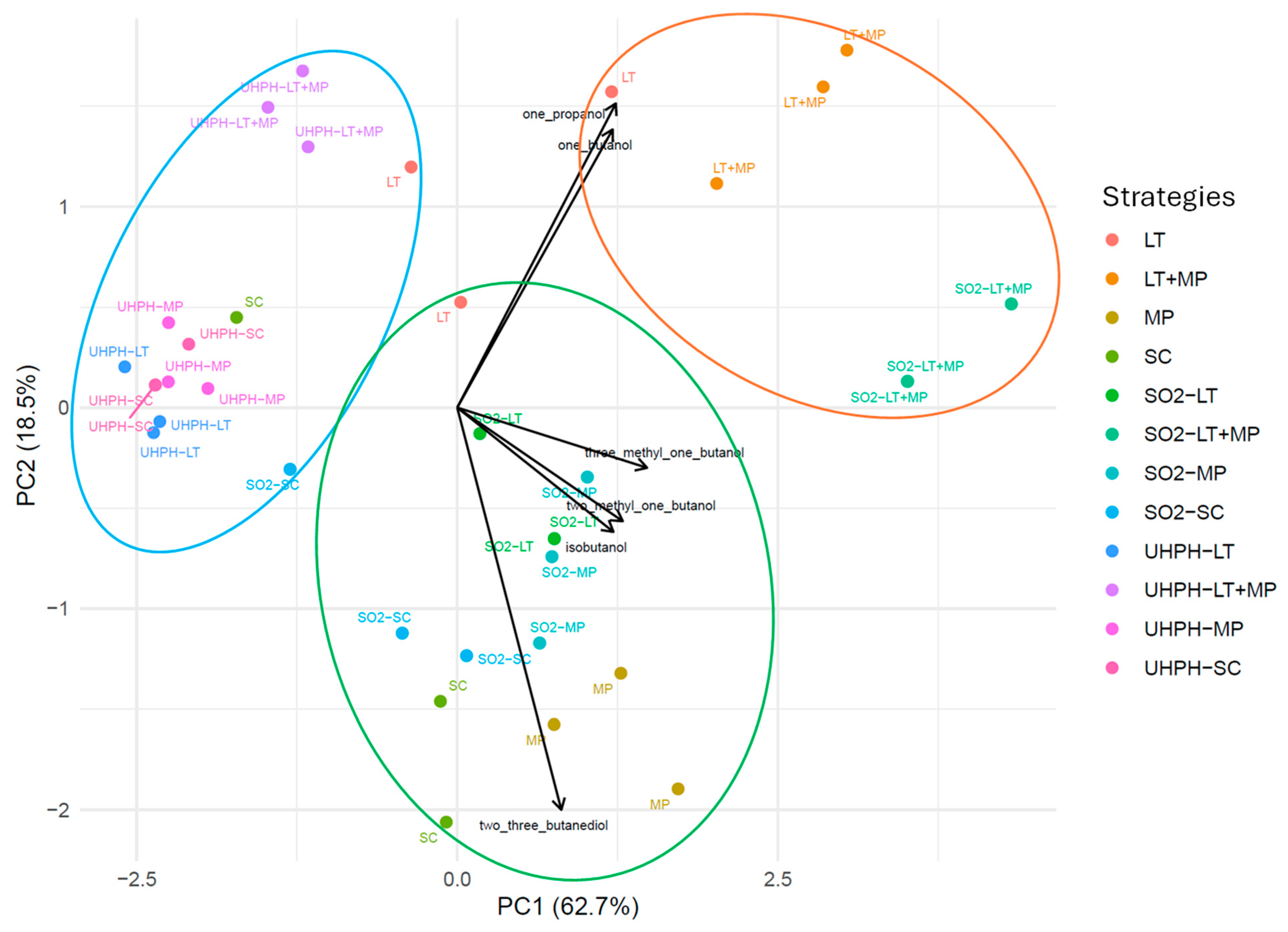
A principal component analysis (PCA) was conducted using volatile compounds with factor loadings greater than 0.7. The first two principal components explained 81.2% of the total variance (Figure 4). Three main clusters were identified: a blue cluster comprising wines produced from UHPH-treated must, which separated clearly along PC1 due to their lower higher-alcohol production; a red cluster grouping wines fermented through L. thermotolerans and M. pulcherrima co-inoculation; and a green cluster including wines fermented with pure cultures of S. cerevisiae, L. thermotolerans and M. pulcherrima from control and SO2-treated must.

3.6. Variable Correlation

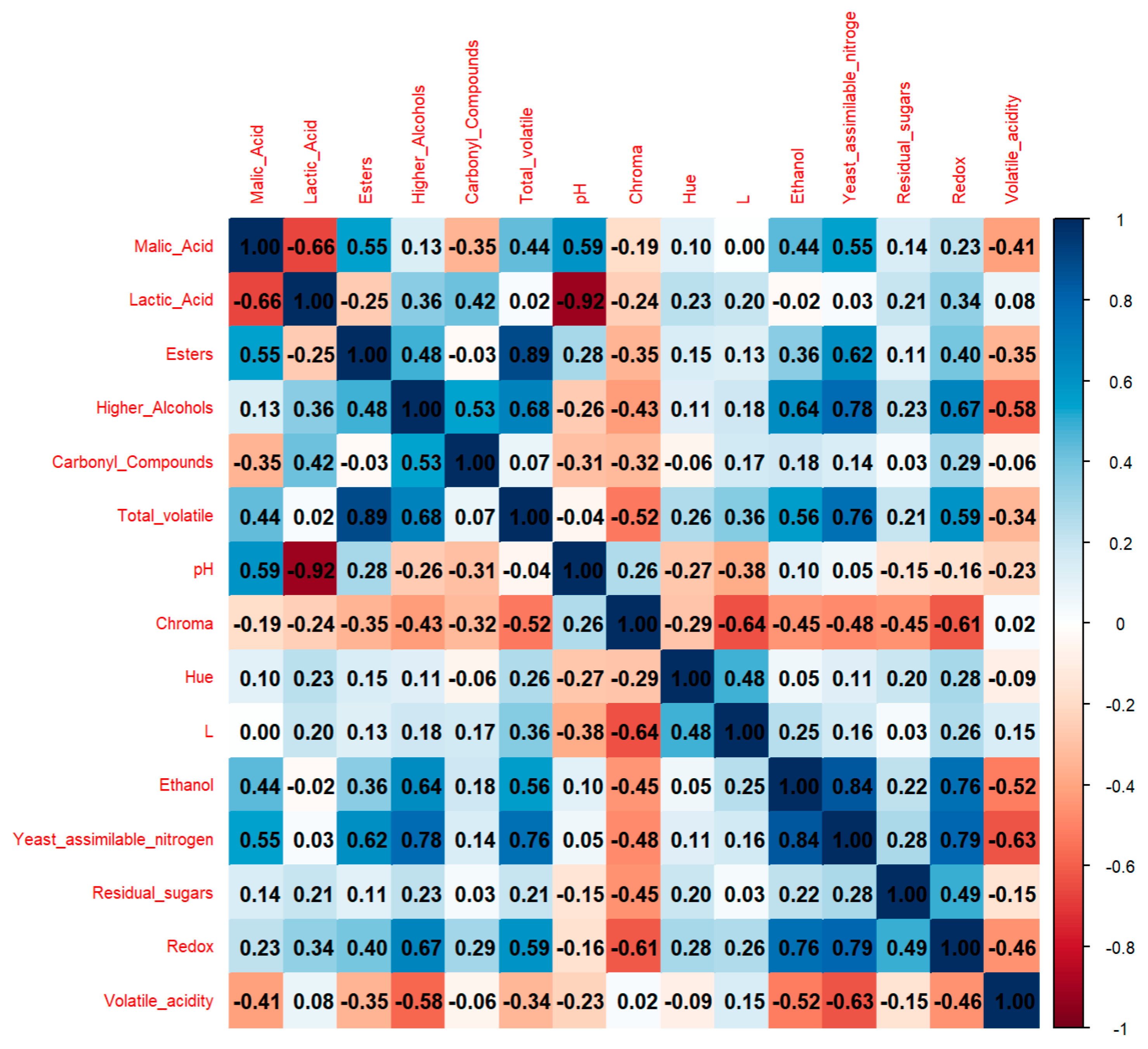
Based on the collected data, a correlation matrix was constructed using Pearson’s correlation coefficients to assess relationships among the evaluated variables (Figure 5). This coefficient ranges from −1 to 1, with values further from zero indicating stronger correlations. Positive values indicate direct relationships between variables, whereas negative values reflect inverse correlations.
The results indicated that pH differences were primarily driven by variations in lactic acid concentration. A positive correlation was also observed between nitrogen content, higher-alcohol composition, total volatile composition, and redox potential. This relationship can be explained by the fact that higher nitrogen availability provides more precursors for the Ehrlich pathway, thereby enhancing higher-alcohol synthesis and increasing total volatile production.
The correlation observed with redox potential may be attributed to the inactivation of oxidative enzymes as a consequence of the UHPH treatment.

3.7. Sensory Analysis

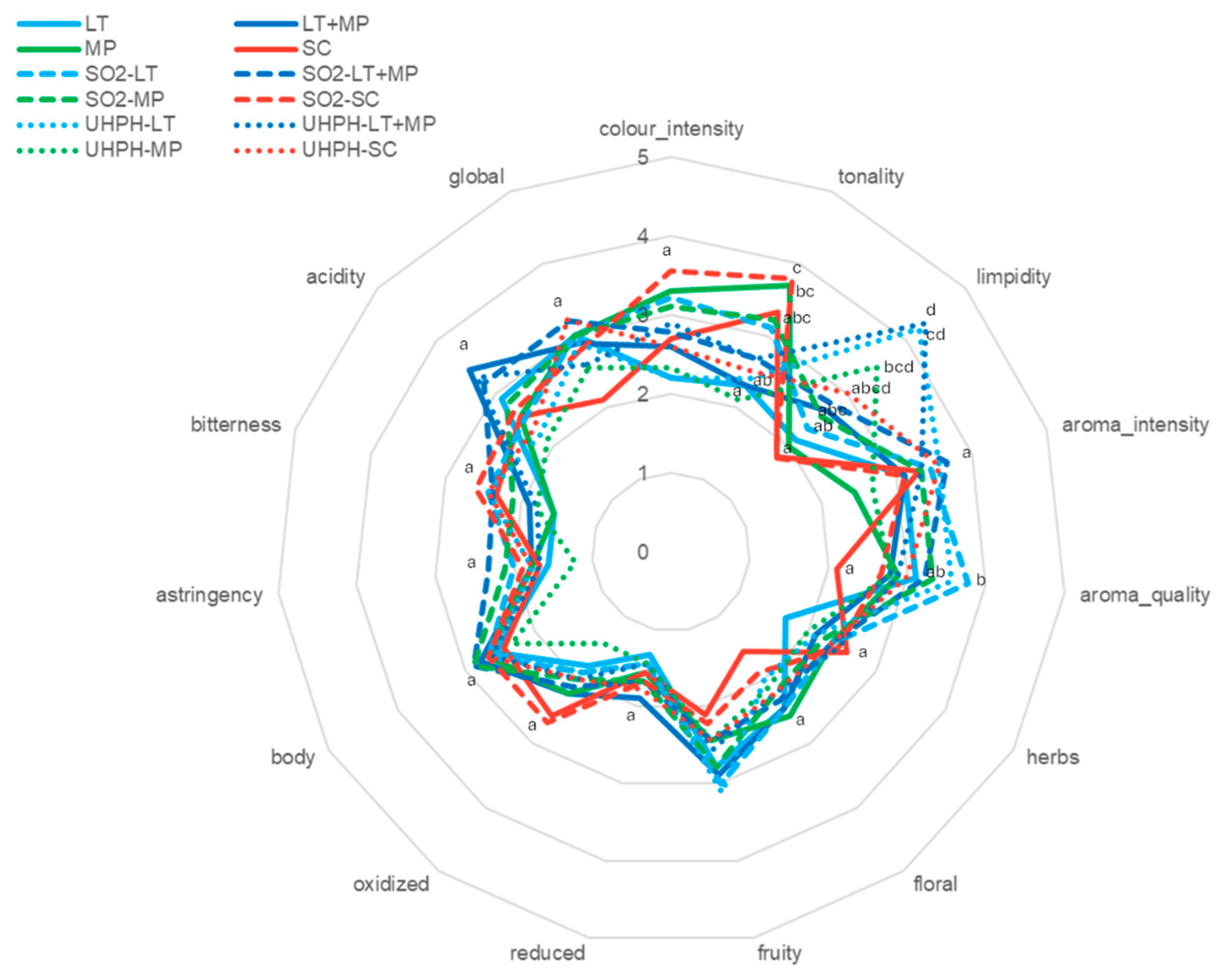
Sensory analysis revealed significant differences in the perception of hue, clarity, and aromatic quality, with no significant differences among judges’ evaluations (Figure 6). Overall, the wines exhibited an acidic and astringent profile, with sweeter and fruitier aromas perceived in wines fermented with non-Saccharomyces yeasts.
Regarding visual attributes, judges assigned low scores for tonality, indicating a greenish tone and limited oxidation. Wines produced from UHPH-treated must showed lower tonality values, with significant differences observed in the fermentation strategy involving M. pulcherrima. This effect may be attributed to a combination of the antioxidant action of the UHPH treatment and the protective effect against oxidation associated with M. pulcherrima. In addition, judges rated wines fermented from UHPH-treated must higher in clarity, suggesting that this process contributes to protein stabilization and facilitates clarification [26,42]. This does not agree with the colorimetry data, although it should be noted that the visible spectrophotometry was performed on the day fermentation ended (under reducing conditions), so the colour may have evolved further by the time of the sensory analysis.
In the evaluation of olfactory attributes, wines fermented with L. thermotolerans received the highest scores, whereas wines fermented with S. cerevisiae received the lowest scores and were described by judges as more oxidized. This may be related to the fact that, although there are no significant differences, wines fermented with S. cerevisiae tend to score higher on the “oxidized” parameter, which also corresponds to higher concentrations of acetaldehyde.
Finally, regarding taste perception, although no statistically significant differences were detected, wines produced by co-inoculation of L. thermotolerans and M. pulcherrima were perceived as more acidic.

4. Conclusions

The results of the trial indicated that co-inoculation of Lt and Mp was an effective strategy for modulating wine composition. In particular, this combination reduced the final ethanol content and promoted lactic acid production, with a consequent decrease in pH. However, when Lt was used in monoculture in UHPH-treated must, adequate implantation was not achieved during fermentation. Unfortunately, the physicochemical differences between the musts prevented us from delving deeper into the matter.
Likewise, a reduction in redox potential was observed in wines made from UHPH-treated must, which could be related to the inactivation of oxidative enzymes during treatment. A similar decrease in redox potential was also detected in wines fermented with Mp.
In terms of volatiles, wines fermented from UHPH must had a characteristic volatile profile, with lower levels of carbonyl compounds and higher alcohols. This profile was rated positively in sensory analysis, indicating that the application of UHPH, in combination with non-Saccharomyces yeasts, can contribute to improving the sensory quality of wine.
The use of UHPH technology in combination with non-Saccharomyces yeasts represents a promising strategy in modern winemaking, helping to modulate the wine’s sensory profile and control the oxidative environment in order to preserve the wine’s freshness.

Author Contributions

Conceptualisation, A.M.; methodology, A.M. and I.L.; software, I.L.; validation, I.L.; formal analysis, M.S.; investigation, M.S.; resources, A.M. and C.G.; data curation, M.S.; writing—original draft preparation, M.S.; writing—review and editing, A.M. and I.L.; visualisation, M.S.; supervision, I.L.; project administration, A.M. and C.G.; funding acquisition, A.M. and C.G. All authors have read and agreed to the published version of the manuscript.

Funding

This research was funded by the coordinated project AEI GENBIOACIDNONTH (PID2024-159270OB-C21 and PID2024-159270OB-C22) and the 4everWINES project under grant number IDI-20230497 (Centre for Technological Development and Innovation (CDTI) and European Regional Development Fund (ERDF), 2021–2027) in collaboration with Bodegas José Pariente (Spain).

Institutional Review Board Statement

The study was conducted in accordance with the Declaration of Helsinki and approved by the Institutional Review Board (UPM Ethics Committee) of Universidad Politécnica de Madrid (AIDLAPPMLB-AMB-HUMANOS-20221026 on 14 November 2022).

Informed Consent Statement

Informed consent was obtained from all subjects involved in the sensory analysis.

Data Availability Statement

The original contributions presented in this study are included in the article. Further inquiries can be directed to the corresponding author.

Acknowledgments

The authors gratefully acknowledge Bodegas José Pariente for generously providing their facilities, resources and financial support, which were essential for the development of this research.

Conflicts of Interest

The authors declare that there are no conflicts of interest.

Abbreviations

The following abbreviations are used in this manuscript:
UHPHultra-high-pressure homogenization
ScSaccharomyces cerevisiae
LtLachancea thermotolerans
MpMetschnikowia pulcherrima

References

  1. Silva, F.V.M.; van Wyk, S. Emerging Non-Thermal Technologies as Alternative to SO2 for the Production of Wine. Foods 2021, 10, 2175. [Google Scholar] [CrossRef]
  2. Yıldırım, H.K.; Darıcı, B. Alternative methods of sulfur dioxide used in wine production. J. Microbiol. Biotechnol. Food Sci. 2020, 9, 675–687. [Google Scholar] [CrossRef]
  3. Zamora, A.; Guamis, B. Opportunities for Ultra-High-Pressure Homogenisation (UHPH) for the Food Industry. Food Eng. Rev. 2015, 7, 130–142. [Google Scholar]
  4. Donsì, F.; Annunziata, M.; Ferrari, G. Microbial Inactivation by High Pressure Homogenization: Effect of the Disruption Valve Geometry. J. Food Eng. 2013, 115, 362–370. [Google Scholar] [CrossRef]
  5. Amador Espejo, G.G.; Hernández-Herrero, M.M.; Juan, B.; Trujillo, A.J. Inactivation of Bacillus Spores Inoculated in Milk by Ultra High Pressure Homogenization. Food Microbiol. 2014, 44, 204–210. [Google Scholar] [CrossRef] [PubMed]
  6. Oey, I.; Van der Plancken, I.; Van Loey, A.; Hendrickx, M. Does High Pressure Processing Influence Nutritional Aspects of Plant Based Food Systems? Trends Food Sci. Technol. 2008, 19, 300–308. [Google Scholar] [CrossRef]
  7. Vaquero, C.; Escott, C.; Loira, I.; Guamis, B.; del Fresno, J.M.; Quevedo, J.M.; Gervilla, R.; de Lamo, S.; Ferrer-Gallego, R.; González, C.; et al. Cabernet Sauvignon Red Must Processing by UHPH to Produce Wine Without SO2: The Colloidal Structure, Microbial and Oxidation Control, Colour Protection and Sensory Quality of the Wine. Food Bioprocess Technol. 2022, 15, 620–634. [Google Scholar] [CrossRef]
  8. Codina-Torrella, I.; Gallardo-Chacon, J.J.; Juan, B.; Guamis, B.; Trujillo, A.J. Effect of Ultra-High Pressure Homogenization (UHPH) and Conventional Thermal Pasteurization on the Volatile Composition of Tiger Nut Beverage. Foods 2023, 12, 683. [Google Scholar] [CrossRef] [PubMed]
  9. Jolly, N.; Augustyn, O.P.H.; Pretorius, I. The Effect of Non-Saccharomyces Yeasts on Fermentation and Wine Quality. S. Afr. J. Enol. Vitic. 2003, 24, 55–62. [Google Scholar] [CrossRef]
  10. Sgouros, G.; Mallouchos, A.; Filippousi, M.-E.; Banilas, G.; Nisiotou, A. Molecular Characterization and Enological Potential of A High Lactic Acid-Producing Lachancea Thermotolerans Vineyard Strain. Foods 2020, 9, 595. [Google Scholar] [CrossRef] [PubMed]
  11. Escott, C.; Vaquero, C.; Loira, I.; López, C.; González, C.; Morata, A. Synergetic Effect of Metschnikowia Pulcherrima and Lachancea Thermotolerans in Acidification and Aroma Compounds in Airén Wines. Foods 2022, 11, 3734. [Google Scholar] [CrossRef] [PubMed]
  12. Hranilovic, A.; Albertin, W.; Capone, D.L.; Gallo, A.; Grbin, P.R.; Danner, L.; Bastian, S.E.P.; Masneuf-Pomarede, I.; Coulon, J.; Bely, M.; et al. Impact of Lachancea Thermotolerans on Chemical Composition and Sensory Profiles of Viognier Wines. J. Fungi 2022, 8, 474. [Google Scholar] [CrossRef]
  13. Porter, T.J.; Divol, B.; Setati, M.E. Lachancea Yeast Species: Origin, Biochemical Characteristics and Oenological Significance. Food Res. Int. 2019, 119, 378–389. [Google Scholar] [CrossRef] [PubMed]
  14. Gobbi, M.; Comitini, F.; Domizio, P.; Romani, C.; Lencioni, L.; Mannazzu, I.; Ciani, M. Lachancea Thermotolerans and Saccharomyces Cerevisiae in Simultaneous and Sequential Co-Fermentation: A Strategy to Enhance Acidity and Improve the Overall Quality of Wine. Food Microbiol. 2013, 33, 271–281. [Google Scholar] [CrossRef] [PubMed]
  15. Canonico, L.; Agarbati, A.; Galli, E.; Comitini, F.; Ciani, M. Metschnikowia Pulcherrima as Biocontrol Agent and Wine Aroma Enhancer in Combination with a Native Saccharomyces Cerevisiae. LWT 2023, 181, 114758. [Google Scholar] [CrossRef]
  16. Puyo, M.; Simonin, S.; Bach, B.; Klein, G.; Alexandre, H.; Tourdot-Maréchal, R. Bio-Protection in Oenology by Metschnikowia Pulcherrima: From Field Results to Scientific Inquiry. Front. Microbiol. 2023, 14, 1252973. [Google Scholar] [CrossRef] [PubMed]
  17. Zhang, J.; del Fresno, J.M.; Palomero, F.; Gonzalez, C.; Morata, A. Traditional vs Bioprotection: Comparative Evaluation of Four Metschnikowia Pulcherrima Strains in Fermentation. In Proceedings of the 1st International Online Conference on Fermentation, Online, 12–13 November 2025. [Google Scholar]
  18. Barbosa, C.; Lage, P.; Esteves, M.; Chambel, L.; Mendes-Faia, A.; Mendes-Ferreira, A. Molecular and Phenotypic Characterization of Metschnikowia Pulcherrima Strains from Douro Wine Region. Fermentation 2018, 4, 8. [Google Scholar] [CrossRef]
  19. Fernández-González, M.; Di Stefano, R.; Briones, A. Hydrolysis and Transformation of Terpene Glycosides from Muscat Must by Different Yeast Species. Food Microbiol. 2003, 20, 35–41. [Google Scholar] [CrossRef]
  20. Ruiz, J.; Belda, I.; Beisert, B.; Navascués, E.; Marquina, D.; Calderón, F.; Rauhut, D.; Santos, A.; Benito, S. Analytical Impact of Metschnikowia Pulcherrima in the Volatile Profile of Verdejo White Wines. Appl. Microbiol. Biotechnol. 2018, 102, 8501–8509. [Google Scholar] [CrossRef] [PubMed]
  21. Zott, K.; Thibon, C.; Bely, M.; Lonvaud-Funel, A.; Dubourdieu, D.; Masneuf-Pomarede, I. The Grape Must Non-Saccharomyces Microbial Community: Impact on Volatile Thiol Release. Int. J. Food Microbiol. 2011, 151, 210–215. [Google Scholar] [CrossRef] [PubMed]
  22. Abalos, D.; Vejarano, R.; Morata, A.; González, C.; Suárez-Lepe, J.A. The Use of Furfural as a Metabolic Inhibitor for Reducing the Alcohol Content of Model Wines. Eur. Food Res. Technol. 2011, 232, 663–669. [Google Scholar] [CrossRef]
  23. ISO 8589:2010; Sensory Analysis: General Guidance for the Design of Test Rooms. International Organization for Standardization: Geneva, Switzerland, 2010.
  24. ISO 5492:2008; Sensory Analysis: Vocabulary. International Organization for Standardization: Geneva, Switzerland, 2010.
  25. Vaquero, C.; Escott, C.; Loira, I.; Lopez, C.; Gonzalez, C.; Del Fresno, J.M.; Guamis, B.; Morata, A. Effect of Ultra-High Pressure Homogenisation (UHPH) on the Co-Inoculation of Lachancea Thermotolerans and Metschnikowia Pulcherrima in Tempranillo Must. Biomolecules 2024, 14, 1498. [Google Scholar] [CrossRef] [PubMed]
  26. Hranilovic, A.; Gambetta, J.M.; Jeffery, D.W.; Grbin, P.R.; Jiranek, V. Lower-Alcohol Wines Produced by Metschnikowia Pulcherrima and Saccharomyces Cerevisiae Co-Fermentations: The Effect of Sequential Inoculation Timing. Int. J. Food Microbiol. 2020, 329, 108651. [Google Scholar] [CrossRef] [PubMed]
  27. Comitini, F.; Gobbi, M.; Domizio, P.; Romani, C.; Lencioni, L.; Mannazzu, I.; Ciani, M. Selected Non-Saccharomyces Wine Yeasts in Controlled Multistarter Fermentations with Saccharomyces Cerevisiae. Food Microbiol. 2011, 28, 873–882. [Google Scholar] [CrossRef] [PubMed]
  28. Gatto, V.; Binati, R.L.; Lemos Junior, W.J.F.; Basile, A.; Treu, L.; de Almeida, O.G.G.; Innocente, G.; Campanaro, S.; Torriani, S. New Insights into the Variability of Lactic Acid Production in Lachancea Thermotolerans at the Phenotypic and Genomic Level. Microbiol. Res. 2020, 238, 126525. [Google Scholar] [CrossRef] [PubMed]
  29. Ferreira, A.M.; Barbosa, C.; Lage, P.; Mendes-Faia, A. The Impact of Nitrogen on Yeast Fermentation and Wine Quality. Ciênc. Téc. Vitiviníc. 2011, 26, 17–32. [Google Scholar]
  30. Gobert, A.; Tourdot-Maréchal, R.; Sparrow, C.; Morge, C.; Alexandre, H. Influence of Nitrogen Status in Wine Alcoholic Fermentation. Food Microbiol. 2019, 83, 71–85. [Google Scholar] [CrossRef] [PubMed]
  31. Jackson, R. Wine Science; Elsevier: Amsterdam, The Netherlands, 2020. [Google Scholar]
  32. Ji, J.; Henschen, C.W.; Nguyen, T.H.; Ma, L.; Waterhouse, A.L. Yeasts Induce Acetaldehyde Production in Wine Micro-Oxygenation Treatments. J. Agric. Food Chem. 2020, 68, 15216–15227. [Google Scholar] [CrossRef] [PubMed]
  33. Mendes-Ferreira, A.; Sampaio-Marques, B.; Barbosa, C.; Rodrigues, F.; Costa, V.; Mendes-Faia, A.; Ludovico, P.; Leão, C. Accumulation of Non-Superoxide Anion Reactive Oxygen Species Mediates Nitrogen-Limited Alcoholic Fermentation by Saccharomyces Cerevisiae. Appl. Environ. Microbiol. 2010, 76, 7918–7924. [Google Scholar] [CrossRef] [PubMed]
  34. Rapp, A.; Versini, G. Influence of Nitrogen Compounds in Grapes on Aroma Compounds of Wines. Dev. Food Sci. 1995, 37, 1659–1694. [Google Scholar] [CrossRef]
  35. Hazelwood, L.A.; Daran, J.-M.; van Maris, A.J.A.; Pronk, J.T.; Dickinson, J.R. The Ehrlich Pathway for Fusel Alcohol Production: A Century of Research on Saccharomyces Cerevisiae Metabolism. Appl. Environ. Microbiol. 2008, 74, 2259–2266. [Google Scholar] [CrossRef] [PubMed]
  36. Liu, P.; Wang, Y.; Ye, D.; Duan, L.; Duan, C.; Yan, G. Effect of the Addition of Branched-Chain Amino Acids to Non-Limited Nitrogen Synthetic Grape Must on Volatile Compounds and Global Gene Expression during Alcoholic Fermentation. Aust. J. Grape Wine Res. 2018, 24, 197–205. [Google Scholar]
  37. Martínez-García, R.; García-Martínez, T.; Puig-Pujol, A.; Mauricio, J.C.; Moreno, J. Changes in Sparkling Wine Aroma during the Second Fermentation Under CO2 Pressure in Sealed Bottle. Food Chem. 2017, 237, 1030–1040. [Google Scholar] [CrossRef] [PubMed]
  38. Ivić, S.; Jeromel, A.; Kozina, B.; Prusina, T.; Budić-Leto, I.; Boban, A.; Vasilj, V.; Korenika, A.-M.J. Sequential Fermentation in Red Wine Cv. Babić Production: The Influence of Torulaspora Delbrueckii and Lachancea Thermotolerans Yeasts on the Aromatic and Sensory Profile. Foods 2024, 13, 2000. [Google Scholar] [CrossRef] [PubMed]
  39. Moreno-Arribas, M.V.; Polo, M.C. (Eds.) Wine Chemistry and Biochemistry; Springer: New York, NY, USA, 2009. [Google Scholar]
  40. Cosme, F.; Filipe-Ribeiro, L.; Nunes, F.M.; Cosme, F.; Filipe-Ribeiro, L.; Nunes, F.M. Wine Stabilisation: An Overview of Defects and Treatments. In Chemistry and Biochemistry of Winemaking, Wine Stabilization and Aging; IntechOpen: London, UK, 2021. [Google Scholar]
  41. Dachery, B.; Hernandes, K.C.; Zini, C.A.; Welke, J.E.; Manfroi, V. Volatile and Sensory Profile of Sparkling Wines Produced by Faster and Alternative Methods (Ancestral and Single Tank Fermentation) Compared to the Usual Methods (Charmat and Traditional). Eur. Food Res. Technol. 2023, 249, 2363–2376. [Google Scholar] [CrossRef]
  42. Loira, I.; Morata, A.; Antonia Banuelos, M.; Puig-Pujol, A.; Guamis, B.; Gonzalez, C.; Antonio Suarez-Lepe, J. Use of Ultra-High Pressure Homogenization Processing in Winemaking: Control of Microbial Populations in Grape Musts and Effects in Sensory Quality. Innov. Food Sci. Emerg. Technol. 2018, 50, 50–56. [Google Scholar] [CrossRef]
Figure 1. Fermentation conditions for the trials (all in triplicate).
Foods 15 02271 g001
Figure 2. Time course of pH during fermentation. Wines fermented with S. cerevisiae are shown in red, those fermented with L. thermotolerans in blue, those fermented with M. pulcherrima in yellow and the co-inoculation of L. thermotolerans and M. pulcherrima in cyan. The solid line represents the wines made with the control must, the dashed line represents the wines made with the UHPH must and the dotted line represents the wines made with the control treated with 50 mg/L of SO2. The graph shows the evolution of all conditions (a) and broken down by category: the evolution of wines fermented from control must (b), wines fermented from UHPH must (c), and wines fermented from must treated with 50 mg/L of SO2 (d). Values between which there is no significant difference (p > 0.05) according to Tukey’s test are indicated with the same letter.
Foods 15 02271 g002
Figure 3. Boxplot of redox potential at the end of fermentation. SC, LT, MP, and LT + MP correspond to wines made from control must fermented with S. cerevisiae, L. thermotolerans, M. pulcherrima, and the co-inoculation of L. thermotolerans + M. pulcherrima, respectively. UHPH-SC, UHPH-LT, UHPH-MP, and UHPH-LT + MP correspond to wines obtained from must treated with UHPH and fermented with the indicated yeasts. SO2-SC, SO2-LT, SO2-MP, and SO2-LT + MP correspond to wines from control must treated with 50 mg/L SO2 and fermented with the indicated yeasts. Values between which there are no significant differences (p > 0.05) according to Tukey’s test are indicated with the same letter.
Foods 15 02271 g003
Figure 4. Principal component analysis performed on the concentrations of volatile compounds measured with GC-FID. SC, LT, MP, and LT + MP correspond to wines made from control must fermented with S. cerevisiae, L. thermotolerans, M. pulcherrima, and the co-inoculation of L. thermotolerans + M. pulcherrima, respectively. UHPH-SC, UHPH-LT, UHPH-MP, and UHPH-LT + MP correspond to wines obtained from must treated with UHPH and fermented with the indicated yeasts. SO2-SC, SO2-LT, SO2-MP, and SO2-LT + MP correspond to wines from control must treated with 50 mg/L SO2 and fermented with the indicated yeasts.
Foods 15 02271 g004
Figure 5. Correlation matrix indicating Pearson’s coefficients calculated from the measured parameters.
Foods 15 02271 g005
Figure 6. Spider graph showing the results of the sensory analysis carried out by eight judges. Wines fermented with S. cerevisiae are shown in red, those fermented with L. thermotolerans in blue, those fermented with M. pulcherrima in green and the co-inoculation of L. thermotolerans and M. pulcherrima in cyan. The solid line represents the wines made with the control must, the dashed line represents the wines made with the UHPH must and the dotted line represents the wines made with the control treated with 50 mg/L of SO2. Values between which there is no significant difference (p > 0.05) according to Tukey’s test are indicated with the same letter.
Foods 15 02271 g006
Table 1. Physicochemical parameters of the musts used for fermentation.
Control MustUHPH Must
Reducing sugars (g/L)264.3220.3
pH *3.873.82
Total acidity expressed as tartaric acid (g/L)3.442.52
Total SO2 (mg/L)<550
Yeast-assimilable nitrogen (mg/L)275.7225.5
* All parameters were measured by FT-IR, except for pH, which was determined using a pH meter.
Table 2. General oenological parameters at the end of fermentation. Values between which there is no significant difference (p > 0.05) according to Tukey’s test are indicated with the same letter. Ethanol content, pH, glucose plus fructose, and volatile acidity were determined using infrared spectroscopy. The concentrations of malic acid and lactic acid were measured by enzymatic analysis. Values are expressed as mean ± standard deviation (n = 3).
StrategyEthanol (%vol)pHGlucose Plus
Fructose (g/L)
Volatile Acidity (g/L Acetic Acid)Malic Acid (g/L)Lactic Acid (g/L)
S. cerevisiae14.9 ± 0.4 bcd3.863 ± 0.006 f0.4 ± 0.4 a0.08 ± 0.01 ab3.00 ± 0.17 def0.107 ± 0.012 a
L. thermotolerans15.7 ± 0.5 d3.55 ± 0.05 b4.3 ± 1.4 ab0.26 ± 0.05 d1.8 ± 0.4 b2.9 ± 0.6 bc
M. pulcherrima15.5 ± 0.3 cd3.71 ± 0.03 cd2.5 ± 0.3 a0.163 ± 0.015 bcd3.03 ± 0.11 ef0.113 ± 0.015 a
L. thermotolerans + M. pulcherrima14.5 ± 0.3 c3.52 ± 0.01 b5.0 ± 3.0 b0.223 ± 0.023 d2.4 ± 0.6 abcde2.9 ± 0.13 bc
UHPH-S. cerevisiae13.0 ± 0.3 a3.78 ± 0.00 e0.0 ± 0.0 a0.197 ± 0.025 cd2.3 ± 0.0 bcd0.11 ± 0.01 a
UHPH-L. thermotolerans13.2 ± 0.4 a3.773 ± 0.006 de1.0 ± 1.6 a0.103 ± 0.006 abc2.1 ± 0.12 bc0.133 ± 0.005 a
UHPH-M. pulcherrima12.3 ± 0.5 a3.697 ± 0.015 c3.0 ± 2.0 ab0.170 ± 0.017 bcd2.63 ± 0.15 cde0.10 ± 0.01 a
UHPH-L. thermotolerans + M. pulcherrima12.4 ± 0.3 a3.397 ± 0.012 a1.0 ± 1.7 a0.23 ± 0.06 d0.93 ± 0.15 a4.0 ± 1.2 c
SO2-S. cerevisiae15.1 ± 0.2 bcd3.77 ± 0.03 de1.0 ± 1.4 ab0.053 ± 0.015 a2.87 ± 0.06 def0.09 ± 0.00 a
SO2-L. thermotolerans15.3 ± 0.2 bcd3.73 ± 0.02 cde3.7 ± 2.1 ab0.10 ± 0.04 abc3.47 ± 0.12 d0.15 ± 0.04 a
SO2-M. pulcherrima15.5 ± 0.4 cd3.70 ± 0.02 c2.4 ± 0.4 a0.153 ± 0.005 abcd3.03 ± 0.15 fe0.17 ± 0.04 a
SO2-L. thermotolerans + M. pulcherrima14.4 ± 0.3 b3.55 ± 0.01 b0.9 ± 0.9 a0.23 ± 0.08 d2.33 ± 0.06 abcd2.26± 0.12 b
Table 3. Colourimetric parameters of the wine samples analysed. Values between which there is no significant difference (p > 0.05) according to Tukey’s test are indicated with the same letter. Values are expressed as mean ± standard deviation (n = 3).
StrategyColour Intensity (Absorbance Units)Tonality (Adimensional)ChromaHue (°)Lab
S. cerevisiae0.80 ± 0.13 ab1.57 ± 0.21 a12 ± 3 ab87.3 ± 1.2 a82 ± 4 ab0.56 ± 0.09 a13 ± 3 abc
L. thermotolerans0.42 ± 0.14 a1.67 ± 0.23 a10 ± 3 ab87 ± 4 a91 ± 3 b0.5 ± 0.6 a10 ± 3 ab
M. pulcherrima0.27 ± 0.09 a2.4 ± 0.3 a10.0 ± 0.8 ab93.0 ± 1.8 a94.9 ± 2.3 b−0.52 ± 0.26 a10.0 ± 0.8 abc
L. thermotolerans + M. pulcherrima0.48 ± 0.12 a1.60 ± 0.03 a7.9 ± 0.6 a92 ± 5 a89 ± 3 ab−0.3 ± 0.7 a7.8 ± 0.7 a
UHPH-S. cerevisiae0.9 ± 0.3 ab1.75 ± 0.32 a14.5 ± 1.3 b88 ± 4 a82 ± 7 ab0.5 ± 1.0 a14.5 ± 1.3 bc
UHPH-L. thermotolerans0.52 ± 0.20 a1.9 ± 0.5 a13.3 ± 1.4 ab87 ± 4 a89 ± 5 b0.6 ± 0.9 a13.2 ± 1.4 abc
UHPH-M. pulcherrima0.7 ± 0.6 ab1.62 ± 0.21 a13 ± 5 ab85 ± 3 a85 ± 13 ab1.4 ± 1.2 a13 ± 5 abc
UHPH-L. thermotolerans + M. pulcherrima0.5 ± 0.3 a2.3 ± 0.8 a14.3 ± 1.6 b90 ± 6 a89 ± 8 b0.0 ± 1.4 a14.2 ± 1.5 bc
SO2-S. cerevisiae1.3 ± 0.2 b1.52 ± 0.10 a15.8 ± 0.9 b87 ± 3 a71 ± 5 a0.8 ± 0.9 a15.7 ± 0.9 c
SO2-L. thermotolerans0.38 ± 0.08 a1.8 ± 0.4 a11.7 ± 1.5 ab87 ± 3 a91.6 ± 2.0 b0.5 ± 0.6 a11.7 ± 1.5 abc
SO2-M. pulcherrima0.30 ± 0.03 a1.659 ± 0.022 a10.2 ± 0.3 ab86.1 ± 1.3 a93.1 ± 0.8 b0.7 ± 0.2 a10.2 ± 0.3 abc
SO2-L. thermotolerans + M. pulcherrima0.35 ± 0.05 a2.4 ± 0.7 a12.9 ± 0.9 ab91 ± 4 a93.3 ± 1.6 b−0.25 ± 0.9 a12.9 ± 0.9 abc
Table 4. Quantification of volatile fermentation compounds using GC-FID. Values between which there is no significant difference (p > 0.05) according to Tukey’s test are indicated with the same letter. Values are expressed as mean ± standard deviation (n = 3).
Compounds (mg/L) SC LTMPLT + MPUHPH–SCUHPH–LTUHPH–MPUHPH–LT + MPSO2–SCSO2-LTSO2–MPSO2–LT + MP
Carbonyl compoundsacetaldehyde120 ± 30 ab60 ± 30 a43 ± 12 a87 ± 11 a300 ± 80 c260 ± 30 c100 ± 50 bc205 ± 9 bc210 ± 30 bc90 ± 30 a50 ± 20 a140 ± 40 ab
diacetyl1.540 ± 0.170 a1.920 ± 0.240 a1.860 ± 0.240 a1.860 ± 0.240 a1.830 ± 0.040 a1.575 ± 0.023 a1.630 ± 0.050 a1.900 ± 0.300 a1.640 ± 0.120 a1.630 ± 0.070 a2.000 ± 0.500 a1.890 ± 0.021 a
acetoin10.0 ± 4.0 a7.1 ± 0.6 a9.0 ± 1.0 a9.2 ± 1.4 a9.6 ± 1.6 a9.0 ± 1.1 a9.1 ± 1.6 a10.9 ± 0.8 a11.0 ± 5.0 a12.7 ± 0.3 a10.6 ± 2.2 a11.0 ± 4.0 a
2,3-butanediol700 ± 300 ab430 ± 40 ab710 ± 40 b590 ± 40 ab540 ± 40 ab490 ± 40 ab510 ± 50 ab390 ± 110 a600 ± 120 ab646 ± 14 ab600 ± 60 ab710 ± 30 b
Higher alcohols1-propanol30.000 ± 4.000 a61.000 ± 8.000 d45.600 ± 2.200 bc77.500 ± 2.700 e35.747 ± 0.015 ab30.700 ± 1.400 a39.000 ± 4.000 abc46.500 ± 1.000 c29.600 ± 2.300 a44.550 ± 0.170 bc40.900 ± 2.700 bc74.000 ± 5.000 e
isobutanol29.0 ± 4.0 a70.0 ± 6.0 b182.0 ± 24.0 e100.0 ± 5.0 c27.1 ± 2.4 a29.0 ± 4.0 a49.0 ± 5.0 ab42.0 ± 4.0 a30.2 ± 1.7 a70.0 ± 6.0 b126.0 ± 12.0 d163.0 ± 3.0 e
1-butanol4.40 ± 0.30 a4.80 ± 0.70 a4.05 ± 0.05 a6.80 ± 0.90 b4.30 ± 0.01 a3.92 ± 0.06 a4.02 ± 0.18 a4.92 ± 0.24 a4.30 ± 0.40 a4.90 ± 0.40 a4.66 ± 0.22 a6.60 ± 0.50 b
3-methyl-1-butanol183.0 ± 21.0 cd222.0 ± 15.0 de237.0 ± 15.0 e255.0 ± 15.0 e85.0 ± 14.0 a91.7 ± 0.4 ab77.0 ± 7.0 a127.0 ± 9.0 b180.0 ± 18.0 c221.0 ± 14.0 de229.0 ± 10.0 e297.0 ± 11.0 f
2-methyl-1-butanol92.00 ± 4.00 bc83.00 ± 17.00 bc92.00 ± 13.00 bc103.00 ± 4.00 cd42.00 ± 8.00 a52.02 ± 0.22 a47.00 ± 6.00 a66.80 ± 1.80 ab108.00 ± 12.00 cd96.00 ± 22.00 cd99.00 ± 10.00 cd122.30 ± 1.60 d
hexanol3.70 ± 0.30 a4.00 ± 0.30 a3.62 ± 0.05 a3.80 ± 0.08 a3.90 ± 0.30 a3.72 ± 0.24 a3.63 ± 0.25 a3.77 ± 0.10 a3.58 ± 0.18 a3.78 ± 0.17 a3.72 ± 0.20 a3.86 ± 0.25 a
2-phenylethanol11.60 ± 1.70 ab14.20 ± 0.60 bc12.10 ± 0.80 abc12.66 ± 0.16 abc11.20 ± 0.80 ab10.60 ± 0.90 a11.60 ± 0.60 ab14.60 ± 1.20 c12.40 ± 1.10 abc12.60 ± 1.10 abc11.30 ± 0.60 ab13.73 ± 0.05 bc
Total350 ± 30 b480 ± 70 de570 ± 50 e551 ± 12 b204 ± 23 a216 ± 6 a228 ± 18 a303 ± 10 ab360 ± 30 bc450 ± 40 cd509 ± 10 de672 ± 17 f
Estersisobutyl acetate1.500 ± 1.700 a0.400 ± 0.700 a1.257 ± 0.010 a1.700 ± 0.500 a2.800 ± 0.900 a1.200 ± 1.000 a1.200 ± 1.200 a1.420 ± 0.070 a1.600 ± 0.600 a0.500 ± 0.900 a0.900 ± 0.700 a1.517 ± 0.021 a
ethyl butyrate2.60 ± 1.20 a2.00 ± 0.60 a1.70 ± 0.30 a1.48 ± 0.18 a1.50 ± 0.21 a1.90 ± 0.30 a4.00 ± 5.00 a3.00 ± 3.00 a1.65 ± 0.15 a1.80 ± 0.30 a1.59 ± 0.14 a1.67 ± 0.22 a
ethyl lactate38.0 ± 10.0 b25.0 ± 14.0 ab13.0 ± 3.0 ab21.0 ± 5.0 ab11.0 ± 4.0 a26.0 ± 10.0 ab32.0 ± 20.0 ab10.0 ± 3.0 a17.0 ± 13.0 ab12.0 ± 4.0 ab8.4 ± 1.5 a19.0 ± 6.0 ab
isoamyl acetate2.40 ± 0.60 a2.22 ± 0.03 a2.27 ± 0.22 a2.57 ± 0.17 a2.20 ± 0.70 a2.40 ± 0.50 a2.50 ± 0.40 a2.60 ± 0.30 a2.51 ± 0.23 a2.26 ± 0.23 a2.16 ± 0.18 a2.25 ± 0.27 a
2-phenylethyl acetate5.80 ± 0.40 b6.50 ± 0.30 ab7.20 ± 0.80 ab8.20 ± 2.20 ab6.00 ± 0.80 a5.63 ± 0.01 a5.80 ± 0.30 a8.90 ± 1.10 b7.40 ± 1.70 ab6.10 ± 0.70 ab7.60 ± 0.80 ab7.00 ± 0.80 ab
Total63 ± 10 a90 ± 24 a54 ± 11 a72 ± 7 a54 ± 10 a84 ± 13 a70 ± 30 a75 ± 16 a41 ± 11 a51 ± 7 a70 ± 30 a70 ± 14 a
 methanol30.0 ± 15.0 ab41.0 ± 8.0 abc42.0 ± 5.0 abc47.8 ± 1.7 bc38.7 ± 2.0 abc42.0 ± 4.0 abc31.0 ± 5.0 a36.9 ± 0.9 a42.0 ± 4.0 abc49.0 ± 3.0 c44.0 ± 3.0 abc48.9 ± 1.4 c
 Total1200 ± 400 ab1110 ± 90 ab1440 ± 70 bc1370 ± 40 abc1150 ± 80 ab1110 ± 30 ab950 ± 90 a980 ± 50 a1300 ± 170 abc1300 ± 70 abc1300 ± 30 abc1660 ± 80 c
Disclaimer/Publisher’s Note: The statements, opinions and data contained in all publications are solely those of the individual author(s) and contributor(s) and not of MDPI and/or the editor(s). MDPI and/or the editor(s) disclaim responsibility for any injury to people or property resulting from any ideas, methods, instructions or products referred to in the content.