Simultaneous Determination, Transfer Behaviors, Degradation, and Risk Assessment of Pesticides and Q-Marker in Angelica sinensis During Decoction


Abstract
1. Introduction
2. Materials and Methods
2.1. Materials and Reagents
2.2. Preparation of Standard Solution
2.3. Sample Preparation
2.3.1. Angelica sinensis Pieces
2.3.2. Angelica sinensis Decoction
2.3.3. Positive Sample
2.4. Sample Pretreatment
2.4.1. AS Pieces
2.4.2. AS Decoction
2.5. Instrumentation and Instrument Conditions
2.6. Construction of Accurate Quality Database
2.7. Calculation of Transfer Rate and Half-Life
2.8. Dietary Intake Risk Assessment
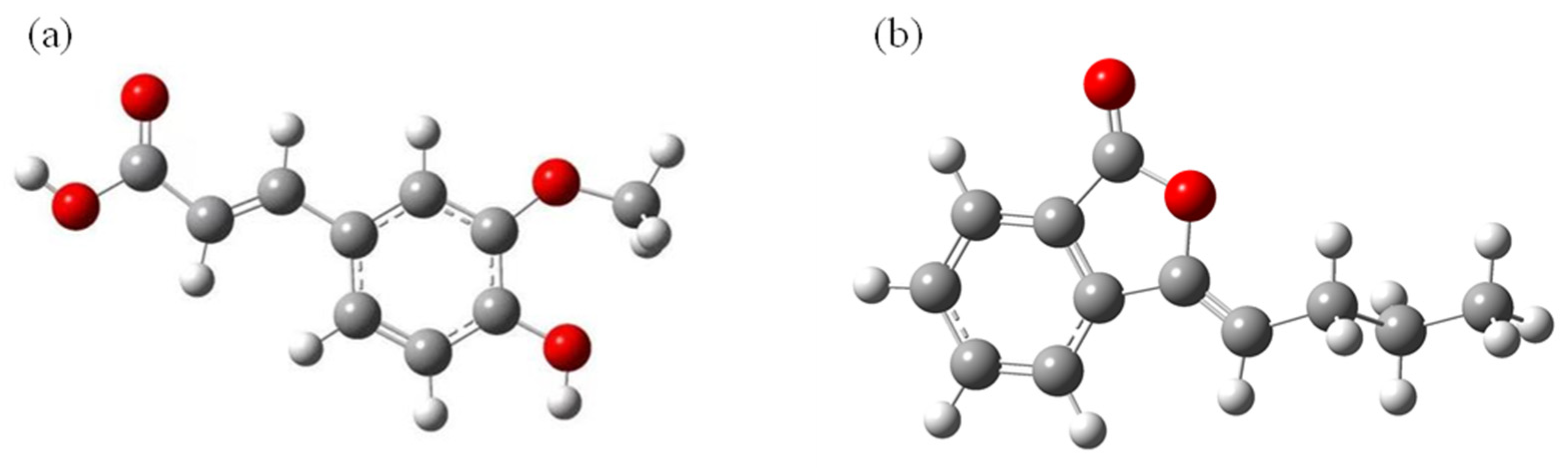
2.9. Density Functional Theory (DFT) Calculations
2.10. Statistical Analysis
2.11. Methodological Validation
2.11.1. Pesticides
2.11.2. Q-Markers
Linearity, LOQ and LOD
Accuracy and Precision
3. Results and Discussion
3.1. Optimization of the Pretreatment Method
3.1.1. Angelica sinensis Pieces
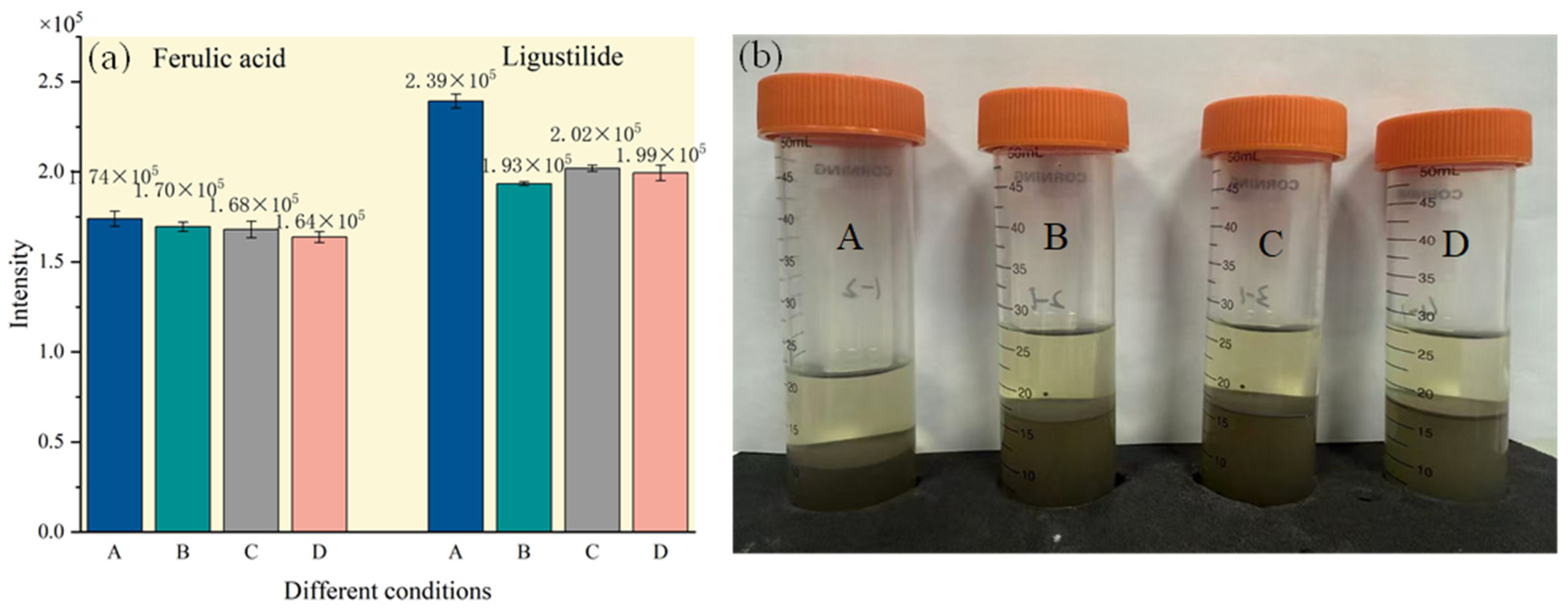
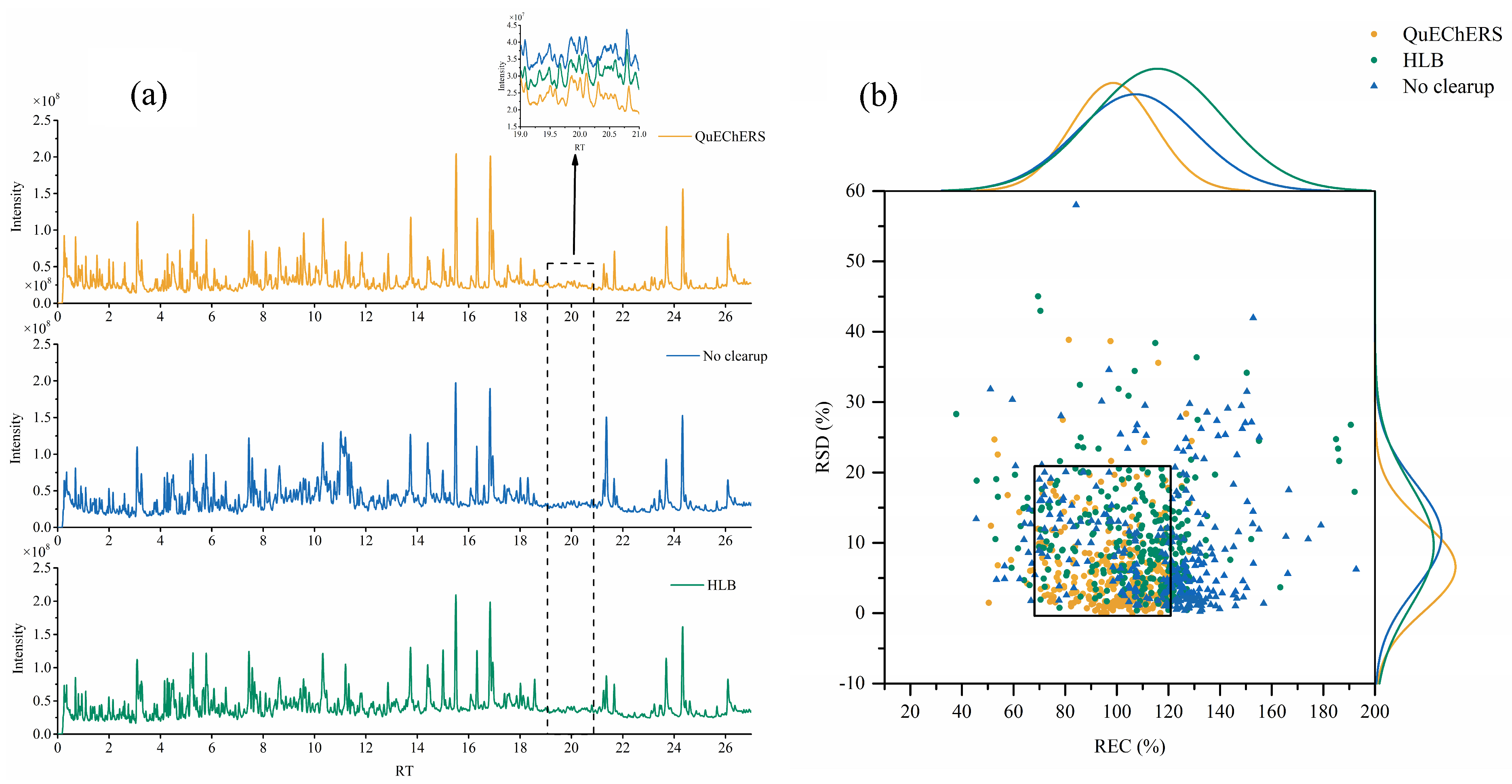
3.1.2. Angelica sinensis Decoction
Extraction
Purification
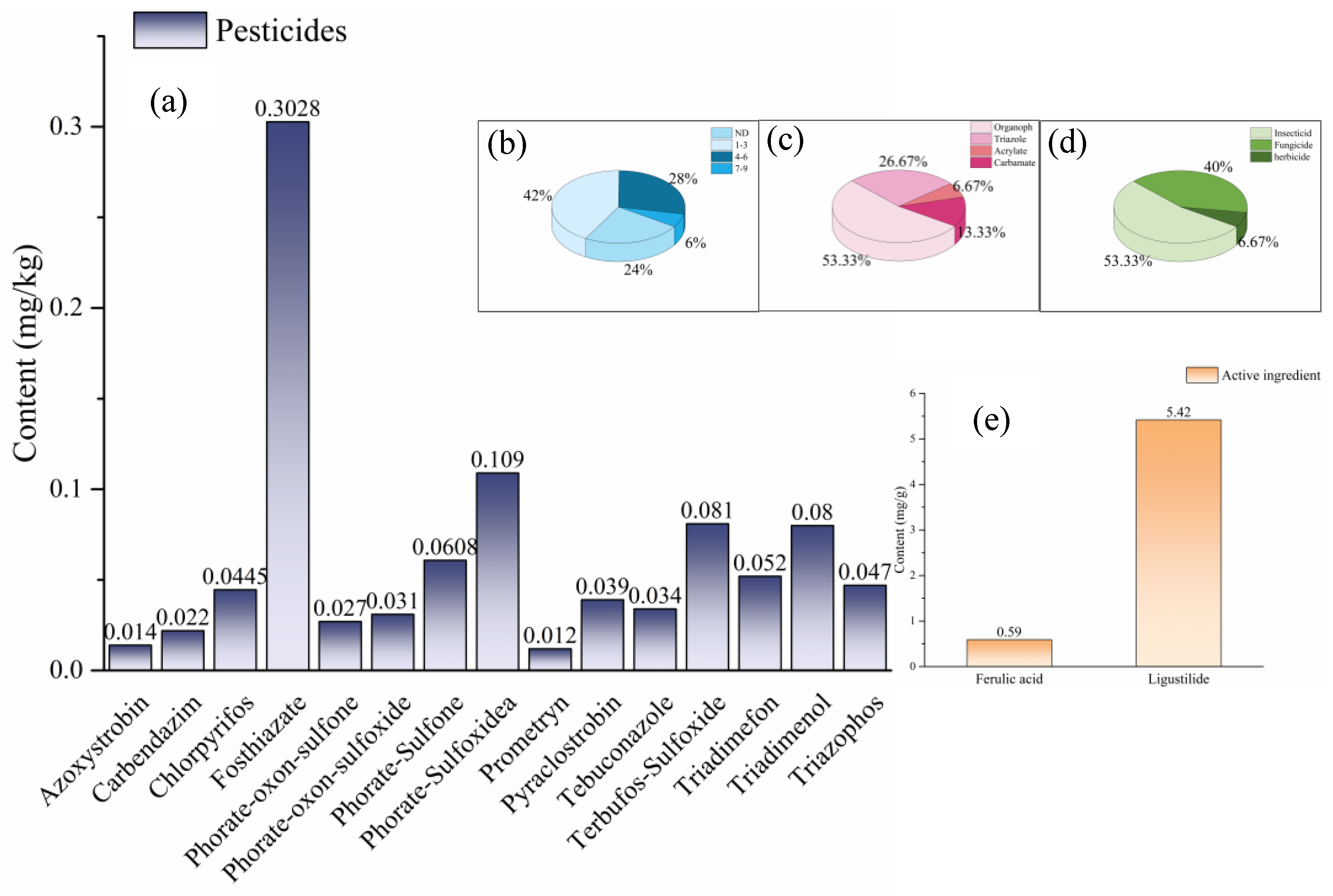
3.2. Result of Angelica sinensis Pieces
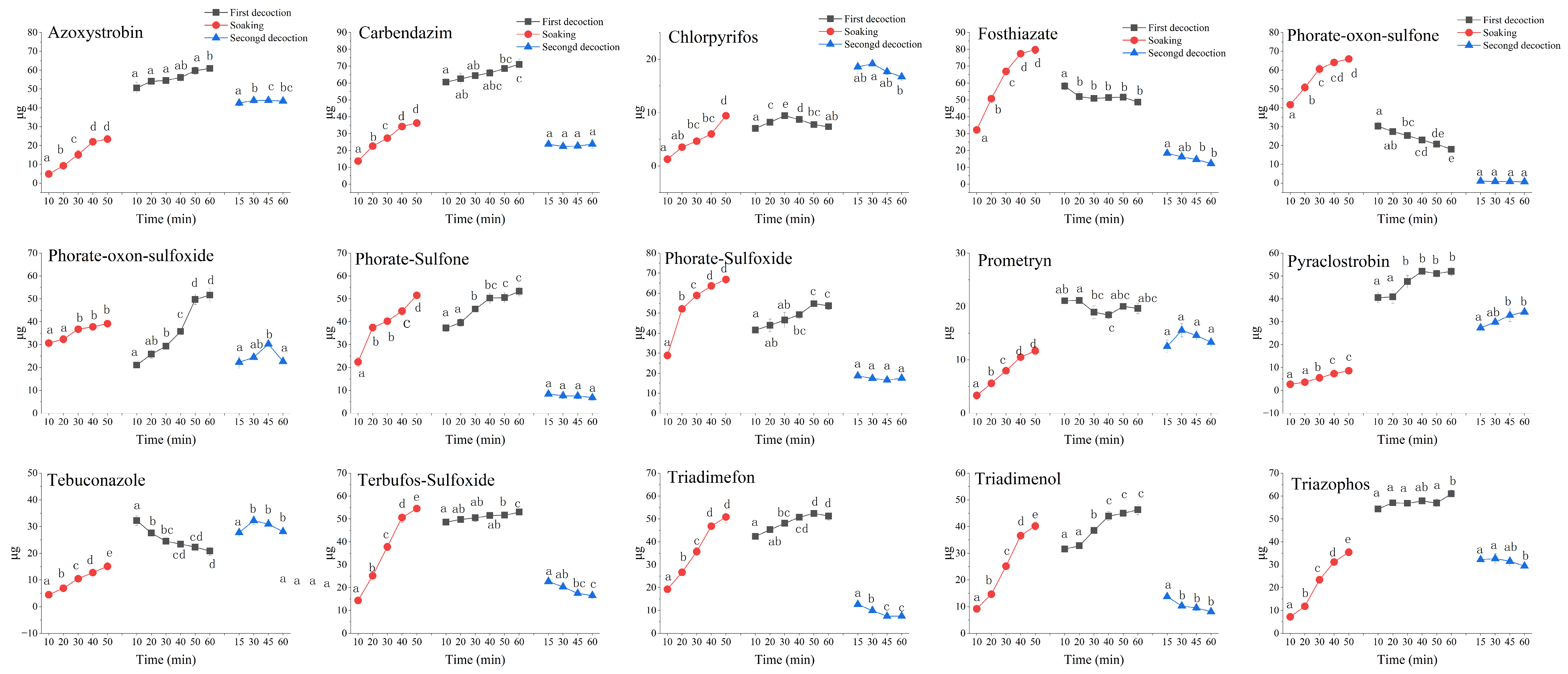
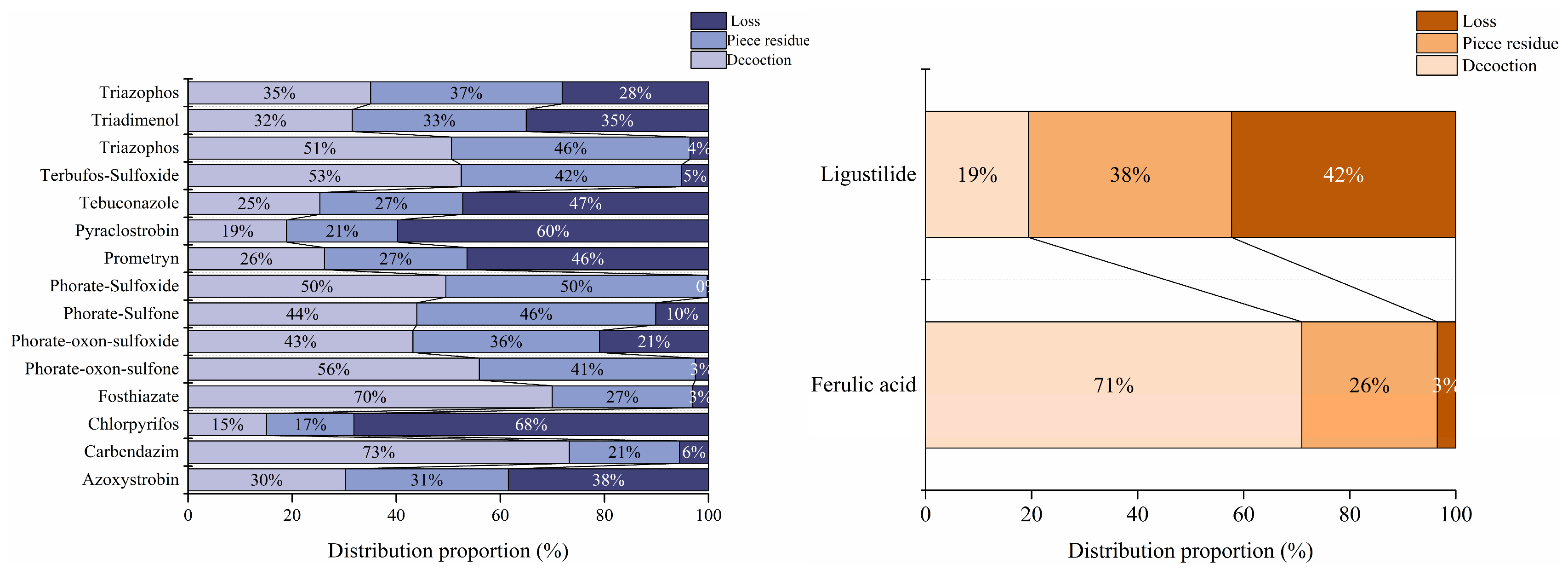
3.3. Pesticide Transfer Behavior During Decoction
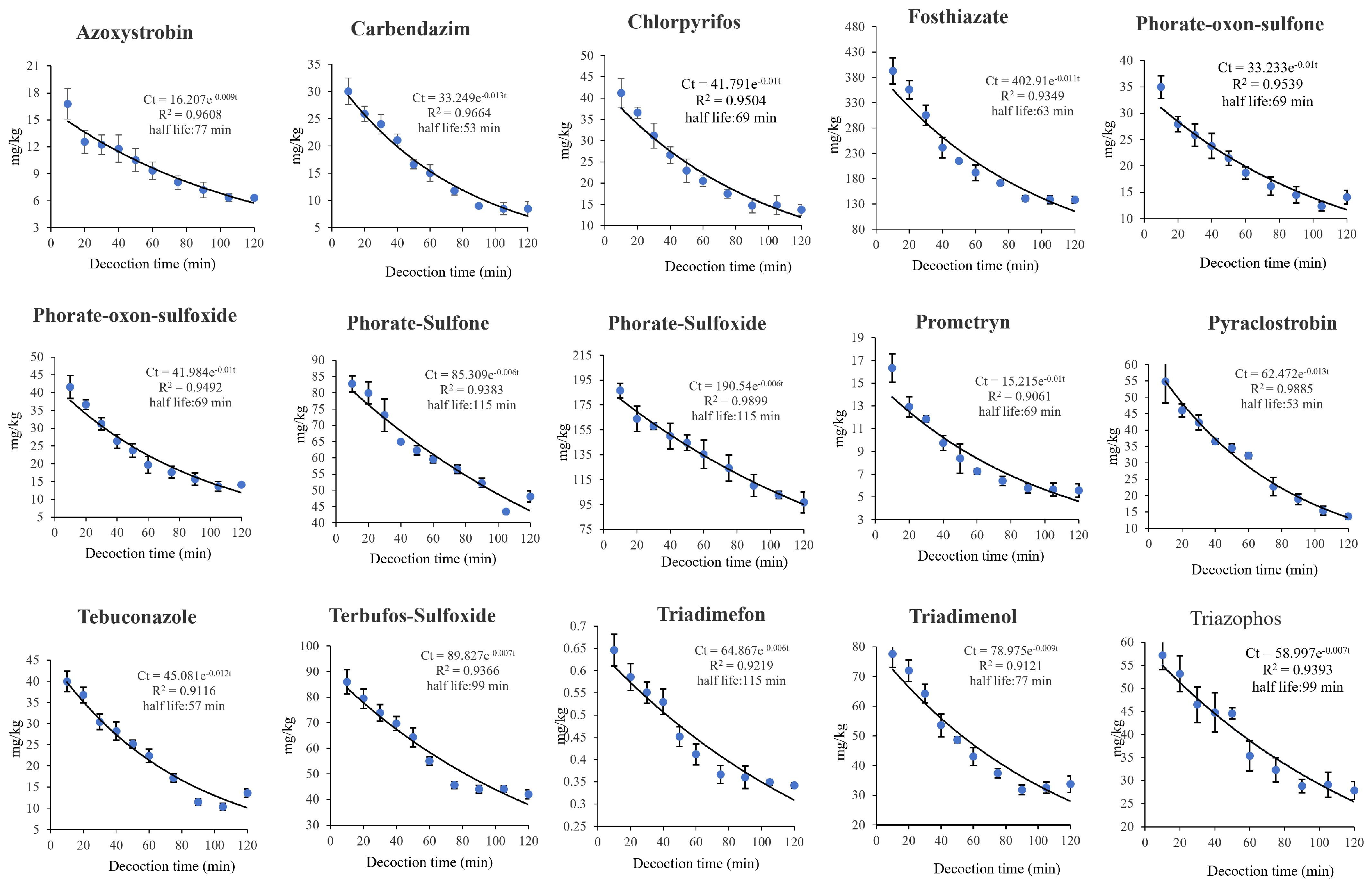
3.4. Pesticide Dissipation Kinetics Model in Piece
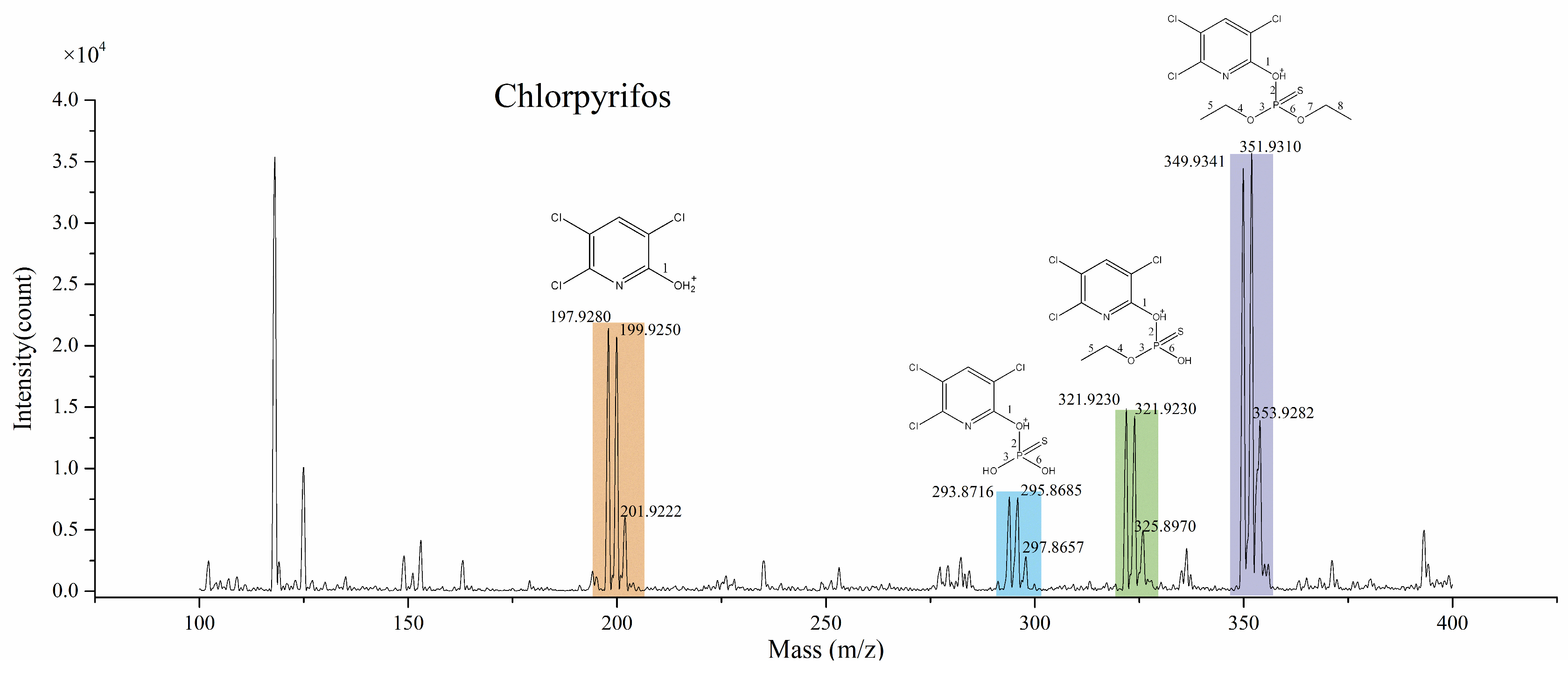
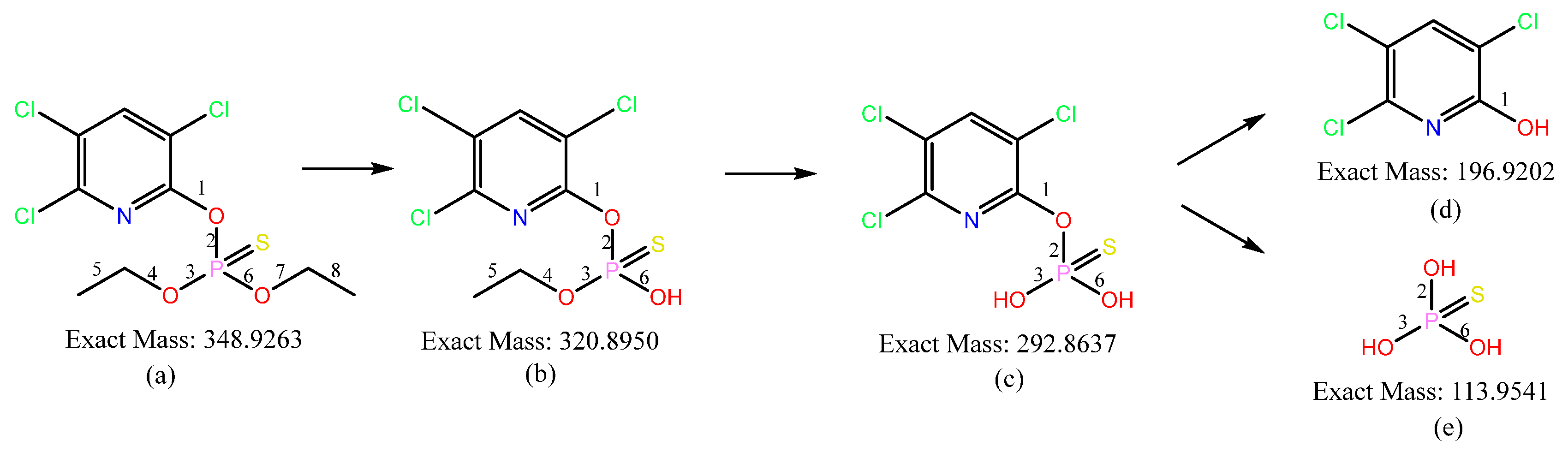
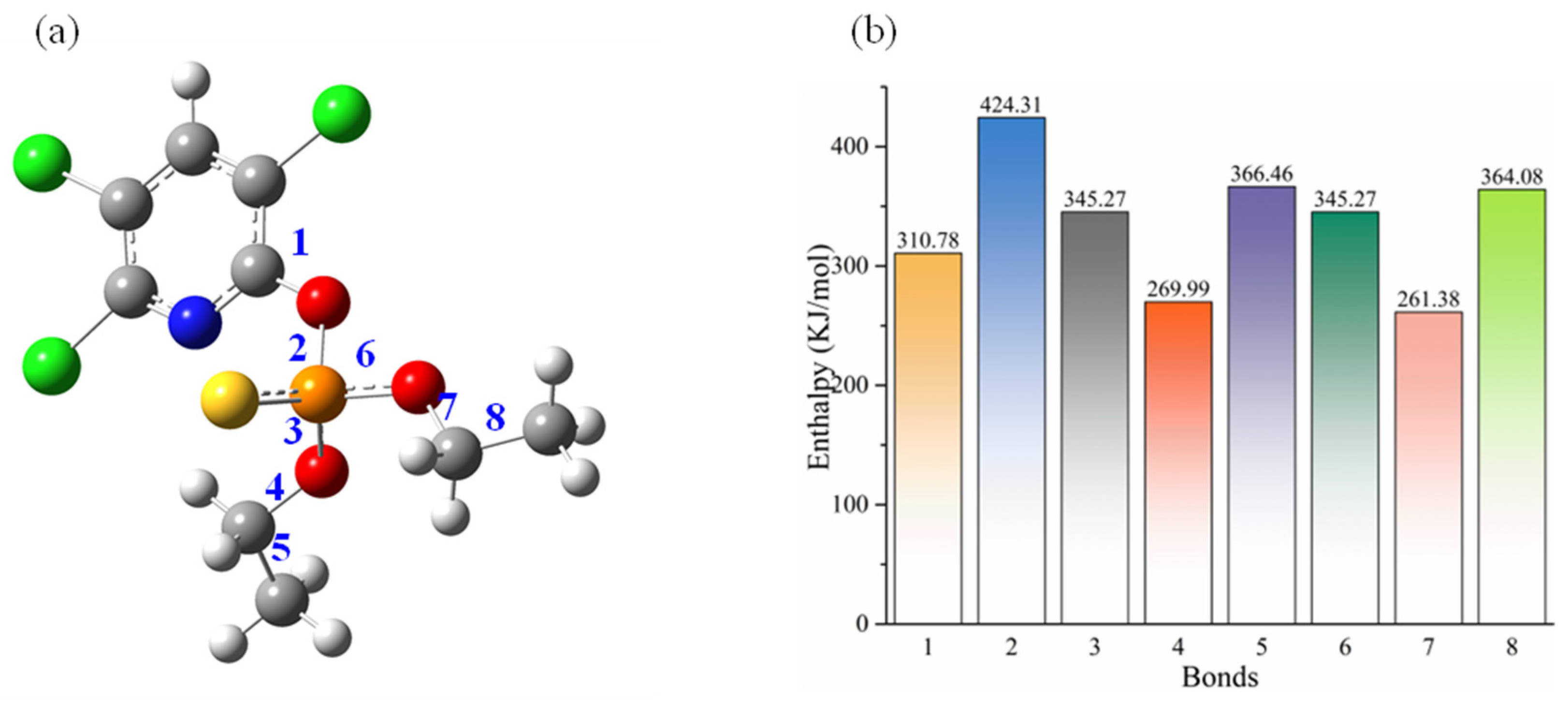
3.5. The Thermal Degradation Mechanism of Chlorpyrifos
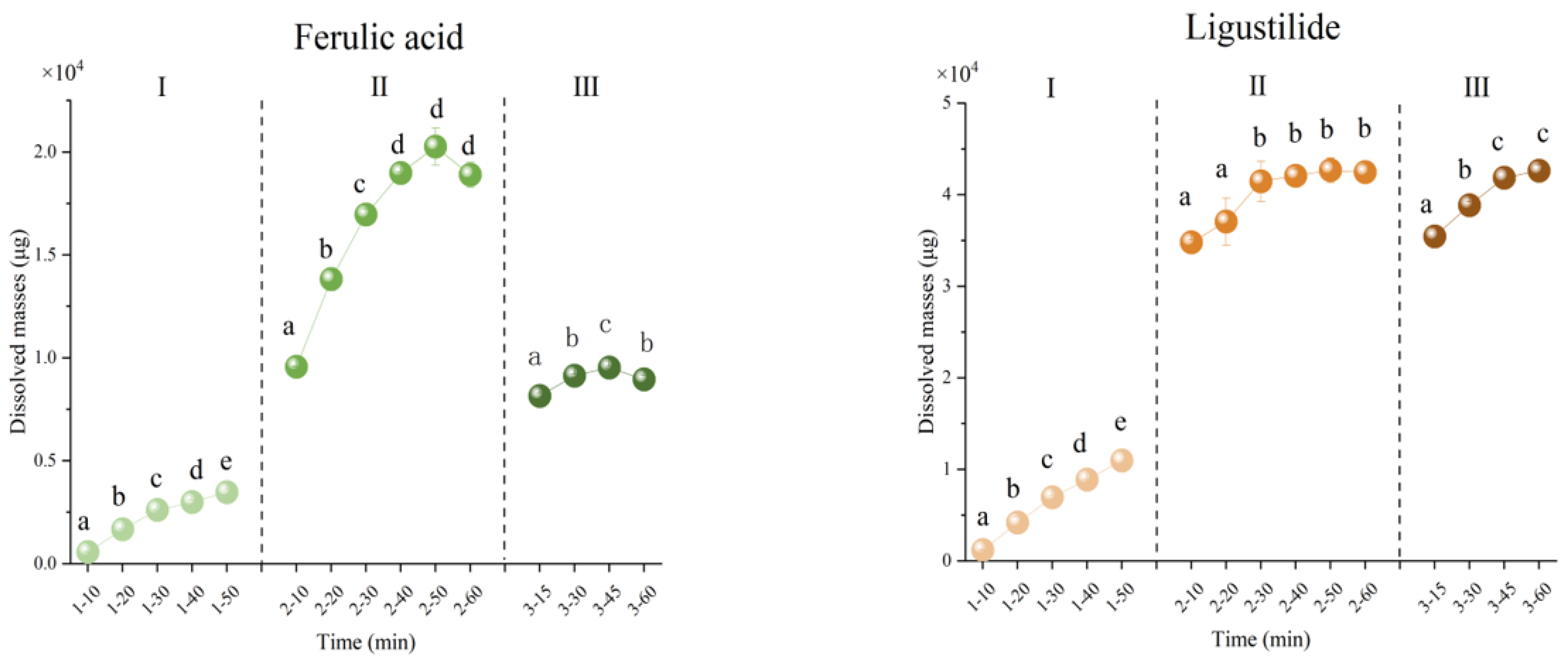
3.6. Q-Markers Transfer Behavior During Decoction
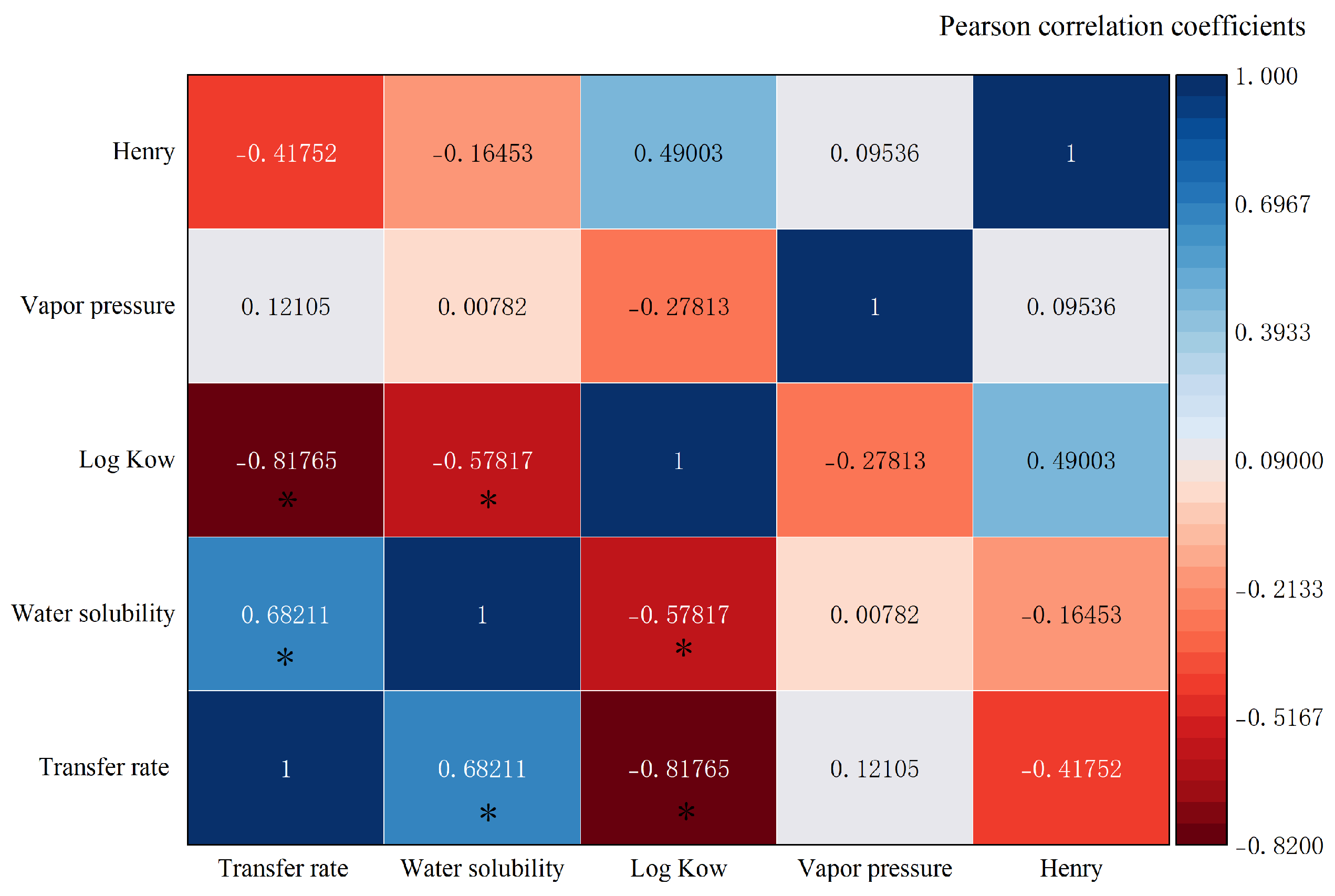
3.7. Rransfer Rate of Pesticides and Q-Markers
3.8. Risk Assessment Results
4. Conclusions
Supplementary Materials
Author Contributions
Funding
Institutional Review Board Statement
Informed Consent Statement
Data Availability Statement
Conflicts of Interest
Abbreviations
| ADI | Allowable Daily Intake |
| ARfD | Acute Reference Dose |
| AS | Angelica sinensis |
| BDE | Bond Dissociation Energy |
| DFT | Density Functional Theory |
| EDI | Estimated Daily Intake |
| ESTI | Estimated Short-Term Intake |
| EFSA | European Food Safety Authority |
| HI | Hazard Index |
| HQc | Chronic Hazard Quotient |
| HQa | Acute Hazard Quotient |
| JMPR | Joint Meeting on Pesticide Residues |
| LC-Q-TOF/MS | Liquid Chromatography Quadrupole Time-of-Flight Mass Spectrometry |
| LOQ | Limit of Quantification |
| MRL | Maximum Residue Limits |
| PCDL | Personal Compound Database and Library Manager |
| Q-markers | Quality Markers |
| RSD | Relative Standard Deviation |
| RSDwR | Within-laboratory Reproducibility |
| SMFH | Substances of Medicine Food Homology |
| TCM | Traditional Chinese Medicine |
References
- Chinese Pharmacopoeia Commission. Pharmacopoeia of the People’s Republic of China; Ministry of Health of the People’s Republic of China: Beijing, China, 2025; Volume 1, p. 142.
- Nai, J.; Zhang, C.; Shao, H.; Li, B.; Li, H.; Gao, L.; Dai, M.; Zhu, L.; Sheng, H. Extraction, structure, pharmacological activities and drug carrier applications of Angelica sinensis polysaccharide. Int. J. Biol. Macromol. 2021, 183, 2337–2353. [Google Scholar] [CrossRef] [PubMed]
- National Health Commission. Announcement on the Inclusion of Six New Substances That Are Both Traditional Food and Traditional Chinese Medicine (No. 8 of 2019). Available online: https://zwfw.nhc.gov.cn/kzx/tzgg/qt_235/202001/t20200106_1452.html (accessed on 6 January 2020).
- Guo, F.; Tan, Q.; Guo, J.; Li, K.; Wang, X.; Cao, W.; Xiao, G. Total Synthesis of the Tridecasaccharide Motif from Angelica Sinensis APS-1 II Polysaccharide with Anti-Leukemia Activity and Structure-Activity Relationship Studies. Angew. Chem. 2025, 64, e202422887. [Google Scholar] [CrossRef] [PubMed]
- Zhang, H.; Chang, Q.; Yang, F.; Li, J.; Wu, F.; Bai, R. Magnetic graphitized carbon black based on crystal growth method combined with high-resolution mass spectrometry for screening of 300 pesticide residues in Radix Codonopsis and Angelica sinensis. J. Chromatogr. B 2023, 1226, 123788. [Google Scholar] [CrossRef] [PubMed]
- Chang, Q.; Ge, L.; Li, J.; Qiu, G.; Wu, F.; Zhang, H.; Xu, F.; Zhu, R.; Qi, P.; Bai, R.; et al. Automated QuEChERS for the determination of 482 pesticide residues in Radix codonopsis by GC-Q-TOF/MS and LC-Q-TOF/MS. Anal. Methods 2021, 13, 5660–5669. [Google Scholar] [CrossRef] [PubMed]
- Łozowicka, B.; Jankowska, M.; Rutkowska, E.; Hrynko, I.; Kaczyński, P.; Miciński, J. The evaluation of a fast and simple pesticide multiresidue method in various herbs by gas chromatography. J. Nat. Med. 2014, 68, 95–111. [Google Scholar] [CrossRef] [PubMed]
- Gu, S.; Zhu, W.; Liu, Y.; Duo, H.; Yang, Q.; Hou, X. Ionic liquid-modified magnetic covalent organic framework for the extraction of four pyrethroids in traditional Chinese herbs. J. Chromatogr. A 2025, 1743, 465719. [Google Scholar] [CrossRef] [PubMed]
- Bai, R.; Chang, Q.; Zhang, H.; Wang, X.; Chen, H.; Bai, Y.; Qiu, G.; Pang, G.; Wang, K.; Zhao, M.; et al. Simultaneous determination of pesticides, mycotoxins and ferulic acid in Angelica sinensis by GC/LC-Q-TOF/MS. J. Chromatogr. A 2024, 1737, 465437. [Google Scholar] [CrossRef] [PubMed]
- Mu, X.; Wang, D.; Meng, L.; Wang, Y.; Chen, J. Glutathione-modified graphene quantum dots as fluorescent probes for detecting organophosphorus pesticide residues in Radix Angelica Sinensis. Spectrochim. Acta Part A Mol. Biomol. Spectrosc. 2023, 286, 122021. [Google Scholar] [CrossRef] [PubMed]
- Li, C.; Wang, H.; Sun, J.; Li, P.; Dong, J.; Huang, J.; Dong, H.; Geng, L.; Yu, Z.; Zhang, P.; et al. Novel electrochemiluminescence platform utilizing AuNPs@Uio-66-NH2 bridged luminescent substrates and aptamers for the detection of pesticide residues in Chinese herbal medicines. Talanta 2025, 281, 126924. [Google Scholar] [CrossRef] [PubMed]
- Zhang, R.; Chen, Y.; Zheng, P.; Dai, Y.; Li, S.; Jia, Y.; Xie, R.; Wang, J. Determination of 101 pesticide residues in Platycodonis radix and extracts of Angelica sinensis by gel permeation chromatography-gas chromatography-ion trap mass spectrometry. Chin. J. Chromatogr. 2023, 41, 178–186. [Google Scholar] [CrossRef] [PubMed]
- Cui, Y.; Xu, Z.; Tang, S.; Wang, Y.; Jiang, G. Organochlorine pesticides and other pesticides in peanut oil: Residue level, source, household processing factor and risk assessment. J. Hazard. Mater. 2022, 429, 128272. [Google Scholar] [CrossRef] [PubMed]
- Cui, K.; Wang, J.; Ma, G.; Guan, S.; Liang, J.; Fang, L.; Ding, R.; Li, T.; Dong, Z.; Wu, X.; et al. Residue levels, processing factors and risk assessment of pesticides in ginger from market to table. J. Hazard. Mater. 2024, 470, 134268. [Google Scholar] [CrossRef] [PubMed]
- Tang, H.; Sun, J.; Huang, Q.; Wen, G.; Han, L.; Wang, L.; Zhang, Y.; Dong, M.; Wang, W. Residue behaviors, degradation, processing factors, and risk assessment of pesticides in citrus from field to product processing. Sci. Total Environ. 2023, 897, 165321. [Google Scholar] [CrossRef] [PubMed]
- Bian, Y.; Feng, Y.; Zhang, A.; Qi, X.; Ma, X.; Pan, J.; Han, J.; Liang, L. Residue behaviors, processing factors and transfer rates of pesticides and metabolites in rose from cultivation to consumption. J. Hazard. Mater. 2023, 442, 130104. [Google Scholar] [CrossRef] [PubMed]
- Cui, I.; Xu, J.; Wu, X.; Pan, X.; Zheng, Y.; Dong, F. From washing to cooking: A comprehensive assessment of ten household processing methods on typical pesticide residues in cowpeas. Food Res. Int. 2025, 221, 117446. [Google Scholar] [CrossRef] [PubMed]
- Liu, C.; Chen, R.; Liu, F.; Gao, Z.; Li, X.; Wang, Y.; Wang, S.; Li, Y. Distribution pattern, removal effect, transfer behavior of ten pesticides and one metabolite during the processing of grapes. Food Res. Int. 2023, 16, 112398. [Google Scholar] [CrossRef] [PubMed]
- Chen, H.; Pan, M.; Liu, X.; Lu, C. Evaluation of transfer rates of multiple pesticides from green tea into infusion using water as pressurized liquid extraction solvent and ultra-performance liquid chromatography tandem mass spectrometry. Food Chem. 2017, 216, 1–9. [Google Scholar] [CrossRef] [PubMed]
- Wang, H.; Zhou, L.; Zhang, X.; Luo, F.; Chen, Z. Transfer of pesticide residue during tea brewing: Understanding the effects of pesticide’s physico-chemical parameters on its transfer behavior. Food Res. Int. 2019, 121, 776–784. [Google Scholar] [CrossRef] [PubMed]
- Bai, A.; Chen, A.; Chen, W.; Liu, S.; Luo, X.; Liu, Y.; Zhang, D. Residue behavior, transfer and risk assessment of tolfenpyrad, dinotefuran and its metabolites during tea growing and tea brewing. J. Sci. Food Agric. 2021, 101, 5992–6000. [Google Scholar] [CrossRef] [PubMed]
- Fang, L.; Long, N.; Li, Y.; Liao, X.; Shi, L.; Zhao, H.; Zhou, L.; Kong, W. Transfer behavior of pesticides from honeysuckle into tea infusions: Establishment of an empirical model for transfer rate prediction. Ecotoxicol. Environ. Saf. 2022, 234, 113377. [Google Scholar] [CrossRef] [PubMed]
- Kaczyński, P.; Iwaniuk, P.; Jankowska, M.; Orywal, K.; Socha, K.; Perkowski, M.; Farhan, J.A.; Łozowicka, B. Pesticide residues in common and herbal teas combined with risk assessment and transfer to the infusion. Chemosphere 2024, 367, 143550. [Google Scholar] [CrossRef] [PubMed]
- State Administration of Traditional Chinese Medicine. Notice of the Ministry of Health and the State Administration of Traditional Chinese Medicine on Issuing the Management Specifications for Chinese Medicinal Decoction Rooms in Medical Institutions. Available online: http://www.natcm.gov.cn/yizhengsi/gongzuodongtai/2018-03-25/6577.html (accessed on 27 March 2009).
- Wang, L.; Wu, P.; Liu, Z.; Gu, M.; Xue, J. Transfer Behaviors of 30 Pesticide Residues during the Common Processing of Ginseng. J. Agric. Food Chem. 2023, 71, 815–824. [Google Scholar] [CrossRef] [PubMed]
- Song, S.; Yu, Q.; Yuan, L.; Anwar, W.; Li, Q.; Hao, Q.; Wu, G.; Li, Y.; Lai, Y. Absorption, translocation, and accumulation of the fungicide triadimefon in Pak choi (Brassica rapa var chinensis), pepper (Capsicum annuum), and cucumber (Cucumis sativus). Environ. Monit. Assess. 2023, 195, 1235. [Google Scholar] [CrossRef] [PubMed]
- Qin, S.; Lin, T.; Tian, H.; Du, L.; Li, K.; Cao, Q.; Liu, H.; Pang, G.; Chang, Q. Kinetics, pathways, mechanism and toxicity evaluation of chiral pesticide Paichongding during the fermentation of Puer tea. Food Chem. X 2025, 26, 102300. [Google Scholar] [CrossRef] [PubMed]
- Xu, Y.; Li, L.; Xu, Y.; Wang, S.; Zhang, X.; Tang, T.; Yu, J.; Zhao, H.; Wu, S.; Zhang, C.; et al. Pesticide multi-residues in Dendrobium officinale Kimura et Migo: Method validation, residue levels and dietary exposure risk assessment. Food Chem. 2021, 343, 128490. [Google Scholar] [CrossRef] [PubMed]
- Kim, D.; Oh, E.; Moon, J.; Choi, J.; Kim, T.; Lee, S.; Park, J.; Kwon, C.; Kyung, K. Monitoring and Risk Assessment of Pesticide Residues in Seafood Using LC-MS/MS. Foods 2025, 14, 3198. [Google Scholar] [CrossRef] [PubMed]
- WHO. Inventory of Evaluations Performed by the Joint Meeting on Pesticide Residues (JMPR). Available online: https://apps.who.int/pesticide-residues-jmpr-database/Home/Search (accessed on 30 November 2024).
- Analytical Quality Control and Method Validation Procedures for Pesticide Residues Analysis in Food and Feed. Available online: https://food.ec.europa.eu/system/files/2023-11/pesticides_mrl_guidelines_wrkdoc_2021-11312.pdf (accessed on 1 November 2023).
- European Pharmacopoeia Commission; European Directorate for the Quality of Medicines & Healthcare. European Pharmacopoeia, 11th ed.; European Directorate for the Quality of Medicines: London, UK, 2023; p. 325. [Google Scholar]
- Xiao, H.; Ma, J.; Wang, F.; Xu, X.; Liao, M.; Shi, Y.; Cao, H. Effect of decocting on the pesticide residues in Paeoniae radix lactiflora and corresponding exposure risk assessment. Environ. Sci. Pollut. Res. 2021, 28, 16655–16662. [Google Scholar] [CrossRef] [PubMed]
- Wang, G.; Zhang, Z.; Xu, D.; Xing, B.; Zhu, L.; Wang, S. Insight into pyrolysis mechanism of plastic waste with C-O/C-N bonds in the backbone. Sci. Total Environ. 2023, 897, 165359. [Google Scholar] [CrossRef] [PubMed]
- Yuan, Q.; Yang, F.; Yu, H.; Xie, Y.; Guo, Y.; Yao, W. Degradation mechanism and toxicity assessment of chlorpyrifos in milk by combined ultrasound and ultraviolet treatment. Food Chem. 2022, 383, 132550. [Google Scholar] [CrossRef] [PubMed]
- Kennedy, E.M.; Mackie, J.C. Mechanism of the Thermal Decomposition of Chlorpyrifos and Formation of the Dioxin Analog, 2,3,7,8-Tetrachloro-1,4-dioxino-dipyridine (TCDDpy). Environ. Sci. Technol. 2018, 52, 7327–7333. [Google Scholar] [CrossRef] [PubMed]
- Huang, K.; Zhang, Z.; Han, G.; Kong, R.; Qin, H.; Zhang, H.; Letcher, R.J.; Qiu, W.; Liu, C.; Shi, J.; et al. Chronic low-dose exposure to chlorpyrifos reduces life span in a wild fish by accelerating aging. Science 2026, 391, 275–279. [Google Scholar] [CrossRef] [PubMed]
- Li, J.; Fang, B.; Ren, F.; Xing, H.; Zhao, G.; Yin, X.; Pang, G.; Li, Y. TCP structure intensified the chlorpyrifos-induced decrease in testosterone synthesis via LH-LHR-PKA-CREB-Star pathway. Sci. Total Environ. 2020, 726, 138496. [Google Scholar] [CrossRef] [PubMed]
- Gao, Y.; Dong, Y.; Guo, Q.; Wang, H.; Feng, M.; Yan, Z.; Bai, D. Study on supramolecules in traditional Chinese medicine decoction. Molecules 2022, 27, 3268. [Google Scholar] [CrossRef] [PubMed]
- Xiao, O.; Li, M.; Chen, D.; Chen, J.; Simal-Gandara, J.; Dai, X.; Kong, Z. The dissipation, processing factors, metabolites, and risk assessment of pesticides in honeysuckle from field to table. J. Hazard. Mater. 2022, 431, 128519. [Google Scholar] [CrossRef] [PubMed]



| Content of Ferulic Acid (g/L) | Standard Added of Ferulic Acid (g/L) | Measured of Ferulic Acid (g/L) | Recovery of Ferulic Acid % | Ave Recover of Ferulic Acidy % | RSD of Ferulic Acid (%) | RSDwR of Ferulic Acid (%) | Content of Ligustilide (g/L) | Standard Added of Ligustilide (g/L) | Measured of Ligustilide (g/L) | Recovery of Ligustilide % | Ave Recovery of Ligustilide % | RSD of Ligustilide (%) | RSDwR of Ligustilide (%) |
|---|---|---|---|---|---|---|---|---|---|---|---|---|---|
| 0.060 | 0.060 | 0.115 | 0.96 | 96.9 | 2.7 | 3.2 | 0.532 | 0.500 | 1.004 | 0.97 | 95.4 | 2.2 | 2.6 |
| 0.058 | 0.060 | 0.118 | 1.00 | 0.540 | 0.500 | 1.025 | 0.99 | ||||||
| 0.058 | 0.060 | 0.112 | 0.95 | 0.531 | 0.500 | 0.984 | 0.95 | ||||||
| 0.059 | 0.060 | 0.117 | 0.98 | 0.559 | 0.500 | 0.993 | 0.94 | ||||||
| 0.059 | 0.060 | 0.111 | 0.93 | 0.542 | 0.500 | 0.972 | 0.93 | ||||||
| 0.058 | 0.060 | 0.117 | 0.99 | 0.551 | 0.500 | 0.990 | 0.94 |
| Conditions | Decoction (mL) | Acetonitrile (1% Acetic Acid) (mL) | MgSO4 (g) | CH3COONa (g) |
|---|---|---|---|---|
| A | 10 | 10 | 4 | 1 |
| B | 15 | 10 | 6 | 1.5 |
| C | 15 | 10 | 6 | 2 |
| D | 15 | 10 | 8 | 2 |
| No. | Pesticides | Spraied Concentration | Detected Concentration (RSD) | Function | Type | Toxicity |
|---|---|---|---|---|---|---|
| 1 | Azoxystrobin | 0.0280 | 0.0219 (4.34) | Fungicide | Acrylate | Slightly |
| 2 | Carbendazim | 0.0440 | 0.0387 (2.54) | Fungicide | Carbamate | Slightly |
| 3 | Chlorpyrifos | 0.0890 | 0.0776 (3.49) | Insecticide | Organophosphorus | Moderate |
| 4 | Fosthiazate | 0.6056 | 0.5051 (4.37) | Insecticide | Organoph | Moderate |
| 5 | Phorate-oxon-sulfone | 0.0540 | 0.0377 (4.34) | Insecticide | Organoph | Hypertoxic |
| 6 | Phorate-oxon-sulfoxide | 0.0620 | 0.0439 (2.39) | Insecticide | Organoph | Hypertoxic |
| 7 | Phorate-Sulfone | 0.1216 | 0.1067 (2.47) | Insecticide | Organoph | Hypertoxic |
| 8 | Phorate-Sulfoxidea | 0.2180 | 0.2078 (4.94) | Insecticide | Organoph | Hypertoxic |
| 9 | Prometryn | 0.0240 | 0.0205 (4.81) | Herbicide | Triazine | Slightly |
| 10 | Pyraclostrobin | 0.0780 | 0.0625 (3.36) | Fungicide | Carbamate | Slightly |
| 11 | Tebuconazole | 0.0680 | 0.0486 (4.65) | Fungicide | Triazole | Moderate |
| 12 | Terbufos-Sulfoxide | 0.1620 | 0.1064 (2.13) | Insecticide | Organoph | Hypertoxic |
| 13 | Triadimefon | 0.1040 | 0.0774 (3.34) | Fungicide | Triazole | Moderate |
| 14 | Triadimenol | 0.1600 | 0.1005 (2.29) | Fungicide | Triazole | Moderate |
| 15 | Triazophos | 0.0940 | 0.0746 (2.89) | Insecticide | Organoph | Highly |
| Compounds | Electronic Energy (Har) | Internal Energy (Har) | Enthalpy (Har) | Gibbs Free Energy (Har) |
|---|---|---|---|---|
| Ferulic acid | −688.120344 | −687.9294882 | −687.9285441 | −687.9802962 |
| Ligustilide | −615.101951 | −614.8855314 | −614.8845872 | −614.9359870 |
| Pesticides | Transfer Rate (%) | ADI (mg/kg) | Risk Assessment of Chronic Dietary Intake | ARfD (mg/kg) | Acute Dietary Intake Risk Assessment | ||||||
|---|---|---|---|---|---|---|---|---|---|---|---|
| EDI (mg/kg BW) | HQc | ESTI (mg/kg BW) | HQa | ||||||||
| Adult | Child | Adult | Child | Adult | Child | Adult | Child | ||||
| Azoxystrobin a | 30.21 | 0.2 | 6.34 × 10⁻⁷ | 2.54 × 10⁻⁶ | 3.17 × 10⁻⁶ | 1.27 × 10⁻⁵ | Unnecessary | 1.15 × 10⁻⁶ | 4.59 × 10⁻⁶ | ||
| Carbendazim a | 73.26 | 0.03 | 2.42 × 10⁻⁶ | 9.67 × 10⁻⁶ | 8.06 × 10⁻⁵ | 3.22 × 10⁻⁴ | 0.1 | 8.94 × 10⁻⁶ | 3.58 × 10⁻⁵ | 8.94 × 10⁻⁵ | 3.58 × 10⁻⁴ |
| Chlorpyrifos a | 15.09 | 0.01 | 1.01 × 10⁻⁶ | 4.03 × 10⁻⁶ | 1.01 × 10⁻⁴ | 4.03 × 10⁻⁴ | 0.1 | 9.71 × 10⁻⁶ | 3.89 × 10⁻⁵ | 9.71 × 10⁻⁵ | 3.89 × 10⁻⁴ |
| Fosthiazate a | 69.97 | 0.004 | 3.18 × 10⁻⁵ | 1.27 × 10⁻⁴ | 7.95 × 10⁻³ | 3.18 × 10⁻² | - | 7.70 × 10⁻⁵ | 3.08 × 10⁻⁴ | ||
| Phorate-oxon-sulfone b | 55.97 | 0.0007 | 2.27 × 10⁻⁶ | 9.07 × 10⁻⁶ | 3.24 × 10⁻³ | 1.30 × 10⁻² | 0.003 | 1.46 × 10⁻⁵ | 5.82 × 10⁻⁵ | 4.85 × 10⁻³ | 1.94 × 10⁻² |
| Phorate-oxon-sulfoxide b | 43.2 | 0.0007 | 2.01 × 10⁻⁶ | 8.04 × 10⁻⁶ | 2.87 × 10⁻³ | 1.15 × 10⁻² | 0.003 | 2.68 × 10⁻⁶ | 1.07 × 10⁻⁵ | 8.93 × 10⁻⁴ | 3.57 × 10⁻³ |
| Phorate-Sulfone b | 43.95 | 0.0007 | 4.01 × 10⁻⁶ | 1.60 × 10⁻⁵ | 5.73 × 10⁻³ | 2.29 × 10⁻² | 0.003 | 1.94 × 10⁻⁵ | 7.75 × 10⁻⁵ | 6.46 × 10⁻³ | 2.58 × 10⁻² |
| Phorate-Sulfoxidea b | 49.54 | 0.0007 | 8.10 × 10⁻⁶ | 3.24 × 10⁻⁵ | 1.16 × 10⁻² | 4.63 × 10⁻² | 0.003 | 1.27 × 10⁻⁴ | 5.07 × 10⁻⁴ | 4.22 × 10⁻² | 1.69 × 10⁻¹ |
| Prometryn a | 26.21 | 0.04 | 4.72 × 10⁻⁷ | 1.89 × 10⁻⁶ | 1.18 × 10⁻⁵ | 4.72 × 10⁻⁵ | - | 7.34 × 10⁻⁷ | 2.94 × 10⁻⁶ | ||
| Pyraclostrobin a | 18.91 | 0.03 | 1.11 × 10⁻⁶ | 4.42 × 10⁻⁶ | 3.69 × 10⁻⁵ | 1.47 × 10⁻⁴ | 0.05 | 1.47 × 10⁻⁶ | 5.90 × 10⁻⁶ | 2.95 × 10⁻⁵ | 1.18 × 10⁻⁴ |
| Tebuconazole a | 25.3 | 0.03 | 1.29 × 10⁻⁶ | 5.16 × 10⁻⁶ | 4.30 × 10⁻⁵ | 1.72 × 10⁻⁴ | 0.3 | 3.44 × 10⁻⁶ | 1.38 × 10⁻⁵ | 1.15 × 10⁻⁵ | 4.59 × 10⁻⁵ |
| Terbufos-Sulfoxide c | 52.5 | 0.0006 | 6.38 × 10⁻⁶ | 2.55 × 10⁻⁵ | 1.06 × 10⁻² | 4.25 × 10⁻² | 0.002 | 8.51 × 10⁻⁶ | 3.40 × 10⁻⁵ | 4.25 × 10⁻³ | 1.70 × 10⁻² |
| Triadimefon a | 50.61 | 0.03 | 3.95 × 10⁻⁶ | 1.58 × 10⁻⁵ | 1.32 × 10⁻⁴ | 5.26 × 10⁻⁴ | 0.08 | 1.87 × 10⁻⁵ | 7.49 × 10⁻⁵ | 2.34 × 10⁻⁴ | 9.36 × 10⁻⁴ |
| Triadimenol a | 31.55 | 0.03 | 3.79 × 10⁻⁶ | 1.51 × 10⁻⁵ | 1.26 × 10⁻⁴ | 5.05 × 10⁻⁴ | 0.08 | 9.68 × 10⁻⁶ | 3.87 × 10⁻⁵ | 1.21 × 10⁻⁴ | 4.84 × 10⁻⁴ |
| Triazophos a | 35.06 | 0.001 | 2.47 × 10⁻⁶ | 9.89 × 10⁻⁶ | 2.47 × 10⁻³ | 9.89 × 10⁻³ | 0.001 | 3.30 × 10⁻⁶ | 1.32 × 10⁻⁵ | 3.30 × 10⁻³ | 1.32 × 10⁻² |
| HI | 4.50 × 10⁻² | 1.80 × 10⁻¹ | 6.26 × 10⁻² | 2.50 × 10⁻¹ | |||||||
Disclaimer/Publisher’s Note: The statements, opinions and data contained in all publications are solely those of the individual author(s) and contributor(s) and not of MDPI and/or the editor(s). MDPI and/or the editor(s) disclaim responsibility for any injury to people or property resulting from any ideas, methods, instructions or products referred to in the content. |
© 2026 by the authors. Licensee MDPI, Basel, Switzerland. This article is an open access article distributed under the terms and conditions of the Creative Commons Attribution (CC BY) license.
Share and Cite
Zhang, H.; Chang, Q.; Li, J.; Wu, F. Simultaneous Determination, Transfer Behaviors, Degradation, and Risk Assessment of Pesticides and Q-Marker in Angelica sinensis During Decoction. Foods 2026, 15, 2222. https://doi.org/10.3390/foods15122222
Zhang H, Chang Q, Li J, Wu F. Simultaneous Determination, Transfer Behaviors, Degradation, and Risk Assessment of Pesticides and Q-Marker in Angelica sinensis During Decoction. Foods. 2026; 15(12):2222. https://doi.org/10.3390/foods15122222
Chicago/Turabian StyleZhang, Hongyan, Qiaoying Chang, Jian Li, and Fuxiang Wu. 2026. "Simultaneous Determination, Transfer Behaviors, Degradation, and Risk Assessment of Pesticides and Q-Marker in Angelica sinensis During Decoction" Foods 15, no. 12: 2222. https://doi.org/10.3390/foods15122222
APA StyleZhang, H., Chang, Q., Li, J., & Wu, F. (2026). Simultaneous Determination, Transfer Behaviors, Degradation, and Risk Assessment of Pesticides and Q-Marker in Angelica sinensis During Decoction. Foods, 15(12), 2222. https://doi.org/10.3390/foods15122222