Article

More than Entertainment: The Association of Social Media Exposure with Adolescents’ Preferences for and Consumption of Sugar-Sweetened Beverages


College of Economics & Management, Northwest A&F University, Yangling 712100, China
*
Author to whom correspondence should be addressed.
Foods 2026, 15(12), 2125; https://doi.org/10.3390/foods15122125 (registering DOI)
Submission received: 21 May 2026 / Revised: 4 June 2026 / Accepted: 10 June 2026 / Published: 12 June 2026

Abstract

Social media has become a significant factor in unhealthy consumption behaviors among adolescents, given the prevalent use of mobile phones and the internet. This study investigates the association between social media exposure and adolescents’ sugar-sweetened beverage (SSB) preferences, as well as their consumption behavior. This study included 1517 adolescents across Henan Province, China, in 2025. We employ a mixed logit model, a hurdle model, and an Ordinary Least Squares (OLS) model to assess the association of social media exposure with adolescents’ SSB preferences and consumption behavior. The findings indicate that social media exposure is positively associated with adolescents’ overall preference for SSB products. Specifically, it is associated with a higher preference for carbonated drinks and beverages containing sweeteners and a lower preference for juice. Furthermore, the association between social media exposure and SSB preferences differs between urban and rural adolescents. Rural adolescents exposed to social media tend to show a lower willingness to forgo SSB options, whereas urban adolescents exposed to social media tend to show less sensitivity to price attributes. Additionally, social media exposure is positively associated with both the selection and consumption of SSBs among adolescents, which in turn are linked to health concerns such as overweight and obesity.

1. Introduction

Adolescent health is critical to public health [1]. Unhealthy dietary behaviors can lead to an increased risk of cardiovascular diseases, diabetes, and other non-communicable diseases over time [2]. Although often overlooked in traditional nutritional interventions and considered a period of relative health, the adolescent developmental stage is receiving increasing attention as epidemiological evidence reveals unfavorable outcomes in areas such as weight gain, physical activity, and dietary intake [3]. Over the past four decades, the average BMI and obesity rates among children and adolescents have risen in most regions and countries, and weight gain during childhood and adolescence is highly likely to lead to lifelong overweight and obesity [4]. The growth rate of overweight and obesity in China is among the highest worldwide, with adults ranking 19th and children 12th globally [5]. Obesity in childhood tends to persist into adulthood, increasing the risk of type 2 diabetes, cardiovascular disease, and premature mortality [6]. These trends have been attributed to changes in the global food system, driven by dominant multinational food corporations. Foods and beverages that are highly processed, energy-dense, and palatable are not only marketed effectively but also aggressively promoted [7]. Based on sugar-sweetened beverage (SSB) intake data from the Global Dietary Database (2020), Chinese citizens consumed an average of 0.2 oz servings per week [8]. While this figure appears low on an individual basis, the aggregate consumption volume remains enormous given the size of the Chinese population. In 2019, the number of deaths attributed to sugar-sweetened beverages in China reached 46,633 with an increase of 95% to 1990 [9]. Given that SSBs are a significant source of added sugar in children’s diets [10], there is growing concern that regular consumption of free sugars increases energy intake, promotes a positive energy balance, reduces the intake of more nutritious foods, and leads to unhealthy diets and weight gain [11].
The marketing environment for food and beverages is considered a key driver behind the global rise in obesity rates [12]. Because cognitive development is not yet fully mature, children and adolescents are particularly susceptible to such food marketing [13]. Adolescence is a life stage with unique characteristics, making adolescents more vulnerable to food marketing than adults [14]. Marketing has been shown to be a significant driver of food and beverage choices among children and adolescents [15], leading them to prefer, purchase, and consume unhealthy foods and beverages [16]. The increase in childhood overweight and obesity has coincided with a rise in children’s consumption of soft drinks and snacks, both in frequency and average amount [17]. National surveys in China have found that the proportion of children aged 15–17 consuming sugar-sweetened beverages more than once per week increased sharply from 14.2% in 2002 to 79.2% in 2012 [18]; the consumption rates of SSBs (25%) among Chinese children and adolescents substantially exceed those of adults [19]. The nutritional quality assessments reveal that products promoted in social media marketing often contain excessive amounts of free sugars and saturated fats [20]. Therefore, this study explores the relationship between social media and adolescents’ beverage attribute preferences, as well as their consumption of sugar-sweetened beverages, which is of significant practical importance. Social media is not only an important channel for adolescents to access dietary information and consumption trends but also influences their perceptions of beverage taste, packaging, price, and health attributes. This study analyzes how social media exposure affects adolescents’ beverage attribute preferences, helping to reveal the underlying mechanisms behind sugar-sweetened beverage consumption behaviors. It also provides a theoretical basis for schools, families, and public health authorities to develop more targeted nutrition intervention strategies.

2. Literature Review

The evolution of digital marketing has introduced new challenges in capturing advertising exposure and its significant impact on dietary behaviors [21]. Digital marketing is highly targeted, interactive, often not recognized as advertising, and frequently accessed by children without supervision [22]. While television is the primary medium for food companies to advertise to children, evidence shows that companies are shifting their advertising expenditures to digital marketing and employing diverse promotional tactics to reach and engage young audiences, particularly on social networking platforms [23]. Adolescents now spend the majority of their non-television screen time on smartphones, with a large portion dedicated to social media platforms. A total of 95% of adolescents report having access to a smartphone, and 43% indicate they check social media hourly or “almost constantly” [24]. One study found that 82% of 12th graders reported daily social media use in 2016, compared to 52% in 2008 [25]. Marketing through social media can amplify the effects of television advertising on brand recall, liking, and reach at a significantly lower cost than traditional advertising [13]. Social media can be defined as the interaction or sharing of content among individuals via the internet or mobile platforms [26]. Adolescents are made particularly vulnerable to interactive promotions and advertisements for foods and beverages high in saturated fat, salt, or free sugars, due to the widespread popularity of social media and the development of digital marketing strategies [27]. Children and adolescents are exposed to unhealthy food and beverage marketing on social media applications from various sources, including advertisements, user-generated and celebrity-generated content, and other forms of entertainment content [23].
Adolescents face a risk of exposure to digital promotions for unhealthy foods and beverages, as food and beverage companies increasingly employ social media advertising and marketing strategies to engage younger audiences [28]. The advent of smartphones and tablets has significantly expanded the reach of food and beverage companies on digital platforms, which are not bound by the government and industry regulations that apply to traditional advertising [29]. Digital marketing may exert a stronger influence on consumer behavior than marketing in television and other traditional advertising environments for several reasons [30]. Children and adolescents represent an important consumer group for marketers, as they spend substantial amounts of their own money, significantly influence household spending, and represent future adult consumers [31]. Most product brands maintain their own social media pages, and sugar-sweetened beverage brands are among the most popular. Evidence shows that food advertising can stimulate respondents’ preferences and desires under laboratory conditions [32], and such engagement may increase the risk of consuming unhealthy foods and beverages. Although unhealthy food marketing is prevalent on social media and adolescents are highly engaged online with such brands [24], the understanding of how digital food marketing influences their dietary behaviors remains under development [33]. Additionally, many studies have focused on the impact of individual characteristics on adolescents’ SSB intake. It is possible that boys may present more heterogeneity in beverage consumption [34]. Parental educational attainment may influence household rules concerning unhealthy foods as well as their availability within the home environment [35]. Previous studies have demonstrated a significant association between household availability and SSB consumption [36]. Furthermore, evidence from China suggests that preferences for sweetened beverages have increased significantly among children residing in rural areas [37]. In addition, adolescents who receive larger amounts of pocket money are more likely to purchase sugar-sweetened beverages [38].
The existing literature has the following limitations. First, most studies only focus on the correlation between social media use and adolescents’ SSB consumption behavior, yet they fail to conduct a unified framework analysis of social media, beverage attribute preferences, and adolescents’ SSB consumption. Second, although discrete choice experiments (DCEs) have been used to measure adolescents’ preferences for beverage attributes, they are rarely combined with social media exposure. This study conducts two parallel analyses: the first one is an analysis of the association between social media exposure and SSB preferences; the second one is an analysis of the association between social media exposure and SSB consumption based on cross-sectional data. We explore the potential value of social media exposure in terms of both consumer preferences and choice. This integrated design helps us to understand the potential pathways linking social media to adolescents’ SSB consumption more comprehensively.
This paper contributes to the existing literature in three aspects. First, the findings suggest the potential value of making sugar content information a mandatory requirement in nutrition labeling systems. Second, we demonstrate that social media is significantly associated with adolescents’ preferences for SSB attributes. In particular, the heterogeneity of social media effects between urban and rural areas provides a theoretical basis for designing targeted measures based on the consumption preference characteristics of adolescents in different regions. Third, we verify the consistency of the correlation between social media use and adolescents’ SSB choice preferences and behaviors, providing insights for limiting social media use. The structure of this paper is as follows: In the subsequent section, we will introduce the experimental procedures used for the choice experiment. Then, we have an explanation of the data collection process, a description of the sample characteristics, a discussion of the empirical analysis of the data, and a presentation of the research findings and conclusions.

3. Research Design

This study investigates the association between social media exposure and adolescents’ sugar-sweetened beverage preferences and consumption. A discrete choice experiment was designed and administered alongside a questionnaire survey to collect relevant data. All analyses were performed using Stata 18. The following section details the survey procedures and data collection methods.

3.1. Data

This study employs a stratified random sampling method, drawing participants from two cities (Nanyang and Xuchang), four counties, eight schools, and thirty-two classes within Henan Province, China. The target population consists of adolescents in grades seven and eight. We distributed 1600 questionnaires. After removing outliers and incomplete responses, we obtained 1517 valid responses. A discrete choice experiment (DCE) was selected to elicit adolescents’ preferences of the attributes of sugar-sweetened beverages. This methodological choice is justified by two primary factors: first, the impending implementation of labeling regulations with mandatory sugar content in 2027 limits the availability of pertinent market data; second, the DCE framework effectively simulates decision-making in a grocery-shopping environment [39], thereby providing a robust approach for investigating consumer food preferences.
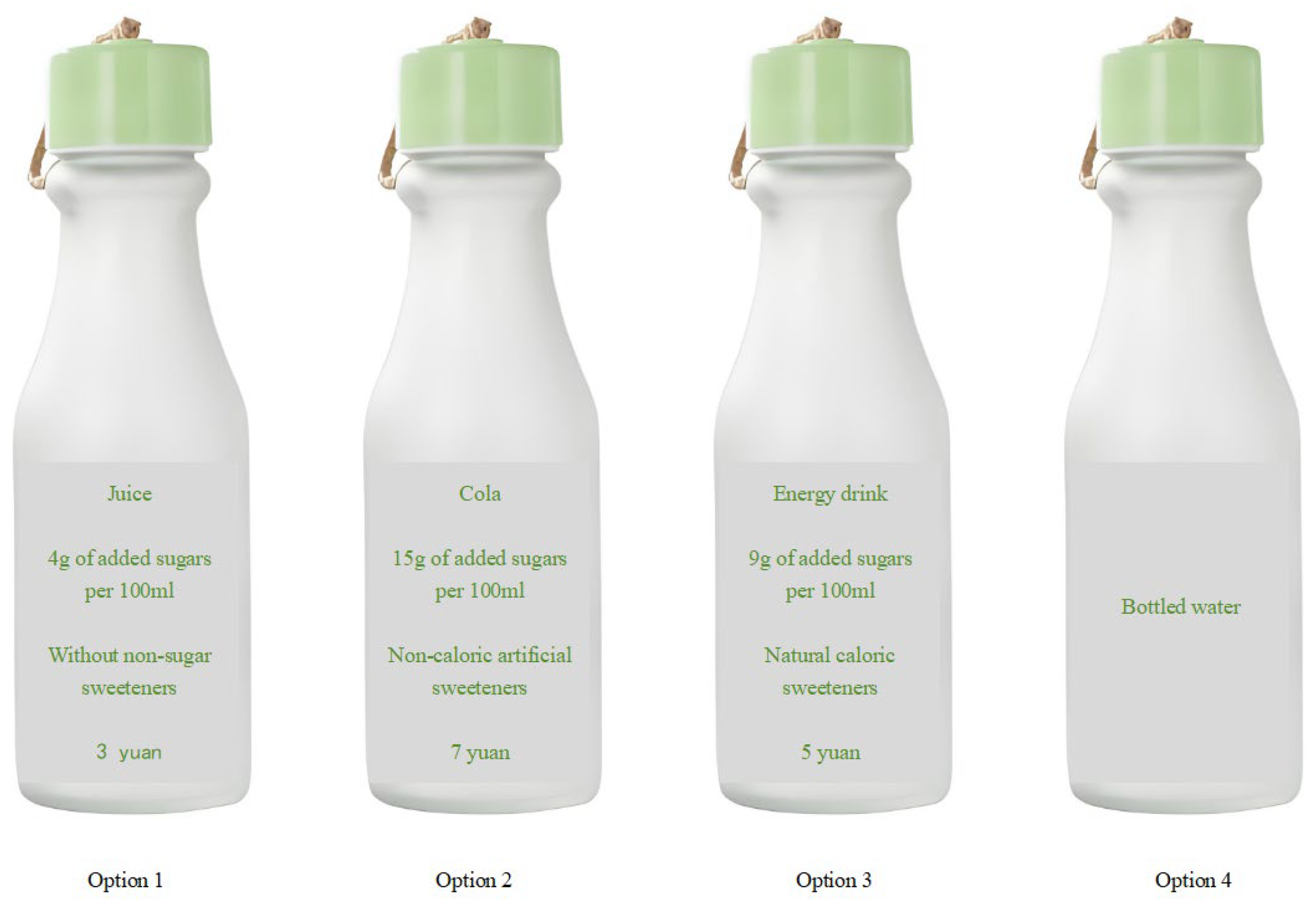
This study selects four attributes to describe the sugar-sweetened beverage products within the DCE drawing on the existing literature: price, sugar content, beverage type (tea drinks, carbonated drinks, juice, energy drinks), and sweetener type (no sweetener, natural caloric sweeteners, non-caloric artificial sweeteners). The specific levels for sugar content are established based on national and nutritional association classifications for low-sugar, sugary, and high-sugar beverages, corresponding to 4 g/100 mL, 9 g/100 mL, and 15 g/100 mL, respectively. The selection of beverage types focuses on four major categories with a substantial market presence. As for sweetener type, three categories are included: non-caloric artificial sweeteners commonly used in production, natural caloric sweeteners derived from sources like starch through complex processing, and no added sweetener.
A series of DCE tasks is designed to measure the influence of social media. Each participating student completes six choice scenarios to ensure orthogonality across the choice sets. As shown in Figure 1, every choice set presents three beverage alternatives (Option 1, Option 2, Option 3) and an opt-out alternative (Option 4). The opt-out option is defined as a non-sugar-sweetened beverage, specifically bottled water to enhance realism and reflect actual market conditions. Concurrently, we also collect data concerning the adolescents’ individual characteristics and household demographics. All data collection is conducted via in-person, paper-based questionnaire surveys.

3.2. Models

Choice modeling is typically derived from the assumption of utility-maximizing behavior by consumers, as formalized by Lancaster [40]. This theory posits that the utility of a good can be decomposed into separate utilities derived from its constituent characteristics or attributes. While researchers can observe some attributes of the alternatives and certain characteristics of individuals, a portion of individual utility remains unobservable and they are treated as stochastic. Since utility cannot be measured directly, indirect utility is inferred from observed preferences over product attributes. This study estimates consumer preferences for sugar-sweetened beverage products, drawing on random utility theory. Formally, the utility that respondent i derives from choosing alternative j in choice task t is given by
U ijt = β i X ijt + ε ijt
Here, X ijt represents a vector of the observed attributes for alternative j , β i is the vector of utility weights, and ε ijt denotes a random error term assumed to be independently and identically distributed (i.i.d.). Generally, the Conditional Logit (CL) model is widely employed as a baseline specification. This model treats parameters as fixed across observations and cannot account for heterogeneity in individual preferences. The Multinomial Logit (MNL) model is also commonly used to analyze discrete choice experiment data. However, the i.i.d. assumption leads to independence from the irrelevant alternatives (IIA) property. This imposes a limitation on the model’s practical application, as it fails to account for the degree of preference heterogeneity among participants [41]. It is more closely aligned with actual consumer behavior, as it allows for heterogeneity in preferences and provides greater flexibility in capturing substitution effects among products. Therefore, this study uses a mixed logit model to analyze adolescents’ preference for SSBs and the association between social media exposure and their choice preferences for SSBs. To estimate preferences for the four specified attributes—price, sugar content, beverage type, and sweetener type—the empirical model is specified as follows:
U ijt = β p 1 price ijt + β a 0 out ijt + β a 1 sweetne ijt + β a 2 CocolBever ijt + β a 3 JuiceBever ijt   + β a 4 EnergyBever ijt + β a 5 Nature ijt + β a 6 Artif ijt + β a 7 out ijt web i                       + β a 8 price ijt web i + β a 9 sweetne ijt web i + β a 10 CocolBever ijt web i   + β a 11 JuiceBever ijt web i + β a 12 EnergyBever ijt web i + β a 13 Nature ijt web i + β a 14 Artif ijt web i + ε ijt
Here, β denotes the coefficient for each attribute chosen by each participant, i represents the participant, j denotes the choice task, and t indicates the choice scenario. out ijt is a specific constant term, indicating the utility when a consumer chooses “opt-out” among the three sugar-sweetened beverage options. When “opt-out” is selected, out ijt is assigned a value of 1; when any sugar-sweetened beverage product is chosen, out ijt is assigned a value of 0. price ijt is a continuous variable, referring to the three price levels included in the experimental design: 3 yuan, 5 yuan, and 7 yuan. sweetne ijt represents the sugar content of the sugar-sweetened beverage. Other dummy variables include beverage type (tea drinks, carbonated drinks, fruit juice drinks, energy drinks) and sweetener type (no sweetener, natural caloric sweeteners, non-caloric artificial sweeteners). ε ijt is the stochastic error term, representing unobserved utility.
A hurdle model approach is employed as a secondary analysis to examine the association between social media exposure and adolescents’ selection of sugar-sweetened beverages. When respondents choose beverages across six choice tasks, the dependent variable is constructed by summing the number of times that a sugar-sweetened beverage is selected, resulting in a value ranging from 0 to 6. The hurdle model adopts a two-stage estimation process. The first stage models factors associated with selecting a sugar-sweetened beverage at least once, using a Probit model. The second stage models factors related to the non-zero frequency of sugar-sweetened beverage choices. The first stage models as the selection model, where the dependent variable is equal to one for adolescents who selected SSBs at least once and zero otherwise. For this second stage, a Poisson regression is estimated. This model incorporates social media exposure and respondent demographic data as independent variables to identify the characteristics associated with a higher frequency of selecting sugar-sweetened beverages.
To further investigate the association between social media exposure and adolescents’ SSB consumption, we specify the model as follows:
beverage i = α 0 + α 1 web i + γ 1 X i + ε i
where beverage i is the logarithm of adolescent’s SSB consumption, and this study performs a logarithmic transformation on SSB consumption. web i denotes the daily duration of social media usage. X i consists of control variables, including individual-level characteristic variables and household-level characteristic variables.

4. Results

The final analytical sample comprises 1517 respondents. As shown in Table 1, the adolescents report average daily social media usage exceeding 3 h, and the sample contains an approximately equal proportion of males and females, all aged between 12 and 16 years. A total of 74.7% of the participants reside in rural areas, and 22.1% attend boarding schools. The average household size exceeds five members. Furthermore, the parents have an average age of 40 years and an average educational attainment above the junior high school level. The adolescents’ average weekly allowance is 32.817 Yuan. Their average Body Mass Index (BMI) is 19.22, which falls within the normal range. Finally, the availability of sugar-sweetened beverages at home is relatively low.

4.1. Social Media Exposure and Adolescents’ Preferences for SSBs

The choice experiment within this study contributes a total of 36,408 valid observations for analysis. This is derived from 1517 completed valid questionnaires, each containing six choice sets where respondents select from four alternative options. The results of the mixed logit model are presented in Table 2. In this model, all estimated coefficients are treated as random parameters following a normal distribution, except those for price and the opt-out alternative, which are specified as fixed.
First, the main effects are presented in column (1); both the price and opt-out coefficients are negative and statistically significant. It indicates that price is an important consideration for adolescent consumption, where higher prices correspond to lower preference. Furthermore, adolescents generally do not want to forgo the purchase of a sugar-sweetened beverage product altogether. The coefficient of sugar content is significantly negative, suggesting adolescents prefer beverages with lower sugar content. This finding demonstrates that sugar content information can contribute to achieving the goal of reducing adolescent SSB consumption. This attribute is included and analyzed via choice experiment due to market data limitations, as comprehensive regulations on sugar content labeling are not scheduled for full implementation until 2027. Adolescents exhibit a stronger preference for juice over tea drinks when considering different beverage types. In contrast, they exhibit a negative preference for both carbonated and energy drinks. Adolescents display a negative preference for both natural caloric and non-caloric artificial sweeteners when compared to no sweetener. This finding aligns with prior research indicating that Chinese consumers express greater concern about sweetener safety compared to the Western consumers [42]. Finally, the estimated standard deviations for all random parameters reveal the presence of statistically significant heterogeneity in adolescent preferences across all attributes and levels.
As for the interaction effects between social media and beverage attributes, our results indicate that social media exposure has significant interactions with preferences related to price, beverage type, and sweetener type. Specifically, a significant positive interaction effect is noted between social media usage and price. This suggests that longer social media exposure is associated with lower price sensitivity to beverages among adolescents. Furthermore, a significant negative interaction is noted between social media usage and opt-out, indicating that longer social media exposure is associated with a stronger preference for choosing sugar-sweetened beverages over opting out among adolescents. As for the beverage types, a significant positive interaction is observed between social media usage and carbonated drinks. This implies that longer social media exposure is associated with a stronger preference for choosing carbonated drinks over tea drinks among adolescents. Moreover, adolescents with longer social media exposure tend to have a lower preference for fruit juice beverages and a higher preference for the two types of sweeteners.

4.2. Urban–Rural Differences in Social Media Exposure and Adolescents’ SSB Preferences

Results based on subsamples stratified by urban–rural status show that the association between social media exposure and adolescents’ SSB preferences is heterogeneous across urban and rural areas. For rural adolescents (Table 3, Column 2), a significantly negative association is observed between social media exposure and the preference for the opt-out option, indicating that prolonged exposure correlates with a greater inclination to choose sugar-sweetened beverages. For beverage categories, a significant positive association is observed between social media exposure and carbonated drinks, but a negative association is found with juice. For sweetener types, it is associated with an increased preference for beverages containing both natural caloric and non-caloric artificial sweeteners.
For urban adolescents (Table 3, Column 4), the analysis shows a positive association between social media exposure and price-related preferences, suggesting that longer social media exposure is associated with lower price sensitivity to beverages among adolescents. For beverage categories, a significantly positive association is observed solely with carbonated drinks. As for sweetener types, social media exposure is associated only with preference for natural sweeteners. These findings imply that interventions to restrict social media exposure could help reduce SSB preferences among rural adolescents and increase price sensitivity among their urban counterparts.

4.3. Hurdle Model Estimates for the Selection of SSBs

Table 4 presents the results from the hurdle model, examining the association between social media exposure and adolescents’ SSB choice. Results from the Probit model indicate that longer usage time of social media is associated with a higher likelihood of adolescents choosing any SSB over non-sweetened bottled water. Results from the Poisson model further demonstrate that increased time on social media is linked to a higher probability of SSB selection. For individual demographic characteristics, the amount of weekly allowance has a significant positive effect on adolescents’ SSB choice decisions, implying that greater income increases the likelihood of selecting SSBs. Family food environment is also significantly associated with adolescents’ SSB consumption [43]. Specifically, individuals are more inclined to choose SSBs when beverages are highly available at home. Interestingly, adolescents with a higher Body Mass Index (BMI) show a tendency to avoid choosing SSBs. Consistent with previous research, several factors are associated with a higher frequency of SSB choices; these factors include being male, having an older father, and belonging to a larger household [44].

4.4. The Impact of Social Media on Adolescents’ SSB Consumption

For adolescents’ actual consumption behavior, the OLS model is employed to analyze the association between social media and their SSB consumption. The results presented in Table 5 indicate that the coefficient for social media exposure in relation to adolescents’ SSB consumption is 0.188, significant at the 1% level. This indicates a significant positive association between social media exposure and adolescents’ SSB consumption, and longer social media exposure is associated with greater SSB consumption among adolescents. For individual characteristics, male adolescents report greater SSB consumption. Furthermore, both a larger allowance amount and higher availability of SSBs at home are associated with increased consumption among adolescents. We conduct robustness checks using a Tobit model and 1% winsorization, and the results support the original findings. In summary, we find that social media exposure is consistently associated with adolescents’ SSB choices and consumption behaviors. Therefore, we have to pay attention to the links between social media exposure and adolescents’ unhealthy consumption and take measures to protect the health interests of the adolescent population.

5. Discussion

This study explores the relationship between social media and two themes: adolescents’ SSB choice preferences and consumption. It applies mixed logit, hurdle models, and Ordinary Least Squares (OLS) models to survey data from adolescents in China. The results show that social media exposure is significantly associated with adolescents’ preferences for SSB product attributes, and that this association differs between urban and rural areas. Furthermore, social media exposure is significantly and positively associated with the quantity of SSB consumption among adolescents.
Consistent with prior research, the use of social networking is associated with a higher likelihood of unhealthy dietary behaviors among adolescents [45,46]. Social media marketing influences children’s dietary choices, promoting the request, purchase, selection, and intake of unhealthy foods and beverages [47]. Adolescents who are more sensitive to advertising not only show a stronger preference for SSBs, but this preference also more strongly impacts their actual consumption [48]. Kucharczuk et al. [28] find that adolescents often consume more unhealthy foods and beverages after watching food and beverage brand videos on social media platforms. The prolonged use of smartphones and the internet for accessing social media leads to increased SSB intake among adolescents [49]. Previous research on other types of food marketing demonstrates that exposure to media depicting unhealthy products is associated with increased consumption of such products [50].
This study reveals the association between social media exposure and adolescents’ preferences for SSB attributes and clarifies that restrictions on social media should be coordinated with different policies across urban and rural areas. Researchers are showing increasing attention to the topic of SSB taxation. Some argue that such taxation positively impacts the reduction of SSB consumption [51], while others contend that it affects adult beverage consumption but does not significantly impact children’s consumption [52]. From the perspective of consumption preferences, this study gives some more precise conclusions. We suggest that SSB taxation is associated with changes in beverage consumption preferences among adolescents in rural areas, whereas for adolescents in urban areas, a combination of SSB taxation and social media restrictions may be more effective. Additionally, longer social media usage is associated with a greater tendency for adolescents to choose SSBs, which ultimately leads to an increase in SSB intake. This study emphasizes the potential value of implementing measures to regulate adolescents’ social media usage.
This study has several limitations. Firstly, when exploring the association between social media exposure and adolescents’ preferences for SSB, it is not possible to exhaust all attributes of SSBs. The preference data from the discrete choice experiment are based on stated preferences rather than revealed preferences or actual behavior. Due to the hypothetical nature of the choice scenarios presented in the survey, preference estimates derived from the mixed logit model may not fully reflect actual sugar-sweetened beverage consumption behaviors. Second, due to data availability constraints, the measurement of SSB consumption is based only on consumption frequency and portion size, as we cannot obtain information on the sugar content of different SSBs. This study cannot make strong causal claims, as potential omitted variables may cause endogeneity. Third, the sample is drawn only from parts of Henan Province and is not nationally representative. Therefore, one must be cautious when generalizing the findings to other regions or the whole country. Future research should validate the results in broader geographic areas. Future research could combine the mixed logit framework with revealed preference data or real economic incentives to address the potential hypothetical bias of the stated choice method used in this study.

6. Implications and Conclusions

6.1. Implications

The findings of this study suggest practical implications for public health interventions aimed at reducing SSB consumption among adolescents. Given that increased social media use is associated with higher preferences and choice of SSBs, parents, educators, and policymakers should consider strategies to mitigate exposure to unhealthy beverage marketing online. Potential applications include the development of digital literacy programs that educate adolescents on the persuasive techniques used in social media advertising and the implementation of platform-level policies restricting targeted marketing of sugary drinks to minors. Additionally, parental monitoring of social media usage may serve as practical measures to reduce adolescents’ SSB intake. Overall, these strategies can help counteract the negative influence of social media on adolescent dietary behaviors and support a healthier lifestyle.

6.2. Future Research

Future research can examine causal associations more rigorously by using panel data, employing instrumental variable methods, or treating changes in social media policies as exogenous shocks. Studies can also test students’ actual behavioral responses to different sugar-labeling schemes or price subsidies/taxes in retail settings or school cafeterias and compare these findings against those from discrete choice experiments.

6.3. Conclusions

This study explores the association of product attributes, such as price, sugar content, beverage type, and sweetener type with beverage choice, as well as the role of social media use in adolescents’ selection of such beverages, thereby enriching the existing literature. Our results show that characteristics such as price, sugar content, and sweetener type are important in adolescents’ beverage choices, and adolescents with different levels of social media use exhibit different beverage preferences. Moreover, although the association between social media exposure and beverage product attributes differs between urban and rural areas, both contexts underscore the necessity of limiting adolescents’ social media use. Similarly, greater social media exposure is associated with both a higher likelihood and frequency of choosing SSBs among adolescents. This finding highlights the tangible benefits of social media restrictions.

Author Contributions

Conceptualization, M.F.; methodology, M.F. and L.Y.; software, M.F.; validation, M.F. and L.Y.; formal analysis, M.F. and L.Y.; investigation, M.F.; resources, M.F.; data curation, M.F.; writing—original draft preparation, M.F.; writing—review and editing, M.F. and L.Y.; visualization, M.F.; supervision, L.Y.; project administration, L.Y. All authors have read and agreed to the published version of the manuscript.

Funding

This research received no external funding.

Institutional Review Board Statement

This study was conducted in accordance with the Declaration of Helsinki and approved by the Ethics Committee of College of Economics & Management, Northwest A&F University (No. 2025-BEPS-009 on 20 April 2025).

Informed Consent Statement

Informed consent was obtained from all subjects involved in the study.

Data Availability Statement

The data that support the findings of this study are available from the corresponding author upon reasonable request.

Acknowledgments

We also thank the anonymous reviewers who provided valuable comments on the manuscript.

Conflicts of Interest

The authors declare no conflicts of interest.

Abbreviations

The following abbreviations are used in this manuscript:
SSBSugar-sweetened beverage
OLSOrdinary Least Squares
DCEDiscrete choice experiment
BMIBody Mass Index

References

  1. Dick, B.; Ferguson, B.J. Health for the World’s Adolescents: A Second Chance in the Second Decade. J. Adolesc. Health 2015, 56, 3–6. [Google Scholar] [CrossRef] [PubMed]
  2. Popkin, B.M. Global Nutrition Dynamics: The World Is Shifting Rapidly toward a Diet Linked with Noncommunicable Diseases2. Am. J. Clin. Nutr. 2006, 84, 289–298. [Google Scholar] [CrossRef]
  3. Mikkilä, V.; Räsänen, L.; Raitakari, O.T.; Pietinen, P.; Viikari, J. Consistent Dietary Patterns Identified from Childhood to Adulthood: The Cardiovascular Risk in Young Finns Study. Br. J. Nutr. 2005, 93, 923–931. [Google Scholar] [CrossRef]
  4. Abarca-Gómez, L.; Abdeen, Z.A.; Hamid, Z.A.; Abu-Rmeileh, N.M.; Acosta-Cazares, B.; Acuin, C.; Adams, R.J.; Aekplakorn, W.; Afsana, K.; Aguilar-Salinas, C.A.; et al. Worldwide Trends in Body-Mass Index, Underweight, Overweight, and Obesity from 1975 to 2016: A Pooled Analysis of 2416 Population-Based Measurement Studies in 128·9 Million Children, Adolescents, and Adults. Lancet 2017, 390, 2627–2642. [Google Scholar] [CrossRef]
  5. World Obesity Federation. World Obesity Atlas 2024. Available online: https://data.worldobesity.org/publications/?cat=22 (accessed on 3 March 2026).
  6. Weihrauch-Blüher, S.; Wiegand, S. Risk Factors and Implications of Childhood Obesity. Curr. Obes. Rep. 2018, 7, 254–259. [Google Scholar] [CrossRef]
  7. Swinburn, B.A.; Sacks, G.; Hall, K.D.; McPherson, K.; Finegood, D.T.; Moodie, M.L.; Gortmaker, S.L. The Global Obesity Pandemic: Shaped by Global Drivers and Local Environments. Lancet 2011, 378, 804–814. [Google Scholar] [CrossRef]
  8. Lara-Castor, L.; O’Hearn, M.; Cudhea, F.; Miller, V.; Shi, P.; Zhang, J.; Sharib, J.R.; Cash, S.B.; Barquera, S.; Micha, R.; et al. Burdens of Type 2 Diabetes and Cardiovascular Disease Attributable to Sugar-Sweetened Beverages in 184 Countries. Nat. Med. 2025, 31, 552–564. [Google Scholar] [CrossRef] [PubMed]
  9. Jiang, Y.; Xu, T.; Dong, W.; Chu, C.; Zhou, M. Study on the Death and Disease Burden Caused by High Sugar-Sweetened Beverages Intake in China from 1990 to 2019. Eur. J. Public Health 2022, 32, 773–778. [Google Scholar] [CrossRef]
  10. Graffe, M.I.M.; Pala, V.; De Henauw, S.; Eiben, G.; Hadjigeorgiou, C.; Iacoviello, L.; Intemann, T.; Jilani, H.; Molnar, D.; Russo, P.; et al. Dietary Sources of Free Sugars in the Diet of European Children: The IDEFICS Study. Eur. J. Nutr. 2020, 59, 979–989. [Google Scholar] [CrossRef] [PubMed]
  11. Keller, A.; Bucher Della Torre, S. Sugar-Sweetened Beverages and Obesity among Children and Adolescents: A Review of Systematic Literature Reviews. Child. Obes. 2015, 11, 338–346. [Google Scholar] [CrossRef]
  12. Harris, J.L.; Taillie, L.S. More than a Nuisance: Implications of Food Marketing for Public Health Efforts to Curb Childhood Obesity. Annu. Rev. Public Health 2024, 45, 213–233. [Google Scholar] [CrossRef]
  13. Kelly, B.; King, M.L.; Chapman, M.K.; Boyland, E.; Bauman, A.E.; Baur, L.A. A Hierarchy of Unhealthy Food Promotion Effects: Identifying Methodological Approaches and Knowledge Gaps. Am. J. Public Health 2015, 105, e86–e95. [Google Scholar] [CrossRef]
  14. Truman, E.; Elliott, C. Identifying Food Marketing to Teenagers: A Scoping Review. Int. J. Behav. Nutr. Phys. Act. 2019, 16, 67. [Google Scholar] [CrossRef] [PubMed]
  15. Boyland, E.; Tatlow-Golden, M. Exposure, Power and Impact of Food Marketing on Children: Evidence Supports Strong Restrictions. Eur. J. Risk Regul. 2017, 8, 224–236. [Google Scholar] [CrossRef]
  16. Rincón-Gallardo Patiño, S.; Tolentino-Mayo, L.; Flores Monterrubio, E.A.; Harris, J.L.; Vandevijvere, S.; Rivera, J.A.; Barquera, S. Nutritional Quality of Foods and Non-Alcoholic Beverages Advertised on Mexican Television According to Three Nutrient Profile Models. BMC Public Health 2016, 16, 733. [Google Scholar] [CrossRef] [PubMed]
  17. Bray, G.A.; Popkin, B.M. Dietary Sugar and Body Weight: Have We Reached a Crisis in the Epidemic of Obesity and Diabetes?: Health Be Damned! Pour on the Sugar. Diabetes Care 2014, 37, 950–956. [Google Scholar] [CrossRef]
  18. Gan, Q.; Xu, P.; Yang, T.; Cao, W.; Xu, J.; Li, L.; Pan, H.; Zhao, W.; Zhang, Q. Sugar-Sweetened Beverage Consumption Status and Its Association with Childhood Obesity among Chinese Children Aged 6–17 Years. Nutrients 2021, 13, 2211. [Google Scholar] [CrossRef]
  19. Chinese Nutrition Society. Report of Scientific Research on Chinese Dietary Guidelines (2021). Available online: https://www.chinanutri.cn/yyjkzxpt/yyjkkpzx/yytsg/zgjm/202103/t20210311_224598.html (accessed on 21 February 2025).
  20. Théodore, F.L.; López-Santiago, M.; Cruz-Casarrubias, C.; Mendoza-Pablo, P.A.; Barquera, S.; Tolentino-Mayo, L. Digital Marketing of Products with Poor Nutritional Quality: A Major Threat for Children and Adolescents. Public Health 2021, 198, 263–269. [Google Scholar] [CrossRef]
  21. Montgomery, K.; Chester, J.; Nixon, L.; Levy, L.; Dorfman, L. Big Data and the Transformation of Food and Beverage Marketing: Undermining Efforts to Reduce Obesity? Crit. Public Health 2019, 29, 110–117. [Google Scholar] [CrossRef]
  22. Potvin Kent, M.; Pauzé, E. The Frequency and Healthfulness of Food and Beverages Advertised on Adolescents’ Preferred Web Sites in Canada. J. Adolesc. Health 2018, 63, 102–107. [Google Scholar] [CrossRef]
  23. Potvin Kent, M.; Pauzé, E.; Roy, E.-A.; de Billy, N.; Czoli, C. Children and Adolescents’ Exposure to Food and Beverage Marketing in Social Media Apps. Pediatr. Obes. 2019, 14, e12508. [Google Scholar] [CrossRef]
  24. Fleming-Milici, F.; Harris, J.L. Adolescents’ Engagement with Unhealthy Food and Beverage Brands on Social Media. Appetite 2020, 146, 104501. [Google Scholar] [CrossRef] [PubMed]
  25. Twenge, J.M.; Martin, G.N.; Spitzberg, B.H. Trends in U.S. Adolescents’ Media Use, 1976–2016: The Rise of Digital Media, the Decline of TV, and the (near) Demise of Print. Psychol. Pop. Media Cult. 2019, 8, 329–345. [Google Scholar] [CrossRef]
  26. Hsu, M.S.H.; Rouf, A.; Allman-Farinelli, M. Effectiveness and Behavioral Mechanisms of Social Media Interventions for Positive Nutrition Behaviors in Adolescents: A Systematic Review. J. Adolesc. Health 2018, 63, 531–545. [Google Scholar] [CrossRef]
  27. Chávez, P.H.; Bernal, A.V.; Menéndez, P.A.; Velázquez, B.B. Social Media Marketing on Popular Sugar-Sweetened Beverages Facebook and Twitter Pages in Mexico. FASEB J. 2017, 31, 640.38. [Google Scholar] [CrossRef]
  28. Kucharczuk, A.J.; Oliver, T.L.; Dowdell, E.B. Social Media’s Influence on Adolescents’ Food Choices: A Mixed Studies Systematic Literature Review. Appetite 2022, 168, 105765. [Google Scholar] [CrossRef] [PubMed]
  29. Kelly, B.; Vandevijvere, S.; Freeman, B.; Jenkin, G. New Media but Same Old Tricks: Food Marketing to Children in the Digital Age. Curr. Obes. Rep. 2015, 4, 37–45. [Google Scholar] [CrossRef]
  30. Gascoyne, C.; Scully, M.; Wakefield, M.; Morley, B. Food and Drink Marketing on Social Media and Dietary Intake in Australian Adolescents: Findings from a Cross-Sectional Survey. Appetite 2021, 166, 105431. [Google Scholar] [CrossRef]
  31. Story, M.; French, S. Food Advertising and Marketing Directed at Children and Adolescents in the US. Int. J. Behav. Nutr. Phys. Act. 2004, 1, 3. [Google Scholar] [CrossRef]
  32. Sadeghirad, B.; Duhaney, T.; Motaghipisheh, S.; Campbell, N.R.C.; Johnston, B.C. Influence of Unhealthy Food and Beverage Marketing on Children’s Dietary Intake and Preference: A Systematic Review and Meta-Analysis of Randomized Trials. Obes. Rev. 2016, 17, 945–959. [Google Scholar] [CrossRef]
  33. Smith, R.; Kelly, B.; Yeatman, H.; Boyland, E. Food Marketing Influences Children’s Attitudes, Preferences and Consumption: A Systematic Critical Review. Nutrients 2019, 11, 875. [Google Scholar] [CrossRef] [PubMed]
  34. Doggui, R.; Ward, S.; Johnson, C.; Bélanger, M. Trajectories of Beverage Consumption during Adolescence. Appetite 2022, 175, 106092. [Google Scholar] [CrossRef]
  35. Gebremariam, M.K.; Lien, N.; Torheim, L.E.; Andersen, L.F.; Melbye, E.L.; Glavin, K.; Hausken, S.E.S.; Sleddens, E.F.C.; Bjelland, M. Perceived Rules and Accessibility: Measurement and Mediating Role in the Association between Parental Education and Vegetable and Soft Drink Intake. Nutr. J. 2016, 15, 76. [Google Scholar] [CrossRef]
  36. Yuhas, M.; Porter, K.J.; Hedrick, V.; Zoellner, J.M. Using a Socioecological Approach to Identify Factors Associated with Adolescent Sugar-Sweetened Beverage Intake. J. Acad. Nutr. Diet. 2020, 120, 1557–1567. [Google Scholar] [CrossRef]
  37. Li, L.; Bai, R.; Zhang, R.; Dong, W.; Lei, J.; Lyu, J. Temporal Trends in Food Preferences and Their Association with Overweight/Obesity among Children in China. Int. J. Gastron. Food Sci. 2021, 24, 100335. [Google Scholar] [CrossRef]
  38. Zhang, Y.; Li, R.; Zhao, Q.; Fan, S. The Impact of Peer Effect on Students’ Consumption of Sugar-Sweetened Beverages-Instrumental Variable Evidence from North China. Food Policy 2023, 115, 102413. [Google Scholar] [CrossRef]
  39. Lusk, J.L.; Schroeder, T.C. Are Choice Experiments Incentive Compatible? A Test with Quality Differentiated Beef Steaks. Am. J. Agric. Econ. 2004, 86, 467–482. [Google Scholar] [CrossRef]
  40. Lancaster, K.J. A New Approach to Consumer Theory. J. Political Econ. 1966, 74, 132–157. [Google Scholar] [CrossRef]
  41. Ben-Akiva, M.; Bierlaire, M. Discrete Choice Models with Applications to Departure Time and Route Choice. In Handbook of Transportation Science; Hall, R.W., Ed.; Springer: Boston, MA, USA, 2003; pp. 7–37. [Google Scholar]
  42. Williams, R.; Moazzem, M.S.; Dees, J.; Hayden, M.; Traynor, M.; Cho, S. Consumer Acceptability of No Added Sugar Pound Cakes under Blind and Informed Testing Conditions. J. Food Sci. 2023, 88, 4677–4692. [Google Scholar] [CrossRef] [PubMed]
  43. Tak, N.I.; Te Velde, S.J.; Oenema, A.; Van der Horst, K.; Timperio, A.; Crawford, D.; Brug, J. The Association between Home Environmental Variables and Soft Drink Consumption among Adolescents. Exploration of mediation by individual cognitions and habit strength. Appetite 2011, 56, 503–510. [Google Scholar] [CrossRef] [PubMed]
  44. Feng, M.; Liu, Q.; Du, D.; Ren, Y. Does Intergenerational Care Increase Sugar-Sweetened Beverage Consumption of Schoolchildren? Evidence from CEPS Data in China. Nutrients 2025, 17, 2267. [Google Scholar] [CrossRef] [PubMed]
  45. Purba, A.K.; Thomson, R.M.; Henery, P.M.; Pearce, A.; Henderson, M.; Katikireddi, S.V. Social Media Use and Health Risk Behaviours in Young People: Systematic Review and Meta-Analysis. BMJ 2023, 383, e073552. [Google Scholar] [CrossRef]
  46. Sampasa-Kanyinga, H.; Chaput, J.-P.; Hamilton, H.A. Associations between the Use of Social Networking Sites and Unhealthy Eating Behaviours and Excess Body Weight in Adolescents. Br. J. Nutr. 2015, 114, 1941–1947. [Google Scholar] [CrossRef]
  47. Mc Carthy, C.M.; de Vries, R.; Mackenbach, J.D. The Influence of Unhealthy Food and Beverage Marketing through Social Media and Advergaming on Diet-Related Outcomes in Children—A Systematic Review. Obes. Rev. 2022, 23, e13441. [Google Scholar] [CrossRef]
  48. Gesualdo, N.; Yanovitzky, I. Advertising Susceptibility and Youth Preference for and Consumption of Sugar-Sweetened Beverages: Findings from a National Survey. J. Nutr. Educ. Behav. 2019, 51, 16–22. [Google Scholar] [CrossRef]
  49. Byun, D.; Kim, R.; Oh, H. Leisure-Time and Study-Time Internet Use and Dietary Risk Factors in Korean Adolescents. Am. J. Clin. Nutr. 2021, 114, 1791–1801. [Google Scholar] [CrossRef]
  50. Folkvord, F.; Anschütz, D.J.; Boyland, E.; Kelly, B.; Buijzen, M. Food Advertising and Eating Behavior in Children. Curr. Opin. Behav. Sci. 2016, 9, 26–31. [Google Scholar] [CrossRef]
  51. Bonnet, C.; Réquillart, V. The Effects of Taxation on the Individual Consumption of Sugar-Sweetened Beverages. Econ. Hum. Biol. 2023, 51, 101277. [Google Scholar] [CrossRef] [PubMed]
  52. Cawley, J.; Frisvold, D.; Hill, A.; Jones, D. The Impact of the Philadelphia Beverage Tax on Purchases and Consumption by Adults and Children. J. Health Econ. 2019, 67, 102225. [Google Scholar] [CrossRef]
Figure 1. Sample choice situations.
Foods 15 02125 g001
Table 1. Descriptive statistics.
VariableSample SizeDefineMinMaxMeanSD
Beverage1517Average weekly amount (mL)016,500798.3851042.772
Webtime15170 = None
1 = Less than 1 h
2 = 1–2 h
3 = 2–3 h
4 = 3–4 h
5 = 4 h or more
053.5371.536
Gender1517Female = 0; Male = 1010.5110.500
Age1517Years121613.630.776
Ethnicity15171 = Han; 0 = Ethnic
Minorities
010.9830.130
Rural1517rural = 1; urban = 0010.7470.435
Lodge1517non-boarders = 0; Boarders = 1010.2210.415
Household1517Permanent residents2125.3861.288
Fa age1517Years306140.385.019
Mo age1517Years306139.144.894
Alledu1517No formal schooling = 1, Primary school = 2, Junior secondary school = 3, Senior secondary school = 4, University = 5, Postgraduate = 6163.6060.788
Pocketmoney1517amount of monthly allowance050032.81739.845
BMI1517kg/m212.5535.6619.222.890
Available15171 = Never, 2 = Rarely, 3 = Sometimes, 4 = Often, 5 = Always152.4610.905
Webtime = Daily social media usage; Fa age = Father’s age; Mo age = Mother’s age; Alledu = Highest level of parents’ education; BMI = Body Mass Index.
Table 2. Mixed logit regression results for discrete choice experiments.
(1)(2)
Main EffectInteraction
Mean
price−0.274 ***0.017 **
(0.026)(0.007)
out−1.230 ***−0.106 **
(0.184)(0.047)
sweetne−0.037 ***0.003
(0.012)(0.003)
CocolBever−0.879 ***0.173 ***
(0.183)(0.046)
JuiceBever0.294 *−0.069 *
(0.150)(0.038)
EnergyBever−0.773 ***−0.033
(0.190)(0.048)
Nature−0.603 ***0.067 **
(0.110)(0.028)
Artif−0.809 ***0.151 ***
(0.125)(0.032)
SD
sweetne0.104 ***
(0.004)
CocolBever1.907 ***
(0.086)
JuiceBever1.388 ***
(0.072)
EnergyBever1.924 ***
(0.084)
Nature0.408 ***
(0.087)
Artif0.449 ***
(0.090)
Number of obs.36,408
Log-likelihood−11,234
AIC22,513
BIC22,700
AIC = Akaike information criterion; BIC = Bayesian information criterion; Nature = natural caloric sweeteners; Artif = non-caloric artificial sweeteners. Standard errors in parentheses * p < 0.1, ** p < 0.05, *** p < 0.01.
Table 3. Regression results based on urban–rural differences.
RuralUrban
(1)(2)(3)(4)
Main EffectInteractionMain EffectInteraction
Mean
price−0.255 ***0.006−0.327 ***0.047 ***
(0.031)(0.008)(0.051)(0.013)
out−1.039 ***−0.178 ***−1.738 ***0.094
(0.215)(0.055)(0.353)(0.091)
sweetne−0.033 **0.002−0.046 **0.005
(0.015)(0.004)(0.023)(0.006)
CocolBever−0.745 ***0.128 **−1.332 ***0.321 ***
(0.213)(0.053)(0.360)(0.090)
JuiceBever0.420 **−0.100 **−0.0650.007
(0.176)(0.045)(0.289)(0.075)
EnergyBever−0.643 ***−0.069−1.016 ***0.046
(0.225)(0.057)(0.361)(0.091)
Nature−0.598 ***0.066 **−0.617 ***0.069
(0.129)(0.032)(0.212)(0.054)
Artif−0.789 ***0.145 ***−0.807 ***0.159 ***
(0.145)(0.037)(0.240)(0.061)
SD
sweetne0.107 *** 0.095 ***
(0.005) (0.009)
CocolBever1.893 *** 1.915 ***
(0.101) (0.172)
JuiceBever1.400 *** 1.400 ***
(0.083) (0.147)
EnergyBever1.948 *** 1.835 ***
(0.099) (0.162)
Nature−0.390 *** 0.499 ***
(0.103) (0.147)
Artif0.409 *** 0.412 **
(0.119) (0.199)
Number of obs.27,192 9216
Log-likelihood−8366 −2859
AIC16,775 5762
BIC16,956 5919
Standard errors in parentheses * p < 0.1, ** p < 0.05, *** p < 0.01.
Table 4. The results of the hurdle model.
(1) (2)
Probit Poisson
CoefficientStd. ErrorCoefficientStd. Error
main
webtime0.066 ***0.0230.032 ***0.005
gender−0.0150.0700.022 *0.012
age−0.0610.0440.0060.008
rural−0.0390.0820.0060.014
lodge0.0010.0850.0020.015
household−0.0400.0280.008 *0.005
fa age0.0210.0160.005 *0.003
mo age−0.0070.016−0.0020.003
alledu−0.0230.046−0.0050.008
pocketmoney0.104 ***0.026−0.0020.005
BMI−0.019 *0.011−0.0020.002
available0.285 ***0.0550.074 ***0.007
_cons1.252 *0.7261.030 ***0.126
Number of obs.3034 2791
Log-likelihood−785.3 −5328.3
Standard errors in parentheses * p < 0.1, ** p < 0.05, *** p < 0.01.
Table 5. Adolescents’ SSB consumption outcomes.
(1)(2)(3)
OLS1% WinsorizationTobit
Webtime0.188 ***0.188 ***0.215 ***
(0.042)(0.042)(0.050)
Gender0.709 ***0.703 ***0.780 ***
(0.120)(0.120)(0.141)
Age0.0750.0750.090
(0.075)(0.075)(0.089)
Ethnicity−0.204−0.212−0.245
(0.457)(0.456)(0.522)
Rural0.0730.0760.092
(0.136)(0.136)(0.161)
Lodge−0.163−0.160−0.188
(0.148)(0.148)(0.174)
Household0.0240.0220.030
(0.044)(0.044)(0.052)
Fa age0.0220.0230.027
(0.026)(0.026)(0.031)
Mo age−0.018−0.020−0.022
(0.025)(0.025)(0.029)
Alledu−0.005−0.004−0.008
(0.078)(0.078)(0.093)
Pocketmoney0.008 ***0.007 ***0.008 ***
(0.001)(0.001)(0.002)
BMI−0.029−0.029−0.036
(0.021)(0.021)(0.025)
Available0.770 ***0.763 ***0.871 ***
(0.064)(0.064)(0.077)
_cons1.7411.7931.084
(1.323)(1.321)(1.555)
var(e.beveragrml) 6.932 ***
(0.440)
Number of obs.151715171517
Log-likelihood−3382−3382−3370
Standard errors in parentheses * p < 0.1, ** p < 0.05, *** p < 0.01.
Disclaimer/Publisher’s Note: The statements, opinions and data contained in all publications are solely those of the individual author(s) and contributor(s) and not of MDPI and/or the editor(s). MDPI and/or the editor(s) disclaim responsibility for any injury to people or property resulting from any ideas, methods, instructions or products referred to in the content.