Communication

A Multiplex PCR-Based Assay for Authentication of Six Commercially Important Cephalopod Species

by
Kang-Rae Kim
1,
Hye-Jin Kim
2,
Su Jin Park
1 and
In-Chul Bang
2,*
1
Southeast Sea Fisheries Research Institute, National Institute of Fisheries Science, Namhae 52440, Republic of Korea
2
Department of Life Science, Soonchunhyang University, Asan 31538, Republic of Korea
*
Author to whom correspondence should be addressed.
Foods 2026, 15(12), 2098; https://doi.org/10.3390/foods15122098
Submission received: 13 April 2026 / Revised: 28 April 2026 / Accepted: 5 June 2026 / Published: 11 June 2026
(This article belongs to the Special Issue Food Analysis: Ensuring Safety, Quality, and Authenticity)

Abstract

Cephalopod products are widely distributed as frozen raw materials or cut portions, making morphology-based species identification difficult during commercial handling and inspection. In this study, we developed a conventional multiplex PCR assay for the simultaneous identification of six commercially important cephalopod species, Octopus vulgaris, O. ocellatus, O. minor, Enteroctopus dofleini, Dosidicus gigas, and Todarodes pacificus. Species-specific forward primers and a shared reverse primer were designed from the mitochondrial cytochrome c oxidase subunit I (COI) region to generate distinct diagnostic amplicons within a single reaction. The assay successfully produced species-resolved bands of 459, 365, 248, 194, 141, and 82 bp for O. vulgaris, E. dofleini, O. ocellatus, O. minor, D. gigas, and T. pacificus, respectively, with no ambiguous overlap among diagnostic fragments. Clear and reproducible amplification was obtained at annealing temperatures of 51–54 °C, with 52 °C selected as the standard condition, indicating useful operational tolerance for routine application. The assay also retained consistent diagnostic performance down to 1 ng of template DNA per reaction. These results demonstrate that the developed multiplex PCR assay provides a simple, rapid, and gel-based method for the preliminary identification of selected cephalopod species in frozen commercial materials and may be useful for seafood inspection and market surveillance.

1. Introduction

Cephalopods, particularly octopus and squid, represent a high-value segment of the global seafood trade and are widely consumed across Asian and Mediterranean markets [1,2]. Squids account for the largest share of cephalopod fishery production worldwide, and commercially prominent resources include Todarodes pacificus in the Northwest Pacific and Dosidicus gigas in the Eastern Pacific [3,4]. Among octopuses, Octopus vulgaris is regarded as a premium seafood commodity in international markets, whereas Octopus minor and Octopus ocellatus are highly preferred edible octopuses in East Asia [5]. Enteroctopus dofleini is likewise an important commercial species in the North Pacific [6]. In terms of distribution, O. vulgaris occurs broadly in temperate to subtropical coastal waters, O. minor and O. ocellatus are centered in Korean, Chinese, and Japanese coastal systems, E. dofleini inhabits the North Pacific, T. pacificus is concentrated in the Northwest Pacific, and D. gigas extends across the Eastern Pacific from the California Current to Peruvian and Chilean waters [4,7].
The six species examined here commonly occur in commercial seafood channels as frozen raw materials or as portions intended for subsequent processing [8,9,10]. In commercial practice, cephalopods often enter processing facilities as frozen blocks, irregular frozen masses, or pre-cut body parts, rather than as whole fresh specimens [6,10]. Once cephalopod products are frozen, trimmed, or portioned, external taxonomic features become difficult to assess consistently, reducing the reliability of morphology-based identification in trade samples [9]. For this reason, mitochondrial cytochrome c oxidase subunit I (COI) provides a practical target for species authentication because it offers strong interspecific discriminatory power and broad applicability across animal taxa [10]. For routine screening, multiplex PCR based on a mitochondrial marker is advantageous because multiple target taxa can be assessed rapidly within a single assay format [6].
Species substitution remains a practical concern in cephalopod supply chains, particularly where products are distributed as frozen or cut materials with limited morphological traceability [11,12]. High-value cephalopods are especially vulnerable to this problem because economically important octopus and squid species become difficult to distinguish once they are frozen, sectioned, or otherwise stripped of their original diagnostic morphology [11,12]. In particular, frozen raw materials imported as blocks or fragmented tissues may be mislabeled either intentionally or unintentionally during distribution and processing [11,12]. Previous studies have shown that molecular approaches can reveal cephalopod mislabeling in retail markets and have documented cases in which premium cephalopod products were substituted with lower-cost squid resources such as jumbo flying squid [12,13]. Collectively, these factors indicate the need for a simple molecular tool that can support species verification in frozen cephalopod lots handled during distribution and inspection [11,14].
Previous molecular approaches for cephalopod species identification and seafood authentication have included DNA barcoding, species-specific PCR, real-time PCR assays, recombinase polymerase amplification combined with lateral flow assay, and DNA metabarcoding [9,11]. These methods have improved the reliability of cephalopod authentication, particularly when morphological characters are unavailable in frozen, cut, or processed products [9,12,14]. However, sequencing-based or instrument-dependent approaches may not always be optimal for rapid preliminary screening in routine inspection laboratories, supporting the need for a simple conventional PCR-based assay [11,14,15,16].
In this study, we selected six commercially important cephalopod species, O. vulgaris, O. ocellatus, O. minor, E. dofleini, D. gigas, and T. pacificus, and developed a conventional multiplex PCR assay for their simultaneous identification. We designed a COI-targeted primer panel capable of generating species-resolved amplicons within a single reaction and evaluated its analytical performance across different annealing temperatures and template DNA concentrations. This study establishes a primer system intended for the practical identification of selected cephalopod species in frozen commercial materials and related inspection settings. The assay was designed as a targeted screening method for the six predefined cephalopod species examined in this study, rather than as a universal identification system for all cephalopod taxa.

2. Materials and Methods

2.1. Sample Collection and Genomic DNA Isolation

Cephalopod samples comprising Octopus vulgaris, O. ocellatus, O. minor, Enteroctopus dofleini, Dosidicus gigas, and Todarodes pacificus were collected from seafood markets in South Korea in March 2021 (Table S1). Therefore, this study did not constitute an animal experiment requiring Institutional Animal Care and Use Committee review under the applicable Korean legal framework. In Korea, the Laboratory Animal Act defines an animal experiment as an experiment conducted on laboratory animals for scientific purposes, whereas the Animal Protection Act limits the scope of protected animals to live vertebrates. Accordingly, the use of commercially obtained dead specimens for laboratory analysis falls outside the scope of animal experimentation requiring ethical approval. Species determination was performed at the time of collection by Kang-Rae Kim, an author of this study and a researcher at the National Institute of Fisheries Science, using external diagnostic traits, such as general body form, relative proportions of the mantle and arms, fin morphology, and species-specific coloration and skin patterns, following published taxonomic descriptions and identification keys. Each specimen was examined and assigned to species by this researcher prior to molecular assay development.
For molecular analysis, muscle tissue was dissected from each individual and preserved under conditions suitable for DNA extraction. The tissue samples were first kept frozen at −20 °C, reflecting the condition in which cephalopod products are commonly distributed in commercial markets, and were then transferred to 1.5 mL microtubes filled with 99.9% ethanol. To prepare DNA templates, a freeze-ethanol preservation procedure was applied, in which frozen tissues were immersed in ethanol and maintained at 4 °C for 3 days prior to extraction. Before genomic DNA isolation, the tissues were rinsed with triple-distilled water (3DW). DNA was subsequently extracted using the HiGene™ Genomic DNA Prep Kit (Biofact, Daejeon, Republic of Korea) according to the manufacturer’s protocol.

2.2. Design of Species-Specific Primers for Six Cephalopod Species

COI sequences were retrieved from the mitochondrial genomes or mitochondrial sequence records of six target cephalopod species deposited in GenBank and used as references for primer design: Octopus vulgaris (NC_006353), O. ocellatus (NC_007896), O. minor (NC_015896), Enteroctopus dofleini (NC_056385), Dosidicus gigas (EU068697), and Todarodes pacificus (NC_006354). The reference sequences were aligned to identify species-discriminatory nucleotide sites within the COI region. Species-specific forward primer candidates were designed from variable regions, and diagnostic nucleotide differences were preferentially positioned near the 3′ end of each primer where possible to enhance target selectivity. A shared reverse primer was selected from a comparatively conserved region of the COI alignment to enable simultaneous amplification of the six target taxa in a single multiplex reaction. Candidate primers were evaluated based on primer length, GC content, melting temperature compatibility, expected amplicon size separation, and suitability for multiplex amplification. Primer candidates were also selected to be compatible with an expected annealing range of approximately 51–54 °C for conventional multiplex PCR, which was subsequently confirmed by empirical temperature optimization. The final primer panel was selected to generate non-overlapping diagnostic fragments that could be clearly resolved by standard 1.5% agarose gel electrophoresis.

2.3. Species-Specific Multiplex PCR Primer Set Amplification

PCR was performed in 20 μL reactions using the AccuPower® Multiplex PCR Pre-mix (Bioneer Inc., Daejeon, Republic of Korea) on a Bio-Rad thermal cycler (Bio-Rad Laboratories, Hercules, CA, USA). Each reaction contained 10 ng of template DNA, six species-specific forward primers, and one shared reverse primer (10 μM stock concentration for each primer). Thermal cycling consisted of 94 °C for 5 min; 34 cycles of 94 °C for 30 s, 55 °C for 30 s, and 72 °C for 30 s; followed by a final extension at 72 °C for 7 min. PCR amplification products were confirmed on a 1.5% agarose gel.

2.4. Determining the Efficient Annealing Temperature of a Multiplex PCR Primer Set

Multiplex PCR was performed as described in the Materials and Methods (Section 2.3), except that to identify the optimal annealing range, the annealing temperature was tested at eight settings (50, 51, 52, 54, 56, 58, 60, and 61 °C).

2.5. Assessment of Multiplex PCR Performance at Varying DNA Concentrations

Multiplex PCR was performed with genomic DNA from each of the six species at four template inputs (50, 10, 1, and 0.1 ng per reaction) to evaluate assay sensitivity. All other reaction conditions were identical to those described in Section 2.3. Post-PCR band intensities for each species and template DNA input were compared by digital image analysis using ImageJ software (version 1.53a). ImageJ analysis was only used to evaluate the relative intensity of amplified PCR products on agarose gel images and was not used to determine the genomic DNA concentration of the template samples.

3. Results and Discussion

3.1. Selection of COI-Based Species-Discriminatory Primer Sites

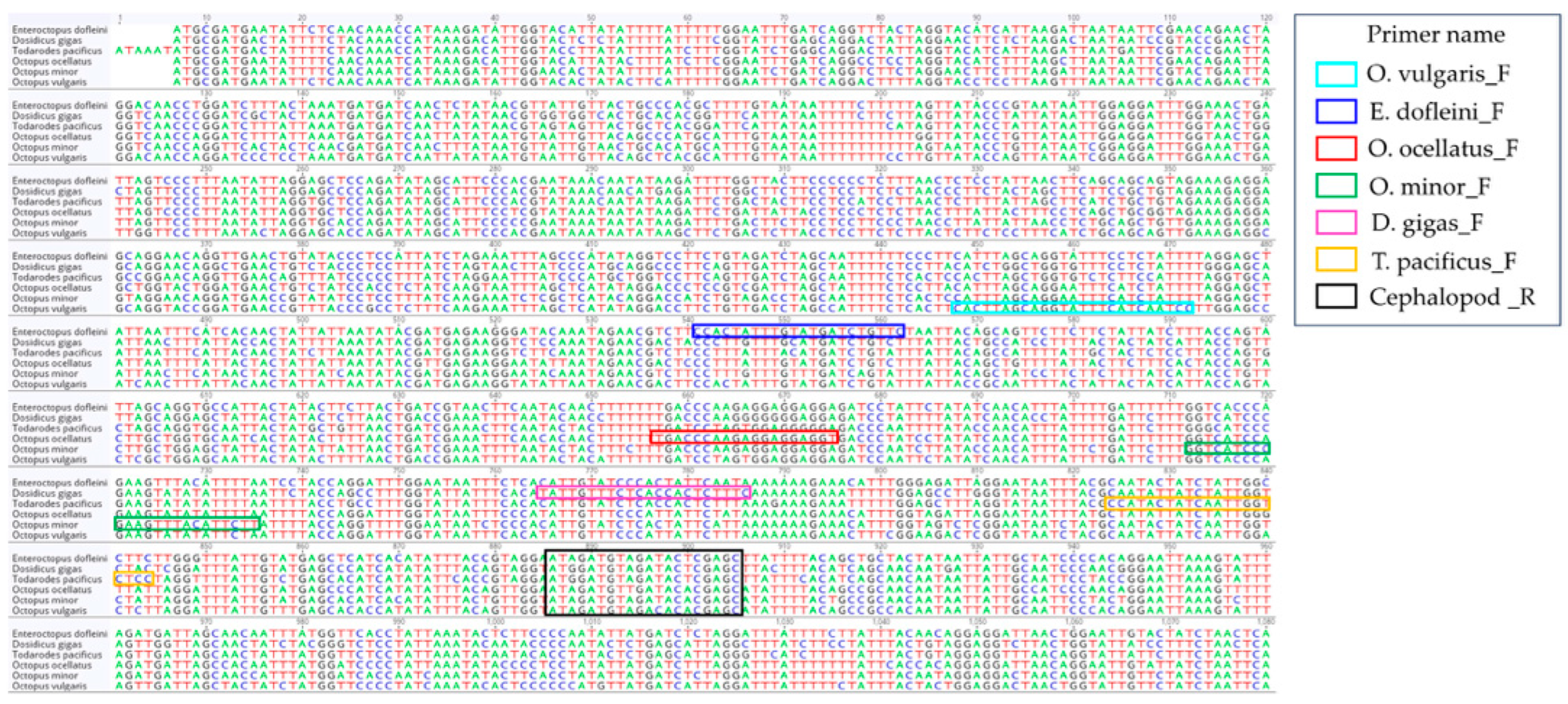
Alignment of the COI region across the six target cephalopods revealed multiple nucleotide positions suitable for species-level primer discrimination. Forward primers were therefore placed in variable regions so that each target taxon carried diagnostic sequence information near the 3′ end of the primer (Figure 1), a configuration expected to suppress extension from non-target templates and thereby improve analytical specificity [17]. To support multiplex compatibility, the reverse primer was designed within a relatively conserved segment shared across the six taxa, and degenerate bases were introduced only where necessary to accommodate limited interspecific variation [18,19,20]. This primer arrangement allowed the assay to retain species selectivity while generating band sizes that could be readily distinguished on standard agarose gels [19,20].

3.2. Species Resolution by the Multiplex PCR Assay

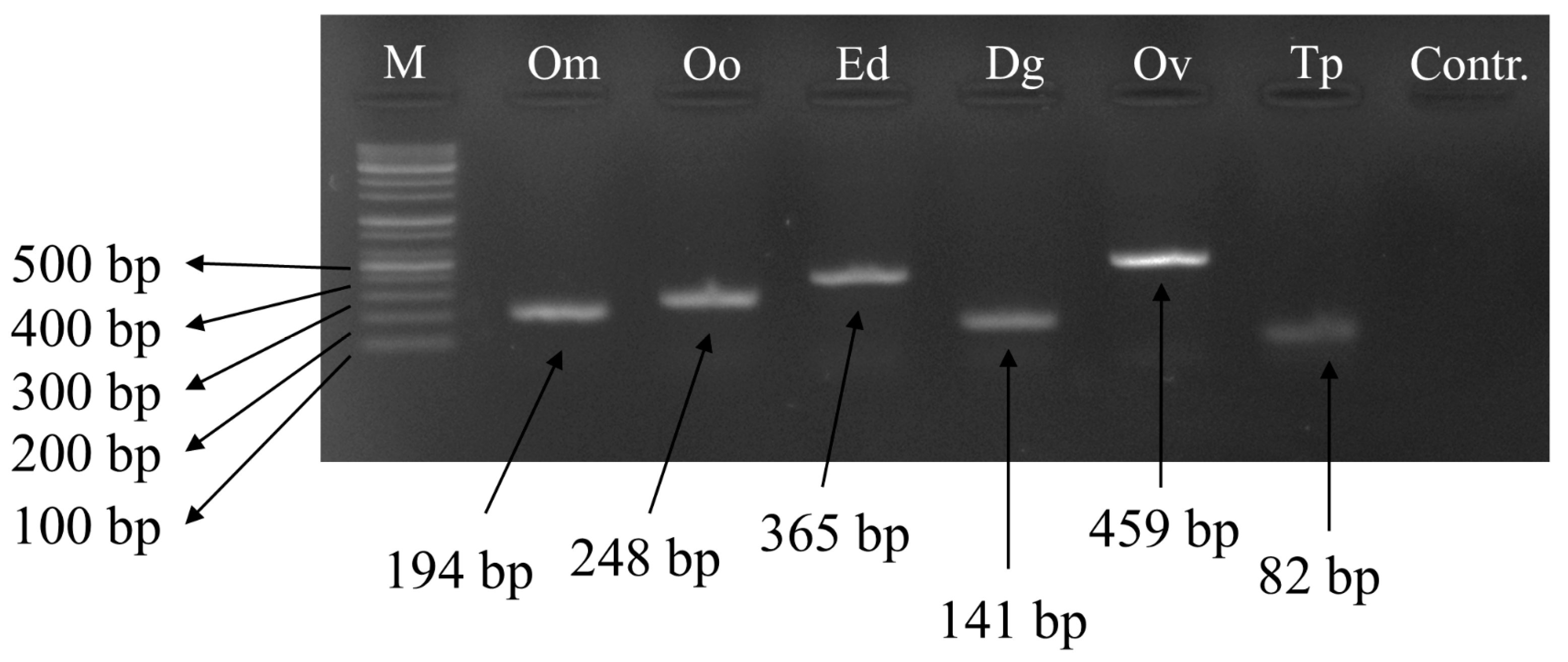
The finalized primer set generated a distinct amplification product for each of the six target species in a single multiplex reaction. All amplicons were resolved at their expected sizes, namely 459 bp for O. vulgaris, 365 bp for E. dofleini, 248 bp for O. ocellatus, 194 bp for O. minor, 141 bp for D. gigas, and 82 bp for T. pacificus (Table 1, Figure 2). No ambiguous overlap among diagnostic bands was observed under the tested conditions, indicating that the size structure of the assay was appropriate for straightforward gel-based identification. These findings show that the primer panel can distinguish the six target cephalopod species under conditions where external morphological diagnosis is not feasible. Because the assay was evaluated only using the six target species, its diagnostic interpretation should be restricted to these species and to the experimental conditions tested in this study.
The utility of this assay extends beyond visual band separation because it addresses a set of cephalopod species that may be difficult to distinguish in frozen trade materials. For routine inspection work, methods are most useful when they combine reliable species resolution with low operational burden and uncomplicated result interpretation [11]. In this respect, the clear size separation among the six diagnostic amplicons is an important advantage of the assay, because it enables direct visual interpretation on standard agarose gels. Accordingly, the assay may be useful as a first-line screening tool in laboratories that process many samples and cannot rely on sequencing for every case [11,15]. Because this method is based on multiplex amplification and gel-based size discrimination, it should be interpreted as a preliminary screening tool rather than as a replacement for sequence-based confirmation. Multiplex PCR can be affected by primer interactions, differential amplification efficiency, and preferential amplification among targets, which may complicate downstream interpretation when multiple primer pairs are included in a single reaction [21,22]. Therefore, future studies should validate representative diagnostic bands by singleplex PCR or standard COI barcoding followed by Sanger sequencing, particularly for ambiguous samples, legally sensitive applications, or broader regulatory use [9]. Compared with DNA barcoding and DNA metabarcoding, the present multiplex PCR assay does not require sequencing or post-sequencing bioinformatic analysis, although it is limited to the six predefined target species [11,12]. Real-time PCR and RPA-LFA assays may provide higher analytical sensitivity or field-deployable detection, but they require specialized instruments, assay formats, or target-specific validation [11,15,23]. Therefore, the practical value of the present assay lies in its low-cost, gel-based format and its ability to simultaneously discriminate six commercially important cephalopod species in a single conventional PCR reaction. Because the assay was developed for visible cephalopod tissue materials, such as frozen blocks or cut portions, its primary purpose was rapid species-level screening of predefined target species rather than trace-level detection, quantitative analysis, or real-time PCR-based confirmation.

3.3. Evaluation of Annealing Temperature Conditions for the Multiplex PCR Assay

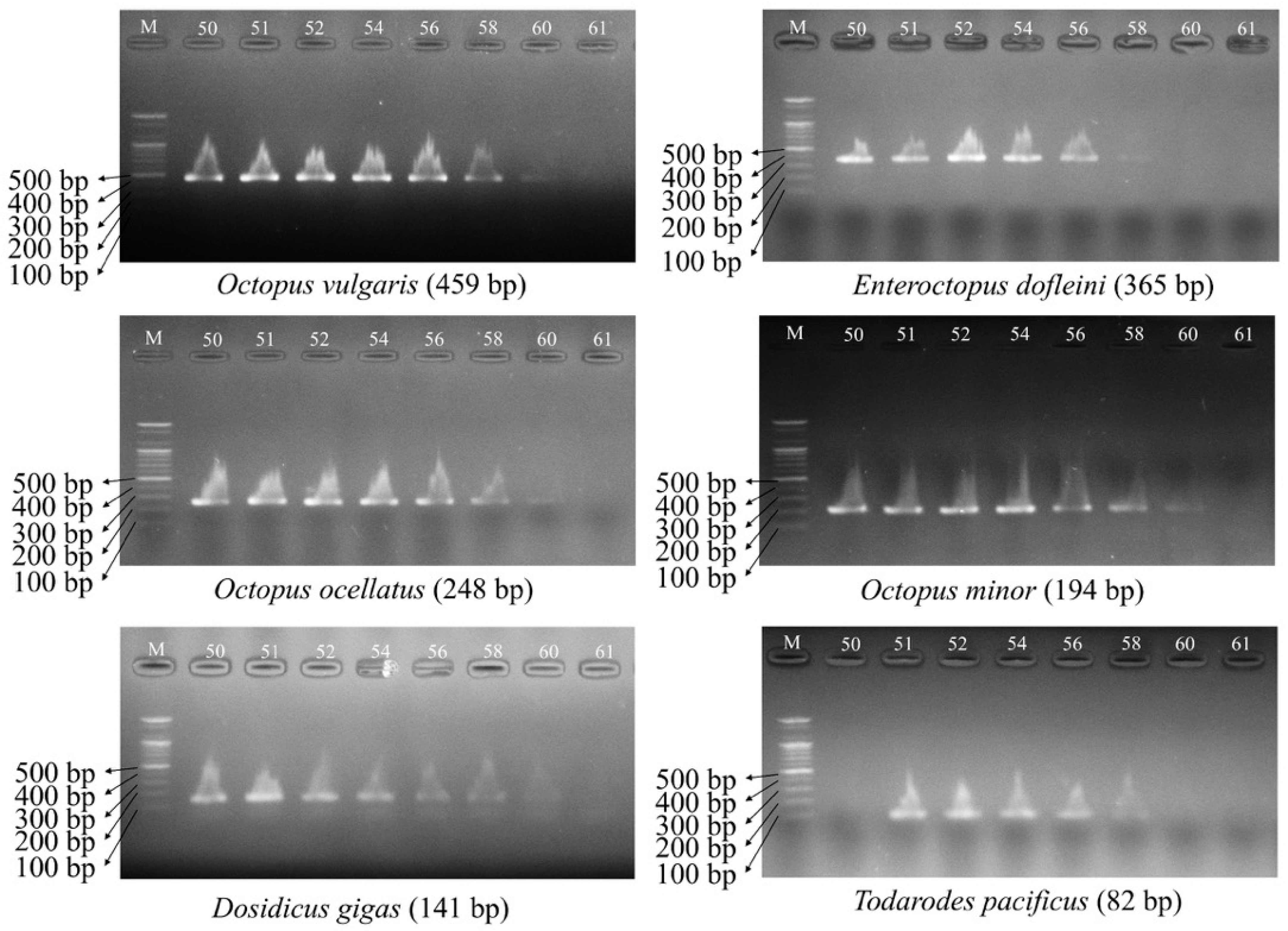
The multiplex assay was evaluated across annealing temperatures from 50 to 61 °C in order to define conditions suitable for routine application (Figure 3). Among the tested annealing temperatures, 51, 52, and 54 °C yielded the clearest and most reproducible species-diagnostic bands and were therefore selected as the optimal annealing conditions. This temperature tolerance is advantageous for practical laboratory use because it reduces sensitivity to minor run-to-run variation and facilitates method transfer between laboratories [24,25]. Accordingly, 52 °C was used as the standard annealing temperature for subsequent analyses, while 51–54 °C was considered a practical working range.
The observed tolerance across several annealing temperatures is also meaningful for practical assay deployment. In routine diagnostic or food control laboratories, minor variation in thermocycler performance, reagent lots, and sample quality can influence amplification outcomes [24]. Methods that depend on a highly restricted thermal condition may be less convenient to reproduce across laboratories, whereas assays that remain functional over a modest temperature interval are more adaptable in routine use [13,25]. The ability of the present primer panel to yield clear diagnostic bands at 51–54 °C therefore suggests that the method has useful operational tolerance for routine implementation rather than being dependent on a highly restrictive thermal condition. Although minor peak-like or curved band shapes were observed in some lanes, these features were not interpreted as additional PCR products because the diagnostic bands were detected at the expected species-specific amplicon sizes. Such minor band-shape distortion may arise from gel loading, well geometry, sample distribution, electrophoretic migration, or image acquisition conditions, which are known to affect band morphology in agarose gel electrophoresis [26].

3.4. Effect of Template DNA Concentration on Multiplex PCR Amplification Efficiency

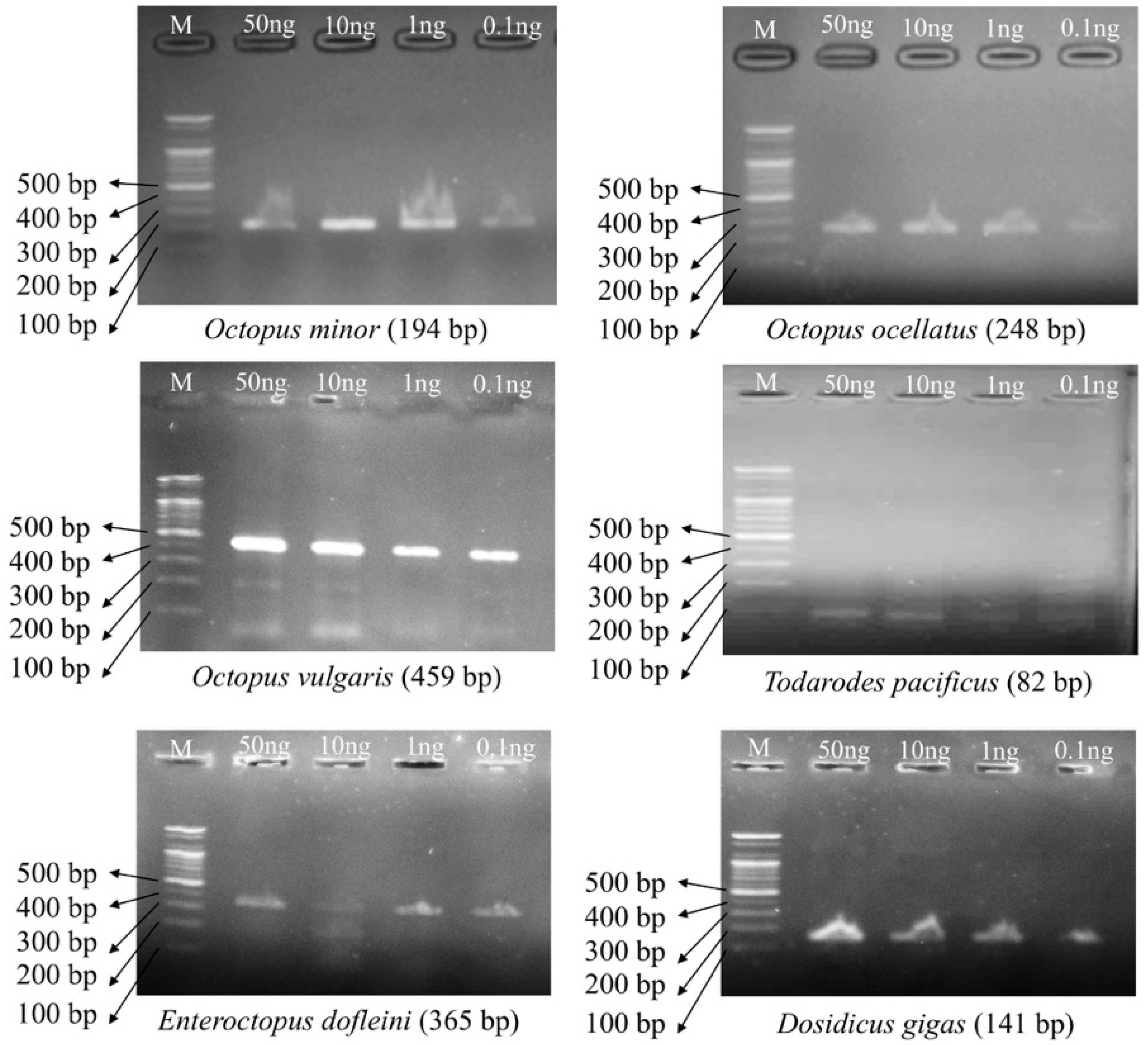
Species-specific amplification was observed across the tested concentration series, and clear diagnostic bands were reproducibly retained down to 1 ng of template DNA per reaction. Although amplification was still detectable at lower inputs in some cases, 1 ng was the lowest concentration that consistently produced clear diagnostic bands across species. Although band intensity generally declined as DNA input decreased, the expected diagnostic fragments remained detectable at 1 ng, which supports the sensitivity of the method for applications involving low-yield extracts or partially degraded material. Because the present assay is a qualitative endpoint multiplex PCR assay, agarose gel band intensity was not used as a quantitative measure of the initial template DNA concentration. In endpoint PCR, final product yield may be influenced by plateau-phase amplification, primer depletion, primer-pair efficiency, primer characteristics, and reaction competition rather than by template input alone [27]. Therefore, occasional differences in band brightness across the DNA concentration series, including stronger bands at lower template inputs in some lanes, were not interpreted quantitatively. The relatively faint band observed for T. pacificus in Figure 4 was retained as a positive diagnostic signal because it appeared at the expected amplicon size of 82 bp. Accordingly, diagnostic interpretation was based on the presence of species-specific bands at the expected sizes, rather than on absolute band intensity. Taken together, these findings indicate that the assay provides sufficient analytical sensitivity for routine species verification of commercial cephalopod products, particularly when template DNA is available at 1 ng per reaction or higher.
The consistent detection observed at 1 ng of template DNA suggests that the assay can accommodate DNA amounts likely to be encountered in commercial sample testing [15,28]. In seafood authentication, DNA quantity and quality are not always optimal, especially when tissues are frozen for extended periods or sampled from fragmented raw materials [28,29]. Under such conditions, an assay does not necessarily need to detect extremely low copy numbers if it can reliably produce interpretable results from typical extracted DNA concentrations encountered in routine monitoring [15]. In practical terms, this result suggests that the assay should remain usable for many frozen-material samples, including those yielding less DNA than freshly collected tissue.
This study should also be interpreted in light of several limitations. This assay was assessed using authenticated reference materials and controlled DNA inputs, whereas its performance in highly processed commercial products was not examined. Since processing can compromise DNA quality, further validation is required for broader application to processed samples [30,31]. Moreover, expanded cross-reactivity testing against closely related and commercially relevant non-target cephalopod species would further support analytical specificity and would be necessary before applying the assay to broader regulatory testing or expanded market-surveillance programs [14,28,32]. Further evaluation using more diverse commercial products will be necessary to define the scope of this method in routine food testing [28,32]. Future validation should include repeatability, reproducibility, mixed-sample testing, broader non-target testing, processed-product evaluation, and inter-laboratory assessment before regulatory implementation.

4. Conclusions

We developed a conventional COI-targeted multiplex PCR assay capable of simultaneously identifying six commercially important cephalopod species, O. vulgaris, O. ocellatus, O. minor, E. dofleini, D. gigas, and T. pacificus, in a single reaction. The assay generated clearly separated diagnostic amplicons, remained stable across the tested annealing conditions, and consistently detected target DNA at template inputs of 1 ng or higher. Using species-directed forward primers together with a common reverse primer in the COI region, the assay offers a simple gel-based option for identifying frozen cephalopod materials in routine testing contexts. Its applicability to processed seafood products remains to be further validated. This primer set may serve as a practical preliminary screening option for laboratories involved in seafood inspection, especially when the rapid verification of frozen materials corresponding to the six target species is required.

Supplementary Materials

The following supporting information can be downloaded at: https://www.mdpi.com/article/10.3390/foods15122098/s1, Figure S1, Quantitative band measurements for six cephalopod species.; Table S1, Sampling sites of six cephalopod species in the study.

Author Contributions

Conceptualization, K.-R.K. and I.-C.B.; methodology, K.-R.K., and H.-J.K.; software, K.-R.K.; validation, K.-R.K., H.-J.K. and S.J.P.; formal analysis, K.-R.K.; investigation, K.-R.K.; resources, K.-R.K.; data curation, K.-R.K.; writing—original draft preparation, K.-R.K.; writing—review and editing, K.-R.K.; visualization, K.-R.K.; supervision, K.-R.K. and I.-C.B.; project administration, I.-C.B.; funding acquisition, I.-C.B. All authors have read and agreed to the published version of the manuscript.

Funding

This research was supported by the project “Development of Discrimination Method and Onsite Kit for Geographical Origin of Fishery Product” funded by the Ministry of Oceans and Fisheries, Republic of Korea (20200425-03), and by research funding from Soonchunhyang University and the National Institute of Fisheries Science, Ministry of Oceans and Fisheries, Republic of Korea (R2026025).

Institutional Review Board Statement

Ethical review and approval were waived for this study because ethics approval is not required for invertebrates under the regulations of the National Institute of Fisheries Science. This study did not involve live animals. All cephalopod specimens were purchased postmortem from commercial seafood markets, and no live animals were captured, handled, maintained, experimentally manipulated, or euthanized for the purposes of this research. Accordingly, this work did not constitute an animal experiment requiring Institutional Animal Care and Use Committee review under the applicable Korean legal framework, because the use of commercially obtained dead specimens for laboratory analysis falls outside the scope of animal experimentation requiring ethical approval in Korea.

Informed Consent Statement

Not applicable.

Data Availability Statement

The data presented in this study are available on request from the corresponding author.

Acknowledgments

During the preparation of this manuscript, the authors used ChatGPT version 5.5 and Gemini Pro version 3.1 for the purposes of translation and grammar correction. The authors have reviewed and edited the output and take full responsibility for the content of this publication.

Conflicts of Interest

The authors, Kang-Rae Kim and In-Chul Bang, are inventors of a Korean patent application published under 1027512000000 (https://doi.org/10.8080/1020210164114), which relates to a multiplex PCR assay for species identification. The authors declare that they have no additional conflicts of interest and have not currently received any financial benefit from this patent.

References

  1. Ospina-Alvarez, A.; de Juan, S.; Pita, P.; Ainsworth, G.B.; Matos, F.L.; Pita, C.; Villasante, S. A network analysis of global cephalopod trade. Sci. Rep. 2022, 12, 322. [Google Scholar] [CrossRef]
  2. Mouritsen, O.G.; Styrbæk, K. Cephalopod gastronomy—A promise for the future. Front. Commun. 2018, 3, 38. [Google Scholar] [CrossRef]
  3. Arkhipkin, A.I.; Rodhouse, P.G.; Pierce, G.J.; Sauer, W.; Sakai, M.; Allcock, L.; Arguelles, J.; Bower, J.R.; Castillo, G.; Ceriola, L. World squid fisheries. Rev. Fish. Sci. Aquac. 2015, 23, 92–252. [Google Scholar] [CrossRef]
  4. Gleadall, I.G.; Moustahfid, H.; Sauer, W.H.; Ababouch, L.; Arkhipkin, A.I.; Bensbai, J.; Elegbede, I.; Faraj, A.; Ferreiro-Velasco, P.; González-Gómez, R. Towards global traceability for sustainable cephalopod seafood. Mar. Biol. 2024, 171, 44. [Google Scholar]
  5. Ainsworth, G.B.; Pita, P.; Pita, C.; Roumbedakis, K.; Pierce, G.J.; Longo, C.; Verutes, G.; Fonseca, T.; Castelo, D.; Montero-Castaño, C. Identifying sustainability priorities among value chain actors in artisanal common octopus fisheries. Rev. Fish Biol. Fish. 2023, 33, 669–698. [Google Scholar]
  6. Lee, Y.-M.; Lee, G.-Y.; Kim, H.-Y. Development of a multiplex PCR assay for the simultaneous detection of big blue octopus (Octopus cyanea), giant Pacific octopus (Enteroctopus dofleini), and common octopus (Octopus vulgaris). Food Sci. Biotechnol. 2022, 31, 497–504. [Google Scholar] [CrossRef]
  7. Jin, P.; Zhang, Y.; Du, Y.; Chen, X.; Kindong, R.; Xue, H.; Chai, F.; Yu, W. Eddy impacts on abundance and habitat distribution of a large predatory squid off Peru. Mar. Environ. Res. 2024, 195, 106368. [Google Scholar] [CrossRef]
  8. Chang, C.-H.; Kao, Y.-T.; Huang, T.-T.; Wang, Y.-C. Product authentication using two mitochondrial markers reveals inconsistent labeling and substitution of canned tuna products in the Taiwanese market. Foods 2021, 10, 2655. [Google Scholar] [CrossRef]
  9. Wen, J.; Tinacci, L.; Acutis, P.; Riina, M.; Xu, Y.; Zeng, L.; Ying, X.; Chen, Z.; Guardone, L.; Chen, D. An insight into the Chinese traditional seafood market: Species characterization of cephalopod products by DNA barcoding and phylogenetic analysis using COI and 16SrRNA genes. Food Control 2017, 82, 333–342. [Google Scholar] [CrossRef]
  10. Yang, F.; Ding, F.; Chen, H.; He, M.; Zhu, S.; Ma, X.; Jiang, L.; Li, H. DNA barcoding for the identification and authentication of animal species in traditional medicine. Evid.-Based Complement. Altern. Med. 2018, 2018, 5160254. [Google Scholar] [CrossRef]
  11. Velasco, A.; Ramilo-Fernández, G.; Denis, F.; Oliveira, L.; Shum, P.; Silva, H.; Sotelo, C.G. A new rapid method for the authentication of common octopus (Octopus vulgaris) in seafood products using recombinase polymerase amplification (rpa) and lateral flow assay (lfa). Foods 2021, 10, 1825. [Google Scholar] [CrossRef] [PubMed]
  12. Giagkazoglou, Z.; Loukovitis, D.; Gubili, C.; Chatziplis, D.; Symeonidis, A.; Imsiridou, A. Untangling the cephalopod market: Authentication of seafood products in Greece with DNA-barcoding. Food Control 2024, 163, 110523. [Google Scholar] [CrossRef]
  13. Günther, B.; Bierne, N.; Borsa, P.; Perrin, C.; Ripoll, O.; Darbois, F.; Arnaud-Haond, S. Citizen science approach for genetic species identification in a local French seafood speciality. Int. J. Gastron. Food Sci. 2024, 35, 100823. [Google Scholar] [CrossRef]
  14. Andronache, J.; Cichna-Markl, M.; Dobrovolny, S.; Hochegger, R. Development of a DNA metabarcoding method for the identification of crustaceans (malacostraca) and cephalopods (coleoidea) in processed foods. Foods 2025, 14, 1549. [Google Scholar] [CrossRef]
  15. Gil, L.A. PCR-based methods for fish and fishery products authentication. Trends Food Sci. Technol. 2007, 18, 558–566. [Google Scholar] [CrossRef]
  16. Espiñeira, M.; Vieites, J.M.; Santaclara, F.J. Species authentication of octopus, cuttlefish, bobtail and bottle squids (families Octopodidae, Sepiidae and Sepiolidae) by FINS methodology in seafoods. Food Chem. 2010, 121, 527–532. [Google Scholar] [CrossRef]
  17. Huang, K.; Zhang, J.; Li, J.; Qiu, H.; Wei, L.; Yang, Y.; Wang, C. Exploring the impact of primer–template mismatches on PCR performance of DNA polymerases varying in proofreading activity. Genes 2024, 15, 215. [Google Scholar] [CrossRef]
  18. Nam, Y.R.; Lee, U.; Choi, H.S.; Lee, K.J.; Kim, N.; Jang, Y.J.; Joo, C.H. Degenerate PCR primer design for the specific identification of rhinovirus C. J. Virol. Methods 2015, 214, 15–24. [Google Scholar] [CrossRef] [PubMed]
  19. Kim, K.-R.; Kim, H.-J.; Bang, I.-C. Development of a Rapid and Cost-Effective Multiplex PCR Assay for the Simultaneous Identification of Three Commercially Important Sea Squirt Species (Halocynthia spp.). Foods 2025, 14, 3003. [Google Scholar] [CrossRef]
  20. Kim, K.-R.; Kim, H.-J.; Bang, I.-C. Development of a Multiplex PCR Assay for Simultaneous Identification of Six Commercially Important Bivalves. Foods 2025, 14, 3881. [Google Scholar] [CrossRef]
  21. Elnifro, E.M.; Ashshi, A.M.; Cooper, R.J.; Klapper, P.E. Multiplex PCR: Optimization and application in diagnostic virology. Clin. Microbiol. Rev. 2000, 13, 559–570. [Google Scholar] [CrossRef] [PubMed]
  22. Fernandes, T.J.; Amaral, J.S.; Mafra, I. DNA barcode markers applied to seafood authentication: An updated review. Crit. Rev. Food Sci. Nutr. 2021, 61, 3904–3935. [Google Scholar] [CrossRef]
  23. Velasco, A.; Ramilo-Fernández, G.; Sotelo, C.G. A real-time PCR method for the authentication of common cuttlefish (Sepia officinalis) in food products. Foods 2020, 9, 286. [Google Scholar] [CrossRef] [PubMed]
  24. Saunders, G.C.; Dukes, J.; Parkes, H.C.; Cornett, J.H. Interlaboratory study on thermal cycler performance in controlled PCR and random amplified polymorphic DNA analyses. Clin. Chem. 2001, 47, 47–55. [Google Scholar] [CrossRef] [PubMed]
  25. Luque-Perez, E.; Mazzara, M.; Weber, T.P.; Foti, N.; Grazioli, E.; Munaro, B.; Pinski, G.; Bellocchi, G.; Van den Eede, G.; Savini, C. Testing the robustness of validated methods for quantitative detection of GMOs across qPCR instruments. Food Anal. Methods 2013, 6, 343–360. [Google Scholar] [CrossRef][Green Version]
  26. Johnson, P.H.; Miller, M.J.; Grossman, L.I. Electrophoresis of DNA in agarose gels: II. Effects of loading mass and electroendosmosis on electrophoretic mobilities. Anal. Biochem. 1980, 102, 159–162. [Google Scholar] [CrossRef]
  27. Jansson, L.; Hedman, J. Challenging the proposed causes of the PCR plateau phase. Biomol. Detect. Quantif. 2019, 17, 100082. [Google Scholar] [CrossRef]
  28. Silva, A.J.; Hellberg, R.S. DNA-based techniques for seafood species authentication. In Advances in Food and Nutrition Research; Elsevier: Amsterdam, The Netherlands, 2021; Volume 95, pp. 207–255. [Google Scholar]
  29. Lin, Y.; Yanhua, J.; Qingjiao, L.; Zhe, S.; Lianzhu, W.; Yuxiu, Z. A comparison of eight methods for DNA etraction from processed seafood products. Food Sci. Technol. Res. 2016, 22, 751–757. [Google Scholar] [CrossRef]
  30. Shokralla, S.; Hellberg, R.S.; Handy, S.M.; King, I.; Hajibabaei, M. A DNA mini-barcoding system for authentication of processed fish products. Sci. Rep. 2015, 5, 15894. [Google Scholar] [CrossRef]
  31. Lo, Y.-T.; Shaw, P.-C. DNA-based techniques for authentication of processed food and food supplements. Food Chem. 2018, 240, 767–774. [Google Scholar] [CrossRef]
  32. Weidner, C.; Köppel, R.; Freyer, R.; Richl, P.; Lieske, K.; Mankertz, J.; Waiblinger, H.-U. Development and validation of a multiplex real-time PCR method for screening genetically modified plants. J. Consum. Prot. Food Saf. 2024, 19, 165–174. [Google Scholar] [CrossRef]
Figure 1. Alignment-guided design of the COI-targeted multiplex primer panel for six cephalopod species. Colored boxes indicate the binding positions of the species-specific forward primers for O. vulgaris, E. dofleini, O. ocellatus, O. minor, D. gigas, and T. pacificus, respectively. The shared reverse primer region is shown within the most conserved segment of the alignment.
Foods 15 02098 g001
Figure 2. Representative multiplex PCR profiles obtained from the six target cephalopod species. M, DNA size marker; Ov, Octopus vulgaris; Ed, Enteroctopus dofleini; Oo, Octopus ocellatus; Om, Octopus minor; Dg, Dosidicus gigas; Tp, Todarodes pacificus; Contr., negative control.
Foods 15 02098 g002
Figure 3. Multiplex PCR amplification patterns of the six-species cephalopod primer panel across annealing temperatures from 50 to 61 °C. M, DNA size marker; numerals above lanes indicate the annealing temperature used in each reaction. Diagnostic interpretation was based on the presence of bands at the expected species-specific amplicon sizes.
Foods 15 02098 g003
Figure 4. Multiplex PCR sensitivity of the six-species cephalopod assay across template DNA inputs of 50, 10, 1, and 0.1 ng per reaction. Species-specific banding patterns were evaluated to determine the lower detectable template input and amplification stability across the tested concentration series. Diagnostic interpretation was based on the presence of bands at the expected species-specific amplicon sizes rather than on minor differences in band intensity.
Foods 15 02098 g004
Table 1. COI-targeted species-specific primers used in the multiplex PCR assay for six commercially important cephalopods.
Primer NameScientific NameSequence (5′-3′)Primer DirectionExpected Amplification Product Size (bp)
O. vulgaris_FOctopus vulgarisCACTTAGCAGGTATTTCATCAATCCForward459
E. dofleini_FEnteroctopus dofleiniCCACTATTTGTATGATCTGTTCForward365
O. ocellatus_FOctopus ocellatusTGACCCAAGAGGAGGAGGTForward248
O. minor_FOctopus minorGGTCATCCCGAAGTTTACATTCTTForward194
D. gigas_FDosidicus gigasTATTGTTTCTCACCACTCTTTCForward141
T. pacificus_FTodarodes pacificusCCATACTATCAATTGGTCTCCForward82
Cephalopod_R-GCWCGWGTRTCWACATCYATReverse-
Disclaimer/Publisher’s Note: The statements, opinions and data contained in all publications are solely those of the individual author(s) and contributor(s) and not of MDPI and/or the editor(s). MDPI and/or the editor(s) disclaim responsibility for any injury to people or property resulting from any ideas, methods, instructions or products referred to in the content.