Institutional Integration and Risk-Based Food Safety Governance in South Korea: A Structured Narrative Review Using the FAO/WHO National Food Control System Framework



Abstract
1. Introduction
2. Evaluation Framework and Methodology
2.1. Review Type and Analytical Strategy
2.2. Sources, Search Strategy and Inclusion Criteria
2.3. Indicator Mapping to the FAO/WHO Framework
2.4. Data Extraction and Quantitative Treatment
2.5. Methodological Limitations
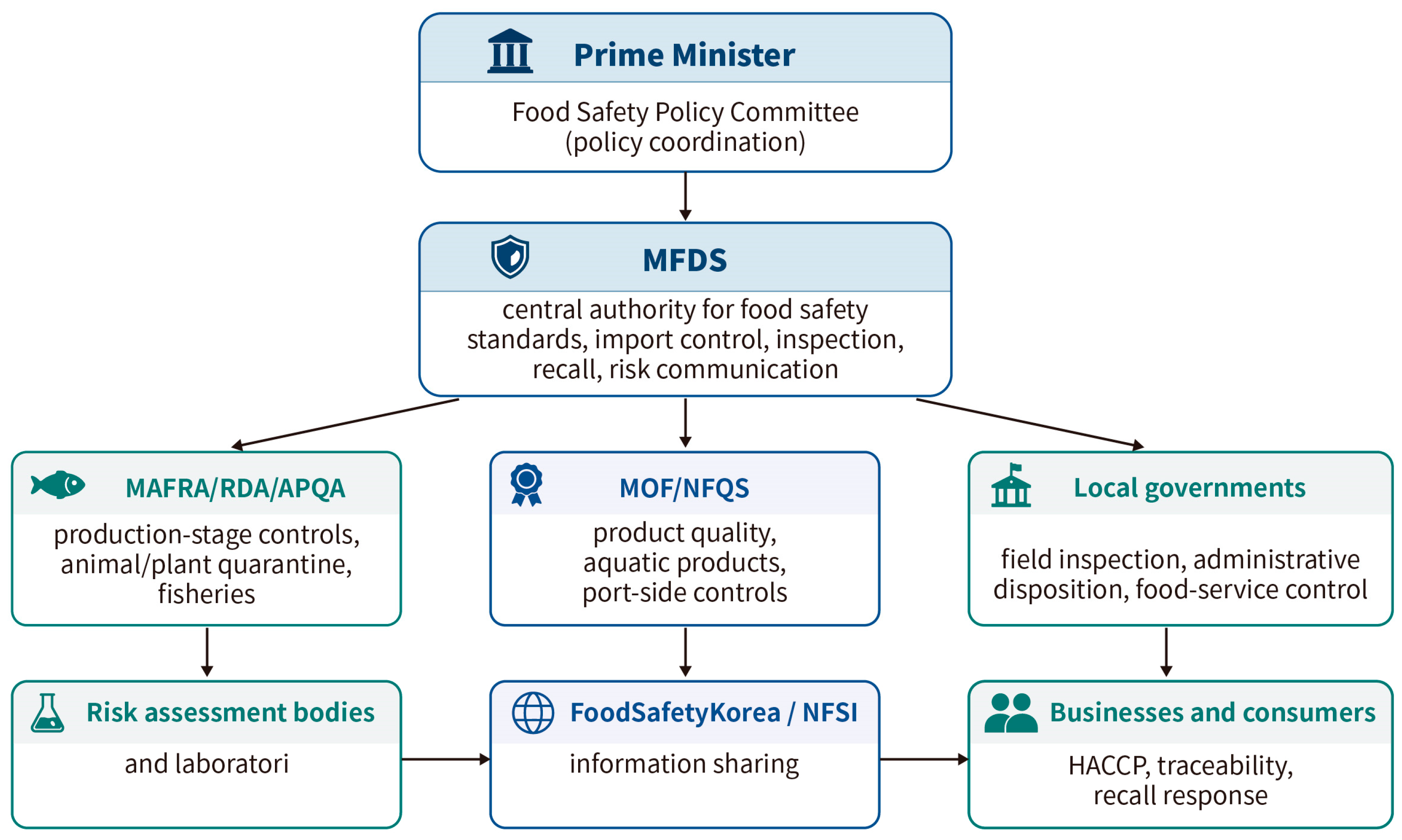
3. Institutional Architecture of South Korea’s Food Control System
3.1. From Fragmented Administration to Coordinated Central Authority
3.2. Legal Foundations and Their Functions
3.3. Institutional Resources and Enforcement Context
4. Operational Mechanisms: Risk-Based Monitoring, PLS, Traceability and Crisis Response
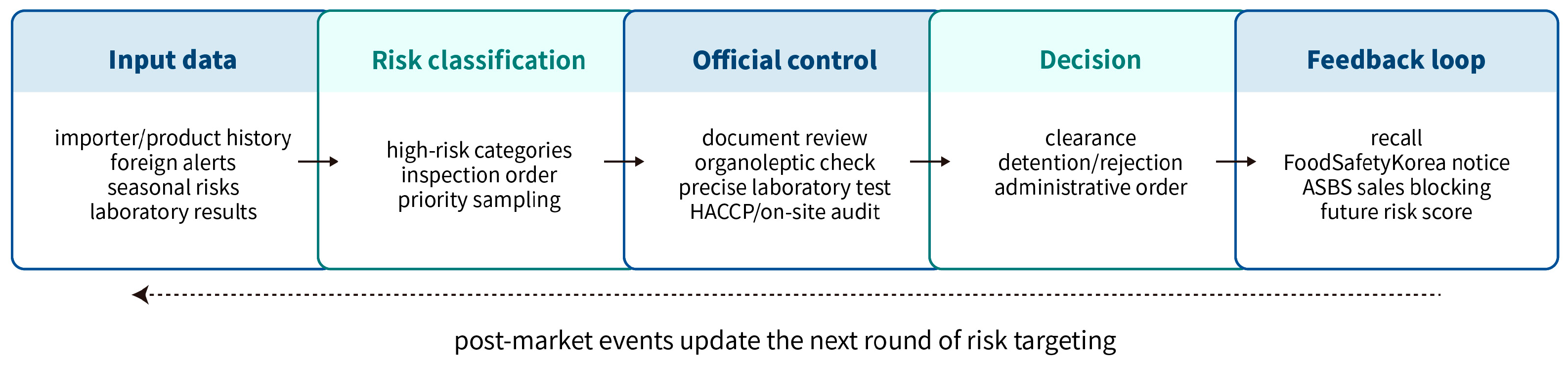
4.1. Risk-Oriented Targeted Monitoring and Import Controls
4.2. Positive List System and Maximum-Residue Governance
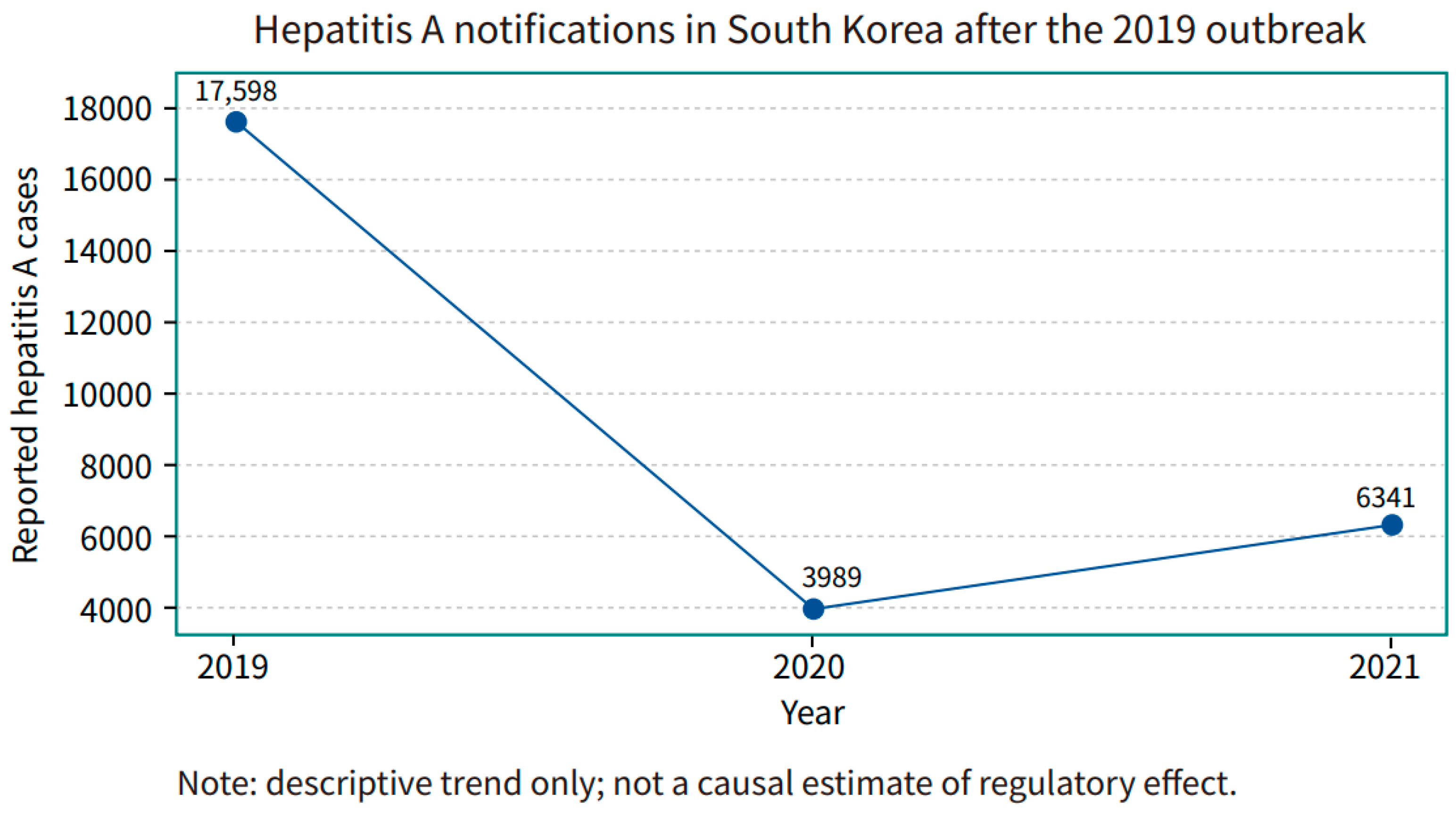
4.3. Hepatitis A Outbreak: Useful Case but Not Causal Proof
4.4. Digital Traceability, Recall and Privacy Safeguards
5. International Perspective: United States, European Union and China
5.1. Korea and the United States FSMA Model
5.2. Korea and the EU Risk-Assessment Model
6. Practical Challenges and Emerging Issues
6.1. SME Compliance Burden and Proportional Regulation
6.2. Novel Foods and Cell-Cultured Food Ingredients
6.3. Cross-Border e-Commerce and Overseas Direct Purchases
6.4. Risk Communication, Social Media and Nutritional Implications
7. Conclusions
Author Contributions
Funding
Institutional Review Board Statement
Informed Consent Statement
Data Availability Statement
Conflicts of Interest
References
- USDA Foreign Agricultural Service. Republic of Korea: Exporter Guide Annual; Seoul ATO: Seoul, Republic of Korea, 2025. Available online: https://apps.fas.usda.gov/ (accessed on 19 May 2026).
- Netherlands Ministry of Agriculture, Fisheries, Food Security and Nature. South Korea’s Grain Self-Sufficiency Rate Dropped Below 20%, Creating Serious Concerns for Food Security. 8 July 2022. Available online: https://www.agroberichtenbuitenland.nl/ (accessed on 19 May 2026).
- World Trade Organization. Agreement on the Application of Sanitary and Phytosanitary Measures. Available online: https://www.wto.org/english/tratop_e/sps_e/spsagr_e.htm (accessed on 19 May 2026).
- World Trade Organization. Agreement on Technical Barriers to Trade. Available online: https://www.wto.org/english/tratop_e/tbt_e/tbt_e.htm (accessed on 19 May 2026).
- Codex Alimentarius Commission. Principles and Guidelines for National Food Control Systems, CAC/GL 82-2013; FAO/WHO: Rome, Italy, 2013. [Google Scholar]
- Sohn, M.-G.; Oh, S. Global harmonization of food safety regulation from the perspective of Korea and a novel fast automatic product recall system. J. Sci. Food Agric. 2014, 94, 1932–1936. [Google Scholar] [CrossRef] [Scilit] [PubMed]
- Lee, J.-G.; Lee, Y.; Kim, C.S.; Han, S.B. Codex Alimentarius Commission on ensuring food safety and promoting fair trade: Harmonization of standards between Korea and Codex. Food Sci. Biotechnol. 2021, 30, 1151–1170. [Google Scholar] [CrossRef] [Scilit] [PubMed]
- Lee, B.O. Main structure of agro-food safety control system in Korea. J. Agric. Life Environ. Sci. 2014, 26, 52–64. [Google Scholar]
- Jianjun, L. Analysis of food safety standards system of South Korean. J. Food Saf. Qual. 2016, 7, 3815–3818. [Google Scholar]
- Ningxin, Z.; Yiqing, S.; Ming, Q.; Zhigang, W. Food safety law and regulation of South Korea and its implications for China. World Agric. 2014, 82–87, 195–196. [Google Scholar]
- Son, S. Transitions in South Korean public food procurement policy: Landscape context, institutionalization, and local agents. Environ. Innov. Soc. Transit. 2023, 48, 100731. [Google Scholar] [CrossRef] [Scilit]
- Kim, Y.R.; Park, D.; Sim, J.H.; Lee, H.; Kim, J.Y.; Shin, D.-W.; Eom, M.O. National long-term monitoring and risk assessment of various veterinary drug residues in livestock products in the Republic of Korea. Food Control 2025, 167, 110818. [Google Scholar] [CrossRef] [Scilit]
- Holdaway, J.; Husain, L. Food Safety in China: A Mapping of Problems, Governance and Research; Forum on Health, Environment and Development (FORHEAD): Leiden, The Netherlands, 2013. [Google Scholar]
- FAO; WHO. Assuring Food Safety and Quality: Guidelines for Strengthening National Food Control Systems; FAO Food and Nutrition Paper 76; FAO/WHO: Rome, Italy, 2003; Available online: https://www.fao.org/4/y8705e/y8705e00.htm (accessed on 19 May 2026).
- FAO; WHO. Food Control System Assessment Tool: Introduction and Glossary; FAO/WHO: Rome, Italy, 2019; Available online: https://openknowledge.fao.org/handle/20.500.14283/ca5334en (accessed on 19 May 2026).
- Korean Law Translation Center. Framework Act on Food Safety. Available online: https://elaw.klri.re.kr/eng_service/lawView.do?hseq=71683&lang=ENG (accessed on 19 May 2026).
- Korean Law Translation Center. Food Sanitation Act. Available online: https://elaw.klri.re.kr/eng_service/lawView.do?hseq=71566&lang=ENG (accessed on 19 May 2026).
- Korean Law Translation Center. Special Act on Imported Food Safety Control. Available online: https://elaw.klri.re.kr/eng_service/lawView.do?hseq=69750&lang=ENG (accessed on 19 May 2026).
- Korean Law Translation Center. Health Functional Foods Act. Available online: https://elaw.klri.re.kr/eng_service/lawView.do?hseq=68131&lang=ENG (accessed on 19 May 2026).
- Korean Law Translation Center. Livestock Products Sanitary Control Act. Available online: https://elaw.klri.re.kr/eng_service/lawView.do?hseq=68723&lang=ENG (accessed on 19 May 2026).
- Korean Law Translation Center. Act on Labeling and Advertising of Foods. Available online: https://elaw.klri.re.kr/eng_mobile/viewer.do?hseq=71236&key=36&type=part (accessed on 19 May 2026).
- Ministry of Food and Drug Safety. Imported Food Safety. Available online: https://www.mfds.go.kr/eng/wpge/m_11/de011002l001.do (accessed on 19 May 2026).
- Ministry of Food and Drug Safety. Food Safety and HACCP Support. Available online: https://www.mfds.go.kr/eng/wpge/m_9/de011001l001.do (accessed on 19 May 2026).
- USDA Foreign Agricultural Service. Korea—Republic of: Implementation of Positive List System for Maximum Residue Limits; USDA Foreign Agricultural Service: Seoul, Republic of Korea, 2018.
- Korea Rural Economic Institute. The Introduction of Positive List System and Its Impacts on Agricultural Sector. 2019. Available online: https://www.krei.re.kr/ (accessed on 19 May 2026).
- Jung, K. Import Tolerance and Positive List System. WTO SPS Committee Workshop Presentation. 2020. Available online: https://www.wto.org/ (accessed on 19 May 2026).
- USDA Foreign Agricultural Service. Update on Korea’s Positive List System for Veterinary Drugs; USDA: Seoul, Republic of Korea, 2023.
- European Parliament and Council. Regulation (EC) No 396/2005 on Maximum Residue Levels of Pesticides in or on Food and Feed of Plant and Animal Origin. Official Journal of the European Union. 2005. Available online: https://eur-lex.europa.eu/eli/reg/2005/396/oj/eng (accessed on 19 May 2026).
- FreshPlaza. Filipino Banana Growers Need More Time to Meet Korean Standards. 5 October 2016. Available online: https://www.freshplaza.com/ (accessed on 19 May 2026).
- Yu, D.; Kang, C.; Yoon, S.; Cho, K. 2020 Infectious Disease and Respiratory Infectious Disease Report, the Republic of Korea. Public Health Wkly. Rep. 2021, 14, 2687–2699. [Google Scholar]
- Ministry of Food and Drug Safety. Information on Hazardous Food Sales Prevention and Public Recall Communication. Available online: https://www.foodsafetykorea.go.kr/ (accessed on 19 May 2026).
- Korean Law Translation Center. Personal Information Protection Act. Available online: https://elaw.klri.re.kr/eng_service/lawView.do?hseq=71740&lang=ENG (accessed on 19 May 2026).
- U.S. Food and Drug Administration. Food Safety Modernization Act (FSMA). Available online: https://www.fda.gov/food/guidance-regulation-food-and-dietary-supplements/food-safety-modernization-act-fsma (accessed on 19 May 2026).
- U.S. Food and Drug Administration. FSMA Final Rule on Foreign Supplier Verification Programs (FSVP) for Importers of Food for Humans and Animals. Available online: https://www.fda.gov/food/food-safety-modernization-act-fsma/fsma-final-rule-foreign-supplier-verification-programs-fsvp-importers-food-humans-and-animals (accessed on 19 May 2026).
- European Food Safety Authority. How EFSA Works: Risk Assessment and Scientific Advice. Available online: https://www.efsa.europa.eu/ (accessed on 19 May 2026).
- European Parliament and Council. Regulation (EC) No 178/2002 Laying Down the General Principles and Requirements of Food Law and Establishing the European Food Safety Authority. Official Journal of the European Communities. 2002. Available online: https://eur-lex.europa.eu/eli/reg/2002/178/oj/eng (accessed on 19 May 2026).
- Yapp, C.; Fairman, R. Factors affecting food safety compliance within small and medium-sized enterprises: Implications for regulatory and enforcement strategies. Food Control 2006, 17, 42–51. [Google Scholar] [CrossRef] [Scilit]
- Fitzsimmons, J.A.; Kinchla, A.J.; Allingham, C. Assessing the cost barrier for small and medium food processing businesses to meet Preventive Controls for Human Foods standards. PLoS ONE 2024, 19, e0306618. [Google Scholar] [CrossRef] [Scilit] [PubMed]
- Ministry of Food and Drug Safety. Standards for Recognition of Temporary Standards and Specifications for Foods (No. 2024-13). Available online: https://www.mfds.go.kr/eng/brd/m_15/list.do (accessed on 19 May 2026).
- Heo, S.; Lee, G.; Jeong, D.W. A study on safety evaluation system of cultured foods among alternative proteins. Food Sci. Biotechnol. 2024, 34, 365–371. [Google Scholar] [CrossRef] [Scilit] [PubMed]
- Ministry of Food and Drug Safety. Measures to Restrict 128 Hazardous Food Products That Have Been Directly Purchased Overseas in the First Half of 2020. Press Release. 6 August 2020. Available online: https://www.mfds.go.kr/eng/ (accessed on 19 May 2026).
- Reuters. South Korea Sea Salt Demand Grows Ahead of Japan’s Fukushima Contaminated Water Release. 11 June 2023. Available online: https://www.reuters.com/ (accessed on 19 May 2026).
- Associated Press. South Koreans Rally in Seoul Against Japanese Plans to Release Treated Nuclear Wastewater into Sea. 2023. Available online: https://apnews.com/ (accessed on 19 May 2026).
- Business Insider. Stop Frying Toothpicks and Eating Them, South Korea Tells Mukbang Influencers. 2024. Available online: https://www.businessinsider.com/ (accessed on 19 May 2026).



| Study | Main Focus | Methodology | Scope | Gap Left Unaddressed |
|---|---|---|---|---|
| Sohn and Oh, 2013/2014 [6] | Institutional reform, harmonization and automatic product recall | Policy review/perspective | Korea, mostly 2008–2013 | Highlights MFDS consolidation and ICT recall systems but does not provide a full FAO/WHO indicator matrix or causal outcome analysis |
| Lee et al., 2021 [7] | Codex, Korean standards and food safety management | Review of Codex harmonization | Korea and Codex, contemporary system | Strong on standards alignment; limited on enforcement data, local implementation and epidemiological outcomes |
| Lee, 2014 [8] | Agro-food safety control structure | Descriptive institutional review | Korea, pre/post-2013 transition | Useful institutional background; limited quantitative validation and no explicit risk-based performance assessment |
| Jianjun, 2016 [9] | Food safety standards system of South Korea | Legal/standards review | South Korea, standards system | Focuses on standards architecture; does not assess operational effectiveness or outcomes |
| Ningxin et al., 2014 [10] | Korean food safety laws and implications for China | Comparative legal review | South Korea and China | Provides comparative lessons but remains policy-descriptive and not data-driven |
| Son, 2023 [11] | Public food procurement and food policy transition | Policy-transition analysis | South Korea, local and national procurement | Relevant to food governance but not primarily a food safety control-system evaluation |
| Kim et al., 2025 [12] | Veterinary drug residues in livestock products | Monitoring and risk assessment | Republic of Korea, long-term monitoring | Provides residue-risk data but focuses on one hazard domain rather than institutional governance |
| Holdaway and Husain/FORHEAD, 2013 [13] | Food safety governance in China | Cross-sector mapping review | China, multi-sector risks | Useful comparator for integrated governance; not Korea-specific and illustrates the need for data integration |
| FAO/WHO Element | Indicator Used in This Review | Data Source | Years | Data Type | Limitations |
|---|---|---|---|---|---|
| Policy and legal framework | Existence and scope of framework laws, food sanitation law, imported food law, health functional food law, labeling law [16,17,18,19,20,21] | Korean legal database; MFDS English regulations; National Assembly records | 2000–2025 | Normative/legal | Legal existence does not show enforcement quality; translations may lag behind Korean amendments |
| Institutional capacity and coordination | MFDS mandate, regional offices, inter-ministerial coordination, division of roles with MAFRA/MOF/local governments | MFDS website; laws; annual reports; official organizational charts | 2013–2025 | Institutional/descriptive | Budget and staffing categories are not always comparable across ministries or countries |
| Risk-based official control | Inspection orders, risk categorization, PLS, HACCP support, targeted import checks [22,23] | MFDS Imported Food Safety pages; USDA GAIN; KREI; WTO SPS materials | 2017–2025 | Process/administrative | Public sources rarely disclose the exact algorithm or inspection-frequency weights |
| Laboratory and surveillance support | Residue monitoring, veterinary drug residue assessment, laboratory testing and foreign testing laboratory designation | MFDS; peer-reviewed residue monitoring studies; official notices | 2013–2025 | Technical/quantitative | Hazard-specific monitoring does not represent all food safety risks |
| Traceability, recall and communication | FoodSafetyKorea recall disclosure, hazardous-food sales blocking, overseas direct-purchase product warnings | MFDS; FoodSafetyKorea; NFSI; official press releases | 2009–2025 | Process/outcome-adjacent | Technical recall-time data and cybersecurity architecture are not fully public |
| Outcome and public health indicators | Hepatitis A notifications, waterborne/foodborne outbreak reports, recall/non-compliance examples | KDCA; official epidemiological reports; peer-reviewed outbreak studies | 2013–2024 | Epidemiological/descriptive | Changes may reflect sanitation, vaccination, reporting behavior, COVID-19 measures and consumer behavior, not regulation alone |
| Legal Act | Scope | Responsible Authority | Importance for Food Control | Relationship with Codex/WTO |
|---|---|---|---|---|
| Framework Act on Food Safety | National food safety policy principles and coordination; basis for policy committees and cross-ministerial planning | Prime Minister/central and local authorities | Provides whole-of-government coordination logic | Supports science-based and risk-management approaches consistent with Codex/WTO principles |
| Food Sanitation Act | General food hygiene, business licensing, safety standards, inspection, administrative disposition and recall | MFDS and local governments | Core statute for everyday food sanitation and enforcement | Implements domestic sanitary controls and food standards |
| Special Act on Imported Food Safety Control | Registration, inspection, traceability and control of imported foods, including risk-based inspection and inspection orders | MFDS | Central statute for import-dependent food risk management | Operationalizes SPS-compatible border controls and import tolerance management |
| Health Functional Foods Act | Safety, efficacy-related claims, manufacturing and labeling of health functional foods | MFDS | Important for high-growth supplement market and cross-border claims | Requires evidence-based functionality and labeling controls |
| Livestock Products Sanitary Control Act | Hygiene and safety of livestock products; slaughtering, processing and distribution controls | MFDS, MAFRA/APQA and local authorities | Addresses animal-origin food hazards and veterinary drug residues | Connects food hygiene with animal health and residue standards |
| Act on Labeling and Advertising of Foods | Labeling, advertising, nutrition information and misleading claims | MFDS and local governments | Supports consumer information and risk communication | Relevant to TBT transparency and truthful labeling |
| Indicator | Value/Description | Year | Source Type | Interpretive Limitation |
|---|---|---|---|---|
| MFDS personnel | 1946 employees | 2020 | Original MFDS/World Bank-reported administrative indicator cited in the previous manuscript; retained only as input context | Not comparable to FDA/EFSA because mandates differ |
| MFDS operating budget | Approximately KRW 540 billion | 2020 | Administrative input indicator used in the previous manuscript | Budget categories do not isolate food safety from drug/medical-product functions |
| MFDS regional food and drug safety administrations | 6 regional offices | 2024–2025 | MFDS organizational information | Indicates subnational coverage but not inspection intensity |
| Agricultural and food imports | USD 45.3 billion; consumer-oriented products USD 20.6 billion | 2024 | USDA GAIN Exporter Guide Annual | Trade value indicates exposure but not risk level |
| Hazardous Food Sales Prevention System | Implemented through barcode-linked blocking at more than 40,000 retail stores as reported by Sohn and Oh | 2009 onward | Peer-reviewed policy review | Coverage and recall-time performance require updated official series |
| Overseas direct-purchase inspection | 544 products purchased/tested; 12 contained restricted substances; 128 hazardous or potentially hazardous products restricted | First half of 2020 | MFDS press release | Targeted sampling cannot estimate prevalence among all overseas purchases |
| Jurisdiction | System | Default Approach | Implementation Context | Relevance for Korea Comparison |
|---|---|---|---|---|
| Korea | Pesticide PLS; veterinary-drug PLS developing separately | 0.01 mg/kg/ppm when no Korean MRL or import tolerance exists | Nuts/seeds and tropical fruits from 2017; all agricultural products from 2019; veterinary-drug PLS schedule from 2024 | Strong import-tolerance relevance; exporters must check Korean MRL database |
| Japan | Positive list system for agricultural chemical residues | Generally 0.01 ppm for substances without a specific standard | Implemented in 2006 | Longer implementation history; similar exporter compliance burden |
| European Union | MRL system under Regulation (EC) No 396/2005 [28] | Default 0.01 mg/kg unless another MRL applies | Current EU-wide system | EFSA risk assessment and EU risk management are institutionally separated |
| Jurisdiction | Governance Structure | Risk Profile | Regulatory Focus/Mechanism | Analytical Implication |
|---|---|---|---|---|
| South Korea | MFDS-centered integrated ministry with roles for MAFRA, MOF and local governments | Import dependence, residues, processed foods, e-commerce, public trust | Central standards, import inspection, PLS, HACCP, FoodSafetyKorea, recall blocking | Efficiency and fast communication; risk of limited visibility of scientific independence |
| United States | FDA-centered preventive controls with USDA roles for meat/poultry/eggs | Large domestic market plus imports; firm-level preventive control | FSMA preventive controls, FSVP, mandatory recall, facility records [33,34] | Strong private-sector obligations; fragmented federal mandate remains |
| European Union | EFSA risk assessment, European Commission/member-state risk management [35,36] | Internal market, cross-border trade, residue and contaminant harmonization | RASFF, EU MRLs, official controls regulation, separation of assessment/management | Scientific independence more visible; multi-level coordination can be slower |
| China | State Administration for Market Regulation and sectoral agencies; local government responsibility | Scale, fragmented production, e-commerce, imported foods, local enforcement disparities | Food Safety Law, national standards, risk monitoring, platform governance | Useful comparator for integrated-market supervision, but local implementation varies |
Disclaimer/Publisher’s Note: The statements, opinions and data contained in all publications are solely those of the individual author(s) and contributor(s) and not of MDPI and/or the editor(s). MDPI and/or the editor(s) disclaim responsibility for any injury to people or property resulting from any ideas, methods, instructions or products referred to in the content. |
© 2026 by the authors. Licensee MDPI, Basel, Switzerland. This article is an open access article distributed under the terms and conditions of the Creative Commons Attribution (CC BY) license.
Share and Cite
Shen, H.; Ma, J.; Liu, L.; Lu, P.; Lin, C.; Yang, Q. Institutional Integration and Risk-Based Food Safety Governance in South Korea: A Structured Narrative Review Using the FAO/WHO National Food Control System Framework. Foods 2026, 15, 2055. https://doi.org/10.3390/foods15122055
Shen H, Ma J, Liu L, Lu P, Lin C, Yang Q. Institutional Integration and Risk-Based Food Safety Governance in South Korea: A Structured Narrative Review Using the FAO/WHO National Food Control System Framework. Foods. 2026; 15(12):2055. https://doi.org/10.3390/foods15122055
Chicago/Turabian StyleShen, Hao, Jingqiu Ma, Lu Liu, Peiqi Lu, Congyu Lin, and Qian Yang. 2026. "Institutional Integration and Risk-Based Food Safety Governance in South Korea: A Structured Narrative Review Using the FAO/WHO National Food Control System Framework" Foods 15, no. 12: 2055. https://doi.org/10.3390/foods15122055
APA StyleShen, H., Ma, J., Liu, L., Lu, P., Lin, C., & Yang, Q. (2026). Institutional Integration and Risk-Based Food Safety Governance in South Korea: A Structured Narrative Review Using the FAO/WHO National Food Control System Framework. Foods, 15(12), 2055. https://doi.org/10.3390/foods15122055