Why Do Consumers Hesitate to Purchase Near-Expiration Food? A Benefit–Risk Perspective on the Green Purchase Paradox




Abstract
1. Introduction
- (1)
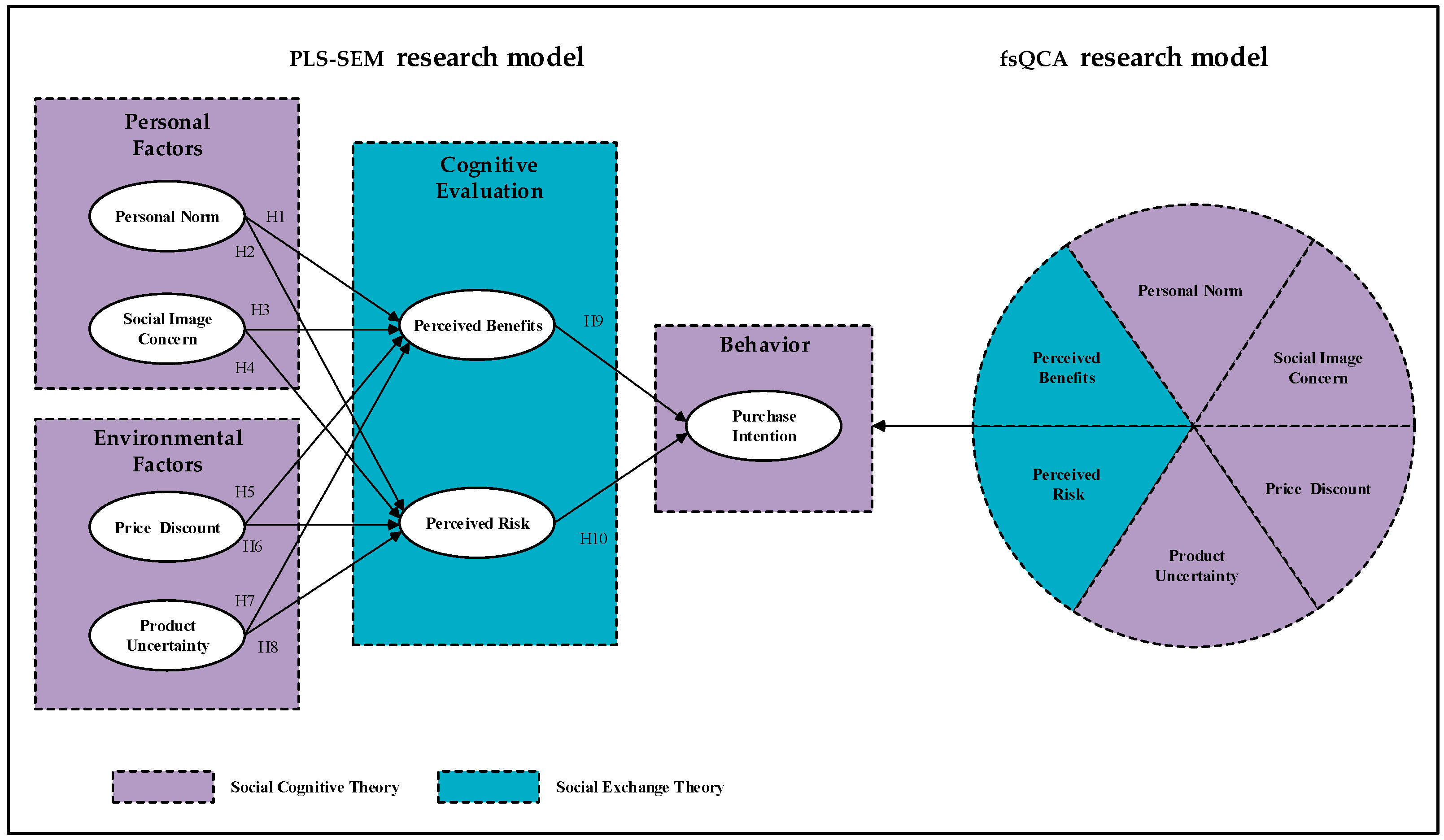
- How do personal and environmental factors influence consumers’ perceived benefits and perceived risks of near-expired food?
- (2)
- How do perceived benefits and perceived risks jointly influence consumers’ purchase intention toward near-expired food?
- (3)
- What combinations of factors can lead to a high level of purchase intention toward near-expired food?
2. Literature Review and Research Hypotheses
2.1. Theoretical Foundation
2.2. Individual Factors and Cognitive Evaluation
2.3. Environmental Factors and Cognitive Evaluation
2.4. Cognitive Evaluation and Purchase Intention
2.5. Configurational Effects of Purchase Intention
3. Research Design
3.1. Variable Measurement
3.2. Questionnaire Design and Data Collection
3.3. Research Methods
4. Results
4.1. Common Method Bias Tests
4.2. Assessment of Measurement Model
4.3. Assessment of Structural Model
4.4. Multi-Group Analysis (MGA)
4.5. Fuzzy-Set Qualitative Comparative Analysis
5. Discussion
5.1. Discussion of the Direct Effects
5.2. Discussion of the Multi-Group Analysis
5.3. Discussion of the fsQCA Results
6. Contributions and Limitations
6.1. Theoretical Contributions
6.2. Practical Implications
6.3. Limitations and Future Research
Author Contributions
Funding
Institutional Review Board Statement
Informed Consent Statement
Data Availability Statement
Acknowledgments
Conflicts of Interest
References
- Beuving, M.; McNabb, W.C.; Smith, N.W. Global nutrient content embedded in food losses and waste: Identifying the sources and magnitude along the food supply chain. Sustain. Prod. Consum. 2024, 51, 519–531. [Google Scholar] [CrossRef]
- Manzoor, S.; Fayaz, U.; Dar, A.H.; Dash, K.K.; Shams, R.; Bashir, I.; Pandey, V.K.; Abdi, G. Sustainable development goals through reducing food loss and food waste: A comprehensive review. Future Foods 2024, 9, 100362. [Google Scholar] [CrossRef]
- iiMediaResearch. China Near-Expiry Food Industry Development and Benchmark Case Studies Report (2023–2024). 2023. Available online: https://report.iimedia.cn/repo7-0/43371.html?acPlatCode=imw&acFrom=recomBar&iimediaId=93052 (accessed on 3 April 2025).
- Zhang, Y.; van Herpen, E.; Van Loo, E.J.; Pandelaere, M.; Geuens, M. Save near-expired food: Does a message to avoid food waste affect food purchase and household waste prevention behaviors? J. Clean. Prod. 2023, 384, 135555. [Google Scholar] [CrossRef]
- Giménez, A.; Aschemann-Witzel, J.; Ares, G. Exploring barriers to consuming suboptimal foods: A consumer perspective. Food Res. Int. 2021, 141, 110106. [Google Scholar] [CrossRef]
- Yamoah, F.A.; Acquaye, A. Unravelling the attitude-behaviour gap paradox for sustainable food consumption: Insight from the UK apple market. J. Clean. Prod. 2019, 217, 172–184. [Google Scholar] [CrossRef]
- Liang, Y.; Yin, Y.; Xu, Q. Decoding consumer resistance to near-expired products: The role of social stereotyping. J. Retail. 2024, 100, 618–634. [Google Scholar] [CrossRef]
- Harcar, T.; Karakaya, F. A cross-cultural exploration of attitudes toward product expiration dates. Psychol. Mark. 2005, 22, 353–371. [Google Scholar] [CrossRef]
- Wansink, B.; Wright, A.O. “Best if used by…” how freshness dating influences food acceptance. J. Food Sci. 2006, 71, S354–S357. [Google Scholar] [CrossRef]
- Newsome, R.; Balestrini, C.G.; Baum, M.D.; Corby, J.; Fisher, W.; Goodburn, K.; Labuza, T.P.; Prince, G.; Thesmar, H.S.; Yiannas, F. Applications and perceptions of date labeling of food. Compr. Rev. Food Sci. Food Saf. 2014, 13, 745–769. [Google Scholar] [CrossRef]
- Theotokis, A.; Pramatari, K.; Tsiros, M. Effects of expiration date-based pricing on brand image perceptions. J. Retail. 2012, 88, 72–87. [Google Scholar] [CrossRef]
- Chung, J.; Li, D. The prospective impact of a multi-period pricing strategy on consumer perceptions for perishable foods. Br. Food J. 2013, 115, 377–393. [Google Scholar] [CrossRef]
- Bandura, A. Social Foundations of Thought and Action: A Social Cognitive Theory; Prentice Hall: Hoboken, NJ, USA, 1986. [Google Scholar]
- Susanty, A.; Puspitasari, N.B.; Prastawa, H.; Listyawardhani, P.; Tjahjono, B. Antecedent factors of green purchasing behavior: Learning experiences, social cognitive factors, and green marketing. Front. Psychol. 2021, 12, 777531. [Google Scholar] [CrossRef]
- Cheng, X.; Hou, T.; Mou, J. Investigating perceived risks and benefits of information privacy disclosure in IT-enabled ride-sharing. Inf. Manag. 2021, 58, 103450. [Google Scholar] [CrossRef]
- Shiau, W.-L.; Luo, M.M. Factors affecting online group buying intention and satisfaction: A social exchange theory perspective. Comput. Hum. Behav. 2012, 28, 2431–2444. [Google Scholar] [CrossRef]
- Pappas, I.O.; Woodside, A.G. Fuzzy-set qualitative comparative analysis (fsQCA): Guidelines for research practice in information systems and marketing. Int. J. Inf. Manag. 2021, 58, 102310. [Google Scholar] [CrossRef]
- Phipps, M.; Ozanne, L.K.; Luchs, M.G.; Subrahmanyan, S.; Kapitan, S.; Catlin, J.R.; Gau, R.; Naylor, R.W.; Rose, R.L.; Simpson, B. Understanding the inherent complexity of sustainable consumption: A social cognitive framework. J. Bus. Res. 2013, 66, 1227–1234. [Google Scholar] [CrossRef]
- Chang, H.-H.; Su, J.-W. Sustainable consumption in Taiwan retailing: The impact of product features and price promotion on purchase behaviors toward expiring products. Food Qual. Prefer. 2022, 96, 104452. [Google Scholar] [CrossRef]
- Homans, G.C. Social behavior as exchange. Am. J. Sociol. 1958, 63, 597–606. [Google Scholar] [CrossRef]
- Loh, Z.; Hassan, S.H. Consumers’ attitudes, perceived risks and perceived benefits towards repurchase intention of food truck products. Br. Food J. 2022, 124, 1314–1332. [Google Scholar] [CrossRef]
- Tsiros, M.; Heilman, C.M. The effect of expiration dates and perceived risk on purchasing behavior in grocery store perishable categories. J. Mark. 2005, 69, 114–129. [Google Scholar] [CrossRef]
- Onwezen, M.C.; Antonides, G.; Bartels, J. The Norm Activation Model: An exploration of the functions of anticipated pride and guilt in pro-environmental behaviour. J. Econ. Psychol. 2013, 39, 141–153. [Google Scholar] [CrossRef]
- Schwartz, S.H. Normative influences on altruism. In Advances in Experimental Social Psychology; Elsevier: Amsterdam, The Netherlands, 1977; Volume 10, pp. 221–279. [Google Scholar]
- Wang, C.-P.; Zhang, Q.; Wong, P.P.W.; Wang, L. Consumers’ green purchase intention to visit green hotels: A value-belief-norm theory perspective. Front. Psychol. 2023, 14, 1139116. [Google Scholar] [CrossRef]
- Niu, N.; Fan, W.; Ren, M.; Li, M.; Zhong, Y. The role of social norms and personal costs on pro-environmental behavior: The mediating role of personal norms. Psychol. Res. Behav. Manag. 2023, 16, 2059–2069. [Google Scholar] [CrossRef]
- Shang, D.; Wu, W. Does green morality lead to collaborative consumption behavior toward online collaborative redistribution platforms? Evidence from emerging markets shows the asymmetric roles of pro-environmental self-identity and green personal norms. J. Retail. Consum. Serv. 2022, 68, 102993. [Google Scholar] [CrossRef]
- Griskevicius, V.; Tybur, J.M.; Van den Bergh, B. Going green to be seen: Status, reputation, and conspicuous conservation. J. Personal. Soc. Psychol. 2010, 98, 392. [Google Scholar] [CrossRef]
- Islam, J.U.; Thomas, G.; Albishri, N.A. From status to sustainability: How social influence and sustainability consciousness drive green purchase intentions in luxury restaurants. Acta Psychol. 2024, 251, 104595. [Google Scholar] [CrossRef]
- White, K.; Habib, R.; Hardisty, D.J. How to SHIFT consumer behaviors to be more sustainable: A literature review and guiding framework. J. Mark. 2019, 83, 22–49. [Google Scholar] [CrossRef]
- Aschemann-Witzel, J. Consumer perception and preference for suboptimal food under the emerging practice of expiration date based pricing in supermarkets. Food Qual. Prefer. 2018, 63, 119–128. [Google Scholar] [CrossRef]
- Zeithaml, V.A. Consumer perceptions of price, quality, and value: A means-end model and synthesis of evidence. J. Mark. 1988, 52, 2–22. [Google Scholar] [CrossRef]
- Szymkowiak, A.; Antoniak, M.A.; Maślana, N. Changing consumer attitudes towards suboptimal foods: The effect of zero waste labeling. Food Qual. Prefer. 2024, 114, 105095. [Google Scholar] [CrossRef]
- Kavanaugh, M.; Quinlan, J.J. Consumer knowledge and behaviors regarding food date labels and food waste. Food Control 2020, 115, 107285. [Google Scholar] [CrossRef]
- Barone, A.M.; Aschemann-Witzel, J. Food handling practices and expiration dates: Consumers’ perception of smart labels. Food Control 2022, 133, 108615. [Google Scholar] [CrossRef]
- Pandey, S.; Bohl, A.; Favari, V.; Mora, P.; Phuyal, S.; Sojková, E.; Budhathoki, M.; Thomsen, M. Consumers’ willingness to buy meat and seafood products close to the expiry date: An exploratory study from Denmark. Front. Nutr. 2024, 11, 1371634. [Google Scholar] [CrossRef]
- Joya, K.; Orth, U.R. Consumers’ lay theories on food safety: Insights from a Q-methodology study. Food Qual. Prefer. 2025, 133, 105641. [Google Scholar] [CrossRef]
- Cheng, S.; Lu, Y.; Ren, Y.; Jiang, Z.; Zhao, M. Which food date label brings us the most excellent opportunity to reduce food waste? Evidence from a quasi-natural intervention experiment in urban China. Agric. Food Econ. 2025, 13, 14. [Google Scholar] [CrossRef]
- Cliceri, D.; Pedrotti, M.; Gasperi, F.; Endrizzi, I. European consumers’ involvement with date labels and implications for household food waste. Food Qual. Prefer. 2025, 129, 105522. [Google Scholar] [CrossRef]
- Yang, C.; Chen, X. Factors affecting consumers’ purchasing of suboptimal foods during the COVID-19 pandemic. Agriculture 2022, 12, 99. [Google Scholar] [CrossRef]
- Zhong, Y. The influence of reference group on consumers’ purchase intention of near-expired food. Asia Pac. J. Mark. Logist. 2025, 37, 3291–3310. [Google Scholar] [CrossRef]
- Cheng, S.; Shi, X.; Ren, Y.; Zhao, M. Improving the public’s willingness to purchase near-expired food to reduce food waste: The case of milk products in China. Agric. Econ. (Zemědělská Ekon.) 2025, 71, 86–98. [Google Scholar] [CrossRef]
- Seo, K.H.; Lee, J.H. Understanding risk perception toward food safety in street food: The relationships among service quality, values, and repurchase intention. Int. J. Environ. Res. Public Health 2021, 18, 6826. [Google Scholar] [CrossRef]
- Chung, J.-h.; Ahn, D.; Choi, Y.S. Miracle in the evening: Explaining the boundary condition of consumer’s self-control on purchase intention of near-expired products. J. Retail. Consum. Serv. 2025, 82, 104125. [Google Scholar] [CrossRef]
- Chen, B.; Hua, W.; Wu, S. Examining the impact of the packaging design of nearly expired food on consumer purchase intentions. Humanit. Soc. Sci. Commun. 2024, 11, 1687. [Google Scholar] [CrossRef]
- Ragin, C.C. Redesigning Social Inquiry: Fuzzy Sets and Beyond; University of Chicago Press: Chicago, IL, USA, 2009. [Google Scholar]
- Woodside, A.G. Moving beyond multiple regression analysis to algorithms: Calling for adoption of a paradigm shift from symmetric to asymmetric thinking in data analysis and crafting theory. J. Bus. Res. 2013, 66, 463–472. [Google Scholar] [CrossRef]
- Pappas, I.O.; Kourouthanassis, P.E.; Giannakos, M.N.; Chrissikopoulos, V. Explaining online shopping behavior with fsQCA: The role of cognitive and affective perceptions. J. Bus. Res. 2016, 69, 794–803. [Google Scholar] [CrossRef]
- Synodinos, C.; Moraes, G.H.S.M.d.; Prado, N.B.d. Green food purchasing behaviour: A multi-method approach of Generation Y in a developing country. Br. Food J. 2023, 125, 3234–3248. [Google Scholar] [CrossRef]
- Talwar, S.; Kaur, P.; Kumar, S.; Salo, J.; Dhir, A. The balancing act: How do moral norms and anticipated pride drive food waste/reduction behaviour? J. Retail. Consum. Serv. 2022, 66, 102901. [Google Scholar] [CrossRef]
- Wang, J.; Li, M.; Li, S.; Chen, K. Understanding consumers’ food waste reduction behavior—A study based on extended norm activation theory. Int. J. Environ. Res. Public Health 2022, 19, 4187. [Google Scholar] [CrossRef]
- Hashidate, Y. Social image concern and reference point formation. BE J. Theor. Econ. 2021, 21, 19–84. [Google Scholar] [CrossRef]
- Ni-Ying, M.; Matute, J.; Derqui, B. Surplus food commercialization in China: An attitude-behaviour-context based strategy for food waste reduction in the retail and hospitality sectors. Br. Food J. 2025, 127, 580–605. [Google Scholar] [CrossRef]
- Chen, X.; Shen, J.; Wei, S. What reduces product uncertainty in live streaming e-commerce? From a signal consistency perspective. J. Retail. Consum. Serv. 2023, 74, 103441. [Google Scholar] [CrossRef]
- Ngo, T.T.A.; Phan, T.Y.N.; Le, T.N.T. Impacts of knowledge and trust on consumer perceptions and purchase intentions towards genetically modified foods. PLoS ONE 2024, 19, e0311257. [Google Scholar] [CrossRef]
- Podsakoff, P.M.; MacKenzie, S.B.; Lee, J.-Y.; Podsakoff, N.P. Common method biases in behavioral research: A critical review of the literature and recommended remedies. J. Appl. Psychol. 2003, 88, 879. [Google Scholar] [CrossRef]
- Hair, J.F.; Black, W.C.; Babin, B.J.; Anderson, R.E. Multivariate Data Analysis: Pearson New International Edition PDF eBook; Pearson Higher Ed: New York, NY, USA, 2013. [Google Scholar]
- Henseler, J.; Ringle, C.M.; Sarstedt, M. A new criterion for assessing discriminant validity in variance-based structural equation modeling. J. Acad. Mark. Sci. 2015, 43, 115–135. [Google Scholar] [CrossRef]
- Bagozzi, R.P.; Yi, Y. On the evaluation of structural equation models. J. Acad. Mark. Sci. 1988, 16, 74–94. [Google Scholar] [CrossRef]
- Hair, J.F. A Primer on Partial Least Squares Structural Equation Modeling (PLS-SEM); Sage: Thousand Oaks, CA, USA, 2014. [Google Scholar]
- Fornell, C.; Larcker, D.F. Evaluating structural equation models with unobservable variables and measurement error. J. Mark. Res. 1981, 18, 39–50. [Google Scholar] [CrossRef]
- O’brien, R.M. A caution regarding rules of thumb for variance inflation factors. Qual. Quant. 2007, 41, 673–690. [Google Scholar] [CrossRef]
- Alrawad, M.; Lutfi, A.; Alyatama, S.; Al Khattab, A.; Alsoboa, S.S.; Almaiah, M.A.; Ramadan, M.H.; Arafa, H.M.; Ahmed, N.A.; Alsyouf, A. Assessing customers perception of online shopping risks: A structural equation modeling–based multigroup analysis. J. Retail. Consum. Serv. 2023, 71, 103188. [Google Scholar] [CrossRef]
- Costa, C.S.R.; da Costa, M.F.; Maciel, R.G.; Aguiar, E.C.; Wanderley, L.O. Consumer antecedents towards green product purchase intentions. J. Clean. Prod. 2021, 313, 127964. [Google Scholar] [CrossRef]
- Zheng, Q.; Wen, X.; Xiu, X.; Chen, Q. Income quality and organic food purchase intention: The chain mediating role of environmental value, perceived consumer effectiveness. Sage Open 2023, 13, 21582440231218974. [Google Scholar] [CrossRef]
- Henseler, J.; Ringle, C.M.; Sarstedt, M. Testing measurement invariance of composites using partial least squares. Int. Mark. Rev. 2016, 33, 405–431. [Google Scholar] [CrossRef]
- Schneider, C.Q.; Wagemann, C. Set-Theoretic Methods for the Social Sciences: A Guide to Qualitative Comparative Analysis; Cambridge University Press: Cambridge, UK, 2012. [Google Scholar]
- Fiss, P.C. Building better causal theories: A fuzzy set approach to typologies in organization research. Acad. Manag. J. 2011, 54, 393–420. [Google Scholar] [CrossRef]
- Kraus, S.; Ribeiro-Soriano, D.; Schüssler, M. Fuzzy-set qualitative comparative analysis (fsQCA) in entrepreneurship and innovation research–the rise of a method. Int. Entrep. Manag. J. 2018, 14, 15–33. [Google Scholar] [CrossRef]
- Woodside, A.G. The Complexity Turn: Cultural, Management, and Marketing Applications; Springer: Cham, Switzerland, 2017. [Google Scholar]
- Aschemann-Witzel, J.; Giménez, A.; Ares, G. Consumer in-store choice of suboptimal food to avoid food waste: The role of food category, communication and perception of quality dimensions. Food Qual. Prefer. 2018, 68, 29–39. [Google Scholar] [CrossRef]
- Hartmann, T.; Jahnke, B.; Hamm, U. Making ugly food beautiful: Consumer barriers to purchase and marketing options for Suboptimal Food at retail level–A systematic review. Food Qual. Prefer. 2021, 90, 104179. [Google Scholar] [CrossRef]
- Kim, S.H.; Seock, Y.-K. The roles of values and social norm on personal norms and pro-environmentally friendly apparel product purchasing behavior: The mediating role of personal norms. J. Retail. Consum. Serv. 2019, 51, 83–90. [Google Scholar] [CrossRef]
- Setiawan, B.; Puspitasari, R. Consumer intentions to reduce food waste in all-you-can-eat restaurants based on personal norm activation. Heliyon 2023, 9, e13399. [Google Scholar]
- Chang, H.-H.; Lu, L.-C.; Kuo, T.-C. Are discounts useful in promoting suboptimal foods for sustainable consumption and production? The interaction effects of original prices, discount presentation modes, and product types. J. Retail. Consum. Serv. 2024, 79, 103881. [Google Scholar] [CrossRef]
- De Hooge, I.E.; Oostindjer, M.; Aschemann-Witzel, J.; Normann, A.; Loose, S.M.; Almli, V.L. This apple is too ugly for me!: Consumer preferences for suboptimal food products in the supermarket and at home. Food Qual. Prefer. 2017, 56, 80–92. [Google Scholar] [CrossRef]
- Dlamini, N.N.; Tuorila, H.; De Kock, H.L. Food choice drivers at varying income levels in an emerging economy. Appetite 2023, 189, 107001. [Google Scholar] [CrossRef]
- Tsalis, G. What’s the deal? Consumer price involvement and the intention to purchase suboptimal foods. A cross-national study. Food Qual. Prefer. 2020, 79, 103747. [Google Scholar] [CrossRef]


| Construct | Items | Source |
|---|---|---|
| Personal Norm (PN) | PN1: I believe that reducing food waste is a responsibility individuals should take. PN2: When edible food is wasted, I feel that it should not happen. PN3: If edible food is thrown away, I feel somewhat uncomfortable. | [50,51] |
| Social Image Concern (SIC) | SIC1: I worry that purchasing near-expiry food may influence others’ impressions of me. SIC2: If others see me purchasing near-expiry food, I would feel somewhat concerned. SIC3: I worry that others may interpret purchasing near-expiry food as being “cheap.” | [52,53] |
| Price Discount (PD) | PD1: Compared with regular food, near-expiry food usually shows a noticeable price difference. PD2: The pricing of near-expiry food is generally more economical than that of similar products. PD3: The price level of near-expiry food usually feels more cost-effective. | [19,31] |
| Product Uncertainty (PU) | PU1: The quality condition of near-expiry food is sometimes difficult to judge. PU2: The actual quality of near-expiry food may involve some degree of uncertainty. PU3: Compared with regular food, near-expiry food is more likely to create a sense of uncertainty. | [44,54] |
| MA4: I think the platform sometimes pushes certain videos too aggressively. | ||
| Perceived Benefits (PB) | PB1: Near-expiry food can help reduce food waste to some extent. PB2: Near-expiry food has certain advantages in terms of economic cost. PB3: Near-expiry food has certain value in terms of environmental protection and resource conservation. | [45,55] |
| Perceived Risk (PR) | PR1: Near-expiry food may involve certain food safety risks. PR2: I worry that the quality of near-expiry food may not be as stable as regular food. PR3: Compared with regular food, near-expiry food makes me feel a higher level of risk. | [21,22] |
| Purchase Intention (PI) | PI1: If appropriate circumstances arise, I would try purchasing near-expiry food. PI2: I am willing to try purchasing more near-expiry food. PI3: I may continue purchasing near-expiry food in the future. | [44] |
| Sample | Category | Number | Percentage (%) |
|---|---|---|---|
| Sex | Male | 308 | 56.3 |
| Female | 239 | 43.7 | |
| Age | 20–29 | 148 | 27.1 |
| 30–39 | 302 | 55.2 | |
| 40–49 | 83 | 15.2 | |
| 50 and above | 14 | 2.6 | |
| Experience | Never | 35 | 6.4 |
| Rarely | 248 | 45.3 | |
| Sometimes | 228 | 41.7 | |
| Frequently | 36 | 6.6 | |
| Monthly disposable income | 2000 and below | 125 | 22.9 |
| 2001–5000 yuan | 200 | 36.6 | |
| 5001–8000 yuan | 183 | 33.5 | |
| 8000 yuan and above | 39 | 7.1 |
| Constructs | Items | Loadings | α | CR | AVE |
|---|---|---|---|---|---|
| PN | PN1 | 0.845 | 0.758 | 0.758 | 0.674 |
| PN2 | 0.816 | ||||
| PN3 | 0.800 | ||||
| SIC | SIC1 | 0.896 | 0.866 | 0.867 | 0.788 |
| SIC2 | 0.885 | ||||
| SIC3 | 0.883 | ||||
| PD | PD1 | 0.785 | 0.738 | 0.743 | 0.655 |
| PD2 | 0.812 | ||||
| PD3 | 0.832 | ||||
| PU | PU1 | 0.839 | 0.796 | 0.796 | 0.710 |
| PU2 | 0.836 | ||||
| PU3 | 0.853 | ||||
| PB | PB1 | 0.827 | 0.753 | 0.754 | 0.669 |
| PB2 | 0.802 | ||||
| PB3 | 0.825 | ||||
| PR | PR1 | 0.861 | 0.814 | 0.814 | 0.729 |
| PR2 | 0.835 | ||||
| PR3 | 0.865 | ||||
| PI | PI1 | 0.900 | 0.866 | 0.867 | 0.788 |
| PI2 | 0.861 | ||||
| PI3 | 0.902 |
| PN | SIC | PD | PU | PB | PR | PI | |
|---|---|---|---|---|---|---|---|
| PN | |||||||
| SIC | 0.109 | ||||||
| PD | 0.724 | 0.097 | |||||
| PU | 0.296 | 0.522 | 0.356 | ||||
| PB | 0.681 | 0.074 | 0.737 | 0.128 | |||
| PR | 0.150 | 0.685 | 0.236 | 0.791 | 0.209 | ||
| PI | 0.613 | 0.109 | 0.713 | 0.066 | 0.695 | 0.190 |
| PN | SIC | PD | PU | PB | PR | PI | |
|---|---|---|---|---|---|---|---|
| PN | 0.821 | ||||||
| SIC | 0.054 | 0.888 | |||||
| PD | 0.540 | 0.078 | 0.810 | ||||
| PU | 0.229 | 0.433 | 0.275 | 0.843 | |||
| PB | 0.515 | 0.051 | 0.552 | 0.098 | 0.818 | ||
| PR | 0.118 | 0.575 | 0.184 | 0.637 | 0.164 | 0.854 | |
| PI | 0.498 | −0.095 | 0.571 | 0.055 | 0.562 | −0.159 | 0.888 |
| Constructs | R2 | R2 Adjusted | Q2 |
|---|---|---|---|
| PB | 0.380 | 0.375 | 0.362 |
| PR | 0.517 | 0.514 | 0.506 |
| PI | 0.381 | 0.379 | 0.304 |
| Hypothesis | Path | Std Beta | p-Value | VIF | Results |
|---|---|---|---|---|---|
| H1 | PN→PB | 0.318 | 0 | 1.427 | Support |
| H2 | PN→PR | −0.034 | 0.396 | 1.427 | No Support |
| H3 | SIC→PB | 0.048 | 0.252 | 1.235 | No Support |
| H4 | SIC→PR | 0.369 | 0 | 1.235 | Support |
| H5 | PD→PB | 0.406 | 0 | 1.462 | Support |
| H6 | PD→PR | 0.043 | 0.332 | 1.462 | No Support |
| H7 | PU→PB | −0.107 | 0.018 | 1.341 | Support |
| H8 | PU→PR | 0.473 | 0 | 1.341 | Support |
| H9 | PB→PI | 0.605 | 0 | 1.028 | Support |
| H10 | PR→PI | −0.258 | 0 | 1.028 | Support |
| Constructs | PZ a | Compositional Invariance | Partial Measurement Invariance | Equal Mean Assessment | Equal Variance Assessment | Full Measurement Invariance | |||
|---|---|---|---|---|---|---|---|---|---|
| Original Correlation | 5.00% | Original Differences | Confidence Interval | Original Differences | Confidence Interval | ||||
| PN | Yes | 0.997 | 0.995 | Yes | −0.116 | [−0.135; 0.140] | −0.092 | [−0.278; 0.275] | Yes/Yes |
| SIC | Yes | 1 | 0.999 | Yes | 0.347 | [−0.138; 0.138] | −0.554 | [−0.213; 0.228] | No/No |
| PD | Yes | 0.999 | 0.995 | Yes | −0.259 | [−0.137; 0.146] | −0.027 | [−0.223; 0.237] | No/Yes |
| PU | Yes | 1 | 0.999 | Yes | 0.154 | [−0.141; 0.138] | −0.327 | [−0.255; 0.265] | No/No |
| PB | Yes | 1 | 0.998 | Yes | −0.163 | [−0.141; 0.143] | −0.181 | [−0.225; 0.250] | No/Yes |
| PR | Yes | 1 | 0.999 | Yes | 0.181 | [−0.145; 0.140] | −0.261 | [−0.234; 0.237] | No/No |
| PI | Yes | 1 | 0.999 | Yes | −0.278 | [−0.145; 0.137] | 0.165 | [−0.203; 0.236] | No/Yes |
| Constructs | PZ a | Compositional Invariance | Partial Measurement Invariance | Equal Mean Assessment | Equal Variance Assessment | Full Measurement Invariance | |||
|---|---|---|---|---|---|---|---|---|---|
| Original Correlation | 5.00% | Original Differences | Confidence Interval | Original Differences | Confidence Interval | ||||
| PN | Yes | 0.998 | 0.995 | Yes | −0.177 | [−0.146; 0.141] | 0.021 | [−0.277; 0.298] | No/Yes |
| SIC | Yes | 0.999 | 0.999 | Yes | −0.138 | [−0.141; 0.151] | −0.219 | [−0.220; 0.219] | Yes/Yes |
| PD | Yes | 0.998 | 0.995 | Yes | −0.148 | [−0.150; 0.141] | −0.032 | [−0.229; 0.220] | Yes/Yes |
| PU | Yes | 1 | 0.999 | Yes | −0.136 | [−0.139; 0.145] | −0.298 | [−0.252; 0.258] | Yes/No |
| PB | Yes | 1 | 0.998 | Yes | −0.123 | [−0.147; 0.138] | −0.156 | [−0.270; 0.246] | Yes/Yes |
| PR | Yes | 1 | 0.999 | Yes | 0.043 | [−0.155; 0.147] | −0.632 | [−0.224; 0.242] | Yes/No |
| PI | Yes | 1 | 0.999 | Yes | 0.025 | [−0.148; 0.140] | −0.450 | [−0.226; 0.230] | Yes/No |
| Path | Experience Groups | Income Groups | ||||
|---|---|---|---|---|---|---|
| Low | High | Difference | Low | High | Difference | |
| PN→PB | 0.42 * | 0.21 | 0.21 * | 0.219 * | 0.442 * | −0.223 * |
| PN→PR | 0.008 | −0.078 | 0.086 | −0.02 | 0.012 | −0.032 |
| SIC→PB | 0.18 * | −0.052 * | 0.232 * | 0.053 | 0.081 | −0.028 |
| SIC→PR | 0.389 * | 0.348 * | 0.041 | 0.243 * | 0.514 * | −0.271 * |
| PD→PB | 0.17 * | 0.641 * | −0.471 * | 0.522 * | 0.236 * | 0.286 * |
| PD→PR | −0.08 | 0.162 * | −0.242 | 0.173 * | −0.038 | 0.211 * |
| PU→PB | −0.174 * | −0.041 | −0.133 | −0.032 | −0.216 * | 0.184 * |
| PU→PR | 0.43 * | 0.517 * | −0.087 | 0.449 * | 0.406 * | 0.043 |
| PB→PI | 0.491 * | 0.741 * | −0.25 * | 0.676 * | 0.503 * | 0.173 * |
| PR→PI | −0.373 * | −0.125 * | −0.248 * | −0.156 * | −0.356 * | 0.2 * |
| Constructs | High PI | Not High PI | ||
|---|---|---|---|---|
| Consistency | Coverage | Consistency | Coverage | |
| PN | 0.794 | 0.779 | 0.602 | 0.576 |
| ~PN | 0.568 | 0.594 | 0.769 | 0.784 |
| SIC | 0.690 | 0.681 | 0.684 | 0.658 |
| ~SIC | 0.654 | 0.680 | 0.669 | 0.677 |
| PD | 0.833 | 0.821 | 0.573 | 0.551 |
| ~PD | 0.545 | 0.567 | 0.814 | 0.826 |
| PU | 0.751 | 0.702 | 0.689 | 0.628 |
| ~PU | 0.603 | 0.666 | 0.673 | 0.725 |
| PB | 0.830 | 0.844 | 0.539 | 0.535 |
| ~PB | 0.543 | 0.547 | 0.843 | 0.828 |
| PR | 0.690 | 0.684 | 0.688 | 0.665 |
| ~PR | 0.661 | 0.685 | 0.672 | 0.679 |
| Configuration | High PI | Not High PI | |||||||
|---|---|---|---|---|---|---|---|---|---|
| M1 | M2 | M3 | M4 | M5 | M6 | M7 | M8 | M9 | |
| PN | ▲ | ● | ✖ | ✖ | ✖ | ✖ | ✖ | ||
| SIC | △ | ✖ | ● | ✖ | ● | ||||
| PD | ● | ● | ● | ● | ✖ | ✖ | ✖ | ✖ | ✖ |
| PU | ▲ | △ | ● | △ | ▲ | ✖ | ▲ | ||
| PB | ● | ● | ● | ● | ✖ | ✖ | ▲ | ✖ | ✖ |
| PR | ✖ | ✖ | ▲ | △ | △ | ● | △ | ||
| Consistency | 0.963 | 0.930 | 0.970 | 0.960 | 0.943 | 0.969 | 0.966 | 0.950 | 0.961 |
| Raw coverage | 0.461 | 0.558 | 0.377 | 0.359 | 0.479 | 0.419 | 0.293 | 0.386 | 0.420 |
| unique coverage | 0.011 | 0.133 | 0.014 | 0.020 | 0.118 | 0.026 | 0.018 | 0.001 | 0.002 |
| Solution coverage | 0.933 | 0.938 | |||||||
| Solution consistency | 0.691 | 0.639 | |||||||
Disclaimer/Publisher’s Note: The statements, opinions and data contained in all publications are solely those of the individual author(s) and contributor(s) and not of MDPI and/or the editor(s). MDPI and/or the editor(s) disclaim responsibility for any injury to people or property resulting from any ideas, methods, instructions or products referred to in the content. |
© 2026 by the authors. Licensee MDPI, Basel, Switzerland. This article is an open access article distributed under the terms and conditions of the Creative Commons Attribution (CC BY) license.
Share and Cite
Chen, X.; Wang, Y.; Chen, J.; Yang, C. Why Do Consumers Hesitate to Purchase Near-Expiration Food? A Benefit–Risk Perspective on the Green Purchase Paradox. Foods 2026, 15, 1718. https://doi.org/10.3390/foods15101718
Chen X, Wang Y, Chen J, Yang C. Why Do Consumers Hesitate to Purchase Near-Expiration Food? A Benefit–Risk Perspective on the Green Purchase Paradox. Foods. 2026; 15(10):1718. https://doi.org/10.3390/foods15101718
Chicago/Turabian StyleChen, Xinqiang, Yu Wang, Jiangjie Chen, and Chun Yang. 2026. "Why Do Consumers Hesitate to Purchase Near-Expiration Food? A Benefit–Risk Perspective on the Green Purchase Paradox" Foods 15, no. 10: 1718. https://doi.org/10.3390/foods15101718
APA StyleChen, X., Wang, Y., Chen, J., & Yang, C. (2026). Why Do Consumers Hesitate to Purchase Near-Expiration Food? A Benefit–Risk Perspective on the Green Purchase Paradox. Foods, 15(10), 1718. https://doi.org/10.3390/foods15101718