Can Citizen Science Be a Key Factor in the Fight Against Mislabeling? Discovering What Squid Is on the Plate

 , , ,
, , ,  and
and
Abstract
1. Introduction
2. Materials and Methods
2.1. Sampling
2.2. Evaluation of Sampling Success
2.3. DNA Extraction, PCR Amplification, and Sequence Analyses
2.4. Labeling Regulations, Mislabeling, and Statistical Analyses
2.5. Analyses of the Questionnaire
3. Results
3.1. Citizen Science: Sampling Success
3.2. Mislabeling Results
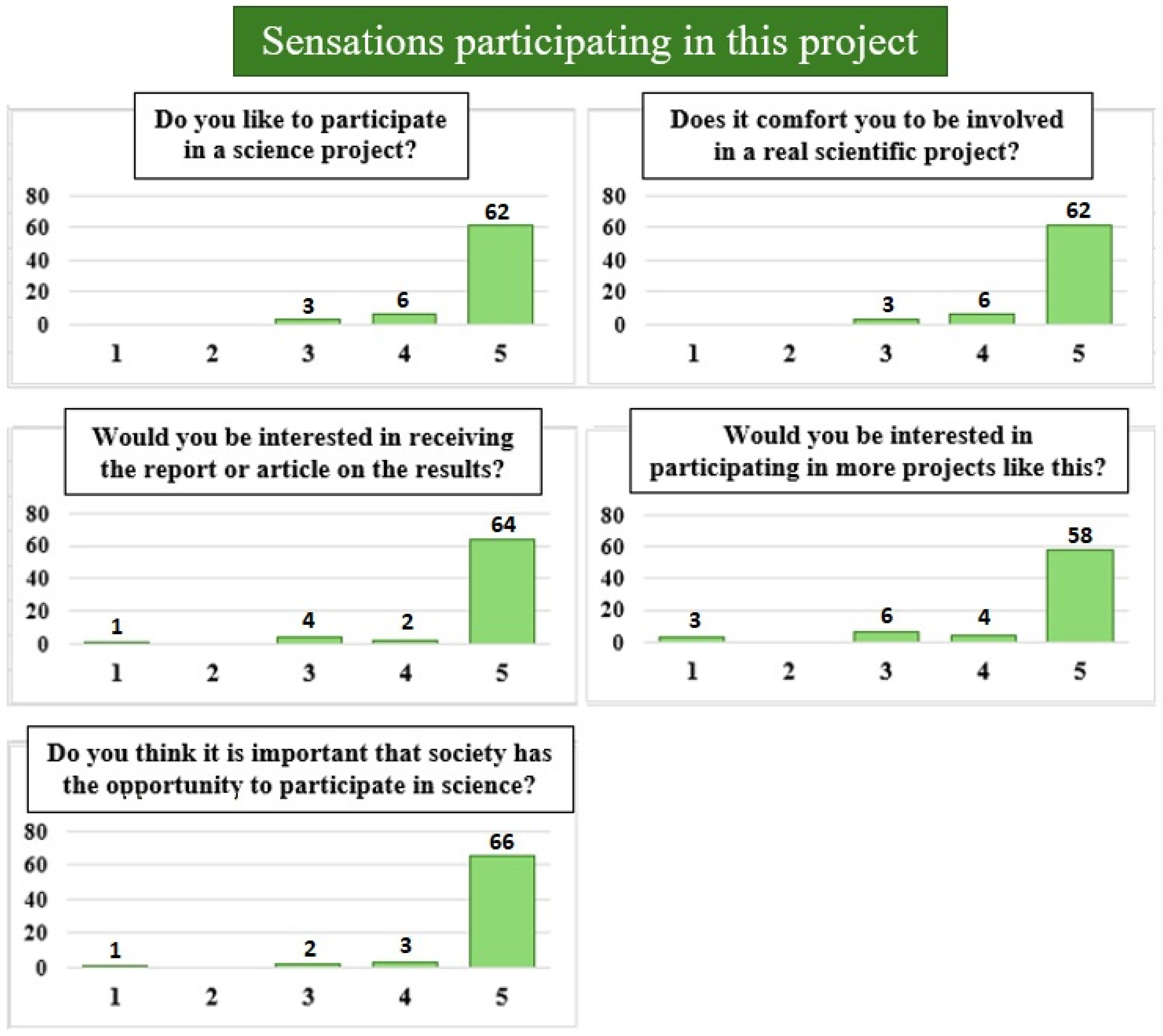
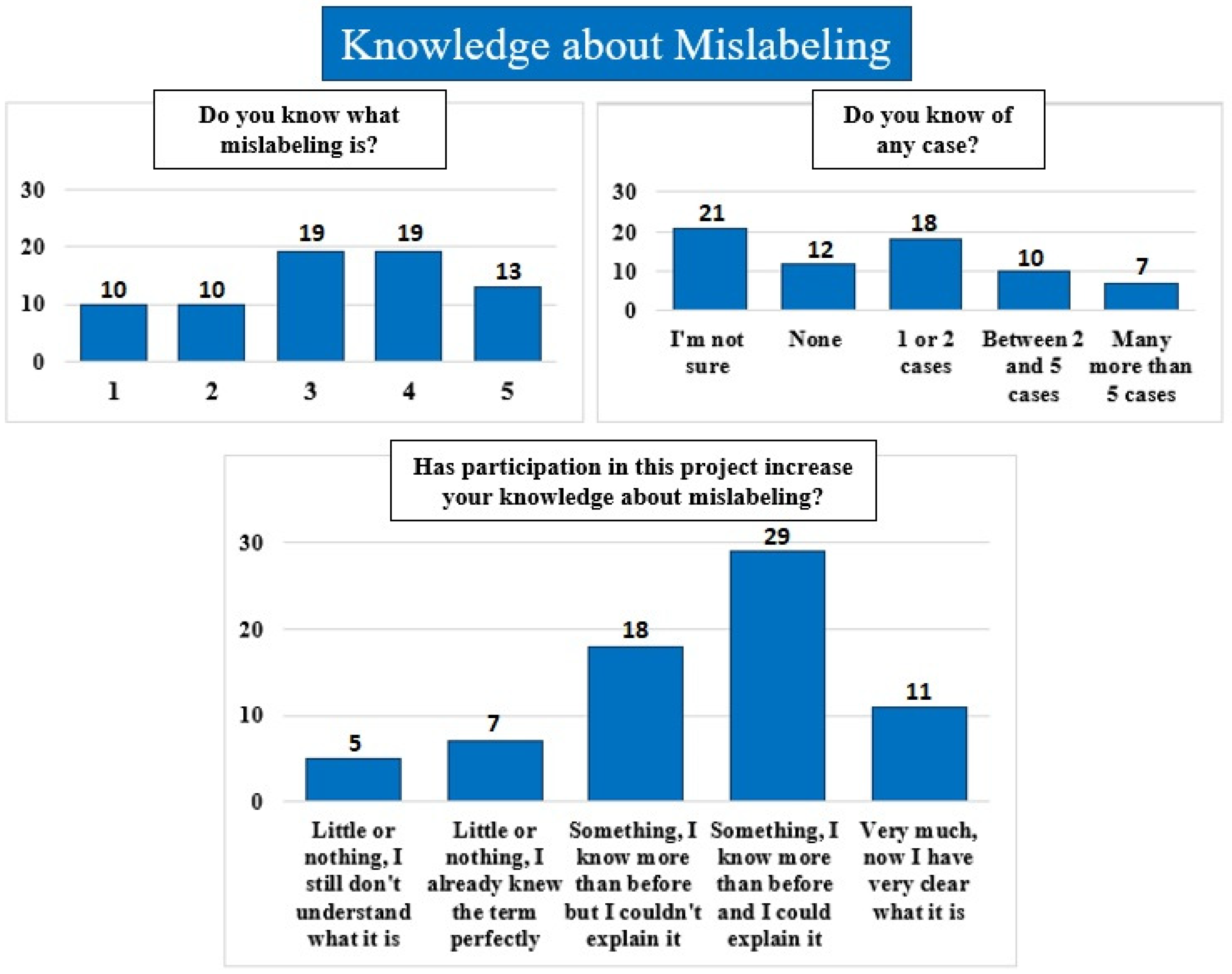
3.3. Citizen Science: Participation and Opinion About Science and Transference
4. Discussion
4.1. Success and Quality of Sampling Based on Citizen Science
4.2. Limitations and Future Recommendations Regarding the Use of CS for Obtaining New Datasets
- -
- A broad recruitment of volunteers, reaching out to the population at all educational levels, as well as a wide sampling scheme in different types of restaurants and city areas. To this end, dissemination in the media and social networks seems essential, in line with what was expressed by the volunteers in this study, as well as informative talks and collaboration with specialized organizations that will help the study’s information reach more types of people. As described by Lin and Kant [36], social media has transformed citizen participation by providing accessible, real-time platforms that remove physical and time barriers. Their open and informal nature fosters social inclusion and empowers groups often excluded by traditional methods. Consequently, these tools enhance transparency and efficiency in the interaction between governments and citizens, leading to more collaborative and representative solutions.
- -
- To encourage participation, only the completion of the sample information should be mandatory, while opinion and satisfaction surveys should always be optional and as short as possible so as not to take too much time for volunteers. Shorter questionnaires have been associated with higher response rates [37].
- -
- As we have tested in this study, it is important to always have two sampler groups, one formed only by experts and another one only for volunteers, in order to check possible bias made by volunteers. This method of assessing data quality is widely accepted and has been implemented in numerous CS studies (e.g., [16,18]).
- -
- Ask for photos of the menu and plate consumed, together with the number of the sample, to solve any questions about the food or label after the sampling and as extra verification points.
4.3. Mislabeling Found in Loligo spp. Squids in Spanish Restaurants
4.4. Citizen Science as Science–Society “Glue”
5. Conclusions
Supplementary Materials
Author Contributions
Funding
Institutional Review Board Statement
Informed Consent Statement
Data Availability Statement
Acknowledgments
Conflicts of Interest
References
- Visciano, P.; Schirone, M. Food frauds: Global incidents and misleading situations. Trends Food Sci. Technol. 2021, 114, 424–442. [Google Scholar] [CrossRef]
- Popping, B.; Buck, N.; Bánáti, D.; Brereton, P.; Gendel, S.; Hristozova, N.; Chaves, S.M.; Saner, S.; Spink, J.; Willis, C.; et al. Food inauthenticity: Authority activities, guidance for food operators, and mitigation tools. Compr. Rev. Food Sci. Food Saf. 2022, 21, 4776–4811. [Google Scholar] [CrossRef]
- Sharma, R.; Nath, P.C.; Lodh, B.K.; Mukherjee, J.; Mahata, N.; Gopikrishna, K.; Tiwari, O.N.; Bhunia, B. Rapid and sensitive approaches for detecting food fraud: A review on prospects and challenges. Food Chem. 2024, 454, 139817. [Google Scholar] [CrossRef]
- Muñoz-Colmenero, M.; Klett-Mingo, M.; Díaz, E.; Blanco, O.; Martínez, J.L.; Garcia-Vazquez, E. Evolution of hake mislabeling niches in commercial markets. Food Control 2015, 54, 267–274. [Google Scholar] [CrossRef]
- Pegels, N.; González, I.; García, T.; Martín, R. Authenticity testing of wheat, barley, rye and oats in food and feed market samples by real-time PCR assays. LWT-Food Sci. Technol. 2015, 60, 867–875. [Google Scholar] [CrossRef]
- Al-Qassab, T.; Kamkar, A.; Shayan, P.; Khanjari, A. Mislabeling in cooked sausage is a seriously increasingly problem in food safety. Iran. J. Vet. Med. 2019, 13, 101. [Google Scholar] [CrossRef]
- Horreo, J.L.; Fitze, P.S.; Jiménez-Valverde, A.; Noriega, J.A.; Pelaez, M.L. Amplification of 16S rDNA reveals important fish mislabeling in Madrid restaurants. Food Control 2019, 96, 146–150. [Google Scholar] [CrossRef]
- Vishnuraj, M.; Devatkal, S.; Vaithiyanathan, S.; Kumar, R.U.; Mendiratta, S. Development and validation of miRNA based method for rapid identification of offal meats in processed chicken meat products. Food Control 2021, 121, 107593. [Google Scholar] [CrossRef]
- Montero, L.; Arrizabalaga-Larrañaga, A.; Ayala-Cabrera, J.F. Emerging Food Authentication Methodologies Using GC/MS; Pastor, K., Ed.; Springer International Publishing: Cham, Switzerland, 2023. [Google Scholar] [CrossRef]
- Gil, F.; Beroiz, B.; Ballesteros, I.; Horreo, J.L. Can consumers avoid mislabelling? Genetic species identification provides recommendations for shrimp/prawn products. J. Sci. Food Agric. 2024, 104, 9486–9493. [Google Scholar] [CrossRef]
- Chammem, N.; Issaoui, M.; De Almeida, A.I.D.; Delgado, A.M. Food Crises and Food Safety Incidents in European Union, United States, and Maghreb Area: Current Risk Communication Strategies and New Approaches. J. AOAC Int. 2018, 101, 923–938. [Google Scholar] [CrossRef]
- Pardo, M.Á.; Jiménez, E. DNA barcoding revealing seafood mislabeling in food services from Spain. J. Food Compos. Anal. 2020, 91, 103521. [Google Scholar] [CrossRef]
- Pappalardo, A.M.; Raffa, A.; Calogero, G.S.; Ferrito, V. Geographic Pattern of Sushi Product Misdescription in Italy—A Crosstalk between Citizen Science and DNA Barcoding. Foods 2021, 10, 756. [Google Scholar] [CrossRef]
- Florença, S.G.; Amaral, A.L.; Costa, F.; Costa, C.A. Citizen Science and the Food System—A Focus Group Pilot Study. Sustainability 2025, 17, 9370. [Google Scholar] [CrossRef]
- Fukase, E.; Martin, W. Economic growth, convergence, and world food demand and supply. World Dev. 2020, 132, 104954. [Google Scholar] [CrossRef]
- Warner, K.A.; Lowell, B.; Timme, W.; Shaftel, E.; Hanner, R.H. Seafood sleuthing: How citizen science contributed to the largest market study of seafood mislabeling in the U.S. and informed policy. Mar. Policy 2019, 99, 304–311. [Google Scholar] [CrossRef]
- Günther, B.; Bierne, N.; Borsa, P.; Perrin, C.; Ripoll, O.; Darbois, F.; Arnaud-Haond, S. Citizen science approach for genetic species identification in a local French seafood speciality. Int. J. Gastron. Food Sci. 2023, 35, 100823. [Google Scholar] [CrossRef]
- Finger, L.; Bogaert, V.v.D.; Schmidt, L.; Fleischer, J.; Stadtler, M.; Sommer, K.; Wirth, J. The science of citizen science: A systematic literature review on educational and scientific outcomes. Front. Educ. 2023, 8, 1226529. [Google Scholar] [CrossRef]
- Luque, G.M.; Donlan, C.J. The characterization of seafood mislabeling: A global meta-analysis. Biol. Conserv. 2019, 236, 556–570. [Google Scholar] [CrossRef]
- Giusti, A.; Malloggi, C.; Tinacci, L.; Nucera, D.; Armani, A. Mislabeling in seafood products sold on the Italian market: A systematic review and meta-analysis. Food Control 2023, 145, 109395. [Google Scholar] [CrossRef]
- Giagkazoglou, Z.; Loukovitis, D.; Gubili, C.; Chatziplis, D.; Symeonidis, A.; Imsiridou, A. Untangling the cephalopod market: Authentication of seafood products in Greece with DNA-barcoding. Food Control 2024, 163, 110523. [Google Scholar] [CrossRef]
- Pardo, M.Á.; Jiménez, E.; Viðarsson, J.R.; Ólafsson, K.; Ólafsdóttir, G.; Daníelsdóttir, A.K.; Pérez-Villareal, B. DNA barcoding revealing mislabeling of seafood in European mass caterings. Food Control 2018, 92, 7–16. [Google Scholar] [CrossRef]
- Guardone, L.; Tinacci, L.; Costanzo, F.; Azzarelli, D.; D’AMico, P.; Tasselli, G.; Magni, A.; Guidi, A.; Nucera, D.; Armani, A. DNA barcoding as a tool for detecting mislabeling of fishery products imported from third countries: An official survey conducted at the Border Inspection Post of Livorno-Pisa (Italy). Food Control 2017, 80, 204–216. [Google Scholar] [CrossRef]
- Sotelo, C.G.; Sanchez, A.; Correa, B.; Testa, M.P.; Perez-Martín, R.I. Are squid rings made from squids? Amplicon-sequencing HTPS method to identify cephalopod species in processed squid products. Food Control 2026, 184, 112028. [Google Scholar] [CrossRef]
- Richardson, D.S.; Jury, F.L.; Blaakmeer, K.; Komdeur, J.; Burke, T. Parentage assignment and extra-group paternity in a cooperative breeder: The Seychelles warbler (Acrocephalus sechellensis). Mol. Ecol. 2001, 10, 2263–2273. [Google Scholar] [CrossRef] [PubMed]
- Folmer, O.; Black, M.; Hoeh, W.; Lutz, R.; Vrijenhoek, R. DNA primers for amplification of mitochondrial cytochrome c oxidase subunit I from diverse metazoan invertebrates. Mol. Mar. Biol. Biotechnol. 1994, 3, 294–299. [Google Scholar]
- Hall, T.A. BioEdit: A User-Friendly Biological Sequence Alignment Editor and Analysis Program for Windows 95/98/NT. In Nucleic Acids Symposium Series; Oxford University Press: Oxford, UK, 1999; Volume 41, pp. 95–98. [Google Scholar]
- Patil, T.S.; Jamdade, R.A.; Patil, S.M.; Govindwar, S.P.; Muley, D.V. DNA barcode based delineation of freshwater fishes from northern Western Ghats of India, one of the world’s biodiversity hotspots. Biodivers. Conserv. 2018, 27, 3349–3371. [Google Scholar] [CrossRef]
- Robson, K.; Dean, M.; Haughey, S.; Elliott, C. A comprehensive review of food fraud terminologies and food fraud mitigation guides. Food Control 2021, 120, 107516. [Google Scholar] [CrossRef]
- Worthington, J.P.; Silvertown, J.; Cook, L.; Cameron, R.; Dodd, M.; Greenwood, R.M.; McConway, K.; Skelton, P. Evolution MegaLab: A case study in citizen science methods. Methods Ecol. Evol. 2011, 3, 303–309. [Google Scholar] [CrossRef]
- Masters, K.; Oh, E.Y.; Cox, J.; Simmons, B.; Lintott, C.; Graham, G.; Greenhill, A.; Holmes, K. Science learning via participation in online citizen science. J. Sci. Commun. 2016, 15, A07. [Google Scholar] [CrossRef]
- Bénard-Capelle, J.; Guillonneau, V.; Nouvian, C.; Fournier, N.; Le Loët, K.; Dettai, A. Fish mislabelling in France: Substitution rates and retail types. PeerJ 2015, 2, e714. [Google Scholar] [CrossRef]
- Callaghan, C.T.; Roberts, J.D.; Poore, A.G.B.; Alford, R.A.; Cogger, H.; Rowley, J.J.L. Citizen science data accurately predicts expert-derived species richness at a continental scale when sampling thresholds are met. Biodivers. Conserv. 2020, 29, 1323–1337. [Google Scholar] [CrossRef]
- Reynolds, C.; Oakden, L.; West, S.; Pateman, R.; Elliott, C.; Armstrong, B.; Gillespie, R.; Patel, M. Future Directions for Citizen Science and Public Policy; Cohen, K., Doubleday, R., Eds.; Centre for Science and Policy: Cambridge, UK, 2021. [Google Scholar]
- Ulberth, F. Tools to combat food fraud—A gap analysis. Food Chem. 2020, 330, 127044. [Google Scholar] [CrossRef]
- Lin, Y.; Kant, S. Using Social Media for Citizen Participation: Contexts, Empowerment, and Inclusion. Sustainability 2021, 13, 6635. [Google Scholar] [CrossRef]
- Rolstad, S.; Adler, J.; Rydén, A. Response Burden and Questionnaire Length: Is Shorter Better? A Review and Meta-analysis. Value Health 2011, 14, 1101–1108. [Google Scholar] [CrossRef]
- Shi, R.; Huang, M.; Wang, J.; He, C.; Ying, X.; Xiong, X.; Xiong, X. Molecular identification of dried squid products sold in China using DNA barcoding and SYBR green real time PCR. Food Addit. Contam. Part A 2020, 37, 1061–1074. [Google Scholar] [CrossRef]
- Meloni, D.; Piras, P.; Mazzette, R. Mislabelling and species substitution in fishery products retailed in Sardinia (Italy), 2009–2014. Ital. J. Food Saf. 2015, 4, 5363. [Google Scholar] [CrossRef][Green Version]
- Fernández, S.; Rodríguez-Muñiz, L.J.; Molina, J.; Muñiz-Rodríguez, L.; Jiménez, J.; García-Vázquez, E.; Borrell, Y.J. Lab experience with seafood control at the undergraduate level: Cephalopods as a case study. Biochem. Mol. Biol. Educ. 2020, 48, 236–246. [Google Scholar] [CrossRef]
- Maggioni, D.; Tatulli, G.; Montalbetti, E.; Tommasi, N.; Galli, P.; Labra, M.; Pompa, P.P.; Galimberti, A. From DNA barcoding to nanoparticle-based colorimetric testing: A new frontier in cephalopod authentication. Appl. Nanosci. 2020, 10, 1053–1060. [Google Scholar] [CrossRef]
- Sarabia-Sainz, H.M.; Torres-Arreola, W.; Márquez-Ríos, E.; Santacruz-Ortega, H.C.; Rouzaud-Sández, O.; Valenzuela-Soto, E.M.; Burgara-Estrella, A.J.; Ezquerra-Brauer, J.M. Interrelation of Collagen Chemical Structure and Nanostructure with Firmness of three Body Regions of Jumbo Squid (Dosidicus gigas). Food Biophys. 2017, 12, 491–499. [Google Scholar] [CrossRef]
- Ochulor, C.E.; Onyeaka, H.; Ibe Njoagwuani, E.; Mazi, I.M.; Olatunji Oladunjoye, I.; Akegbe, H.; Dolapo Omotosho, A.; Odeyemi, I.A.; Nwaiwu, O.; Tamasiga, P. Improper Food Labeling and Unverified Food Claims: Food Safety Implications. Am. J. Food Sci. Nutr. 2022, 4, 9–23. [Google Scholar] [CrossRef]
- Oakden, L.; Bridge, G.; Armstrong, B.; Reynolds, C.; Wang, C.; Panzone, L.; Rivera, X.S.; Kause, A.; Ffoulkes, C.; Krawczyk, C.; et al. The Importance of Citizen Scientists in the Move Towards Sustainable Diets and a Sustainable Food System. Front. Sustain. Food Syst. 2021, 5, 596594. [Google Scholar] [CrossRef]
- Moreira, M.J.; García-Díez, J.; de Almeida, J.M.M.M.; Saraiva, C. Consumer Knowledge about Food Labeling and Fraud. Foods 2021, 10, 1095. [Google Scholar] [CrossRef]



| Price (€) | t-Test | ||||||
|---|---|---|---|---|---|---|---|
| Mean | Median | Range | Std. Dev. | N | p-Value | ||
| Type of sample | Plate | 11.1 | 11.00 | 2–21 | 3.94 | 73 | <0.0001 |
| Sandwich | 5.84 | 5.25 | 3.5–11.5 | 1.99 | 24 | ||
| Food labeling | Correct | 13.71 | 15.50 | 2–19 | 5.45 | 9 | <0.005 |
| Incorrect | 9.40 | 9.00 | 2–21 | 3.90 | 88 | ||
| Food on plate | Not mislabeled | 14.43 | 15.50 | 2–19 | 5.35 | 8 | <0.05 |
| Mislabeled | 10.69 | 10.50 | 2–21 | 3.58 | 65 | ||
| Food on sandwich | Not mislabeled | 8.00 | 8.00 | --- | --- | 1 | |
| Mislabeled | 5.74 | 5.00 | 3.5–11.5 | 1.98 | 23 | ||
Disclaimer/Publisher’s Note: The statements, opinions and data contained in all publications are solely those of the individual author(s) and contributor(s) and not of MDPI and/or the editor(s). MDPI and/or the editor(s) disclaim responsibility for any injury to people or property resulting from any ideas, methods, instructions or products referred to in the content. |
© 2026 by the authors. Licensee MDPI, Basel, Switzerland. This article is an open access article distributed under the terms and conditions of the Creative Commons Attribution (CC BY) license.
Share and Cite
Muñoz-Colmenero, M.; Vargas-Ramírez, M.; Perdiguero, P.; Ballesteros, I.; Beroiz, B.; Gil, F.; Linacero, R.; Horreo, J.L. Can Citizen Science Be a Key Factor in the Fight Against Mislabeling? Discovering What Squid Is on the Plate. Foods 2026, 15, 1690. https://doi.org/10.3390/foods15101690
Muñoz-Colmenero M, Vargas-Ramírez M, Perdiguero P, Ballesteros I, Beroiz B, Gil F, Linacero R, Horreo JL. Can Citizen Science Be a Key Factor in the Fight Against Mislabeling? Discovering What Squid Is on the Plate. Foods. 2026; 15(10):1690. https://doi.org/10.3390/foods15101690
Chicago/Turabian StyleMuñoz-Colmenero, Marta, Marta Vargas-Ramírez, Pedro Perdiguero, Isabel Ballesteros, Beatriz Beroiz, Félix Gil, Rosario Linacero, and Jose Luis Horreo. 2026. "Can Citizen Science Be a Key Factor in the Fight Against Mislabeling? Discovering What Squid Is on the Plate" Foods 15, no. 10: 1690. https://doi.org/10.3390/foods15101690
APA StyleMuñoz-Colmenero, M., Vargas-Ramírez, M., Perdiguero, P., Ballesteros, I., Beroiz, B., Gil, F., Linacero, R., & Horreo, J. L. (2026). Can Citizen Science Be a Key Factor in the Fight Against Mislabeling? Discovering What Squid Is on the Plate. Foods, 15(10), 1690. https://doi.org/10.3390/foods15101690