Axiology of Cultured Meat and Consumer Perception: An Analysis Based on the Phenomenology of Perception


Abstract
1. Introduction
2. Literature Review

3. Material and Methods
3.1. Formulation of the Research Question
3.2. Identification of Relevant Publications
3.3. Evaluation of the Quality of the Selected Studies
3.4. Selection of Studies
3.5. Data Analysis and Interpretation
4. Results
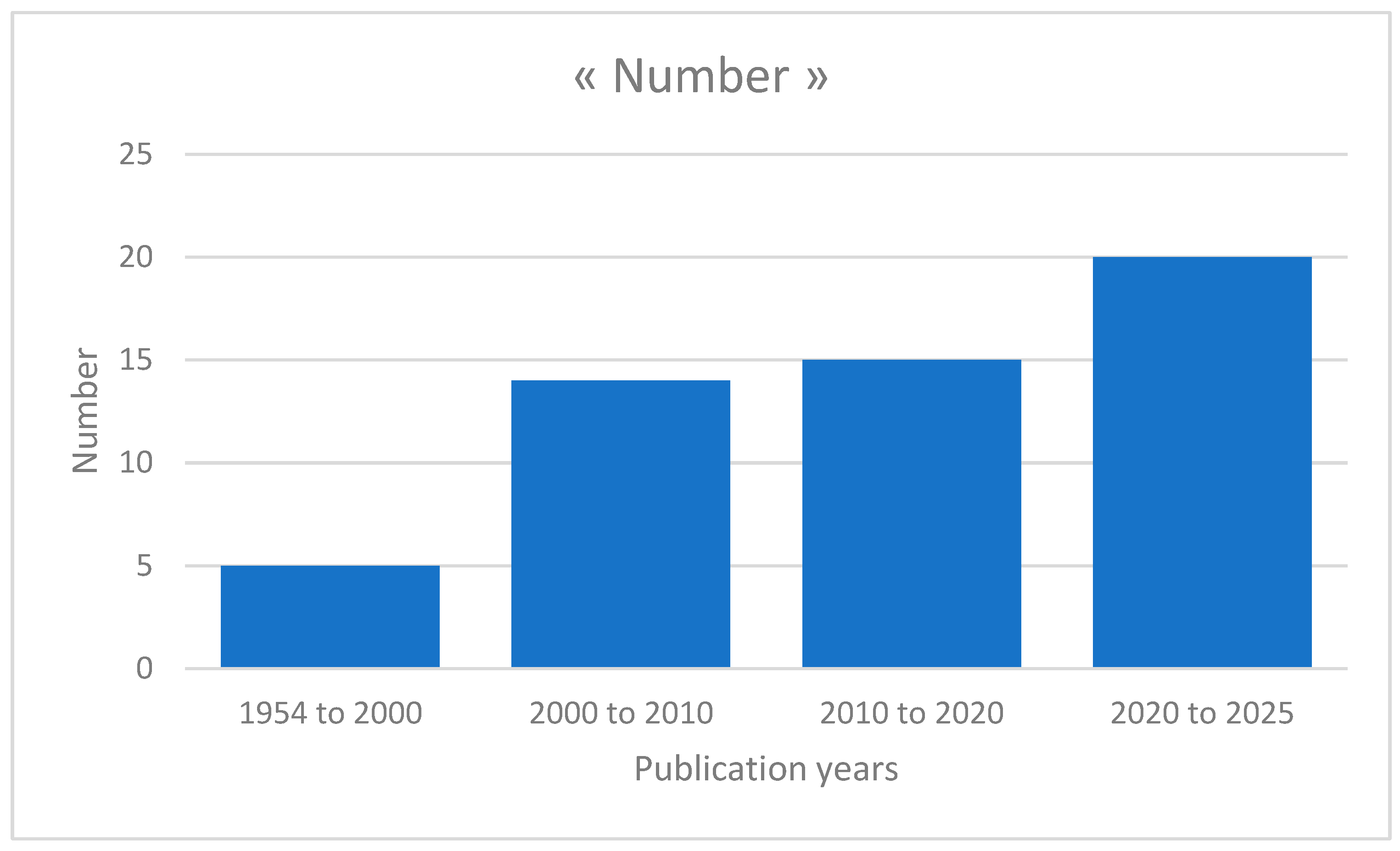
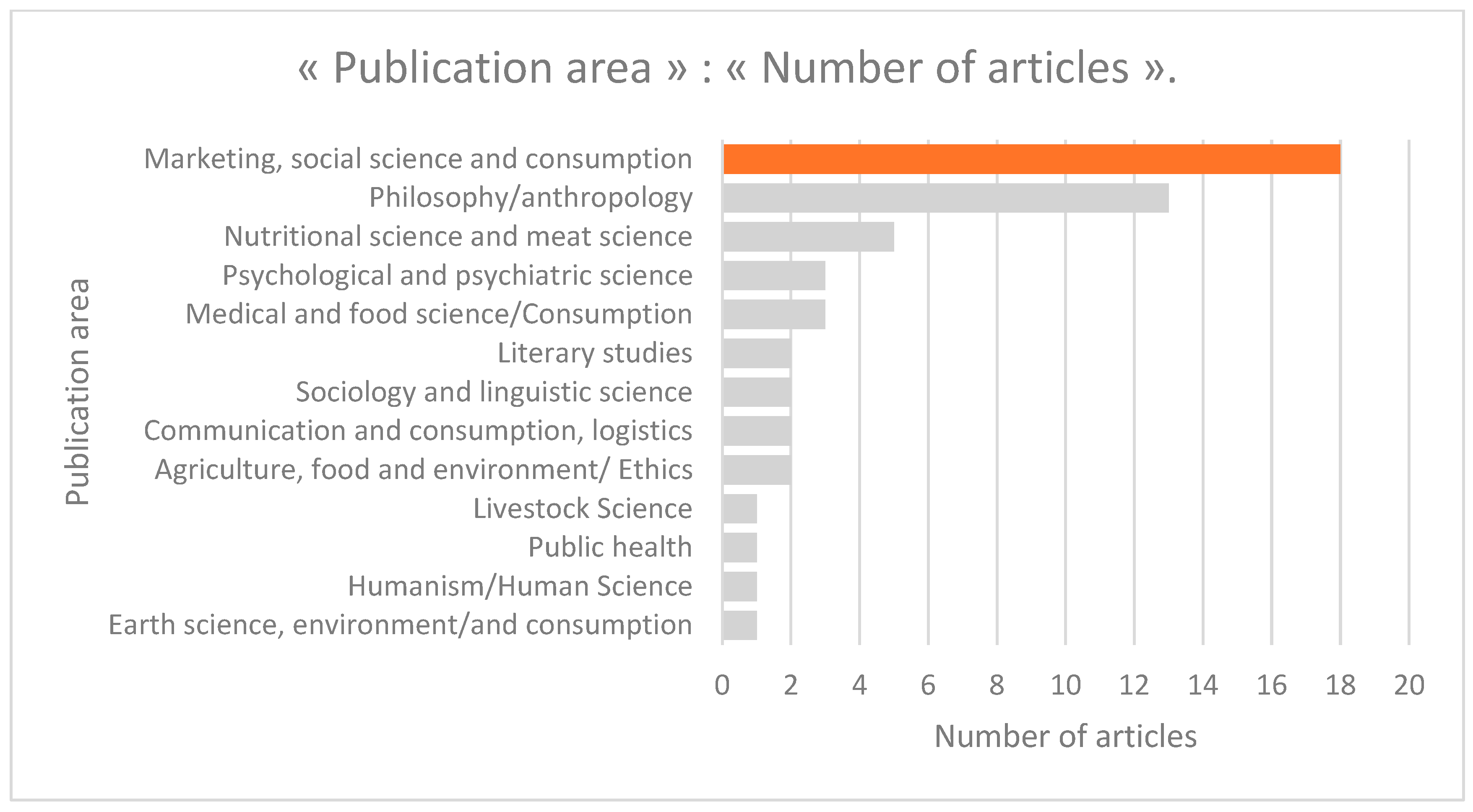
4.1. Results of the Descriptive Analysis (Profile of the Analyzed Articles)
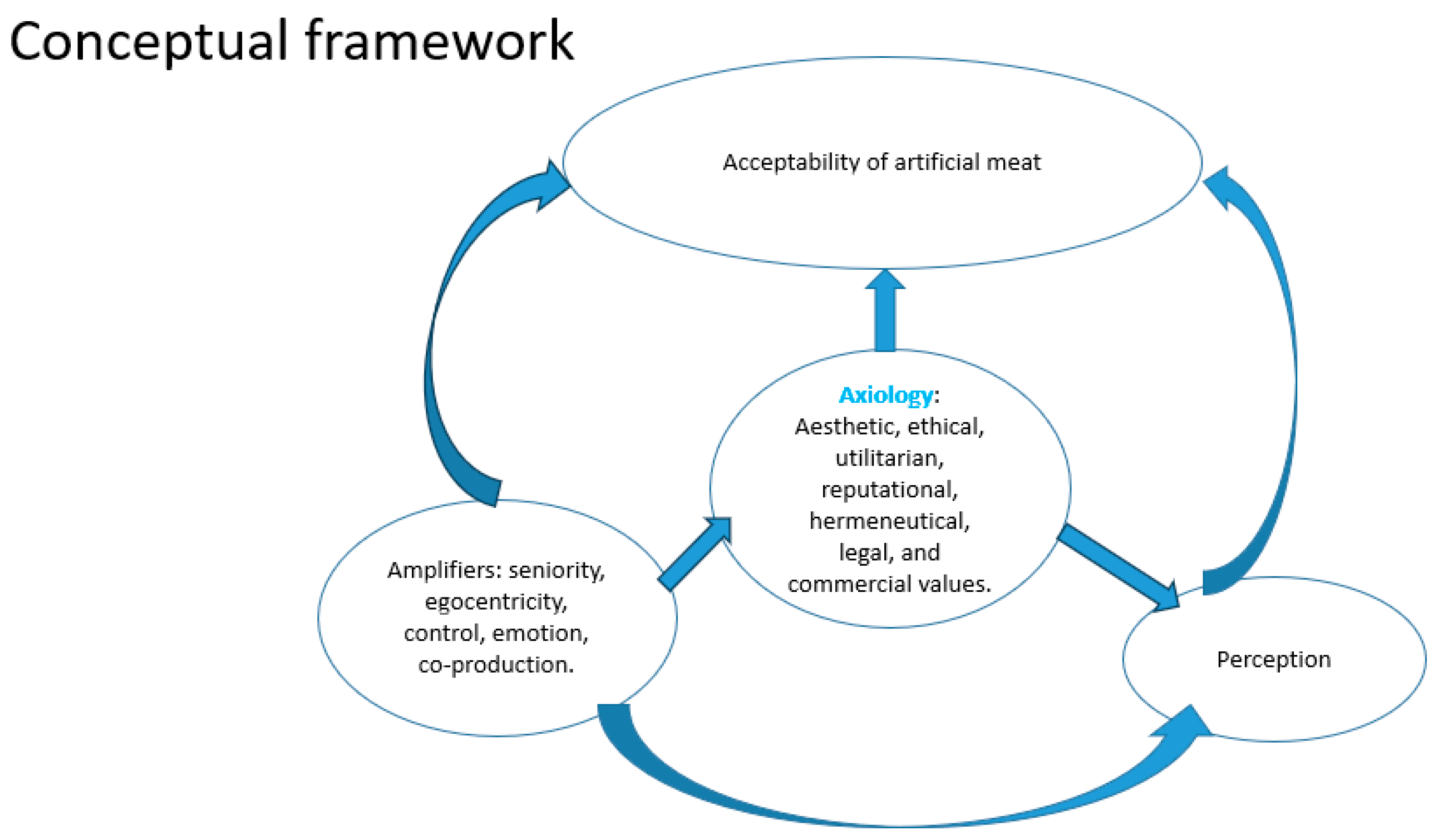
4.2. Register of Axiological Values of Cultured Meat
4.2.1. Aesthetic or Intrinsic Value
4.2.2. Ethical or Extrinsic Values
4.2.3. The Utilitarian Value of Cultured Meat
4.2.4. Reputational Values/Stakeholders
4.2.5. Hermeneutic Values
4.2.6. Legal Values
4.2.7. The Commercial or Economic Value
4.2.8. The Axiological Value Amplifiers of Cultured Meat
- -
- Egocentric Systems
- -
- Control Issues
- -
- Emotions
- -
- The notion of novelty or seniority
- -
- The co-production of value
5. Discussion
6. Research Avenues

| In 2015 |
| Hocquette et al. [97] suggested that a potential research direction would be to better understand the long-term diversity of consumer opinions regarding the acceptability of artificial meat. Verbeke et al. [19], for their part, recommended continuing studies on personal and environmental determinants, particularly personal motivations and the effects of information that may shape perceptions, expectations, and the likelihood of consumer acceptance or rejection of cultured meat. These authors also advocate examining the influence of beliefs, ethnicity, acculturation, or specific perceptions on the acceptance of artificial meat. Furthermore, Laestadius [72] proposed new comparative research on the acceptability of cultured meat relative to other meat alternatives, as well as additional studies on consumer perceptions of cultured meat, focusing on the establishment of a public dialogue regarding cultured meat. |
| In 2019 |
| The work of Bryant et al. [31] suggested that each country should explore consumer acceptance of plant-based and cultured meat, given that most surveys differ in question wording, response options, and terminology. They recommend conducting studies on the role of regulations in individuals’ judgments regarding food safety. For their part, Mancini and Antonioli [68] suggest the need to better understand whether a positive perception predicts a willingness to try or purchase cultured meat. They also recommend analyzing consumer perceptions and expectations, particularly in countries where culture, tradition, and/or religion might hinder the acceptance of cultured meat. |
| In 2020 |
| According to Mancini and Antonioli [69], researchers should conduct studies on the impact of information on consumer acceptance of cultured meat. |
| In 2023 |
| For Kouarfaté and Durif [2], it would be interesting to explore the influence of stakeholders on the acceptance of cultured meat and for Cornelissen and Piqueras-Fiszman [26], future studies should focus on the segmentation factors of these consumers. |
7. Theoretical and Managerial Contributions
8. Limitations of the Research
9. Conclusions
Funding
Institutional Review Board Statement
Informed Consent Statement
Data Availability Statement
Conflicts of Interest
Appendix A
| Author | Publication Date | Full Reference (with DOI, ISBN, …) | Discipline and Sub-Discipline | Research Question | Advanced Theses | Method | Analyzed Empirical Material | Personal Remarks |
|---|---|---|---|---|---|---|---|---|
| Agard, O. | (2009) | Agard, O. (2009). La question de l’humanisme chez Max Scheler. Revue germanique internationale, (10), 163–186. doi: 10.4000/rgi.331 | Philosophy/anthropology | The question of humanism in Max Scheler (understanding man from a phenomenological perspective) | As a real species, humanity is merely one object among other objects, an object in which no (…) | Documentary analysis and criticism | Critique of the works of Max Scheler, on formalism in ethics and the material ethics of values. | Following a phenomenological study, the author strives to understand what may appear to be a paradox. |
| Akem, E. S. And Pemunta, N. V. | (2020) | Akem, E. S. et Pemunta, N. V. (2020). The bat meat chain and perceptions of the risk of contracting Ebola in the Mount Cameroon region. BMC Public Health, 20(1), 593. doi: 10.1186/s12889-020-08460-8 | Health/Public Health | The bat meat supply chain and perceptions of the risk of contracting Ebola in the Mount Cameroon region | This study demonstrates that the complexity and nuances of gender, poverty, and Ebola outcomes predispose certain marginalized groups to the risk of infection by zoonotic diseases. | Qualitative analysis | Cameroun, N = 30 30 individual and ethnographic interviews | Religious and socio-cultural taboos are thought to be the main variables that influence a population’s preference for and consumption of meat. |
| Baddeley, A. D. et Andrade, J. | (2000) | Baddeley, A. D. et Andrade, J. (2000). Working memory and the vividness of imagery. Journal of Experimental Psychology: General, 129(1), 126–145. doi: 10.1037/0096-3445.129.1.126 | Psychology/Experimental Psychology | Working memory and image vividness. Studying the factors that determine the phenomenological vividness of images. | The vividness assessments showed the expected interaction between stimulus modality and concurrent task. | Phenomenological qualitative study based on experimentation | Image-based experiments | In his methodology, the author conducted a well-structured study. |
| Barcellos, V. C., Mottin, C., Prado, R. M. do, Schenkel, T., Viana, C., Vital, A. C. P., Prado, I. N. | (2019) | Barcellos, V. C., Mottin, C., Prado, R. M. do, Schenkel, T., Viana, C., Vital, A. C. P., Prado, I. N. (2019). How the perception of quality for beef evaluated by the buyer at the time of purchase: Study in three Brazilian cities of different sizes—Curitiba, Campo Mourão and Palotina. Acta Scientiarum. Animal Sciences, 41(1), 46533. doi: 10.4025/actascianimsci.v41i1.46533 | Social science (study of consumption) | How does the buyer’s perception of beef quality, as assessed at the time of purchase, affect their perception? | The study results showed that beef buyers are more concerned with extrinsic meat quality indicators than intrinsic indicators and believe that these extrinsic factors positively influence the beef dining experience. | Qualitative study (individual interviews) | Individual interviews conducted in Brazil; N = 519 | This is a large-scale study (individual interviews) conducted in Brazil on a sample of N = 519 |
| Browning, C. J., Qiu, Z., Yang, H., Zhang, T. and Thomas, S. A. | (2019) | Browning, C. J., Qiu, Z., Yang, H., Zhang, T. et Thomas, S. A. (2019). Food, Eating, and Happy Aging: The Perceptions of Older Chinese People. Frontiers in Public Health, 7, 73. doi: 10.3389/fpubh.2019.00073 | Social Science\Marketing and Consumption | Comprendre la perception des consommateurs chinois âgés (Nourriture, manger et bien vieillir: les perceptions des Chinois âgés) | Social and economic life experiences continue to impact the eating and food attitudes and practices of older Chinese people. | Qualitative study | (focus groups and interviews) China, N = 42 (aged 62 to 83 years) | The study is based on a specific age group |
| Bryant, C. J. et Barnett, J. C. | (2019) | Bryant, C. J. et Barnett, J. C. (2019). What’s in a name? Consumer perceptions of in vitro meat under different names. Appetite, 137, 104–113. doi: 10.1016/j.appet.2019.02.021 | Social Sciences\Marketing and Consumption | What’s in a name? Consumer perceptions of in vitro meat under different names | Of the ten or so names initially proposed, the results of this study suggest the use of names such as “clean meat”, “animal-free meat”, “cultured meat” and “artificial meat” | Experimental study | Experiment on the effect of name manipulation on perceptions, USA, N = 185 participants | The study demonstrated the impact of the name on consumer perception. |
| Bryant, C., Szejda, K., Parekh, N., Deshpande, V. and Tse, B. | (2019) | Bryant, C., Szejda, K., Parekh, N., Deshpande, V. et Tse, B. (2019). A Survey of Consumer Perceptions of Plant-Based and Clean Meat in the USA, India, and China. Frontiers in Sustainable Food Systems, 3, 11. doi: 10.3389/fsufs.2019.00011 | Social Sciences\Marketing and Consumption | A survey on consumer perceptions of plant-based meat in the United States, India, and China | For their part, Brayant et al., (2019) emphasized neophobia and believe that it has an effect on artificial meat and its acceptability. | Quantitative studies | (Online survey) China, India and USA (N = 3030) | The study took into account the specific characteristics of several countries and cultures |
| Chriki, S., Ellies-Oury, M.-P., Fournier, D., Liu, J. and Hocquette, J.-F. | (2020) | Chriki, S., Ellies-Oury, M.-P., Fournier, D., Liu, J. et Hocquette, J.-F. (2020). Analysis of Scientific and Press Articles Related to Cultured Meat for a Better Understanding of Its Perception. Frontiers in Psychology, 11, 1845. doi: 10.3389/fpsyg.2020.01845 | Psychology/Consumption and Behavior | Understanding consumer perception related to value addition. | Analysis of scientific and press articles related to cultured meat for a better understanding of its perception. | Qualitative study | Analysis of scientific and press articles (Literature review) | The author highlighted the ethical and aesthetic values. |
| Dankova, N. S.and Dubrovskaya, T. V. | (2018) | Dankova, N. S. et Dubrovskaya, T. V. (2018). Axiology of Bikers’ Group Identity (based on the Internet Communication). Nauchnyy dialog, (7), 53–65. doi: 10.24224/2227-1295-2018-7-53-65 | Social Science\Consumption | The axiology of biker group identity based on internet communication | The authors highlighted the values that govern the identity of a group of motorcyclists: the values of “motorcycle”, “pleasure”, “danger” and “brotherhood”. | Document analysis | Documentary study in russet | The study identified the values of motorcyclists and the amplifiers of these values. |
| Da Silva-Charrak, C. | (2005) | Clara, D. S.-C. (2005). Merleau-Ponty. Le corps et le sens. | Philosophy/anthropology | Explain and critique Merleau-Ponty’s work on the phenomenology of perception | Analysis of Merleau-Ponty’s works | Qualitative studies | Analysis and critique of literature | The author has provided a good interpretation of Merleau-Ponty’s studies on the phenomenology of perception. |
| Dibsdall, L. A., Lambert, N. and Frewer, L. J. | (2002) | Dibsdall, L. A., Lambert, N. et Frewer, L. J. (2002). Using Interpretative Phenomenology to Understand the Food-Related Experiences and Beliefs of a Select Group of Low-Income UK Women. Journal of Nutrition Education and Behavior, 34(6), 298–309. doi: 10.1016/S1499-4046(06)60112-7 | Social science\consumer behavior | Using interpretive phenomenology to understand the food-related experiences and beliefs of a small group of low-income British women | The results of their studies showed that all the identified themes are grouped into three themes, which appeared to govern women’s attitudes and behaviors regarding food choices and health. | In-depth qualitative study | Semi-structured interviews | The study, conducted in the United Kingdom, only involved a group of 14 women (aged 40 to 60). |
| Dreyfus, H. L | (1999) | Dreyfus, H. L. (1999). The Primacy of Phenomenology over Logical Analysis. Philosophical Topics, 27(2), 3–24. | Philosophy/anthropology | The primacy of phenomenology over logical analysis. | Phenomenology offers a new perspective in scientific practices by finding its legitimacy outside of contemporary research practices. | Qualitative study | Documentary review | The authors presented the methodology of a phenomenology |
| Dupond, P. | (2007) | Dupond, Pascal. (2007). Dictionnaire Merleau-Ponty. Paris: Ellipses. Récupéré de http://catalogue.bnf.fr/ark:/12148/cb41178301b | Philosophy/anthropology | Phenomenology of perception | The author shows that Merleau-Ponty provides a broad overview of the advances and dead ends of phenomenology and defines three levels of phenomenological analysis. | Qualitative study | Documentary review | This is an analysis of the thought and works of Merleau-Ponty |
| Edwards, S. | (2013) | Edwards, S. (2013). Living in a Minority Food Culture: A Phenomenological Investigation of Being Vegetarian/Vegan. Phenomenology & Practice, 7(1), 111–125. doi: 10.29173/pandpr20106 | Social Science/Marketing and Social Consumption | Living in a minority food culture: a phenomenological inquiry into being vegetarian/vegan. | Edwards (2013) highlights the themes based on the use of “inside versus outside” descriptions. | Qualitative (exploratory) study | Exploratory phenomenological study | The study is based on a small sample in the USA (N = 2 vegetarian women and the author’s experience) |
| Fleischer, H. | (1968) | Fleischer, H. (1968). Marxismus und axiologie. The Journal of Value Inquiry, 2(4), 249–268. doi: 10.1007/BF00135942 | Philosophy/anthropology | The importance of an axiological study and the notion of value | To develop a philosophical axiology and articulate the meaning of socialism in axiological terms | Qualitative study | Exploratory axiological study | The author developed the axiological notion |
| Heinich, N. | (2012) | Heinich, N. (2012). Les émotions patrimoniales: de l’affect a l’axiologie: les émotions patrimoniales. Social Anthropology, 20(1), 19–33. doi: 10.1111/j.1469-8676.2011.00187.x | Social science/Anthropology | From affect to axiology: heritage emotions | Regarding heritage objects, Heinich (2012) demonstrated that consumers’ emotional connection to these objects constitutes a part of their axiology. For him, this emotional value or “affect” reveals shared values. | Qualitative study | Literature review | This concerns heritage-related emotions: from affect to axiology |
| Hok-Eng Tan, F | (2013) | Hok-Eng Tan, F. (2013). Flavours of Thought: Towards A Phenomenology of Food-Related Experiences. Interdisciplinary Description of Complex Systems, 11(4), 400–414. doi: 10.7906/indecs.11.4.5 | Social science/interdisciplinary | Flavors of Thought: Towards a Phenomenology of Food Experiences | The author believes that this type of study is in the ongoing struggle to claim its rightful place in contemporary research and that the relevance of this study lies in the way interdisciplinary investigations of the brain and mind are carried out. | Qualitative study | Qualitative Phenomenological Study | The author presents the methodology of an axiological study |
| Hubeny, A. | (2004) | Hubeny, A. (2004). Le sens de l’histoire dans la philosophie de Merleau-Ponty. École pratique des hautes études, Section des sciences religieuses, 117(113), 415–420. doi: 10.3406/ephe.2004.12396 | Philosophy and religious studies | The meaning of history in the philosophy of Merleau-Ponty. | This phenomenology suggests three levels: the role of physical attributes, the process of skills acquisition, and finally the links between the body and acquired cultural skills. | Qualitative study | Qualitative Phenomenological Study | The author presents Merleau-Ponty’s impact on the history of philosophy. |
| Joy, A. | (1994) | Joy, A. (1994). Postmodernism, feminism, and the body: The visible and the invisible in consumer research. International Journal of Research in Marketing—INT J RES MARK, 11, 333–357. doi: 10.1016/0167-8116(94)90011-6 | Marketing/Consumption | Postmodernism, feminism, and the body: the visible and the invisible in the pursuit of consumption | The study shed light on the existing consumer literature on embodiment. The author distinguishes between two levels of consciousness: the conscious, or phenomenological, level, and the unconscious cognitive level. | Experiences | Integrated experiences: a selection review of consumer literature | The author distinguishes between two levels of consciousness: the conscious, or phenomenological, level, and the unconscious cognitive level. |
| Joy, A. and Sherry, Jr., John F. | (2003) | Joy, A. et Sherry, Jr., John F. (2003). Speaking of Art as Embodied Imagination: A Multisensory Approach to Understanding Aesthetic Experience. Journal of Consumer Research, 30(2), 259–282. doi: 10.1086/376802 | Marketing/Consumption | Discussing art as embodied imagination: a multisensory approach to understanding the aesthetic experience | According to these authors, embodiment, movement, and multi-sensory experience are concepts that help to clarify the contours of art appreciation in a museum. | Experiences | Phenomenological Experience and Axiology | Analysis of the consumption histories of 30 museum visitors to understand their behavior |
| Laestadius, L. I. | (2015) | Laestadius, L. I. (2015). Public Perceptions of the Ethics of In vitro Meat: Determining an Appropriate Course of Action. Journal of Agricultural and Environmental Ethics, 28(5), 991–1009. doi: 10.1007/s10806-015-9573-8 | Agriculture and the environment/Ethics | Public perceptions of the ethics of in vitro meat: determining an appropriate action plan | According to Laestadius (2015), it is the ethical value that encompasses aspects of socially responsible, ecologically sustainable, healthy, and fair food that would have an impact on the perception of artificial meat. | Qualitative study (nethnography) | a Comment analysis: blog comments. | Study conducted based on blog comments. |
| Laestadius, L. I. and Caldwell, M. A. | (2015) | Laestadius, L. I. et Caldwell, M. A. (2015). Is the future of meat palatable? Perceptions of in vitro meat as evidenced by online news comments. Public Health Nutrition, 18(13), 2457–2467. doi: 10.1017/S1368980015000622 | Social Science/Public Health | Is the future of meat acceptable? Perceptions of in vitro meat as evidenced by online comments | The main themes in commentators’ perceptions of IVM included its benefits for the environment and public health, but also negative themes such as IVM’s status as an unnatural and unappealing food. | Qualitative analysis | Nethnography (Qualitative analysis of online content) | The authors’ work has highlighted the values and amplifiers of artificial meat. |
| Mancini, M. C. and Antonioli, F. | (2020) | Mancini, M. C. et Antonioli, F. (2020). To What Extent are consumers’ Perception and Acceptance of Alternative Meat Production Systems Affected by Information? The Case of Cultured Meat. Animals, 10(4), 656. doi: 10.3390/ani10040656 | Marketing/Culture and Consumption | To what extent are consumer perceptions and acceptances of alternative meat production systems affected by information? The case of cultured meat | Mancini and Antonioli (2020) demonstrated that consumer perception or acceptance of a product like artificial meat is affected by the information made available to them about that product. | Quantitative study | Online survey using questionnaires and measurement scales | The reliability of the measurement scale has not been demonstrated. |
| Marion, G. | (2016) | Marion, G. (2016). Le consommateur coproducteur de valeur. EMS Editions. doi: 10.3917/ems.mario.2016.01 | Sociology of Consumption | Is the consumer a co-producer of value? | Le consommateur coproducteur de valeur: l’axiologie de la consommation. La coproduction apporte une valeur surtout d’usage au produit. | Document analysis | Literary Review | Co-production as an amplifier |
| Merleau-Ponty, M. | (2013) | Merleau-Ponty, M. (2013). Phenomenology of perception (C. Smith, trad.). London: Routledge. | Philosophy/anthropology | Phenomenology of perception | Merleau-Ponty provides a broad overview of the advances and dead ends of phenomenology and defines three levels of phenomenological analysis | The author’s thoughts are based on personal analysis. | Literary Review | The author highlights three levels of phenomenological analysis |
| Merleau-Ponty, M. | (1969) | Merleau-Ponty, M. (1969). Phénoménologie de la perception. Paris: Gallimard. | Philosophy/anthropology | La phénoménologie existentielle | This phenomenology suggests three levels: the role of physical attributes, the process of skills acquisition, and finally the links between the body and acquired cultural skills. | The author’s thoughts are based on personal analysis. | Literary Review | The author’s existential phenomenology constitutes a relevant research method |
| Nietzsche, F. W. | (2009) | Nietzsche, F. W. (2009). Friedrich Wilhelm Nietzsche 1844–1900: a Lou Andreas-Salomé. Litoral, (248), 132–132. | Philosophy/anthropology | The two parts of axiology allow us to highlight the values that are different from each other, but common to the same object of research. | Nietzsche’s work (1961 and 2009) on the genealogy of morality and that of Max Scheler (1999) (cited by Agard, 2009) have shown that axiology “must be considered as a search to establish a hierarchy between the values” of an object of study, thus arguing that it could be composed of two parts, namely ethics and aesthetics. | The author’s thoughts are based on personal analysis. | Literary Review | Highlight the hierarchy of axiological values |
| Ningtyias, F. W. and Kurrohman, T. | (2020) | Ningtyias, F. W. et Kurrohman, T. (2020). Food taboos and recommended foods for pregnant women: the study of phenomenology in pendhalungan society. IOP Conference Series: Earth and Environmental Science, 485, 012149. doi: 10.1088/1755-1315/485/1/012149 | Earth and environmental science/social science and consumption | Food taboos and recommended foods for pregnant women: a phenomenological study in Pendhalungan society | The main concerns regarding food are invisible toxic contaminations that could lead to changes in behavior or experiences with food. | Mixed methods (qualitative and quantitative study) | (Survey and focus group) | Study based on a specific group (Indonesia; N = 11 pregnant women aged 18 to 36 years) |
| Perelman, C. | (1954) | Perelman, Ch. (1954). Introduction au colloque sur la théorie de la preuve. Revue Internationale de Philosophie, 8(27/28 (1/2)), 5–6. | Philosophy/sociology | Virtuality and the theory of perception in Bergson | The importance of the role of the notion of “virtual” in the theory of “pure perception” presented in the first chapter of Matter and Memory. | Experience | Experimental Phenomenological Study | This theory successively introduces the concepts of “virtual perception”, “virtual action”, and “virtual image”. |
| Petracci, M., Soglia, F., Madruga, M., Carvalho, L., Ida, E. and Estévez, M. | (2019) | Petracci, M., Soglia, F., Madruga, M., Carvalho, L., Ida, E. et Estévez, M. (2019). Wooden-Breast, White Striping, and Spaghetti Meat: Causes, Consequences and Consumer Perception of Emerging Broiler Meat Abnormalities: Emerging broiler meat abnormalities…. Comprehensive Reviews in Food Science and Food Safety, 18(2), 565–583. doi: 10.1111/1541-4337.12431 | Food science and safety/Consumption | Wooden breast, white stripes and spaghetti meat: causes, consequences and consumer perception of emerging abnormalities in broiler chicken meat. | Consumers are aware of the occurrence of abnormalities and concerns about animal welfare, and thus they demand efforts to inhibit the onset of myopathies or mitigate the severity of symptoms. | Qualitative study | Document analysis | Consequences and consumer perception of food anomalies. This is a phenomenological methodology. |
| Robert, F. | (2002) | Robert, F. (2002). Phénoménologie et ontologie, Merleau-Ponty lecteur de Husserl et Heidegger. | Philosophy/sociology | Phenomenology and ontology, Merleau-Ponty as a reader of Husserl and Heidegger. | Confirming the existence of Merleau-Ponty’s three levels of phenomenological analysis | Critical analysis | Re-reading the works of Merleau-Ponty | The author also emphasizes the ontology of a phenomenological study |
| Ruzgys, S. and Pickering, G. J. | (2020) | Ruzgys, S. et Pickering, G. J. (2020). Perceptions of Cultured Meat Among Youth and Messaging Strategies. Frontiers in Sustainable Food Systems, 4, 122. doi: 10.3389/fsufs.2020.00122 | Social science and consumption | Perceptions of cultured meat among young people and messaging strategies. Boundaries of sustainable food systems | Ruzgys et al. (2020) showed that information impacts consumer perception of cultured meat and that this perception also influences ethical (ecological, animal welfare, and environmental concerns) and aesthetic values, which in turn influence both the perception and the acceptability of cultured meat. | Mixed method. | Surveys with questionnaires and Nethnography | The author highlights the different values of artificial meat |
| Rykała, E. A. and Żołnierczuk, M. | (2017) | Rykała, E. A. et Żołnierczuk, M. (2017). Axiology of Communication Space and Contemporary Trends of Design of a Transport Hub. Journal of Transport & Health, 5, S112. doi: 10.1016/j.jth.2017.05.275 | Communication and consumption, logistics | Axiology of communication space and contemporary trends in the design of a transport hub. | In this axiological study, they focused primarily on the aesthetic values of three transport hubs, highlighting the character of these places without emphasizing ethical value. | Experimental study | Information manipulation | A small sample in Poland, N = 3 transport hubs were chosen: Kalvina Square, Széll Kálmán Square and Károly Boulevard |
| Steinfeld, H., Gerber, P., Wassenaar, T. D., Castel, V., Rosales M., M. and Haan, C. d. | (2006) | Steinfeld, H., Gerber, P., Wassenaar, T. D., Castel, V., Rosales M., M. et Haan, C. de. (2006). Livestock’s long shadow: environmental issues and options. Rome: Food and Agriculture Organization of the United Nations. | Agriculture and food/environment | The long shadow of livestock farming: environmental problems and options. | Livestock farming generates a lot of CO2 and constitutes an environmental problem. | Mixed method. | (processual study and qualitative analysis) | The author has managed to roughly quantify the CO2 emissions from livestock farming. |
| Teklebrhan, T. | (2020) | Teklebrhan, T. (2020). consumer perceptions and preferences of meat types in harar and haramaya towns, ethiopia. Journal of Microbiology, Biotechnology and Food Sciences, 2020, 959–969. | Social science\consumption | Consumer perceptions and preferences regarding meat types in the cities of Harar and Hararaya, Ethiopia | Tsegay Teklebrhan (2012) suggests that religious and sociocultural taboos are the main variables influencing meat preference and consumption within a population. | Quantitative study | Surveys with questionnaires | The author also highlights the factors that influence the axiological values of the VA |
| Thompson, C. J., Locander, W. B. and Pollio, H. R. | (1989) | Thompson, C. J., Locander, W. B. et Pollio, H. R. (1989). Putting Consumer Experience Back into Consumer Research: The Philosophy and Method of Existential-Phenomenology. Journal of Consumer Research, 16(2), 133. doi: 10.1086/209203 | Philosophy/Marketing/Consumption | Putting the consumer experience back into consumer research: the philosophy and method of existential phenomenology. | An epistemological analysis reveals that existential phenomenology can provide an empirically and methodologically rigorous understanding of consumption phenomena (Thompson et al., 1989) | Qualitative study | Document analysis | The author proposes a phenomenological methodology in consumption |
| Tiggemann, M. and Kemps, E. | (2005) | Tiggemann, M. et Kemps, E. (2005). The phenomenology of food cravings: The role of mental imagery. Appetite, 45(3), 305–313. doi: 10.1016/j.appet.2005.06.004 | Consumption/social science/marketing | The phenomenology of food cravings: the role of mental imagery. Appetite | It was found that mental imagery was a key element in both the retrospective experience of craving and current food induction. In particular, the intensity of craving was related to the vividness of the food image (r = 0.46). | Experimentation | Use of mental imagery | The phenomenology of cravings: the role of mental imagery |
| Van Vliet, M. | (2017) | Van Vliet, M. (2017). Phénoménologie de la perception et anthropologie de l’homme en mouvement: L’incorporation du sens de Cassirer à Ingold. Anthropologie et Sociétés, 40(3), 37–57. doi: 10.7202/1038633ar | Philosophy/anthropology/consumption | Phenomenology of Perception and Anthropology of Man in Motion: The Incorporation of Meaning from Cassirer to Ingold | The anthropology and phenomenology of art become decisive, because art plays a revealing role in the paradigms at work to bring about this articulation. | Experimentation | Use of imaging | The author emphasizes the aesthetic values of art objects. |
| Verbeeck-Boutin, M. | (2009) | Verbeeck-Boutin, M. (2009). De l’axiologie: Pour une théorie des valeurs appliquée à la conservation-restauration. CeROArt, (4). doi: 10.4000/ceroart.1298 | Philosophy/Anthropology/Museology/Consumption | Axiology. Ceroart: conservation, exhibition, restoration of works of art | Verbeeck-Boutin (2009) studied the notion of systematic axiology and concluded that understanding the subjectivity of values is considered a path towards objectivity. | Case study | Axiological analysis | The author emphasizes the importance of axiological analysis in the consumption of art objects. |
| Verbeke, W., Marcu, A., Rutsaert, P., Gaspar, R., Seibt, B., Fletcher, D. and Barnett, J. | (2015) | Verbeke, W., Marcu, A., Rutsaert, P., Gaspar, R., Seibt, B., Fletcher, D. et Barnett, J. (2015). ‘Would you eat cultured meat?’: Consumers’ reactions and attitude formation in Belgium, Portugal and the United Kingdom. Meat Science, 102, 49–58. doi: 10.1016/j.meatsci.2014.11.013 | Meat Science (Science de Gestion) | Do you want to eat cultured meat? Consumer reactions and attitude formation in Belgium, Portugal and the United Kingdom | The set of factors that influence consumer attitudes: disgust, considerations of unnaturalness, societal, global, environmental and global food security benefits, food traditions and rural livelihoods. | Qualitative study | analysis of online group discussions. | The authors highlight the axiological values of artificial meat as well as their amplifiers. |
| Pavel, T. | (2020) | Pavel, T. (2020). Corrigendum to: L’Écriture vive: Woolf, Sarraute, une autre phénoménologie de la perception. Par Naomi Toth. French Studies, 74(1), 167. https://doi.org/10.1093/fs/knz233 | French Studies | Corrigendum to: L’Écriture vive: Woolf, Sarraute, une autre phénoménologie de la perception. Par Naomi Toth | Explore the link between the writing of Virginia Woolf and Nathalie Sarraute through the phenomenology of perception, comparing philosophical thought with the literary approach. | Qualitative study | Document analysis | Explore the link between the writing of Virginia Woolf and Nathalie Sarraute through the phenomenology of perception, comparing philosophical thought with the literary approach. |
| Heinich, N | (2021) | Heinich, N. (2021). Axiologie de la franc-maçonnerie. Humanisme, 333(4), 80. https://doi.org/10.3917/huma.333.0080 | Humanism (Human Science) | Axiology of Freemasonry | Critical analysis of the phenomenology of perception of the Freemasonry network | Qualitative study | Phenomenological Qualitative Study | Critical analysis of the phenomenology of perception of the Freemasonry network |
| Leite, T. | (2024) | Leite, T. (2024). Thématisme et axiologie: Bergson, Ruyer. Bergsoniana, 5. https://doi.org/10.4000/12b4d | Bergsoniana (literature) | Thematism and axiology: Bergson, Ruyer | Instinctive behavior is not necessarily mechanical. | Document analysis | Document analysis | Taking up Bergson’s thesis, Ruyer considers that animal behavior is therefore not simply a precisely and blindly chained mechanism; instinct is creation and guidance in relation to themes that “overlook” activities. |
| Nicklas, T. | (2023) | Nicklas, T. (2023). “La démocratie uniquement pour les démocrates!”. L’axiologie de la politique républicaine selon Wilhelm Hoegner. Revue d’Allemagne et Des Pays de Langue Allemande, 55, 185–197. https://doi.org/10.4000/allemagne.3585 | Review of Germany and German-Speaking Countries | “Democracy only for democrats!” The axiology of republican politics according to Wilhelm Hoegner. | To contribute to the establishment of an “improved democracy”, drawing lessons from the shortcomings of the Weimar Republic. | Document analysis | Axiological analysis in biographical form | Analysis of political errors to contribute to the establishment of an “improved democracy”, drawing lessons from the flaws of the Weimar Republic. |
| Rahmanifar, F. | (2025) | Farhad Rahmanifar. (2025). Impact of Awareness on Attitudes and Behaviors Toward Cultured Meat: A Study of Demographic, Knowledge, and Perception Factors. West Kazakhstan Medical Journal, 67(1). https://doi.org/10.18502/wkmj.v67i1.17043 | West Kazakhstan Medical Journal | Impact of Awareness on Attitudes and Behaviors Toward Cultured Meat | Raising awareness has an impact on attitudes and behaviors towards cultured meat. | Quantitative analysis | Cross-sectional survey n = 71 | These results suggest that targeted educational actions and transparent communication could improve the acceptance of cultured meat. |
| Cornelissen, K., & Piqueras-Fiszman, B. | (2023) | Cornelissen, K., & Piqueras-Fiszman, B. (2023). Consumers’ perception of cultured meat relative to other meat alternatives and meat itself: A segmentation study. Journal of Food Science, 88(S1), A91–A105. https://doi.org/10.1111/1750-3841.16372 | Journal of Food Science | Consumers’ perception of cultured meat relative to other meat alternatives and meat itself: A segmentation study. | Consumers’ perception of cultured meat relative to other meat alternatives and meat itself | Quantitative analysis | Segmentation n = 288 | The results suggest that health, sustainability, and respect for animal welfare are factors that generate the most willingness to consume (WTC). |
| Gousset, C., Gregorio, E., Marais, B., Rusalen, A., Chriki, S., Hocquette, J.-F., & Ellies-Oury, M.-P. | (2022) | Gousset, C., Gregorio, E., Marais, B., Rusalen, A., Chriki, S., Hocquette, J.-F., & Ellies-Oury, M.-P. (2022). Perception of cultured “meat” by French consumers according to their diet. Livestock Science, 260. https://doi.org/10.1016/j.livsci.2022.104909 | Livestock Science | Perception of cultured “meat” by French consumers according to their diet | The public with varied diets in order to analyze consumer perceptions regarding cultured meat. | Qualitative analysis | Individual interviews N = 118 | Regular meat consumers are more favorable to this product than vegetarians and vegans, whose convictions prevent them from tasting artificial “meat”. |
| Hanan, F., Karim, S., Aziz, Y., Ishak, F., & Sumarjan, N | (2024) | Hanan, F., Karim, S., Aziz, Y., Ishak, F., & Sumarjan, N. (2024). Consumer’s Cultured Meat Perception and Acceptance Determinants: A Systematic Review and Future Research Agenda. International Journal of Consumer Studies, 48(5). https://doi.org/10.1111/ijcs.13088 | International Journal of Consumer Studies | Consumer’s Cultured Meat Perception and Acceptance Determinants: A Systematic Review and Future Research Agenda | What are the factors influencing the adoption of cultured meat? | Qualitative analysis | A Systematic Review | The influencing factors are: (i) attitudes and characteristics, (ii) situational impact, (iii) information and nomenclature, (iv) VC properties, (v) perception of the benefit-risk ratio, (vi) familiarity and awareness, and (vii) competition with other alternative proteins. |
| Kombolo Ngah, M., Chriki, S., Ellies-Oury, M.-P., Liu, J., & Hocquette, J.-F. | (2023) | Kombolo Ngah, M., Chriki, S., Ellies-Oury, M.-P., Liu, J., & Hocquette, J.-F. (2023). Consumer perception of “artificial meat” in the educated young and urban population of Africa. Frontiers in Nutrition, 10, 1127655. https://doi.org/10.3389/fnut.2023.1127655 | Frontiers in Nutrition | Consumer perception of “artificial meat” in the educated young and urban population of Africa. | The wealthiest and most educated countries in Africa are more inclined to try “artificial meat”. | Quantitative analysis | Survey N = 12,000 | Significant differences in responses according to country of origin, age and education level of respondents, as well as interactions between these factors regarding willingness to try. |
| Ciobanu, M.-M., Flocea, E.-I., & Boișteanu, P.-C. | (2024) | Ciobanu, M.-M., Flocea, E.-I., & Boișteanu, P.-C. (2024). The Impact of Artificial and Natural Additives in Meat Products on Neurocognitive Food Perception: A Narrative Review. Foods (Basel, Switzerland), 13(23). https://doi.org/10.3390/foods13233908 | Foods | Artificial and Natural Additives in Meat Products on Neurocognitive Food Perception: A Narrative Review. | Shedding light on the impact of artificial and natural additives in meat products on the neurocognitive perception of food | Qualitative analysis | A Narrative Review | The analysis confirms that neurocognitive perception integrates organoleptic sensations to form a complete sensory experience. |
| Weiss, B. | (2025) | Weiss, B. (2025). Wine and fire: a phenomenology of commensality and saturation. Food, Culture & Society, 1–20. https://doi.org/10.1080/15528014.2025.2583825 | Food, Culture & Society | How various qualities materialize in wines and how this process of materialization can be appreciated in very different social contexts and meanings. | Each wine quality has a specific effect linked to the social context of consumption. | Qualitative analysis | A Narrative Review | Each wine quality has a specific effect linked to the social context of consumption. |
| Ifland, J., & Brewerton, T. D. | (2025) | Ifland, J., & Brewerton, T. D. (2025). Binge-type eating disorders and ultra-processed food addiction: phenomenology, pathophysiology and treatment implications. Frontiers in Psychiatry, 16, 1584891. https://doi.org/10.3389/fpsyt.2025.1584891 | Frontiers in Psychiatry | To gather data showing that the characteristics of ED, common to bulimic-type ED and AAT, overlap in many cases, and to examine the impact of these observations on treatment protocols. | To gather data showing that the characteristics of ED, common to bulimic-type ED and AAT, overlap in many cases, and to examine the impact of these observations on treatment protocols. | Quantitative analysis | Document analysis. | The data showing that the characteristics of the TCA, common to bulimic-type TCAs and AAT, overlap in many cases, and to examine the impact of these observations on treatment protocols. |
| Golev, N. | (2023) | Golev, N. (2023). Cognitive and Communicative Axiology of Modern Virtual Pedagogical Communication: Notes for Discussion. Virtual Communication and Social Networks, 2023(4), 204–214. https://doi.org/10.21603/2782-4799-2023-2-4-204-214 | Virtual Communication and Social Networks. | Cognitive and Communicative Axiology of Modern Virtual Pedagogical Communication: Notes for Discussion. | Promote a more informed approach by deconstructing critical or negative attitudes towards virtual pedagogy and the role of social networks in this field. | Qualitative analysis | Document analysis. | The article examines the factors and manifestations of this reluctance on the part of teachers and university staff. |
| Author | Publication Date | Peer-Reviewed |
|---|---|---|
| Agard, O. | (2009) | yes |
| Akem, E. S. et Pemunta, N. V. | (2020) | yes |
| Baddeley, A. D. et Andrade, J. | (2000) | yes |
| Barcellos, V. C., Mottin, C., Prado, R. M. do, Schenkel, T., Viana, C., Vital, A. C. P., Prado, I. N. | (2019) | yes |
| Browning, C. J., Qiu, Z., Yang, H., Zhang, T. et Thomas, S. A. | (2019) | yes |
| Bryant, C. J. et Barnett, J. C. | (2019) | yes |
| Bryant, C., Szejda, K., Parekh, N., Deshpande, V. et Tse, B. | (2019) | yes |
| Chriki, S., Ellies-Oury, M.-P., Fournier, D., Liu, J. et Hocquette, J.-F. | (2020) | yes |
| Dankova, N. S. et Dubrovskaya, T. V. | (2018) | yes |
| Da Silva-Charrak, C. | (2005) | yes |
| Dibsdall, L. A., Lambert, N. et Frewer, L. J. | (2002) | yes |
| Dreyfus, H. L | (1999) | yes |
| Dupond, P. | (2007) | yes |
| Edwards, S. | (2013) | yes |
| Fleischer, H. | (1968) | yes |
| Heinich, N. | (2012) | yes |
| Hok-Eng Tan, F | (2013) | yes |
| Hubeny, A. | (2004) | yes |
| Joy, A. | (1994) | yes |
| Joy, A. et Sherry, Jr., John F. | (2003) | yes |
| Laestadius, L. I. | (2015) | yes |
| Laestadius, L. I. et Caldwell, M. A. | (2015) | yes |
| Mancini, M. C. et Antonioli, F. | (2020) | yes |
| Marion, G. | (2016) | yes |
| Merleau-Ponty, M. | (2013) | yes |
| Merleau-Ponty, M. | (1969) | yes |
| Nietzsche, F. W. | (2009) | yes |
| Ningtyias, F. W. et Kurrohman, T. | (2020) | yes |
| Perelman, C. | (1954) | yes |
| Petracci, M., Soglia, F., Madruga, M., Carvalho, L., Ida, E. et Estévez, M. | (2019) | yes |
| Robert, F. | (2002) | yes |
| Ruzgys, S. et Pickering, G. J. | (2020) | yes |
| Rykała, E. A. et Żołnierczuk, M. | (2017) | yes |
| Steinfeld, H., Gerber, P., Wassenaar, T. D., Castel, V., Rosales M., M. et Haan, C. d. | (2006) | yes |
| Teklebrhan, T. | (2020) | yes |
| Thompson, C. J., Locander, W. B. et Pollio, H. R. | (1989) | yes |
| Tiggemann, M. et Kemps, E. | (2005) | yes |
| Van Vliet, M. (2017). | (2017) | yes |
| Verbeeck-Boutin, M. | (2009) | yes |
| Verbeke, W., Marcu, A., Rutsaert, P., Gaspar, R., Seibt, B., Fletcher, D. et Barnett, J. | (2015) | yes |
| Pavel, T. | (2020) | yes |
| Heinich, N | (2021) | yes |
| Leite, T. | (2024) | yes |
| Nicklas, T. | (2023) | yes |
| Rahmanifar, F. | (2025) | yes |
| Cornelissen, K., & Piqueras-Fiszman, B. | (2023) | yes |
| Gousset, C., Gregorio, E., Marais, B., Rusalen, A., Chriki, S., Hocquette, J.-F., & Ellies-Oury, M.-P. | (2022) | yes |
| Hanan, F., Karim, S., Aziz, Y., Ishak, F., & Sumarjan, N | (2024) | yes |
| Kombolo Ngah, M., Chriki, S., Ellies-Oury, M.-P., Liu, J., & Hocquette, J.-F. | (2023) | yes |
| Ciobanu, M.-M., Flocea, E.-I., & Boișteanu, P.-C. | (2024) | yes |
| Weiss, B. | (2025) | yes |
| Ifland, J., & Brewerton, T. D. | (2025) | yes |
| Golev, N. | (2023) | yes |
References
- FAO (Ed.) Livestock’s Long Shadow: Environmental Issues and Options; Food and Agriculture Organization of the United Nations: Rome, Italy, 2006; ISBN 978-92-5-105571-7. [Google Scholar]
- Kouarfaté, B.B.; Durif, F.N. A Systematic Review of Determinants of Cultured Meat Adoption: Impacts and Guiding Insights. Br. Food J. 2023, 125, 2737–2763. [Google Scholar] [CrossRef]
- Moritz, M.S.M.; Verbruggen, S.E.L.; Post, M.J. Alternatives for Large-Scale Production of Cultured Beef: A Review. J. Integr. Agric. 2015, 14, 208–216. [Google Scholar] [CrossRef]
- Rahmanifar, F. Impact of Awareness on Attitudes and Behaviors Toward Cultured Meat: A Study of Demographic, Knowledge, and Perception Factors. West Kazakhstan Med. J. 2025, 67, 42–61. [Google Scholar] [CrossRef]
- United Nations Department for Economic and Social Affairs. World Population Prospects 2024: Summary of Results; United Nations: Colombo, Sri Lanka, 2025; ISBN 978-92-1-003169-1. [Google Scholar]
- Böhm, I.; Ferrari, A.; Woll, S. Visions of In Vitro Meat among Experts and Stakeholders. NanoEthics 2018, 12, 211–224. [Google Scholar] [CrossRef]
- Gerber, P.J.; Hristov, A.N.; Henderson, B.; Makkar, H.; Oh, J.; Lee, C.; Meinen, R.; Montes, F.; Ott, T.; Firkins, J.; et al. Technical Options for the Mitigation of Direct Methane and Nitrous Oxide Emissions from Livestock: A Review. Animal 2013, 7, 220–234. [Google Scholar] [CrossRef]
- Thompson, C.J.; Locander, W.B.; Pollio, H.R. Putting Consumer Experience Back into Consumer Research: The Philosophy and Method of Existential-Phenomenology. J. Consum. Res. 1989, 16, 133. [Google Scholar] [CrossRef]
- Hok-Eng Tan, F. Flavours of Thought: Towards A Phenomenology of Food-Related Experiences. Interdiscip. Descr. Complex Syst. 2013, 11, 400–414. [Google Scholar] [CrossRef]
- Pavel, T. L’Écriture Vive: Woolf, Sarraute, Une Autre Phénoménologie de La. Perception. PAR NAOMI TOTH. Fr. Stud. 2017, 71, 604, Corrigendum in Fr. Stud. 2020, 74, 167, 604–605. https://doi.org/10.1093/fs/knz233. [Google Scholar] [CrossRef]
- Edwards, S. Living in a Minority Food Culture: A Phenomenological Investigation of Being Vegetarian/Vegan. Phenomenol. Pract. 2013, 7, 111–125. [Google Scholar] [CrossRef]
- Nicklas, T. La Démocratie Uniquement Pour Les Démocrates! L’axiologie de La Politique Républicaine Selon Wilhelm Hoegner. Allemagne 2023, 55, 185–197. [Google Scholar] [CrossRef]
- Leite, T.R.D.M. Thématisme et Axiologie: Bergson, Ruyer. Bergsoniana 2024, 5. [Google Scholar] [CrossRef]
- Heinich, N. Les Emotions Patrimoniales: De l’affect a l’axiologie: Les Emotions Patrimoniales. Soc. Anthropol. 2012, 20, 19–33. [Google Scholar] [CrossRef]
- Dankova, N.S.; Dubrovskaya, T.V. Axiology of Bikers’ Group Identity (Based on the Internet Communication). Nauchnyi Dialog 2018, 7, 53–65. [Google Scholar] [CrossRef]
- Heinich, N. Axiologie de La Franc-Maçonnerie. Humanisme 2021, 333, 80–84. [Google Scholar] [CrossRef]
- Alvaro, C. Lab-Grown Meat and Veganism: A Virtue-Oriented Perspective. J. Agric. Environ. Ethics 2019, 32, 127–141. [Google Scholar] [CrossRef]
- Kouarfaté, B.B.; Durif, F. Understanding Consumer Attitudes toward Cultured Meat: The Role of Online Media Framing. Sustainability 2023, 15, 16879. [Google Scholar] [CrossRef]
- Verbeke, W.; Marcu, A.; Rutsaert, P.; Gaspar, R.; Seibt, B.; Fletcher, D.; Barnett, J. ‘Would You Eat Cultured Meat?’: Consumers’ Reactions and Attitude Formation in Belgium, Portugal and the United Kingdom. Meat Sci. 2015, 102, 49–58. [Google Scholar] [CrossRef]
- Observatoire de la Consommation Responsable, Baromètre 2020. 2020. Available online: https://ocresponsable.com/barometre-2020/ (accessed on 17 February 2023).
- Bryant, C.J.; Barnett, J.C. What’s in a Name? Consumer Perceptions of in Vitro Meat under Different Names. Appetite 2019, 137, 104–113. [Google Scholar] [CrossRef]
- Kouarfaté, B.B.; Durif, F.; Pantin-Sohier, G. Cultured Meat Consumer Acceptance: Addressing Issues of Eco-Emotions. J. Tour. Serv. 2024, 15, 248–266. [Google Scholar] [CrossRef]
- Pakseresht, A.; Ahmadi Kaliji, S.; Canavari, M. Review of Factors Affecting Consumer Acceptance of Cultured Meat. Appetite 2022, 170, 105829. [Google Scholar] [CrossRef]
- Hanan, F.A.; Karim, S.A.; Aziz, Y.A.; Ishak, F.A.C.; Sumarjan, N. Consumer’s Cultured Meat Perception and Acceptance Determinants: A Systematic Review and Future Research Agenda. Int. J. Consum. Stud. 2024, 48, e13088. [Google Scholar] [CrossRef]
- Deliza, R.; Rodríguez, B.; Reinoso-Carvalho, F.; Lucchese-Cheung, T. Cultured Meat: A Review on Accepting Challenges and Upcoming Possibilities. Curr. Opin. Food Sci. 2023, 52, 101050. [Google Scholar] [CrossRef]
- Cornelissen, K.; Piqueras-Fiszman, B. Consumers’ Perception of Cultured Meat Relative to Other Meat Alternatives and Meat Itself: A Segmentation Study. J. Food Sci. 2023, 88, A91–A105. [Google Scholar] [CrossRef] [PubMed]
- Hwang, J.; You, J.; Moon, J.; Jeong, J. Factors Affecting Consumers’ Alternative Meats Buying Intentions: Plant-Based Meat Alternative and Cultured Meat. Sustainability 2020, 12, 5662. [Google Scholar] [CrossRef]
- Weinrich, R.; Strack, M.; Neugebauer, F. Consumer Acceptance of Cultured Meat in Germany. Meat Sci. 2020, 162, 107924. [Google Scholar] [CrossRef]
- Silva, C.P.D.; Semprebon, E. How about Cultivated Meat? The Effect of Sustainability Appeal, Environmental Awareness and Consumption Context on Consumers’ Intention to Purchase. J. Food Prod. Mark. 2021, 27, 142–156. [Google Scholar] [CrossRef]
- Wilks, M.; Phillips, C.J.C.; Fielding, K.; Hornsey, M.J. Testing Potential Psychological Predictors of Attitudes towards Cultured Meat. Appetite 2019, 136, 137–145. [Google Scholar] [CrossRef]
- Bryant, C.; Szejda, K.; Parekh, N.; Deshpande, V.; Tse, B. A Survey of Consumer Perceptions of Plant-Based and Clean Meat in the USA, India, and China. Front. Sustain. Food Syst. 2019, 3, 11. [Google Scholar] [CrossRef]
- Chong, M.; Leung, A.K.-Y.; Lua, V. A Cross-Country Investigation of Social Image Motivation and Acceptance of Lab-Grown Meat in Singapore and the United States. Appetite 2022, 173, 105990. [Google Scholar] [CrossRef]
- Bekker, G.A.; Fischer, A.R.H.; Tobi, H.; Van Trijp, H.C.M. Explicit and Implicit Attitude toward an Emerging Food Technology: The Case of Cultured Meat. Appetite 2017, 108, 245–254. [Google Scholar] [CrossRef]
- Baum, C.M.; Bröring, S.; Lagerkvist, C.-J. Information, Attitudes, and Consumer Evaluations of Cultivated Meat. Food Qual. Prefer. 2021, 92, 104226. [Google Scholar] [CrossRef]
- Gousset, C.; Gregorio, E.; Marais, B.; Rusalen, A.; Chriki, S.; Hocquette, J.-F.; Ellies-Oury, M.-P. Perception of Cultured “Meat” by French Consumers According to Their Diet. Livest. Sci. 2022, 260, 104909. [Google Scholar] [CrossRef]
- Ciobanu, M.-M.; Flocea, E.-I.; Boișteanu, P.-C. The Impact of Artificial and Natural Additives in Meat Products on Neurocognitive Food Perception: A Narrative Review. Foods 2024, 13, 3908. [Google Scholar] [CrossRef] [PubMed]
- Nietzsche, F.W. Friedrich Wilhelm Nietzsche 1844–1900: A Lou Andreas-Salomé. Litoral 2009, 248, 132. [Google Scholar]
- Agard, O. La question de l’humanisme chez Max Scheler. Rev. Ger. Int. 2009, 10, 163–186. [Google Scholar] [CrossRef]
- Fleischer, H. Marxismus und axiologie. J. Value Inq. 1968, 2, 249–268. [Google Scholar] [CrossRef]
- Verbeeck-Boutin, M. De l’axiologie: Pour Une Théorie Des Valeurs Appliquée à La Conservation-Restauration. CeROArt 2009, 1–9. [Google Scholar] [CrossRef]
- Perelman, C. Introduction Au Colloque Sur La Théorie de La Preuve. Theor. Int. J. Theory Hist. Found. Sci. 1954, 2, 149–150. [Google Scholar]
- Menkhaus, D.J.; Colin, D.P.M.; Whipple, G.D.; Field, R.A. The Effects of Perceived Product Attributes on the Perception of Beef. Agribusiness 1993, 9, 57–63. [Google Scholar] [CrossRef]
- Muatip, K.; Aunurohman, H. Perception of the Purwokerto Society on Meat Product. Anim. Prod. 2007, 9, 67576. [Google Scholar]
- Golev, N. Cognitive and Communicative Axiology of Modern Virtual Pedagogical Communication: Notes for Discussion. Virtual Commun. Soc. Netw. 2023, 2023, 204–214. [Google Scholar] [CrossRef]
- Rykała, E.A.; Żołnierczuk, M. Axiology of Communication Space and Contemporary Trends of Design of a Transport Hub. J. Transp. Health 2017, 5, S112. [Google Scholar] [CrossRef]
- Dibsdall, L.A.; Lambert, N.; Frewer, L.J. Using Interpretative Phenomenology to Understand the Food-Related Experiences and Beliefs of a Select Group of Low-Income UK Women. J. Nutr. Educ. Behav. 2002, 34, 298–309. [Google Scholar] [CrossRef]
- Weiss, B. Wine and Fire: A Phenomenology of Commensality and Saturation. Food Cult. Soc. 2025, 1–20. [Google Scholar] [CrossRef]
- Ifland, J.; Brewerton, T.D. Binge-Type Eating Disorders and Ultra-Processed Food Addiction: Phenomenology, Pathophysiology and Treatment Implications. Front. Psychiatry 2025, 16, 1584891. [Google Scholar] [CrossRef] [PubMed]
- Bachelard, G.; Jolas, M.; Stilgoe, J.R. The Poetics of Space: The Classic Look at How We Experience Intimate Places; Nachdr.; Beacon Press: Boston, MA, USA, 2009; ISBN 978-0-8070-6473-3. [Google Scholar]
- Hyppolite, J. Genèse et Structure de la Phénoménologie de l’Esprit de Hegel; Classiques Garnier Multimedia: Paris, France, 1946. [Google Scholar]
- Ningtyias, F.W.; Kurrohman, T. Food Taboos and Recommended Foods for Pregnant Women: The Study of Phenomenology in Pendhalungan Society. IOP Conf. Ser. Earth Environ. Sci. 2020, 485, 012149. [Google Scholar] [CrossRef]
- Tranfield, D.; Denyer, D.; Smart, P. Towards a Methodology for Developing Evidence-Informed Management Knowledge by Means of Systematic Review. Br. J. Manag. 2003, 14, 207–222. [Google Scholar] [CrossRef]
- St-Amand, A.; Saint-Jacques, M.-C. Comment Faire? Une Méta-Analyse, Méthode Agrégative de Synthèse des Connaissances; Université Laval: Québec, QC, Canada, 2013. [Google Scholar]
- Ji, J.-H.; Lee, S.H. A Systematic Review of Consumer Responses to Meat Alternative Labeling. Appetite 2026, 218, 108375. [Google Scholar] [CrossRef]
- Armat, M.R.; Assarroudi, A.; Rad, M.; Sharifi, H.; Heydari, A. Inductive and Deductive: Ambiguous Labels in Qualitative Content Analysis. Qual. Rep. 2018, 23, 219–221. [Google Scholar] [CrossRef]
- Wendt, M.-C.; Weinrich, R. A Systematic Review of Consumer Studies Applying the Food Technology Neophobia Scale: Lessons and Applications. Food Qual. Prefer. 2023, 106, 104811. [Google Scholar] [CrossRef]
- Flemming, K.; Booth, A.; Garside, R.; Tunçalp, Ö.; Noyes, J. Qualitative Evidence Synthesis for Complex Interventions and Guideline Development: Clarification of the Purpose, Designs and Relevant Methods. BMJ Glob. Health 2019, 4, e000882. [Google Scholar] [CrossRef]
- Braun, V.; Clarke, V. Using Thematic Analysis in Psychology. Qual. Res. Psychol. 2006, 3, 77–101. [Google Scholar] [CrossRef]
- Bearman, M.; Dawson, P. Qualitative Synthesis and Systematic Review in Health Professions Education. Med. Educ. 2013, 47, 252–260. [Google Scholar] [CrossRef] [PubMed]
- Mohamed Shaffril, H.A.; Samsuddin, S.F.; Abu Samah, A. The ABC of Systematic Literature Review: The Basic Methodological Guidance for Beginners. Qual. Quant. 2021, 55, 1319–1346. [Google Scholar] [CrossRef]
- Sobrido Prieto, M.; Rumbo-Prieto, J.M. The Systematic Review: Plurality of Approaches and Methodologies. Enferm. Clín. Engl. Ed. 2018, 28, 387–393. [Google Scholar] [CrossRef]
- Kozinets, R.V. The Field behind the Screen: Using Netnography for Marketing Research in Online Communities. J. Mark. Res. 2002, 39, 61–72. [Google Scholar] [CrossRef]
- Van Vliet, M. Phénoménologie de La Perception et Anthropologie de l’homme En Mouvement: L’incorporation Du Sens de Cassirer à Ingold. Érudit 2017, 40, 37–57. [Google Scholar] [CrossRef]
- Bhat, Z.F.; Morton, J.D.; Mason, S.L.; Bekhit, A.E.A.; Bhat, H.F. Technological, Regulatory, and Ethical Aspects of In Vitro Meat: A Future Slaughter-Free Harvest. Comp. Rev. Food Sci. Food Saf. 2019, 18, 1192–1208. [Google Scholar] [CrossRef]
- Laestadius, L.I.; Caldwell, M.A. Is the Future of Meat Palatable? Perceptions of in Vitro Meat as Evidenced by Online News Comments. Public Health Nutr. 2015, 18, 2457–2467. [Google Scholar] [CrossRef]
- Wilks, M.; Phillips, C.J.C. Attitudes to in Vitro Meat: A Survey of Potential Consumers in the United States. PLoS ONE 2017, 12, e0171904. [Google Scholar] [CrossRef]
- Mancini, M.C.; Antonioli, F. Exploring Consumers’ Attitude towards Cultured Meat in Italy. Meat Sci. 2019, 150, 101–110. [Google Scholar] [CrossRef]
- Mancini, M.C.; Antonioli, F. To What Extent Are Consumers’ Perception and Acceptance of Alternative Meat Production Systems Affected by Information? The Case of Cultured Meat. Animals 2020, 10, 656. [Google Scholar] [CrossRef] [PubMed]
- Tuomisto, H.L.; Teixeira De Mattos, M.J. Environmental Impacts of Cultured Meat Production. Environ. Sci. Technol. 2011, 45, 6117–6123. [Google Scholar] [CrossRef] [PubMed]
- Schaefer, G.O.; Savulescu, J. The Ethics of Producing In Vitro Meat. J. Appl. Philos. 2014, 31, 188–202. [Google Scholar] [CrossRef]
- Laestadius, L.I. Public Perceptions of the Ethics of In-Vitro Meat: Determining an Appropriate Course of Action. J. Agric. Environ. Ethics 2015, 28, 991–1009. [Google Scholar] [CrossRef]
- Donaldson, T.; Preston, L.E. The Stakeholder Theory of the Corporation: Concepts, Evidence, and Implications. Acad. Manag. Rev. 1995, 20, 65. [Google Scholar] [CrossRef]
- Andriof, J.; Waddock, S. Unfolding Stakeholder Engagement. In Unfolding Stakeholder Thinking; Routledge: Oxford, UK, 2017; pp. 19–42. [Google Scholar]
- Pasquero, J. Entreprise, Développement Durable et Théorie Des Parties Prenantes: Esquisse d’un Arrimage Socio-Constructionniste. Manag. Int. 2008, 12, 27–47. [Google Scholar] [CrossRef]
- Siegrist, M.; Sütterlin, B. Importance of Perceived Naturalness for Acceptance of Food Additives and Cultured Meat. Appetite 2017, 113, 320–326. [Google Scholar] [CrossRef]
- Tuorila, H.; Hartmann, C. Consumer Responses to Novel and Unfamiliar Foods. Curr. Opin. Food Sci. 2020, 33, 1–8. [Google Scholar] [CrossRef]
- Bryant, C.; Dillard, C. The Impact of Framing on Acceptance of Cultured Meat. Front. Nutr. 2019, 6, 103. [Google Scholar] [CrossRef]
- Choudhury, D.; Tseng, T.W.; Swartz, E. The Business of Cultured Meat. Trends Biotechnol. 2020, 38, 573–577. [Google Scholar] [CrossRef]
- Choudhury, D.; Tun, H.W.; Wang, T.; Naing, M.W. Organ-Derived Decellularized Extracellular Matrix: A Game Changer for Bioink Manufacturing? Trends Biotechnol. 2018, 36, 787–805. [Google Scholar] [CrossRef]
- Hocquette, J.-F. Is in Vitro Meat the Solution for the Future? Meat Sci. 2016, 120, 167–176. [Google Scholar] [CrossRef] [PubMed]
- Chriki, S.; Ellies-Oury, M.-P.; Fournier, D.; Liu, J.; Hocquette, J.-F. Analysis of Scientific and Press Articles Related to Cultured Meat for a Better Understanding of Its Perception. Front. Psychol. 2020, 11, 1845. [Google Scholar] [CrossRef] [PubMed]
- Ruzgys, S.; Pickering, G.J. Perceptions of Cultured Meat Among Youth and Messaging Strategies. Front. Sustain. Food Syst. 2020, 4, 122. [Google Scholar] [CrossRef]
- Browning, C.J.; Qiu, Z.; Yang, H.; Zhang, T.; Thomas, S.A. Food, Eating, and Happy Aging: The Perceptions of Older Chinese People. Front. Public Health 2019, 7, 73. [Google Scholar] [CrossRef]
- Kombolo Ngah, M.; Chriki, S.; Ellies-Oury, M.-P.; Liu, J.; Hocquette, J.-F. Consumer Perception of “Artificial Meat” in the Educated Young and Urban Population of Africa. Front. Nutr. 2023, 10, 1127655. [Google Scholar] [CrossRef]
- Marion, G. Le Consommateur Coproducteur de Valeur; EMS Editions: Caen, France, 2016; ISBN 978-2-84769-845-9. [Google Scholar]
- Faure, L. Sens et Enjeux d’un Interdit Alimentaire Dans Le Judaïsme: L’exemple de Couples Juifs Ashkénazes à Londres. Anthropol. Food 2010, 7, 1–14. [Google Scholar] [CrossRef]
- Hamdan, M.N.; Post, M.J.; Ramli, M.A.; Mustafa, A.R. Cultured Meat in Islamic Perspective. J. Relig. Health 2018, 57, 2193–2206. [Google Scholar] [CrossRef]
- Shaw, E.; Mac Con Iomaire, M. A Comparative Analysis of the Attitudes of Rural and Urban Consumers towards Cultured Meat. Br. Food J. 2019, 121, 1782–1800. [Google Scholar] [CrossRef]
- Barcellos, V.C.; Mottin, C.; Prado, R.M.D.; Schenkel, T.; Viana, C.; Vital, A.C.P.; Bersot, L.D.S.; Sañudo, C.; Prado, I.N.D. How the Perception of Quality for Beef Evaluated by the Buyer at the Time of Purchase: Study in Three Brazilian Cities of Different Sizes—Curitiba, Campo Mourão and Palotina. Acta Sci. Anim. Sci. 2019, 41, 46533. [Google Scholar] [CrossRef]
- Zerfu, T.A.; Umeta, M.; Baye, K. Dietary Habits, Food Taboos, and Perceptions towards Weight Gain during Pregnancy in Arsi, Rural Central Ethiopia: A Qualitative Cross-Sectional Study. J. Health Popul. Nutr. 2016, 35, 22. [Google Scholar] [CrossRef]
- Busato, M.A.; Pedrolo, C.; Gallina, L.S.; da Rosa, L. Ambiente e Alimentação Saudável: Percepções e Práticas de Estudantes Universitários. Semin. Ciênc. Biol. Saúde 2015, 36, 75–84. [Google Scholar] [CrossRef]
- Teklebrhan, T. Consumer Perceptions and Preferences of Meat Types in Harar and Haramaya Towns, Ethiopia. J. Microbiol. Biotechnol. Food Sci. 2012, 2, 959–969. [Google Scholar]
- Akem, E.S.; Pemunta, N.V. The Bat Meat Chain and Perceptions of the Risk of Contracting Ebola in the Mount Cameroon Region. BMC Public Health 2020, 20, 593. [Google Scholar] [CrossRef]
- Merleau-Ponty, M. Phénoménologie de la Perception; Gallimard: Paris, France, 1969; Volume 216. [Google Scholar]
- Tiggemann, M.; Kemps, E. The Phenomenology of Food Cravings: The Role of Mental Imagery. Appetite 2005, 45, 305–313. [Google Scholar] [CrossRef]
- Dupond, P. Dictionnaire Merleau-Ponty; Dictionnaire; Ellipses: Paris, France, 2007; ISBN 978-2-7298-3372-5. [Google Scholar]
- Hocquette, A.; Lambert, C.; Sinquin, C.; Peterolff, L.; Wagner, Z.; Bonny, S.P.F.; Lebert, A.; Hocquette, J.-F. Educated Consumers Don’t Believe Artificial Meat Is the Solution to the Problems with the Meat Industry. J. Integr. Agric. 2015, 14, 273–284. [Google Scholar] [CrossRef]
- El Yaacoubi, Y.; El Yamani, Z. La coproduction du consommateur et son rôle dans le contenu de la communication de marque. Rev. Int. Sci. Gest. 2019, 2, 134–147. [Google Scholar]


| Integration or Inclusion Criterion | Exclusion Criterion |
|---|---|
|
|
| Keywords | Phenomenology of Perception | Axiology of Consumption | Axiology | Cultured Meat and Perception | Artificial Meat and Perception | In Vitro Meat Perception | Phenomenology and Food | Axiology and Communication |
|---|---|---|---|---|---|---|---|---|
| Exact expression in the title of the articles | 126 | 35 | 67 | 59 | 24 | 9 | 22 | 12 |
| Peer-reviewed papers | 89 | 12 | 32 | 46 | 20 | 7 | 17 | 8 |
| Downloadable articles | 6 | 12 | 32 | 42 | 14 | 7 | 12 | 6 |
| Incomplete articles and elimination of duplicates | 3 | 9 | 8 | 38 | 12 | 7 | 9 | 5 |
| Full text (Articles selected for our analysis) | 3 | 5 | 6 | 19 | 5 | 4 | 7 | 5 |
Disclaimer/Publisher’s Note: The statements, opinions and data contained in all publications are solely those of the individual author(s) and contributor(s) and not of MDPI and/or the editor(s). MDPI and/or the editor(s) disclaim responsibility for any injury to people or property resulting from any ideas, methods, instructions or products referred to in the content. |
© 2025 by the author. Licensee MDPI, Basel, Switzerland. This article is an open access article distributed under the terms and conditions of the Creative Commons Attribution (CC BY) license.
Share and Cite
Kouarfaté, B.B. Axiology of Cultured Meat and Consumer Perception: An Analysis Based on the Phenomenology of Perception. Foods 2026, 15, 34. https://doi.org/10.3390/foods15010034
Kouarfaté BB. Axiology of Cultured Meat and Consumer Perception: An Analysis Based on the Phenomenology of Perception. Foods. 2026; 15(1):34. https://doi.org/10.3390/foods15010034
Chicago/Turabian StyleKouarfaté, Béré Benjamin. 2026. "Axiology of Cultured Meat and Consumer Perception: An Analysis Based on the Phenomenology of Perception" Foods 15, no. 1: 34. https://doi.org/10.3390/foods15010034
APA StyleKouarfaté, B. B. (2026). Axiology of Cultured Meat and Consumer Perception: An Analysis Based on the Phenomenology of Perception. Foods, 15(1), 34. https://doi.org/10.3390/foods15010034